

Using the pure rotational H2 lines we can probe the physical conditions of the warm molecular hydrogen in our sample of Starburst and Seyfert galaxies. As we discussed in Sect. 1, the pure rotational lines originate from the warm (T< 2000 K) gas. In what follows we derive excitation temperatures for the "warm'' molecular hydrogen gas as well as masses and compare them to the total masses of the galaxies, as probed by observations of the various transitions of the CO molecule. We also compare and discuss the global properties of the "warm'' gas in starbursts and Seyferts.
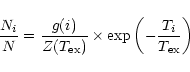
The excitation diagrams in Figs. 3 and 4 show a plot of the
natural logarithm of the column density divided by the statistical
weight in the upper level of each transition against the energy
level. The column density follows from the Boltzmann equation,
 |
(1) |
 is the
excitation temperature, and
is the
excitation temperature, and
 is the partition function at
.
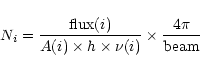
Ni is calculated from the observed quantities according
to:
is the partition function at
.
Ni is calculated from the observed quantities according
to:
 |
(2) |
 is the frequency of the
transition, h is Planck's constant, and beam is the solid angle of the
beam size. In Figs. 3 and 4 we plot the natural logarithm of
Eq. (1).
is the frequency of the
transition, h is Planck's constant, and beam is the solid angle of the
beam size. In Figs. 3 and 4 we plot the natural logarithm of
Eq. (1).
For the excitation diagrams we used extinction-corrected line fluxes.
We estimated the extinction for each line flux using the AV
values listed in Tables 1 and 2. For 
 m we used
 and for
 m
the extinction law of Draine & Lee (1984) and Draine (1989) were used.
We assumed similar obscuration of the ionized and molecular media.
m
the extinction law of Draine & Lee (1984) and Draine (1989) were used.
We assumed similar obscuration of the ionized and molecular media.
| Galaxy Name | D | A V | Spec. type | comments |
| Mpc | [mag] | |||
| NGC 1068 | 14 | 81 | Sy2 | SAb |
| NGC 1275 | 70 | 22 | Sy2 | cD, pec. |
| NGC 1365 | 22.3 | 2.52 | Sy1.8 | SBb |
| NGC 4151 | 20 | 31 | Sy1.5 | SABab |
| Cen A | 4 | 303 | Radio | SO pec. |
| NGC 5506 | 23 | 83 | Sy1.9 | Sa pec. |
| Circinus | 3 | 203 | Sy2 | SAb |
| NGC 7582 | 20 | 183 | Sy2 | SBab |
| NGC 7469 | 66 | 201 | Sy1.2 | SABa |
| Galaxy Name | (1-0)Q(3) | S(7) | S(5) | S(3) | S(2) | S(1) | S(0) |
 |
2.42 | 5.51 | 6.91 | 9.67 | 12.27 | 17.03 | 28.22 |
 10-20 W cm-2 10-20 W cm-2 |
|||||||
| NGC 253 | 2.80 | 8.40 | 11.5 | - | 12.0 | 19.57 | 2.13 |
| IC 342 | 0.39 | <0.9 | 1.60 | - | 2.50 | 4.90 | 0.80 |
| IIZw40 | - | - | <0.45 | - | <4.5 | <0.85 | - |
| M 82 | 2.65 | 4.80 | 11.50 | - | 12.0 | 15.0 | 7.8 |
| NGC 3256a | 0.38 | - | 4.70 | - | 2.35 | 11.50 | <3.90 |
| NGC 3690A | <0.3 | - | 1.97 | - | 1.8 | 3.7 | <1.21 |
| NGC 3690B/C | <0.4 | - | 1.46 | - | 1.92 | 4.11 | <0.7 |
| NGC 4038b | - | - | - | - | 1.6 | 3.95 | - |
| NGC 4945c | 3.2 | 1.11 | 15.4 | 7.45 | 15.1 | 4.82 | |
| NGC 5236 (M83) | - | - | 2.84 | - | - | 7.29 | <1.04 |
| NGC 5253 | 0.55 | - | <0.60 | - | - | 0.50 | - |
| NGC 6946d | - | - | - | - | <0.93 | 2.73 | 0.41 |
| NGC 7552 | <0.86 | 1.08 | 2.37 | 2.84 | <1.5 | 5.11 | <0.52 |
| H2 line fluxes from: | |||||||
| a Rigopoulou et al. (1996). | |||||||
| b Kunze et al. (1996). | |||||||
| c Spoon et al. (2000). | |||||||
| d Valentijn et al. (1996). | |||||||
| Galaxy Name | (1-0)Q(3) | S(7) | S(5) | S(3) | S(2) | S(1) | S(0) |
|
|
2.42 | 5.51 | 6.91 | 9.67 | 12.27 | 17.03 | 28.22 |
| 10-20 W cm-2 |
|||||||
| NGC 1068a | 2.296 | - | 6.403 | 5.757 | - | 6.502 | <1.872 |
| NGC 1275 | <0.8 | 0.9 | 1.55 | - | <1.0 | 2.06 | <2.2 |
| NGC 1365 | <0.85 | - | 2.01 | - | <3.13 | 5.69 | <1.65 |
| NGC 4151 | - | - | 1.32 | - | <1.86 | 1.667 | <1.26 |
| CenA | 0.792 | 3.259 | 4.535 | 5.806 | 5.397 | 8.635 | 2.511 |
| NGC 5506 | - | - | 1.508 | - | <0.859 | 1.185 | <0.928 |
| Circinus | - | 2.72 | 7.97 | - | 2.36 | 13.94 | 1.56 |
| NGC 7582 | - | - | 1.945 | - | <1.289 | 3.116 | 0.764 |
| NGC 7469 | - | - | 1.394 | - | 2.125 | 2.955 | 0.8 |
| H2 line fluxes from: a Lutz et al. (2000). | |||||||
The excitation temperature of the line-emitting gas is the reciprocal
of the slope of the excitation diagram, corresponding to the kinetic
temperature in local thermodynamic equilibrium (LTE). Assuming
thermal emission, it is apparent that H2 is present in a range of
temperatures in all cases![[*]](/icons/foot_motif.gif) . The
excitation temperature changes rapidly with energy level. This is of
course a natural consequence of the fact that the gas is in reality
consisting of various components at various temperatures.
The
detections of the S(1) and S(0) lines (or the upper limits of the
latter whenever not detected) are used to constrain the temperature of
the "warm'' line emitting gas, while the S(5) and S(7) lines are
used to constrain the temperature of the somewhat "hotter" gas. In
fact the S(5) and S(7) lines most likely probe the same excited gas
as the near-infrared ro-vibrational lines. Therefore, the detection of
the S(0) and S(1) lines is more important since we can probe the
more abundant "warm'' gas.
In Tables 5 and 6 (Cols. 2 and 5 respectively) we list the
temperatures (for the "warm'' and the "hotter'' gas)
for the starbursts and Seyferts, respectively.
. The
excitation temperature changes rapidly with energy level. This is of
course a natural consequence of the fact that the gas is in reality
consisting of various components at various temperatures.
The
detections of the S(1) and S(0) lines (or the upper limits of the
latter whenever not detected) are used to constrain the temperature of
the "warm'' line emitting gas, while the S(5) and S(7) lines are
used to constrain the temperature of the somewhat "hotter" gas. In
fact the S(5) and S(7) lines most likely probe the same excited gas
as the near-infrared ro-vibrational lines. Therefore, the detection of
the S(0) and S(1) lines is more important since we can probe the
more abundant "warm'' gas.
In Tables 5 and 6 (Cols. 2 and 5 respectively) we list the
temperatures (for the "warm'' and the "hotter'' gas)
for the starbursts and Seyferts, respectively.
We note that the derived excitation temperature is affected by the total
ortho-to-para conversion rate of H2. For the calculations above
we have assumed an ortho-to-para abundance ratio of 3, the equilibrium
value for temperatures  K (assuming LTE conditions).
Sternberg & Neufeld (1999) have measured an ortho-to-para ratio of 3
in the PDR star-forming region S140. Assuming a lower ortho-to-para
conversion rate of 1 we find higher values of
K (assuming LTE conditions).
Sternberg & Neufeld (1999) have measured an ortho-to-para ratio of 3
in the PDR star-forming region S140. Assuming a lower ortho-to-para
conversion rate of 1 we find higher values of
 and lower values of
 ,
internally inconsistent and
implying that multiple temperature components should be considered to fit
the data. We believe that under the assumption of LTE conditions an ortho-to-
para abundance ratio of 3 is a realistic value.
,
internally inconsistent and
implying that multiple temperature components should be considered to fit
the data. We believe that under the assumption of LTE conditions an ortho-to-
para abundance ratio of 3 is a realistic value.
From the S(0)-S(1) detections in starbursts we derive an average
temperature of
 K. For those starbursts
for which there was no S(0) detection we used the S(1) and S(2) detections
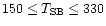
to find the range of temperatures. For the starbursts we find
K. For those starbursts
for which there was no S(0) detection we used the S(1) and S(2) detections
to find the range of temperatures. For the starbursts we find
 K.
For the Seyferts, the S(0) line is detected in CenA, Circinus, NGC 7582 and
NGC 7469. Based on these detections we derive an average temperature
K.
For the Seyferts, the S(0) line is detected in CenA, Circinus, NGC 7582 and
NGC 7469. Based on these detections we derive an average temperature
 K.
For those Seyferts with S(0) non-detections we derive
limits in the range
K.
For those Seyferts with S(0) non-detections we derive
limits in the range
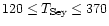 K (using S(1) and S(2)).
Although the number of S(0) detections in the Seyfert sample is slightly
smaller
(in the present sample the S(0) line is detected in 5/10 of the
starbursts and 4/9 of the Seyferts) it is obvious
that the temperatures of the "warm'' gas are, within the errors,
similar in starbursts and Seyferts.
K (using S(1) and S(2)).
Although the number of S(0) detections in the Seyfert sample is slightly
smaller
(in the present sample the S(0) line is detected in 5/10 of the
starbursts and 4/9 of the Seyferts) it is obvious
that the temperatures of the "warm'' gas are, within the errors,
similar in starbursts and Seyferts.
Taken at face value the similar temperatures found for starbursts and Seyferts indicate that the conditions in the gas are the same in both environments. Although this could have been the anticipated result (since we are looking at the same transitions originating in "warm'' clouds in galaxies) we caution that a number of factors may contribute to this effect: first, most of the Seyferts in our sample are "mixed'' objects that is, there is evidence for the presence of an extended starburst component (e.g. NGC 7469, NGC 7582, CenA and Circinus) whose energy output is comparable to that of the central active nucleus. Second, the large SWS apertures sample a mixture of molecular hydrogen emission from cool clouds in the extended circumnuclear regions as well as the warmer central clouds. Thus, effects of dilution of a pure AGN-related effect by the more extended starburst activity are possible. Such a behaviour has already been noted in the case of NGC 1068 (Lutz et al. 2000) where the SWS-H2 emission traces gas originating both in the central active nucleus as well as the molecular ring which is present at larger spatial scales.
We next derive masses corresponding to the gas found at various temperatures, mostly the "warm'' gas emitting the S(0) line as well as the "hotter'' higher excitation gas in which the S(7) line originates. The various masses are derived based on the following method: the column density (from Eq. (1)) is multiplied by the physical area of the object corresponding to the aperture. For aperture sizes we use the values quoted in Sect. 2 depending on the transition (either S(0) or S(7)). The "warm'' molecular masses were derived using the S(0) line (column density and temperature). In the cases of undetected S(0) lines we have used the S(1) line (column density) and the S(1)-S(2) temperature to derive the masses. The "hotter'' gas masses are derived using the S(7) detections. The "warm'' gas masses (denoted as M 1) and the "hotter'' gas masses (denoted as M 2) are listed in Tables 5 and 6 (Cols. 3 and 6) for starbursts and AGN, respectively.
Copyright ESO 2002
![\begin{figure}
\par\includegraphics[width=17.5cm,clip]{ms2078f3.eps}\par\end{figure}](/articles/aa/full/2002/26/aa2078/img16.gif)
![\begin{figure}
\par\includegraphics[angle=90,width=17.5cm,clip]{ms2078f4.eps}\par\end{figure}](/articles/aa/full/2002/26/aa2078/img17.gif)