and Seyfert galaxies
![[*]](/icons/foot_motif.gif)
A&A 389, 374-386 (2002)
DOI: 10.1051/0004-6361:20020607
D. Rigopoulou1 - D. Kunze1 - D. Lutz1 - R. Genzel1 - A. F. M. Moorwood 2
1 - Max-Planck-Institut für extraterrestrische Physik,
Postfach 1312, 85741 Garching bei München, Germany
2 - European Southern Observatory, Karl-Schwarzschild-Str. 2, 85748 Garching
bei München, Germany
Received 12 November 2001 / Accepted 15 April 2002
Abstract
We present results from a survey of molecular hydrogen
emission from a
sample of Starburst and Seyfert galaxies carried out with the Infrared
Space Observatory (ISO).
Pure rotational H2 emission has been detected
in a number of extragalactic objects and a
variety of environments. A number of transitions from S(7) to S(0) are detected
in both starbursts and Seyferts.
Using excitation diagrams we derive temperatures and masses of the "warm''
molecular hydrogen.
We find that the temperature of the "warm'' gas is similar
in starbursts and Seyferts (those Seyferts for which we have firm detections
of the S(0) line) with a value of around  K.
This "warm'' gas accounts for as much as 10% of the
total galactic mass (as probed by CO molecular observations) in starbursts.
The fraction of "warm'' gas is overall higher in Seyferts,
ranging between 2-35%.
We then investigate the origin of the warm H2 emission.
Comparison with published theoretical models and Galactic templates
implies that
although emission from photodissociation regions (PDR) alone could
explain the emission from starbursts
and Seyferts,
most likely a combination of PDR, shock emission and gas heated by X-rays
(mostly for the Seyferts)
is responsible for H2 excitation in extragalactic environments.
Finally, we find that although PAH and H2 line emission correlate
well in starbursts and the large scale emission in AGN, H2 emission
is much stronger compared to PAH emission in cases where a "pure''
AGN dominates the energy output.
K.
This "warm'' gas accounts for as much as 10% of the
total galactic mass (as probed by CO molecular observations) in starbursts.
The fraction of "warm'' gas is overall higher in Seyferts,
ranging between 2-35%.
We then investigate the origin of the warm H2 emission.
Comparison with published theoretical models and Galactic templates
implies that
although emission from photodissociation regions (PDR) alone could
explain the emission from starbursts
and Seyferts,
most likely a combination of PDR, shock emission and gas heated by X-rays
(mostly for the Seyferts)
is responsible for H2 excitation in extragalactic environments.
Finally, we find that although PAH and H2 line emission correlate
well in starbursts and the large scale emission in AGN, H2 emission
is much stronger compared to PAH emission in cases where a "pure''
AGN dominates the energy output.
Key words: galaxies: active - galaxies: starburst - infrared: galaxies
Using the Short Wavelength Spectrometer (SWS; De Graauw et al. 1996) on board
the Infrared Space Observatory (ISO; Kessler et al. 1996),
we have performed a survey of molecular hydrogen emission from
active galaxies displaying a wide range in nuclear activity including
pure bona-fide starbursts, Seyfert 2s (some of them with starburst components)
and pure Seyfert 1 galaxies.
Prior to the ISO mission, extragalactic H2 emission
had only been detected in the ro-vibrational
lines around 2.1  m. Indeed, H2 ro-vibrational emission has been
detected in galactic sources (e.g. Usuda et al. 1996),
Starburst galaxies (e.g. Joseph et al. 1984),
Seyferts (e.g. Moorwood & Oliva 1988; Fischer et al. 1987)
and bright spirals (e.g. Puxley et al. 1988).
m. Indeed, H2 ro-vibrational emission has been
detected in galactic sources (e.g. Usuda et al. 1996),
Starburst galaxies (e.g. Joseph et al. 1984),
Seyferts (e.g. Moorwood & Oliva 1988; Fischer et al. 1987)
and bright spirals (e.g. Puxley et al. 1988).
The ro-vibrational lines typically trace H2 gas of
masses around  10
10
 and temperatures 2000 K. This
gas can be excited either by collisions (thermal) or by absorption of
ultraviolet (UV)
photons in the Lyman and Werner electronic bands (912-1108 Å), followed by a
de-excitation cascade to the ground state (fluorescence).
However, gas at these temperatures is a very small fraction
(as small as 10-6) of the total amount of H2 gas
(e.g. Van der Werf et al. 1993).
Since the ro-vibrational lines tend to get faint at lower temperatures,
most of our knowledge about the H2 content of galaxies comes from CO
observations assuming a CO/H2 conversion factor derived from galactic
molecular
cloud observations. ISO gave the unique opportunity to observe intermediate
temperature gas, ie "warm'' H2, directly in pure rotational lines. Since
transitions with
and temperatures 2000 K. This
gas can be excited either by collisions (thermal) or by absorption of
ultraviolet (UV)
photons in the Lyman and Werner electronic bands (912-1108 Å), followed by a
de-excitation cascade to the ground state (fluorescence).
However, gas at these temperatures is a very small fraction
(as small as 10-6) of the total amount of H2 gas
(e.g. Van der Werf et al. 1993).
Since the ro-vibrational lines tend to get faint at lower temperatures,
most of our knowledge about the H2 content of galaxies comes from CO
observations assuming a CO/H2 conversion factor derived from galactic
molecular
cloud observations. ISO gave the unique opportunity to observe intermediate
temperature gas, ie "warm'' H2, directly in pure rotational lines. Since
transitions with
 are strictly forbidden for the H2molecule, the rotational ladder consists
only of an ortho (J odd) and a para (J even) series of quadrupole transitions.
are strictly forbidden for the H2molecule, the rotational ladder consists
only of an ortho (J odd) and a para (J even) series of quadrupole transitions.
ISO, and in particular SWS, offered the unique opportunity to detect pure rotational H2 emission in a number of galactic and extragalactic sources, thus studying the amount of moderately warm gas in these sources. The spectral range of SWS provides full coverage of a number of transitions (for most galaxies we have observed from the S(0) to S(7) transitions) while its spectral resolution is well matched to the typical velocity dispersions of galaxies. Among the first detections of pure rotational H2 emission in galaxies were the detections in NGC 3256 (Rigopoulou et al. 1996), NGC 6946 (Valentijn et al. 1996), NGC 891 (Valentijn & Van der Werf 1999). However, no study of pure rotational H2emission for a large number of galaxies has so far appeared.
Here, we present an
inventory of H2 emission lines from a number of Starburst and
AGN. Our survey includes 12 and 9 Starburst and Seyfert
galaxies, respectively. Temperatures of the warm molecular gas are deduced from
excitation diagrams whereas the masses of the warm molecular gas are
compared to the total gas content of the galaxies as estimated from
molecular CO observations.
The H2 excitation mechanism is investigated next.
The observations are compared to the predictions of published models
both for PDR, shocked emission and X-ray irradiated gas, as well as to
Galactic templates. Finally we examine possible correlations between
PAH and H2 emission.
The data presented here are part of the MPE ISO Guaranteed time
project "Bright Galactic Nuclei". The observations were carried out
throughout the ISO mission and were all taken in the standard AOT
SWS02 mode, i.e. grating line profile scan.
The SWS has three different apertures with dimensions
(projected on the sky) ap1:
 ,
ap2:
,
ap2:
 and ap3:
.
The following molecular
transitions (and the corresponding apertures) were observed although
not in all sources:
(1-0)Q(3) (ap1), (0-0)S(0) (ap3),
(0-0)S(1) (ap2), (0-0)S(2) (ap1), (0-0)S(3) (ap3),
(0-0)S(5) (ap2), and
(0-0)S(7) (ap2).
The sample targets are presented in Tables 1 and 2 for the starbursts and
Seyferts, respectively.
Galaxy names, distances (assuming
H 0 = 75 km s-1 Mpc-1), extinction towards the ionized medium, and
comments are also listed.
We note that the SWS aperture sizes are most likely larger than
the presumed
sizes of the circumnuclear regions for a large fraction of the present samples
of Starburst and Seyfert galaxies.
and ap3:
.
The following molecular
transitions (and the corresponding apertures) were observed although
not in all sources:
(1-0)Q(3) (ap1), (0-0)S(0) (ap3),
(0-0)S(1) (ap2), (0-0)S(2) (ap1), (0-0)S(3) (ap3),
(0-0)S(5) (ap2), and
(0-0)S(7) (ap2).
The sample targets are presented in Tables 1 and 2 for the starbursts and
Seyferts, respectively.
Galaxy names, distances (assuming
H 0 = 75 km s-1 Mpc-1), extinction towards the ionized medium, and
comments are also listed.
We note that the SWS aperture sizes are most likely larger than
the presumed
sizes of the circumnuclear regions for a large fraction of the present samples
of Starburst and Seyfert galaxies.
| Galaxy Name | D | A V 1 | Spec. type | comments |
| Mpc | [mag] | |||
| NGC 253 | 3.5 | 30 | HII, SB | Sc, edge-on |
| IC 342 | 3.6 | 12 | HII, SB | Scd, face-on |
| II Zw 40 | 7 | 32 | HII | BCD |
| M 823 | 3.3 | 10 | HII, SB | Irr |
| NGC 3256a | 36.6 | 35 | SB | colliding pair |
| NGC 3690A/BC3 | 40 | 20 | SB | pec. merger |
| NGC 4038/393,b | 21.0 | 80 | SB | interacting |
| NGC 4945c | 4 | 20 | SB, Sy2 | Sc edge-on |
| NGC 5236 (M 83) | 5.0 | 5 | HII, SB | SAB(s), face-on |
| NGC 5253 | 4.1 | 14 | HII, SB | Im pec |
| NGC 6946d | 5.7 | 1.84 | HII | S(AB)cd,face-on |
| NGC 7552 | 21.2 | 5 | HII, LINER | SA(c), face-on |
The data were reduced using the Interactive Analysis (IA) Package of the SWS team including sophisticated tools to improve cosmic ray hit removal, dark subtraction, defringing and flat-fielding. The flux calibration is accurate to about 25% (Schaeidt 1996). The calibration files of June 2000 were used.
Figures 1 and 2 show the observed H2 molecular lines
in starburst and Seyfert galaxies.
In almost all cases the
S(1) and S(5) lines are clearly detected in both the Seyfert and the
Starburst samples. Tables 3 and 4 give the actual line flux values
for starbursts and Seyferts, respectively.
From the sample of 13 starbursts (the two components in NGC 3690 have been observed separately) the S(0) line was observed in 10 of them and detected in 5. The S(0) line was observed in all (9) Seyferts and detected in 4 of them.
![\begin{figure}
\par\includegraphics[width=17cm,clip]{ms2078f1.eps}
\end{figure}](/articles/aa/full/2002/26/aa2078/img9.gif) |
Figure 1:
H2 molecular lines from starbursts: from left to right
(1-0)Q(3), (0-0)S(7), (0-0)S(5), (0-0)S(3), (0-0)S(2), (0-0)S(1) and
(0-0)S(0). The vertical axis is Flux in Jy, the horizontal axis is wavelength
in m.
Note: previously published spectra for NGC 3256, NGC 4038 and
NGC 4945 and NGC 6946 are not included in this figure. |
| Open with DEXTER | |
![\begin{figure}
\par\includegraphics[width=17.5cm,clip]{ms2078f2.eps}\par\end{figure}](/articles/aa/full/2002/26/aa2078/img10.gif) |
Figure 2: H2 molecular lines in Seyferts. The spectral lines from the various transitions and the axes are the same as in Fig. 1. |
| Open with DEXTER | |
For those sources where lines were not detected we quote "good confidence'' upper limits. As mentioned earlier a large number of atomic and ionic lines were observed for each source. For the purpose of the current paper we focus on the H2 emission. More detailed analysis for some of the sources can be found in other papers (NGC 4038/39: Kunze et al. 1996; NGC 3256: Rigopoulou et al. 1996; NGC 4151: Alexander et al. 1998; Sturm et al. 1998; Circinus: Moorwood et al. 1996; NGC 1275: Krabbe et al. 2000; NGC 1068: Lutz et al. 2000).
Using the pure rotational H2 lines we can probe the physical conditions of the warm molecular hydrogen in our sample of Starburst and Seyfert galaxies. As we discussed in Sect. 1, the pure rotational lines originate from the warm (T< 2000 K) gas. In what follows we derive excitation temperatures for the "warm'' molecular hydrogen gas as well as masses and compare them to the total masses of the galaxies, as probed by observations of the various transitions of the CO molecule. We also compare and discuss the global properties of the "warm'' gas in starbursts and Seyferts.
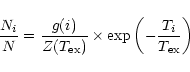
The excitation diagrams in Figs. 3 and 4 show a plot of the
natural logarithm of the column density divided by the statistical
weight in the upper level of each transition against the energy
level. The column density follows from the Boltzmann equation,
 |
(1) |
 is the
excitation temperature, and
is the
excitation temperature, and
 is the partition function at
.
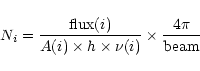
Ni is calculated from the observed quantities according
to:
is the partition function at
.
Ni is calculated from the observed quantities according
to:
 |
(2) |
 is the frequency of the
transition, h is Planck's constant, and beam is the solid angle of the
beam size. In Figs. 3 and 4 we plot the natural logarithm of
Eq. (1).
is the frequency of the
transition, h is Planck's constant, and beam is the solid angle of the
beam size. In Figs. 3 and 4 we plot the natural logarithm of
Eq. (1).
![\begin{figure}
\par\includegraphics[width=17.5cm,clip]{ms2078f3.eps}\par\end{figure}](/articles/aa/full/2002/26/aa2078/img16.gif) |
Figure 3: Excitation diagrams for the starbursts. |
| Open with DEXTER | |
![\begin{figure}
\par\includegraphics[angle=90,width=17.5cm,clip]{ms2078f4.eps}\par\end{figure}](/articles/aa/full/2002/26/aa2078/img17.gif) |
Figure 4: Excitation diagrams for the Seyferts. |
| Open with DEXTER | |
For the excitation diagrams we used extinction-corrected line fluxes.
We estimated the extinction for each line flux using the AV
values listed in Tables 1 and 2. For  m we used
 and for
 m
the extinction law of Draine & Lee (1984) and Draine (1989) were used.
We assumed similar obscuration of the ionized and molecular media.
m
the extinction law of Draine & Lee (1984) and Draine (1989) were used.
We assumed similar obscuration of the ionized and molecular media.
| Galaxy Name | D | A V | Spec. type | comments |
| Mpc | [mag] | |||
| NGC 1068 | 14 | 81 | Sy2 | SAb |
| NGC 1275 | 70 | 22 | Sy2 | cD, pec. |
| NGC 1365 | 22.3 | 2.52 | Sy1.8 | SBb |
| NGC 4151 | 20 | 31 | Sy1.5 | SABab |
| Cen A | 4 | 303 | Radio | SO pec. |
| NGC 5506 | 23 | 83 | Sy1.9 | Sa pec. |
| Circinus | 3 | 203 | Sy2 | SAb |
| NGC 7582 | 20 | 183 | Sy2 | SBab |
| NGC 7469 | 66 | 201 | Sy1.2 | SABa |
| Galaxy Name | (1-0)Q(3) | S(7) | S(5) | S(3) | S(2) | S(1) | S(0) |
 |
2.42 | 5.51 | 6.91 | 9.67 | 12.27 | 17.03 | 28.22 |
 10-20 W cm-2 10-20 W cm-2 |
|||||||
| NGC 253 | 2.80 | 8.40 | 11.5 | - | 12.0 | 19.57 | 2.13 |
| IC 342 | 0.39 | <0.9 | 1.60 | - | 2.50 | 4.90 | 0.80 |
| IIZw40 | - | - | <0.45 | - | <4.5 | <0.85 | - |
| M 82 | 2.65 | 4.80 | 11.50 | - | 12.0 | 15.0 | 7.8 |
| NGC 3256a | 0.38 | - | 4.70 | - | 2.35 | 11.50 | <3.90 |
| NGC 3690A | <0.3 | - | 1.97 | - | 1.8 | 3.7 | <1.21 |
| NGC 3690B/C | <0.4 | - | 1.46 | - | 1.92 | 4.11 | <0.7 |
| NGC 4038b | - | - | - | - | 1.6 | 3.95 | - |
| NGC 4945c | 3.2 | 1.11 | 15.4 | 7.45 | 15.1 | 4.82 | |
| NGC 5236 (M83) | - | - | 2.84 | - | - | 7.29 | <1.04 |
| NGC 5253 | 0.55 | - | <0.60 | - | - | 0.50 | - |
| NGC 6946d | - | - | - | - | <0.93 | 2.73 | 0.41 |
| NGC 7552 | <0.86 | 1.08 | 2.37 | 2.84 | <1.5 | 5.11 | <0.52 |
| H2 line fluxes from: | |||||||
| a Rigopoulou et al. (1996). | |||||||
| b Kunze et al. (1996). | |||||||
| c Spoon et al. (2000). | |||||||
| d Valentijn et al. (1996). | |||||||
| Galaxy Name | (1-0)Q(3) | S(7) | S(5) | S(3) | S(2) | S(1) | S(0) |
|
|
2.42 | 5.51 | 6.91 | 9.67 | 12.27 | 17.03 | 28.22 |
| 10-20 W cm-2 |
|||||||
| NGC 1068a | 2.296 | - | 6.403 | 5.757 | - | 6.502 | <1.872 |
| NGC 1275 | <0.8 | 0.9 | 1.55 | - | <1.0 | 2.06 | <2.2 |
| NGC 1365 | <0.85 | - | 2.01 | - | <3.13 | 5.69 | <1.65 |
| NGC 4151 | - | - | 1.32 | - | <1.86 | 1.667 | <1.26 |
| CenA | 0.792 | 3.259 | 4.535 | 5.806 | 5.397 | 8.635 | 2.511 |
| NGC 5506 | - | - | 1.508 | - | <0.859 | 1.185 | <0.928 |
| Circinus | - | 2.72 | 7.97 | - | 2.36 | 13.94 | 1.56 |
| NGC 7582 | - | - | 1.945 | - | <1.289 | 3.116 | 0.764 |
| NGC 7469 | - | - | 1.394 | - | 2.125 | 2.955 | 0.8 |
| H2 line fluxes from: a Lutz et al. (2000). | |||||||
The excitation temperature of the line-emitting gas is the reciprocal
of the slope of the excitation diagram, corresponding to the kinetic
temperature in local thermodynamic equilibrium (LTE). Assuming
thermal emission, it is apparent that H2 is present in a range of
temperatures in all cases. The
excitation temperature changes rapidly with energy level. This is of
course a natural consequence of the fact that the gas is in reality
consisting of various components at various temperatures.
The
detections of the S(1) and S(0) lines (or the upper limits of the
latter whenever not detected) are used to constrain the temperature of
the "warm'' line emitting gas, while the S(5) and S(7) lines are
used to constrain the temperature of the somewhat "hotter" gas. In
fact the S(5) and S(7) lines most likely probe the same excited gas
as the near-infrared ro-vibrational lines. Therefore, the detection of
the S(0) and S(1) lines is more important since we can probe the
more abundant "warm'' gas.
In Tables 5 and 6 (Cols. 2 and 5 respectively) we list the
temperatures (for the "warm'' and the "hotter'' gas)
for the starbursts and Seyferts, respectively.
We note that the derived excitation temperature is affected by the total
ortho-to-para conversion rate of H2. For the calculations above
we have assumed an ortho-to-para abundance ratio of 3, the equilibrium
value for temperatures  K (assuming LTE conditions).
Sternberg & Neufeld (1999) have measured an ortho-to-para ratio of 3
in the PDR star-forming region S140. Assuming a lower ortho-to-para
conversion rate of 1 we find higher values of
K (assuming LTE conditions).
Sternberg & Neufeld (1999) have measured an ortho-to-para ratio of 3
in the PDR star-forming region S140. Assuming a lower ortho-to-para
conversion rate of 1 we find higher values of
 and lower values of
 ,
internally inconsistent and
implying that multiple temperature components should be considered to fit
the data. We believe that under the assumption of LTE conditions an ortho-to-
para abundance ratio of 3 is a realistic value.
,
internally inconsistent and
implying that multiple temperature components should be considered to fit
the data. We believe that under the assumption of LTE conditions an ortho-to-
para abundance ratio of 3 is a realistic value.
From the S(0)-S(1) detections in starbursts we derive an average
temperature of
 K. For those starbursts
for which there was no S(0) detection we used the S(1) and S(2) detections
to find the range of temperatures. For the starbursts we find
K. For those starbursts
for which there was no S(0) detection we used the S(1) and S(2) detections
to find the range of temperatures. For the starbursts we find
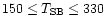 K.
For the Seyferts, the S(0) line is detected in CenA, Circinus, NGC 7582 and
NGC 7469. Based on these detections we derive an average temperature
K.
For the Seyferts, the S(0) line is detected in CenA, Circinus, NGC 7582 and
NGC 7469. Based on these detections we derive an average temperature
 K.
For those Seyferts with S(0) non-detections we derive
limits in the range
K.
For those Seyferts with S(0) non-detections we derive
limits in the range
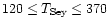 K (using S(1) and S(2)).
Although the number of S(0) detections in the Seyfert sample is slightly
smaller
(in the present sample the S(0) line is detected in 5/10 of the
starbursts and 4/9 of the Seyferts) it is obvious
that the temperatures of the "warm'' gas are, within the errors,
similar in starbursts and Seyferts.
K (using S(1) and S(2)).
Although the number of S(0) detections in the Seyfert sample is slightly
smaller
(in the present sample the S(0) line is detected in 5/10 of the
starbursts and 4/9 of the Seyferts) it is obvious
that the temperatures of the "warm'' gas are, within the errors,
similar in starbursts and Seyferts.
Taken at face value the similar temperatures found for starbursts and Seyferts indicate that the conditions in the gas are the same in both environments. Although this could have been the anticipated result (since we are looking at the same transitions originating in "warm'' clouds in galaxies) we caution that a number of factors may contribute to this effect: first, most of the Seyferts in our sample are "mixed'' objects that is, there is evidence for the presence of an extended starburst component (e.g. NGC 7469, NGC 7582, CenA and Circinus) whose energy output is comparable to that of the central active nucleus. Second, the large SWS apertures sample a mixture of molecular hydrogen emission from cool clouds in the extended circumnuclear regions as well as the warmer central clouds. Thus, effects of dilution of a pure AGN-related effect by the more extended starburst activity are possible. Such a behaviour has already been noted in the case of NGC 1068 (Lutz et al. 2000) where the SWS-H2 emission traces gas originating both in the central active nucleus as well as the molecular ring which is present at larger spatial scales.
We next derive masses corresponding to the gas found at various temperatures, mostly the "warm'' gas emitting the S(0) line as well as the "hotter'' higher excitation gas in which the S(7) line originates. The various masses are derived based on the following method: the column density (from Eq. (1)) is multiplied by the physical area of the object corresponding to the aperture. For aperture sizes we use the values quoted in Sect. 2 depending on the transition (either S(0) or S(7)). The "warm'' molecular masses were derived using the S(0) line (column density and temperature). In the cases of undetected S(0) lines we have used the S(1) line (column density) and the S(1)-S(2) temperature to derive the masses. The "hotter'' gas masses are derived using the S(7) detections. The "warm'' gas masses (denoted as M 1) and the "hotter'' gas masses (denoted as M 2) are listed in Tables 5 and 6 (Cols. 3 and 6) for starbursts and AGN, respectively.
Most of the knowledge about the molecular content of galaxies has so far relied on observations of CO emission, assuming a CO/H2 conversion factor based on Galactic Giant Molecular Clouds (GMCs). However, CO probes successfully gas lying at low temperatures of a few tens up to a hundred. And although the low temperature gas comprises the bulk of the gas content in a galaxy, it provides no information on the "warmer'' gas which might be more directly linked to the source of activity. In Sect. 3.2 we showed how ISO can give a firm estimate of the "warm'' gas content of these galaxies.
Here, we try to estimate what fraction
of the total gas mass lies in higher temperatures as we directly
compare our new ISO findings with published CO data.
Although for such a comparison higher
CO transitions (
 ,
,
 etc.)
probing "warmer'' gas (T > 50 K) are more directly related to the gas
seen by ISO however, these
transitions are not available for the majority of the galaxies
presented here. Such a detailed analysis has been carried out for only
two galaxies,
NGC 6946 (Valentijn et al. 1996), and NGC 4945 (Spoon et al. 2000).
etc.)
probing "warmer'' gas (T > 50 K) are more directly related to the gas
seen by ISO however, these
transitions are not available for the majority of the galaxies
presented here. Such a detailed analysis has been carried out for only
two galaxies,
NGC 6946 (Valentijn et al. 1996), and NGC 4945 (Spoon et al. 2000).
In Tables 5 and 6 we compare the masses derived from the SWS H2 emission lines with mass estimates from CO observations (assuming the GMC CO/H2 conversion factor). The comparison is more meaningful for galaxies where the S(0) is detected because only then do we have an accurate estimate of the "warm'' gas mass.
In the case of starbursts the fraction of "warm'' gas ranges between 1 to 10% of the total gas mass. In Seyferts the fraction of the "warm'' gas is overall higher. Although there is great variation among the different objects, in general, the "warm'' gas makes up between 2 and 35% of the total gas (as probed by CO), a value deduced by using only those Seyferts with S(0) detections. For the mass of the "hotter'' gas we find that it accounts for a lot less, of the order of at most 1% in both starbursts and Seyferts.
Although the gas in starbursts and Seyferts has similar temperatures the corresponding masses of "warm'' gas are distinctively different. The amount of "warm'' gas in Seyferts is one to two orders of magnitude higher than in starbursts. The origin of this difference could lie in the excitation mechanism. As we discuss in Sect. 6 apart from shocks and PDRs H2 may also arise in gas heated by hard X-ray photons originating in the central AGN. These X-ray photons are capable of penetrating large columns of gas thus heating extensive parts of the circumnuclear regions reaching out to the larger scale disks in AGN. Spatially resolved observations of rotational lines in AGN would be crucial in investigating the extent of the H2 emitting regions.
| Galaxy Name | T(S(0)-S(1)) | M1 | T(S(1)-S(2)) | T(S(5)-S(7)) | M2 |
 |
Ref |
| K | 10
 |
K | K | 10
 |
10
|
||
| NGC 253 | 195 | 0.05 | 380 | 1275 | 6.0 | 5 | (1) |
| IC 342 | 171 | 0.05 | 365 |  1075 1075 |
1.0 | 2 | (1) |
| IIZw40 | - | - | - | - | - | - | |
| M 82 | 120 | 0.54 | 450 | 1020 | 4.0 | 6 | (1) |
| NGC 3256 |  135 135 |
10 | 230 | - | - | 300 | (1) |
| NGC 3690A | 140 |
- | 335 | - | - | 130 | (2)a |
| NGC 3690B/C | 170 |
- | - | - | - | - | |
| NGC 4038 | - | - | - | - | - | - | - |
| NGC 4945 | 139 | - | - | - | - | 2.7 | (3) |
| NGC 5236 (M83) | 182 |
2.0 | - | - | - | - | - |
| NGC 5253 | - | - | - | - | - | - | |
| NGC 6946 | 174 | 0.03 | 290 |
- | - | 0.3 | (4) |
| NGC 7552 | 158 |
0.8 | 272 |
1120 | 30 | 80 | (1) |
| Galaxy Name | T(S(0)-S(1)) | M1 | T(S(1)-S(2)) | T(S(5)-S(7)) | M2 |
|
Ref |
| K | 10
|
K | K | 10
|
10
|
Ref | |
| NGC 1068 | 145 |
1.0 | - | - | - | 40 | (1) |
| NGC 1275 | 115 |
25 | 340 | 1170 | 3.0 | 60 | (2) |
| NGC 1365 | 145.0 |
1.7 | 365 | - | - | - | |
| NGC 4151 | 115 |
0.1 | 590 |
- | - | 0.3 | (3) |
| CenA | 145 | 0.11 | 390 | 1300 | 2.0 | 1.0 | (4) |
| NGC 5506 | 112 |
2.0 | 430 |
- | - | 3 | (3) |
| Circinus | 199 | 0.8 | 221 | 555 | 1.53 | 30 | (5) |
| NGC 7582 | 153 | 0.76 | 315 |
- | - | 100 | (6) |
| NGC 7469 | 145 | 54 | 425 | - | - | 150 | (3) |
 excitation mechanisms
The H2 molecule can be excited via three distinct mechanisms:
(a) UV fluorescence where
photons with
 Å are initially absorbed by the
H2 molecule (in its Lyman & Werner bands) and later
re-emitted resulting in the population
of the various vibration-rotation levels of the ground state
(e.g. Black & van Dishoeck 1987).
Å are initially absorbed by the
H2 molecule (in its Lyman & Werner bands) and later
re-emitted resulting in the population
of the various vibration-rotation levels of the ground state
(e.g. Black & van Dishoeck 1987).
(b) Shocks where
high-velocity gas motions in a quiescent cloud can
heat, chemically alter and accelerate the ambient gas resulting in
excitation of the H2 molecule (e.g. Hollenbach & McKee 1989) and,
(c) X-ray illumination where hard X-ray photons
are capable of penetrating deeply into molecular clouds and heating
large amounts of gas
(e.g. Maloney 1996).
To distinguish among the three primary excitation mechanisms is far from trivial: high UV radiation flux as well as high-velocity gas motions are both present in the nuclei of Seyfert galaxies and (to a lesser extent) of starbursts. UV radiation can originate either from the existing stellar population, from current star-forming processes, or the accretion disk. On the other hand, shock excitation can originate from the central engine, an outflow due to the large number of supernovae remnants or finally gas motions due to galaxy-galaxy interactions. In addition, the low rotational transitions arise from collisionally excited warm gas which complicates the distinction even further.
Since the signatures of all three mechanisms on the pure rotational lines are almost indistinguishable, an analysis including both ro-vribational and rotational lines would be ideal to address the issue of the excitation mechanism in extragalactic environments. However, the different apertures used to measure lines at different parts of the spectrum introduce large uncertainties, making such a study almost impossible. In what follows we present a brief account of the various theoretical model predictions and compare them to our observed line ratios. In addition, we compare our measurements for the two extragalactic samples to well-studied Galactic templates with the aim of better understanding the origin of the H2 emission.
In this section we compare the observed line ratios to the published
PDR models of Burton Hollenbach & Tielens (1992, BHT).
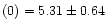
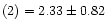
From the present samples we find mean line ratios of S(1)/S
 and
and
 and S(1)/S
 and
and
 for
starbursts and Seyferts, respectively.
We find that the line ratios for the starbursts can be explained with a
sensible combination of gas densities and radiation field strengths. For
instance the mean S(1)/S(0) starburst value can be reproduced
by models 4 or 5 (from BHT) whereas to explain the S(1)/S(2)
ratio a harder radiation
field is necessary (such as in model 7). The mean S(1)/S(0) line ratio
for Seyferts is somewhat but not significantly lower than the one in
starbursts.
Model 3 reproduces fairly
closely the S(1)/S(0) ratio in Seyferts but fail to predict the S(1)/S(2)
ratio which would again require a harder radiation field.
for
starbursts and Seyferts, respectively.
We find that the line ratios for the starbursts can be explained with a
sensible combination of gas densities and radiation field strengths. For
instance the mean S(1)/S(0) starburst value can be reproduced
by models 4 or 5 (from BHT) whereas to explain the S(1)/S(2)
ratio a harder radiation
field is necessary (such as in model 7). The mean S(1)/S(0) line ratio
for Seyferts is somewhat but not significantly lower than the one in
starbursts.
Model 3 reproduces fairly
closely the S(1)/S(0) ratio in Seyferts but fail to predict the S(1)/S(2)
ratio which would again require a harder radiation field.
Although it is impossible to constrain PDR models based on the current observations such direct comparisons of the model prediction and the current measurements suggest that a combination of normal PDRs can explain the emission in both Starburst and Seyfert galaxies.
A direct comparison of the various model predictions (e.g. Brand et al. 1989; Hollenbach & McKee 1989; Kaufman & Neufeld 1996) with our observed line ratios for starbursts and Seyferts shows that, a single speed shock model cannot explain the observed line ratios. Additionally, almost all models predict S(1)/S(0) line ratios much larger than the observed ones (ie the predicted 0-0 S(0) emission is weaker). If the gas temperature is high then the J=2 level is not populated resulting in a weak 0-0 S(0) emission. In galactic sources with shocked H2 emission, the temperature of the higher levels (say J=8 to J=3) is relatively constant at about 700 K (Wright, priv. comm.) thus, the J=2 level does not emit strongly. However, in extragalactic systems the situation is probably different. The low velocity shocks cannot heat the gas to high enough temperatures, the J=2 level is populated resulting in enhanced 0-0 S(0) line emission compared to the various model predictions.
Among the Seyferts, NGC 1275 is a candidate for shock induced H2emission. This is also supported by the ro-vibrational lines observed in the near-IR (Fischer et al. 1987; Krabbe et al. 2000). For the Starburst galaxies it is harder to make any predictions: except perhaps from the case of the luminous IR galaxy NGC 6240 (Egami et al. 2002, in preparation), no other starburst galaxy is a clear case candidate for shock excited H2emission.
So far, the efforts to model X-ray Dominated Regions (XDRs) have been
concentrated mostly on X-rays originating from a central engine.
The model predictions account mostly for the
ro-vibrational line ratios and/or consider additional diagnostics such
as the near-infrared [Fe II] 1.26 m and the cooling lines [OI] 63 m
and [C II] 158 m (Maloney et al. 1996).
Tiné et al. (1997) presented model predictions for the
strength of the S(7) line, the only rotational transition
so far included in XDR models.
In accordance with the results of Maloney et al. (1996), Tiné
et al. found that the H2 emission arises
in typical temperatures T<1000 K and relatively high densities. For higher
temperatures collisional excitation dominates the low vibrational levels.
We note that the H+3 lines characteristic of X-ray irradiated gas
(Draine & Woods 1990) have not been detected in any of our sample starbursts
or Seyferts, therefore it is difficult to make any predictions. An exception
is NGC 1068 where upper limits in H+3 have been reported in
Lutz et al. (2000) but, unfortunately, provide no constraints on the models.
From the comparisons of our measurements to theoretical models we conclude that much of the H2 emission in starbursts could originate in PDRs although a combination of PDRs and shocks of various speeds is also a viable solution. A similar situation is probably true for the Seyferts as well, although as we already discussed in Sect. 4 X-rays from the central AGN may also play an important role in heating up large amounts of gas and triggering H2 emission.
Through the exercise of comparing our observations with theoretical models we want to emphasize how difficult it is to discriminate between the various H2 emission mechanisms and that in order to investigate thoroughly the origin of the H2 emission in galaxies a host of vibrational and rotational transitions must be available.
In this section we compare our measurements to a number of well studied local Galactic templates. For such a comparison we have considered two typical PDR regions "S140'' (Timmermann et al. 1996) and the Orion Bar (Rosenthal 2000, priv. comm), and two cases of shock-powered emission "Cepheus A'' (Wright et al. 1996) and Orion Peak 1 (Rosenthal et al. 1999). In Table 9 we list the temperatures and masses of the local Galactic templates along with "mean'' properties of our sample starburst and Seyfert galaxies. We note that for the mean values quoted in Table 9 we have used all sample galaxies.
| Type | S(1)/S(0) | S(1)/S(2) | T(S(0)-S(1)) |
| K | |||
| Starbursts | 5.3 | 2.33 | 160-(330)1 |
| Seyferts | 3.75 | 1.85 | 150-(370)1 |
| S140 (PDR) | - | 1.00 | 159 |
| Orion Bar (PDR) | 1.11 | 5.29 | 155 |
| Cepheus A West (shock) | 0.54 | 700 | |
| Orion Peak 1 (shock) | - | 0.96 | (570)2 |
The average temperatures for the starburst and Seyfert galaxies are the same as the temperature observed in both cases of PDR emission and well below what is observed for an Orion type shock. Overall, although in reality different regions and excitation mechanisms contribute to the galaxy-integrated temperature distribution these simple comparisons suggest that normal PDRs are responsible for most of the emission in starburst and Seyfert galaxies.
emission
It has been known for some time (see e.g. review by Puget & Lèger 1989)
that the 3-12 m part of the spectrum of galaxies is dominated by
a number of emission features that appear whenever the interstellar
medium is exposed to moderately intense UV radiation. The exact
nature of the carriers that are responsible for the emission is most
likely large carbon-rich molecules the so-called Polycyclic Aromatic
Hydrocarbons (PAH). With ISO it has been possible to detect PAH emission
in a number of galactic (e.g. Verstraete et al. 1996; Roelfsema et al. 1996)
and extragalactic (e.g. Rigopoulou et al. 1999)
environments.
Here, we want to investigate whether
any link exists between PAH emission (ultimately related to the presence
of PDRs and HII regions) and rotational H2 emission originating in
the molecular clouds of galaxies where stars are formed.
If both warm H2 emission and PAH emission originate mostly in
UV-illuminated surfaces of molecular clouds (i.e. PDRs), their luminosities
should correlate well when averaged over a galaxy.
In Fig. 5 we plot the 7.7 m PAH luminosity L 7.7
vs. the H2S(1) luminosity
 for our sample starbursts and AGN.
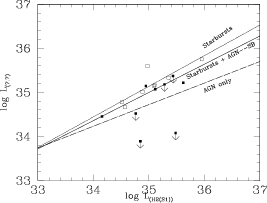 |
Figure 5: PAH luminosity L 7.7 vs. the H2S(1) luminosity for our sample starbursts and AGN. The open and filled squares represent the Starburst and AGN points, respectively. The lines shown represent the least square fits for: dashed line: starbursts, straight line: starbursts and AGN detections, long-dashed line AGN only (non-detection included). |
| Open with DEXTER | |
 .
Some Seyferts deviate strongly from the H2/PAH relation in having
very weak
PAH for their H2 luminosity.
Seyferts as an entire sample (ie including those with PAH upper limits)
follow the relation
.
Some Seyferts deviate strongly from the H2/PAH relation in having
very weak
PAH for their H2 luminosity.
Seyferts as an entire sample (ie including those with PAH upper limits)
follow the relation
 which becomes
 if we only use
AGN with firm PAH detections.
Finally, we have calculated
the relation for both starbursts and AGN (with firm detections) and found
it to be
if we only use
AGN with firm PAH detections.
Finally, we have calculated
the relation for both starbursts and AGN (with firm detections) and found
it to be
 ,
quite
similar in slope to the one found for starbursts.
,
quite
similar in slope to the one found for starbursts.
Overall we find that the 7.7 m and H2S(1) luminosities of
starbursts and AGN (with firm detections) are well correlated implying
that the PAH and H2 emission have a common starburst origin.
Indeed, the four AGN with firm PAH detections, CenA, NGC 7582,
Circinus and NGC 7469, all have substantial starburst activity (e.g.
Genzel et al. 1995 on NGC 7469, Maiolino et al. 1998 on Circinus etc.).
Among the remaining five Seyferts three of them, NGC 4151, NGC 1275 and
NGC 5506 are AGN dominated (with little or no Starburst contribution).
These three AGN are significantly
underluminous in PAH although they are relatively strong H2 emitters.
A possible scenario to explain this behaviour is the following:
in starbursts and in AGN with a significant large scale starburst component,
PAH and H2 emission correlate well. In both cases the emission
most likely originates in the starburst.
In the remaining ``pure'' type AGN, H2 emission is considerably
stronger in comparison to the relatively weaker PAH emission.
There are two possibilities for the high H2/PAH ratio:
either the PAH molecules are destroyed in the
intense radiation field (possibly by the nuclear X-rays) or
energetic photons
escaping from the central X-ray source heat a large fraction of the
circumnuclear material which in turns gives rise to the
enhanced H2 emission (the PAH emission remains normal).
Although it is very difficult to discriminate between these two
options the current observational evidence tends to favor the latter
possibility.
As we already discussed in Sect. 4 the gas masses responsible
for the H2 emission comprise a larger fraction of the total available
gass mass (as traced by CO) in AGN than in starbursts.
We conclude that the central AGN is probably responsible for the bi-modal behaviour of the PAH-H2 relation in Starburst and Seyferts not by suppressing the PAH emission instead, by enhancing the H2 emission by heating larger fractions of the available circumnuclear gas.
We have presented pure rotational H2 emission lines observed with the ISO satellite from a sample of starburst and Seyfert galaxies. We have compared the emission properties of the two samples. The results are summarized as follows:
The lowest S(0) transition has been detected in 5 out of the 10 starbursts and 4 out of the 9 Seyfert galaxies. The S(1)/S(0) line ratio is within the errors not that different in starbursts and in Seyferts.
The temperature of the "warm'' gas, as estimated using the S(0) detections
was found to be similar (within errors)
K, in both starburst and Seyfert
galaxies. This in turn implies that the global properties of the gas in both
environments are the same. We caution though that due to the large ISO beams
dilution of a pure AGN-related effect is important.
The "warm'' gas mass constitutes up to 10% of the total molecular gas content (as traced by CO molecular observations) in starbursts. However, the fraction of "warm'' gas in Seyferts is considerably higher reaching up to 35% (although with a large scatter in values). We propose that, extra "heating'' of the gas is provided by energetic hard X-ray photons originating from the central AGN.
We have compared the observed strength of the molecular H2 lines with theoretical model predictions as well as those of local Galactic templates. Such comparisons reveal that a combination of various PDR clouds explain reasonably the line ratios observed in starbursts. Although such a combination of PDR models can also match the observed line ratios in Seyferts it is likely that slow velocity shocks and some heating from the central X-rays are also present.
Finally, we have examined the existence of a link between PAH and molecular line emission. We find that starbursts and Seyferts with a strong starburst-component follow a very similar correlation. On the other hand the ratio H2/PAH is higher in pure "AGN-dominated'' objects. It is likely that an extended circumnuclear component of "warm'' gas (heated by the nuclear X-ray emission) is present in AGN in which enhanced H2 emission originates. This "warm'' gas component is either too far away for UV photons to reach or, acts as a shield to UV photons resulting in both cases in suppressed PAH emission.
Acknowledgements
We thank Amiel Sternberg, Alfred Krabbe and the anonymous referee for useful comments which significantly improved the present work. We thank Eckhard Sturm for help with the data reduction. SWS and the ISO Spectrometer Data Center at MPE are supported by DLR (DARA) under grants 50 QI 8610 8 and 50 QI 9402 3.