![[*]](/icons/foot_motif.gif)
A&A 388, 632-638 (2002)
DOI: 10.1051/0004-6361:20020433
F. Pepe - M. Mayor - F. Galland - D. Naef - D. Queloz - N. C. Santos - S. Udry - M. Burnet
Observatoire de Genève, 51 Ch. des Maillettes, 1290 Sauverny, Switzerland
Received 7 February 2002 / Accepted 19 March 2002
Abstract
We present the discovery of two Saturn-mass companions to HD 108147 and HD 168746. Both belong to the lightest ever discovered planets. The minimum mass of the companion to HD 168746 is of only 0.77 the mass of Saturn and its orbital period is 6.4 days. The companion to HD 108147 orbits its parent star in 10.9 days and its minimum mass is 1.34 that of Saturn. Its orbit is characterized by a high eccentricity, e=0.50, indicating possibly the presence of a second companion.
The detection of Saturn-mass planets by means of the Doppler technique demands high
radial-velocity measurement precision. The two
new candidates were discovered by means of the CORALIE
echelle spectrograph. The instrumental accuracy of CORALIE
combined with the simultaneous ThAr-reference technique has reached a level
better than 3 m s-1. On many observed objects the precision is now limited by
photon noise. We present in this paper the weighted cross-correlation technique,
which leads to an improvement in the photon noise of the computed radial velocity.
We discuss as well a modification of the numerical cross-correlation mask which
reduces significantly the residual perturbation effects produced by telluric absorption
lines.
Key words: techniques: radial velocities -
stars: individual: HD 108147 - stars:
individual: HD 168746
-
stars: planetary systems
 10 Jupiter masses down to about half the mass of Saturn. Four of the known candidates have sub-Saturnian masses (Jorissen et al. 2001). The lightest planet, HD 83443 c, has been discovered by means of the CORALIE spectrograph and has a mass of only 0.53
 (Mayor et al. 2000).
The technique which underlies all these discoveries is that of precise radial-velocity measurements. It provides us with most orbital parameters. Because this technique does not allow us to constrain the angle of projection  of the orbital plane, only a minimum mass
  of the companion can be determined. The radial-velocity variation induced by a planetary companion on its parent star is large if its minimum mass
is large. This fact makes the technique particularly sensitive to high-mass companions. On the other hand, the detection of low-mass planets is more difficult and produces a detection bias on the low-mass end of the mass function (e.g. Udry & Mayor 2001; Jorissen et al. 2001). In order to reduce this bias the measurement precision must be improved by efficient and stable instrumentation and by efficient measurement and data reduction techniques.
of the companion can be determined. The radial-velocity variation induced by a planetary companion on its parent star is large if its minimum mass
is large. This fact makes the technique particularly sensitive to high-mass companions. On the other hand, the detection of low-mass planets is more difficult and produces a detection bias on the low-mass end of the mass function (e.g. Udry & Mayor 2001; Jorissen et al. 2001). In order to reduce this bias the measurement precision must be improved by efficient and stable instrumentation and by efficient measurement and data reduction techniques.
Using the CORALIE echelle spectrograph on the 1.2-m Euler Swiss telescope at La Silla we are carrying out, since summer 1998, a large high-precision radial-velocity program
(Queloz et al. 2000; Udry et al. 2000). Together with ELODIE in the northern hemisphere, CORALIE has allowed the discovery of about half of the known exoplanet candidates (Udry & Mayor 2001). Recent improvement of the data reduction software have contributed to obtain an overall instrumental precision below 3 m s-1
(Queloz et al. 2001a) over time scales longer than 3 years. The recent asteroseismology measurements on  Cen A
(Bouchy & Carrier 2001) have proven that the short term precision is even better, namely about 1 m s-1 rms over 1 night. The limitations are now determined mainly by photon noise and residual astroclimatic influence.
Cen A
(Bouchy & Carrier 2001) have proven that the short term precision is even better, namely about 1 m s-1 rms over 1 night. The limitations are now determined mainly by photon noise and residual astroclimatic influence.
The present paper describes the discovery of two Saturn-mass companions to the stars HD 108147 and HD 168746. HD 168746 b, with its minimum mass of only 0.77
,
is one of the four sub-Saturnian planets discovered to date. On the other hand, HD 108147 b distinguishes itself by a high eccentricity, fueling the discussion of the origin of such high eccentricity in the case of short-period companions. Before the orbital parameters and the stellar characteristics of these two objects described in detail in the second part of the paper, we discuss additional improvements made recently in the data reduction, and more precisely, in the way of extracting the radial-velocity information obtained from the high-resolution spectra recorded with CORALIE.
 |
= |  |
(1) |
| = |  |
(2) | |
| = |  |
(3) | |
 |
|||
 |
= |  |
(4) |
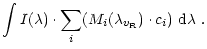
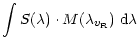
 is the recorded spectrum, and
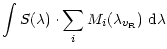
 represents the Doppler-shifted numerical mask which can be expressed as the sum of masks Mi each corresponding to a stellar absorption line i. The resulting
 is a function describing somehow a flux-weighted "mean'' profile of the stellar absorption lines transmitted by the mask. For the radial velocity value of the star, we take the minimum of the CCF, fitted with a Gaussian function.
The cross-correlation technique has proven to be very robust and simple, and to deliver excellent results. The great advantage of the cross-correlation with a numerical mask is that it does not need any high signal-to-noise reference spectra to compute the precise radial velocity. However, it has been shown in the past (Bouchy et al. 2001; Chelli 2000) that in terms of photon noise the technique could still be improved. In fact, the CCF does not extract the radial-velocity information content in an optimized way. Deep and sharp lines, for example, are not weighted sufficiently, although they contain more radial-velocity information than broad and weak lines. The challenge was therefore to combine the simplicity and robustness of the cross correlation with a more efficient information extraction.
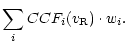
The solution presented here assumes that the absorption lines of the stellar spectrum used to compute the radial velocity have all about the same FWHM, which is a good approximation since broad lines are not included in our standard numerical mask. The lines have different relative depths which are averaged in the resulting CCF. Lines with large relative depth contain intrisically more radial-velocity information than weak lines, however. Our goal is therefore to build up a weighted cross-correlation function
 which accounts for the correct weight of each spectral line contained in the mask:
 is indeed of equal amplitude in both cases, namely
 .
The noise on each point of the cross-correlation function is however proportional to the square root of the real spectral signal Si, and thus
.
The noise on each point of the cross-correlation function is however proportional to the square root of the real spectral signal Si, and thus  times larger in the CCFl. If we would fit each cross-correlation function CCFi independently we would get a precision on the fitted position which is
larger for the line m. Thus, the weight of the line l should be greater.
times larger in the CCFl. If we would fit each cross-correlation function CCFi independently we would get a precision on the fitted position which is
larger for the line m. Thus, the weight of the line l should be greater.
In general, for a given amplitude of the cross-correlation signal CCFi, the noise on each point of the CCF - and thus on the resulting Gaussian fit - is
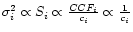 .
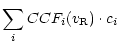
The weight we have to give to the single CCFi must therefore be equal to
.
The weight we have to give to the single CCFi must therefore be equal to
 ,
where ci is the relative depth of each spectral line i. Eq. (5) becomes then:
,
where ci is the relative depth of each spectral line i. Eq. (5) becomes then:
 km s-1 (
 Å at 6000 Å). These means that every stellar line lying within km s-1 from a telluric line is potentially affected by a telluric line more or less strongly in some period of the year. The superposition of these effects can then result in an increased "noise'' or even in an erroneous periodic signal on the stellar velocity with a period of one year. Figure 1 shows simulations made on real ELODIE spectra.
![\begin{figure}
\par\includegraphics[width=8.8cm,clip]{H3477F1}\end{figure}](/articles/aa/full/2002/23/aah3477/img29.gif) |
Figure 1: The plot shows the error on the measured radial velocity produced by telluric lines as a function of Earth radial velocity. For this purpose a real stellar spectrum has been Doppler-shifted by a radial-velocity value ranging from -30 km s-1 to +30 km s-1 and superimposed with a zero-velocity telluric absorption spectrum. The obtained radial velocity has then been compared to the star velocity obtained on the original stellar spectrum, the error being the difference between them. The solid line shows the results using the original numerical mask while the dashed line represents the results with the new clean mask. |
| Open with DEXTER | |
HD 108147 (HIP 60644) is a F8/G0 dwarf in the Crux constellation. Its magnitude is V = 6.99 while the HIPPARCOS catalogue (ESA 1997) lists a color index B-V = 0.537. The precise astrometric parallax is
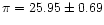 mas corresponding to a distance of about 38.57 pc from the Sun. The derived absolute magnitude, MV = 4.06, is typical for a G0 dwarf.
Stellar parameters such as effective temperature
 K, surface gravity
 ,
as well as [Fe/H] = +0.2 have been derived in the detailed LTE spectroscopic analysis carried out by Santos et al. (2001). The obtained metallicity is slightly higher than the average value for stars of the CORALIE sample, like most of the stars with giant planets, and is very close to the mean value of [Fe/H] of stars with planets (Santos et al. 2001). Using the evolutionary tracks of the Geneva models given by Schaerer et al. (1993), Santos et al. (2001) compute a stellar mass M=1.27
,
as well as [Fe/H] = +0.2 have been derived in the detailed LTE spectroscopic analysis carried out by Santos et al. (2001). The obtained metallicity is slightly higher than the average value for stars of the CORALIE sample, like most of the stars with giant planets, and is very close to the mean value of [Fe/H] of stars with planets (Santos et al. 2001). Using the evolutionary tracks of the Geneva models given by Schaerer et al. (1993), Santos et al. (2001) compute a stellar mass M=1.27  .
The stellar mass is higher than the "typical'' mass of G0 dwarfs and can be explained by the high metallicity of the star.
.
The stellar mass is higher than the "typical'' mass of G0 dwarfs and can be explained by the high metallicity of the star.
![\begin{figure}
\par\includegraphics[width=8.8cm,clip]{H3477F2}\end{figure}](/articles/aa/full/2002/23/aah3477/img34.gif) |
Figure 2:
 Å Ca II H absorption line region of the summed CORALIE spectra. Upper panel: HD 108147. Lower Panel: HD 168746. Both objects show low chromospheric activity. Strong activity would result in an emission peak in the center of the absorption line. Å Ca II H absorption line region of the summed CORALIE spectra. Upper panel: HD 108147. Lower Panel: HD 168746. Both objects show low chromospheric activity. Strong activity would result in an emission peak in the center of the absorption line. |
| Open with DEXTER | |
Figure 2 shows the Ca II H absorption line region of the CORALIE spectrum at
Å. The emission flux in the core of the Ca II H line corrected for the photospheric flux provides us with the chromospheric activity index
 (Santos et al. 2000) from which we derive the activity indicator
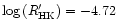 .
This value is typical for stars with a low chromospheric activity level (Henry et al. 1996). Using the calibration given by Donahue (1993) and quoted in Henry et al. (1996) we compute for this star an age of approximately 2 Gyrs, while the rotational period resulting from the calibration given by Noyes et al. (1984) is of 8.7 days. The star is not seen as photometrically variable in the HIPPARCOS data, confirming again the low activity level.
We have estimated the projected rotational velocity of the star to be
.
This value is typical for stars with a low chromospheric activity level (Henry et al. 1996). Using the calibration given by Donahue (1993) and quoted in Henry et al. (1996) we compute for this star an age of approximately 2 Gyrs, while the rotational period resulting from the calibration given by Noyes et al. (1984) is of 8.7 days. The star is not seen as photometrically variable in the HIPPARCOS data, confirming again the low activity level.
We have estimated the projected rotational velocity of the star to be
 km s-1 by means of the CORALIE cross-correlation function (CCF) (Queloz et al. 1998). The relatively high stellar rotation could cause a small jitter on the radial-velocity data, which are however expected to be in the order of only few m s-1 (Saar & Donahue 1997; Santos et al. 2001). The observed and inferred stellar parameters are summarized in Table 1.
|
![\begin{displaymath}\begin{tabular}{l@{}lcc}
\hline\hline
\multicolumn{2}{l}{\bf...
...\rm HK}$) & [Gyr] & 2.17 & --/old star \\
\hline
\end{tabular}\end{displaymath}](/articles/aa/full/2002/23/aah3477/img38.gif)
|
The precise radial velocity data of HD 108147 have been collected
by our group during the period of time from March 1999 to February 2002.
The result of this campaign is a set of 118 data points having a mean photon-noise error on the
individual measurements of
 = 7.8 m s-1. A periodic variation
of the radial velocity could be detected on this data, which clearly indicates the presence of a
planetary companion. The measured variation cannot be produced by stellar activity: the Geneva photometry
data show very low dispersion of 1 mmag and no CCF-bisector variation (Queloz et al.
2001b) has been measured at the m s-1 level. Therefore the planetary explanation
seems to be the most likely.
= 7.8 m s-1. A periodic variation
of the radial velocity could be detected on this data, which clearly indicates the presence of a
planetary companion. The measured variation cannot be produced by stellar activity: the Geneva photometry
data show very low dispersion of 1 mmag and no CCF-bisector variation (Queloz et al.
2001b) has been measured at the m s-1 level. Therefore the planetary explanation
seems to be the most likely.
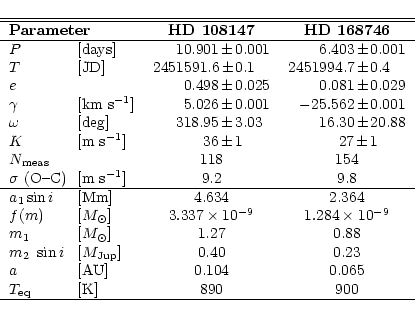
The best-fit Keplerian orbit to the data is shown in Fig. 3. It yields a
precisely-determined orbital period P of
 days and a large eccentricity
 .
The semi-amplitude of the radial-velocity variation is
.
The semi-amplitude of the radial-velocity variation is  m s-1. The weighted rms of the data to the Keplerian fit is 9.2 m s-1. The complete set of orbital elements with their uncertainties are given in Table 2.
Using the best-fit orbital parameters and the mass of HD 108147 given above we derive for the companion a minimum mass

 (which is about only 1.34 times the mass of Saturn). Because of the many data points and the long observation period the orbit is determined very accurately. This allows us to determine the minimum mass of the companion with accuracy of better than 4%, provided that we do not consider the major error source, namely the uncertainty on the mass of the primary. From the orbital parameters and the star mass we get also the separation of the companion to its parent star which is a=0.104 AU. The surface equilibrium temperature of the planet at such a distance is estimated to be about 890 K, following Guillot et al. (1996).
HD 108147 b belongs to the so-called hot Jupiter (or better: hot Saturn!) category of extra-solar planets. The close location to its parent star makes the planet a good candidate for a photometric transit search. The photometric monitoring described in a forthcoming paper (Olsen et al., in prep.) did unfortunately not show any indication for a transit.
![\begin{figure}
\par\includegraphics[width=8.8cm,clip]{H3477F3}
\end{figure}](/articles/aa/full/2002/23/aah3477/img45.gif) |
Figure 3: Phase-folded radial-velocity measurements obtained with CORALIE for HD 108147. The error bars represent photon-noise errors only. On the lower panel the residuals of the measured radial velocities to the fitted orbit are plotted as a function of time. They show a tiny indication for the presence of a long-period, second companion of HD 108147. |
| Open with DEXTER | |
|
|
The weighted rms of the data to the Keplerian fit is 9.2 m s-1 and the reduced  is 1.440, indicating an internal error for the single measurements of 6.4 m s-1. The residual dispersion is 6.6 m s-1 and is only partially composed of instrumental errors, which are in the order of 3 m s-1 (Queloz et al. 2001a). The remaining 6 m s-1 could be due to stellar jitter, since the star is fairly rapidly rotating. Closer analysis of the residuals (Fig. 3, bottom) might indicate however the presence of a possible second companion with an orbital period P of
 days and a minimum mass of
 .
A best-fit solution considering a second companion reduces the rms to the Keplerian to 8.0 m s-1 while the reduced
passes from 1.440 to 1.290. In order to confirm or reject this possibility we will continue to collect additional high-precision data during the next observational seasons. We plan to monitor the radial velocity of this object using the CORALIE spectrograph, but also taking advantage of the superior performances of the HARPS spectrograph (Pepe et al. 2000) which is expected to reach a radial-velocity precision of 1 m s-1.
.
A best-fit solution considering a second companion reduces the rms to the Keplerian to 8.0 m s-1 while the reduced
passes from 1.440 to 1.290. In order to confirm or reject this possibility we will continue to collect additional high-precision data during the next observational seasons. We plan to monitor the radial velocity of this object using the CORALIE spectrograph, but also taking advantage of the superior performances of the HARPS spectrograph (Pepe et al. 2000) which is expected to reach a radial-velocity precision of 1 m s-1.
In the error budget of our best single-orbit solution about 6.6 m s-1 arise from sources other that photon noise. The rms obtained with the standard algorithm was 11.9 m s-1 and with the weighted cross correlation 10.1 m s-1. Considered this, the weighted cross correlation reduced the radial velocity dispersion arising from photon noise by a factor 1.31, confirming the simulation results. On the other hand, the rms of 11.9 m s-1 obtained with the original mask passes to 10.7 m s-1 with the new clean mask. Thus, we estimate that the telluric lines add a dispersion on the stellar radial velocity of roughly 5 m s-1.
| Cross correlation | Obtained rms [m s-1] |
| Standard | 11.9 |
| Clean mask only | 10.7 |
| Weighted only | 10.1 |
| Weighted & clean mask | 9.2 |
 .
Finally, additional scenarios to explain high eccentricities were proposed recently: for example the migration of a single Jupiter-mass planet through a planetesimal disk (Levison et al. 1998), or, the simultaneous formation and migration of two or more planets through the accretion disk,
e.g. locked in a resonant system (Murray et al. 2002). The numerical simulations in the latter paper show that a large variety of possible results can be obtained, depending on the initial planetary mass(es), disk properties and time scales.
.
Finally, additional scenarios to explain high eccentricities were proposed recently: for example the migration of a single Jupiter-mass planet through a planetesimal disk (Levison et al. 1998), or, the simultaneous formation and migration of two or more planets through the accretion disk,
e.g. locked in a resonant system (Murray et al. 2002). The numerical simulations in the latter paper show that a large variety of possible results can be obtained, depending on the initial planetary mass(es), disk properties and time scales.
In summary, various mechanisms can explain short-period eccentric orbits. In almost all of them interaction with planetary or stellar companions plays a fundamental role, and the large eccentricity of the orbit might be an indication for their presence. Therefore it is very likely to find a second, long-period companion around HD 108147. As mentioned above the long-term follow up of this object might confirm or reject this possibility.
HD 168746 (HIP 90004) is a G5 dwarf of magnitude V = 7.95 located at the boundary between the Scutum and the Serpens Cauda constellations. The HIPPARCOS catalogue lists a color index B-V = 0.713. The catalogue indicates also an astrometric parallax of  mas (ESA 1997) corresponding to a distance of about 38.57 pc between the star and the Sun. The resulting absolute magnitude is MV = 4.78.
The spectroscopic analysis by Santos et al. (2001) indicates an effective temperature
 K,
K,
 ,
and [Fe/H] = -0.06. The combination of the precise spectroscopic parameters with the evolution models provide a stellar mass of
,
and [Fe/H] = -0.06. The combination of the precise spectroscopic parameters with the evolution models provide a stellar mass of
 .
The emission flux in the core of the Ca II H shows no evidence for chromospheric activity (see Fig. 2). Since the star is too faint it has not been possible to compute a reliable value for
.
The emission flux in the core of the Ca II H shows no evidence for chromospheric activity (see Fig. 2). Since the star is too faint it has not been possible to compute a reliable value for
 from the CORALIE spectra. Therefore it was not possible to derive neither the age nor
 .
Evolutionary tracks suggest for this star an age of at least several Gyrs.
.
Evolutionary tracks suggest for this star an age of at least several Gyrs.
During the period spanning from May 1999 to September 2001 we have recorded 154 precise radial-velocity data points of HD 168746. Because of the magnitude of the star the mean photon-noise error on the individual measurements is relatively high, namely of
= 9.7 m s-1. Due to the large amount of data we could nevertheless identify easily the presence of a companion with a very low minimum mass. Because of the photometric stability of HD 168746 and the absence of line-bisector variations we can exclude that the measured radial-velocity variation is produced by stellar activity.
![\begin{figure}
\par\includegraphics[width=8.8cm,clip]{H3477F4}\par\end{figure}](/articles/aa/full/2002/23/aah3477/img57.gif) |
Figure 4: Phase-folded radial-velocity measurements obtained with CORALIE for HD 168746. The error bars represent photon-noise errors only. The lower panel shows the residuals of the measured radial velocities to the fitted orbit as a function of time. |
| Open with DEXTER | |
Figure 4 shows the best fitted Keplerian orbit for the companion of HD 168746. We deduce an orbital period P of
 days and a rather small eccentricity of
 .
The semi-amplitude of the radial-velocity variation is only
.
The semi-amplitude of the radial-velocity variation is only  m s-1. The period and the semi-amplitude are well constrained thanks to the large amount of data points covering many periods. The complete set of orbital elements with their uncertainties are given in Table 2.
The best-fit orbital parameters and the mass of HD 168746 yield for its companion a minimum mass of
 ,
which is only 0.77 times the mass of Saturn. The accuracy obtained on this mass estimation is better than 3%, if we again do not consider the uncertainty on the mass of the primary. The separation of the companion to its parent star is a=0.065 AU. The surface equilibrium temperature of the planet at such a distance is about 900 K. Similarly to HD 108147, a dedicated search for a possible photometric transit of the planets in front of HD 168746 remained unsuccessful (Olsen et al., in prep.).
,
which is only 0.77 times the mass of Saturn. The accuracy obtained on this mass estimation is better than 3%, if we again do not consider the uncertainty on the mass of the primary. The separation of the companion to its parent star is a=0.065 AU. The surface equilibrium temperature of the planet at such a distance is about 900 K. Similarly to HD 108147, a dedicated search for a possible photometric transit of the planets in front of HD 168746 remained unsuccessful (Olsen et al., in prep.).
The radial velocity data were computed, as for HD 108147, using the weighted correlation and the cleaned numerical mask. We confirm a reduction of the measured dispersion: the weighted rms of the data to the Keplerian fit decreased from the original 11.2 m s-1 to the final 9.8 m s-1, with a reduced
of 1.5.
The CORALIE individual radial-velocity measurements presented in this paper are available in electronic form at CDS in Strasbourg.
The companions to HD 108147 and HD 168746 possess minimum masses of 1.34 and 0.77
,
respectively. The latter is one of the lightest extra-solar planet candidates found to date. Both objects have been detected by means of the CORALIE spectrograph. CORALIE and its twin instrument ELODIE are particularly efficient for the detection of light planets: seven of the ten lightest candidates and two of the four sub-Saturnian companions have been discovered using these instruments, among which HD 83443 c, the lightest ever discovered planetary companion with only 0.53
.
The suitability of CORALIE for the detection of low-mass planetary companions arises from the intrinsic instrument precision which is better than 3 m s-1 over long time scales. Despite the modest size of the telescope the overall detection efficiency of CORALIE is high, due certainly to the telescope-time availability and, in particular, to the simultaneous ThAr reference. The ThAr technique allows us to cover the full visible wavelength range without any transmission losses, ensuring a gain in flux of at least a factor of 6 compared to the use of an iodine absorption cell. The photon noise is thus reduced by a factor of about 2-2.5 compared to an exposure of same duration using the iodine cell (Bouchy et al. 2001). Nevertheless, the measurements remain in many cases photon-noise limited. The new weighted cross-correlation algorithm presented in this paper allowed us to reduce by about 1.25 the photon-noise contribution to the radial-velocity data. Although some improvement of CORALIE and its data reduction software is still going on, our major future step will be to complete the realization of HARPS (Pepe et al. 2000), a new stable and efficient echelle spectrograph dedicated to the search for extra-solar planets with the ESO 3.6-m telescope at La Silla. The aimed precision of 1 m s-1 should considerably increase the detection rate of sub-Saturnian planets.
Acknowledgements
We thank Dr. Paul Bartholdi for his precious help in implementing the "weighted correlation'' method. We are grateful to the staff from the Geneva and Haute-Provence Observatories who have built and maintain the new 1.2-m Euler Swiss telescope and the CORALIE echelle spectrograph at La Silla. We thank the Geneva University and the Swiss NSF (FNRS) for their continuous support for this project. Support to N.S. from Fundação para a Ciência e Tecnologia (Portugal) is gratefully acknowledged.