![[*]](/icons/foot_motif.gif)
A&A 388, 461-469 (2002)
DOI: 10.1051/0004-6361:20020571
V. L. Afanasiev1 - O. K. Sil'chenko2,3
1 - Special Astrophysical Observatory, Nizhnij Arkhyz, 369167 Russia
2 -
Sternberg Astronomical Institute, University Av. 13,
Moscow 119992, Russia
3 -
Isaac Newton Institute of Chile, Moscow Branch
Received 23 November 2001/ Accepted 12 April 2002
Abstract
Kinematics and stellar population properties in the
center of nearby Sbc galaxy NGC 5055 are studied with the
Multi-Pupil Spectrograph of the 6 m telescope of the Special
Astrophysical Observatory of Russian Academy of Sciences (SAO
RAS). We confirm the rotation and stellar velocity dispersion
asymmetries along the major axis reported earlier by other
authors. We have found a resolved chemically distinct core in
NGC 5055, with the magnesium-enhanced region shifted by  (100 pc) to the south-west from a photometric center, toward a
kinematically identified circumnuclear stellar disk. Mean ages of
stellar populations in the true nucleus, defined as the
photometric center, and in the magnesium-enhanced substructure are
coincident and equal to 3-4 Gyr being younger by several Gyr with
respect to the bulge stellar population. A possible origin of the
asymmetries in the center of NGC 5055 is discussed.
(100 pc) to the south-west from a photometric center, toward a
kinematically identified circumnuclear stellar disk. Mean ages of
stellar populations in the true nucleus, defined as the
photometric center, and in the magnesium-enhanced substructure are
coincident and equal to 3-4 Gyr being younger by several Gyr with
respect to the bulge stellar population. A possible origin of the
asymmetries in the center of NGC 5055 is discussed.
Key words: galaxies: individual: NGC 5055 - galaxies:
nuclei - galaxies: stellar content -
galaxies: kinematics and dynamics
- galaxies: evolution
Very nearby luminous galaxies seem to be studied in detail because each of them has a long list of papers devoted to various aspects of its appearance. But a greater amount of information always reveals an extreme complexity and individuality of the target, so no galaxy is understood in detail. We will use NGC 5055 to illustrate this idea. The main characteristics of this galaxy are given in Table 1.
| NGC 5055 | |
| Type (NED1) | SA(rs)bc |
| R25, kpc (LEDA2) | 17.2 |
 (RC33)
 |
9.03 |
| MB (LEDA) | -21.27 |
| B-V (RC3) | 0.72 |
 (radio, LEDA), km
 |
503 |
Distance (LEDA,
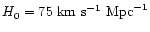 ) ) |
9.2 Mpc |
| Inclination (LEDA) |
 |
PA
 (LEDA, NED)
 |
 |
 ,
km
(LEDA) ,
km
(LEDA) |
211 |
 ,
km
(Heraudeau & Simien 1998) ,
km
(Heraudeau & Simien 1998) |
 |
| 1NASA/IPAC Extragalactic Database. | |
| 2Lyon-Meudon Extragalactic Database. | |
| 3Third Reference Catalogue of Bright Galaxies. | |
A large nearby Sbc galaxy, NGC 5055 attracted the attention of investigators from the beginning of the quantitative extragalactic researches. Fish (1961) did photographic surface photometry of the galaxy, and Burbidge et al. (1960) obtained a rotation curve of the ionized gas with the slit aligned with the major axis of the galactic isophotes. Later, Bosma (1981) studied the rotation and structure of its neutral hydrogen disk and found that the HI disk was twice as extended as the stellar one and showed a noticeable warp beyond the boundaries of the optical image. Afterward kinematical and photometric studies of NGC 5055 were repeated more than once, and often the results were controversial.
Firstly, the spiral arm classification of NGC 5055 remains ambiguous. In the optical Elmegreen (1981) and Elmegreen & Elmegreen (1987) classified NGC 5055 as a flocculent spiral galaxy. But in the NIR (K')- and CO-images Thornley (1996) and Thornley & Mundy (1997) saw two disconnected grand-design spiral patterns, inner and outer, with a boundary at 1.5-2.0 kpc from the center.
Secondly, though the classification of NGC 5055 as Sbc is
certain, we do not know yet if the galaxy is disk- or
bulge-dominated. Thornley (1996), by decomposing the
K'-brightness profile into an exponential disk and a de
Vaucouleurs' bulge, found that the bulge is almost everywhere
more luminous than the disk, including the regions with
grand-design stellar spiral arms. Fillmore et al.
(1986) found that the disk of NGC 5055
dominates the bulge at
 ,
but according to
decomposition results by Baggett et al. (1998), the disk
starts to dominate at
,
but according to
decomposition results by Baggett et al. (1998), the disk
starts to dominate at
 .
Determinations of the disk
exponential scalelength range from 40
.
Determinations of the disk
exponential scalelength range from 40 (Acaretta et al.
1996) to 98
(Kent 1987). Our experience of
brightness profile decompositions with NGC 7331
(Sil'chenko 1999b) and NGC 7217 (Sil'chenko & Afanasiev 2000) shows that when such a variety of
decomposition results exists, a global disk may be readily divided
into several decoupled segments. Two disconnected parts of the spiral
pattern in NGC 5055 make this feasible.
(Acaretta et al.
1996) to 98
(Kent 1987). Our experience of
brightness profile decompositions with NGC 7331
(Sil'chenko 1999b) and NGC 7217 (Sil'chenko & Afanasiev 2000) shows that when such a variety of
decomposition results exists, a global disk may be readily divided
into several decoupled segments. Two disconnected parts of the spiral
pattern in NGC 5055 make this feasible.
The results of kinematical studies are also unusual. Fillmore
et al. (1986) obtained long-slit cross-sections along
the major and minor axes and compared the line-of-sight velocity
distributions for the stars and ionized gas with the model predictions
based on the brightness distribution. Both observed velocity profiles,
and especially the one for the stars, appeared to be
strongly asymmetric. The relative (rotation?) velocities of the stars to
the east of the nucleus are twice as low as those to the west, and the
corresponding stellar velocity dispersions differ in the opposite sense.
Fillmore et al. (1986) note that the isophote shape in the
center of NGC 5055
implies strong dust influence to the west and south-west of the
nucleus; perhaps, on one (the eastern) side they saw the bulge and
on the other (western) side the (warped) disk.
However, simultaneously they detected "weaker absorption lines''
just in the region where the kinematics implied the bulge; this
combination seemed to them improbable. So the puzzle remains to be solved.
Pismis et al. (1995) analysed ionized-gas line-of-sight
velocity distributions along four different directions obtained
under good seeing conditions (
 ), and they
also found a noticeable asymmetry along the major axis: within
), and they
also found a noticeable asymmetry along the major axis: within
 to the west of the nucleus there is an excess
of relative gas velocity. The authors treat this excess as
a manifestation of gas radial outflow due to mild nuclear
activity - a rather strange interpretation considering
that on the major axis the projection of radial velocities onto the
line of sight is zero.
to the west of the nucleus there is an excess
of relative gas velocity. The authors treat this excess as
a manifestation of gas radial outflow due to mild nuclear
activity - a rather strange interpretation considering
that on the major axis the projection of radial velocities onto the
line of sight is zero.
Among the other interesting features of NGC 5055 we must mention
its ultraviolet nucleus. The galaxy is classified as a "UV-bright LINER''
- within the heterogeneous class of LINERs, the "UV-bright'' ones
are usually thought to possess a non-thermal ionizing source. But
in NGC 5055 the ultraviolet nucleus mapped by HST/FOC with high
spatial resolution has appeared to be resolved: its diameter is
6
 pc and its absolute magnitude is
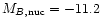 (Maoz et al. 1995), which implies that the UV nucleus of
NGC 5055 may be a young stellar cluster.
(Maoz et al. 1995), which implies that the UV nucleus of
NGC 5055 may be a young stellar cluster.
Some years ago we (Sil'chenko 1994) compiled a list
of galaxies that were candidates for possessing chemically distinct nuclei
based on redder colours of the nuclei with respect to the bulges.
NGC 5055 was not included in this list. But later we saw from
the photometric survey of Heraudeau & Simien (1996) that
it has a very red colour, V-I >1.5, of the central region within
 .
To check if this is a dust concentration or a chemically
distinct nucleus, we needed panoramic spectral observations.
We have observed NGC 5055 with the Multi-Pupil Fiber Spectrograph
(MPFS) of the 6 m telescope in the framework of our program of searching
for chemically distinct nuclei in spiral galaxies, and we
found such a nucleus in this galaxy.
.
To check if this is a dust concentration or a chemically
distinct nucleus, we needed panoramic spectral observations.
We have observed NGC 5055 with the Multi-Pupil Fiber Spectrograph
(MPFS) of the 6 m telescope in the framework of our program of searching
for chemically distinct nuclei in spiral galaxies, and we
found such a nucleus in this galaxy.
In 1999 we undertook two-dimensional spectroscopy of
NGC 5055 with the Multi-Pupil Fiber Spectrograph (MPFS) of the
6 m telescope of the Special Astrophysical Observatory (Nizhnij
Arkhyz, Russia). Exposures were obtained in two spectral ranges:
4250-5600 Å (blue-green), and 5850-7200 Å (red). Detailed
information for the observations is given in Table 2.
A grating of 1200 grooves per mm was used that provided
a reciprocal dispersion of 1.35 Å per pixel and a spectral
resolution of 4 Å. A value for the seeing
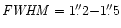 was estimated from an exposure of a double star, STF 1947,
which was used to calibrate the orientation of our pupil frame on the sky.
was estimated from an exposure of a double star, STF 1947,
which was used to calibrate the orientation of our pupil frame on the sky.
| Date | Exposure | Seeing | Sp. range | PA(top) |
| 14/15.06.99 | 40 min |  |
4250-5600 Å |  |
| 15/16.06.99 | 45 min |  |
5850-7200 Å |  |
These spectral observations were made with the new version
of the panoramic spectrophotometer which became operational
at the prime focus of the 6 m telescope at the end of 1997. With
respect to the previous variants of MPFS (Afanasiev et al.
1990,1996),
the field of view is now increased and the common spectral
range is larger due to the use of fibers: they transmit
light from
 square elements of the galaxy image
to the slit of the spectrograph (240 fibers) together with the
sky background taken
square elements of the galaxy image
to the slit of the spectrograph (240 fibers) together with the
sky background taken  away from the galaxy itself
(16 fibers).
The size of one spatial element is
away from the galaxy itself
(16 fibers).
The size of one spatial element is
 .
At the exit of the spectrograph a
.
At the exit of the spectrograph a
 CCD
registers all 256 spectra simultaneously. The primary reduction
of the data is made within IDL. After bias
subtracting, flatfielding, and one-dimensional spectra extraction
from the CCD frame, we linearize and analyse each spectrum
individually. The one-element spectral characteristics, such
as flux in the continuum or in emission lines, redshift, and
absorption-line indices are then combined into two-dimensional
arrays corresponding to the galactic region under consideration
using software developed earlier in the Special
Astrophysical Observatory (Vlasyuk 1993) and our own
programs. To calculate absorption-line indices and their errors we
also used the program of Dr. Vazdekis.
We obtained two-dimensional surface brightness distributions, velocity
fields, and maps of stellar population characteristics. In the
blue-green spectral range, we measured the absorption-line indices
H
CCD
registers all 256 spectra simultaneously. The primary reduction
of the data is made within IDL. After bias
subtracting, flatfielding, and one-dimensional spectra extraction
from the CCD frame, we linearize and analyse each spectrum
individually. The one-element spectral characteristics, such
as flux in the continuum or in emission lines, redshift, and
absorption-line indices are then combined into two-dimensional
arrays corresponding to the galactic region under consideration
using software developed earlier in the Special
Astrophysical Observatory (Vlasyuk 1993) and our own
programs. To calculate absorption-line indices and their errors we
also used the program of Dr. Vazdekis.
We obtained two-dimensional surface brightness distributions, velocity
fields, and maps of stellar population characteristics. In the
blue-green spectral range, we measured the absorption-line indices
H ,
Mgb, Fe5270, and Fe5335 in the Lick
system (Worthey et al. 1994); to check the consistency of our
measurements with the model indices calculated in this system
(Worthey 1994), we regularly observed stars from their list
(Worthey et al. 1994).
The duration of exposure in the blue-green was chosen to be long
enough to provide signal-to-noise ratios of about 100 (per Angstrom)
in the nucleus and
,
Mgb, Fe5270, and Fe5335 in the Lick
system (Worthey et al. 1994); to check the consistency of our
measurements with the model indices calculated in this system
(Worthey 1994), we regularly observed stars from their list
(Worthey et al. 1994).
The duration of exposure in the blue-green was chosen to be long
enough to provide signal-to-noise ratios of about 100 (per Angstrom)
in the nucleus and  20 near the edges of the frames; the
corresponding random error estimations made following Cardiel
et al. (1998) range from 0.15 Å in the center to
0.6-0.8 Å for the individual spatial elements in the outer part.
To keep a constant level of accuracy along the radius, we co-added
the spectra in concentric rings centered on the nucleus, traced the
radial variations of the azimuthally-averaged absorption-line indices,
and compared them to the synthetic models of old stellar populations of
Worthey (1994) and Tantalo et al. (1998). We
estimate the mean accuracy of our azimuthally-averaged indices as 0.1 Å.
Besides index mapping, we use our blue-green spectra to derive a stellar
velocity field in the center of NGC 5055 by cross-correlating
one-element galactic spectra with the spectra of three K-giant stars
with known line-of-sight velocities. In the
red spectral range we measured baricentric positions of the
emission line [NII]
20 near the edges of the frames; the
corresponding random error estimations made following Cardiel
et al. (1998) range from 0.15 Å in the center to
0.6-0.8 Å for the individual spatial elements in the outer part.
To keep a constant level of accuracy along the radius, we co-added
the spectra in concentric rings centered on the nucleus, traced the
radial variations of the azimuthally-averaged absorption-line indices,
and compared them to the synthetic models of old stellar populations of
Worthey (1994) and Tantalo et al. (1998). We
estimate the mean accuracy of our azimuthally-averaged indices as 0.1 Å.
Besides index mapping, we use our blue-green spectra to derive a stellar
velocity field in the center of NGC 5055 by cross-correlating
one-element galactic spectra with the spectra of three K-giant stars
with known line-of-sight velocities. In the
red spectral range we measured baricentric positions of the
emission line [NII] 6583, which is the strongest in the
center of NGC 5055, and also of the H
6583, which is the strongest in the
center of NGC 5055, and also of the H emission line,
to derive the velocity field of the ionized gas. We
estimated the best accuracy of our velocity measurements as 10 km s-1from the night-sky line [OI]6300 analysis.
emission line,
to derive the velocity field of the ionized gas. We
estimated the best accuracy of our velocity measurements as 10 km s-1from the night-sky line [OI]6300 analysis.
In addition to the 2D spectral data, we used some archive photometric data.
NGC 5055 was observed by HST, in particular with NICMOS-CAM3
(ID 7919, PI W. Sparks). The galaxy was exposed on June 4, 1998,
during 192 s through a F160W (H-continuum) filter and during
512 s through a F187N (Pa)
filter. The results of these
observations are reported in detail by Boker et al. (1999);
we use them to estimate morphological parameters of isophotes.
To extend our photometric analysis to the outer parts of the global galactic
disk, we also took recourse to ground-based photometry; we used the
public data of Frei et al. (1996), obtained at the Palomar 1.5 m
telescope through Thuan & Gunn's gri-filters: though of medium
resolution (seeing of
 ), these data are deep
and well-calibrated.
), these data are deep
and well-calibrated.
To study stellar population properties in the center of NGC 5055,
we use the Lick indices H,
Mgb, and
 Fe5270+Fe5335)/2.
Models of simple stellar populations,
e.g. by Worthey (1994),
make it possible to determine simultaneouly a luminosity-weighted mean age
and a mean metallicity for the stellar populations by comparing Hwith Mgb or H
with
Fe5270+Fe5335)/2.
Models of simple stellar populations,
e.g. by Worthey (1994),
make it possible to determine simultaneouly a luminosity-weighted mean age
and a mean metallicity for the stellar populations by comparing Hwith Mgb or H
with
 ,
because the Balmer
absorption lines are more sensitive to the age and the metal-line
indices are more sensitive to the metallicity.
,
because the Balmer
absorption lines are more sensitive to the age and the metal-line
indices are more sensitive to the metallicity.
![\begin{figure}
\par\includegraphics[width=16cm,clip]{h3323f1.eps} \end{figure}](/articles/aa/full/2002/23/aah3323/img50.gif) |
Figure 1:
Lick indices maps (gray-scaled) for the central part of
NGC 5055 overlaid by the green continuum isophotes;
 Fe5270+Fe5335)/2. The maps are spatially
smoothed by a 2D Gaussian with Fe5270+Fe5335)/2. The maps are spatially
smoothed by a 2D Gaussian with
 except the
central
except the
central
 . . |
| Open with DEXTER | |
![\begin{figure}
\par\includegraphics[width=8.41cm,clip]{h3323f2.eps} \end{figure}](/articles/aa/full/2002/23/aah3323/img53.gif) |
Figure 2:
"Index-index'' diagnostic diagrams for the azimuthally averaged
Lick indices in the center of NGC 5055 taken along the radius in
steps of 1
(open circles);
(top)
 vs. Mgb diagram, with the
models of Worthey (1994) for [Mg/Fe]=0, (middle)
H
vs.
,
with the models of Tantalo et al. (1998)
for [Mg/Fe]=+0.3, and (bottom) H
vs.
[MgFe
vs. Mgb diagram, with the
models of Worthey (1994) for [Mg/Fe]=0, (middle)
H
vs.
,
with the models of Tantalo et al. (1998)
for [Mg/Fe]=+0.3, and (bottom) H
vs.
[MgFe
![$]\equiv (\mbox{Mgb} <\mbox{Fe}>)^{1/2}$](/articles/aa/full/2002/23/aah3323/img52.gif) ,
with the models
of Worthey (1994) for [Mg/Fe]=0. In addition to the azimuthally averaged
data we have also plotted the Mg-rich compact region to the south-west
of the nucleus ("SW-island'') by a black dot. Small signs connected by
thin lines present stellar population models of equal ages;
the metallicities for the Worthey's models are +0.50, +0.25, 0.00,
-0.22, -0.50, -1.00,-1.50, -2.00, if one takes the signs from
the right to the left, and for the models of Tantalo et al. they are
+0.4, 0.0, and -0.7. ,
with the models
of Worthey (1994) for [Mg/Fe]=0. In addition to the azimuthally averaged
data we have also plotted the Mg-rich compact region to the south-west
of the nucleus ("SW-island'') by a black dot. Small signs connected by
thin lines present stellar population models of equal ages;
the metallicities for the Worthey's models are +0.50, +0.25, 0.00,
-0.22, -0.50, -1.00,-1.50, -2.00, if one takes the signs from
the right to the left, and for the models of Tantalo et al. they are
+0.4, 0.0, and -0.7. |
| Open with DEXTER | |
Figure 1 presents 2D distributions of the Lick indices
mentioned above
in the center of the galaxy. For a chemically distinct nucleus,
both metal-line indices (or sometimes only Mgb), have to peak
in the photometric center of a galaxy. Indeed, both
and
Mgb vary over the field of view showing maximum values near the
center. But whereas the
peak coincides with the
photometric center of the galaxy, the Mgb-enhanced area is shifted
to the south-west from the nucleus; it is well resolved, with its own
center  from the photometric center
of the galaxy. The whole Mgb-enhanced structure looks like one half
of a nuclear bar or like one half of a highly inclined circumnuclear disk.
Its contrast over the surrounding bulge region,
from the photometric center
of the galaxy. The whole Mgb-enhanced structure looks like one half
of a nuclear bar or like one half of a highly inclined circumnuclear disk.
Its contrast over the surrounding bulge region,  Mgb of
0.6-1.0 Å, exceeds 3
Mgb of
0.6-1.0 Å, exceeds 3 .
The
-enhanced area is more symmetric
around the center though a weak "plume'' toward the Mgb maximum can
be noted. Earlier we found different Mg and Fe distributions
in the centers of galaxies possessing chemically distinct nuclei, but
they were different in opposite sense - usually, the Mgb peak was
unresolved and coincided with the optical nucleus, and the iron-enhanced
areas were more extended and were treated by us as "Fe-rich circumnuclear
disks'' (see e.g. NGC 1023, Sil'chenko 1999a;
NGC 7331, Sil'chenko 1999b; or NGC 4594,
Emsellem et al. 1996). The distribution of H,
though
contaminated by emission at
.
The
-enhanced area is more symmetric
around the center though a weak "plume'' toward the Mgb maximum can
be noted. Earlier we found different Mg and Fe distributions
in the centers of galaxies possessing chemically distinct nuclei, but
they were different in opposite sense - usually, the Mgb peak was
unresolved and coincided with the optical nucleus, and the iron-enhanced
areas were more extended and were treated by us as "Fe-rich circumnuclear
disks'' (see e.g. NGC 1023, Sil'chenko 1999a;
NGC 7331, Sil'chenko 1999b; or NGC 4594,
Emsellem et al. 1996). The distribution of H,
though
contaminated by emission at
 ,
can be used for stellar population
analysis in the center; it matches qualitatively the distribution of
:
the enhanced H
absorption peaks
in the photometric center of the galaxy. This coincidence is explicable:
to obtain a higher iron abundance in stars,
the star formation burst has to be long enough to allow the supply
of a large amount of iron from SNeIa, and such a long star formation
burst would decrease the mean age of the integrated stellar population,
thus increasing the H
index. But to determine correctly both
age and metallicity, we must use "H
vs. metal index''
diagrams.
,
can be used for stellar population
analysis in the center; it matches qualitatively the distribution of
:
the enhanced H
absorption peaks
in the photometric center of the galaxy. This coincidence is explicable:
to obtain a higher iron abundance in stars,
the star formation burst has to be long enough to allow the supply
of a large amount of iron from SNeIa, and such a long star formation
burst would decrease the mean age of the integrated stellar population,
thus increasing the H
index. But to determine correctly both
age and metallicity, we must use "H
vs. metal index''
diagrams.
Firstly we must assure ourselves about the magnesium-to-iron ratio in the
central stellar population of NGC 5055. If this ratio is not solar,
and we apply models with the solar Mg/Fe to these data, various
metal-line indices, when confronted with H,
would give different
age estimates. Figure 2 (top) presents a "
vs. Mgb''-diagram to provide the necessary analysis. As was shown by
Worthey et al. (1992), in the "iron index vs. magnesium
index''-diagrams the models of stellar populations with solar Mg/Fe ratio
are concentrated within a narrow locus independent of their ages or initial
stellar mass function. Any deviation from this locus signifies a non-solar
magnesium-to-iron ratio. Worthey et al. (1992) found that the majority
of elliptical galaxies lie to the right of the model locus, being
mostly magnesium overabundant. Theoreticians now explain this feature
by a main star formation epoch with duration less than 1 Gyr
which finished before the bulk of SNeIa exploded.
In disk galaxies, the statistics of the magnesium-to-iron ratio is more
heterogeneous due perhaps to a larger variety in their circumnuclear
evolution. In NGC 5055 (Fig. 2, top) the first impression
is that the magnesium-to-iron ratio is close to the solar one and does not
change substantially along the radius. But when we look at the next diagram,
"H
vs.
'', or at the diagram of
"H
vs. [MgFe]'' (Fig. 2 middle and bottom), we discover
that because of the high H
index in the photometric center
of the galaxy the mean age of the nuclear stellar population cannot be
larger than 3-4 Gyr. This means that the position of the galactic
nucleus, and also of the nearest circumnuclear outskirts, in the diagram
"
vs. Mgb'' suggests rather a mild magnesium
overabundance if compared to the 5-Gyr model sequence.
Therefore, to quantify carefully the population parameters we must also
involve the models of Tantalo et al. (1998)
calculated for [Mg/Fe]=+0.3. The middle and bottom parts of Fig. 2
present age-diagnostic diagrams for [Mg/Fe]=+0.3 (the models of
Tantalo et al. 1998) and for [Mg/Fe]=0 (the models of Worthey
1994); the right value of the age lies between
the estimates made from these two diagrams. To use the
absorption-line index H
for the stellar population diagnostics,
we must correct it for the emission contamination which is not negligible
at
.
We have done it in the following way: we have summed
the red spectra in the same concentric rings as the green ones,
have calculated the equivalent widths of the H
emission line,
 ,
and then have estimated the correction for the
H
emission as
,
and then have estimated the correction for the
H
emission as
 (Stasinska & Sodre 2001). The values of H
indices
in Fig. 2 have all been corrected for the emission. By inspecting the
Fig. 2, middle and bottom, we conclude that the mean ages of
the stellar populations in the nucleus and in the magnesium-enhanced region
to the SW of the nucleus are roughly the same and are certainly less
than 5 Gyr; we estimate them as 3-4 Gyr. The mean metallicity of
the nucleus is higher than the solar,
(Stasinska & Sodre 2001). The values of H
indices
in Fig. 2 have all been corrected for the emission. By inspecting the
Fig. 2, middle and bottom, we conclude that the mean ages of
the stellar populations in the nucleus and in the magnesium-enhanced region
to the SW of the nucleus are roughly the same and are certainly less
than 5 Gyr; we estimate them as 3-4 Gyr. The mean metallicity of
the nucleus is higher than the solar,
![$\mbox{[Fe/H]}_{\rm nuc}\approx +0.2 {-} +0.3$](/articles/aa/full/2002/23/aah3323/img60.gif) ,
and the mean metallicity of the SW magnesium-rich "island'' is higher
by 0.2-0.3 dex than that of the nucleus. Farther from the center,
the mean age of the stellar population rises sharply and the
Mg/Fe ratio approaches the solar one. Basing ourselves mainly on the models
of Worthey (1994) (Fig. 2, bottom) we estimate
the mean age of the stellar population in the bulge of NGC 5055,
at
,
and the mean metallicity of the SW magnesium-rich "island'' is higher
by 0.2-0.3 dex than that of the nucleus. Farther from the center,
the mean age of the stellar population rises sharply and the
Mg/Fe ratio approaches the solar one. Basing ourselves mainly on the models
of Worthey (1994) (Fig. 2, bottom) we estimate
the mean age of the stellar population in the bulge of NGC 5055,
at
 ,
as 8-10 Gyr.
,
as 8-10 Gyr.
To illustrate how severely the H
index is contaminated by
Balmer emission in the central region of NGC 5055
and to give an impression of the ionized gas distribution and excitation,
we present surface brightness distributions of the red emission line
intensities in Fig. 3. The H
emission is negligible
in the nucleus (see also Pogge's, 1989, statement that
NGC 5055 lacks emission lines in the nucleus), but there are several
bright spots, including one on the major axis at  to the east of the nucleus and one at 9
to the south-west
of the nucleus. The latter HII region was earlier detected and
noted in their Conclusions by Pismis et al. (1995). Therefore,
though NGC 5055
is known as a LINER, it also possesses "hot spots'' - sites of intense
star formation? - in its circumnuclear area. The intensity distribution
of [NII]6583 is peaked in the nucleus as expected for
the LINER. However, this distribution is noticeably asymmetric around the
center, the eastern part being brighter. If we remember the asymmetry of
the stellar kinematics along the major axis of NGC 5055 reported
by Fillmore et al. (1986) and its interpretation as bulge
obscuration by dust to the west of the nucleus, we have to conclude that
the [NII] emission is probably related mostly to the bulge.
Besides, the doubt of Fillmore et al. (1986) that the weaker
absorption lines to the east of the
nucleus contradict the dynamical arguments for the bulge visibility
here now can be put away because of the detection of the chemically
distinct nucleus in the form of an asymmetric circumnuclear disk-like
structure.
to the east of the nucleus and one at 9
to the south-west
of the nucleus. The latter HII region was earlier detected and
noted in their Conclusions by Pismis et al. (1995). Therefore,
though NGC 5055
is known as a LINER, it also possesses "hot spots'' - sites of intense
star formation? - in its circumnuclear area. The intensity distribution
of [NII]6583 is peaked in the nucleus as expected for
the LINER. However, this distribution is noticeably asymmetric around the
center, the eastern part being brighter. If we remember the asymmetry of
the stellar kinematics along the major axis of NGC 5055 reported
by Fillmore et al. (1986) and its interpretation as bulge
obscuration by dust to the west of the nucleus, we have to conclude that
the [NII] emission is probably related mostly to the bulge.
Besides, the doubt of Fillmore et al. (1986) that the weaker
absorption lines to the east of the
nucleus contradict the dynamical arguments for the bulge visibility
here now can be put away because of the detection of the chemically
distinct nucleus in the form of an asymmetric circumnuclear disk-like
structure.
The 2D spectroscopy provides us with full line-of-sight velocity fields
for both stars and ionized gas that are much more informative than
long-slit cross-sections. Figure 4 presents isovelocities
of the ionized gas mapped by measuring independently the H
and
[NII]6583
emission lines. The velocity field looks rather regular and reflects
mostly plane gas rotation; a faster rotation implied by the
H
measurements may be an artifact of the strong stellar
H
absorption line and slower stellar rotation
with respect to the ionized gas. Figure 5 gives the
distributions of
the stellar line-of-sight velocities and stellar velocity dispersion.
Indeed, stars rotate slightly slower than the ionized gas. The disturbance
of the stellar velocity field to the south-west of the center seems
to be stronger than the similar isovelocity twisting in Fig. 4,
but in general we may conclude that the velocity anomaly at
to the west and south-west of the nucleus which
was reported by Pismis et al. (1995) for the ionized gas,
is found to be present
in the velocity distributions of both the stars and the ionized gas.
The stellar velocity dispersion distribution (Fig. 5, right)
also looks asymmetric: there is a local minimum of the velocity
dispersion in the nucleus, and its maximum area has an arc-like shape
and is prominent to the west of the photometric center. We find this
rather puzzling.
![\begin{figure}
\includegraphics[width=11cm,clip]{h3323f3.eps} \end{figure}](/articles/aa/full/2002/23/aah3323/img63.gif) |
Figure 3: Emission-line intensity maps (gray-scaled) for the central part of NGC 5055 overlaid by the red continuum isophotes. |
| Open with DEXTER | |
![\begin{figure}
\includegraphics[width=11cm,clip]{h3323f4.eps} \end{figure}](/articles/aa/full/2002/23/aah3323/img64.gif) |
Figure 4:
Ionized-gas line-of-sight velocity fields in the central
part of NGC 5055 (isolines) as measured by the H
and
N[II]6583 emission-line baricenter positions. The gray-scaled
background presents the red continuum intensity. |
| Open with DEXTER | |
![\begin{figure}
\includegraphics[width=11cm,clip]{h3323f5.eps} \end{figure}](/articles/aa/full/2002/23/aah3323/img65.gif) |
Figure 5: The line-of-sight velocity field of the stellar component (left, isolines) and the stellar velocity dispersion map (right, gray-scaled) in the central part of NGC 5055. The continuum intensity is shown as gray-scaled on the left plot and as isolines on the right plot. |
| Open with DEXTER | |
Whereas long-slit kinematical techniques can in general provide
information about real motions of stars and gas only on a priori
assumptions, usually on the assumption of circular (axisymmetric)
rotation, the 2D velocity fields give a possibility to diagnose the
character of these motions, in particular, to verify the validity of
the circular rotation paradigm. If we have an axisymmetric mass distribution,
and rotation on circular orbits, the direction of maximum central
line-of-sight velocity gradient (we shall call it "kinematical major
axis'') should coincide with the line of nodes as well as the
photometric major axis; whereas in the case of a triaxial potential
the isovelocities align with the principal axis of the ellipsoid,
and generally the dynamical and photometrical major axes diverge,
turning in opposite senses with respect to the line of nodes
(e.g. Monnet et al. 1992; Moiseev & Mustsevoy 2000).
In the simple case of cylindric (disk-like) rotation we have a convenient
analytic expression for the azimuthal dependence of the central
line-of-sight velocity gradient within the area of solid-body rotation:
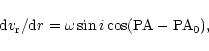
 is the deprojected central rotation angular velocity,
i is the inclination of the rotation plane, and PA0 is the
orientation of the line of nodes, coinciding in the case of the
axisymmetric ellipsoid (or a thin disk) with the photometric
major axis. So by fitting azimuthal variations
of the central line-of-sight velocity gradients with a cosine
curve, we can determine the orientation of the kinematical major
axis by its phase and the central rotation angular velocity
by its amplitude.
is the deprojected central rotation angular velocity,
i is the inclination of the rotation plane, and PA0 is the
orientation of the line of nodes, coinciding in the case of the
axisymmetric ellipsoid (or a thin disk) with the photometric
major axis. So by fitting azimuthal variations
of the central line-of-sight velocity gradients with a cosine
curve, we can determine the orientation of the kinematical major
axis by its phase and the central rotation angular velocity
by its amplitude.
| Component | Radius range of fitting | PA0 |
 ,
km s-1arcsec-1 ,
km s-1arcsec-1 |
| Ionized gas |
 |
 |
 |
| Stars |
 |
 |
 |
| Ionized gas |
 |
 |
 |
| Stars |
 |
 |
 |
| Ionized gas |
 |
 |
 |
| Ionized gas |
 |
 |
 |
![\begin{figure}
\par\includegraphics[width=8.8cm,clip]{h3323f6.eps} \end{figure}](/articles/aa/full/2002/23/aah3323/img90.gif) |
Figure 6:
The azimuthal dependencies of the line-of-sight velocity
gradients for the stars (top) and for the ionized gas
(middle and bottom) in the center of NGC 5055 fitted
by cosine curves with a least-square method. Note the deviations
from the cosine law (or from circular flat rotation) at the
line of nodes. For the stars, black dots show the measurements
in the
 range, and open circles represent
the measurements in the
range, and open circles represent
the measurements in the
 range;
a dashed-line cosine curve fitting formally the latter data
demonstrates a lower rotation-velocity amplitude - but is it
a real effect? The maximum discrepancy between the two data sets
is observed at
range;
a dashed-line cosine curve fitting formally the latter data
demonstrates a lower rotation-velocity amplitude - but is it
a real effect? The maximum discrepancy between the two data sets
is observed at
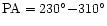 ,
so it is perhaps
the same deviation from a pure circular rotation that is seen
at the bottom plot. ,
so it is perhaps
the same deviation from a pure circular rotation that is seen
at the bottom plot. |
| Open with DEXTER | |
Figure 6 presents the azimuthal variations of the
line-of-sight velocity gradients in a radius ranging from
to  for the stars and for the ionized gas, which are
traced by H
and [NII]6583
emission lines; Table 3 contains the parameter values obtained by fitting
these measurements by a cosine function in somewhat narrower radial bins.
First of all, one can see from Table 3 that due to the good
seeing quality we detect a certain decrease of the gas-rotation angular
velocity over a range of
for the stars and for the ionized gas, which are
traced by H
and [NII]6583
emission lines; Table 3 contains the parameter values obtained by fitting
these measurements by a cosine function in somewhat narrower radial bins.
First of all, one can see from Table 3 that due to the good
seeing quality we detect a certain decrease of the gas-rotation angular
velocity over a range of
 in radius. We do therefore
not confirm the result of Pismis et al. (1995)
concerning solid-body gas
rotation of NGC 5055 up to the radius of 3.
As the solid-body rotation area is traced by us to at most
in radius. We do therefore
not confirm the result of Pismis et al. (1995)
concerning solid-body gas
rotation of NGC 5055 up to the radius of 3.
As the solid-body rotation area is traced by us to at most
 (and actually it is even smaller), the formula
for the azimuthal velocity gradient variations given
above ceases to be precise, but still remains approximately
valid, because due to small ellipticity of isophotes in the center of
NGC 5055 (Fig. 7) the projected radius is close to the
true one. Indeed, the measurements in Fig. 6 are well fitted
by a cosinusoid. We just note one feature of the
azimuthal dependencies of Fig. 6:
in the position angle range of
(and actually it is even smaller), the formula
for the azimuthal velocity gradient variations given
above ceases to be precise, but still remains approximately
valid, because due to small ellipticity of isophotes in the center of
NGC 5055 (Fig. 7) the projected radius is close to the
true one. Indeed, the measurements in Fig. 6 are well fitted
by a cosinusoid. We just note one feature of the
azimuthal dependencies of Fig. 6:
in the position angle range of
 all the plots
demonstrate weaker or stronger deviations from the cosinusoids, in other
words, from circular rotation in the sense that there is a deficiency
of the velocity at
all the plots
demonstrate weaker or stronger deviations from the cosinusoids, in other
words, from circular rotation in the sense that there is a deficiency
of the velocity at
 and an excess at
 .
We think
that just this effect has been
observed by Pismis et al. (1995) in their long-slit cross-sections.
We now have a full two-dimensional picture, though, and it becomes clear
that this cannot be a radial gas outflow; it may be either
counterrotating gas streaming around a thick minibar roughly aligned
with the line of nodes, or, more probably, a gas polar arc (ring?)
shifted from the center and perhaps wrapped around the same minibar.
.
We think
that just this effect has been
observed by Pismis et al. (1995) in their long-slit cross-sections.
We now have a full two-dimensional picture, though, and it becomes clear
that this cannot be a radial gas outflow; it may be either
counterrotating gas streaming around a thick minibar roughly aligned
with the line of nodes, or, more probably, a gas polar arc (ring?)
shifted from the center and perhaps wrapped around the same minibar.
![\begin{figure}
\par\includegraphics[width=8.8cm,clip]{h3323f7.eps} \end{figure}](/articles/aa/full/2002/23/aah3323/img99.gif) |
Figure 7:
Isophote characteristics together with the orientations of
the kinematical major axes for the stars and ionized gas in the center
of NGC 5055. The line of nodes determined from the outermost
isophote orientation is
 and the galaxy plane inclination
of
and the galaxy plane inclination
of  corresponds to
(1-b/a)0=0.43.
corresponds to
(1-b/a)0=0.43. |
| Open with DEXTER | |
It remains unclear if there is really a minibar in the center of
NGC 5055. On the one hand, the morphology of the Mgb surface
distribution, the presence of the HII spot at the major axis, and
the kinematical disturbances described above constitute evidence for it.
On the other hand, we find that the orientations of the kinematical
and photometric major axes in the center of NGC 5055
(Fig. 7) are coincident.
Both may deviate slightly from the line
of nodes of the outer disk, PA
 ,
but they do it together.
Only one possibility for a bar remains under such circumstances:
if it is fully aligned with the line of nodes of the circumnuclear
rotation plane. But in such a configuration the velocity profile along the
major axis must have a plateau in the center and it does not have one.
The problem remains to be solved.
,
but they do it together.
Only one possibility for a bar remains under such circumstances:
if it is fully aligned with the line of nodes of the circumnuclear
rotation plane. But in such a configuration the velocity profile along the
major axis must have a plateau in the center and it does not have one.
The problem remains to be solved.
The kinematical and stellar population parameter distributions in the
center of NGC 5055 have been shown to be so complex that they cannot
yet be interpreted unambiguously. Among a dozen spiral galaxies
with chemically distinct nuclei studied by us with the MPFS, we have
not seen any analogous cases. In the absence of the observational counterparts,
a good choice would be to sketch an environment of this complex central
structure and to try to understand what should proceed inevitably
in such environment from the dynamical point of view. But as we mentioned
in the Introduction, the whole structure of NGC 5055 is highly
ambiguous. Our own attempts to clarify it have not been very productive.
The brightness profile in the range of radius of
 derived from the NICMOS/HST data is well-fitted by a de Vaucouleurs'
formula indicating a classical bulge. But in the same
range of radius the ionized gas spirals are seen -
mainly to the west of the nucleus (Boker et al. 1999);
therefore for some reason the prominent bulge is not able to stabilize
the inner disk. Could the bulge be non-axisymmetric?
Its major axis is aligned in
derived from the NICMOS/HST data is well-fitted by a de Vaucouleurs'
formula indicating a classical bulge. But in the same
range of radius the ionized gas spirals are seen -
mainly to the west of the nucleus (Boker et al. 1999);
therefore for some reason the prominent bulge is not able to stabilize
the inner disk. Could the bulge be non-axisymmetric?
Its major axis is aligned in
 so being turned by
  with respect to the line of nodes,
and the ellipticity is constant but low (Fig. 7).
But the kinematical major axes of the stars and
ionized gas trace the photometric major axis with a high precision
instead of being turned by the same
in opposite sense
(Monnet et al. 1992); so they rotate axisymmetrically. Is it
due to a possible strong mass concentration in the very center? All these
questions remain still unclarified. Now we can only imagine
some possible configurations in the center of NGC 5055 and give
a general qualitative description.
with respect to the line of nodes,
and the ellipticity is constant but low (Fig. 7).
But the kinematical major axes of the stars and
ionized gas trace the photometric major axis with a high precision
instead of being turned by the same
in opposite sense
(Monnet et al. 1992); so they rotate axisymmetrically. Is it
due to a possible strong mass concentration in the very center? All these
questions remain still unclarified. Now we can only imagine
some possible configurations in the center of NGC 5055 and give
a general qualitative description.
A wave perturbation with an m=1 has now become a popular field of
consideration. Theoreticians predicted one-sided bars
(e.g. Colin & Athanassoula 1989) and eccentric nuclei
(e.g. Miller & Smith 1992)
some time ago, one-armed spirals were also favoured by some dynamical models.
Recently a growing amount of observational data has begun to confirm the
reality of such structures, in particular in the centers of normal spiral
galaxies. The most famous lopsided circumnuclear stellar disk belongs
to M 31: its two brightness centers, one with high
stellar velocity dispersion and the other dynamically cold, have been
explained by Tremaine (1995) as an eccentric Keplerian disk around
a supermassive black hole, and Bacon et al. (2001) have argued that
this disk must precess with an angular velocity of some
3 km s-1pc-1 so
suffering an m=1 mode. In NGC 5055 there are too many asymmetries
along the major axis: the brightness asymmetry, including [NII] and
H
emission lines, the rotation and stellar velocity dispersion
asymmetries, and finally, the Mgb index distribution asymmetry found
by us in this work. Whereas a sole brightness asymmetry can always
be explained by the dust projection effect (though it is usually more
pronounced along the minor axis), the whole
complex of asymmetries seen in the center of NGC 5055 proves its
intrinsic physical reality; in particular, the dust cannot affect
narrow-band spectral features, such as the Mgb index, and cannot create
artificial Mgb enhancement to the south-west from the center. We can
imagine a chemically distinct,
rather young circumnuclear stellar disk traced by the high Mgb index;
it can precess slowly so that stars born, say, a few Gyr ago at the
eastern circumnuclear HII region are now to the west of the
dynamical center. We know that there is a mass concentration in the
nucleus of NGC 5055 because of the rotation velocity peak
near the center; it
may be a compact young stellar cluster (Maoz et al. 1995)
or a supermassive black hole, so the whole situation may be similar to
that in M 31, though at a larger scale.
107 yr, and then we should see
some other signatures of merging: tidal tails, global disk heating
and disappearance of spiral structure, etc. We see none.
So the first hypothesis seems to be preferable.
Acknowledgements
We thank the post-graduate student of SAO RAS A. V. Moiseev for supporting the observations at the 6 m telescope. The 6 m telescope is operated under the financial support of Science Ministry of Russia (registration number 01-43). During the data analysis we have used the Lyon-Meudon Extragalactic Database (LEDA) supplied by the LEDA team at the CRAL-Observatoire de Lyon (France) and the NASA/IPAC Extragalactic Database (NED) which is operated by the Jet Propulsion Laboratory, California Institute of Technology, under contract with the National Aeronautics and Space Administration. The research is partly based on observations made with the NASA/ESA Hubble Space Telescope, obtained from the data archive at the Space Telescope Science Institute, which is operated by the Association of Universities for Research in Astronomy, Inc., under NASA contract NAS 5-26555. The work was supported by the grant 1.2.4.1 of the Russian State Scientific-Technical Program "Astronomy. Basic Space Researches" (the "Astronomy'' section).