A&A 388, 158-167 (2002)
DOI: 10.1051/0004-6361:20020450
Integrated photometric characteristics of galactic open star clusters
S. Lata1 - A. K. Pandey1 - R. Sagar12 - V. Mohan1
1 - State Observatory, Manora peak, Nainital 263129, Uttaranchal, India
2 -
Indian Institute of Astrophysics, Bangalore 560034, India
Received 19 November 2001 / Accepted 19 February 2002
Abstract
Integrated UBVRI photometric parameters of 140 galactic open
clusters have been computed. Integrated
I(V-R)0 and
I(V-I)0 colours as well as integrated parameters for 71 star clusters have been obtained for the first time. These, in combination with published data, altogether 352 objects, are used to study the integrated photometric characteristics of the galactic open clusters. The I(MV) values range from -9.0 to -1.0 mag
corresponding to a range in total mass of the star clusters from  25 to
25 to

 .
The integrated colours have a relatively narrow range, e.g.,
I(B-V)0 varies from -0.4 to 1.2 mag. The scatter in integrated colours at a given integrated magnitude can be understood in terms of differences in fraction of red giants/supergiants in the clusters.
The observed integrated magnitudes and colours agree with the synthetic ones, except the dependences of
I(V-R)0 and
I(V-I)0 colours for clusters younger than 100 Myrs and also of the integrated magnitudes of oldest clusters. The large
sample provides the most accurate age dependence of integrated magnitudes and colours determined so far. The luminosity function of the I(MV) has a peak around -3.5 mag and its slope indicates that only 1% of the open clusters in the galactic disc are brighter than
I(MV)=-11 mag. No variation has been found of integrated magnitude with galactocentric distance and metallicity.
.
The integrated colours have a relatively narrow range, e.g.,
I(B-V)0 varies from -0.4 to 1.2 mag. The scatter in integrated colours at a given integrated magnitude can be understood in terms of differences in fraction of red giants/supergiants in the clusters.
The observed integrated magnitudes and colours agree with the synthetic ones, except the dependences of
I(V-R)0 and
I(V-I)0 colours for clusters younger than 100 Myrs and also of the integrated magnitudes of oldest clusters. The large
sample provides the most accurate age dependence of integrated magnitudes and colours determined so far. The luminosity function of the I(MV) has a peak around -3.5 mag and its slope indicates that only 1% of the open clusters in the galactic disc are brighter than
I(MV)=-11 mag. No variation has been found of integrated magnitude with galactocentric distance and metallicity.
Key words: galaxies -
open clusters -
integrated photometry - star formation
![\begin{figure}
\par\includegraphics[width=14.1cm,clip]{3308f1.eps}
\end{figure}](/articles/aa/full/2002/22/aah3308/Timg7.gif) |
Figure 1:
Comparison of the integrated magnitudes I(MV) and
I(B-V)0,
I(U-B)0 colours obtained in this work with those given by Sagar et al. (1983)
(squares), Pandey et al. (1989) (triangles), Spassova & Baev (1985) (crosses), and Battinelli et al. (1994) (hexagons). The solid line represents a slope of unity. The dashed lines represent 3 uncertainties in the
estimation of parameters.
uncertainties in the
estimation of parameters. |
| Open with DEXTER |
Star clusters in a galaxy play an important role in understanding the processes
of star formation and stellar evolution in the galaxy as well as galactic
structure and evolution. The physical quantities required for such studies are
best determined from the observations of individual cluster members.
Unfortunately, such observations are not possible in the case of extra-galactic clusters
because ground based optical telescopes can not resolve
member stars that are separated by less than 1 arcsec.
Even with the Hubble Space Telescope, where
resolution is improved to 0.1 arcsec, all cluster members cannot be
observed in galaxies like M 31, M 33 etc. On the other
hand, in such cases integrated photometric parameters can still be
observable and, in fact, integrated colours and spectra will remain for long time to come the only
way to investigate the evolutionary history of stellar systems beyond the local group of galaxies.
To interpret these parameters in terms of age, stellar content,
metallicity etc. of the extra-galactic star clusters,
it is necessary to study the integrated photometric
parameters of those star clusters of our galaxy where observations of
individual cluster members provide these parameters. Without understanding
these integrated parameters, it may not be possible to study the observations of
integrated light of star clusters of other galaxies, wherein it is not
practical even to visually separate out the open clusters from the globulars.
Integrated light characteristics of star clusters are thus very important.
Based on the observations of individual stars of a galactic star cluster, integrated photometric
parameters have been estimated by several authors (Gray 1965, 1967; Schmidt-Kaler 1967; Piskunov 1972, 1974;
Sagar et al. 1983; Spassova & Baev 1985; Pandey et al. 1989; Battinelli et al. 1994 and references therein).
The luminosity distribution of integrated magnitudes of galactic clusters
have been discussed in detail by van den Bergh & Lafontaine (1984).
Spassova & Baev (1985) and Bhatt et al. (1991) have also obtained
the integrated luminosity function. The slope of the luminosity function obtained
by Bhatt et al. (1991) is steeper than that of van den Bergh & Lafontaine (1984).
Out of over 1200 open star clusters in our galaxy, reliable integrated
photometric parameters are available only for about 200 objects. During the last decade
multicolour CCD photometric data have been obtained for a number of unstudied clusters.
Mermilliod (1995) maintains a data base WEBDA (http://obswww.unige.ch/webda)
for open star clusters. In order to re-investigate the luminosity function studies
we have calculated integrated magnitudes
and colours of 140 clusters in the UBVRI passbands using the method given by Gray (1965). These in combination with earlier estimates provide integrated photometric parameters for 352 star clusters. The sample has been used to study the integrated luminosity function as well as
various photometric properties of integrated light. The data and reduction procedures along
with accuracy of parameters are described in the next section.
The UBV Johnson and RI Cousins CCD data of the open clusters have been taken from the WEBDA data base. To calculate the integrated parameters of the clusters, the photometric membership criterion has been used to reduce the effects of field star contamination. For this purpose, we fitted the theoretical isochrones by Bertelli et al. (1994) to the cluster sequence in the colour-magnitude diagram.
The isochrones were brightened by 0.75 mag to take into account the maximum effects of binaries present in the cluster. This accounts for the broadening of the main-sequence which may also be due to other reasons, e.g., the photometric errors, internal reddening and spread in metallicity. The stars lying along the cluster sequence were considered members and used to compute
the integrated parameters. Wherever CCD data for the bright stars were not available,
the photoelectric data for these stars were taken from the data base. Altogether integrated parameters of 140 clusters were determined. The integrated parameters of 71 star clusters have been computed for the first time. The following relation was used to compute integrated magnitudes in UBVRI passbands
![\begin{displaymath}I(m)= - 2.5 ~ \log \left[ {\sum_ {i}}(10^{-0.4m_{i}})\right],
\end{displaymath}](/articles/aa/full/2002/22/aah3308/img8.gif) |
(1) |
where mi is the magnitude of the ith member star in a passband. In order to account for un-observed faint stars we followed the method suggested by Battinelli et al. (1994).
The integrated apparent colours of the clusters are determined as:
| I(B-V) = I(B) - I(V) |
|
|
(2) |
| I(U-B) = I(U) - I(B) |
|
|
(3) |
| I(V-R) = I(V) - I(R) |
|
|
(4) |
| I(V-I) = I(V) - I(I). |
|
|
(5) |
The apparent integrated magnitudes and colours, thus obtained, are converted
to intrinsic ones and are listed in Table 1 along with the used
distance and E(B-V) values taken from the data base.
The colour excesses E(U-B), E(U-V), E(V-R) and E(V-I) have been calculated from E(B-V) using the relations
E(U-B) = 0.72E(B-V)+0.05E(B-V)2;
E(U-V) = 1.72E(B-V);
E(V-R) = 0.60E(B-V) and
E(V-I) = 1.25E(B-V).
The possible source of errors in determination of the integrated parameters are same as
described by Sagar et al. (1983). The uncertainty in integrated absolute magnitude could
be  mag and in colours it could be
  mag. Battinelli et al. (1994)
have also reported the same order of uncertainty in their estimation of integrated parameters.
mag. Battinelli et al. (1994)
have also reported the same order of uncertainty in their estimation of integrated parameters.
Table 1:
Integrated parameters of the open clusters. The distance
modulus (m-M), E(B-V) and log(age) are taken from data base.
| |
|
|
|
Integrated Absolute values |
| Name of |
(m-M) |
E(B-V) |
 |
I(MV) |
I(U-V)0 |
I(B-V)0 |
I(V-R)0 |
I(V-I)0 |
| cluster |
(mag) |
(mag) |
(t in years) |
(mag) |
(mag) |
(mag) |
(mag) |
(mag) |
| 1 |
2 |
3 |
4 |
5 |
6 |
7 |
8 |
9 |
| NGC 129 |
12.71 |
0.55 |
7.76 |
-6.03 |
-0.25 |
0.39 |
- |
- |
| NGC 146 |
13.61 |
0.49 |
7.60 |
-4.88 |
-0.75 |
-0.07 |
- |
- |
| NGC 188 |
11.41 |
0.09 |
9.82 |
-2.86 |
- |
1.13 |
0.7 |
1.39 |
| NGC 381 |
11.27 |
0.34 |
8.47 |
-2.98 |
-0.31 |
0.11 |
- |
- |
| NGC 433 |
14.58 |
0.86 |
7.50 |
-4.60 |
-0.36 |
-0.09 |
- |
- |
| NGC 436 |
13.88 |
0.48 |
7.78 |
-5.21 |
-0.14 |
0.04 |
- |
0.13 |
| NGC 457 |
13.77 |
0.48 |
7.15 |
-9.01 |
-0.04 |
0.13 |
- |
-0.11 |
| NGC 581 |
13.16 |
0.44 |
7.13 |
-6.82 |
-0.75 |
-0.12 |
- |
-0.10 |
| NGC 637 |
14.12 |
0.70 |
6.96 |
-5.47 |
-1.13 |
-0.28 |
- |
- |
| NGC 654 |
14.64 |
0.85 |
7.08 |
-7.71 |
-0.47 |
-0.21 |
- |
- |
| NGC 659 |
14.00 |
0.64 |
7.63 |
-5.00 |
-0.26 |
-0.14 |
- |
- |
| NGC 663 |
14.42 |
0.82 |
7.13 |
-8.02 |
-0.74 |
-0.14 |
- |
- |
| NGC 869 |
13.48 |
0.58 |
7.10 |
-8.65 |
-1.22 |
-0.23 |
- |
- |
| NGC 884 |
13.83 |
0.58 |
7.15 |
-8.65 |
-0.68 |
0.01 |
- |
- |
| NGC 1039 |
8.82 |
0.10 |
8.26 |
-3.19 |
- |
0.17 |
- |
- |
| NGC 1193 |
13.55 |
0.12 |
9.90 |
-3.00 |
- |
1.06 |
- |
- |
| NGC 1245 |
13.07 |
0.31 |
9.16 |
-3.60 |
- |
0.63 |
- |
- |
| NGC 1750 |
10.08 |
0.34 |
8.30 |
-3.46 |
-0.40 |
0.04 |
0.05 |
0.13 |
| NGC 1798 |
14.75 |
0.51 |
9.15 |
-4.86 |
0.97 |
0.82 |
- |
1.14 |
| NGC 1893 |
14.51 |
0.49 |
7.00 |
-7.63 |
-0.79 |
-0.19 |
- |
- |
| NGC 1907 |
12.24 |
0.43 |
8.61 |
-6.19 |
- |
0.93 |
- |
- |
| NGC 1912 |
11.07 |
0.26 |
8.48 |
-5.22 |
- |
0.83 |
- |
0.32 |
| NGC 1931 |
13.40 |
0.58 |
7.13 |
-3.15 |
-1.02 |
-0.20 |
-0.05 |
-0.07 |
| NGC 2112 |
11.12 |
0.50 |
9.48 |
-1.88 |
- |
0.65 |
- |
- |
| NGC 2158 |
14.51 |
0.49 |
9.27 |
-2.81 |
- |
0.61 |
- |
- |
| NGC 2168 |
10.44 |
0.25 |
8.00 |
-4.93 |
-0.10 |
0.13 |
- |
0.06 |
| NGC 2192 |
13.36 |
0.20 |
9.04 |
-3.53 |
0.59 |
0.49 |
- |
0.54 |
| NGC 2204 |
13.44 |
0.08 |
9.27 |
-4.65 |
- |
0.72 |
- |
1.10 |
| NGC 2243 |
13.17 |
0.03 |
9.49 |
-2.67 |
- |
0.23 |
- |
0.78 |
| NGC 2244 |
12.61 |
0.48 |
6.80 |
-6.69 |
-1.07 |
-0.24 |
- |
- |
| NGC 2264 |
9.57 |
0.06 |
6.99 |
-5.29 |
-1.27 |
-0.27 |
-0.11 |
-0.24 |
| NGC 2266 |
12.98 |
0.10 |
8.86 |
-3.83 |
1.02 |
0.62 |
- |
- |
| NGC 2355 |
12.10 |
0.12 |
8.85 |
-3.67 |
0.81 |
0.59 |
- |
0.64 |
| NGC 2383 |
12.33 |
0.27 |
7.61 |
-3.18 |
- |
-0.05 |
0.04 |
0.08 |
| NGC 2384 |
12.95 |
0.29 |
6.92 |
-5.63 |
- |
-0.21 |
-0.22 |
-0.01 |
| NGC 2420 |
12.02 |
0.02 |
9.32 |
-3.44 |
- |
0.71 |
- |
- |
Table 1:
continued.
| |
|
|
|
Integrated Absolute Values |
| Name of |
(m-M) |
E(B-V) |
|
I(MV) |
I(U-V)0 |
I(B-V)0 |
I(V-R)0 |
I(V-I)0 |
| cluster |
(mag) |
(mag) |
(t in years) |
(mag) |
(mag) |
(mag) |
(mag) |
(mag) |
| 1 |
2 |
3 |
4 |
5 |
6 |
7 |
8 |
9 |
| NGC 2421 |
13.23 |
0.50 |
7.25 |
-4.75 |
-0.89 |
-0.21 |
- |
- |
| NGC 2439 |
14.39 |
0.39 |
7.13 |
-8.00 |
0.38 |
0.52 |
- |
- |
| NGC 2453 |
13.53 |
0.47 |
7.00 |
-5.15 |
- |
-0.25 |
- |
-0.12 |
| NGC 2477 |
12.00 |
0.33 |
8.95 |
-5.70 |
0.66 |
0.49 |
- |
0.67 |
| NGC 2489 |
13.25 |
0.45 |
8.18 |
-3.91 |
1.06 |
0.35 |
- |
- |
| NGC 2506 |
12.89 |
0.13 |
9.07 |
-4.31 |
0.76 |
0.54 |
0.37 |
0.78 |
| NGC 2567 |
11.47 |
0.09 |
8.43 |
-3.68 |
- |
0.56 |
- |
- |
| NGC 2627 |
14.62 |
0.63 |
8.20 |
-4.84 |
- |
0.24 |
- |
0.00 |
| NGC 2658 |
14.18 |
0.40 |
8.30 |
-3.87 |
-0.03 |
0.03 |
- |
- |
| NGC 2660 |
13.52 |
0.38 |
9.22 |
-4.08 |
0.95 |
0.61 |
- |
1.31 |
| NGC 2670 |
11.63 |
0.45 |
7.73 |
-4.24 |
- |
0.62 |
- |
0.74 |
| NGC 2682 |
9.75 |
0.07 |
9.72 |
-3.16 |
1.06 |
0.78 |
0.56 |
- |
| NGC 2818 |
13.11 |
0.18 |
8.97 |
-3.54 |
0.61 |
0.48 |
0.17 |
0.37 |
| NGC 2910 |
11.16 |
0.07 |
8.50 |
-3.14 |
- |
0.12 |
- |
- |
| NGC 3114 |
9.95 |
0.06 |
7.93 |
-5.33 |
- |
0.22 |
- |
- |
| NGC 3766 |
11.98 |
0.20 |
7.42 |
-7.09 |
-0.53 |
0.11 |
- |
-0.14 |
| NGC 4103 |
12.16 |
0.29 |
7.46 |
-4.70 |
-0.82 |
-0.18 |
-0.04 |
-0.03 |
| NGC 4755 |
12.90 |
0.40 |
7.26 |
-8.65 |
-0.85 |
-0.11 |
-0.05 |
-0.03 |
| NGC 4815 |
14.64 |
0.78 |
8.48 |
-6.02 |
0.32 |
0.29 |
- |
- |
| NGC 5168 |
13.34 |
0.66 |
8.18 |
-3.72 |
0.52 |
0.33 |
- |
- |
| NGC 5460 |
9.23 |
0.12 |
8.06 |
-3.84 |
- |
0.04 |
- |
- |
| NGC 5606 |
12.98 |
0.49 |
6.87 |
-5.02 |
-1.14 |
-0.24 |
-0.10 |
-0.22 |
| NGC 5617 |
12.57 |
0.51 |
7.57 |
-4.25 |
-0.87 |
-0.17 |
- |
- |
| NGC 5999 |
13.00 |
0.45 |
8.60 |
-3.85 |
- |
0.18 |
- |
0.29 |
| NGC 6005 |
13.59 |
0.45 |
9.08 |
-3.66 |
- |
0.45 |
- |
0.80 |
| NGC 6031 |
12.75 |
0.50 |
8.40 |
-3.87 |
- |
-0.03 |
- |
0.00 |
| NGC 6067 |
12.34 |
0.37 |
7.97 |
-6.18 |
- |
0.31 |
- |
0.61 |
| NGC 6087 |
10.26 |
0.18 |
7.91 |
-5.09 |
-0.03 |
0.18 |
- |
- |
| NGC 6192 |
12.94 |
0.66 |
7.96 |
-4.57 |
-0.46 |
-0.10 |
- |
- |
| NGC 6204 |
11.63 |
0.43 |
7.92 |
-3.75 |
-0.58 |
-0.07 |
- |
- |
| NGC 6231 |
12.30 |
0.41 |
6.75 |
-8.34 |
-1.15 |
-0.23 |
- |
-0.18 |
| NGC 6253 |
11.53 |
0.20 |
9.70 |
-2.68 |
1.15 |
0.81 |
0.58 |
0.97 |
| NGC 6451 |
13.55 |
0.67 |
8.05 |
-4.45 |
-0.23 |
0.11 |
- |
0.52 |
| NGC 6475 |
7.08 |
0.06 |
8.11 |
-3.89 |
- |
0.12 |
- |
0.50 |
| NGC 6520 |
13.34 |
0.44 |
8.14 |
-5.03 |
-0.54 |
-0.04 |
- |
- |
Table 1:
continued.
| |
|
|
|
Integrated Absolute Values |
| Name of |
(m-M) |
E(B-V) |
|
I(MV) |
I(U-V)0 |
I(B-V)0 |
I(V-R)0 |
I(V-I)0 |
| cluster |
(mag) |
(mag) |
(t in years) |
(mag) |
(mag) |
(mag) |
(mag) |
(mag) |
| 1 |
2 |
3 |
4 |
5 |
6 |
7 |
8 |
9 |
| NGC 6603 |
15.31 |
0.79 |
8.30 |
-6.40 |
- |
0.22 |
- |
0.26 |
| NGC 6611 |
14.03 |
0.76 |
6.10 |
-7.15 |
-1.36 |
-0.28 |
- |
- |
| NGC 6649 |
16.01 |
1.37 |
7.69 |
-6.92 |
-0.34 |
0.08 |
- |
- |
| NGC 6705 |
12.61 |
0.42 |
8.05 |
-6.00 |
-0.43 |
0.18 |
- |
- |
| NGC 6709 |
10.90 |
0.32 |
8.01 |
-3.43 |
- |
0.11 |
- |
0.51 |
| NGC 6716 |
9.51 |
0.13 |
7.97 |
-2.84 |
-0.32 |
0.00 |
- |
- |
| NGC 6755 |
13.69 |
0.85 |
7.78 |
-4.21 |
-0.70 |
-0.14 |
- |
- |
| NGC 6791 |
13.93 |
0.20 |
9.86 |
-4.14 |
1.84 |
1.02 |
- |
1.45 |
| NGC 6823 |
14.40 |
0.85 |
6.56 |
-7.22 |
-1.12 |
-0.24 |
-0.16 |
-0.27 |
| NGC 6871 |
12.41 |
0.47 |
6.95 |
-7.28 |
-1.13 |
-0.24 |
- |
- |
| NGC 6913 |
13.47 |
0.78 |
7.19 |
-6.96 |
-0.81 |
-0.10 |
- |
- |
| NGC 7044 |
14.63 |
0.70 |
9.20 |
-3.93 |
1.06 |
0.58 |
- |
0.82 |
| NGC 7380 |
14.20 |
0.60 |
6.96 |
-7.50 |
-0.69 |
-0.18 |
- |
- |
| NGC 7419 |
17.28 |
1.71 |
7.15 |
-6.51 |
-0.90 |
0.04 |
-0.05 |
-0.11 |
| NGC 7510 |
16.03 |
1.02 |
7.00 |
-7.69 |
- |
-0.16 |
- |
- |
| NGC 7654 |
12.95 |
0.65 |
7.72 |
-7.08 |
- |
0.14 |
- |
-0.09 |
| NGC 7762 |
11.74 |
0.76 |
9.23 |
-1.45 |
- |
0.55 |
- |
- |
| NGC 7790 |
14.10 |
0.53 |
7.74 |
-4.75 |
-0.30 |
-0.03 |
- |
- |
| Trum 1 |
14.02 |
0.63 |
7.43 |
-5.65 |
-0.92 |
-0.04 |
- |
- |
| Trum 5 |
14.24 |
0.58 |
9.50 |
-5.06 |
- |
0.84 |
- |
1.01 |
| Trum 14 |
14.21 |
0.52 |
6.50 |
-8.03 |
-1.31 |
-0.27 |
-0.12 |
-0.22 |
| Trum 16 |
14.08 |
0.52 |
6.43 |
-8.98 |
-1.42 |
-0.36 |
- |
- |
| Be 2 |
16.16 |
0.80 |
8.90 |
-4.18 |
0.60 |
0.46 |
- |
- |
| Be 7 |
14.61 |
0.80 |
6.60 |
-4.54 |
-0.94 |
-0.15 |
- |
- |
| Be 14 |
15.37 |
0.52 |
9.20 |
-4.07 |
0.60 |
0.67 |
- |
0.51 |
| Be 18 |
14.50 |
0.46 |
9.63 |
-4.90 |
2.14 |
0.93 |
- |
- |
| Be 21 |
15.93 |
0.76 |
9.34 |
-3.41 |
1.56 |
0.37 |
- |
- |
| Be 22 |
16.01 |
0.64 |
9.68 |
-3.27 |
- |
0.88 |
- |
- |
| Be 29 |
16.40 |
0.21 |
9.60 |
-4.64 |
- |
0.70 |
- |
- |
| Be 30 |
15.00 |
0.50 |
8.48 |
-5.11 |
0.21 |
0.29 |
- |
- |
| Be 31 |
14.25 |
0.13 |
9.90 |
-2.57 |
0.95 |
0.73 |
- |
- |
| Be 32 |
13.20 |
0.16 |
9.53 |
-2.97 |
1.06 |
0.78 |
- |
- |
| Be 33 |
15.57 |
0.70 |
8.85 |
-4.61 |
- |
0.43 |
- |
0.62 |
| Be 39 |
13.78 |
0.12 |
9.90 |
-4.28 |
- |
0.93 |
- |
- |
Table 1:
continued.
| |
|
|
|
Integrated Absolute Values |
| Name of |
(m-M) |
E(B-V) |
|
I(MV) |
I(U-V)0 |
I(B-V)0 |
I(V-R)0 |
I(V-I)0 |
| cluster |
(mag) |
(mag) |
(t in years) |
(mag) |
(mag) |
(mag) |
(mag) |
(mag) |
| 1 |
2 |
3 |
4 |
5 |
6 |
7 |
8 |
9 |
| Be 42 |
12.45 |
0.74 |
9.03 |
-0.72 |
0.71 |
0.64 |
0.33 |
- |
| Be 54 |
14.27 |
0.77 |
9.60 |
-3.21 |
- |
0.85 |
- |
- |
| Be 58 |
14.61 |
0.55 |
8.42 |
-5.04 |
0.37 |
0.32 |
- |
- |
| Be 62 |
14.05 |
0.86 |
7.00 |
-4.04 |
-0.58 |
-0.08 |
- |
- |
| Be 64 |
16.30 |
1.05 |
9.00 |
-4.01 |
- |
0.60 |
0.48 |
0.59 |
| Be 69 |
14.60 |
0.65 |
8.95 |
-3.16 |
0.59 |
0.38 |
0.15 |
0.42 |
| Be 81 |
15.59 |
1.00 |
9.00 |
-4.70 |
- |
0.60 |
- |
- |
| Be 86 |
12.93 |
0.88 |
7.05 |
-5.98 |
-1.20 |
-0.28 |
-0.09 |
-0.12 |
| Be 99 |
14.41 |
0.30 |
9.50 |
-3.66 |
- |
1.00 |
- |
- |
| IC 1311 |
13.93 |
0.28 |
9.20 |
-3.90 |
1.17 |
0.85 |
- |
- |
| IC 1590 |
13.37 |
0.32 |
6.54 |
-6.52 |
-1.19 |
-0.20 |
- |
- |
| IC 1805 |
14.27 |
0.80 |
6.67 |
-8.07 |
-1.13 |
-0.23 |
- |
- |
| IC 2602 |
6.23 |
0.05 |
7.36 |
-4.28 |
- |
-0.19 |
- |
- |
| IC 4665 |
8.29 |
0.19 |
7.58 |
-3.40 |
- |
-0.10 |
- |
- |
| IC 4651 |
9.90 |
0.13 |
9.52 |
-2.89 |
- |
1.03 |
- |
0.81 |
| IC 4996 |
13.44 |
0.66 |
7.00 |
-7.17 |
-1.25 |
-0.27 |
-0.17 |
-0.37 |
| Pism 19 |
16.39 |
1.45 |
9.04 |
-4.59 |
- |
0.45 |
- |
- |
| Pism 20 |
16.41 |
1.20 |
6.38 |
-8.69 |
-1.26 |
-0.23 |
- |
- |
| Coll 74 |
13.21 |
0.38 |
9.11 |
-2.88 |
0.80 |
0.76 |
- |
1.15 |
| Coll 228 |
12.76 |
0.30 |
6.69 |
-7.70 |
-1.26 |
-0.24 |
- |
- |
| Coll 261 |
12.57 |
0.27 |
9.95 |
-2.87 |
- |
1.07 |
- |
1.05 |
| Coll 272 |
13.25 |
0.45 |
7.11 |
-5.31 |
-0.75 |
-0.16 |
-0.01 |
0.01 |
| Haff 6 |
13.94 |
0.43 |
9.00 |
-3.81 |
- |
0.47 |
- |
- |
| King 7 |
15.71 |
1.25 |
8.80 |
-4.96 |
- |
0.25 |
- |
- |
| King 10 |
16.24 |
1.16 |
7.70 |
-5.34 |
-0.77 |
-0.19 |
-0.11 |
0.68 |
| Stock 24 |
13.85 |
0.50 |
8.08 |
-5.04 |
- |
0.26 |
- |
- |
| Rup 32 |
15.24 |
0.50 |
7.08 |
-5.20 |
- |
-0.26 |
- |
- |
| Rup 79 |
14.40 |
0.76 |
7.66 |
-4.46 |
-0.68 |
-0.13 |
- |
- |
| Rup 115 |
13.75 |
0.65 |
8.78 |
-3.50 |
- |
0.29 |
- |
0.55 |
| Rup 120 |
13.75 |
0.70 |
8.18 |
-3.76 |
- |
0.14 |
- |
0.27 |
| Terzan 7 |
17.48 |
0.12 |
9.89 |
-5.20 |
- |
0.80 |
- |
- |
| Melo 71 |
12.25 |
0.01 |
8.65 |
-3.83 |
0.85 |
0.64 |
- |
0.77 |
| Melo 105 |
13.08 |
0.48 |
8.29 |
-4.27 |
-0.04 |
0.07 |
- |
- |
| Dolid 25 |
16.19 |
0.81 |
7.11 |
-8.11 |
-0.32 |
0.02 |
- |
- |
| Bochum 2 |
15.65 |
0.86 |
6.56 |
-6.05 |
-1.43 |
-0.30 |
- |
- |
Figure 1 shows a comparison of the present integrated values with those available in the literature, where the solid line has a slope of unity.
It indicates that the integrated magnitudes I(MV) are, in general (92% lies within 3), in fair agreement barring
some points that deviate considerably from the relation. The difference is mainly due to the difference in the values
of distance modulus used. The
I(U-B)0 and
I(B-V)0 colours are also in fair agreement (97% lies within 3)
barring a
few points which show large deviation.
![\begin{figure}
\par\includegraphics[width=8.8cm,clip]{3308f2.eps}
\end{figure}](/articles/aa/full/2002/22/aah3308/Timg12.gif) |
Figure 2:
The I(MV),
I(B-V)0 diagram.
f is the fraction of red giants/supergiants in the open clusters. The curves with solid lines are theoretical evolutionary tracks given by Battinelli & Capuzzo-Dolcetta (1989). The dotted curve is the location of the zero-age main sequence (ZAMS)
given by Schmidt-Kaler (1982). |
| Open with DEXTER |
In the present work we have calculated integrated photometric parameters for 140 clusters.
The integrated photometric data along with age estimates for another 162 clusters are taken from
Sagar et al. (1983) and Pandey et al. (1989). When age estimates are not available in these catalogues they are taken from the catalogue of Mermilliod (1995). As a comparison of these observed integrated parameters
with those obtained for synthetic clusters provides a check to basic assumptions made to derive synthetic parameters, the same is done below.
In Fig. 2, we plot I(MV) against
I(B-V)0.
The values of I(MV) range from -9.0 to -1.0 mag while
I(B-V)0 varies from -0.4 to 1.2 mag. The variations
in the parameters are thus significantly larger than the corresponding errors in them. The I(MV) is related linearly
with the total mass of the cluster and according to Lyngå (1982),
 mag correspond to
 .
Part of the variation in integrated parameters of
the clusters can be understood in terms of the difference in the total mass of the clusters. A comparison of the observed data points with the Battinelli & Capuzzo-Dolcetta (1989) theoretical evolutionary model
for solar composition indicates
that range in total mass of the present sample of clusters is from 25 to
.
The scatter in
I(B-V)0 at a given I(MV) increases with decreasing integrated brightness of the cluster. This can be understood if one considers the fraction f
of red giants/supergiants present in the cluster. The fraction is calculated for the three brightest bins of V magnitude assuming that the brightest bins are not affected by the incompleteness of the data. For a given I(MV) (or total mass) of the cluster, the value of f will depend upon the age, the mass function (MF)
and dynamical state of the cluster and consequently the
I(B-V)0 value increases with the cluster age. On the other hand, for star clusters of the same age and I(MV), but differing MF and the dynamical evolution, the integrated colours of those open clusters will be relatively redder in which relatively heavier stars are present since,
due to evolution, the stars will become red giants/supergiants and will therefore affect the
I(B-V)0. Figure 2, in fact, provides an observational support for this, as the clusters with a large fraction of red giants/supergiants
have relatively redder
I(B-V)0 values. The spread in the values of I(MV) and
I(B-V)0 present in Fig. 2 can thus be understood in terms of above mentioned factors.
.
Part of the variation in integrated parameters of
the clusters can be understood in terms of the difference in the total mass of the clusters. A comparison of the observed data points with the Battinelli & Capuzzo-Dolcetta (1989) theoretical evolutionary model
for solar composition indicates
that range in total mass of the present sample of clusters is from 25 to
.
The scatter in
I(B-V)0 at a given I(MV) increases with decreasing integrated brightness of the cluster. This can be understood if one considers the fraction f
of red giants/supergiants present in the cluster. The fraction is calculated for the three brightest bins of V magnitude assuming that the brightest bins are not affected by the incompleteness of the data. For a given I(MV) (or total mass) of the cluster, the value of f will depend upon the age, the mass function (MF)
and dynamical state of the cluster and consequently the
I(B-V)0 value increases with the cluster age. On the other hand, for star clusters of the same age and I(MV), but differing MF and the dynamical evolution, the integrated colours of those open clusters will be relatively redder in which relatively heavier stars are present since,
due to evolution, the stars will become red giants/supergiants and will therefore affect the
I(B-V)0. Figure 2, in fact, provides an observational support for this, as the clusters with a large fraction of red giants/supergiants
have relatively redder
I(B-V)0 values. The spread in the values of I(MV) and
I(B-V)0 present in Fig. 2 can thus be understood in terms of above mentioned factors.
The integrated colour-magnitude diagram seems
to confirm the reliability of cluster-integrated photometry as only just a few lie to the left of the ZAMS. The anomalously
blue (
I(B-V)0 < -0.33) colours
are within the uncertainties in the integrated
I(B-V)0 colour. As already
mentioned by Sagar et al. (1983), contrary to the suggestions made by Gray (1965), the observed as well as theoretical
relations between I(MV) and
I(B-V)0 do not seem to be linear.
In addition to the data of 302 clusters discussed above, we include the data
of 50 additional clusters from Battinelli et al. (1994) for further discussion. They could not be used in Fig. 2
due to lack of knowledge of the fraction of red giants/supergiants in individual clusters.
The observed as well as theoretical dependences of the integrated magnitude and colours are plotted
against log(age) in Fig. 3. This indicates that as a cluster becomes older, its integrated brightness decreases while the integrated colours become redder, as expected due to
stellar evolutionary effects. However, at a given cluster age, there is a scatter in integrated parameters. In I(MV), the standard deviation ()
in various log (age) bins ranges from 0.9 to 1.7 mag while in integrated colours it ranges from 0.04 to 0.3 mag.
The scatter in the integrated magnitudes is thus larger than that in the integrated colours and can not be accounted for in terms of errors in I(MV).
This can be explained in terms of difference in the initial mass of the parent cloud from which a cluster is formed. It can vary from 104 to 106 ,
as the star formation efficiency is generally only a few percent and the observed total stellar mass of the cluster varies from 25 to
(see Sect. 3.1). Since the clusters formed from the massive molecular clouds will contain a larger number of brighter stars in comparison to those clusters which are formed from the less massive molecular clouds,
there will be a range in integrated parameters of star clusters of a given age.
The age dependence of the integrated parameters has been discussed by many investigator (see Gray 1965; Sagar
et al. 1983; Balázs 1986; Pandey et al. 1989; Battinelli et al. 1994). The least-square linear regressions
used in the present sample of 352 yield the following relations between the various parameters:
 |
(6) |
with

 |
(7) |
with

 |
(8) |
with

 |
(9) |
with

 |
(10) |
with

where t is the age (in years) of the cluster. The above relations indicate that the age of a cluster can be estimated from the observed integrated parameters
of star clusters of solar metallicity in external galaxies and it can be determined accurately with
integrated colours in comparison to integrated magnitudes. Amongst colours, the
I(U-V)0 colour provides the best age estimate.
![\begin{figure}
\par\includegraphics[width=8.8cm,clip]{3308f3.eps}
\end{figure}](/articles/aa/full/2002/22/aah3308/Timg25.gif) |
Figure 3:
The I(MV) and integrated colours
are shown as a function of log (age).
The curves represent the theoretical dependences predicted by models. Solid line is by Pandey et al. (1989) for whole cluster,
long dash line is by Maraston (1998) and short long dash line is by Brocato et al. (1999). The filled circles and error bars
are the average and
respectively of the data points binned in log(age). |
| Open with DEXTER |
A comparison of the coefficients of the relations 6 to 8 with the corresponding values given by Gray (1965) and
Balázs (1986) indicates that the present coefficients are better determined due to use of larger sample. In order to see whether higher orders fit the data points better, the
least-square fitting of a polynomial of second order has been carried out. They yield the following relation:
| I(B-V)0 |
= |
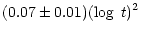 |
|
| |
|
 |
(11) |
with
 indicating a marginal improvement over the
  value earlier obtained with the
linear relation. Similar improvements are also observed in other relations, e.g., in
value earlier obtained with the
linear relation. Similar improvements are also observed in other relations, e.g., in
| I(MV) |
= |
 |
|
| |
|
 |
(12) |
The average value of observed parameters is compared with the the synthetic parameters in Fig. 3. This indicates that:
- (i)
- The theoretical dependences of
I(B-V)0 -log (age) and
I(U-B)0 -log (age),
given by Pandey et al. (1989); Maraston (1998) and
Brocato et al. (1999) agree fairly well with the observed ones. However, the theoretical dependences of
I(V-R)0 and
I(V-I)0 on log (age), given by Maraston (1998) and Brocato et al. (1999) differ from the observed one for clusters younger than 100 Myrs.
- (ii)
- The observed dependence of integrated luminosity on the age is compared with models in Fig. 3.
The theoretical dependences were obtained for a fixed value of MF barring the work
of Pandey et al. (1989) who assumed a time-dependent initial mass function (IMF). The comparison indicates that a steeper MF is needed to match
the integrated luminosities of oldest clusters (age
 109 years). Elson & Fall (1985) reported that, unlike the relation between colour and age, the relation between luminosity and age depends strongly on the IMF.
![\begin{figure}
\par\includegraphics[width=8.8cm,clip]{3308f4.eps}
\end{figure}](/articles/aa/full/2002/22/aah3308/Timg33.gif) |
Figure 4:
The histograms are the frequency distribution of the luminosity of 352 clusters
according to their ages. |
| Open with DEXTER |
Table 2:
Completeness radius and surface density
for the different magnitude intervals.
| I(MV) |
Total |
Clusters |
Completeness |
Number of |
Surface |
| interval |
number of |
within |
radius, r |
clusters |
density, |
| (mag) |
clusters |
3.0 kpc |
(kpc) |
within r |
(cluster/kpc2) |
| 2 |
to |
1 |
1 |
1 |
- |
- |
- |
| 1 |
to |
0 |
0 |
0 |
- |
- |
- |
| 0 |
to |
-1 |
4 |
4 |
- |
- |
- |
| -1 |
to |
-2 |
10 |
9 |
- |
- |
- |
| -2 |
to |
-3 |
47 |
48 |
2.00 |
40 |
3.18 |
| -3 |
to |
-4 |
81 |
68 |
2.51 |
63 |
3.18 |
| -4 |
to |
-5 |
78 |
62 |
3.16 |
65 |
2.07 |
| -5 |
to |
-6 |
56 |
45 |
3.98 |
50 |
1.01 |
| -6 |
to |
-7 |
33 |
20 |
5.01 |
28 |
0.36 |
| -7 |
to |
-8 |
21 |
15 |
6.61 |
21 |
0.15 |
| -8 |
to |
-9 |
19 |
13 |
6.92 |
18 |
0.12 |
| -9 |
to |
-10 |
1 |
0 |
- |
- |
- |
| -10 |
to |
-11 |
0 |
0 |
- |
- |
- |
| -11 |
to |
-12 |
1 |
0 |
- |
- |
- |
Figure 4 shows the integrated absolute magnitude distribution
of 352 clusters according to their ages which indicates a maximum at
I(MV) = -3.5 mag and
a sharp cut off at
I(MV) = -2.0 mag which agree with the results earlier obtained by
van den Bergh & Lafontaine (1984) and Bhatt et al. (1991). Van den Bergh & Lafontaine (1984)
concluded that the sharp cut-off at
I(MV) = -2.0 mag is probably
due to selection effects while Bhatt et al. (1991) concluded that the observed distribution of open clusters fainter than
I(MV) = -2.0 mag may not be entirely due to selection effects. There may be some physical causes of the cut-off at
I(MV) = -2.0 mag. It is important to consider
the limiting number of stars to form a cluster because if a multiple-star system with five components is also defined as a cluster then one can expect that the number of clusters fainter
than
I(MV) = -2.0 mag could be large. Although the star formation efficiency is maximum
in the low-mass (100 )
molecular clouds (Pandey et al. 1990), it
is also true that low-mass clouds generate poor clusters only. The lifetime of star clusters depends on the richness of the clusters (Pandey & Mahra 1986; Janes & Adler 1982). Poor clusters have a shorter lifetime
compared to the rich ones and very poor clusters (say 5 to 10 stars only) will be disrupted on a very small time scale and consequently, it seems that these will not contribute in any way to the statistics at fainter limits.
From the luminosity distribution for different age groups shown in Fig. 4, one can see that young clusters and the majority of older clusters have integrated magnitudes brighter than
I(MV) = -2.0 mag, while
a few old clusters have magnitudes fainter than that. The reason is that with age, dynamical
evolution produces mass segregation in a cluster while stellar evolution depletes massive
stars (Nilakshi et al. 2002 and references therein). The old clusters which have magnitudes brighter than
I(MV) = -2.0 mag
most probably contain a number of red giants/supergiants.
![\begin{figure}
\par\includegraphics[width=8.8cm,clip]{3308f5.eps}
\end{figure}](/articles/aa/full/2002/22/aah3308/Timg34.gif) |
Figure 5:
The log N versus log d plots for different
integrated magnitude intervals. |
| Open with DEXTER |
![\begin{figure}
\par\includegraphics[width=8.8cm,clip]{3308f6.eps}
\end{figure}](/articles/aa/full/2002/22/aah3308/Timg35.gif) |
Figure 6:
The integrated luminosity function of the
open clusters. |
| Open with DEXTER |
The surface density of open clusters in the galactic plane, ,
has been
obtained using the relation
 |
(13) |
where, N is the number of open clusters observed within the completeness radius r,
for each magnitude interval. The cluster population N and the surface density
have also been tabulated in Table 2 for different magnitude intervals. A plot of log N against log d (where d is
the distance of the cluster)
for different integrated brightness is shown in Fig. 5.
Data completeness has been estimated assuming that log N  log d
as suggested by Bhatt et al. (1991). Table 2 and Fig. 5 show that present sample
can be considered complete up to 3.0 kpc whereas the data used by van den Bergh & Lafontaine (1984) and Bhatt et al. (1991), were complete only up to 400 pc and 2.0 kpc respectively.
log d
as suggested by Bhatt et al. (1991). Table 2 and Fig. 5 show that present sample
can be considered complete up to 3.0 kpc whereas the data used by van den Bergh & Lafontaine (1984) and Bhatt et al. (1991), were complete only up to 400 pc and 2.0 kpc respectively.
The integrated luminosity function of open clusters brighter than -2.0 mag is shown in Fig. 6 and can be represented by the relation
 |
(14) |
which is in good agreement with the relation obtained by Bhatt et al. (1991).
Extrapolation of this equation to higher luminosities, and assuming that the
galactic disc has an area of 500 kpc2, yields approximately 10 clusters
with
I(MV) = -11.0 mag.
The luminosity function by van den Bergh & Lafontaine (1984) yields
102 clusters with
I(MV) = -11.0 mag in the same area.
This means that according to the slope of luminosity
function obtained in the present analysis only about 1% of the clusters in the galactic disc have a
magnitude of -11.0 mag while this is about 10% according to the luminosity function obtained
by van den Bergh & Lafontaine (1984). The disagreement in the slope of the
luminosity function obtained in the two studies
may be due to large sample, towards the fainter end of the luminosity distribution, used in the present analysis. The present results should therefore be considered more realistic.
![\begin{figure}
\par\includegraphics[width=8.4cm,clip]{fig7.eps}
\end{figure}](/articles/aa/full/2002/22/aah3308/Timg39.gif) |
Figure 7:
The galactocentric distance  ,
I(MV);
the metallicity [Fe/H], I(MV) and the heliocentric distance ,
I(MV);
the metallicity [Fe/H], I(MV) and the heliocentric distance  ,
I(MV) plots are shown in a), b) and c) panels
respectively. The filled circles and error bars in a) and b) are the average and
respectively of the data points
binned in I(MV). ,
I(MV) plots are shown in a), b) and c) panels
respectively. The filled circles and error bars in a) and b) are the average and
respectively of the data points
binned in I(MV). |
| Open with DEXTER |
Figures 7a and b show the variation of I(MV) with galactocentric distance,
(in kpc) and metallicity, [Fe/H], respectively. They indicate that the I(MV) does neither depend on
nor on [Fe/H].
Figures 7c shows the variation of I(MV) with
heliocentric distance
of the clusters. Like Barkhatova & Pylskaya (1983)
and Balázs (1986) the relation between
and I(MV)
can be represented by the following equation
 |
(15) |
where
is in kpc. Balázs (1986) found similar effects
but he suggests that this correlation is simply caused by selection effects.
The integrated magnitudes and colours of 140 open
clusters have been derived. Along with
results published earlier they
have been used to study the characteristics of integrated
parameters of galactic star clusters. The main conclusions are:
- 1.
- The comparison of observed dependence of integrated luminosity on the age indicates that
a steeper MF is needed to match the integrated luminosities of oldest clusters.
- 2.
- The integrated luminosity function can be represented by the relation
 .
.
This indicates that about 1% of the open clusters in the galactic disc is brighter than
I(MV) = -11 mag.
Acknowledgements
We gratefully acknowledge the suggestions given by Prof K. S. de Boer, which improved the contents of the paper.
- Balázs, B. A. 1986, Publ. Astron. Dep. Eötvös Univ., No. 8, 41
In the text
- Barkhatova, K. A., & Pylskaya, O. P. 1983, Publ. Astrophys. Inst. Czech. Acad. Sci., No. 56, 14
In the text
- Battinelli, P., Brandimarti, A., & Capuzzo-Dolcetta, R. 1994, A&AS, 104, 379
In the text
NASA ADS
- Battinelli, P., & Capuzzo-Dolcetta, R. 1989, ApJ, 347, 794
In the text
NASA ADS
- Bertelli, G., Bressan, A., Chiosi, C., Fagotto, F., & Nasi, E. 1994, A&AS, 106, 275
In the text
NASA ADS
- Bhatt, B. C., Pandey, A. K., & Mahra, H. S. 1991, JAA, 12, 179
In the text
- Brocato, E., Castellani, V., Raimondo, G., & Romaniello, M. 1999, A&AS, 136, 65
In the text
NASA ADS
- Elson, R. A. W., & Fall, S. M. 1985, ApJ, 299, 211
In the text
NASA ADS
- Gray, D. F. 1965, AJ, 70, 362
In the text
NASA ADS
- Gray, D. F. 1967, AJ, 72, 800
In the text
- Janes, K. A., & Adler, D. 1982, ApJS, 49, 425
NASA ADS
- Lyngå, G. 1982, A&A, 109, 213
In the text
NASA ADS
- Maraston, C. 1998, MNRAS, 300, 872
In the text
NASA ADS
- Mermilliod, J.-C. 1995, in Information and on line data in Astronomy, ed. J.-C. Egret, & M. A. Abrecht (Kulwar
Academic Press), 277
In the text
- Nilakshi, Sagar, R., Pandey, A. K., & Mohan, V. 2002, A&A, 383, 153
In the text
NASA ADS
- Pandey, A. K., & Mahra, H. S. 1986, Ap&SS, 126, 167
In the text
NASA ADS
- Pandey, A. K., Bhatt, B. C., Mahra, H. S., & Sagar, R. 1989, MNRAS, 236, 263
In the text
NASA ADS
- Pandey, A. K., Paliwal, D. C., & Mahra, H. S. 1990, ApJ, 362, 165
In the text
NASA ADS
- Piskunov, A. E. 1972, Nauch. Inf. Astr. Counc. Acad. Sci. USSR, 23, 97
In the text
- Piskunov, A. E. 1974, Nauch. Inf. Astr. Counc. Acad. Sci. USSR, 33, 101
In the text
- Sagar, R., Joshi, U. C., & Sinvhal, S. D. 1983, BASI, 11, 44
In the text
NASA ADS
- Schmidt-Kaler, Th. 1967, AJ, 72, 526
In the text
NASA ADS
- Schmidt-Kaler, Th. 1982, Landolt-Bornstein, Numerical data and Funct. Relationship in Sci. and Tech. New Ser., Group 6, vol. 2b, 1
In the text
- Spassova, N. M., & Baev, P. V 1985, Ap&SS, 112, 111
In the text
NASA ADS
- van den Bergh, S., & Lafontaine, A. 1984, AJ, 89, 1822
In the text
NASA ADS
Copyright ESO 2002
![\begin{figure}
\par\includegraphics[width=14.1cm,clip]{3308f1.eps}
\end{figure}](/articles/aa/full/2002/22/aah3308/img7.gif)
![\begin{figure}
\par\includegraphics[width=8.8cm,clip]{3308f2.eps}
\end{figure}](/articles/aa/full/2002/22/aah3308/img12.gif)
![\begin{figure}
\par\includegraphics[width=8.8cm,clip]{3308f3.eps}
\end{figure}](/articles/aa/full/2002/22/aah3308/img25.gif)
![\begin{figure}
\par\includegraphics[width=8.8cm,clip]{3308f4.eps}
\end{figure}](/articles/aa/full/2002/22/aah3308/img33.gif)
![\begin{figure}
\par\includegraphics[width=8.8cm,clip]{3308f5.eps}
\end{figure}](/articles/aa/full/2002/22/aah3308/img34.gif)
![\begin{figure}
\par\includegraphics[width=8.8cm,clip]{3308f6.eps}
\end{figure}](/articles/aa/full/2002/22/aah3308/img35.gif)
![\begin{figure}
\par\includegraphics[width=8.4cm,clip]{fig7.eps}
\end{figure}](/articles/aa/full/2002/22/aah3308/img39.gif)