A&A 388, 326-334 (2002)
DOI: 10.1051/0004-6361:20020497
Spatial distribution of emission in unidentified infrared bands
from the Midcourse Space Experiment survey
S. K. Ghosh - D. K. Ojha
Tata Institute of Fundamental Research, Homi Bhabha Road,
Mumbai (Bombay) 400 005, India
Received 23 January 2002 / Accepted 12 March 2002
Abstract
The Midcourse Space Experiment (MSX) has surveyed
the Galactic plane in four infrared bands between 6 and 25  m.
Two of these bands cover several Unidentified Infrared
emission Bands (UIBs).
With the aim of
extracting the spatial distribution of the UIB
emission on a large scale,
a scheme has been developed
to model the MSX data with emission
in the UIBs alongwith the underlying thermal continuum
from the interstellar dust.
In order to test this scheme,
a sample of five Galactic compact H II regions
(Sh-61, Sh-138, Sh-152, Sh-156, Sh-186; Zavagno & Ducci 2001)
for which imaging data in some individual UIBs
is available from ISOCAM measurements, has been studied.
The results of this comparative study on a small angular scale
are as follows:
(i) the morphological details extracted from our scheme
agree very well with those from the superior ISOCAM
measurements;
(ii) the integrated strength of UIBs extracted from the
MSX database correlates extremely well with
the sum of the strengths of individual UIBs
measured from ISOCAM.
This tight correlation is very encouraging and promises the
potential of MSX database for the study of large-scale
spatial distribution of
UIB emission (and the carriers of UIBs) in the
entire Galactic plane.
m.
Two of these bands cover several Unidentified Infrared
emission Bands (UIBs).
With the aim of
extracting the spatial distribution of the UIB
emission on a large scale,
a scheme has been developed
to model the MSX data with emission
in the UIBs alongwith the underlying thermal continuum
from the interstellar dust.
In order to test this scheme,
a sample of five Galactic compact H II regions
(Sh-61, Sh-138, Sh-152, Sh-156, Sh-186; Zavagno & Ducci 2001)
for which imaging data in some individual UIBs
is available from ISOCAM measurements, has been studied.
The results of this comparative study on a small angular scale
are as follows:
(i) the morphological details extracted from our scheme
agree very well with those from the superior ISOCAM
measurements;
(ii) the integrated strength of UIBs extracted from the
MSX database correlates extremely well with
the sum of the strengths of individual UIBs
measured from ISOCAM.
This tight correlation is very encouraging and promises the
potential of MSX database for the study of large-scale
spatial distribution of
UIB emission (and the carriers of UIBs) in the
entire Galactic plane.
Key words: infrared: ISM - ISM: lines and bands - ISM: H II regions
The near- to mid-infrared spectrum originating from the interstellar medium
of the Galactic star-forming regions
consists of various features in addition to a continuum.
The continuum emission is attributed to the thermal emission
from the interstellar dust component
and almost all narrow emission lines have been identified
with atomic nebular, molecular and other transitions originating
from the interstellar gas component.
In addition, several broader features have been detected which
have been identified with features due to the solid state material
of the dust (e.g. silicate absorption features at  10 and
18 m etc.).
There exists a class of broad emission features,
sometimes called "Unidentified Infrared emission Bands" (UIBs;
at 3.3, 6.2, 7.7, 8.6, 11.3, 12.7 m), the identity
of whose carriers and emission mechanisms are
still a subject of active research.
Some of these bands are widely believed to be characteristic of
the bending and stretching modes of C=C and C-H bonds in
aromatic molecules
(e.g. fluorescent emission of
Polycyclic Aromatic Hydrocarbons or PAHs; Leger & Puget 1984;
Allamandolla et al. 1985).
However, other contenders also exist in the literature
(e.g. amorphous materials with aromatic
hydrocarbon; Sakata et al. 1984; Borghesi et al. 1987).
The study of large scale distribution of emission in the UIBs
in the Galactic plane
in general and selected star forming regions in particular
would be
important in understanding the details of their emission mechanism.
10 and
18 m etc.).
There exists a class of broad emission features,
sometimes called "Unidentified Infrared emission Bands" (UIBs;
at 3.3, 6.2, 7.7, 8.6, 11.3, 12.7 m), the identity
of whose carriers and emission mechanisms are
still a subject of active research.
Some of these bands are widely believed to be characteristic of
the bending and stretching modes of C=C and C-H bonds in
aromatic molecules
(e.g. fluorescent emission of
Polycyclic Aromatic Hydrocarbons or PAHs; Leger & Puget 1984;
Allamandolla et al. 1985).
However, other contenders also exist in the literature
(e.g. amorphous materials with aromatic
hydrocarbon; Sakata et al. 1984; Borghesi et al. 1987).
The study of large scale distribution of emission in the UIBs
in the Galactic plane
in general and selected star forming regions in particular
would be
important in understanding the details of their emission mechanism.
The recent Infrared Space Observatory (ISO) mission,
in particular the imaging camera ISOCAM, has made it possible
to study selected Galactic star forming regions in the UIBs.
The ISOCAM instrument has several filters with the passbands
selected to cover these UIBs (and also the neighbouring continuum)
so that emission in these individual features can be measured
very precisely.
However, it is unreasonable to expect Galactic plane surveys
in UIB emission using the ISOCAM, since its primary objective
was to achieve the best possible (nearly diffraction limited)
angular resolution in studies of individual astrophysical sources.
As a result, the largest single image from ISOCAM covers
 .
.
With the advent of the Midcourse Space Experiment (MSX), new
possibilities have emerged. The
SPIRIT III instrument onboard the MSX spacecraft has surveyed the entire
Galactic Plane (
 )
in four mid infrared bands
centered around
8.3, 12.13, 14.65 and 21.34
m with an angular resolution 18
)
in four mid infrared bands
centered around
8.3, 12.13, 14.65 and 21.34
m with an angular resolution 18 (Price et al. 2001).
These four bands are referred to as A, C, D and E
spectral bands of MSX respectively (the SPIRIT III instrument
also has two additional narrower bands at 4.29 and 4.35 m,
called B1 and B2 bands).
The usefulness of the MSX survey for the study of the diffuse
interstellar medium and global characteristics has already
been demonstrated (Cohen & Green 2001; Cohen 1999).
The MSX band A includes the dominant UIB features at
6.2, 7.7 and 8.7 m. Similarly, the MSX band C includes
the UIB features at 11.3 and 12.7 m.
(Price et al. 2001).
These four bands are referred to as A, C, D and E
spectral bands of MSX respectively (the SPIRIT III instrument
also has two additional narrower bands at 4.29 and 4.35 m,
called B1 and B2 bands).
The usefulness of the MSX survey for the study of the diffuse
interstellar medium and global characteristics has already
been demonstrated (Cohen & Green 2001; Cohen 1999).
The MSX band A includes the dominant UIB features at
6.2, 7.7 and 8.7 m. Similarly, the MSX band C includes
the UIB features at 11.3 and 12.7 m.
While the ISOCAM provides imaging capability of selected regions
in narrower spectral bands
at higher angular resolution (3
or 6)
the MSX survey covers the entire Galactic plane in four broader
bands (two of these covering several UIBs in addition to the continuum).
Making use of this complementarity of ISOCAM vis a vis
MSX, the following scheme has been explored to study
large-scale emission in the UIBs in the Galaxy:
- Model each picture element of the MSX images with an integrated
emission in UIB features superimposed on a gray body
continuum spectrum under some reasonable assumptions.
The best fit solution (for each pixel) provides a measure
of the UIB emission locally.
- Test the reliability of the above scheme by comparing
the results of some
selected Galactic star forming regions that have been
studied using the ISOCAM and whose emission in individual
UIBs has been quantified (e.g. Zavagno & Ducci 2001).
- The comparison should cover not only qualitative
aspects, (e.g. structural
details/morphology), but also the quantitative
correlation between the integrated estimate of
UIB emission from our scheme and the ISOCAM results.
Section 2 describes the modelling scheme in detail, and
Sect. 3 presents the results for the sample of six Galactic
star forming regions using the MSX survey data.
In Sect. 4, a comparison is made between our results and
those from the ISOCAM by Zavagno & Ducci (2001).
The conclusions are summarised in Sect. 5.
The publicly-available MSX Galactic plane survey
radiance images (Infrared Processing and Analysis Center
at http://irsa.ipac.caltech.edu/applications/MSX) in the four
bands at 8.3 (A), 12.1 (C), 14.7 (D) and 21.3 (E) m
are gridded in
 pixels, although the true angular resolution is
18.3
(Price et al. 2001), with the unit of
pixels, although the true angular resolution is
18.3
(Price et al. 2001), with the unit of
 .
The zodiacal background has already been subtracted out from these
MSX survey maps.
The spectrum emitted from each pixel is assumed to be a
combination of a thermal continuum (modified Planck
function or gray body) and the total radiance due to the relevant
UIB features within the MSX band.
.
The zodiacal background has already been subtracted out from these
MSX survey maps.
The spectrum emitted from each pixel is assumed to be a
combination of a thermal continuum (modified Planck
function or gray body) and the total radiance due to the relevant
UIB features within the MSX band.
| |
|
 |
(1) |
| |
|
i = A, C, D, E |
|
where Ri are the measured radiances
in the MSX bands.
 is the Planck function, and the term in parenthesis
emulates the gray body spectrum emitted by the dust grains.
is the Planck function, and the term in parenthesis
emulates the gray body spectrum emitted by the dust grains.
 is the optical depth due to the
interstellar dust component at the frequency
is the optical depth due to the
interstellar dust component at the frequency  .
The functions
.
The functions
 represent the normalized relative spectral
responses of the four MSX bands (Egan et al. 1999).
represent the normalized relative spectral
responses of the four MSX bands (Egan et al. 1999).
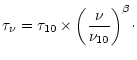
Since the range of frequencies covered by the MSX bands is
limited, we assume a power law dependence of the
dust emissivity on frequency, viz.,
 |
|
|
(2) |
 is the optical depth at 10 m and
 the frequency corresponding to wavelength 10 m.
The value of
the frequency corresponding to wavelength 10 m.
The value of  is a constant determined from the type
of dust assumed. The effect of varying
is discussed later.
The
is a constant determined from the type
of dust assumed. The effect of varying
is discussed later.
The
 are the modelled total radiances in UIBs within
the ith MSX band.
Since there are no known UIBs within the bands D and E of MSX,
are the modelled total radiances in UIBs within
the ith MSX band.
Since there are no known UIBs within the bands D and E of MSX,
 and
and
 .
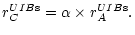
In addition, it has been assumed that the total radiance due to
the UIBs in band C is proportional to that in band A, viz.,
.
In addition, it has been assumed that the total radiance due to
the UIBs in band C is proportional to that in band A, viz.,
 |
|
|
(3) |
Here  is held fixed to a reasonable value (based on
available observational data and understanding) for all pixels of
all star forming regions studied, though the effect of changing
the value of
will also be discussed later.
is held fixed to a reasonable value (based on
available observational data and understanding) for all pixels of
all star forming regions studied, though the effect of changing
the value of
will also be discussed later.
For each pixel on the sky
with sufficient signal to noise ratio in each of the
four MSX bands (implemented by map dynamic range cuts),
we solve the set of four equations
(Eq. (1)), for the three unknown variables viz., T,
and
 .
A non-linear chi-square minimization scheme
based on the finite difference Levenberg-Marquardt algorithm
has been used for this purpose.
The integrals in Eq. (1) are evaluated numerically using
a cautious adaptive Romberg extrapolation method.
In order to ensure that the best
solution obtained indeed corresponds to a global minimum
of chi-square, the computations are repeated for 125
different sets of initial guesses comprising of 5
values each of T,
and
.
The grid of initial guess values for these three variables
have been selected to cover a wide range of physical
situations (e.g. T ranging between 50 and 800 K;
between 10-6 and 10-2;
between 10-7 and 10-3
).
.
A non-linear chi-square minimization scheme
based on the finite difference Levenberg-Marquardt algorithm
has been used for this purpose.
The integrals in Eq. (1) are evaluated numerically using
a cautious adaptive Romberg extrapolation method.
In order to ensure that the best
solution obtained indeed corresponds to a global minimum
of chi-square, the computations are repeated for 125
different sets of initial guesses comprising of 5
values each of T,
and
.
The grid of initial guess values for these three variables
have been selected to cover a wide range of physical
situations (e.g. T ranging between 50 and 800 K;
between 10-6 and 10-2;
between 10-7 and 10-3
).
Invariably, the same solution is obtained starting from
almost all different sets of initial guesses.
The procedure is repeated for all pixels of the MSX map
resulting in spatial distributions of these three physical variables.
Here we extensively use the map of
,
that
can be compared with the measurements from ISOCAM.
From the literature we have selected the work of
Zavagno & Ducci (2001; hereafter ZD), which
is based on ISOCAM measurements,
for detailed comparison with results from our scheme of extracting
emission in UIBs from the MSX data.
The reason for selecting ZD is that they have
very uniformly studied (using same set of filters) a reasonable
sample size comprising of five Galactic compact H II regions,
viz., Sharpless(Sh)-61, Sh-138, Sh-152, Sh-156 and Sh-186.
They studied the entire 3-12 m wavelength range
accessible through ISOCAM. The ZD sample of compact H II regions
are bright in the IRAS 12 m band and are known to be
strong emitters of UIBs at 7.7, 8.6 and 11.3 m but
show no silicate absorption feature at 10 or 18 m.
In addition, they
represent a sequence in equivalent stellar type of the
main exciting star.
Results of ZD are based on imaging with the
 pixel mode of ISOCAM covering
 regions around Sh-61, Sh-152 & Sh-186 and
 around Sh-138 & Sh-156. Based on images in
SW1 (centre
around Sh-138 & Sh-156. Based on images in
SW1 (centre  :
3.57 m;
range: 3.05-4.10 m;
Césarsky et al. 1996), SW2 (3.30; 3.20-3.40),
LW4 (6.00; 5.50-6.50), LW6 (7.75; 7.00-8.50),
LW8 (11.4; 10.7-12.0) filters and five selected wavelengths using the
CVF, they have quantified the UIB fluxes (actually radiances)
in the 3.3, 6.2, 7.7 and 11.2 m features integrated over the
mapped regions.
:
3.57 m;
range: 3.05-4.10 m;
Césarsky et al. 1996), SW2 (3.30; 3.20-3.40),
LW4 (6.00; 5.50-6.50), LW6 (7.75; 7.00-8.50),
LW8 (11.4; 10.7-12.0) filters and five selected wavelengths using the
CVF, they have quantified the UIB fluxes (actually radiances)
in the 3.3, 6.2, 7.7 and 11.2 m features integrated over the
mapped regions.
Using the publicly available ISOCAM data of the ZD sample sources
(ISO Postcards from the ISO Data Archive for General Users;
http://www.iso.vilspa.esa.es), we have extracted the spatial distribution of
emission in the 7.7 m UIB feature, using a method
similar (but not identical) to ZD. First of all the
underlying continuum at 7.7 m was estimated from power law
interpolation using the CVF images at 6.91 and 8.22 m.
Next, this continuum was subtracted from the LW6 image
and the resulting emission was attributed to the 7.7 m
UIB (hereafter UIB7.7 map).
The resulting maps are presented and discussed in the next section.
Table 1:
Dynamic ranges of MSX maps and extracted peak UIBA radiance.
| Source |
MSX Master |
Usable Dynamic Range |
Peak(UIBA) |
| name |
Plate Number |
Band A |
Band C |
Band D |
Band E |
 |
Sh-61 |
GP027.0+1.5 |
41 |
20 |
25 |
40 |
 |
Sh-138 |
GP105.0+0.0 |
30 |
17 |
19 |
80 |
 |
Sh-152 |
GP109.5-1.5 |
52 |
26 |
27 |
39 |
 |
Sh-156 |
GP109.5+0.0 |
71 |
41 |
51 |
109 |
 |
Sh-186 |
GP124.5+0.0 |
15 |
7.7 |
5.7 |
8.5 |
 |
The MSX images of the five sources from ZD sample were
processed following the scheme described above.
The dust emissivity power law index
has been
taken to be 1.0, which is commonly used in the literature
for general interstellar grains in
the mid infrared wavelength region relevant to the
MSX bands (Scoville & Kwan 1976;
Savage & Mathis 1979; Mathis 1990).
However, other values of
have also been explored
to ensure that
the results obtained here are not sensitive to the choice
of ,
as discussed later.
The value of
represents the ratio of radiances
in the UIBs within the passbands of MSX bands C and A (see
Eq. (3)). These correspond to the features at 11.2 and 12.7 m
(in band C) and at 6.2, 7.7 and 8.6 m (in band A).
The value of
used here is based on the recent work
by Verstraete et al. (2001) using the ISO-SWS.
They studied the 2.4-25 m spectra of three
selected bright Galactic interstellar regions where dense molecular
gas is illuminated by stellar radiation. Their wavelength
range covers all the four MSX bands adequately.
In addition, their choice of the three regions, viz.,
NGC 2023, Orion bar and M17-SW spans a wide range of
excitation parameters (flux as well as hardness of
the radiation field). The spectral resolution of the
ISO-SWS measurements used by them was either 200 or 500,
large enough to resolve individual UIBs.
The average value of
for the above three
regions, representing different physical conditions,
has been estimated by us from Fig. 1
of Verstraete et al. (2001) to be 0.32
(with a very small dispersion).
The effect of choosing different values of
have been
studied by us, as is discussed later.
From the study of Verstraete et al. (2001)
it is clear that the contribution of forbidden ionic lines
and molecular rotational lines to the radiance within the
MSX bands is negligible compared to the UIBs and the
underlying continuum. Hence the presence of these narrow lines
should not affect our scheme of extracting the radiance due
to the UIBs from the MSX data.
The extent of the angular region considered around each
target was determined by the available dynamic
ranges in the four MSX bands (i.e. only pixels satisfying
the dynamic range condition in each band were modelled).
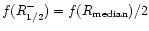
The usable dynamic range, UDR, for each band was defined
from the frequency distribution of the
radiance values, f(R), in the corresponding map in the following
manner:
 / (
/ (
 + R-1/2), where
 is the brightest pixel value,
is the median value of R as determined from f(R),
and R-1/2 represents the brightness value satisfying
is the brightest pixel value,
is the median value of R as determined from f(R),
and R-1/2 represents the brightness value satisfying
 and
and
 .
For a purely Gaussian distribution, the above translates to
using the brightest 15% pixels of the full sample.
It may be noted here that any particular choice of
dynamic range only
changes the outer boundary of the region where our scheme is
applied by either including or excluding these pixels,
without affecting any numerical results for other pixels.
The details of the dynamic range used for the five regions
are presented in Table 1.
.
For a purely Gaussian distribution, the above translates to
using the brightest 15% pixels of the full sample.
It may be noted here that any particular choice of
dynamic range only
changes the outer boundary of the region where our scheme is
applied by either including or excluding these pixels,
without affecting any numerical results for other pixels.
The details of the dynamic range used for the five regions
are presented in Table 1.
The resulting integrated UIB radiance maps extracted
by us from the MSX data for
Sh-61, Sh-138, Sh-152, Sh-156 and Sh-186 are
displayed in Figs. 1 to 5 respectively as isophot
contour plots.
The sizes of these maps are selected based on
the regions covered by the study of ZD.
The peak UIB radiance values are also listed in Table 1.
Morphologically the extracted UIB radiance maps are very
similar to the corresponding maps of thermal continuum emission
from the dust grains, in general (at the scale of MSX resolution).
However, there are differences between the spatial distribution
of UIB emission and the other modelled parameters, viz., the dust
temperature and the optical depth corresponding to the thermal
continuum emission. As one example, the map of
dust optical depth (,
at 10 m) for the Sharpless
152 region is presented in Fig. 6, which can be compared
with Fig. 3.
![\begin{figure}
\par\includegraphics[width=8.8cm,clip]{2302.fig1.eps}
\end{figure}](/articles/aa/full/2002/22/aa2302/Timg46.gif) |
Figure 1:
The spatial distribution of total radiance in Unidentified Infrared
emission Bands for the region around Sharpless 61,
as extracted from the MSX maps.
The contour levels are at 99, 90, 80, 70, 60, 50, 40,
30, 25, 20, 15, 10, and 5% of the peak
value of
 .
The abscissa and the ordinate are RA (J2000.0) and
Dec (J2000.0) respectively. .
The abscissa and the ordinate are RA (J2000.0) and
Dec (J2000.0) respectively. |
| Open with DEXTER |
![\begin{figure}
\par\includegraphics[width=8.8cm,clip]{2302.fig2.eps}
\end{figure}](/articles/aa/full/2002/22/aa2302/Timg48.gif) |
Figure 2:
Same as Fig. 1 but for the Sharpless 138 region.
The contour levels represent the same fractions of the
peak as in Fig. 1.
The peak here is
 . . |
| Open with DEXTER |
![\begin{figure}
\par\includegraphics[width=8.8cm,clip]{2302.fig3.eps}
\end{figure}](/articles/aa/full/2002/22/aa2302/Timg50.gif) |
Figure 3:
Same as Fig. 1 but for the Sharpless 152 region.
The peak here is
 . . |
| Open with DEXTER |
![\begin{figure}
\par\includegraphics[width=8.8cm,clip]{2302.fig4.eps}
\end{figure}](/articles/aa/full/2002/22/aa2302/Timg52.gif) |
Figure 4:
Same as Fig. 1 but for the Sharpless 156 region.
The peak here is
 . . |
| Open with DEXTER |
![\begin{figure}
\par\includegraphics[width=8.8cm,clip]{2302.fig5.eps}
\end{figure}](/articles/aa/full/2002/22/aa2302/Timg54.gif) |
Figure 5:
Same as Fig. 1 but for the Sharpless 186 region.
The peak here is
 . . |
| Open with DEXTER |
![\begin{figure}
\par\includegraphics[width=8.8cm,clip]{2302.fig6.eps}
\end{figure}](/articles/aa/full/2002/22/aa2302/Timg55.gif) |
Figure 6:
The spatial distribution of dust optical depth (at 10 m) for the Sharpless 152 region.
The contour levels are at 99, 90, 80, 70, 60, 50,
40, 30, and 20% of the peak value of
 .
The structure of these contours differ from those
of UIB radiance for the same region shown in
Fig. 3. .
The structure of these contours differ from those
of UIB radiance for the same region shown in
Fig. 3. |
| Open with DEXTER |
It is instructive to compare our maps from
modelling of MSX data with those
based on the ISOCAM data.
The most relevant ISOCAM filters for this comparison
are LW4, LW6 and LW8 covering the 6.2, 7.7 and
11.2 m UIBs. The former two features contribute
to the UIB radiance in the MSX band A and the last one
in the MSX band C.
The ISOCAM-based UIB7.7 maps have been superimposed (grey scale)
on our integrated UIB map extracted from MSX maps, viz.
,
(hereafter UIBA), in Figs. 7 to 11 corresponding to
Sh-61, Sh-138, Sh-152, Sh-156 and Sh-186 respectively.
For a more general comparison involving other UIBs, we refer
to Fig. 2 of ZD.
In principle, our UIB7.7 map for each source must resemble the LW6
map of ZD,
which indeed is the case.
![\begin{figure}
\par\includegraphics[width=8.8cm,clip]{2302.fig7.eps}
\end{figure}](/articles/aa/full/2002/22/aa2302/Timg56.gif) |
Figure 7:
Comparison of the
total radiance in Unidentified Infrared
emission Bands (UIBA; contours, same as in Fig. 1)
as extracted from the MSX maps, with
the emission in the 7.7 m UIB feature
obtained from ISOCAM (UIB7.7 in grey scale;
the grey scaled region also represents the area imaged by
ISOCAM),
for the region around Sharpless 61.
The abscissa and the ordinate are RA (J2000.0) and
Dec (J2000.0) respectively. |
| Open with DEXTER |
A marked morphological similarity between the contour plots
corresponding to all these three ISOCAM filters (LW4, LW6, and LW8)
for all the five sources support our assumption
that
 and
are correlated (Eq. (3)).
Next, we comment qualitatively on
structural similarities between the spatial distribution
of emission in individual UIBs as obtained from ISOCAM
(our UIB7.7; LW4, LW6, and LW8 maps of ZD),
vis-a-vis the total emission due to all UIBs within
the MSX band A (UIBA). Note that ZD's
maps represent intensity while ours are radiance.
For a qualitative comparison of structural details,
it may be acceptable, however quantitive comparison
is made in identical units later in this subsection.
and
are correlated (Eq. (3)).
Next, we comment qualitatively on
structural similarities between the spatial distribution
of emission in individual UIBs as obtained from ISOCAM
(our UIB7.7; LW4, LW6, and LW8 maps of ZD),
vis-a-vis the total emission due to all UIBs within
the MSX band A (UIBA). Note that ZD's
maps represent intensity while ours are radiance.
For a qualitative comparison of structural details,
it may be acceptable, however quantitive comparison
is made in identical units later in this subsection.
The peak position for Sh-61 in the UIBA map matches
exactly that of UIB7.7 (Fig. 7 here)/LW6 and LW4
(Fig. 2 of ZD). The general structure of the
UIBA contours is also very similar to the
maps LW4, LW6 as well as LW8 of ZD, with extension along the
E-W direction. We have detected an additional emission region S-W of the
main peak in the UIBA map, which is perhaps barely
below the lowest contour displayed in LW4 or LW6.
However, our UIB7.7 map gives some hint of the same
despite being near the edge of the ISOCAM field.
For Sh-138 (Fig. 8),
the UIB7.7 map has been able to resolve two components
along the N-S direction, and
the UIBA map shows the peak position as well as the contour shape
consistent with them
(note that the former has an angular resolution
of 18
while ISOCAM's is 3).
The contours in the LW4, LW6 and LW8 maps are remarkably
similar with a main peak and extension towards the north.
Our UIB7.7 (Fig. 9) as well as
the LW4, LW6 and LW8 maps for Sh-152 show very rich
(but again similar between these filters) structure
at an angular scale beyond the scope of MSX's resolution.
Still, our UIBA map for Sh-152 reproduces the major structures
consistent with the above, viz., the curved shape extending
approximately from the S-E to N-W.
The entire UIBA map seems to be shifted by 10with respect to the UIB7.7 map.
Additional interesting structures are detected in our map
(see Fig. 3; due north and due south with respect to the main peak)
that lie outside the region mapped by ISOCAM.
In the case of Sh-156 the
UIB7.7, LW4, LW6 and LW8 maps also show
structural details at a smaller angular scale that are
unresolved in our UIBA map (Fig. 10). However, the curvature and
density of contours in the latter indicate a morphology
consistent with the above ISOCAM maps.
The positions of respective peaks match very
well in all these maps.
UIB emission is detected from a larger extended region
all around the region mapped by ISOCAM, with one isolated
secondary peak west of the main peak (Fig. 4).
The UIB7.7 as well as the UIBA maps
have resolved the Sh-186 region into two major
peaks separated mainly along the S-E to N-W line (Fig. 11).
The stronger component is the S-E one in all maps.
A similar structure is also seen in the
LW4, LW6 and LW8 maps.
The position of the peaks and other
structural features also match very well (within <10)
between the UIBA and all ISOCAM maps.
The UIBA map shows much more extended emission well outside
the region mapped by ZD (Fig. 5).
In order to make a quantitative comparison, the UIBAradiance maps of the five regions have been integrated over
the same corresponding regions as imaged by ZD, to get
I(
 ).
ZD have tabulated the solid angle integrated UIB fluxes F(3.3 m),
F(6.2 m), F(7.7 m) and F(11.2 m) in their Table 4.
We have compared their [F(6.2 m)+F(7.7 m)]=
I(ISOCAM4+6)
for each region with our integrated UIBA radiances (see Table 2).
Surprisingly, an extremely tight linear correlation
has been found between
I(ISOCAM4+6) and I(
).
It has been found that the ratio,
).
ZD have tabulated the solid angle integrated UIB fluxes F(3.3 m),
F(6.2 m), F(7.7 m) and F(11.2 m) in their Table 4.
We have compared their [F(6.2 m)+F(7.7 m)]=
I(ISOCAM4+6)
for each region with our integrated UIBA radiances (see Table 2).
Surprisingly, an extremely tight linear correlation
has been found between
I(ISOCAM4+6) and I(
).
It has been found that the ratio,
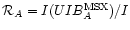 (ISOCAM4+6) =
 (mean value and the error of the mean).
This is despite several simplifying assumptions made in our
analysis of the MSX data.
This is indeed a remarkable finding, considering the very
complex microscopic as well as macroscopic detail that
must go into deciding the amount of emission in the UIBs.
Whereas the UIBs at 3.3, 8.6, 11.3 and 12.7 m originate from
vibrational modes of the aromatic C-H bond, the bands
at 6.2 and 7.7 m arise from the aromatic C-C bonds.
There is strong evidence from laboratory work on
PAHs (carriers of UIBs), that the relative strengths of these
features are very sensitive to the ionization state of the
PAHs (Allamandola et al. 1999).
Several observational studies of the spatial distribution
of UIBs in well-resolved H II regions support this conclusion.
Joblin et al. (1996) found that the ratio of 8.6 m to 11.3 m
emission increases with the local far-UV (FUV) flux, which can ionize
the PAH molecules. In a more recent study, Crété et al. (1999) found similar
variations in the ratio of UIB features for the M 17 complex.
One possible explanation for the above correlation is as follows:
(i) the angular sizes of the sample of sources considered here
are such that the intrinsic resolution of MSX (18)
spatially averages out various excitation effects expected close to
the source of the FUV radiation field; and (ii) the sample spans a
somewhat limited range of FUV luminosity (2).
It may be interesting to extend the present work to
nearby star forming regions for which the MSX resolution is
adequate to probe the UIB emitting regions close to the
exciting FUV source,
and also covering a larger range of
(mean value and the error of the mean).
This is despite several simplifying assumptions made in our
analysis of the MSX data.
This is indeed a remarkable finding, considering the very
complex microscopic as well as macroscopic detail that
must go into deciding the amount of emission in the UIBs.
Whereas the UIBs at 3.3, 8.6, 11.3 and 12.7 m originate from
vibrational modes of the aromatic C-H bond, the bands
at 6.2 and 7.7 m arise from the aromatic C-C bonds.
There is strong evidence from laboratory work on
PAHs (carriers of UIBs), that the relative strengths of these
features are very sensitive to the ionization state of the
PAHs (Allamandola et al. 1999).
Several observational studies of the spatial distribution
of UIBs in well-resolved H II regions support this conclusion.
Joblin et al. (1996) found that the ratio of 8.6 m to 11.3 m
emission increases with the local far-UV (FUV) flux, which can ionize
the PAH molecules. In a more recent study, Crété et al. (1999) found similar
variations in the ratio of UIB features for the M 17 complex.
One possible explanation for the above correlation is as follows:
(i) the angular sizes of the sample of sources considered here
are such that the intrinsic resolution of MSX (18)
spatially averages out various excitation effects expected close to
the source of the FUV radiation field; and (ii) the sample spans a
somewhat limited range of FUV luminosity (2).
It may be interesting to extend the present work to
nearby star forming regions for which the MSX resolution is
adequate to probe the UIB emitting regions close to the
exciting FUV source,
and also covering a larger range of
 .
.
In any case, our
strong empirical correlation
has many important and useful implications.
For example, spatial distribution of emission in
the UIBs for the entire Galactic plane can be studied following
our method and the MSX survey with an angular resolution 20.
Of course the ISOCAM data provides
higher angular resolution information of
selected regions and also the very important calibration factor
above.
Since the band A of MSX includes the UIB at 8.6 m
in addition to the ones at 6.2 and 7.7 m, it is natural
to obtain a value for
 greater than unity.
The mean value of
so obtained can be interpreted
in terms of the relative strength of the 8.6 m feature
vis-a-vis 6.2 m + 7.7 m features.
greater than unity.
The mean value of
so obtained can be interpreted
in terms of the relative strength of the 8.6 m feature
vis-a-vis 6.2 m + 7.7 m features.
A similar correlation between UIBC (which is
just a scaled-down value of UIBA) and the 11.2 m
feature emission measured using ISOCAM (LW8) by ZD has been
explored for our sample of five sources.
The ratio,
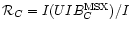 (ISOCAM8), turns out to be
 ,
which shows a much larger
dispersion.
In view of the fact that band C of MSX also includes the UIB
feature at 12.7 m, the above is not surprising.
The average value of
,
which shows a much larger
dispersion.
In view of the fact that band C of MSX also includes the UIB
feature at 12.7 m, the above is not surprising.
The average value of
 should provide information
regarding the relative strengths of the features at 11.2 and
12.7 m. The larger dispersion in the values of
among the five regions considered here is perhaps indicative of the
observed variability of the strength of the 12.7 m feature vis-a-vis
other UIBs at shorter wavelengths (e.g. among the sources whose
ISO-SWS spectra have been presented by Verstraete et al. 2001).
should provide information
regarding the relative strengths of the features at 11.2 and
12.7 m. The larger dispersion in the values of
among the five regions considered here is perhaps indicative of the
observed variability of the strength of the 12.7 m feature vis-a-vis
other UIBs at shorter wavelengths (e.g. among the sources whose
ISO-SWS spectra have been presented by Verstraete et al. 2001).
Next, we discuss how sensitive the value of
is to the various assumptions made in
analysing/modelling the MSX data.
One of the parameters while modelling the
continuum from the MSX radiance in band A, is
,
the dust emissivity index.
Let us consider a few most popular types of dust grains,
e.g., the Draine and Lee type (DL; Draine & Lee 1984),
and Mathis, Mezger and Panagia (MMP; Mathis et al. 1983).
One of the most popular dust size distribution is due to
Mathis et al. (MRN; Mathis et al. 1977).
The MRN size distribution averaged values of
absorption cross sections for DL and MMP type
dust, for silicate and graphite grains,
have been computed (Mookerjea & Ghosh 1999;
Mookerjea et al. 1999).
Using these for
the MSX bands A to E, we find the effective
value of
to be in the range 0.56 to 0.89.
All calculations were repeated
for the values of  and 0.5 (in addition to 1.0).
This had an insignificant effect on the value of
,
and
also on the tightness of correlation between
I(ISOCAM4+6) and
and 0.5 (in addition to 1.0).
This had an insignificant effect on the value of
,
and
also on the tightness of correlation between
I(ISOCAM4+6) and
 ).
It may be noted here that in the case where a strong silicate absorption
feature at 9.8 m was important, the above correlation
could have been lost. The sample of ZD had been selected
such that the silicate feature is not visible in the IRAS LRS spectrum.
).
It may be noted here that in the case where a strong silicate absorption
feature at 9.8 m was important, the above correlation
could have been lost. The sample of ZD had been selected
such that the silicate feature is not visible in the IRAS LRS spectrum.
Another very important parameter in our scheme is
(see Eq. (3)), which has been held at a value
of 0.32 on the basis of the result of Verstraete et al. (2001).
In order to study the sensitivity of our results on the
numerical value of ,
we have repeated the calculations
for a range of its values between 0 and 0.7. We find that,
for the value of
between 0.15 and 0.35, the correlation
between I(ISOCAM4+6) and
)
remains very
tight, though the numerical value of
changes
slightly between 2.0 and 2.3. For values of
outside
this range (0.15-0.35), the correlation
becomes much poorer and also the value of
decreases
on either side of this range. All of the above can
be understood, if the total UIB feature strength in MSX bands Aand C are really proportional.
Hence we conclude that value of
determined here is
physically meaningful and should help quantify the
UIB emission in the Galactic plane in general.
A scheme has been developed to extract the contribution
of Unidentified Infrared emission Bands (UIBs) from the
mid infrared Galactic plane survey carried out by the
SPIRIT III instrument onboard the Midcourse Space Experiment (MSX)
satellite in four bands. The scheme models the observations
with a combination of thermal emission (gray body) from
interstellar dust and the UIB emission from the gas component,
under reasonable assumptions. Thus the spatial distribution
of emission in the UIBs with an angular resolution 20
(intrinsic to the MSX survey) has been extracted.
In order to verify the reliability of this scheme, a detailed
comparison has been made with the results obtained by
Zavagno & Ducci (2001) using the ISOCAM instrument
onboard the Infrared Space Observatory (ISO), which has
superior spectral
and spatial resolution than that of the MSX survey.
Five Galactic star forming regions, Sharpless 61 (Sh-61),
Sh-138, Sh-152, Sh-156 and Sh-186, studied by Zavagno &
Ducci (2001) have been used in this comparison.
The following results have been found:
- the UIB emission extracted from the MSX data is able
to reproduce all major structural/morphological details
detected by ISOCAM,
consistent with its angular resolution;
- a very tight linear correlation has been found between
the integrated UIB emission extracted from MSX data and that
obtained from ISOCAM data (hence MSX-based UIB radiance
estimates can be well calibrated);
The above validates our assumption regarding the emissivity law
for interstellar dust grains and is consistent with
the assumed proportionality of UIB emission between the bands
A and C of MSX.
The correlation may be the result of spatial averaging over
regions with different excitation details.
- the numerical value of the ratio of UIB radiances obtained
from MSX and ISOCAM is important information for understanding
the relative strengths of UIBs.
Hence, we conclude that our empirical scheme, along with the MSX Galactic
plane survey, can be a powerful tool to study large-scale
spatial distribution of UIB carriers.
Acknowledgements
It is a pleasure to thank the referee Dr. M. P. Egan whose
suggestions have improved the scientific content of this paper.
This research made use of data products from the Midcourse Space
Experiment. Processing of the data was funded by the Ballistic
Missile Defense Organization with additional support from the NASA
Office of Space Science. This research has also made use of the
NASA/ IPAC Infrared Science Archive, which is operated by the
Jet Propulsion Laboratory, California Institute of Technology,
under contract with the National Aeronautics and Space
Administration.
The present work is
based on observations with ISO, an ESA project with instruments funded by
ESA Member States (especially the PI countries: France, Germany, The
Netherlands and the UK) and with the participation of ISAS and NASA.
- Allamandola, L. J., Hudgins, D. M., & Sandford, S. A.
1999, ApJ, 511, L115
In the text
NASA ADS
- Allamandola, L. J., Tielens, A. G. G. M., &
Barker, J. R. 1985, ApJ, 290, L25
In the text
NASA ADS
- Borghesi, A., Bussoletti, E., & Colangeli, L.
1987, ApJ, 314, 422
In the text
NASA ADS
- Césarsky, C. J., Abergel, A., Agnese, P., et al.
1996, A&A, 315, L32
In the text
NASA ADS
- Cohen, M. 1999, in New Perspectives on the
Interstellar Medium, ed. A. R. Taylor, T. L. Landecker, &
G. Joncas, ASP Conf. Ser., 168, 97
In the text
- Cohen, M., & Green, A. J. 2001, MNRAS, 325, 531
In the text
NASA ADS
- Crété, E., Giard, M., Joblin, C., et al. 1999, A&A, 352, 277
In the text
NASA ADS
- Draine, B. T., & Lee, H. M. 1984, ApJ, 285, 89
In the text
NASA ADS
- Egan, M. P., Price, S. D., Moshir, M. M., et al. 1999, MSX Point Source Catalog
Explanatory Guide, AFRL-VS-TR-1999-1522
In the text
- Joblin, C., Tielens, A. G. G. M., Geballe, T. R.,
& Wooden, D. H. 1996, ApJ, 460, L119
In the text
NASA ADS
- Leger, A., & Puget, J. L. 1984, A&A, 137, L5
In the text
NASA ADS
- Mathis, J. S. 1990, ARA&A, 28, 37
In the text
NASA ADS
- Mathis, J. S., Rumpl, W., & Nordsieck, K. H. 1977, ApJ, 217, 425
In the text
NASA ADS
- Mezger, P. G., Mathis, J. S., & Panagia, N. 1982, A&A, 105, 327
- Mookerjea, B., & Ghosh, S. K. 1999, JA&A, 20, 1
In the text
- Mookerjea, B., Ghosh, S. K., Karnik, A. D.,
et al. 1999, ApJ, 522, 285
NASA ADS
- Price, S. D., Egan, M. P., Carey, S. J.,
Mizuno, D. R., & Kuchar, T. A. 2001, AJ, 121, 2819
In the text
NASA ADS
- Sakata, A., Wada, S., Tanabe, T., & Onaka, T.
1984, ApJ, 287, L51
In the text
NASA ADS
- Savage, B. D., & Mathis, J. S. 1979, ARA&A, 17, 73
In the text
NASA ADS
- Scoville, N. Z., & Kwan, J. 1976, ApJ, 206, 718
In the text
NASA ADS
- Verstraete, L., Pech, C., Moutou, C.,
et al. 2001, A&A, 372, 981
In the text
NASA ADS
- Zavagno, A., & Ducci, V. 2001, A&A, 371, 312 (ZD)
In the text
NASA ADS
Copyright ESO 2002
![\begin{figure}
\par\includegraphics[width=8.8cm,clip]{2302.fig1.eps}
\end{figure}](/articles/aa/full/2002/22/aa2302/img46.gif)
![\begin{figure}
\par\includegraphics[width=8.8cm,clip]{2302.fig2.eps}
\end{figure}](/articles/aa/full/2002/22/aa2302/img48.gif)
![\begin{figure}
\par\includegraphics[width=8.8cm,clip]{2302.fig3.eps}
\end{figure}](/articles/aa/full/2002/22/aa2302/img50.gif)
![\begin{figure}
\par\includegraphics[width=8.8cm,clip]{2302.fig4.eps}
\end{figure}](/articles/aa/full/2002/22/aa2302/img52.gif)
![\begin{figure}
\par\includegraphics[width=8.8cm,clip]{2302.fig5.eps}
\end{figure}](/articles/aa/full/2002/22/aa2302/img54.gif)
![\begin{figure}
\par\includegraphics[width=8.8cm,clip]{2302.fig6.eps}
\end{figure}](/articles/aa/full/2002/22/aa2302/img55.gif)
![\begin{figure}
\par\includegraphics[width=8.8cm,clip]{2302.fig7.eps}
\end{figure}](/articles/aa/full/2002/22/aa2302/img56.gif)
![\begin{figure}
\par\includegraphics[width=8.8cm,clip]{2302.fig8.eps}
\end{figure}](/articles/aa/full/2002/22/aa2302/img57.gif)
![\begin{figure}
\par\includegraphics[width=8.8cm,clip]{2302.fig9.eps}
\end{figure}](/articles/aa/full/2002/22/aa2302/img58.gif)
![\begin{figure}
\par\includegraphics[width=8.8cm,clip]{2302.fig10.eps}
\end{figure}](/articles/aa/full/2002/22/aa2302/img59.gif)
![\begin{figure}
\par\includegraphics[width=8.8cm,clip]{2302.fig11.eps}
\end{figure}](/articles/aa/full/2002/22/aa2302/img60.gif)
 )c
)c


