|
Figure 1:
B-band CCD images. Image size:
 ,
except for ESO 115-G021 and ESO 154-G023, for which the
size is ,
except for ESO 115-G021 and ESO 154-G023, for which the
size is
 .
North is up and east to the
left. .
North is up and east to the
left. |
 |
Figure 2:
B-band CCD image of the newly discovered galaxy NGC 2784 DW1,
together with PGC 166099, the actual target, and NGC 2784. Image size:
 .
North is up and east to the left. .
North is up and east to the left. |
The two main sources of the present photometric sample of dwarf
galaxies are the catalogue of nearby galaxies by Schmidt & Boller
(1992) and the list of galaxies by Karachentsev et al. (1999). Both
include galaxies with a distance limit of roughly 10 Mpc. We selected
25, mostly field dwarf candidates in the southern sky from these
catalogues. Since some of the dwarfs are rather close companions of
giant galaxies, they are not as isolated as might be associated with
the definition of field galaxy. However, all but one galaxy do not
belong to one of the known groups in the volume in question and are
therefore defined as field dwarfs. Most of the candidates are late
type galaxies. A list of the objects selected and observed along with
some basic data is given in Table 1. The columns of Table 1 are as
follows:
Columns 2 and 3: identification of the observed galaxy;
Cols. 4 and 5: their 2000.0 epoch coordinates (from NED);
Col. 6: morphological type in the classification system of
Sandage & Binggeli (1984);
Col. 7: galaxy semi-major (R25) and semi-minor axis
(r25) in arcsecs and at the level of
 ;
used as ellipse fit parameters;
;
used as ellipse fit parameters;
Col. 8: position angle at the level of the
isophote, measured from north to east;
Col. 9: total B-band magnitude, corrected for galactic
extinction (cf. Table 2);
Cols. 10 and 11: heliocentric radial velocity in km s-1
(from the NED) and distance in Mpc (mostly from Karachentsev et al. 1999
and Huchtmeier et al. 2000; see also Sect. 3.1);
Col. 12: absolute B-band magnitude, based on the data given in
Cols. 9 and 11.
| No. | Ident. 1 | Ident. 2 | RA | Dec | Type |
 |
PA | B |
 |
Dist. | MB |
| (1) |  (2) (2) |
(3) |
(4) | (5) | (6) | (7) | (8) | (9) | (10) | (11) | (12) |
| 1. | ESO 410-G005 | KK 3 | 00 15 31.13 | -32 10 55.46 | dE | 37.0 25.4 25.4 |
46 | 14.84 | ... | 1.9 | -11.55 |
| 2. | ESO 473-G024 | PGC 1920 | 00 31 23.06 | -22 46 02.30 | Im | 28.012.8 |
38 | 15.96 | 541 | 8.7 | -13.74 |
| 3. | ESO 115-G021 | PGC 9962 | 02 37 48.10 | -61 20 18.00 | Sm | 148.522.2 |
45 | 13.23 | 513 | 4.8 | -15.18 |
| 4. | ESO 154-G023 | PGC 11139 | 02 56 50.38 | -54 34 17.10 | Sm | 197.042.4 |
42 | 12.62 | 578 | 5.9 | -16.23 |
| 5. | NGC 1311 | ESO 200-G007 | 03 20 07.37 | -52 11 06.68 | Sm | 93.627.8 |
41 | 13.09 | 571 | 5.7 | -15.69 |
| 6. | IC 1959 | ESO 200-G039 | 03 33 11.80 | -50 24 38.28 | Sdm | 76.518.3 |
-29 | 13.21: | 640 | 6.7 | -15.92: |
| 7. | IC 2038 | ESO 157-G001 | 04 08 54.10 | -55 59 31.20 | Sd | 52.415.3 |
-27 | 14.93: | 712 | 7.6 | -14.47: |
| 8. | NGC 1800 | ESO 422-G030 | 05 06 24.07 | -31 57 10.90 | Sm/BCD | 60.634.3 |
-70 | 13.01 | 803 | 7.1 | -16.25 |
| 9. | AM 0521-343 | KK45 | 05 23 23.40 | -34 34 30.00 | Im | 23.315.6 |
-65 | 15.74: | ... | 9.9 | -14.24 |
| 10. | ESO 555-G028 | PGC 18370 | 06 04 27.92 | -19 37 20.70 | Im | 31.711.8 |
-26 | 16.01: | 882 | 6.4 | -13.02: |
| 11. | ESO 489-G056 | PGC 19041 | 06 26 16.98 | -26 15 56.20 | Im | 22.916.5 |
24 | 15.42 | 495 | 3.7 | -12.42 |
| 12. | ESO 490-G017 | PGC 19337 | 06 37 56.60 | -25 59 58.70 | Im | 51.940.5 |
-26 | 13.67: | 499 | 7.0 | -15.55: |
| 13. | ESO 308-G022 | PGC 19382 | 06 39 33.08 | -40 43 18.50 | Im | 18.817.0 |
-20 | 15.67 | 821 | 7.5 | -13.71 |
| 14. | PGC 20125 | AM 0704-582 | 07 05 17.40 | -58 31 14.00 | Im | 27.319.1 |
-6 | 14.44 | 554 | 3.8 | -13.46 |
| 15. | ESO 558-G011 | PGC 20171 | 07 06 56.84 | -22 02 26.10 | Im | 72.051.4 |
44 | 12.83: | 737 | 7.1 | -16.43: |
| 16. | ESO 059-G001 | PGC 21199 | 07 31 18.20 | -68 11 16.80 | Im | 71.851.0 |
-19 | 13.35 | 528 | 3.7 | -14.49 |
| 17. | ESO 006-G001 | PGC 23344 | 08 19 23.26 | -85 08 41.10 | Im | 37.531.7 |
9 | 14.30 | 738 | 7.0 | -14.92 |
| 18. | UGCA 148 | DDO 56 | 09 09 46.54 | -23 00 33.00 | Im | 37.927.1 |
64 | 14.91 | 725 | 6.3 | -14.09 |
| 19. | NGC 2784 DW1 | ... | 09 12 18.50: | -24 12 41.00: | dE,N: | 17.29.0 |
-89 | 16.38: | ... | ... | ... |
| 20. | PGC 166099 | KK 73 | 09 12 29.20 | -24 14 28.00 | dE,N | 23.519.3 |
-60 | 15.50 | ... | 6.0 | -13.39 |
| 21. | UGCA 153 | ESO 564-G030 | 09 13 12.08 | -19 24 31.00 | Sm | 42.017.6 |
-43 | 15.02 | 765 | 7.0 | -14.20 |
| 22. | NGC 2915 | ESO 037-G003 | 09 26 11.49 | -76 37 35.60 | Sm/BCD | 89.150.3 |
-50 | 12.01 | 468 | 5.3 | -16.61 |
| 23. | UGCA 193 | PGC 29086 | 10 02 36.00 | -06 00 49.00 | Sdm | 92.810.3 |
17 | 14.67 | 662 | 9.2 | -15.15 |
| 24. | UGCA 200 | PGC 29299 | 10 05 35.20 | -07 44 44.00 | dE,N | 23.113.8 |
-31 | 16.16: | ... | 9.2 | -13.66: |
| 25. | NGC 3115 DW1 | PGC 29300 | 10 05 41.59 | -07 58 53.50 | dE,N | 54.349.2 |
2 | 13.38 | 698 | 9.2 | -16.44 |
 CCD camera. We took three 10 min exposures in B and three
5 min exposures in R, except ESO 410-G005, for which only one
30 and one 15 min exposure in B and R, respectively, has been
taken. The field of view is
CCD camera. We took three 10 min exposures in B and three
5 min exposures in R, except ESO 410-G005, for which only one
30 and one 15 min exposure in B and R, respectively, has been
taken. The field of view is
 with a
resolution of
with a
resolution of
 per pixel. The gain was set to
 per ADU, and the CCD was read out with a readout noise of
 .
Seeing was between
.
Seeing was between
 and
and
 .
.
 can be regarded as small enough for our purpose, which we
achived after one substraction.
can be regarded as small enough for our purpose, which we
achived after one substraction.
For the calibration we used standard stars from AU. Landolt (1992). The fields with the standard stars were imaged before and after each observing block of our targets i.e. six to seven times per night. In all four nights we could observe under photometric conditions, therefore we could combine all standard stars of one night for the calibration.
The galaxy frames were then cleaned from disturbing foreground stars or background galaxies. Only the objects, for which the membership to one of these classes was obvious, were removed. Due to the similarity of certain bright, star forming regions in the irregular galaxies to foreground stars, some of these might have remained on the frames by mistake. With the available resolution, such confusions can not be avoided. However, the measured parameters can not be wrong by much, as any bright foreground stars, which really would affect the results, are easily cognizable. That the removal of bright foreground stars is important indeed was shown in Paper VI, Sect. 4.4.
After this "cleaning'' we used the ellipse fitting routine FIT/ELL3
to fit an ellipse to the isophote with the surface
brightness of  25 mag/
 .
The center, the
ellipticity and the position angle of the major axis of this ellipse
were then used to integrate the galaxy light in elliptic apertures of
growing equivalent radius
.
The center, the
ellipticity and the position angle of the major axis of this ellipse
were then used to integrate the galaxy light in elliptic apertures of
growing equivalent radius
 ,
where a and b are the
major and minor axis of the corresponding ellipse,
respectively. Plotting the obtained intensities against equivalent
radius yields the growth curve (integrated light profile). From this
curve all model-free parameters can be derived (see below). The
behaviour of this curve at larger radii also submits another
possibility to check the flatness and level of the background. A
perfectly flat background with intensity zero would show up in a
perfectly asymptotic growth curve, whereas remaining gradients or
deviants from zero cause an always rising or suddenly decreasing
curve. A slightly positive (negative) background can now be corrected
by subtracting (adding) a constant to all pixel intensities in the
frame. These corrections should be small compared to the substracted
background intensity. In general our flat fielding and background
substraction procedures worked very well, only the images taken very
close to the galactic plane, which were crowded by foreground stars
and where a determination of the background was difficult, suffered
from remaining gradients. However, these gradients only affect the
faintest parts of the galaxies and do not strongly influence the
global parameters considered in this work.
,
where a and b are the
major and minor axis of the corresponding ellipse,
respectively. Plotting the obtained intensities against equivalent
radius yields the growth curve (integrated light profile). From this
curve all model-free parameters can be derived (see below). The
behaviour of this curve at larger radii also submits another
possibility to check the flatness and level of the background. A
perfectly flat background with intensity zero would show up in a
perfectly asymptotic growth curve, whereas remaining gradients or
deviants from zero cause an always rising or suddenly decreasing
curve. A slightly positive (negative) background can now be corrected
by subtracting (adding) a constant to all pixel intensities in the
frame. These corrections should be small compared to the substracted
background intensity. In general our flat fielding and background
substraction procedures worked very well, only the images taken very
close to the galactic plane, which were crowded by foreground stars
and where a determination of the background was difficult, suffered
from remaining gradients. However, these gradients only affect the
faintest parts of the galaxies and do not strongly influence the
global parameters considered in this work.
 ,
which is related to the total apparent
magnitude, m, through:
,
which is related to the total apparent
magnitude, m, through:
 |
(1) |
![\begin{displaymath}\langle\mu\rangle_{\rm eff}~[{\rm mag}/\ifmmode\hbox{\rlap{$\...
...0\endgraf}\fi\arcsec]=m+5~\log(r_{\rm eff}[\arcsec])
+1.995.
\end{displaymath}](/articles/aa/full/2002/22/aa2298/img34.gif) |
(2) |
Col. 3: total apparent magnitude in the B band.
Col. 4: total B-R colour index.
Col. 5: galactic absorption in B using the extinction maps of
Schlegel et al. (1998).
Cols. 6 and 7: effective radius in B and R,
respectively, in arcseconds.
Cols. 8 and 9: effective surface brightnesses in B and R,
respectively, in mag/
.
The surface brightness profiles, obtained by differentiating the
growth curve with respect to equivalent radius, are shown in Fig. 3
with a resolution or bin size of
,
which corresponds
also to the pixel size. The profiles are traced down to the radius
where the growth curve becomes flat.
| No. | Galaxy | B | B-R | AB |
 |
 |
 |
 |
 |
 |
 |
 |
 |
 |
| (1) | (2) | (3) | (4) | (5) | (6) | (7) | (8) | (9) | (10) | (11) | (12) | (13) | (14) | (15) |
| 1. | ESO 410-G005 | 14.84 | 1.02 | 0.06 | 24.20 | 25.55 | 23.75 | 22.85 | 22.67 | 21.55 | 14.56 | 14.52 | 0.02 | -0.07 |
| 2. | ESO 473-G024 | 15.96 | 0.61 | 0.08 | 16.93 | 17.54 | 24.10 | 23.56 | 22.00 | 21.72 | 7.32 | 8.16 | -0.28 | -0.18 |
| 3. | ESO 115-G021 | 13.23 | 0.91 | 0.11 | 33.19 | 34.81 | 22.83 | 22.02 | 21.63 | 20.87 | 19.35 | 20.34 | -0.03 | 0.00 |
| 4. | ESO 154-G023 | 12.62 | 0.82 | 0.07 | 52.98 | 54.49 | 23.23 | 22.48 | 20.10 | 19.75 | 18.66 | 21.28 | -0.87 | -0.68 |
| 5. | NGC 1311 | 13.09 | 0.89 | 0.09 | 22.00 | 24.00 | 21.80 | 21.10 | 21.74 | 20.59 | 17.50 | 16.79 | 0.44 | 0.27 |
| 6. | IC 1959 | 13.21: | 0.88: | 0.05 | 20.08: | 20.35: | 21.72: | 20.87: | 19.25 | 19.01 | 8.54 | 9.88 | -0.61 | -0.29 |
| 7. | IC 2038 | 14.93: | 1.09: | 0.05 | 14.10: | 14.07: | 22.67: | 21.58: | 21.63 | 20.57 | 8.68 | 8.62 | 0.01 | 0.06 |
| 8. | NGC 1800 | 13.01 | 0.98 | 0.06 | 14.40 | 16.44 | 20.80 | 20.10 | 21.64 | 20.53 | 15.01 | 15.51 | 0.75 | 0.55 |
| 9. | AM 0521-343 | 15.74: | 0.79: | 0.12 | 11.70: | 12.07: | 23.07: | 22.35: | 21.60 | 20.95 | 6.12 | 6.57 | -0.07 | -0.08 |
| 10. | ESO 555-G028 | 16.01: | 0.87: | 0.38 | 19.19: | 20.51: | 24.42: | 23.69: | 23.43 | 21.89 | 12.00 | 9.87 | 0.03 | -0.22 |
| 11. | ESO 489-G056 | 15.42 | 0.68 | 0.28 | 11.55 | 12.15 | 22.73 | 22.16 | 23.01 | 21.82 | 9.59 | 8.86 | 0.68 | 0.35 |
| 12. | ESO 490-G017 | 13.67: | 0.83: | 0.34 | 22.83: | 25.56: | 22.46: | 21.87: | 21.30 | 20.57 | 13.28 | 14.41 | 0.03 | 0.00 |
| 13. | ESO 308-G022 | 15.67 | 0.80 | 0.38 | 25.79 | 23.30 | 24.72 | 23.70 | 23.81 | 22.78 | 15.93 | 14.32 | 0.13 | 0.13 |
| 14. | PGC 20125 | 14.44 | 0.74 | 0.51 | 53.32 | 57.34 | 25.07 | 24.49 | 23.75 | 21.97 | 30.67 | 22.51 | -0.12 | -0.49 |
| 15. | ESO 558-G011 | 12.83: | 1.01: | 1.60 | 27.10: | 30.53: | 21.99: | 21.24: | 22.08 | 20.64 | 21.42 | 20.49 | 0.60 | 0.27 |
| 16. | ESO 059-G001 | 13.35 | 0.96 | 0.63 | 43.47 | 44.24 | 23.53 | 22.61 | 22.20 | 21.17 | 25.21 | 24.86 | -0.15 | -0.15 |
| 17. | ESO 006-G001 | 14.30 | 1.24 | 0.83 | 20.05 | 23.50 | 22.80 | 21.91 | 22.12 | 21.16 | 13.66 | 16.03 | 0.15 | 0.08 |
| 18. | UGCA 148 | 14.91 | 1.03 | 0.72 | 20.01 | 19.91 | 23.41 | 22.37 | 21.40 | 20.35 | 9.47 | 9.40 | -0.39 | -0.39 |
| 19. | NGC 2784 DW1 | 16.38: | 1.12: | 0.89 | 20.67: | 19.85: | 24.95: | 23.74: | 23.68 | 22.53 | 12.56 | 12.36 | -0.19 | -0.18 |
| 20. | PGC 166099 | 15.50 | 1.16 | 0.85 | 19.52 | 20.10 | 23.95 | 22.85 | 23.09 | 21.96 | 12.84 | 13.38 | 0.05 | -0.01 |
| 21. | UGCA 153 | 15.02 | 0.94 | 0.38 | 30.47 | 31.32 | 24.43 | 23.55 | 23.32 | 22.34 | 17.94 | 18.58 | 0.03 | -0.08 |
| 22. | NGC 2915 | 12.01 | 0.91 | 1.18 | 17.20 | 21.91 | 20.18 | 19.80 | 21.26 | 20.22 | 19.60 | 20.37 | 0.79 | 0.58 |
| 23. | UGCA 193 | 14.67 | 0.90 | 0.16 | 16.65 | 17.71 | 22.77 | 22.01 | 21.98 | 21.35 | 10.96 | 12.32 | 0.11 | 0.13 |
| 24. | UGCA 200 | 16.16: | 1.38: | 0.20 | 17.99: | 19.55: | 24.43: | 23.23: | 23.19 | 22.26 | 10.59 | 12.52 | -0.09 | 0.00 |
| 25. | NGC 3115 DW1 | 13.38 | 1.38 | 0.23 | 29.98 | 28.88 | 22.76 | 21.30 | 22.26 | 20.72 | 21.36 | 20.01 | 0.24 | 0.22 |
![$B~[{\rm mag}/\ifmmode\hbox{\rlap{$\sqcap$ }$\sqcup$ }\else{\unskip\nobreak\hfil...
...$\sqcap$ }$\sqcup$ }
\parfillskip=0pt\finalhyphendemerits=0\endgraf}\fi\arcsec]$](/articles/aa/full/2002/22/aa2298/img45.gif) and
and
![$R~[{\rm mag}/\ifmmode\hbox{\rlap{$\sqcap$ }$\sqcup$ }\else{\unskip\nobreak\hfil...
...$\sqcap$ }$\sqcup$ }
\parfillskip=0pt\finalhyphendemerits=0\endgraf}\fi\arcsec]$](/articles/aa/full/2002/22/aa2298/img46.gif) ,
respectively.
Cols. 12 and 13: exponential scale length in
arcseconds
,
respectively.
Cols. 12 and 13: exponential scale length in
arcseconds ![$[\arcsec]$](/articles/aa/full/2002/22/aa2298/img47.gif) ,
in B and R, respectively.
Cols. 14 and 15: difference between the total magnitude as
derived from the exponential model and the true total magnitude in B
and R, respectively.
,
in B and R, respectively.
Cols. 14 and 15: difference between the total magnitude as
derived from the exponential model and the true total magnitude in B
and R, respectively.
The meaning of these parameters and the reason for their introduction
is straightforward. Since the sample considered here consists mainly
of dwarf irregular galaxies, most of the resulting profiles look
rather noisy, above all in the central parts. At larger radii the
profiles become more and more straight lines, which corresponds to an
exponential behaviour of the intensity profile. The outer profile
might represent the older, underlying stellar disk of the galaxy and
therefore provides a physically meaningful parameter when fitted by an
exponential function (de Vaucouleurs 1959; Binggeli & Cameron
1993). In the surface brightness (magnitude) representation this model
is of the form:
 |
(3) |
 and the
exponential scale length
and the
exponential scale length  are the two free parameters of the
exponential fit. The fitting range must be defined for each galaxy
individually. For most of the galaxies the choice of this interval was
quite obvious, for three cases however the best fitting region was
hard to find (i.e. ESO 308-G022, PGC 20125, UGCA 153). In these cases
we used rather large radius ranges for the fits to compensate for the
fluctuations. As mentioned, the extrapolated central surface
brightness and the scale length of the best-fitting exponential for
the individual galaxies are listed in Table 2, while the corresponding
profiles are plotted as solid lines in Fig. 3 along with the observed
profiles. Note that scientists who decide to include the central portions
of their profiles for the exponential fitting as well may get rather
different scale lengths and central surface brightnesses.
are the two free parameters of the
exponential fit. The fitting range must be defined for each galaxy
individually. For most of the galaxies the choice of this interval was
quite obvious, for three cases however the best fitting region was
hard to find (i.e. ESO 308-G022, PGC 20125, UGCA 153). In these cases
we used rather large radius ranges for the fits to compensate for the
fluctuations. As mentioned, the extrapolated central surface
brightness and the scale length of the best-fitting exponential for
the individual galaxies are listed in Table 2, while the corresponding
profiles are plotted as solid lines in Fig. 3 along with the observed
profiles. Note that scientists who decide to include the central portions
of their profiles for the exponential fitting as well may get rather
different scale lengths and central surface brightnesses.
The deviation of the observed profile from a pure exponential law is
expressed by the difference  between the total magnitude of
an exponential intensity law, given by
between the total magnitude of
an exponential intensity law, given by
 |
(4) |
to be a measure for the goodness of a fit by
means of an exponential intensity profile.
 |
Figure 3: Radial surface brightness profiles of the observed dwarf galaxies in B (bottom curves) and R (upper curves). The solid lines represent the exponential fits, as described in the text. |
 whereas for the dwarf ellipticals we get
 .
The "bluest'' dE is ESO 410-G005 with
B-R=1.02, for which the classification as dE might indeed be
doubtful (see Notes on individual galaxies). Among the late-type
dwarfs two are rather red: IC 2038 with B-R=1.09, which is a
disk galaxy seen almost edge-on and therefore reddened by the internal
dust absorption, and ESO 006-G001 with B-R=1.24. The latter galaxy
has a rather peculiar morphology. Its central part is dominated by
bright, knotty features, which, as a whole, shows even a spiral
structure. This "late-type part'' of the galaxy is surrounded by a
spherical, dwarf elliptical-like component, which makes the
classification rather difficult. For the galaxies lying close to the
zone of avoidance (e.g. ESO 558-G011), the accuracy of the determined
colour can not be very high, as any slight uncertainty in the
correction with respect to colour will produce a large error in the
"true'' colour index.
.
The "bluest'' dE is ESO 410-G005 with
B-R=1.02, for which the classification as dE might indeed be
doubtful (see Notes on individual galaxies). Among the late-type
dwarfs two are rather red: IC 2038 with B-R=1.09, which is a
disk galaxy seen almost edge-on and therefore reddened by the internal
dust absorption, and ESO 006-G001 with B-R=1.24. The latter galaxy
has a rather peculiar morphology. Its central part is dominated by
bright, knotty features, which, as a whole, shows even a spiral
structure. This "late-type part'' of the galaxy is surrounded by a
spherical, dwarf elliptical-like component, which makes the
classification rather difficult. For the galaxies lying close to the
zone of avoidance (e.g. ESO 558-G011), the accuracy of the determined
colour can not be very high, as any slight uncertainty in the
correction with respect to colour will produce a large error in the
"true'' colour index.
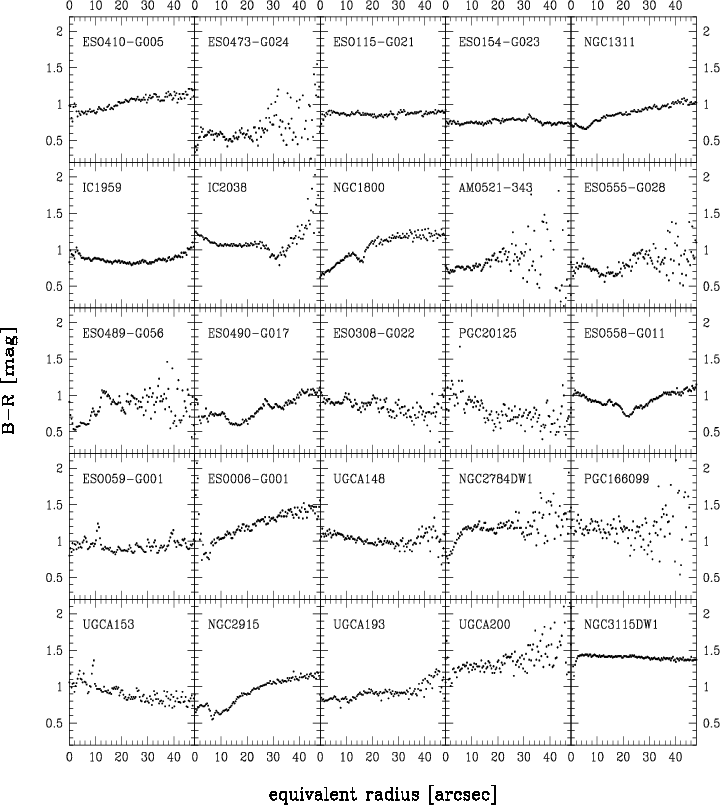
B-R colour profiles are shown in Fig. 4. Due to the active or recent star formation, in the inner parts, late-type dwarfs normaly show a stellar population gradient, e.g. younger and bluer stars are centrally concentrated and older and redder stars dominate the outer parts of the galaxy. Therefore, their colour indices are expected to increase with galactocentric radius. However, only eight galaxies among the late-type dwarfs show such a positive colour gradient, another eight examples have a more or less flat colour profile and four actually have a negative gradient. As the scatter in some of these profiles is rather large the sign of their gradients is not obvious. Finally we remain with two clear outliers: UGCA 148 is classified as Im, but might be a transition type between Im and dE, because, aside from a couple of bright knots on the outer parts, the galaxy looks like a dwarf elliptical. UGCA 153 has clearly two spiral arms and can therefore probably be regarded as a disturbed (dwarf) spiral galaxy, hence the colour gradient makes sense.
 error of 0.03 mag. Another contribution to the error
comes from the determination of the extinction, which was also measured
each night. The
error in this case is 0.02 mag. To check the
accuracy of the flat-fielding and the background substraction, we fitted a
plane to the background of the already reduced image and measured the remaining
gradient (see Sect. 2.2). The mean of these gradients is
error of 0.03 mag. Another contribution to the error
comes from the determination of the extinction, which was also measured
each night. The
error in this case is 0.02 mag. To check the
accuracy of the flat-fielding and the background substraction, we fitted a
plane to the background of the already reduced image and measured the remaining
gradient (see Sect. 2.2). The mean of these gradients is  ,
which is so
low that it can be neglected. However, small fluctuations in the background
can not be discovered with this method. Hints of such deviations are provided
by the corrections, which have to be applied to the background in order to get
a perfectly asymptotic growth curve. Only in rare cases the first integration
of the galaxy light, after the standard reduction steps, yielded a perfectly
assymptotic growth curve. Therefore, we normally had to correct the background
by a constant, which in general was small compared to the substracted
background intensity. Considering these corrections, we are on the
safe side by assigning an uncertainty of 0.05 mag to this effect, which
gives, together with the error from the calibration, a total error of
0.1 mag.
,
which is so
low that it can be neglected. However, small fluctuations in the background
can not be discovered with this method. Hints of such deviations are provided
by the corrections, which have to be applied to the background in order to get
a perfectly asymptotic growth curve. Only in rare cases the first integration
of the galaxy light, after the standard reduction steps, yielded a perfectly
assymptotic growth curve. Therefore, we normally had to correct the background
by a constant, which in general was small compared to the substracted
background intensity. Considering these corrections, we are on the
safe side by assigning an uncertainty of 0.05 mag to this effect, which
gives, together with the error from the calibration, a total error of
0.1 mag.
 |
Figure 5: Comparison of the total apparent magnitude in B (not corrected for galactic extinction) from this work with values from the literature. |
![[*]](/icons/foot_motif.gif) , asteriks. We consider a
deviation of
, asteriks. We consider a
deviation of  0.2 mag as a good agreement. What concernes the brightest
galaxies our results
are in agreement with at least two other sources. However, there are a few huge
differences among the fainter objects. For PGC 20125 the comparison to (1)
yields
0.2 mag as a good agreement. What concernes the brightest
galaxies our results
are in agreement with at least two other sources. However, there are a few huge
differences among the fainter objects. For PGC 20125 the comparison to (1)
yields
 mag. This galaxy is very diffuse and extended and
therefore difficult to measure. The deviation might be caused partly by
differencies in removing forground stars. The same holds for UGCA 153 with
mag. This galaxy is very diffuse and extended and
therefore difficult to measure. The deviation might be caused partly by
differencies in removing forground stars. The same holds for UGCA 153 with
 mag to (1) and
 mag to (2). The difference
of
mag to (2). The difference
of
 mag to (1) for UGCA 193 is not clear. The agreement with
the actual value in LEDA is much better,
mag to (1) for UGCA 193 is not clear. The agreement with
the actual value in LEDA is much better,
 mag, supporting
our result. For UGCA 148 (DDO 56) the three other sources agree very well
((1):
mag, supporting
our result. For UGCA 148 (DDO 56) the three other sources agree very well
((1):
 mag, (2):
 mag, (3):
 mag), whereas
our result (
mag), whereas
our result (
 mag) is quite deviant, which we can not explain.
Altogether, our results are in good agreement with earlier studies.
mag) is quite deviant, which we can not explain.
Altogether, our results are in good agreement with earlier studies.
ESO 410-G005: the nearest galaxy of our sample and a probable member of
the Sculptor Group (Côté et al. 1997). Since some stars are resolved and
therefore must be very bright, this galaxy is probably a transition type
between dwarf irregulars and dwarf ellipticals. This is also supported by the
colour-magnitude diagram in Karachentsev et al. (2000), derived with the Hubble
Space Telescope.
ESO 473-G024: confirmed member of the Sculptor Group (Côté
et al. 1997). A contour plot in the J-band is shown in Bergvall et al.
(1999).
ESO 115-G021: member of the Flat Galaxy Catalogue
(Karachentsev et al. 1999). It has a bulge-like feature slightly offset
towards the upper left and is therefore very likely a disk galaxy seen
edge-on.
ESO 154-G023: again a rather flat, but bright galaxy. The exceptional
shape of the surface brightness profile is caused by the remarkable bright
star forming region near the upper left edge of the galaxy.
NGC 1311: disk galaxy viewed almost edge-on. No signs of spiral arms, but
obviously with a bulge. The colour profile shows a blue gradient in the central
part and a reddening in the outer parts.
IC 1959: irregular disk galaxy without bulge. Again a blue colour
gradient in the inner parts, more extended than NGC 1311 and probably
caused by internal extinction due to dust, and a reddening towards larger
radii.
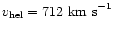
IC 2038: since Karachentsev et al. (1999) do not provide a distance for
this galaxy, we can only rely on its radial velocity, which is
 .
However, as to its morphology and angular size the distance
can not be much larger than 10 Mpc. The galaxy in the lower left is IC
2039, classified as S0. Ferguson & Sandage (1990) include it, together with
IC 2038, in the Dorando Group at a distance of 20 Mpc, despite its
radial velocity of
.
However, as to its morphology and angular size the distance
can not be much larger than 10 Mpc. The galaxy in the lower left is IC
2039, classified as S0. Ferguson & Sandage (1990) include it, together with
IC 2038, in the Dorando Group at a distance of 20 Mpc, despite its
radial velocity of
 .
In fact, the correctness of this
velocity is somewhat doubtful. If it would be confirmed, the distance of IC
2039 ought to be much smaller and we would deal with a M32-like galaxy.
.
In fact, the correctness of this
velocity is somewhat doubtful. If it would be confirmed, the distance of IC
2039 ought to be much smaller and we would deal with a M32-like galaxy.
NGC 1800: this galaxy is undergoing a strong starburst, which is
reflected in the
bright bar. The B-R colour map in Fig. 6 shows that the bluest, and hence
strongest, star forming region is not located at the center of the galaxy, but
completly offset at the end of the bar. This starburst region is also showing
up in the colour gradient, which suddenly decreases at
 .
Marlowe et al. (1999) include this galaxy in their sample of
blue amorphous galaxies and examine its taxonomy and starburst properties.
.
Marlowe et al. (1999) include this galaxy in their sample of
blue amorphous galaxies and examine its taxonomy and starburst properties.
 |
Figure 6:
B-R colour map of NGC 1800. Shown is the interval 0.3 (black)
 (white). The image size is
 .
North is up and east to the left. .
North is up and east to the left. |
Copyright ESO 2002