 and
and  photometry of 25 southern field
dwarfs
photometry of 25 southern field
dwarfs![[*]](/icons/foot_motif.gif) and a disk parameter analysis of the complete
sample of nearby irregulars
and a disk parameter analysis of the complete
sample of nearby irregulars
A&A 388, 29-49 (2002)
DOI: 10.1051/0004-6361:20020432
and
photometry of 25 southern field
dwarfs and a disk parameter analysis of the complete
sample of nearby irregularsB. R. Parodi - F. D. Barazza - B. Binggeli
Astronomisches Institut der Universität Basel, Venusstrasse 7, 4102 Binningen, Switzerland
Received 23 January 2002 / Accepted 12 March 2002
Abstract
We present B and R band surface photometry of 25
Southern field dwarf galaxies
within a distance of 10 Mpc. For each galaxy we give the
essential model-free photometric parameters and, by fitting
exponentials to the surface brightness profiles, the central
extrapolated surface brightness and the exponential scale length, in
both colour bands. Surface brightness and colour profiles are
shown. One of the objects, a very faint dwarf elliptical in the
vicinity of NGC 2784, has been discovered in the course of this
work.
Drawing on the data from this and all previous papers of this series,
we construct a complete sample of 72 late-type ("irregular'') dwarf
galaxies in nearby groups and the field within the 10 Mpc volume, to
study the exponential-disk parameter relations of these galaxies with
respect to galaxy environment. We confirm our previous finding of
statistically lower scale lengths/higher central surface brightnesses
for field and group galaxies as compared to cluster galaxies. However,
using a clear-cut definition of "group'' versus "field''
environment, we find no significant difference in the photometric
structure of group and field irregulars. A difference in the star
formation history may partly account for this structure-environment
relation: for a given luminosity cluster dwarfs are on average redder
than field and group galaxies. We also report evidence for the colour
gradients of dwarf irregulars being roughly inversely proportional to
the disk scale lengths.
Supplementing our photometric data with kinematic data from the
literature, we study possible relations with kinematic properties of
the inner disk. Applying the dark matter scaling relations for a
Burkert halo we show that for field and group galaxies of a given
luminosity faster-than-mean disk rotational velocities at a radius of
about two scale lengths are correlated with larger-than-mean disk
scale lengths.
Key words: galaxies: general - galaxies: fundamental parameters - galaxies: irregular - galaxies: photometry - galaxies: structure - galaxies: kinematics and dynamics
An early attempt to list all galaxies out to a LG-centric velocity of 500 km s-1, corresponding roughly to a distance of 10 Mpc, by Kraan-Korteweg & Tammann (1979) has set the scene for all later efforts, including the present work, to improve on our knowledge of dwarf objects in that "10 Mpc volume''. The most recent update of the "10 Mpc Catalogue'', listing some 300 galaxies, is given by Karachentsev et al. (1999). Many of these objects have only recently been discovered by Karachentseva & Karachentsev (1998) and confirmed to be nearby dwarfs by Huchtmeier et al. (2000). The number of known galaxies within the 10 Mpc volume is bound to grow further in the future.
Follow-up work on the known nearby dwarfs, done primarily by Karachentsev and collaborators, has mainly focused on the distance determination for these objects from the brightest blue stars in late-type, and the tip of the red giant branch in early-type dwarfs (see Karachentsev et al. 1999 and refs. therein; Seitzer et al. 2001). In order to secure also a data base of surface photometry for these objects, we have started a programme of systematic CCD imaging, in at least two colour bands, of all known dwarf galaxies in the 10 Mpc volume for which no such photometric data was, or is, available. Our goal is not only to contribute to the "fair sample'' census mentioned above, but to study the systematic structural differences of dwarf galaxies in different environments. Clearly, the low-mass, low-density "dwarf'' galaxies are expected to show the strongest reactions to, and hence the most significant signs of, environmental influences. A large and homogeneous sample of nearby, well-resolved dwarfs will therefore provide an ideal test bed for evolutionary scenarios.
In previous papers of this series we have reported on our B and R-band observations of dwarf members of the M 81, M 101, and CVnI groups (Bremnes et al. 1998, 1999, 2000 = Papers I, III, IV) and of field dwarfs in the Northern hemisphere (Barazza et al. 2001 = Paper VI). Based on these data, supplemented by data from other studies, Bremnes (2000) did a preliminary comparison of the photometric scaling properties of nearby field and group dwarfs with those of cluster dwarfs, drawing on the cluster data of Binggeli & Cameron (1993) and Ferguson & Sandage (1990). Bremnes (2000) found an important, significant effect: at a given total magnitude, the central exponential (or also effective) surface brightness of a dwarf galaxy - of early or late type - is lower in the high-density environment of a cluster than in the low-density field or group. The same trend is mirrored in the exponential scale length or the effective radius. A sample of Northern field dwarfs was added by Paper VI, where the analysis of Bremnes (2000) was repeated and his results confiremd for late-type dwarfs.
In the present paper, number VII of the series, we present, in a first part (Sect. 2), B and R-band surface photometry for another 25 Southern field dwarfs. One of these objects, now called NGC 2784 DW1, was not listed before but has been discovered on one of our images in the course of this work. As in our previous papers we show surface brightness and colour profiles and give the conventional photometric parameters (total magnitudes, effective, and exponential parameters) for all objects.
As most dwarfs in the nearby field, including groups of galaxies, are low-luminosity spirals (Scd, Sd, Sm) and irregulars (Im, BCD), we have by now accumulated a fairly large sample of late-type dwarfs. In the second part of the paper (Sect. 3) we therefore present a statistical analysis of the photometric, but also kinematic, properties of all 72 odd late-type dwarfs (= "irregulars'' for short) for which we have done imaging so far. For the sake of homogeneity, the whole analysis is restricted to our own photometric data. This is in contrast to Bremnes (2000) and Paper VI, where data from the literature were mixed in.
One novelty of the present study is the use of a rather simple but clear-cut definition of "group'' versus "field'' dwarfs: a "field'' dwarf has no neighbour brighter than MB = -17.5 mag within a distance of 1 Mpc. Distance estimates are mostly provided by Karachentsev et al. (1999). In this way certain traditional group members lying in the outskirts of the group would become "field'' dwarfs, and certain dwarfs satellite to giants outside of the known groups would become "group'' dwarfs. A similar but continuous, and more physically motivated environmental parameter, the "tidal index'', was introduced before by Karachentsev & Makarov (1999).
We confirm, in Sect. 3.4, that there is a significant shift in exponential scale length, and consequently in all other photometric parameters as well, at a given total magnitude, between field and group and cluster irregulars; there is, however, no such shift between group and field objects alone. There is some support for Bremnes' (2000) interpretation of this effect in terms of a difference in star formation history, in that the higher surface brightness field and group irregulars are also bluer. However, the photometric difference between field/group and cluster dwarfs could primarily also be a structural difference: in a cluster environment the dwarfs could plausibly have been puffed up to larger scale length by frequent tidal encounters. Moreover, different halos in different environments may also cause a shift: by combining our photometry with H I rotational velocity data from Karachentsev et al. (1999) and that for the PGC (Bottinelli et al. 1990), in Sect. 3.6, we show that our irregulars are indeed rotating disk galaxies obeying a Tully-Fisher relation, and that photometric parameters are correlated with inner disk circular speeds.
We also report, in Sect. 3.5, perhaps the first clear evidence of a relation between colour gradient and exponential scale length, which has a simple physical meaning. A summary of our results can be found in Sect. 4.
 |
Figure 1:
B-band CCD images. Image size:
 ,
except for ESO 115-G021 and ESO 154-G023, for which the
size is ,
except for ESO 115-G021 and ESO 154-G023, for which the
size is
 .
North is up and east to the
left. .
North is up and east to the
left. |
| Open with DEXTER | |
 |
Figure 1: continued. |
| Open with DEXTER | |
 |
Figure 2:
B-band CCD image of the newly discovered galaxy NGC 2784 DW1,
together with PGC 166099, the actual target, and NGC 2784. Image size:
 .
North is up and east to the left. .
North is up and east to the left. |
| Open with DEXTER | |
The two main sources of the present photometric sample of dwarf
galaxies are the catalogue of nearby galaxies by Schmidt & Boller
(1992) and the list of galaxies by Karachentsev et al. (1999). Both
include galaxies with a distance limit of roughly 10 Mpc. We selected
25, mostly field dwarf candidates in the southern sky from these
catalogues. Since some of the dwarfs are rather close companions of
giant galaxies, they are not as isolated as might be associated with
the definition of field galaxy. However, all but one galaxy do not
belong to one of the known groups in the volume in question and are
therefore defined as field dwarfs. Most of the candidates are late
type galaxies. A list of the objects selected and observed along with
some basic data is given in Table 1. The columns of Table 1 are as
follows:
Columns 2 and 3: identification of the observed galaxy;
Cols. 4 and 5: their 2000.0 epoch coordinates (from NED);
Col. 6: morphological type in the classification system of
Sandage & Binggeli (1984);
Col. 7: galaxy semi-major (R25) and semi-minor axis
(r25) in arcsecs and at the level of
 ;
used as ellipse fit parameters;
;
used as ellipse fit parameters;
Col. 8: position angle at the level of the
isophote, measured from north to east;
Col. 9: total B-band magnitude, corrected for galactic
extinction (cf. Table 2);
Cols. 10 and 11: heliocentric radial velocity in km s-1
(from the NED) and distance in Mpc (mostly from Karachentsev et al. 1999
and Huchtmeier et al. 2000; see also Sect. 3.1);
Col. 12: absolute B-band magnitude, based on the data given in
Cols. 9 and 11.
| No. | Ident. 1 | Ident. 2 | RA | Dec | Type |
 |
PA | B |
 |
Dist. | MB |
| (1) |  (2) (2) |
(3) |
(4) | (5) | (6) | (7) | (8) | (9) | (10) | (11) | (12) |
| 1. | ESO 410-G005 | KK 3 | 00 15 31.13 | -32 10 55.46 | dE | 37.0 25.4 25.4 |
46 | 14.84 | ... | 1.9 | -11.55 |
| 2. | ESO 473-G024 | PGC 1920 | 00 31 23.06 | -22 46 02.30 | Im | 28.012.8 |
38 | 15.96 | 541 | 8.7 | -13.74 |
| 3. | ESO 115-G021 | PGC 9962 | 02 37 48.10 | -61 20 18.00 | Sm | 148.522.2 |
45 | 13.23 | 513 | 4.8 | -15.18 |
| 4. | ESO 154-G023 | PGC 11139 | 02 56 50.38 | -54 34 17.10 | Sm | 197.042.4 |
42 | 12.62 | 578 | 5.9 | -16.23 |
| 5. | NGC 1311 | ESO 200-G007 | 03 20 07.37 | -52 11 06.68 | Sm | 93.627.8 |
41 | 13.09 | 571 | 5.7 | -15.69 |
| 6. | IC 1959 | ESO 200-G039 | 03 33 11.80 | -50 24 38.28 | Sdm | 76.518.3 |
-29 | 13.21: | 640 | 6.7 | -15.92: |
| 7. | IC 2038 | ESO 157-G001 | 04 08 54.10 | -55 59 31.20 | Sd | 52.415.3 |
-27 | 14.93: | 712 | 7.6 | -14.47: |
| 8. | NGC 1800 | ESO 422-G030 | 05 06 24.07 | -31 57 10.90 | Sm/BCD | 60.634.3 |
-70 | 13.01 | 803 | 7.1 | -16.25 |
| 9. | AM 0521-343 | KK45 | 05 23 23.40 | -34 34 30.00 | Im | 23.315.6 |
-65 | 15.74: | ... | 9.9 | -14.24 |
| 10. | ESO 555-G028 | PGC 18370 | 06 04 27.92 | -19 37 20.70 | Im | 31.711.8 |
-26 | 16.01: | 882 | 6.4 | -13.02: |
| 11. | ESO 489-G056 | PGC 19041 | 06 26 16.98 | -26 15 56.20 | Im | 22.916.5 |
24 | 15.42 | 495 | 3.7 | -12.42 |
| 12. | ESO 490-G017 | PGC 19337 | 06 37 56.60 | -25 59 58.70 | Im | 51.940.5 |
-26 | 13.67: | 499 | 7.0 | -15.55: |
| 13. | ESO 308-G022 | PGC 19382 | 06 39 33.08 | -40 43 18.50 | Im | 18.817.0 |
-20 | 15.67 | 821 | 7.5 | -13.71 |
| 14. | PGC 20125 | AM 0704-582 | 07 05 17.40 | -58 31 14.00 | Im | 27.319.1 |
-6 | 14.44 | 554 | 3.8 | -13.46 |
| 15. | ESO 558-G011 | PGC 20171 | 07 06 56.84 | -22 02 26.10 | Im | 72.051.4 |
44 | 12.83: | 737 | 7.1 | -16.43: |
| 16. | ESO 059-G001 | PGC 21199 | 07 31 18.20 | -68 11 16.80 | Im | 71.851.0 |
-19 | 13.35 | 528 | 3.7 | -14.49 |
| 17. | ESO 006-G001 | PGC 23344 | 08 19 23.26 | -85 08 41.10 | Im | 37.531.7 |
9 | 14.30 | 738 | 7.0 | -14.92 |
| 18. | UGCA 148 | DDO 56 | 09 09 46.54 | -23 00 33.00 | Im | 37.927.1 |
64 | 14.91 | 725 | 6.3 | -14.09 |
| 19. | NGC 2784 DW1 | ... | 09 12 18.50: | -24 12 41.00: | dE,N: | 17.29.0 |
-89 | 16.38: | ... | ... | ... |
| 20. | PGC 166099 | KK 73 | 09 12 29.20 | -24 14 28.00 | dE,N | 23.519.3 |
-60 | 15.50 | ... | 6.0 | -13.39 |
| 21. | UGCA 153 | ESO 564-G030 | 09 13 12.08 | -19 24 31.00 | Sm | 42.017.6 |
-43 | 15.02 | 765 | 7.0 | -14.20 |
| 22. | NGC 2915 | ESO 037-G003 | 09 26 11.49 | -76 37 35.60 | Sm/BCD | 89.150.3 |
-50 | 12.01 | 468 | 5.3 | -16.61 |
| 23. | UGCA 193 | PGC 29086 | 10 02 36.00 | -06 00 49.00 | Sdm | 92.810.3 |
17 | 14.67 | 662 | 9.2 | -15.15 |
| 24. | UGCA 200 | PGC 29299 | 10 05 35.20 | -07 44 44.00 | dE,N | 23.113.8 |
-31 | 16.16: | ... | 9.2 | -13.66: |
| 25. | NGC 3115 DW1 | PGC 29300 | 10 05 41.59 | -07 58 53.50 | dE,N | 54.349.2 |
2 | 13.38 | 698 | 9.2 | -16.44 |
 CCD camera. We took three 10 min exposures in B and three
5 min exposures in R, except ESO 410-G005, for which only one
30 and one 15 min exposure in B and R, respectively, has been
taken. The field of view is
CCD camera. We took three 10 min exposures in B and three
5 min exposures in R, except ESO 410-G005, for which only one
30 and one 15 min exposure in B and R, respectively, has been
taken. The field of view is
 with a
resolution of
with a
resolution of
 per pixel. The gain was set to
 per ADU, and the CCD was read out with a readout noise of
 .
Seeing was between
.
Seeing was between
 and
and
 .
.
 can be regarded as small enough for our purpose, which we
achived after one substraction.
can be regarded as small enough for our purpose, which we
achived after one substraction.
For the calibration we used standard stars from AU. Landolt (1992). The fields with the standard stars were imaged before and after each observing block of our targets i.e. six to seven times per night. In all four nights we could observe under photometric conditions, therefore we could combine all standard stars of one night for the calibration.
The galaxy frames were then cleaned from disturbing foreground stars or background galaxies. Only the objects, for which the membership to one of these classes was obvious, were removed. Due to the similarity of certain bright, star forming regions in the irregular galaxies to foreground stars, some of these might have remained on the frames by mistake. With the available resolution, such confusions can not be avoided. However, the measured parameters can not be wrong by much, as any bright foreground stars, which really would affect the results, are easily cognizable. That the removal of bright foreground stars is important indeed was shown in Paper VI, Sect. 4.4.
After this "cleaning'' we used the ellipse fitting routine FIT/ELL3
to fit an ellipse to the isophote with the surface
brightness of  25 mag/
 .
The center, the
ellipticity and the position angle of the major axis of this ellipse
were then used to integrate the galaxy light in elliptic apertures of
growing equivalent radius
.
The center, the
ellipticity and the position angle of the major axis of this ellipse
were then used to integrate the galaxy light in elliptic apertures of
growing equivalent radius
 ,
where a and b are the
major and minor axis of the corresponding ellipse,
respectively. Plotting the obtained intensities against equivalent
radius yields the growth curve (integrated light profile). From this
curve all model-free parameters can be derived (see below). The
behaviour of this curve at larger radii also submits another
possibility to check the flatness and level of the background. A
perfectly flat background with intensity zero would show up in a
perfectly asymptotic growth curve, whereas remaining gradients or
deviants from zero cause an always rising or suddenly decreasing
curve. A slightly positive (negative) background can now be corrected
by subtracting (adding) a constant to all pixel intensities in the
frame. These corrections should be small compared to the substracted
background intensity. In general our flat fielding and background
substraction procedures worked very well, only the images taken very
close to the galactic plane, which were crowded by foreground stars
and where a determination of the background was difficult, suffered
from remaining gradients. However, these gradients only affect the
faintest parts of the galaxies and do not strongly influence the
global parameters considered in this work.
,
where a and b are the
major and minor axis of the corresponding ellipse,
respectively. Plotting the obtained intensities against equivalent
radius yields the growth curve (integrated light profile). From this
curve all model-free parameters can be derived (see below). The
behaviour of this curve at larger radii also submits another
possibility to check the flatness and level of the background. A
perfectly flat background with intensity zero would show up in a
perfectly asymptotic growth curve, whereas remaining gradients or
deviants from zero cause an always rising or suddenly decreasing
curve. A slightly positive (negative) background can now be corrected
by subtracting (adding) a constant to all pixel intensities in the
frame. These corrections should be small compared to the substracted
background intensity. In general our flat fielding and background
substraction procedures worked very well, only the images taken very
close to the galactic plane, which were crowded by foreground stars
and where a determination of the background was difficult, suffered
from remaining gradients. However, these gradients only affect the
faintest parts of the galaxies and do not strongly influence the
global parameters considered in this work.
 ,
which is related to the total apparent
magnitude, m, through:
,
which is related to the total apparent
magnitude, m, through:
 |
(1) |
![\begin{displaymath}\langle\mu\rangle_{\rm eff}~[{\rm mag}/\ifmmode\hbox{\rlap{$\...
...0\endgraf}\fi\arcsec]=m+5~\log(r_{\rm eff}[\arcsec])
+1.995.
\end{displaymath}](/articles/aa/full/2002/22/aa2298/img34.gif) |
(2) |
Col. 3: total apparent magnitude in the B band.
Col. 4: total B-R colour index.
Col. 5: galactic absorption in B using the extinction maps of
Schlegel et al. (1998).
Cols. 6 and 7: effective radius in B and R,
respectively, in arcseconds.
Cols. 8 and 9: effective surface brightnesses in B and R,
respectively, in mag/
.
The surface brightness profiles, obtained by differentiating the
growth curve with respect to equivalent radius, are shown in Fig. 3
with a resolution or bin size of
,
which corresponds
also to the pixel size. The profiles are traced down to the radius
where the growth curve becomes flat.
| No. | Galaxy | B | B-R | AB |
 |
 |
 |
 |
 |
 |
 |
 |
 |
 |
| (1) | (2) | (3) | (4) | (5) | (6) | (7) | (8) | (9) | (10) | (11) | (12) | (13) | (14) | (15) |
| 1. | ESO 410-G005 | 14.84 | 1.02 | 0.06 | 24.20 | 25.55 | 23.75 | 22.85 | 22.67 | 21.55 | 14.56 | 14.52 | 0.02 | -0.07 |
| 2. | ESO 473-G024 | 15.96 | 0.61 | 0.08 | 16.93 | 17.54 | 24.10 | 23.56 | 22.00 | 21.72 | 7.32 | 8.16 | -0.28 | -0.18 |
| 3. | ESO 115-G021 | 13.23 | 0.91 | 0.11 | 33.19 | 34.81 | 22.83 | 22.02 | 21.63 | 20.87 | 19.35 | 20.34 | -0.03 | 0.00 |
| 4. | ESO 154-G023 | 12.62 | 0.82 | 0.07 | 52.98 | 54.49 | 23.23 | 22.48 | 20.10 | 19.75 | 18.66 | 21.28 | -0.87 | -0.68 |
| 5. | NGC 1311 | 13.09 | 0.89 | 0.09 | 22.00 | 24.00 | 21.80 | 21.10 | 21.74 | 20.59 | 17.50 | 16.79 | 0.44 | 0.27 |
| 6. | IC 1959 | 13.21: | 0.88: | 0.05 | 20.08: | 20.35: | 21.72: | 20.87: | 19.25 | 19.01 | 8.54 | 9.88 | -0.61 | -0.29 |
| 7. | IC 2038 | 14.93: | 1.09: | 0.05 | 14.10: | 14.07: | 22.67: | 21.58: | 21.63 | 20.57 | 8.68 | 8.62 | 0.01 | 0.06 |
| 8. | NGC 1800 | 13.01 | 0.98 | 0.06 | 14.40 | 16.44 | 20.80 | 20.10 | 21.64 | 20.53 | 15.01 | 15.51 | 0.75 | 0.55 |
| 9. | AM 0521-343 | 15.74: | 0.79: | 0.12 | 11.70: | 12.07: | 23.07: | 22.35: | 21.60 | 20.95 | 6.12 | 6.57 | -0.07 | -0.08 |
| 10. | ESO 555-G028 | 16.01: | 0.87: | 0.38 | 19.19: | 20.51: | 24.42: | 23.69: | 23.43 | 21.89 | 12.00 | 9.87 | 0.03 | -0.22 |
| 11. | ESO 489-G056 | 15.42 | 0.68 | 0.28 | 11.55 | 12.15 | 22.73 | 22.16 | 23.01 | 21.82 | 9.59 | 8.86 | 0.68 | 0.35 |
| 12. | ESO 490-G017 | 13.67: | 0.83: | 0.34 | 22.83: | 25.56: | 22.46: | 21.87: | 21.30 | 20.57 | 13.28 | 14.41 | 0.03 | 0.00 |
| 13. | ESO 308-G022 | 15.67 | 0.80 | 0.38 | 25.79 | 23.30 | 24.72 | 23.70 | 23.81 | 22.78 | 15.93 | 14.32 | 0.13 | 0.13 |
| 14. | PGC 20125 | 14.44 | 0.74 | 0.51 | 53.32 | 57.34 | 25.07 | 24.49 | 23.75 | 21.97 | 30.67 | 22.51 | -0.12 | -0.49 |
| 15. | ESO 558-G011 | 12.83: | 1.01: | 1.60 | 27.10: | 30.53: | 21.99: | 21.24: | 22.08 | 20.64 | 21.42 | 20.49 | 0.60 | 0.27 |
| 16. | ESO 059-G001 | 13.35 | 0.96 | 0.63 | 43.47 | 44.24 | 23.53 | 22.61 | 22.20 | 21.17 | 25.21 | 24.86 | -0.15 | -0.15 |
| 17. | ESO 006-G001 | 14.30 | 1.24 | 0.83 | 20.05 | 23.50 | 22.80 | 21.91 | 22.12 | 21.16 | 13.66 | 16.03 | 0.15 | 0.08 |
| 18. | UGCA 148 | 14.91 | 1.03 | 0.72 | 20.01 | 19.91 | 23.41 | 22.37 | 21.40 | 20.35 | 9.47 | 9.40 | -0.39 | -0.39 |
| 19. | NGC 2784 DW1 | 16.38: | 1.12: | 0.89 | 20.67: | 19.85: | 24.95: | 23.74: | 23.68 | 22.53 | 12.56 | 12.36 | -0.19 | -0.18 |
| 20. | PGC 166099 | 15.50 | 1.16 | 0.85 | 19.52 | 20.10 | 23.95 | 22.85 | 23.09 | 21.96 | 12.84 | 13.38 | 0.05 | -0.01 |
| 21. | UGCA 153 | 15.02 | 0.94 | 0.38 | 30.47 | 31.32 | 24.43 | 23.55 | 23.32 | 22.34 | 17.94 | 18.58 | 0.03 | -0.08 |
| 22. | NGC 2915 | 12.01 | 0.91 | 1.18 | 17.20 | 21.91 | 20.18 | 19.80 | 21.26 | 20.22 | 19.60 | 20.37 | 0.79 | 0.58 |
| 23. | UGCA 193 | 14.67 | 0.90 | 0.16 | 16.65 | 17.71 | 22.77 | 22.01 | 21.98 | 21.35 | 10.96 | 12.32 | 0.11 | 0.13 |
| 24. | UGCA 200 | 16.16: | 1.38: | 0.20 | 17.99: | 19.55: | 24.43: | 23.23: | 23.19 | 22.26 | 10.59 | 12.52 | -0.09 | 0.00 |
| 25. | NGC 3115 DW1 | 13.38 | 1.38 | 0.23 | 29.98 | 28.88 | 22.76 | 21.30 | 22.26 | 20.72 | 21.36 | 20.01 | 0.24 | 0.22 |
![$B~[{\rm mag}/\ifmmode\hbox{\rlap{$\sqcap$ }$\sqcup$ }\else{\unskip\nobreak\hfil...
...$\sqcap$ }$\sqcup$ }
\parfillskip=0pt\finalhyphendemerits=0\endgraf}\fi\arcsec]$](/articles/aa/full/2002/22/aa2298/img45.gif) and
and
![$R~[{\rm mag}/\ifmmode\hbox{\rlap{$\sqcap$ }$\sqcup$ }\else{\unskip\nobreak\hfil...
...$\sqcap$ }$\sqcup$ }
\parfillskip=0pt\finalhyphendemerits=0\endgraf}\fi\arcsec]$](/articles/aa/full/2002/22/aa2298/img46.gif) ,
respectively.
Cols. 12 and 13: exponential scale length in
arcseconds
,
respectively.
Cols. 12 and 13: exponential scale length in
arcseconds ![$[\arcsec]$](/articles/aa/full/2002/22/aa2298/img47.gif) ,
in B and R, respectively.
Cols. 14 and 15: difference between the total magnitude as
derived from the exponential model and the true total magnitude in B
and R, respectively.
,
in B and R, respectively.
Cols. 14 and 15: difference between the total magnitude as
derived from the exponential model and the true total magnitude in B
and R, respectively.
The meaning of these parameters and the reason for their introduction
is straightforward. Since the sample considered here consists mainly
of dwarf irregular galaxies, most of the resulting profiles look
rather noisy, above all in the central parts. At larger radii the
profiles become more and more straight lines, which corresponds to an
exponential behaviour of the intensity profile. The outer profile
might represent the older, underlying stellar disk of the galaxy and
therefore provides a physically meaningful parameter when fitted by an
exponential function (de Vaucouleurs 1959; Binggeli & Cameron
1993). In the surface brightness (magnitude) representation this model
is of the form:
 |
(3) |
 and the
exponential scale length
and the
exponential scale length  are the two free parameters of the
exponential fit. The fitting range must be defined for each galaxy
individually. For most of the galaxies the choice of this interval was
quite obvious, for three cases however the best fitting region was
hard to find (i.e. ESO 308-G022, PGC 20125, UGCA 153). In these cases
we used rather large radius ranges for the fits to compensate for the
fluctuations. As mentioned, the extrapolated central surface
brightness and the scale length of the best-fitting exponential for
the individual galaxies are listed in Table 2, while the corresponding
profiles are plotted as solid lines in Fig. 3 along with the observed
profiles. Note that scientists who decide to include the central portions
of their profiles for the exponential fitting as well may get rather
different scale lengths and central surface brightnesses.
are the two free parameters of the
exponential fit. The fitting range must be defined for each galaxy
individually. For most of the galaxies the choice of this interval was
quite obvious, for three cases however the best fitting region was
hard to find (i.e. ESO 308-G022, PGC 20125, UGCA 153). In these cases
we used rather large radius ranges for the fits to compensate for the
fluctuations. As mentioned, the extrapolated central surface
brightness and the scale length of the best-fitting exponential for
the individual galaxies are listed in Table 2, while the corresponding
profiles are plotted as solid lines in Fig. 3 along with the observed
profiles. Note that scientists who decide to include the central portions
of their profiles for the exponential fitting as well may get rather
different scale lengths and central surface brightnesses.
The deviation of the observed profile from a pure exponential law is
expressed by the difference  between the total magnitude of
an exponential intensity law, given by
between the total magnitude of
an exponential intensity law, given by
 |
(4) |
to be a measure for the goodness of a fit by
means of an exponential intensity profile.
 |
Figure 3: Radial surface brightness profiles of the observed dwarf galaxies in B (bottom curves) and R (upper curves). The solid lines represent the exponential fits, as described in the text. |
| Open with DEXTER | |
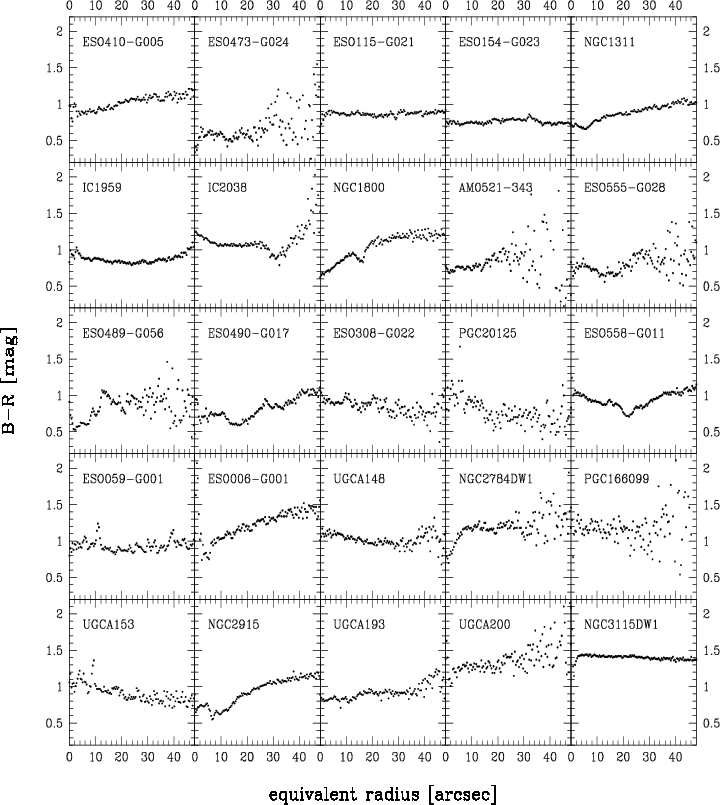 |
Figure 4: Radial B-R colour profiles. |
| Open with DEXTER | |
 whereas for the dwarf ellipticals we get
 .
The "bluest'' dE is ESO 410-G005 with
B-R=1.02, for which the classification as dE might indeed be
doubtful (see Notes on individual galaxies). Among the late-type
dwarfs two are rather red: IC 2038 with B-R=1.09, which is a
disk galaxy seen almost edge-on and therefore reddened by the internal
dust absorption, and ESO 006-G001 with B-R=1.24. The latter galaxy
has a rather peculiar morphology. Its central part is dominated by
bright, knotty features, which, as a whole, shows even a spiral
structure. This "late-type part'' of the galaxy is surrounded by a
spherical, dwarf elliptical-like component, which makes the
classification rather difficult. For the galaxies lying close to the
zone of avoidance (e.g. ESO 558-G011), the accuracy of the determined
colour can not be very high, as any slight uncertainty in the
correction with respect to colour will produce a large error in the
"true'' colour index.
.
The "bluest'' dE is ESO 410-G005 with
B-R=1.02, for which the classification as dE might indeed be
doubtful (see Notes on individual galaxies). Among the late-type
dwarfs two are rather red: IC 2038 with B-R=1.09, which is a
disk galaxy seen almost edge-on and therefore reddened by the internal
dust absorption, and ESO 006-G001 with B-R=1.24. The latter galaxy
has a rather peculiar morphology. Its central part is dominated by
bright, knotty features, which, as a whole, shows even a spiral
structure. This "late-type part'' of the galaxy is surrounded by a
spherical, dwarf elliptical-like component, which makes the
classification rather difficult. For the galaxies lying close to the
zone of avoidance (e.g. ESO 558-G011), the accuracy of the determined
colour can not be very high, as any slight uncertainty in the
correction with respect to colour will produce a large error in the
"true'' colour index.
B-R colour profiles are shown in Fig. 4. Due to the active or recent star formation, in the inner parts, late-type dwarfs normaly show a stellar population gradient, e.g. younger and bluer stars are centrally concentrated and older and redder stars dominate the outer parts of the galaxy. Therefore, their colour indices are expected to increase with galactocentric radius. However, only eight galaxies among the late-type dwarfs show such a positive colour gradient, another eight examples have a more or less flat colour profile and four actually have a negative gradient. As the scatter in some of these profiles is rather large the sign of their gradients is not obvious. Finally we remain with two clear outliers: UGCA 148 is classified as Im, but might be a transition type between Im and dE, because, aside from a couple of bright knots on the outer parts, the galaxy looks like a dwarf elliptical. UGCA 153 has clearly two spiral arms and can therefore probably be regarded as a disturbed (dwarf) spiral galaxy, hence the colour gradient makes sense.
 error of 0.03 mag. Another contribution to the error
comes from the determination of the extinction, which was also measured
each night. The
error in this case is 0.02 mag. To check the
accuracy of the flat-fielding and the background substraction, we fitted a
plane to the background of the already reduced image and measured the remaining
gradient (see Sect. 2.2). The mean of these gradients is
error of 0.03 mag. Another contribution to the error
comes from the determination of the extinction, which was also measured
each night. The
error in this case is 0.02 mag. To check the
accuracy of the flat-fielding and the background substraction, we fitted a
plane to the background of the already reduced image and measured the remaining
gradient (see Sect. 2.2). The mean of these gradients is  ,
which is so
low that it can be neglected. However, small fluctuations in the background
can not be discovered with this method. Hints of such deviations are provided
by the corrections, which have to be applied to the background in order to get
a perfectly asymptotic growth curve. Only in rare cases the first integration
of the galaxy light, after the standard reduction steps, yielded a perfectly
assymptotic growth curve. Therefore, we normally had to correct the background
by a constant, which in general was small compared to the substracted
background intensity. Considering these corrections, we are on the
safe side by assigning an uncertainty of 0.05 mag to this effect, which
gives, together with the error from the calibration, a total error of
0.1 mag.
,
which is so
low that it can be neglected. However, small fluctuations in the background
can not be discovered with this method. Hints of such deviations are provided
by the corrections, which have to be applied to the background in order to get
a perfectly asymptotic growth curve. Only in rare cases the first integration
of the galaxy light, after the standard reduction steps, yielded a perfectly
assymptotic growth curve. Therefore, we normally had to correct the background
by a constant, which in general was small compared to the substracted
background intensity. Considering these corrections, we are on the
safe side by assigning an uncertainty of 0.05 mag to this effect, which
gives, together with the error from the calibration, a total error of
0.1 mag.
 |
Figure 5: Comparison of the total apparent magnitude in B (not corrected for galactic extinction) from this work with values from the literature. |
| Open with DEXTER | |
, asteriks. We consider a
deviation of  0.2 mag as a good agreement. What concernes the brightest
galaxies our results
are in agreement with at least two other sources. However, there are a few huge
differences among the fainter objects. For PGC 20125 the comparison to (1)
yields
0.2 mag as a good agreement. What concernes the brightest
galaxies our results
are in agreement with at least two other sources. However, there are a few huge
differences among the fainter objects. For PGC 20125 the comparison to (1)
yields
 mag. This galaxy is very diffuse and extended and
therefore difficult to measure. The deviation might be caused partly by
differencies in removing forground stars. The same holds for UGCA 153 with
mag. This galaxy is very diffuse and extended and
therefore difficult to measure. The deviation might be caused partly by
differencies in removing forground stars. The same holds for UGCA 153 with
 mag to (1) and
 mag to (2). The difference
of
mag to (2). The difference
of
 mag to (1) for UGCA 193 is not clear. The agreement with
the actual value in LEDA is much better,
mag to (1) for UGCA 193 is not clear. The agreement with
the actual value in LEDA is much better,
 mag, supporting
our result. For UGCA 148 (DDO 56) the three other sources agree very well
((1):
mag, supporting
our result. For UGCA 148 (DDO 56) the three other sources agree very well
((1):
 mag, (2):
 mag, (3):
 mag), whereas
our result (
mag), whereas
our result (
 mag) is quite deviant, which we can not explain.
Altogether, our results are in good agreement with earlier studies.
mag) is quite deviant, which we can not explain.
Altogether, our results are in good agreement with earlier studies.
ESO 410-G005: the nearest galaxy of our sample and a probable member of
the Sculptor Group (Côté et al. 1997). Since some stars are resolved and
therefore must be very bright, this galaxy is probably a transition type
between dwarf irregulars and dwarf ellipticals. This is also supported by the
colour-magnitude diagram in Karachentsev et al. (2000), derived with the Hubble
Space Telescope.
ESO 473-G024: confirmed member of the Sculptor Group (Côté
et al. 1997). A contour plot in the J-band is shown in Bergvall et al.
(1999).
ESO 115-G021: member of the Flat Galaxy Catalogue
(Karachentsev et al. 1999). It has a bulge-like feature slightly offset
towards the upper left and is therefore very likely a disk galaxy seen
edge-on.
ESO 154-G023: again a rather flat, but bright galaxy. The exceptional
shape of the surface brightness profile is caused by the remarkable bright
star forming region near the upper left edge of the galaxy.
NGC 1311: disk galaxy viewed almost edge-on. No signs of spiral arms, but
obviously with a bulge. The colour profile shows a blue gradient in the central
part and a reddening in the outer parts.
IC 1959: irregular disk galaxy without bulge. Again a blue colour
gradient in the inner parts, more extended than NGC 1311 and probably
caused by internal extinction due to dust, and a reddening towards larger
radii.
IC 2038: since Karachentsev et al. (1999) do not provide a distance for
this galaxy, we can only rely on its radial velocity, which is
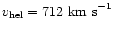 .
However, as to its morphology and angular size the distance
can not be much larger than 10 Mpc. The galaxy in the lower left is IC
2039, classified as S0. Ferguson & Sandage (1990) include it, together with
IC 2038, in the Dorando Group at a distance of 20 Mpc, despite its
radial velocity of
.
However, as to its morphology and angular size the distance
can not be much larger than 10 Mpc. The galaxy in the lower left is IC
2039, classified as S0. Ferguson & Sandage (1990) include it, together with
IC 2038, in the Dorando Group at a distance of 20 Mpc, despite its
radial velocity of
 .
In fact, the correctness of this
velocity is somewhat doubtful. If it would be confirmed, the distance of IC
2039 ought to be much smaller and we would deal with a M32-like galaxy.
.
In fact, the correctness of this
velocity is somewhat doubtful. If it would be confirmed, the distance of IC
2039 ought to be much smaller and we would deal with a M32-like galaxy.
NGC 1800: this galaxy is undergoing a strong starburst, which is
reflected in the
bright bar. The B-R colour map in Fig. 6 shows that the bluest, and hence
strongest, star forming region is not located at the center of the galaxy, but
completly offset at the end of the bar. This starburst region is also showing
up in the colour gradient, which suddenly decreases at
 .
Marlowe et al. (1999) include this galaxy in their sample of
blue amorphous galaxies and examine its taxonomy and starburst properties.
.
Marlowe et al. (1999) include this galaxy in their sample of
blue amorphous galaxies and examine its taxonomy and starburst properties.
 |
Figure 6:
B-R colour map of NGC 1800. Shown is the interval 0.3 (black)
 (white). The image size is
 .
North is up and east to the left. .
North is up and east to the left. |
| Open with DEXTER | |
Our long-term project of establishing a volume-limited data base on the photometry of nearby dwarf galaxies is approaching its final stage. We may now proceed with the exploitation of the accumulated information. Earlier analyses have already revealed a new effect which needs to be confirmed. With our larger, nearly complete sample at hand we may hope to find other interesting relations among the parameters available. Concerning photometry the present analysis focuses on exponential parameters of dwarf irregular galaxies. Where not stated separately the term "irregular'' denotes all late-type dwarfs, i.e. Im galaxies, BCD or BCD-like galaxies as well as spirals of type Scd or later. More photometric parameter relations, including dwarf elliptical galaxies, are discussed in Bremnes (2000).
![\begin{figure}
\par\mbox{\includegraphics[width=5cm]{MS2298f07a.eps} \hspace*{2m...
....eps} \hspace*{2mm}
\includegraphics[width=5cm]{MS2298f07c.eps} }
\end{figure}](/articles/aa/full/2002/22/aa2298/img75.gif) |
Figure 7: Luminosity function, apparent magnitude distribution, and distance distribution for the Im galaxies (dark shaded), BCD or BCD-like galaxies (light shaded), and spiral galaxies later than Sc (white). Binnings are 0.5 mag for the magnitude distributions and 0.5 Mpc for the distance distribution. |
| Open with DEXTER | |
In a series of five papers (Papers I, III, IV, VI, and this one) we have presented photometric results for more than 100 field and group dwarf galaxies in the nearby 10 Mpc volume. Among the galaxies with reliable distance estimates there are 71 dwarf irregulars with B- and R-band data and 4 with B-band data only. Three galaxies (UGC 5658, UGC 8914, and DDO 97) with distances clearly above 10 Mpc are excluded in the following. The three galaxies with the largest distances within the sample are then BK1N at 10.5 Mpc, UGC 4998 at 11.2 Mpc and Kar54 at 12.2 Mpc.
BR photometry and kinematic data for 72 irregular dwarf galaxies of our sample are listed in Table 3 (available only in electronic form at the CDS, see footnote on first page). Selected columns are taken over from our series of papers, complemented where necessary, converted to physical units where adequate, and two columns are newly added. The meaning of the individual columns is as follows:
Column 1 gives the reference to the original
publication. Roman numbers refer to the papers of our series with
VII being the present one. Columns 2 and 3 name the galaxy
and its type. Columns 4 and 5 list the B apparent
magnitude (corrected for galactic extinction) and B-R colour, while
Col. 6 gives the B absolute magnitude calculated by means
of the distance in Col. 7. With a few exceptions all the
distances are from the catalog of nearby galaxies by Karachentsev et al. (1999) and
given in Mpc; they are based on photometric, group-membership and
Hubble law distance determinations. For five galaxies (KK45,
ESO 555-G028, ESO 489-G056, ESO 308-G022, and ESO 558-PN011) H distance estimates are taken from Huchtmeier et al. (2000), and for seven
galaxies (Kar54, UGC 4998, BK1N, NGC 4248, ESO 473-G024, IC 2038, and
ESO 059-G001) distances are determined in accordance with Karachentsev et al. (1999)
by means of a Local Group centroid correction and of the Hubble law
using a local Hubble constant of
distance estimates are taken from Huchtmeier et al. (2000), and for seven
galaxies (Kar54, UGC 4998, BK1N, NGC 4248, ESO 473-G024, IC 2038, and
ESO 059-G001) distances are determined in accordance with Karachentsev et al. (1999)
by means of a Local Group centroid correction and of the Hubble law
using a local Hubble constant of  km
km s
s Mpc-1.
Column 8 informs about field (F) or group (G) membership. While most galaxies in Papers I, III, and IV were considered to be group galaxies and those in Paper VI to be field galaxies, we apply a common selection criterion to the galaxies of the present study: we define a group dwarf galaxy as one with a neighbour brighter than -17.5 in absolute magnitude and with a relative distance of less than 1 Mpc. As a pool for possible neighbouring galaxies the catalog of Karachentsev et al. (1999) was used which provides distance information for more than 300 galaxies within 10 Mpc.
Column 9 lists the axial ratio of the fitted ellipse at the 25th-mag/arcsec2 isophote. Columns 10 and 11 give the B-band model parameters for an exponential light distribution, i.e. extrapolated central surface brightness in mag/arcsec2(uncorrected for inclination) and the corresponding scale length in pc (measured in terms of equivalent radii), respectively. Column 12 is a measure for the B-R colour gradient (see Sect. 3.5 for an explanation), and Col. 13 lists the magnitude difference between that of a virtual comparison galaxy with a purely exponential radial surface brightness profile and that of the actual galaxy (as defined in Sect. 2.3).
Unlike in Paper VI where external data from other authors was added to enlarge the sample we will rely only on our own photometric data set. This guarantees a consistent treatment (as exemplified in Sect. 2) which is particularly required for the inquiry of subtle effects that otherwise could be overseen in an increased extrinsic scatter. However, for a comparison with dwarf irregular galaxies residing in clusters we will refer to the compilation of Bremnes (2000) including Virgo cluster data from Binggeli & Cameron (1993) and Centaurus cluster data from Jerjen & Dressler (1997).
Finally, in Col. 14 we compile the measured rotation
velocities where available. The majority stems from Karachentsev et al. (1999), and
for the other about 20 percent galaxies left the 21-cm line width
measurements were taken from Bottinelli et al. (1990), corrected for
turbulent motion according to the prescriptions of Tully & Fouqué (1985), and
inclination corrected assuming a mean intrinsic axial ratio of
q0=0.2 on behalf of Hubble's formula for the conversion of b/ainto an inclination angle (Hubble 1926) and allowing for a minimum
inclination of  .
.
A peculiarity of the distance distribution is the three-peaked appearance which is basically due to the influence of the group and cloud galaxies belonging either to the M 81 group, the CVnI cloud, or the M101 group at distances around 3.5, 5, or 6.5 Mpc, respectively. The two galaxies within the sample with the largest distances are not included in the histogram.
 to the subsamples
of the Im, the BCD or BCD-like, and the spiral galaxies lead to
similar slopes with values
to the subsamples
of the Im, the BCD or BCD-like, and the spiral galaxies lead to
similar slopes with values
 .
As can be inferred
from Table 4 the three morphologically distinct
constituents of our sample (Im, BCD or BCD-like, and spirals galaxies)
form a homogenous data base as concerned to scale length (and
consequently to central surface brightness) and to colour.
.
As can be inferred
from Table 4 the three morphologically distinct
constituents of our sample (Im, BCD or BCD-like, and spirals galaxies)
form a homogenous data base as concerned to scale length (and
consequently to central surface brightness) and to colour.
![\begin{table}
{
\begin{displaymath}
\begin{array}{l\vert c\vert ccc\vert ccc}...
...).
\item[$^{i}$ ] $\Upsilon=1~M_\odot / L_\odot^B$ .
\end{list}
}
\end{table}](/articles/aa/full/2002/22/aa2298/img83.gif) |
 The gently
decreasing sequence of mean scale lengths for the subsamples at a
given absolute magnitude is below statistical
significance. Similarly, the mean colours <B-R> are the same within
the errors to the mean of the whole sample, i.e.
The gently
decreasing sequence of mean scale lengths for the subsamples at a
given absolute magnitude is below statistical
significance. Similarly, the mean colours <B-R> are the same within
the errors to the mean of the whole sample, i.e.
 mag
(MB<-14 mag). For our purposes we therefore see no
need to differentiate between morphological classes in the
following. Opposite to this, the galaxy environment definitely is of
discriminating influence, as we will demonstrate now.
mag
(MB<-14 mag). For our purposes we therefore see no
need to differentiate between morphological classes in the
following. Opposite to this, the galaxy environment definitely is of
discriminating influence, as we will demonstrate now.
![\begin{figure}
\par\includegraphics[width=8.3cm,height=8.7cm]{MS2298f08a.eps}\hspace*{4mm}
\includegraphics[width=8.3cm]{MS2298f08b.eps}
\end{figure}](/articles/aa/full/2002/22/aa2298/img86.gif) |
Figure 8:
a) Scale length vs absolute magnitude for the
field (squares) and group (filled circles) galaxies. The solid
line is a forced fit with slope -0.08 to all galaxies brighter
than our limit of completeness (MB<-14, indicated by the
vertical dotted line). This slope was previously found for the dwarf
irregular galaxies in clusters (Bremnes 2000); their corresponding
relation is plotted as the dashed line for comparison. Field and
group galaxies each obey the same relation (solid line).
b) Residuum in log(
 )
vs. B-R colour.
The residuum is defined as the difference between the measured
value of log(
)
and the fitted value according to
Fig. 8a. Symbols as in Fig. 8a,
with those for galaxies brighter than MB=-14 mag additionally circled.
The solid line is a least-squares fit to these brighter galaxies only.
Also indicated by vertical lines are the mean colours for the brighter
field (dot-dashed) and group (short-dashed) galaxies. )
vs. B-R colour.
The residuum is defined as the difference between the measured
value of log(
)
and the fitted value according to
Fig. 8a. Symbols as in Fig. 8a,
with those for galaxies brighter than MB=-14 mag additionally circled.
The solid line is a least-squares fit to these brighter galaxies only.
Also indicated by vertical lines are the mean colours for the brighter
field (dot-dashed) and group (short-dashed) galaxies. |
| Open with DEXTER | |
It was recently found (Bremnes 2000; Barazza et al. 2001 (Paper VI)) that dwarf irregulars in a field or group environment have brighter central surface brightnesses in the mean than cluster dwarf irregulars. Equivalently, the scale lengths of field and group dwarf irregulars are on average lower than those of dwarf irregulars dwelling in clusters. However, comparing field against group dwarf irregulars no such differences are seen. Here we report further evidence for this trend of a structural dependence on environment among dwarf irregular galaxies.
In Fig. 8a scale length is plotted against absolute
magnitude in the B band. Squares and circles represent field (50)
and group (22) galaxies, respectively. The solid line is a fit to all
our field (32) and group (15) galaxies brighter than -14 mag and with
a forced slope of -0.08. This slope corresponds to a least-squares
fit to cluster late-type galaxies in the magnitude interval
![$M_B \in
[-13, -17]$](/articles/aa/full/2002/22/aa2298/img87.gif) (Bremnes 2000) shown as the dashed line. A free fit to our
dwarfs yields with values of
(Bremnes 2000) shown as the dashed line. A free fit to our
dwarfs yields with values of
 essentially the same
slope. But there obviously is a shift in the sense that - at a given
absolute magnitude - a denser environment is related to a higher
scale length (fainter central surface
brightness). Table 4 summarizes our numerical
findings. While in Bremnes (2000) and in Paper VI the mean differences
essentially the same
slope. But there obviously is a shift in the sense that - at a given
absolute magnitude - a denser environment is related to a higher
scale length (fainter central surface
brightness). Table 4 summarizes our numerical
findings. While in Bremnes (2000) and in Paper VI the mean differences
 log(
)
were 0.15 and 0.14 (
log(
)
were 0.15 and 0.14 (
 and 0.76 mag), respectively, we find the shift amounting to 0.12 mag
(
and 0.76 mag), respectively, we find the shift amounting to 0.12 mag
(
 mag). Despite the lower value as compared to the
previous determinations (which also included galaxies from other
sources) the shift is clearly statistically significant given the
uncertainty of 0.03 mag for the field and group irregulars or 0.02 mag
for the cluster irregulars. Note that when comparing field and group
dwarf irregulars one finds no such separation; field and group
galaxies are thus not repeating the trend described above. However,
the scatter
mag). Despite the lower value as compared to the
previous determinations (which also included galaxies from other
sources) the shift is clearly statistically significant given the
uncertainty of 0.03 mag for the field and group irregulars or 0.02 mag
for the cluster irregulars. Note that when comparing field and group
dwarf irregulars one finds no such separation; field and group
galaxies are thus not repeating the trend described above. However,
the scatter  for the (logarithmic) scale length is twice as
small for the group than for the field dwarf irregulars.
for the (logarithmic) scale length is twice as
small for the group than for the field dwarf irregulars.
![\begin{figure}
\par\mbox{\includegraphics[width=8.3cm]{MS2298f09a.eps} \hspace*{4mm}
\includegraphics[width=8.3cm,height=8.8cm]{MS2298f09b.eps}}
\end{figure}](/articles/aa/full/2002/22/aa2298/img93.gif) |
Figure 9: a) Exponential-fit accuracy parameter versus central surface brightness in the B band. b) Colour gradient versus scale length in the B band. The horizontal line marks the mean for the galaxies brighter than MB=-14 mag; the curved lines are proportional to the inverse scale length: the dotted one is for a constant factor of proportionality while for the short-dashed line the factor of proportionality is a linear function of scale length (see text for details). - Symbols as in Fig. 8b. |
| Open with DEXTER | |
The scatter - particularly for the field irregulars - is
considerable and must be partly intrinsic. Given the shift between
field and group and cluster galaxies we may wonder if it is related to
different stellar populations dominating galaxies in different
environments. Due to a lack of B-R colour indices for the cluster
dwarf irregulars we have to circumvent a direct B-R colour
comparison between the two environments. Following Bremnes (2000) we
define the residuum  log(
)
as the difference of the
measured value to the fitted value, i.e. log(
)
log(
)
as the difference of the
measured value to the fitted value, i.e. log(
)
 log(
)
-(-0.08 MB +1.493), and plotting it
against colour B-R some relation becomes manifest. This is
revealed in Fig. 8b where a least-squares fit applied
to the galaxies brighter than -14 mag (circled symbols) is shown as
the solid line, obeying
log(
)
-(-0.08 MB +1.493), and plotting it
against colour B-R some relation becomes manifest. This is
revealed in Fig. 8b where a least-squares fit applied
to the galaxies brighter than -14 mag (circled symbols) is shown as
the solid line, obeying
 |
(5) |
for the mean <B-R> colour is smaller for the group than for the
field dwarf irregulars.
 or
(cf. Sect. 2). In Fig. 9a)
is plotted
against central surface brightness
or
(cf. Sect. 2). In Fig. 9a)
is plotted
against central surface brightness  .
The majority of galaxies
shows the exponential law being nominally a good description for the
radial intensity distribution (
.
The majority of galaxies
shows the exponential law being nominally a good description for the
radial intensity distribution (
 ). There are,
however, quite a few aberrant galaxies. As was discussed in Paper III
deviations from the exponential-fit description are frequently seen in
the innermost regions and/or at large radii, the reasons ranging from
strongly asymmetric distributed star formation regions to uncertain
sky subtraction. Therefore it is not surprising that these deviations
are not correlated with either the central surface brightness, shown
here, or with other global parameters such as absolute magnitude,
scale length, or colour.
). There are,
however, quite a few aberrant galaxies. As was discussed in Paper III
deviations from the exponential-fit description are frequently seen in
the innermost regions and/or at large radii, the reasons ranging from
strongly asymmetric distributed star formation regions to uncertain
sky subtraction. Therefore it is not surprising that these deviations
are not correlated with either the central surface brightness, shown
here, or with other global parameters such as absolute magnitude,
scale length, or colour.
The fitted exponential scale lengths provide a definition of the
colour gradient in the surface brightness representation by means of
differentiating Eq. (3), leading to
 .
As mentioned in Sect. 2.3, and as can be
seen in Fig. 9b, most dwarf irregulars exhibit
no or small, mainly positive colour gradients. For the galaxies
brighter than MB<-14 mag the mean has a value of only 0.16 mag/kpc
(horizontal line). Several galaxies, particularly those with small
scale lengths, have strong positive colour gradients, up to more
than 1 mag/kpc. This is, however, not too surprising: rewriting
.
As mentioned in Sect. 2.3, and as can be
seen in Fig. 9b, most dwarf irregulars exhibit
no or small, mainly positive colour gradients. For the galaxies
brighter than MB<-14 mag the mean has a value of only 0.16 mag/kpc
(horizontal line). Several galaxies, particularly those with small
scale lengths, have strong positive colour gradients, up to more
than 1 mag/kpc. This is, however, not too surprising: rewriting
 ). Applying a linear
relation
). Applying a linear
relation
 for the inverse
scale lengths numerically gives a more realistic fit, including the
region of negative colour gradients (short-dashed line). But this
seems not to hold for a handfull of galaxies with negative
colour gradients and with scale lengths shorter than about
0.6 kpc. Among them the most extremes are also faint and rather
blue. However, as we will argue in Sect. 3.7.3, the colour
gradients of most of these suspicious galaxies are simply inadequately
determined by means of the above deduced gradient measure (as
opposed to a gradient fitted directly to the colour profiles).
for the inverse
scale lengths numerically gives a more realistic fit, including the
region of negative colour gradients (short-dashed line). But this
seems not to hold for a handfull of galaxies with negative
colour gradients and with scale lengths shorter than about
0.6 kpc. Among them the most extremes are also faint and rather
blue. However, as we will argue in Sect. 3.7.3, the colour
gradients of most of these suspicious galaxies are simply inadequately
determined by means of the above deduced gradient measure (as
opposed to a gradient fitted directly to the colour profiles).
![\begin{figure}
\par\includegraphics[width=17cm]{MS2298f10.eps}
\end{figure}](/articles/aa/full/2002/22/aa2298/img104.gif) |
Figure 10:
Residual plots revealing the linkage of photometric with
kinematic properties. The residuals for a parameter are defined as
the deviations from a mean at given luminosity, while the mean is
determined from an ordinary least-squares bisector fit of the
parameter to absolute magnitude (see
Table 4). Plotted are the residuals for scale
length and surface brightness versus the residuls of three distinct
circular velocities: the two leftmost panels use the residuals of
the conventional rotational velocity
 ,
measured at or
beyond the optical extent of the galaxy; the middle panels use the
residuals of the peak circular velocity of a hypothetical
self-gravitating exponential disk, at an inner disk radius of about
two scale lengths (Eq. (7)); and the rightmost panels use the
residuls of the halo contribution to the rotational velocity at the
same inner disk radius, as inferred from the Burkert (1995) halo
model for dwarf irregular galaxies. See text for details. ,
measured at or
beyond the optical extent of the galaxy; the middle panels use the
residuals of the peak circular velocity of a hypothetical
self-gravitating exponential disk, at an inner disk radius of about
two scale lengths (Eq. (7)); and the rightmost panels use the
residuls of the halo contribution to the rotational velocity at the
same inner disk radius, as inferred from the Burkert (1995) halo
model for dwarf irregular galaxies. See text for details. |
| Open with DEXTER | |
Different models on the formation of galaxy disks all predict systematic dependencies on kinematic conditions for the resulting scale lengths and central surface brightnesses (e.g., Dalcanton et al. 1997; Weil et al. 1998; Zhang & Wyse 2000; Silk 2001). In this section we therefore seek to validate these expectations using observed quantities for the dwarf irregular galaxies of our sample. We particularly ask whether the scatter in the scale length or central surface brightness versus absolute luminosity diagram may be explained by deviating rotational velocities at fixed luminosity. In the following a variable's linear dependence on absolute magnitude defines its mean at a given luminosity. The difference of an individual data point from this mean we call the residual, in accordance to the definition given in Sect. 3.4. In Table 4 the relations for five variables are given including the particular circular velocities described below. The given relations have been determined applying ordinary least-squares bisector fits (Isobe et al. 1990) to all the 62 galaxies of our sample with known rotational velocity data. We chose working with bisector fits for reasons of statistical consistency: working with simple least-squares or with orthogonal fits results in spurious dependencies of the photometric variable residua on some of the photometric variables themselves. While for an exponential intensity profile the surface brightness residua have to correlate with scale length residua, other pairs of parameters should not correlate with each other. Only for ordinary least-squares bisector fits no significant correlations were found in plotting the scale length residua (surface brightness residua) against scale length (surface brightness) or absolute magnitude. This was even more evident if we relaxed the completeness condition, allowing for a longer fitting intervall for the strongly scattered data in determining the mean relations listed in Table 4. Therefore we work in the following with all the galaxies for which kinematic data is available, including also the galaxies fainter than the limiting magnitude imposed so far.
A Tully-Fisher-like relation between the conventional rotational
velocity
,
measured at or beyond the optical extent of
the galaxy, and absolute magnitude MB is exhibited by the data
(Table 4). Its scatter is rather large and, at
a fixed luminosity, is not related to the scatter in scale
length or central surface brightness. This is shown in the two
leftmost residual plots of Fig. 10. And it is not
surprising: dwarf irregular galaxies are known to be dark matter
dominated at all radii (Carignan & Freeman 1988; Burkert 1995), thus
it is not the baryonic matter that determines
.
A more convenient kinematic measure to work with would be given by the
disk and/or halo contributions to the velocity at some characteristic
inner disk radius. The predicted rotation curve for an
exponential mass distribution corresponding to the observed
exponential surface brightness profile has been analytically given for
a thin, self-gravitating exponential disk (Freeman 1970). Providing a
characteristic inner disk radius this description may serve here as a
simple model for the luminous matter distribution and the related
Keplerian kinematics despite dwarf irregular and low-surface
brightness galaxies being known to be better characterized by expanded
disks (Sung et al. 1998). The velocity profile exhibits a peak at radius
 where it has a value of
 ;
here G is
the gravitational constant,
;
here G is
the gravitational constant,
 the disk mass-to-light
ratio, I0 the face-on central mass surface density, and
the disk mass-to-light
ratio, I0 the face-on central mass surface density, and
 the scale length (e.g., Chiba & Yoshi
1995). Converted to B band observables we have
the scale length (e.g., Chiba & Yoshi
1995). Converted to B band observables we have
 |
(7) |
![$\mu_{0,i}^B[{\rm mag}/\ifmmode\hbox{\rlap{$\sqcap$ }$\sqcup$ }\else{\unskip\nob...
...$\sqcap$ }$\sqcup$ }
\parfillskip=0pt\finalhyphendemerits=0\endgraf}\fi\arcsec]$](/articles/aa/full/2002/22/aa2298/img110.gif) the inclination-corrected
central surface brightness,
the inclination-corrected
central surface brightness,
![$\alpha^{-1}_B[{\rm pc}]$](/articles/aa/full/2002/22/aa2298/img111.gif) the disk scale
length measured in parsecs along the major axis, and
the disk scale
length measured in parsecs along the major axis, and
![${\mit\Upsilon}\equiv\frac{M}{L_B}[\frac{M_\odot}{L_{\odot}^B}]$](/articles/aa/full/2002/22/aa2298/img112.gif) the
disk mass-to-light ratio in solar units. In the middle panels of
Fig. 10 the deviations of this peak velocity from its
mean value at a given galaxy luminosity is compared to the
corresponding residuals in scale length and surface brightness. Now
the two residual plots clearly suggest a linkage between photometric
and kinematic properties: at a given luminosity deviations from the
mean are related to different rotation velocities, in the sense that
higher scale lengths or fainter central surface brightnesses correlate
with lower-than-mean peak rotational velocites divided by
the square root of an unknown disk mass-to-light ratio. The plots
shown correspond to a constant
the
disk mass-to-light ratio in solar units. In the middle panels of
Fig. 10 the deviations of this peak velocity from its
mean value at a given galaxy luminosity is compared to the
corresponding residuals in scale length and surface brightness. Now
the two residual plots clearly suggest a linkage between photometric
and kinematic properties: at a given luminosity deviations from the
mean are related to different rotation velocities, in the sense that
higher scale lengths or fainter central surface brightnesses correlate
with lower-than-mean peak rotational velocites divided by
the square root of an unknown disk mass-to-light ratio. The plots
shown correspond to a constant
 .
There are several caveats with our finding: First, the issue of the
unknown individual mass-to-light ratios is a non-trivial one and its
possible relation with surface brightness, luminosity, or color is not
tackled in the above approach. Second, one must be cautious in
applying the model parameter
.
There are several caveats with our finding: First, the issue of the
unknown individual mass-to-light ratios is a non-trivial one and its
possible relation with surface brightness, luminosity, or color is not
tackled in the above approach. Second, one must be cautious in
applying the model parameter  which is deduced from
photometric quantities only and which does not relate to an
independent, actually observed kinematic quantity. Finally, the thin
disk assumption and, above all, ignoring the presence of dark matter
leaves the model rather unrealistic.
which is deduced from
photometric quantities only and which does not relate to an
independent, actually observed kinematic quantity. Finally, the thin
disk assumption and, above all, ignoring the presence of dark matter
leaves the model rather unrealistic.
However, we may approximately infer the contribution of the
dark-matter halo to the total rotational velocity at
(in fact, at any radius) on purely
phenomenological grounds. The total rotational velocity v(r) is
conventionally decomposed into a dark matter (
 ), a
stellar (
), a
stellar (
 ), and an HI component. Burkert (1995) and
Salucci & Burkert (2000) successfully describe the rotation curves of
dark matter-dominated dwarf galaxies by means of an empirically found
one-parameter family of halos: Provided the rotational velocity v0of the dark matter halo is known at a particular density scale radius
(corresponding to the halo core size of typically four to seven optical
scale lengths), then the rotational velocity due to the halo
is calculable at every radius r. One can show that the seven
selected dwarf galaxies of Burkert (1995) obey
), and an HI component. Burkert (1995) and
Salucci & Burkert (2000) successfully describe the rotation curves of
dark matter-dominated dwarf galaxies by means of an empirically found
one-parameter family of halos: Provided the rotational velocity v0of the dark matter halo is known at a particular density scale radius
(corresponding to the halo core size of typically four to seven optical
scale lengths), then the rotational velocity due to the halo
is calculable at every radius r. One can show that the seven
selected dwarf galaxies of Burkert (1995) obey
 ,
i.e., the input parameter v0 typically is lower
by about 20 percent than the measurable circular velocity
of the flat or nearly flat part of the rotation curve. Thus we
may adopt
,
i.e., the input parameter v0 typically is lower
by about 20 percent than the measurable circular velocity
of the flat or nearly flat part of the rotation curve. Thus we
may adopt
 as a working approximation
and determine the halo contribution to the rotational velocity at
as a working approximation
and determine the halo contribution to the rotational velocity at
 ,
,
 ,
by means
of the Burkert-halo parametrization. The rightmost panels of
Fig. 10 plot its residuals versus the residuals in
scale length and surface brightness. It is revealed that the
photometric exponential-disk parameters do indeed correlate with the
corresponding halo-related kinematics: at a fixed luminosity
higher-than-mean halo-induced rotational velocities are related to
larger scale lengths and fainter central surface brightnesses. Note,
however, that there is an island of nine galaxies with lower-than-mean
scale lengths and with corresponding slower-than-mean circular
velocities but with central surface brightnesses too faint instead of
too bright; they all are brighter than about MB=-16 mag but, as far
as we can tell, share otherwise no distinctive feature.
,
by means
of the Burkert-halo parametrization. The rightmost panels of
Fig. 10 plot its residuals versus the residuals in
scale length and surface brightness. It is revealed that the
photometric exponential-disk parameters do indeed correlate with the
corresponding halo-related kinematics: at a fixed luminosity
higher-than-mean halo-induced rotational velocities are related to
larger scale lengths and fainter central surface brightnesses. Note,
however, that there is an island of nine galaxies with lower-than-mean
scale lengths and with corresponding slower-than-mean circular
velocities but with central surface brightnesses too faint instead of
too bright; they all are brighter than about MB=-16 mag but, as far
as we can tell, share otherwise no distinctive feature.
 relations were similar for Im, BCD/-like,
and late spiral galaxies, the individual free-fit slopes yielding
relations were similar for Im, BCD/-like,
and late spiral galaxies, the individual free-fit slopes yielding
 (Sect. 3.3). Guided by the work of Bremnes (2000) in
comparing photometric mean values for field and group versus cluster
dwarf irregulars, we adopted his slope of -0.08 found for Virgo and
Centaurus cluster galaxies (Sect. 3.4). In an independent analysis
of only the Virgo dwarf irregulars we find a slope about twice as
steep. We checked that the structure-environment relation is present
irrespective of the actually chosen slope value, as expected. For the
inquiry on a linkage of photometric and kinematic data a steeper slope
was used that emerged from double regression applied for reasons of
statistical consistency (Sect. 3.6). Such a steeper slope also
agrees better with a global
(Sect. 3.3). Guided by the work of Bremnes (2000) in
comparing photometric mean values for field and group versus cluster
dwarf irregulars, we adopted his slope of -0.08 found for Virgo and
Centaurus cluster galaxies (Sect. 3.4). In an independent analysis
of only the Virgo dwarf irregulars we find a slope about twice as
steep. We checked that the structure-environment relation is present
irrespective of the actually chosen slope value, as expected. For the
inquiry on a linkage of photometric and kinematic data a steeper slope
was used that emerged from double regression applied for reasons of
statistical consistency (Sect. 3.6). Such a steeper slope also
agrees better with a global
 relation as
determined for a combined sample of late-type irregulars and early type
spirals (Makarova 1999, her Fig. 5). We stress, however, that the
qualitative results reported in this paper are insensitive to the
adopted fitting procedure.
relation as
determined for a combined sample of late-type irregulars and early type
spirals (Makarova 1999, her Fig. 5). We stress, however, that the
qualitative results reported in this paper are insensitive to the
adopted fitting procedure.
The structure-environment relation says that for cluster dwarf irregulars the exponential parameters differ on average from those of non-cluster galaxies. In particular, the scale lengths for field and group dwarf irregulars are on average shorter and thus the central surface brightnesses are brighter than for dwarfs in clusters. This was already reported in Bremnes (2000) and in Paper VI and is confirmed here with our complete data sample (Sect. 3.4). Several reasons may be responsible for the structure-environment relation. There are the manyfold influences of the cluster environment on a dwarf galaxy, including a relatively high peculiar velocity, galaxy harassment, ram pressure, and - quite important - tidal effects (stripping, stirring, induced angular momentum). In particular,
(i) an environmentally induced loss of a substantial amount of gas would lower the gravitational potential and thus expand the galaxy;
(ii) quenching of star-formation in cluster late-type galaxies may
partly account for the observed effect. Late-type galaxies in
clusters tend to be gas-deficient, implying a lowered present-day
star formation rate (Gallagher & Hunter 1986; Cayatte et al. 1994). Thus Bremnes (2000) suggests a simple uniform fading
scenario to explain the higher central surface brightness in field
and group dwarf irregulars. According to this scenario star formation
was much more efficient in cluster galaxies at earlier epochs while
it is still ongoing at a moderately high rate in field and group
galaxies. Such a fading in cluster irregulars would be accompagned by
a reddening of the galaxies. Indeed, the cluster irregular sample of
Gallagher & Hunter (1986) with
 mag is by
 mag
redder than their field and group comparison sample. This is also
redder by
mag
redder than their field and group comparison sample. This is also
redder by
 mag than the equal means for the field and
group irregular samples of Makarova (1999) and van Zee (2000),
mag than the equal means for the field and
group irregular samples of Makarova (1999) and van Zee (2000),
 mag. Consistently, Paper VI (excluding UGC 1281)
provides us with a representative value of
mag. Consistently, Paper VI (excluding UGC 1281)
provides us with a representative value of
 mag
for our sample of field and group dwarf irregular galaxies. The idea
of quenched star-formation is additionally supported by our finding
that for a given luminosity galaxies with higher scale lengths (or
equivalently, with lower central surface brightnesses) are somewhat
redder on average. This nicely agrees with the positive correlation
between star formation or metallicity and central surface brightness
in dwarf irregular galaxies as recently elucidated by van Zee (2001) and
Grebel (2001), respectively. Thus both the colour trends that emerge
from our photometric data (the sample mean colour values and the
scale length dependence) provide some credits to a fading scenario;
mag
for our sample of field and group dwarf irregular galaxies. The idea
of quenched star-formation is additionally supported by our finding
that for a given luminosity galaxies with higher scale lengths (or
equivalently, with lower central surface brightnesses) are somewhat
redder on average. This nicely agrees with the positive correlation
between star formation or metallicity and central surface brightness
in dwarf irregular galaxies as recently elucidated by van Zee (2001) and
Grebel (2001), respectively. Thus both the colour trends that emerge
from our photometric data (the sample mean colour values and the
scale length dependence) provide some credits to a fading scenario;
(iii) due to tidal stirring, the initial gas dispersion of cluster dwarfs may be expected to be higher than in an isolated dwarf galaxy, naturally leading to a somewhat larger scale length for the stellar population (Andersen & Burkert 2000). Actually, tidal thickening of interacting galaxies has been observed by Reshetnikov & Combes (1997).
For low surface brightness dwarf galaxies Taylor (1997) observes an increased rate of star formation depending on the small-scale environment, thus empirically supporting the hypothesis that galaxy interactions may trigger bursts of star formation which lead in turn to structural transformations. Recent simulations on the evolution of group dwarf irregular galaxies orbiting massive galaxies even suggest morphological transformations, caused by tidal stirring, to either dwarf spheroidals or dwarf ellipticals (Mayer et al. 2001). Within the group galaxies of our sample such influences are, however, not (yet) manifest: for the parameters under investigation the group and field galaxies are rather similar (cf. Table 4). Our empirical finding of late-type spiral galaxies having on average not significantly shorter scale lengths than Im galaxies at similar absolute magnitudes neither validates nor contradicts such an evolutionary scenario, too. The scatter may simply be too large for such subtleties to be uncovered. This coincides with the negative result of Karachentsev et al. (1999) who state that their "tidal'' or isolation index - which is a measure of local mass density surrounding a galaxy - is independent from the HI mass-to-luminosity ratio when applied to some hundred nearby galaxies of various types. Some hints for possible differences between our field and group data nevertheless arise from the slightly redder mean B-R colour for group galaxies than for field galaxies, and from the smaller scatter for the group galaxies both in scale length at a given luminosity and in colour;
(iv) for field galaxies we observe a linkage between the optical parameters for an exponential disk and the dark matter contribution to the rotational velocity at an inner disk radius of about two scale lengths (Sect. 3.6). Concerning the structure-environment relation this linkage hints to the possibility that cluster galaxies are embedded in slightly different (more massive) halos than field galaxies resulting on average in somewhat higher disk scale lengths. We discuss both our finding and its possible implication for the structure-environment relation further below (Sect. 3.7.4).
Positive colour gradients are typical for most of our galaxies (see
Fig. 9 b) and are naturally expected for galaxies
with star formation concentrated to the denser inner regions. Despite
of this, quite a few galaxies seem to have negative colour
gradients. In particular, galaxies with scale lengths higher than
about 1 kpc seem to enter the area of negative colour gradients. This
is consistent with the observation that larger galaxies (LSB and
normal spirals) have older central populations forcing negative colour
gradients, with values correlated to bulge sizes (Bell & de Jong
2000; Matthews & Wood 2001; Andredakis et al. 1995). A handful of
our dwarf irregular galaxies exhibit strong negative colour
gradients, however. They all are faint, blue, and have relatively
small scale lengths (
 kpc). While particularly
the appearance of young and small sized isolated galaxies may be
strongly influenced by outward-propagating supershells which induce
peripheral star formation activity, this seems unlikely to be the
case for most of the galaxies under investigation. Thus the negative
colour gradients neither seem to be related to heavily off-centered
star formation sites dominating galaxy colour and structure nor can
they be explained by an overtly red central stellar population. After
inspection of the surface brightness profiles and the corresponding
colour profiles, and taking care of the estimated errors, one comes to
the conclusion that the strong negative gradients are photometric
artefacts resulting from an inconsistent scale length determination in
the two photometric bands which is propagated to the indirect gradient
determinition method adopted; thus the gradients are likely to be much
smaller, i.e. closer to zero, or even positive. This statement seems
to hold for some galaxies with weakly negative colour gradients as
well, particularly those with small scale lengths. An example for an
unintended mismatch between gradient definition according to Eq. (6)
and the actual colour profile as shown in Fig. 3 is
UGCA 148 with similar scale lengths in B and R (as determined
beyond
kpc). While particularly
the appearance of young and small sized isolated galaxies may be
strongly influenced by outward-propagating supershells which induce
peripheral star formation activity, this seems unlikely to be the
case for most of the galaxies under investigation. Thus the negative
colour gradients neither seem to be related to heavily off-centered
star formation sites dominating galaxy colour and structure nor can
they be explained by an overtly red central stellar population. After
inspection of the surface brightness profiles and the corresponding
colour profiles, and taking care of the estimated errors, one comes to
the conclusion that the strong negative gradients are photometric
artefacts resulting from an inconsistent scale length determination in
the two photometric bands which is propagated to the indirect gradient
determinition method adopted; thus the gradients are likely to be much
smaller, i.e. closer to zero, or even positive. This statement seems
to hold for some galaxies with weakly negative colour gradients as
well, particularly those with small scale lengths. An example for an
unintended mismatch between gradient definition according to Eq. (6)
and the actual colour profile as shown in Fig. 3 is
UGCA 148 with similar scale lengths in B and R (as determined
beyond  25) but with a relatively strong positive
colour gradient in the outer envelope.
25) but with a relatively strong positive
colour gradient in the outer envelope.
Strong positive colour gradients appear for galaxies with very short scale lengths only (see Fig. 9b) and - according to van Zee (2001) - may be related to starbursts. In fact, any centrally concentrated young population imprints its influence on the colour gradient more pronounced in a small galaxy (i.e. in one with relatively short scale lengths) than in a bigger galaxy. Moreover, for galaxies with exponential intensity laws the colour gradients are positive and inversely proportional to the scale lengths in general as long as the blue-band scale lengths are shorter than those in the red band by a roughly constant value. We have illustrated that adopting a scale length difference of about 10% will indeed approximately result in the expected behaviour for the majority of our galaxies. We have extracted this same behaviour from the data on isolated dwarf irregulars in van Zee (2001) and independently in Heller & Brosch (2001) for Virgo cluster dwarf irregulars. If a slightly more complicated factor of proportionality is allowed for, i.e. an affine relation as described, then galaxies with larger scale lengths are predicted to exhibit also negative colour gradients, as indeed is observed with our sample. There are two immediate consequences from such a behaviour. First, it implies a constant B-R colour increase of about 0.1 mag for an interval of one scale length for dwarf irregular galaxies, irrespective of size or total colour. Second, the B-band scale lengths being systematically shorter than those in the R band (for the smaller galaxies only, i.e. those with short scale lengths) is in line with disk models that explain the formation and evolution of exponential gaseous and stellar systems by means of viscous radial infall (Firmani et al. 1996; Zhang & Wyse 2000; cf. also Hunter et al. 1998).
The fair to tight correlations seen in Fig. 10 between
optical disk parameters and the inferred accompagning disk dynamics
are at first view rather astononishing, in particular for the
rightmost panels given the crude estimate used for the input parameter
v0 of the Burkert model, i.e.
.
The
quantitative results are, however, rather insensitive to the exact
value of the adopted coefficient. Therefore it is not disturbing that
the outermost observed rotational velocity of dwarf galaxies often
resides on a still rising rotation curve and thus constitutes only a
lower limit to the true maximum value where the rotation curve
becomes flat. The
tightness of the
 -
-
 -relation is a consequence of applying the Burkert-model dark
matter scaling relations at a small radius proportional to scale
length: at small radii the imposed velocity profiles
still
form a rather similar family, thus reading off the velocities at
scale-length dependent radii immediately translates into tightly
correlated variations of circular velocity. Thus we are confident with our adopted working
approximation and with the resulting correlations as presented.
-relation is a consequence of applying the Burkert-model dark
matter scaling relations at a small radius proportional to scale
length: at small radii the imposed velocity profiles
still
form a rather similar family, thus reading off the velocities at
scale-length dependent radii immediately translates into tightly
correlated variations of circular velocity. Thus we are confident with our adopted working
approximation and with the resulting correlations as presented.
Navarro (1997) already established an observational
 -
-like relation for high- and
low-surface brightness galaxies working not with the Burkert-halo
density distribution but with a Navarro-Frenk-White profile and having
available measured rotational velocities at inner disk radii,
particular at the peak rotational velocity. Recently, van den Bosch et al. (2001)
studied the angular momentum content of dwarf galaxies with a sample
of 14 late-type spirals. Using a Navarro-Frenk-White profile they
determined the spin parameters for the baryonic disks. One can show
that a - admittedly weak - correlation emerges from their data
between either the central surface brightness or the scale length and
the disk spin parameter. Moreover, Chiba & Yoshi (1995) have already
applied a tight correlation found between disk scale length and a
combination of central surface brightness and measured rotational
velocity at the characteristic radius of 2.14 scale lengths in order
to determine extragalactic distances of early- and late-type spirals;
their approach is similar to a Tully-Fisher relation study but working
with inner disk circular velocities and assuming an exponential light
distribution. This previous work and our own approach lead us to the
conclusion that the scatter in the scale length or surface
brightness versus absolute magnitude diagrams, particularly for dwarf
irregular galaxies, seems to be correlated with the kinematic disk
properties induced by the surrounding dark matter halo. The smaller
kinematic contribution of luminous matter probably is related to the
photometric structure as well, but due to the unknown disk
mass-to-light ratios and ignoring effects of viscous infall we cannot
make an argument as strong as above. Our conclusion is also in line
with theoretical expectations: models on the formation of disk
galaxies predict that, for a given mass or luminosity, increasing the
halo angular momentum increases the exponential scale length or,
correspondingly, decreases the extrapolated central surface brightness
(Dalcanton et al. 1997; Zhang & Wyse 2000; Silk 2001). This applies
to our case of measured rotional velocities, because halo angular
momenta or halo circular speeds are indicative for the circular speed
of the collapsed, centrifugally supported disks (Weil et al. 1998).
-
-like relation for high- and
low-surface brightness galaxies working not with the Burkert-halo
density distribution but with a Navarro-Frenk-White profile and having
available measured rotational velocities at inner disk radii,
particular at the peak rotational velocity. Recently, van den Bosch et al. (2001)
studied the angular momentum content of dwarf galaxies with a sample
of 14 late-type spirals. Using a Navarro-Frenk-White profile they
determined the spin parameters for the baryonic disks. One can show
that a - admittedly weak - correlation emerges from their data
between either the central surface brightness or the scale length and
the disk spin parameter. Moreover, Chiba & Yoshi (1995) have already
applied a tight correlation found between disk scale length and a
combination of central surface brightness and measured rotational
velocity at the characteristic radius of 2.14 scale lengths in order
to determine extragalactic distances of early- and late-type spirals;
their approach is similar to a Tully-Fisher relation study but working
with inner disk circular velocities and assuming an exponential light
distribution. This previous work and our own approach lead us to the
conclusion that the scatter in the scale length or surface
brightness versus absolute magnitude diagrams, particularly for dwarf
irregular galaxies, seems to be correlated with the kinematic disk
properties induced by the surrounding dark matter halo. The smaller
kinematic contribution of luminous matter probably is related to the
photometric structure as well, but due to the unknown disk
mass-to-light ratios and ignoring effects of viscous infall we cannot
make an argument as strong as above. Our conclusion is also in line
with theoretical expectations: models on the formation of disk
galaxies predict that, for a given mass or luminosity, increasing the
halo angular momentum increases the exponential scale length or,
correspondingly, decreases the extrapolated central surface brightness
(Dalcanton et al. 1997; Zhang & Wyse 2000; Silk 2001). This applies
to our case of measured rotional velocities, because halo angular
momenta or halo circular speeds are indicative for the circular speed
of the collapsed, centrifugally supported disks (Weil et al. 1998).
Accepting that higher-than-mean rotational velocities of field and group galaxies exhibit higher-than-mean scale lengths one wonders whether this trend should not show up in a direct comparison of the kinematics of cluster and field irregulars, too. This would point to a deeper cause for the structure-environment relation than a mere evolutionary difference, e.g. different halo populations. We are not aware of a study comparing observed rotational velocities in cluster and field environments in the sense that it supports or contradicts our interpretation; however, for galaxies in clusters Mould (1997) does not see a correlation of the intercept of the Tully-Fisher relation and cluster richness. Unfortunately, only 20 out of the 35 Virgo irregulars/late-type spirals mentioned in Sect. 3.7.1 do have kinematic data in the PGC, turning out to be too small a sample to exhibit the structure-environment shift. Thus we cannot rely on this cluster subsample in order to perform a kinematic analysis as above. Such a more complete and direct analysis is therefore postponed to future work with more galaxies at hand.
 mag, allowing for a statistical exploitation.
Acknowledgements
B.R.P. thanks Markus Samland, Victor Debattista, and Alfonso Aguerri for stimulating conversations. Financial support by the Swiss National Science Foundation is gratefully acknowledged. This work has made use of the NASA/IPAC Extragalactic Database (NED) which is operated by the Jet Propulsion Laboratory, CalTech, under contract with NASA and NASA's ADS Abstract Service.
