A&A 387, 993-1002 (2002)
DOI: 10.1051/0004-6361:20020472
Re-examining the X-ray versus spin-down luminosity correlation of
rotation powered pulsars
A. Possenti 1 - R. Cerutti 2 - M. Colpi 3 - S. Mereghetti 4
1 - Osservatorio Astronomico di Bologna,
via Ranzani 1, 40127 Bologna, Italy
2 -
Dipartimento di Fisica, Università di Milano ,
via Celoria 16, 20133 Milano, Italy
3 -
Dipartimento di Fisica, Università di Milano Bicocca,
Piazza della Scienza 3, 20126 Milano, Italy
4 -
Istituto di Astrofisica Spaziale e Fisica Cosmica,
Sezione di Milano "G.Occhialini'', CNR,
via Bassini 15, 20133 Milano, Italy
Received 25 September 2001 / Accepted 22 March 2002
Abstract
The empirical relation between the X-ray luminosity (in the
2-10 keV band) and the rate of spin-down energy loss
 of a
sample of 39 pulsars is re-examined considering recent data from
ASCA, RXTE, BeppoSAX, Chandra, and XMM-Newton and including
statistical and systematic errors. The data show a significant
scatter around an average correlation between
of a
sample of 39 pulsars is re-examined considering recent data from
ASCA, RXTE, BeppoSAX, Chandra, and XMM-Newton and including
statistical and systematic errors. The data show a significant
scatter around an average correlation between
 and
.
By fitting a dependence of
on the period P and period
derivative
and
.
By fitting a dependence of
on the period P and period
derivative  of the type
 ,
we
obtain a=-4.00 and b=+1.34 (i.e.
,
we
obtain a=-4.00 and b=+1.34 (i.e.
 ). This translates
into the relation
). This translates
into the relation
 with a normalization
 .
However, the
reduced
.
However, the
reduced  is large (=7.2) making the fit unacceptable on
statistical ground. All the X-ray luminosities lie below a critical
line
is large (=7.2) making the fit unacceptable on
statistical ground. All the X-ray luminosities lie below a critical
line
 :
the corresponding efficiency of conversion of
rotational energy into 2-10 keV X-rays is
:
the corresponding efficiency of conversion of
rotational energy into 2-10 keV X-rays is
 and varies, within the sample,
between 0.1 and 80%. The large dispersion of
and varies, within the sample,
between 0.1 and 80%. The large dispersion of  below
indicates that other physical parameters uncorrelated with P and
need to be included to account for the observed emission at
X-ray energies. We indicate a few possibilities that all conspire to
reduce
.
below
indicates that other physical parameters uncorrelated with P and
need to be included to account for the observed emission at
X-ray energies. We indicate a few possibilities that all conspire to
reduce
.
Key words: radiation mechanisms: non-thermal - star:
neutron - stars: pulsar: general - X-rays: general -  -rays: observations
About 40 of the nearly 1400 known radio pulsars (Manchester 2001)
have been so far detected in the X-ray range. Despite the great
differences in their rotational parameters, magnetic field and age,
these rotation-powered X-ray sources seem to obey a simple empirical
law. The data reveal a correlation between their high-energy
luminosity and their spin-down luminosity
 ,
where P and
are the spin period and its derivative, and Iis the neutron star momentum of inertia that we assume
equal to 1045 g cm2.
,
where P and
are the spin period and its derivative, and Iis the neutron star momentum of inertia that we assume
equal to 1045 g cm2.
This correlation was first noticed in a small set of radio pulsars by
Seward & Wang (1988), and later investigated by Becker &
Trümper (1997; BT97 hereafter) using a sample of 27 powered
pulsars detected with ROSAT in the soft energy band (0.1-2.4 keV). BT97 described the available data with a simple
scaling relation
 |
(1) |
However, a harder energy interval seems preferred to explore the
nature of the X-ray emission resulting from the rotational energy
loss: at energies above  2 keV the contribution from the neutron
star cooling and the spectral fitting uncertainties due to
interstellar absorption are reduced. Saito (1998) examined the
correlation between
and the pulsed X-ray luminosity using a
sample of radio pulsars detected at high energies with ASCA
(2-10 keV) finding the scaling relation
2 keV the contribution from the neutron
star cooling and the spectral fitting uncertainties due to
interstellar absorption are reduced. Saito (1998) examined the
correlation between
and the pulsed X-ray luminosity using a
sample of radio pulsars detected at high energies with ASCA
(2-10 keV) finding the scaling relation
 |
(2) |
None of these studies included the statistical and systematic
uncertainties on
resulting from the errors on the X-ray fluxes
and on the poorly known distances of most pulsars. A proper treatment
of these uncertainties is required to quantify the strength of the
correlation.
The physical origin of the non-thermal X-ray emission from radio
pulsars is uncertain. Polar cap models give predictions on the pulsed
X-ray luminosity, which is attributed to inverse Compton scattering of
higher order generation pairs on soft photons emitted by the surface
of the neutron star and/or by hot polar caps (Zhang & Harding 2000).
The soft tail in the inverse Compton scattering spectrum can explain
the non-thermal X-ray component observed in many pulsars.
Outer gap models attribute the pulsed non-thermal X-ray emission to
synchrotron radiation of downward cascades from the outer gap
particles, and include (as in the inner gap models) a thermal
component from the hot polar caps heated by impinging particles. Both
models are consistent with the scaling relation
 (Cheng et al. 1998) in the ROSAT domain, but are in
conflict with the observations in the ASCA (Zhang & Harding
2000) domain where they over or under-predict the values of (relative to relation [2]). In polar cap models, these discrepancies
can be accounted for by invoking ad hoc model parameters for the
single sources, due to the difficulty in tracking the full cascade of
particles and photons down to X-ray energies, coupled with the
uncertainties in the temperature of the polar cap and of the whole
surface.
(Cheng et al. 1998) in the ROSAT domain, but are in
conflict with the observations in the ASCA (Zhang & Harding
2000) domain where they over or under-predict the values of (relative to relation [2]). In polar cap models, these discrepancies
can be accounted for by invoking ad hoc model parameters for the
single sources, due to the difficulty in tracking the full cascade of
particles and photons down to X-ray energies, coupled with the
uncertainties in the temperature of the polar cap and of the whole
surface.
The correlation between
and
is even more difficult to
quantify when considering that pulsed emission is observed only in 15
of the sources. Thus, for most of the pulsars, the total luminosity
can be considered only as an upper limit on the pulsed
component.
often contains also the (unpulsed) contribution
resulting from pulsar wind nebular emission (Chevalier 2000) which is
in end related to the spin parameters P and .
For a comparison of the theoretical predictions with the observations,
a statistical analysis of the data seems useful. Given the improved
capabilities of the Chandra and XMM-Newton observatories,
it is now timely to reconsider the correlation
versus
in
statistical terms, and this is the aim of our paper.
In Sect. 2 we describe the current sample and the criteria used to
account for the uncertainties in .
In Sect. 3 we present the
results. In Sect. 4 we comment on the possible origin of the large
scatter seen in the data and in Sect. 5 we summarize our conclusions.
Table 1:
Parameters and emission of the 41 sample pulsars.
|
Refs:
Note: a Pulsed component photon index; b compact nebula photon index;
c polar cap black body temperature.
Detector: PSPC and HRI are instruments aboard of ROSAT; GIS and SIS are intruments
aboard of ASCA; LECS, MECS and PCA are instruments aboard of Beppo-SAX; ACIS-I, ACIS-S and HRC
are instruments aboard of Chandra; MOS is an instrument aboard of Newton-XMM.
Obs Band: is the energy band of the observation from which the fluxes
reported in column 9 are measured or extrapolated.
References:
[1] Becker et al. (2000);
[2] Mineo et al. (2000);
[3] BT99;
[4] Kawai et al. (1998);
[5] Saito et al. (1997);
[6] Nicastro et al. (2002);
[7] Sakurai et al. (2001);
[8] Wang & Halpern (1997);
[9] Slane (1995);
[10] Slane (1994);
[11] Sun et al. (1995);
[12] Halpern & Wang (1997);
[13] Greiveldinger et al. (1996);
[14] Cheng & Zhang (1999);
[15] Chang & Ho (1997);
[16] Pavlov et al. (2001);
[17] Pivovaroff et al. (2000);
[18] Gotthelf & Kaspi (1998);
[19] Roberts et al. (2001);
[20] Finley et al. (1998);
[21] Kaspi et al. (2001);
[22] Finley & Ogelman (1994);
[23] Torii et al. (1999);
[24] Finley et al. (1996);
[25] Harrus et al. (1996);
[26] Halpern et al. (2001);
[27] BT97;
[28] Murray et al. (2002);
[29] Willingale et al. (2001);
[30] Marshall et al. (1998);
[31] Kaaret et al. (2000);
[32] Pivovaroff et al. (2001);
[33] Hughes et al. (2001);
[34] Camilo et al. (2002);
[35] Marsden et al. (1997);
[36] Torii et al. (1998);
[37] Gotthelf et al. (2000);
[38] Mereghetti et al. (2002).
|
Our aim is to estimate the fraction of the rotational energy loss of a
neutron star going into X-rays. This excludes from the sample the
X-ray pulsars powered by accretion from binary companions (see
e.g. Bildsten et al. 1997), and the Anomalous X-ray Pulsars
(Mereghetti 2002), the luminosities of which are inconsistent with
rotational energy loss in case of neutron stars. According to these
criteria, the current sample consists of the 41 pulsars listed in
Table 1.
Even in the case of spin-down powered neutron stars, some
contribution(s) to the X-ray flux can derive from cooling. Thus we
include only the following components in the calculation of the X-ray
luminosity: (i) the non-thermal (pulsed) emission that
originates in the neutron star magnetosphere; (ii) the thermal
emission resulting from the re-heating of (parts of) the neutron star
surface by backward accelerated particles; (iii) the flux from
the extended synchrotron nebulae powered by the relativistic particles
and/or magnetic fields ejected by the neutron star. As a rule, when
possible we subtracted the contribution to the X-ray emission from the
extended supernova shells. At energies  2 keV, the contribution
from the neutron star cooling becomes unimportant. Thus, by
considering the energy range 2-10 keV we reduce the uncertainties
related to the subtraction of the cooling components.
2 keV, the contribution
from the neutron star cooling becomes unimportant. Thus, by
considering the energy range 2-10 keV we reduce the uncertainties
related to the subtraction of the cooling components.
![\begin{figure}
\par\includegraphics[width=9cm,clip]{MS1938f1.eps}
\end{figure}](/articles/aa/full/2002/21/aa1938/Timg28.gif) |
Figure 1:
The X-ray luminosity in the band
(2-10) keV against the spin-down luminosity for the 41 sources of our
sample. The objects are grouped in 5 classes and labeled accordingly:
millisecond Pulsar ( filled squares), old pulsar ( empty
squares), Geminga-like ( filled triangles), Vela-like (
empty triangles) and Crab-like ( filled stars). The solid
line represents our Eq. (3); it has been calculated on 39 objects (thus excluding PSR J0114+58 and PSR J0538+2817, also labeled
with a circle filled with a cross and without their huge error bar;
see Table 1). |
| Open with DEXTER |
We reviewed all the data in the literature for each source of our
sample. When good observations were available in the 2-10 keV band,
we adopted the reported flux. When only fluxes in a different energy
range were available, we converted them to our range, adopting the
parameters of the best spectral fit reported in the literature (see
the references in Table 1). The luminosities
are calculated
assuming isotropic emission and the distances listed in Table 1.
As a main improvement with respect to previous similar studies, we
derive a weighted fit of the
versus
data. For
this purpose, we have taken into account the uncertainty associated to
each value of
 Contributions to such uncertainties have
different origins:
Contributions to such uncertainties have
different origins:
- (a)
- Uncertainties in the distances; for most of the
pulsars, we have used the distances derived from the dispersion
measure (DM; Pulsar Catalogue http://pulsar.princeton.edu/pulsar/catalog). They rely on a model
for the electron distribution of the interstellar medium (Taylor &
Cordes 1993). For individual sources this can lead to an error in the
distance up to a factor 3 (e.g. the case of PSR J1119-6127,
Camilo et al. 2000; Crawford et al. 2001), but, when averaged over the
pulsar population, the typical errors reduce significantly (Taylor &
Cordes 1993). When only the distance inferred from the DM was
available, we conservatively adopted an uncertainty of
 40%. This
translates in an error 0.3 in
40%. This
translates in an error 0.3 in
 .
When other
determinations of d exist (e.g. from parallax measurements or from
associations with supernova remnants) we opted for the most accurate
ones, assuming the uncertainties reported for the related measure.
.
When other
determinations of d exist (e.g. from parallax measurements or from
associations with supernova remnants) we opted for the most accurate
ones, assuming the uncertainties reported for the related measure.
- (b)
- Statistical errors in the number of photons; the
errors due to photon counting statistics dominate the weak pulsars
first detected with ROSAT, yielding uncertainties up to 0.5 in
 statistical errors in the count rate are negligible
for brighter objects.
statistical errors in the count rate are negligible
for brighter objects.
- (c)
- Errors depending on interstellar absorption; the
conversion from the observed flux to that emitted at the source
depends on the amount of interstellar absorption, which is typically
deduced (in a model dependent way) from the X-ray spectral fits. We
evaluated the errors deriving from the poor knowledge of
 on a
case by case basis.
on a
case by case basis.
- (d)
- Errors depending on spectral and spatial modeling;
collecting area, integration time, spectral and spatial resolution
span a large range of values for the observations of different
sources, implying that they have been studied with different degree of
details. This introduces strong differences in the uncertainties
related to the modeling of each source. So we have studied them
individually.
In the computation of the error bars we first varied
and the
spectral parameters within the uncertainties reported in Table 1,
taking the resulting maximum and minimum fluxes. The errors on  are then propagated accounting for the distance
uncertainties and for the error due to photon counting statistics.
are then propagated accounting for the distance
uncertainties and for the error due to photon counting statistics.
![\begin{figure}
\par\includegraphics[width=10cm,clip]{MS1938f2.eps}
\end{figure}](/articles/aa/full/2002/21/aa1938/Timg41.gif) |
Figure 2:
The X-ray luminosity in the (2-10) keV band plotted against the
spin-down luminosity for 4 subclasses of objects in our sample.
The solid lines represent the best fits
of a relation of the type
 calculated for the sources of each subclass: they are calculated for the sources of each subclass: they are
 for the Millisecond Pulsars (panel a)),
 for the Geminga-like sources (panel b)),
 for the Vela-like sources (panel c)) and
 for the Crab-like sources (panel d)).
The dashed line is the fit given in Eq. (3): see text for details.
for the Crab-like sources (panel d)).
The dashed line is the fit given in Eq. (3): see text for details. |
| Open with DEXTER |
The 41 pulsars listed in Table 1 can be naturally grouped into five
classes, based on their intrinsic and observational characteristics.
- I
- Millisecond pulsars (MSPs): six among the ten
MSPs in our sample have been detected only by ROSAT, and four of
these with a very low photon counting statistics (<50 photons).
This does not allow to asses which is their best spectral model. The
objects studied in more detail with ROSAT indicate that
non-thermal fits are preferred (Becker & Trümper 1999). However,
recent observations with Chandra of the MSP population in the
globular cluster 47 Tucanae (Grindlay et al. 2001), indicate that a
thermal component may be present at energies
 1.5 keV.
Considering that the possible thermal component would contribute only
slightly to the luminosity in our energy range (2-10 keV), we have
adopted for all the MSPs a power law spectrum with photon index
1.5 keV.
Considering that the possible thermal component would contribute only
slightly to the luminosity in our energy range (2-10 keV), we have
adopted for all the MSPs a power law spectrum with photon index
 (so that the specific energy flux
 ). The list of sources belonging to this group is
reported in the upper section of Table 1.
). The list of sources belonging to this group is
reported in the upper section of Table 1.
- II
- Old pulsars: only three of the non recycled pulsars in
our sample have characteristics ages (
 )
greater than
106 yr: PSR B0823+26, PSR B0950+08 and PSR B1929+10. ASCA
observations of the latter two sources were reported by Wang &
Halpern (1997), but it was later found that the results for
PSR B0950+08 were affected by the presence of a nearby AGN (see note
in Wang et al. 1998). The spectrum of PSR B1929+10 in the ASCA
band can be described by thermal emission from a small fraction of the
star surface (10-30 m in size). This is generally interpreted
in terms of re-heating of the polar caps by backward accelerated
particles in the magnetosphere. Assuming that the same interpretation
is valid for PSR B0823+26 and PSR B0950+08, we use for these objects
the flux obtained by scaling their ROSAT count rates to that of
PSR B1929+10 and adopting large error bars.
)
greater than
106 yr: PSR B0823+26, PSR B0950+08 and PSR B1929+10. ASCA
observations of the latter two sources were reported by Wang &
Halpern (1997), but it was later found that the results for
PSR B0950+08 were affected by the presence of a nearby AGN (see note
in Wang et al. 1998). The spectrum of PSR B1929+10 in the ASCA
band can be described by thermal emission from a small fraction of the
star surface (10-30 m in size). This is generally interpreted
in terms of re-heating of the polar caps by backward accelerated
particles in the magnetosphere. Assuming that the same interpretation
is valid for PSR B0823+26 and PSR B0950+08, we use for these objects
the flux obtained by scaling their ROSAT count rates to that of
PSR B1929+10 and adopting large error bars.
- III
- Geminga-like: this class contains the middle aged
pulsars (
 yr) for which the internal cooling gives a
substantial contribution, at least at energies below 2 keV. For
the three brightest objects of this group (Geminga, PSR B0656+14 and
PSR B1055-52) accurate spectral modeling exist, allowing to estimate
with a good accuracy and subtract the contribution from the cooling to .
For PSR B1951+32 our adopted
derives mainly from the
synchrotron nebula surrounding the pulsar. The remaining two sources
(PSR B0114+58, PSR J0538+2817) are considerably weak preventing a
detailed spectral analysis; therefore these two sources are not
included in the statistical fit. However, in order to include them in
the graphical representations of Figs. 1 and 4, we have assumed a
power-law model, with
yr) for which the internal cooling gives a
substantial contribution, at least at energies below 2 keV. For
the three brightest objects of this group (Geminga, PSR B0656+14 and
PSR B1055-52) accurate spectral modeling exist, allowing to estimate
with a good accuracy and subtract the contribution from the cooling to .
For PSR B1951+32 our adopted
derives mainly from the
synchrotron nebula surrounding the pulsar. The remaining two sources
(PSR B0114+58, PSR J0538+2817) are considerably weak preventing a
detailed spectral analysis; therefore these two sources are not
included in the statistical fit. However, in order to include them in
the graphical representations of Figs. 1 and 4, we have assumed a
power-law model, with  as given in Table 1, and a ratio
10-3 between the flux in the power-law and the cooling
component, i.e., an average between Geminga and PSR B1055-52. This
could largely underestimate the flux if it is entirely of
magnetospheric origin.
as given in Table 1, and a ratio
10-3 between the flux in the power-law and the cooling
component, i.e., an average between Geminga and PSR B1055-52. This
could largely underestimate the flux if it is entirely of
magnetospheric origin.
- IV
- Vela-like: this is a rather inhomogeneous group of
104-105 years old pulsars. Some of them are associated to
supernova remnants. For most of these objects, the main contribution
to
arises from their synchrotron nebulae, that typically
have power-law spectra with
 in the range 1.5-2.3
(PSR B0833-45, PSR B1046-58, PSR J1105-6107, PSR B1706-44,
PSR J1811-1926, PSR B1823-13, PSR B1853+01, PSR J2229+61). In the
case of PSR B1757-24 the bulk of the emission in the (2-10 keV)
band seems of magnetospheric origin, whereas in the cases of
PSR J1420-6048, PSR B1800-21, PSR B2334+61 the number of collected
photons is too small for a detailed analysis.
in the range 1.5-2.3
(PSR B0833-45, PSR B1046-58, PSR J1105-6107, PSR B1706-44,
PSR J1811-1926, PSR B1823-13, PSR B1853+01, PSR J2229+61). In the
case of PSR B1757-24 the bulk of the emission in the (2-10 keV)
band seems of magnetospheric origin, whereas in the cases of
PSR J1420-6048, PSR B1800-21, PSR B2334+61 the number of collected
photons is too small for a detailed analysis.
- V
- Crab-like: these are the youngest pulsars in our
sample. They have been directly seen in the hard energy band, and are
usually bright enough for a careful examination of their spectra.
Their emission consists of two components, a pulsed one of
magnetospheric origin, and a second one (unpulsed) from the
synchrotron nebula. The pulsars of this class are listed in the lower
section of Table 1. Only for PSR J1119-6127 and PSR J1124-5916
observation prevents the possibility of disentangling the pulsed from
the unpulsed components: for the former source due to the low photon
statistics of the ASCA detection, for the latter object due to
the poor time resolution of the adopted Chandra detector.
![\begin{figure}
\par\includegraphics[width=10cm,clip]{MS1938f3.eps}
\end{figure}](/articles/aa/full/2002/21/aa1938/Timg49.gif) |
Figure 3:
X-ray luminosities in the (2-10) keV band plotted versus the
rotational period (panel a)), the period derivative (panel b)), the characteristic age (panel c)), and the surface magnetic
field (panel d)). |
| Open with DEXTER |
![\begin{figure}
\par\includegraphics[width=9cm,clip]{MS1938f4.eps}
\end{figure}](/articles/aa/full/2002/21/aa1938/Timg51.gif) |
Figure 4:
The X-ray luminosity in the band
(2-10) keV against the spin-down luminosity for the 41 sources of our
sample. Objects and labels are as in Fig. 1. The dot-dashed line
represents the line
 ,
whereas the solid
line is the critical line of Eq. (6), obtained excluding the two
pulsars PSR J0114+58 and PSR J0538+2817. All points in this
diagram locate below the solid line. ,
whereas the solid
line is the critical line of Eq. (6), obtained excluding the two
pulsars PSR J0114+58 and PSR J0538+2817. All points in this
diagram locate below the solid line. |
| Open with DEXTER |
To facilitate the comparison with previous works, we have first fitted
39 points in Fig. 1 with a linear relation, obtaining
 |
(3) |
with a
 (solid line in Fig. 1). The formal
  intervals of uncertainty are
 (for the slope) and
 (for the constant term). Thus the slope m of the
relation (3) is slightly flatter than the value of 1.5
derived in the same energy interval for a sample of 15 objects by
Saito (1998), who considered only the pulsed emission. At lower
energies, ROSAT data instead suggest a slope of
(for the constant term). Thus the slope m of the
relation (3) is slightly flatter than the value of 1.5
derived in the same energy interval for a sample of 15 objects by
Saito (1998), who considered only the pulsed emission. At lower
energies, ROSAT data instead suggest a slope of
 for 27 sources (BT97), though a steeper
dependence
m(0.1-2.4)=1.35 was derived by Ögelman (1995)
using a sample of 7 sources. At the intermediate energy range 0.2-4 keV Seward & Wang (1988) found a value of 1.39 based on a small
sample of 8 pulsars. We note however that the empirical relation of
with
is not fully satisfied as the fit of Eq. (3) is statistically unacceptable having an extremely large
value of the reduced
for 27 sources (BT97), though a steeper
dependence
m(0.1-2.4)=1.35 was derived by Ögelman (1995)
using a sample of 7 sources. At the intermediate energy range 0.2-4 keV Seward & Wang (1988) found a value of 1.39 based on a small
sample of 8 pulsars. We note however that the empirical relation of
with
is not fully satisfied as the fit of Eq. (3) is statistically unacceptable having an extremely large
value of the reduced
 .
The scatter around this
relation is remarkable, even when splitting the data in the different
classes of sources, as shown in Fig. 2.
.
The scatter around this
relation is remarkable, even when splitting the data in the different
classes of sources, as shown in Fig. 2.
In the caption of Fig. 2, we have reported the results of the linear
fit for 4 distinct subclasses of objects in our sample. We note that
the Crab-like sources (panel d) are evenly distributed on both sides
of the best-fit line of Eq. (3) (dashed line in all
the panels of Fig. 2), but their local best fit line (with a slope
of
 )
is flatter than that derived
from fitting all data in our sample. Remarkably, the two sources
located in the Magellanic Clouds (whose relative X-ray luminosity is
not affected by uncertainties in the distance) even show an
anticorrelation between
and
:
PSR J0537-69 (whose
is about 3 times greater than that of PSR B0540-69) appears
about ten times dimmer in the ASCA band than PSR B0540-69: we
note that the ratio between the two luminosities, for these two
objects, scales with the ratio of their period derivatives .
)
is flatter than that derived
from fitting all data in our sample. Remarkably, the two sources
located in the Magellanic Clouds (whose relative X-ray luminosity is
not affected by uncertainties in the distance) even show an
anticorrelation between
and
:
PSR J0537-69 (whose
is about 3 times greater than that of PSR B0540-69) appears
about ten times dimmer in the ASCA band than PSR B0540-69: we
note that the ratio between the two luminosities, for these two
objects, scales with the ratio of their period derivatives .
Geminga and the other cooling pulsars have a relatively steep slope
 and (with the exception of PSR B0355+54) are
underluminous of 1-1.5 dex relative to the dashed line (Eq. (3))
describing the whole sample. This could suggest that either the
(subtracted) thermal component has been overestimated or that these
sources are preferred targets for the mechanisms which could reduce
the luminosity in the 2-10 keV band (see Sect. 5).
and (with the exception of PSR B0355+54) are
underluminous of 1-1.5 dex relative to the dashed line (Eq. (3))
describing the whole sample. This could suggest that either the
(subtracted) thermal component has been overestimated or that these
sources are preferred targets for the mechanisms which could reduce
the luminosity in the 2-10 keV band (see Sect. 5).
The typical spin down ages, the morphologies and the spectral
characteristics of the Vela-like pulsars classify them between the
Crab-like and the Geminga-like objects. Thus, it is not surprising
that the data plotted for this group of sources (panel c of Fig. 2)
display features of both the Crab-like and the Geminga-like plots. In
fact the slope
 is much flatter than that of the
entire sample and a significant number of these objects appear much
dimmer than predicted by Eq. (3).
is much flatter than that of the
entire sample and a significant number of these objects appear much
dimmer than predicted by Eq. (3).
Finally, Fig. 2 shows that the MSPs are the sources which better
follow the general
 relation,
both in terms of slope
relation,
both in terms of slope
 and of luminosities.
Interestingly, the MSPs in 47 Tuc observed in the (0.5-2.5) keV
interval with Chandra appear to have a weaker dependence of
on
than those in the field, with a best median estimate
for the slope of
and of luminosities.
Interestingly, the MSPs in 47 Tuc observed in the (0.5-2.5) keV
interval with Chandra appear to have a weaker dependence of
on
than those in the field, with a best median estimate
for the slope of
 (Grindlay et al. 2002).
![\begin{figure}
\par\includegraphics[width=9cm,clip]{MS1938f5.eps}
\end{figure}](/articles/aa/full/2002/21/aa1938/Timg67.gif) |
Figure 5:
High energy luminosity as a function
of
in two selected energy domains: in the (2-10) keV (
 )
and above 400 MeV ( )
and above 400 MeV (
 ). Stars
represent young -ray pulsars taken from Zhang & Harding
(2000; Fig. 3); open squares refer to the pulsars of our
sample (with the exclusion of MSPs). The dot-dashed line gives
the locus where luminosity equals the spin-down power. The
dashed lines gives the critical luminosities (described as
single power laws) in the two energy domains while the broken
solid line interpolates the two lines, and indicates the observed
change in slope, as discussed in Sect. 5. ). Stars
represent young -ray pulsars taken from Zhang & Harding
(2000; Fig. 3); open squares refer to the pulsars of our
sample (with the exclusion of MSPs). The dot-dashed line gives
the locus where luminosity equals the spin-down power. The
dashed lines gives the critical luminosities (described as
single power laws) in the two energy domains while the broken
solid line interpolates the two lines, and indicates the observed
change in slope, as discussed in Sect. 5. |
| Open with DEXTER |
Figures 3a and 3b illustrate that the scatter in the values of
(already appearing in Fig. 1) is even larger when the
X-ray luminosities are plotted separately versus the periods and
period derivatives. We also note the lack of any correlation between
the plotted quantities. There are two physical ways of combining Pand
to give the characteristic age (
)
and
the surface magnetic field (
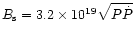 G) of
a pulsar. In Figs. 3c and 3d we report
versus these two
quantities: while the spread in the data remains large, a correlation
(already noted by BT97) is visible in
versus
G) of
a pulsar. In Figs. 3c and 3d we report
versus these two
quantities: while the spread in the data remains large, a correlation
(already noted by BT97) is visible in
versus  ,
when
the subsample of the MSPs is excluded.
,
when
the subsample of the MSPs is excluded.
This suggests the possibility to improve the quality of the fit by
using a more general function of P and .
In fact, the
proposed physical models for the X-ray emission rely on mechanisms
depending on different combinations of these two quantities.
Therefore, we have explored a fit of the type
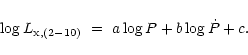 |
(4) |
Using a
minimization code, we found
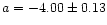 ,
,
 ,
,
 with a
 ,
implying that
the fit is still unacceptable. Only enlarging the error bars on
,
implying that
the fit is still unacceptable. Only enlarging the error bars on
 up to absolutely unreliable values of 0.9 (in
units of log(erg s-1)), this modeling of the data would become
statistically acceptable (with
up to absolutely unreliable values of 0.9 (in
units of log(erg s-1)), this modeling of the data would become
statistically acceptable (with
 ).
Rearranging the best-fit, we get
).
Rearranging the best-fit, we get
 .
Since
.
Since
 spans the interval
  ,
the last addendum is of the
order of the
uncertainty on the constant term, and thus we
can approximate the formula, getting
,
the last addendum is of the
order of the
uncertainty on the constant term, and thus we
can approximate the formula, getting
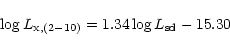 |
(5) |
which is very close to the best fit of Eq. (3).
This exercise has shown that, when properly accounting for the
uncertainties in the measured
,
no combination of P and
of the type
 can fit the data in a
statistically acceptable way. However, it is remarkable that, among
all the possible combinations of P and ,
the one which
better describes the data selects again a scaling with
.
can fit the data in a
statistically acceptable way. However, it is remarkable that, among
all the possible combinations of P and ,
the one which
better describes the data selects again a scaling with
.
We note that all the data of Fig. 4 lie under the critical line
 |
(6) |
obtained searching for that line having the minimum weighted
distance to the observed points. This line gives the maximum
efficiency of conversion of spin-down energy in X-rays:
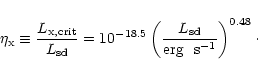 |
(7) |
For
in the interval
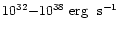 ,
the efficiency
varies within
,
the efficiency
varies within
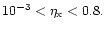
can be interpreted as the line giving the maximum luminosity
that can be attributed exclusively to magnetospheric processes, and
the large scatter below that line as due to additional mechanisms that
tend to reduce
and that are independent of P and .
Note that the width of the spread in the values of
does not vary
over the whole interval of
,
thus supporting further this
interpretation.
The magnetospheric emission is pulsed and intrinsically anisotropic.
Thus, the detection of a pulsed signal is susceptible to various
geometrical corrections. In the computation of
we have assumed
that the entire beam is seen. The angle
between the spin
axis and the dipolar magnetic field controls the intrinsic width of
the emission cone. According to Zhang & Harding (2000),
does
depend on .
This effect is particularly pronounced for
 and causes a drop in the luminosity. Disappointingly,
it is still difficult to have a direct measure of ,
which is
known, with large uncertainty, only for a handful of sources (Miller
& Hamilton 1993). The Vela pulsar is recognized to be an orthogonal
rotator: this can explain the drop of
by 1-2 orders of
magnitude relative to
,
making the observation consistent
with the prediction, within the error determination. However, the
small
and causes a drop in the luminosity. Disappointingly,
it is still difficult to have a direct measure of ,
which is
known, with large uncertainty, only for a handful of sources (Miller
& Hamilton 1993). The Vela pulsar is recognized to be an orthogonal
rotator: this can explain the drop of
by 1-2 orders of
magnitude relative to
,
making the observation consistent
with the prediction, within the error determination. However, the
small
 of PSR 0656+14 is not sufficient to explain
its displacement from
of PSR 0656+14 is not sufficient to explain
its displacement from
 It is thus plausible that influences the values of
but is not sufficient to explain the
scatter seen in the
versus
correlation.
It is thus plausible that influences the values of
but is not sufficient to explain the
scatter seen in the
versus
correlation.
Environmental effects can also be a source of scatter for the young
pulsars of the sample. As an example, PSR 0537-69 is one order of
magnitude less luminous than the Crab pulsar despite the similarity in
the value of
and in the apparent morphology. Wang et al.
(2001) explain the smaller efficiency in terms of a stronger
confinement of the pulsar nebula by a surrounding star formation
region, which combined with the high pulsar velocity (600 km s-1) gives a smaller shock radius of a fraction of a parsec. The
relativistic particles responsible for the X-ray emission thus escape
the nebula in a time much shorter than the time of radiative energy
loss.
The 2-10 keV energy band in which the sources are detected is selected
by instrumental needs, but it is not necessarily optimal to sample the
bulk of the broad-band high energy X-ray emission from pulsars. This
is what emerges from a spectral analysis of a number of bright pulsars
carried out with BeppoSAX data (Massaro et al. 2000). These new
observations indicate that the photon spectral index ()
of the
non-thermal emission is itself a function of energy
 (with a and b parameters of the
spectral fit and E0=1 keV) that is consistent with the
observational data when extrapolated in the UV-optical-IR range and at
gamma-ray energies below 30 MeV. The spectral photon distribution
peaks at a characteristic energy
(with a and b parameters of the
spectral fit and E0=1 keV) that is consistent with the
observational data when extrapolated in the UV-optical-IR range and at
gamma-ray energies below 30 MeV. The spectral photon distribution
peaks at a characteristic energy
 th
from source to source. For Crab,
th
from source to source. For Crab,
 keV so that the
2-10 keV interval contains a large fraction of .
For Vela, the
maximum would fall at about one MeV and then it would imply a low
,
just as observed (relative to
). The existence of a
characteristic energy or, more generally, of an energy threshold could
cause the deviation of
from
keV so that the
2-10 keV interval contains a large fraction of .
For Vela, the
maximum would fall at about one MeV and then it would imply a low
,
just as observed (relative to
). The existence of a
characteristic energy or, more generally, of an energy threshold could
cause the deviation of
from
The -ray luminosity (above 400 MeV) seems to follow a relation
of the type
 (Thompson et al. 1997;
Thompson 2001). In Fig. 5 we have drawn (in analogy to
in
the 2-10 keV band) the critical -ray luminosity (assuming
emission in one steradian)
(Thompson et al. 1997;
Thompson 2001). In Fig. 5 we have drawn (in analogy to
in
the 2-10 keV band) the critical -ray luminosity (assuming
emission in one steradian)
 derived from Fig. 5 of Zhang &
Harding (2000). We note that at least three young pulsars (MSPs are
excluded in this discussion), with high
lie in between
and
derived from Fig. 5 of Zhang &
Harding (2000). We note that at least three young pulsars (MSPs are
excluded in this discussion), with high
lie in between
and
 .
This indicates that for these sources the
X-ray luminosity (in the interval 2-10 keV) dominates over
.
This indicates that for these sources the
X-ray luminosity (in the interval 2-10 keV) dominates over
 and that the the correlation with
of the
luminosity integrated above 1 eV is steeper than indicated by Thompson
(2001) above a value of
which is around
and that the the correlation with
of the
luminosity integrated above 1 eV is steeper than indicated by Thompson
(2001) above a value of
which is around
 (as indicated in Fig. 5). A possible
interpretation of this steepening is that the physical mechanisms at
play favor the emission in the X-ray channel when
exceeds some
value: cascade processes can develop fully so that higher generation
pairs can produce photons at energies of only a few keV. In this
framework one expects that the slope n of the efficiency which is a
function of
and of the selected energy band
(as indicated in Fig. 5). A possible
interpretation of this steepening is that the physical mechanisms at
play favor the emission in the X-ray channel when
exceeds some
value: cascade processes can develop fully so that higher generation
pairs can produce photons at energies of only a few keV. In this
framework one expects that the slope n of the efficiency which is a
function of
and of the selected energy band
 (where
  is the centroid
frequency of the observational band) gradually increases when moving
toward less energetic frequencies
is the centroid
frequency of the observational band) gradually increases when moving
toward less energetic frequencies  Since the observed
efficiency in the -ray energy band (above 400 MeV) is
Since the observed
efficiency in the -ray energy band (above 400 MeV) is
 while in the 2-10 keV range varies
as
while in the 2-10 keV range varies
as
 ,
we predict that the maximum
efficiency should become almost independent of
(i.e.,
,
we predict that the maximum
efficiency should become almost independent of
(i.e.,  )
in an energy band intermediate the two. Future observations of
pulsars in the energy range of INTEGRAL between (0.1-10) MeV may
help in testing this prediction.
)
in an energy band intermediate the two. Future observations of
pulsars in the energy range of INTEGRAL between (0.1-10) MeV may
help in testing this prediction.
The analysis of the current data (with their uncertainties) on the
non-thermal X-ray emission from rotation-powered pulsars shows:
- 1.
- No monomial combination of P and
fits
in a statistically acceptable way.
- 2.
- Still, a correlation between the X-ray luminosity
in the band 2-10 keV and
persists in the data and the preferred scaling is

- 3.
- All the data lie below a critical line
 providing the maximum efficiency of conversion
of
in X-ray emission.
providing the maximum efficiency of conversion
of
in X-ray emission.
- 4.
- Geometrical effects, cut-off energy scales and
environment could be the causes of the reduction
in the detected
,
thus explaining the large scatter
present in the data.
After comparing our results with those derived similarly in the
-ray band, we suggest that the maximum efficiency of
conversion of spin-down power in high energy emission should be almost
independent of
in the energy band that will be explored by
INTEGRAL.
Acknowledgements
Part of this work was supported by the Italian ASI ARS 1R272000 grant.
We thank the referee Yoshitaka Saito for very useful and stimulating
comments.
- Becker, W., Trumper J., Lommen, A. N., & Backer, D. C. 2000,
ApJ, 545, 1015
In the text
NASA ADS
- Becker, W., & Trumper, J. 1999, A&A, 341, 803
In the text
NASA ADS
- Becker, W., & Trumper, J. 1997, A&A, 326, 682
In the text
NASA ADS
- Bildsten, L., Chakrabarty, D., Chiu, J., et al. 1997, ApJS, 113, 367
In the text
NASA ADS
- Camilo, F., Kaspi, V. M., Lyne, A. G., et al. 2000,
ApJ, 541, 367
In the text
NASA ADS
- Camilo, F., Manchester, R. N., Gaensler, B. M., Lorimer, D. R.,
& Sarkissian, J. 2002, ApJ, 567, L71
In the text
NASA ADS
- Chang, H. K., & Ho, C. 1999, ApJ, 510, 404
NASA ADS
- Chang, H. K., & Ho, C. 1997, ApJ, 479, L125
In the text
NASA ADS
- Cheng, K. S., Gil, J., & Zhang, L. 1998, ApJ, 493, L35
In the text
NASA ADS
- Cheng, K. S., & Zhang, L. 1999, ApJ, 515, 337
In the text
NASA ADS
- Chevalier, R. A. 2000, ApJ, 539, L45
In the text
NASA ADS
- Crawford, F., Gaensler, B. M., Kaspy, V. M., et al. 2001,
ApJ, 554, 152
In the text
NASA ADS
- Finley, J. P., Srinivasan, R., Saito, Y., et al.
1998, ApJ, 493, 884
In the text
NASA ADS
- Finley, J. P., Srinivasan, R., & Park, S. 1996, ApJ, 466, 938
In the text
NASA ADS
- Finley, J. P., & Ogelman, H. 1994, ApJ, 434, L25
In the text
NASA ADS
- Gotthelf, E. V., & Kaspi, V. M. 1998, ApJ, 497, L29
In the text
NASA ADS
- Gotthelf, E. V., Vasisht, G., Boylan-Kolchin, M., & Torii, K.
2000, ApJ, 542, L37
In the text
NASA ADS
- Greiveldinger, C., Camerini, U., Fry, W., et al.
1996, ApJ, 465, L35
In the text
NASA ADS
- Grindlay, J. E., Heinke, C., Edmonds, P. D., & Murray, S. S.
2001, Science, 292, 2290
In the text
NASA ADS
- Grindlay, J. E., Camilo, F., Heinke, C., et al. 2002, ApJ, submitted [astro-ph/0112484 ]
In the text
- Halpern, J. P., Camilo, F., Gotthelf, E. V., et al.
2001, ApJ, 552, L125
In the text
NASA ADS
- Halpern, J. P., & Wang, F. Y-H. 1997, ApJ, 477, 905
In the text
NASA ADS
- Harrus, I. M., Hughes, J. P., & Helfand, D. J. 1996,
ApJ, 464, L161
In the text
NASA ADS
- Hughes, J. P., Slane, P. O., Burrows, D. N., et al. 2001, ApJ, 559, L153
In the text
NASA ADS
- Kaaret, P., Marshall, H. L., Aldcroft, T. L., et al.
2001, ApJ, 546, 1159
In the text
NASA ADS
- Kawai, N., Tamura, K., & Saito, Y. 1998,
Advances in Space Research, 21, 213K
In the text
- Kaspi, V. M., Gotthelf, E., Gaensler, B. M., & Lyutikov, M. 2001,
ApJ, 562, L163
In the text
NASA ADS
- Manchester, R. N. 2001, PASA, 18 [astro-ph/0009405 ]
In the text
- Marsden, D., Blanco, P. R., Gruber, D. E., et al.
1997, ApJ, 491, L39
In the text
NASA ADS
- Marshall, F. E., Gotthelf, E. V., Zhang, W., Middleditch, J.,
& Wang, Q. D. 1998, ApJ, 499, L179
In the text
NASA ADS
- Massaro, E., Cusumano, G., Litterio, M., & Mineo, T. 2000,
A&A, 361, 695
In the text
NASA ADS
- Mereghetti, S. 2002, in The Neutron Star Black
Hole Connection, ed. C. Kouveliotou, J. van Paradijs, & J. Ventura
(Dordrecht Kluwer), NATO ASI Ser., 351 [astro-ph/9911252]
- Mereghetti, S., Bandiera, R., Bocchino, F., & Israel, G. L. 2002,
ApJ, submitted
In the text
- Miller, M. C., & Hamilton, R. J. 1993, ApJ, 411, 289
In the text
- Mineo, T., Cusumano, G., Kuiper, L., et al.
2000, A&A, 355, 1053
In the text
NASA ADS
- Murray, S. S, Slane, P. O., Seward, F. D., Ramson, S. M.,
& Gaensler, B. M. 2002, ApJ, in press [astro-ph/0108489]
In the text
- Nicastro, L., Cusumano, G., Kuiper, L., et al. 2002, in preparation
In the text
- Ögelman, H. 1995, ASP Conf. Ser., 72,
ed. A. S. Fruchter, M. Tavani, & D. C. Backer, 309
- Pavlov, G. G., Zavlin, V. E., Sanwal, D., Burwitz, V.,
& Garmire, G. P. 2001, ApJ, 552, L129
In the text
NASA ADS
- Pivovaroff, M. J., Kaspi, V. M., Camilo, F., Gaensler, B. M.,
& Crawford, F. 2001, ApJ, 554, 161
In the text
NASA ADS
- Pivovaroff, M. J., Kaspi, V. M., & Gotthelf, E. V. 2000,
ApJ, 528, 436
In the text
NASA ADS
- Roberts, M. S. E., Romani, R. W., & Johnston, S. 2001,
ApJ, 561, L187
In the text
NASA ADS
- Sakurai, I., Yanagisama, K., Kobiki, T., Kasahara, S., & Nakakubo, K. 2001, PASJ, 53, 535
In the text
NASA ADS
- Saito, Y. 1998, Ph.D. Thesis, Univ. of Tokyo (S98)
In the text
- Saito, Y., Kawai, N., Kamae, T., et al. 1997, ApJ, 477, L37
In the text
NASA ADS
- Seward, F. D., & Wang, Z. 1988, ApJ, 332, 199
In the text
NASA ADS
- Slane, P. 1994, ApJ, 437, 458
In the text
NASA ADS
- Slane, P., & Lloyd, N. 1995, ApJ, 452, 115
In the text
- Sun, X., Aschenbach, B., Becker, W., et al. 1995, IAUC, 6187
In the text
- Takahashi, M., Shibata, S., Torii, K., et al. 2001,
ApJ, 554, 316
NASA ADS
- Taylor, J. H., & Cordes, J. M. 1993, ApJ, 411, 674
In the text
NASA ADS
- Thompson, D. J., Harding, A. K., Hermsen, W., & Ulmer, M. P.
1997, in Proc. Fourth Compton Symposium, ed. C. D. Dermer,
M. S. Strickman, & J. D. Kurfess, AIP Conf. Proc. 410, 39 [TH97]
In the text
- Thompson, D. J. 2001 [astro-ph/0101039]
In the text
- Torii, K., Kinugasa, K., Toneri, T., et al. 1998,
ApJ, 494, L207
In the text
NASA ADS
- Torii, K., Saito, Y., Nagase, F., et al. 2001, ApJ, 551, L151
NASA ADS
- Torii, K., Tsunemi, H., Dotani, T., et al. 1999,
ApJ, 523, L69
In the text
NASA ADS
- Wang, Q. D., Gotthelf, E. V., Chu, Y.-H., & Dickel, J. R. 2001,
ApJ, 559, 275
In the text
NASA ADS
- Wang, F. Y-H., & Halpern, J. P. 1997, ApJ, 482, L159
In the text
NASA ADS
- Wang, F. Y-H.,Ruderman, M., Halpern, J. P., & Zhu, T. 1998, ApJ, 498, 373
In the text
NASA ADS
- Willingale, R., Aschenbach, B., Griffiths, R. G., et al.
2001, A&A, 365, L212
In the text
NASA ADS
- Zhang, B., & Harding, A. K. 2000, ApJ, 532, 1150
In the text
NASA ADS
Copyright ESO 2002

![\begin{figure}
\par\includegraphics[width=9cm,clip]{MS1938f1.eps}
\end{figure}](/articles/aa/full/2002/21/aa1938/img28.gif)
![\begin{figure}
\par\includegraphics[width=10cm,clip]{MS1938f2.eps}
\end{figure}](/articles/aa/full/2002/21/aa1938/img41.gif)
![\begin{figure}
\par\includegraphics[width=10cm,clip]{MS1938f3.eps}
\end{figure}](/articles/aa/full/2002/21/aa1938/img49.gif)
![\begin{figure}
\par\includegraphics[width=9cm,clip]{MS1938f4.eps}
\end{figure}](/articles/aa/full/2002/21/aa1938/img51.gif)
![\begin{figure}
\par\includegraphics[width=9cm,clip]{MS1938f5.eps}
\end{figure}](/articles/aa/full/2002/21/aa1938/img67.gif)