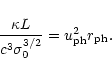
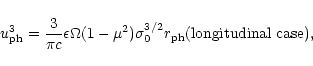
The photosphere is located where the optical depth reaches a value of 1. The optical depth depends on the density and the the radial
velocity u and must be integrated from a finite radius to infinity.
Because we only want to know the photospheric radius within a factor
of, say 2, we define it to be where the mean free path of a photon
equals the distance from the source r. In the comoving frame a
photon sees the mass density  and the mean free path for
Thompson scattering is
and the mean free path for
Thompson scattering is
 .
The source distance in this
frame is
.
The source distance in this
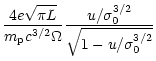
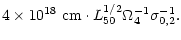
frame is  so that the photosphere is located at
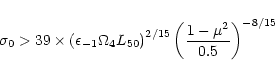
 |
(51) |
 does not
depend on the initial Poynting flux ratio
does not
depend on the initial Poynting flux ratio  and only weakly
on L.
and only weakly
on L.
For the transversal case the flow velocity always depends greatly on
the initial radius r0. The dissipation time scale is
 and most energy is released at small rnear the source. The acceleration depends crucially on the onset of
the dissipation and therefore on r0. In our simple model r0 and
and most energy is released at small rnear the source. The acceleration depends crucially on the onset of
the dissipation and therefore on r0. In our simple model r0 and
 are not well determined by physical arguments so that the
transversal case is rather uncertain and highly speculative. One
cannot write down robust equations for the photosphere like in the
longitudinal case without many degrees of freedom.
are not well determined by physical arguments so that the
transversal case is rather uncertain and highly speculative. One
cannot write down robust equations for the photosphere like in the
longitudinal case without many degrees of freedom.
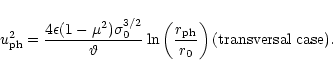
The energy dissipated beyond the photospheric radius is
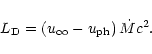 |
(57) |
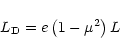 |
(58) |
 is
dissipated internally while a fraction
is
dissipated internally while a fraction
 can be converted
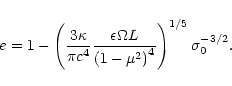
to radiation beyond the photosphere. Thus e is an efficiency
factor, which gives the ratio between the energy dissipated in the
optically thin domain and the total dissipated energy. Efficient
conversion of free magnetic energy into non-thermal radiation can
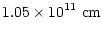
happen if e is of the order unity which requires that the second
term in (59) is small:
can be converted
to radiation beyond the photosphere. Thus e is an efficiency
factor, which gives the ratio between the energy dissipated in the
optically thin domain and the total dissipated energy. Efficient
conversion of free magnetic energy into non-thermal radiation can
happen if e is of the order unity which requires that the second
term in (59) is small:
 ,
,
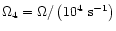 ,
,
 and
and
 are parameters scaled to fiducial GRB
values.
are parameters scaled to fiducial GRB
values.
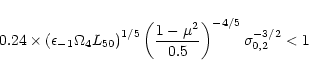
When (61) is satisfied, part of the magnetic energy is
released beyond the photosphere, and powers the prompt radiation. If
it is not satisfied, the energy is released inside the photosphere and
is converted, instead, into bulk kinetic energy. Some other means of
conversation into radiation is then needed, such as internal shocks.
Since the dependence on parameters other than the initial Poynting
flux ratio
is small in (61), we conclude that
efficient powering of prompt radiation by magnetic dissipation in GRB
is possible for
 .
.
The major difference between the longitudinal and the transversal case
is the different dissipation time scale. While the decay time scale
for the longitudinal case (44) is
 and therefore limited by
 ,
the time scale for the
transversal case
is not limited. At small
radii it starts at low values but grows then to infinity. This major
difference is visualised in Fig. 1 where the flow
Lorentz factor is plotted depending on the radius.
,
the time scale for the
transversal case
is not limited. At small
radii it starts at low values but grows then to infinity. This major
difference is visualised in Fig. 1 where the flow
Lorentz factor is plotted depending on the radius.
As mentioned in Sect. 4.1 the transversal case depends
strongly on the initial radius r0. This is seen in
Fig. 2 where the numerical solutions of (39) are shown for various initial radii. While all
longitudinal case solutions merge toward the
 power-law
there is a large spread in the transversal case solutions.
power-law
there is a large spread in the transversal case solutions.
The longitudinal and transversal cases are the two limits for a
general case where both kinds of scaling of the decay time scale
occur. One can model the mixing of both cases by writing the
dissipation time scale as
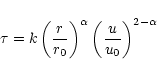 |
(62) |
 is a dimensionless parameter which determines the
mixing.
is a dimensionless parameter which determines the
mixing.  corresponds to the pure longitudinal case and
 to the transversal case. The constant k can be written
depending on the corresponding model parameters as
to the transversal case. The constant k can be written
depending on the corresponding model parameters as
 |
(63) |
 |
(64) |
 values. All graphs result from a numerical integration of
(39). Beyond the photosphere, assuming it is around
values. All graphs result from a numerical integration of
(39). Beyond the photosphere, assuming it is around
 ,
the dissipation is only efficient if the field
variation does not point in transversal direction. The efficiency
estimation in (59) is therefore an upper limit for the
general case with
,
the dissipation is only efficient if the field
variation does not point in transversal direction. The efficiency
estimation in (59) is therefore an upper limit for the
general case with
 .
.
Because we work with the ideal MHD approximation we have to make sure
that there are enough charges in the flow to make up the required
electric current density. Because the reconnection processes will
destroy the ordered initial field configuration quickly it does not
make much sense to consider this configuration throughout the flow.
But one can at least estimate needed currents by looking at a
sinusoidal wave in the equatorial plane. In Paper I we
derived the limiting radius where the MHD condition breaks down by
using a constant flow speed and assumed  .
The condition that
enough charges are available to carry the current is
.
The condition that
enough charges are available to carry the current is
 |
(65) |
 is
written as a function of u and depends implicitly on r. At r0where
is
written as a function of u and depends implicitly on r. At r0where
 it starts at the value (67)
and rises strongly until the final velocity
it starts at the value (67)
and rises strongly until the final velocity
 is reached where
diverge to
is reached where
diverge to  .
For the GRB parameters assumed here, we find
.
For the GRB parameters assumed here, we find
 and the MHD approximation is always fulfilled, as in
Paper I.
and the MHD approximation is always fulfilled, as in
Paper I.
Dissipation of magnetic energy was applied to the Crab pulsar wind by
Lyubarsky & Kirk (2001). Their model setup included a striped pulsar
wind (Coroniti 1990) that is the equatorial wind of on inclined
rotator. This is quite similar to our longitudinal case where all
Poynting flux can decay so that .
The wind starts with
 and reaches
 as in our model. Due to a difference approach to model the
reconnection rate they obtain a flow acceleration of
as in our model. Due to a difference approach to model the
reconnection rate they obtain a flow acceleration of
 (Eq. (30) Lyubarsky & Kirk 2001) which is faster than
 form (50).
The findings of Lyubarsky & Kirk (2001) that the reconnection is
inefficient for the Crab wind seems to contradict our result, that it
efficiently accelerates the GRB outflow. The reason for that is the
different initial Poynting flux values used for the Crab pulsar and in
our study.
is the critical parameter controlling the final
Lorentz factor and the spatial size of the accelerating wind.
Discussing the Crab pulsar wind in detail and speculating why
reconnection fails is beyond the scope of the present paper. Instead,
we simply take the flow parameter values
 ,
,
 from Lyubarsky & Kirk (2001) and show that our model
gives basically the same result as the striped wind model. However,
see Yubarsky & Eichler (2001) for a critical revision of the Crab pulsar
wind parameters. Equation (50) yields for the
4-velocity at the observed termination shock at
from Lyubarsky & Kirk (2001) and show that our model
gives basically the same result as the striped wind model. However,
see Yubarsky & Eichler (2001) for a critical revision of the Crab pulsar
wind parameters. Equation (50) yields for the
4-velocity at the observed termination shock at
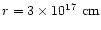
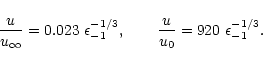 |
(68) |
The radius
 from (49) denotes the radius
where the Poynting flux conversion ends. Its value scales with the
third power of .
Plausible Lorentz factors for GRB winds of
around 102-104 imply
from (49) denotes the radius
where the Poynting flux conversion ends. Its value scales with the
third power of .
Plausible Lorentz factors for GRB winds of
around 102-104 imply
 -5 (or larger
for
-5 (or larger
for  ). This lowers
by 6 orders of magnitudes
compared to the Crab wind. Thus
). This lowers
by 6 orders of magnitudes
compared to the Crab wind. Thus
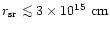 which is smaller than the radius
 where the flow runs into
the ambient medium (Piran 1999).
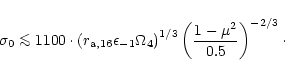
The requirement on
for the dissipation to take place inside
a radius
where the flow runs into
the ambient medium (Piran 1999).
The requirement on
for the dissipation to take place inside
a radius  can be expressed by (49) which
yields an upper limit for the initial Poynting flux ratio:
can be expressed by (49) which
yields an upper limit for the initial Poynting flux ratio:
 |
(69) |
Copyright ESO 2002

![$\displaystyle \left[
\frac{3\kappa}{\pi c^4} \epsilon\Omega (1-\mu^2)L
\right]^{1/5}$](/articles/aa/full/2002/20/aah3387/img149.gif)
![$\displaystyle 119\cdot \left[
\epsilon_{-1} \Omega_4
\left(\frac{1-\mu^2}{0.5}\right) L_{50}
\right]^{1/5} \ ,$](/articles/aa/full/2002/20/aah3387/img150.gif)

![$\displaystyle \left[
\frac{\pi^2 \kappa^3}{9 c^7}
\frac{L^3}{\left(\epsilon\Omega(1-\mu^2)\right)^2}
\right]^{1/5}
\sigma_0^{-3/2}$](/articles/aa/full/2002/20/aah3387/img152.gif)
![$\displaystyle \times \left[
\epsilon_{-1} \Omega_4 \left(\frac{1-\mu^2}{0.5}\right)
\right]^{-2/5}
L_{50}^{3/5}
\sigma_{0,2}^{-3/2}.$](/articles/aa/full/2002/20/aah3387/img154.gif)
![\begin{figure}
\par\includegraphics[width=8.8cm,clip]{h3387f2.eps}\end{figure}](/articles/aa/full/2002/20/aah3387/img171.gif)
 .
The constants used where
.
The constants used where
 ,
,
 ,
,
 ,
,
 .
For the transversal cases
.
For the transversal cases
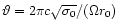 is chosen so that
the initial acceleration (slope at r0) is the same as in the
corresponding longitudinal cases.
is chosen so that
the initial acceleration (slope at r0) is the same as in the
corresponding longitudinal cases.![\begin{figure}
\par\includegraphics[width=8.8cm,clip]{h3387f3.eps} \end{figure}](/articles/aa/full/2002/20/aah3387/img180.gif)
 for different parameters
 .
The other wind parameters
were set to
.
The other wind parameters
were set to
 ,
,
 in the transversal
description). The different winds all start with the same
dissipation rate so that they show the same initial acceleration.
in the transversal
description). The different winds all start with the same
dissipation rate so that they show the same initial acceleration.
 is marked by a horizontally dotted line.
 =
=