A&A 384, 350-363 (2002)
DOI: 10.1051/0004-6361:20020051
Lasers without inversion (LWI) in Space: A possible explanation for intense,
narrow-band, emissions that dominate the visible and/or far-UV (FUV) spectra
of certain astronomical objects
P. P. Sorokin - J. H. Glownia
IBM Research Division, PO Box 218, Yorktown Heights, NY 10598, USA
Received 3 December 2001 / Accepted 20 December 2001
Abstract
The optical or far-UV (FUV) spectra of certain objects in Space are
completely dominated by one or two spectrally narrow emission lines,
strongly suggesting that laser action of some kind occurs in these objects.
However, the electronic level structures of the atoms/ions producing these
emissions preclude the possibility of maintaining population inversions on
the electronic transitions involved. In lasers, gain is normally produced on
an optical transition that is inverted, i.e. one that has more atoms
maintained in the upper than in the lower state, so that stimulated emission
can exceed stimulated absorption. However, as a result of discoveries made
in quantum electronics over the past 30 years or so, one now knows that
there are several ways to make stimulated emission occur on a transition
that is not inverted, i.e. to realize a "laser without inversion (LWI)''.
This requires first making the atoms non-absorbing at the lasing frequency,
i.e. setting up a condition of "electromagnetically induced transparency
(EIT)''. Some recently developed EIT techniques for three-level atoms are
first reviewed. A simple model for a space LWI based upon a gas of two-level
atoms is then proposed. In this model, transparency results from a form of
EIT induced by the presence of an intense, monochromatic, continuous-wave,
laser beam tuned to the frequency
 of the two-level-atom transition.
Amplification of light at this same frequency occurs via resonant stimulated
hyper-Raman scattering (SHRS) and four-wave mixing (FWM), with pumping
energy provided by continuum starlight spectrally overlapping the two outer
absorption sidebands ("Mollow bands'') induced by the presence of the beam at
.
Two specific examples of superintense line emission from
Space are here considered. These are (a) the H(
of the two-level-atom transition.
Amplification of light at this same frequency occurs via resonant stimulated
hyper-Raman scattering (SHRS) and four-wave mixing (FWM), with pumping
energy provided by continuum starlight spectrally overlapping the two outer
absorption sidebands ("Mollow bands'') induced by the presence of the beam at
.
Two specific examples of superintense line emission from
Space are here considered. These are (a) the H( )
emission line
appearing as a dominant singularity in certain reddened, early-type stars,
and (b) the powerful O VI (1032 Å, 1038 Å) emission doublet that
dominates the FUV emission spectra of symbiotic stars such as RR Tel.
)
emission line
appearing as a dominant singularity in certain reddened, early-type stars,
and (b) the powerful O VI (1032 Å, 1038 Å) emission doublet that
dominates the FUV emission spectra of symbiotic stars such as RR Tel.
Key words: atomic processes - radiation mechanisms: non-thermal - stars:
early type - stars: individual: HD 44179 - stars: individual: RR Tel - ISM: lines and bands
The introduction of an entirely new concept to explain a class of observed
phenomena in any field of science would seem to be a redundant activity, if
the phenomena can reasonably be accounted for with use of existing theories
and models. However, in the cases of certain astronomical observations of
anomalously intense emission lines, standard explanations appear to be
inadequate. This paper focuses specifically on the H()
emission
line appearing as an intense,  -function-like, singularity in the spectra of some
reddened early-type stars, and also on the powerful O VI (1032 Å, 1038 Å)
emission doublet that dominates the FUV spectra of symbiotic stars
such as RR Tel. The fact that one or two sharp spectral lines can dominate
the total emission spectrum of any space object over a very wide spectral
range suggests that laser action of some kind is occurring in that object.
However, as is shown below, under typical conditions existing in
astrophysical environments surrounding bright stars, the electronic level
structures of both H atoms and O VI ions preclude the possibility of
population inversions occurring on any of the transitions producing the
intense emissions that are observed. Since population inversion is generally
thought to be a prerequisite for lasing, this would appear to
rule out immediately any possibility that the latter could be the cause of the observed
anomalously strong emission lines. However, as a result of theoretical and
experimental studies done over the past 30 years, one now knows that there
are ways in which laser action can occur on a transition without a
population inversion being present on that transition. This fact is the
essential message conveyed by many recent studies performed in the
relatively new research area of quantum electronics termed "lasers without
inversion (LWI)''. The first step in realizing an LWI is to cancel somehow
the absorption arising from the noninverted atoms. This can be accomplished
through a variety of recently developed techniques based upon quantum
interference that create a condition in the LWI medium known as
"electromagnetically induced transparency (EIT)''. Part of the present paper
is devoted to a brief review of some especially striking results achieved in
the EIT field.
-function-like, singularity in the spectra of some
reddened early-type stars, and also on the powerful O VI (1032 Å, 1038 Å)
emission doublet that dominates the FUV spectra of symbiotic stars
such as RR Tel. The fact that one or two sharp spectral lines can dominate
the total emission spectrum of any space object over a very wide spectral
range suggests that laser action of some kind is occurring in that object.
However, as is shown below, under typical conditions existing in
astrophysical environments surrounding bright stars, the electronic level
structures of both H atoms and O VI ions preclude the possibility of
population inversions occurring on any of the transitions producing the
intense emissions that are observed. Since population inversion is generally
thought to be a prerequisite for lasing, this would appear to
rule out immediately any possibility that the latter could be the cause of the observed
anomalously strong emission lines. However, as a result of theoretical and
experimental studies done over the past 30 years, one now knows that there
are ways in which laser action can occur on a transition without a
population inversion being present on that transition. This fact is the
essential message conveyed by many recent studies performed in the
relatively new research area of quantum electronics termed "lasers without
inversion (LWI)''. The first step in realizing an LWI is to cancel somehow
the absorption arising from the noninverted atoms. This can be accomplished
through a variety of recently developed techniques based upon quantum
interference that create a condition in the LWI medium known as
"electromagnetically induced transparency (EIT)''. Part of the present paper
is devoted to a brief review of some especially striking results achieved in
the EIT field.
In Sect. 2, a few spectra taken from a recent astronomical survey are
displayed which strikingly demonstrate that enormously enhanced H()
emissions are indeed seen in some reddened, early-type stars. Yet from a
portion of the H-atom energy level diagram that includes the upper and lower
levels of the H()
transition, one readily sees that it would be
virtually impossible to have a population inversion continuously maintained
on this same transition. In Sect. 3, spectra of three symbiotic stars are
presented to illustrate just how dominant the O VI (1032 Å, 1038 Å)
emission doublet can be in the FUV spectra of such stars. In this case,
maintaining population inversions on the two emitting transitions is made
even more difficult by virtue of the fact that the lower level of each
transition is the O VI ion ground state level. Presaging further the
possible necessity for a new paradigm to be here considered are serious
difficulties one encounters when trying to account for symbiotic star O VI
doublet emission through conventional means. For example, linear optical
pumping of O VI ions by FUV continuum light from the hot white dwarf member
can only result in elastic scattering of the light. No real excitation of
the two upper O VI levels can be produced in this manner in an atmosphere as
rarified as that characterizing the gas occupying the region between the two
members of a symbiotic star. Again, if one assumes that excitation of the O
VI upper levels occurs via recombination of ions and electrons, one is then
faced with the difficulty of explaining why the intensity ratio of the two
emission components of the O VI doublet is observed to vary greatly from the
theoretically expected 2:1 ratio in the various symbiotic star systems
surveyed.
Sensing that a radically new approach might indeed be needed to
explain the superintense emission lines from Space described above, in Sect. 4
we consider some of the
striking results that have been achieved in the fields of EIT and coherently
phased atoms. Most recent research in these areas has focussed on
three-level atomic structures, which allow two nonlinearly-coupled resonant
light waves to propagate together through a medium without being at all
attenuated. It seems reasonable to speculate that this finding might form a cornerstone for a space
laser model that could explain intense H()
or O VI emissions from
Space. Less apparent is the likelihood that another striking discovery made
by investigators in the EIT field - ultraslow propagation of light - can
also play an important role in determining the amount of gain (i.e. optical
amplification per unit propagation distance) one calculates for a space
laser model in which the signal wave group velocity depends upon EIT. An
attempt to find an answer to this question is nonetheless made in Sect. 4.
The exact nature of the pumping mechanism is often only vaguely specified in
the various schemes for LWI that have been considered in the literature. In
proposing that a form of LWI occurs around certain objects in Space, we
initially consider a somewhat unusual nonlinear pumping mechanism termed
stimulated hyper-Raman scattering. This involves multi-photon absorption of
continuum light from a nearby illuminating star via new resonances that are
induced in two-level atoms when intense, monochromatic light is applied at
the transition frequency. The transparency required for a two-level-atom
LWI to operate results both from the effect of saturation and from a form of
EIT that occurs in two-level-atom gases. This leads to a greatly
simplified space laser model, as is explained in Sect. 5. The optical gain of
a 2-level LWI operating in a symbiotic star environment is calculated in
Sect. 5, and is found to be more than sufficient, implying rather strongly
that LWI's must indeed be the generators of the superintense (1032 Å,
1038 Å) O VI doublet emissions seen in these space objects. It is also
concluded in Sect. 5 that 2-level lasing without inversion is the most
likely explanation of superintense H()
emissions seen in some
reddened, early-type stars. However, lack of detailed knowledge about the
astrophysical environments of these objects makes this conclusion somewhat
less certain.
In Rawlings et al. (2000) new optical spectroscopy for 45% of an older
catalog (Stephenson 1992) of  440 reddened stars was performed in an
attempt to isolate reddened stars which are also early-type. The spectra
between 6100 Å and 6900 Å of all the stars studied are shown in
Rawlings et al. (2000). Only fifteen of the stars surveyed could be
classified as early-type stars. With regard to H(), the spectra of
these early-type stars show tremendous variations. Some (Fig. 1a) show H()
only in absorption. Others (Figs. 1b-d) show H()
strongly in emission, with an intensity completely disproportionate to all
other absorption features present. Yet the spectral types of these stars are
all apparently roughly comparable. In the spectra of all the cooler stars
surveyed by Rawlings et al. (2000), H(), if present at all, appears
only in absorption.
440 reddened stars was performed in an
attempt to isolate reddened stars which are also early-type. The spectra
between 6100 Å and 6900 Å of all the stars studied are shown in
Rawlings et al. (2000). Only fifteen of the stars surveyed could be
classified as early-type stars. With regard to H(), the spectra of
these early-type stars show tremendous variations. Some (Fig. 1a) show H()
only in absorption. Others (Figs. 1b-d) show H()
strongly in emission, with an intensity completely disproportionate to all
other absorption features present. Yet the spectral types of these stars are
all apparently roughly comparable. In the spectra of all the cooler stars
surveyed by Rawlings et al. (2000), H(), if present at all, appears
only in absorption.
![\begin{figure}
\includegraphics[width=17cm,clip]{h3337f1.eps}\end{figure}](/articles/aa/full/2002/10/aah3337/Timg16.gif) |
Figure 1:
a-d) Spectra of three reddened early-type stars selected from Fig. 4
of Rawlings et al. (2000). Features labeled "d'' and "t'' are diffuse
interstellar and telluric features, respectively. Stars labeled by running
numbers used in Table 1 of Stephenson (1992). (StRS  "Stephenson
Reddened Star''.) Standard identifications for StRS 177 and StRS 368 are IRAS
18179-1346 and IRAS 20298+4011, respectively.
"Stephenson
Reddened Star''.) Standard identifications for StRS 177 and StRS 368 are IRAS
18179-1346 and IRAS 20298+4011, respectively. |
| Open with DEXTER |
Much spectral data exists for the star, HD 44179, that powers the Red
Rectangle nebula. We here consider an apertured line-of-sight that includes
just the star, not the nebula. In such a line-of-sight, one sees (Cohen et al. 1975) that all Balmer lines, with the notable exception of H(),
appear as broad absorptions against the star's blackbody continuum. No
emissions are present in the blue-green spectral region. However, H()
appears as a strong, narrow, emission line centrally placed in a broad
absorption. A recent STIS scan showing H()
emission in HD 44179 is
shown in Fig. 2.
![\begin{figure}
\includegraphics[width=8.8cm,clip]{h3337f2.eps}\end{figure}](/articles/aa/full/2002/10/aah3337/Timg17.gif) |
Figure 2:
STIS scan of HD 44179 taken on Mar 26, 1998 (T. Gull, principal
investigator). Spectrum obtained from HST web archive. |
| Open with DEXTER |
In view of the enormous variations in H()
spectral width and
intensity observed in lines-of-sight to reddened stars of roughly the same
spectral type, a non-stellar origin for this emission is strongly suggested.
Hence - at least in the most singular cases - this emission must originate
from H atoms located outside the photosphere of the illuminating star. If
the H()
emissions resulted from electron impact excitation
occurring in compact H II regions about the stars, one would expect also to
detect emissions at the wavelength of H( ), H(
), H( ), H(), etc. At least in the case of HD 44179, these are not observed.
![\begin{figure}
\par\includegraphics[width=7cm,clip]{h3337f3.eps}\end{figure}](/articles/aa/full/2002/10/aah3337/Timg20.gif) |
Figure 3:
Partial energy level diagram for H atoms, showing the levels involved in
H()
emission from stars. |
| Open with DEXTER |
At first glance, one would also think that the H()
emissions could
reasonably be produced via linear photoexcitation of H atoms located in
neutral regions bordering thin H II regions. A portion of the H-atom energy
level diagram that contains both upper and lower levels of the H()
transition is shown in Fig. 3. Transitions
 and
and
 are allowed; the total radiative decay rate of
quantum level
are allowed; the total radiative decay rate of
quantum level  3
3 is 109 s-1, with most of the
fluorescent emission occurring on the transition
.
Since 2
decays radiatively to 1
via
spontaneous two-photon emission at a rate
is 109 s-1, with most of the
fluorescent emission occurring on the transition
.
Since 2
decays radiatively to 1
via
spontaneous two-photon emission at a rate  8 s-1, transition
 is basically forbidden. A typical H-atom
concentration existing in a cold neutral cloud surrounding an early-type
star might be 104 cm-3. The corresponding collision rate
would be
10-7 - 10-8 s-1 - low enough for the gaseous
medium to be realistically considered collisionless. Weisskopf (1931) first
showed that if a two-level atom in a collisionless medium is excited by
weak, monochromatic, resonant radiation, the resulting fluorescence is also
monochromatic and has the same frequency as the incident light. In other
words, the scattering is purely elastic, and no real excitation of the upper
level occurs. This statement ceases to hold for the case of strong field
excitation, when the induced transition rate is comparable to, or greater
than, the spontaneous emission rate. It was, of course, the advent of the
laser that stimulated theoreticians in quantum electronics to work out
eventually the correct expressions for both (a) the absorption spectrum
(Mollow 1972) and (b) the fluorescence spectrum (Mollow 1969) of a two-level
atom excited by an intense, monochromatic, field. When the exciting
monochromatic field is exactly on resonance, there is a range of power
levels for which both spectral distributions consist largely of three peaks.
This same range of power levels will concern us in Sect. 5, and we will
there refer to the three peaks as "Mollow bands''.
is basically forbidden. A typical H-atom
concentration existing in a cold neutral cloud surrounding an early-type
star might be 104 cm-3. The corresponding collision rate
would be
10-7 - 10-8 s-1 - low enough for the gaseous
medium to be realistically considered collisionless. Weisskopf (1931) first
showed that if a two-level atom in a collisionless medium is excited by
weak, monochromatic, resonant radiation, the resulting fluorescence is also
monochromatic and has the same frequency as the incident light. In other
words, the scattering is purely elastic, and no real excitation of the upper
level occurs. This statement ceases to hold for the case of strong field
excitation, when the induced transition rate is comparable to, or greater
than, the spontaneous emission rate. It was, of course, the advent of the
laser that stimulated theoreticians in quantum electronics to work out
eventually the correct expressions for both (a) the absorption spectrum
(Mollow 1972) and (b) the fluorescence spectrum (Mollow 1969) of a two-level
atom excited by an intense, monochromatic, field. When the exciting
monochromatic field is exactly on resonance, there is a range of power
levels for which both spectral distributions consist largely of three peaks.
This same range of power levels will concern us in Sect. 5, and we will
there refer to the three peaks as "Mollow bands''.
The " '' system shown in Fig. 3 is a three-level system, not a
two-level system. Under collisionless conditions, when this system is
excited by weak, monochromatic excitation anywhere in a narrow spectral
range spanning the
transition, both elastic
scattering and spontaneous Raman scattering occur (Loudon 2000), but, again,
as in the two-level case, no real excitation of quantum level 3
takes place. The light produced by the Raman scattering process
would have a broadened spectral profile centered on H(), but it
would be radiated into 4
'' system shown in Fig. 3 is a three-level system, not a
two-level system. Under collisionless conditions, when this system is
excited by weak, monochromatic excitation anywhere in a narrow spectral
range spanning the
transition, both elastic
scattering and spontaneous Raman scattering occur (Loudon 2000), but, again,
as in the two-level case, no real excitation of quantum level 3
takes place. The light produced by the Raman scattering process
would have a broadened spectral profile centered on H(), but it
would be radiated into 4 steradians and cannot therefore account for
the extreme -function-like profiles observed in, for example, Figs.
1b and 1c.
steradians and cannot therefore account for
the extreme -function-like profiles observed in, for example, Figs.
1b and 1c.
The occurrence of stimulated emission or lasing on the
transition could easily account for H()
emissions from Space
that appear sharp, intense, and singular-looking (i.e. unaccompanied by a
significant pedestal). However, it is a trivial matter to show that it would
be virtually impossible to have a population inversion continuously
maintained on the
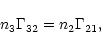
transition. From Fig. 3, one sees
that in the steady state the following condition must hold:
 |
(1) |
where the n's are the level population densities and the  's are
(one half) the radiative decay rates. (For a lifetime broadened transition,
's are
(one half) the radiative decay rates. (For a lifetime broadened transition,  is the FWHM linewidth of the Lorentzian profile expressed in rad s-1.
 ,
where A is the Einstein coefficient
and
,
where A is the Einstein coefficient
and  is the radiative lifetime.) Since
 ,
no population inversion can continually be maintained on the
transition.
,
no population inversion can continually be maintained on the
transition.
A symbiotic star is generally considered by astronomers to consist of two
stars orbiting together in Space while remaining a fixed distance apart from
one another. One of the stars is assumed to be a decaying red giant, the
other an extremely hot white dwarf. The red giant continually loses mass;
some of this mass accretes onto the white dwarf, leading to additional
heating of the latter. A typical geometry for a symbiotic star is shown in
Fig. 4.
![\begin{figure}
\includegraphics[width=8.8cm,clip]{h3337f4.eps}\end{figure}](/articles/aa/full/2002/10/aah3337/Timg34.gif) |
Figure 4:
Sketch of the geometry of the symbiotic star RW Hydrae, based upon
measurements presented in Schild et al. (1996). |
| Open with DEXTER |
Much of the enthusiasm that currently exists for symbiotic star research was
stimulated by a series of recent spectral studies. Symbiotic stars often
show two emission lines at 6825 Å and 7082 Å. The origin of these
lines remained for many years a mystery in astronomy, until they were
identified as spontaneous Raman scattering of the O VI (1032 Å, 1038 Å) resonance doublet by hydrogen atoms (Schmid 1989). These spontaneous Raman
scattering processes are shown in Fig. 5. For the past ten years or so,
these lines have provided astronomers with a new and powerful diagnostic
tool for determining the geometric structure of symbiotic systems.
Spectropolarimetric observations reveal that the Raman lines are polarized.
In symbiotic stars the O VI region is assumed to be close to the hot
component, and the H-atom concentration is known to be large near the red
giant. Thus the polarization angle provides the orientation of the binary
axis of the symbiotic system.
![\begin{figure}
\includegraphics[width=6.2cm,clip]{h3337f5.eps}\end{figure}](/articles/aa/full/2002/10/aah3337/Timg35.gif) |
Figure 5:
Spontaneous Raman scattering processes responsible for producing emissions
observed at 6825 Å and 7082 Å in symbiotic stars. |
| Open with DEXTER |
Although measurements of the red lines alone could provide all the
information needed for the structures of symbiotic star systems to be
determined, it was only comparatively recently that high quality FUV spectra
of some of these objects were recorded (Schmid et al. 1999). The O VI lines
of several symbiotic stars were observed during the
ORFEUS-SPAS I and
ORFEUS-SPAS II space shuttle missions STS-51 (September 1993) and STS-80
(November/December 1996). The ORFEUS telescope fed two instruments: the
Berkeley spectrometer with spectral resolution 3000 and the Echelle
spectrometer with spectral resolution 10000. Details of the
experimental techniques employed and examples of spectra taken with the
Berkeley spectrometer on both missions and with the Echelle spectrometer
during the second mission are presented in Schmid et al. (1999). In Figs. 6-8 are shown Berkeley spectra of three symbiotic stars recorded during the first space shuttle mission.
One sees from these spectra that the O VI doublet emission indeed completely
dominates the FUV spectra of these symbiotic stars over a wide frequency
range. Again, one senses that a lasing process of some kind must be involved
in order for such relatively intense, narrow-band, emissions to be produced.
Yet on the basis of an O VI energy level diagram (Fig. 9) that includes the
transitions on which the light is emitted, it appears very difficult to
provide a reasonable scenario showing just how intense, narrow-band, light
emission is generated in symbiotic stars. It is perhaps even more difficult
to do this than it was to try to explain the intense, narrow-band, H()
emissions observed in some reddened, early-type stars. For one thing, to
maintain population inversions on both transitions of the (1032 Å, 1038 Å) doublet would require that at least two-thirds of all the O VI ions
must at any time reside in the excited state levels. This would require the
continuous application of unattainable high pump powers. Linear pumping of
the excited state levels by the FUV continuum radiated by the hot white
dwarf can result only in elastic scattering, not real excitation of the
levels, and cannot therefore explain the emissions. Regarding possible
excitation of the levels through either electron impact or recombination of
ions and electrons, there is a fairly strong indication in Figs. 6-8 that
this is not what happens in symbiotic stars. Excitation by electronic impact
or via ion-electron recombination should theoretically always result in a
2:1 intensity ratio for the fluxes from the two doublet components. The
(1032 Å, 1038 Å) line fluxes determined from the Berkeley spectra are
given in Table 2 of Schmid et al. (1999). The line flux ratios vary from 10 (Z And) to 1.3 (RR Tel).
One here might anticipate examining superintense symbiotic star O VI
emission in the light of LWI/EIT concepts by noting that the three levels of
O VI shown in Fig. 9 would form a particularly "clean'' example of a "V''-type
three-level system that is frequently considered in the context of LWI/EIT.
Firstly, the next highest level of O VI occurs at 640040 cm-1. The
three levels shown in Fig. 9 therefore form a closed system, with no
effective radiative or non-radiative couplings to any other levels.
Secondly, the even mass number O16 isotope (99.76% abundant) has no
nuclear spin. Therefore, there is no hyperfine splitting in any of the O VI
electronic levels. In atoms such as Na23, hyperfine splitting can
greatly complicate LWI/EIT experiments.
The majority of EIT studies are concerned with three-level atom systems,
which for the most part are either "''-type, as in Fig. 3, or
"V''-type, as in Fig. 9. In one approach, pioneered by the group of S. E.
Harris, the emphasis has generally been to consider how a weak monochromatic
"probe beam'', applied in the vicinity of the
 transition in a -type three-level system, propagates in a gas of such atoms when a
strong monochromatic laser beam (the EIT "coupling beam''), tuned to line
center
transition in a -type three-level system, propagates in a gas of such atoms when a
strong monochromatic laser beam (the EIT "coupling beam''), tuned to line
center
 of the
transition,
copropagates in the same gas. In another approach, copropagation of probe
and coupling beams is studied when there is no constraint that the intensity
of the probe beam be small compared to that of the coupling beam. At first
glance, this second approach would appear to be of more relevance for a
space laser model. However, since valuable insight is likely to be gained by
examining results obtained in the first approach, we now proceed to do so.
of the
transition,
copropagates in the same gas. In another approach, copropagation of probe
and coupling beams is studied when there is no constraint that the intensity
of the probe beam be small compared to that of the coupling beam. At first
glance, this second approach would appear to be of more relevance for a
space laser model. However, since valuable insight is likely to be gained by
examining results obtained in the first approach, we now proceed to do so.
Let us specifically consider a -type three-level atom having an
energy level diagram similar to that in Fig. 3. Transitions
and
are allowed. Transition
is assumed to be basically forbidden. (One half) the
total radiative decay rate of quantum level 3
is
 ,
i.e.
,
i.e.
 .
The quantity
.
The quantity
 ,
which is assumed to be nearly zero, is for simplicity here
designated by
,
which is assumed to be nearly zero, is for simplicity here
designated by
 .
.
When a strong monochromatic laser beam (the EIT "coupling beam''), tuned to
line center
of the
transition, is
applied to a gas of three-level atoms, a sharp dip in absorption in the
vicinity of the
transition occurs (Fig. 10a). This
cancellation in the imaginary part of the linear susceptibility (absorption
is proportional to
 )
can be shown to arise from quantum
interference. For the ideal case
)
can be shown to arise from quantum
interference. For the ideal case
 there is perfect
transparency at the minimum. The width of the transparency hole varies as
there is perfect
transparency at the minimum. The width of the transparency hole varies as
 (
(
 ), the so-called Rabi frequency of the
coupling laser, which is proportional to the square root of the laser power (
), the so-called Rabi frequency of the
coupling laser, which is proportional to the square root of the laser power (
 where
where  is the transition
dipole matrix element and
is the transition
dipole matrix element and  is the optical field of the coupling laser
beam). Thus, by applying to a gas of -type three-level atoms an
intense, monochromatic, laser beam tuned to
,
one can induce
almost perfect transparency in the gas in a narrow spectral interval about
.
This is a dramatic prediction of EIT which was first
demonstrated in the laboratory by S. E. Harris and co-workers (Kasapi et al.
1995). In Harris et al. (1992), formulae characterizing this induced
transparency are derived and tabulated. For example, the per length Efield loss
is the optical field of the coupling laser
beam). Thus, by applying to a gas of -type three-level atoms an
intense, monochromatic, laser beam tuned to
,
one can induce
almost perfect transparency in the gas in a narrow spectral interval about
.
This is a dramatic prediction of EIT which was first
demonstrated in the laboratory by S. E. Harris and co-workers (Kasapi et al.
1995). In Harris et al. (1992), formulae characterizing this induced
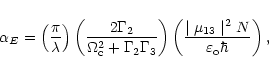
transparency are derived and tabulated. For example, the per length Efield loss
 at exact probe resonance is shown to be given by
the following formula:
at exact probe resonance is shown to be given by
the following formula:
 |
(2) |
where N is the atom density and
 is the permittivity of
free space. Equation (2) shows that perfect transparency results when
is the permittivity of
free space. Equation (2) shows that perfect transparency results when
 .
.
![\begin{figure}
\par\includegraphics[width=8.5cm,clip]{h3337f10.eps}\end{figure}](/articles/aa/full/2002/10/aah3337/Timg56.gif) |
Figure 10:
Imaginary a) and real b) parts of the linear susceptibility for a weak probe pulse of frequency  in the presence (solid lines) or absence (dashed line) of a strong coupling field tuned to the transition
of a -type, three-level atom. Normalization is to the peak value of the imaginary part of the susceptibility. After Fig. 2 of Harris et al. (1990).
in the presence (solid lines) or absence (dashed line) of a strong coupling field tuned to the transition
of a -type, three-level atom. Normalization is to the peak value of the imaginary part of the susceptibility. After Fig. 2 of Harris et al. (1990). |
| Open with DEXTER |
Figure 10b shows that the real part of the susceptibility (refractive index)
exhibits a steep slope with no inflection point at
 .
The probe pulse, when tuned exactly to resonance, thus experiences a
linear rapidly varying refractive index with very slow group velocity and
zero group-velocity dispersion. The latter feature allows resonant pulses to
propagate long distances without pulse reshaping. Harris et al. (1992) also
present formulas for the dispersive properties of a weak probe pulse
propagating in an EIT medium. For example, when the group velocity
.
The probe pulse, when tuned exactly to resonance, thus experiences a
linear rapidly varying refractive index with very slow group velocity and
zero group-velocity dispersion. The latter feature allows resonant pulses to
propagate long distances without pulse reshaping. Harris et al. (1992) also
present formulas for the dispersive properties of a weak probe pulse
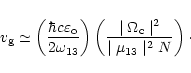
propagating in an EIT medium. For example, when the group velocity  is significantly slower than c, the velocity of light, and
,
one has:
is significantly slower than c, the velocity of light, and
,
one has:
 |
(3) |
With this result, it is possible to estimate how low a group velocity a weak
optical light pulse traveling in space could have when its propagation is
mediated by the presence of an EIT coupling beam. For simplicity, assume
that a 100 mW/cm2 continuous-wave coupling laser beam is propagating
through a tenuous (
 cm-3) gas of -type
three-level atoms. Assume the
transition has a
spontaneous emission decay rate
cm-3) gas of -type
three-level atoms. Assume the
transition has a
spontaneous emission decay rate
 s-1 and occurs at 6000 Å. Thus
 rad s-1. Assume the
transition to which the co-propagating weak probe pulse is tuned decays in a
nanosecond and occurs at 1000 Å.
rad s-1. Assume the
transition to which the co-propagating weak probe pulse is tuned decays in a
nanosecond and occurs at 1000 Å.
The maximum value of the oscillating electric field
of the coupling
laser beam is 868 V/m. To find the corresponding Rabi frequency
 ,
one needs to know the value of .
The latter is related to
,
one needs to know the value of .
The latter is related to
 via the general formula (Loudon 2000) given in Eq. (4) below.
(This formula assumes equal degeneracy of levels 2
and 3.)
via the general formula (Loudon 2000) given in Eq. (4) below.
(This formula assumes equal degeneracy of levels 2
and 3.)
 |
(4) |
From Eq. (4) and the equation discussed earlier relating
to
 and ,
one finds that
is here
and ,
one finds that
is here 
 rad s-1, corresponding to a frequency of about
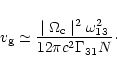
89 MHz. One can combine Eqs. (3) and (4) to give the following equation
for the group velocity of the probe pulse propagating in the EIT medium:
rad s-1, corresponding to a frequency of about
89 MHz. One can combine Eqs. (3) and (4) to give the following equation
for the group velocity of the probe pulse propagating in the EIT medium:
 |
(5) |
We thus calculate for our hypothetical case that
 m/s. This value is greater than c, which simply means that use of
Eq. (3) here is invalid because
is not significantly
less than c. The density of atoms in space is thus simply too low for slow
group velocities to result, even though the medium is made fully transparent
at the probe frequency via EIT. Note, however, that if N were 1014 cm-3,
would be 660 m/s. In a recent
laboratory experiment (Hau et al. 1999), a light speed reduction to 17 m/s
was achieved in an ultracold atomic gas. Refining the techniques used in
this experiment, two groups reported actually
"stopping'' light in the laboratory (Liu et al. 2001; Phillips et al. 2001).
m/s. This value is greater than c, which simply means that use of
Eq. (3) here is invalid because
is not significantly
less than c. The density of atoms in space is thus simply too low for slow
group velocities to result, even though the medium is made fully transparent
at the probe frequency via EIT. Note, however, that if N were 1014 cm-3,
would be 660 m/s. In a recent
laboratory experiment (Hau et al. 1999), a light speed reduction to 17 m/s
was achieved in an ultracold atomic gas. Refining the techniques used in
this experiment, two groups reported actually
"stopping'' light in the laboratory (Liu et al. 2001; Phillips et al. 2001).
We now consider the case when the intensity of the monochromatic probe beam
is no longer small compared to that of the coupling beam. It is assumed that
both beams are here still tuned to the respective line centers of
 and
.
What happens in this case is that the atoms in
the gas will quickly adjust so that there is also no absorption about the
line center of the
transition. This occurs
independently of the ratio of Rabi frequencies
and
.
What happens in this case is that the atoms in
the gas will quickly adjust so that there is also no absorption about the
line center of the
transition. This occurs
independently of the ratio of Rabi frequencies
 .
The two laser beams rapidly drive all atoms of the system into a stable
"coherently trapped population state''. In this state, the wavefunction of
all the atoms in the gas becomes an antisymmetric linear combination of the
unperturbed wavefunctions of levels 1
and 2.
In this state, no atoms are present in level 3.
Atoms
coherently trapped by this method are also commonly referred to as
"coherently phased'' atoms. One of the earliest experiments in which coherent
trapping of atomic populations was realized is described in Gray et al.
(1978). Coherent trapping can be vividly demonstrated in the laboratory as a
complete quenching of fluorescent emission from level 3when both coupling and probe beams are applied to a vapor cell, whereas when
only one or the other of the beams is applied, bright fluorescence is seen.
For this reason, the coherently trapped state is sometimes termed a "dark
state''. Once all the atoms of a gas have been coherently phased by this
method, light at the two applied laser frequencies can continue to pass over
the atoms without being attenuated. Since there is no effective dipole
interaction of either pump or probe beam with the atoms of a coherently
phased medium, no slower-than-c group velocities are here possible. Although
we have continually assumed throughout the discussion presented in this
section that coupling and probe beams are tuned exactly to
and
,
respectively, this is actually not required for the
preparation of coherently phased atoms. The frequencies of both beams can
each be detuned from the line centers of
and
,
as long as they remain in exact two-photon resonance with levels 1
and 2.
.
The two laser beams rapidly drive all atoms of the system into a stable
"coherently trapped population state''. In this state, the wavefunction of
all the atoms in the gas becomes an antisymmetric linear combination of the
unperturbed wavefunctions of levels 1
and 2.
In this state, no atoms are present in level 3.
Atoms
coherently trapped by this method are also commonly referred to as
"coherently phased'' atoms. One of the earliest experiments in which coherent
trapping of atomic populations was realized is described in Gray et al.
(1978). Coherent trapping can be vividly demonstrated in the laboratory as a
complete quenching of fluorescent emission from level 3when both coupling and probe beams are applied to a vapor cell, whereas when
only one or the other of the beams is applied, bright fluorescence is seen.
For this reason, the coherently trapped state is sometimes termed a "dark
state''. Once all the atoms of a gas have been coherently phased by this
method, light at the two applied laser frequencies can continue to pass over
the atoms without being attenuated. Since there is no effective dipole
interaction of either pump or probe beam with the atoms of a coherently
phased medium, no slower-than-c group velocities are here possible. Although
we have continually assumed throughout the discussion presented in this
section that coupling and probe beams are tuned exactly to
and
,
respectively, this is actually not required for the
preparation of coherently phased atoms. The frequencies of both beams can
each be detuned from the line centers of
and
,
as long as they remain in exact two-photon resonance with levels 1
and 2.
Although we have up to now focussed in this section on EIT and coherent
phasing of -type three-level atoms, the techniques are known to
work as well for V-type three-level atoms. (In the LWI/EIT literature, a
third variety of atomic level structure - the so-called "cascade''-type
three-level atom - is also sometimes considered. However, this does not
appear to be relevant for our space laser model and (except in Fig. 11) is
not discussed in the present paper). Figure 11 shows results from a recent
theoretical study of the effects of mismatching wavelengths for the coupling
and probe fields in Doppler-broadened media for the three atomic
configurations commonly utilized in EIT. Note that, for matched wavelength
pulses, EIT seems easiest to excite in the V-type system.
![\begin{figure}
\par\includegraphics[width=6.5cm,clip]{h3337f11.eps}\end{figure}](/articles/aa/full/2002/10/aah3337/Timg73.gif) |
Figure 11:
Absorption of a weak probe field as a function of detuning for a) the cascade, b) the ,
and c) the V-type schemes. A resonant coupling field Rabi frequency (=250 MHz) equal to half the Doppler width (=500 MHz) is assumed present. In each case, three wavelengths regimes are considered:
 (dotted line),
 (dashed line), and
 (solid line). From Boon et al. (1999).
 |
| Open with DEXTER |
In this section it has been outlined that preparation of coherently phased
atoms via co-propagation of two resonantly tuned laser beams through a
tenuous gas of three-level atoms accomplishes one major step needed to
realize an LWI in space - it removes in principle all attenuation (loss) for
the two beams as they propagate away from the stars that provide the pumping
power required for amplification of the beams. In the next section, a
specific pumping mechanism for a 2-level LWI is proposed.
It will also be shown that there exists a form of EIT for
2-level-atom gases that can provide the transparency required for lasing
without inversion in these systems.
Harris et al. (1990) were the first to show that, while EIT makes a material
system transparent to resonant laser radiation, it nonetheless allows a
large nonlinear resonant process to occur with high probability. On the
basis of this general and important finding, we now propose that one such
nonlinear resonant process, stimulated hyper-Raman scattering (SHRS), might
be a viable mechanism for pumping an LWI in symbiotic stars, thus accounting
for the superintense (1032 Å, 1038 Å) O VI doublet emission that is
seen in such space objects. At the end of this section we will briefly
speculate on what might be happening when superintense H()
emission
is seen in reddened, early-type stars.
Despite the emphasis that has thus far been placed in the present paper on
EIT occurring with three-level atoms, let us now proceed to explain how a
somewhat analogous transparency can be attained in an ideal gas of two-level atoms irradiated by an intense, narrow-band laser beam tuned
exactly to
,
the line center of the atomic transition. A
strong, fully allowed, electric dipole transition is here assumed.
Establishment of transparency in the spectral vicinity of
would seem to be a fairly obvious requirement for a 2-level-atom LWI to
operate in Space. As we will shortly see, in order for such a laser to
develop sufficient optical gain via the pumping mechanism to be proposed,
the 2-level-atom gas must also be irradiated by intense continuum radiation
from a nearby illuminating star. It is thus assumed in the model that such
radiation is present everywhere in a very broad spectral range that includes

![\begin{figure}
\par\includegraphics[width=8.8cm,clip]{h3337f12.eps}\end{figure}](/articles/aa/full/2002/10/aah3337/Timg75.gif) |
Figure 12:
a) Experimentally determined absorption-gain spectra (showing percent change of probe power) in a 2-level atomic gas (sodium) for various intensities of a continous-wave, monochromatic, resonant pump laser beam applied to the gas. Pump powers range from 0 (i) to 560 mW/cm2 (v). Vertical scale per large division ranges from 1% (i) to 0.06% (v). b) Lineshapes calculated on the basis of the absorption-gain spectrum formula given in Mollow 1972. Horizontal scale 75 MHz/div. From Wu et al. (1977). |
| Open with DEXTER |
Figure 12 shows results from a landmark experiment (Wu et al. 1977) in which
the absorption (gain) spectrum of a probe beam was measured for a gas of
two-level atoms (sodium) irradiated by an intense, monochromatic,
continuous-wave beam tuned exactly to resonance. The experimental
measurements are shown on the left. Computed spectra using the expression
for the absorption-amplification line profile calculated by Mollow (Mollow
1972) are shown to the right. It is seen that very good agreement exists
between theory and experiment. Note that as the power of the monochromatic
resonant pump beam is increased from zero, the probe absorption spectrum
takes on a distinctive three-lobed profile, with sidebands symmetrically
displaced about the central frequency
by approximately 
 ,
where
is the Rabi frequency. As the pump beam power is
increased still more, regions of gain appear between the outer absorption
sidebands. All absorption and gain features become less intense as the laser
power at
is increased. (The vertical scale in (i) is roughly
twenty times larger than in (v).) At the highest pump power level shown,
gain and absorption are seen to cancel exactly at the line center of the
transition.
,
where
is the Rabi frequency. As the pump beam power is
increased still more, regions of gain appear between the outer absorption
sidebands. All absorption and gain features become less intense as the laser
power at
is increased. (The vertical scale in (i) is roughly
twenty times larger than in (v).) At the highest pump power level shown,
gain and absorption are seen to cancel exactly at the line center of the
transition.
![\begin{figure}
\par\includegraphics[width=7cm,clip]{h3337f13.eps}\end{figure}](/articles/aa/full/2002/10/aah3337/Timg77.gif) |
Figure 13:
a) and b) Diagrams showing the unit simultaneous three-photon processes involved in resonant SHRS pumping of two-level LWI's. The energy levels of a two-level atom are split as shown in the presence of a monochromatic field at
.
is the Rabi frequency. |
| Open with DEXTER |
The spectra in Fig. 12 are usually explained in terms of the irradiated
atom energy level diagram shown in Figs. 13a and 13b. When a monochromatic
pump beam is applied exactly on resonance, the energy levels of a two-level
atom are split as shown by the ac Stark effect (Autler & Townes 1955).
This leads to new resonance frequencies which can enhance various nonlinear
processes, such as the simultaneous three-photon transitions indicated in
the figure. Linear absorption processes occurring at the three allowed
transition frequencies in Figs. 13a and 13b can
approximately account for
the three-lobed absorption spectrum appearing at lower power levels of the
monochromatic pump. As the pump power level is increased, both saturation
(i.e. the tendency for the upper and lower electronic states to become
equally populated at high pump powers) and quantum interference effects play
important roles in determining the spectral shapes seen in Fig. 12.
Saturation is largely responsible for the general decrease in intensity of
all spectral features observed as the laser power at
is
increased. Quantum interference accounts for the detailed spectral shapes
and determines exactly which spectral regions show gain and which show loss.
Without separating the exact contributions of each of these effects to the
overall absorption-gain spectra shown in Fig. 12, one nonetheless can
clearly see that application of an intense monochromatic resonant pump beam
to a gas of 2-level atoms can by itself create the transparency conditions
that would be needed in a space laser that operates at the same frequency.
If a separate pumping mechanism could be found that would create photons at
,
one would then have the basis for an LWI that potentially
could operate on a single allowed transition.
Consider first a situation in which there is only modest power at
present, so that the atom transition is not heavily saturated. In
such a situation, it is reasonable to speculate that the resonant
three-photon transitions depicted in Figs. 13a and 13b could satisfactorily
serve to pump a 2-level-atom LWI. In the unit process for such
transitions, two photons having frequencies that are both symmetrically
disposed about
and that fall within the outer absorption
sideband profiles are simultaneously absorbed from the intense continuum
irradiating the gas, a photon at
is created, and an atom is
excited into the upper electronic state - with all four events occurring
simultaneously. This nonlinear process is known as stimulated hyper-Raman
scattering (SHRS). The SHRS transition probability per unit time is
proportional both to the square of the continuum flux contained within the
spectral width of the outer absorption sidebands, and to the total flux of
the narrow-band laser beam itself. In a normal laser, a beam becomes
amplified as it passes through a medium in which a population inversion
exists. The production rate of new photons (i.e. the stimulated emission
rate) is at any time proportional to the intensity present in the beam. With
the SHRS pumping mechanism proposed here, the production rate of new photons
is also proportional to the intensity of the beam being amplified, but no
population inversion is involved. The resonant SHRS mechanism just
described could only work for low intensities of the beam at
,
since it requires that the population in the two upper Stark-split
levels of Fig. 13 be less than that in the two lower Stark-split levels.
It will be shown below that there is another resonant nonlinear process,
four-wave mixing (FWM), that becomes the dominant gain-producing mechanism
when the intensity of the beam being amplified (i.e. the beam at
)
becomes high.
The SHRS pumping process described above is fully resonant. Nonetheless, it
is a nonlinear process. Nonlinear optical processes are practically unknown
in astronomy. One should therefore now examine whether there is enough FUV
continuum light in symbiotic stars to pump an LWI of the type here being
considered, and whether such lasers can explain the superintense O VI (1032 Å, 1038 Å) doublet emissions that are observed. One can estimate how
much a monochromatic beam at
would become amplified via SHRS
in this space laser model by using the formula for the SHRS gain coefficient
given as Eq. (5.22) in Hanna et al. (1979). This formula gives
 the intensity gain per unit length experienced by the monochromatic beam at
,
when a total pumping intensity
the intensity gain per unit length experienced by the monochromatic beam at
,
when a total pumping intensity  is applied at each of
the Mollow absorption sidebands. The quantity
is applied at each of
the Mollow absorption sidebands. The quantity
 determines the
amount of intensity amplification the beam receives exponentially, i.e.
determines the
amount of intensity amplification the beam receives exponentially, i.e.
 ,
where
,
where  is the distance traveled by the
light from
is the distance traveled by the
light from  .
.
For simplicity, it is here assumed that the same transition dipole matrix
element value  holds for each of the allowed transitions in Figs. 13a and 13b. All energy differences appearing in the denominator of Eq. (5.22) in Hanna et al. (1979) are replaced by ,
since all three
participating waves are resonant. The SHRS gain thus becomes simply:
holds for each of the allowed transitions in Figs. 13a and 13b. All energy differences appearing in the denominator of Eq. (5.22) in Hanna et al. (1979) are replaced by ,
since all three
participating waves are resonant. The SHRS gain thus becomes simply:
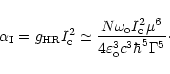 |
(6) |
Utilizing Eq. (4), one then has:
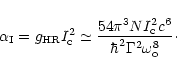 |
(7) |
To get an idea of the gain coefficient magnitude, we initially assume a
two-level atom transition at 1000 Å, a value of
equal to
 rad s-1, a space atom density of 104 cm-3, and a
continuum pump power of 1W/cm2 in each of the two, 160-MHz-wide, Mollow absorption sidebands. With these values substituted in
Eq. (7), one finds the intensity gain coefficient of the beam at
to be
rad s-1, a space atom density of 104 cm-3, and a
continuum pump power of 1W/cm2 in each of the two, 160-MHz-wide, Mollow absorption sidebands. With these values substituted in
Eq. (7), one finds the intensity gain coefficient of the beam at
to be
 /m.
/m.
To place this estimate of
in the context of a typical
symbiotic star environment, one must turn to measurements and estimates of
the latter that have been made. For RW Hydrae, these were shown in Fig. 4.
One presumes that the symbiotic star LWI is positioned close to the hot star
surface. The light coherently generated by the LWI should radiate radially
away from the white dwarf, perhaps preferentially towards the red giant,
since it is material from the latter that accretes onto the hot white dwarf
and causes it to be heated still more. Assuming the value of the hot star
temperature (180000 K) estimated in Schild et al. (1996), one calculates from the blackbody
photon distribution law (Allen 1976) that at 1000 Å, the blackbody
continuum power emanating from the white dwarf surface is roughly 16.4 W/cm2 in a 160 MHz bandwidth. This implies that the
value for
an LWI in a typical symbiotic star environment would be about
 /m. With this value, one calculates that the beam at
would
theoretically be amplified 1097 times in radially propagating
away from the hot star surface a distance
/m. With this value, one calculates that the beam at
would
theoretically be amplified 1097 times in radially propagating
away from the hot star surface a distance
 equal to the hot star radius. Thus, at least for low power levels of the
narrow-band beam being amplified, the SHRS mechanism appears to provide
enough optical gain for a symbiotic star LWI to operate.
equal to the hot star radius. Thus, at least for low power levels of the
narrow-band beam being amplified, the SHRS mechanism appears to provide
enough optical gain for a symbiotic star LWI to operate.
![\begin{figure}
\includegraphics[width=8cm,clip]{h3337f14.eps}\end{figure}](/articles/aa/full/2002/10/aah3337/Timg91.gif) |
Figure 14:
Two-level-atom absorption spectrum as a function of probe detuning for a resonant monochromatic pump having a Rabi frequency .
T2 is twice the radiative decay time. From Fig. 2 of Boyd et al. (1981). |
| Open with DEXTER |
For a given value of beam power, the two outer Mollow absorption bands are
separated by twice the Rabi frequency, and one would expect that all
continuum starlight overlapping these bands would be converted by SHRS
into light in the beam at
.
Within the 160 MHz spectral
width of these bands, the continuum power radiated at the surface of the hot
star in RW Hydrae is evidently something like 16.4 W/cm2. As the power
in the beam at
increases, the two Mollow absorption sidebands
symmetrically move outwards, allowing continuum power in different spectral
ranges to be converted into photons at
.
This behavior of the
Mollow bands is illustrated in the calculations shown in Fig. 14. One
also again can see from this figure how rapidly the average strength of the
absorption-gain features in the linear probe spectrum decreases with
increasing power of the beam at
- the result of saturation, as
was indicated earlier. Saturation would also similarly prevent the
above-postulated SHRS pumping process from occurring at high
-beam intensities, and this now points to the possible existence of a severe
logical inconsistency in our space laser model via the following argument
(A. Kutyrev, private communication). Assume in Fig. 14 that
T1=10-9 s. Then, for the (
 )
curve shown, the Rabi
frequency is about 0.27 cm-1. Assuming that this curve corresponds
approximately to the limit on the SHRS pumping process imposed by
saturation, one can say that the maximum power that could be generated in
the beam at
near the surface of the hot white dwarf in a
symbiotic star would be about 1.6 kW cm-2. Next, consider any of the
spectra shown in Figs. 6-8. These spectra
were obtained with an instrument
(the Berkeley spectrometer) for which the spectral resolution was 3000. Consequently, each detector element (i.e. "bin'') tallied all incident
photons with frequencies falling within the 33 cm-1-wide spectral
range monitored by the bin. For all bins, the incident photons included
those representing light from the star's blackbody continuum. For one or
possibly two of the bins, photons from the symbiotic star space laser beam at
would also have been included. However, whereas the star's
continuum power recorded in any bin near 1000 Å would have been about 101.5 kW cm-2, the upper limit of the power in the beam at
was
estimated above to be 1.6 kW cm-2. Under such circumstances, it would
thus be impossible to observe intense O VI FUV doublet emission lines from
symbiotic stars.
)
curve shown, the Rabi
frequency is about 0.27 cm-1. Assuming that this curve corresponds
approximately to the limit on the SHRS pumping process imposed by
saturation, one can say that the maximum power that could be generated in
the beam at
near the surface of the hot white dwarf in a
symbiotic star would be about 1.6 kW cm-2. Next, consider any of the
spectra shown in Figs. 6-8. These spectra
were obtained with an instrument
(the Berkeley spectrometer) for which the spectral resolution was 3000. Consequently, each detector element (i.e. "bin'') tallied all incident
photons with frequencies falling within the 33 cm-1-wide spectral
range monitored by the bin. For all bins, the incident photons included
those representing light from the star's blackbody continuum. For one or
possibly two of the bins, photons from the symbiotic star space laser beam at
would also have been included. However, whereas the star's
continuum power recorded in any bin near 1000 Å would have been about 101.5 kW cm-2, the upper limit of the power in the beam at
was
estimated above to be 1.6 kW cm-2. Under such circumstances, it would
thus be impossible to observe intense O VI FUV doublet emission lines from
symbiotic stars.
![\begin{figure}
\par\includegraphics[width=4cm,clip]{h3337f15.eps}\end{figure}](/articles/aa/full/2002/10/aah3337/Timg93.gif) |
Figure 15:
Resonant four-wave mixing (FWM) process that creates photons at
at high values of
 . . |
| Open with DEXTER |
The above difficulty is resolved if it can be shown that there is a new
pumping mechanism which becomes effective when the Rabi frequency of the
beam at
becomes very high, and that the new mechanism is
capable of converting continuum starlight spanning a very wide frequency
range into light at
.
The new mechanism here proposed is the
resonant four-wave mixing (FWM) process diagrammed in Fig. 15. Since this
mechanism is a multi-photon parametric process (i.e. it begins and ends on
the same level), it is not as strongly diminished in intensity as SHRS when saturation occurs.
Thus, it still remains effective in converting continuum light from the star into
light in the beam at
,
even at very high intensities of the
latter. If, for example, the FWM LWI pumping mechanism in a symbiotic star
were capable of converting continuum starlight over a range
 cm-1 into monochromatic light at
,
the Berkeley spectrometer
aboard the ORFEUS missions would have recorded symbiotic star O VI
emission lines rising 90 times above the star's continuum background,
resulting in recorded spectra not totally dissimilar to those shown in Figs. 6-8. In this case, the power in the symbiotic star space laser beam near the
surface of the hot white dwarf would be more than 9 MW cm-2. Thus, the
FWM process potentially can capture symbiotic star continuum light over an
enormous spectral range and turn it into narrow-band, coherent, laser light.
cm-1 into monochromatic light at
,
the Berkeley spectrometer
aboard the ORFEUS missions would have recorded symbiotic star O VI
emission lines rising 90 times above the star's continuum background,
resulting in recorded spectra not totally dissimilar to those shown in Figs. 6-8. In this case, the power in the symbiotic star space laser beam near the
surface of the hot white dwarf would be more than 9 MW cm-2. Thus, the
FWM process potentially can capture symbiotic star continuum light over an
enormous spectral range and turn it into narrow-band, coherent, laser light.
However, there is an essential feature that the proposed FWM pumping process
must possess in order to be considered a viable mechanism. There exists a
directly competitive FWM process that results in loss of photons at
.
This competitive process is the one obtained by reversing the
directions of all arrows in the multi-photon scheme shown in Fig. 15. Since the maximum absolute values of the nonlinear
cross-sections for both processes should be the same, it would seem that, on
the average, photons at
would be neither gained nor lost. One
is thus required to make an additional assumption regarding these two FWM
processes. It is therefore here conjectured that if one were to compute a
set of parameterized curves (the beam intensity at
being the
parameter) plotting the nonlinear cross-section for gain at
(positive values indicating that photons at
are added;
negative values indicating that photons are lost) as a function of frequency
offset
 ,
with monochromatic light of
intensity
being assumed present at both
,
with monochromatic light of
intensity
being assumed present at both
 ,
the
two outer portions of each curve would appear much as in Fig. 14c, that
is, with positive values occurring at the largest frequency offsets from
.
Such a feature being present would always allow the FWM
process that creates photons at
to deplete entirely the
continuum photon density in any spectral range before the competing FWM
process is able to interact with it. In the Appendix, arguments are presented to show
why we believe the above conjecture to be true.
,
the
two outer portions of each curve would appear much as in Fig. 14c, that
is, with positive values occurring at the largest frequency offsets from
.
Such a feature being present would always allow the FWM
process that creates photons at
to deplete entirely the
continuum photon density in any spectral range before the competing FWM
process is able to interact with it. In the Appendix, arguments are presented to show
why we believe the above conjecture to be true.
We now consider here briefly what might be happening when superintense H()
emission is seen in reddened, early-type stars. While the
environments of symbiotic stars are well characterized, not much information
exists about the environments of stars emitting superintense H()
radiation. Nonetheless, we outline for consideration a possible model for
this emission by stating, and then briefly discussing, the two most
essential features of this model. (1) Superintense H()
emission
results from 2-level lasing without inversion on the H()
transition. Two-level, rather than 3-level, lasing without inversion must be
presumed, because we know of no evidence showing Ly-
emission in
such stars. (2) The necessary H-atom population in the 2s level is achieved
via linear spontaneous resonance Raman scattering of light around Ly-,
as discussed in Sect. 2. It is presumed that a relatively dense cloud
containing H atoms (and dust) engulfs the star without there being a
significant H II region present. Significant population in the 2s level
results from the spontaneous Raman scattering rate of H atoms close to the
star being comparable to
.
When a star's continuum light near 6600 Å is not enough to pump an H()
LWI, one sees H()
in absorption, as in Fig. 1a.
While the continuum flux at 6600 Å near the surface of an H()
star will be much less than
that emitted near 1000 Å at the surface of the hot white dwarf in a
symbiotic star, a factor more than 3 million is gained in the value for
,
due to the quantity
 appearing in the
denominator of Eq. (7).
appearing in the
denominator of Eq. (7).
It has here been proposed and argued that the superintense, narrow-band,
(1032 Å, 1038 Å) O VI emission lines, which dominate the far-UV spectra
of symbiotic stars, result from two-level lasing without inversion occurring
in a gas of O VI ions located close to the surface of the hot white dwarf
star in such space objects. The narrow-band stimulated emission light that
is generated originates at the hot star surface, and then propagates
radially outward from this surface in roughly spherical fashion, rapidly
increasing in intensity as continuum light from the hot star becomes
converted into narrow-band laser light by two nonlinear pumping mechanisms,
stimulated hyper-Raman scattering (SHRS) and four-wave mixing (FWM). Closest
to the star surface, where the narrow-band laser intensity initially starts
to grow, SHRS is the dominant pumping mechanism. At greater distances from
the star surface, where the laser power has greatly increased, FWM becomes
the most important process. The FWM pumping mechanism in symbiotic stars
appears to be a very efficient one, mainly because it sweeps into resonance
with all spectral regions of the hot star's continuum light before a
competing FWM process - one which would destroy photons at
- can do
so. Via the FWM pumping mechanism, broadband continuum light from the hot
star, contained within a spectral range extending symmetrically for perhaps a
thousand or so wavenumbers on either side of the resonance, becomes entirely
converted into narrow-band laser light. For typical symbiotic stars, the
intensity of the narrow-band laser light in the vicinity of the hot star
surface could easily attain values as high as 10 MW/cm2. Although the
astrophysical environments of reddened, early-type stars are not as well
known as those of symbiotic stars, it is suggested that when superintense H()
emission is seen in space objects of the former type, it too is
the result of two-level-atom LWI.
Acknowledgements
We are grateful to the reviewer of the original manuscript we submitted on
this subject for the suggestion that we quantify the main ideas that were
proposed in that submission. We have especially benefited from discussions
with D. J. Gauthier, B. D. Guenther, and J. E. Thomas of Duke University, and
with A. Kutyrev, M. M. Freund, and T. R. Gull of the NASA GSFC.
In this Appendix, evidence is presented to support the speculation made in
Sect. 5 that, at high powers of the beam at
,
the maximum
cross-sections for the FWM process shown in Fig. 15 occur at frequencies
symmetrically offset from
by larger amounts than the
frequencies at which the competitive FWM process maximizes. This evidence is
based upon formulae contained in Boyd et al. (1981). These authors analyze
four-wave parametric processes in strongly driven two-level systems,
following an approach that is based upon density matrix techniques.
(For ease in making numerical estimates based upon the formulae in
Boyd et al. (1981), the Gaussian system of units employed by these authors
is here utilized.)
In Sect. III of Boyd et al. (1981), the spatial propagation of two waves (at
frequencies
 ,
,
 )
copropagating with an intense wave at
is studied. The waves
at
,
)
copropagating with an intense wave at
is studied. The waves
at
,
 are assumed to be of weak intensity, while
the intensity of the wave at
can be arbitrarily large. The
form of the coupling assumed between the weak fields is expressed by writing
the polarization amplitudes in terms of the susceptibilities as:
are assumed to be of weak intensity, while
the intensity of the wave at
can be arbitrarily large. The
form of the coupling assumed between the weak fields is expressed by writing
the polarization amplitudes in terms of the susceptibilities as:
 |
|
|
(A.1) |
 |
|
|
(A.2) |
with the susceptibility elements being related to the elements of the
density matrix by Eqs. (20a-d) of Boyd et al. (1981).
The above polarization amplitudes are then used as the source terms in the
Helmholtz equations for the amplitudes of the waves at
and
.
Under the slowly varying envelope approximation, and for zero
propagation vector mismatch (
 ), the Helmholtz equations become:
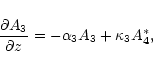 |
(A.3) |
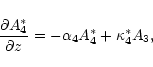 |
(A.4) |
where the coupling constants are given in terms of
 ,
,
 by Eqs. (24a-d) of Boyd et al. (1981).
The coupled amplitude Eqs. (A.3) and (A.4) can be solved for arbitrary
initial values A30 and A40 of the field amplitudes A3(z)and A4(z) at the boundary of the nonlinear medium. Each of the
solutions for the amplitudes A3 and
 (given in Eqs. (25a,b) of Boyd et al. 1981) consists of two terms having exponential zdependence, with gain coefficients
  given by:
![\begin{displaymath}g_{\pm }=\pm \frac{1}{2}\Big[(\alpha _{3}-\alpha _{4})^{2}+4\...
...ast }\Big]^{\frac{1}{2}}-\frac{1}{2}(\alpha _{3}+\alpha _{4}).
\end{displaymath}](/articles/aa/full/2002/10/aah3337/img110.gif) |
(A.5) |
Although Eq. (A.5) assumes a very complicated form when the coupling
constants are written generally in terms of the off-diagonal density-matrix
elements
 (the latter given in Eqs. (5a)-(6), and (7) of
Boyd et al. 1981), the situation becomes greatly simplified when the Rabi
frequency
is much greater than
T2-1, and when one assumes
that
,
are both located spectrally close to
(the latter given in Eqs. (5a)-(6), and (7) of
Boyd et al. 1981), the situation becomes greatly simplified when the Rabi
frequency
is much greater than
T2-1, and when one assumes
that
,
are both located spectrally close to
 .
For simplicity, we also here assume a
collisionless medium, so that
T2=2T1. One then finds, for example,
that:
.
For simplicity, we also here assume a
collisionless medium, so that
T2=2T1. One then finds, for example,
that:
![\begin{displaymath}\rho _{\rm ba}(\omega _{3})\approx \frac{i\mu _{\rm ba}E_{3}(...
...m aa}-\rho
_{\rm bb})^{0}}{\hbar T_{2}[\nu ^{2}-\Omega ^{2}]},
\end{displaymath}](/articles/aa/full/2002/10/aah3337/img113.gif) |
(A.6) |
![\begin{displaymath}\rho _{\rm ba}(2\omega _{\rm o}-\omega _{3})\approx \frac{-i\...
...m aa}-\rho _{\rm bb})^{0}}{\hbar T_{2}[\nu ^{2}-\Omega ^{2}]},
\end{displaymath}](/articles/aa/full/2002/10/aah3337/img114.gif) |
(A.7) |
where
 .
From the above equations,
and Eqs. (20a), (20c), (24a), and (24c) of Boyd et al. (1981), one finds that
.
From the above equations,
and Eqs. (20a), (20c), (24a), and (24c) of Boyd et al. (1981), one finds that
 .
From an equivalent set of equations, one
sees that
.
From an equivalent set of equations, one
sees that
 .
From Eq. (A.5), one therefore
deduces that
.
From Eq. (A.5), one therefore
deduces that
 and that g
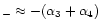 .
Thus, when
and
are in the vicinity of
.
Thus, when
and
are in the vicinity of
 ,
both waves
grow exponentially with an intensity gain coefficient equal to:
,
both waves
grow exponentially with an intensity gain coefficient equal to:
![\begin{displaymath}2g_{-}\approx -\frac{8\pi N\omega _{\rm o}\mid \mu _{\rm ab}\...
...-\rho _{\rm bb})^{0}}{c\hbar T_{2}[\nu ^{2}-\Omega ^{2}]}\cdot
\end{displaymath}](/articles/aa/full/2002/10/aah3337/img121.gif) |
(A.8) |
From Eq. (A.8), one sees that positive gain exists for the FWM process that
is competitive to the one shown in Fig. 15 only when
 .
Only the FWM process of Fig. 15 occurs when
.
Only the FWM process of Fig. 15 occurs when
 .
For large
values, the rate at which
photons are added to the beam at
via conversion of continuum
photons in the two spectral intervals of width
.
For large
values, the rate at which
photons are added to the beam at
via conversion of continuum
photons in the two spectral intervals of width
 ,
spectrally centered at
,
is given by:
,
spectrally centered at
,
is given by:
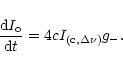 |
(A.9) |
The expression in Eq. (A.9) has to be integrated over all values of  greater than .
The total rate of power transfer from the hot star continuum to the beam
at
is thus approximately:
greater than .
The total rate of power transfer from the hot star continuum to the beam
at
is thus approximately:
 |
|
|
(A.10) |
Since the integral in Eq. (A.10) equals
 the FWM power transfer rate
is seen to fall off somewhat less rapidly than
the FWM power transfer rate
is seen to fall off somewhat less rapidly than
 .
.
One can start to apply Eq. (A.10)
to O VI emission in symbiotic stars with substitution of the following
values:
N = 104 cm-3,
 rad s-1,
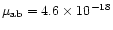 esu, and
 s. At a Rabi frequency of one wavenumber
(i.e.
s. At a Rabi frequency of one wavenumber
(i.e.
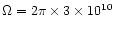 rad s-1), one finds
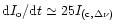 .
From Sect. 5, the estimate for
.
From Sect. 5, the estimate for
 was
about 3 kW/cm2 in a spectral bandwidth of one wavenumber. Thus, at a Rabi
frequency of one wavenumber, the power in the beam at
is
calculated to increase only at a rate 75 kW cm-2 s-1.
Since, in one second, the beam would have traveled a distance roughly equal
to ten times the radius of the hot white dwarf, this rate of power transfer
from the continuum to the beam at
is at least two orders of
magnitude lower than what has been assumed throughout the present paper. The
transfer rate calculated from Eq. (A.10)
would roughly equal the number earlier assumed if the O VI ion density near
the hot white dwarf were 106 cm-3.
was
about 3 kW/cm2 in a spectral bandwidth of one wavenumber. Thus, at a Rabi
frequency of one wavenumber, the power in the beam at
is
calculated to increase only at a rate 75 kW cm-2 s-1.
Since, in one second, the beam would have traveled a distance roughly equal
to ten times the radius of the hot white dwarf, this rate of power transfer
from the continuum to the beam at
is at least two orders of
magnitude lower than what has been assumed throughout the present paper. The
transfer rate calculated from Eq. (A.10)
would roughly equal the number earlier assumed if the O VI ion density near
the hot white dwarf were 106 cm-3.
-
Allen, C. W. 1976, Astrophysical Quantities, 3rd ed. (Athlone Press, London
and Dover, New Hampshire)
In the text
-
Autler, S. H., & Townes, C. H. 1955, Phys. Rev., 100, 703
In the text
NASA ADS
-
Boon, J. R., Zekou, E., McGloin, D., et al. 1999, Phys. Rev. A, 59, 4675
In the text
NASA ADS
-
Boyd, R. W., Raymer, M. G., Narum, P., et al. 1981, Phys. Rev. A, 24, 411
In the text
NASA ADS
-
Cohen, M., Anderson, C. M., Cowley, A., et al. 1975, ApJ, 196, 179
In the text
NASA ADS
-
Gray, H. R., Whitley, R. M., & Stroud, C. R. 1978, Opt. Lett., 3, 218
In the text
-
Hanna, D. C., Yuratich, M. A., & Cotter, D. 1979, Nonlinear Optics of Free Atoms
and Molecules (Springer-Verlag, Berlin, Heidelberg, and New York)
In the text
-
Harris, S. E., Field, J. E., & Imamoglu, A. 1990, Phys. Rev. Lett., 64, 1107
In the text
NASA ADS
-
Harris, S. E., Field, J. E., & Kasapi, A. 1992, Phys. Rev. A, 46, R29
In the text
-
Hau, L. V., Harris, S. E., Dutton, Z., et al. 1999, Nature, 397, 594
In the text
-
Kasapi, A., Jain Maneesh, Yin, G. Y., et al. 1995, Phys. Rev. Lett., 74, 2447
In the text
NASA ADS
-
Liu, C., Dutton, Z., Behroozi, C. H., et al. 2001, Nature, 409, 490
In the text
NASA ADS
-
Loudon, R. 2000, The Quantum Theory of Light, 3rd ed. (Oxford Univ. Press, Oxford)
In the text
-
Mollow, B. R. 1969, Phys. Rev., 188, 1969
In the text
NASA ADS
-
Mollow, B. R. 1972, Phys. Rev. A, 5, 2217
In the text
NASA ADS
-
Phillips, D. F., Fleischauer, A., Mair, A., et al. 2001, Phys. Rev. Lett., 86, 783
In the text
NASA ADS
-
Rawlings, M. G., Adamson, A. J., & Whittet, D. C. B. 2000, ApJS, 131, 531
In the text
NASA ADS
-
Schild, H., Mürset, U., & Schmutz, W. 1996, A&A, 306, 477
In the text
NASA ADS
-
Schmid, H. M. 1989, A&A, 211, L31
In the text
NASA ADS
-
Schmid, H. M., Krautter, J., Appenzellar, I., et al. 1999, A&A, 348, 950
In the text
NASA ADS
-
Stephenson, C. B. 1992, AJ, 103, 263
In the text
NASA ADS
-
Weisskopf, V. 1931, Ann. Phys. Leipzig, 9, 23
In the text
-
Wu, F. Y., Ezekiel, S., Ducloy, M., et al. 1977, Phys. Rev. Lett., 38, 1077
In the text
NASA ADS
Copyright ESO 2002
 )
emissions in reddened early-type stars
)
emissions in reddened early-type stars![\begin{figure}
\includegraphics[width=17cm,clip]{h3337f1.eps}\end{figure}](/articles/aa/full/2002/10/aah3337/img16.gif)
![\begin{figure}
\includegraphics[width=8.8cm,clip]{h3337f2.eps}\end{figure}](/articles/aa/full/2002/10/aah3337/img17.gif)
![\begin{figure}
\par\includegraphics[width=7cm,clip]{h3337f3.eps}\end{figure}](/articles/aa/full/2002/10/aah3337/img20.gif)
![\begin{figure}
\includegraphics[width=8.8cm,clip]{h3337f4.eps}\end{figure}](/articles/aa/full/2002/10/aah3337/img34.gif)
![\begin{figure}
\includegraphics[width=6.2cm,clip]{h3337f5.eps}\end{figure}](/articles/aa/full/2002/10/aah3337/img35.gif)
![\begin{figure}
\par\includegraphics[width=8.6cm,clip]{h3337f6.eps}\end{figure}](/articles/aa/full/2002/10/aah3337/img36.gif)
![\begin{figure}
\par\includegraphics[width=8.5cm,clip]{h3337f7.eps}\end{figure}](/articles/aa/full/2002/10/aah3337/img37.gif)
![\begin{figure}
\par\includegraphics[width=8.5cm,clip]{h3337f8.eps}\end{figure}](/articles/aa/full/2002/10/aah3337/img38.gif)
![\begin{figure}
\includegraphics[width=8.5cm,clip]{h3337f9.eps}\end{figure}](/articles/aa/full/2002/10/aah3337/img39.gif)
![\begin{figure}
\par\includegraphics[width=8.5cm,clip]{h3337f10.eps}\end{figure}](/articles/aa/full/2002/10/aah3337/img56.gif)
![\begin{figure}
\par\includegraphics[width=6.5cm,clip]{h3337f11.eps}\end{figure}](/articles/aa/full/2002/10/aah3337/img73.gif)
![\begin{figure}
\par\includegraphics[width=8.8cm,clip]{h3337f12.eps}\end{figure}](/articles/aa/full/2002/10/aah3337/img75.gif)
![\begin{figure}
\par\includegraphics[width=7cm,clip]{h3337f13.eps}\end{figure}](/articles/aa/full/2002/10/aah3337/img77.gif)
![\begin{figure}
\includegraphics[width=8cm,clip]{h3337f14.eps}\end{figure}](/articles/aa/full/2002/10/aah3337/img91.gif)
![\begin{figure}
\par\includegraphics[width=4cm,clip]{h3337f15.eps}\end{figure}](/articles/aa/full/2002/10/aah3337/img93.gif)