 |
(1) |
A&A 383, 574-579 (2002)
DOI: 10.1051/0004-6361:20011744
Y. Osaki 1 - F. Meyer 2
1 - Faculty of Education, Nagasaki University, Nagasaki
852-8521, Japan
2 -
Max-Planck-Institut für Astrophysik, Karl Schwarzschild Str. 1,
85740 Garching, Germany
Received 7 November 2001 / Accepted 6 December 2001
Abstract
Photometric humps in outburst that are locked with the binary orbital
period have been
observed exclusively in the early phase of outbursts of WZ Sge stars.
It is suggested that this "early hump'' phenomenon is the
manifestation of the tidal 2:1 resonance in accretion disks of
binary systems with extremely low mass ratios. The "early humps'' can
be understood by the two-armed spiral pattern of tidal dissipation
generated by the 2:1 resonance, first discussed by Lin & Papaloizou
(1979). The tidal removal of angular momentum from the disk during
outbursts of dwarf novae, an important feature, is discussed in the
context of the disk instability model. The
ordering of tidal truncation radius, the 3:1 and 2:1 resonance
radius in systems of different mass ratio naturally leads to a
classification of dwarf nova systems in three groups according
to their mass ratio. The WZ Sge stars are those systems which
have the lowest mass ratios and are therefore characterized by "early humps''.
Key words: accretion disks - cataclysmic variables - stars: dwarf novae - stars individual: WZ Sge
Different from these is another type of photometric humps recently recognized as "early humps'' observed in the first about ten days of the outbursts in WZ Sge stars. These humps repeat with the binary orbital period but they only appear in the early phase of outburst in WZ Sge-type dwarf novae exclusively and they are replaced by the ordinary "superhumps'' in the later phase of the outburst. The "early hump'' phenomenon was first discovered in the 1978 outburst of WZ Sge itself by Patterson et al. (1981) and has been observed consequently in other WZ Sge systems: the 1995 outburst of AL Com (Kato et al. 1996; Patterson et al. 1996); the 1992 outburst of HV Vir (Leibowitz et al. 1994) and the 1996 outburst of EG Cnc (Matsumoto 1998). These "early humps'' have either been called "outburst orbital humps'' by Patterson et al. (1996) or "early superhumps'' by Kato et al. (1996). The different designation reflects a different interpretation of the phenomenon: Patterson et al. (1981, 1996) favor a "super-hot spot'' interpretation in which early humps are due to a brightened hot spot which in turn is due to an enhanced mass transfer from the secondary star during outburst (Patterson et al. 1981), while Kato et al. (1996) favor an "early superhump'' interpretation in which early humps are a premature form of the true superhumps. Here we call these humps simply "early humps'' to avoid any particular interpretation.
In July 2001 WZ Sge (the proto-type of its group) underwent an unexpected full-scale outburst, 10 years earlier than expected with its former 33 years recurrence period. The star was caught on the rising branch of its outburst light curve. It was extensively observed by professional and amateur astronomers. Beautiful light curves showing "early humps'' with an initial amplitude reaching 0.5 mag and then decreasing a few tenths were observed (VSNET 2001: http://www.kyoto-u.ac.jp/vsnet/DNe/wzsge01.html).
In this investigation we first suggest that the early humps exclusively observed in the early phase of outbursts in WZ Sge stars are most likely a manifestation of the 2:1 resonance in the accretion disk in these systems with extremely low mass ratios (Sect. 2). The amplitude of the early humps in the light curve is discussed in Sect. 3. In Sect. 4 we then present a general discussion of angular momentum removal from the accretion disk during outbursts of dwarf novae based on the disk instability model. This leads (Sect. 5) to a new subdivision in the dwarf novae unification model of Osaki (1996) which allows to distinguish between ordinary SU UMa stars and WZ Sge stars as those with the lowest mass ratios exhibiting "early humps'' and "echo outbursts''.
One of peculiarities of WZ Sge stars is the rather late appearance of the superhumps. In the 1987 outburst of WZ Sge, the regular superhumps first appeared ten days after the start of the outburst, while in ordinary SU UMa stars they usually develop within only a few days. The late development of superhumps in WZ Sge stars can be understood by the low growth rate of the eccentric tidal instability in these systems. Lubow (1991) showed analytically that the eccentricity growth rate is proportional to the square of the binary mass ratio q, if other conditions are kept the same. This very slow growth in the case of extremely low mass ratio systems is also confirmed by numerical simulations (Hirose & Osaki 1990; Whitehurst 1994).
If in WZ Sge stars the eccentric disk is not yet well developed in the early phase when the major outburst has already started, the disk must expand well beyond the 3:1 resonance radius because nothing removes the angular momentum (released by the accreting matter). As demonstrated below, in binary systems with the extremely low mass ratio of WZ Sge stars, the disk would expand well beyond another resonance radius, the 2:1 resonance radius. In such a case the 2:1 resonance acts to truncate the disk. The 2:1 resonance is a very strong resonance as the periodic tidal force acting upon the disk resonates with the two-armed (m=2) wave pattern in the Keplerian disk, i.e., the inner Lindblad resonance.
In fact, more than twenty years ago, Lin & Papaloizou (1979) showed that the accretion disk in binary systems with extremely low mass ratio is truncated at the 2:1 resonance radius and that near the resonance, a strong two-armed dissipation pattern forms. We here suggest that the tidal effect due to the 2:1 resonance is responsible for the "early humps'' observed in WZ Sge stars.
The two-armed dissipation pattern produced by the 2:1 resonance was shown in Fig. 3a in Lin & Papaloizou (1979). From this figure we can find that the strongest dissipation appears around 0.7 in the binary orbital phase while the second peak appears around 0.2 where phase zero is defined at the conjuction of the secondary star in front of the primary white-dwarf, i.e., the eclipse center. This is in good agreement with the observed phases of the double humps in the 2001 WZ Sge outburst. On the other hand, in the super-hot spot model proposed by Patterson et al. (1981), the spot in outburst would have to be displaced by 60 degrees to the downstream direction from its position at quiescence, a rather unlikely possibility. The double-hump nature of the early humps also is difficult to explain by the hot spot model. The interpretation of early humps as a premature form of superhumps is clearly ruled out because early humps are repeated with the binary orbital period and not with the ordinary superhump period which is always longer than the orbital period by about one percent (or a few percent in the case of ordinary SU UMa stars) and because the amplitudes of the early humps were found to be larger than that of the ordinary superhumps in the 2001 WZ Sge outburst. Furthermore, as to the two other interpretations of the early humps, i.e., the super-hot spot model and the early superhump model, it has remained to be demonstrated why the early humps appear exclusively in those systems with extreme mass ratios.
In the 2001 outburst of WZ Sge, large-amplitude periodic humps were observed near the maximum with an initial amplitude of 0.5 mag but then settling to an amplitude of a few tenths of a magnitude. Basically the same phenomenon was observed in the 1995 outburst of AL Com but with a much lower amplitude. We interpret this phenomenon as a two-step process, an initial transient adjustment stage of the disk and a more or less quasi-steady state in the later stage.
We first discuss the initial transient stage. Let us consider
what would happen if the quiescent disk suddenly turns to a fully viscous
state.
In our picture of WZ Sge stars, the viscosity in the quiescent disk is
extremely
low. In the extreme case, material transfered from the secondary star is
accumulated simply in a torus with its radius given by the
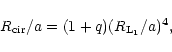
circularization
radius (Lubow-Shu radius). The circularization radius is
given by
|
(1) |
 are the binary separation, the
binary
mass ratio, and the distance from the primary white dwarf to the
inner Lagrangian point, respectively. The distance to the Lagrangian
point,
,
is given by (see, e.g., Warner 1995)
are the binary separation, the
binary
mass ratio, and the distance from the primary white dwarf to the
inner Lagrangian point, respectively. The distance to the Lagrangian
point,
,
is given by (see, e.g., Warner 1995)
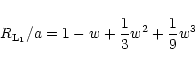 |
(2) |
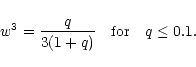 |
(3) |
 .
Here we have assumed the surface density profile
.
Here we have assumed the surface density profile
 of
a steady
hot disk with free-free opacity whose mean specific angular momentum,
of
a steady
hot disk with free-free opacity whose mean specific angular momentum,
 ,
is given by
,
is given by
 .
This is to be compared with the 2:1 resonance radius given by
.
This is to be compared with the 2:1 resonance radius given by
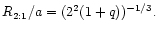
Figure 1 illustrates the outer edge of the disk
and the 2:1 resonance radius as a function of mass ratio.
We find that the outer edge of the disk exceeds the 2:1 resonance radius
in the low mass-ratio systems with q less than 0.08.
In those systems, the 2:1 resonance ensues, resulting in the two-armed
spiral shocks and strong tidal torques acting on the disk.
The extra angular momentum of the disk will be rapidly removed from
the disk. We find from Fig. 1 that the extra angular momentum to be
gotten rid off becomes greater as the binary mass ratio becomes smaller.
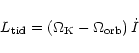
The tidal dissipation luminosity resulting from
the transfer of angular momentum by the 2:1 resonance is given by
 |
(4) |
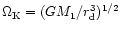 Kepler angular
frequency,
Kepler angular
frequency,
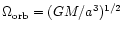 orbital angular
frequency,
M=(1+q)M1 total mass and
orbital angular
frequency,
M=(1+q)M1 total mass and  the outer disk
radius,
the outer disk
radius,
 rate of angular momentum removed tidally from the accretion
disk. At the earliest phase of the outburst, the rate of tidal
removal of angular
momentum from the disk, ,
must be much larger than that of the
later
phase discussed below because of the extra angular momentum of the disk
to be removed.
rate of angular momentum removed tidally from the accretion
disk. At the earliest phase of the outburst, the rate of tidal
removal of angular
momentum from the disk, ,
must be much larger than that of the
later
phase discussed below because of the extra angular momentum of the disk
to be removed.
After this intial transient phase is ended, a slower removal of angular momentum by the 2:1 resonance will follow. Let us estimate the amplitude of the early hump in this second stage expected from this 2:1 resonance model.
![\begin{figure}
\par\includegraphics[width=6cm,clip]{H3280f1.ps}\end{figure}](/articles/aa/full/2002/08/aah3280/img15.gif) |
Figure 1: Outer edge of the disk and radius of the 2:1 resonance, measured in units of binary separation a, as a function of the mass ratio q. |
| Open with DEXTER | |
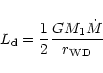
For this we compare the 2:1 resonance luminosity (i.e. the
non-axisymmetric component of the dissipation) with the luminosity
of the accretion disk (i.e. the axisymmetric component of the
dissipation)
 |
(5) |
 is the radius of the central white dwarf. In
steady state the rate
of angular momentum transfer is equal to the rate of angular
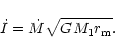
momentum released in the disk,
is the radius of the central white dwarf. In
steady state the rate
of angular momentum transfer is equal to the rate of angular
momentum released in the disk,
 |
(6) |
 is that radius where the Kepler specific angular
momentum is equal to mean specific angular momentum of the disk. For
the surface density profile
is that radius where the Kepler specific angular
momentum is equal to mean specific angular momentum of the disk. For
the surface density profile
 as before one
obtains
as before one
obtains
 .
At the 2:1 resonance
.
At the 2:1 resonance
 is
is
 .
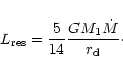
Inserting these values
into Eq. (4) we obtain
.
Inserting these values
into Eq. (4) we obtain
 |
(7) |
 |
(8) |
 cm,
cm,
 cm.
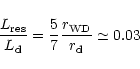
This value is already of the right order of magnitude to explain the
amplitude of the early humps observed in other WZ Sge systems, e.g.
AL Com: 0.05 mag, HV Vir: 0.1 mag, EC Cnc: 0.02 mag, provided that
the bolometric corrections for the disk luminosity and for the resonance
luminosity are similar.
cm.
This value is already of the right order of magnitude to explain the
amplitude of the early humps observed in other WZ Sge systems, e.g.
AL Com: 0.05 mag, HV Vir: 0.1 mag, EC Cnc: 0.02 mag, provided that
the bolometric corrections for the disk luminosity and for the resonance
luminosity are similar.
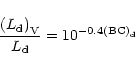
The following consideration estimates the relations in more detail. By integrating the bolometrically corrected (Allen 1973) contributions of individual rings of a standard accretion disk and comparing the resulting visual luminosity with the bolometric one one can derive a bolometric correction for the disk as a whole.
For the parameters as above and an estimated accretion rate of
 /yr for the early outburst phase of WZ Sge we obtain
 |
(9) |
 where the subscript V denotes the
visual luminosity and BC is the bolometric correction.
where the subscript V denotes the
visual luminosity and BC is the bolometric correction.
For the 2:1 resonance luminosity the bolometric correction is
determined by the effective temperature
which is obtained from the luminosity and the area from which it is
radiated. For the latter
we estimate a total azimuthal extent of  (see Lin & Papaloizou
1979) and assume a width of 4H where H is the scaleheight for the
obtained temperature. With the parameters of WZ Sge as above this
gives
(see Lin & Papaloizou
1979) and assume a width of 4H where H is the scaleheight for the
obtained temperature. With the parameters of WZ Sge as above this
gives
 K and a bolometric
correction
K and a bolometric
correction
 .
.
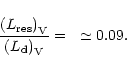
The ratio of the visual luminosity from the resonance dissipation to
that from the disk is then,
larger than that of the bolometric luminosities by the factor
![$10^{-0.4[(\rm {BC})_{\rm {res}}-(\rm {BC})_{\rm d}]} \simeq 3$](/articles/aa/full/2002/08/aah3280/img34.gif) .
With
Eq. (8) we obtain
.
With
Eq. (8) we obtain
 |
(10) |
![\begin{displaymath}%
\frac{\frac{2}{3}(L_{\rm {res}})_{\rm V} \cdot \sin i}
{[(L...
... V}+\frac{1}{2} (L_{\rm {res}})_{\rm V}]
\cos i} = 0.05 \tan i
\end{displaymath}](/articles/aa/full/2002/08/aah3280/img36.gif) |
(11) |
 that of the
radially pointing surface at maximum.
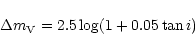
The expected hump amplitude then becomes
that of the
radially pointing surface at maximum.
The expected hump amplitude then becomes
 |
(12) |
 (Smak 1993)
 |
(13) |
 = 0.2 to 0.15 after the first two days.
WZ Sge is the only eclipsing system among the known WZ Sge stars.
The other non-eclipsing systems must have lower inclination,
leading to lower values for the hump amplitude, e.g.
 = 0.1 for
 and
= 0.03 for
and
= 0.03 for
 .
This fits well to the
observed
range of
in these other systems mentioned above.
.
This fits well to the
observed
range of
in these other systems mentioned above.
Thus the cyclic behavior of dwarf novae is well understood as a process of interchanging mass accumulation and drainage in the disk. Equally important here is the cyclic variation of the total angular momentum in the disk. Angular momentum also accumulates during quiescence of dwarf novae. When an outburst occurs, the increase of viscosity leads to accretion onto the central white dwarf. However, in order to conserve angular momentum some material must move outward to radii of higher Kepler angular momentum giving rise to an expansion of the disk. The angular momentum brought outward will finally be returned to the orbit of the binary by tidal torques from the secondary star acting in the disk. It is thus understood that in a time-average over the outburst cycle a steady state is established for the total angular momentum of the disk in a same way as for the total mass of the disk.
In ordinary U Gem-type dwarf novae, a quasi-periodic outburst/quiescence cycle repeats in which the disk expands to the tidal truncation radius during an outburst. There extra angular momentum can be returned to the binary orbital motion via tidal torques. The accretion disk is then truncated at this radius. During quiescence, the disk radius gradually decreases since the matter added to the disk from the secondary star has a specific angular momentum lower than that at the disk edge. This gives rise to a cyclic variation of the disk radius. This picture fits very well to the observed variation of the disk radius in dwarf novae (Anderson 1988; Ichikawa & Osaki 1992).
Paczynski (1977) calculated the tidal truncation radius as that of the last non-intersecting orbit of a test particle around the central star in the binary potential. His results agree fairly well with an analytic treatment of the tidal torques in the binary by Papaloizou & Pringle (1977) who showed that tidal torques increase strongly with an increase of the radial coordinate in the disk.
For the angular momentum removal from the disk a new aspect emerged with the discovery of the tidal instability by Whitehurst (1988). In this instability, an accretion disk is deformed to an eccentric elliptic shape and then precesses progradely in the inertial coordinate system. When the eccentric disk is developed a very efficient removal of angular momentum from the disk is supposed to occur. The 3:1 resonance in the accretion disk, responsible for the tidal instability, is only possible in binary systems with a ratio q=M2/M1 of the secondary to the primary mass less than about 0.25. This is because only in these low mass-ratio systems the tidal truncation radius is large enough to accommodate the 3:1 resonance radius within its boundary.
By combining the tidal instability with the thermal instability, Osaki (1989) proposed the thermal-tidal instability model (called TTI model) for the superoutburst cycle of SU UMa-type dwarf novae. In this model, the short normal outbursts occur as long as the disk radius is small and the mass accreted during the normal outbursts is less than that accumulated during quiescent intervals. Mass and angular momentum of the disk gradually build up. Thus during the sequence of normal outbursts the disk radius gradually increases until a final normal outburst drives the outer edge of the disk beyond the 3:1 resonance radius, triggering the tidal instability. Enhanced tidal removal of angular momentum in the eccentric precessing disk then keeps the disk in a hot state longer than a normal outburst does. This explains the long duration of the superoutburst and the superhump phenomenon. The typical supercycle length of SU UMa stars is a few hundred days, i.e., less than about a year.
The WZ Sge stars are an extreme case of SU UMa stars with long supercycles lasting decades. Besides a long recurrence time, WZ Sge stars exhibit several other unique characteristics, which are discussed by various workers (for modeling see Osaki 1995). It is thought that these systems have mass transfer rates lower than the ordinary SU UMa stars, 1015 g/s for WZ Sge stars versus 1016 g/s for the ordinary SU UMa stars. During quiescence the disk viscosity is very low (Smak 1993) which can be understood as to be related to the fact that the secondary stars are brown dwarfs without magnetic activity (Meyer & Meyer-Hofmeister 1999), mass ratios q=M2/M1 less than 0.1, most likely as low as 0.03. The "echo outbursts'', a repetitive rebrightening after the main outburst, beautifully established during the 2001 outburst, are also related to the low viscosity (Osaki et al. 2001).
Recently Hellier (2001) made an interesting suggestion that some of peculiarities of WZ Sge stars and some of ER UMa stars can be understood within the TTI model by considering a possibility of rather weak tidal torques in the eccentric disk, in those with extreme mass ratios. He suggested that tidal dissipation in these systems is too weak to sustain the disk in the hot state long enough. A premature shut-down of the superoutburst could be responsible for "echo outburst'' observed after the end of the main outburst in EG Cnc. Indeed Osaki et al. (2001) showed that the viscosity decrease related to the disk cooling after the main outburst and magnetic field decay causes the repetitive rebrightening of EG Cnc.
As discussed in Sect. 3, in binary systems like WZ Sge stars
with the extremely low mass ratio, of
 ,
once an outburst
occurs,
the outer edge of the hot viscous disk exceeds the 2:1 resonance radius,
thus exciting the strong two-armed dissipation pattern due to the 2:1
resonance, which now can remove angular momentum from the disk.
The WZ Sge stars are thus those systems which are characterized
by "early humps''. Since the 3:1 resonance radius is smaller the 2:1
resonance
radius, the tidal eccentric instability due to the 3:1 resonance
still operates in those systems even though its growth rate is rather
low.
Eventually (after about ten days from the outburst maximum) the
precessing
eccentric pattern characterized by "ordinary superhumps'' has grown to a
sufficient amplitude. "Early humps'' are now replaced
by "ordinary superhumps'' because the disk's outer edge does
not need to reach the 2:1 resonance radius any more as the tidal
eccentric
pattern due to the 3:1 resonance can now remove angular momentum
from the disk. Our interpretation is that what is occurring
during outbursts of WZ Sge stars is just this process.
,
once an outburst
occurs,
the outer edge of the hot viscous disk exceeds the 2:1 resonance radius,
thus exciting the strong two-armed dissipation pattern due to the 2:1
resonance, which now can remove angular momentum from the disk.
The WZ Sge stars are thus those systems which are characterized
by "early humps''. Since the 3:1 resonance radius is smaller the 2:1
resonance
radius, the tidal eccentric instability due to the 3:1 resonance
still operates in those systems even though its growth rate is rather
low.
Eventually (after about ten days from the outburst maximum) the
precessing
eccentric pattern characterized by "ordinary superhumps'' has grown to a
sufficient amplitude. "Early humps'' are now replaced
by "ordinary superhumps'' because the disk's outer edge does
not need to reach the 2:1 resonance radius any more as the tidal
eccentric
pattern due to the 3:1 resonance can now remove angular momentum
from the disk. Our interpretation is that what is occurring
during outbursts of WZ Sge stars is just this process.
![\begin{figure}
\par\includegraphics[width=6cm,clip]{H3280f2.ps}\end{figure}](/articles/aa/full/2002/08/aah3280/img46.gif) |
Figure 2: Tidal truncation radius together with the radii of the 2:1 and 3:1 resonance, measured in units of binary separation a, as a function of the mass ratio q and dividing lines between the three classes of systems. The dividing line between WZ Sge and SU Uma systems is moved to the dashed position if the tidal force becomes to weak to truncate the disk (see text). |
| Open with DEXTER | |
The exact location of the boundaries between the three cases is
uncertain
since the tidal truncation radius (taken here as 90% of the radius of
the Roche lobe) is rather approximate.
In particular, the boundary between the SU UMa stars and the WZ Sge
stars in
Fig. 2 is found to be around q=0.025, which seems to be too small as
compared with
 obtained in Sect. 3. In those binary
systems
with the extreme low mass ratio, the tidal force will be weak and the
ordinary tidal torques at the tidal truncation radius may not be strong
enough to stop sudden expansion of the disk caused by an outburst.
In such a case, the 2:1 resonance radius could be the only place where
the disk is effectively truncated and the boundary between the SU UMa
stars
and the WZ Sge stars may be at
rather than
obtained in Sect. 3. In those binary
systems
with the extreme low mass ratio, the tidal force will be weak and the
ordinary tidal torques at the tidal truncation radius may not be strong
enough to stop sudden expansion of the disk caused by an outburst.
In such a case, the 2:1 resonance radius could be the only place where
the disk is effectively truncated and the boundary between the SU UMa
stars
and the WZ Sge stars may be at
rather than
 .
.
Acknowledgements
We would like to thank Emmi Meyer-Hofmeister for helpful discussions and technical assistance. Yoji Osaki acknowledges financial support from the Japanese Ministry of Education, Culture, Sports, Science and Technology with a Grant-in Aid for Scientific Research No. 12640237.