A&A 382, 872-887 (2002)
DOI: 10.1051/0004-6361:20011640
Turbulent viscosity in clumpy accretion disks
Application to the Galaxy
B. Vollmer - T. Beckert
Max-Planck-Institut für Radioastronomie, Auf dem
Hügel 69, 53121 Bonn, Germany
Received 29 May 2001/ Accepted 16 November 2001
Abstract
The equilibrium state of a turbulent clumpy gas disk is analytically
investigated. The disk consists of distinct self-gravitating clouds.
Gravitational cloud-cloud interactions transfer energy over spatial scales
and produce a viscosity, which allows mass accretion in the gas disk.
Turbulence is assumed to be generated by instabilities
involving self-gravitation and to be maintained by the energy input from
differential rotation and mass transfer. Disk parameters, global
filling factors, molecular fractions, and star formation rates are derived.
The application of our model to the Galaxy shows good agreement with
observations. They are consistent with the scenario where turbulence
generated and maintained by gravitation
can account for the viscosity in the gas disk of spiral galaxies.
The rôle of the galaxy mass for the morphological classification
of spiral galaxies is investigated.
Key words: ISM: clouds - ISM: structure - Galaxy: structure -
galaxies: ISM
Galactic gas disks are not continuous but clumpy. The structure
of the interstellar medium (ISM) is usually hierarchical (Scalo 1985)
over length scales of several magnitudes up to  100 pc.
The clouds are not uniform
nor isolated and their boundaries are often of fractal nature
(Elmegreen & Falgarone 1996). Whereas the atomic gas (H I)
is mainly in the form of filaments, the molecular gas is highly clumped.
The largest self-gravitating molecular clouds (giant molecular clouds = GMC)
have sizes of 30 pc and masses of 10
100 pc.
The clouds are not uniform
nor isolated and their boundaries are often of fractal nature
(Elmegreen & Falgarone 1996). Whereas the atomic gas (H I)
is mainly in the form of filaments, the molecular gas is highly clumped.
The largest self-gravitating molecular clouds (giant molecular clouds = GMC)
have sizes of 30 pc and masses of 10
 (see e.g. Larson 1981). The GMCs have a volume filling factor
 ,
with the ratio of the diameter of a
typical GMC to the vertical scale height of the GMC distribution
(=130 pc, Sanders et al. 1985) 0.4. In this respect, the GMC
distribution resembles more a planetary ring (Goldreich & Tremaine 1987).
The mass-size relation of
the GMCs is
,
with the ratio of the diameter of a
typical GMC to the vertical scale height of the GMC distribution
(=130 pc, Sanders et al. 1985) 0.4. In this respect, the GMC
distribution resembles more a planetary ring (Goldreich & Tremaine 1987).
The mass-size relation of
the GMCs is
 .
The fractal dimension of a volume fractal is
.
The fractal dimension of a volume fractal is
 (Elmegreen &
Falgarone 1996). The origin of this dimension could be turbulent diffusion
in an incompressible fluid with a Kolmogorov velocity spectrum
(
(Elmegreen &
Falgarone 1996). The origin of this dimension could be turbulent diffusion
in an incompressible fluid with a Kolmogorov velocity spectrum
(
 for
for
 ;
see Meneveau & Sreenivasan
1990).
;
see Meneveau & Sreenivasan
1990).
The Kolmogorov theory applies for fully developed subsonic incompressible
fluids. However, the ISM is supersonic and compressible.
Only recently, 3D numerical studies of magneto-hydrodynamical and
hydrodynamical turbulence in an isothermal, compressible, and
self-gravitating fluid indicated that the energy spectrum of supersonic
compressible turbulence follows a Kolmogorov law (Mac Low 1999;
Klessen et al. 2000; Mac Low & Ossenkopf 2000). The molecular clouds
themselves are stabilized against gravitational collapse by the turbulent
velocity field within them (see e.g. Larson 1981).
Wada & Norman (1999) used high-resolution, 2D, hydrodynamical
simulations to investigate the evolution of a self-gravitating multiphase
interstellar medium in a galactic disk. They found that a gravitationally
and thermally unstable disk evolves towards a globally quasi-stationary state
where the disk is characterized by clumpy and filamentary structures.
The energy source of the turbulence in this system originate in the shear
driven by galactic rotation and self-gravitational energy of the gas.
The effective Q parameter of the disk was found to have a value between
2 and 5. Without feedback the energy spectrum
 corresponds
to a Kolmogorov law in two dimensions, but changes into
corresponds
to a Kolmogorov law in two dimensions, but changes into
 if stellar energy feedback is included (Wada & Norman 2001).
This power law is expected if shocks dominate the system (Passot et al. 1988).
Furthermore, Wada & Norman (2001) derived a driving length scale of 200 pc for the model without stellar energy feedback.
if stellar energy feedback is included (Wada & Norman 2001).
This power law is expected if shocks dominate the system (Passot et al. 1988).
Furthermore, Wada & Norman (2001) derived a driving length scale of 200 pc for the model without stellar energy feedback.
While the turbulent nature of the ISM is well established now,
its origin and maintenance is still a matter of debate.
This is of great importance, because turbulence can provide
angular momentum transport in the disk of spiral galaxies.
The evolution and the structure of an accretion disk depends
entirely on the effective viscosity caused by turbulence.
Two ingredients are necessary for a steady state turbulence:
(i) a dynamical instability to generate and (ii) a steady energy input
to maintain turbulence.
(i) Five possible instabilities were put forward by different authors:
-
viscous instability (Lightman & Eardley 1974);
-
thermal instability (Pringle et al. 1973);
-
Parker instability (Parker 1966);
-
magneto-hydrodynamic instability (Balbus & Hawley 1991);
-
gravitational instability (Toomre 1964).
Because self-gravity is always present in the
ISM, the gravitational instability can operate in conjunction with
all other forms of instabilities. As soon as the density rises
due to such a combined instability and increases over the value
of the ambient medium by a factor 2, self-gravitation should be
the dominant force (Elmegreen 1982).
Moreover, the gravitational instability can produce
a whole hierarchy of clumped structures inside the largest ones.
Therefore, we will only discuss gravitational instability.
(ii) Two main mechanisms are proposed to provide the energy input in
order to maintain the observed turbulence of
 kms-1:
-
supernova explosions (see e.g. Spitzer 1968; McKee & Ostriker 1977);
-
galactic differential rotation (Fleck 1981).
The supernova shocks, which can accelerate low mass clouds,
are extremely ineffective in accelerating GMCs, because of the
much larger mass to area ratio of GMCs. Jog & Ostriker (1988)
applying directly the results of McKee & Ostriker (1977) found
that supernova shocks can provide no more than 10% of the
kinetic energy of the GMCs (however, Cui et al. (1996) suggested that
uncertain background corrections could make this fraction larger).
Therefore, we will only focus on energy input by galactic rotation.
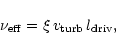
The effective viscosity
 due to turbulence can be
expressed in general as
due to turbulence can be
expressed in general as
 |
(1) |
where
 is the turbulent velocity on large scales,
 the driving wavelength, and
  a constant.
For continuous disks the most widely used form is the so-called
a constant.
For continuous disks the most widely used form is the so-called
 -ansatz introduced by Shakura (1972) and Shakura & Sunyaev (1973).
They assumed that the turbulent velocity is limited by the sound velocity
(
-ansatz introduced by Shakura (1972) and Shakura & Sunyaev (1973).
They assumed that the turbulent velocity is limited by the sound velocity
(
 ),
the turbulent length scale equals the disk scale height
),
the turbulent length scale equals the disk scale height
 ,
and
,
and
 .
Lin & Pringle (1987a) derived a prescription for the
effective viscosity due to gravitational instability:
and
.
Lin & Pringle (1987a) derived a prescription for the
effective viscosity due to gravitational instability:
and
 ,
where Q is the Toomre parameter
(Toomre 1964). Recently, Duschl et al. (2000) suggested a
prescription for the viscosity due to hydrodynamically driven turbulence
at the critical effective Reynolds number
,
where Q is the Toomre parameter
(Toomre 1964). Recently, Duschl et al. (2000) suggested a
prescription for the viscosity due to hydrodynamically driven turbulence
at the critical effective Reynolds number
 ,
where
,
where
 ,
,
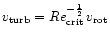 ,
and
the driving wavelength is a well defined fraction of the local radius
in the disk
,
and
the driving wavelength is a well defined fraction of the local radius
in the disk
 .
.
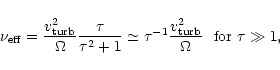
For clumpy accretion disks, Goldreich & Tremaine (1978)
and Stewart & Kaula (1980) elaborated models where the shear viscosity
in a rotating disk is due to cloud-cloud interactions. Their prescription
has the form:
 |
(2) |
where  is the rotational angular velocity and
 is the number of cloud interactions per rotation
period with the interaction time scale
is the number of cloud interactions per rotation
period with the interaction time scale
 between the clouds.
Vertical hydrostatic equilibrium
between the clouds.
Vertical hydrostatic equilibrium
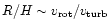 gives
gives
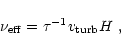 |
(3) |
where
 is the rotation velocity.
In this article we derive a prescription for the turbulent
viscosity of comparable form with
is the rotation velocity.
In this article we derive a prescription for the turbulent
viscosity of comparable form with
 in terms of the turbulent
Reynolds number Re. All disk parameters are given as functions of
Re, Q, and the mass accretion rate
in terms of the turbulent
Reynolds number Re. All disk parameters are given as functions of
Re, Q, and the mass accretion rate  .
We apply our
model to the Galaxy and derive a Galactic mass accretion rate.
.
We apply our
model to the Galaxy and derive a Galactic mass accretion rate.
We consider a gaseous accretion disk in a given gravitational
potential  which gives rise to an angular velocity
 .
The Toomre parameter (Toomre 1964) is treated as a free parameter
.
The Toomre parameter (Toomre 1964) is treated as a free parameter
 |
(4) |
with the restriction  ,
where G is the gravitational constant,
,
where G is the gravitational constant,
 the average gas column density, and
  the local
epicyclic frequency.
The disk consists of distinct self-gravitating clouds, which are
orbiting in an external gravitational field and have a velocity
dispersion
the local
epicyclic frequency.
The disk consists of distinct self-gravitating clouds, which are
orbiting in an external gravitational field and have a velocity
dispersion  .
These clouds might be embedded in a low density medium
as long as
.
These clouds might be embedded in a low density medium
as long as
 ,
where
,
where
 is the sound speed of the external medium.
This is the case for the warm atomic or ionized phase (
is the sound speed of the external medium.
This is the case for the warm atomic or ionized phase (
 K)
and the hot ionized phase (
K)
and the hot ionized phase (
 K).
The disk scale height is determined uniquely by the turbulent
pressure
K).
The disk scale height is determined uniquely by the turbulent
pressure
 ,
where
,
where  is the averaged density in the disk.
The clouds have a small volume filling factor
is the averaged density in the disk.
The clouds have a small volume filling factor
 .
The transport of angular momentum is due to cloud-cloud
interactions. These can be gravitational (elastic) encounters or
direct (inelastic) collisions. Thus, gravitational scattering of the
massive clouds off each other in a differentially rotating galactic disk
gives rise to an effective "gravitational'' viscosity.
Jog & Ostriker (1988) determined analytically the one-dimensional
velocity dispersion of such a system to be
.
The transport of angular momentum is due to cloud-cloud
interactions. These can be gravitational (elastic) encounters or
direct (inelastic) collisions. Thus, gravitational scattering of the
massive clouds off each other in a differentially rotating galactic disk
gives rise to an effective "gravitational'' viscosity.
Jog & Ostriker (1988) determined analytically the one-dimensional
velocity dispersion of such a system to be
 5-7 kms-1 which is in good agreement with
observations. We assume that energy is dissipated in the disk when
clouds become self-gravitating. Turbulence is generated by
instabilities involving self-gravitation and is maintained by
the energy input, which is provided by differential rotation via
cloud-cloud interactions. Thus, the dissipative scale
length
5-7 kms-1 which is in good agreement with
observations. We assume that energy is dissipated in the disk when
clouds become self-gravitating. Turbulence is generated by
instabilities involving self-gravitation and is maintained by
the energy input, which is provided by differential rotation via
cloud-cloud interactions. Thus, the dissipative scale
length
 is equivalent to the size of the largest
self-gravitating clouds. Since we assume clouds to form from local
instabilities due to self-gravitation, which do not depend on the
distance to the galaxy center, Q = const. Furthermore, we assume
that the turbulent Reynolds number Re is also independent of the
galactic radius.
is equivalent to the size of the largest
self-gravitating clouds. Since we assume clouds to form from local
instabilities due to self-gravitation, which do not depend on the
distance to the galaxy center, Q = const. Furthermore, we assume
that the turbulent Reynolds number Re is also independent of the
galactic radius.
3.1 The viscosity prescription
In the inertial range of a turbulent medium kinetic energy is
transferred from large scale structures to small scale structures
practically without losing energy. So there is a constant energy flux
from large scales to small scales where the energy is finally dissipated.
Since the velocity dispersion (
 kms-1)
within the disk is more important than the
shear, there is no preferred transfer direction. The turbulence is
therefore assumed to be isotropic. In this case the similarity theory
of Kolmogorov applies (see e.g. Landau & Lifschitz 1959).
The assumption of a universal Kolmogorov equilibrium implies
that the kinetic energy spectrum of the turbulence depends only on
the energy dissipation rate per unit mass
kms-1)
within the disk is more important than the
shear, there is no preferred transfer direction. The turbulence is
therefore assumed to be isotropic. In this case the similarity theory
of Kolmogorov applies (see e.g. Landau & Lifschitz 1959).
The assumption of a universal Kolmogorov equilibrium implies
that the kinetic energy spectrum of the turbulence depends only on
the energy dissipation rate per unit mass  and the characteristic
size of the turbulent eddy
and the characteristic
size of the turbulent eddy
 ,
where k is the
wave number.
The kinetic energy E(k) is related to the mean kinetic energy in
the following way:
,
where k is the
wave number.
The kinetic energy E(k) is related to the mean kinetic energy in
the following way:
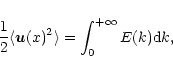 |
(5) |
where  is the velocity of the medium. Kolmogorov's theory yields
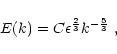 |
(6) |
where C is a constant of order unity.
Considering a schematic energy spectrum given by
E(k)=0, for
 and for
 and by
Eq. (6) for
and by
Eq. (6) for
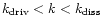 ,
one derives an expression for the dissipative length scale
,
one derives an expression for the dissipative length scale
 and the large scale
velocity
:
and the large scale
velocity
:
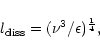 |
(7) |
where  is the large scale viscosity due to turbulence;
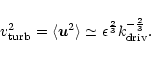 |
(8) |
This leads to a relation between the two length scales and the turbulent
Reynolds number, which is defined by
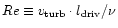 :
:
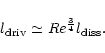 |
(9) |
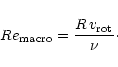
This turbulent Reynolds number is not equivalent to the
macroscopic Reynolds number defined by e.g. Frank et al. (1992)
 |
(10) |
We will show in Sect. 7 that
 .
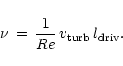
In this work we will use the following viscosity prescription:
.
In this work we will use the following viscosity prescription:
 |
(11) |
In our model the Reynolds number Re defined by Eq. (9)
is a free parameter with the restriction  .
This viscosity prescription will be compared to others
in Sect. 5.
.
This viscosity prescription will be compared to others
in Sect. 5.
It is formally equivalent to
the expression for a clumpy accretion disk (Ozernoy et al. 1998)
where the viscosity is
due to cloud-cloud interactions (Eq. (2)).
We interpret this equivalence
as two different pictures for a turbulent self-gravitating medium.
We prefer the point of view where the whole ISM (all phases) is
taken as one turbulent gas which change phases (i) on turbulent
time scales
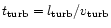 and (ii)
due to external processes (energy output by stars, i.e.
supernovae, UV radiation by O/B stars). Only near the midplane
of the disk can the gas become molecular and self-gravitating which
leads to a maximum GMC lifetime of
and (ii)
due to external processes (energy output by stars, i.e.
supernovae, UV radiation by O/B stars). Only near the midplane
of the disk can the gas become molecular and self-gravitating which
leads to a maximum GMC lifetime of
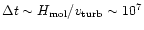 yr,
where (
yr,
where (
 pc Sanders et al. 1985).
On the other hand the lifetime of a molecular cloud
is approximately given by the crossing time
pc Sanders et al. 1985).
On the other hand the lifetime of a molecular cloud
is approximately given by the crossing time
 ,
where
,
where
 is the cloud size. With a cloud size of 30 pc this results
in
is the cloud size. With a cloud size of 30 pc this results
in
 yr. These values are comparable to
the lifetimes of star-forming molecular clouds given by Blitz & Shu (1980).
Since these lifetimes are about 10 times smaller than the expected
mean collision time (
yr. These values are comparable to
the lifetimes of star-forming molecular clouds given by Blitz & Shu (1980).
Since these lifetimes are about 10 times smaller than the expected
mean collision time (
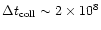 yr Elmegreen 1987),
direct cloud-cloud collisions are very rare and are not important
for the effective viscosity.
yr Elmegreen 1987),
direct cloud-cloud collisions are very rare and are not important
for the effective viscosity.
Even with the limited lifetime of molecular clouds, gravitational interactions
always take place between the continuously appearing and disappearing
clouds. These interactions give rise to a collision term in the Boltzmann
equation with an average collision time for gravitational encounters
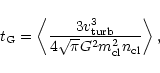 |
(12) |
(Braginskii 1965) where
 is the cloud mass
and
is the cloud mass
and
 is the spatial
number density of the clouds. For molecular clouds the turbulent
velocity is approximately independent of the cloud mass
(
is the spatial
number density of the clouds. For molecular clouds the turbulent
velocity is approximately independent of the cloud mass
(
 Larson 1981), thus
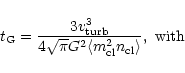 |
(13) |
 |
(14) |
where we have used the differential number density of molecular clouds
given by Elmegreen (1987).
Using integration boundaries
m1=104  ,
m2=106 ,
and
,
m2=106 ,
and
 10 kms-1one obtains
 yr. Assuming a galactic radius
R= 10 kpc and a rotation velocity of
yr. Assuming a galactic radius
R= 10 kpc and a rotation velocity of
 200 kms-1gives
 .
.
Since the dissipative scale length is of the order of the largest
self-gravitating clouds
 pc,
we can calculate the value of the driving wavelength
pc,
we can calculate the value of the driving wavelength
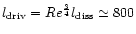 pc.
This is of the same order as the thickness of the distribution of
the atomic gas (Kulkarni & Heiles 1987; Dickey 1993).
We will show in Sect. 4 that in our model
pc.
This is of the same order as the thickness of the distribution of
the atomic gas (Kulkarni & Heiles 1987; Dickey 1993).
We will show in Sect. 4 that in our model
 .
The scale height of the molecular disk
.
The scale height of the molecular disk
 is smaller,
because of the limited lifetime of molecular clouds.
is smaller,
because of the limited lifetime of molecular clouds.
Wada & Norman (2001) found an energy spectrum of the form
in their 2D hydrodynamical simulations of a supersonic, compressible turbulence
including stellar energy feedback. This power law corresponds to that of a
shock dominated medium. In contrast to a compression
dominated medium, the exponent of the power law for an incompressible medium
is the same in two and three dimensions (Passot et al. 1988).
In this section we assume that
in three dimensions
In this case, an alternative explanation for this exponent comes from the
theory of intermittency (Frisch 1995). The open parameter of this model
is the dimension D. In the case of intermittent turbulence the energy flux
from scales l to smaller scales is
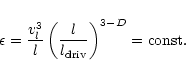 |
(15) |
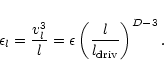
The local spatial average of the energy dissipation can then be expressed as
 |
(16) |
Within this framework
implies D=2 and consequently
 ,
i.e.
the local spatial average of the energy dissipation decreases with decreasing
length scale l. The ratio between the driving and the dissipation
length scale is then
,
i.e.
the local spatial average of the energy dissipation decreases with decreasing
length scale l. The ratio between the driving and the dissipation
length scale is then
 |
(17) |
instead of
 in the case of Kolmogorov turbulence.
For a Reynolds number
in the case of Kolmogorov turbulence.
For a Reynolds number
 the difference is about a factor 2.5.
Since the power law exponent of the ISM energy spectrum is not yet
well established, both possibilities must be considered.
the difference is about a factor 2.5.
Since the power law exponent of the ISM energy spectrum is not yet
well established, both possibilities must be considered.
In a steady state accretion disk, the mass accretion rate is
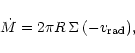 |
(18) |
where
 is the radial velocity.
The angular momentum equation can be integrated giving
is the radial velocity.
The angular momentum equation can be integrated giving
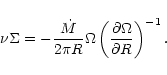 |
(19) |
Furthermore, we use
 |
(20) |
for the surface density of the disk, where
is the mass
density at the midplane.
3.4 Energy flux conservation
The ISM turbulence in the disk is initiated by an instability
involving self-gravitation. The transport of angular momentum
is due to cloud-cloud interactions giving rise to radial mass
accretion. We assume that the necessary energy input to maintain
the turbulence is the gravitational energy, which is gained when
the ISM is accreted to smaller Galactic radii, i.e. the energy input
is supplied by the Galactic differential rotation. Kinetic energy of the
Galactic rotation is transfered to the turbulent cascade at the driving
wavelength
and reaches the dissipative length scale
without loosing energy. The energy per unit time which
is transferred by turbulence is
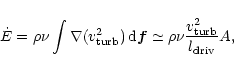 |
(21) |
where the integration is over the area
 .
Thus, the energy flux per unit time and unit area is
.
Thus, the energy flux per unit time and unit area is
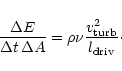 |
(22) |
From standard fluid dynamics, the viscosity
generates dissipation
in the disk at a rate
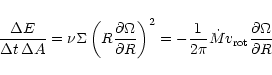 |
(23) |
(see e.g. Pringle 1981), where
.
This is valid for
 ,
where
,
where
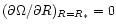 .
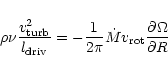
Conservation of energy flux leads thus to
.
Conservation of energy flux leads thus to
 |
(24) |
and relates the mass accretion rate to the turbulence in the disk.
Since we assume that the sound velocity of the ambient medium
is smaller than the turbulent velocity dispersion of the clouds,
the only pressure which counterbalances gravitation in the
vertical direction is the turbulent pressure
.
We distinguish three cases
for the gravitational force in the vertical z direction:
- 1.
-
 ,
where
,
where  is the disk mass and
M is the central mass (dominating central mass);
is the disk mass and
M is the central mass (dominating central mass);
- 2.
-
 and
and
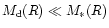 ,
where
,
where
 is the stellar central density/disk mass
within a radius R (dominating stellar disk mass);
is the stellar central density/disk mass
within a radius R (dominating stellar disk mass);
- 3.
-
 and
and
 ,
where M(R) is the total mass enclosed within a radius R
(self-gravitating gas disk in z direction).
,
where M(R) is the total mass enclosed within a radius R
(self-gravitating gas disk in z direction).
For these cases the gravitational pressure
 has the
following forms:
has the
following forms:
- 1.
-
 (see e.g. Pringle 1981);
- 2.
-
 ,
where
,
where
 is the stellar
surface density of the disk (see e.g. Binney & Tremaine 1987);
is the stellar
surface density of the disk (see e.g. Binney & Tremaine 1987);
- 3.
-
 (Paczynski 1978).
The equilibrium in the vertical direction is given by
 |
(25) |
The basic principles underlying the gravitational instability
of a thin rotating disk can be found in Toomre (1964).
A gaseous disk is locally stable to axisymmetric perturbations, if
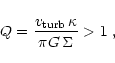 |
(26) |
where
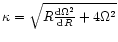 .
Since in general
.
Since in general
 ,
we will use the
following equation:
,
we will use the
following equation:
 |
(27) |
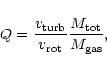
Multiplying the numerator and the denominator of the right hand side
by R2 gives
 |
(28) |
where
 is the total enclosed mass and the total enclosed
gas mass at radius R.
Thus for a given velocity dispersion Q-1 is proportional to the ratio
of gas mass to total mass.
is the total enclosed mass and the total enclosed
gas mass at radius R.
Thus for a given velocity dispersion Q-1 is proportional to the ratio
of gas mass to total mass.
4 Results
We have solved the set of equations Eq. (11), Eq. (19),
Eq. (20), Eq. (24), Eq. (25), and Eq. (27),
for the three cases:
- 1.
- dominating central mass;
- 2.
- dominating stellar disk mass;
- 3.
- self-gravitating gas disk in z direction.
We will use
 with
with
 in the region of interest.
Pressure equilibrium (Eq. (25)) leads to
 |
(29) |
which is equivalent to the hydrostatic equilibrium where the sound speed
is replaced by the turbulent velocity dispersion.
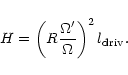
From energy flux conservation (Eq. (24)) and the angular momentum
equation (Eq. (19)) it follows
 |
(30) |
Thus, the driving wavelength is proportional to the disk height
 and the viscosity prescription reads
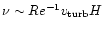 ,
which is formally equivalent
to the viscosity prescription for clumpy disks of Goldreich & Tremaine
(1978), Stewart & Kaula (1980) (see Eq. (3)), and the
-viscosity (Shakura & Sunyaev 1973)
with
and
,
which is formally equivalent
to the viscosity prescription for clumpy disks of Goldreich & Tremaine
(1978), Stewart & Kaula (1980) (see Eq. (3)), and the
-viscosity (Shakura & Sunyaev 1973)
with
and
 .
.
![\begin{figure}
\par\includegraphics[width=13.2cm,clip]{H2905f1.ps}
\end{figure}](/articles/aa/full/2002/06/aah2905/Timg139.gif) |
Figure 1:
Disk parameters for the case of a dominating central mass.
Solid lines: constant rotation curve. Dashed line: rising
rotation curve
 .
If Q=1 the behaviour of these parameters is the same
in the case of a selfgravitating gas disk in z direction. .
If Q=1 the behaviour of these parameters is the same
in the case of a selfgravitating gas disk in z direction. |
| Open with DEXTER |
Inserting Eqs. (29) in (27) and using
 gives
gives
 |
(31) |
If we define the critical cloud density for stability against tidal shear
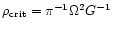 ,
the Toomre parameter
Q represents the ratio between the critical density and the
volume averaged density in the disk
,
the Toomre parameter
Q represents the ratio between the critical density and the
volume averaged density in the disk
 .
.
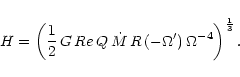
Inserting the viscosity prescription (Eq. (11)) into the angular momentum
equation (Eq. (19)) leads to
 |
(32) |
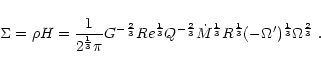
With
 we obtain
 |
(33) |
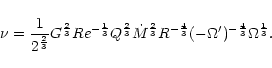
Inserting Eqs. (33) into (19) gives
 |
(34) |
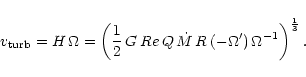
The turbulent velocity can be calculated using the pressure equilibrium
(Eq. (25)):
 |
(35) |
If
 ,
the viscosity is inversely proportional to the
angular velocity
,
the viscosity is inversely proportional to the
angular velocity
 and the turbulent velocity is
constant. In the case of a Keplerian velocity field due to a point mass
and the turbulent velocity is
constant. In the case of a Keplerian velocity field due to a point mass
 .
The behaviour of the disk parameters (
,
,
,
H,
,
and )
are shown for a constant rotation curve (solid line) and
a rising rotation curve
(dashed line) in
Fig. 1. The free parameters Q=1, Re=50, and
.
The behaviour of the disk parameters (
,
,
,
H,
,
and )
are shown for a constant rotation curve (solid line) and
a rising rotation curve
(dashed line) in
Fig. 1. The free parameters Q=1, Re=50, and
 yr-1 were chosen such that the
disk parameters fit the observed values for the Galaxy (see Sect. 7).
yr-1 were chosen such that the
disk parameters fit the observed values for the Galaxy (see Sect. 7).
![\begin{figure}
\par\includegraphics[width=13cm,clip]{H2905f2.ps}
\end{figure}](/articles/aa/full/2002/06/aah2905/Timg153.gif) |
Figure 2:
Disk parameters for the case of a dominating stellar disk.
Solid lines: constant rotation curve. Dashed line: rising
rotation curve
. |
| Open with DEXTER |
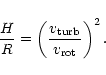
Pressure equilibrium (Eq. (25)) together with
 leads to
 |
(36) |
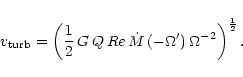
Inserting Eq. (36) in the equation for the Toomre parameter
(Eq. (27)) and using the viscosity prescription (Eq. (11)),
the angular momentum equation (Eq. (19)) and energy flux conservation
(Eq. (24)) gives
 |
(37) |
In the case of
,
the turbulent velocity is
inversely proportional to the square root of the rotation velocity
 .
.
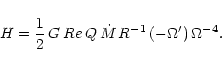
Inserting Eqs. (37) into (36) gives the disk scale height
 |
(38) |
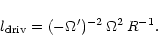
Equations (11), (19), and (24) together with Eq. (38)
lead to the following expression for the driving wavelength
 |
(39) |
From the same equations the density, column density, and viscosity read
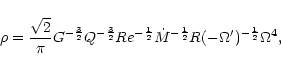 |
(40) |
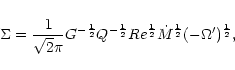 |
(41) |
and
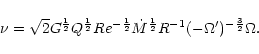 |
(42) |
If
,
the driving wavelength is proportional
to the galactic radius
 .
Therefore, in the case of a dominating stellar disk, one obtains for the
viscosity prescription (Eq. (11))
.
Therefore, in the case of a dominating stellar disk, one obtains for the
viscosity prescription (Eq. (11))
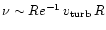 .
In this case, the viscosity is proportional
to the galactic radius divided by the square of the rotation velocity
.
In this case, the viscosity is proportional
to the galactic radius divided by the square of the rotation velocity
 .
Furthermore, if the rotation
curve is flat, i.e.
const.,
.
Furthermore, if the rotation
curve is flat, i.e.
const.,
 .
This behaviour can be observed in Fig. 2 where
the disk parameters (
,
,
,
H, ,
and
)
are shown for a constant rotation curve (solid line) and
a rising rotation curve
(dashed line)
for Q=1000, Re=50, and
yr-1.
Re, and
are the same as for the Galaxy (see Sect. 7)
and the value of Q is chosen such that the turbulent velocity dispersion
corresponds to that measured of an S0 galaxy (50 kms-1
D'Onofrio et al. 1999).
.
This behaviour can be observed in Fig. 2 where
the disk parameters (
,
,
,
H, ,
and
)
are shown for a constant rotation curve (solid line) and
a rising rotation curve
(dashed line)
for Q=1000, Re=50, and
yr-1.
Re, and
are the same as for the Galaxy (see Sect. 7)
and the value of Q is chosen such that the turbulent velocity dispersion
corresponds to that measured of an S0 galaxy (50 kms-1
D'Onofrio et al. 1999).
The pressure equilibrium (Eq. (25)) together
with the equation for the Toomre parameter (Eq. (27)) leads to
 |
(43) |
The square of the Toomre parameter thus represents the fraction between
the critical density with respect to tidal shear and the
volume averaged density in the disk
 .
We want to recall here that for a dominating point mass
.
.
We want to recall here that for a dominating point mass
.
Inserting Eq. (43) into the pressure equilibrium equation
(Eq. (25)) gives
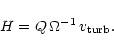 |
(44) |
Then, using the angular momentum equation (Eq. (19)), it follows
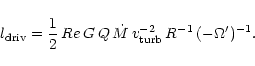 |
(45) |
From the energy flux conservation (Eq. (24)) one obtains
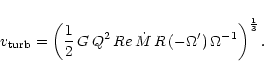 |
(46) |
For
,
the turbulent velocity is constant.
This is what is observed in the nearby galaxy NGC 3938 (van der Kruit
& Shostak 1982).
Inserting this expression in Eq. (45) leads to
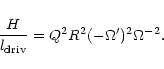 |
(47) |
For
,
 .
Thus, the viscosity prescription yields
.
Thus, the viscosity prescription yields
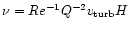 .
Here, Re is not the macroscopic Reynolds number
.
Here, Re is not the macroscopic Reynolds number
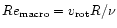 (see Sect. 7).
In the case of Re=1 this is the prescription given by Lin & Pringle (1987a).
(see Sect. 7).
In the case of Re=1 this is the prescription given by Lin & Pringle (1987a).
Inserting Eqs. (46) into (44) leads to the disk height
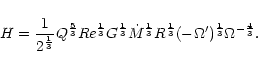 |
(48) |
With
one obtains the following expression for the
column density:
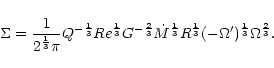 |
(49) |
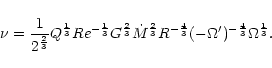
Equation (11), Eqs. (46)-(48) lead to
 |
(50) |
In the case of
,
the column density is
proportional to and the viscosity is inversely proportional to
the angular velocity:
 ,
.
If in addition the rotation velocity is constant, then
.
,
.
If in addition the rotation velocity is constant, then
.
Comparing this result with Eq. (42) shows that
both models with a gravitational potential
due to an extended mass
distribution give the same viscosity prescription if the rotation velocity
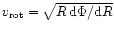 is constant.
On the other hand, the dominating central mass model and the
self-gravitating gas disk model have the same analytical solutions for Q=1(see Fig. 1).
5 Discussion of the results
Models of turbulent, self-gravitating gas disks can be divided into two different
approaches: (i) The disk is assumed to be quasi continuous and at the edge of
fragmentation ( ); (ii) The disk is already clumpy and the viscosity is due
to cloud-cloud interactions (
); (ii) The disk is already clumpy and the viscosity is due
to cloud-cloud interactions ( ).
).
We will first discuss the quasi continuous approach.
Paczynski (1978) investigated a self-gravitating disk with a polytropic index
of
 which corresponds to a radiation pressure
dominated disk. Furthermore, he assumed the disk luminosity to be at the
Eddington limit. With the acceleration due to a central mass M and the disk
gas surface density :
which corresponds to a radiation pressure
dominated disk. Furthermore, he assumed the disk luminosity to be at the
Eddington limit. With the acceleration due to a central mass M and the disk
gas surface density :
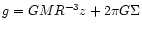 ,
he obtained
,
he obtained
 and thus
 for a constant rotation curve.
Lin & Pringle (1987a) proposed a viscosity prescription based on the Toomre
instability criterion (Toomre 1964):
for a constant rotation curve.
Lin & Pringle (1987a) proposed a viscosity prescription based on the Toomre
instability criterion (Toomre 1964):
 .
They showed that under certain
conditions this prescription allows a similarity solution
.
They showed that under certain
conditions this prescription allows a similarity solution
 .
Their viscosity prescription can be generalized
.
Their viscosity prescription can be generalized
 with
with
 or
or
 for self-gravitating disk
in z and R direction (Saio & Yoshii 1990).
Shlosman & Begelman (1989) also considered a disk at the edge of
selfgravitation, i.e. .
They obtained
for self-gravitating disk
in z and R direction (Saio & Yoshii 1990).
Shlosman & Begelman (1989) also considered a disk at the edge of
selfgravitation, i.e. .
They obtained
 for constant turbulent and rotation velocities.
On the other hand, Duschl et al. (2000) made a completely different ansatz:
for constant turbulent and rotation velocities.
On the other hand, Duschl et al. (2000) made a completely different ansatz:
 ,
with
,
with
 .
They found
.
They found
 and
for a disk with
and
for a disk with
 .
.
On the other hand, using a clumpy disk model Silk & Norman (1981) derived a viscosity
prescription in assuming that the cooling time for cloud-cloud collisions
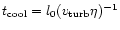 equals the
viscous time scale
equals the
viscous time scale
 for all radii R,
where
for all radii R,
where  is the fraction of cloud kinetic
energy radiated in a collision and l0 is the cloud mean free path.
This leads to
is the fraction of cloud kinetic
energy radiated in a collision and l0 is the cloud mean free path.
This leads to
 ), where
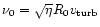 and R0 is a characteristic length scale. Lynden Bell & Pringle (1974)
showed that for this viscosity prescription
and R0 is a characteristic length scale. Lynden Bell & Pringle (1974)
showed that for this viscosity prescription
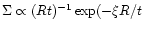 ),
where
is a constant and t is time. Later Shlosman & Begelman (1987)
also used
),
where
is a constant and t is time. Later Shlosman & Begelman (1987)
also used
 .
Ozernoy (1998) and Kumar (1999)
suggested a viscosity prescription based on the collisional Boltzmann equation
(see Sect. 3.1)
.
Ozernoy (1998) and Kumar (1999)
suggested a viscosity prescription based on the collisional Boltzmann equation
(see Sect. 3.1)
 ,
where
,
where
 .
.
In this section we will only discuss the self-gravitating gas disk in z direction,
because only for this set of equation ,
i.e. the gravitational instability
is active. This point will be further discussed in Sect. 5.2.
Whereas the above cited viscosity prescriptions (except Duschl et al. 2000)
use
,
the driving wavelength
is a priori a
free parameter in our set of equations. It is then defined by the energy
flux conservation (Eq. (24)). In terms of the standard
accretion disk equations (see e.g. Pringle 1981), the "thermostat'' equation,
i.e. the viscous heating is radiated by the disk , is replaced by the
turbulent energy flux equation (Eq. (24)), where the energy gained
through accretion and differential rotation is transported by turbulence to
smaller scales where it is dissipated. The addition of this
energy flux conservation to the "traditional'' set of disk equations leads
to
.
Once this relation is established, the viscosity prescription has the
form of that derived from the collisional Boltzman equation
with
 (see Sect. 3.1). On the other hand, our viscosity
is a factor Re-1 smaller than that of Lin & Pringle (1987a) for .
(see Sect. 3.1). On the other hand, our viscosity
is a factor Re-1 smaller than that of Lin & Pringle (1987a) for .
Thus, a big difference to previous models is that we do not use a disk "thermostat'',
i.e. that the viscous heating is radiated by the disk. Radiation is not included
in our model. Duschl et al. (2000)
noticed that the
viscosity together with a pressure term due
to self-gravitation leads to a constant sound velocity. They declared this
unphysical within the framework of a disk "thermostat''. On the other hand,
if one replaces the sound velocity by the turbulent velocity this is
exactly what is observed in spiral galaxies.
Since
 we have
 ,
and consequently
and
.
,
and consequently
and
.
5.2 Why can the Toomre parameter be greater than 1?
Whereas the two approaches of a continuous and a clumpy disk can be unified,
this can not be done for a disk with Q > 1. In this case the disk is
not globally gravitational unstable (Toomre 1964). The turbulent velocity is so high,
or the surface density is so low that the disk is globally gravitationally
stable. However, we can imagine two possibilities for the formation of Q > 1 disks:
(i) In Sect. 7 we will show that the mass accretion rate
within the disk is much smaller than the star formation rate. Thus, starting
from a
disk with star formation, Q will increase with time
(if there is no external mass infall). This could be the case for S0 galaxies.
(ii) The gas which falls into the given gravitational potential is already
clumpy. This could be the case for the Circumnuclear Disk in the Galactic Center
(Vollmer & Duschl 2000).
For these scenarios the above models for a dominating central mass and
a dominating stellar disk are valid. We are the first to solve these sets of equations.
We will now show that
 can be understood in terms of star formation.
With the critical density for tidal disruption
can be understood in terms of star formation.
With the critical density for tidal disruption
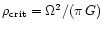 and using
 (Eq. (71)) one obtains:
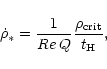 |
(51) |
where
 is the vertical crossing time.
Thus,
together with
is the vertical crossing time.
Thus,
together with
 means that the
star formation rate is proportional to the critical density with respect
to tidal shear divided by the vertical crossing time.
means that the
star formation rate is proportional to the critical density with respect
to tidal shear divided by the vertical crossing time.
The detailed comparison between observations and our model will show
if Q > 1 models are useful to describe clumpy disks with a low gas mass or high velocity
dispersion.
If turbulence is dissipated by self-gravitation, the energy dissipation rate due
to self-gravitation of the disk in z direction
 must equal the constant,
turbulent energy dissipation rate per unit mass
must equal the constant,
turbulent energy dissipation rate per unit mass
 .
.
The energy due to self-gravitation of a gaseous disk is
 |
(52) |
where  is the disk surface. The growth rate of the gravitational
instability in z direction is approximately the free fall time
is the disk surface. The growth rate of the gravitational
instability in z direction is approximately the free fall time
 .
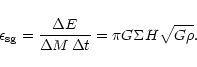
Thus, one obtains for the energy dissipation rate per unit mass due to self-gravitation
.
Thus, one obtains for the energy dissipation rate per unit mass due to self-gravitation
 |
(53) |
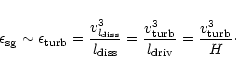
Using Eqs. (43) and (44) it can be shown that
 |
(54) |
In order to estimate the mass of a self-gravitating cloud, we use
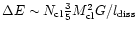 ,
where
,
where
 is the number of selfgravitating clouds and
 is the cloud mass.
With the free fall time of the clouds
is the cloud mass.
With the free fall time of the clouds
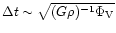 this leads to
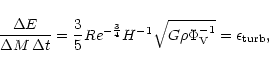 |
(55) |
where
 is the volume filling factor (see Sect. 6.1) and
 .
Using the expression for
derived in Sect. 6.1 and
Eq. (43) gives
.
Using the expression for
derived in Sect. 6.1 and
Eq. (43) gives
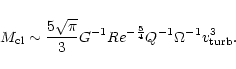 |
(56) |
With Q=1, Re=50,
 yr-1, and
 kms-1one obtains
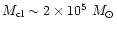 .
This is consistent with
the mass of GMCs.
.
This is consistent with
the mass of GMCs.
In the present paper we have assumed that the potential energy gained through
accretion is dissipated locally. This is true only in the absence of radial
energy transport, which can be checked a posteriori.
The energy dissipation rate due to self-gravitation of the disk
in z direction is
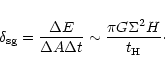 |
(57) |
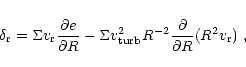
The radial energy flux is given by
 |
(58) |
where
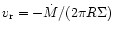 is the radial velocity
and e the specific internal energy.
For supersonic turbulence in clumpy disks e is dominated by the specific kinetic
energy
is the radial velocity
and e the specific internal energy.
For supersonic turbulence in clumpy disks e is dominated by the specific kinetic
energy
 .
Since
,
.
Since
,
 .
With
.
With
 one obtains
 |
(59) |
Using
and Eqs. (43), (46), (48), (49) one obtains
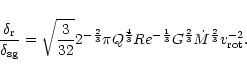 |
(60) |
With Q=1, Re=50, and
yr-1 (see Sect. 7)
this leads to
![\begin{displaymath}%
\frac{\delta_{\rm r}}{\delta_{\rm sg}} \sim \frac{2}{(v_{\rm rot} [{\rm km\,s}^{-1}])^{2}}
\ll 1.
\end{displaymath}](/articles/aa/full/2002/06/aah2905/img241.gif) |
(61) |
The radial advective energy flux is much smaller than the energy gain by mass accretion
and can therefore be neglected as long as Eq. (61) holds.
We can conclude here that the energy flux transported to
small scales by turbulence has the same order of magnitude as the energy dissipation
rate due to selfgravitation of the gaseous disk.
Moreover, the potential energy gained through accretion is dissipated locally at small scales.
Since our model fits observations for a reasonable choice of parameters,
we conclude that, based on energy flux conservation, it is possible that turbulence
is generated and dissipated through gravitational instabilities, and maintained by
the energy input due to mass inflow and differential rotation (Sect. 3.4).
6.1 Volume filling factors
In this section we compare the crossing time of a turbulent cloud to the
gravitational free fall time in order to derive an expression for the
volume filling factor as a function of the Reynolds number Re and the
Toomre parameter Q. We assume turbulence with a Kolmogorov spectrum
for
 .
This implies:
.
This implies:
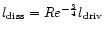 and
and
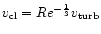 ,
where
,
where
 is the turbulent
velocity of a cloud of size
.
is the turbulent
velocity of a cloud of size
.
The characteristic turbulent time scale of clouds whose size is comparable
to the dissipative length scale is
 |
(62) |
The gravitational free fall time is given by
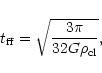 |
(63) |
where
 is the density of a single cloud, which is related
to the overall disk density
by the volume filling factor
is the density of a single cloud, which is related
to the overall disk density
by the volume filling factor
 :
:
 .
.
The clouds are self gravitating for
 .
Inserting the
expressions given in Sect. 4 leads to:
.
Inserting the
expressions given in Sect. 4 leads to:
- 1.
- dominating central mass:
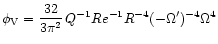 ;
;
- 2.
- dominating stellar disk mass:
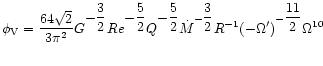
 ;
;
- 3.
- self-gravitating gas disk in z direction:
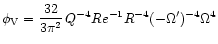 .
.
For a non Kolmogorov spectrum
,
the volume filling factors have to be
multiplied by Re-1:
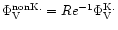 .
.
We will now consider the limit
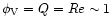 ,
which means
,
which means
 and
and
 .
This implies
.
This implies  ,
i.e. this is the limit for a spherical configuration.
It is assumed that
,
i.e. this is the limit for a spherical configuration.
It is assumed that
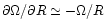 .
The viscosity prescription (Eq. (11)) together with
energy flux conservation equation (Eq. (24)) gives
.
The viscosity prescription (Eq. (11)) together with
energy flux conservation equation (Eq. (24)) gives
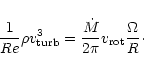 |
(64) |
Setting
 ,
Re=1 and using
,
Re=1 and using
 leads to
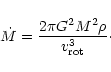 |
(65) |
This is equivalent to the Bondi-Hoyle accretion rate (Bondi & Hoyle 1944),
which is given by
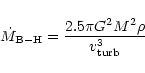 |
(66) |
for
.
In order to derive an expression for the molecular fraction of the gas in the disk,
we compare the crossing time of the turbulent layer
 and the
H-H2 transition time scale
and the
H-H2 transition time scale
 (Hollenbach & Tielens 1997).
We define the molecular fraction here as
(Hollenbach & Tielens 1997).
We define the molecular fraction here as
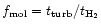 .
.
For the three different cases we obtain using a Kolmogorov spectrum:
- 1.
- dominating central mass:
 ;
;
- 2.
- dominating stellar disk mass:

 ;
;
- 3.
- self-gravitating gas disk in z direction:
 .
.
For a non Kolmogorov spectrum
,
the molecular fractions have to be
multiplied by
 :
:
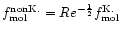 .
.
In the following we will only treat the case of a self-gravitating gas disk in
z direction, because it represents the most realistic description of
normal field spiral galaxies. We will motivate this choice in Sect. 6.4.
For a galaxy with a constant rotation velocity the molecular gas surface density
is given by
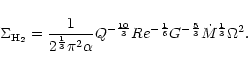 |
(67) |
The total integrated molecular gas mass is then
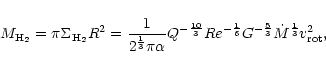 |
(68) |
which does not depend on the galactic radius.
With these results we can now calculate the ratio of molecular to atomic gas in
spiral galaxies
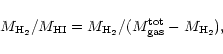 |
(69) |
where
 is the total gas mass.
6.4 Star formation and the Tully-Fisher relation
The star formation rate per unit area
 is usually described by a
Schmidt law (Schmidt 1959) of the form
is usually described by a
Schmidt law (Schmidt 1959) of the form
 |
(70) |
where
 (Kennicutt 1998). An alternative description of the star
formation rate was proposed by Elmegreen (1997) and Silk (1997).
They suggested that it scales with the ratio of the gas density to the average
orbital time scale
(Kennicutt 1998). An alternative description of the star
formation rate was proposed by Elmegreen (1997) and Silk (1997).
They suggested that it scales with the ratio of the gas density to the average
orbital time scale
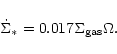 |
(71) |
This parameterization provides a fit that is nearly as good as the Schmidt law.
On the basis of our model, we suggest that the star formation time scale
is
 ,
which is the interaction time scale
between the clouds. This corresponds to the time scale
of gravitational encounters between the clouds. We thus find
,
which is the interaction time scale
between the clouds. This corresponds to the time scale
of gravitational encounters between the clouds. We thus find  ,
which
is only a factor 2 higher than our estimate based on the disk height and
the cloud size. In the case of a constant rotation velocity our star formation
prescription yields in the case of selfgravitation in z direction:
,
which
is only a factor 2 higher than our estimate based on the disk height and
the cloud size. In the case of a constant rotation velocity our star formation
prescription yields in the case of selfgravitation in z direction:
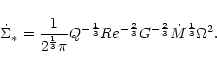 |
(72) |
Thus both, the star formation rate per unit area and the molecular gas density,
are proportional to the square of the angular velocity
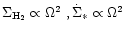 .
Both profiles have thus
the same dependence on the galactic radius. This is what is found when comparing
CO and H,
radio continuum, B band luminosity profiles of most of the Virgo
cluster galaxies observed by Kenney & Young (1989). More recently, Rownd & Young (1999)
combined H
imaging and CO-line observations to derive radial star formation
efficiencies for a sample of cluster and field spiral galaxies. They found that
.
Both profiles have thus
the same dependence on the galactic radius. This is what is found when comparing
CO and H,
radio continuum, B band luminosity profiles of most of the Virgo
cluster galaxies observed by Kenney & Young (1989). More recently, Rownd & Young (1999)
combined H
imaging and CO-line observations to derive radial star formation
efficiencies for a sample of cluster and field spiral galaxies. They found that
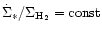 ,
which is consistent with
our findings. It is worth noting, that in the framework of our model this
proportionality only exists between the star formation rate and the molecular gas mass
and not the total gas mass.
,
which is consistent with
our findings. It is worth noting, that in the framework of our model this
proportionality only exists between the star formation rate and the molecular gas mass
and not the total gas mass.
Whereas the star formation laws of Kennicutt (1998) or Silk (1997) depend explicitly
on the gas surface density, our prescription only depends on the angular velocity .
The proportionality factor depends on
and the free parameters Re, Q.
The results of Rownd & Young (1999) imply that the combination of these
parameters or all parameters individually are the same for all spiral galaxies.
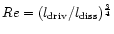
The prescription of Silk (1997) is equivalent to ours
 .
We identify
.
The observationally derived
is consistent
with the definition of
.
We identify
.
The observationally derived
is consistent
with the definition of
 .
For the comparison between the Kennicutt and Silk law we refer to Kennicutt (1998).
.
For the comparison between the Kennicutt and Silk law we refer to Kennicutt (1998).
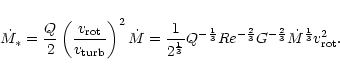
The integrated star formation rate is
 |
(73) |
Thus the integrated star formation rate is proportional to the square
of the rotation velocity as the total amount of molecular gas.
Observationally, Devereux & Hameed (1997) found that the ratio of
star formation rate to molecular gas (
 )
is independent of the morphological type of a spiral galaxy, thus
)
is independent of the morphological type of a spiral galaxy, thus
 .
.
The blue Tully-Fisher relation is dominated by light associated with current
star formation. In general, the galaxy luminosity is proportional to the
rotation velocity at a certain power
 .
Compilations of Tully-Fisher data for available samples find that
.
Compilations of Tully-Fisher data for available samples find that
 2.1-2.2 for the B band with a systematic increase with increasing
wavelength (Silk 1997). Our model would ideally predict
2.1-2.2 for the B band with a systematic increase with increasing
wavelength (Silk 1997). Our model would ideally predict
 ,
i.e.
,
i.e.  .
Since the B band
luminosity is provided by a mixture of stars of different ages, we would expect
that
.
Since the B band
luminosity is provided by a mixture of stars of different ages, we would expect
that  is slightly higher than predicted by our model.
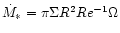
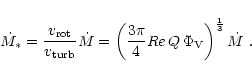
We will now calculate the integrated star formation rate for the case of a galaxy
with dominating stellar disk. Inserting the
expression for the volume filling factor for a constant rotation velocity disk
 and Eq. (41)
into the expression for the integrated star formation rate
and Eq. (41)
into the expression for the integrated star formation rate
 yields
 |
(74) |
Taking
 ,
Re=50,
yr-1,
and
,
Re=50,
yr-1,
and
 kms-1 gives
 kms-1 and
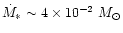 yr-1. Thus, the integrated
star formation rate is comparable to the mass accretion rate. Such low
integrated star formation rates are only observed for S0 galaxies
(Kennicutt 1998). The Toomre parameter for such a disk is
yr-1. Thus, the integrated
star formation rate is comparable to the mass accretion rate. Such low
integrated star formation rates are only observed for S0 galaxies
(Kennicutt 1998). The Toomre parameter for such a disk is
 .
For
.
For
 ,
,
 .
This is not the case for normal field spirals. Thus, for most of the field spiral
galaxies, the case of a self-gravitating disk in z direction applies.
.
This is not the case for normal field spirals. Thus, for most of the field spiral
galaxies, the case of a self-gravitating disk in z direction applies.
Low surface brightness (LSB) galaxies have low density/column density gas
but a high gas fraction
 (de Blok 1999).
These LSB galaxies can be either dwarf galaxies with small rotation velocities
(see e.g. Walter & Brinks 1999) or large galaxies with high rotation velocities
(see e.g. Pickering et al. 1997). Both have small angular velocities
(de Blok 1999).
These LSB galaxies can be either dwarf galaxies with small rotation velocities
(see e.g. Walter & Brinks 1999) or large galaxies with high rotation velocities
(see e.g. Pickering et al. 1997). Both have small angular velocities
 .
Since our model yields
.
Since our model yields
 and
and
 ,
a small angular velocity implies a low gas column density.
Thus, the observed small gas density/column density of LSB galaxies can be
partly due to their small angular velocity.
,
a small angular velocity implies a low gas column density.
Thus, the observed small gas density/column density of LSB galaxies can be
partly due to their small angular velocity.
7 Application to the Galaxy
As motivated in Sect. 6.4 the model of a vertically self-gravitating
gas disk describes the gas disks of spiral galaxies.
We will use the local parameter of the ISM in the solar neighbourhood
given by Binney & Tremaine (1987):
 pc-3,
pc-3,
 pc-2,
pc-2,
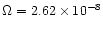 yr-1 and R=10 kpc.
Furthermore, we have shown in Sects. 3.1 and 6.4 that
yr-1 and R=10 kpc.
Furthermore, we have shown in Sects. 3.1 and 6.4 that  60-80.
The rotation curve is assumed to be constant. Equation (43) leads to
.
On the other hand, the definition of the Q parameter (Eq. (27))
would yield
60-80.
The rotation curve is assumed to be constant. Equation (43) leads to
.
On the other hand, the definition of the Q parameter (Eq. (27))
would yield
 kms-1. This equation would thus
require
kms-1. This equation would thus
require  in order to match the gas
velocity dispersion
of
kms-1 found by van der Kruit & Shostak (1982).
We will here adopt
in order to match the gas
velocity dispersion
of
kms-1 found by van der Kruit & Shostak (1982).
We will here adopt
Q=1,
Re=50,
 yr pc-3(this corresponds to a molecular transition time scale of
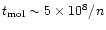 yr, where n is the particle density),
R=10 kpc, and
kms-1.
Equation (46) then leads to
 yr-1.
Thus, we suggest that the Galactic mass accretion rate is
yr-1.
Figure 3 shows the derived turbulent velocity, driving
wavelength, gas column density, disk scale height, gas density, viscosity,
molecular fraction, and volume filling factor for three different
rotation velocities.
yr-1.
Thus, we suggest that the Galactic mass accretion rate is
yr-1.
Figure 3 shows the derived turbulent velocity, driving
wavelength, gas column density, disk scale height, gas density, viscosity,
molecular fraction, and volume filling factor for three different
rotation velocities.
![\begin{figure}
\par\includegraphics[width=13.2cm,clip]{H2905f3.ps}
\end{figure}](/articles/aa/full/2002/06/aah2905/Timg322.gif) |
Figure 3:
Radial profiles of the rotation velocity, angular velocity,
turbulent velocity, driving wavelength, gas column density,
disk scale height, gas density, viscosity, molecular fraction,
and volume filling factor for three different rotation velocities
(solid line:
 kms-1, dashed line: kms-1, dashed line:
 kms-1, dotted line: kms-1, dotted line:
 kms-1). kms-1). |
| Open with DEXTER |
For the model of the Galaxy, we have adopted
kms-1.
This results in a total gas mass of
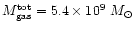 ,
a total molecular gas mass
,
a total molecular gas mass
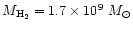 ,
a total atomic gas mass
,
a total atomic gas mass
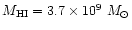 ,
and
,
and
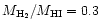 .
Scoville & Sanders (1987) give
.
Scoville & Sanders (1987) give
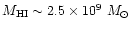 ,
,
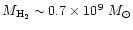 (we have used the conversion factor
X=1020 cm-2(Kkms-1)-1 of Digel et al. 1996)
and thus
(we have used the conversion factor
X=1020 cm-2(Kkms-1)-1 of Digel et al. 1996)
and thus
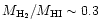 .
Our model calculations are consistent within a factor of 2 with the
absolute values of the total gas mass
and the observed ratio of molecular to atomic gas in the Galaxy.
Figure 4 shows the radial profiles of the
total gas (dotted line), the molecular (solid line), and the
atomic (dashed line) gas surface density for
kms-1and
.
Our model calculations are consistent within a factor of 2 with the
absolute values of the total gas mass
and the observed ratio of molecular to atomic gas in the Galaxy.
Figure 4 shows the radial profiles of the
total gas (dotted line), the molecular (solid line), and the
atomic (dashed line) gas surface density for
kms-1and
 yr pc3.
![\begin{figure}
\par\includegraphics[width=8.8cm,clip]{H2905f4.ps}
\end{figure}](/articles/aa/full/2002/06/aah2905/Timg331.gif) |
Figure 4:
Radial profiles of the total gas (dotted line), the molecular (solid line),
and the atomic (dashed line) gas surface density. |
| Open with DEXTER |
These profiles well resemble that found by Kenney & Young (1989) (their Fig. 12).
Honma et al. (1995) examined the H I and H2 radial distributions
of four face-on spiral galaxies. They found that the gas phase transition occurs
suddenly within a narrow range of radius. This transition is explained using a
theory whose main parameters are the ISM pressure, the UV radiation field, and
the metallicity. It was found that the metallicity gradient is most crucial
for the formation of a narrow range transition. Our model (Fig. 4)
also shows a sharp phase transition. For a given Re, Q, and ,
the location of this transition region depends mainly on the formation time scale of H2 from H I. If
depends on metallicity (and that is
what one would expect), the two models are in good agreement, because radiation,
which is not included in our model, does not play a major rôle.
The disk height equals the driving wavelength
 pc,
and the viscosity is
pc,
and the viscosity is
 pc2 yr
 cm2 s-1.
Thus, the macroscopic Reynolds number is
cm2 s-1.
Thus, the macroscopic Reynolds number is
 .
This value of the driving wavelength is only
a factor of 2 larger than that found by Wada & Norman (2001) in their
2D hydrodynamical simulations.
.
This value of the driving wavelength is only
a factor of 2 larger than that found by Wada & Norman (2001) in their
2D hydrodynamical simulations.
The derived mass accretion rate is much smaller than the star formation rate
(Eq. (73) yields
 yr-1 compared to
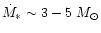 yr-1 as suggested by the observations of
other Sbc spirals; Tammann et al. 1994; Cappellaro et al. 1997).
The current viscous time scale
yr-1 as suggested by the observations of
other Sbc spirals; Tammann et al. 1994; Cappellaro et al. 1997).
The current viscous time scale
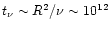 yr
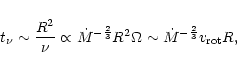
is larger than a Hubble time. Since the viscous time scale is given by
yr
is larger than a Hubble time. Since the viscous time scale is given by
 |
(75) |
viscous evolution has taken place at a time when the mass accretion
rate was higher and/or the disk was smaller and/or rotation velocity was smaller.
After this evolution the gas distribution reached an equilibrium state
that is described by our model. Lin & Pringle (1987b) and later Saio & Yoshii (1990)
have shown that one obtains an exponential stellar disk if
 .
In our model this is only the case for a dominating stellar disk, where
.
In our model this is only the case for a dominating stellar disk, where
 .
However, we have to stress here that
is the
mass accretion rate in the disk. If there is also external accretion present,
this formally increases t*, which can lead to
.
.
However, we have to stress here that
is the
mass accretion rate in the disk. If there is also external accretion present,
this formally increases t*, which can lead to
.
In this section we investigate the link between the morphological classification
of galaxies and their mass on the basis of our model for vertically
selfgravitating gas disks. In general, disk galaxies of later types (Sc-Scd)
are smaller and less massive than galaxies of earlier type (Sa-Sab)
(Roberts & Haynes 1994). Some of the properties which lead to the morphological
classification could thus be due to the galaxies' gravitational potential
as proposed by Gavazzi et al. (1996).
It is a surprising fact that galactic gas disks all have dispersion velocities between
8 and 10 kms-1 (see e.g. Freeman 1999). Assuming a constant rotation
velocity Eq. (46) implies that
 is approximately
constant for spiral galaxies of all types and all luminosities.
Furthermore, if the galaxy forms still actively stars Q should be 1.
Thus
is approximately
constant for spiral galaxies of all types and all luminosities.
Furthermore, if the galaxy forms still actively stars Q should be 1.
Thus
 can only vary by a factor 10.
From Eq. (28) we find
 .
Since the gas velocity dispersion is almost constant,
.
Since the gas velocity dispersion is almost constant,
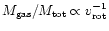 .
Galaxies with high rotation velocities
have thus smaller gas to total mass ratios. This trend is also
observed in the Hubble sequence: early type spirals have larger rotation
velocities and smaller gas to total mass ratios (Roberts & Haynes 1994).
.
Galaxies with high rotation velocities
have thus smaller gas to total mass ratios. This trend is also
observed in the Hubble sequence: early type spirals have larger rotation
velocities and smaller gas to total mass ratios (Roberts & Haynes 1994).
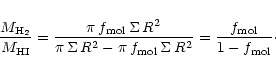
Young & Knezek (1989) have shown that the ratio of molecular to atomic gas mass
in spiral galaxies increases from early type galaxies to late type galaxies by
a factor 10. We have calculated the ratio
 |
(76) |
We used the following parameters: Q=1, Re=50,
yr pc-3, and R=10 kpc.
The result can be seen in Fig. 5.
![\begin{figure}
\par\includegraphics[width=8.8cm,clip]{H2905f5.ps}
\end{figure}](/articles/aa/full/2002/06/aah2905/Timg347.gif) |
Figure 5:
Ratio of molecular to atomic gas mass as a function of the galaxy rotation velocity. |
| Open with DEXTER |
There is almost a factor 10 between the molecular to atomic gas ratio of a galaxy
with
 kms-1 and a galaxy with
 kms-1.
Of course, galaxies with small rotation velocities tend to be smaller,
but their H I diameter should be larger, justifying R= const. as a first approach.
Furthermore, we expect that there is an influence of the molecule
formation time scale
on the ratio between molecular and atomic gas mass.
This time scale should depend on the galaxy's metallicity.
Thus the observed trend might be a mixture of (i) higher metallicities
(and therefore smaller )
of early type spiral galaxies and (ii)
higher rotation velocities of early type spiral galaxies compared to
late type spirals, i.e. that early type galaxies are more massive.
kms-1.
Of course, galaxies with small rotation velocities tend to be smaller,
but their H I diameter should be larger, justifying R= const. as a first approach.
Furthermore, we expect that there is an influence of the molecule
formation time scale
on the ratio between molecular and atomic gas mass.
This time scale should depend on the galaxy's metallicity.
Thus the observed trend might be a mixture of (i) higher metallicities
(and therefore smaller )
of early type spiral galaxies and (ii)
higher rotation velocities of early type spiral galaxies compared to
late type spirals, i.e. that early type galaxies are more massive.
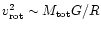
The integrated star formation rate times the rotation period divided by the total
mass should be comparable to the ratio of FIR luminosity to H band luminosity
 .
Using Eq. (73) and
.
Using Eq. (73) and
 ,
we obtain for our model
,
we obtain for our model
 |
(77) |
This means that rapidly rotating galaxies have smaller
.
Devereux & Hameed (1997) found indeed that galaxies of later type have smaller
.
Since the FIR luminosity is assumed to be a measure
of recent star formation and the H band luminosity a measure of the total
mass,
 decreases with increasing mass.
Moreover, Gavazzi et al. (1996) found a trend of smaller
H
equivalent width for more luminous (H band) galaxies.
This also translates into a decreasing
with increasing galaxy mass. Thus, again, a part of this observed trend might be
due to the fact that early spirals have higher rotation velocities than late type
spirals.
decreases with increasing mass.
Moreover, Gavazzi et al. (1996) found a trend of smaller
H
equivalent width for more luminous (H band) galaxies.
This also translates into a decreasing
with increasing galaxy mass. Thus, again, a part of this observed trend might be
due to the fact that early spirals have higher rotation velocities than late type
spirals.
We have analytically investigated the equilibrium state of a turbulent
clumpy gas disk.
The disk consists of distinct self-gravitating clouds, which are be embedded
in a low density medium, and evolve in the fixed gravitational potential
of the galaxy. The disk scale height results from the balance between the
gravitational acceleration and the pressure due to the turbulent velocity
dispersion of the clouds. Gravitational cloud-cloud interactions in the
disk give rise to an effective viscosity and allows the transport of
angular momentum and mass in the gas disk. In our scenario turbulence
is assumed to be generated by instabilities involving self-gravitation
and to be maintained
by the energy input, which is provided by differential rotation of the disk
and mass transfer to smaller galactic radii via cloud-cloud interactions.
A description of the turbulent viscosity is given, which is formally
equivalent to a prescription derived from the collisional Boltzman equation.
The vertical gravitational acceleration in the gas disk is either due to a
(i) dominating central mass, (ii) dominating stellar disk mass, or (iii)
the vertically self-gravitating gas disk itself. For all three cases
we derive analytical expressions for disk parameters (density, surface density,
velocity dispersion, disk height, driving wavelength, and viscosity)
as functions of
the Toomre parameter Q, the turbulent Reynolds number Re,
the mass accretion rate ,
the galactic radius R, and the angular
velocity
of the gas.
The model does not include radiation. The "thermostat'' equation of the
standard accretion disk model is replaced by an equation which assumes
that the energy flux generated by mass inflow and differential rotation
is entirely transported by turbulence to smaller scales where it is dissipated.
Whereas case (iii) corresponds to the
disk, case (i) and (ii)
require Q > 1.
The structure of the resulting clumpy gas disks allows us to derive
global volume filling factors of self-gravitating clouds as a function of
Q and Re. Along the same line analytical expressions for
the molecular fraction and the star formation rate are given.
On the basis of our analytical model we conclude that
- 1.
- constant velocity dispersions in the gas as observed for spiral galaxies can
be reproduced by models with a (i) dominating central mass
and (iii) a vertically selfgravitating gas disk.
- 2.
- In models (ii) with a dominating stellar disk the velocity dispersion
depends on the rotation velocity.
- 3.
- The driving wavelength of the turbulence equals approximately the disk
scale height if the vertical acceleration is not dominated
by the stellar disk.
- 4.
- The effective turbulent viscosity
depends on the galactic radius.
For a disk in Keplerian rotation with a (i) dominating central mass
 .
The other two model classes (ii) and
(iii) give
for a constant velocity rotation curves.
.
The other two model classes (ii) and
(iii) give
for a constant velocity rotation curves.
- 5.
- The molecular gas surface density and the star formation rate are proportional
to the square of the angular velocity
 in
self-gravitating gas disks.
in
self-gravitating gas disks.
The model of a selfgravitating disk in vertical direction is applied to the
Galaxy and gives a good description of its gas disk.
Furthermore, we investigate the rôle of the galaxy mass for the
morphological classification of spiral galaxies.
A comparison of our analytical model to the Galaxy shows that
- 1.
- The observed global star formation time scale implies a Reynolds number
.
- 2.
- Our model is consistent with observations. That is the model reproduces
the physical parameters of the Galaxy as derived from observations.
- 3.
- The derived mass accretion rate of the galaxy is
yr-1. It is thus
much smaller than the star formation rate
 .
.
- 4.
- The dependence of several physical parameters of spiral galaxies on morphological
type might be at least partly due to the mass-morphology relation, i.e.
galaxies of later types are more massive.
In our model we assume that turbulence is generated by local instabilities
due to selfgravitation. The energy input from accretion and differential
rotation is high enough to maintain the ISM turbulence. Moreover,
the energy dissipation rate per unit mass due to the self-gravitation of the
gaseous disk in z direction has the same order of magnitude as the
energy per unit time and unit mass transported to smaller scales by turbulence.
Thus, in terms of energy conservation, turbulence generated and
maintained by gravitation can account for the viscosity of spiral galaxies.
This does not exclude energy input in the turbulence through supernovae.
Nevertheless, our model where accretion in the galactic
potential is sufficient to maintain ISM turbulence is fully consistent with
observations.
Acknowledgements
We would like to thank the referee, K. Wada, for helping us to
improve this article considerably and W. J. Duschl for fruitful discussions.
- Balbus, S. A., & Hawley, J. F. 1991, ApJ, 376, 214
In the text
NASA ADS
- Binney, J., & Tremaine,
S. 1987, in Galactic Dynamics (Princeton University Press)
In the text
- Blitz, L., & Shu, F. H. 1980, ApJ, 238, 148
In the text
NASA ADS
- Bondi, H., & Hoyle, F. 1944, MNRAS, 104, 273
In the text
NASA ADS
- Braginskii, S. I. 1965, in Review of
Plasma Physics, ed. M. A., Leontovich, Consultants Bureau, N. Y., 1, 205
In the text
- Cappellaro, E., Turatto, M., Tsvetkov, D., et al.
1997, A&A, 322, 43
In the text
- Cui, W., Sanders, W. T., McCammon, D.,
Snowden, S. L., & Womble, D. S. 1996, ApJ, 468, 102
In the text
NASA ADS
- de Blok, W. J. G. 1999, in Low
Surface Brightness Universe, ASP Conf. Ser.,
170, ed. J. I. Davies, C. Impey, & S. Phillipps,
Astronomical Society of the Pacific (San Francisco), 161
In the text
- Devereux, N. A., & Hameed, S 1997, AJ, 113, 599
In the text
NASA ADS
- Dickey, J. M. 1993, in The Minnesota lectures on the
structure and dynamics of the Milky Way, ed. R. M. Humphreys, ASP Conf. Ser., 39, 93
In the text
- Digel, S. W., Grenier, I. A., Heithausen, A., Hunter, S. D., & Thaddeus, P. 1996, ApJ, 463, 609
In the text
NASA ADS
- D'Onofrio, M., Capaccioli, M., Merluzzi, P., Zaggia, S., & Boulesteix, J. 1999, A&AS, 134, 437
In the text
NASA ADS
- Duschl, W. J., Strittmatter, P. A., & Biermann, P. L. 2000, A&A, 357, 1123
In the text
NASA ADS
- Elmegreen, B. G. 1982, ApJ, 253, 655
In the text
NASA ADS
- Elmegreen, B. G. 1987, in Interstellar processes,
ed. D. J. Hollenbach, & H. A. Thronson Jr. (Dordrecht: Kluwer), 259
In the text
- Elmegreen, B. G. 1997, in Starburst Activity in Galaxies,
ed. J. Franco, R. Terlevich, & A. Serano, Rev. Mex. Conf. Ser., 6, 165
In the text
- Elmegreen, B. G., & Falgarone, E. 1996, ApJ, 471, 816
In the text
NASA ADS
- Fleck Jr., R. C. 1981, ApJ, 246, L151
In the text
NASA ADS
- Frank, J., King, A., & Raine, D. 1992, Accretion Power in Astrophysics (Cambridge University Press)
In the text
- Frisch, U. 1995, Turbulence - The Legacy of A.N. Kolmogorov (Cambridge University press)
In the text
- Freeman, K. C. 1999, Ap&SS, 269, 119
In the text
NASA ADS
- Gavazzi, G., Pierini, D., & Boselli, A. 1996, A&A, 312, 397
In the text
NASA ADS
- Goldreich, P., & Tremaine, S. 1978, Icarus, 34, 227
In the text
NASA ADS
- Hollenbach, D. J., & Tielens, A. G. G. M. 1997, ARA&A, 35, 179
In the text
NASA ADS
- Honma, M., Sofue, Y., & Arimoto, N. 1995, A&A, 304, 1
In the text
NASA ADS
- Jog, C. J., & Ostriker, J. P. 1988, ApJ, 328, 404
In the text
NASA ADS
- Kenney, J. D. P., & Young, J. S. 1989, ApJ, 344, 171
In the text
NASA ADS
- Kennicutt Jr., R. C. 1998, ARA&A, 36, 189
In the text
NASA ADS
- Klessen, R. S., Heitsch, F., & Mac Low, M.-M. 2000, ApJ, 535, 887
In the text
NASA ADS
- Kulkarni, S. R., & Heiles, C. 1988, in Galactic
and Extragalactic Radio Astronomy, ed. G. L. Verschuur, & K. I.
Kellermann (New York: Springer Verlag), 95
- Kumar, P. 1999, ApJ, 519, 599
In the text
NASA ADS
- Landau, L. D., & Lifschitz, E. M. 1959, Fluid Mechanics
In the text
- Larson, R. B. 1981, MNRAS, 194, 809
In the text
NASA ADS
- Lightman, A. P., & Eardley, D. M. 1974, ApJ, 187, L1
In the text
NASA ADS
- Lin, D. N. C., & Pringle, J. E. 1987a, MNRAS, 225, 607
In the text
NASA ADS
- Lin, D. N. C., & Pringle, J. E. 1987b, ApJ, 320, L87
In the text
NASA ADS
- Lynden-Bell, D., & Pringle, J. E. 1974, MNRAS, 168, 603
In the text
NASA ADS
- Mac Low, M.-M. 1999, ApJ, 524, 169
In the text
NASA ADS
- Mac Low, M.-M., & Ossenkopf, V. 2000, A&A, 353, 339
In the text
NASA ADS
- McKee, C. F., & Ostriker, J. P. 1977, ApJ, 218, 148
In the text
NASA ADS
- Meneveau, C., & Sreenivasan, K. R. 1990, Phys. Rev. A, 41, 2246
In the text
NASA ADS
- Ozernoy, L. M., Fridman, A. M., & Biermann, P. L. 1998,
A&A, 337, 105
In the text
NASA ADS
- Paczynski, B. 1978, Acta Astron., 28, 91
In the text
NASA ADS
- Parker, E. N. 1966, ApJ, 145, 811
In the text
NASA ADS
- Passot, T., Pouquet, A., & Woodward, P. 1988, A&A, 197, 228
In the text
NASA ADS
- Pickering, E., Impey, C. D., van Gorkom, J. H.,
& Bothun, G. D. 1997, AJ, 114, 1858
In the text
NASA ADS
- Pringle, J. E. 1981, ARA&A, 19, 137
In the text
NASA ADS
- Pringle, J. E., Rees, M. J., &
Pacholczyk, A. G. 1973, A&A, 29, 179
In the text
NASA ADS
- Roberts, M. S., & Haynes, M. P. 1994, ARA&A, 32, 115
In the text
NASA ADS
- Rownd, B. K., & Young, J. 1999, ApJ, 118, 670
In the text
- Saio, H., & Yoshii, Y. 1990, ApJ, 363, 40
In the text
NASA ADS
- Sanders, D. B., Scoville, P. M., & Solomon, P. M. 1985, ApJ, 289, 373
In the text
NASA ADS
- Scalo, J. 1985, in Protostars and Planets II,
ed. D. C. Black, & M. S. Matthews (Tucson: Univ. Arizona), 201
In the text
- Scoville, N. Z., & Sanders, D. B. 1987,
in Interstellar processes, ed. D. J. Hollenbach, & H. A.
Thronson Jr. (Dordrecht: Kluwer), 21
In the text
- Schmidt, M. 1959, ApJ, 129, 243
In the text
NASA ADS
- Shlosman, I., & Begelman, M. C. 1987, Nature, 329, 810
In the text
NASA ADS
- Shlosman, I., & Begelman, M. C. 1989, ApJ, 341, 685
In the text
NASA ADS
- Shakura, N. I. 1972, Astron.
Zhur. 49, 921 (translated in: SvA AJ 16, 921 (1973))
In the text
- Shakura, N. I., & Sunyaev, R. A. 1973, A&A, 24, 337
In the text
NASA ADS
- Silk, J. 1997, ApJ, 481, 703
In the text
NASA ADS
- Silk, J., & Norman, C. 1981, ApJ, 247, 59
In the text
NASA ADS
- Spitzer, L. 1968, Diffuse Matter in Space (New York: Wiley Interscience)
In the text
- Stewart, G. L., & Kaula, W. 1980, Icarus, 44, 154
In the text
NASA ADS
- Tammann, G., Loefler, W., & Schroder, A. 1994, ApJS, 92, 487
In the text
NASA ADS
- Toomre, A. 1964, ApJ, 139, 1217
In the text
NASA ADS
- van der Kruit, P. C., & Shostak, G. S. 1982, A&A, 105, 351
In the text
NASA ADS
- Vollmer, B., & Duschl, W. J. 2000, A&A, 367, 72
In the text
NASA ADS
- Wada, K., & Norman, C. A. 1999, ApJ, 516, L13
In the text
NASA ADS
- Wada, K., & Norman, C. A. 2001, ApJ, 547, 172
In the text
NASA ADS
- Walter, F., & Brinks, E. 1999, in Low
Surface Brightness Universe, ASP Conf. Ser., 170,
ed. J. I. Davies, C. Impey, & S. Phillipps, Astronomical
Society of the Pacific (San Francisco), 224
In the text
- Young, J. S., & Knezek, P. M. 1989, ApJ, 347, L55
In the text
NASA ADS
Copyright ESO 2002
![\begin{figure}
\par\includegraphics[width=13.2cm,clip]{H2905f1.ps}
\end{figure}](/articles/aa/full/2002/06/aah2905/img139.gif)
![\begin{figure}
\par\includegraphics[width=13cm,clip]{H2905f2.ps}
\end{figure}](/articles/aa/full/2002/06/aah2905/img153.gif)
![\begin{figure}
\par\includegraphics[width=13.2cm,clip]{H2905f3.ps}
\end{figure}](/articles/aa/full/2002/06/aah2905/img322.gif)
![\begin{figure}
\par\includegraphics[width=8.8cm,clip]{H2905f4.ps}
\end{figure}](/articles/aa/full/2002/06/aah2905/img331.gif)
![\begin{figure}
\par\includegraphics[width=8.8cm,clip]{H2905f5.ps}
\end{figure}](/articles/aa/full/2002/06/aah2905/img347.gif)