![[*]](/icons/foot_motif.gif)
A&A 381, 464-471 (2002)
DOI: 10.1051/0004-6361:20011474
Z. Y. Wu1,2,3 - K. P. Tian1,2,3 - L. Balaguer-Núñez5,1 - C. Jordi5,6 - J. L. Zhao 4,1,2,3 - J. Guibert7
1 - Shanghai Astronomical Observatory, CAS Shanghai 200030,
PR China
2 -
Chinese National Observatories, CAS, PR China
3 -
Joint Lab of Optical Astronomy, CAS, PR China
4 -
CCAST (WORLD LABORATORY) PO Box 8730, Beijing 100080,
PR China
5 -
Departament d'Astronomia i Mateorologia, Universitat de
Barcelona, Avda. Diagonal 647, 08028 Barcelona, Spain
6 -
Institut d'Estudis Espacials de Catalunya IEEC, Edif. Nexus
Gran Capità 24, 08034 Barcelona, Spain
7 -
Centre d'Analyse des Images, Observatoire de Paris,
Bâtiment Perrault, 77 Av. Denfert-Rochereau,
75014 Paris, France
Received 7 May 2001 / Accepted 18 October 2001
Abstract
Absolute proper motions, their corresponding errors and membership
probabilities of 501 stars in the intermediate-age open cluster NGC 2548 region
are determined from MAMA
measurements of 10 photographic plates. The plates
have the maximum epoch difference of 82 years and they were taken
with the double astrograph at Zô-Sè station of Shanghai
Observatory, which has an aperture of 40 cm
and a plate scale of 30
 mm-1. The average proper motion
precision is 1.18 mas yr-1. These proper motions are used to
determine the membership probabilities of stars in the region.
The number of stars with membership probabilities higher than 0.7
is 165.
mm-1. The average proper motion
precision is 1.18 mas yr-1. These proper motions are used to
determine the membership probabilities of stars in the region.
The number of stars with membership probabilities higher than 0.7
is 165.
Key words: galaxy: open clusters and associations: individual: NGC 2548 - astrometry - galaxy: kinematics and dynamics
The open cluster NGC 2548, also known as M 48, in Hydra
(
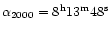 ,
,
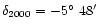 )
seems to be an intermediate-age open cluster with an estimated distance
of 630 pc (Pesch 1961) or 530 pc (Clariá 1985).
It has not been the object of
any recent complete astrometric or photometric study
(Ebbinghausen 1939; Li 1954), in spite of being an extended
object with an apparent diameter of
)
seems to be an intermediate-age open cluster with an estimated distance
of 630 pc (Pesch 1961) or 530 pc (Clariá 1985).
It has not been the object of
any recent complete astrometric or photometric study
(Ebbinghausen 1939; Li 1954), in spite of being an extended
object with an apparent diameter of
 (Trumpler 1930) or even
 (Collinder 1931) and brilliant enough to be
in the Messier list (s.XVIII) with number 48 (Messier 1850).
It was even considered inexistent for several years
owing to the fact that Messier mistook its real coordinates owing to a
change of sign in its relative position
with a final difference in declination of
(Collinder 1931) and brilliant enough to be
in the Messier list (s.XVIII) with number 48 (Messier 1850).
It was even considered inexistent for several years
owing to the fact that Messier mistook its real coordinates owing to a
change of sign in its relative position
with a final difference in declination of  .
.
There is no
feasible estimation of its age but it seems to be an intermediate-age
open cluster, around
 (Lyngå 1987),
with a slightly poorer CN abundance
than the giants of the Hyades but significantly
richer than the K giants of the solar neighborhood (Clariá
1985; Twarog et al. 1997).
(Lyngå 1987),
with a slightly poorer CN abundance
than the giants of the Hyades but significantly
richer than the K giants of the solar neighborhood (Clariá
1985; Twarog et al. 1997).
Proper motions of bright stars in this region were published by Ebbinghausen (1939) with four pairs of plates of only a maximum epoch difference of 28 years. Li (1954) published positions and proper motions in the field of NGC 2548 based on three plates taken with the 40 cm astrograph at Shanghai Zo-Sè station with a maximum epoch difference of only 14 years.
In this paper we determine, for the first time, precise
absolute proper motions of 501 stars within a 1
 6
6  1
6 area in the NGC 2548 region, from automatic MAMA measurements
of 10 plates, five of which are newly taken. The estimated
membership probabilities lead
us to a complete astrometric study of the cluster area.
Section 2 describes the plate material and its measurement as well as
the proper motion reduction procedure and results with comparisons with the
Hipparcos and Tycho-2 catalogues. Section 3 accounts for the membership
determination. Section 4 is devoted to the analysis of results.
Finally, a summary is presented in Sect. 5.
1
6 area in the NGC 2548 region, from automatic MAMA measurements
of 10 plates, five of which are newly taken. The estimated
membership probabilities lead
us to a complete astrometric study of the cluster area.
Section 2 describes the plate material and its measurement as well as
the proper motion reduction procedure and results with comparisons with the
Hipparcos and Tycho-2 catalogues. Section 3 accounts for the membership
determination. Section 4 is devoted to the analysis of results.
Finally, a summary is presented in Sect. 5.
| Plate | Epoch | Exp.Time | Plate center | Plate size | No. of |
| Id. | (1900+) | min | (

 ) ) |
cm | stars |
| CL422 | 16.03.24 | 90 | 8
 2283 -5
779 2283 -5
779 |
2430 |
450 |
| CL534 | 30.03.21 | 90 | 8
2286 -5
775 |
2430 |
556 |
| CL535 | 30.03.28 | 90 | 8
2291 -5
767 |
2430 |
566 |
| CL56006 | 56.03.14 | 60 | 8
2288 -5
779 |
2430 |
577 |
| CL56007 | 56.03.16 | 60 | 8
2372 -5
779 |
2430 |
558 |
| CL98004 | 98.04.03 | 30 | 8
2447 -5
958 |
2430 |
548 |
| CL98047 | 98.12.16 | 30 | 8
2227 -5
796 |
2020 |
268 |
| CL98Tian | 98.12.25 | 30 | 8
2255 -5
804 |
2020 |
268 |
| CL98Chen | 98.12.25 | 30 | 8
2255 -5
804 |
2020 |
298 |
| CL98Gu | 98.12.16 | 30 | 8
2227 -5
796 |
2020 |
432 |
Ten plates of the NGC 2548 region were available.
They were taken with the double astrograph at the Zô-Sè station
of Shanghai Observatory. This telescope, built by Gaultier in Paris
at the beginning of the last century, has an aperture of 40 cm, a focal
length of 6.9 m and hence a plate scale of 30
mm-1. The size of the
old plates is 24 cm by 30 cm, or 2
0
2
5,
and that of the new ones is 20 cm by 20 cm, or 1
65
1
65.
The oldest plate was taken in 1916, and the newest ones in 1998. Relevant information on these plates is shown in Table 1. The hour angles are not provided in Table 1 because the starting exposure time of the old plates was not recorded.
All plates were measured at the Centre d'Analyse des Images at
the Observatoire de Paris, using the high precision
microdensitometer "Machine Automatique à Mesurer pour l'Astronomie''
(MAMA).
This device has a superb optical and mechanical performance
(Guibert et al. 1990). It uses a quartz-iodine illuminating
source, whose transmitted light is detected by a reticon, 1024
pixels large, with a pixel size of 10  m, and the absolute
accuracy of the measurements is 0.6 m (Soubiran 1992).
After the plates were scanned, the resulting images
were stored in a grid of
m, and the absolute
accuracy of the measurements is 0.6 m (Soubiran 1992).
After the plates were scanned, the resulting images
were stored in a grid of
 sub-images for each plate.
Once every plate was digitized, we
identified all point sources in these 361 frames. The source
extraction was performed on each frame using SExtractor
(Bertin & Arnouts 1996), a software dedicated to the
automatic analysis of astronomical images using a
multi-threshold algorithm allowing good object deblending.
To improve the accuracy of the measurements, we chose to
retain only rather bright objects with a signal-to-noise ratio of at
least 12.
sub-images for each plate.
Once every plate was digitized, we
identified all point sources in these 361 frames. The source
extraction was performed on each frame using SExtractor
(Bertin & Arnouts 1996), a software dedicated to the
automatic analysis of astronomical images using a
multi-threshold algorithm allowing good object deblending.
To improve the accuracy of the measurements, we chose to
retain only rather bright objects with a signal-to-noise ratio of at
least 12.
During the scanning, MAMA includes in the
catalogue not only real images, but also the plate grid,
emulsion flaws, plate annotations and scratches. A first step
is required to reject spurious detections, most of which
can be recognized with analysis of the object shape,
by removing the plate grid, annotations and big scratches by
visual comparison with the original plates.
The shape parameters given by SExtractor can be
used to clarify the remaining stars but the most direct way to reject
spurious detection is by comparison between plates,
searching each object from one plate to the other, and
retaining only the paired data.
There is a total of 596 stars measured with a
limiting magnitude  around 14.
This limiting magnitude was roughly estimated from the stars
in common with Tycho-2 catalogue.
around 14.
This limiting magnitude was roughly estimated from the stars
in common with Tycho-2 catalogue.
The detection of 182 PPM and ACT stars on the whole plate allowed us to determine the star positions in a common system. Thus for each scanned plate, we obtained a preliminary astrometric catalogue to perform initial cross-identification between plates.
The absolute proper motions for 596 stars in the region of NGC 2548 were reduced on the basis of the MAMA measurements following the central overlapping procedure (Russel 1976; Wang et al. 1995, 1996, 2000). This method determines the plate-to-plate transformation parameters, the star motions and their errors simultaneously. Stellar positions and absolute proper motions were reduced from a catalogue used as the original data for the first iteration. As initial catalogue, 265 stars from the Tycho-2 catalogue at epoch J2000 (Hog et al. 2000) were chosen on the basis of the results of the PPM and ACT astrometric catalogue given by MAMA. To select the best plate constant model, we used Eichhorn & Williams' criterion (Eichhorn & Williams 1963; Wang et al. 1982) and obtained a model with six linear constants on coordinates, a magnitude and a coma term, and a magnitude distortion term. Magnitudes used were the instrumental magnitudes. All the proper motions are constrained by having at least one measurement from the modern epoch plates, i.e. taken in 1998. The whole process is iterated until the resulting proper motions converge. We iterate the process until mean differences in position are smaller than 1.1 mas, the rms smaller than 3.6 mas and the differences in proper motion below 0.1 masyr-1, yielding a final outcome of 501 stars.
Table 2 shows mean precisions of final proper motions
for stars in the NGC 2548 region detected on different numbers of measured
plates (greater than 2).
The units of the proper motions and their precisions all along are
mas yr-1. The precision of the final proper motions strongly depends
on the number of plates.
Figure 1 gives the number of stars for which various
numbers of plates are available. More than  of proper
motions were obtained from at least 5 plates.
of proper
motions were obtained from at least 5 plates.
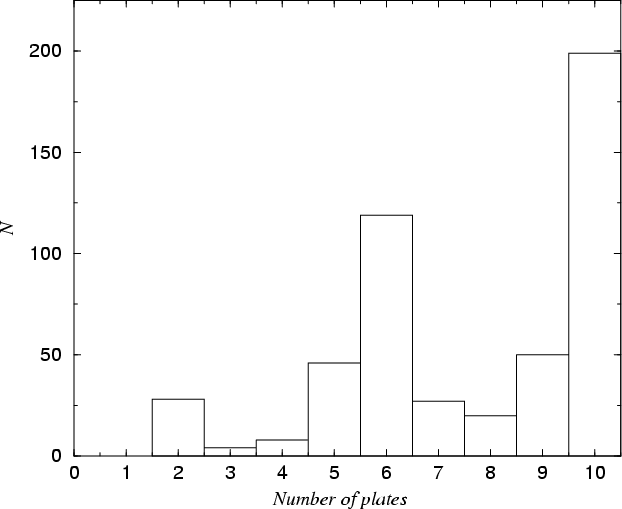 |
Figure 1: The number of stars vs the number of available plates. |
| Open with DEXTER | |
The rms errors on proper motions for more than
of stars
are
 mas yr-1,
 masyr-1 and
 masyr-1, where
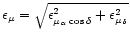 .
In the most precise case, the rms errors are
0.77 masyr-1 for stars with 10 plates (
.
In the most precise case, the rms errors are
0.77 masyr-1 for stars with 10 plates ( of stars).
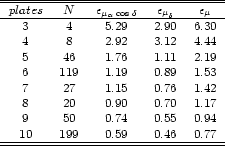 |
Figure 2 shows the distribution of rms proper motion errors with
the number of stars: N versus
 ,
,
 and
and
 .
Thus the precisions
of the proper motions of stars in the region of NGC 2548 obtained
in this study are relatively high, thanks to the quality of the stellar
images taken with
the 40 cm double astrograph and the excellent positioning behavior of the
MAMA scanning machine.
.
Thus the precisions
of the proper motions of stars in the region of NGC 2548 obtained
in this study are relatively high, thanks to the quality of the stellar
images taken with
the 40 cm double astrograph and the excellent positioning behavior of the
MAMA scanning machine.
Figure 3 gives
 ,
,
 and their errors with respect to
instrumental magnitude.
and their errors with respect to
instrumental magnitude.
Our absolute proper motions and their errors are compared with those of
Tycho-2 catalogue
in Fig. 4. We would like to highlight the
precision of the proper motions derived in this paper.
Mean differences in the sense ours minus Tycho-2 are -0.123 ( = 2.112)
and -0.203 ( = 2.158) in
and
,
respectively.
No apparent systematic residuals were
found as a function of magnitude.
A linear fit to the proper motion data gives us:
= 2.112)
and -0.203 ( = 2.158) in
and
,
respectively.
No apparent systematic residuals were
found as a function of magnitude.
A linear fit to the proper motion data gives us:

Only 8 stars were found in this region from the Hipparcos
catalogue (ESA 1997). By comparing our absolute proper
motions with these common stars, the
mean differences are (in the sense ours minus Hipparcos) -0.610 (
= 1.710) and
-0.198 (
 )
in
and
,
respectively.
We obtain the following linear fit:
)
in
and
,
respectively.
We obtain the following linear fit:

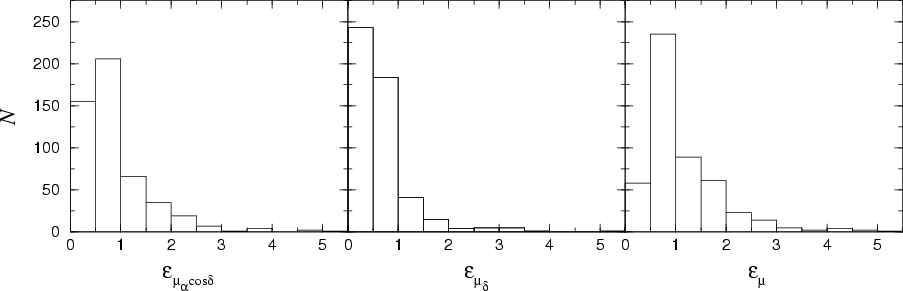 |
Figure 2: The number of stars vs. the rms errors on proper motions in mas yr-1. |
| Open with DEXTER | |
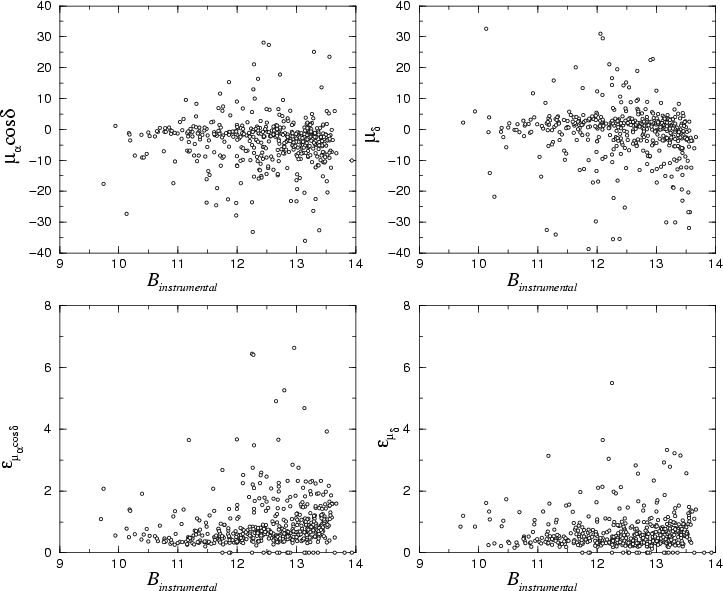 |
Figure 3: Proper motions (top) and their errors (bottom) vs. instrumental magnitude. Null errors are from proper motions calculated with only two plates. (Units are mas yr-1). |
| Open with DEXTER | |
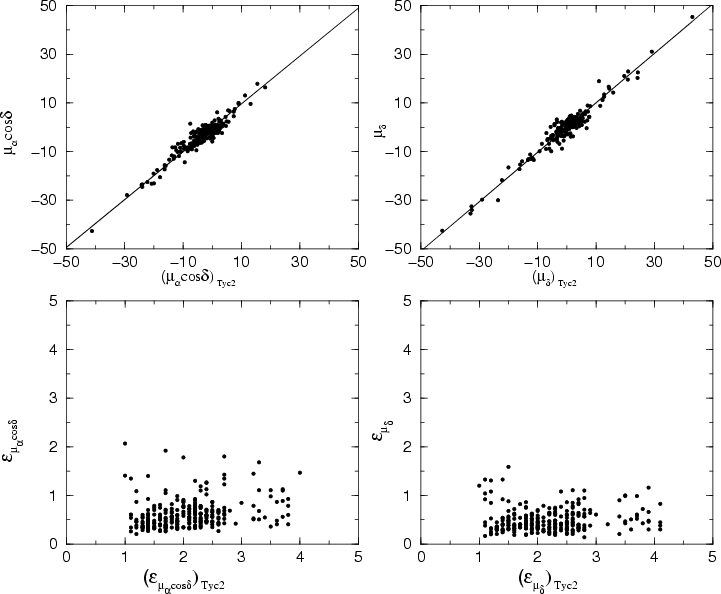 |
Figure 4: Proper motions and their errors from this paper compared to those in Tycho-2 catalogue. (Units are mas yr-1). |
| Open with DEXTER | |
An improved method for membership determination of stellar clusters based on proper motions with different observed precisions was developed by Stetson (1980) and Zhao & He (1990). Zhao & Shao (1994) then added the correlation coefficient of the field star distribution to the set of parameters describing their distribution on the sky. This model has been frequently used (Wang et al. 1995, 1996, 2000).
We used a maximum likelihood method with a 9-parametric
Gaussian model for the frequency function,
as follows:
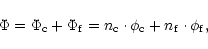
where
 ,
and
,
and
 ,
are the probability density functions of cluster members and
field stars respectively in the proper motion space,
with
,
are the probability density functions of cluster members and
field stars respectively in the proper motion space,
with  the normalized number of cluster stars, and
  the normalized number of field stars.
The probability density function for the ith star of the cluster can be written as
follows:
![\begin{eqnarray*}\phi_{\rm c}(i) &=&\frac{1} {2\pi (\sigma_{\rm c}^2+\epsilon_{(...
...gma_{\rm c}^2+\epsilon_{(\mu_{\delta})_{i}}^2}\right]\right\},
\end{eqnarray*}](/articles/aa/full/2002/02/aah2862/img45.gif)
 ,
,
 ]
are the
proper motions of the ith star, [
]
are the
proper motions of the ith star, [
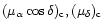 ]
the cluster mean proper motion,
]
the cluster mean proper motion,
 the intrinsic proper motion dispersions of member stars
and [
the intrinsic proper motion dispersions of member stars
and [
 ,
,
 ]
the observed
errors on the proper motion components of the ith star.
]
the observed
errors on the proper motion components of the ith star.
Analogously, for the field we have:
![\begin{eqnarray*}\phi_{\rm f}(i) =&&\frac{1}{2\pi (1-\gamma^2)^{1/2}
(\sigma_{(\...
...)_{\rm f}}^2+\epsilon_{(\mu_{\delta})_{i}}^2}\right] \right \} ,
\end{eqnarray*}](/articles/aa/full/2002/02/aah2862/img52.gif)
where
[
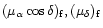 ]
are the field mean proper motion,
[
]
are the field mean proper motion,
[
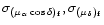 ]
the field intrinsic
proper motion dispersions and
]
the field intrinsic
proper motion dispersions and  is the correlation coefficient.
The unknown parameters for the assumed  distribution are [,
 ,
,
 ,
]
for the cluster and
[
,
]
for the cluster and
[
 ,
,
 ,
,
 ,
,
 ,
]
for the field population. Membership probability
of the ith star belonging to the cluster can be calculated
from
,
]
for the field population. Membership probability
of the ith star belonging to the cluster can be calculated
from

 mas yr-1.
|
|
|
|
 |
 |
|
|
| NGC 2548 | 0.382 | -1.41 | 1.64 | 1.23 | |||
 |
 |
|
 |
||||
| field | -4.89 | -1.63 | 7.37 | 8.21 | -0.28 | ||
 |
 |
 |
 |
0.03 |
Table 5 lists the results for all 501 stars in the region of the
open cluster: Col. 1 is the ordinal star number; Cols. 2 and 3
are
and
;
Cols. 4 and 6 are the respective absolute proper motions (
 ); Cols. 5 and 7 are the
standard errors of the proper motions; Col. 8 is the membership
probability of stars belonging to NGC 2548
); Cols. 5 and 7 are the
standard errors of the proper motions; Col. 8 is the membership
probability of stars belonging to NGC 2548
 ;
Col. 9 is the
instrumental magnitude given by SExtractor;
Col. 10 gives the number of plates used and Col. 11 the identification number
in Tycho-2 for the stars in common.
;
Col. 9 is the
instrumental magnitude given by SExtractor;
Col. 10 gives the number of plates used and Col. 11 the identification number
in Tycho-2 for the stars in common.
| Table 5 | Hipparcos | Tycho-2 | BDA | Member |  |
| 257 | 40110 | 4859_00078_1 | 366 | N | 0.00 |
| 140 | 40238 | 4859_00250_1 | 1005 | M | 0.87 |
| 139 | 40254 | 4859_00036_1 | 1073 | M | 0.77 |
| 336 | 40281 | 4859_00921_1 | 0.00 | ||
| 133 | 40302 | 4855_01706_1 | 1320 | M | 0.78 |
| 234 | 40348 | 4859_01156_1 | 1560 | M | 0.88 |
| 162 | 40362 | 4859_00092_1 | 1628 | M | 0.84 |
| 42 | 40498 | 4856_00072_1 | 2184 | N | 0.00 |
The cross-identification of our 8 common stars with the Hipparcos catalogue is shown in Table 4. Comparison with the membership determination calculated by Baumgardt et al. (2000) for the seven stars in common shows complete agreement.
Figures 5 and 6 show the proper motion vector-point
diagram and the position distribution on the sky for all the measured
stars respectively, where  denotes a member of NGC 2548 with
 ,
and all other stars are considered field stars indicated
by "+".
,
and all other stars are considered field stars indicated
by "+".
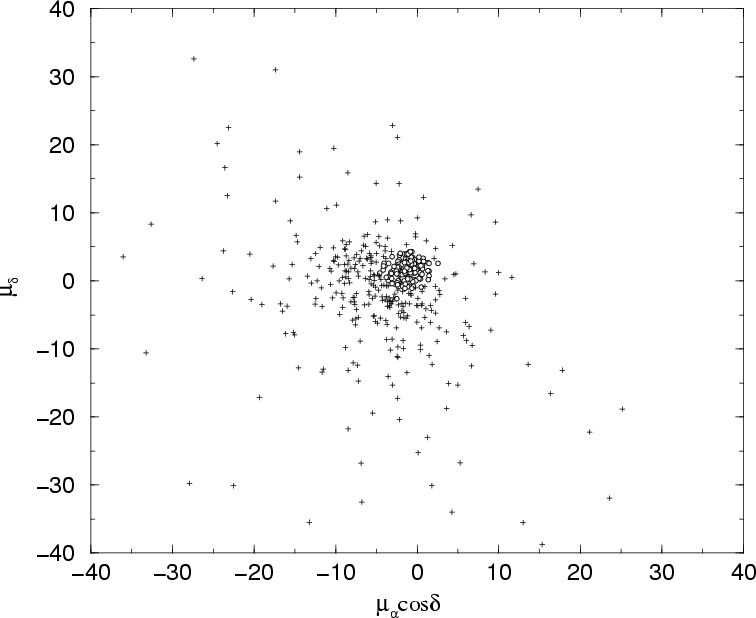 |
Figure 5:
The proper motion vector-point diagram of NGC 2548. (Units are mas yr-1.)
(" " denotes a member of NGC 2548 with
,
"+" a field star with " denotes a member of NGC 2548 with
,
"+" a field star with
 ). ). |
| Open with DEXTER | |
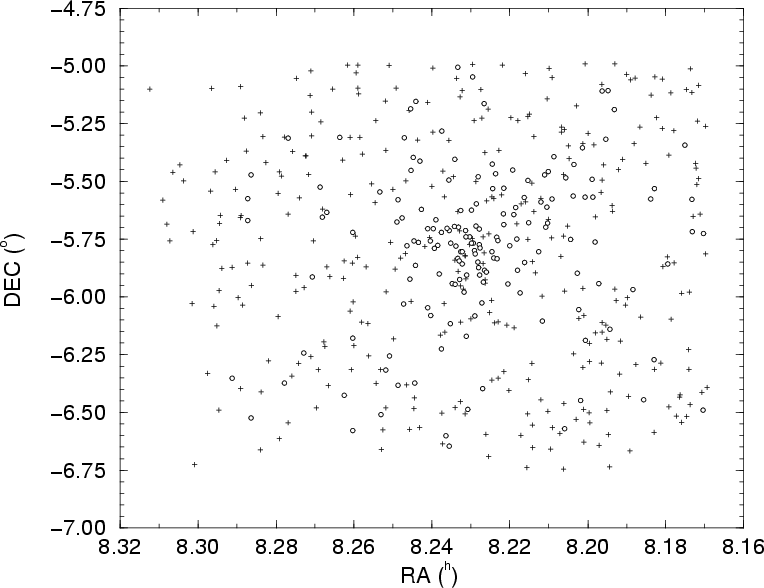 |
Figure 6:
The position distribution of stars in NGC 2548 area.
("" denotes a member of NGC 2548 with
,
"+" a field star with
). |
| Open with DEXTER | |
The cluster membership probability histogram (Fig. 7) shows a very
clear separation between cluster members and field stars. The
number of stars with membership probabilities higher than 0.7 for
NGC 2548 is 165. The average cluster membership probability is 0.90, giving a
contamination by field stars not larger than  .
If these stars were considered as belonging to the field, the apparent
deficiency of field stars in the central region would vanish.
Likewise, the contamination
by cluster stars in the field is not larger than
.
If these stars were considered as belonging to the field, the apparent
deficiency of field stars in the central region would vanish.
Likewise, the contamination
by cluster stars in the field is not larger than  .
.
The present results for this cluster should be complemented with photometry and radial velocity studies. To this end, our group is working on a complete photometric study of the region.
Contamination by background and foreground objects due to the
observational projection effect cannot be avoided.
Following Shao & Zhao (1996), we can assess the effectiveness of
our membership determination, which
is set as:
![\begin{displaymath}E=1- \frac{N \sum_{i=1}^{N} \left\{ P_{\rm c}(i)\left[1-P_{\r...
...} P_{\rm c}(i) \sum_{i=1}^{N}
\left[1-P_{\rm c}(i)\right] }\ , \end{displaymath}](/articles/aa/full/2002/02/aah2862/img81.gif)
We thus obtained an effectiveness of membership
determination of 0.77 for NGC 2548. Figure 3 of
Shao & Zhao (1996) paper shows that the effectiveness
of membership determination of 43 open clusters ranges from 0.20 to 0.90 and the peak value is 0.55. Compared with previous
studies (Shao  Zhao 1996; Tian et al. 1998;
Balaguer-Núñez et al. 1998), the effectiveness
of membership determination for this open cluster is significantly high.
Zhao 1996; Tian et al. 1998;
Balaguer-Núñez et al. 1998), the effectiveness
of membership determination for this open cluster is significantly high.
By combining our absolute proper motion results with radial velocity (Piatti et al. 1995), and the age and distance of the cluster from the Catalogue of Lyngå (1987), we determined the space velocity and the galactic orbit of NGC 2548.
To obtain the velocity of the cluster in the
galactocentric frame, we assumed the motion of the Sun in the LSR
to be
 kms-1 (Bienaymé 1999).
We adopted the current IAU standard values of
kms-1 (Bienaymé 1999).
We adopted the current IAU standard values of
 kms-1 for the local circular rotation velocity and
 kpc
for the Sun galactocentric distance. The resulting
galactocentric position and velocity of the cluster are
(x,y,z) = (-8.89,-0.44,+0.16) kpc and
(U,V,W) = (0,222,7) kms-1.
These vectors, together with the galactic gravitational potential model
of Allen & Santillan (1991) with the estimated cluster age of
,
determine the orbit of the cluster in the Galaxy. The
resulting orbit is characterized by an eccentricity of 0.022, radial oscillations
between distances from the galactic center of 8.67 and 9.04 kpc and vertical oscillations between -0.19 and 0.19 kpc. The
cluster has made 1.18 revolutions around the galactic center
and 8 crossings of the galactic disk in its lifetime.
Assuming the distance of Clariá (1985) does not affect the results.
We currently observe the cluster near its maximum distance from the plane. This is
consistent with the expectation of a higher probability of finding the cluster near
its maximum |z|, where the cluster will spend more time due to its vertical motion.
kpc
for the Sun galactocentric distance. The resulting
galactocentric position and velocity of the cluster are
(x,y,z) = (-8.89,-0.44,+0.16) kpc and
(U,V,W) = (0,222,7) kms-1.
These vectors, together with the galactic gravitational potential model
of Allen & Santillan (1991) with the estimated cluster age of
,
determine the orbit of the cluster in the Galaxy. The
resulting orbit is characterized by an eccentricity of 0.022, radial oscillations
between distances from the galactic center of 8.67 and 9.04 kpc and vertical oscillations between -0.19 and 0.19 kpc. The
cluster has made 1.18 revolutions around the galactic center
and 8 crossings of the galactic disk in its lifetime.
Assuming the distance of Clariá (1985) does not affect the results.
We currently observe the cluster near its maximum distance from the plane. This is
consistent with the expectation of a higher probability of finding the cluster near
its maximum |z|, where the cluster will spend more time due to its vertical motion.
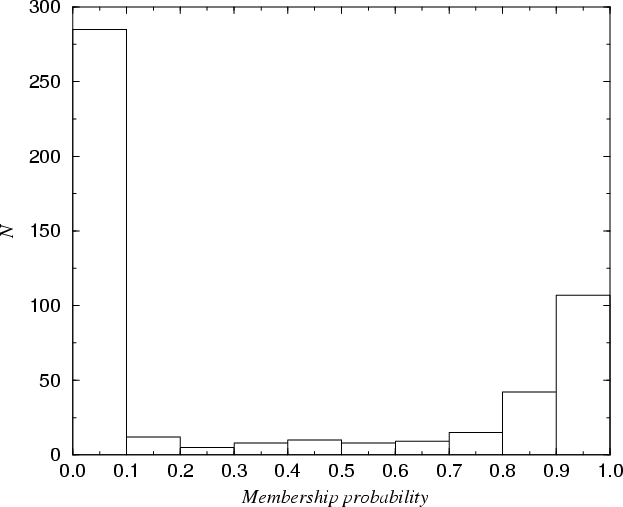 |
Figure 7: The histogram of cluster membership probability of NGC 2548. |
| Open with DEXTER | |
6
1
6 area in
the NGC 2548 region were determined from automatic MAMA measurements
of 10 plates, five of which were newly taken. Comparison with Tycho-2
and Hipparcos Catalogues shows good agreement and underlines the precision
of the proper motions derived in this paper. These proper motions are
then used to determine membership probabilities of the stars in the region.
We obtained 165 stars with membership probabilities higher than 0.7.
Acknowledgements
We would like to thank Prof. J. J. Wang for useful discussions and Dr. D. Galadí-Enríquez for help and useful comments. We would also like to thank R. Chesnel and P. Toupet for scanning and prereduction of the plates. This study was partially supported by the National Natural Science Foundation of China Grant No. 19733001 and by Joint Laboratory for Optional Astronomy of CAS. L.B-N. gratefully acknowledges financial support from Wang Kuan Cheng Fund, Chinese Academy of Sciences. This study was also partially supported by the contract No. A&A2000-0937 with MCYT.