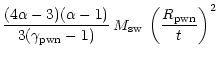
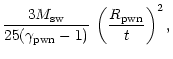
A&A 380, 309-317 (2001)
DOI: 10.1051/0004-6361:20011437
Pulsar wind nebulae in supernova remnants
Spherically symmetric hydrodynamical simulations
E. van der Swaluw 1,2 -
A. Achterberg 1 -
Y. A. Gallant1,3,4 -
G. Tóth 5
1 -
Astronomical Institute, Utrecht University, PO Box 80000, 3508 TA Utrecht, The Netherlands
2 -
Dublin Institute for Advanced Studies, 5 Merrion Square, Dublin 2, Republic of Ireland
3 -
Osservatorio Astrofisico di Arcetri, Largo E. Fermi 5, 50125 Firenze, Italy
4 -
Service d'Astrophysique, CEA Saclay, 91191 Gif-sur-Yvette Cedex, France
5 -
Department of Atomic Physics, Pázmány Péter sétány 1, 1117 Budapest, Hungary
Received 19 December 2000 / Accepted 27 September 2001
Abstract
A spherically symmetric model is presented for the interaction of a pulsar wind
with the associated supernova remnant. This results in a pulsar wind nebula
whose evolution is coupled to the evolution of the surrounding supernova remnant.
This evolution can be divided in three stages.
The first stage is characterised by a supersonic expansion of the pulsar wind nebula
into the freely expanding ejecta of the progenitor star. In the next stage the
pulsar wind nebula is not steady; the pulsar wind nebula oscillates between
contraction and expansion due to interaction with the reverse shock of the supernova remnant:
reverberations which propagate forward and backward in the remnant.
After the reverberations of the reverse shock have almost completely vanished
and the supernova remnant has relaxed to a Sedov solution, the
expansion of the pulsar wind nebula proceeds subsonically. In this paper we
present results from hydrodynamical simulations of a pulsar wind nebula
through all these stages in its evolution. The simulations were carried out
with the Versatile Advection Code.
Key words: ISM: supernova remnants - stars: pulsars: general - hydrodynamics - shock waves
The explosion of a massive star at the end of its life as a supernova
releases an amount of energy roughly equal to 1053
erg. Roughly 99% of this energy is radiated away in the form of
neutrinos as a result of the deleptonization of the  1
1  stellar
core as it collapses into a neutron star. The remaining (mechanical) energy
of about 1051 erg is contained in the strong shock propagating through
the stellar mantle, and ultimately
drives the expansion of the supernova remnant (SNR).
In those cases where a rapidly rotating neutron star (pulsar) remains as a
"fossil'' of the exploded star,
a pulsar wind, driven by the spindown luminosity of the
pulsar, can be formed.
The precise magnetospheric physics leading to such a pulsar
wind is not fully understood, but it is believed that a major fraction of
the spin-down luminosity of the pulsar is converted into the mechanical
luminosity of such a wind.
stellar
core as it collapses into a neutron star. The remaining (mechanical) energy
of about 1051 erg is contained in the strong shock propagating through
the stellar mantle, and ultimately
drives the expansion of the supernova remnant (SNR).
In those cases where a rapidly rotating neutron star (pulsar) remains as a
"fossil'' of the exploded star,
a pulsar wind, driven by the spindown luminosity of the
pulsar, can be formed.
The precise magnetospheric physics leading to such a pulsar
wind is not fully understood, but it is believed that a major fraction of
the spin-down luminosity of the pulsar is converted into the mechanical
luminosity of such a wind.
The total rotational energy released by a Crab-like pulsar over its lifetime
is of order
1049-1050 erg. This is much less than the mechanical
energy of 1051 erg driving the expansion of the SNR.
Therefore, the dynamical influence of the pulsar wind on the
global evolution of the supernova remnant itself will be small.
From an observational point of view, however, the presence of a pulsar
wind can lead to a plerionic supernova remnant, where the emission at
radio wavelengths shows an extended, flat-spectrum central source associated
with a Pulsar Wind Nebula (PWN). The best-known example of such a system
is the Crab Nebula, and about a half-dozen other PWNs are known unambiguously
around pulsars from radio surveys (e.g. Frail & Scharringhausen 1997).
These surveys suggest that only young pulsars with a high spindown luminosity
produce observable PWNs at radio wavelengths.
At other than radio wavelengths, in particular X-rays,
there are about ten detections of PWN around pulsars both in our own galaxy
and in the large Magellanic cloud (LMC) (e.g. Helfand 1998; Table 1 of Chevalier 2000).
The expansion of an isolated SNR into the general interstellar medium (ISM)
can be divided in four different stages
(Woltjer 1972; see also Cioffi 1990 for a review):
the free expansion stage, the Sedov-Taylor stage,
the pressure-driven snowplow stage and the momentum-conserving stage.
In the models presented here we will only focus on the
evolution of a pulsar wind nebula (PWN) during the first two stages of the
SNR: the free expansion stage and the Sedov-Taylor stage. We will assume that
the pulsar is stationary at the center of the remnant, excluding such
cases as CTB80 (e.g. Strom 1987; Hester & Kulkarni 1988),
PSR1643-43 and
PSR1706-44 (Frail et al. 1994), where the
pulsar position is significantly excentric with respect to the SNR,
presumably due to a large kick velocity of the
pulsar incurred at its birth, assuming of course
that SNR and pulsar are associated and we are not dealing with
a chance alignment of unrelated sources.
The case of a pulsar moving through the remnant with a significant
velocity will be treated in a later paper.
In this paper we compare (approximate) analytical expressions for the
expansion of a PWN in a supernova remnant with hydrodynamical simulations
carried out with the Versatile Advection
Code![[*]](/icons/foot_motif.gif) (VAC). We confirm earlier
analytical results
(Reynolds & Chevalier 1984; Chevalier & Fransson 1992)
which state that
the PWN is expanding supersonically when it is moving through the freely
expanding ejecta of the SNR. Due to deceleration of the
expanding SNR ejecta by the interstellar medium (ISM), a reverse shock
propagates back to the center of the SNR (e.g. McKee 1974; Cioffi
et al. 1988). Due to the
presence of reverberations of the reverse shock in the SNR, the expansion of
the PWN goes through an unsteady phase when this
reverse shock hits the edge of the PWN. After these reverberations
have decayed, the expansion of the PWN through the ejecta of the SNR progenitor star
continues subsonically with the PWN almost in pressure equilibrium with
the interior of the SNR.
(VAC). We confirm earlier
analytical results
(Reynolds & Chevalier 1984; Chevalier & Fransson 1992)
which state that
the PWN is expanding supersonically when it is moving through the freely
expanding ejecta of the SNR. Due to deceleration of the
expanding SNR ejecta by the interstellar medium (ISM), a reverse shock
propagates back to the center of the SNR (e.g. McKee 1974; Cioffi
et al. 1988). Due to the
presence of reverberations of the reverse shock in the SNR, the expansion of
the PWN goes through an unsteady phase when this
reverse shock hits the edge of the PWN. After these reverberations
have decayed, the expansion of the PWN through the ejecta of the SNR progenitor star
continues subsonically with the PWN almost in pressure equilibrium with
the interior of the SNR.
This paper is organised as follows. In Sects. 2 and 3 we discuss
the aforementioned two stages of the PWN/SNR system. In Sect. 4 the
hydrodynamical simulations will be presented and compared with the analytical
expressions from Sects. 2 and 3.
In the early stage of the evolution of a PWN, the SNR consists mostly of the
stellar ejecta expanding freely into the interstellar medium.
The PWN expands into these ejecta. The sound velocity in the interior of
the SNR is much smaller than the expansion velocity of the PWN.
The supersonic expansion of the PWN results in a
shock propagating into the ejecta (see Fig. 1).
An analytical equation for
the radius of this shock can be derived for a constant spindown luminosity.
Using this solution, the assumption of supersonic expansion will be checked
a posteriori.
For simplicity we assume that the ejecta have a uniform density,
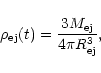 |
(1) |
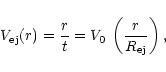
and a linear velocity profile as a function of radius,
 |
(2) |
with
 the radius of the front of the ejecta. The
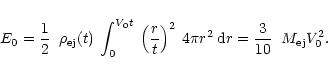
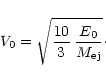
value of V0 is determined by the requirement that the kinetic energy
of the ejecta equal the total mechanical energy E0 of the SNR:
the radius of the front of the ejecta. The
value of V0 is determined by the requirement that the kinetic energy
of the ejecta equal the total mechanical energy E0 of the SNR:
 |
(3) |
This yields:
 |
(4) |
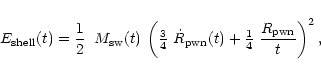
We assume that the stellar ejecta swept up by the strong
shock which bounds the PWN collect in a thin shell, and that
this material moves with the post-shock velocity. Neglecting the contribution
of the thermal energy we can write the total (kinetic) energy of this shell,
 ,
as:
,
as:
 |
(5) |
where
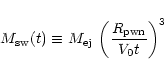 |
(6) |
is the ejecta mass swept up by the pulsar wind nebula.
In deriving the post-shock velocity,
we assumed that the ejecta behave as an ideal non-relativistic gas with
adiabatic heat ratio
 and used the Rankine-Hugoniot jump
conditions for a strong shock.
and used the Rankine-Hugoniot jump
conditions for a strong shock.
The interior of the PWN is dominated by thermal
energy. The sound speed in a realistic PWN is close to the speed of light
c, while the expansion velocity is much less than c.
Perturbations in the pressure will be smoothed
out rapidly, on a sound crossing time
 ,
much less than
the expansion time scale
,
much less than
the expansion time scale
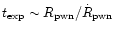 .
Therefore, we can assume a nearly uniform pressure
.
Therefore, we can assume a nearly uniform pressure
 in the PWN.
The internal energy of the PWN then equals
in the PWN.
The internal energy of the PWN then equals
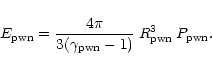 |
(7) |
Here we take
 because the pulsar wind nebula material is
relativistically hot.
The pressure of the interior of the PWN is a few times (4 when
)
the pressure in the shocked ejecta
just downstream of the outer shock of the pulsar wind nebula (Chevalier
1984, Fig. 4).
In the Appendix, we give a derivation of this result using the thin shell approximation
for the motion of the shocked ejecta, assuming a power-law expansion:
because the pulsar wind nebula material is
relativistically hot.
The pressure of the interior of the PWN is a few times (4 when
)
the pressure in the shocked ejecta
just downstream of the outer shock of the pulsar wind nebula (Chevalier
1984, Fig. 4).
In the Appendix, we give a derivation of this result using the thin shell approximation
for the motion of the shocked ejecta, assuming a power-law expansion:
 .
There we show that the ratio of the shock radius
.
There we show that the ratio of the shock radius  and the radius
  of the
contact discontinuity separating the pulsar wind material from the shocked ejecta satisfies
(Eq. (A.2))
of the
contact discontinuity separating the pulsar wind material from the shocked ejecta satisfies
(Eq. (A.2))
 (=24/23 when
and
(=24/23 when
and
 ,
see below), and that the pressure of the
pulsar wind bubble equals (Eq. (A.6)):
,
see below), and that the pressure of the
pulsar wind bubble equals (Eq. (A.6)):
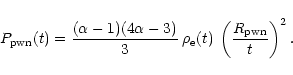 |
(8) |
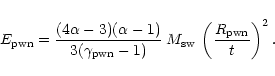
Combining these relations yields:
 |
(9) |
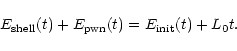
Energy conservation for the PWN system reads:
 |
(10) |
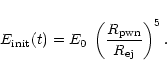
Here
 is the kinetic energy which the swept-up ejecta would
have if they were freely expanding. This quantity can be obtained by integrating
the kinetic energy density of ejecta in a sphere with radius
is the kinetic energy which the swept-up ejecta would
have if they were freely expanding. This quantity can be obtained by integrating
the kinetic energy density of ejecta in a sphere with radius
 if there was no PWN. This yields:
 |
(11) |
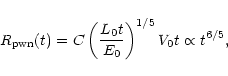
After some algebra using the Eqs. (1)-(11) one can
obtain a power-law solution for the radius of the pulsar wind bubble:
 |
(12) |
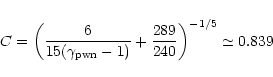
where C is a numerical constant of order unity:
 |
(13) |
assuming
 and
and
 .
Chevalier (1977) and Reynolds & Chevalier (1984) already
obtained this
.
Chevalier (1977) and Reynolds & Chevalier (1984) already
obtained this
 expansion law. It can easily be checked that the expansion
velocity obtained in this manner is indeed much larger than the sound velocity
in the freely expanding supernova remnant.
expansion law. It can easily be checked that the expansion
velocity obtained in this manner is indeed much larger than the sound velocity
in the freely expanding supernova remnant.
![\begin{figure}
\par\includegraphics[angle=-90,scale=0.5]{H2599F1.PS}\end{figure}](/articles/aa/full/2001/46/aah2599/Timg44.gif) |
Figure 1:
Schematic representation of PWN in a freely expanding SNR. There are a
total of four shocks and two contact discontinuities. From left to right one can
see: the pulsar wind termination
shock
 (dashed line), the first contact discontinuity
 (dotted line) separating shocked pulsar wind material from shocked ejecta,
the PWN shock
(dotted line) separating shocked pulsar wind material from shocked ejecta,
the PWN shock
 (solid line) bounding the PWN. For the SNR we
have a reverse shock
(solid line) bounding the PWN. For the SNR we
have a reverse shock
 (dashed line), the second contact discontinuity
 (dotted line) separating shocked ejecta from shocked ISM, and the
SNR shock
(dotted line) separating shocked ejecta from shocked ISM, and the
SNR shock
 (solid line) which is the outer boundary of
the PWN/SNR system.
(solid line) which is the outer boundary of
the PWN/SNR system. |
| Open with DEXTER |
Towards the end of the free expansion stage a reverse shock is driven deep
into the interior of the SNR. This reverse shock reheats the stellar ejecta,
and as a result the sound velocity increases by a large factor.
When the reverberations due to reflections of the reverse shock
have almost completely dissipated, one can
approximate the interior of the SNR by using the analytical Sedov solution
(Sedov 1959).
The interaction with the reverse shock influences the evolution of the pulsar
wind nebula quite dramatically. Cioffi et al. (1988) have already shown in their
1D simulation of a pure shell SNR that the reverse shock gives rise to all kinds
of sound waves and weak shocks traveling back and forth through the ejecta before the
interior relaxes towards a Sedov solution.
We will show that during the process of relaxation
the radius of the pulsar wind nebula contracts and
expands due to reverberations of the reverse shock. Compression waves
are partly reflected and partly transmitted at the edge of the PWN.
We will come back to this point when we discuss results from hydrodynamics simulations in
Sect. 4, which allow a more detailed picture of this process.
In this section we consider a fully relaxed Sedov SNR.
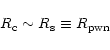
The PWN expands subsonically into the remnant because the interior of the SNR has
been re-heated by the reverse shock.
For the case of a constant (mechanical) luminosity driving the pulsar wind
an analytical expression for the radius of the PWN can be easily obtained.
In this stage of the PWN evolution, we associate
its radius
with the contact discontinuity
separating pulsar wind material from the ejecta of the progenitor star (see
Fig. 2).
![\begin{figure}
\par\includegraphics[scale=0.5,angle=-90]{H2599F2.PS}\end{figure}](/articles/aa/full/2001/46/aah2599/Timg45.gif) |
Figure 2:
Schematic representation of a PWN in a Sedov SNR. There are a total of 2
shocks and 2 contact discontinuities. From left to right one can see: the
pulsar wind termination shock
(dashed line), the first contact
discontinuity
(dotted line) separating shocked pulsar wind
material from shocked ejecta, bounding the PWN. Furthermore there is another
contact discontinuity
 (dotted line) separating shocked ejecta
from shocked ISM, and the SNR shock
(solid line) which bounds the
PWN/SNR system.
(dotted line) separating shocked ejecta
from shocked ISM, and the SNR shock
(solid line) which bounds the
PWN/SNR system. |
| Open with DEXTER |
We first present an order-of-magnitude calculation which
leads to the correct power-law solution for the radius of the PWN.
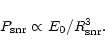
The assumption of subsonic expansion implies approximate pressure
equilibrium between the wind material and the stellar ejecta
at the edge the PWN. In the interior of the SNR the pressure scales as
 |
(14) |
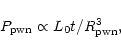
On the other hand, the pressure in
the interior of the PWN scales as
 |
(15) |
with L0 the mechanical luminosity driving the wind.
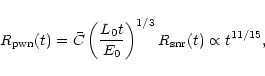
Pressure equilibrium at the contact discontinuity at
implies the following relation for the radius of the
PWN as a function of time:
 |
(16) |
with the constant of proportionality  to be determined below.
A more detailed derivation uses the first law of
thermodynamics, assuming once again a constant energy
input L0 into the PWN by the pulsar-driven wind:
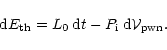 |
(17) |
Here
 is the thermal energy of the PWN,
 its internal pressure, and
 its volume.
This yields the following equation describing the energy balance of a slowly
expanding PWN:
its volume.
This yields the following equation describing the energy balance of a slowly
expanding PWN:
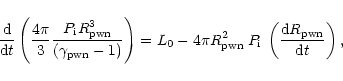 |
(18) |
or equivalently
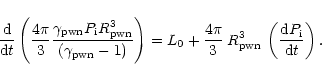 |
(19) |
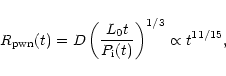
This equation has a power-law solution for
 provided the internal pressure
 in the SNR behaves as
a power-law in time so that the relation
in the SNR behaves as
a power-law in time so that the relation
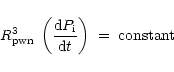 |
(20) |
can be satisfied. For a Sedov SNR expanding into a uniform ISM one has
 and one finds:
 |
(21) |
where
![\begin{displaymath}%
D = \left[ \frac{4\pi}{3} \:
\left({\gamma_{\rm pwn}\over\gamma_{\rm pwn} -1}+\frac{6}{5} \:
\right) \right]^{- 1/3} .
\end{displaymath}](/articles/aa/full/2001/46/aah2599/img61.gif) |
(22) |
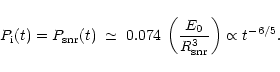
If
 we can use the central pressure from the
Sedov solution with
we can use the central pressure from the
Sedov solution with
 for the interior pressure in the SNR
which confines the PWN (e.g. Shu 1992):
for the interior pressure in the SNR
which confines the PWN (e.g. Shu 1992):
 |
(23) |
We find the same result for
as in the order-of-magnitude
calculation (Eq. (16)), determining the constant in that expression
as
 for a non-relativistic fluid (
 )
and
)
and
 for a relativistic fluid (
).
By comparing the sound speed with the expansion velocity at the edge of the
PWN, we confirm that the expansion remains subsonic.
for a relativistic fluid (
).
By comparing the sound speed with the expansion velocity at the edge of the
PWN, we confirm that the expansion remains subsonic.
![\begin{figure}
\par\includegraphics[width=8.8cm,clip]{H2599F3.PS}\end{figure}](/articles/aa/full/2001/46/aah2599/Timg67.gif) |
Figure 3:
Comparison between results from numerical simulations and
analytical result for the radius of the PWN, i.e. Eq. (12).
The dashed line indicates the radius for the PWN obtained from numerical
simulations. The solid line corresponds to Eq. (12) with
 ,
as appropriate for
.
The different
physical parameters are as indicated in Table 1 (Simulation 1). The injected
mass of the pulsar wind has been chosen in such a way that the termination
velocity of the pulsar wind equals the speed of light. One can see that in the
simulation the radius
is about 5% smaller than predicted by
the analytical result, but the power-law behaviour ,
as appropriate for
.
The different
physical parameters are as indicated in Table 1 (Simulation 1). The injected
mass of the pulsar wind has been chosen in such a way that the termination
velocity of the pulsar wind equals the speed of light. One can see that in the
simulation the radius
is about 5% smaller than predicted by
the analytical result, but the power-law behaviour
 is correctly reproduced.
 |
| Open with DEXTER |
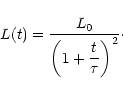
The constant wind luminosity assumption is not very realistic by the time
the effects of the reverse shock and its associated reverberations have vanished.
The spin-down luminosity of the pulsar is more realistically described by the
luminosity evolution from a rotating magnetic dipole model:
 |
(24) |
Therefore we now consider the more realistic case of a time-dependent luminosity
given by (24).
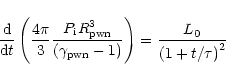
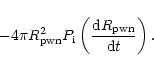
The energy balance equation for the PWN reads:
 |
(25) |
We solve this equation numerically using a fourth-order Runge-Kutta
method (e.g. Press et al. 1992). As an initial condition we
take the radius of the PWN equal to zero at the start of the evolution,
neglecting the initial stage when the PWN is expanding supersonically. For the
pressure ,
we use the pressure at the center of the Sedov SNR
(23). We find
that the solution for
converges to
 .
The same result was obtained by Reynolds & Chevalier (1984) who noted that
this behaviour follows from the adiabatic expansion of the relativistic pulsar
wind bubble after the energy input of the pulsar has almost ceased,
where the pressure scales as
.
The same result was obtained by Reynolds & Chevalier (1984) who noted that
this behaviour follows from the adiabatic expansion of the relativistic pulsar
wind bubble after the energy input of the pulsar has almost ceased,
where the pressure scales as
 ,
and the behaviour of
the pressure
in the Sedov remnant.
Pressure equilibrium then yields
,
and the behaviour of
the pressure
in the Sedov remnant.
Pressure equilibrium then yields
 .
Figure 9 shows this semi-analytical result
together with results from hydrodynamical simulations. For the semi-analytical
equation we use
,
because the hydrodynamics code also
uses this value (see Sect. 4.1 below).
.
Figure 9 shows this semi-analytical result
together with results from hydrodynamical simulations. For the semi-analytical
equation we use
,
because the hydrodynamics code also
uses this value (see Sect. 4.1 below).
Our simulations were performed using the Versatile Advection Code
(VAC, Tóth 1996) which can integrate the equations of gas dynamics
in a conservative form in 1, 2 or 3 dimensions. We used the TVD-MUSCL
scheme with a Roe-type approximate Riemann solver
from the numerical algorithms available in VAC
(Tóth & Odstrcil 1996); a discussion of this and other schemes
for numerical hydrodynamics can be found in Leveque (1998). In this
paper our calculations are limited to spherically symmetric flows.
We use a uniform grid with a grid spacing chosen sufficiently fine
to resolve both the shocks
inside the PWN and the larger-scale shocks associated with the SNR.
Table 1 gives the physical scale associated with the grid size
for the simulations presented here. An expanding SNR is created by
impulsively releasing the mechanical energy of the SN explosion in the first
few grid cells. The thermal energy and mass deposited there lead to
freely expanding ejecta with a nearly uniform density,
and a linear velocity profile as a function of radius.
![\begin{figure}
\par\includegraphics[width=8.8cm,clip]{H2599F4.PS}\end{figure}](/articles/aa/full/2001/46/aah2599/Timg74.gif) |
Figure 4:
Pressure profile of the PWN/SNR system as a function of radius,
at time t=1000 years after the SN explosion. Physical parameters are
as indicated in Table 1 (Simulation 2).
Moving outwards in radius one can see the wind termination shock,
the shock bounding the PWN,
the reverse shock of the SNR and the shock bounding the SNR.
The interior of the PWN is nearly isobaric.
There is a sudden increase in pressure of the ejecta behind the SNR reverse
shock. |
| Open with DEXTER |
A realistic shocked pulsar wind is presumably highly relativistic
with an adiabatic heat ratio
.
The (shocked) stellar ejecta
on the other hand are non-relativistic with
.
The VAC code does not currently include relativistic hydrodynamics.
Therefore, the best approach available to us is to keep
,
but to take a
luminosity for the pulsar wind, L(t), and an associated mass injection,
 ,
such that the terminal velocity obtained from these
two parameters,
,
such that the terminal velocity obtained from these
two parameters,
 |
(26) |
roughly equals the speed of light.
Since the pulsar wind material downstream of the termination shock moves with
only a mildly relativistic bulk speed we expect our results to be qualitatively
correct. Thermal energy and mass are deposited continuously in a small
volume as a source for the wind.
The hydrodynamics code then develops a steady
wind reaching the terminal velocity  well before the (cold) wind
is terminated by the standing termination shock.
well before the (cold) wind
is terminated by the standing termination shock.
We trace the total mass injected into the PWN by the pulsar wind in order
to determine the radius of the contact discontinuity which separates the
pulsar wind material from
the SN ejecta (
in Fig. 1 and
in Fig. 2).
We also determine the position of the shock bounding the PWN during the stage
of supersonic expansion.
This enables us to compare the numerical results with the
analytical expressions derived in Sects. 2 and 3 for the PWN radius.
Table 1:
Simulation parameters.
![\begin{table}
\par\includegraphics[angle=270,width=8.8cm,clip]{H2599T1.PS}\par\end{table}](/articles/aa/full/2001/46/aah2599/img78.gif) |
![\begin{figure}
\par\includegraphics[width=8.8cm,clip]{H2599F6.PS}\end{figure}](/articles/aa/full/2001/46/aah2599/Timg79.gif) |
Figure 6:
Sound velocity profile as a function of radius, for the same case
as in Figs. 4 and 5.
Because of the Rankine-Hugoniot jump conditions at the wind termination shock,
the sound velocity of the shocked wind material
in the PWN bubble is close to the speed of light. Behind the contact discontinuity,
where the bubble consists of swept-up ejecta, the sound speed has a smaller value. |
| Open with DEXTER |
![\begin{figure}
\par\includegraphics[width=8.8cm,clip]{H2599F7.PS}\end{figure}](/articles/aa/full/2001/46/aah2599/Timg80.gif) |
Figure 7:
Velocity profile for the PWN/SNR system with the same parameters.
The terminal wind velocity, ,
is close to the speed of light.
The large jump in the velocity at a radius 4 pc is the reverse shock
which is still propagating forwards in the laboratory frame.
The velocity jump of the PWN shock at radius 2.5 pc is much smaller. |
| Open with DEXTER |
As a test of the code we have calculated a pulsar wind driven by a constant
luminosity L0 (Simulation 1 in Table 1).
We let the PWN evolve until the reverse shock propagating in the SNR
hits its outer edge. Figure 3 shows the radius of the shock of the PWN
together with the analytical
Eq. (12). We take
in the analytical expressions
for comparison with the numerical results. Although the analytical result of
Eq. (12)
is not reproduced exactly (the radius
is about 5% smaller), the power-law expansion law
is reproduced.
Our simulations of the evolution of a pulsar wind nebula inside a supernova
remnant employ the parameters listed in Table 1.
In the early stage of its evolution the
PWN is bounded by a strong shock propagating through the ejecta of the
progenitor star. In Figs. 4-7 one can clearly identify the four
shocks indicated schematically in Fig. 1.
Moving outward in radius one first encounters the pulsar wind termination shock;
this termination shock is followed by the PWN shock.
In the sound velocity profile of Fig. 6 one can see a large jump between
these two shocks:
the contact discontinuity separating shocked pulsar wind material
from shocked ejecta.
Further outward one encounters the SNR reverse shock,
which at this stage of the SNR evolution is still moving outwards
from the point of view of a stationary outside observer.
The whole PWN-SNR system is bounded by the SNR blast wave.
Figure 9 shows the evolution of the contact discontinuity radius
,
which can be identified with the radius of the PWN in the subsonic
expansion stage. One can clearly see the moment at
 kyr when the reverse shock hits the edge of the PWN: the expansion becomes
unsteady with the PWN contracting and expanding due to the interaction with
the pressure pulses associated with the reverberations of the
reverse shock. When these reverberations have almost
dissipated the expansion of the PWN relaxes to a steady subsonic
expansion. In this stage, we can fit the radius of the PWN obtained
from the simulations with the (semi-)analytical solution obtained
from a numerical integration of Eq. (18), as shown in this
figure.
kyr when the reverse shock hits the edge of the PWN: the expansion becomes
unsteady with the PWN contracting and expanding due to the interaction with
the pressure pulses associated with the reverberations of the
reverse shock. When these reverberations have almost
dissipated the expansion of the PWN relaxes to a steady subsonic
expansion. In this stage, we can fit the radius of the PWN obtained
from the simulations with the (semi-)analytical solution obtained
from a numerical integration of Eq. (18), as shown in this
figure.
The interaction of the PWN with the reverse shock and the associated
reverberations is quite complicated. We will therefore describe this process
in more detail.
![\begin{figure}
\par\includegraphics[angle=-90,width=8.8cm,clip]{H2599F8.PS}
\end{figure}](/articles/aa/full/2001/46/aah2599/Timg82.gif) |
Figure 8:
The radius of the PWN contact discontinuity as a function of time
(solid line). We compare with the semi-analytical solution from
Eq. (25) (dashed line). Here one can see that the
expansion of the PWN is unsteady, due to the reverberations of the reverse
shock. This simulation was done with the parameters listed in Table 1
(Simulation 3). |
| Open with DEXTER |
![\begin{figure}
\par\includegraphics[angle=-90,width=8.8cm,clip]{H2599F9.PS}\end{figure}](/articles/aa/full/2001/46/aah2599/Timg83.gif) |
Figure 9:
The radius of the PWN as a function of time, together with the ratio of
the total energy in the PWN bubble with respect to the total energy input by
the pulsar wind. The solid line represents the radius of the contact discontinuity
of the PWN (in arbitrary units), the open squares represent the aforementioned ratio
of energy. This simulation was done with the parameters as listed in Table 1
(Simulation 3). |
| Open with DEXTER |
The reverse shock initially encounters the PWN in its supersonic expansion stage.
After the collision between the reverse shock and the PWN shock a
reflected shock propagates back towards the outer
(Sedov-Taylor) blast wave of the SNR.
A transmitted shock propagates into the shocked ejecta inside the PWN.
When this shock hits the contact discontinuity bounding the pulsar wind material
a similar reflection/transmission event occurs: a shock moves radially
outwards, and a compression wave moves into the pulsar wind material. The
latter wave is rapidly dissipated in the pulsar wind bubble because of the
high sound speed in the shocked pulsar wind.
After a few sound crossing times the pulsar wind bubble contracts adiabatically
in response to the pressure increase inside the SNR. After this contraction
it regains pressure equilibrium with the surrounding SNR and the PWN expands
subsonically henceforth. This chain of events can be clearly seen in Fig. 8
where we plot the radius of the PWN. The whole process takes a
time comparable with the duration of the initial
supersonic expansion stage.
When the PWN has more or less relaxed
to a steady subsonic expansion the PWN has gained energy
as a result of the interaction with the reverse shock. Consequently,
the radius of the PWN is roughly 20% larger than the value
predicted by the semi-analytical solution obtained from Eq. (18) in Sect. 2.
In Fig. 9 we show the ratio between the (mostly thermal) energy of the pulsar
wind bubble, i.e. the part of the PWN that consists of shocked pulsar wind
material, and the total mechanical energy deposited by the pulsar.
One can clearly see the increase in the energy content
of the pulsar wind bubble. A large fraction of the energy deposited by the pulsar
wind in the stage when the expansion is supersonic is contained in the kinetic
energy of the shocked stellar ejecta in the PWN shell. When the reverse SNR
shock is interacting with the PWN bubble, energy is apparently
transferred from this thin shell to the interior of the bubble by the process of
adiabatic compression. One can see the effect of adiabatic compression in
Fig. 9 where the radius of the PWN and the energy content of the PWN are
anti-correlated.
We have considered a spherically symmetric PWN/SNR system in the
early and middle stages of its evolution,
well before cooling of the SNR shell becomes dynamically important and
before a significant disruption of spherical symmetry due to a possible
(large) kick velocity of the pulsar can take place. The expansion of the
PWN is coupled with the dynamics of the expanding SNR,
leading to two distinct evolutionary stages separated by an unsteady
transition phase:
- When the PWN is surrounded by the freely expanding ejecta of
the SNR, the expansion of the PWN is supersonic. In this stage
the pressure in the interior of the PWN bubble is slightly larger than
one would expect from ram pressure of the surrounding ejecta alone, using the
Rankine-Hugoniot relations at the PWN shock. This is
due to the thin shell of shocked, swept-up ejecta which needs to be
accelerated by the outward force due to the interior pressure of the PWN.
- This stage of supersonic expansion is ultimately followed by a
subsonic expansion of the PWN. This happens after the reverse shock has
encountered the shock of the PWN.
- The transition between these two stages is unsteady due to the
interaction of the PWN with the reverse shock and its associated
reverberations. From the hydrodynamical simulations we see that the
time scale for adjustment to the pressure of the surrounding SNR is determined
by the sound speed of the ejecta shocked by the PWN in the first stage.
Two of the prototypes of plerionic SNRs are the Crab Nebula and 3C58. In the
Crab, there is a decrease in the radio flux of
 yr-1 (Aller & Reynolds 1985).
By contrast, 3C58 shows an increase in its flux density at radio frequencies
between 1967 and 1986 (Green 1987). This increase might be the result of the
reverse shock which has encountered the PWN shock around 3C58; the PWN is
being compressed and therefore the flux density is going up.
yr-1 (Aller & Reynolds 1985).
By contrast, 3C58 shows an increase in its flux density at radio frequencies
between 1967 and 1986 (Green 1987). This increase might be the result of the
reverse shock which has encountered the PWN shock around 3C58; the PWN is
being compressed and therefore the flux density is going up.
Our numerical simulations are different from the results presented by
Jun (1998). This author concentrates on the details of the PWN in the
supersonic expansion stage, and in
particular on the formation of Rayleigh-Taylor fingers in his two-dimensional
simulations. Our simulations include the whole supernova remnant, but can not
address the development of Rayleigh-Taylor instabilities due to our assumption
of spherical symmetry.
In future work we will discuss
how these results change when the influence of a significant kick velocity
of the pulsar is taken into account. If this is taken into account, the model
presented here will lose its validity at a certain time: one can calculate when
the motion of a pulsar will become supersonic in a Sedov stage. One can show
that this will happen when the pulsar is about halfway from the explosion
center to the edge of the SNR: a bow shock is
expected to result from this and clearly the model presented here will break
down. Observationally there is evidence that this is the case for the pulsar
associated with the SNR W44.
We briefly derive an expression for the pressure in the PWN, and for the thickness
of the shell of shocked ejecta material surrounding the PWN
in the first (supersonic) expansion stage of PWN evolution.
The starting point of our derivation is the assumption that velocity of the material in the
shell moves at a constant velocity. This assumption is justified by detailed calculations
by Chevalier (1984) who calculates the velocity, pressure and density using similarity
variables. We denote the radius of the contact discontinuity separating pulsar wind
material from ejecta material by ,
and the radius of the shock wave propagating
into the ejecta by  .
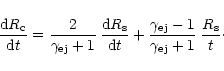
The constant velocity assumption implies that the velocity
of the contact discontinuity must equal the fluid velocity directly behind the shock.
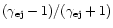
Assuming the shock to be strong with compression ratio
.
The constant velocity assumption implies that the velocity
of the contact discontinuity must equal the fluid velocity directly behind the shock.
Assuming the shock to be strong with compression ratio
 this implies:
 |
(A.1) |
Here we used the fact that upstream of the shock the velocity of the uniformly expanding ejecta
equals
 .
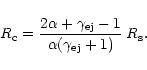
Assuming a self-similar solution where
.
Assuming a self-similar solution where
 the above condition
implies
the above condition
implies
 |
(A.2) |
If we assume
and use that
if the mechanical power L of
the pulsar is constant we find
 |
(A.3) |
and the thickness of the layer of shocked ejecta material is
 .
The
thin layer approximation is therefore a good one.
.
The
thin layer approximation is therefore a good one.
We now neglect the difference between
and ,
putting
as is done in the main paper. The equation of motion for the thin layer of shocked ejecta can
be approximated by (e.g. Ostriker & Gunn 1971)
![\begin{displaymath}%
M_{\rm sw}(t) \: \frac{{\rm d}^{2} R_{\rm pwn}}{{\rm d} t^{...
...eft[ P_{\rm pwn} - \rho_{\rm ej}(t) \:
V_{\rm rel}^{2}\right],
\end{displaymath}](/articles/aa/full/2001/46/aah2599/img95.gif) |
(A.4) |
where
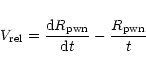 |
(A.5) |
is the relative velocity between the shell and the expanding ejecta.
The outward motion of the shell is driven by the difference between the presure in the
PWN and the ram-pressure
 .
Here
.
Here
 is the mass of the swept-up ejecta. Using Eqs. (1) and (6) of the
main paper we can write
is the mass of the swept-up ejecta. Using Eqs. (1) and (6) of the
main paper we can write
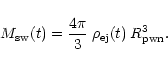 |
(A.6) |
Assuming that the PWN expands as
,
the above equation
can be solved for the pressure
of the pulsar wind material at the contact
discontinuity:
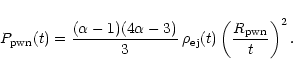 |
(A.7) |
The pressure just behind the strong shock at the outer edge of the layer is given by
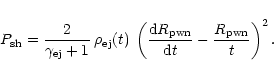 |
(A.8) |
Using once again
,
this implies that the ratio
of the pressure in the PWN and the post-shock pressure equals
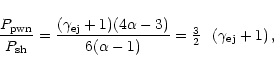 |
(A.9) |
where we assumed
in the second equality. For
one
has
 ,
in good agreement with the calculations of
Chevalier (1984) (see his Fig. 4).
The pressure rises considerably in the layer of shocked ejecta material,
where the sound speed is low. This result implies that the energy of the hot
material in the PWN, defined in Eq. (7)
of the main paper, equals
,
in good agreement with the calculations of
Chevalier (1984) (see his Fig. 4).
The pressure rises considerably in the layer of shocked ejecta material,
where the sound speed is low. This result implies that the energy of the hot
material in the PWN, defined in Eq. (7)
of the main paper, equals
where we used
in the second equality.
Acknowledgements
The authors would like to thank L. Drury for discussions on the subject,
T. Downes for discussing several numerical techniques, D. Frail for clarifying the
nature of W44, and R. Keppens for his assistance with the code VAC.
We thank the referee, Dr. R. A. Chevalier, for his helpful comments.
The Versatile Advection Code has been developed as part of the project on
"Parallel Computational Magneto-Fluid Dynamics'', funded by the Dutch
Science Foundation (NWO) from 1994 to 1997.
EvdS is currently supported by the European Commission under the TMR
programme, contract number ERB-FMRX-CT98-0168.
Y.A.G. acknowledges support from
The Netherlands Foundation for Research
in Astronomy (GBE/MPR grant 614-21-008) and the Italian Ministry of
Universities and Research (grant Cofin-99-02-02).
G.T. is currently supported by the Hungarian Science Foundation
(OTKA, grant No. D 25519) and the Education Ministry of Hungary
(grant No. FKFP-0242-2000).
-
Aller, H. D., & Reynolds, S. P. 1985, ApJ, 293, L73
In the text
NASA ADS
-
Chevalier, R. A. 1977, in Supernovae, ed. D. N. Schramm (D. Reidel Publ. Co., Dordrecht, Holland), 53
In the text
-
Chevalier, R. A. 1984, ApJ, 280, 797
In the text
NASA ADS
-
Chevalier, R. A. 2000, ApJ, 539, L45
In the text
NASA ADS
-
Chevalier, R. A., & Fransson, C. 1992, ApJ, 395, 540
In the text
NASA ADS
-
Cioffi, D. F., McKee, C. F., & Bertschinger, E. 1988, ApJ, 334, 252
In the text
NASA ADS
-
Cioffi, D. F. 1990, in Physical Processes in Hot Cosmic Plasmas, ed. W. Brinkmann, A. C. Fabian, & F.
Giovanelli (Kluwer Academic Publ., Dordrecht, Holland), 1
In the text
-
Frail, D. A., Goss, W. M., & Whiteoak, J. B. Z. 1994, ApJ, 437, 781
In the text
NASA ADS
-
Frail, D. A., & Scharringhausen, B. R. 1997, ApJ, 480, 364
In the text
NASA ADS
-
Green, D. A. 1987, MNRAS, 225, 11
In the text
-
Helfand, D. J. 1998, MSAI, 69, 791
In the text
-
Hester, J. J., & Kulkarni, S. R. 1988, ApJ, 331, L121
In the text
NASA ADS
-
Jun, B.-I. 1998, ApJ, 499, 282
In the text
NASA ADS
-
Leveque, R. J. 1998, in Computational Methods for Astrophysical Fluid Flow, Saas Fee Adv. Course 27,
ed. R. J. Leveque, D. Mihalas, E. A. Dorfi, & E. Müller (Springer Verlag, Heidelberg), 1
In the text
-
McKee, C. F. 1974, ApJ, 188, 335
In the text
NASA ADS
-
Ostriker, J. P., & Gunn, J. E. 1971, ApJL, 164, L95
In the text
NASA ADS
-
Press, W. H., Teukolsky, S. A., Vertterling, W. T., & Flanery, N. P. 1992, Numerical recipes in C
(Cambridge University Press, New York)
In the text
-
Reynolds, S. P., & Chevalier, R. A. 1984, ApJ, 278, 630
In the text
NASA ADS
-
Sedov, L. I. 1959, Similarity and Dimensional Methods in Mechanics (Academic, New York)
In the text
-
Shu, F. H. 1992, The Physics of Astrophysics: vol. II Gas Dynamics (University Science Books, Mill
Valley)
In the text
-
Strom, R. G. 1987, ApJ, 319, L103
In the text
NASA ADS
-
Tóth, G. 1996, Astrophys. Lett. & Comm., 34, 245
In the text
-
Tóth, G., & Odstrcil, D. 1996, J. Comp. Phys., 128, 82
In the text
-
Woltjer, L. 1972, ARA&A, 10, 129
In the text
NASA ADS
Copyright ESO 2001
![\begin{figure}
\par\includegraphics[angle=-90,scale=0.5]{H2599F1.PS}\end{figure}](/articles/aa/full/2001/46/aah2599/img44.gif)
![\begin{figure}
\par\includegraphics[scale=0.5,angle=-90]{H2599F2.PS}\end{figure}](/articles/aa/full/2001/46/aah2599/img45.gif)
![\begin{figure}
\par\includegraphics[width=8.8cm,clip]{H2599F3.PS}\end{figure}](/articles/aa/full/2001/46/aah2599/img67.gif)
![\begin{figure}
\par\includegraphics[width=8.8cm,clip]{H2599F4.PS}\end{figure}](/articles/aa/full/2001/46/aah2599/img74.gif)
![\begin{figure}
\par\includegraphics[width=8.8cm,clip]{H2599F5.PS}\end{figure}](/articles/aa/full/2001/46/aah2599/img75.gif)
![\begin{figure}
\par\includegraphics[width=8.8cm,clip]{H2599F6.PS}\end{figure}](/articles/aa/full/2001/46/aah2599/img79.gif)
![\begin{figure}
\par\includegraphics[width=8.8cm,clip]{H2599F7.PS}\end{figure}](/articles/aa/full/2001/46/aah2599/img80.gif)
![\begin{figure}
\par\includegraphics[angle=-90,width=8.8cm,clip]{H2599F8.PS}
\end{figure}](/articles/aa/full/2001/46/aah2599/img82.gif)
![\begin{figure}
\par\includegraphics[angle=-90,width=8.8cm,clip]{H2599F9.PS}\end{figure}](/articles/aa/full/2001/46/aah2599/img83.gif)