A&A 380, 292-299 (2001)
DOI: 10.1051/0004-6361:20011446
Gravitational microlensing of stars with transiting planets
G. F. Lewis
Anglo-Australian Observatory, PO Box 296, Epping, NSW
1710, Australia
Received 3 January 2001 / Accepted 15 October 2001
Abstract
If planetary systems are ubiquitous then a fraction of stars
should possess a transiting planet when being microlensed. This paper
presents a study of the influence of such planets on microlensing
light curves. For the giant planets recently identified, the
deviations in the light curve can be substantial, although the
specifics of the perturbations are dependent upon the radius of the
planet relative to that of the star, the location of the planet over
the stellar surface and the orientation of the sweeping caustic.
Given that the instantaneous probability of transiting hot-Jupiter
like planets is small, less than a percent, and only a proportion of
microlensing events exhibit caustic crossing events, the
probability of detecting a transiting planet during a microlensing
event is small,  10-6. However, a number of factors
influencing this probability, such as the number of solar type star
that possess planets, are uncertain, and the prospect of detecting
transiting planets in future large catalogues of microlensing light
curves may be viable. The results of this study also have bearing on
the gravitational microlensing of spots on the stellar
surface.
10-6. However, a number of factors
influencing this probability, such as the number of solar type star
that possess planets, are uncertain, and the prospect of detecting
transiting planets in future large catalogues of microlensing light
curves may be viable. The results of this study also have bearing on
the gravitational microlensing of spots on the stellar
surface.
Key words: gravitational lensing - planetary systems
1 Introduction
More than fifty planets have now been identified outside the Solar
system (see http://exoplanets.org for a summary of the known
planetary systems). While the majority of these have been found via
the measurement of a stellar radial velocity changes due to the
presence of an orbiting planet, more recently the dimming of stellar
light due to the transit of a giant planet has been observed,
specifically in the case of HD 209458 (Charbonneau et al. 2000; Henry
et al. 2000; Queloz et al. 2000; Castellano et al. 2000; Doyle et al. 2000; Gaudi 2000). Typically, light curves are seen to dip by
1-2% as the planet transits the star, corresponding to planetary
radii of
 .
Given current observational limits, these
techniques can only be used to identify planets within a few tens of
parsecs.
.
Given current observational limits, these
techniques can only be used to identify planets within a few tens of
parsecs.
Gravitational microlensing has the potential to discover planets over
a much greater distance. Perturbing the magnification distribution,
and hence the form of the microlensing light curve, planets can be
identified orbiting compact objects in the Galactic Halo (Mao &
Paczynski 1991; Gould & Loeb 1992; Bolatto & Falco 1994;
Bennett & Rhie 1996; Wambsganss 1997). More recently, Graff &
Gaudi (2000) and Lewis & Ibata (2000) turned their attention to using
gravitational microlensing to identify planets orbiting stars in the
Galactic Bulge, that is detecting planets orbiting the
source star in a microlensing event, rather than orbiting
the lens. Assuming that the star plus planet system is swept by a
fold caustic formed by a binary lens, it was shown that the feeble
light that is reflected from the planet (up to
10-4 L*) can be magnified to observable levels, resulting in
a
 mag fluctuation. The scattering responsible for
reflecting the stellar light from the planet also acts to polarize it
and Lewis & Ibata (2000) demonstrated that this signature too is
boosted to observable levels, probing the physical conditions in the
planetary atmosphere. Following these initial studies, Ashton &
Lewis (2001) considered the influence of the planetary phase on the
form of the microlensing light curve, finding that when the planet
appears crescent-like, the magnification can be substantially greater
than the simple, circularly symmetric model that was employed in these
earlier studies. While the resulting flux is still lower than that
of a microlensed planet at opposition, this additional magnification
does aid detection of crescent-like planets.
mag fluctuation. The scattering responsible for
reflecting the stellar light from the planet also acts to polarize it
and Lewis & Ibata (2000) demonstrated that this signature too is
boosted to observable levels, probing the physical conditions in the
planetary atmosphere. Following these initial studies, Ashton &
Lewis (2001) considered the influence of the planetary phase on the
form of the microlensing light curve, finding that when the planet
appears crescent-like, the magnification can be substantially greater
than the simple, circularly symmetric model that was employed in these
earlier studies. While the resulting flux is still lower than that
of a microlensed planet at opposition, this additional magnification
does aid detection of crescent-like planets.
This paper also focuses on the identification of planets orbiting
stars that are the sources during gravitational microlensing
events. Instead of looking at the reflected light, however, this paper
examines what effect a planet transiting a stellar surface has on a
microlensing light curve. Section 2 presents simulations
of such microlensing situations, considering first a simple model with
a star and static planet (Sect. 2.2), while
Sect. 2.3 this study is expanded to include the effects
of planetary motion. Section 3 compares the
results of this study with previous investigations of the influence of
spots on the stellar surface, as well as investigating the frequency
of planetary transits during microlensing events.
Section 4 presents the conclusions of this study.
![\begin{figure}
\par\includegraphics[angle=-90,width=8.8cm,clip]{ms1004f1.ps}
\end{figure}](/articles/aa/full/2001/46/aa1004/Timg5.gif) |
Figure 1:
A sample binary caustic-crossing microlensing light
curve, showing the very sharp features characteristic of a caustic
crossing. This paper concerns itself only with the high magnification
regions of the light curve, where the caustic actually sweeps across
the source. This is highlighted in the inset box. The time scale of
the microlensing event is discussed in Sect. 2.3. |
| Open with DEXTER |
2 Simulations
2.1 Microlensing
A wealth of information has resulted from the rapid growth in the
field of Galactic and Local Group gravitational microlensing over the
last decade. The reader is directed to the review of Paczynski
(1996) which covers this background material in detail.
![\begin{figure}
\par\includegraphics[width=14.5cm,clip]{ms1004f2.ps}
\end{figure}](/articles/aa/full/2001/46/aa1004/Timg6.gif) |
Figure 2:
The microlensing light curves for the planetary
configurations described in the text. In each panel, the relative
position of the star, caustic (hashed region being the region of high
magnification, with the arrow denoting its direction of travel) and
planets are presented in the top right hand corner. Each series of
light curves in a particular panel are for a range of planetary radii
(0.035, 0.1, 0.2 and 0.3  ), the greyscale for each light curve
corresponding to the greyscale of the planet in the upper portion of
each figure. These light curves should be compared to the exampled
light curve given in Fig. 1. The lower section of each panel
presents the percentage difference in the magnification between a star
with a transiting planets and the same star without such a planet.
The units on the abscissa denote the position of the caustic in
stellar radii, relative to the centre of the star at the origin. The
total observed duration of such caustic crossings is 10 hours. ), the greyscale for each light curve
corresponding to the greyscale of the planet in the upper portion of
each figure. These light curves should be compared to the exampled
light curve given in Fig. 1. The lower section of each panel
presents the percentage difference in the magnification between a star
with a transiting planets and the same star without such a planet.
The units on the abscissa denote the position of the caustic in
stellar radii, relative to the centre of the star at the origin. The
total observed duration of such caustic crossings is 10 hours. |
| Open with DEXTER |
Most studies of Galactic halo microlensing have focused upon
microlensing by isolated compact objects, which display simple,
bell-shaped light curves. A fraction of events, however, display
several rapid, asymmetric features which are characteristic of
microlensing by a binary system (Alcock et al. 2000), presented
schematically in Fig. 1. These features are the result of
the presence of extended caustics which are associated with binary
lenses. The large magnifications which result when a caustic sweeps
across a source has proved to be a powerful diagnostic of not only
stellar systems (Agol 1996; Han et al. 2000;
Heyrovský et al. 2000), but also, at high optical
depths, structure at the heart of quasars (Wambsganss & Paczynski
1991; Lewis & Belle 1998; Agol & Krolik 1999; Belle & Lewis
2000). Caustics in such networks are comprised of "fold
catastrophes'' (Schneider et al. 1992), combining in regions
to form higher order catastrophes. As they dominate the caustic
structure formed by a binary lens in the following analysis it is
assumed that the source star and planet are swept by a fold caustic.
It is assumed that the caustic is straight in the vicinity of the
source star and planet. It should be noted, however, that for a
small number of microlensing light curves the observed variations are
are consistent with the source star being swept with cusp-like
caustics (see Alcock et al. 2000). Due to their curvature,
microlensing events due to cusp caustics can result in different light
curves (Fluke & Webster 1999).
As a point source is swept by a fold caustic, the magnification at a
location x is given by
 |
(1) |
where  is the "strength'' of the caustic,
  is the
location of the caustic and H(x) is the Heaviside step function.
The background magnification,
is the
location of the caustic and H(x) is the Heaviside step function.
The background magnification,
 ,
is due to other lensed images,
not associated with the caustic crossing, formed by the binary
lens. In the following study it is assumed that
,
is due to other lensed images,
not associated with the caustic crossing, formed by the binary
lens. In the following study it is assumed that
 .
.
An examination of Eq. (1) reveals that as the caustic
crosses the point source, where
 ,
the resulting magnification
is infinite. With any finite source, however, integrating the
magnification distribution over the source results in a finite
magnification, smoothing out the microlensing light curve in the
vicinity of the caustic (see inset box in Fig. 1). The peak
magnification in the light curve for a source swept by a fold caustic
is given by
,
the resulting magnification
is infinite. With any finite source, however, integrating the
magnification distribution over the source results in a finite
magnification, smoothing out the microlensing light curve in the
vicinity of the caustic (see inset box in Fig. 1). The peak
magnification in the light curve for a source swept by a fold caustic
is given by
 |
(2) |
where
is the radius of the source, and f is a form factor that
accounts for the specific geometry of the source (Chang 1984). For a
uniformly bright circular source, f=1.39. With regards to the
work presented in Sect. 2.2, these parameters are chosen such
that
 ,
a value typical for microlensed stars of a
Solar radius in the Galactic Bulge (Lewis & Ibata 2000). The results
in this paper are simply scalable to other stellar radii and caustic
strengths using Eq. (2).
,
a value typical for microlensed stars of a
Solar radius in the Galactic Bulge (Lewis & Ibata 2000). The results
in this paper are simply scalable to other stellar radii and caustic
strengths using Eq. (2).
2.2 Idealized simulations
The magnification of a star during a gravitational microlensing
event is a powerful probe of the physical conditions of the stellar
surface (Minniti et al. 1998; Gaudi & Gould 1999; Heyrovský et al. 2000). One particular observational success in this
regard is the study of Albrow et al. (1999b) who measured the
limb-darkening of K giant star, the source of the microlensing event
97-BLG-28. Such a measure is only possible because the details of the
surface brightness of the source star influences the form of the light
curve during a gravitational microlensing event. As all stars will be
limb-darkened to some degree, resulting in slightly different light
curves. Hence, limb-darkening is introduced by modeling the surface
brightness of the star to be (Albrow et al. 1999a; Afonso et al. 2000)
![\begin{displaymath}S(R) = 1 - \Gamma\left[ 1 -
\frac{3}{2}
\sqrt{\left( 1 - \frac{R^2}{R_{\rm s}^2}\right)}\right]
\end{displaymath}](/articles/aa/full/2001/46/aa1004/img15.gif) |
(3) |
where  is a limb-darkening parameter, such that
  corresponds to a star with a uniform surface brightness, while
 the star is centrally bright, fading to zero at .
Outside the range
the star is centrally bright, fading to zero at .
Outside the range
 the surface brightness
distribution possesses negative regions and is, therefore, unphysical.
In the following, the surface brightness of the star is parameterized
with a limb-darkening of
the surface brightness
distribution possesses negative regions and is, therefore, unphysical.
In the following, the surface brightness of the star is parameterized
with a limb-darkening of
 ,
which is approximately the mean
value found for the microlensing event 98-SMC-1 (Afonso et al. 2000),
although it is found that, while the form of the microlensing light
curve is strongly dependent upon the value of ,
the magnitude
of the influence of a transiting planet is not.
,
which is approximately the mean
value found for the microlensing event 98-SMC-1 (Afonso et al. 2000),
although it is found that, while the form of the microlensing light
curve is strongly dependent upon the value of ,
the magnitude
of the influence of a transiting planet is not.
The planet is also represented as a circular disk that completely
obscures a fraction of light from the star. Four fiducial
planetary radii were investigated, with
 ,
0.1, 0.2
and 0.3 .
With regards to our own Solar system, Jupiter is
,
0.1, 0.2
and 0.3 .
With regards to our own Solar system, Jupiter is
 ,
while Uranus and Neptune are
,
while Uranus and Neptune are
 ;
these would
induce a transit dimming of the Sun of
;
these would
induce a transit dimming of the Sun of  and
and  respectively. For these initial simulations, it is assumed that the
time scale for the caustic crossing the stellar surface is small
compared to the orbital motion of the planet can be neglected. The
orbital motion of the planet is considered in Sect. 2.3.
respectively. For these initial simulations, it is assumed that the
time scale for the caustic crossing the stellar surface is small
compared to the orbital motion of the planet can be neglected. The
orbital motion of the planet is considered in Sect. 2.3.
For a source with an arbitrary brightness profile, the calculation of
its light curve as it is swept by a caustic is typically obtained with
a brute-force integration (see Ashton & Lewis 2001). Therefore, to
determine the magnification, such a brute-force approach was adopted,
numerically integrating Eq. (1), weighted by the brightness
distribution over the disk of the star, and dividing by the flux of
the star in the absence of the lens (see Lewis & Belle 1998 and
Ashton & Lewis 2001 for a description of the approach). The
accuracy of the numerical integration was ensured with comparison to
analytic results.
Figure 2 present the magnifications and light curve
deviations for the models discussed in the previous section. In each
panel, the schematic in the upper right-hand corner represents the
relative orientation of the star, planet and caustic. The hashed
region denotes the region of high magnification associated with the
caustic, and the arrow its direction of motion. The upper section of
each panel presents the microlensing light curve in the region of the
peak magnification. The flux received by an observer is this
magnification multiplied by the unlensed flux of the source, a point
returned to in Sect. 2.3. The lower regions of each panel
presents the percentage difference in the observed magnification
between the light curves of a star with and without a transiting
planet;
 |
(4) |
The scale on the abscissa on all panels is the location of the caustic
with respect to the centre of the star, which resides at the origin.
The time scale of these microlensing events is discussed in
Sect. 2.3.
In the various panels of Fig. 2 the planet is located at
several differing positions over the stellar surface. Some of these
lie completely over the star, while with others only a fraction of the
planet obscures the star. It is immediately apparent that the form of
the microlensing light curve is very dependent upon the position of
the planet over the stellar surface relative to the orientation of the
sweeping caustic. If the planet is located where the caustic
initially crosses onto the star, substantial fractional deviations
from the case without a planet can be seen, the largest deviation
occurring for the largest planets (a feature that is seen in all of
the light curves presented in this paper). For planets placed further
across the stellar surface, deviations can be seen to occur in the
light curve, although the location of these deviations is strongly
dependent upon the planetary location. When the planet is located
nearer to the far side of the stellar surface, the deviations from the
uniformly bright star become quite dramatic in vicinity of the
light curve peak, displaying quite complex structure, with deviations
of up to  for the largest planets. For the smallest
planets considered, however, the fractional deviation is comparatively
small, typically peaking at a couple of percent.
for the largest planets. For the smallest
planets considered, however, the fractional deviation is comparatively
small, typically peaking at a couple of percent.
2.3 Realistic simulations
In the previous section, it was assumed that the planet remains
fixed over the surface of the source star as it is swept my a
microlensing caustic. Here, this assumption is examined in more
detail.
![\begin{figure}
\par\includegraphics[width=15cm,clip]{ms1004f3.ps}
\end{figure}](/articles/aa/full/2001/46/aa1004/Timg28.gif) |
Figure 3:
Several examples of realistic microlensing simulations,
presenting flux verses time for several planetary paths. The thin
lines correspond to the microlensing light curves without a transiting
planet, while those possessing a small deviation from this curve are
for a planet of radius 0.1 .
The large deviation light curves
are for a planet with a radius of 0.3 .
Each panel possesses a
series of boxes which illustrate the position of the planet and the
caustic over the stellar surface. The high magnification side of the
caustic is denoted by a hashed region. Each box is labeled A...E,
these correspond to the points on the light curves below each of the
letters in the main panel. |
| Open with DEXTER |
An examination of a catalogue of binary microlensing light curves
(Alcock et al. 2000) reveals that the total microlensing event (such
as that portrayed in Fig. 1) can span 20 to several hundred
days. The time scale for the caustic sweeping across the source star,
as denoted in the inset box of Fig. 1, is much smaller. Examining two
cases in the literature, the light curves presented in Fig. 2
represent 17 hours in the case of 98-SMC-1 (Afonso et al. 2000)
and 7.5 hours for 96-BLG-3 (Alcock et al. 2000), with the
time for the caustic to cross the stellar surface being 9 hours
and 4 hours respectively. It is the value for this latter
event that will be adopted for the simulations presented in this
section.
How does this time scale compare to the transiting time of an
extrasolar planet? Examining the light curve of HD 209458 (Charbonneau
et al. 2000) reveals that the planet to cover the apparent stellar
diameter is 2.3 hours (this is slightly shorter than the transit
time if the HD 209458's planet is orbiting with an inclination of
90 ), comparable to the caustic sweeping time. Therefore, in
fully simulating the influence of a transiting planet during a
microlensing event requires changing the position of the planet over
the stellar surface during the caustic crossing. In the following
study, the transiting time scale for HD 209458 will be employed.
), comparable to the caustic sweeping time. Therefore, in
fully simulating the influence of a transiting planet during a
microlensing event requires changing the position of the planet over
the stellar surface during the caustic crossing. In the following
study, the transiting time scale for HD 209458 will be employed.
Figure 3 presents eight examples of the microlensing of
planetary transits. Each panel possesses a number of curves. The thin
curves present the light curves in the case of no transiting planet.
Two planetary radii are considered in this plot, represented as thick
solid lines, one of 0.1 ,
the other of 0.3 ;
distinguishing
these two is simple as the smaller planet always produces smaller
deviations from the case with no transiting planet. Again, a
limb-darkening parameter of
is employed. Each panel also
presents a series of boxes, displaying the relative position of the
planet (dark circle) over the stellar surface (open circle). The
caustic, denoted by a line with a hashed region indicating the high
magnification side, is also presented. Each box is labeled with a
letter, A...E; these correspond to the times along the light curve as
indicated by the lettering at the top of each panel. An important
point to note is that each light curve present flux verses time and so
takes into account the slight dimming that occurs when a planet is in
front of the stellar surface, which, for a planet of radius 0.3 corresponds to a dip of almost  .
.
In examining the light curves presented here, there are several points
to note. Firstly, as seem in the previous sections, larger planets
have a larger impact on the microlensing light curves. Secondly, if a
planet is located over the stellar surface but in a region yet to be
swept by the caustic it produces no effect other than a slight dimming
of several percent of the unlensed source flux; this change is
negligible compared to the flux form the magnified portion of the
star. Of course, when the planet has moved completely off the stellar
surface it has no influence on the light curve which becomes the same
as case without a transiting planet.
It is also apparent that the path of the planet over the stellar
surface, relative to the sweeping caustic, greatly influences the form
of the resultant light curve, with some light curves for a planetary
radius of 0.3 ,
displaying variations of up to 20% from the
situation with no transiting planet. For both Figs. 2 and
3 it is important to emphasis that the deviations in the
light curves possess quite characteristic forms and would not be
confused with an incorrectly assumed limb-darkening parameter etc. For
large planets, such deviations would be apparent in the high
signal-to-noise, fine temporal sampling light curve of caustic
crossings already obtained (Afonso et al. 2000).
3 Discussion
3.1 Transit frequency
Assuming randomly oriented circular orbits, the probability that a
planet of radius  will be found at a given instant
transiting the surface of a star of radius
is
will be found at a given instant
transiting the surface of a star of radius
is
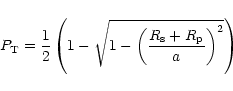 |
(5) |
where a is the radius of the orbit. As an example, we consider the
parameters of the recently identified transiting planet of HD 209458,
a G0 star with a radius of 1.1  (Henry et al.
2000; Charbonneau et al. 2000). The planet is
orbiting at 0.046 AU and possesses a radius of
(Henry et al.
2000; Charbonneau et al. 2000). The planet is
orbiting at 0.046 AU and possesses a radius of
 ,
suggesting
a transit probability of
,
suggesting
a transit probability of
 .
As
.
As
 ,
the
planet would cause deviations of several percent in a caustic crossing
microlensing event (see Fig. 3).
,
the
planet would cause deviations of several percent in a caustic crossing
microlensing event (see Fig. 3).
In calculating the expected rate of planetary transit events seen in
microlensing light curves, a number of points need to be considered.
Firstly, what proportion of microlensing events possess caustic
crossing events; Di Stefano (2000) considered this question,
concluding that if the entire halo population was composed of
binaries, then  should present caustic crossings, although
this may slightly underestimate, due to observational bias, the true
rate (Alcock et al. 2000). This is, of course, modified by the halo
fraction of binary MACHOs,
should present caustic crossings, although
this may slightly underestimate, due to observational bias, the true
rate (Alcock et al. 2000). This is, of course, modified by the halo
fraction of binary MACHOs,
 ,
which has yet to be determined.
Also important is the fraction of microlensed stars that are
,
which has yet to be determined.
Also important is the fraction of microlensed stars that are
 in size; as it is the relative size of the star and
planet that is important, the transit of even a hot (close-in) Jupiter
around a giant star will not result in a significant light curve
deviation. Alcock et al. (2000) found that
in size; as it is the relative size of the star and
planet that is important, the transit of even a hot (close-in) Jupiter
around a giant star will not result in a significant light curve
deviation. Alcock et al. (2000) found that  of stars whose
size could be determined in caustic crossing microlensing events
possessed radii
of stars whose
size could be determined in caustic crossing microlensing events
possessed radii 
 ,
the smallest being
,
the smallest being
 ;
this value is adopted here. Finally, there is the
proportion of solar type stars that possess a hot Jupiter-like planet;
again, given our current observations, this number if not well
determined, although recent studies suggest that this is
;
this value is adopted here. Finally, there is the
proportion of solar type stars that possess a hot Jupiter-like planet;
again, given our current observations, this number if not well
determined, although recent studies suggest that this is  for planets orbiting at less than 0.1 AU (Cumming et al. 1999).
Combining these, the fraction of microlensing events that are expected
to show evidence of transiting planets is
for planets orbiting at less than 0.1 AU (Cumming et al. 1999).
Combining these, the fraction of microlensing events that are expected
to show evidence of transiting planets is
 .
While this indicates that the identification of transiting planets
during microlensing events is a very rare occurrence, several factor
are uncertainty and future revisions may make the identification of
transiting planets in microlensing surveys a more attractive
prospect.
.
While this indicates that the identification of transiting planets
during microlensing events is a very rare occurrence, several factor
are uncertainty and future revisions may make the identification of
transiting planets in microlensing surveys a more attractive
prospect.
3.2 Stellar spots
The dimming produced by a transiting planet mimics a completely dark
spot on the stellar surface. Heyrovský & Sasselov (2000)
considered the microlensing of a spotty star by a single isolated
mass. In general, this resulted in only small perturbations to the
microlensing light curve, although larger deviations were possible
with the alignment of the spot with the point-like caustic of the
isolated lens. Han et al. (2000) extended this earlier
work and considered a spotty star microlensed by the extended caustic
structure of a binary lens, akin to the model presented in this paper.
Han et al. (2000) placed a spot with a contrast of 10 projected solely at the centre of the star and assuming that changing
the location of the spot does not greatly affect the resultant light
curve. Considering the work presented in this paper, however, this
latter assumption turns out not to be true, as changing the location
of the spot, like changing the location of the planet, introduces
quite different deviations into the light curve. Hence, the work of
Han et al. (2000) needs to be extended to consider this
effect (their study also requires the addition of a limb-darkened
stellar surface brightness profile to obtain "realistic'' results).
While it appears that the microlensing signature of a stellar spot
can imitate the microlensing signature of a transiting planet, there
are several features of each that can ease the differentiation of the
two phenomena. Firstly, while a star with a single large spot can be
envisaged, many are likely to present a number of spots on the
stellar surface. This would result in multiple variations in the
microlensing light curve, as opposed to the variations seen in
Fig. 2. Multiple planets transiting the stellar surface may
mimic such a spotty star, but considering the probabilities presented
in Sect. 3.1, such occurrences will be extremely rare.
Unlike planets, however, spots are not necessarily circular,
presenting possibly peculiar forms to the sweeping caustic. Circular
spots also appear elliptical when at the limb of a star, leading to
deviations from the expected planetary light curves presented in this
paper. As noted previously, stellar spots need not be completely
black against the stellar surface, possessing both colour and
intensity structure. These would introduce additional chromatic
and spectroscopic variations to the microlensing event
(Heyrovský & Sasselov 2000; Bryce & Hendry 2000).
Unfortunately, the identification of such spectroscopic variability
does not cleanly differentiate between the two as transiting planets
in themselves can introduce such features (Queloz et al. 2000; Jha et al. 2000), as can microlensing of a rotating stellar surface (Gould
1997). Hence, a more careful spectroscopic analysis, taking into
account the various sources of spectroscopic variability, is required
before a conclusive identification of a transiting planet can be
made. To provide the framework for such an analysis, and to fully
determine the photometric and spectroscopic differences of the
microlensing signature of a spotty star and a transiting planet, a
more extensive numerical study of each case is required.
4 Conclusions
Several studies have demonstrated that planets orbiting compact
objects in the Galactic disk/halo can perturb the form of a light
curve during a microlensing event. More recently, researchers have
turned their attention to using microlensing to identify planets orbit
the source stars in the Galactic bulge and Magellanic Clouds. The
resulting deviations in the form of the microlensing light curve are
small and are observationally tricky with today's technology.
However, a number of specialized monitoring teams (MOA, PLANET, GMAN,
etc.) have succeeded in collecting many hundreds of data points for
several microlensing events, with high photometric accuracy, and
demonstrate that it is possible to detect such small amplitude
deviations.
This paper has investigated this scenario further by examining the
microlensing of a star which possesses a transiting planet.
Jupiter-like planets transiting Sun-like stars produce a dimming of the star light. If such a system is microlensed, however,
the presence of a planet transiting the star can lead to very
characteristic deviations to the form of the microlensing light curve.
The degree of the deviation is very dependent upon the radius of the
planet and the relative position of the planet in front of the star
and the orientation of the caustic crossing.
In flux, the light curve profile can deviate strongly ( for
the largest planets considered), with quite characteristic shapes,
from that expected from the microlensing of star without the
transiting planet, making identification possible. Smaller
deviations, corresponding to relatively smaller transiting planets,
can be found by comparing separate high magnification events during
binary microlensing events (see Fig. 1), as these are
separated by several days and the planet will have moved due to its
orbital motion to another location over the stars surface, or, more
probably, completely off the stellar disk. As the characteristics of
the caustic crossing will also be different, in both strength and
sweeping direction, the resulting light curve of this second high
magnification event will be different, even if the location of the
planet over the stellar surface does not change. The details of the
light curve reveal the underlying caustic structure of binary
microlens (Alcock et al. 2000) and, for events that do not possess a
transiting planet, the surface brightness profile of the star,
including the effects of limb-darkening, can be determined in detail
(Albrow et al. 1999b). This information can be used to untangle the
influence of the stellar profile during the microlensing event with
the transiting planet.
for
the largest planets considered), with quite characteristic shapes,
from that expected from the microlensing of star without the
transiting planet, making identification possible. Smaller
deviations, corresponding to relatively smaller transiting planets,
can be found by comparing separate high magnification events during
binary microlensing events (see Fig. 1), as these are
separated by several days and the planet will have moved due to its
orbital motion to another location over the stars surface, or, more
probably, completely off the stellar disk. As the characteristics of
the caustic crossing will also be different, in both strength and
sweeping direction, the resulting light curve of this second high
magnification event will be different, even if the location of the
planet over the stellar surface does not change. The details of the
light curve reveal the underlying caustic structure of binary
microlens (Alcock et al. 2000) and, for events that do not possess a
transiting planet, the surface brightness profile of the star,
including the effects of limb-darkening, can be determined in detail
(Albrow et al. 1999b). This information can be used to untangle the
influence of the stellar profile during the microlensing event with
the transiting planet.
The deviations formed by the presence of a transiting planet can
mimic the effects of a spot on the stellar surface. For many systems
differentiating between planets and spots will be straight forward, as
a star can possess multiple spots, where only a single transiting
planet is expected. Other clues come from the non-circular nature of
spots and the fact that spots can possess strong colour and intensity
variations across them, resulting in additional chromatic
deviations over the light curve, although a number of other spectral
signatures as a result of microlensing of the stellar surface or the
presence of the transit planet will make this differentiation more
difficult. Finally, given the rarity of hot Jupiter planets, the
possibility of transits and the low binary microlensing rates in the
Galaxy, the prospects for detecting planetary transits during
microlensing are poor. Some of the parameters necessary for
determining the expected rate are poorly known and so a future
revised estimate may make the proposition more favourable. The results
in this study, however, are relevant to the study of the more
frequently expected detection of stellar spots during microlensing.
Acknowledgements
Joachim Wambsganss is thanked for enlightening conversations on
gravitational microlensing and extrasolar planets, and for his
comments on a previous draft of this paper, and Chris Tinney is
thanked for discussions on planetary systems. The referee, David
Heyrovský, is thanked for constructive comments.
-
Afonso, C., Alard, C., Albert, J. N., et al.
2000, ApJ, 532, 340
In the text
NASA ADS
-
Agol, E.
1996, MNRAS, 279, 571
In the text
NASA ADS
-
Agol, E., & Krolik, J.
1999, ApJ, 524, 49
In the text
NASA ADS
-
Albrow, M. D., Beaulieu, J.-P., Caldwell, J. A. R., et al.
1999a, ApJ, 522, 1011
In the text
NASA ADS
-
Albrow, M. D., Beaulieu, J.-P., Caldwell, J. A. R., et al.
1999b, ApJ, 522, 1022
In the text
NASA ADS
-
Alcock, C., Allsmar, R. A., Alves, D., et al.
2000, ApJ, 541, 270
In the text
NASA ADS
-
Ashton, C. E., & Lewis, G. F.
2001, MNRAS, 325, 305
In the text
NASA ADS
-
Bennett, D. P., & Rhie, S. H.
1996, ApJ, 472, 660
In the text
NASA ADS
-
Belle, K. E., & Lewis, G. F.
2000, PASP, 112, 320
In the text
NASA ADS
-
Bolatto, A. D., & Falco, E. E.
1994, ApJ, 436, 112
In the text
NASA ADS
-
Bryce, H. M., & Hendry, M. A.
2000 [astro-ph/0004250]
In the text
-
Castellano, T., Jenkins, J., Trilling, D. E., Doyle, L., & Koch, D.
2000, ApJ, 532, L51
In the text
NASA ADS
-
Chang, K.
1984, A&A, 130, 157
In the text
NASA ADS
-
Charbonneau, D., Brown, T. M., Latham, D. W., & Mayor, M.
2000, ApJ, 529, L45
In the text
NASA ADS
-
Cumming, A., Marcy, G. W., & Butler, R. P.,
1999, ApJ, 526, 890
In the text
NASA ADS
-
Di Stefano, R.
2000, ApJ, 541, 587
NASA ADS
-
Doyle, L. R., Deeg, H. J., Kozhevnikov, V. P., et al.
2000, ApJ, 535, 338
In the text
NASA ADS
-
Fluke, C. J., & Webster, R. L.
1999, MNRAS, 302, 68
In the text
NASA ADS
-
Graff, D. S., & Gaudi, B. S.
2000, ApJ, 538, L133
In the text
NASA ADS
-
Gaudi, B. S.
2000, ApJ, 539, 59
In the text
-
Gaudi, B. S., & Gould, A.
1999, ApJ, 513, 619
In the text
NASA ADS
-
Gould, A.
1997, ApJ, 483, 98
In the text
NASA ADS
-
Gould, A., & Loeb, A.
1992, ApJ, 396, 104
In the text
NASA ADS
-
Han, C., Park, S., & Lee, Y.
2000, MNRAS, 314, 59
NASA ADS
-
Han, C., Park, S., Kim, H., & Chang, K.
2000, MNRAS, 316, 665
NASA ADS
-
Henry, G. W., Marcy, G. W., Butler, R. P., & Vogt, S. S.
2000, ApJ, 529, L41
In the text
NASA ADS
-
Heyrovský, D., & Sasselov, D.
2000, ApJ, 529, 69
In the text
NASA ADS
-
Heyrovský, D., Sasselov, D., & Loeb, A.
2000, 543, 406
In the text
-
Jha, S., Torres, G., Stefanik, R. P., Latham, D. W., & Mazeh, T.
2000, MNRAS, 317, 375
In the text
NASA ADS
-
Lewis, G. F., & Belle, K. E.
1998, MNRAS, 297, 69
In the text
NASA ADS
-
Lewis, G. F., & Ibata, R. A.
2000, ApJ, 539, L63
In the text
NASA ADS
-
Mao, S., & Paczynski, B.
1991, ApJ, 374, L37
In the text
NASA ADS
-
Minniti, D., Vandehei, T., Cook, K. H., Griest, K., & Alcock, C.
1998, ApJ, 499, L175
In the text
NASA ADS
-
Paczynski, B.
1996, ARA&A, 34, 419
In the text
NASA ADS
-
Queloz, D., Eggenberger, A., Mayor, M., et al.
2000, ApJ, 359, L13
In the text
-
Schneider, P., Ehlers, J., & Falco, E. E.
1992, Gravitational lenses (Berlin: Springer)
In the text
-
Wambsganss, J.
1997, MNRAS, 284, 172
In the text
NASA ADS
-
Wambsganss, J., & Paczynski, B.
1991, ApJ, 102, 864
In the text
Copyright ESO 2001
![\begin{figure}
\par\includegraphics[angle=-90,width=8.8cm,clip]{ms1004f1.ps}
\end{figure}](/articles/aa/full/2001/46/aa1004/img5.gif)
![\begin{figure}
\par\includegraphics[width=14.5cm,clip]{ms1004f2.ps}
\end{figure}](/articles/aa/full/2001/46/aa1004/img6.gif)
![\begin{figure}
\par\includegraphics[width=15cm,clip]{ms1004f3.ps}
\end{figure}](/articles/aa/full/2001/46/aa1004/img28.gif)