A&A 378, 1-29 (2001)
DOI: 10.1051/0004-6361:20011175
A long-wavelength view on galaxy evolution from deep surveys
by the Infrared Space Observatory
A. Franceschini1 - H. Aussel2,3 - C. J. Cesarsky4 -
D. Elbaz5 - D. Fadda6
1 - Dipartimento di Astronomia, Vicolo Osservatorio 5, 35122 Padova,
Italy
2 -
Osservatorio Astronomico, Vicolo Osservatorio 5, 35122 Padova
3 -
Institute for Astronomy, Honolulu, Hawaii
4 -
European Southern Observatory, Germany
5 -
Service d'Astrophysique, CEA/DSM/DAPNIA Saclay, France
6 -
Instituto de Astrofisica de Canarias, La Laguna, Tenerife, Spain
Received 7 February 2001/ Accepted 20 August 2001
Abstract
We discuss the constraints set on galaxy evolution by a variety of data from
deep extragalactic surveys performed in the mid-IR and far-IR with the Infrared
Space Observatory and with millimetric telescopes at longer wavelengths.
These observations indicate extremely high rates of evolution for IR galaxies,
exceeding those measured for galaxies at other wavelengths and
comparable or larger than the rates observed for quasars.
We also match the modelled integrated emission by IR galaxies at any redshifts
with the observed spectral intensity of the extragalactic IR background (CIRB),
as a further constraint.
The multi-wavelength statistics on IR galaxies can be reconciled with each other by
assuming for the bulk of the population spectral energy distributions (SED) as
typical for starbursts, which we take as an indication that stellar
(rather than AGN, see also Fadda et al. 2001) activity powers
IR emission by faint galaxies. According to our model and following the analysis of
Elbaz et al. (2001), the deep ISO surveys at 15  m
may have already resolved more than 50% of the bolometric CIRB intensity:
the faint ISO 15 m source samples, relatively easy to identify in deep
optical images (Aussel et al. 1999), can then allow to investigate
the origin of the CIRB background. From our fits to the observed
optical-IR SEDs, these objects appear to mostly involve massive galaxies hosting
luminous starbursts (
m
may have already resolved more than 50% of the bolometric CIRB intensity:
the faint ISO 15 m source samples, relatively easy to identify in deep
optical images (Aussel et al. 1999), can then allow to investigate
the origin of the CIRB background. From our fits to the observed
optical-IR SEDs, these objects appear to mostly involve massive galaxies hosting
luminous starbursts (

 /yr).
The evolutionary scheme we infer from these data considers a bimodal star formation
(SF),
including a phase of long-lived quiescent SF, and enhanced SF taking place during
transient events recurrently triggered by interactions and merging.
We interpret the strong observed evolution as an increase with z of the rate
of interactions between galaxies (density evolution) and an increase of their
IR luminosity due to the more abundant fuel available in the past (luminosity
evolution): both factors enhance the probability to detect a galaxy during the "active"
phase at higher z. Very schematically, we associate the origin of the bulk of
the optical/NIR
background to the quiescent evolution, while the CIRB is interpreted as mostly due
the dusty starburst phase. The latter possibly leads to the formation
of galaxy spheroids, when the dynamical events triggering the starburst
re-distribute already present stellar populations.
The large energy contents in the CIRB and optical backgrounds are not
easily explained, considering the moderate efficiency of energy generation by stars:
a top-heavy stellar IMF associated with the starburst phase (and compared with a more
standard IMF during the quiescent SF) would alleviate the problem.
The evolution of the IR emissivity of galaxies from the present time to
/yr).
The evolutionary scheme we infer from these data considers a bimodal star formation
(SF),
including a phase of long-lived quiescent SF, and enhanced SF taking place during
transient events recurrently triggered by interactions and merging.
We interpret the strong observed evolution as an increase with z of the rate
of interactions between galaxies (density evolution) and an increase of their
IR luminosity due to the more abundant fuel available in the past (luminosity
evolution): both factors enhance the probability to detect a galaxy during the "active"
phase at higher z. Very schematically, we associate the origin of the bulk of
the optical/NIR
background to the quiescent evolution, while the CIRB is interpreted as mostly due
the dusty starburst phase. The latter possibly leads to the formation
of galaxy spheroids, when the dynamical events triggering the starburst
re-distribute already present stellar populations.
The large energy contents in the CIRB and optical backgrounds are not
easily explained, considering the moderate efficiency of energy generation by stars:
a top-heavy stellar IMF associated with the starburst phase (and compared with a more
standard IMF during the quiescent SF) would alleviate the problem.
The evolution of the IR emissivity of galaxies from the present time to  is
so strong that the combined set of constraints by the observed z-distributions and
the CIRB spectrum impose it to turn-over at z>1:
scenarios in which a dominant fraction of stellar formation occurs at very high-z
are not supported by our analysis.
is
so strong that the combined set of constraints by the observed z-distributions and
the CIRB spectrum impose it to turn-over at z>1:
scenarios in which a dominant fraction of stellar formation occurs at very high-z
are not supported by our analysis.
Key words: galaxies: formation - surveys - infrared: galaxies - galaxies: evolution
galaxies: active, starbursts
High-redshift galaxies and the generation of stars during the past cosmic history are
most usually investigated by observing the stellar integrated emissions in the
UV/optical/near-IR.
These studies, based on a variety of selection techniques and exploiting
very large telescopes on ground and efficient photon detectors, achieved extraordinary successes
during the last ten years in discovering large numbers of high-z galaxy candidates,
most of which were later confirmed by high-sensitivity optical spectroscopy
(Madau et al. 1996; Steidel et al. 1999). The outcomes of these unbiased
surveys are galaxies characterized by typically moderate luminosities and a
modest activity of star-formation (few /yr on average).
However, that this view could be to some extent incomplete is illustrated by the
fact that biased optical surveys emphasize a quite more active universe,
as revealed by
the existence of heavily metal-enriched environments around quasars and active
galaxies at any redshifts (Omont et al. 1996; Padovani & Matteucci 1993; Franceschini &
Gratton 1997); by the presence of populations of massive elliptical galaxies
up to z>1, with dynamically relaxed profiles and complete exhaustion of the ISM
(e.g. Moriondo et al. 2000; Rodighiero et al. 2001),
expected to originate from violent starbursts;
and by the intense activity of massive stars required to explain
the metal-polluted hot plasmas present in galaxy clusters and groups
(Mushotzky & Loewenstein 1997).
What is essentially missing from optical observations is the evidence of cosmic
sites where active transformations of baryons are taking place at rates high enough
to explain the above findings, among others.
Hints on such a possible missing link between the active and quiescent
universe come from inspection of the local universe.
The IRAS long-wavelength surveys, in particular, have revealed
that in a small fraction of local massive galaxies
(the so-called luminous [LIRG] and very luminous
[ULIRG] infrared galaxies) star-formation is taking place at very high rates
(
 /yr) (Sanders et al. 1988; Kormendy & Sanders 1992).
Interesting to note, the reddened optical spectra of these
objects do not contain manifest signatures of the dramatic phenomena revealed
by the far-IR observations (Poggianti & Wu 1998). All this emphasizes the role of
extinction by
dust, which is present wherever stars are formed, but is increasingly important in
the most
luminous objects. This also illustrates the power of extending the selection waveband
for cosmological surveys from the optical (tracing the stellar-dominated emission)
to the IR where ISM-dominated emission is observable.
/yr) (Sanders et al. 1988; Kormendy & Sanders 1992).
Interesting to note, the reddened optical spectra of these
objects do not contain manifest signatures of the dramatic phenomena revealed
by the far-IR observations (Poggianti & Wu 1998). All this emphasizes the role of
extinction by
dust, which is present wherever stars are formed, but is increasingly important in
the most
luminous objects. This also illustrates the power of extending the selection waveband
for cosmological surveys from the optical (tracing the stellar-dominated emission)
to the IR where ISM-dominated emission is observable.
It is only during the last five years that new powerful instrumentation has
allowed to start a systematic exploration of the distant universe at long
wavelengths. Three major developments have allowed this.
Firstly, the discovery in the COBE all-sky maps of a bright isotropic
background in the far-IR/sub-mm, of likely extragalactic origin (CIRB) and
interpreted as the integrated emission by dust present
in distant and primeval galaxies (Puget et al. 1996; Hauser et al. 1998).
The second important fact was the start of operation of the bolometer
array SCUBA on the 15 m sub-millimetric telescope JCMT, able to resolve
a substantial fraction of the CIRB background at long wavelengths
into a population of very luminous IR galaxies at
or larger
(Smail et al. 1997; Hughes et al. 1998; Barger et al. 1998; Blain et al.
1999).
A new powerful bolometric imaging camera (MAMBO) has also recently become
operative on the
IRAM 30 m telescope, and started to provide clean deep images of the distant
universe at 1300 m (Bertoldi et al. 2000, 2001).
Finally, the Infrared Space Observatory (ISO) allowed for the first time to
perform sensitive surveys of distant IR sources in the mid- and far-IR
(Elbaz et al. 1999; Puget et al. 1999) and to characterize in detail the evolution
of the IR emissivity of galaxies up to redshift
and above.
The present paper is devoted to the analysis of a large dataset
including number counts, redshift distributions, and luminosity functions
for faint IR sources selected between
 and
and
 m. We emphasize in our analysis deep survey data from
the ISO mission, particularly in the mid-IR where the number count statistics are
robust (Elbaz et al. 1999; Altieri et al. 1999; Aussel et al. 1999;
Oliver et al. 1997).
m. We emphasize in our analysis deep survey data from
the ISO mission, particularly in the mid-IR where the number count statistics are
robust (Elbaz et al. 1999; Altieri et al. 1999; Aussel et al. 1999;
Oliver et al. 1997).
Our approach is different from those of previous models fitting
the IR galaxy counts. In most cases (e.g. Devriendt et al. 1999; Roche & Eales
1999; Pearson & Rowan-Robinson 1996; Rowan-Robinson 2001; Xu et al. 2001)
attempts have been made to provide
combined descriptions of the IR and optical-UV data on faint galaxies.
This approach could produce even misleading results
whenever the optical data would constrain the global solution to
give very poor fits of the IR data.
Only an extremely detailed description of the complex relationship between
optical and IR emissions could provide meaningful results at some
stages. In our view, published models (e.g. Guiderdoni et al. 1998, including
sophisticated modelling of the formation of structures) illustrate more
the inconsistencies emerging when comparing optical and IR statistics
on faint sources than the benefits of a combined analysis.
Another way to see the problem is to consider in some details the optical spectral
properties of luminous and ultra-luminous IR galaxies. Poggianti & Wu (2000),
Poggianti et al. (2001) and Rigopoulou et al. (2000)
have studied rest-frame optical spectra for both
local and high-redshift objects, and consistently found that
 of the energy emitted by young stars and reprocessed in the far-IR leaves no
traces in the optical spectrum (even after correction for dust extinction),
hence can only be accounted for by
long-wavelength observations. Altogether, the ratio of IR to optical emissions is
very broadly distributed and no clear empirical, nor physical, relationships
have yet been established between the two.
of the energy emitted by young stars and reprocessed in the far-IR leaves no
traces in the optical spectrum (even after correction for dust extinction),
hence can only be accounted for by
long-wavelength observations. Altogether, the ratio of IR to optical emissions is
very broadly distributed and no clear empirical, nor physical, relationships
have yet been established between the two.
Consequently,
we have chosen to confine our analysis to data at long-wavelengths (10 to 1000 m) and to search for simple parametrizations of the evolution of galaxies
in the IR, as an attempt to provide guidelines for future physical models of galaxy
activity and its evolution.
Only at the end we will relate these results with optical data on faint galaxies,
by comparing the observed integrated emissions in the forms of the optical
and CIRB backgrounds.
In spite of the schematicity of such an approach,
our results already contain new critical information on galaxy formation and evolution.
The paper is organized as follows. We set first the general framework by discussing
in Sect. 2 the information contained in the CIRB spectral intensity.
Indeed, the availability of the CIRB measurements, providing a solid constraint
on the integrated IR emission of galaxies at any epochs, is a rather unique
feature of the IR domain, making it of extreme interest for studies of galaxy
evolution. We mention here some recent measurements of the cosmic
opacity at very high (TeV) energies, allowing to set relevant constraints
at wavelengths where the CIRB is not directly measurable.
Section 3 is devoted to summarize results from the most relevant survey projects
with ISO, while in Sect. 4 some relevant data obtained with millimetric telescopes
are summarized.
Section 5 illustrates our attempt to reproduce the multi-wavelength data with
simple prescriptions. Our present understanding of the physical nature of the
IR source populations is discussed in Sect. 6, together with a simple physical
interpretation of their previously described evolution.
Section 7 contains a discussion of the global properties of high-redshift IR
galaxies, like the evolutionary SFR density, and of the energy constraints set by the
observed IR and optical backgrounds. Our conclusions are summarized in Sect. 8.
For consistency with previous analyses, we adopt for H0 the value of 50 km s-1/Mpc
(note that this choice has no impact
on our inferred evolution properties, since the dependences on H0 of the
luminosity functions and number counts cancel out). In the following we indicate
with the symbol
 the luminosity
 calculated at
 m
and expressed in solar units. The same terminology is used for L at other wavelengths.
The symbol
m
and expressed in solar units. The same terminology is used for L at other wavelengths.
The symbol
 indicates the monochromatic flux (in Jy) at 12 m
(and similarly for other wavelengths).
indicates the monochromatic flux (in Jy) at 12 m
(and similarly for other wavelengths).
Cosmic background radiations provide a fundamental channel of information
on high-redshift sources, particularly when, for technological limitations,
observations at faint flux levels in a given waveband are not possible
(as it is largely the case in the IR/sub-mm domain).
We briefly review in this Section the observational status about
the recently discovered cosmological background at IR and sub-millimetric
wavelengths (CIRB), providing important constraints on galaxy formation and evolution.
The discovery of the CIRB - anticipated by a modellistic prediction by
Franceschini et al. (1994a), and made possible by the NASA's COBE mission -
was viewed as the first chance to determine, or at least constrain,
the integrated emission of distant galaxies (Puget et al. 1996; Guiderdoni et al.
1997; Hauser et al. 1998; Fixsen et al. 1998).
For comparison, extragalactic backgrounds at other wavelengths appear
to contain only moderate contributions by distant galaxies:
the Radio, X-ray and  -ray backgrounds, apparently dominated by distant
quasars and AGNs (Giacconi et al. 2001; Tozzi et al. 2001),
and the Cosmic Microwave Background including photons generated at
-ray backgrounds, apparently dominated by distant
quasars and AGNs (Giacconi et al. 2001; Tozzi et al. 2001),
and the Cosmic Microwave Background including photons generated at
 .
Also, direct measurements of the optical-UV backgrounds are hampered by the intense
starlight reflected by high latitude "cirrus" dust and Zodiacal-reflected Sun-light.
.
Also, direct measurements of the optical-UV backgrounds are hampered by the intense
starlight reflected by high latitude "cirrus" dust and Zodiacal-reflected Sun-light.
In spite of the presence of bright foregrounds (Zodiacal and Interplanetary
dust emission, Galactic Starlight, high-latitude "cirrus" emission), there are two
relatively clean spectral windows in the IR
where these summed emissions produce two minima:
the near-IR (3-4 m) and the sub-mm (100-500 m) cosmological windows.
Redshifted photons by the two most prominent galaxy emission features,
the stellar photospheric peak at
 m and the one at
 m due to dust re-radiation, are here observable in principle.
Particularly favourable for the detection of an extragalactic signal turned out to be
the longer-wavelength channel. By exploiting the different
spatial dependencies of the various dust components and the observed
correlations with appropriate dust tracers like the neutral and ionized hydrogen
(throug the HI 21 cm and H lines),
Puget et al. (1996) have identified in the
all-sky FIRAS/COBE maps an isotropic signal with an intensity following the law
lines),
Puget et al. (1996) have identified in the
all-sky FIRAS/COBE maps an isotropic signal with an intensity following the law
 m/
m/
 W m-2 sr-1 in the 400-1000 m interval.
![\begin{figure}
\par\includegraphics[width=16cm,height=11cm,clip]{bkg.eps}\end{figure}](/articles/aa/full/2001/40/aah2688/Timg36.gif) |
Figure 1:
The Cosmic Infrared Background (CIRB) spectrum as measured by independent
groups in the all-sky COBE maps (e.g. Hauser et al. 1998), compared
with estimates of the optical extragalactic background based on ultradeep
optical integrations by the HST in the HDF (Madau & Pozzetti 2000).
The three lower datapoints in the far-IR are from a re-analysis
of the DIRBE data by Lagache et al. (1999), the shaded areas from Fixsen
et al. (1998) and Lagache et al. The two mid-IR points are the resolved fraction of the
CIRB by the deep ISO surveys IGTES (Elbaz et al. 2001), while the dashed histograms are
limits set by TeV cosmic opacity measurements (Sect. 2.2).
The lower dashed line is the expected intensity based on the assumption that the
IR emissivity of galaxies does not change with cosmic time.
The thick line is the predicted CIRB spectrum of the presently discussed reference
model for IR galaxy evolution.
The dotted line marked CBR corresponds to the Cosmic Microwave Background spectrum. |
| Open with DEXTER |
This tentative detection has been confirmed by various other groups
with independent analyses of data from FIRAS on COBE (e.g. Fixsen et al. 1998),
as well as from the DIRBE experiment in two broad-band
channels at
 and
and  m (Hauser et al. 1998).
The most recent results from DIRBE (Hauser et al. 1998; Lagache et al. 1999;
Finkbeiner et al. 2000) and FIRAS (Fixsen et al. 1998) are reported in Fig. 1.
m (Hauser et al. 1998).
The most recent results from DIRBE (Hauser et al. 1998; Lagache et al. 1999;
Finkbeiner et al. 2000) and FIRAS (Fixsen et al. 1998) are reported in Fig. 1.
Finkbeiner et al. (2000),
after a very delicate subtraction of the far dominant Galactic and IPD foregrounds,
found an isotropic signal at 60 and 100 m with intensities at the
level of
 W m-2 sr-1. This controversial result
(see Puget & Lagache 2001 for a critical assessment)
appears to conflict, in any case, with independent estimates based on observations
of the cosmic high-energy opacity (see below).
W m-2 sr-1. This controversial result
(see Puget & Lagache 2001 for a critical assessment)
appears to conflict, in any case, with independent estimates based on observations
of the cosmic high-energy opacity (see below).
Recent analyses by Dwek & Arendt (1998) and Gorjian et al. (2000)
have claimed tentative detections in the near-IR cosmological window at
3.5 m and in the J, H and K DIRBE bands, however with
large uncertainties because of the very problematic evaluation of the Zodiacal
scattered light. Because of this, CIRB estimates particularly in J, H and Kare to be taken more reliably as upper limits.
No significant isotropic signals were detected at
 m
m
 m, any cosmological flux being far dominated here by the
Interplanetary dust (IPD) emission
(to reduce it, missions to the outer Solar System would be needed).
In this wavelength interval the CIRB energy density can be presently constrained with
high-energy observations of Blazars, by measuring the optical depth at
TeV energies due to the
m, any cosmological flux being far dominated here by the
Interplanetary dust (IPD) emission
(to reduce it, missions to the outer Solar System would be needed).
In this wavelength interval the CIRB energy density can be presently constrained with
high-energy observations of Blazars, by measuring the optical depth at
TeV energies due to the
 interaction
with the background CIRB photons (Stecker et al. 1992).
interaction
with the background CIRB photons (Stecker et al. 1992).
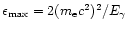
The absorption cross-section of -rays of energy  has a maximum for IR photons with energies obeing the condition:
 ,
or equivalently:
,
or equivalently:
![$\lambda_{\rm peak} \simeq 1.24\pm 0.6(E_\gamma [{\rm TeV}])~\mu$](/articles/aa/full/2001/40/aah2688/img45.gif) m.
The optical depth for a high-energy photon E0 travelling through a cosmic medium
filled of low-energy photons with density
m.
The optical depth for a high-energy photon E0 travelling through a cosmic medium
filled of low-energy photons with density  from
from  to the present time is
![$\displaystyle \tau(E_0,z_{\rm e}) c\int_0^{z_{\rm e}} {\rm d}z {{\rm d}t \over ...
...
(1{+}z)^3 {\rho_\nu (z) \over h\nu } \sigma_{\rm\gamma\gamma} (E_0,\nu[1{+}z])$](/articles/aa/full/2001/40/aah2688/img48.gif) |
|
|
(1) |
where
 is the cross-section for photon-photon interaction.
Coppi & Aharonian (1999) report the following analytical approximation, good
to better than 40%, to Eq. (1):
is the cross-section for photon-photon interaction.
Coppi & Aharonian (1999) report the following analytical approximation, good
to better than 40%, to Eq. (1):
Applications of this concept have been possible when data from
the Gamma Ray Observatory and X-ray space telescopes
have been combined with observations at TeV energies by the Whipple, HEGRA and other
Cherenkov observatories on Earth. Stanev & Franceschini (1998) have discussed upper
limits on the CIRB with minimal a-priori guess on the CIRB spectrum, using HEGRA data
for the Blazar MKN 501 (z=0.034) during an outburst in 1997, on the assumption that
the high-energy source spectrum is the flattest allowed by the data.
These limits (dotted histogram in Fig. 1) get quite close to the
background flux already resolved by the ISO mid-IR deep surveys (see Sect. 5.4 below).
More recently, Krawczynski et al. (1999) have combined the observations by Aharonian
et al. (1999) of the MKN501 1997 outburst with X-ray data from RossiXTE and
BeppoSAX, providing a simultaneous high-quality description of the whole high-energy
spectrum. These data are well fit by a Synchrotron Self Compton (SSC) model
in which the TeV spectrum (
 Hz) is produced
by Inverse Compton of the hard X-ray spectrum (
Hz) is produced
by Inverse Compton of the hard X-ray spectrum (
 Hz): the combination
of the two constrains the shape of the "primary" (i.e. before
cosmic attenuation) spectrum at TeV energies. This is used to derive
Hz): the combination
of the two constrains the shape of the "primary" (i.e. before
cosmic attenuation) spectrum at TeV energies. This is used to derive
 as a function of energy and, after Eqs. (1) and (2), a constraint on the spectral intensity of the CIRB.
The result is compatible with the limits by Stanev & Franceschini (1998, see also
Renault et al. 2001)
and allows a tentative, model dependent, estimate of the CIRB intensity in the
interval from
as a function of energy and, after Eqs. (1) and (2), a constraint on the spectral intensity of the CIRB.
The result is compatible with the limits by Stanev & Franceschini (1998, see also
Renault et al. 2001)
and allows a tentative, model dependent, estimate of the CIRB intensity in the
interval from
 to 40 m (see Fig. 1).
The observations of purely power-law Blazar spectra around
to 40 m (see Fig. 1).
The observations of purely power-law Blazar spectra around
 TeV
translate into a fairly robust upper limit
of about 10-8 W/m2 sr at
m shown in Fig. 1.
Substantially exceeding it, as sometimes suggested (Bernstein et al. 1998;
Gorjian et al. 2000), would imply either very "ad hoc"
TeV
translate into a fairly robust upper limit
of about 10-8 W/m2 sr at
m shown in Fig. 1.
Substantially exceeding it, as sometimes suggested (Bernstein et al. 1998;
Gorjian et al. 2000), would imply either very "ad hoc"  ray source spectra or new
physics (Harwit et al. 1999).
ray source spectra or new
physics (Harwit et al. 1999).
Altogether, after years of active debate among various teams working
on the COBE data, first about the existence and later on the intensity and spectral
shape of CIRB, there is now ample consensus, at least from 140 to 500 m where
the CIRB spectrum is most reliably measured and where two completely independent datasets
(FIRAS and DIRBE, with independent absolute calibrations) are available.
The CIRB flux has in particular stabilized at values
 and
and
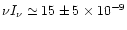 W/m2/sr at
and
240 m. Modest differences in the calibration of
FIRAS and DIRBE around 100 m have been reported (Hauser et al. 1998),
but these do not affect the overall result.
W/m2/sr at
and
240 m. Modest differences in the calibration of
FIRAS and DIRBE around 100 m have been reported (Hauser et al. 1998),
but these do not affect the overall result.
The measurement of the CIRB provides the
global energy density radiated in the IR by cosmic sources at any redshifts.
Two concomitant facts - the very strong K-correction for galaxies in the far-IR/sub-mm
due to the very steep and featureless dust spectra, and their
robustness due to the modest dependence of dust equilibrium temperature T on
the radiation field intensity - have suggested to use the CIRB spectrum to infer
the evolution of the long-wavelength galaxy emissivity as a function of redshift
(Gisper et al. 2000).
Indeed, while the peak intensity at
 to 200 m constrains it
at
to 200 m constrains it
at  ,
the low foreground contamination at
,
the low foreground contamination at
 m allows to set important constraints on the universal emissivity at z>1.
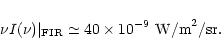
Between 100 and 1000 m the observed integrated CIRB intensity turns out to be
 W/m2/sr. In addition to this measured part of the CIRB,
one has to consider the
presently un-measurable fraction resident between 100 and 10 m.
Adopting modellistic extrapolations as in Fig. 1, consistent with the
constraints set by the cosmic opacity observations, the total energy density
between 7 and 1000 m rises to
W/m2/sr. In addition to this measured part of the CIRB,
one has to consider the
presently un-measurable fraction resident between 100 and 10 m.
Adopting modellistic extrapolations as in Fig. 1, consistent with the
constraints set by the cosmic opacity observations, the total energy density
between 7 and 1000 m rises to
 |
(3) |
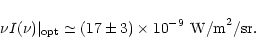
This flux is to be compared with the integrated bolometric emission by distant galaxies
between 0.1 and 7 m (the "optical background"), for which we adopt the value
given by Madau & Pozzetti (2000):
 |
(4) |
This latter has been obtained from HST source counts between 0.3 and 3 m
down to the faintest detectable limits, by exploiting the number count convergence
at magnitudes
 .
A significant upwards revision of this optical background suggested by Bernstein
et al. (1998) to account for low surface brigtness emission by galaxies is not
confirmed and would tend to conflict with measurements of the cosmic high-energy
opacity.
.
A significant upwards revision of this optical background suggested by Bernstein
et al. (1998) to account for low surface brigtness emission by galaxies is not
confirmed and would tend to conflict with measurements of the cosmic high-energy
opacity.
Already the directly measured part of the CIRB sets a relevant constraint on
the evolution of cosmic sources, if we consider that for local galaxies only 30% on
average of the bolometric flux is absorbed by dust and re-emitted in the far-IR (Soifer & Neugebauer 1991).
The CIRB's intensity exceeding the optical
background tells that galaxies in the past should have been much more
"active" in the far-IR than in the optical, and very luminous in an absolute sense.
A substantial fraction of the whole energy emitted by high-redshift galaxies should
have been reprocessed by dust at long wavelengths.
The ISO Observatory (a 60 cm cryogenic telescope operated by ESA between 1995 and
1998) included two instruments of cosmological interest: a mid-IR
 array
camera (ISOCAM), and a far-IR imaging photometer (ISOPHOT) with small
array
camera (ISOCAM), and a far-IR imaging photometer (ISOPHOT) with small
 and
and  detector arrays from 60 to 200 m.
The main extragalactic results from the 30-month ISO mission have been summarized by
Genzel & Cesarsky (2000).
detector arrays from 60 to 200 m.
The main extragalactic results from the 30-month ISO mission have been summarized by
Genzel & Cesarsky (2000).
The improvement in sensitivity
offered by ISO with respect to the previous IRAS surveys motivated to spend a
relevant fraction of the observing time to perform a set of deep surveys
at mid- and far-IR wavelengths, with the aim to parallel optical searches
of the deep sky with observations at wavelengths where dust is not only far less
effective in extinguishing optical light (relevant for estimating
the very uncertain extinction corrections for high redshift
galaxies, e.g. Meurer et al. 1997), but is also an intense source of emission.
ISO observations then provided an important complementary tool
to evaluate the global energy output by stellar populations and active nuclei.
Deep surveys with ISO have been performed in two wide mid-IR
(LW2: 5-8.5 m and LW3: 12-18 m)
and two far-IR (
 and 170 m) wavebands. All surveys are
performed through repeated raster pointings to achieve the best spatial
resolution and sensitivity.
The diffraction-limited spatial resolutions were
and 170 m) wavebands. All surveys are
performed through repeated raster pointings to achieve the best spatial
resolution and sensitivity.
The diffraction-limited spatial resolutions were  arcsec FWHM at 15 m and
  arcsec at 100 m. Mostly because of the better imaging,
ISO sensitivity limits in the mid-IR are three orders of magnitude
deeper in flux density than at long wavelengths (0.1 mJy versus 100 mJy).
To some extent, these different performances are counter-balanced by the typical
FIR spectra of galaxies and AGNs, which are almost two orders of magnitude
brighter at 100 m than at 10 m.
We summarize in the following the most relevant programs of ISO surveys.
arcsec at 100 m. Mostly because of the better imaging,
ISO sensitivity limits in the mid-IR are three orders of magnitude
deeper in flux density than at long wavelengths (0.1 mJy versus 100 mJy).
To some extent, these different performances are counter-balanced by the typical
FIR spectra of galaxies and AGNs, which are almost two orders of magnitude
brighter at 100 m than at 10 m.
We summarize in the following the most relevant programs of ISO surveys.
Five extragalactic surveys with the LW2 and LW3 filters have been performed
in the ISOCAM Guaranteed Time (IGTES), including large-area
shallow surveys (
![$S_{\rm 15}[\lim]\simeq 0.5{-}0.7$](/articles/aa/full/2001/40/aah2688/img75.gif) mJy) and small-area deep integrations
(
mJy) and small-area deep integrations
(
![$S_{\rm 15}[\lim]\simeq 0.1$](/articles/aa/full/2001/40/aah2688/img76.gif) mJy). A total area of 1.5 sq. degrees
have been surveyed in the Lockman Hole and the "Marano" southern field, where more
than one thousand sources have been detected (Elbaz et al. 1999). These two areas
were selected for their low zodiacal and cirrus emissions and because of
the existence of data at other wavelengths (optical, radio, X).
Since the LW2 band at 7 m does not sample dust emission in high-z sources
and includes a large fraction of Galactic stars,
we will confine our analysis in the following to data in the LW3 15 m.
mJy). A total area of 1.5 sq. degrees
have been surveyed in the Lockman Hole and the "Marano" southern field, where more
than one thousand sources have been detected (Elbaz et al. 1999). These two areas
were selected for their low zodiacal and cirrus emissions and because of
the existence of data at other wavelengths (optical, radio, X).
Since the LW2 band at 7 m does not sample dust emission in high-z sources
and includes a large fraction of Galactic stars,
we will confine our analysis in the following to data in the LW3 15 m.
The European Large Area ISO Survey (ELAIS) was the largest program in the ISO Open Time
(Oliver et al. 2000a).
A total of 12 square degrees have been surveyed at 15 m with ISOCAM
and at 90 m with ISOPHOT (6 and 1 sq. degrees have been
covered at 6.7 and 170 m respectively).
To reduce the effects of cosmic variance, ELAIS was split into
3 fields of comparable size, 2 in the north (N1, N2), one in the south (S1),
plus six smaller areas.
While data analysis is still in progress, a source list of over 1000
(mostly 15 m)
sources is being published, including starburst galaxies and AGNs (type-1 and type-2),
typically at z<0.5, with several quasars (including various BAL QSOs)
found up to the highest z.
![\begin{figure}
\par\includegraphics[width=16cm,height=11cm,clip]{c15dif.eps}\end{figure}](/articles/aa/full/2001/40/aah2688/Timg77.gif) |
Figure 2:
Differential counts at
 m normalized to the
Euclidean law ( m normalized to the
Euclidean law (
![$N[S]\propto S^{-2.5}$](/articles/aa/full/2001/40/aah2688/img2.gif) ;
the differential form is preferred here because
all data points are statistically independent).
The data come from an analysis of the IGTES surveys by Elbaz et al. (1999).
The dotted line corresponds to the expected counts for a population of
non-evolving spirals. The short dashed line comes from our modelled population
of strongly evolving starburst galaxies, the long-dashed one are type-I AGNs.
The shaded region at ;
the differential form is preferred here because
all data points are statistically independent).
The data come from an analysis of the IGTES surveys by Elbaz et al. (1999).
The dotted line corresponds to the expected counts for a population of
non-evolving spirals. The short dashed line comes from our modelled population
of strongly evolving starburst galaxies, the long-dashed one are type-I AGNs.
The shaded region at
 mJy
comes from an extrapolation of the faint 60 m IRAS counts (Mazzei et al. 2001).
mJy
comes from an extrapolation of the faint 60 m IRAS counts (Mazzei et al. 2001). |
| Open with DEXTER |
The two ultradeep blank-field exposures by the Hubble Space Telescope
(one in the North and the other in the South, the Hubble Deep Fields, HDF) have
promoted a substantial effort of multi-wavelength studies aimed at
characterizing the SEDs of distant and high-z galaxies. These areas,
including the Flanking Fields for a total of
sq. arcmin,
have been observed by ISOCAM at 6.7 and 15 m down to
a completeness limit of 100 Jy at 15 m.
These sensitive ISO surveys have allowed to detect dust emission from
luminous starburst galaxies up to a redshift z=1.3 (Rowan-Robinson et al. 1997;
Aussel et al. 1999). In the inner 11 sq. arcmin, the HST provides a detailed
morphological information for ISO galaxies at any redshifts.
Thanks to the variety of photometric data and an almost complete redshift
information available (Aussel et al. 1999; Cohen et al. 2000), these surveys are
allowing the most detailed characterization of the faint IR source population.
The redshift distributions at the LW3 survey limits show an excess number of
sources between z=0.5 and z=1.2,
partly an effect of the K-correction as explained below.
![\begin{figure}
\par\includegraphics[width=14.2cm,height=9.2cm,clip]{c170.eps}\end{figure}](/articles/aa/full/2001/40/aah2688/Timg79.gif) |
Figure 3:
Integral counts based on the ISOPHOT FIRBACK survey (Sect. 3.1) at
 m (filled circles, from Dole et al. 2000) and on the ISOPHOT
Serendipitous survey (open squares,
Stickel et al. 1998). The shaded region is a constraint coming from a fluctuation
analysis by Matsuhara et al. (2000). The dashed and dot-dashed lines correspond to
the non-evolving and the strongly evolving populations as in Fig. 2.
The lowest curve is the expected contribution of type-I AGNs.
The horizontal lines mark the confusion limits (assumed to correspond to 27 beams/source) for various telescope sizes: the lines marked "85 cm" and "360 cm"
correspond to the SIRTF and Herschel/FIRST limits for faint source detection, assumed
diffraction-limited spatial sampling. The confusion limit scales up on the y-axis
proportionally to the square of the diameter of the primary reflector. m (filled circles, from Dole et al. 2000) and on the ISOPHOT
Serendipitous survey (open squares,
Stickel et al. 1998). The shaded region is a constraint coming from a fluctuation
analysis by Matsuhara et al. (2000). The dashed and dot-dashed lines correspond to
the non-evolving and the strongly evolving populations as in Fig. 2.
The lowest curve is the expected contribution of type-I AGNs.
The horizontal lines mark the confusion limits (assumed to correspond to 27 beams/source) for various telescope sizes: the lines marked "85 cm" and "360 cm"
correspond to the SIRTF and Herschel/FIRST limits for faint source detection, assumed
diffraction-limited spatial sampling. The confusion limit scales up on the y-axis
proportionally to the square of the diameter of the primary reflector. |
| Open with DEXTER |
Two fields from the Canada-France Redshift Survey (CFRS) have been
observed with ISOCAM to intermediate depths: the "1415+52'' field (observed at 6.7 and
15 m) and the "0302+00'' field (with only 15 m data, but twice as deep).
Studies of ISOCAM sources detected in both fields have provided the first
tentative interpretation of the nature of distant IR galaxies (Flores et al. 1999).
The LW3 survey displays a redshift distribution similar to those of the HDF surveys
(see Fig. 10 below).
FIRBACK is a set of deep cosmological surveys carried out with ISOPHOT,
specifically aimed at detecting at 170 m the sources of the far-IR background
(Puget et al. 1999).
Part of this survey was done in the Marano area and in ELAIS N1, and
part in collaboration with the ELAIS team in ELAIS N2.
This survey is limited by extragalactic source confusion in the large ISOPHOT beam
(90 arcsec) to
 mJy (see for more details Puget et al. 1999;
Dole et al. 2001). Constraints
on the counts below the confusion limit obtained from a fluctuation analysis of
one Marano/FIRBACK field are discussed by Lagache & Puget (1999).
The roughly 200 sources detected are presently targets of follow-up observations,
especially using deep radio exposures to help reducing the ISO errorbox and
identifying the optical counterparts. Also an effort is being made
to follow-up these sources with sub-mm telescopes (JCMT, IRAM) to derive constraints
on their redshifts.
mJy (see for more details Puget et al. 1999;
Dole et al. 2001). Constraints
on the counts below the confusion limit obtained from a fluctuation analysis of
one Marano/FIRBACK field are discussed by Lagache & Puget (1999).
The roughly 200 sources detected are presently targets of follow-up observations,
especially using deep radio exposures to help reducing the ISO errorbox and
identifying the optical counterparts. Also an effort is being made
to follow-up these sources with sub-mm telescopes (JCMT, IRAM) to derive constraints
on their redshifts.
Three lensing galaxy clusters, Abell 2390, Abell 370 and Abell 2218,
have received very long integrations by ISOCAM (Altieri et al. 1999; Lemonon
et al. 1999; Biviano et al. 2001). The lensing has been exploited to achieve even
better sensitivities with respect to ultradeep blank-field surveys (e.g. the HDFs),
and allowed detection of sources between 30 and 100 Jy at 15 m
over a total area of 56 square arcmin (obviously at the expense of an additional
uncertainty introduced by flux amplification and area distortion).
The lensing-corrected
number counts at 15 m were used by Biviano et al. (2001) to estimate a
lower limit to the CIRB of
 nW/m2/sr, close to the upper limit
by Stanev & Franceschini (1998).
nW/m2/sr, close to the upper limit
by Stanev & Franceschini (1998).
Ultra-deep surveys in the Lockman Hole and SSA13 with the LW2 7 m
ISOCAM band were performed by Taniguchi et al. (1997).
The Lockman region was also surveyed with ISOPHOT
by the same team: constraints on the source counts at 90 and 170 are derived by Matsuhara et al. (2000) based on a fluctuation analysis.
ISOCAM data needed particular care to remove - in addition to the usual photon, readout,
flat-field and dark current noises - the effects of glitches induced
by the frequent impacts of cosmic rays on the
detectors (the 960 pixels registered on average 4.5 events/s during the mission).
This badly conspired with the need to keep them cryogenically cooled to reduce
the instrumental noise, which implied a slow electron reaction time
and long-term memory effects.
For the deep surveys this implied a problem to
disentangle faint sources from trace signals by cosmic ray impacts.
To correct for that, tools have been developed by various groups for the
two main instruments (CAM and PHOT),
essentially based on identifying patterns in the time history
of the response of single pixels, which are specific to either astrophysical
sources (a jump above the average background flux when a source
falls on the pixel) or cosmic ray glitches (transient spikes followed by
a slow recovery to the nominal background).
The most common "normal" glitches, induced by cosmic electron impacts and
lasting only one or two readouts, where the easier to identify and remove.
Other less frequent impacts by protons and alpha particles
leave longer-lasting spurious signals, from typically several to occasionally
one hundreds or more readouts. The long integrations adopted for deep ISO
surveys were needed not only to reduce the instrumental noise, but even more to
achieve enough redundancy (number of elementary integrations per sky position)
to separate spurious from astrophyical signals in the pixel time history.
A rather performant non-parametric algorithm for ISOCAM data reduction is PRETI
(Stark et al. 1999), exploiting multi-resolution
wavelet transforms in the 2-D observable plane of the position on the detector
vs. time sequence). A competely independent parametric method, based on a physical
model for the detector transients, has been devised by Lari et al. (2001),
and especially taylored for the shallow ELAIS integrations.
Independent tools have been developed by Désert et al. (1999) and by Oliver et al.
(2000a).
The PRETI and LARI detection algorithms have been tested by means of
Monte Carlo simulations including all artifacts introduced by the analyses.
Such simulations have been performed
on real datasets, including both a long staring observation of more than 500
readouts (Elbaz et al. 1998) and the deep survey frame itself
(Lari et al. 2000). Test sources with known fluxes were introduced with their PSF
and model transients, against which the detection algorithm has been tested.
With these simulations it has been possible to control as a function
of the flux threshold: the detection reliability, the completeness, the Eddington
bias and photometric accuracy (
 % when enough redundancy was available,
as in the CAM HDFs and IGTES ultradeep surveys).
The PRETI and LARI methods have been applied in particular to the HDF North
dataset (Aussel et al. 1999; C. Lari, private communication), and they showed
excellent agreement down to the faintest fluxes.
% when enough redundancy was available,
as in the CAM HDFs and IGTES ultradeep surveys).
The PRETI and LARI methods have been applied in particular to the HDF North
dataset (Aussel et al. 1999; C. Lari, private communication), and they showed
excellent agreement down to the faintest fluxes.
The astrometric accuracy is of order of 2 arcsec for deep highly-redundant
and properly registered images, allowing relatively easy identification of the
sources (Aussel et al. 1999, 2001; Elbaz et al. 2001; Fadda et al. 2001).
For example, among the complete ISOCAM sample of 41 galaxy identifications in the
HDF North studied by Aussel et al. (1999, 2001), all have an optical counterpart
brighter than I=23 within 3
 ,
and only one source appears to be confused by the
presence of more than one optical galaxy in the ISO errorbox.
The quality and reproducibility of the results for the CAM surveys is also
proven by the good consistency of the counts from independent surveys
(see Fig. 2 below).
A reliable reduction of the longer wavelength ISOPHOT observations proved to be
more difficult.
The
,
and only one source appears to be confused by the
presence of more than one optical galaxy in the ISO errorbox.
The quality and reproducibility of the results for the CAM surveys is also
proven by the good consistency of the counts from independent surveys
(see Fig. 2 below).
A reliable reduction of the longer wavelength ISOPHOT observations proved to be
more difficult.
The  m counts from PHOT C200 surveys are 90% reliable above the 5-
 confusion
limit
confusion
limit
 mJy, and required relatively standard procedures for
baseline corrections and "de-glitching".
Quite more severe are the noise problems for the C100 channel (60 to
mJy, and required relatively standard procedures for
baseline corrections and "de-glitching".
Quite more severe are the noise problems for the C100 channel (60 to  m,
which would
otherwise benefit by a better spatial resolution), preventing so far to achieve
significantly better sensitivities than IRAS. The C100 PHOT survey dataset
is still presently under analysis (C. Lari and G. Rodighiero, work in progress).
m,
which would
otherwise benefit by a better spatial resolution), preventing so far to achieve
significantly better sensitivities than IRAS. The C100 PHOT survey dataset
is still presently under analysis (C. Lari and G. Rodighiero, work in progress).
![\begin{figure}
\par\includegraphics[width=8.5cm,height=7.4cm,clip]{c170dif.eps}\end{figure}](/articles/aa/full/2001/40/aah2688/Timg88.gif) |
Figure 4:
Differential counts from the ISOPHOT FIRBACK survey at
m, from Dole et al. (2001), compared with the prediction
of the reference model. As in Fig. 2, the dotted line corresponds to the
non-evolving spiral population, the short-dashed to evolving starbursts,
long-dashes are type-I AGNs. |
| Open with DEXTER |
IR-selected galaxies have typically red colors, partly because of extinction by dust
responsible for the excess IR flux. When found at substantial redshifts,
these sources are also quite faint in the optical.
For this reason the redshift information is presently available
only for limited subsamples (e.g. the HDF North and CFRS samples).
In this situation, the source number counts provide crucial
constraints on the evolution properties.
Particularly relevant information comes from the mid-IR surveys based on the
ISOCAM 15 m LW3 filter, because they include the faintest, most distant
and most numerous ISO-detected sources with reliable identifications.
To cover with LW3 a wide dynamic range in flux with good source statistics,
Elbaz et al. (1999) performed a variety of surveys with sky coverages decreasing
as a function of the flux limits.
Including ELAIS and the IRAS data, the range in fluxes reaches four
orders of magnitude.
The differential counts (normalized to the Euclidean law d
 )
based on data from seven independent sky areas, shown in Fig. 2,
reveal a remarkable agreement.
Of the various samples considered by Elbaz et al., only sources in flux bins for
which
the survey was better than 80% complete were used (for a total of 614 sources).
)
based on data from seven independent sky areas, shown in Fig. 2,
reveal a remarkable agreement.
Of the various samples considered by Elbaz et al., only sources in flux bins for
which
the survey was better than 80% complete were used (for a total of 614 sources).
At fluxes fainter than 1 mJy the contamination by stars is of the order of only few %,
while at brighter fluxes in the Lockman Shallow Survey it reaches
 ,
and
further increases at increasing flux.
,
and
further increases at increasing flux.
In addition to the data reported by Elbaz et al., the shaded region at S15>5 mJy
in Fig. 2 corresponds to an estimate of the extragalactic counts by
Mazzei et al. (2001) overriding the problem to account for the large fraction
of galactic stars at these bright fluxes. This estimate is based on the
60 m IRAS galaxy counts translated to the LW3 band by using ISOCAM photometry of
a complete sample of faint IRAS sources in the North Ecliptic Pole (Aussel et al.
2000). This evaluation of the bright 15 m counts helps to constrain the
level of non-evolving galaxies and the normalization of the local luminosity
function (see Sect. 5.1), untill a systematic identification of the ELAIS catalogues
will be available.
The combined 15 m differential counts display various remarkable features
(Elbaz et al. 1999):
a roughly euclidean slope from the brightest fluxes sampled by IRAS down to
 mJy; a fast upturn at S15< 3 mJy, where the counts increase
as d
mJy; a fast upturn at S15< 3 mJy, where the counts increase
as d
 to
to
 mJy; and finally the evidence for a
flattening below
mJy; and finally the evidence for a
flattening below
 mJy (where the slope becomes quickly sub-Euclidean,
d
mJy (where the slope becomes quickly sub-Euclidean,
d
 ).
Note that the sudden change in slope and the faint flux convergence is supported by 3
independent surveys.
).
Note that the sudden change in slope and the faint flux convergence is supported by 3
independent surveys.
The areal density of ISOCAM 15 m sources at the limit of
 Jy is
Jy is
 arcmin-2. If we consider that the
diffraction-limited diameter of a point-source is arcsec2and for a slope of the counts
arcmin-2. If we consider that the
diffraction-limited diameter of a point-source is arcsec2and for a slope of the counts
 ,
this density is close to the ISO confusion limit at 15 m of
,
this density is close to the ISO confusion limit at 15 m of
 sources/areal resolution element, or
 in our case (Franceschini 2000).
Confusion will likely remain a limitation for the NASA's SIRTF mission,
in spite of the moderately larger primary collector and better PSF sampling.
in our case (Franceschini 2000).
Confusion will likely remain a limitation for the NASA's SIRTF mission,
in spite of the moderately larger primary collector and better PSF sampling.
Obviously, far-IR selected samples are even more seriously affected by confusion.
The datapoints on the 170 m integral counts reported in Fig. 3
come from the FIRBACK survey (Dole et al. 2001),
while Fig. 4 shows the same counts in
differential units. Similarly deep observations at 90, 150 and 180 m
are reported by Juvela et al. (2000). These surveys have essentially
attained at the ISOPHOT confusion limit.
Additional constraints at slightly fainter fluxes have been attempted using
background fluctuation analyses (Lagache & Puget 1999; Matsuhara et al. 2000,
see shaded region in Fig. 3).
Shorter wavelength ISOPHOT C100 observations could in principle benefit by a less
severe confusion limitation.
Preliminary results of ISOPHOT ELAIS surveys at
 m
(Efstathiou et al. 2000), as well as counts derived from the IRAS 100 m survey,
are reported in Fig. 5, showing nice agreement in the overlap flux range.
m
(Efstathiou et al. 2000), as well as counts derived from the IRAS 100 m survey,
are reported in Fig. 5, showing nice agreement in the overlap flux range.
![\begin{figure}
\par\includegraphics[width=8.5cm,height=7.3cm,clip]{c90.eps}\end{figure}](/articles/aa/full/2001/40/aah2688/Timg102.gif) |
Figure 5:
Integral counts at
 m based on the IRAS (open circles)
and the ELAIS 90 m (filled circles) surveys, as reported by Efstathiou
et al. (2000). Line symbols as in Fig. 3. The lines marked "60 cm" and "360 cm"
correspond to the ISO and Herschel/FIRST limits for faint source detection. m based on the IRAS (open circles)
and the ELAIS 90 m (filled circles) surveys, as reported by Efstathiou
et al. (2000). Line symbols as in Fig. 3. The lines marked "60 cm" and "360 cm"
correspond to the ISO and Herschel/FIRST limits for faint source detection. |
| Open with DEXTER |
Surveys in the sub-millimeter offer a unique advantage
to naturally generate volume-limited samples from flux-limited observations.
This property is due to the peculiar shape of galaxy spectra,
with an extremely steep slope from 1 mm to 200 m
(roughly
 ,
Andreani & Franceschini 1996).
Then, as we observe in the sub-mm galaxies
at larger and larger redshifts, the selection waveband in the source rest-frame
moves to higher frequencies along a steeply increasing
spectrum, and the corresponding K-correction almost completely counter-balances
the cosmic dimming of the flux, for sources at
,
Andreani & Franceschini 1996).
Then, as we observe in the sub-mm galaxies
at larger and larger redshifts, the selection waveband in the source rest-frame
moves to higher frequencies along a steeply increasing
spectrum, and the corresponding K-correction almost completely counter-balances
the cosmic dimming of the flux, for sources at  and up to
  (Blain & Longair 1993).
A further related advantage of sub-mm surveys is that local galaxies
emit very modestly at these wavelengths. Altogether, a sensitive sub-mm survey
will avoid local objects (stars and nearby galaxies) and will select preferentially
sources at high and very high redshifts: a kind of direct picture of the
high-redshift universe, impossible to obtain at other frequencies.
(Blain & Longair 1993).
A further related advantage of sub-mm surveys is that local galaxies
emit very modestly at these wavelengths. Altogether, a sensitive sub-mm survey
will avoid local objects (stars and nearby galaxies) and will select preferentially
sources at high and very high redshifts: a kind of direct picture of the
high-redshift universe, impossible to obtain at other frequencies.
Important discoveries have come from the operation of a powerful array of bolometers
(SCUBA) on JCMT, due to a combined effect of sensitivity, large multiplexing
capability, an efficient 15 m primary mirror, and an operation site allowing to
observe at short mm wavelengths (
 m). In such way,
SCUBA on JCMT has allowed to resolve more than
m). In such way,
SCUBA on JCMT has allowed to resolve more than  of the long-
 CIRB background into a population of faint distant, mostly high-z, sources.
![\begin{figure}
\par\includegraphics[width=14.2cm,height=9.2cm,clip]{c850.eps}\end{figure}](/articles/aa/full/2001/40/aah2688/Timg109.gif) |
Figure 6:
Integral counts at
 m.
The filled squares are from Blain et al. (1999), the open squares from Barger et al. (1999).
See caption to Fig. 3 for meaning of the lines. m.
The filled squares are from Blain et al. (1999), the open squares from Barger et al. (1999).
See caption to Fig. 3 for meaning of the lines. |
| Open with DEXTER |
Various groups have used SCUBA for deep cosmological surveys.
Smail et al. (1997, 1999) have exploited 7 distant galaxy clusters as cosmic
lenses, obtaining a sample of 17 (3)
sources with
 mJy.
Hughes et al. (1998) published a single very deep image of the HDF North
containing 5 (
mJy.
Hughes et al. (1998) published a single very deep image of the HDF North
containing 5 ( )
sources at
)
sources at
 mJy.
Lilly et al. (1999) and Eales et al. (2000) have published samples including
mJy.
Lilly et al. (1999) and Eales et al. (2000) have published samples including
 (
( )
sources to 3.5 mJy. Scott, Dunlop et al. (2001, in prep) have recently completed a survey
in the Lockman and ELAIS N2 regions
and detected approximately 20 ()
sources.
In addition to deep sub-mm surveys (Barger et al. 1998, 1999), Barger, Cowie and
co-workers have carried out an extensive program of follow-up of SCUBA
sources with optical telescopes. Other systematic identification efforts
have been attempted by Ivison et al. (2000, see also Sect. 6.3).
)
sources to 3.5 mJy. Scott, Dunlop et al. (2001, in prep) have recently completed a survey
in the Lockman and ELAIS N2 regions
and detected approximately 20 ()
sources.
In addition to deep sub-mm surveys (Barger et al. 1998, 1999), Barger, Cowie and
co-workers have carried out an extensive program of follow-up of SCUBA
sources with optical telescopes. Other systematic identification efforts
have been attempted by Ivison et al. (2000, see also Sect. 6.3).
Each of these deep integrations required many tens of hours each of
especially good weather, which meant approximately 20%
of the JCMT observatory time since 1997.
In spite of this effort, the surveyed areas (few tens of arcmin2) and number of
detected sources (from 100 to 200 sources) are modest, which illustrates the
difficulty to work from ground at these wavelengths.
Much fewer sources have been detected in the 450 m channel,
for which the atmospheric transmission at JCMT is usually poor.
The extragalactic source counts at 850 m, reported in Fig. 6,
show a dramatic departure from the Euclidean law [d
 in the crucial flux-density interval from 2 to 10 mJy], a clear signature of the
strong evolution and high redshift of SCUBA-selected sources.
in the crucial flux-density interval from 2 to 10 mJy], a clear signature of the
strong evolution and high redshift of SCUBA-selected sources.
A new bolometer array (MAMBO) has become recently operative on the largest existing
mm telescope, the IRAM 30 m.
A large survey at
 mm of 3 fields with a total area of over
200 arcmin2 to a flux limit of few mJy has been performed with MAMBO
(Bertoldi et al. 2000): preliminary galaxy counts and evaluations of the redshift
distributions are reported by Bertoldi et al. (2001), both confirming the SCUBA
results at 850 m (see Fig. 7).
mm of 3 fields with a total area of over
200 arcmin2 to a flux limit of few mJy has been performed with MAMBO
(Bertoldi et al. 2000): preliminary galaxy counts and evaluations of the redshift
distributions are reported by Bertoldi et al. (2001), both confirming the SCUBA
results at 850 m (see Fig. 7).
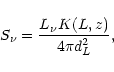
A zero-th order interpretation of data on deep counts is obtained by
comparing them with the expectations of models assuming no-evolution for cosmic sources.
When referred, in particular, to the mid-IR galaxy counts of Fig. 2,
this calculation has to account in detail for the effects of the complex mid-IR
spectrum of galaxies (including strong PAH emission and silicate absorption features,
see Fig. 13 and 17 below) in the K-correction factor relating
observed flux S and rest-frame luminosity L:
 |
(5) |
where dL is the luminosity distance![[*]](/icons/foot_motif.gif) and
and
![$K(L,z)={(1+z) L[\nu (1+z)]\over L(\nu)}$](/articles/aa/full/2001/40/aah2688/img124.gif) the K-correction.
The differential number counts (sources/unit flux interval/unit solid angle) at a given flux
S write as:
the K-correction.
The differential number counts (sources/unit flux interval/unit solid angle) at a given flux
S write as:
![\begin{displaymath}%
{{\rm d}N \over {\rm d}S} =
\int_{\rm0}^{z_{\rm max}}\,{\r...
...rm d}z}\,{{\rm d} \log L(S,z)\over {\rm d}S}\,
\rho[L(S,z),z]
\end{displaymath}](/articles/aa/full/2001/40/aah2688/img125.gif) |
(6) |
where
![$\rho[L(S,z),z]$](/articles/aa/full/2001/40/aah2688/img126.gif) is the epoch-dependent luminosity function and
d
is the epoch-dependent luminosity function and
d
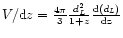 is the differential volume
element. The moments of various order of the distribution
is the differential volume
element. The moments of various order of the distribution
 of Eq. (6)
provide respectively the integral counts
of Eq. (6)
provide respectively the integral counts
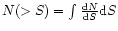 ,
the contribution to the background intensity
,
the contribution to the background intensity
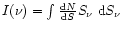 ,
and
to the background fluctuations
,
and
to the background fluctuations
![$<[\delta I(\nu)]^2>=\int {{\rm d}N \over {\rm d}S} S^2_\nu\ {\rm d}S_\nu$](/articles/aa/full/2001/40/aah2688/img131.gif) .
.
Taking into account the system transmission function
 ,
the
K-correction is more appropriately written as:
,
the
K-correction is more appropriately written as:
![\begin{displaymath}%
K(L,z)={(1+z)\ \int_{\rm\lambda_1}^{\lambda_2} {\rm d}\lamb...
...lambda_0 \over \lambda \right)\
T(\lambda)\ L[\nu,z=0]} \cdot
\end{displaymath}](/articles/aa/full/2001/40/aah2688/img133.gif) |
(7) |
Figure 8 illustrates the effects of the mid-IR emission/absorption
features on K-correction,
for different mid-IR spectra (an inactive spiral [dotted line], a M 82-like starburst
[continuous line], both observed with ISOCAM LW3) and different filters (the starburst M 82
observed with LW2 [dashed line]). The detailed spectral response functions of the
various filters, as given in the ISOCAM Observer Manual (ESA Publications),
have been used in Eq. (7).
The effect of the prominent emission features on the counts is particularly
important in the wide LW3 (12-18 m) filter, as they imply an enhanced sensitivity
to sources at 0.5<z<1.3, and a diminished one outside this redshift interval.
Correspondingly, the LW3 selection provides improved capability to study in detail
the evolution of galaxies between z=0.5 and 1, a redshift-interval that current
cosmogonic models (e.g. Kauffmann & Charlot 1998) predict
to be critical for the formation of structures.
![\begin{figure}
\par\includegraphics[width=8.2cm,height=8cm,clip]{Kcorr.eps}\end{figure}](/articles/aa/full/2001/40/aah2688/Timg134.gif) |
Figure 8:
K-correction as a function of the source redshift (Eq. (7))
for different filters
and source spectra. Dotted line: inactive spiral spectrum observed with the LW3 filter;
continuous line: M 82-like spectrum with LW3; dashed line: M 82 spectrum observed with LW2.
Note that the spiral spectrum (dotted line) implies the strongest K-correction at because of the lack of hot-dust emission depressing the rest-frame LW3 flux compared
with the redshifted PAH-dominated emission. |
| Open with DEXTER |
The second ingredient for the no-evolution prediction is the local galaxy luminosity
function (LLF). In the mid-IR, LLFs have been published by Rush et al.
(1993), Xu et al. (1998) and Fang et al. (1998), all based on the 12 m
all-sky IRAS survey. Unfortunately, in spite of the proximity of the
CAM LW3 and IRAS 12 m bands, our knowledge of the 15 m LLF is still
somehow uncertain, because of: a) uncertainties in the IRAS 12 m photometry;
b) the effect of local inhomogeneities, particularly the local Virgo super-cluster,
in the shallow IRAS survey; and c) the uncertain flux conversion between the IRAS and
CAM-LW3 bands (Alexander & Aussel 2000).
Because of (a) and (b), the Rush et al. LLF determination was affected by an improper
flux normalization and a too steep faint-end slope (e.g. inconsistent with the IRAS
60 m LLF).
These various effects have been discussed by Fang et al. (1998) and Xu et al. (1998): a re-calibrated 12 m luminosity function based on these analyses
is reported in Fig. 9. Open squares
at

 come from Fang et al. (1998). For lower luminosity
values the Fang et al. LLF persisted to show excess density, and for this reason
we used here the determination by Xu et al. (1998, we neglect the small correction
from 15 to 12 m, given the flat shape of the LLF here).
The shallower low-luminosity slope of this new LLF determination is in particular
consistent with the 60 m one (small filled squares in Fig. 9,
see also Sect. 5.3 below).
We fit these data (dotted line in Fig. 9) with an analytic form
come from Fang et al. (1998). For lower luminosity
values the Fang et al. LLF persisted to show excess density, and for this reason
we used here the determination by Xu et al. (1998, we neglect the small correction
from 15 to 12 m, given the flat shape of the LLF here).
The shallower low-luminosity slope of this new LLF determination is in particular
consistent with the 60 m one (small filled squares in Fig. 9,
see also Sect. 5.3 below).
We fit these data (dotted line in Fig. 9) with an analytic form
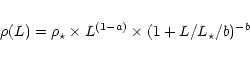
similar to the one suggested by Rush et al., but with different slopes (a=1.15 vs. 1.7,
b=3.1 vs. 3.6) and different normalizations.
![\begin{figure}
\par\includegraphics[width=14.1cm,height=10cm,clip]{llf12.eps} %
\end{figure}](/articles/aa/full/2001/40/aah2688/Timg138.gif) |
Figure 9:
Galaxy LLF's at 12 m from Fang et al. (1998, red open squares)
and adapted from Xu et al. (1998) in the low-luminosity regime. A comparison
is made with the IRAS 60 m LLF by Saunders et al. (1990, small filled squares).
Black circles are an estimate, based on the Rush et al. (1993) catalogue,
of the contribution to the 12 m LLF by
active galaxies (including type-I AGNs [red long-dashed line] and type-II AGNs plus
starbursts [green short-dash line]). Type-II AGNs and starbursts are included in the
same population on the assumption that in both classes the IR spectrum is dominated
by starburst emission.
The dotted line is the separate contribution of normal spirals, while the continous line
is the total LLF. In our reference model (Sect. 5.2), only type-I AGNs
and active galaxies dominated by starburst emission (short-dashes) are allowed
to evolve. |
| Open with DEXTER |
The dotted line in Fig. 2 corresponds to the predicted counts assuming
a non-evolving population using this best-estimate LLF. The correction to the CAM
LW3 band is made by adopting a 12 m to LW3 flux ratio which is a function
of the 12 m luminosity: for the less luminous objects the ratio
is based on the observed mid-IR spectrum of quiescent spirals, while for
the highest luminosity galaxies the ratio is the one expected for ultraluminous
IR galaxies, and for intermediate objects is close to a typical starburst spectrum
like the one of M 82 (continuous line in Fig. 17).
The 15 to 12 m flux ratio is then assumed to increase
continuously with luminosity, the
15 m flux being increasingly dominated by the starburst emission at increasing L(see Sect. 5.3 for details).
Note that in the absence of evolution, different values for the cosmological
parameters have negligible influence on the no-evolution expectation.
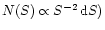
It is clear that the no-evolution prediction, even taking into account the
effects of the PAH features on the K-corrections, falls quite short of the
observed counts at fluxes fainter than a few mJy. Also the observed slope
in the 0.4 to 4 mJy flux range (d
![$N[S]\propto S^{-3\pm0.1} \,{\rm d}S$](/articles/aa/full/2001/40/aah2688/img139.gif) in differential units)
is very significantly different from the no-evolution prediction (d
in differential units)
is very significantly different from the no-evolution prediction (d
 .
The extrapolation to the bright fluxes is instead consistent, within the uncertainties,
with the IRAS 12 m counts with a slope close to Eclidean.
.
The extrapolation to the bright fluxes is instead consistent, within the uncertainties,
with the IRAS 12 m counts with a slope close to Eclidean.
Another clear sign of a serious mis-match is provided by the comparison of the no-evolution
prediction with the observed redshift distributions in Fig. 10, where
the model keeps a large factor below the observed peak at
 .
.
A first robust conclusion of the previous Section was the need for an
evolving source population dominating the counts.
The shape of the differential counts shown in Fig. 2 contains
some indications about the properties of the evolving populations.
In particular the almost flat (Euclidean) normalized
counts extending from the bright IRAS fluxes down to a few mJy, followed by the sudden
upturn below, suggests that is not likely the whole population of IR galaxies that evolve:
in this case and for the adopted IR galaxy LLF, the super-Euclidean
increase in the counts would appear at brighter fluxes and not be as abrupt as observed.
The observed behaviour is more consistent with a locally
small fraction of IR galaxies to evolve with high rates back in cosmic time.
We have reproduced the IR counts in Fig. 2 with the contribution of three
population components characterized by different physics and evolutionary properties.
The main contributions come from non-evolving normal spirals
(with a 12 m LLF as the dotted line in Fig. 9),
and from a fast evolving population (LLF as the green dashed line in Fig. 9).
The evolving population includes type-II AGNs and starburst galaxies, with the idea
that for both classes the IR spectrum may be dominated by starburst emission.
A third component considered are type-I
AGNs, whose LLF is the long-dashed line in Fig. 9. Based on optical and X-ray
surveys (e.g. Franceschini et al. 1994b), the latter are assumed to evolve
in luminosity as
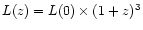 up to z=1.5 and
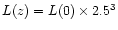 above.
This different treatment of type-I and II AGNs is not necessarily in contradiction
with the Unified AGN Model: for type-II objects the inclined dusty torus implies a
self-absorbed emission in the mid-IR by the AGN, and an overall IR spectrum
dominated by a circum-nuclear starburst.
above.
This different treatment of type-I and II AGNs is not necessarily in contradiction
with the Unified AGN Model: for type-II objects the inclined dusty torus implies a
self-absorbed emission in the mid-IR by the AGN, and an overall IR spectrum
dominated by a circum-nuclear starburst.
A similar multi-population modelling was proposed time ago by Danese et al. (1987)
to explain the IRAS and faint radio counts, and more recently by Roche & Eales (1999)
and Xu et al. (2001).
As shown in Fig. 9, the fraction of the evolving starburst population
is assumed
to be  percent of the total, roughly consistent with the local observed fraction
of interacting galaxies. The quick upturn in the counts then
requires a strong increase with redshift of the average emissivity of the evolving
population to match the peak in the normalized counts around
percent of the total, roughly consistent with the local observed fraction
of interacting galaxies. The quick upturn in the counts then
requires a strong increase with redshift of the average emissivity of the evolving
population to match the peak in the normalized counts around
 mJy.
mJy.
![\begin{figure}
\par\includegraphics[width=8.5cm,height=8cm,clip]{dzhdf.eps} %
\end{figure}](/articles/aa/full/2001/40/aah2688/Timg146.gif) |
Figure 10:
Redshift distribution of 15 m sources with
 Jy in the
HDF North (continuous red histogram; Cohen et al. 2000; Aussel et al. 2001),
compared with our best-fit evolutionary model (continuous line).
The dashed green histogram is the z-distribution of sources in the CFRS field reported
by Flores et al. (1999). The dotted line at the bottom corresponds to the no-evolution
prediction. Jy in the
HDF North (continuous red histogram; Cohen et al. 2000; Aussel et al. 2001),
compared with our best-fit evolutionary model (continuous line).
The dashed green histogram is the z-distribution of sources in the CFRS field reported
by Flores et al. (1999). The dotted line at the bottom corresponds to the no-evolution
prediction. |
| Open with DEXTER |
In the presence of strong evolution, the fit to the observed counts has a sensible
dependence on the assumed values for the geometrical parameters of the universe.
For a zero- open universe (
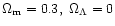 ),
a physically plausible solution would require a redshift increase of the comoving
density of the starburst sub-population as
),
a physically plausible solution would require a redshift increase of the comoving
density of the starburst sub-population as
![$\rho(L[z],z) = \rho_0(L_0)\times (1+z)^6$](/articles/aa/full/2001/40/aah2688/img149.gif) and of their luminosity as
and of their luminosity as
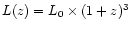 for
for
 ,
with
,
with  and L constant above,
and
and L constant above,
and
 .
These are quite extreme evolution rates, if compared for example with those observed in
optically-selected samples of merging and interacting galaxies (e.g.
Le Fevre et al. 2000).
.
These are quite extreme evolution rates, if compared for example with those observed in
optically-selected samples of merging and interacting galaxies (e.g.
Le Fevre et al. 2000).
The inclusion of a non-zero cosmological constant, with the consequent increase
of the cosmic timescale and volumes at ,
tends to make the best-fitting
evolution rates less extreme.
For
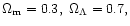 a best-fit to the counts requires:
with
 and
and
 .
.
Note that, although there are margins for variations of the relative weight for the
number density and luminosity evolution, only a combination of the two provides
credible solutions. Assuming for example evolution only in source number density
or only in L would require unplausibly high evolution rates for the evolving
population (
![$\rho\propto [1+z]^{11}$](/articles/aa/full/2001/40/aah2688/img161.gif) ,
or alternatively
,
or alternatively
![$L[z]\propto [1+z]^{6}$](/articles/aa/full/2001/40/aah2688/img162.gif) ).
Such extreme solutions would also encounter problems when fitting the radio or
far-IR counts as counterpart to the 15 m population counts.
).
Such extreme solutions would also encounter problems when fitting the radio or
far-IR counts as counterpart to the 15 m population counts.
The vast majority (>90%) of the sources in the HDFN and CFRS 1415 ISO surveys have
spectroscopic redshifts, and for the remaining objects photometric redshifts are
easy to estimate. The redshift distributions D(z) for the HDF
North (Cohen et al. 2000; Elbaz et al. 2001; Aussel et al. 2001) and
CFRS 1415 surveys (Flores et al. 1999)
are compared in Fig. 10 with our best-fitting model, which
appears to properly account for these data. They set stringent limits on the rate of
cosmological evolution for IR galaxies above ,
and force it to level off to
avoid exceeding the observed D(z) on the high-z tail.
Also, a consequence of the fast evolution observed at z<1 is that the observed
CIRB intensity is quickly saturated at moderate z, and requires again the evolution
rate to turn over at .
Unfortunately, apart from these constraints on the high-z IR emissivity,
ISO surveys do not offer an accurate sampling of the hidden SF in the interval
 ,
which will only be possible with the longer-wavelength surveys
by SIRTF at
,
which will only be possible with the longer-wavelength surveys
by SIRTF at
 m and by the Herschel Space Observatory
(formerly FIRST) in the far-IR, probing dust and PAH emission at z>1.
m and by the Herschel Space Observatory
(formerly FIRST) in the far-IR, probing dust and PAH emission at z>1.
In our present evolutionary scheme, any single galaxy would be expected to spend most
of its life in the quiescent (non-evolving) phase, while being occasionally put by
interactions in a short-lived (few to several 107 yrs) starbursting mode.
The cosmological evolution characterizing this phase may simply be due
to an increased probability in the past to find a galaxy during such an excited mode.
The density evolution in Eq. (8) scales with redshift approximately
as the rate of interactions due to a simple geometric effect following the
increased source volume density.
The luminosity evolution may be interpreted as an effect of the larger
gas mass available to form stars at higher z.
Deep surveys at various IR/sub-mm wavelengths can be exploited to simultaneously
constrain the evolution properties and broad-band spectra of faint IR sources.
We report in this section a comparison of
the 15 m survey data with those coming from longer-wavelength
surveys, in particular the IRAS 60 m, the FIRBACK 90 and 170 m,
and the SCUBA
850 m data, which are the deepest, most reliable available at the moment.
Information on both number counts and the source redshift distributions,
whenever available, were used for these comparisons.
![\begin{figure}
\par\includegraphics[width=8.6cm,height=8.2cm,clip]{llf60.eps}\end{figure}](/articles/aa/full/2001/40/aah2688/Timg165.gif) |
Figure 11:
Local luminosity function of galaxies at
 m
(filled squares) by Saunders et al. (1990). The lines are the best-fit model predictions
(upper continuous line: total; dotted: quiescent population; lower continuous: starbursts). m
(filled squares) by Saunders et al. (1990). The lines are the best-fit model predictions
(upper continuous line: total; dotted: quiescent population; lower continuous: starbursts). |
| Open with DEXTER |
Further essential constraints, providing the local boundary conditions on the
evolutionary histories, are given by the multi-wavelength local luminosity functions.
In addition to the 12 and 15 m LLF's discussed in Sect. 5.1,
the galaxy LLF is particularly well known at 60 m after the IRAS all-sky
survey and the extensive spectroscopic follow-up (Saunders et al. 1990),
and is illustrated in Fig. 11.
Dunne et al. (2000) also attempted to constrain the galaxy LLF in the millimeter
based on mm observations of complete samples of IRAS 60 m galaxies.
The results are shown in Fig. 12.
![\begin{figure}
\par\includegraphics[width=8.5cm,height=8.2cm,clip]{llf_850.eps}\end{figure}](/articles/aa/full/2001/40/aah2688/Timg167.gif) |
Figure 12:
Local luminosity function of galaxies at
 m
(open squares) by Dunne et al. (2000), compared with the IRAS 60 m LLF
by Saunders et al. (1990). Note the completely different slopes of the two. m
(open squares) by Dunne et al. (2000), compared with the IRAS 60 m LLF
by Saunders et al. (1990). Note the completely different slopes of the two. |
| Open with DEXTER |
As previously mentioned, the properties of LLF's observed at various IR/sub-mm
wavelengths can be explained by assuming that the galaxy IR SED's depend on bolometric
luminosity.
The comparisons of LLF's made in Figs. 9 and 12 show that the
60 m LLF has a much flatter power-law shape at high-luminosities compared with
both the mid-IR and millimetric LLF's. This is clearly an effect of the spectra for
luminous
active galaxies showing excess 60 m emission compared with inactive galaxies,
as also illustrated by the luminosity-dependence of the IRAS far-IR colours.
We defer to Franceschini (2000, Sect 6.6) for further discussion on this effect.
Consequently, we have modelled the redshift-dependent multi-wavelength LLF's of
galaxies by assuming spectral energy distributions dependent
on luminosity, with spectra ranging from those typical of low-luminosity inactive
objects, to those peaked at 80 m of luminous and ultra-luminous IR galaxies
as previously described.
We have taken as reference for our multi-wavelength LF
the one by IRAS at 12 m (
 )
discussed in Sect. 5.1.
This is transformed to longer wavelengths
according to spectral energy distributions which vary according to the value of
.
The assumption was that for
)
discussed in Sect. 5.1.
This is transformed to longer wavelengths
according to spectral energy distributions which vary according to the value of
.
The assumption was that for
 the spectrum is that of an inactive
spiral (
the spectrum is that of an inactive
spiral (
![$S_{\rm low}[\nu ]$](/articles/aa/full/2001/40/aah2688/img13.gif) ,
the lower dotted line in Fig. 13),
while for
,
the lower dotted line in Fig. 13),
while for
 it is a typical
ULIRG spectrum (
it is a typical
ULIRG spectrum (
![$S_{\rm high}[\nu ]$](/articles/aa/full/2001/40/aah2688/img14.gif) ,
top line in Fig. 13).
For intermediate luminosity objects, the assumed SED S
,
top line in Fig. 13).
For intermediate luminosity objects, the assumed SED S is a linear
interpolations between the two:
is a linear
interpolations between the two:
 |
|
|
(9) |
From
 it is immediate to compute the luminosity at
any frequencies and the K-correction from Eq. (7), taking into account the
detailed filter response functions.
The multi-wavelength LLFs at any wavelengths
are easily computed from the
relation
it is immediate to compute the luminosity at
any frequencies and the K-correction from Eq. (7), taking into account the
detailed filter response functions.
The multi-wavelength LLFs at any wavelengths
are easily computed from the
relation
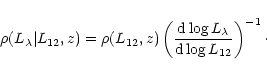 |
(10) |
Good fits to the multi-wavelength LF's
are found by setting
 and
and
 .
.
![\begin{figure}
\par\includegraphics[width=8.7cm,height=8.2cm,clip]{spectra.eps}\end{figure}](/articles/aa/full/2001/40/aah2688/Timg177.gif) |
Figure 13:
Our adopted range of mid- to far-IR spectra of galaxies. The lower dotted line
corresponds to a low-luminosity inactive spiral (
in Eq. (9)),
the top dotted line is typical of ULIRGs (
).
The intermediate one (cyan continuous line) corresponds to our adopted spectrum for
the starburst population: this spectrum is similar to the one of the prototype
star-forming galaxy M 82 (in the range from 5 to 18 m it is precisely the ISOCAM
CVF spectrum of M 82). |
| Open with DEXTER |
For the evolving active starburst galaxies we adopted both a single average spectral energy
distribution (independent on luminosity) and a luminosity-dependent
spectral shape as discussed for the non-evolving population.
For simplicity and for a better controlled parametrization,
our best-fit model for the active starburst population assumes
the single spectrum solution.
If we adopt as representative for the starburst spectrum
the IR SED of the ultra-luminous galaxy Arp 220, the consequence would be
that all far-IR counts (and the CIRB intensity, see Elbaz et al. 2001)
would be exceeded by substantial factors.
On the contrary, if we assume for the IR evolving sources a more typical starburst
spectrum (see continuous line in Fig. 13, which is similar to those of M 82
and other luminous starbursts observed by ISO), then most of the observed
properties of far-IR galaxy samples (number counts, redshift distributions,
luminosity functions) are appropriately reproduced.
Best-fits to the counts based on our reference
model and adopting a spectral template as in Fig. 13,
are given in Figs. 2, 3, 5-7.
Figure 14 reports the fit to the 60 m differential
counts derived from various IRAS
surveys, while Fig. 15 compares our model prediction with the z-distribution
for faint galaxies selected from the IRAS Faint Source Survey at 60 m by Oliver
et al. (1996, see also Saunders et al. 2000), with a flux limit of
 mJy.
In addition to the 60 m counts,
the model clearly reproduces the observed z-distribution up to z=0.4,
while it predicts a somewhat excess fraction of higher-z sources.
We do not interprete this as to necessarily be a problem for the model, since due
to the large IRAS errorbox,
the most distant and optically faint sources could have been systematically
mis-identified with
brighter more local galaxies falling by chance in the errorbox: our model would
predict that of order of 4% of the FSS could be starbursts at z>0.4.
mJy.
In addition to the 60 m counts,
the model clearly reproduces the observed z-distribution up to z=0.4,
while it predicts a somewhat excess fraction of higher-z sources.
We do not interprete this as to necessarily be a problem for the model, since due
to the large IRAS errorbox,
the most distant and optically faint sources could have been systematically
mis-identified with
brighter more local galaxies falling by chance in the errorbox: our model would
predict that of order of 4% of the FSS could be starbursts at z>0.4.
It is evident that, with various degrees of significance which depend on the
survey depths, all the observed long-wavelength counts require a substantial
increase of the IR volume emissivity of galaxies with redshift.
![\begin{figure}
\par\includegraphics[width=8.5cm,height=5.4cm,clip]{c60.eps}\end{figure}](/articles/aa/full/2001/40/aah2688/Timg179.gif) |
Figure 14:
Differential counts at 60 m from IRAS surveys, normalized
to the Euclidean law
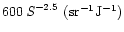 ,
versus the 60 m
flux in Jy. Meaning of the lines as in previous figures. ,
versus the 60 m
flux in Jy. Meaning of the lines as in previous figures. |
| Open with DEXTER |
![\begin{figure}
\par\includegraphics[width=8.5cm,height=5.3cm,clip]{dz60.eps}\end{figure}](/articles/aa/full/2001/40/aah2688/Timg180.gif) |
Figure 15:
Predicted redshift distribution for the 60 m IRAS Faint Source Survey
identified by Oliver et al. (1996). The survey depth and area are indicated.
Meaning of the lines as in the previous figures. |
| Open with DEXTER |
We report in Fig. 16 the evolutionary 15 m luminosity function
of IR sources in the critical redshift interval from z=0 to 1. The
evolution of the high-luminosity end is partly driven by the type-I AGN population,
which dominates the LF above
 .
Note that
.
Note that  is required to exceed at
the local galaxy density (as
evident in particular in the luminosity interval
is required to exceed at
the local galaxy density (as
evident in particular in the luminosity interval
 to
to
 ), which we interprete as an effect of merging,
implying an increase of the comoving number of objects in the past.
), which we interprete as an effect of merging,
implying an increase of the comoving number of objects in the past.
The evolution pattern of the global LF is clearly luminosity dependent:
the largest increase happens at
 ,
whereas at very
low and very large luminosities the evolution is lower.
The model predicts that the evolution of galaxies
with
,
whereas at very
low and very large luminosities the evolution is lower.
The model predicts that the evolution of galaxies
with
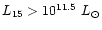 (the Ultra-Luminous Galaxies, ULIRGs) is lower than
that of the Luminous IR galaxies (LIRGs) around
(the Ultra-Luminous Galaxies, ULIRGs) is lower than
that of the Luminous IR galaxies (LIRGs) around
 .
The assumption of similar evolution for LIRGs and ULIRGs would tend to imply exceeding
the observed fraction of z>0.4 galaxies in the 60 m IRAS Faint Source Surveys
and the North Ecliptic Pole survey (Ashby et al.1996; Aussel et al. 2000).
.
The assumption of similar evolution for LIRGs and ULIRGs would tend to imply exceeding
the observed fraction of z>0.4 galaxies in the 60 m IRAS Faint Source Surveys
and the North Ecliptic Pole survey (Ashby et al.1996; Aussel et al. 2000).
![\begin{figure}
\par\includegraphics[width=8.3cm,height=8cm,clip]{llf_evol.eps} %
\end{figure}](/articles/aa/full/2001/40/aah2688/Timg188.gif) |
Figure 16:
Evolution of the 15 m luminosity function of IR sources,
following our best-fitting reference model. The lower continuous and dotted
lines are the contribution of AGN and of normal galaxies to the LLF. The three continuous
lines labelled z=0, 0.4 and 1 are the global (AGN + galaxy) LFs at the corresponding
redshifts. |
| Open with DEXTER |
The available data at long on faint galaxies, although
constraining the evolution pattern, do not allow to determine it univocally.
We have attempted, in particular, evolutionary schemes considering a single evolving
population with combined luminosity/density evolution, as an alternative to the
previously discussed two-population model.
on faint galaxies, although
constraining the evolution pattern, do not allow to determine it univocally.
We have attempted, in particular, evolutionary schemes considering a single evolving
population with combined luminosity/density evolution, as an alternative to the
previously discussed two-population model.
This model allows the LF for the whole population of IR galaxies to evolve in both
luminosity and volume density following a pattern as in Eq. (8), with reduced
evolution
rates:
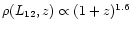 ,
,
 ,
,
,
,
 ,
and
,
and
 ,
in Eq. (9),
,
in Eq. (9),
 and
and
 similar to those plotted in Fig. 13.
Forcing it to best-fit to the 15 m counts and D(z),
the model appears to be too rigid when fitting data at longer wavelengths.
In particular, the predicted 60 m counts show a fast convergence already below
 Jy and a very modest contribution to the CIRB, while at the same
time the 170 m counts would be very steep and exceeding the observations.
The predicted 850 m counts are also steeper than observed.
Jy and a very modest contribution to the CIRB, while at the same
time the 170 m counts would be very steep and exceeding the observations.
The predicted 850 m counts are also steeper than observed.
Under this scheme, the evolution rates are assumed to depend linearly on luminosity:
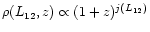 ,
with
,
with
 ,
and
,
and
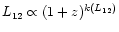 ,
with
,
with
 [with
J, K, L1 and L2 as adjustable parameters]. This law
is intended to add freedom to the single-population model, by considering that
galaxies with higher
(hence more "active") may evolve with faster rates
with respect to lower-
(less "active") objects.
[with
J, K, L1 and L2 as adjustable parameters]. This law
is intended to add freedom to the single-population model, by considering that
galaxies with higher
(hence more "active") may evolve with faster rates
with respect to lower-
(less "active") objects.
As a matter of fact, the larger freedom for this model is of no help to
improve the quality of the fits (the parameters L1 and L2 tend to assume
low values, i.e. to go back to the luminosity-independent solution).
Altogether, evolutionary schemes alternative to our reference two-population model
appear to provide worse fits to the multi-wavelength combined IR data.
Our previously discussed evolution model provides the best statistical
fit of the data with a plausible physical interpretation (but certainly not the only
acceptable solution).
Finer variations of the relative fractions of sources belonging to the
different physical components (AGNs, normal spirals and evolving active galaxies),
with respect to the values adopted in our best-fit model,
are clearly allowed by the present data. However, the 15 m number counts, local
LF and redshift distributions, in particular, together with looser constraints from
longer-wavelength observations, allow rather narrow margins to such variations.
For example, if the normalization of the evolving population is incresed and that
of the non-evolving one decreased to still keep fitting the 15 m local LF,
we may obtain steeper counts in Fig. 2 in the flux interval from 10 to
0.5 mJy (with a suitable change of the evolution rates). This, however, would
start forcing the fit to the observed counts in this flux range,
and would also tend to spoil those to the longer-
data (Figs. 3, 11, 14).
Note also that our modelling of the AGN component cannot be but rough at this
stage. Our adopted procedure treats type-I and type-II AGNs separately. The latter
are simply included in a single evolving population together with the active
starbursts. This reflects our view that dust-extinguished AGN and starburst emissions
happen concomitantly in the same sources during the "active" phase
and reflects our present inability to quantitatively disentangle the two.
This concomitant "activity" is now revealed by a variety of facts, including the
hard X-ray observations of ISO sources reported by Fadda et al. (2001, see
also Elbaz et al. 2001), and some evidence that the brightest sub-mm objects
are associated with AGNs (Ivison et al. 2000a).
On the contrary, our modelling of the type-I AGNs is simple and robust, and exploits
the 12 m LLF by Rush et al. (1993) and the evolution rate found from
optical and X-ray surveys. Based on this, type-I AGN are expected to contribute
 of the bright 15 m counts (
mJy, see Fig. 2),
and negligible fractions at fainter fluxes or longer wavelengths.
of the bright 15 m counts (
mJy, see Fig. 2),
and negligible fractions at fainter fluxes or longer wavelengths.
The 15 m counts in Fig. 2 display a remarkable convergence
below
 mJy, proven by at least three independent surveys. The observed
asymptotic slope flatter than -2 in differential count units implies a modest
contribution to the integrated CIRB flux by sources fainter than 0.1 mJy, unless
a sharp upturn of the counts would happen at much fainter fluxes
with a very steep number count distribution, which seems rather unplausible.
A meaningful estimate of the CIRB flux can then be obtained from direct integration
of the observed mid-IR counts:
this computation has been done by Elbaz et al. (2001), who find a value at 15 m
of
mJy, proven by at least three independent surveys. The observed
asymptotic slope flatter than -2 in differential count units implies a modest
contribution to the integrated CIRB flux by sources fainter than 0.1 mJy, unless
a sharp upturn of the counts would happen at much fainter fluxes
with a very steep number count distribution, which seems rather unplausible.
A meaningful estimate of the CIRB flux can then be obtained from direct integration
of the observed mid-IR counts:
this computation has been done by Elbaz et al. (2001), who find a value at 15 m
of
 nW/m2/sr contributed by LW3 sources brighter than
 Jy
(corresponding to the datapoint at 15 m in Fig. 1, and consistent with
the results by Biviano et al. 2001; the other closeby point in the figure
comes from a similar integration of ISO counts at 7 m).
From our reference evolutionary model we expect that the
contribution of fainter sources would bring the total background to 3.3 nJy/m2/sr.
Jy
(corresponding to the datapoint at 15 m in Fig. 1, and consistent with
the results by Biviano et al. 2001; the other closeby point in the figure
comes from a similar integration of ISO counts at 7 m).
From our reference evolutionary model we expect that the
contribution of fainter sources would bring the total background to 3.3 nJy/m2/sr.
Comparing these values with the upper limits set by the observed TeV cosmic opacity
(dotted histogram in Fig. 1) confirms that the ISOCAM surveys have resolved
a significant fraction (50-70%) of the CIRB intensity in the mid-IR.
Unfortunately, we do not have a way to test directly how much of the bolometric CIRB these
faint 15 m surveys contribute. In particular, the depths of the ISO far-IR surveys
(FIRBACK and ELAIS, see Dole et al. 2001) are not enough to resolve more than few
percent of the CIRB at its peak wavelength.
Using the locally established good correlation between the mid-IR and the
far-IR fluxes for local IR galaxies and after a careful analysis of the
incidence of AGNs among the faint ISOCAM sources (this is essential because
starbursts and AGNs have different IR SEDs, with peak emissions at
 m and
m and
 m, respectively),
Elbaz et al. (2001) estimate that the
sources resolved by CAM LW3 contribute 60% at least of the COBE/DIRBE background
at 140 and 240 m.
m, respectively),
Elbaz et al. (2001) estimate that the
sources resolved by CAM LW3 contribute 60% at least of the COBE/DIRBE background
at 140 and 240 m.
The good match to the IR multi-wavelength counts and related statistics that we found
in our previous analysis by
assuming a typical starburst spectrum for the evolving population indicates that
these IR sources are likely dominated by star-formation processes (see also Sect. 6.4).
Our best-fit model of the multi-wavelength statistics implies that the ISOCAM sources
with
 Jy contribute a CIRB intensity at 170 m of
 W/m2/sr, or
 of the observed flux (Fig. 1).
At 90 m the fraction rises to
of the observed flux (Fig. 1).
At 90 m the fraction rises to
 .
All this supports the conclusion
that the population detected by ISO in the mid-IR not only contributes a major
fraction of CIRB at 15, but is also likely responsible for a
majority contribution to the photon energy density contained in the CIRB.
.
All this supports the conclusion
that the population detected by ISO in the mid-IR not only contributes a major
fraction of CIRB at 15, but is also likely responsible for a
majority contribution to the photon energy density contained in the CIRB.
On the contrary, sources at much higher redshifts, as the SCUBA ones are observed to
be (see Sect. 6.3 below), likely produce a much less significant contribution to the
bolometric CIRB whatever their comoving volume energy production rate might be.
The high-z energy production can only last for a short cosmic time interval
(

 ), and the generated photons are degraded
in energy by (1+z), for a total penalty factor of
(1+z)3.5 (Harwit 1999).
Nevertheless, because of the K-correction, high-redshift objects can dominate the
CIRB at the
longer wavelengths, as SCUBA sources are observed to do. All in all, the background
radiation is not a sensitive tracer of the very ancient cosmic phases.
), and the generated photons are degraded
in energy by (1+z), for a total penalty factor of
(1+z)3.5 (Harwit 1999).
Nevertheless, because of the K-correction, high-redshift objects can dominate the
CIRB at the
longer wavelengths, as SCUBA sources are observed to do. All in all, the background
radiation is not a sensitive tracer of the very ancient cosmic phases.
![\begin{figure}
\par\includegraphics[width=8.5cm,height=8.2cm,clip]{source8.eps}\end{figure}](/articles/aa/full/2001/40/aah2688/Timg213.gif) |
Figure 17:
Broad-band spectrum of a mid-IR source selected by ISOCAM LW3
in the Hubble Deep Field North (Aussel et al. 1999), compared with
the SED's of M 82 (thick continuous line), Arp 220 (dashed line), and M 51
(dotted line). Estimates of the SF rate [based on the M 82 and Arp 220
templates] and of the stellar mass [based on the M 51 template] are indicated. |
| Open with DEXTER |
Given the variety of multi-wavelength imaging data, the ISO surveys in the Hubble
Deep Fields and the CFRS areas (Sect. 3.1) provide ideal tools for tests of
the evolving population responsible for the upturn of the ISO mid-IR counts and for
a substantial fraction of the CIRB.
Aussel et al. (1999, 2001) report reliably tested complete samples of
49 and 63 sources to
 Jy in the HDF North and South respectively.
Flores et al. (1999) analyse a sample of 41 sources brighter than
Jy in the HDF North and South respectively.
Flores et al. (1999) analyse a sample of 41 sources brighter than
 Jy in the CFRS 1415+52 area.
These surveys have been performed with highly redundant spatial and temporal sampling
with ISOCAM LW3, allowing to achieve a precise astrometric registering.
These sources are identified with optical galaxies having typical magnitudes
from
Jy in the CFRS 1415+52 area.
These surveys have been performed with highly redundant spatial and temporal sampling
with ISOCAM LW3, allowing to achieve a precise astrometric registering.
These sources are identified with optical galaxies having typical magnitudes
from
 to
to
 (Aussel et al. 2001; see also Sect. 3.2).
The optical-IR SED of a typical faint LW3 source at z=1.14 is reported in Fig. 17, where the LW3 flux and the LW2 upper limit are plotted together with
optical-NIR fluxes.
The dotted line fitting the optical-NIR spectrum and corresponding to the SED of
a quiescent spiral (M 51) falls short by a factor
of explaining the mid-IR
emission, whereas SEDs of IR starbursts (Arp220, dashed line; M 82 continuous line)
provide more consistent fits to the observed mid-IR flux after normalizing
to the optical/NIR spectral intensity.
The vast majority of faint ISO sources show similar mid-IR flux excesses.
A clue to the nature of ISO sources can be obtained from HST imaging data, providing
detailed morphological information, and spectroscopic follow-up available
in these fields.
Flores et al. (1999) find that at least 30 to 50% of them show
evidence of peculiarities and multiple structures, in keeping with the local evidence
that galaxy interactions are the primary trigger of luminous IR starbursts.
The Caltech redshift survey in the HDF North by
Cohen et al. (2000) showed that over 90% of the faint LW3 ISO sources are members
of galaxy concentrations and groups, which they identify as peaks in their redshift
distributions. It is in such dense galaxy environments with low velocity dispersion
that interactions produce resonant perturbation effects on galaxy dynamics
and the most efficient trigger of SF.
However, both morphological and clustering properties of ISO sources need further
investigation, which is currently in progress.
Flores et al. (1999) report a preliminary analysis of optical spectra for IR sources
in CFRS 1415+52, noting that a majority of these display both weak emission
(OII 3727) and absorption (H )
lines, as typical of the e(a) galaxy spectral
class. Rigopoulou et al. (2000) have observed with the ISAAC spectrograph
on VLT a sample of 13 high-z (0.2<z<1.4) galaxies selected in the HDF South with
)
lines, as typical of the e(a) galaxy spectral
class. Rigopoulou et al. (2000) have observed with the ISAAC spectrograph
on VLT a sample of 13 high-z (0.2<z<1.4) galaxies selected in the HDF South with
 Jy:
a prominent (EW> 50 Å)
Jy:
a prominent (EW> 50 Å)  line is detected in almost all of the
sources, indicating substantial rates of SF
after de-reddening corrections, and demonstrating that these optically faint but IR luminous
sources are indeed powered by an ongoing massive dusty starburst.
line is detected in almost all of the
sources, indicating substantial rates of SF
after de-reddening corrections, and demonstrating that these optically faint but IR luminous
sources are indeed powered by an ongoing massive dusty starburst.
The e(a) spectral appearence found by Flores et al. (1999) is interpreted by
Poggianti & Wu (1999) and
Poggianti et al. (2001) as due to selective dust attenuation,
extinguishing more the newly-formed stars than the older ones which have already
disrupted their parent molecular cloud.
These papers independently found that
 of the energy emitted by young
stars leaves no traces in the optical spectrum, hence can only be accounted for with
long-wavelength observations.
of the energy emitted by young
stars leaves no traces in the optical spectrum, hence can only be accounted for with
long-wavelength observations.
Further efforts of optical-NIR spectroscopic follow-up of faint
ISO sources are presently ongoing, including attempts to address the
source kinematics and dynamics based on line studies with IR spectrographs on large
telescopes (Rigopoulou et al. 2001, in preparation).
At the moment, for an evaluation of the main properties of the IR population
we have to rely on indirect estimates exploiting the near-IR and far-IR fluxes.
We have estimated the baryonic mass in stars from fits of template SEDs of
local galaxies to the observed near-IR broad-band spectrum.
Our adopted templates come from the modellistic analysis of Silva et al. (1998)
of a sample of both inactive spirals and starbursts of various masses and
luminosities.
The Initial Mass Function is assumed to be a Salpeter with standard low- and
high-mass cutoffs (0.15 to 100 ).
Our estimated values of the baryonic masses (
 at z>0.4,
with 1 dex typical spread, see Fig. 18)
indicate that already evolved and massive galaxies preferentially host the
powerful starbursts.
at z>0.4,
with 1 dex typical spread, see Fig. 18)
indicate that already evolved and massive galaxies preferentially host the
powerful starbursts.
![\begin{figure}
\par\includegraphics[width=8.5cm,height=10.8cm,clip]{sfr_z.eps}\end{figure}](/articles/aa/full/2001/40/aah2688/Timg223.gif) |
Figure 18:
Evaluations of the star formation rates [from an estimator based on the
mid-IR flux] and baryonic masses [from fits of the NIR SED] as a function of redshift
for galaxies selected by ISOCAM LW3 at 15 m in the HDFN (filled squares)
and CFRS 1415+52 (open circles). |
| Open with DEXTER |
For estimating the other fundamental indicator of the physical and
evolutionary status of the sources - the ongoing rate of star-formation (SFR) -
we have exploited the mid-IR flux as an alternative to
the (heavily extinguished) optical-UV emissions.
The capability of the mid-IR flux (from both LW3 and LW2 ISOCAM observations)
as a tracer of the SFR is discussed by
Vigroux et al. (1999), Elbaz et al. (2001) and Aussel et al. (2001):
the fluxes in these IR bands appear tightly correlated with the bolometric (mostly far-IR)
emission, which is the most robust measure of the number of massive reddened
newly-formed stars, and is also correlated with the radio emission of stellar origin.
Only very extinguished peculiar sources (e.g. Arp 220), for which the mid-IR
spectrum is self-absorbed, escape this correlation.
Note that the ISO mid-IR flux at these very faint limits provides advantages over
the radio to be a more reliable
(having a tighter correlation with the bolometric
flux, see e.g. Cohen et al. 2000) and more sensitive indicator of star formation.
Of the 49 ISO sources in the HDFN only 7 are detected in an ultra-deep radio map
at 1.4 GHz by Richards et al. (1998): the ISO 15 m completeness limit of 0.1 mJy
would correspond to a flux of few Jy at 1.4 GHz (i.e. quite below the
Richards et al. limit of 40 Jy),
taking into account the radio/far-IR luminosity correlation for typical starbursts.
The rates of SF indicated by the fits to the mid-IR flux for sources at z>0.5range from several tens to few hundreds solar masses/yr, i.e. a
substantial factor larger than found for optically-selected galaxies at similar
redshifts (e.g. Ellis 1997).
Altogether, the galaxy population dominating the faint mid-IR counts and substantially
contributing to the bolometric CIRB intensity (assumed typical SB SEDs)
appears to be composed of luminous (
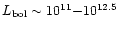 )
starbursts in massive (
)
starbursts in massive (
 )
galaxies at
)
galaxies at
 ,
observed during a phase of intense stellar formation (
/yr).
The typically red colors of these systems suggest that they are mostly unrelated to
the faint blue galaxy population dominating the optical counts (Ellis 1997),
and should be considered as an independent manifestation of (optically hidden)
star formation (Elbaz 1999, preprint; Aussel 1998).
,
observed during a phase of intense stellar formation (
/yr).
The typically red colors of these systems suggest that they are mostly unrelated to
the faint blue galaxy population dominating the optical counts (Ellis 1997),
and should be considered as an independent manifestation of (optically hidden)
star formation (Elbaz 1999, preprint; Aussel 1998).
Surveys at longer wavelengths suffer quite severe problems in the identification
of the optical counterparts of the IR sources.
The FIRBACK/ELAIS surveys have resolved a modest fraction (
 ,
see Dole
et al. 2001) of the CIRB at its peak wavelength of 170 m, the limit being
imposed by source confusion.
Because of the missing information on the far-IR LLF, the interpretation of the counts
in Figs. 3-5 is subject to some uncertainties.
Our best-fit multi-wavelength model implies that the observed counts at the faint
flux limit are a moderate factor (
,
see Dole
et al. 2001) of the CIRB at its peak wavelength of 170 m, the limit being
imposed by source confusion.
Because of the missing information on the far-IR LLF, the interpretation of the counts
in Figs. 3-5 is subject to some uncertainties.
Our best-fit multi-wavelength model implies that the observed counts at the faint
flux limit are a moderate factor (
 )
above the source areal density
corresponding to no-evolution (see Fig. 4). The model predicts that the
detected sources lye at moderate-redshifts (the majority at
)
above the source areal density
corresponding to no-evolution (see Fig. 4). The model predicts that the
detected sources lye at moderate-redshifts (the majority at  ,
see Fig. 22). The multi-wavelength follow-up performed at 1.4 GHz, 1.3 mm, 850 and
450 m, as well as optical/NIR identifications and spectroscopy based on
cross-correlations with deep radio surveys (e.g. Sanders 2001), seem to show that
the majority of the sources are local (z<0.5), with 10% or so being found at
or higher (Dole et al. 2001).
,
see Fig. 22). The multi-wavelength follow-up performed at 1.4 GHz, 1.3 mm, 850 and
450 m, as well as optical/NIR identifications and spectroscopy based on
cross-correlations with deep radio surveys (e.g. Sanders 2001), seem to show that
the majority of the sources are local (z<0.5), with 10% or so being found at
or higher (Dole et al. 2001).
Scott et al. (2000), in particular,
have obtained data at 450 and 850 m for 10 FIRBACK sources
with accurate radio astrometry: although the combined FIR/radio selection and the
sub-mm follow-up may somehow bias the result, the FIR-mm SEDs compared with
plausible far-IR template spectra tentatively indicate mostly low redshifts for these
sources, with a minority being at .
In the future, deeper far-IR observations will be possible with SIRTF,
while a proper characterization
of the faint far-IR population will require the Herschel's better spatial resolution.
Thanks to the unique K-correction for dusty spectra, deep millimetric surveys
are capable to detect starburst galaxies over an extremely wide redshift interval.
However, the sensitivities achievable by present-day instruments and the modest
surveyed areas imply that only sources at z>1 are selected;
consequently, only the very high luminosity tail
of the population of IR sources (essentially ULIRGs with
 )
is detectable in this way.
)
is detectable in this way.
Therefore, ISOCAM and millimetric telescopes provide extremely complementary
sampling capabilities in terms of redshift coverage (typically z<1for sources selected by ISO and z>1 by SCUBA)
and source luminosities (mostly
 by ISO, and larger by SCUBA).
Unfortunately, the extreme properties of the mm-selected sources entail a
dramatic difficulty to identify the sources. Several factors contribute: the
very high redshifts imply that the optical counterparts are extremely
faint and red, hence largely unaccessible by optical spectroscopy
(Smail et al. 1999 identify a fraction of SCUBA sources with Extremely Red Objects,
ERO's, see also discussion in Dey et al. 1999).
Furthermore, the dominance of dust emission implies very extinguished
optical-NIR spectra. Although the diffraction-limited beams of both SCUBA (15 arcsec)
and IRAM (11 arcsec) are much sharper than the ISO far-IR beam (
 arcsec),
the faintness of optical counterparts implies a very high chance
of mis-identification. It is remarkable that, in spite of the important effort
for SCUBA source identification, of the 100-200 sources only three have reliable
identifications and redshifts at present. All these three have been observed to
contain massive reservoirs of gas (Frayer et al. 1999; Ivison et al. 2000a).
arcsec),
the faintness of optical counterparts implies a very high chance
of mis-identification. It is remarkable that, in spite of the important effort
for SCUBA source identification, of the 100-200 sources only three have reliable
identifications and redshifts at present. All these three have been observed to
contain massive reservoirs of gas (Frayer et al. 1999; Ivison et al. 2000a).
Given the extreme difficulty to get the redshift from optical spectroscopy,
some millimetric estimators have been devised.
The most promising of such techniques, exploiting the
 flux ratio
as a monotonic function of redshift (Carilli & Yun 1999), confirms in a statistical
sense that faint SCUBA sources are ultra-luminous galaxies at typical
to
flux ratio
as a monotonic function of redshift (Carilli & Yun 1999), confirms in a statistical
sense that faint SCUBA sources are ultra-luminous galaxies at typical
to
 (Barger et al. 1999; Smail et al. 2000).
The predicted z-distribution by
our reference model (Fig. 22) is in rough agreement with these estimates.
(Barger et al. 1999; Smail et al. 2000).
The predicted z-distribution by
our reference model (Fig. 22) is in rough agreement with these estimates.
As suggested by several authors (Franceschini et al. 1994a; Lilly et al. 1999;
Granato et al. 2001), the similarity in properties (bolometric luminosities, SEDs) between
this high-z population and local ultra-luminous IR galaxies argues in favour
of the idea that these represent the long-sought "primeval galaxies", those in particular
originating the local massive elliptical and S0 galaxies.
This is also supported by estimates of the volume density of these
objects in the field
 Mpc-3, high enough to allow most
of the E/S0 to be formed in this way (Lilly et al. 1999).
As for the E/S0 galaxies in clusters, the recent discovery by SCUBA of a
significant excess of very luminous (
Mpc-3, high enough to allow most
of the E/S0 to be formed in this way (Lilly et al. 1999).
As for the E/S0 galaxies in clusters, the recent discovery by SCUBA of a
significant excess of very luminous (
 )
sources at 850 m
around the z=3.8 radiogalaxy 4C 41.17 (Ivison et al. 2000b) may
indicate the presence of a forming cluster surrounding the radiogalaxy, where the
SCUBA sources would represent the very luminous ongoing starbursts.
)
sources at 850 m
around the z=3.8 radiogalaxy 4C 41.17 (Ivison et al. 2000b) may
indicate the presence of a forming cluster surrounding the radiogalaxy, where the
SCUBA sources would represent the very luminous ongoing starbursts.
By continuity, the less extreme of the starbursts
(those with
 )
discovered by ISOCAM at lower redshifts may be related to the origin of lower
mass spheroids and spheroidal components in later morphological type galaxies.
)
discovered by ISOCAM at lower redshifts may be related to the origin of lower
mass spheroids and spheroidal components in later morphological type galaxies.
A natural question arises as of how much of the bolometric flux in these IR/mm
sources is contributed by gravitational accretion rather than stellar emission.
Almaini et al. (1999) have suggested that a minimum of  of the
CIRB at 850 m (and a similar fraction of the bolometric one) may be
due to obscured AGNs, and that this fraction could even be quite larger.
Unfortunately, probing the nature of the faint IR-mm sources at high-redshifts
turned out to be exceedingly difficult, since the optical-UV-soft-X-ray primary
emission is almost completely re-processed by dust into
an IR spectrum barely sensitive to the properties of the primary incident one.
Ivison et al. (2000a) find indications for the presence of (type-II) AGN components
in three of the seven SCUBA sources in cluster fields, a fraction not inconsistent
with that observed in local ULIRGs of similar extreme luminosity.
of the
CIRB at 850 m (and a similar fraction of the bolometric one) may be
due to obscured AGNs, and that this fraction could even be quite larger.
Unfortunately, probing the nature of the faint IR-mm sources at high-redshifts
turned out to be exceedingly difficult, since the optical-UV-soft-X-ray primary
emission is almost completely re-processed by dust into
an IR spectrum barely sensitive to the properties of the primary incident one.
Ivison et al. (2000a) find indications for the presence of (type-II) AGN components
in three of the seven SCUBA sources in cluster fields, a fraction not inconsistent
with that observed in local ULIRGs of similar extreme luminosity.
Preliminary inspection of the H line profiles for the faint
ISO mid-IR sources (Rigopoulou et al. 2000), together with constraints set by the
15 to 7 m flux ratios (for sources at
line profiles for the faint
ISO mid-IR sources (Rigopoulou et al. 2000), together with constraints set by the
15 to 7 m flux ratios (for sources at
 this ratio measures the
presence of very hot dust heated by the AGN, which is absent in starbursts), indicate
that the large majority of sources are also mostly powered by a starburst rather
than an AGN.
Tran et al. (2001) consistently find that the contribution of gravitational
accretion to the IR emission by local ULIRGs becomes important, or even dominant, only
in the very high luminosity regime (
this ratio measures the
presence of very hot dust heated by the AGN, which is absent in starbursts), indicate
that the large majority of sources are also mostly powered by a starburst rather
than an AGN.
Tran et al. (2001) consistently find that the contribution of gravitational
accretion to the IR emission by local ULIRGs becomes important, or even dominant, only
in the very high luminosity regime (
 ).
).
An important diagnostic is being offered by observations of the hard X-ray flux,
since starbursts are weaker X-ray emitters than any kinds of AGNs.
The Chandra X-ray observatory has performed several deep investigations
of the high-z SCUBA population (Fabian et al. 2000; Hornschemeier et al.
2000; and Barger et al. 2001). Only a very small percentage of the objects turn
out to be in common, the two classes of sources being largely orthogonal.
The two high-z sub-mm sources detected with Chandra by Bautz et al. (2000)
were both previously classified as AGN based on optical spectra.
Unless the large majority of sub-mm sources are Compton-thick and any hard X-ray
scattered photons are also
photo-electrically absorbed, the conclusion is that the bulk of the emission by
high-luminosity SCUBA sources is due to star formation (in agreement with a
dominant stellar emission in local ULIRGs inferred by Genzel et al. 1998).
The fraction of the CIRB at 850 m due to AGNs was estimated by
Barger et al. (2001) to be not likely larger than 10%.
Fadda et al. (2001) and Elbaz et al. (2001) discuss cross-correlations of faint
ISO samples with deep hard X-ray maps from XMM and Chandra. They find that
typically 10% of the faint ISO sources show hard X-ray evidence for the
presence of an AGN.
Although the detailed interplay between starbursts and AGNs is still an open issue,
it is quite likely that minor AGN contributions are present in a substantial
fraction of the active IR population:
Risaliti et al. (2000) and Bassani et al. (2001) find trace
AGN emission in 60-70% of local ULIRGs, based on BeppoSAX hard X-ray data.
Similarly, a significant fraction of the high-z IR starbursts discovered by
ISO and SCUBA may contain (energetically-negligible) low-luminosity AGNs, detectable
in hard X-rays, and possibly responsible for the bulk of the X-ray background.
Still their IR emission is likely to be mostly of stellar origin.
Among various samples of faint sources selected at long wavelengths,
those detected by ISOCAM in deep and ultra-deep surveys allow
the most precise quantification of the cosmic history of the IR population.
The ISOCAM LW3 extragalactic counts, extending over 4 orders of magnitude in flux
(Fig. 2) when combined with the IRAS 12 m local surveys, provide
rather detailed constraints on the evolution pattern. The LW3 sources not only
contribute a dominant fraction of the CIRB in the mid-IR,
but they are also likely important contributors to the CIRB at longer wavelengths.
The extremely high luminosities and redshifts and modest volume densities of SCUBA
sources indicate that they probably produce only a small fraction of the bolometric
CIRB energy.
It should not be forgotten, however, that these inferences will remain model dependent
untill we will be able to resolve into sources a significant fraction of the CIRB
at its peak wavelengths, and this will have to wait for the operation of Herschel/FIRST.
Because of their non-extreme properties, ISOCAM LW3
sources can be fairly unambiguously identified and investigated in the optical.
The outcome of our spectroscopic observations is that the faint population
making up the CIRB in the mid-IR appears dominated by actively star-forming galaxies
with substantial H
emission.
The LW3 ISOCAM counts and redshift distributions require extremely
high rates of evolution of the 15 m luminosity function up to ,
with preference for evolution (in both source luminosity and spatial density)
of a population of IR starbursts contributing little to the local LF.
A natural way to account for this would be to assume that this population consists of
otherwise normal galaxies, but observed during a dust-extinguished luminous starburst
phase, and that its extreme evolution is due to an increased probability
with z to observe a galaxy during such a transient luminous starburst event.
The widespread evidence that starbursts are triggered by interactions and merging
suggests that the number density evolution could be interpreted as an
increased probability of interaction back in time.
Assuming that the phenomenon is dominated by interactions in the field and a
velocity field constant with z, than this probability would scale roughly as
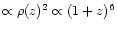 ,
being the number density in the proper
(physical)
volume. A more complex situation is likely to occur, since also the velocity field
evolves
with z in realistic cosmological scenarios and if we consider that the most
favourable
environment for interactions are galaxy groups, which are observed to host the
majority of ISOCAM distant sources (Cohen et al. 2000).
In turn, the increased luminosity with z of the typical starburst is due,
qualitatively, to the larger amount of gas available in the past to make stars.
,
being the number density in the proper
(physical)
volume. A more complex situation is likely to occur, since also the velocity field
evolves
with z in realistic cosmological scenarios and if we consider that the most
favourable
environment for interactions are galaxy groups, which are observed to host the
majority of ISOCAM distant sources (Cohen et al. 2000).
In turn, the increased luminosity with z of the typical starburst is due,
qualitatively, to the larger amount of gas available in the past to make stars.
How this picture of a 2-phase evolution of faint IR sources compares with results
of optical and near-IR deep galaxy surveys has not been investigated by us.
Since, because of dust, most of the bolometric emission during a starburst comes out in
the far-IR, we would not expect the optical surveys to see much of this violent
starbursting phase revealed by IR observations.
Indeed, B-band counts of galaxies and spectroscopic surveys are interpreted in
terms of number-density evolution, consequence of merging, and essentially no evolution
in luminosity.
The Faint Blue Object population found in optical surveys can be interpreted in our
scheme as
the post-starburst population, objects either observed after the major event of SF,
or more likely ones in which the moderately extinguished intermediate age
( 107 yrs)
stars in a prolonged starburst (several 107 yrs) dominate the optical spectrum.
In this sense optical and far-IR selections trace different phases of the evolution of
galaxies, and provide independent sampling of the cosmic star formation.
107 yrs)
stars in a prolonged starburst (several 107 yrs) dominate the optical spectrum.
In this sense optical and far-IR selections trace different phases of the evolution of
galaxies, and provide independent sampling of the cosmic star formation.
A lively debate is currently taking place about the capabilities of UV-optical
observations to map by themselves the past and present
star-formation, based on suitable corrections for dust extinction in distant galaxies.
Adelberger et al. (2000) suggest that the observed 850 m galaxy counts and the
background could be explained with the optical Lyman drop-out high-z population
by applying a proportionality correction to the optical flux and by taking into
account the locally observed distribution of mm-to-optical flux ratios.
On the other hand, a variety of facts indicate that optically-selected and
IR/mm-selected faint high-redshift sources form almost completely disjoint samples.
Chapman et al. (2000) observed with SCUBA a subset of  Lyman-break
galaxies having the highest predicted rates of SF as inferred from the optical
spectrum, but detected only one object out of ten.
van der Werf et al. (2000) found that the procedures adopted to correct
the optical-UV spectrum and to infer their sub-mm fluxes failed in the case of two
strongly lensed Lyman-break galaxies observed with SCUBA.
A similar dichotomy is observed in the local universe, where the bolometric flux by
luminous IR galaxies is mostly unrelated with the optical emission spectrum
(Sanders & Mirabel 1996).
Lyman-break
galaxies having the highest predicted rates of SF as inferred from the optical
spectrum, but detected only one object out of ten.
van der Werf et al. (2000) found that the procedures adopted to correct
the optical-UV spectrum and to infer their sub-mm fluxes failed in the case of two
strongly lensed Lyman-break galaxies observed with SCUBA.
A similar dichotomy is observed in the local universe, where the bolometric flux by
luminous IR galaxies is mostly unrelated with the optical emission spectrum
(Sanders & Mirabel 1996).
Rigopoulou et al. (2000), Poggianti & Wu (2000) and Poggianti
et al. (2001) report independent evidence on both local and high-z luminous
starbursts that typically 70% to 80% of the bolometric flux from young stars
leaves no traces in the UV-optical spectrum, because it is completely obscured
by dust. As there seems to be no robust "a priori" way to correct for this missing
energy, we conclude that only long-wavelength observations, with the appropriate
instrumentation, can eventually measure SF in galaxies at any redshifts.
![\begin{figure}
\par\includegraphics[width=8.5cm,height=8.2cm,clip]{sfr.eps}\end{figure}](/articles/aa/full/2001/40/aah2688/Timg245.gif) |
Figure 19:
Evolution of the comoving luminosity density for the IR-selected population
based on the model of IR evolution discussed in Sect. 5. The luminosity density
is expressed here in terms of the star formation rate density
(computed from the far-IR
luminosity assuming a Salpeter IMF, according to the recipes reported in
Rowan-Robinson et al. (1997, their Eq. (7)).
The IR evolution is compared with data coming from optical observations by
Lilly et al. (1996), Connolly et al. (1997) and Madau et al. (1996), transformed
to our adopted
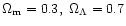 cosmology.
Dotted line: quiescent population. Short-dash line: evolving starbursts.
Long dashes: type-I AGNs (with arbitrary normalization).
The continuous line is the total.
The shaded horizontal region is an evaluation of the average SFR in spheroidal
galaxies by Mushotzky & Loewenstein (1997).
cosmology.
Dotted line: quiescent population. Short-dash line: evolving starbursts.
Long dashes: type-I AGNs (with arbitrary normalization).
The continuous line is the total.
The shaded horizontal region is an evaluation of the average SFR in spheroidal
galaxies by Mushotzky & Loewenstein (1997). |
| Open with DEXTER |
We are not presently in the position to derive an independent assessment
of the evolutionary SFR density based on the available complete samples of faint
IR sources, since the process of optical identifications is far from complete.
Again, only model-dependent estimates of the SFR density as a function of redshift
are possible at the moment. The prediction based
on our previously described evolution scheme is reported in Fig. 19.
There is a clear indication here that the contribution of IR-selected sources
to the luminosity density significantly exceeds those based on optically
selected sources, and that the excess may be progressive with redshift up to .
Consider that, in any case, the optical and IR
estimates of the SFR in Fig. 19 refer to largely distinct source populations
(extinction-corrected optical fluxes account on average for only 20-30%
of the bolometric emission by young stars in IR galaxies, see Sect. 6).
The fast evolution inferred from the IR observation should however level off at z>1,
to allow consistency with the observed z-distributions for faint ISOCAM sources
(Fig. 10, se also Chary & Elbaz 2001).
Another important constraint in this sense comes from the observed spectral
shape of the CIRB, with its apparent sharp peak around
 m and the fast turnover longwards: fitting it with standard dust-emission
spectra implies a maximum in the comoving galaxy IR emissivity close to
z=1. This is also confirmed by attempts to derive the average time-dependent
IR volume emissivity from deconvolution of the CIRB spectrum, see Gisper et al. (2000)
and Takeuchi et al. (2001).
m and the fast turnover longwards: fitting it with standard dust-emission
spectra implies a maximum in the comoving galaxy IR emissivity close to
z=1. This is also confirmed by attempts to derive the average time-dependent
IR volume emissivity from deconvolution of the CIRB spectrum, see Gisper et al. (2000)
and Takeuchi et al. (2001).
Surveys of H
line emission (the best optical indicator of SF) from high-zgalaxies indicate similar evolution of the SFR density, with a similarly sharp
change in slope occurring at
(see van der Werf et al. 2001
for a review). Our present results offer the advantage, however, to be unaffected
by the uncertain extinction corrections of the optical SF indicators, and to exploit
the very robust constraint set by the CIRB.
Altogether these results indicate that the history of galaxy long-wavelength emission
does probably follow a general path not much dissimilar from that revealed
by optical-UV observations,
by showing a similar peak activity around
 ,
rather than being
confined to the very high-redshifts as sometimes was suggested based on SCUBA
results. This confirms that the bulk of the galaxy activity is to
be placed around z=1, which is evident from Fig. 19 if the dependence of the
cosmological timescale on redshift is considered (see also Harwit 1999;
Haarsma & Partridge 1998).
,
rather than being
confined to the very high-redshifts as sometimes was suggested based on SCUBA
results. This confirms that the bulk of the galaxy activity is to
be placed around z=1, which is evident from Fig. 19 if the dependence of the
cosmological timescale on redshift is considered (see also Harwit 1999;
Haarsma & Partridge 1998).
As a final note, the estimated rate of evolution of the IR volume
emissivity of galaxies appears in Fig. 19 to be even higher than the evolution
rate for type-I AGNs.
Further constraints on the high-redshift far-IR/sub-mm population can be inferred
from observations of the global energetics residing in the CIRB and optical backgrounds.
These imply a very substantal demand on contributing sources,
as detailed below in schematic terms.
Let us assume that a fraction  of the universal mass density in baryons
![$ \rho_{\rm b} = {3H_0^2 (1+z)^3 \over 8 \pi G } \Omega_{\rm b}
\simeq 7\times 10^{10}(1+z)^3 h_{\rm 50}^2 \Omega_{\rm b}\ {\rm [{\it M}_\odot/Mpc^3]} $](/articles/aa/full/2001/40/aah2688/img249.gif) undergoes at redshift
undergoes at redshift  a transformation (either processed in stars or by
gravitational fields) with radiative efficiency
a transformation (either processed in stars or by
gravitational fields) with radiative efficiency  .
The locally observed
energy density of the remnant photons is
.
The locally observed
energy density of the remnant photons is
![$\displaystyle \rho_\gamma = \rho_{\rm b} {c^2\epsilon f_\ast \over (1+z_\ast)^4...
...\ast \over 0.1}
{2.5 \over (1+z_\ast)} {\epsilon \over 0.001} [{\rm gr/cm^3}] .$](/articles/aa/full/2001/40/aah2688/img252.gif) |
|
|
(11) |
For stellar processes,
is essentially determined
by the IMF:
 for a Salpeter IMF and a low-mass cutoff
 ,
,
 and
and
 for
for
 and
and
 ,
while
gets the usually quoted value of
,
while
gets the usually quoted value of
 only for
 .
.
Let us adopt for the optical/near-IR bolometric emission by distant galaxies
between 0.1 and 7 m the value given in Eq. (4).
We discussed evidence that in luminous starbursts the optical spectra are only
moderately contributed by the starburst emission itself, the latter being largely
hidden in the far-IR. Then let us assume that the optical/NIR background
mostly originates by moderately active SF in spiral disks and by
intermediate and low-mass stars. As observed in the Solar Neighborhood, a good
approximation to the IMF in such relatively quiescent environments is the
Salpeter law with standard low-mass cutoff, corresponding to a mass-energy
conversion efficiency
 .
With these parameter values, we
can reproduce the whole optical BKG intensity of Eq. (4) by
transforming a fraction
.
With these parameter values, we
can reproduce the whole optical BKG intensity of Eq. (4) by
transforming a fraction
 of all nucleosynthetic baryons into
(mostly low-mass) stars, assumed the bulk of this process happened at
of all nucleosynthetic baryons into
(mostly low-mass) stars, assumed the bulk of this process happened at
 and 5% of the closure value in baryons (for our adopted
H0=50 Km s-1/Mpc, or
and 5% of the closure value in baryons (for our adopted
H0=50 Km s-1/Mpc, or
 ,
consistent with the theory of
primordial nucleosynthesis):
,
consistent with the theory of
primordial nucleosynthesis):

A local density in low-mass stars is generated in this way consistent with the observations
(Ellis et al. 1996), and based on standard mass to light ratios:
 |
(12) |
For typical solar metallicities, this corresponds to a local density in metals of
 |
|
|
(13) |
Following our previous assumption that luminous starbursting galaxies
emit negligible energy in the optical-UV and most of it in the far-IR,
we coherently assume that the energy resident in the CIRB background
(Eq. (3)) originates from
star-forming galaxies at median
 .
The amount of baryons
processed in this phase and the conversion efficiency have to account for the combined constraints set by Eqs. (12), (13) and (3),
that is to provide a huge amount of energy without contributing much
stellar remnants to the locally observed amount. A viable solution
is then to change the assumptions about the stellar IMF characterizing
the starburst phase, for example to a Salpeter distribution cutoff below
,
with a correspondingly higher efficiency
(see Sect. 7.2). This may explain the energy density in the CIRB
(Eq. (3)):
.
The amount of baryons
processed in this phase and the conversion efficiency have to account for the combined constraints set by Eqs. (12), (13) and (3),
that is to provide a huge amount of energy without contributing much
stellar remnants to the locally observed amount. A viable solution
is then to change the assumptions about the stellar IMF characterizing
the starburst phase, for example to a Salpeter distribution cutoff below
,
with a correspondingly higher efficiency
(see Sect. 7.2). This may explain the energy density in the CIRB
(Eq. (3)):
assumed that a similar amount of baryons,
,
as processed with low
efficiency during the "inactive'' secular evolution, are processed with higher
radiative efficiency during the starbursting phases,
producing a two times larger amount of metals:
 .
Note that by decreasing
.
Note that by decreasing
 during the SB phase would decrease the efficiency
and increase
the amount of processed baryons ,
and would bring to exceed the locally
observed mass in stellar remnants (Eq. (12)).
during the SB phase would decrease the efficiency
and increase
the amount of processed baryons ,
and would bring to exceed the locally
observed mass in stellar remnants (Eq. (12)).
The above scheme is made intentionally extreme, to illustrate the point. The reality
is obviously more complex, e.g. by including a flattening at low mass values in the
Salpeter law (e.g. Zoccali et al. 1999) for the solar-neighborhood SF and, likewise,
a more gentle convergence of the starburst IMF than a simple low-mass cutoff.
A direct prediction of the above scheme is that most of the metals produced
during the starburst phase have to be removed by the galaxies to avoid
exceeding the locally observed metals in galactic stars (Eq. (13)).
There is clear evidence in local starbursts, based on optical and
X-ray observations, for large-scale super-winds out-gassing high-temperature
enriched plasmas from the galaxy. Our expectation would be that the
amounts of metals originating from the SF processes producing the CIRB
are hidden in hot cosmic media.
Where all these metals are? Most likely the polluted plasmas are hidden
in the diffuse (mostly primordial and un-processed) inter-cluster medium
with densities and temperatures preventing to detect them.
On the other hand, an interesting support to our scheme is provided by
observations of rich clusters of galaxies, considered as closed boxes
from a chemical point of view, as well as representative samples of the universe.
The mass of metals in the ICP plasma can be evaluated from the total amount of
ICP baryons ( 5 times the mass in galactic stars)
and from their average metallicity,
5 times the mass in galactic stars)
and from their average metallicity,
 solar. The mass of ICP metals
is then
solar. The mass of ICP metals
is then
 ,
i.e. two times larger than the mass of the metals present in galactic stars
and consistent with the mass in metals we inferred to be produced during the
SB phase.
,
i.e. two times larger than the mass of the metals present in galactic stars
and consistent with the mass in metals we inferred to be produced during the
SB phase.
Hence, the same starbursts producing the ICP metals are also likely responsible
for the origin of the CIRB. In a similar fashion, Mushotzky & Loewenstein (1997)
used their metallicity measurements of clusters to estimate the contribution of
spheroidal galaxies to the SFR density (see Fig. 19).
Our reference model implies that
star formation in galaxies has proceeded along two phases: a quiescent one
taking place during most of the Hubble time, slowly building stars with
standard IMF
from the regular flow of gas in rotational supported disks; and a transient actively
starbursting phase, recurrently triggered by galaxy mergers and interactions.
During the merger,
violent relaxation redistributes old stars, producing de Vaucouleur profiles typical
of galaxy spheroids, while young stars are generated following a top-heavy IMF.
Because of the geometric (thin disk) configuration of the diffuse ISM and the modest
incidence of dusty molecular clouds, the quiescent phase is only moderately
affected by dust extinction, and naturally produces most of the optical/NIR background
(including NIR emission by early-type galaxies completely deprived of an ISM).
The merger-triggered active starburst phase is instead characterized by a large-scale
redistribution of the dusty ISM, with bar-modes and shocks, compressing a large
fraction of
the gas into the inner galactic regions and triggering formation of molecular clouds.
As a consequence, this phase is expected to be heavily extinguished
and the bulk of the emission to happen at long wavelengths, naturally originating
the cosmic IR background.
Based on dynamical considerations, we expect that during this violent SB phase
the elliptical and S0 galaxies are formed in the most luminous IR SBs
(corresponding to the SCUBA source population), whereas galactic bulges in later-type
galaxies likely originate in lower IR luminosity starbursts (the ISO mid-IR population).
The presently available IR-selected galaxy samples, dominated as they are by
K-correction and selection effects, cannot allow to establish the precise
evolutionary timescales as a function of source luminosity.
In our best-fit model, both SCUBA-selected ULIRG and ISO-selected LIRG
galaxies have the same evolution history: if anything, SCUBA
sources originating massive E/S0s might evolve on a faster cosmic timescale.
This could be still in line with the expectations of hierarchical clustering models
if we consider that SCUBA sources likely trace the
very high-density environments (galaxy clusters) with an accelerated merging rate at
high-z, while ISO sources are likely related with lower-density environments
(galaxy groups or the field) entering the non-linear collapse phase at later cosmic
epochs (e.g. Franceschini et al. 1999).
Finally, if indeed the IMF characteristic of the starburst phase is deprived
of low-mass stars, as suggested in
the previous paragraphs, a consequence would be that the excess blue stars
formed during the starburst would quickly die and disappear, leaving the colors of the
emerging remnant as typically observed for early-type galaxies and keeping
consistent with the evidence that the stellar mass in spheroidal galaxies does
not change much for z<1.
![\begin{figure}
\par\includegraphics[width=7.6cm,height=6.4cm,clip]{c24.eps}\par\vspace*{2mm}
\includegraphics[width=7.6cm,height=6.4cm,clip]{c70.eps}\end{figure}](/articles/aa/full/2001/40/aah2688/Timg275.gif) |
Figure 20:
Integral number counts at
 and 70 m. The SIRTF
confusion limits are referred to as the 85 cm lines.
For comparison, an 8 m New Generation Space Telescope observing at
24 m would be confusion limited at a source areal density of
106 sources/sq. deg. (at the level of the top axis).
and 70 m. The SIRTF
confusion limits are referred to as the 85 cm lines.
For comparison, an 8 m New Generation Space Telescope observing at
24 m would be confusion limited at a source areal density of
106 sources/sq. deg. (at the level of the top axis). |
| Open with DEXTER |
![\begin{figure}
\par\includegraphics[width=7.5cm,height=6.4cm,clip]{c250.eps}\par\vspace*{2mm}
\includegraphics[width=7.5cm,height=6.4cm,clip]{c450.eps}\end{figure}](/articles/aa/full/2001/40/aah2688/Timg276.gif) |
Figure 21:
Integral number counts at
 and 450 m, relevant
for future surveys with the Hershel Observatory. See also caption to Fig. 20.
and 450 m, relevant
for future surveys with the Hershel Observatory. See also caption to Fig. 20. |
| Open with DEXTER |
![\begin{figure}
\par\includegraphics[width=7.5cm,height=6.2cm,clip]{dz170.eps}\pa...
...ace*{2mm}
\includegraphics[width=7.5cm,height=6.2cm,clip]{dz850.eps}\end{figure}](/articles/aa/full/2001/40/aah2688/Timg277.gif) |
Figure 22:
Distributions of redshifts for flux-limited samples at 170 (top panel)
and 850 m (bottom), at the limits of confusion for ISO and SCUBA. |
| Open with DEXTER |
We have analyzed a large dataset derived from deep galaxy surveys at
long wavelengths, exploiting in particular new ISO and published SCUBA observations,
but also including data from IRAS, COBE and IRAM.
This study of galaxy evolution at long wavelengths benefit also by the
unique situation to combine constraints coming from faint resolved sources
with data on the integrated source emission provided by the spectral intensity of the
cosmic IR background. The main results of our analysis are hereby summarized.
-
(1) The deep surveys by ISOCAM LW3 at 15 m provide the most precise quantification
of statistical properties of faint IR galaxies, in the form of deep source counts
and redshift distributions for faint complete samples.
The numerous ISO-selected 15 m sources also allow to
perform detailed physical investigations of the high-z IR population, since their
optical counterparts are rather straightforward to identify.
Analyses of the mid-IR to far-IR flux correlations suggest that not only at the ISOCAM
LW3 flux limit a major fraction of the mid-IR CIRB intensity is resolved into sources,
but also that the same sources are likely to contribute a substantial fraction of the
bolometric energy density in the CIRB (Elbaz et al. 2001).
Our present comparative study of the multi-wavelength counts and
LF's entirely confirms this conclusions, by showing that the various statistics
on IR sources can only be reconciled with each other by assuming
IR SEDs typical of starbursts, in which case
of the bolometric CIRB
is contributed by ISOCAM 15 m sources brighter than
 Jy.
The sources of this important cosmological component, including
Jy.
The sources of this important cosmological component, including
 of the
integrated bolometric emission by galaxies, can then be investigated in the ISOCAM
population.
By contrast, our model predictions suggest that the extreme luminosities and
redshifts and low spatial density of the SCUBA-selected population are such that
only a modest fraction of the bolometric CIRB energy can be produce by them,
although they can dominate it at the long-.
For a constant comoving volume emissivity as a function of z (see Fig. 19),
high-redshift sources suffer a
(1+z)-3.5 penalty factor in their contribution
to the CIRB.
of the
integrated bolometric emission by galaxies, can then be investigated in the ISOCAM
population.
By contrast, our model predictions suggest that the extreme luminosities and
redshifts and low spatial density of the SCUBA-selected population are such that
only a modest fraction of the bolometric CIRB energy can be produce by them,
although they can dominate it at the long-.
For a constant comoving volume emissivity as a function of z (see Fig. 19),
high-redshift sources suffer a
(1+z)-3.5 penalty factor in their contribution
to the CIRB.
-
(2) The most robust conclusion coming from the present analysis appears to be that of
a very
rapid increase of galaxy long-wavelength volume emissivity with redshift, paralleled
by an
increased incidence in high-redshift sources of dust extinction and thermal dust
reprocessing, with respect to locally observed galaxies. This is the faster evolution
rate observed for galaxies at any wavelengths (
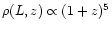 if averaged
over the whole galaxy population, see Fig. 19),
and is higher than the rates inferred for quasars.
We have found that the shape of the LW3 counts (a roughly Euclidean behavior down to
if averaged
over the whole galaxy population, see Fig. 19),
and is higher than the rates inferred for quasars.
We have found that the shape of the LW3 counts (a roughly Euclidean behavior down to
 mJy followed by a very fast upturn) is better fit by assuming
that for only a fraction of local galaxies the IR emissivity evolves back in time.
In this case strong evolution both in number density and in the average source
luminosity is indicated.
mJy followed by a very fast upturn) is better fit by assuming
that for only a fraction of local galaxies the IR emissivity evolves back in time.
In this case strong evolution both in number density and in the average source
luminosity is indicated.
-
(3) The combined constraints set by the z-distributions
and by the spectral shape of the CIRB impose that this fast evolution rolls-over
around redshift 1, and keeps flat above. The evolution of the luminosity density
is so rapid up to
 that no much further increase is left for the higher
redshifts. Consequently, the history
of galaxy formation traced by long-wavelength observations does not appear
fundamentally different from
the one inferred from optical observations, and shows a maximum around .
Scenarios in which a substantial fraction of stellar formation happens at very high-z
(e.g. producing the bulk of stars in spheroidal galaxies at z>2-3)
are not supported by our analysis, and appear to conflict in particular with the
observed shape of the CIRB at
that no much further increase is left for the higher
redshifts. Consequently, the history
of galaxy formation traced by long-wavelength observations does not appear
fundamentally different from
the one inferred from optical observations, and shows a maximum around .
Scenarios in which a substantial fraction of stellar formation happens at very high-z
(e.g. producing the bulk of stars in spheroidal galaxies at z>2-3)
are not supported by our analysis, and appear to conflict in particular with the
observed shape of the CIRB at
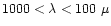 m.
Obviously, for a definitive proof of these statements it will be necessary
to resolve a significant
fraction of the CIRB at its peak (
m.
Obviously, for a definitive proof of these statements it will be necessary
to resolve a significant
fraction of the CIRB at its peak (
 to 300 m). The next important
step in this sense is expected from the Herschel Space Observatory.
to 300 m). The next important
step in this sense is expected from the Herschel Space Observatory.
-
(4) Our present results, together with preliminary spectroscopic studies of the faint
IR sources, suggest that only a minor fraction of their IR flux originates from AGN
activity, the bulk of it being likely due to star formation. Our best-fits to the SEDs
indicate massive systems hosting violent starbursts (
/yr).
We have suggested that the most natural interpretation for the strong observed
evolution is to assume that the evolving starbursting population consists of otherwise
normal galaxies observed during a dust-extinguished short-lived but
luminous starburst event. The strong increases with redshift
of the probability of interactions (as partly due to a plain geometrical effect
in the expanding universe) and of the effects of interactions (due to the
more abundant fuel avaliable in the past), likely explain the observed rapid
evolution. Galaxy interactions and mergers are emphasized by the present analysis
as a crucial cosmogonic driver for galaxy evolution.
-
(5) Our suggested evolutionary scheme considers bi-modal star-formation in
galaxies: SF during a long-lived quiescent phase, and enhanced SF taking place in
transient starburst phases recurrently triggered by interactions and merging.
The former would be responsible for building of galaxy disks,
the latter for the assembly of spheroidal components in galaxies.
Very schematically, we have attributed the optical background to emission during
the quiescent mode, and explain the CIRB as mostly due to dust-extinguished emission
by young stars during the starbursting phase.
-
(6) The large energy content in
the CIRB is not easy to explain, if we consider the modest efficiency of the
mass-energy transformations allowed by stellar evolution.
The most obvious way to alleviate the
combined constraints set by the local observed amounts of low-mass stars and metals
would be to assume that a stellar IMF somewhat deprived in low-mass stars is
characteristic of the IR starburst phase.
In any case, we expect that as much as 2 times the amount of
metals in stars should be present in the diffuse intergalactic medium
as a remnant of the ancient SB phase. A support to this concept is provided by
observations of the abundance of metals in hot Intra-Cluster plasmas.
-
(7) Many of the phenomena revealed by long-wavelength observations were largely
unexpected based on UV-optical-NIR observation: among others,
the rate of cosmic evolution of IR
galaxies, the CIRB energetics, the luminosities and rates of SF for LIRGs and ULIRGs.
The attempts so far to infer the IR properties based on UV-optical observations are
producing modest results: there does not seem to be an alternative to long-wavelength
observations if we aim at an exhaustive and reliable description of the history
of SF in galaxies.
![\begin{figure}
\par\includegraphics[width=8.5cm,height=6.2cm,clip]{dz24.eps}\par...
...ace*{2mm}
\includegraphics[width=8.5cm,height=6.2cm,clip]{dz450.eps}\end{figure}](/articles/aa/full/2001/40/aah2688/Timg286.gif) |
Figure 23:
Distributions of redshifts for flux-limited samples at 24 (top panel)
and 450 m (bottom), at the limits of confusion for SIRTF and Herschel. |
| Open with DEXTER |
Acknowledgements
We have pleasure to acknowledge fruitful discussions and exchanges in particular
with S. Bressan, J. L. Puget, M. Harwit and H. Flores.
This research has been supported by the Italian Space Agency (ASI) and the
European Community RTN Network "POE" (under contract HPRN-CT-2000-00138) and "Galaxy Formation'' (under contract ERBFMAX-CT96-0086).
We report in this section predictions based on the reference
model, which could be useful for testing it, as well as
for planning of future observations.
The confusion noise, which is the fundamental limiting factor for space IR instrumentation,
is evaluated in this Section as well as in the paper from the criterion to
accept sources down to a flux limit corresponding to 1/27 independent beams.
For Euclidean counts, this roughly corresponds to a
confidence limit.
Note however that for non-Euclidean counts, a case often encountered in the infrared,
this criterion may under- or over-predict the
limit according to
the count slope (Franceschini 2000).
SIRTF will operate an imaging camera (MIPS) with broad-band filters centered
at 24, 70 and 170 m. Figure 20 (see also Fig. 3)
reports predicted counts at these wavelengths.
The Herschel Observatory (former ESA Cornerstone FIRST) will
characterize the far-IR (70 to 500 m) emission by galaxies at any redshifts,
by pushing down in flux the limit of confusion with its large 3.6 m primary mirror.
Figure 21 illustrates galaxy counts and the confusion threshold in two of the
Herschel long-
channel at 250 and 450 m
(other information can be retrived from Figs. 3 and 20).
The distributions of redshifts for flux-limited samples with complete identification
are the other fundamental statistical observable for faint distant sources.
Identifications of FIRBACK/ELAIS sources detected by ISO at 170 m will
require an extensive effort of deep radio imaging to reduce the errorbox.
A similar effort will be required to identify SCUBA- or IRAM-detected high-z
galaxies. Alternatively, the errorbox will be reduced by following-up
SCUBA sources with mm interferometers (Plateaux de Bure, ALMA).
We report in Fig. 22 predicted z-distributions for both kind of surveys
at the typical limiting fluxes.
Finally, we report in Figs. 23 z-distributions for confusion-limited
surveys by SIRTF and Herschel at 24 and 450 m, respectrively.
In both cases, the K-correction for typical starburst spectra plays in favour
of the detection of galaxies well above z=1.
Note, in particular, the secondary peak at  in D(z) for the
24 m selection, due to the PAH emission bundle in the rest-frame
in D(z) for the
24 m selection, due to the PAH emission bundle in the rest-frame
 m entering the observable bandwidth at such redshift, provides
an attractive feature of the forthcoming SIRTF surveys (e.g. Lonsdale 2001;
Lonsdale et al. 2001; Dickinson 2001).
m entering the observable bandwidth at such redshift, provides
an attractive feature of the forthcoming SIRTF surveys (e.g. Lonsdale 2001;
Lonsdale et al. 2001; Dickinson 2001).
-
Adelberger, K. L., & Steidel, C. C. 2000, ApJ, 544, 218
In the text
NASA ADS
-
Aharonian, F., Akhperjanian, A. G., Barrio, J. A., et al. 1999, A&A, 349, 11
In the text
NASA ADS
-
Alexander, D., & Aussel, H. 2000, in ISO Surveys of a Dusty Universe, in press
[astro-ph/0002200]
In the text
-
Almaini, O., Lawrence, A., & Boyle, B. J. 1999, MNRAS, 305, L59
In the text
NASA ADS
-
Altieri, B., Metcalfe, L., Kneib, J. P., et al. 1999, A&A, 343
In the text
-
Andreani, P., & Franceschini, A. 1996, MNRAS, 283, 85
In the text
NASA ADS
-
Aussel, H. 1998, Ph.D. Thesis, CEA Saclay, Paris
In the text
-
Aussel H., Cesarsky C., Elbaz D., & Starck, J. L. 1999, A&A, 342, 313
In the text
NASA ADS
-
Aussel, H., et al. 2001, in preparation
In the text
-
Aussel, H., Coia, D., Mazzei, P., De Zotti, G., & Franceschini, A.
2000, A&AS, 141, 257
In the text
NASA ADS
-
Barger, A. J., Cowie, L. L., Sanders, D. B., et al. 1998, Nature, 394, 248
In the text
NASA ADS
-
Barger, A. J., Cowie, L. L., & Sanders, D. B. 1999, ApJ, 518, L5
In the text
NASA ADS
-
Barger, A. J., Cowie, L. L., Smail, I.,
et al. 1999, AJ, 117, 2656
NASA ADS
-
Barger, A., Cowie, L., Mushotzky, R., & Richards, E. 2001,
AJ, 121, 662
In the text
NASA ADS
-
Bassani, L., Franceschini, A., Malaguti, G., Cappi, M., & Della Ceca,
R. 2001, A&A, submitted
In the text
-
Bautz, M. W., Malm, M. R., Baganoff, F. K., et al. 2000, ApJ, 543, L119
In the text
NASA ADS
-
Bernstein, R. A. 1998, Ph.D. Thesis, California Institute of Technology,
Source DAI-B 59/11
In the text
-
Bertoldi, F., Carilli, C. L., Menten, K. M., et al. 2000, A&A, 360, 92
In the text
NASA ADS
-
Bertoldi, F., Menten, K. M., Kreysa, E., Carilli, C. L., & Owen, F. 2001,
in Proc. JD9, IAU Manchester 2001, Cold Gas and Dust at High Redshift,
ed. D. J. Wilner, Highlights of Astronomy vol. 12. PASP, in press [astro-ph/0010553]
In the text
-
Biviano, A., Metcalfe, L., Altieri, B., et al. 2001, ASP Conference
Proceedings on Clustering at high redshifts, ed. A. Mazure et al.,
in press [astro-ph/9910314]
In the text
-
Blain, A. W., & Longair, M. S. 1993, MNRAS, 264, 509
In the text
NASA ADS
-
Blain, A. W., Kneib, J.-P., Ivison, R. J., & Smail, I. 1999, ApJ, 512, L87
In the text
NASA ADS
-
Carilli, C. L., & Yun, M. S. 1999, ApJL, 513, L13
In the text
NASA ADS
-
Chapman, S. C., Scott, D., Steidel, C., et al. 2000, MNRAS, 319, 318
In the text
NASA ADS
-
Chary, R., & Elbaz, D. 2001, ApJ, 556, 562
In the text
NASA ADS
-
Cohen, J., Hogg, D. W., Blandford, R., et al. 2000, ApJ, 538, 29
In the text
NASA ADS
-
Connolly, A., Szlay, A., Dickinson, M., Subbarao, M., & Brunner, R. 1997, ApJ, 486, L11
In the text
NASA ADS
-
Coppi, P., & Aharonian, F. 1999, Astropart. Phys., 11, 35
In the text
NASA ADS
-
Danese, L., De Zotti, L., Franceschini, A., & Toffolatti, L. 1987,
ApJL, 318, L15
In the text
NASA ADS
-
Desert, F. X., Puget, J.-L., Clements, D., et al. 1999, A&A, 342, 363
In the text
NASA ADS
-
Devriendt, J. E. G., Guiderdoni, B., & Sadat, R. 1999, A&A, 350, 381
In the text
NASA ADS
-
Dey, A., Ivison, R., Smail, I., Wright, J., & Liu, M. 1999, ApJ, 519, 610
In the text
NASA ADS
-
Dickinson, M. 2001, The Great Observatories Origins Deep Survey (GOODS),
AAS, 198, 2501
In the text
NASA ADS
-
Dole, H., Gispert, R., Lagache, G., et al. 2000, in ISO Beyond Point Sources,
Studies of Extended Infrared Emission, ed. R. Laureijs, K. Leech, & M. Kessler,
ESA-SP, 455, 167.
In the text
-
Dole, H., Gispert, R., Lagache, G., et al. 2001, A&A, 372, 364
In the text
NASA ADS
-
Dunne, L., Eales, S. Edmunds, M., et al. 2000, MNRAS, 315, 115
In the text
NASA ADS
-
Dwek, E., & Arendt, R. G. 1998, ApJ, 508, L9
In the text
NASA ADS
-
Eales, S., Lilly, S., Webb, T., et al. 2000, AJ, 120, 2244
In the text
NASA ADS
-
Efstathiou, A., Oliver, S., Rowan-Robinson, M., et al. 2000, MNRAS, 319, 1169
In the text
NASA ADS
-
Elbaz, D., Aussel, H., Cesarsky C. J., et al. 1998, in
Proc. of 34th Liege International Astrophysics Colloquium on the Next Generation
Space Telescope, Belgium [astro-ph/9807209]
In the text
-
Elbaz, D., Cesarsky, C. J., Fadda, D., et al. 1999, A&A, 351, L37
In the text
NASA ADS
-
Elbaz, D., Cesarsky, C., Chanial, P., et al. 2001, A&A, submitted
In the text
-
Ellis, R. S. 1997, ARA&A, 35, 389
In the text
NASA ADS
-
Ellis, R. S., Colless, M., Broadhurst, T., Heyl, J., & Glazebrook, K. 1996,
MNRAS, 280, 235
In the text
NASA ADS
-
Fabian, A., Smail, I., Iwasawa, K., et al. 2000, MNRAS, 315, 8
In the text
-
Fadda, D., Flores, H., Hasinger, G., et al. 2001, A&A, submitted
In the text
-
Fang, F., Shupe, D. L., Xu, C., & Hacking, P. B. 1998, ApJ, 500, 693
In the text
NASA ADS
-
Finkbeiner, D. P., Davies, M., & Schlegel, D. J. 2000, ApJ, 544, 81
In the text
NASA ADS
-
Fixsen, D. J., Dwek, E., Mather, J. C., et al. 1998, ApJ, 508, 123
In the text
NASA ADS
-
Flores, H., Hammer, F., Thuan, T., et al. 1999, ApJ, 517, 148
In the text
NASA ADS
-
Franceschini, A., Mazzei, P., De Zotti, G., & Danese, L. 1994a, ApJ, 427, 140
In the text
NASA ADS
-
Franceschini, A., La Franca, F., Cristiani, S., & Martin-Mirones, J.
1994b, MNRAS, 269, 683
In the text
NASA ADS
-
Franceschini, A., & Gratton, R. 1997, MNRAS, 286, 235
In the text
NASA ADS
-
Franceschini, A., Hasinger, G., Miyaji, T., & Malquori, D. 1999,
MNRAS, 310, L5
In the text
In the text
NASA ADS
-
Franceschini, A. 2000, in Galaxies at High Redshifts,
Proceedings of the XI Canary Islands Winter School of Astrophysics,
ed. F. Sanchez, I. Perez-Fournon, M. Balcells, & F. Moreno-Insertis (Cambridge University Press)
In the text
-
Frayer, D. T., Ivison, R. J., Scoville, N. Z.,
et al. 1999, ApJ, 514, L13
NASA ADS
-
Genzel, R., & Cesarsky, C. J. 2000, ARA&A, 38, 761
In the text
NASA ADS
-
Genzel, R., Lutz, D., Sturm, E., et al. 1998, ApJ, 498, 579
In the text
NASA ADS
-
Giacconi, R., Rosati, P., Tozzi, P., et al. 2001, ApJ, 551, 624
In the text
NASA ADS
-
Gispert, R., Lagache, G., & Puget, J. L. 2000, A&A, 360, 1
In the text
NASA ADS
-
Gorjian, V., Wright, E. L., & Chary, R. R. 2000, ApJ, 536, 550
In the text
NASA ADS
-
Granato, G. L., Silva, L., Monaco, P., et al. 2001, MNRAS, 324, 757
In the text
NASA ADS
-
Guiderdoni, B., Bouchet, F., Puget, J.-L., et al. 1997, Nature, 390, 257
In the text
NASA ADS
-
Haarsma, D. B., & Partridge, R. B. 1998, ApJ, 503, L5
NASA ADS
-
Harwit, M. 1999, ApJ, 510, L83
In the text
In the text
NASA ADS
-
Harwit, M., Protheroe, R. J.,
& Biermann, P. L. 1999, ApJ, 524, L91
NASA ADS
-
Hauser, M. G., Arendt, R. G., Kelsall, T., et al. 1998, ApJ, 508, 25
In the text
NASA ADS
-
Hornschemeier, A. E., Brandt, W. N., & Garmire, G. P. 2000, ApJ, 554, 742
In the text
NASA ADS
-
Hughes, D., Serjeant, S., Dunlop, J., et al. 1998, Nature, 394, 241
In the text
NASA ADS
-
Ivison, R. J., Smail, I., Barger, A. J., et al. 2000a, MNRAS, 315, 209
In the text
NASA ADS
-
Ivison, R. J., Dunlop, J. S., Smail, I., et al. 2000b,
ApJ, 542, 27
In the text
NASA ADS
-
Juvela, M., Mattila, K., & Lemke, D. 2000, A&A, 360, 813
In the text
NASA ADS
-
Kauffmann, G., & Charlot, S. 1998, MNRAS, 297, L23
In the text
NASA ADS
-
Kormendy, J., & Sanders, D. 1992, ApJ, 390, L53
In the text
NASA ADS
-
Krawczynski, H., Coppi, P. S., Maccarone, T., & Aharonian, F. A. 2000, A&A, 353, 97
NASA ADS
-
Lagache, G., & Puget, J. L. 2000, A&A, 355, L17
-
Lagache, G., Abergel, A., Boulanger, F., Desert, F. X., & Puget, J. L. 1999,
A&A, 344, L322
In the text
-
Lari, C., Pozzi, F., Gruppioni, C., et al. 2001, MNRAS, 325, 1173
In the text
NASA ADS
-
Le Fevre, O., Abraham, R., Lilly, S. J., et al. 2000, MNRAS, 311, 565
In the text
NASA ADS
-
Lilly, S., Le Fevre, O., Hammer, F., & Crampton, D. 1996, ApJ, 460, L1
In the text
NASA ADS
-
Lilly, S. J., Eales, S. A., Gear, W., et al. 1999, ApJ, 518, 641
In the text
NASA ADS
-
Lonsdale, C. J. 2001, AAS, 198, 2502
In the text
In the text
NASA ADS
-
Lonsdale, C. J., Smith, H. E., Rowan-Robinson, M., et al. 2001,
The SIRTF Wide-Area Infrared Extragalactic
Survey (SWIRE), http://www.ipac.caltech.edu/SWIRE
-
Madau, P., & Pozzetti, L. 2000, MNRAS, 312, 9
In the text
-
Madau, P., Ferguson, H. C., Dickinson, M. E., et al. 1996, MNRAS, 283, 1388
In the text
NASA ADS
-
Matsuhara, H., Kawara, K., Sato, Y., et al. 2000, A&A, 361, 407
In the text
NASA ADS
-
Mazzei, P., Aussel, H., Xu, C., et al. 2001,
New Astron., 6, 265
In the text
NASA ADS
-
Mushotzky, R. F., & Loewenstein, M. 1997, ApJ, 481, L63
In the text
NASA ADS
-
Oliver, S., Rowan-Robinson, M., Broadhurst, T. J., et al. 1996, MNRAS, 280, 673
In the text
NASA ADS
-
Oliver, S., Goldschmidt, P., Franceschini, A., et al. 1997, MNRAS, 289, 471
In the text
NASA ADS
-
Oliver, S., Rowan-Robinson, M., Alexander, D. M., et al.
2000a, MNRAS, 316, 749
In the text
NASA ADS
-
Oliver, S., Mann, R. G., Carballo, R., et al. 2000b, MNRAS, submitted
-
Omont, A., McMahon, R. G., Cox, P., et al. 1996, A&A, 315, 1
In the text
NASA ADS
-
Padovani, P., & Matteucci, F. 1993, ApJ, 416, 26
In the text
NASA ADS
-
Pearson, C., & Rowan-Robinson, M. 1996, MNRAS, 283, 174
In the text
NASA ADS
-
Poggianti, B. M., Bressan, A., & Franceschini, A. 2001, ApJ, 550, 195
In the text
NASA ADS
-
Poggianti, B. M., & Wu, H. 2000, ApJ, 529, 157
In the text
NASA ADS
-
Puget, J.-L., Abergel, A., Bernard, J.-P., et al. 1996, A&A, 308, L5
In the text
NASA ADS
-
Puget, G. L., Lagache, G., Clements, D., et al. 1999, A&A, 345, 29
In the text
NASA ADS
-
Renault, C., Barrau, A., Lagache, G., & Puget, J.-L. 2001, A&A, 371, 771
In the text
NASA ADS
-
Richards, E. A., Kellermann, K. I., Fomalont, E. B., Windhorst, R. A., & Partridge, R. B.
1998, AJ, 116, 1039
In the text
NASA ADS
-
Rigopoulou, D., Franceschini, A., Aussel, H., et al. 2000,
ApJ, 537, L85
In the text
NASA ADS
-
Risaliti, G., Gilli, R., Maiolino, R., & Salvati, M. 2000, A&A, 357, 13
In the text
NASA ADS
-
Roche, N., & Eales, S. A. 1999, MNRAS, 307, 111
In the text
NASA ADS
-
Rodighiero, G., Franceschini, A., & Fasano, G. 2001, MNRAS, 324, 491
In the text
NASA ADS
-
Rowan-Robinson, M., Mann, R. G., Oliver, S. J., et al. 1997, MNRAS, 289, 482
In the text
NASA ADS
-
Rowan-Robinson, M. 2001, ApJ, 549, 745
In the text
NASA ADS
-
Rush, B., Malkan, M. A., & Spinoglio, L. 1993, ApJS, 89, 1
(J. Wiley & Sons)
In the text
NASA ADS
-
Sanders, D., Soifer, B. T., Elias, J. H., et al. 1988, ApJ, 325, 74
In the text
NASA ADS
-
Sanders, D., & Mirabel, I. F. 1996, ARA&A, 34, 749
In the text
NASA ADS
-
Sanders, D. B. 2001, in New results in Far-Infrared and Sub-millimeter
Astronomy, ed. T. de Graauw, & R. Szczerba, in press
In the text
-
Saunders, W., Rowan-Robinson, M., Lawrence, A., et al. 1990, MNRAS, 242, 318
In the text
NASA ADS
-
Scott, D., Lagache, G., Borys, C., et al. 2000, A&A, 357, L5
In the text
NASA ADS
-
Silva, L., Granato, G. L., Bressan, A., & Danese, L. 1998, ApJ, 509, 103
In the text
NASA ADS
-
Smail, I., Ivison, R. J., & Blain, A. W. 1997, ApJ, 490, L5
In the text
NASA ADS
-
Smail, I., Ivison, R. J., Kneib, J.-P., et al. 1999, MNRAS, 308, 1061
In the text
NASA ADS
-
Smail, I., Ivison, R. J., Owen, F. N., Blain, A. W., & Kneib, J.-P.
2000, ApJ, 528, 612
In the text
NASA ADS
-
Soifer, B. T., & Neugebauer, G. 1991, ApJ, 101, 354
In the text
-
Stanev, T., & Franceschini, A. 1998, ApJ, 494, L159
In the text
NASA ADS
-
Starck, J. L., Aussel, H., Elbaz, D., Fadda, D., & Cesarsky, C. 1999, A&AS, 138, 365
In the text
NASA ADS
-
Stecker, F., De Jager, O., & Salamon, M. 1992, ApJ, 390, L49
In the text
NASA ADS
-
Steidel, C., Adelberger, K., Giavalisco, M., Dickinson, M., & Pettini, M. 1999, ApJ, 519, 1
In the text
NASA ADS
-
Stickel, M., Bogun, S., Lemke, D., et al. 1998, A&A, 336, 116
In the text
NASA ADS
-
Takeuchi, T., Ishii, T., Hirashita, H., et al. 2001, PASJ, 53, 37
In the text
NASA ADS
-
Taniguchi, Y., Cowie, L. L., Sato, Y., Sanders, D.,
& Kawara, K. 1997, A&A, 328, L9
In the text
NASA ADS
-
Tozzi, P., Rosati, P., Nonino, M., et al. 2001, ApJ, in press [astro-ph/0103014]
In the text
-
Tran, Q. D., Lutz, D., Genzel, R., et al. 2001, ApJ, 552, 527
In the text
NASA ADS
-
van der Werf, P., Knudsen, K., Labb'e, I., & Franx, M. 2001,
in The far-infrared and submillimeter spectral energy distributions of active
and starburst galaxies, ed. I. van Bemmel, B. Wilkes, & P. Barthel,
Elsevier New Astron. Rev., in press [astro-ph/0011217]
-
van der Werf, P., Moorwood, A. F. M., & Yan, L. 2001, Proceedings of 2nd Hellenic Cosmology
Workshop, ed. M. Plionis et al. (Kluwer), in press [astro-ph/0108161]
-
Vigroux, L., Charmandaris, V., Gallais, P., et al. 1999, in The Universe as seen by ISO, ESA-SP, 427, 805
In the text
-
Xu, C., Hacking, P., Fang, F., et al. 1998, ApJ, 508, 576
In the text
NASA ADS
-
Xu, C., Lonsdale, C. J., Shupe, D. L., O'Linger, J., & Masci, F. 2001,
ApJ, in press [astro-ph/0009220]
In the text
-
Zoccali, M., Cassisi, S., Frogel, J. A., et al. 2000, ApJ, 530, 418
NASA ADS
Copyright ESO 2001
![\begin{figure}
\par\includegraphics[width=16cm,height=11cm,clip]{bkg.eps}\end{figure}](/articles/aa/full/2001/40/aah2688/img36.gif)




![\begin{figure}
\par\includegraphics[width=16cm,height=11cm,clip]{c15dif.eps}\end{figure}](/articles/aa/full/2001/40/aah2688/img77.gif)
![\begin{figure}
\par\includegraphics[width=14.2cm,height=9.2cm,clip]{c170.eps}\end{figure}](/articles/aa/full/2001/40/aah2688/img79.gif)
![\begin{figure}
\par\includegraphics[width=8.5cm,height=7.4cm,clip]{c170dif.eps}\end{figure}](/articles/aa/full/2001/40/aah2688/img88.gif)
![\begin{figure}
\par\includegraphics[width=8.5cm,height=7.3cm,clip]{c90.eps}\end{figure}](/articles/aa/full/2001/40/aah2688/img102.gif)
![\begin{figure}
\par\includegraphics[width=14.2cm,height=9.2cm,clip]{c850.eps}\end{figure}](/articles/aa/full/2001/40/aah2688/img109.gif)
![\begin{figure}
\par\includegraphics[width=8.5cm,height=7.4cm,clip]{c1200.eps}\end{figure}](/articles/aa/full/2001/40/aah2688/img115.gif)
 m by Bertoldi et al. (
![\begin{figure}
\par\includegraphics[width=8.2cm,height=8cm,clip]{Kcorr.eps}\end{figure}](/articles/aa/full/2001/40/aah2688/img134.gif)
![\begin{figure}
\par\includegraphics[width=14.1cm,height=10cm,clip]{llf12.eps} %
\end{figure}](/articles/aa/full/2001/40/aah2688/img138.gif)
![\begin{figure}
\par\includegraphics[width=8.5cm,height=8cm,clip]{dzhdf.eps} %
\end{figure}](/articles/aa/full/2001/40/aah2688/img146.gif)
![$\displaystyle %
\rho(L_{\rm 12}[z],z) = \rho_0(L_{\rm 12})\times (1+z)^{4} \ \ \ \ \ z<z_{\rm break}$](/articles/aa/full/2001/40/aah2688/img155.gif)
![$\displaystyle \rho(L_{\rm 12}[z],z) = \rho_0(L_{\rm 12})\times (1+z_{\rm break})^{4} \ \ \ \ z_{\rm break}<z<z_{\rm max}$](/articles/aa/full/2001/40/aah2688/img156.gif)


![\begin{figure}
\par\includegraphics[width=8.6cm,height=8.2cm,clip]{llf60.eps}\end{figure}](/articles/aa/full/2001/40/aah2688/img165.gif)
![\begin{figure}
\par\includegraphics[width=8.5cm,height=8.2cm,clip]{llf_850.eps}\end{figure}](/articles/aa/full/2001/40/aah2688/img167.gif)
![\begin{figure}
\par\includegraphics[width=8.7cm,height=8.2cm,clip]{spectra.eps}\end{figure}](/articles/aa/full/2001/40/aah2688/img177.gif)
![\begin{figure}
\par\includegraphics[width=8.5cm,height=5.4cm,clip]{c60.eps}\end{figure}](/articles/aa/full/2001/40/aah2688/img179.gif)
![\begin{figure}
\par\includegraphics[width=8.5cm,height=5.3cm,clip]{dz60.eps}\end{figure}](/articles/aa/full/2001/40/aah2688/img180.gif)
![\begin{figure}
\par\includegraphics[width=8.3cm,height=8cm,clip]{llf_evol.eps} %
\end{figure}](/articles/aa/full/2001/40/aah2688/img188.gif)
![\begin{figure}
\par\includegraphics[width=8.5cm,height=8.2cm,clip]{source8.eps}\end{figure}](/articles/aa/full/2001/40/aah2688/img213.gif)
![\begin{figure}
\par\includegraphics[width=8.5cm,height=10.8cm,clip]{sfr_z.eps}\end{figure}](/articles/aa/full/2001/40/aah2688/img223.gif)
![\begin{figure}
\par\includegraphics[width=8.5cm,height=8.2cm,clip]{sfr.eps}\end{figure}](/articles/aa/full/2001/40/aah2688/img245.gif)

![\begin{figure}
\par\includegraphics[width=7.6cm,height=6.4cm,clip]{c24.eps}\par\vspace*{2mm}
\includegraphics[width=7.6cm,height=6.4cm,clip]{c70.eps}\end{figure}](/articles/aa/full/2001/40/aah2688/img275.gif)
![\begin{figure}
\par\includegraphics[width=7.5cm,height=6.4cm,clip]{c250.eps}\par\vspace*{2mm}
\includegraphics[width=7.5cm,height=6.4cm,clip]{c450.eps}\end{figure}](/articles/aa/full/2001/40/aah2688/img276.gif)
![\begin{figure}
\par\includegraphics[width=7.5cm,height=6.2cm,clip]{dz170.eps}\pa...
...ace*{2mm}
\includegraphics[width=7.5cm,height=6.2cm,clip]{dz850.eps}\end{figure}](/articles/aa/full/2001/40/aah2688/img277.gif)
![\begin{figure}
\par\includegraphics[width=8.5cm,height=6.2cm,clip]{dz24.eps}\par...
...ace*{2mm}
\includegraphics[width=8.5cm,height=6.2cm,clip]{dz450.eps}\end{figure}](/articles/aa/full/2001/40/aah2688/img286.gif)