A&A 377, 285-296 (2001)
DOI: 10.1051/0004-6361:20011110
Echelle spectroscopy of H2 in the HH 111 jet
C. J. Davis1 -
K. W. Hodapp2 -
L. Desroches1,3
1 - Joint Astronomy Centre, 660 North A'ohoku Place,
University Park, Hilo, Hawaii 96720, USA -
Institute for Astronomy,
640 North A'ohoku Place,
Hilo, Hawaii 96720, USA
2 - Dept. of Physics, University of Victoria, PO Box 3055
STN CSC, Victoria, BC V8W 3P6, Canada
Received 22 June 2001 / Accepted 3 August 2001
Abstract
Near-Infrared echelle spectra of the Herbig-Haro knots F-P in the
western lobe of the HH111 outflow are presented. 10 adjacent,
parallel slit positions were observed so that the kinematics could
be mapped across the width of the flow. We find broad (FWZI  kms-1), two-component H2 profiles in the knots nearest the
source; the profiles converge to a single, intermediate-velocity
peak (
kms-1), two-component H2 profiles in the knots nearest the
source; the profiles converge to a single, intermediate-velocity
peak (
 kms-1) at knot P. The kinematic
signature of the HH111 jet in H2 is very similar to that seen
at optical wavelengths (from both radial and tangential velocity
meaurements). In conjunction with published proper-motion
(knot/shock pattern speed) measurements, we interpret the data in
terms of a simple geometrical bow shock model. The model infers a
high pre-shock velocity, of the order of 200-250 kms-1, with H2 excitation in the extended bow wings in knots L, H and F, though
exclusively near the bow head in knot P, with probably C-type shock
excitation throughout.
kms-1) at knot P. The kinematic
signature of the HH111 jet in H2 is very similar to that seen
at optical wavelengths (from both radial and tangential velocity
meaurements). In conjunction with published proper-motion
(knot/shock pattern speed) measurements, we interpret the data in
terms of a simple geometrical bow shock model. The model infers a
high pre-shock velocity, of the order of 200-250 kms-1, with H2 excitation in the extended bow wings in knots L, H and F, though
exclusively near the bow head in knot P, with probably C-type shock
excitation throughout.
Key words: interstellar medium: jets and outflows -
stars: pre-main-sequence -
observations -
Herbig-Haro objects: HH111
The HH111 jet is notable for being one of the longest and best
collimated Herbig-Haro (HH) flows known to date (Reipurth et al.
1997a). It is driven by a low mass protostar (

 )
that is part of a double (and possibly even triple) system
that is hidden from view at optical wavelengths by a dense
circumstellar core (Stapelfeldt & Scoville 1993). Originally found
with the Very Large Array (VLA), the source of the outflow has
since been detected with the Hubble Space Telescope (HST) at
near-IR wavelengths (Reipurth et al. 1999).
)
that is part of a double (and possibly even triple) system
that is hidden from view at optical wavelengths by a dense
circumstellar core (Stapelfeldt & Scoville 1993). Originally found
with the Very Large Array (VLA), the source of the outflow has
since been detected with the Hubble Space Telescope (HST) at
near-IR wavelengths (Reipurth et al. 1999).
In the optical the western, blue-shifted lobe of the jet comprises a
series of compact bow shocks, best illustrated in the HST images
of Reipurth et al. (1997b), that are moving towards the distant, more
nebulous HH object HH311; the eastern lobe of the flow, which is
largely obscured from view at optical wavelength (though evident in
the near-IR), extends towards HH113. The total extent of the flow so
far observed is almost 1 ,
or 7.7pc, on the sky (Reipurth
et al. 1997a). The flow is thought to lie within 10
of the
plane of the sky (Reipurth et al. 1992). It is also
associated with a molecular (CO) outflow (Cernicharo & Reipurth
1996), more recently mapped at high resolution, and shown to be
conical near the source, by Nagar et al. (1997) and Lee et al. (2000). The HH111 jet was first mapped in H2 line emission by
Gredel & Reipurth (1993) and Davis et al. (1994).
,
or 7.7pc, on the sky (Reipurth
et al. 1997a). The flow is thought to lie within 10
of the
plane of the sky (Reipurth et al. 1992). It is also
associated with a molecular (CO) outflow (Cernicharo & Reipurth
1996), more recently mapped at high resolution, and shown to be
conical near the source, by Nagar et al. (1997) and Lee et al. (2000). The HH111 jet was first mapped in H2 line emission by
Gredel & Reipurth (1993) and Davis et al. (1994).
In this paper we discuss radial velocity measurements derived from
high-resolution, near-IR echelle spectroscopy, data which complement
published optical and near-IR proper motion studies and
high-resolution images, as well as molecular outflow maps. We first
consider the overall kinematics of the observed jet section in
relation to other published radial and tangential velocity measurements.
We then consider each HH knot in detail and compare
the profiles observed with a simple yet relatively
powerful geometrical bow shock model. Finally, we briefly discuss the
H2 data in relation to the associated molecular (CO) outflow.
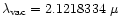
Echelle spectra in H2 1-0S(1) emission (
 m; Bragg et al. 1982) were obtained on 24
December 1999 (UT) at the UK Infrared Telescope (UKIRT) using
the facility spectrometer CGS4. The instrument is equipped with a
256
m; Bragg et al. 1982) were obtained on 24
December 1999 (UT) at the UK Infrared Telescope (UKIRT) using
the facility spectrometer CGS4. The instrument is equipped with a
256 256 pixel InSb array; the pixel scale is 0
 41
0
90 (0
41 in the dispersion direction). A
1-pixel-wide slit was used, resulting in a velocity resolution of
41
0
90 (0
41 in the dispersion direction). A
1-pixel-wide slit was used, resulting in a velocity resolution of
 8 kms-1 (although over-sampled spectra were obtained by
physically shifting the array by 1/2 pixel, so that two detector
positions were observed per resolution element). The instrumental
profile in the dispersion direction, measured from Gaussian fits to
sky lines, was 11.3 (
8 kms-1 (although over-sampled spectra were obtained by
physically shifting the array by 1/2 pixel, so that two detector
positions were observed per resolution element). The instrumental
profile in the dispersion direction, measured from Gaussian fits to
sky lines, was 11.3 ( 1.5) kms-1 . Data at ten parallel, adjacent
slit positions were obtained, the offset between each slit measuring
0.4
1.5) kms-1 . Data at ten parallel, adjacent
slit positions were obtained, the offset between each slit measuring
0.4
 (equivalent to the slit width). The slits were orientated
at a position angle (PA) roughly parallel with the HH111 jet
axis. The CGS4 image rotator was set to 97,
the nominal jet axis
PA (e.g. Reipurth et al. 1997b). However, we found a clear discrepancy
(of 7)
between each slit and the jet axis (noted in
Fig. 1 and evident in Fig. 2), which suggests a possible error in the
slit angle calibration. All of the knots were in any case included
in our 10 slit positions.
Object-sky-sky-object sequences were repeated a number of times
at each slit location to build up signal-to-noise, the sky position
being 10
to the north of the jet axis. Each spectral image
was bias subtracted and flat-fielded. Sky-subtracted object frames
were then co-added into reduced "groups'' (one group frame per slit
position). Each reduced group spectral image was subsequently
wavelength calibrated using the four adjacent OH sky lines that are
present in each raw image (Olivia & Origlia 1992; Davis et al. 2001);
the first "raw object frame'' observed at each slit location (the
first frame in each group) was used as a reference frame in each case.
(equivalent to the slit width). The slits were orientated
at a position angle (PA) roughly parallel with the HH111 jet
axis. The CGS4 image rotator was set to 97,
the nominal jet axis
PA (e.g. Reipurth et al. 1997b). However, we found a clear discrepancy
(of 7)
between each slit and the jet axis (noted in
Fig. 1 and evident in Fig. 2), which suggests a possible error in the
slit angle calibration. All of the knots were in any case included
in our 10 slit positions.
Object-sky-sky-object sequences were repeated a number of times
at each slit location to build up signal-to-noise, the sky position
being 10
to the north of the jet axis. Each spectral image
was bias subtracted and flat-fielded. Sky-subtracted object frames
were then co-added into reduced "groups'' (one group frame per slit
position). Each reduced group spectral image was subsequently
wavelength calibrated using the four adjacent OH sky lines that are
present in each raw image (Olivia & Origlia 1992; Davis et al. 2001);
the first "raw object frame'' observed at each slit location (the
first frame in each group) was used as a reference frame in each case.
The IRAF tasks used to wavelength calibrate the data (IDENTIFY,
RE-IDENTIFY, FITCOORDS and TRANSFORM), also correct for
distortion along the columns in each image (i.e. along arc or sky
lines), via a 3rd-order fit in two dimensions. The relative velocity
calibration across each spectral image, measured from Gaussian fits to
sky lines in "velocity-calibrated and distortion-corrected'' raw
frames, is estimated to be accurate to  4 kms-1. Instrument
flexure over the duration of the observations could, however,
introduce additional uncertainties in the absolute velocity
calibration, i.e. by shifting the individual frames with respect to
the wavelength reference used to calibrate the reduced group spectral
image. By comparing the positions of sky lines in a number of raw
frames we found that this effect was small; indeed, the narrowness of
the H2 emission features observed at some locations in the final,
reduced data (as compared to the instrumental profile width, which is
measured from just one frame), confirms this finding. Nevertheless,
flexure could still result in an additional broadening of H2 lines
and a shift in the line centre by a few km s-1. We therefore
conclude that the overall velocity calibration is accurate to
better than 10 kms-1, while perceived velocity shifts between adjacent
spectra observed along the same slit will be considerably more
accurate, to within 1 kms-1.
A and G-type bright standards were also observed with the
same instrument configuration. These indicate that there are no
measurable telluric absorption lines in this narrow wavelength regime
that might distort the observed profile shapes.
4 kms-1. Instrument
flexure over the duration of the observations could, however,
introduce additional uncertainties in the absolute velocity
calibration, i.e. by shifting the individual frames with respect to
the wavelength reference used to calibrate the reduced group spectral
image. By comparing the positions of sky lines in a number of raw
frames we found that this effect was small; indeed, the narrowness of
the H2 emission features observed at some locations in the final,
reduced data (as compared to the instrumental profile width, which is
measured from just one frame), confirms this finding. Nevertheless,
flexure could still result in an additional broadening of H2 lines
and a shift in the line centre by a few km s-1. We therefore
conclude that the overall velocity calibration is accurate to
better than 10 kms-1, while perceived velocity shifts between adjacent
spectra observed along the same slit will be considerably more
accurate, to within 1 kms-1.
A and G-type bright standards were also observed with the
same instrument configuration. These indicate that there are no
measurable telluric absorption lines in this narrow wavelength regime
that might distort the observed profile shapes.
![\begin{figure}
\par\includegraphics[width=8.4cm,clip]{MS1608f1.eps}
\end{figure}](/articles/aa/full/2001/37/aa1608/Timg21.gif) |
Figure 1:
The spectral image on the left a) is the average of
all ten spectra (slit positions) observed; it therefore effectively
represents the integrated emission from a 4
-wide slit
(illustrated in b) by the box). For comparison, a narrow-band
H2 2.12  m (+ continuum) image of the section of the jet
observed is presented in b, scaled to the same spatial scale (see Coppin
et al. 1998 for details of the image). Some HH knots are labelled. The
contours in the P-V plot start at 3
the standard deviation, m (+ continuum) image of the section of the jet
observed is presented in b, scaled to the same spatial scale (see Coppin
et al. 1998 for details of the image). Some HH knots are labelled. The
contours in the P-V plot start at 3
the standard deviation,
 ,
to the mean background and increase in steps of
4.
The countours in the H2 image at right measure
4,
8
(black), 12,
16... etc. (white). ,
to the mean background and increase in steps of
4.
The countours in the H2 image at right measure
4,
8
(black), 12,
16... etc. (white). |
| Open with DEXTER |
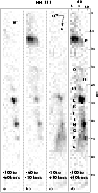 |
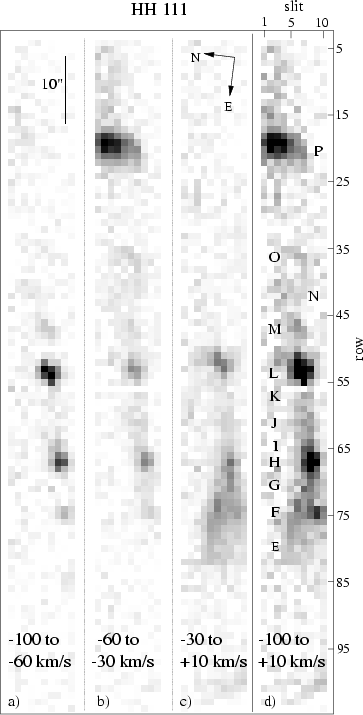
Figure 2:
Channel maps showing the distribution of high a), intermediate
b), and low c) velocity H2 emission in HH111 (LSR velocity
ranges are indicated). The right-hand image d) is the addition
of the other three images and thus represents an image of
integrated H2 in the section of the jet observed. Note that
the pixel scale is 0.9
(along the slit) by 0.4
perpendicular to the slit (the slitwidth). Thus, the aspect
ratio of each image is 4:9 (horizontal:vertical) and the
scale-bar is only applicable to the vertical axis. The positions
of the discrete optical HH knots resolved by HST (Reipurth
et al. 1997b) are labelled. |
| Open with DEXTER |
H2 spectra were obtained at 10 adjacent/parallel slit positions
across HH111. The spacing between slits was 0.4
.
Thus, an
area 4
wide (and about 90
long) was observed. The
spectral images from each slit position have been added to give the
position-velocity (P-V) plot in Fig.1. The velocity scale in this
plot, and in all subsequent figures, is Local Standard of Rest (LSR);
the systemic velocity of the source, derived from (sub)mm observations
of the source region in optically-thin CO isotopes, is +8.5 kms-1 (Cernicharo & Reipurth 1996). On the narrow-band H2 image shown in
Fig. 1 (adapted from the data of Coppin et al. 1998) we also
indicate the section of the blue-shifted HH111 jet lobe observed.
Strong emission was detected from knots P, L, H and F. The H2 peak
towards knot P in the averaged spectral image (Fig. 1a) is symmetric
and very narrow (full-width half maximum [FWHM]
20 kms-1),
though it is blue-shifted to
 kms-1. Nearer the
source, the H2 profiles broaden dramatically; towards knots L and H
the full-width zero intensity (FWZI - measured between points on the
spectrum where the flux reaches the
kms-1. Nearer the
source, the H2 profiles broaden dramatically; towards knots L and H
the full-width zero intensity (FWZI - measured between points on the
spectrum where the flux reaches the  background noise
level) of extracted spectra measure 110 kms-1 and 90 kms-1. These profiles are double-peaked, with no emission detected at
intermediate velocities (i.e. at the same velocity as knot P). The
profile associated with the fan-shaped HH knot F peaks at only
background noise
level) of extracted spectra measure 110 kms-1 and 90 kms-1. These profiles are double-peaked, with no emission detected at
intermediate velocities (i.e. at the same velocity as knot P). The
profile associated with the fan-shaped HH knot F peaks at only
 -10 kms-1, though it also extends out to blue-shifted
velocities of -100 kms-1. Further downwind, between knots L and P, the very faint H2 emission detected at the
-10 kms-1, though it also extends out to blue-shifted
velocities of -100 kms-1. Further downwind, between knots L and P, the very faint H2 emission detected at the
 level indicates a steady "narrowing'' of profile widths along the jet
axis.
level indicates a steady "narrowing'' of profile widths along the jet
axis.
Channel maps constructed from the H2 echelle data are presented in
Fig. 2. In Fig. 2d we also show an "image'' of HH111 constructed
from the 10 spectral images (each was collapsed into a 1-D image
strip; the 10 columns thus represent the integrated signal from each
adjacent slit). The positions of discrete optical knots or bow
shocks, resolved by HST (Reipurth et al. 1997b) are also marked
in Fig. 2d. Here one can clearly see that, at the highest radial
velocities, only knots L, H and the compact peak associated with knot F are detected. The more extended "wings'' of knot F (which are resolved into a separate broad bow, knot E, in optical HST
images; Reipurth et al. 1997b) are evident at lower radial velocities
(Fig. 2c). Note also that knot P is, again, only detected at
intermediate velocities (between -60 kms-1 and -30 kms-1; Fig. 2b).
The overall kinematic picture described above is very similar to that
derived from high-dispersion optical spectrocopy, obtained at a
similar spatial and spectral resolution (though only with a single,
2
wide slit; Reipurth et al. 1997b). The optical and near-IR
observations exhibit three common properties: 1) the velocity
dispersion steadily increases between knot P and the knots closer to
the source (knot F and knot E), 2) towards knot P emission lines are
single-peaked and blue-shifted to intermediate velocities (
kms-1 in H2, [SII] and H ), while further
upwind around F and E the profiles become double-peaked, the peaks
straddling the radial velocity seen in knot P, and 3) the broadest
profiles are observed towards the bright knot L (where the Hlines reach almost 200 kms-1 FWZI; the widths of the H2 lines will
be limited by molecular dissociation).
), while further
upwind around F and E the profiles become double-peaked, the peaks
straddling the radial velocity seen in knot P, and 3) the broadest
profiles are observed towards the bright knot L (where the Hlines reach almost 200 kms-1 FWZI; the widths of the H2 lines will
be limited by molecular dissociation).
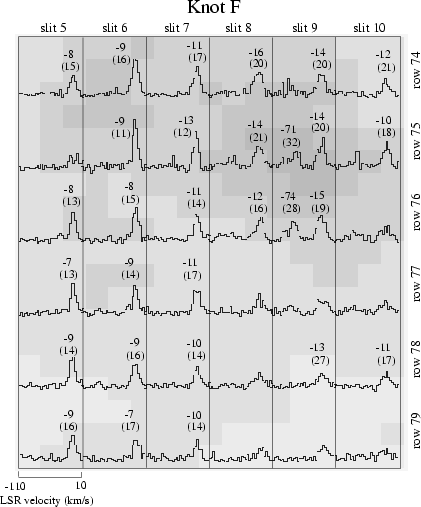
Figures 1 and 2 illustrate the global velocity structure across
HH111. In Figs. 3-6 we show the line profiles observed across the
brightest knots, P, L, H and F, in more detail. Each spectrum,
identified by its slit number and row number, corresponds to a given
pixel in the image in Fig. 2d.
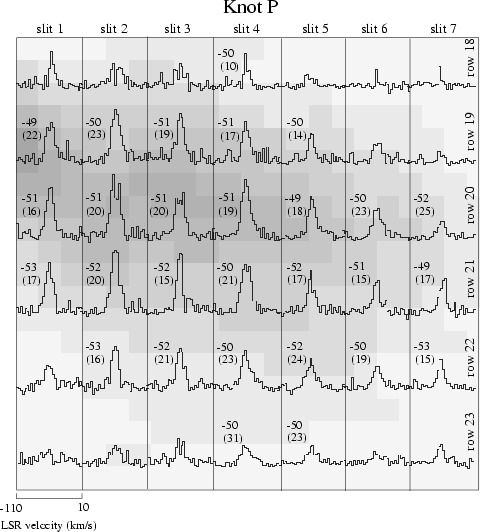
 |
Figure 3:
H2 profiles across knot P, extracted from 7 adjacent
slit positions (see Fig.2d). Each spectrum covers an area of
0.4
0.9
.
The spectra are
superimposed onto a greyscale image of Knot P. North and east are
orientated in the same sense as in Figs. 1 and 2,
i.e. (approximately) to the left and downwards respectively. The
HH111 flow direction is upwards in this and all other figures.
The numbers next
to each spectrum are the mean and FWHM from Gaussian fits to each
line. |
| Open with DEXTER |
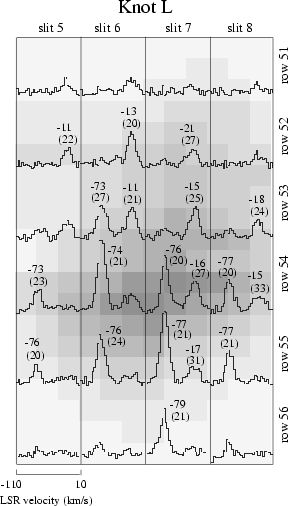
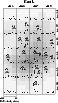 |
Figure 4:
H2 profiles across knot L, presented in the same way
as for knot P (see Fig. 3 for details). The numbers next to each spectrum
are the mean and FWHM from Gaussian fits to each line; where
two well-separated components are observed, two Gaussian fits were
applied. |
| Open with DEXTER |
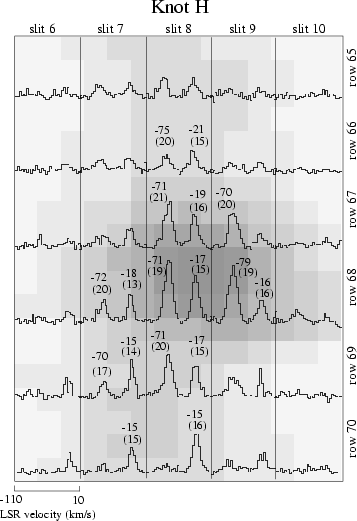
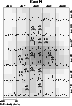 |
Figure 5:
H2 profiles across knot H, presented in the same way
as for knot P (see Fig. 3 for details).
The mean and FWHM from Gaussian fits to each component are noted. |
| Open with DEXTER |
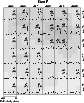 |
Figure 6:
H2 profiles across knot F, presented in the same way
as for knot P (see Fig. 3 for details).
The mean and FWHM from Gaussian fits to each component are noted. |
| Open with DEXTER |
Beside each spectrum in Figs. 3-6 we mark the peak LSR velocity and
FWHM line width (in brackets) measured from Gaussian fits to the
line. Fits were made to the entire profile in each spectrum (i.e. from
the "zero-counts'' baseline on either side of the emission line),
regardless of any slight asymmetries that might be present.
Generally, most lines are in fact "symmetric'' and close to Gaussian
in shape, so errors from the fitting are rather small, of the order of
a few kms-1. As mentioned in Sect. 2, absolute velocity measurements
are likely to be accurate to only about 5-10 kms-1. However, errors due
to distortion of the profiles along the slit are much smaller, and
will be negligeable compared to the errors associated with the
Gaussian fitting. Thus, any perceived change in peak velocity or
FWHM between adjacent spectra in Figs. 3-6 is expected to be real. In
cases where two velocity components are clearly present, two Gaussians
were fitted to the data and so two sets of measured values are
included in the plot.
Below we consider the kinematic properties of each knot separately.
In optical HST observations of the jet (Reipurth et al. 1997b)
knot P appears as a well-defined, conical (almost triangular) bow
shock with a diameter in the bow flanks approaching 10
.
It is situated a few arseconds to the south-east of an unrelated field
star (Fig. 1). The limb-brightened tips of the bow wings are
detected in H2 emission above and below the jet axis (Coppin et al. 1998), although this emission is too far off-axis to be observed
in these echelle data.
One might expect the H2 profile shapes to be dictated by the
geometry of the HH111P bow. The profiles in Fig. 3 are, however,
all clearly symmetric and single-peaked, with very little evidence for
extended line-wing emission (with the possible exception of spectra in
slit 4, rows 22 and 23 which have a weak red-shifted wing). Over much
of knot P the profiles are centred at
kms-1 and
are typically 20 kms-1 wide FWHM. We see no evidence for a change in
line width or line peak velocity as we move from the leading edge
upwind through the bow shock (i.e. down slit 4 in Fig. 3) or across
the width of the bow (from left to right in Fig. 3). Instead, the
radial velocity is remarkably constant, given that this extended
bow-shaped HH object is spatially resolved in these observations.
Like knot P, knots L and E (E is merged with knot F in our H2 image
and echelle spectroscopy) appear bow shock shaped in the optical HST images of Reipurth et al. (1997), although both are only about
3
in diameter. Between L and E there are half-a-dozen other,
more compact knots, the brightest in both optical and H2 emission
lines being knot H. All of these knots exhibit curved or bow-shaped
morphologies in the HST images and so, again, we would expect
line-emission profile shapes to be dictated by bow shock geometry.
Across knot L (Fig. 4) we observe radically changing H2 line
profiles. The two velocity components observed across this feature
peak at
 kms-1 and -15 kms-1; the
components are of the order of 20-30 kms-1 wide FWHM throughout. Yet
the relative intensities of these two components change across knot L,
the high-velocity component (HVC) becoming stronger relative to the
low-velocity component (LVC) towards the rear (eastward side) of the
emission peak; at the leading edge of knot L (rows 51 and 52 in
Fig. 4) the LVC clearly dominates. We also find that both components
become slightly more blueshifted - by a few kms-1 - as we again move
eastward (upwind) across the knot. Note that this trend is
particularly evident in the HVC where the line peaks are strong; the
velocity calibration of each spectrum relative to its neighbour along
each slit is known to be very good, certainly less than 1 kms-1 (see
Sect. 2); the accuracy of the Gaussian fitting used to measure the
velocities is also high, of the order of 1-2 kms-1. The peak velocity
increase in the HVC towards the rear of knot L is therefore thought to
be real. Indeed, this trend continues downwind and across knot M: the
six spectra observed in M (at a 5
level or higher; not shown
here) peak between -69 and -72 kms-1, i.e. they are less blue-shifted
than in Knot L. No LVC is observed in knot M (Fig. 2).
kms-1 and -15 kms-1; the
components are of the order of 20-30 kms-1 wide FWHM throughout. Yet
the relative intensities of these two components change across knot L,
the high-velocity component (HVC) becoming stronger relative to the
low-velocity component (LVC) towards the rear (eastward side) of the
emission peak; at the leading edge of knot L (rows 51 and 52 in
Fig. 4) the LVC clearly dominates. We also find that both components
become slightly more blueshifted - by a few kms-1 - as we again move
eastward (upwind) across the knot. Note that this trend is
particularly evident in the HVC where the line peaks are strong; the
velocity calibration of each spectrum relative to its neighbour along
each slit is known to be very good, certainly less than 1 kms-1 (see
Sect. 2); the accuracy of the Gaussian fitting used to measure the
velocities is also high, of the order of 1-2 kms-1. The peak velocity
increase in the HVC towards the rear of knot L is therefore thought to
be real. Indeed, this trend continues downwind and across knot M: the
six spectra observed in M (at a 5
level or higher; not shown
here) peak between -69 and -72 kms-1, i.e. they are less blue-shifted
than in Knot L. No LVC is observed in knot M (Fig. 2).
The spectra from knot H are again double-peaked (Fig. 5). The HVC
and LVC peak velocities are within a few kms-1 of
 kms-1 and
 kms-1 respectively; component profile widths
are again of the order of 15-20 kms-1 (FWHM). In knot H the
relative intensities of the LVCs and HVCs change in a similar fashion
to those across knot L, although the effect is less dramatic.
kms-1 respectively; component profile widths
are again of the order of 15-20 kms-1 (FWHM). In knot H the
relative intensities of the LVCs and HVCs change in a similar fashion
to those across knot L, although the effect is less dramatic.
Low- and high-velocity components are also observed in knot F
(Fig. 6), although the HVC is weak in relation to the LVC and is
confined to the emission peak. Knot F is notable for having extended
wings that are bright in H2 emission (see Fig. 1). The line
profiles across these wings are consistently very narrow, no wider in
fact than the instrumental broadening. Moreover, the line profiles
peak at between -8 kms-1and -11 kms-1, increasing to -14 to -16 kms-1 near the leading edge (and emission peak) in this knot. Note,
however, that the H2 emission in the region shown in Fig. 6
derives from at least two bow shocks, knot F and the more extended bow
knot E (Reipurth et al. 1997b). The narrow, low-velocity component in
row 77-79 therefore likely derives from the oblique wings of bow shock E.
The two velocity components evident in the H2 observations of knots F to L are relatively unique among protostellar flows. Given
sufficient spectral resolution, asymmetric and double-peaked profiles
have been detected in the wakes of some molecular bow shocks
(e.g. Davis & Smith 1996; Yu et al. 2000; Davis et al. 2000, 2001),
although this is not the case for all bow shocks (Davis et al. 1996; Tedds et al. 1999). Double-peaked H2 profiles
should be a natural result of the hollow shell-like morphology of
molecular bows, even if the bow is unresolved (e.g. Hartigan et al. 1987; Völker et al. 1999; Tedds et al. 1999), since the
near and far sides of the bow shock shell, seen in projection, will
deflect material in opposite directions. The difference between the
maximum and minimum velocities measured in the wings of the overall
profile are then equivalent to the velocity of the bow shock with
respect to the pre-shock medium (Hartigan et al. 1987). In the case
of H2 profiles, the maximum extent of the lines will, however, be
limited to roughly twice the dissociation speed limit ( )
of H2 (Smith & Brand 1990; Davis et al. 2000).
)
of H2 (Smith & Brand 1990; Davis et al. 2000).
J-type bow shocks should not produce extremely wide H2 profiles,
since without ambipolar diffusion and hence magnetic "cushioning'' of
the approaching shock front H2 will be dissociated for shock speeds
above 20-25 kms-1 (Kwan 1977; Smith 1994). The full extent of observed
profiles should thus be limited to
 kms-1. Only for
highly-magnetised C-shocks could
kms-1. Only for
highly-magnetised C-shocks could
 exceed 80-100 kms-1 (Smith
& Brand 1990; Smith 1994).
exceed 80-100 kms-1 (Smith
& Brand 1990; Smith 1994).
Here we investigate whether a simple, geometrical, bow shock model can
explain the overall H2 profile widths observed in HH111 as well
as the velocity separation between the LVCs and HVCs in the
knots nearest the source. The model is applied specifically to
HH111, although more general results are given in the Appendix. We
assume that the two velocity components observed in HH111 are
excited in the near and far sides of a hollow, bow shock shell
(illustrated in Fig. 7). The bow moves along the jet axis at speed
 (measured with respect to the stationary driving source
- in this case, VLA1). The bow and jet are surrounded by a
"cocoon'' of slow-moving, low-density material. The cocoon is itself
bounded by a shell of dense, swept-up gas which separates the cocoon
from the ambient medium. The cocoon has presumably been swept out by
a bow shock further down-stream, and so the cocoon gas is assumed to
be moving parallel with the jet axis at speed
(measured with respect to the stationary driving source
- in this case, VLA1). The bow and jet are surrounded by a
"cocoon'' of slow-moving, low-density material. The cocoon is itself
bounded by a shell of dense, swept-up gas which separates the cocoon
from the ambient medium. The cocoon has presumably been swept out by
a bow shock further down-stream, and so the cocoon gas is assumed to
be moving parallel with the jet axis at speed
 .
Note
that numerical bow models do often produce this cocoon plus dense
shell scenario (Raga et al. 1995; Völker et al. 1999; Downes & Ray
1999). Moreover, a coaxial, hollow, molecular shell has already
been observed around the inner jet section in CO maps of HH111 (Lee
et al. 2000).
.
Note
that numerical bow models do often produce this cocoon plus dense
shell scenario (Raga et al. 1995; Völker et al. 1999; Downes & Ray
1999). Moreover, a coaxial, hollow, molecular shell has already
been observed around the inner jet section in CO maps of HH111 (Lee
et al. 2000).
 |
Figure 7:
Schematic diagram of a simple bow-shock model. The
diagram in the box is a blow-up of one region on the bow surface,
defined by the angle . |
| Open with DEXTER |
![\begin{figure}
\par\includegraphics[angle=-90,width=18cm]{MS1608f8.eps}
\end{figure}](/articles/aa/full/2001/37/aa1608/Timg39.gif) |
Figure 8:
Plots showing how the observed radial velocity of gas
excited in the bow shock wings varies with angle,
(see text
for details). Graphs a) and b) give the radial velocities
predicted from gas excited in the near and far sides of the hollow
bow shock shell. Positive velocities are red-shifted with respect
to the observer, negative velocities blue-shifted. In c) we show
the resulting velocity dispersion when the near and far sides of the
bow are seen in projection. In a- c) curves for different
values of
(indicated next to each curve) are
plotted. Throughout we adopt a bow shock velocity
 kms-1 and a jet inclination angle of kms-1 and a jet inclination angle of  .
Note that
all velocities in a) and b) are with respect to the outflow source
which in the model is assumed to be stationary with respect to the
observer. In HH111 the LSR velocity of VLA1 is +8.5 kms-1and so
observed radial velocities should be blue-shifted (reduced) by this
amount. .
Note that
all velocities in a) and b) are with respect to the outflow source
which in the model is assumed to be stationary with respect to the
observer. In HH111 the LSR velocity of VLA1 is +8.5 kms-1and so
observed radial velocities should be blue-shifted (reduced) by this
amount. |
| Open with DEXTER |
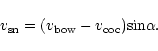
In the oblique bow shock wings the angle between the jet axis and the
tangent to the shock surface, ,
is small. The normal component
of the shock velocity,
 will also be small here.
Specifically,
will also be small here.
Specifically,
 |
(1) |
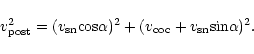
The velocity of the post-shock gas (
 )
at a
given position in the bow wings (defined by the angle )
is
then given by
)
at a
given position in the bow wings (defined by the angle )
is
then given by
 |
(2) |
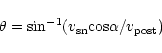
The angle of this velocity vector with respect to the jet axis,
 ,
is given by
,
is given by
 |
(3) |
and hence, the observed radial component of the velocity of the
post-shock gas (along the line of sight) is given by:
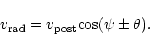 |
(4) |
Here  is the inclination angle of the jet axis with respect
to the line of sight; in the case of HH111 this is known to be about
80
(Reipurth et al. 1992). The angle
is the inclination angle of the jet axis with respect
to the line of sight; in the case of HH111 this is known to be about
80
(Reipurth et al. 1992). The angle
 is
specific to emission from the far side of the bow shock surface (the
edge furthest from the observer), while
is
specific to emission from the far side of the bow shock surface (the
edge furthest from the observer), while
 is used for
the same position on the near side of the bow surface (the point
where the tangent to the shock surface subtends the same angle
with respect to the jet axis).
is used for
the same position on the near side of the bow surface (the point
where the tangent to the shock surface subtends the same angle
with respect to the jet axis).
The front and rear sides of the bow shock shell will produce two
velocity components and so potentially two line-emission peaks when
seen in projection. A range of velocities will contribute to these
two components because of the curvature of the two shock surfaces; the
observed line components may therefore be quite broad. The highest
velocities will occur near the bow head where
is largest.
However, for bright (observable) H2 emission
will be
limited to regions in the bow flanks where the shock speed normal to
the bow surface does not exceed the H2 dissociation speed limit,
(Smith 1994). This maximum angle,
 ,
is
given by:
,
is
given by:
![\begin{displaymath}\alpha_{\rm d} = {\rm sin}^{-1}( v_{\rm d}/
\left[ v_{\rm bow} - v_{\rm coc} \right] )
\end{displaymath}](/articles/aa/full/2001/37/aa1608/img50.gif) |
(5) |
where
is a speed above which H2 is destroyed.
is of course dependent on the "type'' of shock observed, in other
words, whether J- or C-type (Draine et al. 1983; Draine &
McKee 1993). In the extreme case of a low ionisation fraction, a
strong magnetic field, and so a high Alfvén speed in the pre-shock
gas (a C-type shock),
 kms-1; in a J-type shock,
will be at best half this value (Kwan 1977; Smith 1994).
kms-1; in a J-type shock,
will be at best half this value (Kwan 1977; Smith 1994).
How, then, does the model compare with our observations of the HH111
jet? For HH111 we already know a number of model parameters. We
have, from published optical and near-IR proper motion measurements, a
good idea of what
is, since tangential LSR velocities of
the order of 300 kms-1 have been measured (although the uncertainties
are high, typically 25-50%; Reipurth et al. 1992; Coppin et al. 1998). We also know the inclination angle of the flow with
respect to the line-of-sight, .
Since
 ,
we
adopt a "typical'' bow shock velocity (along the jet axis with
respect to the source which, in our model, is in the rest frame) of
kms-1. As mentioned above, the range of values of
for which H2 is excited into emission is also limited: in
the case of a C-shock (with
kms-1), for
,
we
adopt a "typical'' bow shock velocity (along the jet axis with
respect to the source which, in our model, is in the rest frame) of
kms-1. As mentioned above, the range of values of
for which H2 is excited into emission is also limited: in
the case of a C-shock (with
kms-1), for
 kms-1,
 (Eq. (5)); for
faster pre-shock gas, e.g.
(Eq. (5)); for
faster pre-shock gas, e.g.
 kms-1,
 .
We therefore limit our model to values of less than
,
although note that if the difference
between
and
is less than ,
H2 will be excited into emission across the entire bow surface.
.
We therefore limit our model to values of less than
,
although note that if the difference
between
and
is less than ,
H2 will be excited into emission across the entire bow surface.
We use the model to predict the range of velocities one should observe
from the front and rear sides of each bow shock shell in HH111. The
curves in Fig. 8 show how the radial velocity of shocked H2 varies
with angle ;
the extent of each curve therefore covers the
range of velocities predicted. Separate curves are plotted for
different values of
;
is fixed for all
curves at 300 kms-1. The range of
plotted applies to the
extended bow wings, where
is small; each curve is only drawn
between
 and
and
 ,
as defined by Eq. (5) for the five values of
considered (we assume C-type shock excitation and use
,
as defined by Eq. (5) for the five values of
considered (we assume C-type shock excitation and use
 kms-1). We also plot (in Fig. 8c) the difference between the radial velocities of the gas in the near and
far sides of the bow. This difference is only approximately
equal to the observed velocity dispersion, since we assume
is
the same for the near and far sides of the bow seen in projection.
This will only be the case for large inclination angles (i.e. for a
jet near the plane of the sky), or if the bow shock - or the region
of the bow where
changes rapidly (near the bow cap) - is
unresolved. In either case, the observed velocity dispersion will be
dictated by the maximum value of
included in the telescope
beam.
is known to be 80
for HH111, and the bow
shocks are observed to be small in optical HST images, only a
few times larger than our CGS4 pixels, so the plot in Fig. 8c is
probably applicable to our HH111 spectra. A more accurate plot of
observed velocity dispersion would require a more sophisticated model
involving a pre-defined bow-shock shape.
kms-1). We also plot (in Fig. 8c) the difference between the radial velocities of the gas in the near and
far sides of the bow. This difference is only approximately
equal to the observed velocity dispersion, since we assume
is
the same for the near and far sides of the bow seen in projection.
This will only be the case for large inclination angles (i.e. for a
jet near the plane of the sky), or if the bow shock - or the region
of the bow where
changes rapidly (near the bow cap) - is
unresolved. In either case, the observed velocity dispersion will be
dictated by the maximum value of
included in the telescope
beam.
is known to be 80
for HH111, and the bow
shocks are observed to be small in optical HST images, only a
few times larger than our CGS4 pixels, so the plot in Fig. 8c is
probably applicable to our HH111 spectra. A more accurate plot of
observed velocity dispersion would require a more sophisticated model
involving a pre-defined bow-shock shape.
At low values of
(in the extended wings of the bow shock) the
shock has little effect on the velocity of the cocoon gas and so the
observed radial velocities are close to the radial component of the
(preshock) cocoon velocity,
,
for each curve. As
increases (as we approach the bow cap), the near and far
sides of the bow increasingly deflect the cocoon gas in opposite
directions, thus yielding a higher overall velocity dispersion in
Fig. 8c; indeed, near the bow head the value for the velocity
dispersion will approach that of the overall bow shock velocity (the
difference between the bow and cocoon velocities). As was shown by
Hartigan et al. (1987), for an unresolved bow that emits over its
entire surface (i.e. where all values of
are observed), the
maximum velocity dispersion should be equivalent to the shock
velocity. We note here that in Fig. 8c the dispersion values
predicted by the model approach the difference between
and
(the bow shock velocity) for each curve plotted.
Lastly, we mention that the curves in Fig. 8b cross at a point where
 .
This results from the fact that, for
.
This results from the fact that, for
 ,
the higher shock velocities (lower values of
)
produce the more blue-shifted gas; for
,
the higher shock velocities (lower values of
)
produce the more blue-shifted gas; for
 ,
the radial velocities approach the velocity of the
line-of-sight component of
.
,
the radial velocities approach the velocity of the
line-of-sight component of
.
The model is of course limited. We do not consider what the minimum
values of
and the shock velocity (
 )
are that still induce observable H2 emission. Nor do we
take into account the effects turbulence and/or cooling will have on
the dynamics of the shocked H2; instead, we assume that, at a given
position on the bow surface, the post-shock gas is accelerated to the
full velocity of the normal component of the shock velocity. Also, we
have no knowledge of whether the density of the pre-shock "cocoon''
gas is high enough to produce the observed H2 flux.
Furthermore, we ignore the possible contribution of emission from a
"reverse shock'' or Mack disk.
)
are that still induce observable H2 emission. Nor do we
take into account the effects turbulence and/or cooling will have on
the dynamics of the shocked H2; instead, we assume that, at a given
position on the bow surface, the post-shock gas is accelerated to the
full velocity of the normal component of the shock velocity. Also, we
have no knowledge of whether the density of the pre-shock "cocoon''
gas is high enough to produce the observed H2 flux.
Furthermore, we ignore the possible contribution of emission from a
"reverse shock'' or Mack disk.
The model is also strictly two-dimensional. Towards the
limb-brightened edges of a real 3-D bow shock the shocked gas is
deflected in the plane of the sky, so the radial component of the
pre-shock velocity will not change as the gas passes through the
shock. One would expect to see narrow, single-peaked profiles along
the edges of a bow and only double-peaked lines along the central axis
and through the cap of the bow. The curves in Fig. 8 therefore
illustrate only the maximum range of velocities produced along
the jet axis by the near and far sides of the bow shock surface (seen
in projection). Here the greatest dispersion of radial velocities
will be produced. Indeed, in some cases (see Fig. 8 and also the
Appendix) the velocity dispersion described by the curves from the
near and far sides of the bow shell will not overlap; then, one would
expect to see separate peaks, as we do in HH111. The fact that we
do not see marked changes in profile shapes and velocities across the
width of HH111 is probably a result of the coarse velocity and
spatial scales of the echelle observations. Nevertheless, the model
does still constrain many of the bow shock parameters in the HH111
jet.
It is clear from Fig. 8 that because the bows observed along the axis
of the HH111 jet are travelling at high speed (they possess high
proper motions), then even in the oblique bow wings where
is
low, molecular material can be accelerated to relatively high speeds.
The peaks in the two-component profiles observed in HH111 knots L to F are separated by 50 kms-1. The observed radial LSR velocities
of the LVC and HVC gas are of the order of
 kms-1 and
 kms-1 respectively, which translate to
 kms-1 and
 kms-1 when we take into account the velocity of the
system (the VLA1 source) with respect to the observer. These two
components are about 30-40 kms-1 wide, however, so if the HVC and LVC
derive from the two sides of the same bow, then gas must be
accelerated to radial velocities of approximately -5 kms-1 to -45 kms-1 (the LVC) in the far side and -60 kms-1 to -100 kms-1 (the HVC) in the
near side. This is possible if the pre-shock gas is fast-moving
(
kms-1 when we take into account the velocity of the
system (the VLA1 source) with respect to the observer. These two
components are about 30-40 kms-1 wide, however, so if the HVC and LVC
derive from the two sides of the same bow, then gas must be
accelerated to radial velocities of approximately -5 kms-1 to -45 kms-1 (the LVC) in the far side and -60 kms-1 to -100 kms-1 (the HVC) in the
near side. This is possible if the pre-shock gas is fast-moving
(
 kms-1) and the bulk of the observed H2is excited in the section of the bow wings where lies in the
range 10-30
(see Figs. 8a, 8b). A slightly lower value
of
yields lower values for the HVC and LVC components,
resulting in more widely spaced peaks. And of course if H2 is
excited over more of the bow surface (over a wider range in ),
the dispersion of velocities associated with the HVC and LVC profiles
will increase until the discrete components observed in HH111 merge
to form a single, though double-peaked, profile. The HVCs and LVCs in
the HH111 bows are clearly well-separated (Figs. 4-6); the H2 emission must therefore be confined to the bow wings. Note also that,
because the HH111 flow axis is inclined towards the observer
(blue-shifted), the far side of each bow shock will be seen projected
slightly ahead of the near side. The far side produces the
low-velocity component (Fig. 8a); the symmetrically-located near side
the higher-velocity gas (Fig. 8b). Hence, the LVC should extend
slightly ahead of the HVC, precisely as is observed in knot L
(Fig. 4), as well as to a lesser extent in knot H (Fig. 5 - down
slit 8) and around the emission peak in knot F (Fig. 6 - slits 8 and 9).
kms-1) and the bulk of the observed H2is excited in the section of the bow wings where lies in the
range 10-30
(see Figs. 8a, 8b). A slightly lower value
of
yields lower values for the HVC and LVC components,
resulting in more widely spaced peaks. And of course if H2 is
excited over more of the bow surface (over a wider range in ),
the dispersion of velocities associated with the HVC and LVC profiles
will increase until the discrete components observed in HH111 merge
to form a single, though double-peaked, profile. The HVCs and LVCs in
the HH111 bows are clearly well-separated (Figs. 4-6); the H2 emission must therefore be confined to the bow wings. Note also that,
because the HH111 flow axis is inclined towards the observer
(blue-shifted), the far side of each bow shock will be seen projected
slightly ahead of the near side. The far side produces the
low-velocity component (Fig. 8a); the symmetrically-located near side
the higher-velocity gas (Fig. 8b). Hence, the LVC should extend
slightly ahead of the HVC, precisely as is observed in knot L
(Fig. 4), as well as to a lesser extent in knot H (Fig. 5 - down
slit 8) and around the emission peak in knot F (Fig. 6 - slits 8 and 9).
The lower-velocity, single-peaked profiles observed in the extended
wings of knots F and H may also be accounted for, since here will remain essentially constant across the region of each bow covered
by each spectrum. For
,
the emission from the near
and far sides of the bow will be accelerated to roughly the same low
radial velocities provided, as above,
is high (200-250 kms-1).
We can also explain the single-peaked profiles observed in knot P, where
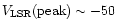 kms-1 and FWZI
 kms-1. We assume the same inclination angle and bow shock
velocity as for the other HH knots further upwind. Unlike the
single-peaked profiles from the extended wings of knots F and H,
however, the H2 profiles in knot P must predominantly derive from a
region near the bow head, since little or no H2 emission is
observed in the bow wings in knot P (Coppin et al. 1998). Our model
supports emission from a region near the bow cap if
kms-1. We assume the same inclination angle and bow shock
velocity as for the other HH knots further upwind. Unlike the
single-peaked profiles from the extended wings of knots F and H,
however, the H2 profiles in knot P must predominantly derive from a
region near the bow head, since little or no H2 emission is
observed in the bow wings in knot P (Coppin et al. 1998). Our model
supports emission from a region near the bow cap if
 (Fig. 8). A slightly higher value of
is then
needed (higher than used above for the upwind knots) to explain the
narrow, blue-shifted H2 profiles. Indeed, the differential
velocity between the bow and pre-shock ambient medium must be low to
facilitate the survival of H2 in the almost "face-on'' bow cap.
If
(Fig. 8). A slightly higher value of
is then
needed (higher than used above for the upwind knots) to explain the
narrow, blue-shifted H2 profiles. Indeed, the differential
velocity between the bow and pre-shock ambient medium must be low to
facilitate the survival of H2 in the almost "face-on'' bow cap.
If
 kms-1 radial velocities in the range -25 kms-1 to -75 kms-1 are predicted in Fig. 8, which is precisely the same
range of radial velocities as is observed (when corrected for the LSR
velocity of the source) across knot P.
kms-1 radial velocities in the range -25 kms-1 to -75 kms-1 are predicted in Fig. 8, which is precisely the same
range of radial velocities as is observed (when corrected for the LSR
velocity of the source) across knot P.
Finally, can we distinguish between J or C-type shock excitation? The
curves drawn in Fig.8 are limited to values of
in the range 0 to
,
where in each case a C-type shock speed limit is used to calculate
.
The effects of using a lower
H2 dissociation speed limit are illustrated in the Appendix: here
we see that because H2 excitation is limited to lower values of ,
lower radial velocities are predicted. In most of the
HH111 bow shocks, however, higher values of
are needed to
produce the high radial velocities observed and particularly the
highest velocities in profile line wings. A C-type excitation
mechanism is therefore preferred.
CO observations of the HH111 jet reveal a two-component molecular
outflow. Higher-resolution, interferometric maps show a symmetric,
conical cavity of low-velocity (<10 kms-1) gas that is co-axial
with the HH jet (Nagar et al. 1997; Lee et al. 2000). The radius of
the cavity increases from about 7
near knot F to
12
at knot P. The bulk of the molecular material in
this limb-brightened cavity is situated within 30
-40
of the VLA1 source; over most of this region the HH jet is very faint or
undetected at optical wavelengths. This region presumably represents
the dense core that still obscures the central outflow source.
However, between HH knots F and P a fainter spur is observed which may
represent material swept up by the relatively expansive bow shock P,
which is of course seen at optical and near-IR wavelengths (Reipurth
et al. 1997b; Coppin et al. 1998).
Sensitive, single-dish (sub)mm maps reveal, on the other hand, a chain
of warm, high-velocity bullets that lie along the jet axis (Cernicharo
& Reipurth 1996; Hatchell et al. 1999). Six compact bullets have
been discovered, the first located a few arcseconds ahead of knot P,
with the rest randomly situated further downwind. The radial LSR
velocities of the bullets are between -20 kms-1 and -80 kms-1, this
velocity range is similar to the radial velocities measured for the H2 bow shocks observed nearer the source. It seems likely that the
bullets and HH jet are closely related. The bullet masses typically
measure 10-3
 .
Such high masses can only be explained if
the bullets represent either discrete clumps ejected from the central
engine (Cernicharo & Reipurth 1996) or jet material swept up along
much of the path length travelled by each bullet (Hatchell et al. 1999).
.
Such high masses can only be explained if
the bullets represent either discrete clumps ejected from the central
engine (Cernicharo & Reipurth 1996) or jet material swept up along
much of the path length travelled by each bullet (Hatchell et al. 1999).
If the molecular bullets do represent swept-up ambient gas, then it is
likely that they are swept up by molecular shocks similar to those
observed in H2 throughout the flow. An estimate of the mass of hot
H2 associated with each HH bow shock can be made from the
integrated H2 flux (e.g. Davis et al. 2000): for a typical
integrated H2 1-0S(1) flux of 2.0
 Wm-2 for
HH111 (Gredel & Reipurth 1993), then we calculate a mass for the
hot (radiating) H2 associated with each bow,
Wm-2 for
HH111 (Gredel & Reipurth 1993), then we calculate a mass for the
hot (radiating) H2 associated with each bow,
 ,
of
roughly 2
,
of
roughly 2
 .
This compares to a typical bullet
mass,
.
This compares to a typical bullet
mass,
 (Hatchell et al. 1999). However, the former represents only the mass of gas in the
post-shock cooling zone. H2 cooling times of the order of a few
years have been inferred from observations of this and other
H2 flows (Coppin et al. 1998; Micono et al. 1998; Chrysostomou et al. 2000). The mass of each CO bullet is derived from observations
of much colder gas that has been accumulated over a much longer time
scale (possibly a large fraction of the dynamical age of the
entire outflow). Consequently we must compare the mass accumulation
rates from the two sets of observations. In other words, the rate at
which H2 passes through a molecular bow and cools should be
comparable to the mass accumulation rate in the CO bullets. We can
write this equality in terms of the H2 cooling distance,
(Hatchell et al. 1999). However, the former represents only the mass of gas in the
post-shock cooling zone. H2 cooling times of the order of a few
years have been inferred from observations of this and other
H2 flows (Coppin et al. 1998; Micono et al. 1998; Chrysostomou et al. 2000). The mass of each CO bullet is derived from observations
of much colder gas that has been accumulated over a much longer time
scale (possibly a large fraction of the dynamical age of the
entire outflow). Consequently we must compare the mass accumulation
rates from the two sets of observations. In other words, the rate at
which H2 passes through a molecular bow and cools should be
comparable to the mass accumulation rate in the CO bullets. We can
write this equality in terms of the H2 cooling distance,
 and the CO bullet accumulation size scale,
 :
:
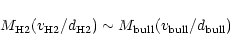 |
(6) |
where
 and
and
 ,
the velocities of the entrained
gas in the H2 bows and CO bullets, are assumed to be equal
(provided cooling has little effect on the latter). The mass ratio,
,
the velocities of the entrained
gas in the H2 bows and CO bullets, are assumed to be equal
(provided cooling has little effect on the latter). The mass ratio,
 ,
should then be comparable to
,
should then be comparable to
 .
Given that
.
Given that
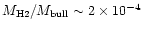 and that
will be roughly equal to the distance
between the CO bullets (50
or 3.4
and that
will be roughly equal to the distance
between the CO bullets (50
or 3.4
 m),
then the inferred H2 cooling length is very small, of the order of
1012 m. Indeed, this may well be an upper limit, since it
is unlikely that
m),
then the inferred H2 cooling length is very small, of the order of
1012 m. Indeed, this may well be an upper limit, since it
is unlikely that
 will be overestimated; optical depth
effects will have the opposite effect, so the ratio
,
and the value of
will be overestimated; optical depth
effects will have the opposite effect, so the ratio
,
and the value of
 ,
could be even lower
(extinction affects are not likely to effect our H2 mass estimate
since the HH objects are optically visible).
,
could be even lower
(extinction affects are not likely to effect our H2 mass estimate
since the HH objects are optically visible).
The value of
will of course be related to the shock
excitation mechanism. It is interesting to note that only J-type
shocks produce such short cooling lengths (Shull & Hollenbach 1978;
Smith & MacLow 1997; Chrysostomou et al. 2000); C-type shocks produce
much wider cooling zones, of the order of
1013-1014 m
(Smith & MacLow 1997), because the frictional drag between the ions
and neutrals causes the shock layer to be spread out. Even given the
uncertainties associated with the H2 and CO bullet mass estimates,
which are probably only accurate to within a factor of 10, this crude
analysis does seem to support J-type shock excitation, in contrast
with the C-type H2 excitation needed to explain the high radial
velocities discussed in Sect. 4.1. Although not concrete, these
conflicting results do therefore point to possible difficulties with
the swept-up gas model as an explanation for the observed molecular
clumps. A more in-depth examination of the excitation along this jet
(and in a number of other flows) will be presented in a future paper
(Tedds et al. 2002).
A radial-velocity map, in H2 1-0S(1) emission, comprising echelle
spectra taken at 10 adjacent, parallel slit locations across HH111
is presented. The blue-shifted lobe of the flow, between knot P and
the source, is observed. In this region we see a transition from
single-peaked, intermediate-velocity profiles in Knot P to
two-component profiles between (and including) knots L and H. The
same low and high-velocity H2 components are detected towards the
bright HH knot F, where we also see the greatest velocity dispersion.
We interpret the H2 line profiles with a simple, geometrical bow
shock model. Even though the model is rather basic and only
2-dimensional, we are able to explain the radial velocities quite
accurately and constrain some flow parameters: we find that the two
velocity components (the LVC and HVC) associated with the HH bows near
to the source derive from hot, post-shock gas in the extended wings of
each bow. Towards knot P, the single-peaked, intermediate-velocity
profiles are accounted for if the H2 is excited only near the head
of the bow shock. In all cases, a high, pre-shock velocity, of the
order of 200-250 kms-1, is predicted, since the bow shocks themselves
are known to be moving away from the source at about 300 kms-1. The
model also accounts for the fact that the LVC extends just ahead of
the HVC, particularly in knot L, though also in knots H and F.
The high H2 velocities recorded throughout the observed jet section
tend to support C-type shock excitation, although J-shocks cannot be
ruled out entirely.
Acknowledgements
The UKIRT is operated by the Joint Astronomy Centre on behalf of
the UK. Particle Physics and Astronomy Research Council. We thank
the Telescope System Specialist, Olga Kuhn, for helping us obtain
these data so close to the holiday season. We also thanks Bo Reipurth
for his comments and thorough review of this article.
![\begin{figure}\includegraphics[width=15cm]{1608f9.eps}\par
\end{figure}](/articles/aa/full/2001/37/aa1608/Timg89.gif) |
Figure A.1:
Plots of the range of radial (line-of-sight) velocities one would
observe from the near and far sides of a curved shock surface (a bow
shock). The maximum and minimum velocities given by each curve
represent the maximum and minimum velocities one would see in the
wings of an observed H2 line profile. Each curve is limited by
the maximum value of ,
(see Eq. (5)). With the
exception of Plot IV, all bows are blue-shifted; all are moving
towards the observer ( ). Five curves are plotted in
each graph for the five values of
listed; from the
lowest to highest velocities given, the curves are drawn as thick
line, thin line, dots, stars and circles. ). Five curves are plotted in
each graph for the five values of
listed; from the
lowest to highest velocities given, the curves are drawn as thick
line, thin line, dots, stars and circles. |
Here (Fig. A.1) we plot radial velocities predicted by the simple analytical
model presented in Sect. 4.1. The model is not dependent on a
pre-defined bow shock shape. Instead, it relies on the fact that,
regardless of whether the bow is conical, parabolic, or hemispherical,
a range of shock angles, ,
will be present (
is the
angle between a tangent at a given point on the shock surface and the
bow axis of symmetry, which is assumed to be the same as the flow axis
and axis of propagation of the bow shock). The range of velocities
that one can expect to observe from the radiating, post-shock
molecular gas is then limited by the velocity difference between the
pre-shock gas and the bow shock. The pre-shock gas may be (i)
stationary, ambient material if the bow is the leading working surface
of a jet, (ii) jet material that is moving at almost the same
speed as the bow if the bow represents an internal working surface
along the jet axis, or (iii) slow-moving, cocoon gas that
surrounds the jet beam assuming that the jet is travelling down a
"swept-out'' cavity. In Sect. 4.1 we assume that the H2 emission
in HH111 is excited in only the bow shock wings and therefore
describe the data in terms of case (ii). In reality, a
combination of (ii) and (iii) is more likely to be the
case.
The model does not consider the minimum velocities, pre-shock density
and/or angle
for which observable H2 emission will be
produced. Nor do we consider the effects inhomogeneities in the
preshock medium or asymmetries in the bow shock shape will have on the
velocities observed. It does, nevertheless, predict the range of
radial velocities one can expect to observe from the near and far
sides of a bow, the main limitation being the dissociation of H2near the bow head for large values of .
In Fig. A.1 we plot the radial velocity component of the post shock
velocity vector that one would observe (along the line of sight) for
different values of the bow and pre-shock gas velocities (
and
respectively) and for different viewing angles
(
is the angle between the jet axis and the line of sight). The
near and far sides of the bow are dealt with separately; two graphs
are presented for each set of input parameters. In all but one case
(plot V) we adopt a high value for the dissociation speed limit,
,
appropriate to a C-type shock, since this permits H2 excitation closer to the head of the bow and so produces higher
velocities. Actual observed radial velocities may be limited to lower
values of
(shorter curves), as one can see by comparing
the curves in plots III and V.
Finally, we also assume that emission after H2 recombination in the
post-shock cooling layer is negligeable.
- Bragg, S. L., Smith, W. H., & Brault, J. W. 1982, ApJ, 263, 999
In the text
NASA ADS
- Cernicharo, J., & Reipurth, B. 1996, ApJ, 460, L57
In the text
NASA ADS
- Chrysostomou, A., Hobson, J., Smith, M. D., Davis, C. J., & Berndsen, A.
2000, MNRAS, 314, 229
In the text
NASA ADS
- Coppin, K. E. K., Davis, C. J., & Micono, M. 1998, MNRAS, 301, L10
In the text
NASA ADS
- Davis, C. J., Berndsen, A., Smith, M. D., Chrysostomou, A.,
& Hobson, J. 2000, MNRAS, 314, 241
In the text
NASA ADS
- Davis, C. J., Eislöffel, J., & Smith, M. D. 1996, ApJ, 463, 246
In the text
In the text
NASA ADS
- Davis, C. J., Mundt, R., & Eislöffel, J. 1994, ApJ, 437, L55
In the text
NASA ADS
- Davis, C. J., Ray, T. P., Desroches, L., & Aspin, C. 2001,
MNRAS, 326, 524
In the text
NASA ADS
- Davis, C. J., & Smith, M. D. 1996, A&A, 309, 929
NASA ADS
- Downes, T. P., & Ray, T. P. 1999, A&A, 345, 977
In the text
NASA ADS
- Draine, B. T., Roberge, W. G., & Dalgarno, A. 1983, ApJ, 264, 485
In the text
NASA ADS
- Draine, B. T., & McKee, C. F. 1993, ARA&A, 31, 373
In the text
NASA ADS
- Gredel, R., & Reipurth, B. 1993, ApJ, 407, L29
In the text
NASA ADS
- Hartigan, P., Raymond, J. C., & Hartmann, L. 1987, ApJ, 316, 323
In the text
NASA ADS
- Hatchell, J., Fuller, G. A., & Ladd, E. 1999, A&A, 346, 584
In the text
- Kwan, J. 1977, ApJ, 216, 713
In the text
NASA ADS
- Lee, C. F., Mundy, L. G., Reipurth, B., Ostriker, E. C., & Stone, J. M.
2000, ApJ, 542, 925
In the text
NASA ADS
- Micono, M., Davis, C. J., Ray, T. P., Eislöffel, J., & Shetrone, M. D.
1998, ApJ, 494, L227
In the text
NASA ADS
- Nagar, N. M., Vogel, S. N., Stone, J. M., & Ostriker, E. C.
1997, ApJ, 482, L195
In the text
NASA ADS
- Olivia, E., & Origlia, L. 1992, A&A 254, 466
In the text
NASA ADS
- Raga, A. C., Cantó, J., Binette, L., & Calvet, N. 1990,
ApJ, 364, 601
NASA ADS
- Raga, A. C., Taylor, S. D., Cabrit, S., & Biro, S. 1995,
A&A, 296, 833
In the text
NASA ADS
- Reipurth, B., Bally, J., & Devine, D. 1997a, AJ, 114, 2708
In the text
NASA ADS
- Reipurth, B., Hartigan, P., Heathcote, S., Morse, J. A.,
& Bally, J. 1997b, AJ, 114, 757
In the text
NASA ADS
- Reipurth, B., Raga, A. C., & Heathcote, S. 1992, ApJ, 392, 145
In the text
NASA ADS
- Reipurth, B., Yu, K. C., Rodríguez, L. F., Heathcote, S.,
& Bally, J. 1999, A&A, 352, L83
In the text
NASA ADS
- Shull, J. M., & Hollenbach, D. J. 1978, 220, 525
In the text
- Smith, M. D. 1994, MNRAS, 266, 238
In the text
NASA ADS
- Smith, M. D., & Brand, P. W. J. L. 1990, MNRAS, 242, 495
In the text
NASA ADS
- Smith, M. D., & MacLow, M. M. 1997, A&A, 326, 801
In the text
NASA ADS
- Stapelfeldt, K. R., & Scoville, N. Z. 1993, ApJ, 408, 239
In the text
NASA ADS
- Tedds, J. A., Brand, P. W. J. L., & Burton, M. G. 1999, MNRAS, 307, 337
In the text
NASA ADS
- Tedds, J. A., Fernandes, A., Smith, M. D., & Davis, C. J. 2002,
in preparation
In the text
- Yu, K. C., Billawala, Y., Smith, M. D., Bally, J., & Butner, H. M.
2000, AJ, 120, 1974
In the text
NASA ADS
- Völker, R., Smith, M. D., Suttner, G., & Yorke, H. W. 1999,
A&A, 343, 953
In the text
NASA ADS
Copyright ESO 2001
![\begin{figure}
\par\includegraphics[width=8.4cm,clip]{MS1608f1.eps}
\end{figure}](/articles/aa/full/2001/37/aa1608/img21.gif)

![\begin{figure}
\par\includegraphics[angle=-90,width=18cm]{MS1608f8.eps}
\end{figure}](/articles/aa/full/2001/37/aa1608/img39.gif)
![\begin{figure}\includegraphics[width=15cm]{1608f9.eps}\par
\end{figure}](/articles/aa/full/2001/37/aa1608/img89.gif)