A&A 375, 553-565 (2001)
DOI: 10.1051/0004-6361:20010769
Interstellar C2 and CN toward
the Cyg OB2 association
A case study of
X-ray induced chemistry
R. Gredel
1 -
J. H. Black
2 -
M. Yan 3
1 -
Max-Planck Institut für Astronomie, Königstuhl 17, 69117
Heidelberg, Germany
2 -
Onsala Space Observatory, Chalmers University of Technology,
43992 Onsala, Sweden
3 -
Harvard-Smithsonian Center for Astrophysics, 60 Garden
Street, Cambridge, MA 02138, USA
Received 7 February 2001 / Accepted 23 May 2001
Abstract
An analysis of deep optical echelle spectra towards six stars in the
Cyg OB2 (VI Cygni) association is presented. Interstellar absorption
lines up to J''=18 in the (2,0) and (3,0) bands of the C2
A
 - X
- X
 system are detected towards Cyg OB2 No. 12. The large number
of rotational lines accurately constrains the
gas-kinetic temperature T and the density
n to T = 35 K and
system are detected towards Cyg OB2 No. 12. The large number
of rotational lines accurately constrains the
gas-kinetic temperature T and the density
n to T = 35 K and
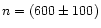 cm-3.
The inferred C2column density is N(C
2) = (20+4-2) 1013 cm-2.
The detection of various lines in the (1,0) and (2,0) band of the
CN A
cm-3.
The inferred C2column density is N(C
2) = (20+4-2) 1013 cm-2.
The detection of various lines in the (1,0) and (2,0) band of the
CN A
 - X
- X
 red system suggest a column density of N(CN
 cm-2.
C2 absorption lines
are also detected towards Cyg OB2 No. 5 and No. 9. Inferred parameters
are T = 50 K,
cm-2.
C2 absorption lines
are also detected towards Cyg OB2 No. 5 and No. 9. Inferred parameters
are T = 50 K,
 cm-3,
N(C
cm-3,
N(C
 cm-2 towards No. 5, and T = 100 K,
  cm-3,
N(C
cm-3,
N(C
 cm-2 towards No. 9. Marginal detections of C2 towards Cyg OB2 No. 8A
indicate N(C
cm-2 towards No. 9. Marginal detections of C2 towards Cyg OB2 No. 8A
indicate N(C
 cm-2 and
 K. Upper
limits are N(C
K. Upper
limits are N(C
 cm-2 toward Cyg OB2 No. 7 and No. 11.
The C2 observations eliminate the possibility that the molecular material along
the line of sight towards Cyg OB2 No. 12 is spread over a pathlength of
several hundred parsecs of very low density
cm-2 toward Cyg OB2 No. 7 and No. 11.
The C2 observations eliminate the possibility that the molecular material along
the line of sight towards Cyg OB2 No. 12 is spread over a pathlength of
several hundred parsecs of very low density
 cm-3. The
observations provide some support to a recent chemical model
which assumes a nested structure of the molecular gas. Alternatively,
the C2 and CN abundances obtained towards Cyg OB2 No. 12 are in agreement
with the predictions of an X-ray induced chemistry driven by an ionisation
rate of
cm-3. The
observations provide some support to a recent chemical model
which assumes a nested structure of the molecular gas. Alternatively,
the C2 and CN abundances obtained towards Cyg OB2 No. 12 are in agreement
with the predictions of an X-ray induced chemistry driven by an ionisation
rate of
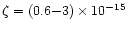 s-1. Calculated equilibrium
temperatures of T = 25-50 K agree with temperatures inferred from
C2. The model also reproduces the observed column densities of CO and CH,
and that of H3+ to within a factor of two. We predict a H2O+
column density of
s-1. Calculated equilibrium
temperatures of T = 25-50 K agree with temperatures inferred from
C2. The model also reproduces the observed column densities of CO and CH,
and that of H3+ to within a factor of two. We predict a H2O+
column density of
 cm-2 towards Cyg OB2 No. 12 and
H2O+ absorption lines which are detectable by optical absorption
line techniques.
We report the detection of interstellar Rubidium towards Cyg OB2 No. 12
and No. 5. Inferred column densities are N(Rb
cm-2 towards Cyg OB2 No. 12 and
H2O+ absorption lines which are detectable by optical absorption
line techniques.
We report the detection of interstellar Rubidium towards Cyg OB2 No. 12
and No. 5. Inferred column densities are N(Rb
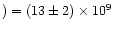 cm-2 towards No. 12 and N(Rb
cm-2 towards No. 5.
cm-2 towards No. 12 and N(Rb
cm-2 towards No. 5.
Key words: ISM: abundances - ISM: clouds - ISM: molecules -
X-rays: general
The line of sight towards the heavily reddened
star Cyg OB2 No. 12 has received renewed attention recently
after the detection of very large amounts of interstellar
H3+ (McCall et al. 1998; Geballe et al. 1999).
Cyg OB2 No. 12 is classified as a B8Ia supergiant
and reddened by some 10 magnitudes of visual extinction
(Souza & Lutz 1980).
It is generally accepted that the reddening is caused
by foreground material. The star suffers from a strong stellar
wind with a velocity of
 km s-1
(Leitherer et al. 1982; Bieging et al. 1989).
A near-infrared excess of the star found by
Leitherer et al. (1982)
is attributed to free-free
emission from the expanding envelope. The absence of
interstellar H2O and CO2 ices at 3
km s-1
(Leitherer et al. 1982; Bieging et al. 1989).
A near-infrared excess of the star found by
Leitherer et al. (1982)
is attributed to free-free
emission from the expanding envelope. The absence of
interstellar H2O and CO2 ices at 3  m and 4.27 m,
respectively, suggests that the foreground molecular
material is diffuse (Whittet et al. 1997).
m and 4.27 m,
respectively, suggests that the foreground molecular
material is diffuse (Whittet et al. 1997).
The H3+ column density towards Cyg OB2 No. 12
of N(H
 cm-2 is comparable
to H3+ column densities observed in dense clouds
(Geballe & Oka 1996; McCall et al. 1999).
The question arises
what processes are responsible for the production of such large amounts
of H3+ in the diffuse gas, and what physical conditions
prevail in the medium. In a first interpretation,
McCall et al. (1998)
and Geballe et al. (1999)
proposed that H3+forms in low density material with n = 10 cm-3 spread over
pathlengths of 400-1200 pc. The authors noted, however, that their
model fails to explain the abundance of CO which the authors
inferred from their CO infrared observations, and that the model
is in clear disagreement with earlier C2 observations
(Gredel & Münch 1994, GM94 hereafter).
A detailed model of the physical and chemical structure of the line
of sight towards No. 12 was recently presented by
Cecchi-Pestellini & Dalgarno (2000),
who proposed a nested structure
of the molecular material. In their model, H3+ forms
in diffuse gas of density n = 50-100 cm-3, C2 forms in
embedded clouds at n = 7000 cm-3 at temperatures of T = 35 K,
and CO forms in dense cloudlets of n> 104 cm-3.
cm-2 is comparable
to H3+ column densities observed in dense clouds
(Geballe & Oka 1996; McCall et al. 1999).
The question arises
what processes are responsible for the production of such large amounts
of H3+ in the diffuse gas, and what physical conditions
prevail in the medium. In a first interpretation,
McCall et al. (1998)
and Geballe et al. (1999)
proposed that H3+forms in low density material with n = 10 cm-3 spread over
pathlengths of 400-1200 pc. The authors noted, however, that their
model fails to explain the abundance of CO which the authors
inferred from their CO infrared observations, and that the model
is in clear disagreement with earlier C2 observations
(Gredel & Münch 1994, GM94 hereafter).
A detailed model of the physical and chemical structure of the line
of sight towards No. 12 was recently presented by
Cecchi-Pestellini & Dalgarno (2000),
who proposed a nested structure
of the molecular material. In their model, H3+ forms
in diffuse gas of density n = 50-100 cm-3, C2 forms in
embedded clouds at n = 7000 cm-3 at temperatures of T = 35 K,
and CO forms in dense cloudlets of n> 104 cm-3.
Observations of interstellar C2 allow physical conditions such
as the density and the temperature in the molecular material to
be inferred. The theory of C2 excitation was developed by
van Dishoeck & Black (1982). It has been used
by a variety of authors to measure densities and temperatures
in diffuse and translucent molecular
clouds (Gredel 1999 and references therein).
Molecular carbon was detected towards No. 12 by
Souza & Lutz (1977),
in their discovery detection
of C2 in the interstellar medium.
The authors observed the R(2) and Q(2) lines of the (1,0) band
of the C2 Phillips system, near 1 m, and estimated a
rotational excitation temperature of
 -40 K and a total C2 column
density of about N(C
2) = 1014 cm-2. Higher temperatures
of
-40 K and a total C2 column
density of about N(C
2) = 1014 cm-2. Higher temperatures
of
 K were derived by
Lutz & Crutcher (1983).
A new search of
C2 towards various stars in the Cyg OB2 association resulted in
the detection of the R(2), Q(2), and Q(4) lines towards Cyg OB2
No. 12 and No. 5 by GM94.
Gredel & Münch (1994) confirmed
a low C2 rotational excitation
temperature towards No. 12 but failed to detect rotational
lines with J'' > 4. Accurate column densities for levels J''>4
are required if densities are to be inferred
(van Dishoeck & Black 1982).
K were derived by
Lutz & Crutcher (1983).
A new search of
C2 towards various stars in the Cyg OB2 association resulted in
the detection of the R(2), Q(2), and Q(4) lines towards Cyg OB2
No. 12 and No. 5 by GM94.
Gredel & Münch (1994) confirmed
a low C2 rotational excitation
temperature towards No. 12 but failed to detect rotational
lines with J'' > 4. Accurate column densities for levels J''>4
are required if densities are to be inferred
(van Dishoeck & Black 1982).
A proper modeling of the chemistry towards Cyg OB2 No. 12
requires a knowledge of the physical conditions
which prevail in the line of sight. We decided
to obtain a deep optical spectrum towards No. 12, with the
aim of detecting rotational lines with J''>4 so
that densities may be accurately determined. The observations
are described in Sect. 2. Section 3 contains a summary of the
C2 analysis and the results obtained. It includes the results
of the detection of interstellar CN towards No. 12 in the
(1,0) and (2,0) band of the CN A
- X
red system, and of interstellar
Rubidium towards No. 12 and No. 5. A comparison
of the derived C2 and CN abundances with a chemical model
driven by X-ray ionisation is given in Sect. 4.
Interstellar absorption lines which arise from the (2,0) and
(3,0) bands of the C2 A
- X
Phillips System, around 8765 Å
and 7720  ,
respectively, and of interstellar CN in the (2,0)
and (1,0) bands of the CN A
- X
red system, around 7900 Å and
9150 ,
respectively, were searched
towards stars Nos. 5, 7, 8A, 9, 11, and 12, of the Cyg OB2 association.
The observations were carried out during eight
nights in September 1999, using the fibre-fed echelle spectrograph
FOCES of the Calar Alto Observatory 2.2 m telescope. The instrument
is described in detail by
Pfeiffer et al. (1998).
Total integration times were two hours each for Nos. 7, 8A, 9, 11,
five hours for No. 5, and twelve hours for No. 12.
The 2 pixel resolution of FOCES is
,
respectively, and of interstellar CN in the (2,0)
and (1,0) bands of the CN A
- X
red system, around 7900 Å and
9150 ,
respectively, were searched
towards stars Nos. 5, 7, 8A, 9, 11, and 12, of the Cyg OB2 association.
The observations were carried out during eight
nights in September 1999, using the fibre-fed echelle spectrograph
FOCES of the Calar Alto Observatory 2.2 m telescope. The instrument
is described in detail by
Pfeiffer et al. (1998).
Total integration times were two hours each for Nos. 7, 8A, 9, 11,
five hours for No. 5, and twelve hours for No. 12.
The 2 pixel resolution of FOCES is
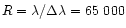 using a 15 m detector.
The achieved resolution is about R=45 000, as judged from the width of the
thorium lines. The full optical wavelength region of
4000-10 000 Å is obtained with a single integration.
The data were reduced using the MIDAS echelle context.
The background, including the bias and the scattered light
contamination, was defined by
fitting a two-dimensional surface to the regions between individual orders.
Pixel-to-pixel variations of the detector were corrected by use
of integrations on an internal halogen lamp.
The location of the spectral orders was determined using the Hough
algorithm. Extracted spectra were transformed from pixel to wavelength
scale using integrations on internal thorium arcs
taken at the beginning and at the end of each night.
The spectra were re-binned to a linear, heliocentric wavelength scale.
Heliocentric velocities were inferred from the
rest wavelengths of Chauville et al. (1977).
Uncertainties in the velocities
are estimated to be of the order of 1-1.5 km s-1.
using a 15 m detector.
The achieved resolution is about R=45 000, as judged from the width of the
thorium lines. The full optical wavelength region of
4000-10 000 Å is obtained with a single integration.
The data were reduced using the MIDAS echelle context.
The background, including the bias and the scattered light
contamination, was defined by
fitting a two-dimensional surface to the regions between individual orders.
Pixel-to-pixel variations of the detector were corrected by use
of integrations on an internal halogen lamp.
The location of the spectral orders was determined using the Hough
algorithm. Extracted spectra were transformed from pixel to wavelength
scale using integrations on internal thorium arcs
taken at the beginning and at the end of each night.
The spectra were re-binned to a linear, heliocentric wavelength scale.
Heliocentric velocities were inferred from the
rest wavelengths of Chauville et al. (1977).
Uncertainties in the velocities
are estimated to be of the order of 1-1.5 km s-1.
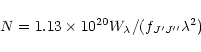
The measured equivalent widths
 of the C2 lines were converted into
column densities N using
of the C2 lines were converted into
column densities N using
 |
(1) |
with
and  in units of Å and N in
units of cm-2.
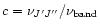
Line oscillator strengths fJ'J'' were
calculated from the (2,0) band oscillator strength f20 from
the relation
fJ'J'' = f20 c SJ'J''/(2 (2J''+1)), with
in units of Å and N in
units of cm-2.
Line oscillator strengths fJ'J'' were
calculated from the (2,0) band oscillator strength f20 from
the relation
fJ'J'' = f20 c SJ'J''/(2 (2J''+1)), with
 and
Hönl-London factors SJ'J'' of (J''+2),
(2J''+1), and (J''-1) for the R, Q, and P lines, respectively.
We used
and
Hönl-London factors SJ'J'' of (J''+2),
(2J''+1), and (J''-1) for the R, Q, and P lines, respectively.
We used
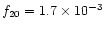 which is obtained from an ab initio
calculation by van Dishoeck (1983). The value is close to a
theoretical value of
which is obtained from an ab initio
calculation by van Dishoeck (1983). The value is close to a
theoretical value of
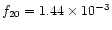 given by
Langhoff et al. (1990), and to a measurement by
Erman & Iwamae (1995)
who infer
given by
Langhoff et al. (1990), and to a measurement by
Erman & Iwamae (1995)
who infer
 .
It is
larger than
.
It is
larger than
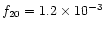 suggested by Lambert et al. (1995).
For a recent discussion of discrepancies between
theoretical and experimental f-values see Erman & Iwamae (1995) and
Lambert et al. (1995).
The band oscillator strength for the (3,0) band was derived from f20using the theoretical ratio of
f20 / f30 = 2.2
(van Dishoeck & Black 1982).
suggested by Lambert et al. (1995).
For a recent discussion of discrepancies between
theoretical and experimental f-values see Erman & Iwamae (1995) and
Lambert et al. (1995).
The band oscillator strength for the (3,0) band was derived from f20using the theoretical ratio of
f20 / f30 = 2.2
(van Dishoeck & Black 1982).
![\begin{figure}
\par\includegraphics[width=15cm,clip]{12spec.ps}\end{figure}](/articles/aa/full/2001/32/aah2693/Timg38.gif) |
Figure 1:
Spectrum covering the (2,0) band of
the C2 Phillips System towards Cyg OB2 No. 12.
Detected rotational lines are identified and marked by filled triangles.
Open triangles indicate the expected positions of rotational lines which
are used to infer upper limits in the populations. |
| Open with DEXTER |
In the models of
van Dishoeck & Black (1982) the distribution of
populations of the levels J'' of C2 is determined by the ratio
 where
where  is the density of the collision
partners of C2,
is the density of the collision
partners of C2,
 cm-2 is the cross section for collision induced transitions for level
J'' to rotational level (J''-2) and I is a scaling factor for the incident
radiation field in the near-infrared. If a C2 absorption oscillator strength
different from the one used here is adopted,
the parameter
should be scaled by the ratio of
the oscillator strengths
(cf. note added in proof in van Dishoeck & Black 1982).
For a gas of H2,
cm-2 is the cross section for collision induced transitions for level
J'' to rotational level (J''-2) and I is a scaling factor for the incident
radiation field in the near-infrared. If a C2 absorption oscillator strength
different from the one used here is adopted,
the parameter
should be scaled by the ratio of
the oscillator strengths
(cf. note added in proof in van Dishoeck & Black 1982).
For a gas of H2,
 (H2) and
 (H2) is the total
column density of hydrogen nuclei. The density
of hydrogen nuclei is
(H2) is the total
column density of hydrogen nuclei. The density
of hydrogen nuclei is
 .
We take I=1 corresponding to
the standard interstellar radiation field (see discussion in Sect. 4.1).
.
We take I=1 corresponding to
the standard interstellar radiation field (see discussion in Sect. 4.1).
For the CN A
- X
system, the experimental band oscillator strengths of
Davis et al. (1986) of
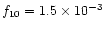 and
and
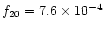 were adopted for the (1,0) and (2,0) bands,
respectively. Heliocentric velocities of CN were inferred from the
rest wavelengths given by
van Dishoeck & Black (1989).
were adopted for the (1,0) and (2,0) bands,
respectively. Heliocentric velocities of CN were inferred from the
rest wavelengths given by
van Dishoeck & Black (1989).
The spectrum covering the (2,0) band of the C2 Phillips system
towards Cyg OB2 No. 12 is shown in Fig. 1.
The spectrum of the star is dominated by a strong stellar
H I Paschen 12 line near 8752 Å and the 3p3P - 9d3D He I line near
8777 Å. Superimposed on the stellar continuum are interstellar
C2 absorption lines, which are identified. The broad absorption feature
near 8763 Å is a blend of the C2 Q(4) line and of a diffuse
interstellar band (cf. Sect. 3.4). The sharp absorption
features near 8799.75 Å, 8803.23 Å, 8811.51 Å, 8820.05 Å,
8831.2 Å, and 8835.5 Å, arise from telluric H2O absorption.
The C2 measurements are summarised in Table 1, where Cols. 1-5 contain
the line designation, the heliocentric wavelength
 in Å, the
derived heliocentric velocity
in Å, the
derived heliocentric velocity
 in km s-1, the measured
equivalent width
in mÅ with uncertainties in parenthesis, and the
derived column densities N(J'') in units of 1013 cm-2, with
uncertainties in parenthesis. The colon in Col. 2 of Table 1, and in
Tables 2, 3, and 6, indicates an uncertain
wavelength, either because it is inferred from a line blend, or
because the wavelength is indicative only in cases were upper limits in
are given.
in km s-1, the measured
equivalent width
in mÅ with uncertainties in parenthesis, and the
derived column densities N(J'') in units of 1013 cm-2, with
uncertainties in parenthesis. The colon in Col. 2 of Table 1, and in
Tables 2, 3, and 6, indicates an uncertain
wavelength, either because it is inferred from a line blend, or
because the wavelength is indicative only in cases were upper limits in
are given.
Uncertainties in
are largely governed by uncertainties in the placement of
the local continuum, particularly near the strong stellar H I Paschen
12 absorption line. For equivalent widths obtained from a decomposition
of unresolved line blends, such as the (2,0) band R(2)+R(10) blend,
uncertainties are of the order of 2-3 mÅ.
In general, the uncertainties are larger than 3 standard deviations
of the noise in the stellar continuum.
The C2 column densities adopted here are inferred in the limit
of C2 Doppler values
 (cf. Eq. (1)).
A curve of growth analysis shows that
deviations from the linear relation of Eq. (1) exceed values
of 10% for
(cf. Eq. (1)).
A curve of growth analysis shows that
deviations from the linear relation of Eq. (1) exceed values
of 10% for
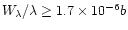 for b in km s-1for the absorption lines in the C2 (2,0) band. Assuming a typical value
of b = 1 km s-1 for C2, the C2 lines suffer from saturation for
equivalent widths of
for b in km s-1for the absorption lines in the C2 (2,0) band. Assuming a typical value
of b = 1 km s-1 for C2, the C2 lines suffer from saturation for
equivalent widths of  15 mÅ. The strongest C2
absorption lines have equivalent widths of
15 mÅ. The strongest C2
absorption lines have equivalent widths of
 m.
We nevertheless ignore saturation corrections
for the following two reasons. Firstly,
the observations of GM94 indicate the presence of two main C2 velocity
components separated by 3.7 km s-1. Assuming an equal distribution
of the population density in both velocity components, the C2 lines
are not saturated unless
m.
We nevertheless ignore saturation corrections
for the following two reasons. Firstly,
the observations of GM94 indicate the presence of two main C2 velocity
components separated by 3.7 km s-1. Assuming an equal distribution
of the population density in both velocity components, the C2 lines
are not saturated unless
 mÅ per velocity
component or
mÅ per velocity
component or
 mÅ per absorption line.
Secondly, the C2 Doppler parameter may be larger than 1 km s-1.
The doublet ratio method
applied by Chaffee & White (1982)
in their analysis of K I absorption
lines towards Cyg OB2 No. 12 indicates a Doppler value of
b(K) = 6.4 km s-1 towards No. 12, with a range of b(K) = 0.7-10.5 km s-1 allowed by the measurement uncertainties. For b(C2) =
b(KI), the C2 lines are not saturated unless
mÅ per absorption line.
Secondly, the C2 Doppler parameter may be larger than 1 km s-1.
The doublet ratio method
applied by Chaffee & White (1982)
in their analysis of K I absorption
lines towards Cyg OB2 No. 12 indicates a Doppler value of
b(K) = 6.4 km s-1 towards No. 12, with a range of b(K) = 0.7-10.5 km s-1 allowed by the measurement uncertainties. For b(C2) =
b(KI), the C2 lines are not saturated unless
 m.
m.
The spectra of stars Nos. 5, 9, 8A, 7, and 11
are shown in Fig. 2, normalised to unity and shifted by values
of 0, -0.1, -0.2, -0.3, -0.4, and -0.5, respectively, along
the ordinate. The scale of the ordinate
applies to star No. 5. The C2 lines detected towards
Cyg OB2 No. 5 and No. 9 are summarised in Tables 2 and 3, respectively.
C2 absorption lines are marginally detected towards Cyg OB2 No. 8A.
Absorption features, which may be assigned to the Q(2), Q(6), and
Q(8) lines, appear near heliocentric wavelengths of 8761.038, 8767.640,
and 8773.043 Å, respectively, with equivalent widths of
 mÅ or 1-2 standard deviations.
A weak diffuse interstellar band near 8763 Å
is present in all five spectra.
mÅ or 1-2 standard deviations.
A weak diffuse interstellar band near 8763 Å
is present in all five spectra.
Table 1:
Summary of C2 measurements towards Cyg OB2 No. 12.
![\begin{table}\par\begin{displaymath}
\begin{array}[h]{p{0.25\linewidth}llrrr}
...
...\rm Affected\ by\ cosmic-ray\ hit.}} \\
\end{array}\end{displaymath}\end{table}](/articles/aa/full/2001/32/aah2693/img56.gif) |
![\begin{figure}
\par\includegraphics[width=17cm,clip]{5spec.ps}\end{figure}](/articles/aa/full/2001/32/aah2693/Timg57.gif) |
Figure 2:
Stellar spectra covering the (2,0) Phillips band
towards stars Cyg OB2 Nos. 5, 9, 8A, 7, and 11.
All spectra are normalised to unity and shifted along the ordinate
(see text). C2 lines detected in Cyg OB2 No. 5 are marked by filled
triangles.
Open triangles indicate the expected positions of rotational lines which
are used to infer upper limits in the populations. |
| Open with DEXTER |
Table 2:
Cyg OB2 No. 5, C2 (2,0) Phillips band.
![\begin{table}\par\begin{displaymath}
\begin{array}[h]{p{0.25\linewidth}llrrr}
...
...icolumn{2}{l}{^a {\rm Line\ blend.}} \\
\end{array}\end{displaymath}\end{table}](/articles/aa/full/2001/32/aah2693/img58.gif) |
Table 3:
Cyg OB2 No. 9, C2 (2,0) Phillips band.
|
In order to obtain average column densities
 in rotational levels J'',
the column densities inferred from the individual
measurements in the R, P, and Q lines of the (2,0) and (3,0) bands,
when available, were combined by weighting with the corresponding
oscillator strengths. The gas-kinetic temperature
T was determined from the rotational excitation temperature
in rotational levels J'',
the column densities inferred from the individual
measurements in the R, P, and Q lines of the (2,0) and (3,0) bands,
when available, were combined by weighting with the corresponding
oscillator strengths. The gas-kinetic temperature
T was determined from the rotational excitation temperature
 of the lowest rotational levels, because the population
density in these levels is not significantly affected by
radiative effects. Total C2 column densities
of the lowest rotational levels, because the population
density in these levels is not significantly affected by
radiative effects. Total C2 column densities
 and densities
were obtained from theoretical fits to the population
distribution, with forced agreement for N(2) (cf. van Dishoeck
& Black 1982). Total observed column densities were derived
from the sum
and densities
were obtained from theoretical fits to the population
distribution, with forced agreement for N(2) (cf. van Dishoeck
& Black 1982). Total observed column densities were derived
from the sum
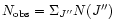 over the observed rotational levels.
The signal to noise ratio (S/N) of the spectral region covering the
(2,0) Phillips band is very high and reaches values of
S/N > 600. Figure 3 contains an excitation diagram
constructed from the detected lines,
with values of
 plotted versus excitation energy E(J'') of rotational level J''.
Individual measurements are
represented by filled triangles and upper limits by open triangles.
The squares correspond to
the averages
.
The five lines drawn
in the diagram represent theoretical population distributions calculated
for a temperature of T = 35 K and densities of collision
partners of
plotted versus excitation energy E(J'') of rotational level J''.
Individual measurements are
represented by filled triangles and upper limits by open triangles.
The squares correspond to
the averages
.
The five lines drawn
in the diagram represent theoretical population distributions calculated
for a temperature of T = 35 K and densities of collision
partners of
 ,
300, 350, 400, 450 cm-3. The large number of
rotational lines detected towards Cyg OB2 No. 12 sharply
constrains the density .
The theoretical population distribution
predicted for T = 35 K and
,
300, 350, 400, 450 cm-3. The large number of
rotational lines detected towards Cyg OB2 No. 12 sharply
constrains the density .
The theoretical population distribution
predicted for T = 35 K and
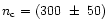 cm-3
agrees with the measurements. The total density of hydrogen is
cm-3. The theoretical
total C2 column density derived from N(2) and T and is
cm-3
agrees with the measurements. The total density of hydrogen is
cm-3. The theoretical
total C2 column density derived from N(2) and T and is
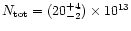 cm-2.
The total observed column density
is
cm-2.
The total observed column density
is
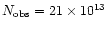 cm-2. The average C2velocity, derived by weighting individual velocities with the
absorption oscillator strengths of the corresponding absorption lines,
is
(C
2) = -5.5 km s-1.
cm-2. The average C2velocity, derived by weighting individual velocities with the
absorption oscillator strengths of the corresponding absorption lines,
is
(C
2) = -5.5 km s-1.
![\begin{figure}
\par\includegraphics[width=8.5cm,clip]{12exc.ps}\end{figure}](/articles/aa/full/2001/32/aah2693/Timg68.gif) |
Figure 3:
C2 excitation diagram of Cyg OB2 No. 12,
with rotational population densities plotted versus excitation
energies E(J''). Filled triangles correspond to individual
line detections, open triangles are upper limits. Open squares
are averages for individual rotational levels. The five lines drawn
in the diagram represent theoretical population distributions obtained
at gas-kinetic temperatures of T = 35 K and densities of collision
partners of /I = 250, 300, 350, 400, 450 cm-3. |
| Open with DEXTER |
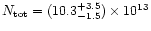
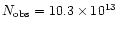
The excitation diagrams constructed for Cyg OB2 No. 5 and No. 9 are
shown in Figs. 4 and 5. The observed population
distribution towards No. 5 is reproduced well by T = 50 K and
 cm-3. The parameters indicate a total C2 column
density
cm-3. The parameters indicate a total C2 column
density
 cm-2.
The total observed column density is
cm-2.
The total observed column density is
 cm-2.
The average heliocentric velocity is
(C
2) = -7.9 km s-1.
cm-2.
The average heliocentric velocity is
(C
2) = -7.9 km s-1.
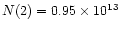
The excitation diagram constructed for No. 9
is less constraining than that for No. 12 or No. 5.
The population
density in the J''=0 - 8 rotational levels may be
described by a thermal population distribution at
T = 100 K. The fit to the population densities in
 yields
 cm-2 which
is adopted in the following as N(2).
The population density in J''=10 and the
upper limit in J'' = 12 suggest
cm-2 which
is adopted in the following as N(2).
The population density in J''=10 and the
upper limit in J'' = 12 suggest
 cm-3.
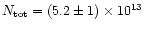
For T = 100 K,
cm-3, and N(2), the
modeled total C2 column density is
cm-3.
For T = 100 K,
cm-3, and N(2), the
modeled total C2 column density is
 cm-2.
The observations yield
N(C
cm-2.
The observations yield
N(C
 cm-2. The average heliocentric velocity
is
(C
2) = -10.2 km s-1.
cm-2. The average heliocentric velocity
is
(C
2) = -10.2 km s-1.
![\begin{figure}
\par\includegraphics[width=8.3cm,clip]{5exc.ps}\end{figure}](/articles/aa/full/2001/32/aah2693/Timg77.gif) |
Figure 4:
Rotational excitation diagram for Cyg OB2 No. 5.
Symbols as in Fig. 3. The five lines correspond to
theoretical population distributions obtained at T = 50 K
and densities of
 ,
300, 400, 600, 800 cm-3. ,
300, 400, 600, 800 cm-3. |
| Open with DEXTER |
![\begin{figure}
\par\includegraphics[width=8.5cm,clip]{9exc.ps}\end{figure}](/articles/aa/full/2001/32/aah2693/Timg78.gif) |
Figure 5:
Rotational excitation diagram for Cyg OB2 No. 9. Symbols as in
Fig. 3. The five lines correspond to densities
of
,
400, 800, 1600 cm-3, and a thermal distribution
at T = 100 K. |
| Open with DEXTER |
The marginal detections of a few Q-branch lines towards Cyg OB2 No. 8A
yield column densities of about
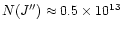 cm-2
in each of J'' = 2, 6, and 8. The total observed column
density is
cm-2
in each of J'' = 2, 6, and 8. The total observed column
density is
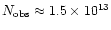 cm-2. The population
distribution in rotational levels J'' = 2, 6, and 8 indicates
a rotational excitation temperature of
cm-2. The population
distribution in rotational levels J'' = 2, 6, and 8 indicates
a rotational excitation temperature of
 K. Assuming the kinetic temperature
T = 100 K and a thermal
distribution, we obtain a value of
K. Assuming the kinetic temperature
T = 100 K and a thermal
distribution, we obtain a value of
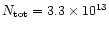 cm-2.
The mean heliocentric velocity of the three absorption lines is
(C
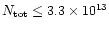
2) = -5.2 km s-1. Towards Cyg OB2 No. 7 and
Cyg OB2 No. 11, the upper limits on the Q(2) line correspond to
cm-2.
The mean heliocentric velocity of the three absorption lines is
(C
2) = -5.2 km s-1. Towards Cyg OB2 No. 7 and
Cyg OB2 No. 11, the upper limits on the Q(2) line correspond to
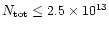
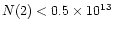 cm-2, or
 cm-2 towards both
stars, for a thermal population distribution at T = 100 K.
The C2 column density is
cm-2 towards both
stars, for a thermal population distribution at T = 100 K.
The C2 column density is
 if T were less than 50 K.
Table 4:
Summary of C2 measurements in Cyg OB2.
![\begin{table}\par\begin{displaymath}
\begin{array}[h]{p{0.25\linewidth}lrrrrrr...
...\ldots \\
\noalign{\smallskip }
\hline
\end{array}\end{displaymath}
\end{table}](/articles/aa/full/2001/32/aah2693/img86.gif) |
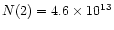
Our C2 measurements are consistent with
previous results. The first detection of C2 towards
Cyg OB2 No. 12 (Souza & Lutz 1977) yielded a column
density in the J''=2 level of
 cm-2,
rescaled to the absorption oscillator strength adopted
here. Our value is
cm-2,
rescaled to the absorption oscillator strength adopted
here. Our value is
 cm-2. The column densities
of GM94, in units of 1013 cm-2,
are
N(0) = 1.1,
N(2) = 5.1, and
N(4) = 4.2, respectively, again
rescaled to the absorption oscillator strength of
van Dishoeck (1983). Our values
are
N(0) = 1.4,
N(2) = 4.85,
N(4) = 4.3.
Towards No. 5, GM94 measured
N(0) = 0.5,
N(2) = 2.4, and
N(4) = 1.6, all
in units of 1013 cm-2, which compares with our data
of
N(0) = 0.5,
N(2) = 2.1, and
N(4) = 2.1.
In general, our measured equivalent widths are consistent with
those of Lutz & Crutcher (1983).
Exceptions occur for
the P(4)+Q(8) line blend, where Lutz & Crutcher (1983) obtain
cm-2. The column densities
of GM94, in units of 1013 cm-2,
are
N(0) = 1.1,
N(2) = 5.1, and
N(4) = 4.2, respectively, again
rescaled to the absorption oscillator strength of
van Dishoeck (1983). Our values
are
N(0) = 1.4,
N(2) = 4.85,
N(4) = 4.3.
Towards No. 5, GM94 measured
N(0) = 0.5,
N(2) = 2.4, and
N(4) = 1.6, all
in units of 1013 cm-2, which compares with our data
of
N(0) = 0.5,
N(2) = 2.1, and
N(4) = 2.1.
In general, our measured equivalent widths are consistent with
those of Lutz & Crutcher (1983).
Exceptions occur for
the P(4)+Q(8) line blend, where Lutz & Crutcher (1983) obtain
 m,
compared to our value of
m,
compared to our value of
 m,
and the R(0) line, where Lutz & Crutcher (1983)
give
m,
and the R(0) line, where Lutz & Crutcher (1983)
give
 m,
compared to our value of
m,
compared to our value of  m.
m.
The observations of GM94 were taken at the
higher spectral resolution of R=65 000 and indicate
a total of four absorption components towards No. 12, two unresolved components
at
 5.7 and -2.5 km s-1, and two weaker components near
-10.6 km s-1 and +13.6 km s-1. This agrees reasonably well
with our detection of a single, unresolved absorption line near
5.5 km s-1. The absorption components near -10.6 km s-1 and
+13.6 km s-1 of GM94 are not present in our spectrum, which has a significantly
higher S/N compared to the spectra of GM94. They may thus not be real.
5.7 and -2.5 km s-1, and two weaker components near
-10.6 km s-1 and +13.6 km s-1. This agrees reasonably well
with our detection of a single, unresolved absorption line near
5.5 km s-1. The absorption components near -10.6 km s-1 and
+13.6 km s-1 of GM94 are not present in our spectrum, which has a significantly
higher S/N compared to the spectra of GM94. They may thus not be real.
Table 4 summarises the C2 measurements towards
the Cyg OB2 association. It contains, in Cols. 1-8, respectively,
the star and its spectral type, its visual extinction AV as given
by Humphreys (1978),
the gas-kinetic temperature
T, the density ,
the column
density in rotational level J''=2, the total C2 column
density
inferred from T,
and N(2), the total
observed column density
 ,
and the average
heliocentric velocity
.
In the discussion of Sect. 4,
theoretical C2 column densities
are used in the
comparison with chemical models, rather than
,
because the theoretical column densities include the population
densities in the unobserved levels as well.
,
and the average
heliocentric velocity
.
In the discussion of Sect. 4,
theoretical C2 column densities
are used in the
comparison with chemical models, rather than
,
because the theoretical column densities include the population
densities in the unobserved levels as well.
![\begin{figure}
\par\includegraphics[width=13.4cm,clip]{12cn.ps}\end{figure}](/articles/aa/full/2001/32/aah2693/Timg95.gif) |
Figure 6:
Normalised spectra covering the (2,0) band and (1,0) bands of
the CN A
- X
red system towards Cyg OB2 No. 12 (bold lines).
Comparison spectra of  Tau are represented by dotted lines.
The locations of various CN lines (cf. Table 6) are
given by triangles.
Tau are represented by dotted lines.
The locations of various CN lines (cf. Table 6) are
given by triangles. |
| Open with DEXTER |
3.4 Diffuse interstellar bands near 7721 Å and 8763 Å
The spectra of all six stars in Cyg OB2 observed here are
affected by absorption
bands near 7721 Å and near 8763 Å which are broader than
the interstellar C2 lines. These bands were
previously identified as new diffuse interstellar bands (DIBs)
(Herbig & Leka 1991; Gredel & Münch 1986). A complete discussion
of the DIBs will be presented elsewhere.
Table 4 summarises the measurements of the band near 8763 ,
with the star, the wavelength, the full width at half maximum
(FWHM), and the equivalent width of the band, listed in Cols. 1-4, respectively. It has been suggested that DIBs form largely
in low-density, diffuse material (Herbig 1995). We note here that
the DIB towards Cyg OB2 No. 12 is relatively weak
compared with the other stars in Cyg OB2. Such is not expected if
the line of sight towards No. 12 passes through a high column density
of low density material spread over a pathlength of some 1000 pc
(cf. discussion in Sect. 4.1).
Table 5:
The 8763 Å diffuse interstellar band towards Cyg OB2.
![\begin{table}\par\begin{displaymath}
\begin{array}[t]{p{0.3\linewidth}lcr}
\hl...
...0 & 13 \\
\noalign{\smallskip }
\hline
\end{array}\end{displaymath}
\end{table}](/articles/aa/full/2001/32/aah2693/img96.gif) |
The spectral region which covers the absorption lines of the (1,0)
and (2,0) bands of the CN red system is heavily contaminated by
telluric absorption lines. However, a few lines in the (1,0) and
(2,0) bands are well isolated and accurate equivalent widths
can be determined.
Figure 6 contains the normalised spectra towards
Cyg OB2 No. 12. The position of the detected CN lines is indicated
by filled triangles. Open triangles mark the expected positions of CN
absorption lines which are blended with atmospheric features.
The (2,0)
SR21(0) (7871.5 ),
(2,0) [
RQ21(1)+R2(1)] (7873.9 ),
(2,0)
RQ21(0) (7874.7 ),
(2,0) R1(0) (7906.5 ),
(1,0) [
QP21(1) + Q2(1)] (9146.9 ), and
(1,0) R1(0) (9186.8 )
lines or line blends, are clearly detected.
The measurements allow the determination the column density N(0) in
the rotational level
N''=0. The lack of clear detections of absorption lines arising
from the rotational level N''=1 constrains the column density N(1).
In order to judge what the maximum CN abundance is towards Cyg OB2 No. 12,
upper limits are estimated for the
(2,0) R1(1) (7903.6 ),
(1,0)
SR21(0) (9139.6 ), and
(1,0) R1(1) (9183.3 )
lines.
The estimate was obtained from a comparison of the relative
strengths of the telluric lines in Cyg OB2 No. 12 and in
Tau.
The spectrum of
Tau is represented in Fig. 6 by the
dotted line. CN is not detected towards Tau.
Upper limits estimated for the column density in N''=1
agree reasonably well with
the column density inferred from the marginally detected
(1,0)[
QP21(1)+Q2(1)] line blend near 9147 .
The CN measurements are summarised in Table 6. It gives,
in Cols. 1-6, the line designation, the measured heliocentric
wavelength
and the heliocentric velocity
,
the measured
equivalent width
,
and the inferred column densities
N(0) and N(1) in the N''=0 and N''=1 rotational levels,
respectively. Uncertainties are given in parentheses.
The last row contains in Cols. 5 and 6, respectively,
the average column density N(0) inferred from the observations
and the column density N(1) in the limit where the CN excitation
temperature T10 is close to the cosmic microwave background
radiation temperature of 2.7 K. The row above contains
the value N(1) estimated from the observations,
and the corresponding CN excitation temperature in Col. 7.
A firm lower limit to the total CN column density towards
Cyg OB2 No. 12 is N(CN
 cm-2, and the
upper limit is N(CN
cm-2, and the
upper limit is N(CN
 cm-2. The average
heliocentric velocity of CN is -4.3 km s-1 which is consistent
with the velocity of C2.
cm-2. The average
heliocentric velocity of CN is -4.3 km s-1 which is consistent
with the velocity of C2.
Table 6:
Summary of CN absorption lines towards Cyg OB2 No. 12.
![\begin{table}\par\begin{displaymath}
\begin{array}[h]{ccccccc}
\hline
\noal...
...\
\par\noalign{\smallskip }
\hline
\end{array} \end{displaymath}
\end{table}](/articles/aa/full/2001/32/aah2693/img99.gif) |
![\begin{figure}
\par\includegraphics[width=8.8cm,clip]{Rb.ps}\end{figure}](/articles/aa/full/2001/32/aah2693/Timg100.gif) |
Figure 7:
Detection of the interstellar line of Rb I
5s
2S1/2 - 5p2P3/2
towards Cyg OB2 No. 12 and No. 5. The spectrum of No. 5 is
shifted by 0.03 units along the ordinate. |
| Open with DEXTER |
We report the detection of the interstellar Rb I
 s
2S1/2 - 5p2P3/2 resonance line
near 7800 Å towards Cyg OB2 No. 12 and towards No. 5.
This presents the first firm detection of rubidium in the
interstellar medium. The significance of an earlier
Rb I measurement by
Jura & Smith (1981)
towards
s
2S1/2 - 5p2P3/2 resonance line
near 7800 Å towards Cyg OB2 No. 12 and towards No. 5.
This presents the first firm detection of rubidium in the
interstellar medium. The significance of an earlier
Rb I measurement by
Jura & Smith (1981)
towards  Oph has been questioned by
Federman et al. (1985),
who did not detect Rb I
in their high quality spectra towards
Oph and
towards two other lines of sight.
Oph has been questioned by
Federman et al. (1985),
who did not detect Rb I
in their high quality spectra towards
Oph and
towards two other lines of sight.
Our spectra are shown in Fig. 7. The Rb I
line is detected at 10 standard deviations towards Cyg OB2 No. 12.
We use the formalism and the atomic data of Morton (2000) to
transfer measured equivalent widths of
 mÅ and
 mÅ towards No. 12 and No. 5, respectively,
into column densities of N(Rb I
cm-2 and
N(Rb I
mÅ towards No. 12 and No. 5, respectively,
into column densities of N(Rb I
cm-2 and
N(Rb I
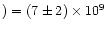 cm-2. Heliocentric velocities
are
6.4 km s-1 for No. 12 and -8.1 km s-1 towards No. 5,
respectively. The Rb I velocities agree with those of C2 within
the errors.
cm-2. Heliocentric velocities
are
6.4 km s-1 for No. 12 and -8.1 km s-1 towards No. 5,
respectively. The Rb I velocities agree with those of C2 within
the errors.
Neutral rubidium has an ionisation potential of 4.77 eV, thus
interstellar rubidium is mostly ionised. The ionisation potential
is similar to that of potassium, and relative abundances
of N(Rb+)/N(K+) may be related to measured ratios
N(Rb)/N(K) (Federman et al. 1985). Column densities of
N(K
 cm-2 towards No. 12 and
N(K
cm-2 towards No. 12 and
N(K
 cm-2 towards No. 5 were
inferred by
Chaffee & White (1982).
The K I 7664 Å and 7698 Å absorption lines are also present
in our spectra. The K I 7698 Å line is well
separated from a telluric O2 absorption line but the K I 7664 Å
line is not. Equivalent widths of the K I 7698 Å lines
are
cm-2 towards No. 5 were
inferred by
Chaffee & White (1982).
The K I 7664 Å and 7698 Å absorption lines are also present
in our spectra. The K I 7698 Å line is well
separated from a telluric O2 absorption line but the K I 7664 Å
line is not. Equivalent widths of the K I 7698 Å lines
are
 mÅ and
 m,
respectively, towards No. 12 and No. 5. The measured equivalent
widths are consistent
with those inferred by
Chaffee & White (1982), who give
m,
respectively, towards No. 12 and No. 5. The measured equivalent
widths are consistent
with those inferred by
Chaffee & White (1982), who give
 towards No. 12 and
 towards No. 5.
Using the atomic
parameters of Morton (1991),
we infer N(K
towards No. 5.
Using the atomic
parameters of Morton (1991),
we infer N(K
 cm-2 towards No. 12 and N(K
 cm-2
towards No. 5. These values, calculated in the limit of
unsaturated lines, are close to the neutral K column densities derived
Chaffee & White (1982)
who used the doublet ratio to estimate
saturation corrections.
cm-2
towards No. 5. These values, calculated in the limit of
unsaturated lines, are close to the neutral K column densities derived
Chaffee & White (1982)
who used the doublet ratio to estimate
saturation corrections.
The K I column densities inferred by
Chaffee & White (1982) and
the Rb I column densities inferred here suggest values
of N(Rb+)/N(K
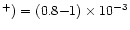 towards Cyg OB2.
This ratio compares with upper limits of
N(Rb+)/N(K
towards Cyg OB2.
This ratio compares with upper limits of
N(Rb+)/N(K
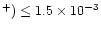 inferred by
Federman et al. (1985)
towards o Per,
Per, and
Oph. The Rb+/K+ ratio towards No. 12 is about a
factor of three lower than the solar ratio of N(Rb+)/N(K
inferred by
Federman et al. (1985)
towards o Per,
Per, and
Oph. The Rb+/K+ ratio towards No. 12 is about a
factor of three lower than the solar ratio of N(Rb+)/N(K
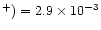 (as given in Federman et al. 1985).
![\begin{figure}
\par\includegraphics[width=8.8cm,clip]{mod600.ps}\end{figure}](/articles/aa/full/2001/32/aah2693/Timg117.gif) |
Figure 8:
Fractional molecular abundances f(X)
plotted versus X-ray energy deposition rate H/n calculated
for a model of n = 600 cm-3 and N(H
 cm-2.
Dots are fractional molecular abundances towards Cyg OB2 No. 12
inferred from observations.
The shaded region corresponds to X-ray ionisation rates of
s-1. cm-2.
Dots are fractional molecular abundances towards Cyg OB2 No. 12
inferred from observations.
The shaded region corresponds to X-ray ionisation rates of
s-1. |
| Open with DEXTER |
4 Discussion
The absence of circumstellar material around No. 12
was inferred from direct near-infrared photometry of the star,
carried out using a multi-filter Ge bolometer
(Persi & Ferrari-Toniolo 1982; Leitherer et al. 1982).
No. 12 has been
identified, however, as the optical counterpart of an IRAS source
(Parthasarathy et al. 1992). Parthasarathy et al. (1992)
interpreted their
mid-infrared IRAS observations to indicate the presence of warm (T=900 K)
and cold dust (T=80 K) around the star.
From an analysis of the wavelength dependence of the polarisation,
McMillan & Tapia (1977)
concluded that the reddening arises in
two uniformly polarising slabs, one of them possibly located
within the Cyg OB2 association.
Massey & Thompson (1991)
have
suggested that the high luminosity of the star coupled with its
high extinction is in fact not a coincidence, but may provide
evidence of a previous episode of mass loss, and that the large
visual extinction of the star is mainly circumstellar. If so,
the detection of unusual
isotope ratios may provide an observational test. We have searched
our spectra for the presence of 12C13C absorption lines.
We use mass-scaled rotational constants and the molecular parameters of
Amiot & Verges (1983)
to obtain wavelengths of 12C13C.
The R-branch bandhead of the (2,0) band of the 12C13C Phillips
system is located near 8792 ,
and the Q(1)-Q(10) lines of the
(2,0) band are located in the 8808-8830 Å region. Our spectrum
shown in Fig. 1 does not contain absorption features which may be
associated with 12C13C. Upper limits are
 m.
The vibrational transition probabilities of 12C13C are
similar than those of C2 (Halmann & Laulicht 1966). 12C13C
is a hetero-nuclear molecule and all rotational levels in the various
electronic states are present. Consequently, the 12C13C
population density is spread over twice as many rotational levels
as for C2. The ratio of the equivalent widths of the say Q(2)
absorption lines from C2 and 12C13C is >54. This value
leads to an estimate of
N(C2)/N(12C13C)
> 27. Assuming that N(C2)/N(12C13C
) = a2/2a where
a is the 12C/13C isotope ratio, we obtain a value of
a > 54 towards Cyg OB2 No. 12, which is consistent with the
interstellar value of a=65 and which agrees within a factor of two with
the terrestrial value of a=89. This finding provides little evidence that
the extinction towards No. 12 is largely circumstellar.
m.
The vibrational transition probabilities of 12C13C are
similar than those of C2 (Halmann & Laulicht 1966). 12C13C
is a hetero-nuclear molecule and all rotational levels in the various
electronic states are present. Consequently, the 12C13C
population density is spread over twice as many rotational levels
as for C2. The ratio of the equivalent widths of the say Q(2)
absorption lines from C2 and 12C13C is >54. This value
leads to an estimate of
N(C2)/N(12C13C)
> 27. Assuming that N(C2)/N(12C13C
) = a2/2a where
a is the 12C/13C isotope ratio, we obtain a value of
a > 54 towards Cyg OB2 No. 12, which is consistent with the
interstellar value of a=65 and which agrees within a factor of two with
the terrestrial value of a=89. This finding provides little evidence that
the extinction towards No. 12 is largely circumstellar.
4.1 C2 and CN formation in quiescent translucent clouds
Observed molecular column densities towards No. 12 are
N(H
cm-2 and N(CO
 cm-2(McCall et al. 1998; Geballe et al. 1999),
N(C
cm-2(McCall et al. 1998; Geballe et al. 1999),
N(C
 cm-2 and
N(CN
cm-2 and
N(CN
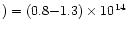 cm-2 (present work),
N(CH
cm-2 (present work),
N(CH
 cm-2, and
N(HCO
+) = 1011 cm-2 (Scappini et al. 2000).
The CH column
density is inferred from an emission line near
4.7 km s-1 (Willson 1984). Note that
McCall et al. (1998) do not include
saturation corrections when inferring CO column densities.
The CO column density may be significantly larger than cited.
The presence of
strong interstellar absorption lines from CH and CH+ was
reported by
Souza & Lutz (1980),
but neither equivalent widths
nor molecular column densities are given. Because of the large
reddening of Cyg OB2 No. 12, the signal to noise ratio in the
blue wavelength region of our spectrum is very low, and
neither the CH+ (4232 )
nor the CH (4300 )
absorption lines are detected.
cm-2, and
N(HCO
+) = 1011 cm-2 (Scappini et al. 2000).
The CH column
density is inferred from an emission line near
4.7 km s-1 (Willson 1984). Note that
McCall et al. (1998) do not include
saturation corrections when inferring CO column densities.
The CO column density may be significantly larger than cited.
The presence of
strong interstellar absorption lines from CH and CH+ was
reported by
Souza & Lutz (1980),
but neither equivalent widths
nor molecular column densities are given. Because of the large
reddening of Cyg OB2 No. 12, the signal to noise ratio in the
blue wavelength region of our spectrum is very low, and
neither the CH+ (4232 )
nor the CH (4300 )
absorption lines are detected.
The visual extinction of
AV = 10 mag towards No. 12 corresponds
to a total hydrogen column density of
N(H
cm-2.
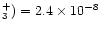
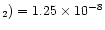
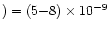
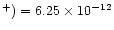
The observed molecular column densities are converted to fractional
abundances f(X) = N(X) / N(H) of
f(H
 ,
f(C
,
f(C
 ,
f(CN
,
f(CN
 ,
f(CO
,
f(CO
 ,
f(CH
,
f(CH
 ,
and
f(HCO
,
and
f(HCO
 .
.
The models of
McCall et al. (1998) and Geballe et al. (1999)
reproduce the observed column density of H3+ by assuming
that the molecular material along the line of sight towards Cyg OB2
is dominated by diffuse material of average density n = 10 cm-3spread over pathlengths of some 400-1200 parsec. The authors note that
the model does not produce the observed abundances of C2 and CO.
The presence of clumps of molecular
gas with densities of
 cm-3, or
cm-3,
towards Cyg OB2 No. 12, is demonstrated
from the C2 observations presented above.
cm-3, or
cm-3,
towards Cyg OB2 No. 12, is demonstrated
from the C2 observations presented above.
A model by Cecchi-Pestellini & Dalgarno (2000) avoids the
assumption of long pathlength and produces the observed abundance of
H3+ from a nested structure for the clouds.
In their model, H3+ is formed in low density clouds of
n = 50-100 cm-3, C2 is formed in embedded cloudlets at
temperatures T = 35 K and
 cm-3,
and CO is formed in high density cores of n = 105 cm-3or greater. The model also predicts a HCO+ column density of
N(HCO
cm-3,
and CO is formed in high density cores of n = 105 cm-3or greater. The model also predicts a HCO+ column density of
N(HCO
 cm-2. The recent detection of HCO+towards No. 12 by Scappini et al. (2000) provides further and
strong support to a model with dense cores embedded in lower
density material.
cm-2. The recent detection of HCO+towards No. 12 by Scappini et al. (2000) provides further and
strong support to a model with dense cores embedded in lower
density material.
The gas-kinetic temperature of the C2-containing
cloudlets inferred from the present observations
agree very well with the prediction of the model of
Cecchi-Pestellini & Dalgarno (2000). The densities inferred from
C2 are significantly lower though, unless a value of I=11 is
adopted as the scaling factor of the radiation field of the
general background starlight. We have modeled the radiation field
from the 44 most luminous stars in the association (cf. Sect. 4.2).
We find that the molecular gas will have
to be closer than 100 pc to the association in order for it to dominate
the radiation field, which we consider unlikely. We conclude that
the C2 observations do indicate a low gas density,
rather than a grossly enhanced radiation field.
4.2 X-ray induced chemistry towards Cyg OB2
![\begin{figure}
\par\includegraphics[width=8.4cm,clip]{h2op.ps}\end{figure}](/articles/aa/full/2001/32/aah2693/Timg132.gif) |
Figure 9:
Fractional abundances of H2O+plotted versus X-ray energy deposition rate H/n calculated
for a model of n= 600 cm-3 and N(H
cm-2.
The shaded region corresponds to ionisation
rates of
s-1. |
| Open with DEXTER |
The stars Cyg OB2 Nos. 5, 8A, 9, and 12, are all very powerful
X-ray emitters (Kitamoto & Mukai 1996; Waldron et al. 1998).
If molecular gas is exposed to X-rays,
its chemistry will be modified by
increased photoionisation rates caused by X-ray absorptions.
In order to estimate whether X-rays may affect the chemical
composition of the translucent cloud towards Cyg OB2,
we have modeled the radiation field of the 44 most luminous
stars with MV < -4 mag of
Massey & Thompson (1991).
We obtain a total luminosity of
 s-1 ionising
photons and a total of
s-1 ionising
photons and a total of
 s-1 of X-ray photons.
Note that these are lower limits as the Cygnus OB2 region
may contain up to 2600 OB stars (Knödlseder 2000).
We use the radio observations of
Downes & Rinehart (1966) to
estimate an emission measure of
s-1 of X-ray photons.
Note that these are lower limits as the Cygnus OB2 region
may contain up to 2600 OB stars (Knödlseder 2000).
We use the radio observations of
Downes & Rinehart (1966) to
estimate an emission measure of
 cm-6 pc and an electron
density of
cm-6 pc and an electron
density of
 cm-3 towards No. 12.
The large number of ionising photons will support a Strömgren sphere
of 104 pc at an electron density of
cm-3.
This is roughly the size of the 5 GHz free-free emission region
seen in the radio map of Downes & Rinehart (1966). The stellar
winds may have evacuated such a large region already that the
nebula is density-bounded, and thus leaking photons into the
neighboring neutral gas. We conclude that an X-ray driven chemistry
may very well provide an alternative scenario for the formation
of molecules towards the Cygnus OB2 region.
cm-3 towards No. 12.
The large number of ionising photons will support a Strömgren sphere
of 104 pc at an electron density of
cm-3.
This is roughly the size of the 5 GHz free-free emission region
seen in the radio map of Downes & Rinehart (1966). The stellar
winds may have evacuated such a large region already that the
nebula is density-bounded, and thus leaking photons into the
neighboring neutral gas. We conclude that an X-ray driven chemistry
may very well provide an alternative scenario for the formation
of molecules towards the Cygnus OB2 region.
The effects of X-rays on the chemistry of translucent
molecular clouds have been modeled by
Lepp & Dalgarno (1996).
They presented steady-state abundances of various interstellar
molecules as a function of  ,
where
is the
X-ray ionisation rate in units of s-1. The observed fractional
abundances of CO, CH, HCO+, and CN, are all well reproduced
for ionisation rates per density of
,
where
is the
X-ray ionisation rate in units of s-1. The observed fractional
abundances of CO, CH, HCO+, and CN, are all well reproduced
for ionisation rates per density of
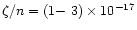 s-1 cm3, or
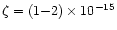 s-1 for
densities of n = 600 cm-3.
The fractional abundance of CH and CN is also reproduced with
the lower ionisation rate of
s-1 for
densities of n = 600 cm-3.
The fractional abundance of CH and CN is also reproduced with
the lower ionisation rate of
 s-1,
but that of the other molecules is not. The lower ionisation
rate is close to the cosmic ray ionisation rate of dark clouds.
s-1,
but that of the other molecules is not. The lower ionisation
rate is close to the cosmic ray ionisation rate of dark clouds.
Maloney et al. (1996)
showed that the physics
and the chemistry of an X-ray irradiated gas are predominantly
determined by the local X-ray energy deposition rate per particle
H divided by the particle density n.
Comprehensive models of the energy deposition of X-rays in
atomic and molecular gas and the effects of the X-rays on the
chemistry were developed by Yan (1996),
who calculated fractional
molecular abundances as a function of H/n. A full discussion of
the models and the chemical network used will be presented
elsewhere. The parameter H, expressed
in units of erg s-1 per hydrogen nucleus, is related to
the X-ray ionisation rate
in units of s-1 per
hydrogen molecule by
 (Yan 1996). Here we use the
models of Yan (1996)
to calculate the fractional abundances of
H3+, CO, C2, CN, CH, and HCO+. In all simulations,
the total hydrogen density is fixed to a value of
(Yan 1996). Here we use the
models of Yan (1996)
to calculate the fractional abundances of
H3+, CO, C2, CN, CH, and HCO+. In all simulations,
the total hydrogen density is fixed to a value of
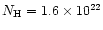 cm-2 and the density is n = 600 cm-3.
Figure 8 contains the calculated fractional molecular abundances
as a function of H/n. Filled dots are fractional abundances
inferred from the observations. The shaded region
corresponds to values of
s-1.
The observed fractional abundances of CO, C2,
CN, and CH, are well reproduced for this range of X-ray ionisation rates.
The inferred ionisation rates agree with those suggested by the
models of Lepp & Dalgarno (1996). The modeled fractional
H3+ abundance is
cm-2 and the density is n = 600 cm-3.
Figure 8 contains the calculated fractional molecular abundances
as a function of H/n. Filled dots are fractional abundances
inferred from the observations. The shaded region
corresponds to values of
s-1.
The observed fractional abundances of CO, C2,
CN, and CH, are well reproduced for this range of X-ray ionisation rates.
The inferred ionisation rates agree with those suggested by the
models of Lepp & Dalgarno (1996). The modeled fractional
H3+ abundance is
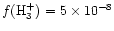 ,
which corresponds to a column density of N(H
,
which corresponds to a column density of N(H
 cm-2.
Thus, our model falls short by a factor of two to reproduce
the H3+ column density towards Cyg OB2 No. 12.
cm-2.
Thus, our model falls short by a factor of two to reproduce
the H3+ column density towards Cyg OB2 No. 12.
The models of Yan (1996)
determine the gas temperature and the grain
temperature by solving the heating and cooling balance equations.
The equilibrium temperatures which result for ionisation rates
of
s-1 are 25-50 K, which
agree perfectly with the gas-kinetic temperature derived from the C2observations.
We derive large abundances of H2O+ in our model.
Figure 9 contains a plot of the fractional H2O+abundance as a function of H/n. At
the ionisation rates inferred above, again represented
by the shaded region, f(H2O+) is of the order of 10-10.
H2O+ peaks with f(H2O
 at high ionisation rates of
 s-1.
We predict that towards Cyg OB2 No. 12, H2O+ absorption lines which arise
from the
s-1.
We predict that towards Cyg OB2 No. 12, H2O+ absorption lines which arise
from the
 system are detectable in the optical wavelength region.
We use the molecular parameters of Lew (1976)
to calculate the
air wavelengths given in Table 7. Oscillator strengths
are from Lutz (1987).
Towards Cyg OB2 No. 12, the predicted
H2O+ fractional abundance corresponds to a column density of
N(H2O
system are detectable in the optical wavelength region.
We use the molecular parameters of Lew (1976)
to calculate the
air wavelengths given in Table 7. Oscillator strengths
are from Lutz (1987).
Towards Cyg OB2 No. 12, the predicted
H2O+ fractional abundance corresponds to a column density of
N(H2O
 cm-2. The strongest lines, such as the
 transition of the
(0,4,0) - (0,0,0) band
near 8057.7 Å (cf. Table 7),
will have equivalent widths of some
transition of the
(0,4,0) - (0,0,0) band
near 8057.7 Å (cf. Table 7),
will have equivalent widths of some
 m.
The H2O+ absorption lines are strong enough to be detectable
by optical absorption line techniques.
Our spectrum towards Cyg OB2 No. 12 covers all H2O+ lines
given in Table 7, but it is not of sufficient quality
to unequivocally identify H2O+. At the resolution adopted here,
H2O+ will be detectable in spectra with
S/N > 1000.
m.
The H2O+ absorption lines are strong enough to be detectable
by optical absorption line techniques.
Our spectrum towards Cyg OB2 No. 12 covers all H2O+ lines
given in Table 7, but it is not of sufficient quality
to unequivocally identify H2O+. At the resolution adopted here,
H2O+ will be detectable in spectra with
S/N > 1000.
We have presented observations of interstellar absorption lines
of C2 and CN towards Cyg OB2 No. 12. The C2 observations indicate
low densities of
 cm-3 of the molecular gas. We
find evidence that the chemistry of the translucent cloud towards
Cyg OB2 is affected by X-rays. We reproduce the observed
column densities of C2, CN, CH, and CO, for X-ray ionisation rates
of
cm-3 of the molecular gas. We
find evidence that the chemistry of the translucent cloud towards
Cyg OB2 is affected by X-rays. We reproduce the observed
column densities of C2, CN, CH, and CO, for X-ray ionisation rates
of
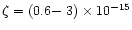 s-1. The observed column density
of H3+ is reproduced to within a factor of two. We predict large
amounts of H2O+ towards Cyg OB2 No. 12 which will be detectable
by optical absorption line techniques.
s-1. The observed column density
of H3+ is reproduced to within a factor of two. We predict large
amounts of H2O+ towards Cyg OB2 No. 12 which will be detectable
by optical absorption line techniques.
Acknowledgements
It is a pleasure to thank Alex Dalgarno for
most fruitful discussions and suggestions. The careful reading
of the manuscript by the referee, Dr. S. R. Federman, is kindly
acknowledged.
-
Amiot, C., & Verges, J. 1983, A&AS, 51, 257
In the text
NASA ADS
-
Chauville, J., Maillard, J. P., & Mantz, A. W. 1977, J. Molec. Spectr., 68, 399
In the text
-
Bieging, J. H., Abbott, D. C., & Churchwell, E. B. 1989, ApJ, 340, 518
In the text
NASA ADS
-
Cecchi-Pestellini, C., & Dalgarno, A. 2000, MNRAS, 313, L6
In the text
NASA ADS
-
Chaffee, F. H., Jr., & White, R. E. 1982, ApJS, 50, 169
In the text
NASA ADS
-
Davis, S. P., Shortenhaus, D., Stark, G., et al. 1986, ApJ, 303, 892
In the text
NASA ADS
-
Downes, D., & Rinehart, R. 1966, ApJ, 144, 937
In the text
NASA ADS
-
van Dishoeck, E. F. 1983, Chem. Phys., 77, 277
In the text
-
van Dishoeck, E. F., & Black, J. H. 1982, ApJ, 258, 533
In the text
NASA ADS
-
van Dishoeck, E. F., & Black, J. H. 1989, ApJ, 340, 273
In the text
NASA ADS
-
Erman, P., & Iwamae, A. 1995, ApJ, 450, L31
In the text
NASA ADS
-
Federman, S. R., Sneden, C., Schrempp, W. V., & Smith, W. H. 1985, ApJ, 290, L55
In the text
NASA ADS
-
Geballe, T. R., & Oka, T. 1996, Nature, 384, 334
In the text
NASA ADS
-
Geballe, T. R., McCall, B. J., Hinkle, K. H., & Oka, T. 1999, ApJ, 510, 251
In the text
NASA ADS
-
Gredel, R. 1999, A&A, 351, 657
In the text
NASA ADS
-
Gredel, R., & Münch, G. 1986, A&A, 154, 336
In the text
NASA ADS
-
Gredel, R., & Münch, G. 1994, A&A, 285, 640 (GM94)
In the text
NASA ADS
-
Halmann, M., & Laulicht, I. 1966, ApJS, 110, 307
In the text
-
Herbig, G. H. 1995, ARA&A, 33, 19
In the text
NASA ADS
-
Herbig, G. H., & Leka, K. D. 1991, ApJ, 382, 193
In the text
NASA ADS
-
Humphreys, R. M. 1978, ApJS, 38, 309
In the text
NASA ADS
-
Jura, M., & Smith, W. H. 1981, ApJ, 251, L43
In the text
NASA ADS
-
Knödlseder, J. 2000, A&A, 360, 539
NASA ADS
-
Kitamoto, S., & Mukai, K. 1996, PASJ, 48, 813
In the text
NASA ADS
-
Lambert, D. L., Sheffer, Y., & Federman, S. R. 1995, ApJ, 438, 740
In the text
NASA ADS
-
Langhoff, S. R., Bauschlicher, C. W., Jr.,
Rendell, A. P., & Komornicki, A. 1990, J. Chem. Phys., 92, 300
In the text
-
Leitherer, C., Hefele, H., Stahl, O., & Wolf, B. 1982, A&A, 108, 102
In the text
NASA ADS
-
Lepp, S., & Dalgarno, A. 1996, A&A, 306, L21
In the text
NASA ADS
-
Lew, H. 1976, Canad. J. Phys., 54, 2028
In the text
NASA ADS
-
Lutz, B. L. 1987, ApJ, 315, L147
In the text
NASA ADS
-
Lutz, B. L., & Crutcher, R. M. 1983, ApJ, 271, L101
In the text
NASA ADS
-
Maloney, P. R., Hollenbach, D. J., & Tielens, A. G. G. M. 1996,
ApJ, 466, 561
In the text
NASA ADS
-
Massey, P., & Thompson, A. B. 1991, AJ, 101, 1408
In the text
NASA ADS
-
McCall, B. J., Geballe, T. R., Hinkle, K. H., & Oka, T. 1999, ApJ, 522, 338
In the text
NASA ADS
-
McCall, B. J., Geballe, T. R., Hinkle, K. H., & Oka, T. 1998,
Science, 279, 1910
In the text
NASA ADS
-
McMillan, R. S., & Tapia, S. 1977, ApJ, 212, 714
In the text
NASA ADS
-
Morton, D. C. 1991, ApJS, 77, 119
In the text
NASA ADS
-
Morton, D. C. 2000, ApJS, 130, 403
In the text
NASA ADS
-
Parthasarathy, M., Jain, S. K., & Bhatt, H. C. 1992,
A&A, 266, 202
In the text
NASA ADS
-
Persi, P., & Ferrari-Toniolo, M. 1982, A&A, 111, L7
In the text
NASA ADS
-
Pfeiffer, M. J., Frank, C., Baumüller, D., Fuhrmann, K., & Gehren, T. 1998,
A&AS, 130, 381
In the text
NASA ADS
-
Scappini, F., Cecchi-Pestellini, C., Codella, C., & Dalgarno, A.
2000, MNRAS, 317, L6
In the text
NASA ADS
-
Souza, S. P., & Lutz, B. L. 1977, ApJ, 216, L49
In the text
NASA ADS
-
Souza, S. P., & Lutz, B. L. 1980, ApJ, 235, L87
In the text
NASA ADS
-
Waldron, W. L., Corcoran, M. F., Drake, S. A., & Smale, A. P.
1998, ApJS, 118, 217
In the text
NASA ADS
-
Whittet, D. C. B., Boogert, A. C. A., Gerakines, P. A., et al. 1997, ApJ, 490, 729
In the text
NASA ADS
-
Yan, M. 1996, The Influence of X-rays on Molecular Clouds, Ph.D.
Thesis, Harvard University, Cambridge, Massachusetts, December 1996
In the text
Copyright ESO 2001
![\begin{figure}
\par\includegraphics[width=15cm,clip]{12spec.ps}\end{figure}](/articles/aa/full/2001/32/aah2693/img38.gif)
![\begin{figure}
\par\includegraphics[width=17cm,clip]{5spec.ps}\end{figure}](/articles/aa/full/2001/32/aah2693/img57.gif)
![\begin{figure}
\par\includegraphics[width=8.5cm,clip]{12exc.ps}\end{figure}](/articles/aa/full/2001/32/aah2693/img68.gif)
![\begin{figure}
\par\includegraphics[width=8.3cm,clip]{5exc.ps}\end{figure}](/articles/aa/full/2001/32/aah2693/img77.gif)
![\begin{figure}
\par\includegraphics[width=8.5cm,clip]{9exc.ps}\end{figure}](/articles/aa/full/2001/32/aah2693/img78.gif)
![\begin{figure}
\par\includegraphics[width=13.4cm,clip]{12cn.ps}\end{figure}](/articles/aa/full/2001/32/aah2693/img95.gif)
 - X
- X
![\begin{figure}
\par\includegraphics[width=8.8cm,clip]{Rb.ps}\end{figure}](/articles/aa/full/2001/32/aah2693/img100.gif)
![\begin{figure}
\par\includegraphics[width=8.8cm,clip]{mod600.ps}\end{figure}](/articles/aa/full/2001/32/aah2693/img117.gif)
![\begin{figure}
\par\includegraphics[width=8.4cm,clip]{h2op.ps}\end{figure}](/articles/aa/full/2001/32/aah2693/img132.gif)


