A&A 375, 293-307 (2001)
DOI: 10.1051/0004-6361:20010825
The Arcetri NEO Precovery Program
A. Boattini
1 - G. D'Abramo
2 - G. Forti
3 - R. Gal
4
1 - Osservatorio Astronomico di Roma,
Via Frascati 33, 00040 - Monteporzio Catone (Roma), Italy
2 -
IAS-CNR, Via Fosso del Cavaliere 100,
00133 Roma, Italy
3 -
Osservatorio Astrofisico di Arcetri, Largo E. Fermi 5,
50122 Firenze, Italy
4 -
Johns Hopkins University, Dept. of Physics and Astronomy,
3701 San Martin Dr., Baltimore, MD 21218, USA
Received 10 April 2001 / Accepted 8 June 2001
Abstract
The Arcetri Near Earth Object Precovery Program (ANEOPP) is a project
dedicated to the identification of images of Near Earth Objects (NEOs)
on past archival materials, an activity usually referred to as precovery.
Going years back in time to locate such images results in the acquisition of very
good orbital information, which, in turn, allows astronomers to perform
more accurate studies of the dynamical evolution and physical
characterization of NEOs, as well as improve assessments of their impact hazard.
We discuss the tasks involved in this work and the basic techniques used to
yield successful identifications on photographic plates.
Begun in mid-1999, ANEOPP has precovered more than
70 NEOs to date, which were previously observed only during
the discovery apparition. The keys to obtaining these results have been:
i) easy access to competitive collections both in digital form and as plastic
copies; ii) traveling to additional collections; iii) the recent development
of reliable algorithms to determine the boundaries of
the recovery region, which is the portion of the celestial sphere where an
asteroid with an uncertain orbit can be found at a given time.
Key words: minor planets asteroids - astrometry - celestial
mechanics - astronomical data bases: miscellaneous - surveys
In the last ten years discussions regarding searches for Near-Earth
Objects (NEOs) have concentrated on the hazard aspect of these objects
(Tedesco et al. 2000). In addition to theoretical studies,
various publications have discussed the best methods to
discover a significant fraction of the larger NEOs within a
limited amount of time (Morrison 1992; Shoemaker 1995;
Harris 1998).
The goal of such a dedicated mid-term survey, the so-called Spaceguard
goal, is to achieve 90% discovery of km-sized NEOs in about 10 years.
However, hazard mitigation requires much more than just discovery;
above all, we need very good orbits for these bodies, and this
can be achieved by obtaining astrometric positions over a long period of time.
Orbital improvements are obtained both with follow-up observations immediately after
discovery for the calculation of a reliable orbit and, subsequently, with recovery
observations at other convenient apparitions years later.
Several professional observatories and a handful of good amateurs operating
well-equipped stations take part in the process of follow-up astrometry
of NEOs (Ticha et al. 2000). The amount of work required for this task
is enormous; more efforts and resources are needed to follow them all properly.
For this reason NEO coordination centers have been established recently
(Boattini et al. 2000a; Hahn 2001; JPL-NEOP 2001).
Here we describe an activity that complements the ongoing follow-up programs.
Recovery observations are a very important part of the process.
There are generally four methods for obtaining astrometric data
at a second apparition (Boattini & Forti 2000):
-
direct recovery at the telescope at some future epoch;
-
identification of the object with data already existing in the Minor Planet Center (MPC)
files;
-
accidental rediscovery of the object;
-
direct recovery search on archival material (photographic or CCD).
This last type of recovery is called precovery (Steel et al. 1997).
Various researchers have provided valid arguments to support precovery searches
of NEOs in astronomical archives:
i) it is the most rapid method for obtaining very good orbits
soon after discovery;
ii) it was aptly demonstrated in the last few years when two km-sized NEOs, 1997 XF11and 1999 AN10, were found to have very small collision probabilities with the Earth;
the collision solutions could be excluded with data from photographic archives
(Marsden 1998; Helin & Lawrence 1998; MPEC 1999-N21);
iii) it saves a great deal of telescope time, as well as money;
iv) it can be a day-time activity, unaffected by the vagaries of weather.
The Arcetri NEO Precovery Program, or ANEOPP, is a dedicated project started
in mid-1999 by A. Boattini and G. Forti
(Boattini et al. 2000b). At various stages other people became
involved with this project: Roy Gal, Maura Tombelli, Luciano Tesi, Germano D'Abramo
and Mike Read.
As of April 9, 2001, over 1300 NEOs have been discovered, and their number is rapidly increasing.
If we consider only the asteroidal component of the population (i.e. Near-Earth
Asteroids, NEAs), accurate, multi-opposition orbits are available for about
490 NEAs. It is
interesting to note that for almost 170 of these, data from a second apparition
have been provided by photographic archival resources. Three-quarters of these
precovery identifications have been made in the past two years alone.
If the initial orbit is very accurate, then precovery is generally a
straightforward process
because the object will be located at most a few arcminutes away from
the nominal prediction. Various linear approximations can help observers
locate the desired object under such conditions. These have been the conditions
in which both 1997 XF11 and 1999 AN10 have been found. However, the recent theoretical
studies which led to the identification of these potential impactors have
recognized similar objects at smaller sizes, but with less certain orbits. This requires
observing programs to improve their capabilities in order to recover these bodies
when the sky uncertainty is much larger.
The search for NEAs with uncertain orbits is
greatly complicated by nonlinear effects. The development of reliable algorithms
to address these nonlinear effects is the result of dedicated studies started recently
(Muinonen & Bowell 1993).
A. Milani (1999), with various co-workers,
produced a specialized software package, called Orbfit, to make
such calculations (Appendix A). An online information service,
the Near Earth Object Dynamic Site, (NEODyS), is also available (Milani et al. 2000a).
ANEOPP makes use of these mathematical tools to guide precovery attempts of
NEOs with poor orbits. Archives offer a very interesting opportunity to test
search techniques for difficult recoveries without requiring
a lot of telescope time. Although there is still a lot of work to be done,
the first results, presented in this paper, are very encouraging.
This paper is organized as follows: after a short historical review of
NEO precovery work so far, in Sect. 2
we describe the archives used by ANEOPP.
In Sect. 3 we briefly review all the different steps that lead to a
successful precovery identification. In Sect. 4 we discuss
the methods used to search for NEAs and how we proceed when the
the orbital information changes from case to case. By using
the example of the Amor-type object 1998 NU, we show interesting aspects
of the successful application of the multiple solution method.
Finally, in Sect. 5 we summarize the results, consisting of the precovery of many
NEOs, and provide general conclusions regarding the impact of this work
on other aspects of NEO science.
Precovery searches for minor bodies (comets and asteroids) are not a new
activity, and have led to scientifically valuable results in the recent past.
For example, the identification of the Amor-type object (4015) = 1979 VA
with Periodic Comet Wilson-Harrington (1949 III)
on a plate from 1949 (Bowell 1992),
showed clear evidence that the distinction between asteroids and comets is
not very straightforward. The well-known comet Hale-Bopp had its orbital solution
significantly improved thanks to precovery data during the early stages
of the follow-up process (McNaught 1995). The orbit of P/Swift-Tuttle
was refined in the same way (Haver et al. 1992), after it had been secured
by an accidental recovery (Marsden 1992).
After the pioneering efforts of the Anglo-Australian Near-Earth Asteroid
Survey (AANEAS) in 1990-1996 (Steel et al. 1997), newly discovered NEOs are
now routinely searched for on some photographic archives by a variety of
dedicated programs. In addition to ANEOPP, significant efforts have been made
by DANEOPS in Germany (Hahn et al. 1999) and by the team of E. Helin in California
using the PCAS archive (Helin et al. 1979). An extensive precovery
program for minor planets in general has also been carried out at
Lowell Observatory using various archival collections.
These initiatives have benefited from one obvious factor in common:
access to some local archival resources. Part of their success
is that they could conduct this activity without traveling around the world,
because the working team either: a) owns the plate collection
(PCAS and Lowell);
b) is based where the plates have been taken and partly maintained (AANEAS);
c) remotely retrieves archival material in a digital form on the internet (DANEOPS
and ANEOPP).
Currently, two main sources are available for ANEOPP activity: the
Arcetri Plate Library and the Digital Sky Survey.
The Arcetri plate library consists of almost 5000 plate plastic copies (film copies),
available from the following collections:
-
The Palomar Observatory Sky Survey I (POSS-I);
-
The Palomar Observatory Sky Survey II (POSS-II);
-
The UKST southern sky survey, consisting in a set of J, equatorial J (EJ),
selected short red (SR) and infrared (I) survey plate copies.
The film copies available at the library are part of a large
project, whose goal was to map the entire sky in different colours, typically
blue, red, and near-infrared. Three telescopes have been employed in
this task: the 1.2-m Oschin Schmidt telescope at Palomar
Observatory in the USA (Abell 1959; Reid et al. 1991);
the 1.2-m UK Schmidt telescope in Australia and the 1.1-m ESO Schmidt
telescope in Chile (Tritton 1983).
The plate library has been regularly accessed since February 2000.
By using a hand magnifier
we visually inspect the film copies in order to find the desired target.
Minor planets can be efficiently discriminated from stars by their long
trailed appearance; this is the result both of long exposures (35-100 min) and of the large plate scale of the 1.2-m Schmidt telescopes.
Print copies of these surveys have been distributed all over the world and
represent the most accessible resource for precovery work. In order
to fully exploit their scientific potential, astronomers realized that
photographs must be converted into a digital format,
suitable for computer analysis. This led to the Digital Sky
Survey, a project carried out at the Space Telescope Science
Institute (STScI). Similar initiatives have been conducted at the US Naval
Observatory (Levine 2000) and at the Royal Observatory at Edinburgh (ROE),
the SuperCOSMOS Sky Survey (Read 1999).
The Digital Sky Survey (DSS) was carried out in two phases: in DSS-I,
plates were scanned at 25 micron resolution, corresponding to a
 /pixel
scale. The most recent surveys have been digitized with an image
sampling of 15 microns, corresponding to about
/pixel
scale. The most recent surveys have been digitized with an image
sampling of 15 microns, corresponding to about
 /pixel scale (DSS II).
This is approximately the intrinsic image resolution on the photographic
plate emulsion (Bucciarelli 1999), so it is close
to an ideal situation with little or no information loss.
/pixel scale (DSS II).
This is approximately the intrinsic image resolution on the photographic
plate emulsion (Bucciarelli 1999), so it is close
to an ideal situation with little or no information loss.
There is a trade-off between the use of DSS and the film copies to locate
precovery images: visual inspection of the film copies is the most
time efficient way to look for the desired target since exploring a full
Schmidt plate takes no more than half an hour. The field of view of
these Schmidt plates is
 .
Covering the same area of sky using DSS images is much more time consuming
because these images must be downloaded from the web: the largest,
.
Covering the same area of sky using DSS images is much more time consuming
because these images must be downloaded from the web: the largest,
 wide, are a few MB each in size.
On the other hand, visual inspection of film copies has a disadvantage over DSS:
it is fraught with physiological and subjective
errors, and faint trails may pass undetected. Utilizing digitized images,
one can extract information objectively and accurately.
wide, are a few MB each in size.
On the other hand, visual inspection of film copies has a disadvantage over DSS:
it is fraught with physiological and subjective
errors, and faint trails may pass undetected. Utilizing digitized images,
one can extract information objectively and accurately.
The asteroidal component of NEOs has traditionally been divided into the
Aten, Apollo and Amor classes (NEAs), based upon their current
osculating orbital elements (Shoemaker et al. 1979).
Comets have not been included in our program yet because
the numerical tools we use can only solve the gravitational
problem, and cannot be used if non-gravitational forces are
also involved. However, we are currently undertaking tests to
ascertain if such forces can be generally ignored.
Hereafter, we apply our search methods and results only to NEAs.
The great bulk of the precovery work within ANEOPP has focused on
NEAs observed only in the course of one opposition. Only bodies larger than
100 m are usually considered because of the low likelihood of
recording smaller objects on the photographic emulsion.
Our methodology is as follows:
- As soon as a preliminary orbit of a new NEA is available, we produce
three separate sets of fully perturbed n-body ephemerides: 1949-1958,
1973-1987 and 1987-2000. These span
all the appropriate epochs for the plate collections available;
-
These ephemerides are cross-checked with the catalog files of the UKST,
POSS I - II
and ESO Schmidt archives, in order to identify possible useful plates.
The result, a list of candidate plates, is available in different forms,
depending on the expected sky uncertainty of the target and the amount
of time we want to invest. This is a critical issue and is
addressed in detail later;
-
The third step is to separate the selected plates into two categories:
first, those immediately available to us,
either as plastic copies at the library and/or as part of DSS, and second,
those plates that are available only
in situ, where they were taken or are archived;
-
Every reliable candidate, with motion vector and magnitude close
to the predictions, is considered and measured using the USNO A2.0
astrometric catalogue (Monet et al. 1998);
-
As soon as we have astrometric data for one or more candidates, we
proceed to attempt an orbital linkage between the
two sets of astrometric data (from two or more oppositions).
If the linkage with the new data is successful, the
cross-checking process is repeated in order to locate additional images of
the object, with the advantage of a much smaller ephemeris uncertainty.
After this step the data is finally submitted to the Minor Planet Center
(MPC) if the attribution
of the precovery images to the object we are searching for is virtually certain.
The problems that we need to analyze and solve are: i) the localization of the sky region
where the object of interest may be found; ii) efficient coverage of this region;
iii) limiting magnitude and trailing loss of the photographic system; iv) identification
and correct attribution of the object.
The first step of the process is the calculation of the sky uncertainty
in the position of the asteroid. Since this is a quite complex subject and
is beyond the scope of this paper, we provide only a brief overview
of the problem. For those who wish to know more about this topic,
there are recent studies in the literature (Muinonen & Bowell 1993;
Muinonen et al. 1997; Milani 1999; Milani et al. 2000b;
Milani et al. 2000c).
In the classical approach, asteroid recovery was performed following
a line in the sky, obtained by slightly varying the object's mean anomaly, M,
for a given orbit. Although this is a good approximation when the sky uncertainty
(SU) is small, this approach cannot be used with more difficult cases.
Milani (1999) has developed increasingly complex algorithms
to deal with cases with increasing difficulty. These algorithms have been implemented
in a software package called Orbfit (Appendix A), which has been used in our precovery
program.
Each set of astrometric data, which is thought to belong to a specific object,
contains a certain amount of error. From this data it is generally
possible to calculate a preliminary orbit. It is also possible to represent
the uncertainty of this orbit by a confidence region in the six-dimensional space
of orbital elements. In order to derive the SU from this region, either a linear or
a nonlinear theory can be used.
In the framework of the linear theory, the confidence region is approximated
by a confidence ellipsoid, whose projection on the sky plane is an ellipse.
Usually, this ellipsoid is elongated only in the direction
of M, resulting in an ellipse that appears as a straight line segment.
This segment, the long axis of the confidence region, is defined as the
Line of Variation (LOV) (e.g., Milani et al. 1999).
Other times the SU has a more classic oval shape; under these circumstances
search efforts become more time consuming since the search cannot be done
only along one dimension.
The use of the linear theory, which is very efficient with small uncertainties,
is not recommended when the confidence region becomes too large, because
nonlinear effects can no longer be neglected.
The use of a nonlinear theory is the appropriate method for addressing large
sky uncertainties. Different sources of nonlinearity have been found: as we will see later,
one apparent effect of nonlinearity is the projection of the confidence region
on the sky plane. This region appears not as an ellipse, but rather
a very asymmetric figure with respect to the object's nominal position.
When the SU is large, it often appears as a curved line segment, especially
for objects observed only for a short arc and/or lost for a long time.
The nonlinear theory, which allows us to map all the points of the confidence region
in the six-dimensional hypervolume, has the inconvenience of requiring heavy calculations.
In order to reduce the amount of work, a semilinear theory has also been
developed (Milani 1999).
This approach has two advantages. First, it approximates the boundaries of the confidence
prediction region on the sky plane well enough in the great majority of cases;
and second, it requires much less computational time,
because it maps the confidence region only along a line, the longest axis of the
confidence ellipsoid (the LOV).
We use the results of this semilinear theory in our search efforts, both when
using Orbfit or the on-line version NEODyS. Our policy is to stop the search
along the LOV, at the  level, in order to make the
search virtually complete.
level, in order to make the
search virtually complete.
The second problem is finding the most efficient way to cover
this region. We start with a tentative evaluation of the effort
required to achieve a reasonable chance of success. Keeping in mind
that there are no guarantees that precovery images will be found, our
objective is to maximize the chances of locating the object while minimizing
effort.
In order to obtain a list of plates where the target could be located, we
need to define a search window. The search window (SW) is a square window
of a size to be defined, which is always centered on the target's nominal
position in the sky.
The cross-checking
process defines the SW by comparing the position of the center of each plate from the catalogue
with the nominal position of the target at the time the plate was exposed.
If the angular distance between these two points in the sky is smaller
than a certain number, which depends on the size of the Schmidt field of view
(SFOV), then the object's
position will be inside the SFOV and the target can be detected if it
is brighter than a specific threshold magnitude. When a plate meets both requirements,
we define it as a candidate plate.
In order to be sure that no candidate plates are left undetected, the size
of the SW must be at least as large as the SFOV.
For each object we generate an output file listing all of its candidate
plates.
Unfortunately, a complete search for such plates can be much more complex because
there is always some uncertainty in the object position.
Evaluation of the target's SU provides the full
solution to this issue. We devise five
scenarios which are based on the comparison between the object's SU and SFOV:
(A) - SU  SFOV
SFOV
(B) - SU < SFOV
(C) - SU  SFOV
SFOV
(D) - SU > SFOV
(E) - SU  SFOV.
SFOV.
In order to estimate the difficulty of a precovery search, we make a first guess, based on
the uncertainty in the object orbit's semi-major axis.
The SU is smaller when plates have been taken closer to the discovery
apparition and/or when the object is not near the Earth. The
general trend is that uncertainties are larger when the object is brighter
(i.e., closer to the Earth).
There is another trade-off: opportunities at fainter
magnitudes, and therefore smaller uncertainties, can be unsafe because objects are
frequently beyond the detection threshold of the plate.
As a matter of fact, the same object may experience
more than one of the five scenarios during visibility opportunities
at different epochs. Generally,
(A) applies to bodies already numbered by the MPC or observed on multiple
apparitions, (B) to single apparition objects with good orbits, while
(C), (D) and (E) apply, respectively, to bodies with some SU, large SU,
or to totally lost targets.
In the following subsections we discuss
four tested procedures, ordered by level of increasing difficulty.
The result of each procedure is to generate a different output file.
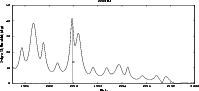 |
Figure 1:
This plot shows the sky uncertainty ( SU) behaviour of 1998 NU
between 1985 and 2000 using a linear approximation.
At discovery, mid-1998, SU is less than 1
 ,
but it grows
quite rapidly with time. The vertical solid line around 1990
is a projection of the semi-lenght of the line of variation ( LOV) at the time
of the precovery observation, stopped at the
level. The crossmark
shows the object position relative to the nominal solution,
the X-axis of the plot. ,
but it grows
quite rapidly with time. The vertical solid line around 1990
is a projection of the semi-lenght of the line of variation ( LOV) at the time
of the precovery observation, stopped at the
level. The crossmark
shows the object position relative to the nominal solution,
the X-axis of the plot. |
| Open with DEXTER |
If we are in case (A), i.e., with very good orbits,
we consider a window slightly bigger than the SFOV:
a
 window provides
a safe margin to avoid missing plates.
A larger window, such as
window provides
a safe margin to avoid missing plates.
A larger window, such as
 ,
is selected for cases (B) and (C): we define this as our small window.
It is useful for
targets that would not pose particular difficulties if the
recovery had to be made at the telescope at some future epoch.
,
is selected for cases (B) and (C): we define this as our small window.
It is useful for
targets that would not pose particular difficulties if the
recovery had to be made at the telescope at some future epoch.
As soon as we have the full list of
candidate plates, we select the ones with the smallest SU and start
the search from them.
The great majority of ANEOPP identifications were made using this SW.
If we are in case (C) or moving from (D) to (C), we need a larger window, such as
 .
However, the use of a square window is not
appropriate because
it will include in the output list plates which are far from the object's LOV. The solution we adopt is to consider a rectangular medium window
of
.
However, the use of a square window is not
appropriate because
it will include in the output list plates which are far from the object's LOV. The solution we adopt is to consider a rectangular medium window
of
 ,
aligned
along the direction of the LOV, provided in the ephemeris
string of Orbfit.
,
aligned
along the direction of the LOV, provided in the ephemeris
string of Orbfit.
This choice, often implemented at the plate library, resulted in some successul
early precovery identifications: 2000 SY2, 2000 LY27 and 2000 PM8.
When the discovery of the Aten-type object 2000 SY2 was announced by the MPC
(MPEC 2000-S36), this target had
only 2 days' arc. Three hours later it was found only 6 degrees
from the prediction on a plate taken in 1977.
Probably, we would have missed that plate if we had used the
small window.
2000 LY27 was located in a similar way, by relying
on the data from the discovery announcement alone (MPEC 2000-M04).
2000 PM8, a 5-km Amor, was found on a UKST digitized plate without realizing that
this trail had been already measured by AANEAS at the time the plate was exposed.
The primary goal of AANEAS was to systematically search for new NEAs from the
plates of the 1.2-m UK Schmidt Telescope as soon as they were taken.
Unfortunately, in the particular case of 2000 PM8, then designated 1991 GM12,
the direction of motion for the trailed image was reported incorrectly, and targeted
follow-up was not possible (MPEC 2000-Q23). Incoveniences like these
could often occur when the techniques used for taking these plates were
not optimized for asteroid detection.
A useful technique for solving this kind of problem is exposure gating
(Helin & Dunbar 1990): by breaking the exposure into two parts of unequal
duration on a single search plate, separated by a short blank interval,
asteroids can be unambiguously discriminated from defects, and their motions,
both apparent speed and direction, can be determined.
As we move to objects with higher SU, we must expand the search
window further. Large windows, such as
 ,
can be successful in recovering such
bodies. On the other hand, examination of the behaviour of the ephemeris
uncertainty with time in Fig. 1 demonstrates
how easy it is to lose some candidate plates when the SU undergoes
intrinsic jumps that exceed the SW.
,
can be successful in recovering such
bodies. On the other hand, examination of the behaviour of the ephemeris
uncertainty with time in Fig. 1 demonstrates
how easy it is to lose some candidate plates when the SU undergoes
intrinsic jumps that exceed the SW.
When the SU grows to tens
of degrees, a fixed window centered on the nominal solution is not viable
due to nonlinear effects. Other conditions also discourage the use of very large windows:
-
The LOV can no longer be approximated by a straight line in the sky,
and it often cannot be contained within a simple rectangular window,
without the risk of including many unnecessary candidate plates;
-
The identification of the desired object becomes very difficult. Although we can
still find out where its LOV lies by using the NEODyS database, we no
longer have reliable information about its angular speed and magnitude, two
fundamental criteria for discrimination. In fact, they can both change significantly
when we are not close to the nominal solution for geometrical reasons;
-
Nonlinear effects also make it nearly impossible to combine the
contributions to the coverage of the object's confidence region from multiple plates.
Such calculations serve both to avoid duplication of effort and to find out which
sections of the confidence region cannot be covered by the resources that are
available from the output list.
When the target's orbital information is too poor for planning a search
relying on a single orbit, we use another approach (Milani 1999; Milani et al. 2000b),
wherein we sample the confidence region with
a swarm of virtual asteroids, with a family of differing orbits, all compatible
with the observations. Since the confidence
region contains a continuum of orbits, each virtual asteroid is representative
of a small region, due to its own orbital uncertainty, but to a much smaller degree.
Earlier, we approximated the confidence region in the sky along one dimension,
described by the LOV. In this case each orbit
is representative of a short segment of this one dimensional subset. This is the
multiple solutions (MS) approach, which gives uniformly spaced (in  units)
solutions along the LOV. If n is the number of orbital solutions selected with the
MS method, each corresponding to a virtual asteroid, then the
cross-checking process is repeated n times, resulting in n output lists of candidate
plates. By combining the contribution of all the candidate plates from these lists we can
estimate our chances of finding one or more precovery images.
units)
solutions along the LOV. If n is the number of orbital solutions selected with the
MS method, each corresponding to a virtual asteroid, then the
cross-checking process is repeated n times, resulting in n output lists of candidate
plates. By combining the contribution of all the candidate plates from these lists we can
estimate our chances of finding one or more precovery images.
The most important requirement of the MS method is that these orbits must
be very dense, otherwise we risk missing candidate plates. This can happen when
the separation on the sky plane between two consecutive orbits is bigger than the SW
we defined. For example, if a plate which happens to include the LOV of the target is located
between the two orbits, it is very likely that it will not be reported in either of the
output files, undermining the search effort.
A good indicator of this situation
is when a plate is listed only for one solution, but not for any of the nearby
orbits. In order to make sure that the number of orbits is dense enough, we also need to
make an analysis of the SU during past close approaches for all these solutions.
This is done by checking the full set of ephemerides of all the available orbits and
analyzing the separation on the sky plane for each pair of nearby solutions. All of these elements
help in devising the appropriate density of solutions for the confidence region.
The calculation of a great amount of orbits requires only a few minutes on a common CPU,
but the human work analyzing the output files and searching the plates
may be beyond our resources. For this reason,
we prefer to start the search with fewer orbits and eventually repeat the search
with a denser set if the object is not found. For each solution we tend to apply
a
 SW.
By exploring and analyzing each solution, it is possible to keep track of the ones
that have been safely covered with archival material (plate coverage) and those that have not.
When we use the MS approach, we usually get plate coverage only for some of
the orbital solutions. Other orbits are not covered: the result is that the combination of
covered and uncovered solutions follows an unpredictable pattern.
Of course, there are many intermediate cases, where it becomes difficult
to say if a specific orbit received plate coverage; for example, when the target is close
to the plate limit and it is not clear what the true reason is for the missing detection.
SW.
By exploring and analyzing each solution, it is possible to keep track of the ones
that have been safely covered with archival material (plate coverage) and those that have not.
When we use the MS approach, we usually get plate coverage only for some of
the orbital solutions. Other orbits are not covered: the result is that the combination of
covered and uncovered solutions follows an unpredictable pattern.
Of course, there are many intermediate cases, where it becomes difficult
to say if a specific orbit received plate coverage; for example, when the target is close
to the plate limit and it is not clear what the true reason is for the missing detection.
The MS is a very powerful procedure because it takes into account some of the aspects of
nonlinearity of the confidence region, such as the asymmetry in the SU (Fig. 3).
It also avoids most of the inconveniences discussed in Sects. 4.1.5 and 4.1.6.
 |
Figure 2:
Observing prediction for 1998 NU at the time of the precovery, as
derived from the NEODyS database. The observing prediction shows the
object SU, at the epoch the plate was exposed.
The crossmark on the continous line (the
line of variation) marks the object position on Dec. 17, 1989. It was
found at about 14 degrees from the nominal position. The dashed
line represents the direction of the object's motion vector on the sky, for the nominal
solution. |
| Open with DEXTER |
Like the other methods, the search is started on plates with smaller SU.
If the object is found, which often occurs on plates with small SU, it is
worthwhile to repeat the search after the orbit has been improved. Occasionally
this new check leads to the location of additional images on plates where the
object's SU is significantly larger than on the plate where the first
image was found.
If the object is not found, a denser set of orbits is produced in order to: i) locate
additional candidate plates; ii) define more accurately which orbits received plate coverage.
If the target still is not found during a check of all the available plates, then it is
reasonable to take full advantage of these negative results: all the solutions from the densest
set of orbits which do not have plate coverage can be inspected using a dedicated telescope
at the earliest visibility opportunity.
In case of a lost target, efforts can be eventually
combined using a battery of telescopes looking at predictions with different orbits.
The first test of this method was implemented very recently, in the course of
the independent precovery of 2000 QJ1 (MPEC 2000-R02). A remarkable demonstration
of the strength of MS was given with the precovery of the lost Amor
1998 NU, which we will discuss in Sect. 4.5.
When a good candidate is found, we must securely attribute this
image to the NEA we are looking for (Milani et al. 2001).
The policy of the Minor Planet Center for recoveries is, in general, to request
observers for data on two different nights in order to provide a confident attribution.
For precoveries, given the deep image scale of the large Schmidt telescopes and
the often unusual angular speeds of these bodies, a single trail generally provides
a safe margin for correct identification. For this reason, the astrometric procedure
for the target consists of measuring the beginning and end of its trailed image using
the USNO A2.0 catalogue. DSS images are particularly suitable for this purpose.
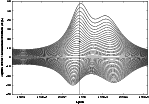 |
Figure 3:
Precovery circumstances of 1998 NU. In this plot we can see 41 continuous
curves, each one corresponding to one of 41 orbits produced with the MS
method at the 3
level. For all of them the plot shows the angular distance
from the nominal solution, which is represented by the only curve perfectly
parallel to the X-axis. In this scheme the nominal solution is the orbit No. 21,
while the confidence region is filled with 20 orbits on each side of the nominal solution.
The position of 1998 NU
is indicated by the small dot in the middle of the plot: it is located very close to
solution No. 29. The MS figure covers two years, from 1989 to 1991. It is
important to notice its asymmetric shape, an evident manifestation
of nonlinearity. |
| Open with DEXTER |
In any case the following general requirements must be satisfied for attribution:
i) the object must be located near its LOV;
ii) the predicted and measured angular rates and magnitudes must agree;
iii) the measured angular rates should allow the observer to discriminate it from objects
belonging to more common
orbital classes. If this is not the case, then a more accurate analysis is necessary,
including either searching for other images at different apparitions, or making
sure that its SU is very small in order to avoid confusion; this is
especially true when trails are very faint.
Most importantly, we repeat the search after improving the orbit (utilizing
the location of the first precovery image) because the SU is
reduced to a few arcsec, allowing us to discriminate very faint
trails of real objects from ghost images.
If the object is bright, then it might be reasonable to assume that all the
other objects of similar brightness are already known;
iv) the orbital linkage between the new data (which provides the starting
orbit) and the old data must be successful;
v) finally, we may chose not to release our precovery data or the MPC may chose
to hold it until there is an opportunity to re-observe the target at the
telescope for confirmation of the tentative candidate.
An additional aspect of the precovery work is the
evaluation of the potential of a photographic system in terms
of limiting magnitude and its degradation due to the target's angular rate.
In Table 1 we report approximate limiting magnitudes for each color
of two sky surveys, POSS-II and UKST. These limits are for stellar
objects in good seeing (<1.5
)
and can vary by up to  magnitude
from plate
to plate. Unfortunately the performance for minor planets is much lower,
because these deep limiting magnitudes were achieved with long
exposures. Even slow moving main-belt objects (MBOs) leave
distinctive trails: the longer the trails, the less deep the
limiting magnitude will be. This loss is called trailing loss.
magnitude
from plate
to plate. Unfortunately the performance for minor planets is much lower,
because these deep limiting magnitudes were achieved with long
exposures. Even slow moving main-belt objects (MBOs) leave
distinctive trails: the longer the trails, the less deep the
limiting magnitude will be. This loss is called trailing loss.
Harris (1994) provided the background and formalism allowing the comparison of asteroid
detection efficiencies for different photographic and CCD systems. Steel (1995)
used these results to measure the asteroid discovery
efficiencies for telescope systems at Siding Spring Observatory. Their treatment
of a photographic system is based on three equations, each applicable to a
different range of angular speeds:
Pseudo-stationary images:

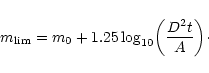 |
(1) |
Short-trailed images:
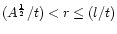
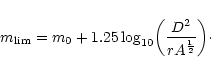 |
(2) |
Long-trailed images:r > (l/t)
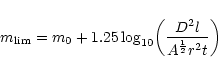 |
(3) |
where
 is the limiting magnitude of the system,
m0 is a constant (evaluated from demonstrated performance of a system of known
characteristics),
D is the effective telescope aperture in metres (allowing for obscurations
by the secondary mirror and support, plate holder, reflectivity losses, vignetting,
etc.), t is the exposure time (s), A is the image area (arcsec2), r
is the angular speed
in the sky plane (arcsec s-1) and l is the correlation length (arcsec) defined
as
is the limiting magnitude of the system,
m0 is a constant (evaluated from demonstrated performance of a system of known
characteristics),
D is the effective telescope aperture in metres (allowing for obscurations
by the secondary mirror and support, plate holder, reflectivity losses, vignetting,
etc.), t is the exposure time (s), A is the image area (arcsec2), r
is the angular speed
in the sky plane (arcsec s-1) and l is the correlation length (arcsec) defined
as
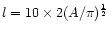 for photographic systems. An application of
these calculations is described in the next paragraph.
for photographic systems. An application of
these calculations is described in the next paragraph.
A good application of the techniques discussed in this section led to
the precovery of the lost asteroid 1998 NU, an Amor with an estimated size of 2-3 km. It was
discovered by the Spacewatch program as a
20.5 - 21.0 V target on July 2,
1998. Additional observations provided an arc of 27 days, leading to
the computation of a preliminary orbit which was not good enough
to allow an easy recovery.
Since this was a relatively large NEA, we set up a precovery plan.
The extent and the behaviour of the object SU with time, shown in Fig. 1,
suggested that we had to use the MS approach.
By running the fitobs
routine of the Orbfit software, we produced a total of 41 orbits,
each one compatible with the observations at the 3
level.
For each of these orbits we derived a list of candidate plates.
A review of the plate listings showed that: i) there was a nice
opportunity in 1989 from POSS-II plates, and ii) searches at previous apparitions
required a denser set of orbits.
The 41 solutions turned out to be sufficient for success: in fact, 1998 NU
was located on the POSS-II plate SF02992, which was taken on Dec. 17,
1989. Figure 2 shows the object SU at the time of the precovery.
The new improved orbit is almost coincident with the orbital solution
No. 29, as we can see from Table 2 and Fig. 3, where nonlinear effects are quite remarkable. Table 2 is a reproduction of the plate output list produced by the MS method.
The new orbit allowed the MPC to identify some unlinked observations from
1999 (MPEC 2000-R57). After we located an additional image from POSS-I in 1953,
the MPC assigned a permanent number to this object (18736).
Table 2:
Output sample of multiple solutions for 1998 NU: three consecutive
solutions (Nos. 28-30) are listed, showing the successful identification
from POSS-II red plate SF02992.
Variation of angular speed (arcsec/hour) and apparent magnitude are
already evident among these solutions. The position angle of the LOV,
expressed in degrees, is counted from North to East.
1998 NU was found very close to solution No. 29 as can be seen
from the astrometric positions at the bottom: they are reported in the MPC
80-character format.
| Plate number, epoch and coordinates |
Orbital |
Object position |
Mag. |
Angular speed - RA/Dec |
Direction of |
| |
solution |
RA Dec. |
|
arcsec/hour |
L.O.V |
| SF02992 |
28 |
03 38 31.08 +24 05 01.9 |
17.8 |
-50.9 -19.6 |
77.6 |
| 1989 12 17.20000 |
29 |
03 49 02.11 +24 37 04.8 |
17.7 |
-53.1 -19.1 |
78.6 |
| 03 42 24 +25 07.6 |
30 |
04 00 11.76 +25 08 00.6 |
17.6 |
-55.0 -18.3 |
79.6 |
     J98N00U 2 1989 12 17.17569 03 47 56.83 +24 35 03.0          17.5 V      261
     J98N00U 2 1989 12 17.22431 03 47 52.85 +24 34 43.7                      261
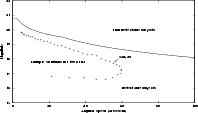 |
Figure 4:
This plot shows apparent motion versus visual magnitude for all 41
orbital solutions considered in the search for 1998 NU. The dashed
curved line is the detection limit of the POSS-II red plate SF02992,
derived by using appropriate values for the variables used that appear
in Eqs. (1-3). |
| Open with DEXTER |
Another interesting feature of this detection analysis is shown in Fig. 4,
where we plot the angular speed of 1998 NU versus its visual magnitude for all 41 solutions at the precovery date. Using the procedure described in Sect. 4.3
we calculated the detection
efficiency of the POSS-II red plate SF02992 for a moving object, plotting it
with a dashed line. As Table 1 shows, red plates do not have the
same performance as the blue plates, but they still approach magnitude 21.
The threshold limit for this red plate was derived by using information from
the POSS-II catalog and by assuming or calculating the value of
additional parameters:
m0 = 17.4, A = 8, l = 32, D = 1
and t = 4200. The threshold is not very rigid and we should allow at least a
 magnitude variation to account for asteroid and plate variation.
For this plate we use Eq. (1) for
magnitude variation to account for asteroid and plate variation.
For this plate we use Eq. (1) for
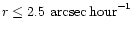 ,
Eq. (2) for
,
Eq. (2) for
 ,
Eq. (3) for
,
Eq. (3) for
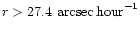 .
.
We can look at this plot in another way: if a hypothetical search for
1998 NU had to be carried out on that night covering the whole confidence region with a set
of red plates identical to SF02992, we are virtually certain that 1998 NU would have been
detected. The only problem would have been how to discriminate it from
MBOs because about half of the orbital solutions produce slow angular rates.
2000 BF19 is an Apollo of 500 meters in size, which was
discovered by the Spacewatch program on January 28, 2000. It
came to the attention of the astronomical community during the early
stages of the follow-up process because it was found to have a very remote
chance of collision with the Earth in the near future. Further observations
excluded this possibility and facilitated the identification of a precovery
image (MPEC 2000-D13). The good plate (from POSS-II) was exposed on October 4,
1991, with 2000 BF19 at magnitude 18.
As can be seen from Fig. 5, this case is quite different from 1998 NU (Fig. 2). The
confidence region does not appear as a line segment because the uncertainty
in M was not dominant over that of other orbital elements.
On that date the object could be located anywhere on a large portion
of the plate and not simply along a thin line (the LOV).
To secure the identification, we
had to pay particular attention to the angular speed expected
from each position on the sky plane of the plate.
There is another area where archives can provide a precious contribution.
In Sect. 4.1.4 we introduced the notion of virtual asteroids in order to
address the problem of targets with very poor orbits. If one of these virtual
asteroids is on a collision path to the Earth, we define it as a virtual impactor, (VI)
(Milani et al. 2000c).
The condition of being on a collision path strongly constrains the
orbital elements, and the region of sky to explore becomes relatively small.
This makes dedicated observing campaigns for negative observations possible,
in the hope of not finding the target at the expected position. In this way
we can exclude the object being on a collision course without investing a great deal of effort
in a difficult search.
2000 PN9 is the first object investigated in these terms, before it was
located on two POSS-II plates, confirming that it will not pose any danger
in the foreseeable future (MPEC 2000-Q37).
A search plan for other VIs was carried out for another NEA,
1998 OX4, which is still
lost. About 200 meters in size, this is currently the biggest known NEA
with non-zero collision probabilities with the Earth (Milani et al. 2000c).
 |
Figure 5:
Observing prediction for 2000 BF19 at the precovery epoch, on
Oct. 4, 1991. Unlike 1998 NU, its sky uncertainty (SU) has a more
classic elliptical shape. The small cross symbol indicates the centre of
this figure (the nominal solution). Both the cross symbol and the object
position (the circular dot) are located inside the POSS-II red plate
SF04256, the square figure on the sky plane. |
| Open with DEXTER |
ANEOPP has been quite successful in locating new object prediscovery images
on archival plates quickly after their discovery. The most relevant results
are summarized in Table 3. It reports a list of 80 NEAs,
arranged in chronological order and
divided into four sets, depending on the survey in which they were first located.
These objects were single opposition at the time of the precovery, and
became multi-opposition targets following these identifications. All
have been published in Minor Planet Electronic Circulars (MPECs).
The first column reports identifications found directly from POSS-I.
They have been less numerous because: i) this survey does not go as faint as the others;
ii) sky coverage is reduced especially by the fact that blue and red plates
were taken consecutively; iii) NEAs tend to show higher uncertainties,
because POSS-I was created about 50 years ago; and iv) we could not benefit from
the print copies of POSS-I, because of their poor quality.
The second column lists precoveries from POSS-II, a project carried out from 1985 to 1999.
We found 24 NEAs on this collection
and this is an interesting result that gives considerable credit to the quality of this
archival material. In fact, POSS-II plates were already
inspected by Palomar personnel while grading the survey plates: as a by-product of this
work they discovered many supernovae, comets and 16 NEAs.
Additionally, a collaboration
with the California Institute of Technology allowed us to
access some of the digitized material before it was publicly available. This material
is part of the Digital Palomar Sky Survey (DPOSS), a collaboration between
Caltech, STScI and other Institutes, in which the entire POSS-II has been digitized
and represents part of DSS. The goal of DPOSS is to catalog all
objects on the entire Northern Sky (Djorgovski et al. 1998).
The third column of Table 3, reports identifications from a set of
plates of the UKST collection which was started in 1973. It includes material also available
in digitized form. More than 20 objects were found. The great majority of these
were measured from images taken before 1990, because the AANEAS program
had not started yet. AANEAS discovered 38 NEAs in seven years of activity
(Steel et al. 1997).
Most of the identifications of ANEOPP from these first three lists
have been obtained directly from DSS, while the Arcetri plate library has been
used for bodies with more uncertain orbits.
The last column lists NEAs found from another set of the
UKST collection which is not remotely accessible through the web. In
order to produce these results, one of us (A.B.) arranged a two week visit to the Royal
Observatory of Edinburgh (ROE), where the great bulk of the UKST archive
(
 plates) is maintained. The goal of the visit
was to systematically search for all of the known NEAs observed in the
course of one opposition, leaving some spare time for multi-opposition targets.
plates) is maintained. The goal of the visit
was to systematically search for all of the known NEAs observed in the
course of one opposition, leaving some spare time for multi-opposition targets.
Thanks to the excellent support from ROE staff coordinated by Mike Read, 300 plates were inspected.
This resulted in the precovery of 22 objects, including the lost Amor 1992 BL2.
Considerable efforts were made to look for additional lost objects, but there was
not enough time to perform a complete search of all the candidate plates for each target.
The work on the plates at ROE continues thanks to the direct collaboration
of Mike Read, who very recently contributed to the identifications of the last four objects in this column.
Table 3:
This table reports a listing
of single opposition Aten, Apollo and Amor asteroids (i.e., NEAs) precovered
by ANEOPP, arranged in chronological order of precovery.
It comprises 80 objects, whose identifications have been
published in the Minor Planet Electronic Circulars: 74 NEAs were
directly precovered by ANEOPP; 4 are independent detections (found by other
teams hours before) and have been
reported in parenthesis; 1999 RM28 (!) was located and measured by R. H.
McNaught at Siding Spring, based on the ANEOPP prediction; 1998 MR24 (!!) was
independently identified from pre-existing observations by M. E. Sansaturio
and G. Forti. Targets found with the MS method are underlined.
Precovered NEAs have been divided into four sets, depending on the
archival collection where they have been located first.
| POSS-I |
POSS-II |
UKSTU |
UKSTU |
| |
|
(survey) |
(non survey) |
| 1999 GJ4* |
1998 MX5 |
1996 BZ3 |
1999 RM28 ! |
| 1999 YT |
1997 WT22 |
1999 LF6 |
1998 MR24 !! |
| 1999 UM3 |
1997 GH3 |
1998 FM5 |
1998 YB8 |
| 2000 CQ101 |
1999 HZ1 |
2000 CN101 |
1999 JU3 |
| 2000 ED104 |
2000 BF19 |
1999 VM40 |
2000 JS66 |
| 1998 WT |
1998 QH2 |
1999 RH33 |
1998 WM |
| |
1999 WC2 |
(2000 ES70) |
1999 KX4 |
| |
1999 XA143 |
2000 BO28 |
1999 RR28 |
| |
1999 RD32 |
2000 GQ146 |
2000 QP |
| |
2000 DH8 |
2000 GC2 |
1998 OR2 |
| |
2000 GP82 |
2000 GR146 |
2000 EZ148 |
| |
2000 DV110 |
2000 HO14 |
1998 UT18 |
| |
2000 PN9 |
2000 JQ66 |
1998 BX7 |
| |
(2000 QJ1) |
2000 HA24** |
1999 GJ2 |
| |
2000 NG11 |
2000 HD24 |
1992 BL2 |
| |
1998 NU |
2000 CG59 |
1999 YB |
| |
2000 GV147 |
2000 LY27 |
2000 NF11 |
| |
2000 UV13 |
2000 JN10 |
1999 JV3 |
| |
2000 UT16 |
2000 PM8 |
1999 LQ28 |
| |
2000 VM2 |
2000 SY2 |
1999 RP36 |
| |
(2000 YK29) |
2000 SE45 |
2000 JT66 |
| |
(2000 YJ66) |
2000 VN2 |
2000 PG5 |
| |
2001 BW15 |
|
2000 UV16 |
| |
2001 AU43 |
|
2000 WP148 |
| |
|
|
2000 XK44 |
| |
|
|
2001 CV26 |
Additional notes:
*) 1999 GJ4 was found in the course of a joint effort with a team led
by Ted Bowell at the Lowell Observatory in Arizona;
**) 2000 HA24 was independently located by E. Helin and K. Lawrence on 1993 photos
from the PCAS archive.
Some time has been invested in searching for NEA images on plates taken
during their discovery apparition, in order to extend their observing arc.
A list of such targets is reported in Table 4, in the left column.
Occasionally we have located and measured multi-opposition NEAs, but
it is not a priority of this project, since there are a growing number of
teams that can contribute when precovery work becomes easier (Table 4, middle
column).
Very little time has been devoted to other unusual populations.
The most important of these identifications is that of the Centaur-type
object (10199) Chariklo. Chariklo, previously designated as 1997 CU26,
is a 200-km sized object and, with (2060) Chiron, is the biggest known
body in the Jupiter-Neptune region (the Centaur region).
It moves along an almost circular
orbit, located between Saturn and Uranus. Using data from three
oppositions, 1997, 1998 and early 1999, it was located on two POSS-II film
copies, one from 1988 and the second from 1989. The new very accurate orbit has also been
used to obtain stellar occultation candidates for 1999-2005 (Stone et al. 2000).
Another minor segment of our activities is the identification of precovery
images of MBOs. Being a very time consuming activity, this work
has been limited to those targets discovered by a few Italian observatories,
where some of the authors have been involved for some time.
The main output of this initiative is to speed up the process of
having these bodies numbered by the MPC. As a result Asiago
Observatory at Cima Ekar (MPC code 098) and San Marcello Pistoiese (104)
became two of the most prolific discovery sites in Italy for numbered objects.
Table 4:
The left column
lists NEAs precovered during their discovery apparition (so = same
opposition); the middle column reports NEAs already observed at multiple
oppositions (mo); the right column lists a few objects belonging to other
unusual classes.
| NEAs - so |
NEAs - mo |
Unusual Objects |
1988 PA |
1950 DA |
1996 TE11 |
| 1989 VB |
1991 VE |
1998 XB9 |
| 1991 TB2 |
1996 AS1 |
1999 US3 |
| 1992 BC* |
1997 WS22 |
(10199) Chariklo |
| 1992 SZ |
1997 XF11 |
|
| 1994 NE |
1998 EP8 |
|
| 1997 YM3 |
2000 NF5 |
|
| |
(02212) |
|
| |
2000 OG** |
|
Additional notes:
*) It was located thanks to a collaboration with S. Levine of the US Naval Observatory.
**) Independent identification.
One interesting result of this work is a preliminary
analysis of the angular speeds of the precovered targets at the plate epochs.
The objective is to compare the fraction of NEAs that could have been
discovered by a dedicated search program using the precovery resources as
search material, with the total number of precoveries.
Using software similar to the one first developed in the course of the Spacewatch
program (Scotti et al. 1991; Rabinowitz 1991; Scotti 1994),
we perform this analysis by dividing angular rates of precovered objects into three categories.
-
When NEAs are not too far from Earth, they generally show
apparent angular speeds that cannot be reproduced by any other minor planet class:
either they move too fast and/or at unusual angles with respect to the ecliptic.
We call these virtually secure NEAs, since they can be immediately
discriminated by the observer;
-
A second case is when bodies from other orbital classes, like Hungarias,
Mars-crossers or high inclination/eccentricity groups can display similar rates.
We call these suspected NEAs;
-
Other times the geometric circumstances and/or their larger geocentric distances
make them indistinguishable from classical MBOs. We
call these disguised NEAs.
![\begin{figure}
\par\includegraphics[width=7.9cm,height=6.6cm,clip]{MS1372f6.eps}\end{figure}](/articles/aa/full/2001/31/aa1372/Timg40.gif) |
Figure 6:
NEAs are categorized into three pairs of bins, based on an analysis
of their motion rates at the precovery epoch:
(A) is the cumulative representation of NEAs that
could be discriminated by other minor planet populations:
(B), the shorter bin of the pair, reports targets that are too faint
for detection in the course of a general survey.
In the same way (C) and (D) report bodies that could mimic specific
minor planet populations, such as Mars-Crossers and high-inclination
asteroids, like the Hungaria class. (E) and (F) list all the cases where
angular rates are completely indistinguishable from MBO motions. |
| Open with DEXTER |
Results of this investigation are shown in Fig. 6: three pairs of bins are
represented, each one related to one of the categories defined above. From a total
of 104 precovery images, we find 50 virtually secure NEAs, 36 suspected NEAs and
18 disguised NEAs. Of these, 19, 16, and 7 NEAs, respectively, cannot be found by
a dedicated program, principally because
of the faintness of the trail, based on our personal experience
developed with minor planet photographic searching.
From these numbers we find that only in 31 out of 104 cases would NEA
discoveries have been virtually secure,
 of the total.
Of course, if time for follow-up is allocated,
some NEAs of the second group could reveal their true nature, pushing the total number
to about 40% or more. Unfortunately, past NEO photographic programs have been
conducted under significant time pressure, which worked against the
accomplishment of proper discrimination and follow-up coverage of the slower candidates.
Another factor that keeps this percentage fairly small is the trailing loss,
because it produces
a bias that increases the relative number of detections with slower rates. Furthermore,
many survey plates were not taken close to the opposition region where confusion
among asteroid classes is minimal.
of the total.
Of course, if time for follow-up is allocated,
some NEAs of the second group could reveal their true nature, pushing the total number
to about 40% or more. Unfortunately, past NEO photographic programs have been
conducted under significant time pressure, which worked against the
accomplishment of proper discrimination and follow-up coverage of the slower candidates.
Another factor that keeps this percentage fairly small is the trailing loss,
because it produces
a bias that increases the relative number of detections with slower rates. Furthermore,
many survey plates were not taken close to the opposition region where confusion
among asteroid classes is minimal.
The results shown in Fig. 6 are valid only for large Schmidt telescopes because of their
large area and
deep limiting magnitude. Thanks to the plate scale of these instruments, it is easier
for the observer to use the apparent length of a trail as a first discriminating factor,
before the acquisition of astrometric data refines the first guess.
![\begin{figure}
\par\includegraphics[width=8.2cm,height=6.8cm,clip]{MS1372f7a.eps}\par\includegraphics[width=8.2cm,height=6.8cm,clip]{MS1372f7b.eps}\end{figure}](/articles/aa/full/2001/31/aa1372/Timg42.gif) |
Figure 7:
Histogram a) shows the size distribution in absolute magnitude (H) of
all NEAs discovered in three years, from 1998 to 2000. Histogram b) shows the
size distribution of the 69 single-opposition Atens, Apollos, Amors (NEAs) precovered
by ANEOPP and discovered between 1998-2000; a concentration of objects between
H = 16.0 and H = 19.5 is quite evident, although some random fluctuations are present. |
| Open with DEXTER |
Among the objects listed in Table 3, 69 were discovered between 1998
and 2000. An interesting aspect of the precovery work is the comparison
between the size distribution of NEAs discovered during 1998-2000 (Fig. 7a)
with that of the 69 Atens, Apollos, Amors precovered by ANEOPP (Fig. 7b)
which were discovered within the same time span.
The comparison of the features
of these two size distributions gives an insight into the potential of these
photographic surveys.
The size scale is expressed in absolute magnitude (H): we used the data
from the Minor Planet Center database. The conversion
between H and diameter depends on the asteroid's intrinsic reflectivity (albedo),
which is often unknown. Although NEO albedoes can vary by a full order of magnitude
(Bowell et al. 1989),
as a rule of thumb, H = 16.0 corresponds to objects with diameter between 2 and 4 km, while H = 18.5 to asteroids between 0.5 and 1.2 km (MPC, H - diameter conversion).
Examining Fig. 7b,
the small number of precovered NEAs brighter than H = 16.0 can be explained by
the fact that most of them are already known, either by observations during
multiple apparitions or holding permanent numbers assigned by
the MPC.
For H > 16.0 there is a steep rise in the number of precovered
targets. This means that current NEO search efforts are discovering many
objects in this size range, also indicating that the inventory within the same
range is not close to being complete.
In Fig. 7b, the cut-off at faint magnitudes is also quite steep. This is likely due
both to the relative small rate of discovery in the magnitude range 21-22
and the less frequent opportunities to record them accidentally on
photographic plates. The future availability of CCD archival resources will very
likely increase the relative fraction of objects precovered at smaller sizes.
The number of precovery identifications made in the course of the
ANEOPP project is the consequence of two main factors:
a) Increased efficiency in the NEO discovery rate by a few NASA funded
NEO survey programs, with the LINEAR project
taking a leading role in the field (Stokes et al. 2000).
Each month there are a few new NEOs that can be searched for in archives
with reasonable expectations of success. Part of the credit goes to numerous
stations that provide immediate follow-up observations.
b) Significant improvements in the field of orbital computations and general
database access, including both the development of new services and
the improvement of those already existing: i) DSS provides
an immense set of data in the form of digitized images; ii) the
MPC releases new astrometric data for NEAs on a daily basis in the form
of Daily Orbit Update (DOU) MPECs; iii) Orbfit demonstrably
provides reliable information for the
calculation of the sky uncertainty and for searching for bodies with poor orbits.
Other services have been very helpful from time to time,
in particular some of those developed at Lowell Observatory
(Koehn & Bowell 1999), with the
Select List of Orbital Parameters, (SLOP) being the most useful.
We have presented a general overview of the activities of the Arcetri NEO
Precovery Program, and discussed in more detail search techniques and
preliminary results. Archival collections taken with the biggest Schmidt
telescopes have been the most successful resources for the
identification of NEO trails. Such resources are only a small fraction of the
estimated two million plates/films worldwide
from professional archives and an unknown number from private collections;
ANEOPP and other teams are working to obtain access to additional
archives soon.
Unfortunately, a significant part of this historic material is not
accessible to the scientific community. Hudec (1999) describes
a vicious cycle in
which the lack of users becomes the predominant problem. The astronomical plate
archives mostly suffer from a lack of suitable instrumentation for extracting
scientific data from the plates. Part of the problem is limited or no
search software. There are, however, very encouraging signals; in fact,
very important work in this direction has been made by Tsvetkov et al. within IAU
Commission 9, Working Group on WF Imaging, with their list/catalogue
(although not yet complete) of wide-field plate archives (Tsvetkov et al. 1998).
The related Wide-Field Plate Database (WFPDB) was installed at CDS
in Strasbourg (Bonnarel et al. 1999). A coordination center has
also been established at Uccle Observatory, known as the UDAPAC project.
As our inventory of km-sized NEAs becomes more and more complete,
there will be fewer and fewer opportunities to find precovery images of
newly discovered NEAs. Nevertheless, since these and smaller bodies approach the Earth
at a different distance during each encounter, their magnitude varies dramatically
from encounter to encounter. This means that there might be many smaller objects,
yet to be discovered, whose images are contained in existing photographic archives.
So, in years to come, when virtually all km-sizes objects have been identified,
they may still offer numerous images of the smaller bodies.
Another important resource for the future is represented by CCD archives.
Current NEO survey programs already offer an invaluable source for future
precovery work because they sweep huge regions of the celestial sphere
each month with powerful state of the art CCD systems. Since NEOs are discovered
by means of automatic detection software, it is not unusual to have missing
detections even at relatively high signal-to-noise ratios, as recently demonstrated
by the recent case of 2000 SG344. Targeted image
processing of this data can also produce additional identifications.
For these reasons it is highly recommended that these programs maintain such
archives, something that unfortunately does not always occur.
Acknowledgements
The DSS are copyrighted material. See their proper acknowledgements.
In addition, we thank and acknowledge all the observers who took the original plates
included in this project.
We also want to thank all the people that helped us during the early stages
of this program. Particular thanks go to the team led by Dr. Andrea Milani of the
University of Pisa for developing most of the software that led to the success of this
project, to the Arcetri Observatory for giving us access to the plate
library and to Dr. Giovanni Valsecchi and Dr. Andrea Milani for providing useful comments
to improve the manuscript.
Part of this work has been sponsored by a grant of the Italian Space Agency.
All the observing predictions and part of the orbital determination and
linkages reported in this paper have been performed with the Orbfit
software package (ver. 2.0). Orbfit has been developed by a consortium formed in 1996
by the groups led by A. Milani (Univ. of Pisa), by M. Carpino (Obs.
Milan/Brera), K. Muinonen (Univ. Helsinki), Z. Knezevic (Obs. Belgrade)
and G. B. Valsecchi (IAS-CNR, Rome).
This software package is distributed as free software (under a GNU type
public licence) and can be obtained either by anonymous ftp or by
contacting any one of the observers.
- Abell, G. O. 1959,
Astron. Soci. Pac. Leafl., 8, 121
In the text
- Boattini, A., D'Abramo, G., & Valsecchi,
G. B. 2000a, The Spaceguard Central Node,
In the text
http://spaceguard.ias.rm.cnr.it/SSystem/SSystem
- Boattini, A., Forti, G., Gal, R.,
& D'Abramo, G. 2000b, The Arcetri NEO Precovery Program,
In the text
http://www.arcetri.astro.it/science/aneopp/
- Boattini, A., & Forti G. 2000, P&SS,
48, 939
In the text
NASA ADS
- Bonnarel, F., Fernique, P., Louys, M., & Bienayme, O. 1999,
in Treasure-Hunting in Astronomical Plate Archives, Proc. of the International
Workshop held at Sonneberg Observatory, March 4 to 6, 1999, 235
In the text
- Bowell, E., Hapke, B., Domingue, D., et al.
1989, in Asteroids II, ed. R. P. Binzel, T. Gehrels,
& M. S. Matthews, 524
In the text
- Bowell, E., IAU Circ., 5585 and 5586
In the text
- Bowell, E. 1997, Hierarchical Astrometric Observing: Rules of Thumb,
unpublished
- Bucciarelli, B. 1999, in Treasure-Hunting in Astronomical
Plate Archives, Proc. of the International Workshop held at Sonneberg Observatory,
March 4 to 6, 1999, 45
In the text
- Carpino, M., Milani. A., & Chesley, S. R.
2001, in preparation
- Djorgovski, S. G.,
Gal, R. R., Odewahn, S. C., et al. 1998, Wide Field Surveys in Cosmology, 14th IAP meeting
held May 26-30, 1998, Paris (Publisher: Éditions Frontières), ISBN: 2-8
6332-241-9, 89
In the text
- Hahn, G., Doppler, A., & Gnadig, A. 1999,
The DANEOPS project,
In the text
http://earn.dlr.de/daneops/
- Hahn, G. 2001, The Near-Earth Asteroids Data Base,
In the text
http://earn.dlr.de/nea/database.htm
- Harris, A. W. 1994, in Seventy-Five Years
of Hirayama Asteroid Families, ed. Y. Kozai, R. P. Binzel, &
T. Hirayama, Astron. Soc. Pacific Conf. Ser., 63, 203
In the text
- Harris, A. W. 1998, P&SS, 46, 283
In the text
NASA ADS
- Haver, R., Boattini, A., Tombelli, M., & Kohoutek, L. 1992,
IAU Circ., 5670
In the text
- Helin, E. F., & Shoemaker, E. M. 1979,
Icarus, 40, 321
In the text
NASA ADS
- Helin, E. F., & Dunbar, S. R. 1990,
Vistas Astron., 33, 21
In the text
NASA ADS
- Helin, E. F., & Lawrence, K. 1998, IAU Circ., 6839
In the text
- Hudec, R. 1999, in Treasure-Hunting in
Astronomical Plate Archives, Proc. of the International Workshop held at
Sonneberg Observatory, March 4 to 6, 1999, 28
In the text
- Koehn, B., & Bowell, E. 1999, Asteroid Observing Services,
In the text
http://asteroid.lowell.edu
- Levine, S. 2000,
In the text
http://www.nofs.navy.mil/data/FchPix/cfra.html
- Marsden, B. G. 1992, IAU Circ., 5620
In the text
- Marsden, B. G. 1998, IAU Circ., 6837
In the text
- McNaught, R. H. 1995, IAU Circ., 6198
In the text
- Milani, A. 1999, Icarus, 137, 269
In the text
- Milani, A., Chesley, S. R., & Valsecchi, G. 1999,
A&A, 346, L65
In the text
NASA ADS
- Milani, A., Chesley, S. R., & Ronci, N. 2000a,
Near Earth Object Dynamic Site,
In the text
http://newton.dm.unipi.it/neodys/
- Milani, A., Chesley, S. R., & Valsecchi, G. B.
2000b, PSS, 48, 945
In the text
- Milani, A., Chesley, S. R., Boattini, A.,
& Valsecchi G. B. 2000c, Icarus, 145, 12
In the text
NASA ADS
- Milani, A., Sansaturio, M. E., & Chesley, S. R.
2001, submitted to Icarus
In the text
- Minor Planet Center,
Conversion of Absolute Magnitude to Diameter,
In the text
http://cfa-www.harvard.edu/iau/lists/Sizes.html
- Minor Planet Center, 2000, MPEC, 1999-N21
In the text
- Minor Planet Center, 2000, MPEC, 2000-D13
In the text
- Minor Planet Center, 2000, MPEC, 2000-J47
- Minor Planet Center, 2000, MPEC, 2000-M04
In the text
- Minor Planet Center, 2000, MPEC, 2000-Q23
In the text
- Minor Planet Center, 2000, MPEC, 2000-Q37
In the text
- Minor Planet Center, 2000, MPEC, 2000-R02
In the text
- Minor Planet Center, 2000, MPEC, 2000-R57
In the text
- Minor Planet Center, 2000, MPEC, 2000-S36
In the text
- Monet, D., Bird, A., Canzian, B., et al.
In the text
http://xena.harvard.edu/software/catalogs/ua2.html
- Morrison, D. (ed.) 1992, The Spaceguard Survey,
Report of the NASA International Near-Earth-Objects Detection Workshop,
Jet Propulsion Laboratory, Pasadena,
In the text
http://impact.arc.nasa.gov/reports/spaceguard/
- Muinonen, K., & Bowell, E. 1993, Icarus, 104, 255
In the text
NASA ADS
- Muinonen, K., Milani, A., & Bowell, E. 1997, in
Dynamics and Astrometry of Natural and Artificial Celestial Bodies,
ed. I. Wytrzyszczak, J. H. Lieske, & R.A. Feldman (Kluwer Academic, Dordrecht), 191
In the text
- NASA-JPL Near-Earth Object Program, 2001,
In the text
http://neo.jpl.nasa.gov
- Rabinowitz, D. 1991, AJ, 104(4), 1518
In the text
- Read, M., The SuperCOSMOS Sky Survey 1999,
In the text
http://www-wfau.roe.ac.uk/sss/
- Reid, I. N., Brewer, C., Brucato, R. J., et al. 1991, PASP, 103, 661
In the text
NASA ADS
- Scotti, J. V., Gehrels, T., Rabinowitz, D. L.,
Asteroids, Comet, Meteors, 1991, 541
In the text
- Scotti, J. V., A. Milani, et al. (eds.) 1993,
Asteroid, Comet, Meteors, 17
In the text
- Shoemaker, E. M., Williams, J. G.,
Helin, E. F., & Wolfe, R. F. 1979, in Asteroids, ed. T. Gehrels, 253
In the text
- Shoemaker, E. M. (Chairmain) 1995, Report of the
Near-Earth Object Survey Working Group, NASA, Solar System Exploration
Division, Office of Space Science, Washington, DC 20546-0001, June 1995
In the text
- Space Telescope Science Institute,
The Digital Sky Survey
http://stdatu.stsci.edu/dss/
- Steel, D. I. 1995, Publ. Astron. Soc. Aust., 12,
202
In the text
NASA ADS
- Steel, D. I., McNaught R. H., Garradd, G. J.,
Asher D. J., & Russell, K. S. 1997, Austr. J. Astron., 7, 67
In the text
- Stokes, G. H., Evans J. B., Viggh, H. E. M.,
Shelly, F. C., & Pearce, E. C. 2000, Icarus, 148, 21
In the text
NASA ADS
- Stone, R. C., McDonald, S. W., Elliot, J. L.,
& Bowell, E. 2000, AJ, 119, 2018
In the text
NASA ADS
- Tedesco, E. F., Muinonen, K., & Price, S. D.
2000, P&SS, 48, 801
In the text
NASA ADS
- Ticha, J., Tichy, M., & Moravec, Z. 2000, P&SS,
48, 787
In the text
NASA ADS
- Tritton, S. 1983, The UKSTU Handbook
In the text
- Tsvetkov, M., & Tsvetokova, K. 1999, in
Treasure-Hunting in Astronomical Plate Archives,
Proc. of the International Workshop held at Sonneberg Observatory, March 4 to 6, 88
In the text
Copyright ESO 2001
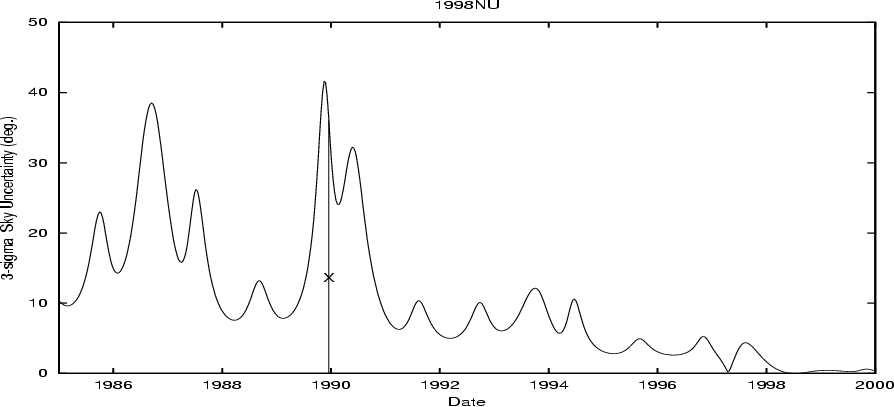
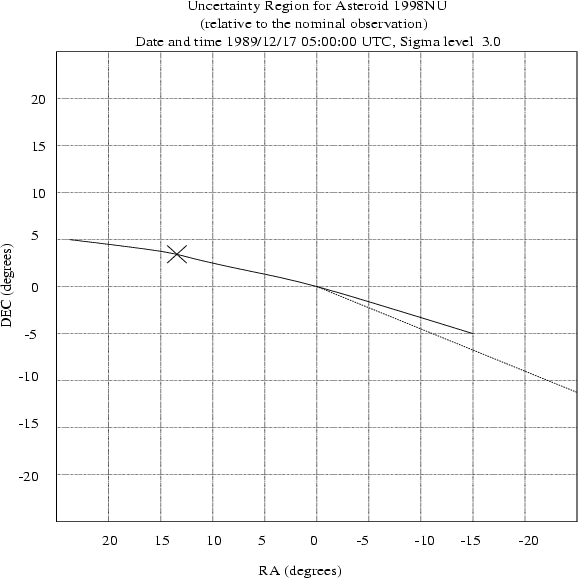
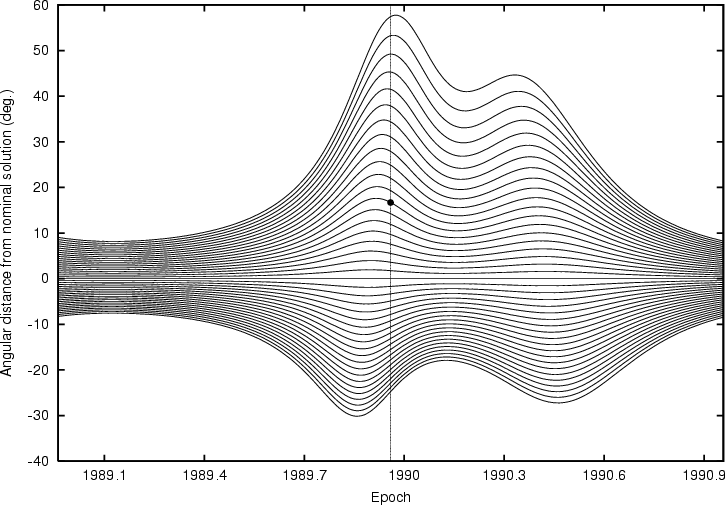
 0.4 magnitude from plate to plate.
 (lim)
(lim) (lim)
(lim) (lim)
(lim)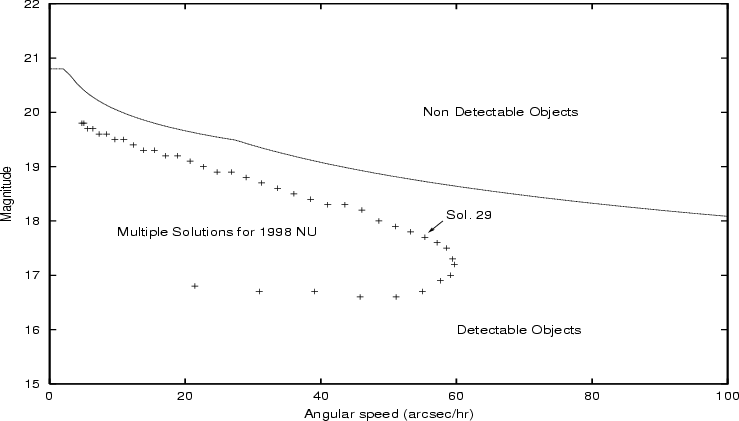
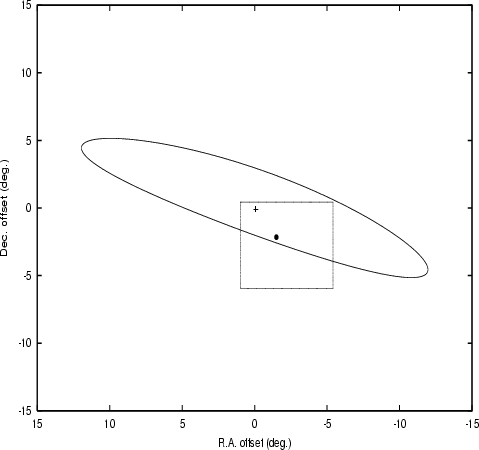
![\begin{figure}
\par\includegraphics[width=7.9cm,height=6.6cm,clip]{MS1372f6.eps}\end{figure}](/articles/aa/full/2001/31/aa1372/img40.gif)
![\begin{figure}
\par\includegraphics[width=8.2cm,height=6.8cm,clip]{MS1372f7a.eps}\par\includegraphics[width=8.2cm,height=6.8cm,clip]{MS1372f7b.eps}\end{figure}](/articles/aa/full/2001/31/aa1372/img42.gif)