 observations of the LMC compact H12pt14ptII region N11A
![[*]](/icons/foot_motif.gif)
A&A 372, 527-534 (2001)
DOI: 10.1051/0004-6361:20010504
observations of the LMC compact H12pt14ptII region N11AM. Heydari-Malayeri1
-
V. Charmandaris 2 -
L. Deharveng 3 -
M.R. Rosa 4,
-
D. Schaerer 5
-
H. Zinnecker 6
1 - DEMIRM, Observatoire de Paris, 61 avenue de l'Observatoire,
75014 Paris, France
2 -
Cornell University, Astronomy Department, 106 Space Sciences Bldg.,
Ithaca, NY 14853, USA
3 -
Observatoire de Marseille, 2 place Le Verrier, 13248 Marseille Cedex
4, France
4 -
Space Telescope European Coordinating Facility, European Southern
Observatory,
Karl-Schwarzschild-Strasse-2, 85748 Garching bei
München, Germany
5 -
Observatoire Midi-Pyrénées, 14 avenue E. Belin, 31400 Toulouse,
France
6 -
Astrophysikalisches Institut Potsdam, An der Sternwarte 16, 14482
Potsdam, Germany
Received 13 March 2001 / Accepted 28 March 2001
Abstract
We present a study of the LMC compact 2 region N11A using
Hubble Space Telescope imaging observations which resolve N11A
and reveal its unknown nebular and stellar features. The presence of
a sharp ionization front extending over more than 4'' (1 pc) and
fine structure filaments as well as larger loops indicate an
environment typical of massive star formation regions, in agreement
with high [O III]/H line ratios. N11A is a young region, as deduced
from its morphology, reddening, and especially high local
concentration of dust, as indicated by the Balmer decrement map. Our
observations also reveal a cluster of stars lying towards the central
part of N11A. Five of the stars are packed in an area less than
2'' (0.5 pc), with the most luminous one being a mid O type star.
N11A appears to be the most evolved
compact 2 region in the Magellanic Clouds so far studied.
line ratios. N11A is a young region, as deduced
from its morphology, reddening, and especially high local
concentration of dust, as indicated by the Balmer decrement map. Our
observations also reveal a cluster of stars lying towards the central
part of N11A. Five of the stars are packed in an area less than
2'' (0.5 pc), with the most luminous one being a mid O type star.
N11A appears to be the most evolved
compact 2 region in the Magellanic Clouds so far studied.
Key words: stars: early-type - ISM: dust, extinction - 2 regions - ISM: individual objects: N11A - galaxies: Magellanic Clouds
The giant 2 complex N11 (Henize 1956) or DEM34
(Davies et al. 1976) is the most luminous H source
in the Large Magellanic Cloud (LMC) after the famous 30 Doradus (Kennicutt
& Hodge 1986). Interestingly, N11 has been suggested to be
reminiscent of an evolved, some
source
in the Large Magellanic Cloud (LMC) after the famous 30 Doradus (Kennicutt
& Hodge 1986). Interestingly, N11 has been suggested to be
reminiscent of an evolved, some
 years older version of
the 30 Doradus starburst (Walborn & Parker 1992). Known also as
MC18 (McGee et al. 1972), it lies at the north-western
extremity of the LMC bar and consists of a dozen ionized nebulae
(named N11A to N11L) with several filaments surrounding a central
cavity (see Fig. 1 of Rosado et al.
1996). Almost the entire complex is contained
within a bubble
years older version of
the 30 Doradus starburst (Walborn & Parker 1992). Known also as
MC18 (McGee et al. 1972), it lies at the north-western
extremity of the LMC bar and consists of a dozen ionized nebulae
(named N11A to N11L) with several filaments surrounding a central
cavity (see Fig. 1 of Rosado et al.
1996). Almost the entire complex is contained
within a bubble  25
25
 '
(375
'
(375
 pc) in size created by stellar winds and
several supernova explosions (Meaburn et al. 1989; Rosado et al. 1996; Mac Low et al. 1998; Kim et al. 1999).
The complex harbors tens of hot stars at different stages of evolution
distributed in four OB associations, LH9, LH10, LH13, and LH14 (Lucke
& Hodge 1970).
pc) in size created by stellar winds and
several supernova explosions (Meaburn et al. 1989; Rosado et al. 1996; Mac Low et al. 1998; Kim et al. 1999).
The complex harbors tens of hot stars at different stages of evolution
distributed in four OB associations, LH9, LH10, LH13, and LH14 (Lucke
& Hodge 1970).
A considerable amount of work has been devoted to examining various properties of the whole complex. In particular, the physical properties of the components B (LH10), C (LH13), and D (LH14) and their massive star contents were studied by Heydari-Malayeri & Testor (1983 and 1985, hereafter Papers I and II), Heydari-Malayeri et al. (1987), Parker et al. (1992), Degioia-Eastwood et al. (1993), Heydari-Malayeri & Beuzit (1994), Parker et al. (1996), and Heydari-Malayeri et al. (2000). Parker et al. (1992) present an extensive spectral classification of some 70 O and B stars in the associations LH9 and LH10. The latter association, which powers N11B, is the largest and brightest component of the complex containing several young massive stars of type O3.
N11A (also known as IC2116, HD32279), to which this paper is
devoted, is a quite isolated ionized region situated north-east of
N11B (see Fig. 1 of Paper I). It is a fairly bright object with
V12.5 mag, and its size of 12'' makes it the
smallest and the most compact nebula in the complex. Using
ground-based narrow-band imaging and spectroscopy, in Papers I and II
we studied several physical characteristics of N11A
(emission spectrum, excitation, extinction, gas density, chemical
composition, abundances, etc.), and suggested that it is the most
excited ionized region of the complex. These observations indicated
that the excitation source has a
 44000 K, corresponding to
a mid-O type star. Israel & Koornneef (1991) also presented
infrared and IRAS photometry of N11A, and showed that it is a strong
near-IR source dominated by nebular emission.
44000 K, corresponding to
a mid-O type star. Israel & Koornneef (1991) also presented
infrared and IRAS photometry of N11A, and showed that it is a strong
near-IR source dominated by nebular emission.
N11A belongs to the class of the so-called high excitation blobs (HEBs) in the Magellanic Clouds. In contrast to the typical 2 regions of the Magellanic Clouds, which are extended structures spread over several minutes of arc on the sky and powered by a large number of hot stars, HEBs are very dense small regions usually 5'' to 10'' in diameter. At the distance of the Magellanic Clouds this corresponds to sizes of more than 50 pc for normal 2 regions and 1 to 3 pc for the blobs. They are also characterized by large amounts of local dust. HEBs are in fact created by very young massive stars just leaving their natal molecular cloud (see Heydari-Malayeri et al. 1999c for references).
In their study of N11A, Parker et al. (1992) used a method for removing the contribution of the surrounding nebular brightness in CCD images and found an embedded star with V=14.21 mag and two fainter neighbors (unpublished images). The presence of He II absorption lines in the spectrum of the brightest component (which they called LH10: 3264) confirmed as O the spectral type of the main exciting source, even though contamination by very strong nebular emission lines made possible to only restrict its subclass within the O3-O5V range. In this paper we use the excellent imaging power of the Hubble Space Telescope (HST) to resolve N11A and study the structure of the ionized gas as well as its stellar content. This allows us to present a clear picture of the compact ionized nebula and identify its exciting stars. Such information is essential for a better understanding of massive star formation, particularly in isolated, compact regions.
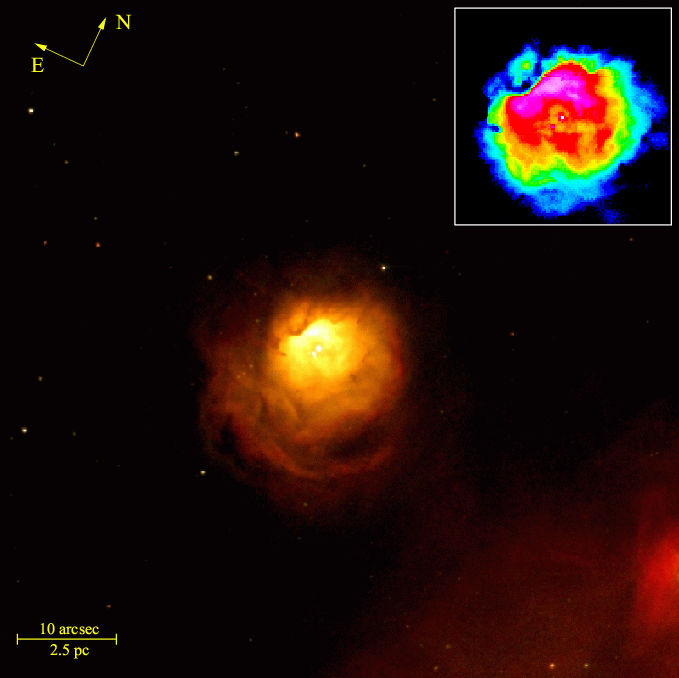 |
Figure 1:
A WFPC2 "true color'' image of the LMC compact 2 region
N11A created by combining images taken with the H
(red), [O III]
(green), and H
(blue) filters. The field size is
63
 '' (15 '' (15
 pc).
The nebulosity to the south-west belongs to the large
2 region N11B. The false-color image shows N11A in H. pc).
The nebulosity to the south-west belongs to the large
2 region N11B. The false-color image shows N11A in H.
|
| Open with DEXTER | |
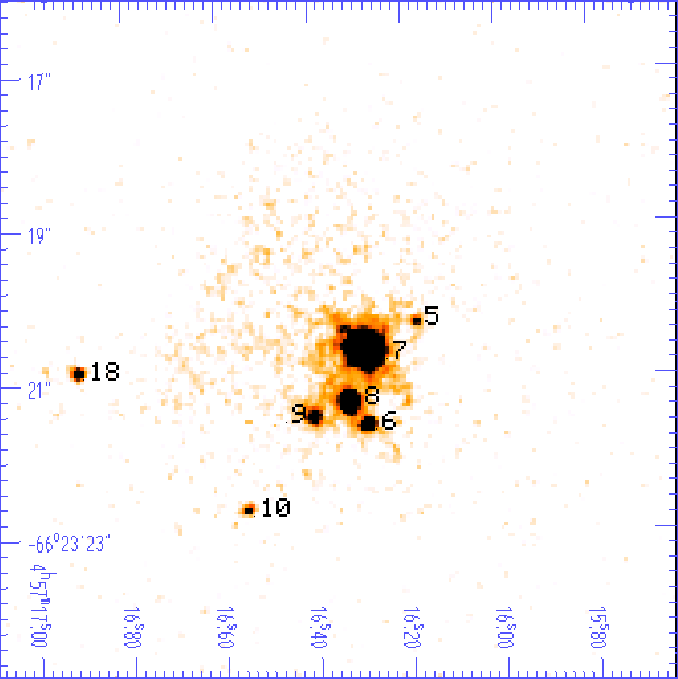 |
Figure 2:
The stellar content of the LMC compact 2 region
N11A as revealed by the Strömgren y image. The field size
8'' .8 8'' .8 (2.2pc2.2pc). 8'' .8 (2.2pc2.2pc).
|
| Open with DEXTER | |
The observations of N11A were performed as part of our project GO-8247 with the Wide Field Planetary Camera 2 (WFPC2) on board of the HST. The images taken with the broad-band filters (F300W, F467M, F410M, and F547M) were obtained on February 7, 2000. Centered on the Planetary Camera (PC), these images had as a goal to reveal the details of the stellar content of N11A. The narrow-band filter images (F487N, F503N and F656N) were obtained on May 21, 2000. In that case the target was centered on the WF2 which has larger pixels and lower noise than the PC CCD and is better suited for detecting faint nebular emission. Exposures were taken at 4 different pointings offset by 0'' .8 and the exposure times ranged from 10 to 300 s (see Table 1 for details).
| HST filter | Wavelength | Exposure time |
 (Å) (Å) |
(s) | |
| F300W (wide-U) | 2911 | 414=56 |
| F410M (Strömgren v) | 4090 | 450=200 |
| F467M (Strömgren b) | 4669 | 435=140 |
| F547M (Strömgren y) | 5479 | 410=40 |
| F487N (H) |
4866 | 4260=1040 |
| F502N ([OIII]) | 5013 | 4300=1200 |
| F656N (H) |
6563 | 4260=1040 |
The data were processed through the standard HST pipeline
calibration. Multiple images were co-added using the STSDAS
task imcombine, while cosmic rays were detected and removed with
the STSDAS task crrej. Normalized images were then
created using the total exposure times for each filter. To extract
the positions of the stars, the routine daofind was applied to
the images by setting the detection threshold to 5 above the local background level. The photometry was performed
setting a circular aperture of 3-4 pixels in radius in the daophot package in STSDAS.
above the local background level. The photometry was performed
setting a circular aperture of 3-4 pixels in radius in the daophot package in STSDAS.
A crucial point in our data reduction was the sky subtraction. For
most isolated stars the sky level was estimated and subtracted
automatically using an annulus of 6-8 pixel width around each star.
However, this could not be done for several stars located in the
central region of N11A due to their crowding. In those cases we
carefully examined the PSF size of each individual star (FWHM2 pixels, corresponding to 0'' .09 on the sky) and did
an appropriate sky subtraction using the mean of several nearby
off-star positions. To convert into a magnitude scale we used zero
points in the Vegamag system, that is, the system where Vega is set to
zero mag in Cousin broad-band filters. The magnitudes measured were
corrected for geometrical distortion, finite aperture size (Holtzman
et al. 1995), and charge transfer efficiency as recommended by
the HST Data Handbook. An additional correction to take into
account the long versus short photometric anomaly (Casertano &
Muchler 1998) was also applied. This increased the brightness of our
fainter stars by as much as 0.4 magnitudes but it had no measurable
effect on the brighter stars of the region.
We note that the filter F547M is wider than the standard Strömgren y filter. To evaluate the presence of any systematic effects in our photometry and color magnitude diagrams due to this difference in the filters, we used the STSDAS package synphot. Using synthetic spectra of hot stars, with spectral types similar to those found in 2 regions, we estimated the difference due to the HST band-passes to be less than 0.002 mag, which is well within the photometric errors.
Narrow-band H
and [O III] images obtained with ground-based
telescopes show N11B to be delineated at its eastern part by a sharp
ionization front (Paper I). In those images N11A appears as a
featureless blob situated 50'' (12 pc) east of the ionization
front.
The present HST observations resolve N11A into a very
bright core surrounded by a diffuse envelope of 8'' in
diameter (Fig. 1) and reveal several interesting nebular and
stellar features. A sharp ridge or front, extending over 4''
along the south-east to north-west direction, borders the core towards
north. Beyond the ridge the H
emission drops by about a factor of 10. A small cluster of five tightly packed stars are seen towards a
cavity in the central region (Fig. 2).
The small scale filamentary structures are best seen in
Fig. 3, which presents an un-sharp masking image of N83B in
H
from which large scale structures have been subtracted. In
order to remove these brightness variations and enhance the high
spatial frequencies, a digital "mask'' was created from the H
image. First, the H
image was convolved by a 22-pixel
Gaussian, and then the smoothed frame was subtracted from the original
H
image.
A map of the H/H
Balmer decrement is presented in
Fig. 4a. It reveals a strong absorption zone north of the
bright ridge, where the H/H
ratio reaches values as high as
5.5, while its mean value there is 4.5. Applying the
interstellar reddening law, these ratios correspond to
AV = 1.8and 1.3 mag respectively. Outside that area the ratio is smaller
with a mean value of 3.5 which corresponds to
AV = 0.6 mag.
| Star | RA (J2000) | Dec (J2000) | F300W | F410M | F467M | F547M | Color |
| Wide U | Strömgren v | Strömgren b | Strömgren y | b-y | |||
| 1 | 4:57:13.9 | -66:23:21.0 | 18.74 | 19.30 | 19.47 | 19.29 | +0.18 |
| 2 | 4:57:14.7 | -66:23:07.4 | 18.94 | 19.32 | 19.31 | 19.51 | -0.20 |
| 3 | 4:57:15.4 | -66:23:35.7 | 18.38 | 19.36 | 19.42 | 19.40 | +0.02 |
| 4 | 4:57:15.9 | -66:23:10.2 | 14.52 | 16.02 | 16.13 | 16.15 | -0.02 |
| 5 | 4:57:16.2 | -66:23:20.3 | - | - | - | 20.23 | - |
| 6 | 4:57:16.3 | -66:23:21.6 | 17.03 | 18.28 | 18.34 | 18.26 | +0.08 |
| 7 | 4:57:16.3 | -66:23:20.6 | 12.85 | 14.59 | 14.67 | 14.69 | -0.02 |
| 8 | 4:57:16.3 | -66:23:21.3 | 15.16 | 16.70 | 16.67 | 16.68 | -0.01 |
| 9 | 4:57:16.4 | -66:23:21.5 | 17.56 | 18.68 | 18.81 | 18.68 | +0.13 |
| 10 | 4:57:16.6 | -66:23:22.7 | 18.13 | 19.92 | 19.27 | 19.41 | -0.14 |
| 11 | 4:57:17.2 | -66:23:25.2 | 17.75 | 19.21 | 19.28 | 19.32 | -0.04 |
| 12 | 4:57:17.3 | -66:23:26.3 | 18.81 | 19.26 | 19.19 | 19.31 | -0.11 |
| 13 | 4:57:17.3 | -66:23:26.8 | 18.22 | 19.15 | 19.13 | 19.14 | -0.01 |
| 14 | 4:57:17.4 | -66:23:20.7 | 18.45 | 19.26 | 19.23 | 19.32 | -0.09 |
| 15 | 4:57:17.4 | -66:23:09.3 | 18.48 | 19.56 | 19.50 | 19.54 | -0.04 |
| 16 | 4:57:17.7 | -66:23:18.3 | 19.18 | 19.31 | 19.34 | 19.38 | -0.04 |
| 17 | 4:57:18.5 | -66:23:18.8 | 17.26 | 18.46 | 18.40 | 18.50 | -0.10 |
| 18 | 4:57:16.9 | -66:23:20.9 | 17.39 | 19.32 | 18.81 | 18.88 | -0.07 |
The [O III]5007/H
intensity map
(Fig. 4b) reveals a remarkably extended high-excitation
zone where the O++ ions occupy almost the same volume as H+.
The most excited area, though, surrounds the central stellar cluster,
with a mean ratio of 4.1, while the ratio reaches slightly
higher values in some pixels in the zone
lying between the sharp ridge and the
exciting stars. On average, the [O III]/H
is 3.7 over
the diffuse part of the nebula.
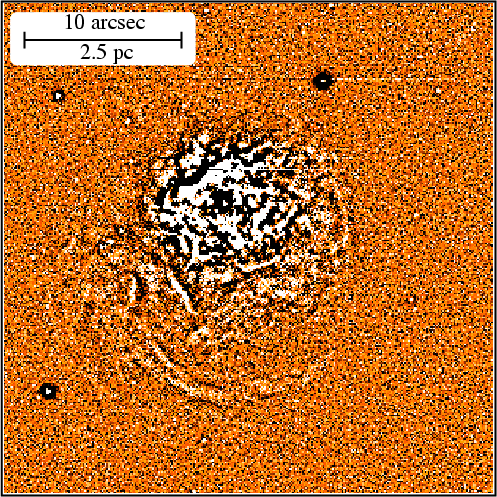 |
Figure 3:
An un-sharp masking image of N11A obtained
in H,
which highlights the filamentary patterns
of the nebula (see the text).
The field size is 30
 '' (7.5 '' (7.5
 pc),
and the orientation as in Fig. 1. pc),
and the orientation as in Fig. 1. |
| Open with DEXTER | |
/H
map, we can accurately correct the H
flux of
the 2 region for interstellar reddening on a pixel by pixel basis.
The total corrected flux is
F0(H)=
 erg cm-2 s-1above 3
level without the stellar contribution and accurate to
3%, if our extinction correction which assumes external dust is
verified. Supposing that the 2 region is ionization-bounded, the
corresponding Lyman continuum flux of the region is
erg cm-2 s-1above 3
level without the stellar contribution and accurate to
3%, if our extinction correction which assumes external dust is
verified. Supposing that the 2 region is ionization-bounded, the
corresponding Lyman continuum flux of the region is
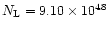 photons s-1. Similarly,
with the assumption of a homogeneous spherical nebula, a mean electron
density of 550 cm-3 can be derived from the H
flux, which
leads to an ionized hydrogen mass estimate of 54
photons s-1. Similarly,
with the assumption of a homogeneous spherical nebula, a mean electron
density of 550 cm-3 can be derived from the H
flux, which
leads to an ionized hydrogen mass estimate of 54 .
.
A single main sequence star of type O7.5 or O8 or several massive stars of later types can account for this ionizing photon flux (Vacca et al. 1996; Schaerer & de Koter 1997). However, this could clearly be an underestimate since the 2 region is more likely to be density-bounded almost in all directions except northward where lies the sharp ridge.
The automatic search routine daofind detected 18 stars in the WFPC2 field of N11A, all of them unambiguously present in the four stellar filters (Fig. 5) with their magnitudes ranging from y=14.69to 20.23. The photometry measurements for these stars are presented in Table 2, where the star numbers refer to Figs. 2 and 4.
Among these stars only seven are situated in the direction of N11A. A
small cluster of five stars, observed at the center of N11A (Fig. 2),
is obviously associated with this region. Star #7, with a ymagnitude of 14.69 is the main exciting star of the region, nearly 6
times more luminous than star
#8, the second brightest star, which is situated 0'' .7
to its south, and has a magnitude of y=16.68. Star #5
lying 0'' .8 to the north-east of #7 is the faintest member of the
sample. If this one is an exciting star, its faint magnitude
should be due to local reddening.
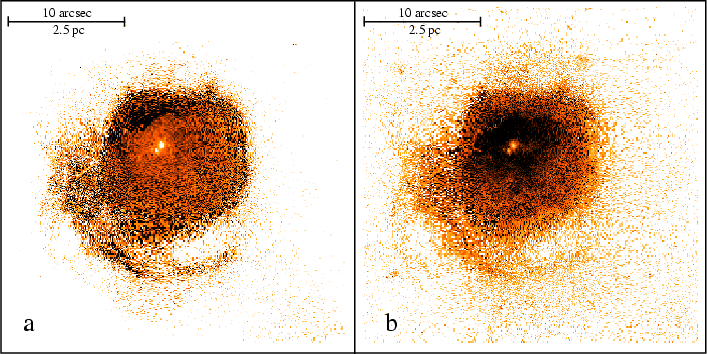 |
Figure 4:
Line intensity ratios for the LMC compact nebula
N11A. Darker colors correspond to higher ratio values. The field of
view and orientation are identical to Fig. 3. The white spots are
stars and can be identified using Fig. 2. a)
H/H
Balmer decrement. Its mean value over the diffuse component is
3.5 (AV=0.6 mag), while the ratio goes up to 5.5
(AV=1.8 mag) towards the darkest area north-east of the
exciting stars.
b) The [O III]5007/H
ratio. The mean value around the
stars is 4.1, while the highest
values reach 4.5 in the zone between the exciting stars and the
sharp ridge. |
| Open with DEXTER | |
 and M = 25 .
Parker et al. (1992) derived a more luminous exciting star with MV=-5.1 mag corresponding to an O6V type. The reason for this discrepancy is that they measure a V magnitude which is 0.48 mag brighter than our Strömgren y and also use a stronger visual extinction of AV = 0.8 mag. A magnitude offset of this type could be attributed to the fact that the exciting stars are tightly packed inside a very bright 2 region, making sky subtraction difficult.
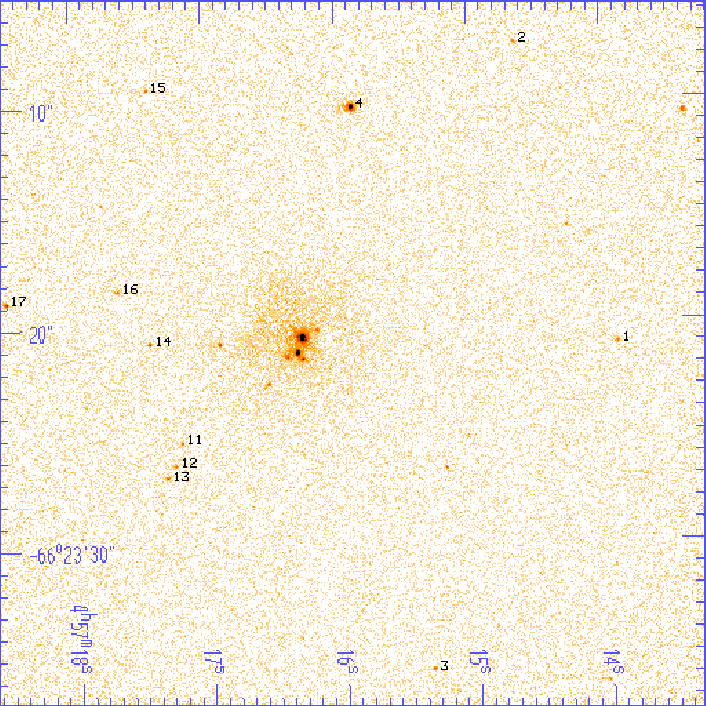 |
Figure 5:
A WFPC2 image showing the LMC compact 2 N11A and its
adjacent field in the Strömgren y filter (F547M) where the
brighter stars are labelled. A close-up image of the 2 region is
displayed in Fig. 2 and the photometry of the
stars is presented in Table 2. The field size is
32
 '' (8pc8pc), and the
coordinates are in J2000. '' (8pc8pc), and the
coordinates are in J2000. |
| Open with DEXTER | |
The total H
flux measured for N11A corresponds to a main exciting
source of spectral type O7.5-O8V. There are two major reasons, though,
which suggest that this estimate is a lower limit to the
power of the exciting star. One, as we mentioned earlier, is
the fact that the 2 region is most probably not fully
ionization-bounded and a fraction of the UV photons produced by the
star remain unaccounted for because they escape into the interstellar
medium. A second factor which contributes to underestimating the
H
flux is possibly an inadequate estimate of the extinction
correction, since the H
flux was corrected assuming only external
extinction. Otherwise, it is also probable that the region harbors
hotter undetected stars still embedded in the gas/dust concentrations.
The same exciting star was observed by Parker et al. (1992) who
estimated its spectral type as O6-O3V. The O3 type,
though, is uncertain because of contamination by the strong nebular
emission line of He I4471Å. Moreover, if an O3V star lies
inside N11A, one would expect an [O III]/H
ratio much higher than
that actually measured.
Ionization fronts in 2 regions, which represent the separation between the hot ionized gas and the photodissociation region, can appear differently according to their orientation with respect to the line of sight. The high resolution HST images reveal a sharp ridge north-east of the exciting stars which can be explained by the presence of such a front. The associated molecular cloud in which the stars of N11A formed must therefore be further to the north-east of that front, in agreement with the observation that the dust content increases significantly in that direction, as suggested by the higher values of the Balmer decrement. This result is supported by the CO (1-0) observations of the N11 complex (Israel & de Graauw 1991; Caldwell & Kutner 1996). The CO map shows that molecular emission comes from a zone surrounding the central cavity of N11 and has a long branch spreading in a north-east direction which passes by N11A. Although the spatial resolution of the CO map is much coarser than that of the present observations, there is little doubt about the relative position of the molecular cloud with respect to N11A.
The morphology of N11A is well accounted for by the champagne model (Tenorio-Tagle 1979; Bodenheimer et al. 1979). It corresponds to the evolutionary stage when the ionization front has reached the border of the molecular cloud. The central bright area (Fig. 1) is the cavity created in the molecular cloud by the ionizing photons of the stars, and the bright ridge is a part of the cavity situated along the line of sight. Dense ionized gas is pouring out of the cavity into the interstellar medium as shown by the presence of the outer diffuse component. Since the line of sight is slightly tilted with respect to the outflow axis, a part of the cavity and the associated external dust hides a portion of the 2 region and causes the higher extinction observed at its north-east side. The surrounding filamentary structure (Fig. 3) is probably created by the stellar winds from the central cluster acting on the dense ionized gas at the surface of the molecular cloud.
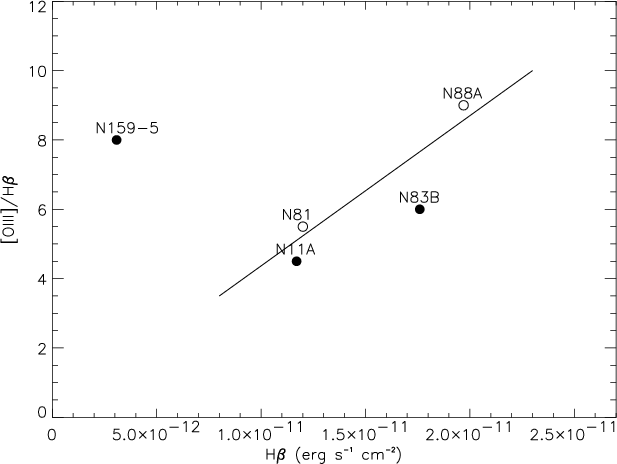 |
Figure 6:
The variation of the [O III](5007 Å)/H
ratio for the Magellanic
Clouds compact 2 regions with respect to their corresponding de-reddened
H
flux. The full dots denote the LMC regions and the empty dots SMC
ones. The line is simply indicative of the direction of the
correlation suggested by the models. |
| Open with DEXTER | |
fluxes and the
corresponding [O III](5007 Å)/H
ratios (Fig. 6). The motivation
for that is due to current photoionization models
of spherically symmetric 2 regions which suggest that the emission
line spectrum of the region depends on the effective
temperature of the star(s), the ionization parameter, and the gas
metallicity (Stasinska 1990; Stasinska & Leitherer
1996). The ionization parameter is defined as
 ,
where Q is the total number of ionizing photons with
energy above 13.6 eV, R the Strömgren radius, n the hydrogen
density, and c the speed of light. Models by Stasinska (1990)
show a linear correlation between
[O III]/H
and the H
flux for 2 regions with the same gas
density, the same number of exciting stars, but with increasing
effective temperatures. The reason for this relationship is that when
there are energetic UV photons available for producing high
[O III]/H
ratios, they also produce a large H
flux.
The models also show that lower metallicity environments favor higher
[O III]/H
ratios, but the metallicity dependence can be outweighed
by the ionization parameter.
,
where Q is the total number of ionizing photons with
energy above 13.6 eV, R the Strömgren radius, n the hydrogen
density, and c the speed of light. Models by Stasinska (1990)
show a linear correlation between
[O III]/H
and the H
flux for 2 regions with the same gas
density, the same number of exciting stars, but with increasing
effective temperatures. The reason for this relationship is that when
there are energetic UV photons available for producing high
[O III]/H
ratios, they also produce a large H
flux.
The models also show that lower metallicity environments favor higher
[O III]/H
ratios, but the metallicity dependence can be outweighed
by the ionization parameter.
Even though the real 2 regions are not ionization-bounded spheres,
and one should be careful when applying model results to observations;
the fact that HEBs have sizes which are of the same order of magnitude
provides a good opportunity for comparison. It is interesting that if
we exclude N159-5, the plot of Fig. 6 suggests that there is indeed a
linear relationship as predicted by the models. The reason for
discarding N159-5 is because we know (Heydari-Malayeri et al. 1999c)
that it is a very reddened region by both local and external dust, and
its discrepant position may be due to inadequate flux correction for
extinction in a manner similar to the one discussed at the beginning
of this section. If our reasoning is justified, then the measured
H
flux of N159-5 is underestimated by a factor of 5,
mainly due to the effect of internal dust whose properties
remain to be studied.
We also observe that among the HEBs studied,
SMC N88A is the most excited and LMC N11A the least excited. The
lower excitation of N11A may simply be due to the fact that it is
excited by a less massive, young star. It may also be the result of an
evolutionary effect, in the sense that the lower [O III]/H
may in
fact be the consequence of a smaller gas density caused by the
champagne outflow. From our previous HST observations we know
that SMC N88A is younger than SMC N81, since it is more compact, of
higher gas density, and more affected by dust so that its exciting
stars are still hidden inside the 2 region. The same holds for the
LMC objects, since N159-5 is associated with a much larger amount of
dust than N83B and N11A and is more compact compared to them.
One should keep in mind though, that
despite the compactness of N11A (and
HEBs in general) compared to typical extragalactic 2 regions, if it was
situated in our Galaxy, it would appear as a rather "classical'' 2
region
nearly 4 times smaller than the Orion
nebula. In fact, based on our new observation, it appears that N11A has
many similarities with Orion regarding its central exciting cluster, its
high excitation, a region of high extinction at the northern border
and the filamentary loops on the southern side.
Consequently, these small, high excitation, compact 2 regions found
in the Magellanic Clouds near locations where other giant 2
regions are present, are very interesting to study in order to better
understand massive star formation processes in more distant
galaxies.
Acknowledgements
We would like to thank the referee Dr. Joel Wm. Parker for his helpful comments. We are also grateful to Dr. Grazyna Stasinska for discussions. VC would like to acknowledge the financial support for this work provided by NASA through grant number GO-8247 from the STScI, which is operated by the Association of Universities for Research in Astronomy, Inc., under NASA contract 26555.