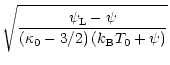
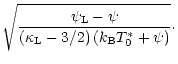
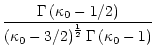
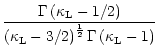
A&A 372, 686-701 (2001)
DOI: 10.1051/0004-6361:20010552
On the temperature profile and heat flux in the solar corona:
Kinetic simulations
S. Landi - F. G. E. Pantellini
Département de Recherche Spatiale, Observatoire de Paris-Meudon, 92195 Meudon Cedex, France
Received 29 January 2001 / Accepted 26 March 2001
Abstract
In the solar corona the collisional mean free path  for a thermal particle (electrons or protons) is of the
order of 10-2 to 10-4 times the typical scale of
variation H of macroscopic quantities like the density or
the temperature. Despite the relative smallness of the ratio
for a thermal particle (electrons or protons) is of the
order of 10-2 to 10-4 times the typical scale of
variation H of macroscopic quantities like the density or
the temperature. Despite the relative smallness of the ratio
 ,
an increasingly large number of authors have
become convinced that the heat flux in such a plasma
cannot be described satisfactorily by theories which suppose
that the local particle velocity distribution functions are
close to Maxwellian. We address this question
through kinetic simulations of the low solar corona
by assuming that non thermal velocity distribution functions
are present at the base of the corona. In particular, we show
that if one assumes that the electron velocity distribution functions
at the base of the corona have sufficiently strong
suprathermal power law tails, the heat flux may flow
upwards, i.e. in the direction of increasing temperature.
Using kappa velocity distribution functions as
prototypes for non thermal velocity distributions, we find
that the heat conduction can be properly described
by the classical Spitzer & Härm (1953)
law provided the kappa index is
,
an increasingly large number of authors have
become convinced that the heat flux in such a plasma
cannot be described satisfactorily by theories which suppose
that the local particle velocity distribution functions are
close to Maxwellian. We address this question
through kinetic simulations of the low solar corona
by assuming that non thermal velocity distribution functions
are present at the base of the corona. In particular, we show
that if one assumes that the electron velocity distribution functions
at the base of the corona have sufficiently strong
suprathermal power law tails, the heat flux may flow
upwards, i.e. in the direction of increasing temperature.
Using kappa velocity distribution functions as
prototypes for non thermal velocity distributions, we find
that the heat conduction can be properly described
by the classical Spitzer & Härm (1953)
law provided the kappa index is
 .
This value is
much smaller than the value previously found by Dorelli & Scudder
(1999). In addition we show that, unless
extremely strong power law tails are assumed near the base
of the corona (i.e.
.
This value is
much smaller than the value previously found by Dorelli & Scudder
(1999). In addition we show that, unless
extremely strong power law tails are assumed near the base
of the corona (i.e.
 ), a local heating
mechanism (e.g. waves) is needed to sustain the temperature gradient
between the base of the corona and the coronal temperature
maximum.
), a local heating
mechanism (e.g. waves) is needed to sustain the temperature gradient
between the base of the corona and the coronal temperature
maximum.
Key words: Sun: corona - methods: numerical - plasmas - conduction
In this paper we present results from a one dimensional
kinetic model of a semicollisional electron-proton plasma plunged in
a gravitational field. The model is especially suited for
stationary (not necessarily static) flows and for
Knudsen numbers
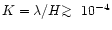 ,
where H is a typical
scale of variation of a macroscopic quantity, such as the density
or the temperature and
the distance between
two successive collisions of a typical particle in the system.
A simplified version of the model has previously been used
by Pantellini (2000) to simulate a one-species atmosphere
in a constant gravitational field.
As expected, the result was the formation
of a stratified isothermal atmosphere with
an exponentially decreasing density known as the barometric law.
The fact that the barometric law could be recovered
was the first confirmation of the fact that,
despite being one dimensional, the model
could correctly reproduce known results.
More recently, we implemented
a more sophisticated version of the model
to simulate an electron-proton plasma confined to the space
between two conducting plates held at different temperatures and
not subject to any external force (Pantellini & Landi 2000).
We could show that the thermoelectric field needed to ensure
quasi-neutrality in our simulation compares quite well
with results of Fokker-Planck calculations with
all possible interspecies collisions included (Spitzer & Härm 1953).
These encouraging results motivated us to use the model to
address the question of the heat flux in the solar corona.
,
where H is a typical
scale of variation of a macroscopic quantity, such as the density
or the temperature and
the distance between
two successive collisions of a typical particle in the system.
A simplified version of the model has previously been used
by Pantellini (2000) to simulate a one-species atmosphere
in a constant gravitational field.
As expected, the result was the formation
of a stratified isothermal atmosphere with
an exponentially decreasing density known as the barometric law.
The fact that the barometric law could be recovered
was the first confirmation of the fact that,
despite being one dimensional, the model
could correctly reproduce known results.
More recently, we implemented
a more sophisticated version of the model
to simulate an electron-proton plasma confined to the space
between two conducting plates held at different temperatures and
not subject to any external force (Pantellini & Landi 2000).
We could show that the thermoelectric field needed to ensure
quasi-neutrality in our simulation compares quite well
with results of Fokker-Planck calculations with
all possible interspecies collisions included (Spitzer & Härm 1953).
These encouraging results motivated us to use the model to
address the question of the heat flux in the solar corona.
The motivation for applying
the model to the solar corona stems from the fact that
observations suggest that above the transition region
the typical thermal Knudsen number
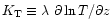 is of the order 10-3
or larger (e.g. Dupree 1972; Ko et al. 1997;
David et al. 1998; Fludra et al. 1999).
It has been demonstrated that such a value, despite being
much smaller than unity, is large enough for
the classical transport coefficients
(obtained by applying the Chapmann-Enskog formalism
to the Fokker-Planck equation) to become substantially modified
because of the presence of
high non thermal energy tails in the electron velocity
distribution functions (e.g. Shoub 1983;
Scudder 1992b).
Whence the necessity of using a numerical model
appropriate for the
solar atmosphere above the chromosphere-corona transition
region where high values of the thermal Knudsen number
is of the order 10-3
or larger (e.g. Dupree 1972; Ko et al. 1997;
David et al. 1998; Fludra et al. 1999).
It has been demonstrated that such a value, despite being
much smaller than unity, is large enough for
the classical transport coefficients
(obtained by applying the Chapmann-Enskog formalism
to the Fokker-Planck equation) to become substantially modified
because of the presence of
high non thermal energy tails in the electron velocity
distribution functions (e.g. Shoub 1983;
Scudder 1992b).
Whence the necessity of using a numerical model
appropriate for the
solar atmosphere above the chromosphere-corona transition
region where high values of the thermal Knudsen number
 10-3 are commonplace.
The difficulty with
the coronal plasma (and even for the solar wind plasma
out to distances of the order of astronomical units) is
that neither a collisionless model based on the Vlasov
equation nor a fluid model with Spitzer-Härm
transport coefficients provide a convenient framework
for investigation. Unfortunately, acceptance of the postulate of the
existence of non thermal electron velocity distributions in
the solar corona introduces an infinite number of
additional free parameters required to define
the distributions at the boundaries of the system.
However, it is
common practice to generalize the standard Maxwell-Boltzmann
velocity distribution function
using kappa distributions (see Eq. (18) below)
which have the substantial advantage of requiring one additional
free parameter only (the
10-3 are commonplace.
The difficulty with
the coronal plasma (and even for the solar wind plasma
out to distances of the order of astronomical units) is
that neither a collisionless model based on the Vlasov
equation nor a fluid model with Spitzer-Härm
transport coefficients provide a convenient framework
for investigation. Unfortunately, acceptance of the postulate of the
existence of non thermal electron velocity distributions in
the solar corona introduces an infinite number of
additional free parameters required to define
the distributions at the boundaries of the system.
However, it is
common practice to generalize the standard Maxwell-Boltzmann
velocity distribution function
using kappa distributions (see Eq. (18) below)
which have the substantial advantage of requiring one additional
free parameter only (the  index). Depending on the
value of the parameter
the distribution departs
more or less significantly from a Maxwell-Boltzmann
distribution due to the presence of a more or less large excess of
high energy particles. At least two studies have already
discussed the fate of electron kappa distributions in the solar
corona under the action of collisions.
Anderson (1994) shows that collisions
do strongly affect density and temperature profiles obtained
using Scudder's (1992b) collisionless
approach. After assuming that collisions do merely introduce first
order perturbations to the collisionless distribution function
he finds that the actual perturbations are of order unity or larger
showing that collisions need to be treated
self-consistently. To a certain extent this has been done
by Dorelli & Scudder (1999) who let
collisions affect the first order term of the Legendre
polynomial expansion of the electron distribution function
without assuming that this term was small but with the
assumption of all higher order terms being zero.
However, as we shall
demonstrate below, higher order Legendre terms cannot be
neglected. For example we find that collisions substantially
modify the collisionless temperature profile (this has been
observed by Anderson 1994, as well)
indicating that at least the second order Legendre term must
be retained in the expansion.
The approach of Lie-Svendsen et al. (1999)
is not substantially different from that of Dorelli & Scudder
(1999) since they also use
a first order truncated Legendre expansions for the electron
distribution function. According to
Chapman & Cowling (1970),
such a truncation is valid for
index). Depending on the
value of the parameter
the distribution departs
more or less significantly from a Maxwell-Boltzmann
distribution due to the presence of a more or less large excess of
high energy particles. At least two studies have already
discussed the fate of electron kappa distributions in the solar
corona under the action of collisions.
Anderson (1994) shows that collisions
do strongly affect density and temperature profiles obtained
using Scudder's (1992b) collisionless
approach. After assuming that collisions do merely introduce first
order perturbations to the collisionless distribution function
he finds that the actual perturbations are of order unity or larger
showing that collisions need to be treated
self-consistently. To a certain extent this has been done
by Dorelli & Scudder (1999) who let
collisions affect the first order term of the Legendre
polynomial expansion of the electron distribution function
without assuming that this term was small but with the
assumption of all higher order terms being zero.
However, as we shall
demonstrate below, higher order Legendre terms cannot be
neglected. For example we find that collisions substantially
modify the collisionless temperature profile (this has been
observed by Anderson 1994, as well)
indicating that at least the second order Legendre term must
be retained in the expansion.
The approach of Lie-Svendsen et al. (1999)
is not substantially different from that of Dorelli & Scudder
(1999) since they also use
a first order truncated Legendre expansions for the electron
distribution function. According to
Chapman & Cowling (1970),
such a truncation is valid for
 (weak inhomogeneity assumption)
but, as pointed out by Shoub
(1983)
and Anderson (1994),
(weak inhomogeneity assumption)
but, as pointed out by Shoub
(1983)
and Anderson (1994),
 is probably a more appropriate condition
for the first order truncated Legendre expansion to
remain a justified approximation,
especially in the case of non-thermal boundary conditions.
Unfortunately, 10-3 is
a typical value for the thermal Knudsen number
is probably a more appropriate condition
for the first order truncated Legendre expansion to
remain a justified approximation,
especially in the case of non-thermal boundary conditions.
Unfortunately, 10-3 is
a typical value for the thermal Knudsen number  in the corona and the weak inhomogeneity assumption may
be regarded as questionable.
Assuming much stronger temperature
gradients than the ones assumed in both the Dorelli & Scudder
(1999) paper and in the present work,
Lie-Svendsen et al. (1999)
argue that the classical Spitzer &
Härm (1953) heat flux adequately
describes the heat flux in the lower solar corona
if Maxwellian boundary conditions are chosen
at both ends of the simulated plasma slab.
All these Fokker-Planck based models
eventually are affected by additional limitations.
For example, Dorelli & Scudder
(1999) use the standard hydrostatic
equilibrium equation as a closure whereas,
following Shoub (1983),
Lie-Svendsen et al. (1999)
use a contestable zero-gravity pressure equilibrium condition.
We do not need such a fluid closure equation nor do we
require the velocity distribution functions to
be of any particular form.
However, the principal advantage of our model stems from the fact
that collisions are included self-consistently, even though
their treatment is strongly simplified with respect
to the complexity of collisions in a real plasma.
We are unable to evaluate precisely the importance of the
simplified treatment of the collisions on our results.
However, the very fact that the transport properties
measured in test simulations compare well with
those predicted by Fokker-Planck calculations
suggests that our simplified way of handling collisions
allows us to retain most of the essential physics
occurring in a non-magnetized plasma.
in the corona and the weak inhomogeneity assumption may
be regarded as questionable.
Assuming much stronger temperature
gradients than the ones assumed in both the Dorelli & Scudder
(1999) paper and in the present work,
Lie-Svendsen et al. (1999)
argue that the classical Spitzer &
Härm (1953) heat flux adequately
describes the heat flux in the lower solar corona
if Maxwellian boundary conditions are chosen
at both ends of the simulated plasma slab.
All these Fokker-Planck based models
eventually are affected by additional limitations.
For example, Dorelli & Scudder
(1999) use the standard hydrostatic
equilibrium equation as a closure whereas,
following Shoub (1983),
Lie-Svendsen et al. (1999)
use a contestable zero-gravity pressure equilibrium condition.
We do not need such a fluid closure equation nor do we
require the velocity distribution functions to
be of any particular form.
However, the principal advantage of our model stems from the fact
that collisions are included self-consistently, even though
their treatment is strongly simplified with respect
to the complexity of collisions in a real plasma.
We are unable to evaluate precisely the importance of the
simplified treatment of the collisions on our results.
However, the very fact that the transport properties
measured in test simulations compare well with
those predicted by Fokker-Planck calculations
suggests that our simplified way of handling collisions
allows us to retain most of the essential physics
occurring in a non-magnetized plasma.
Since the simulation model we use has never been described
in full, we shall devote the next section to
doing so. Non-essential details of the algorithm are presented in
Appendix A.
A brief discussion
of the differences and similarities between our model
and conventional Fokker-Planck models is given in
Appendix B.
The derivation of some
relevant quantities (density, temperature and heat flux)
for a collisionless plasma is given in
Appendix C.
A qualitative sketch of the model is shown in Fig. 1.
 |
Figure 1:
Schematic illustration of the model for a proton-electron
plasma plunged in a z aligned constant
gravitational field. The particles' velocities are 3D even though the model is
spatially 1D. E0 is a z aligned external electric field which
is generally needed to ensure local quasi-neutrality. In some cases
a constant electric field does not suffice for the system to be
neutral everywhere. In this case an additional small inter-particle
electric field is introduced (as shown on the left hand side
of the figure)
to compensate for these polarization effects. When two particles
encounter each other, they may collide as described in Sect.
2.3.
If a particle of species  hits one of the
two boundaries at z=0,L it is injected
back into the system according to prescribed velocity distributions
hits one of the
two boundaries at z=0,L it is injected
back into the system according to prescribed velocity distributions
 (cf. Sect. 2.4)
where vz is the particle's velocity along the z axis
and
(cf. Sect. 2.4)
where vz is the particle's velocity along the z axis
and  the absolute value of the particle's velocity
in a plane perpendicular to z.
the absolute value of the particle's velocity
in a plane perpendicular to z. |
| Open with DEXTER |
The model is based on the numerical integration of the one
dimensional motion (one space and three velocity components)
of N protons and N electrons plunged in a
constant gravitational field and an electric field
which is generally needed to ensure quasi-neutrality
everywhere in the system.
Particles are confined
to the interval
![$z\in [0,L]$](/articles/aa/full/2001/23/aa1074/img24.gif) by two conducting plates. Each time
a particle hits one of the plates, it is instantly reinjected
into the system according to a user defined prescription (e.g. elastic
reflection, contact with a heat bath, etc.).
Whenever the world lines of any two particles meet
they may (or not) make an elastic collision depending on the
magnitude of their relative velocity. The functional form
of the velocity-dependent collision probability
strongly influences the macroscopic behavior of the plasma
(cf. 2.3).
by two conducting plates. Each time
a particle hits one of the plates, it is instantly reinjected
into the system according to a user defined prescription (e.g. elastic
reflection, contact with a heat bath, etc.).
Whenever the world lines of any two particles meet
they may (or not) make an elastic collision depending on the
magnitude of their relative velocity. The functional form
of the velocity-dependent collision probability
strongly influences the macroscopic behavior of the plasma
(cf. 2.3).
Both the gravitational field acceleration  and the electric field
![$\vec{E}(z)=[E_0+\delta E(z)]\vec{\hat z}$](/articles/aa/full/2001/23/aa1074/img26.gif) are directed along the z axis so that the equation of motion
for a particle of species
can be written as
are directed along the z axis so that the equation of motion
for a particle of species
can be written as
| |
|
 |
(1) |
| |
|
 |
(2) |
where  and
and  are the charge and the mass of the
particles of species
(electrons or protons).
As can be seen on the left hand side of Fig. 1,
we assume that the electric field between
adjacent particles is constant, eventually increasing (decreasing)
discontinuously by an arbitrary amount
are the charge and the mass of the
particles of species
(electrons or protons).
As can be seen on the left hand side of Fig. 1,
we assume that the electric field between
adjacent particles is constant, eventually increasing (decreasing)
discontinuously by an arbitrary amount  at the position of each proton (electron) in the system
as if the particles where a succession of condensator plates attracting
or repulsing each other depending on the charges on each plate.
We then take the electrostatic field felt by a given particle
(or condensator plate) to be the mean of the electrostatic
field on either side of the particle.
Thus, if we number all the particles in the system from 1 (bottom particle)
to 2N (top particle) it follows that particle i feels the electrostatic
field
at the position of each proton (electron) in the system
as if the particles where a succession of condensator plates attracting
or repulsing each other depending on the charges on each plate.
We then take the electrostatic field felt by a given particle
(or condensator plate) to be the mean of the electrostatic
field on either side of the particle.
Thus, if we number all the particles in the system from 1 (bottom particle)
to 2N (top particle) it follows that particle i feels the electrostatic
field
 during the whole time interval
 until the earliest of the three possible collisions between
i and
until the earliest of the three possible collisions between
i and  and between i-1 and i-2. Note that only a collision
between particles of different charges may modify the topology of the
electrostatic field in the system, provided the interacting particles
exchange their relative position during the collision.
Since the electrostatic field is piecewise constant, we always
integrate Eq. (1) using a constant E field.
and between i-1 and i-2. Note that only a collision
between particles of different charges may modify the topology of the
electrostatic field in the system, provided the interacting particles
exchange their relative position during the collision.
Since the electrostatic field is piecewise constant, we always
integrate Eq. (1) using a constant E field.
2.2 The electric field
It is often possible to ensure a satisfactory charge
neutrality in the system without the need for an
interparticle electrostatic field .
In these cases,
the same constant external electric field E0 can be used for all
particles in the system. Particles do not feel each other. However,
in the general case, a constant electric field is not good enough,
as the plasma may behave like a dielectric medium, where
polarization effects are no longer negligible.
In that case, the Poisson equation must be written in the form
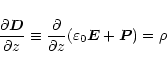 |
(3) |
where  is the charge density,
 the permittivity of
the vacuum,
the permittivity of
the vacuum,  the electric displacement and
  the polarization.
If
is negligible or (and) independent of z Eq. (3)
implies that the electric field
the polarization.
If
is negligible or (and) independent of z Eq. (3)
implies that the electric field  needed to ensure charge
neutrality (
needed to ensure charge
neutrality ( )
is a constant
)
is a constant
 .
This may be
the case when the density or temperature gradients in the system are small
(Pantellini & Landi 2000). In cases where polarization effects are not
negligible, a better charge neutrality can be obtained by introducing a
moderately strong interparticle electric field
as shown in
Fig. 1. Let Ei denote the electric field between particles
i and i-1 and let E0 be an external electric field, for example the
gravitoelectric field (Rosseland 1924).
Let us suppose
that the boundaries at z=0 and z=L are conducting. It is well known
that in this case a charged particle is
attracted by the boundary as if there was a particle of
opposite charge in the symmetric position behind the conductor.
In this case, it is easy to see that the electric field E1between the conducting wall at z=0 and particle number 1 as well as the
field Ei+1 above particle i must be given by
.
This may be
the case when the density or temperature gradients in the system are small
(Pantellini & Landi 2000). In cases where polarization effects are not
negligible, a better charge neutrality can be obtained by introducing a
moderately strong interparticle electric field
as shown in
Fig. 1. Let Ei denote the electric field between particles
i and i-1 and let E0 be an external electric field, for example the
gravitoelectric field (Rosseland 1924).
Let us suppose
that the boundaries at z=0 and z=L are conducting. It is well known
that in this case a charged particle is
attracted by the boundary as if there was a particle of
opposite charge in the symmetric position behind the conductor.
In this case, it is easy to see that the electric field E1between the conducting wall at z=0 and particle number 1 as well as the
field Ei+1 above particle i must be given by
We emphasize that to simulate a plasma,
should be taken to be small enough for
the electrostatic energy between neighboring particles
 (
( is a typical interparticle distance) to be much smaller
than the typical kinetic energy of the particles.
Otherwise particles of
opposite charge become bounded and form atoms.
is a typical interparticle distance) to be much smaller
than the typical kinetic energy of the particles.
Otherwise particles of
opposite charge become bounded and form atoms.
2.3 Collisions
A particle of the system shown in Fig. 1
can either collide with another particle or with one of the
two conducting walls at z=0,L.
The former is elastic, i.e. both total momentum and total energy of the
colliding particles are conserved while the latter is not, as the walls
reflect particles according to a prescribed velocity distribution function
regardless of the particles' velocities before the collision.
Let us discuss the case of a particle-particle collision first; we shall
come back to the particle-wall collision in Sect. 2.4.
Two particles may collide if they simultaneously occupy the
same position along the z-axis. During an elastic collision between two
particles (labeled 1 and 2) the velocity changes according to
the well-known rules (e.g. Landau & Lifshitz 1960)
where primed and unprimed velocities represent pre- and post-collision
velocities, respectively and
 .
We note that the orientation of the unity vector
.
We note that the orientation of the unity vector  in velocity space is not specified by the
requirement of the total energy (1 equation) and total momentum
(3 equations) to be conserved during the collision, as the
number of unknowns is 6 (the three velocity components for both particles).
Let us use spherical coordinates to define
the orientation of
in velocity space
with
in velocity space is not specified by the
requirement of the total energy (1 equation) and total momentum
(3 equations) to be conserved during the collision, as the
number of unknowns is 6 (the three velocity components for both particles).
Let us use spherical coordinates to define
the orientation of
in velocity space
with
 being the angle between
and
the z-axis and
being the angle between
and
the z-axis and
 the angle between the projection of in the (x,y) plane and the x axis. The question is: how shall
we choose the angles
and
for any
given collision in the system? Given the rotational symmetry of our system
around the z axis, it is quite natural to choose
according to a uniform probability distribution in the interval
the angle between the projection of in the (x,y) plane and the x axis. The question is: how shall
we choose the angles
and
for any
given collision in the system? Given the rotational symmetry of our system
around the z axis, it is quite natural to choose
according to a uniform probability distribution in the interval
 .
The answer is not as obvious concerning the angle
since
the system is not spherically symmetric. In the case of particles
of equal mass (Pantellini 2000) the probability
distribution for
is specified by the requirement that the system
(in its most simple configuration, e.g. without external forces
and with elastic boundary conditions)
must relax towards a stationary state where the
particle velocity distribution function is isotropic.
This condition implies the post-collision angle
should be chosen according to
(see Sect. IIC in Pantellini 2000)
.
The answer is not as obvious concerning the angle
since
the system is not spherically symmetric. In the case of particles
of equal mass (Pantellini 2000) the probability
distribution for
is specified by the requirement that the system
(in its most simple configuration, e.g. without external forces
and with elastic boundary conditions)
must relax towards a stationary state where the
particle velocity distribution function is isotropic.
This condition implies the post-collision angle
should be chosen according to
(see Sect. IIC in Pantellini 2000)
![\begin{displaymath}\theta^\prime = \arccos(\sqrt{P}),~
{\rm with}~ P={\rm random~number}\in[-1,1].
\end{displaymath}](/articles/aa/full/2001/23/aa1074/img57.gif) |
(8) |
It is straightforward to convince oneself that the same result
holds in the case of particles of unequal mass.
Now, even though the orientation of the
in Eqs. (6) and (7) must be chosen according
to the above probability distributions if one requires
the relaxed particle velocities to become distribute isotropically,
one is still free to decide whether or not two particles
which encounter each other effectively make a collision.
If one decides that there isn't a collision, the two particles
just go through each other without changing their
velocities. If one decides that there is a collision, we
compute the new velocities of the particles using
Eqs. (6)-(8) to determine .
In general, one is allowed to decide if two encountering particles collide
depending on the magnitude u of their relative velocity only.
The collision probability cannot depend on the
orientation of
as the relaxed state
would no longer be characterized by an isotropic velocity distribution.
 |
Figure 2:
Collision probability R for hard sphere type collisions
(solid line)
and for Coulomb type collisions (dashed line) as a function of the relative
velocity u. |
| Open with DEXTER |
Figure 2 shows two choices for the velocity
dependence of the collision probability R on the relative velocity
u. One may interpret R as the collisional cross-section.
Accordingly, we call the case R=1, where particles collide at
each encounter, the "hard spheres'' case and
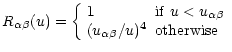 |
|
|
(9) |
the "Coulomb'' case.
In Eq. (9) the indices
and  indicate that one is considering collisions between a particle
of species
and a particle of species
(e.g. electron-electron, proton-electron, proton-proton).
indicate that one is considering collisions between a particle
of species
and a particle of species
(e.g. electron-electron, proton-electron, proton-proton).
A detailed comparison of the present model with other numerical models
based on the Fokker-Planck or the Boltzmann equation (e.g. Shoub
1992) is beyond the scope of the present paper.
Qualitatively speaking, the justification of the model
stems from the fact that the scattering cross-section
due to the cumulated effect of distant encounters
in a near-equilibrium plasma is proportional to
 (e.g. Chandrasekhar 1943). Accordingly, one may interpret
one collision in our model as representing the cumulated effect of
a large number of distant encounters in a real plasma.
Given that the most widely used (and best justified)
numerical model to simulate distant encounter
dominated plasma are Fokker-Planck models, we discuss
more thoroughly the relation between our model
and Fokker-Planck models in
Appendix B.
In the paper by Pantellini & Landi (2000) we
show that using cut-off
velocities
(e.g. Chandrasekhar 1943). Accordingly, one may interpret
one collision in our model as representing the cumulated effect of
a large number of distant encounters in a real plasma.
Given that the most widely used (and best justified)
numerical model to simulate distant encounter
dominated plasma are Fokker-Planck models, we discuss
more thoroughly the relation between our model
and Fokker-Planck models in
Appendix B.
In the paper by Pantellini & Landi (2000) we
show that using cut-off
velocities
 of the order of, or smaller than, the
typical relative velocity between
particles and
particles, our model gives results that compare well
with results from Fokker-Planck calculations.
of the order of, or smaller than, the
typical relative velocity between
particles and
particles, our model gives results that compare well
with results from Fokker-Planck calculations.
2.4 Boundary conditions
There are several ways of treating the problem
of a particle hitting one of the boundaries at z=0 and
z=L. One may, for example, let the particle
rebound elastically by simply changing the sign of the
z component of its velocity. In this case, total energy is
exactly conserved. However, neither temperature gradients nor
non-Max- wellian distribution functions can be simulated
in such a system.
Given that we are interested in situations where both
temperature gradients and non-Maxwellian distributions are
present, we shall use more sophisticated boundary conditions
allowing the injection of an arbitrary velocity distribution function.
The prescription is as follows.
Each time a particle of species
hits one of the boundaries, it is
reinjected into the system following a specified velocity
distribution function
 .
This implies that
in a stationary state, and apart from statistical
fluctuations, the bulk velocity along z must be zero
everywhere. We further
assume that particles are injected following isotropic
velocity distribution functions, i.e.
.
This implies that
in a stationary state, and apart from statistical
fluctuations, the bulk velocity along z must be zero
everywhere. We further
assume that particles are injected following isotropic
velocity distribution functions, i.e.
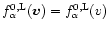 ,
where
,
where
 is the magnitude of the velocity of the injected particle.
Accordingly, the theoretical flux of particles
coming from the boundary with velocity
is the magnitude of the velocity of the injected particle.
Accordingly, the theoretical flux of particles
coming from the boundary with velocity  in the magnitude interval
![$[v,v+{\rm d}v]$](/articles/aa/full/2001/23/aa1074/img67.gif) and orientation
with respect to the z axis in the
range
and orientation
with respect to the z axis in the
range
![$[\theta,\theta+{\rm d}\theta]$](/articles/aa/full/2001/23/aa1074/img68.gif) is given by
is given by
This expression can be integrated separately for both the velocity v
and the angle  ,
leading to the probability distributions
Pv and
,
leading to the probability distributions
Pv and  of observing
a particle entering the system from the boundary at z=0
with velocity V<v and
in
in the range
of observing
a particle entering the system from the boundary at z=0
with velocity V<v and
in
in the range
![$[0,\theta]$](/articles/aa/full/2001/23/aa1074/img72.gif)
where we have suppressed the species index
for readability and where Av and
 are normalization constants such that
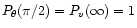 .
Thus, each time a particle hits the boundary at
z=0 it is reinjected following the probability distributions
(10) and (11). This requires that the expressions
(10) and (11) be
solved for
and v . For example, the angle
is obtained by computing
.
Thus, each time a particle hits the boundary at
z=0 it is reinjected following the probability distributions
(10) and (11). This requires that the expressions
(10) and (11) be
solved for
and v . For example, the angle
is obtained by computing
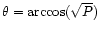 where
P is a random number in the range [0,1].
Similarly
v=P-1v(P) where P is again a random number in the range
[0,1] and where the function
P-1v is obtained by inverting
(in most cases numerically) Eq. (11).
Of course this procedure applies for both boundaries and all species.
where
P is a random number in the range [0,1].
Similarly
v=P-1v(P) where P is again a random number in the range
[0,1] and where the function
P-1v is obtained by inverting
(in most cases numerically) Eq. (11).
Of course this procedure applies for both boundaries and all species.
3 Results
In the present simulations we consider a thin layer of a fully ionized
electron-proton plasma plunged in a uniform gravitational field
 where
where  and
and  are the solar
mass and the solar radius, respectively while G is the universal
constant of gravitation.
are the solar
mass and the solar radius, respectively while G is the universal
constant of gravitation.
Following the reference paper by Dorelli & Scudder
(1999),
we assume typical temperatures and densities
at the z=0 boundary to be
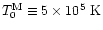 and
and
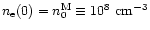 (we shall use these quantities for
normalization in the remaining of the paper).
The typical temperature gradient
between the two boundaries at z=0 and z=L
is of the order of
(we shall use these quantities for
normalization in the remaining of the paper).
The typical temperature gradient
between the two boundaries at z=0 and z=L
is of the order of
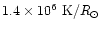 .
For a
system length
.
For a
system length
 this leads to
an upper boundary temperature
this leads to
an upper boundary temperature
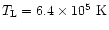 .
These parameters
correspond to a thermal Knundsen number
.
These parameters
correspond to a thermal Knundsen number
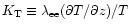 (T is the temperature and
 the mean free path for electron-electron
collisions) of the order 10-4 to 10-3,
which is typical for the low solar
corona in coronal holes
(e.g. Ko et al. 1997; David et al. 1998; Fludra et al. 1999).
The Fokker-Planck electron-proton collision
frequency for such a plasma is given by Eq. (B.11). The same
collision frequency is obtained in our simulation model if the number
of electrons (or protons) N is of the order
the mean free path for electron-electron
collisions) of the order 10-4 to 10-3,
which is typical for the low solar
corona in coronal holes
(e.g. Ko et al. 1997; David et al. 1998; Fludra et al. 1999).
The Fokker-Planck electron-proton collision
frequency for such a plasma is given by Eq. (B.11). The same
collision frequency is obtained in our simulation model if the number
of electrons (or protons) N is of the order
 (cf.
Appendix B),
which is therefore a typical value for all the
simulations presented in the paper.
(cf.
Appendix B),
which is therefore a typical value for all the
simulations presented in the paper.
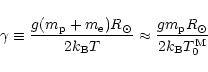
In order to reduce computational time a proton-to-electron mass ratio
 has been chosen for all simulations. This
can be done provided the relevant dimensionless parameter
has been chosen for all simulations. This
can be done provided the relevant dimensionless parameter
 |
(12) |
is chosen to be the same as in the real world, i.e.
 .
We note that
.
We note that  is the length
expressed in units of the isothermal scale height of the atmosphere.
Thus if one assumes protons to be less massive than
in the real world, one has to assume gravity g to be
stronger than in the real world (i.e. a fictitious Sun
more massive then the real Sun), so
as to ensure
remains unchanged.
On the other hand, as we
shall see below, a thermoelectric field
is the length
expressed in units of the isothermal scale height of the atmosphere.
Thus if one assumes protons to be less massive than
in the real world, one has to assume gravity g to be
stronger than in the real world (i.e. a fictitious Sun
more massive then the real Sun), so
as to ensure
remains unchanged.
On the other hand, as we
shall see below, a thermoelectric field  is needed to
ensure quasi-neutrality in a plasma with an imposed temperature gradient
(cf. Eq. (17)). Since
does not depend on the mass
of the particles, at least as long as
is needed to
ensure quasi-neutrality in a plasma with an imposed temperature gradient
(cf. Eq. (17)). Since
does not depend on the mass
of the particles, at least as long as
 ,
there is no reason to use the real mass ratio in the simulation, the
only requirement being the condition
.
,
there is no reason to use the real mass ratio in the simulation, the
only requirement being the condition
.
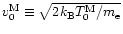
In simulations it is generally convenient to suitably normalize all
physical quantities. Thus, throughout the remainder of the paper, we
shall assume that velocities are normalized to
 ,
distances to the slab thickness L, time
intervals to
,
distances to the slab thickness L, time
intervals to
 ,
electric fields to
,
electric fields to
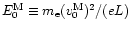 and heat fluxes to
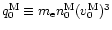 .
.
Distribution functions and moments are constructed
by regularly sampling positions and
velocities of the particles in the system.
In practice, we sample positions in bins of
width 0.03125 L and velocities in bins of
width of the order of 0.4 times the thermal velocity
of the given population.
In a typical simulation, 103 particles encounter some 1010times and the distribution functions are obtained by sampling
positions and velocities every 104 encounters. This sampling
interval is roughly the time it takes for a thermal proton to cross
the plasma slab, which is also an estimate of the time memory of the
system.
The just described procedure allows the construction
of density or heat flux profiles which are not yet
normalized. In order to do so one has to determine the
"real" number density (in
 )
somewhere in the system, for example at z=0.
This is impossible in a collisionless stationnary
and quasi-neutral system
where the absolute density is an arbitrary parameter
which can be eliminated from the equations (e.g.
from the Vlasov equation).
In a collisional system, however,
the number density is no longer an arbitrary parameter
given its intimate (roughly linear) connection with, for
example, the electron-proton collision frequency.
Thus, by recording the electron-proton collision
frequency somewhere in the system
(in units of
)
somewhere in the system, for example at z=0.
This is impossible in a collisionless stationnary
and quasi-neutral system
where the absolute density is an arbitrary parameter
which can be eliminated from the equations (e.g.
from the Vlasov equation).
In a collisional system, however,
the number density is no longer an arbitrary parameter
given its intimate (roughly linear) connection with, for
example, the electron-proton collision frequency.
Thus, by recording the electron-proton collision
frequency somewhere in the system
(in units of
 and thus in
 ), say at z=0, one can
determine the absolute density there, provided a
relationship between density and collision frequency
has been previously established in some way.
Such a relationship may have been
established experimentally by measuring the
collision frequency in a real Maxwellian plasma as a function
of temperature and density. As we shall discuss
below, and in
Appendix B,
we much more
pragmatically adopt the relationship provided by
a Fokker-Planck model. In brief, our strategy
goes as follows:
we choose a number of simulation particles N
such that the recorded collision frequency near z=0
corresponds to a typical Fokker-Planck collision
frequency for a plasma
with an electron (or proton) number density
n(0) of about
), say at z=0, one can
determine the absolute density there, provided a
relationship between density and collision frequency
has been previously established in some way.
Such a relationship may have been
established experimentally by measuring the
collision frequency in a real Maxwellian plasma as a function
of temperature and density. As we shall discuss
below, and in
Appendix B,
we much more
pragmatically adopt the relationship provided by
a Fokker-Planck model. In brief, our strategy
goes as follows:
we choose a number of simulation particles N
such that the recorded collision frequency near z=0
corresponds to a typical Fokker-Planck collision
frequency for a plasma
with an electron (or proton) number density
n(0) of about
 .
In practice we just ensure that the Knudsen number
in our simulation and in the solar corona
are the same, despite the fact that the number of
particles N in our system is ridiculously small
compared to the number of particles which populate the
solar corona. Fortunately, only 103 to
104 particles are required to simulate the corona.
A number
.
In practice we just ensure that the Knudsen number
in our simulation and in the solar corona
are the same, despite the fact that the number of
particles N in our system is ridiculously small
compared to the number of particles which populate the
solar corona. Fortunately, only 103 to
104 particles are required to simulate the corona.
A number
 would already require
a computational power well beyond present day
computer capabilities.
would already require
a computational power well beyond present day
computer capabilities.
In the following subsections we shall discuss the
behavior of a slab of solar corona for three
different kinds of boundary conditions.
The thickness of the slab L is taken to be either
 or
or
 .
The temperatures
(based on the second moment of the velocity
distribution function) of the boundaries are
adjusted to make the mean temperature and the
temperature gradient of the system compatible with
the previously prescribed plasma conditions. No energy sources
or sinks are present in the system. Energy is injected
at the boundaries in the form of kinetic energy of the
particles. The only way of transporting energy in the
system is through a collisional (or collisionless) heat
flux which means that all other means (e.g. radiation,
waves, internal energy of the particles) are excluded.
.
The temperatures
(based on the second moment of the velocity
distribution function) of the boundaries are
adjusted to make the mean temperature and the
temperature gradient of the system compatible with
the previously prescribed plasma conditions. No energy sources
or sinks are present in the system. Energy is injected
at the boundaries in the form of kinetic energy of the
particles. The only way of transporting energy in the
system is through a collisional (or collisionless) heat
flux which means that all other means (e.g. radiation,
waves, internal energy of the particles) are excluded.
The first subsection is devoted to the simulation of the
"classical'' case with thermalized (Maxwellian)
boundary conditions. We shall see that even in this
case the Spitzer and Härm heat flux (Spitzer & Härm 1953)
is not able to sustain the prescribed temperature gradient
over a distance larger than
or so.
In the second subsection we shall discuss the case
of non thermal velocity distribution functions
at the lower boundary. These simulations show
that the prescribed temperature gradient can be
sustained without local heating provided the number
of suprathermal particles is high enough. This number turns
out to be much higher than suggested in previous works
(e.g. Dorelli & Scudder 1999).
In the last subsection we briefly discuss the case
of both boundary conditions being non thermal. We consider
this case as rather unphysical as it supposes a source of
suprathermal particles somewhere above the
base depending on the position of the upper boundary.
We discuss this case mainly because in the collisionless
studies (e.g. Scudder 1992b) and in the
reference paper by Dorelli & Scudder
(1999) the nonthermal
distributions "survive", by construction, across the entire
slab of plasma.
 |
Figure 3:
Maxwell-Maxwell boundaries:
in the top panel the electron density (solid line) and the
temperature (dashed line) profiles are plotted. The dotted
profile in the top panel represents
the Spitzer-Härm temperature profile assuming a
spatially constant electron heat flux. The dark square on the right
indicates the temperature of the upper thermostat, i.e.
the temperature of the boundary at
 .
The bottom panel shows the proton and electron heat flux.
As expected, their relative strength is of the order .
The bottom panel shows the proton and electron heat flux.
As expected, their relative strength is of the order
 .
The Spitzer labeled
profile in the bottom panel has been computed via
Eq. (14) using the measured
electron temperature and density profiles. .
The Spitzer labeled
profile in the bottom panel has been computed via
Eq. (14) using the measured
electron temperature and density profiles. |
| Open with DEXTER |
For the simulations in this section
we impose Maxwellian distribution functions at the boundaries, i.e.
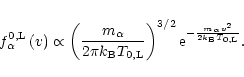 |
(13) |
The normalized temperature and density profiles
as well as both the electron and proton heat flux profiles are
shown in Fig. 3.
As expected, the electron to proton heat flux ratio is
roughly equal to
,
which means
that the energy is predominantly transported by
the electrons.
The dotted temperature profile in the upper panel has been
obtained by assuming that the electron heat flux
 between the two
boundaries is constant and that the heat flux is given by
the Spitzer & Härm formula (Spitzer & Härm 1953),
which under the above conditions can be approximated by
between the two
boundaries is constant and that the heat flux is given by
the Spitzer & Härm formula (Spitzer & Härm 1953),
which under the above conditions can be approximated by
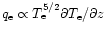 (cf. Eq. (14) and
Appendix B).
From the figure, it appears that
if the upper thermostat is located at a distance
of
from the surface,
the measured profiles are in good agreement with the
Spitzer-Härm predicted profiles, which seems to indicate
that a classical Spitzer-Härm heat flux can
sustain the given temperature profile up to a height of
without the need for
some sort of local heating mechanism (e.g. dissipation of MHD
waves).
However, before accepting this statement
as definitive, we have to ensure that the simulated
plasma has the characteristics of the coronal plasma. In
order to do so, we have to compute the "real" density
of the simulated plasma and compare it to the density of the
lower solar corona.
(cf. Eq. (14) and
Appendix B).
From the figure, it appears that
if the upper thermostat is located at a distance
of
from the surface,
the measured profiles are in good agreement with the
Spitzer-Härm predicted profiles, which seems to indicate
that a classical Spitzer-Härm heat flux can
sustain the given temperature profile up to a height of
without the need for
some sort of local heating mechanism (e.g. dissipation of MHD
waves).
However, before accepting this statement
as definitive, we have to ensure that the simulated
plasma has the characteristics of the coronal plasma. In
order to do so, we have to compute the "real" density
of the simulated plasma and compare it to the density of the
lower solar corona.
In a collisional plasma, the collision
frequencies depend on the density (the higher the density
the higher is the rate at which a particle undergoes
collisions). On the other hand,
the gravitational timescale
 does not depend
on density, which means that density is not just a free
parameter as in the collisionless case (cf.
Appendix C).
We may then estimate the "real" density of the simulated
system from the measured electron-proton collision
frequency.
The measured electron-proton collision frequency in the simulation is
approximately
does not depend
on density, which means that density is not just a free
parameter as in the collisionless case (cf.
Appendix C).
We may then estimate the "real" density of the simulated
system from the measured electron-proton collision
frequency.
The measured electron-proton collision frequency in the simulation is
approximately
 near the bottom
at z=0. This means that in the average an electron collides 717
times with a proton
during the time interval
near the bottom
at z=0. This means that in the average an electron collides 717
times with a proton
during the time interval
 .
Based on the measured
collision frequency we may now determine the (unknown) number density
n of the simulated plasma. In order to do so we
make a slight detour in the field of Fokker-Planck models
by observing that in Fokker-Planck models of a close
to equilibrium plasma, with temperature T, collision frequency
.
Based on the measured
collision frequency we may now determine the (unknown) number density
n of the simulated plasma. In order to do so we
make a slight detour in the field of Fokker-Planck models
by observing that in Fokker-Planck models of a close
to equilibrium plasma, with temperature T, collision frequency
 and density n are intimately connected
through Eq. (B.11) (cf.
Appendix B).
Thus, by using Eq. (B.10) with
and
setting
and density n are intimately connected
through Eq. (B.11) (cf.
Appendix B).
Thus, by using Eq. (B.10) with
and
setting
 in Eq. (B.11) we can estimate the density at the bottom
of our simulation region to be
in Eq. (B.11) we can estimate the density at the bottom
of our simulation region to be
 which is an acceptable value for the low solar corona.
Similarly, we may compare the electron heat flux observed
in our simulation with the
Fokker-Planck heat flux for a fully ionized electron-proton plasma
(e.g. Spitzer & Härm 1953)
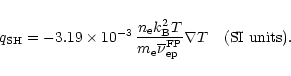 |
(14) |
Assuming, as above, that
with
 given by Eq. (B.10)
and taking the temperature gradient measured
in Fig. 3, one finds
given by Eq. (B.10)
and taking the temperature gradient measured
in Fig. 3, one finds
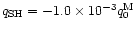 ,
which is in good agreement
with the heat flux
,
which is in good agreement
with the heat flux
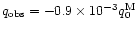 measured in the simulation.
We emphasize that even in the collisionless case
there is a heat flux flowing from the hot
(upper) to the cold (lower) boundary. The collisionless heat flux
 can be computed analytically by applying Liouville's theorem
(e.g. Landau & Lifshitz 1960)
to the electron and proton distributions in constant
gravitational and electric fields and subject to
the above-specified boundary conditions, i.e.
can be computed analytically by applying Liouville's theorem
(e.g. Landau & Lifshitz 1960)
to the electron and proton distributions in constant
gravitational and electric fields and subject to
the above-specified boundary conditions, i.e.
 with
with
 .
Given that the net particle flux
is zero, the neutralizing electric field is nothing but the
familiar gravitoelectric field (Rosseland 1924)
.
Given that the net particle flux
is zero, the neutralizing electric field is nothing but the
familiar gravitoelectric field (Rosseland 1924)
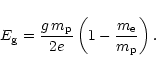 |
(15) |
In general, for Maxwell-Maxwell boundaries
the collisionless electron heat flux is
given by (see
Appendix C)
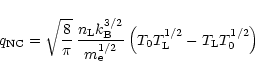 |
(16) |
where the electron density at the upper boundary  is
a complicated function of all other parameters,
which turns out to be
is
a complicated function of all other parameters,
which turns out to be
 for the present case.
In the particular case shown in Fig. 3 we
have
for the present case.
In the particular case shown in Fig. 3 we
have
 from which we obtain
a theoretical collisionless heat flux
from which we obtain
a theoretical collisionless heat flux
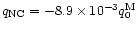 which is much stronger
a flux than either
which is much stronger
a flux than either
 or
or
 .
The collisionless heat flux is an upper limit for
the electron transported energy flux.
.
The collisionless heat flux is an upper limit for
the electron transported energy flux.
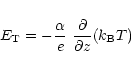
As already stated, in the collisionless regime  is
the charge neutralizing field. However, in the collisional regime
the total electric field is generally made of the sum of
and
the thermoelectric field (see e.g. Golant et al.
1980;
Hinton 1983)
is
the charge neutralizing field. However, in the collisional regime
the total electric field is generally made of the sum of
and
the thermoelectric field (see e.g. Golant et al.
1980;
Hinton 1983)
 |
(17) |
where
is a constant of order unity.
In our simulations,
lies in
the range 0.7 to 0.9 when
in Eq. (9) is smaller than the typical
relative velocity between particles of species
and
particles of species
(Pantellini & Landi 2000).
Fokker-Planck models including all kind of collisions
(electron-electron, electron-proton and proton-proton)
predict
 (Spitzer & Härm 1953).
The thermoelectric field required to ensure quasi-neutrality
in the simulation of Fig. 3
is
(Spitzer & Härm 1953).
The thermoelectric field required to ensure quasi-neutrality
in the simulation of Fig. 3
is
 ,
which is small (but not negligible)
compared to the gravitoelectric field
,
which is small (but not negligible)
compared to the gravitoelectric field
 .
.
The question one may now ask is whether the above
results depend on the position of the upper boundary
or not. Even if the exact position
of the temperature maximum is unknown it is likewise
located somewhere between 0.2 and
 above the
solar surface (e.g. Ko et al. 1997;
David et al. 1998).
Without going up to such heights
where the zero mass flux hypothesis may no longer be valid,
we may just ask the question of what happens if the upper
boundary is located at twice the distance, i.e.
above the
solar surface (e.g. Ko et al. 1997;
David et al. 1998).
Without going up to such heights
where the zero mass flux hypothesis may no longer be valid,
we may just ask the question of what happens if the upper
boundary is located at twice the distance, i.e.
 .
For coherence, the temperature of the upper
thermostat has been chosen to be such that the temperature
difference between the two thermostats is twice the
value in the first simulation.
The results are shown in Fig. 4.
Interestingly enough, they are not quite the same as
for the smaller system of Fig. 3.
One observes that the electron temperature
gradient is too weak to smoothly connect to the temperature
of the upper thermostat (dark square). The heat that flows
from the upper to the lower boundary is simply too weak to
sustain the prescribed temperature profile: a local heating
mechanism (waves?) is required in this case.
The lower panel also shows that the observed electron heat
flux is rather badly approximated by the
Spitzer-Härm heat flux formula Eq. (14), suggesting
that even in the most favorable case of Maxwellian boundary conditions,
Eq. (14) does not provide a sufficiently reliable
estimate of the thermal heat flux in the lower solar corona.
.
For coherence, the temperature of the upper
thermostat has been chosen to be such that the temperature
difference between the two thermostats is twice the
value in the first simulation.
The results are shown in Fig. 4.
Interestingly enough, they are not quite the same as
for the smaller system of Fig. 3.
One observes that the electron temperature
gradient is too weak to smoothly connect to the temperature
of the upper thermostat (dark square). The heat that flows
from the upper to the lower boundary is simply too weak to
sustain the prescribed temperature profile: a local heating
mechanism (waves?) is required in this case.
The lower panel also shows that the observed electron heat
flux is rather badly approximated by the
Spitzer-Härm heat flux formula Eq. (14), suggesting
that even in the most favorable case of Maxwellian boundary conditions,
Eq. (14) does not provide a sufficiently reliable
estimate of the thermal heat flux in the lower solar corona.
3.2 Kappa-Maxwell boundaries
 |
Figure 5:
Kappa-Maxwell boundaries
with  .
The top panel shows the density (solid
line) and the temperature (dashed line). Note that the
temperature of the left boundary is only .
The top panel shows the density (solid
line) and the temperature (dashed line). Note that the
temperature of the left boundary is only
 (instead of
 used in the Maxwellian
case of Fig. 3) to compensate for the strong
collisional heating of the plasma with height. The dashed
line reproduces the temperature profile of the
thermal boundaries case shown in Fig. 3.
The lower panel shows the heat flux profiles for
electrons and protons as well as the total heat flux
(protons + electrons). The collisionless electron heat flux
has been computed using Eq. (20).
Note that while the proton heat flows down the
temperature gradient (the "classical" behavior), the
opposite is true for the electrons.
used in the Maxwellian
case of Fig. 3) to compensate for the strong
collisional heating of the plasma with height. The dashed
line reproduces the temperature profile of the
thermal boundaries case shown in Fig. 3.
The lower panel shows the heat flux profiles for
electrons and protons as well as the total heat flux
(protons + electrons). The collisionless electron heat flux
has been computed using Eq. (20).
Note that while the proton heat flows down the
temperature gradient (the "classical" behavior), the
opposite is true for the electrons. |
| Open with DEXTER |
In this section we discuss a run with
Maxwellian boundary conditions at
z=L (as in the previous section) and
kappa velocity distribution functions
![\begin{displaymath}f_{\kappa}(v) =
A_\kappa\left[1+\frac{v^2}{\left(\kappa - 3/2\right)v_0^2}\right]^
{\displaystyle -\kappa - 1}
\end{displaymath}](/articles/aa/full/2001/23/aa1074/img142.gif) |
(18) |
with
as boundary condition at z=0.
In order to ensure energy equipartition among
species, we use the same
index for both protons and
electrons and a velocity v0 (reminiscent of the
thermal velocity in a Maxwellian distribution)
smaller for protons than for electrons.
The density and temperature profiles as well the vz distribution
profiles for electron and protons are shown in
Fig. 5 for the case .
The upper panel
shows that the temperature profile increases very rapidly away from
the lower boundary.
The rapid rise in temperature is not the manifestation
of the collisionless gravitational velocity filtration
mechanism first described by Scudder (1992a)
but is essentially due to collisional effects.
This can be demonstrated easily by estimating the
temperature gradient due to the
velocity filtration mechanism. According to
Scudder (1992a)
the latter is given by
where
 is the total potential energy of a particle
with
is the total potential energy of a particle
with
 being the gravitoelectric potential
energy (cf. Eq. (15)).
According to Eq. (19),
the temperature rises linearly with height
provided
being the gravitoelectric potential
energy (cf. Eq. (15)).
According to Eq. (19),
the temperature rises linearly with height
provided
 .
For
and
.
For
and
 one has
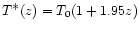 and at
z=0.3 the temperature should be
and at
z=0.3 the temperature should be
 only.
Such a temperature is well below the temperature
only.
Such a temperature is well below the temperature
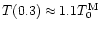 observed in the simulation (see Fig. 5)
from where we conclude
that velocity filtration is not the principal reason for the rapid
rise of the temperature profile inward from the z=0 boundary.
Indeed, the strong inward heating of the plasma
is neither due to
the gravitational field nor to the temperature gradient imposed
by the boundary conditions. The heating is essentially due
to the effect of collisions on the
velocity distribution
injected from the z=0 boundary. Of course the heating effect
decreases with increasing
and in the limit
observed in the simulation (see Fig. 5)
from where we conclude
that velocity filtration is not the principal reason for the rapid
rise of the temperature profile inward from the z=0 boundary.
Indeed, the strong inward heating of the plasma
is neither due to
the gravitational field nor to the temperature gradient imposed
by the boundary conditions. The heating is essentially due
to the effect of collisions on the
velocity distribution
injected from the z=0 boundary. Of course the heating effect
decreases with increasing
and in the limit
 (the Maxwellian case)
it disappears completely, as shown in Fig. 5.
Let us give a qualitative physical interpretation of the
strong temperature gradient near the kappa boundary.
If there were no collisions in the system,
a collisionless electron heat flux would flow from
the lower to the upper boundary (see Eq. (20)).
However, the
system is collisional and collisions do always act in the
sense of a reduction of the heat flux. This is clearly visible
in Fig. 5, where the electron heat
flux is seen to decreases inwards from the right hand boundary
over a distance of the order of 0.3L, inducing
a strong heating of the plasma over this
very same distance. Since protons become
thermalized much more rapidly than electrons, the former
carry energy in a "classical'' way, i.e. protons transport heat
down the temperature gradient against the electron heat
flux. We note that the total (proton + electron) heat flux is
constant despite the fact that this is not so for individual
species. Thus energy is transferred from electrons to protons
and vice versa.
(the Maxwellian case)
it disappears completely, as shown in Fig. 5.
Let us give a qualitative physical interpretation of the
strong temperature gradient near the kappa boundary.
If there were no collisions in the system,
a collisionless electron heat flux would flow from
the lower to the upper boundary (see Eq. (20)).
However, the
system is collisional and collisions do always act in the
sense of a reduction of the heat flux. This is clearly visible
in Fig. 5, where the electron heat
flux is seen to decreases inwards from the right hand boundary
over a distance of the order of 0.3L, inducing
a strong heating of the plasma over this
very same distance. Since protons become
thermalized much more rapidly than electrons, the former
carry energy in a "classical'' way, i.e. protons transport heat
down the temperature gradient against the electron heat
flux. We note that the total (proton + electron) heat flux is
constant despite the fact that this is not so for individual
species. Thus energy is transferred from electrons to protons
and vice versa.
This peculiar behavior of the plasma near a kappa boundary
does not show on the temperature
profiles in Fig. 2 of Dorelli & Scudder
(1999).
The difference is due to the restrictions imposed upon the general
shape of the electron velocity distribution functions
by Dorelli and Scudder. In their paper, the general form
of the electron velocity distribution function is
a first order truncated Legendre polynomial expansion. Thus,
at any given height z, the electron velocity distribution
is a superposition of an isotropic kappa distribution
function and an odd function of vz (the first order
correction) which does not affect the even moments of the
velocity distribution function so that
the temperature is by construction
determined by the zero order distribution only, i.e.
by the isotropic kappa distribution.
Our simulation shows that restricting the Legendre expansion
to the first order term only does not allow for a correct
description of the temperature profiles especially
for boundary conditions with low
indices.
However, as we shall see in the remainder of this section,
and in the next section, the unusual behavior
of the heat flux (unusual from a fluid point of view)
described by Dorelli & Scudder
(1999), remains qualitatively valid
for small values of .
The average total heat flux observed in our simulation is
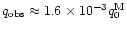 and is mainly carried
by the electrons (cf. Fig. 5).
The very fact that
and is mainly carried
by the electrons (cf. Fig. 5).
The very fact that
 means
that energy flows upwards, i.e. from the cold to the hot
thermostat. This may appear to be a surprising result as
it seems to contradict the second law of thermodynamics
(cf. the Introduction in Scudder 1992b).
However, the
behavior of our system can be described by the
Boltzmann equation with a particular scattering operator,
defined by the rules outlined in Sect. 2.3,
and must therefore obey Boltzmann's H-theorem
(Boltzmann 1872) and all fundamental laws of
thermodynamics.
means
that energy flows upwards, i.e. from the cold to the hot
thermostat. This may appear to be a surprising result as
it seems to contradict the second law of thermodynamics
(cf. the Introduction in Scudder 1992b).
However, the
behavior of our system can be described by the
Boltzmann equation with a particular scattering operator,
defined by the rules outlined in Sect. 2.3,
and must therefore obey Boltzmann's H-theorem
(Boltzmann 1872) and all fundamental laws of
thermodynamics.
As a guiding reference for future discussion, we compute the collisionless
electron heat flux
by applying Liouville's theorem
to the proton and electron velocity distribution functions
imposed by the boundary conditions at z=0,L and the constraint
of zero bulk velocity. Under these conditions, the charge-neutralizing
electric field is precisely the gravitoelectric field
given by Eq. (15).
Straightforward application of Liouville's theorem then
leads to
![\begin{displaymath}q_{\rm NC} = \sqrt{{8}\over{\pi}}\, \frac{n_{\rm L}k_{\rm B}^...
...a - 2}\right)T^
{\displaystyle\ast}_{\rm L} - T_{\rm L}\right]
\end{displaymath}](/articles/aa/full/2001/23/aa1074/img157.gif) |
(20) |
where the density
 is a complicated
function of the other parameters of the problem
(cf. Appendix C),
is a complicated
function of the other parameters of the problem
(cf. Appendix C),
 and
and  is a
dependent constant
is a
dependent constant
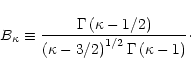 |
(21) |
With the parameters of the present simulation (i.e.
,
 )
one finds
)
one finds
 ,
and
,
and
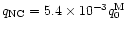 which, as expected, is stronger than the observed collisional
electron heat flux observed in the simulation
(Fig. 5).
However, the general behavior of the system is neither
that of a strongly collisional plasma with a Spitzer & Härm
heat flux (1953) nor
that of a collisionless plasma since the electron heat flux intensity is
both spatially variable and substantially smaller than the
collisionless value
.
which, as expected, is stronger than the observed collisional
electron heat flux observed in the simulation
(Fig. 5).
However, the general behavior of the system is neither
that of a strongly collisional plasma with a Spitzer & Härm
heat flux (1953) nor
that of a collisionless plasma since the electron heat flux intensity is
both spatially variable and substantially smaller than the
collisionless value
.
The vz velocity distributions for both electrons
and protons at z=0.5L are shown in
Fig. 6. From the figure it appears
that while the proton distribution is essentially Maxwellian,
the electron distribution has still substantial
suprathermal tails, particularly for large positive velocities
 .
The obvious reason is that the collisional cross section for
a suprathermal proton vs. thermal electron collision is only weakly
velocity dependent given that the relative velocity
is always approximately
.
The obvious reason is that the collisional cross section for
a suprathermal proton vs. thermal electron collision is only weakly
velocity dependent given that the relative velocity
is always approximately  ,
independent
of the proton's velocity.
Thus suprathermal protons are
efficiently thermalized by collisions with thermal electrons.
This is not so for a suprathermal electron since its velocity with
respect to either a thermal proton or a thermal electron is,
by definition, larger than .
Given that the collisional
cross section decreases as the forth power of the relative velocity it
then follows that the thermalization of the suprathermal electrons is much
less efficient than the thermalization of the suprathermal protons.
,
independent
of the proton's velocity.
Thus suprathermal protons are
efficiently thermalized by collisions with thermal electrons.
This is not so for a suprathermal electron since its velocity with
respect to either a thermal proton or a thermal electron is,
by definition, larger than .
Given that the collisional
cross section decreases as the forth power of the relative velocity it
then follows that the thermalization of the suprathermal electrons is much
less efficient than the thermalization of the suprathermal protons.
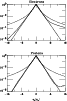 |
Figure 6:
Velocity distribution functions for kappa-Maxwell boundary conditions
()
at height z=0.5L for the case
shown in Fig. 5. Velocities have
been normalized to the local thermal velocity
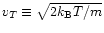 of the relevant species.
The dotted curves are Maxwellians normalized
to the local temperature and density. The
dashed curves are kappa distributions with
where n0 and v0
are determined by the local density and temperature (cf.
Eq. (18)).
of the relevant species.
The dotted curves are Maxwellians normalized
to the local temperature and density. The
dashed curves are kappa distributions with
where n0 and v0
are determined by the local density and temperature (cf.
Eq. (18)). |
| Open with DEXTER |
Let us conclude this section with a short discussion of the simulation in
the light of the Dorelli & Scudder (1999) model (we
shall call it the DS model). As already stated, there are some qualitative
similarities between the behavior of the plasma observed in our simulations
and the behavior of the plasma in their model. However, the very particular
form of the distribution function in the DS model implies that their
temperature profiles do differ significantly from ours.
As already stated, the difference stems from the
fact that in the DS model the just described collisional heating
near a kappa boundary is missing, essentially because by
construction the temperature in the DS model
is that of a
distribution function with the same
index throughout the whole plasma slab.
The reason for the DS temperature profile
not being the collisionless temperature profile is due to the fact that
their electric field (which has not been computed
explicitly by the authors) is not Rosseland's gravitoelectric field
(cf. Eq. (15)), which happens to be charge
neutralizing in the collisionless case
only.
Despite these substantial differences,
we do observe an upward-directed heat flux
for the
in accordance with the
DS model which predicts an upward directed heat
flux for
 .
.
 |
Figure 7:
Kappa-Maxwell boundaries
with .
The format of the figure is the same
as in Fig. 5. Note that the upper boundary
is located at
 and the temperature of the
upper thermostat is the same as for the
Maxwell-Maxwell case of Fig. 4.
Again, the temperature of the lower thermostat
is
,
as in Fig. 5. The dashed
line in the top panel reproduces the temperature profile for
the thermal boundary case of Fig. 4.
As in the shorter system of Fig. 5,
heat flows upward in the temperature gradient.
and the temperature of the
upper thermostat is the same as for the
Maxwell-Maxwell case of Fig. 4.
Again, the temperature of the lower thermostat
is
,
as in Fig. 5. The dashed
line in the top panel reproduces the temperature profile for
the thermal boundary case of Fig. 4.
As in the shorter system of Fig. 5,
heat flows upward in the temperature gradient. |
| Open with DEXTER |
How sensitive are the above results on the
rather arbitrary position of the upper boundary?
Figure 7 shows that
doubling the size of the system
and changing the temperature of the upper thermostat
accordingly does not change the
conclusions in a very substantial way. The main difference is that the
average temperature gradient is slightly reduced with respect to the
shorter system. As a consequence, the temperature of the
plasma near the upper boundary is clearly below the
prescribed temperature of the boundary (dark square on the figure).
Thus, even with a kappa index as small as
one has
to invoke a local heating mechanism
to sustain the prescribed temperature gradient up to the z=0.2 level.
For comparison, if the system was entirely collisionless,
the temperature near the upper boundary would be
as high as
 ,
i.e. above the
temperature of the boundary.
,
i.e. above the
temperature of the boundary.
 |
Figure 8:
Temperature
and density profiles for kappa-Maxwell boundary conditions.
Each profile corresponds to a different kappa index
ranging from
(dotted line) to
 (solid line). The heat flux associated with each profile
are shown in Fig. 10.
(solid line). The heat flux associated with each profile
are shown in Fig. 10. |
| Open with DEXTER |
The temperature profiles for different kappa indices
of the z=0 boundary distribution functions are plotted in
Figs. 8 and 9.
For each run the temperature of the z=0 boundary has been
adjusted to obtain equal mid-box temperatures and
temperature gradients. The collisional heating near
the z=0 boundary is clearly visible on all plotted profiles
except the
case. Figure 8
shows that if the upper boundary (the source of energy)
is located at
the system is able to sustain
the prescribed temperature profile independently of the
index. On the other hand,
Fig. 9 shows that
if the upper boundary is located at a height
the system is no longer able to sustain the
temperature gradient
unless some local heating is at work.
Indeed, all temperature profiles
reach the
level with a temperature which is clearly
below the value imposed by the boundary. We note in passing
that the steepening of the temperature profiles above
 is not due solely to the vicinity
of the hot boundary but also to the collisionless
gravitational velocity filtration.
The reason for the collisionless filtration to
become more efficient above
is that at such heights the density has become
extremely low (of the order 10-2 times the density
at z=0) and collisions much less effective
in thermalizing the electron distribution function
which still have suprathermal tails at a non
negligible level (cf. Fig. 6)
going into the heating via the collisionless
gravitational velocity filtration mechanism.
Of course gravitational filtration does not work in the
Maxwellian case, which is the reason for the temperature
to grow more slowly for
is not due solely to the vicinity
of the hot boundary but also to the collisionless
gravitational velocity filtration.
The reason for the collisionless filtration to
become more efficient above
is that at such heights the density has become
extremely low (of the order 10-2 times the density
at z=0) and collisions much less effective
in thermalizing the electron distribution function
which still have suprathermal tails at a non
negligible level (cf. Fig. 6)
going into the heating via the collisionless
gravitational velocity filtration mechanism.
Of course gravitational filtration does not work in the
Maxwellian case, which is the reason for the temperature
to grow more slowly for
 in
the Maxwellian case than in the
case (cf. Fig. 7).
in
the Maxwellian case than in the
case (cf. Fig. 7).
Even though the temperature and density profiles appear to be quite similar
over the major part of the simulation domain
for all cases shown in Figs. 8 and
9, the transport properties
are different. This is particularly evident for the heat flux.
 |
Figure 10:
Heat flux measured in the simulations for
kappa-Maxwell boundaries shown in Fig. 8.
Solid line represents the Spitzer-Härm value
for the Maxwell-Maxwell case (cf. Fig. 3). |
| Open with DEXTER |
In Fig. 10 are plotted the values of the
total heat flux observed in the simulations
for different values of the kappa index.
The horizontal solid line represents the
total heat flux for the Maxwell-Maxwell boundaries case,
i.e. the classical Spitzer & Härm (1953) heat flux
for the given temperature gradient and plasma parameters.
For the kappa-Maxwell simulations, the energy
flows depend sensitively on ;
for
 the heat flux is positive and flows from
the cold to the hot boundary. For
the heat flux is positive and flows from
the cold to the hot boundary. For  the heat flux is
negative but its intensity is still significantly
smaller than the classical Spitzer-Härm value. For
the heat flux is
negative but its intensity is still significantly
smaller than the classical Spitzer-Härm value. For
 the heat flux is essentially
Spitzer-Härm.
The index
the heat flux is essentially
Spitzer-Härm.
The index
 below which the energy flows in the
upward direction can be determined in the collisionless
limit using Eq. (20) and the
condition
below which the energy flows in the
upward direction can be determined in the collisionless
limit using Eq. (20) and the
condition
 from where one obtains
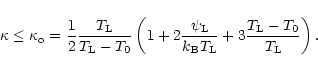 |
(22) |
Plugging the parameters of the above simulations
into Eq. (22) one finds
 which is significantly
larger than the value we find in Fig. 10.
We conclude by noting that in the
DS model, reversal occurs for
which is significantly
larger than the value we find in Fig. 10.
We conclude by noting that in the
DS model, reversal occurs for
 which is
also the value for which the collisionless heat flux
reverses in the kappa-kappa case (see Eq. (24) below).
Our simulations indicate that the effect of collisions
on both the heat flux and the temperature profile
is much stronger than suggested by the DS model.
which is
also the value for which the collisionless heat flux
reverses in the kappa-kappa case (see Eq. (24) below).
Our simulations indicate that the effect of collisions
on both the heat flux and the temperature profile
is much stronger than suggested by the DS model.
3.3 Kappa-kappa boundaries
In this section we briefly discuss the case where the
velocity distribution functions are
kappa at both boundaries z=0 and z=L.
The collisionless electron heat
flux
can be computed analytically using the
general expressions given in
Appendix C
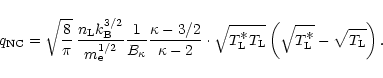 |
(23) |
As for the kappa-Maxwell case, one can determine the
limiting value
 below which heat flows
in the direction of the temperature gradient
by setting
in Eq. (23).
The result is
below which heat flows
in the direction of the temperature gradient
by setting
in Eq. (23).
The result is
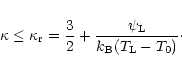 |
(24) |
For the parameters we use (which are the
same as in the Dorelli & Scudder 1999, paper)
one finds
 which, of course, is precisely the value predicted by
the DS model.
Indeed, the main effect of collisions in the DS model is to
reduce the intensity of the heat flux, not its sign.
We note that
is always smaller than
the heat flux reversal value
found
in the kappa-Maxwell case by an amount
which, of course, is precisely the value predicted by
the DS model.
Indeed, the main effect of collisions in the DS model is to
reduce the intensity of the heat flux, not its sign.
We note that
is always smaller than
the heat flux reversal value
found
in the kappa-Maxwell case by an amount
 .
This difference is due
to the fact that heat flows more
easily up the temperature gradient if there is no
downward-directed suprathermal tail due to
the kappa boundary condition at z=L.
.
This difference is due
to the fact that heat flows more
easily up the temperature gradient if there is no
downward-directed suprathermal tail due to
the kappa boundary condition at z=L.
We have opted not to present simulations with
kappa-kappa boundary conditions for two reasons.
The main reason is that from a conceptual point of view
it does not make much sense to suppose that there
is a generator of kappa distributions located
at an arbitrary height L above the coronal base.
How shall one choose this point? What is the
most appropriate value of the kappa index there?
Our approach consists of assuming that there is a
mechanism (e.g. shocks) capable of generating
suprathermal tails at the base of the corona, i.e.
at a natural boundary of the
solar atmosphere. This is not so for the
fictitious upper boundary we suppose to be located
at
(following Dorelli & Scudder
1999) or
,
given that the
solar corona extends out to distances
of the order of many tens of AU.
Also, given the strong collisionality of the system,
we found the choice of the Maxwellian distribution
to be the most natural one (or the less artificial one).
Simulations with a kappa boundary located at much larger
distances, where the wind is supersonic and essentially collisionless,
may be realistic as non thermal distributions
are systematically observed there.
Such simulations may become possible in the near future.
We conclude this section by noting that in the DS model
the lower and the upper boundary conditions are not
independent of each other, as the zero order
distribution function is supposed to be a kappa
distribution, with the same index ,
in all points of the system. The constant kappa
index assumption in the DS model
finds its justification in the fact that
the kappa index is known to remain unchanged
in the collisionless case (Scudder 1992a).
As a consequence, the above discussion on the choice of
the upper boundary condition for our simulation
is irrelevant in the DS model where the two
boundaries cannot be treated separately
due to the constant constant kappa index assumption.
There we summarize the most important aspects arising
from our simulations. First of all, as already
suggested by other authors, it appears that due to their
rapid thermalization, on a scale much shorter than the
density or temperature scale of height, proton velocity
distributions are close to Maxwellian in the solar corona.
Unless some nonthermal local ion acceleration mechanism
(e.g. some kind of magnetic turbulence) is at work, the Spitzer
& Härm (1953)
theory provides a good description of the proton
transport properties in the corona. This seems not to be
the case for the electron velocity distributions which, if
not Maxwellian at a given height (at z=0 in the
simulation), remain non Maxwellian over distances greater
than the scale of height of macroscopic quantities. More
specifically, if the electron velocity distributions have
suprathermal tails, there is no hope for the Spitzer-Härm
theory to provide the correct value of the electron heat
flux. On the other hand, heat flux density and temperature
profiles cannot be described by Scudder's collisionless
model either (Scudder 1992a). This has been
demonstrated by Anderson (1994), who also
showed that the effect of collisions on the velocity
filtration model is not a minor effect, which means that
linearized collisional operators are inadequate for the
description of the transport properties in the corona.
Dorelli & Scudder (1999) tried to
overcome this difficulty by expanding kappa distributions in
terms of Legendre polynomials. This approach has the
advantage of not requiring the first order Legendre term
f1 to be small compared to the zero order term f0.
However, the limitation of the development to the first
order term only turns out to be too restrictive because of
the strong up-down anisotropy of the problem. In particular,
the temperature profiles cannot be conveniently described
using a Legendre expansion truncated after the first order
term, given that the latter does not directly contribute to
the temperature. This is not very surprising. Anderson
(1994) already suggested that the
collisionless temperature profile is strongly modified by
collisions (see Fig. 4 in his paper). Here we show that the
collisionless temperature profiles of kappa distributions are
strongly modified by collisions and
that the effect is strongest close to the boundaries where
the kappa distributions are
artificially maintained (the z=0
boundary in our simulations). The simulations show
that the collisional heating of the plasma near a kappa
boundary increases with decreasing kappa index. The
scale height of the collisional heating is determined
by the relaxation length of the electron velocity
distribution function, which for coronal plasma conditions
is much shorter than the assumed temperature
scale height
![$[(\partial T/\partial z)/T]^{-1}
\approx 0.4 ~R_{\odot}$](/articles/aa/full/2001/23/aa1074/img192.gif) .
The heating of a plasma
near a kappa boundary could not be observed by Dorelli &
Scudder (1999) due to the limited
impact on the temperature that collisions are allowed to have
in their model. One of the key points of the DS model
was to show that the predictions of the collisionless
gravitational velocity filtration model (Scudder 1992a)
for the corona are only weakly modified by collisions.
For example, for a given coronal temperature gradient,
heat flux reversal occurs at the same kappa value
whether collisions are included or not, the only
effect of collisions being a reduction of the heat flux
intensity. In reality, the effect of collisions on the
collisionless results happens to be much more destructive than
suggested by the DS model. We find that in the coronal
plasma, heat flux reversal already occurs at
.
The heating of a plasma
near a kappa boundary could not be observed by Dorelli &
Scudder (1999) due to the limited
impact on the temperature that collisions are allowed to have
in their model. One of the key points of the DS model
was to show that the predictions of the collisionless
gravitational velocity filtration model (Scudder 1992a)
for the corona are only weakly modified by collisions.
For example, for a given coronal temperature gradient,
heat flux reversal occurs at the same kappa value
whether collisions are included or not, the only
effect of collisions being a reduction of the heat flux
intensity. In reality, the effect of collisions on the
collisionless results happens to be much more destructive than
suggested by the DS model. We find that in the coronal
plasma, heat flux reversal already occurs at
 .
For ,
the heat flux is already
of the Spitzer-Härm type whereas the DS model predicts
strong departures from the classical heat conduction
even for
.
For ,
the heat flux is already
of the Spitzer-Härm type whereas the DS model predicts
strong departures from the classical heat conduction
even for
 .
Our simulations also
suggest that velocity filtration alone is not capable
of sustaining the assumed coronal temperature gradient of
unless
.
This means
that unless some extremely intense source of suprathermal
electrons exists near the base of the corona some
local heating mechanism (e.g. waves) has to be at work between the
base of the corona and the coronal temperature maximum,
which we assume to be at a height
.
Our simulations also
suggest that velocity filtration alone is not capable
of sustaining the assumed coronal temperature gradient of
unless
.
This means
that unless some extremely intense source of suprathermal
electrons exists near the base of the corona some
local heating mechanism (e.g. waves) has to be at work between the
base of the corona and the coronal temperature maximum,
which we assume to be at a height
 .
Thus, gravitational velocity filtration may be capable
of sustaining the observed temperature gradient
without substantial heating, provided electron
distributions near the coronal base
have strong suprathermal tails.
Even if present observations
of the corona do not allow us to exclude the presence of
strongly non thermal electron distributions at low altitudes,
it seems hard to imagine a mechanism (e.g. Fermi
acceleration, Fermi 1954) capable of sustaining such
distributions given the high collisionality of the
plasma. The conclusion would eventually be different if kappa
distributions were injected into the system from the top,
i.e. from the solar wind where non thermal electron velocity
distributions are commonplace. However, this is much more general
problem which cannot be treated in zero mass flux and plane
parallel approximation used in this paper.
.
Thus, gravitational velocity filtration may be capable
of sustaining the observed temperature gradient
without substantial heating, provided electron
distributions near the coronal base
have strong suprathermal tails.
Even if present observations
of the corona do not allow us to exclude the presence of
strongly non thermal electron distributions at low altitudes,
it seems hard to imagine a mechanism (e.g. Fermi
acceleration, Fermi 1954) capable of sustaining such
distributions given the high collisionality of the
plasma. The conclusion would eventually be different if kappa
distributions were injected into the system from the top,
i.e. from the solar wind where non thermal electron velocity
distributions are commonplace. However, this is much more general
problem which cannot be treated in zero mass flux and plane
parallel approximation used in this paper.
Appendix A: The algorithm
The structure of the algorithm for advancing the particles of the system of
Fig. 1 during a given time interval is very similar to
the algorithm described in Pantellini (2000) for the
case of hard sphere particles of equal mass and no charge.
The main difference is that the presence of an
electric field makes the integration of the equations of motion slightly
more complicated (not all particles feel the same acceleration).
In addition, a non negligible fraction of the simulation time
must be spent in computing the charge-neutralizing
electric field.
The algorithm can be summarized as follows:
- 1.
- Initialize the velocities
 and the positions
 of N protons and N electrons. Order the particles
based on their height such that
0<z1<z2<...<z2N<L.
Make an initial guess for the external electric field E0
and eventually choose a non zero value for the variable
(cf. Eqs. (4) and (5)) if polarization effects
are expected to be important;
of N protons and N electrons. Order the particles
based on their height such that
0<z1<z2<...<z2N<L.
Make an initial guess for the external electric field E0
and eventually choose a non zero value for the variable
(cf. Eqs. (4) and (5)) if polarization effects
are expected to be important;
- 2.
-
Determine for each pair of neighboring particles, with indices
i and i-1 and for
 ,
the time interval
until their next collision. If particle i and i-1 do not collide
in the future, we shall set
,
the time interval
until their next collision. If particle i and i-1 do not collide
in the future, we shall set
 .
Also compute the time
.
Also compute the time
 and
and
 until the next collision of the first and last particle
with one of the boundaries.
The equations of motion to be solved are Eqs. (1)
and (2) with the electric field felt by the particle
i being
until the next collision of the first and last particle
with one of the boundaries.
The equations of motion to be solved are Eqs. (1)
and (2) with the electric field felt by the particle
i being
 ,
where Ei is recursively given by
Eqs. (4) and (5);
,
where Ei is recursively given by
Eqs. (4) and (5);
- 3.
- Determine the time interval
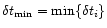 until the next collision in the system. Let
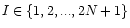 be the index of the particle making this collision;
- 4.
- Advance all particles through the time interval
 ;
;
- 5.
- Make the collision between particle I and particle I-1
if
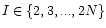 according to the prescriptions given in
Sect. 2.3.
If I=1 or I=2N+1 (particle-wall collision), draw a new
velocity vector for the particle using, in particular,
Eqs. (10) and (11);
according to the prescriptions given in
Sect. 2.3.
If I=1 or I=2N+1 (particle-wall collision), draw a new
velocity vector for the particle using, in particular,
Eqs. (10) and (11);
- 6.
- If the system's charge neutrality is not
satisfactory, increase or decrease E0 in order to
reduce departures from neutrality. E0 should not be corrected
too often. Ideally one should not update E0 before the system has become
stationary. This can be a very long time since it is of the order
of the longest macroscopic relaxation time. For a Maxwellian
plasma, the characteristic timescales could be
or
L/c, where c is the sound speed. This step is
rarely performed;
- 7.
- Repeat steps 2-5 until
a given time level has been reached.
The computational time needed to go through
one cycle is proportional to
N. A more sophisticated version of the
algorithm allows us to make the computational time
be proportional to  instead.
Appendix B: Comparison with Fokker-Planck model
Let's consider a relaxed system where N particles
of species
and N particles of species
are uniformly distributed in a box of dimension L.
Let's consider particles which have
relative velocities in the spherically geometric
velocity-space element
 ,
where
,
where
 (
being the angle between
(
being the angle between
 and the z direction).
The number of collisions per time unit
experienced by a particle of species
with particles of species
with relative velocities near
is then given by
and the z direction).
The number of collisions per time unit
experienced by a particle of species
with particles of species
with relative velocities near
is then given by
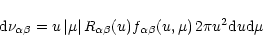 |
(B.1) |
where
 is the collision probability function
defined in Eq. (9) and
is the collision probability function
defined in Eq. (9) and
 is the distribution function for the relative velocities
between
and
particles.
If the distribution functions for both species are Maxwellians
with thermal velocities
is the distribution function for the relative velocities
between
and
particles.
If the distribution functions for both species are Maxwellians
with thermal velocities
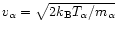 and
and
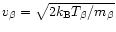 ,
respectively, one has
,
respectively, one has
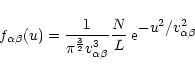 |
(B.2) |
with
 .
Integration of Eq. (B.1)
over all velocities and directions then gives the total
collision frequency
.
Integration of Eq. (B.1)
over all velocities and directions then gives the total
collision frequency
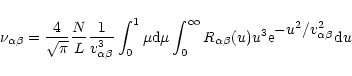 |
(B.3) |
i.e.
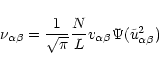 |
(B.4) |
where
 and
and  is the function
![\begin{displaymath}\Psi (x) \equiv [1-(1+x){\rm e}^{-x} + x^2\Gamma\,(0,x)]
\end{displaymath}](/articles/aa/full/2001/23/aa1074/img222.gif) |
(B.5) |
with
being the incomplete gamma function of order 0.
Sample values for the function  are given in
Table B.1.
are given in
Table B.1.
Table B.1:
Sample values for the function defined in Eq. (B.5);
 correspond to hard spheres collision.
| x |
0.125 |
0.25 |
0.5 |
1 |
 |
|
0.03256 |
0.0918 |
0.230 |
0.484 |
1 |
Let us now consider the case of a thermalized and fully ionized
electron-proton plasma and let's choose
in
Eq. (9) by setting
 |
(B.6) |
so that the dependency on
is the same for
all kind of collisions (i.e. proton-proton, electron-proton,
electron-electron).
For
 ,
we then have
,
we then have
 ,
,
 and
and
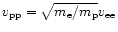 which leads to
the familiar relationship between the collision frequencies
which leads to
the familiar relationship between the collision frequencies
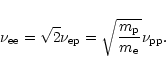 |
(B.7) |
It is common practice to define the collision frequency
 as the rate of momentum
exchange between particles of species
and
particles of species .
For isotropic distribution functions
and elastic collisions one has (Golant et al. 1980)
as the rate of momentum
exchange between particles of species
and
particles of species .
For isotropic distribution functions
and elastic collisions one has (Golant et al. 1980)
![\begin{displaymath}\overline{\nu}_{\alpha\beta} = \left\langle
\frac{\partial}{\...
...k}}
\left[u_{\rm k}\nu_{\alpha\beta}^*(u)\right]\right\rangle
\end{displaymath}](/articles/aa/full/2001/23/aa1074/img233.gif) |
(B.8) |
where
 means averaging over the relative velocities
distribution Eq. (B.2)
and
means averaging over the relative velocities
distribution Eq. (B.2)
and
 is the collision frequency for the
particles in the velocity-space element
.
Carring out the integration, using the collision frequency
Eq. (B.4), leads to
is the collision frequency for the
particles in the velocity-space element
.
Carring out the integration, using the collision frequency
Eq. (B.4), leads to
On the other hand, the Fokker-Planck electron-proton
transport collision frequency for a plasma with an
electron density n and temperature T
is known to be (e.g. Golant et al. 1980)
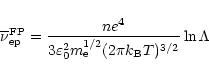 |
(B.11) |
where
is the Coulomb logarithm.
We emphasize that the collision rate given in Eq. (B.11) is
based on the time interval it takes for a
thermal electron's trajectory to become
strongly deflected by the protons in the system.
After setting
 we find the number of electrons N needed to simulate
a plasma with a given Fokker-Planck collision frequency
to be
we find the number of electrons N needed to simulate
a plasma with a given Fokker-Planck collision frequency
to be
![\begin{displaymath}N =
\frac{1}{24\pi}\frac{ne^4\ln \Lambda}{\varepsilon_0^2k^2_...
...2_{\rm ep}\right)
{\rm e}^{-\tilde{u}^2_{\rm ep}}\right]}\cdot
\end{displaymath}](/articles/aa/full/2001/23/aa1074/img242.gif) |
(B.12) |
For typical coronal conditions, e.g.
 and
and
 one has
 .
Thus, in order to simulate a plasma slab of thickness
some
.
Thus, in order to simulate a plasma slab of thickness
some
 particles are required.
We note that the number of particles
needed to simulate a given plasma
strongly depends on the choice
of
in Eq. (B.6):
the smaller the ratio
particles are required.
We note that the number of particles
needed to simulate a given plasma
strongly depends on the choice
of
in Eq. (B.6):
the smaller the ratio
 the larger
N and the heavier the simulation. One should therefore
choose
as large as possible
remembering that when
the larger
N and the heavier the simulation. One should therefore
choose
as large as possible
remembering that when
 the macroscopic
characteristics of the plasma (e.g. heat conduction, thermoelectric
coefficient, etc.) are no longer those of a
Coulomb collision dominated plasma
because of the large number of
hard-sphere type collisions involving all particles moving
at relative velocities
the macroscopic
characteristics of the plasma (e.g. heat conduction, thermoelectric
coefficient, etc.) are no longer those of a
Coulomb collision dominated plasma
because of the large number of
hard-sphere type collisions involving all particles moving
at relative velocities
 .
The properties of such a plasma may differ substantially
from the properties of a real electron-proton plasma!
.
The properties of such a plasma may differ substantially
from the properties of a real electron-proton plasma!
Appendix C: The collisionless limit
Let us consider a collisionless electron-proton plasma plunged in
a gravitational field
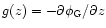 ,
which is not necessarily constant. At the boundaries,
z=0 and z=L, particles are injected with kappa type
velocity distributions with
temperatures T0 and
,
which is not necessarily constant. At the boundaries,
z=0 and z=L, particles are injected with kappa type
velocity distributions with
temperatures T0 and  and
kappa indices
and
kappa indices  and
and
 ,
respectively.
Due to the unequal mass of electrons and protons,
an electric field
,
respectively.
Due to the unequal mass of electrons and protons,
an electric field
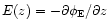 is needed to ensure local charge neutrality.
The stationary distribution function f(v,z)
for particles of mass m and charge q with a monotonical
potential energy
is needed to ensure local charge neutrality.
The stationary distribution function f(v,z)
for particles of mass m and charge q with a monotonical
potential energy
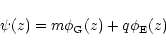 |
(C.1) |
can be computed using Liouville's theorem, viz.
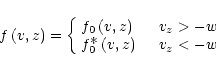 |
(C.2) |
where
![$w^2 \equiv 2\left[\psi_{\rm L}-\psi\left(z\right)\right]/m$](/articles/aa/full/2001/23/aa1074/img257.gif) and
and
![$\displaystyle f_0 = \left(\frac{m}{2\pi k_{\rm B}T_0}\right)^{3/2}
\frac{A_0\Ga...
...
\left[1+\frac{mv^2+2\psi}{(\kappa_0 - 3/2)2k_{\rm B}T_0}
\right]^{-\kappa_0-1}$](/articles/aa/full/2001/23/aa1074/img258.gif) |
|
|
(C.3) |
![$\displaystyle f_0^{\displaystyle\ast} =\left(\frac{m}{2\pi
k_{\rm B}T_0^\ast}\r...
...^2+2\psi}{(\kappa_{\rm L} - 3/2)2
k_{\rm B}T_0^\ast}\right]^{-\kappa_{\rm L}-1}$](/articles/aa/full/2001/23/aa1074/img259.gif) |
|
|
(C.4) |
and where we have set  and
and
 .
In Eq. (C.4)
.
In Eq. (C.4)  is the
temperature of the downward-traveling kappa distribution
at z=0 which is linked to
the temperature
is the
temperature of the downward-traveling kappa distribution
at z=0 which is linked to
the temperature
 via (Scudder 1992a)
![\begin{displaymath}T_0^\ast = T_{\rm L}\left[1 - \frac{\psi_{\rm L}}
{\left(\kappa_{\rm L} - 3/2\right)k_{\rm B}T_{\rm L}}\right].
\end{displaymath}](/articles/aa/full/2001/23/aa1074/img264.gif) |
(C.5) |
The problem has two unknown parameters, A0 and  ,
which are determined by the condition of zero bulk velocity
and
.
The electric field profile is obtained by imposing local
charge neutrality. We shall show that this field corresponds
to the field required to make the potential energy
of protons and electrons to be equal (cf. Eq. (C.14)).
,
which are determined by the condition of zero bulk velocity
and
.
The electric field profile is obtained by imposing local
charge neutrality. We shall show that this field corresponds
to the field required to make the potential energy
of protons and electrons to be equal (cf. Eq. (C.14)).
Let
 be an
arbitrary function of the absolute velocity v and
be an
arbitrary function of the absolute velocity v and
 ,
where
is
the angle between z direction and the velocity.
The mean value of this function is then given by
,
where
is
the angle between z direction and the velocity.
The mean value of this function is then given by
 |
(C.6) |
For example, the density is obtained by integrating of Eq. (C.6) with
 :
:
where
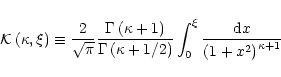 |
(C.8) |
and
In the limit
 we have
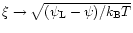 and
and
 ,
the standard error function
,
the standard error function
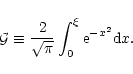 |
(C.11) |
On the other hand the zero bulk velocity condition
 leads to
![$\displaystyle A_0 = A \left[\frac{\left(\kappa_0 - 1\right)
\kappa_0\Gamma \lef...
...c{\psi_{\rm L}}{\left(\kappa_0 - 3/2\right)
k_{\rm B}T_0}\right]^{\kappa_0 - 1}$](/articles/aa/full/2001/23/aa1074/img286.gif) |
|
|
(C.12) |
![$\displaystyle A_{\rm L} = A
\left[\frac{\left(\kappa_{\rm L} - 1 \right)\kappa_...
...0^\ast}\right]^
{\kappa_{\rm L} - 1} \left({\frac{T_0}{T_0^\ast}}\right)^{1/2}.$](/articles/aa/full/2001/23/aa1074/img287.gif) |
|
|
(C.13) |
All the above calculations indicate that the density
n(z) only depends on the charge and mass of the
particles via the potential energy  . Thus, if we
use the same
and same boundary temperatures T0
and
for both electrons and protons the charge neutrality
condition reduces to
. Thus, if we
use the same
and same boundary temperatures T0
and
for both electrons and protons the charge neutrality
condition reduces to
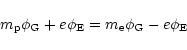 |
(C.14) |
which arises
from where one easily computes
the classical gravitoelectric field (Rosseland 1924)
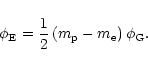 |
(C.15) |
The constant parameter A in Eqs. (C.12) and (C.13)
is determined by the condition
 ,
i.e.
,
i.e.
A
=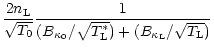 |
(C.16) |
with
and where the quantity
![\begin{displaymath}T_{\rm L}^\ast = T_0\left[1 +
{{\psi_{\rm L}}\over{(\kappa_0-3/2)k_{\rm B}T_0}}
\right]
\end{displaymath}](/articles/aa/full/2001/23/aa1074/img297.gif) |
(C.19) |
has been introduced.
We can now compute explicitly the higher moments
for the velocity distribution
function
Eq. (C.2). For example,
the parallel pressure (with respect to z) turns out to be
![$\displaystyle P \left(z\right) = \frac{A_0k_{\rm B}T_0}{2}
\left[1+\frac{\psi\l...
...0}\right]^{-\kappa_0+3/2}
\left[1+{\cal K} \left(\kappa_0-2,\xi_0\right)\right]$](/articles/aa/full/2001/23/aa1074/img298.gif) |
|
|
|
![$\displaystyle + \frac{A_{\rm L}k_{\rm B}T_0^\ast}{2}
\left[1+\frac{\psi\left(z\...
...{\rm L}+3/2}
\left[1-{\cal K} \left(\kappa_{\rm L}-2,\xi_{\rm L}\right)\right].$](/articles/aa/full/2001/23/aa1074/img299.gif) |
|
|
(C.20) |
If we impose
 and
and
 ,
using Eq. (C.7) and Eq. (C.20),
we obtain the well known result (Scudder 1992a)
,
using Eq. (C.7) and Eq. (C.20),
we obtain the well known result (Scudder 1992a)
![\begin{displaymath}T^{\displaystyle\ast} \left(z\right) =
T_0\left[1+\frac{\psi(z)}{\left(\kappa -3/2\right)k_{\rm B}T_0}\right].
\end{displaymath}](/articles/aa/full/2001/23/aa1074/img302.gif) |
(C.21) |
Similarly we find the collisionless heat flux by setting
 in Eq. (C.6), whence
![$\displaystyle q = \sqrt{\frac{8}{\pi}}\frac{n_{\rm L}k_{\rm B}^{3/2}}{m_{\rm e}...
...
-\left(\frac{\kappa_{\rm L} - 3/2}{\kappa_{\rm L} - 2}\right)T_{\rm L}\right].$](/articles/aa/full/2001/23/aa1074/img304.gif) |
|
|
(C.22) |
The heat flux for the Maxwellian case given in
Eq. (16) can be obtained in the limit
 and
and
 .
Equation (20)
is obtained in the limit
and Eq. (23) by imposing
.
Equation (20)
is obtained in the limit
and Eq. (23) by imposing
 .
.
-
Anderson, S. W. 1994, ApJ, 437, 860
In the text
NASA ADS
-
Boltzmann, L. 1872, Wien. Ber., 275
In the text
-
Chandrasekhar, S. 1943,
Rev. Mod. Phys., 15, 1
In the text
-
Chapman, S., & Cowling, T. 1970,
The mathematical theory of non-uniform gases, 3 edition
(Cambridge University Press, Cambridge, England)
In the text
-
David, C., Gabriel, A. H., Bely-Dubau, F., et al. 1998, A&A, 336, L90
In the text
NASA ADS
-
Dorelli, J. C., & Scudder, J. D. 1999,
Geophys. Res. Lett., 26, 3537
In the text
-
Dupree, A. K. 1972,
ApJ, 178, 527
In the text
NASA ADS
-
Fermi, E. 1954,
ApJ, 119, 1
In the text
-
Fludra, A., del Zanna, G., Alexander, D., & Bromage, B. J. I. 1999,
J. Geophys. Res., 104, 9709
In the text
NASA ADS
-
Golant, V., Zhilinsky, A., & Sakharov, I. 1980,
Fundamantals of plasma physics
(John Wiley & Sons, New York)
In the text
-
Hinton, F. 1983,
in Basic Plasma Physics, ed. A. Galeev, & R. Sudan, vol. 1
(North-Holland, Amsterdam), 147-197
In the text
-
Ko, Y., Fisk, L. A., Geiss, J., et al. 1997,
Sol. Phys., 171, 345
In the text
NASA ADS
-
Landau, L., & Lifshitz, E. 1960,
Course of Theoretical Physics, vol. 1, 1st edition
(Pergamon Press, Oxford, England)
In the text
-
Lie-Svendsen, Ø., Holzer, T. E., & Leer, E. 1999,
ApJ, 525, 1056
In the text
NASA ADS
-
Pantellini, F., & Landi, S. 2000, Ap&SS, in press
In the text
-
Pantellini, F. G. E. 2000,
Am. J. Phys., 67, 60
In the text
-
Rosseland, S. 1924, MNRAS, 84, 720
In the text
NASA ADS
-
Scudder, J. D. 1992a,
ApJ, 398, 299
In the text
NASA ADS
-
Scudder, J. D. 1992b,
ApJ, 398, 319
In the text
NASA ADS
-
Shoub, E. C. 1983,
ApJ, 266, 339
In the text
NASA ADS
-
Shoub, E. C. 1992,
ApJ, 389, 558
In the text
NASA ADS
-
Spitzer, L., & Härm, R. 1953,
Phys. Rev. A, 89, 372
In the text
Copyright ESO 2001
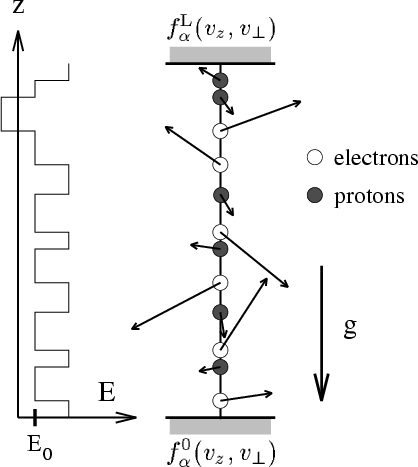

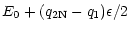


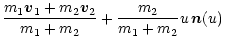

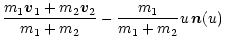



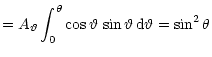
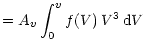
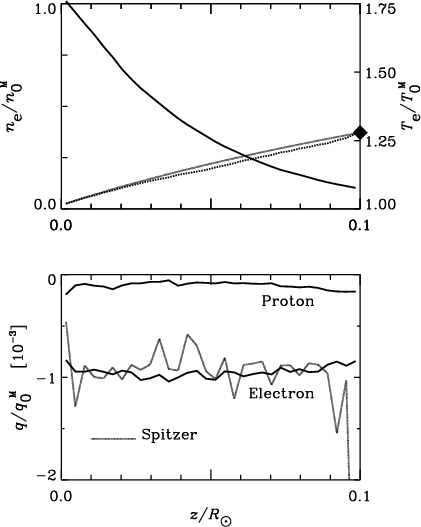
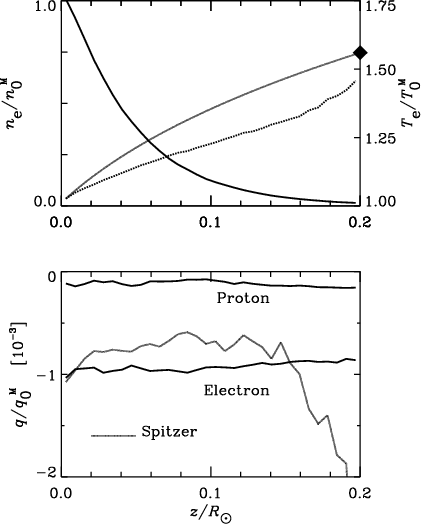
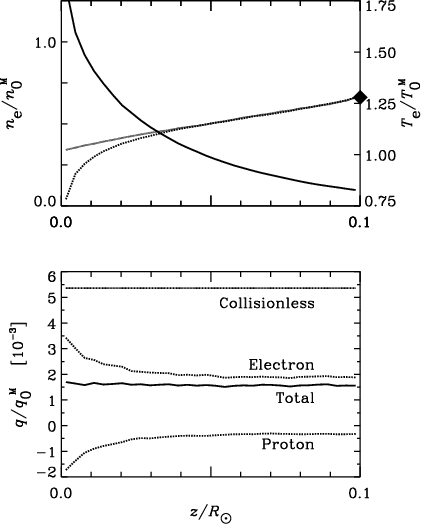
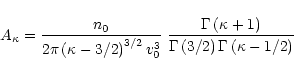

![$\displaystyle T_0\left[1+\frac{\psi(z)}
{(\kappa - 3/2)k_{\rm B}T_0}\right]$](/articles/aa/full/2001/23/aa1074/img145.gif)
![$\displaystyle T_0\left[
1+{{gz/v_0^2}\over{\kappa-3/2}} {{m_{\rm p}+m_{\rm e}}\over{m_{\rm e}}}
\right]$](/articles/aa/full/2001/23/aa1074/img146.gif)
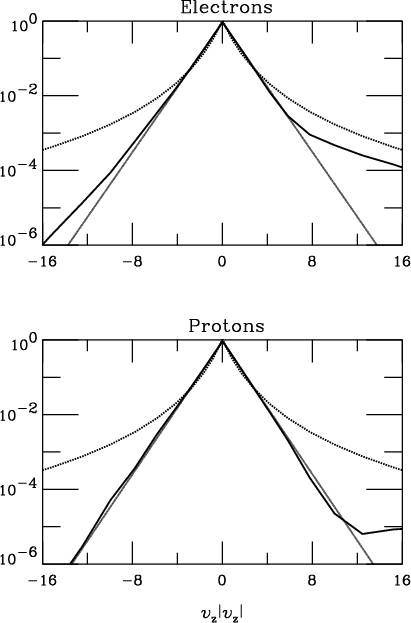
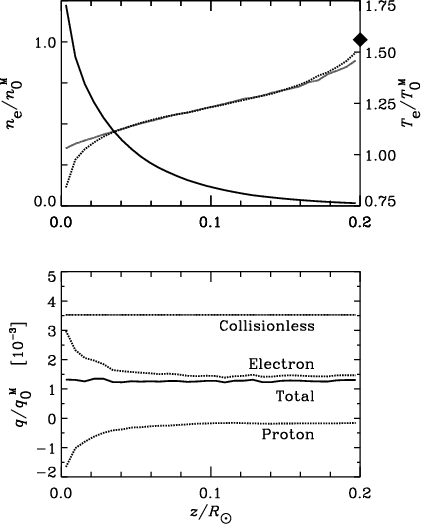
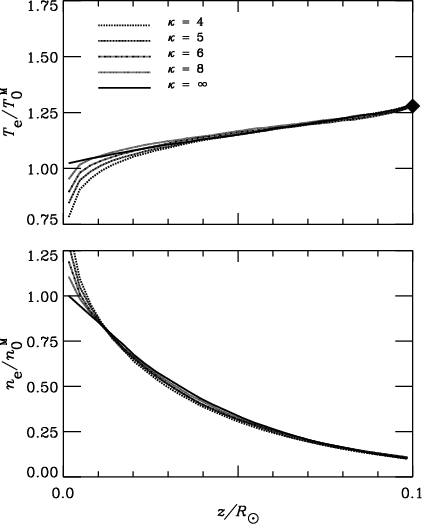
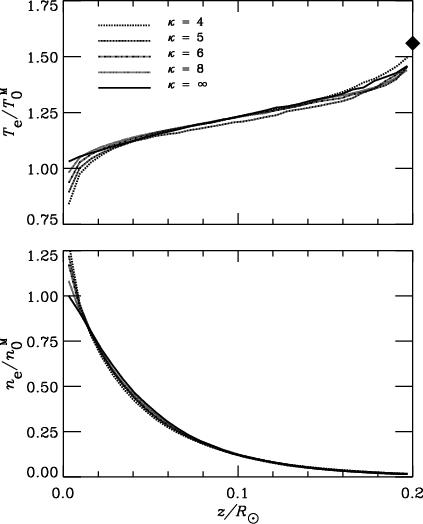
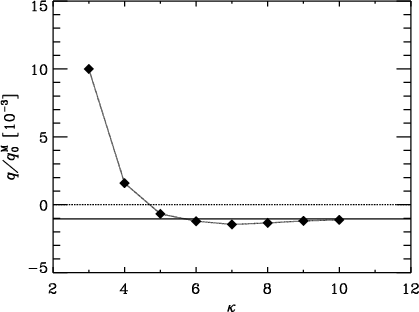
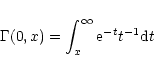

![$\displaystyle \frac{2}{\sqrt{\pi}}\frac{N}{L}v_{\alpha\beta}
[1-(1+\tilde{u}^2_{\alpha\beta}){\rm e}^{-\tilde{u}^2_{\alpha\beta}}]$](/articles/aa/full/2001/23/aa1074/img237.gif)
![$\displaystyle \nu_{\alpha\beta}{2\over {\Psi(\tilde{u}^2_{\alpha\beta})}}
\left[1-(1+\tilde{u}^2_{\alpha\beta}){\rm e}^{-\tilde{u}^2_{\alpha\beta}}\right].$](/articles/aa/full/2001/23/aa1074/img238.gif)
![$\displaystyle \ln \Lambda=\ln \left[\frac{12\pi(\varepsilon_0k_{\rm B}T)^{3/2}}
{n^{1/2}e^3}\right]$](/articles/aa/full/2001/23/aa1074/img240.gif)

![$\displaystyle \frac{A_0}{2}\left[1+\frac{\psi}
{k_{\rm B}T_0\left(\kappa_0 - 3/2\right)}\right]^{-\kappa_0+1/2}$](/articles/aa/full/2001/23/aa1074/img271.gif)
![$\displaystyle \left[1 + {\cal K}\left(\kappa_0 - 1,\xi_0\right)\right]$](/articles/aa/full/2001/23/aa1074/img272.gif)
![$\displaystyle \frac{A_{\rm L}}{2}\left[1+\frac{\psi}
{k_{\rm B}T_0^\ast\left(\kappa_{\rm L} - 3/2\right)}\right]^
{-\kappa_{\rm L}+1/2}$](/articles/aa/full/2001/23/aa1074/img273.gif)
![$\displaystyle \left[1 - {\cal K}\left(\kappa_{\rm L} -
1,\xi_{\rm L}\right)\right]$](/articles/aa/full/2001/23/aa1074/img274.gif)