![[*]](/icons/foot_motif.gif)
A&A 372, L1-L4 (2001)
DOI: 10.1051/0004-6361:20010478
M. Uslenghi1 - L. Tommasi2 - A. Treves2 - V. Piirola3 - P. Reig4,5
1 - Istituto di Fisica Cosmica "G.Occhialini'', CNR, Via
Bassini 15, 20133 Milano, Italy
2 -
Università degli Studi dell'Insubria, Polo di Como,
Via
Valleggio 11, 22100 Como, Italy
3 -
Tuorla Observatory, SF21500 Piikkio, Finland
4 -
Foundation for Research and Technology - Hellas, 710 10
Heraklion, Crete, Greece
5 -
Physics Department, University of
Crete, 710 03 Heraklion, Crete, Greece
Received 26 January 2001 / Accepted 31 March 2001
Abstract
We report on UBVRI polarimetry of the recently
identified Intermediate Polar 1WGA J1958.2+3232,
carried out on 2000 August, 4-6 at the Nordic Optical
Telescope. Circular polarization was detected in R and I bands
with an increasing absolute mean value with wavelength. There
is evidence of possible modulation of the circular polarization
at twice the previously reported white dwarf spin period,
suggesting that it is the true period and that the modulation
in optical and X-ray is dominated by the first harmonic.
Indication of modulation at the orbital period is also present.
Key words: stars: individual: 1WGA J1958.2+3232 - novae, cataclysmic variables - binaries: close - stars: magnetic fields - polarization
1WGA J1958.2+3232 is one of the objects found by Israel
et al. (1998) in a systematic search for pulsators in the
catalogue of ROSAT X-ray sources compiled by White et al. (1994). The source appeared modulated with a
period 721  14 s and with a pulsed fraction of about
80%. A subsequent observation performed by ASCA confirmed both
the flux level and the strong periodic modulation at
14 s and with a pulsed fraction of about
80%. A subsequent observation performed by ASCA confirmed both
the flux level and the strong periodic modulation at
 s (Israel 2000, private communication), which was
interpreted as a spin period.
s (Israel 2000, private communication), which was
interpreted as a spin period.
On the basis of optical photometry and low resolution spectroscopy, Israel et al. (1999) proposed a mV=15.7 star as the optical counterpart of 1WGA J1958.2+3232.
Further spectroscopic measurements carried out by Negueruela et
al. (2000), as well as time resolved optical photometry
performed by Uslenghi et al. (2000) (which provided
detection of optical modulation at
 s),
confirmed the candidate of Israel et al. (1999) and
allowed its classification as an Intermediate Polar (IP).
s),
confirmed the candidate of Israel et al. (1999) and
allowed its classification as an Intermediate Polar (IP).
A 4.36 modulation was also detected by Zharikov et al. (2000), in time-resolved photometric and spectroscopic
observations, and interpreted as due to the orbital period.
modulation was also detected by Zharikov et al. (2000), in time-resolved photometric and spectroscopic
observations, and interpreted as due to the orbital period.
We report here on the results of the first polarimetric measurements on this object.
The observations were carried out at the 2.56 m Nordic Optical Telescope (NOT), La Palma, equipped with the TURPOL double image chopping photopolarimeter (Piirola 1973, 1988). The instrument allows simultaneous measurements in the UBVRI bands and was operated in the simultaneous linear and circular polarization mode.
In this mode, polarization of the light is explored by a
quarter-wave retarder plate, rotated through eight positions by
22.5 steps. A calcite slab then splits the light into
ordinary and extraordinary rays, that pass through identical
diaphragms. Both components of sky background light enter in the
two diaphragms, resulting in a cancellation of the polarization of
sky light. Finally, the beam is split by four dichroic+bandpass
filter combinations and sent to five photomultipliers. Each of
these channels reproduces the spectral response of one of the
UBVRI Johnson-Cousins bands. In this way, truly
simultaneous multiband observations can be performed. For all the
observations, an integration time of 10 s was used for each
position of the retarder plate, giving a polarimetric measurement
every 3.5 min (whereas the time resolution for photometry is
about 23 s). A 10 s sky background integration was
normally performed every 15 min. High (HD 15445 and HD 204827)
and null (BD+323739 and BD+284211)
polarization standard stars from Schmidt et al. (1992),
observed many times per night (at the beginning, near midnight
and at the end), were used to determine instrumental polarization
and the orientation of the zero point of the retarder plate with
respect to North.
steps. A calcite slab then splits the light into
ordinary and extraordinary rays, that pass through identical
diaphragms. Both components of sky background light enter in the
two diaphragms, resulting in a cancellation of the polarization of
sky light. Finally, the beam is split by four dichroic+bandpass
filter combinations and sent to five photomultipliers. Each of
these channels reproduces the spectral response of one of the
UBVRI Johnson-Cousins bands. In this way, truly
simultaneous multiband observations can be performed. For all the
observations, an integration time of 10 s was used for each
position of the retarder plate, giving a polarimetric measurement
every 3.5 min (whereas the time resolution for photometry is
about 23 s). A 10 s sky background integration was
normally performed every 15 min. High (HD 15445 and HD 204827)
and null (BD+323739 and BD+284211)
polarization standard stars from Schmidt et al. (1992),
observed many times per night (at the beginning, near midnight
and at the end), were used to determine instrumental polarization
and the orientation of the zero point of the retarder plate with
respect to North.
We monitored 1WGA J1958.2+3232 for a total of about 13 hours, during three nights, on 2000 August 4, 5 and 6 (see the Journal of observations in Table 1). However, due to poor weather conditions, the signal-to-noise ratio during the first night is quite low and the data have been discarded.
| HJD | UT start | UT stop | n.measures |
| 2451761 a | 01.03.28 | 03.58.47. | 52 |
| 2451762 | 22.26.27 | 04.13.12 | 76 |
| 2451763 | 22.44.40 | 04.34.04 | 84 |
Data reduction was performed using dedicated routines. They allow calculation of Q, U and V Stokes parameters by fitting the counts recorded in the eight positions of the retarder plate with a suitable cosine function, using a least-squares algorithm. Subtraction of a mean sky value obtained by interpolating between the nearest sky background acquisitions taken close to the object is automatically performed. Finally, the measured Stokes parameters are corrected by taking into account the instrumental constants, determined through observation of standard polarized stars. The error estimate takes into account both photon statistics and uncertainty of the least-squares fit.
Tables 2 and 3 report the two night means of circular and linear polarization, respectively. The former is characterized by amplitude and sign of the polarization percentage, the second by polarization percentage and position angle. Overall means of all the circular polarization collected data on both nights are reported in the last column of Table 2.
A strong wavelength dependence is apparent, with circular polarization increasing, in absolute value, toward the infrared. This is a common result for polarized IPs (BG CMi, Penning et al. 1986; PQ Gem, Piirola et al. 1993; RX J1712.6-2414, Buckley et al. 1997) and it is generally attributed to cyclotron emission, possibly in combination with free-free emission (Chanmugam & Frank 1987; West et al. 1987; Piirola et al. 1993; Väth 1997; Buckley 2000). Cyclotron radiation produces very large circular polarization and the emission is strong at low harmonics, but drops suddenly at higher harmonics. The drop is used to estimate the strength of the magnetic field: typical values estimated for the polarized Intermediate Polars are in the range 5-10 MG (see, e.g., Piirola et al. 1993), below the 10-100 MG reported for the Polars.
In Fig. 1 the observed polarized fluxes
(
 )
are reported for
the R and I bands, together with the 3
)
are reported for
the R and I bands, together with the 3 upper limits in
UBV, versus
upper limits in
UBV, versus
 ,
where
,
where
 is the cyclotron frequency for a typical magnetic
field of 8 MG. Normalization is arbitrary for both axis
but, since the scale is logarithmic, changes in normalization
result in a shift only.
is the cyclotron frequency for a typical magnetic
field of 8 MG. Normalization is arbitrary for both axis
but, since the scale is logarithmic, changes in normalization
result in a shift only.
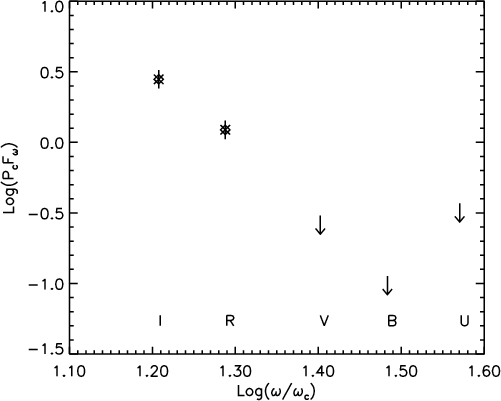 |
Figure 1:
Wavelength dependence of the circularly polarized
fluxes;
is referred to a 8 MG field. Each point is calculated from the overall
observations. |
| Open with DEXTER | |
Polarimetric data were analysed for the presence of periodic variations related to the dynamics of the binary system.
In Fig. 2 the Lomb-Scargle periodogram (Scargle
1982) of the degree of the circularly polarized light in
UBVRI bands is reported.  and
and  are the
purported orbital and white dwarf spin frequencies, respectively
(
are the
purported orbital and white dwarf spin frequencies, respectively
(
 h, Zharikov et al. 2000,
 s, Uslenghi et al. 2000). No
evidence of a periodicity at
is present. However, some
power around half of this frequency can be seen in all bands
other than U. The clearest evidence is in the I filter, where
the second highest peak in the periodogram occurs at
s, Uslenghi et al. 2000). No
evidence of a periodicity at
is present. However, some
power around half of this frequency can be seen in all bands
other than U. The clearest evidence is in the I filter, where
the second highest peak in the periodogram occurs at
 s, consistent with /2. Since the
frequency is known a priori, in computing the
significance level for this peak the correction for multiple
trials does not apply and the significance level, due to the
exponential distribution of the power at a given frequency, is
simply given by
s, consistent with /2. Since the
frequency is known a priori, in computing the
significance level for this peak the correction for multiple
trials does not apply and the significance level, due to the
exponential distribution of the power at a given frequency, is
simply given by
 ,
where z is the value of the
periodogram (i.e. the power normalized by the variance). In this
case (z=6.6) the significance level is 99.8% (in effect, the
presence of non-white noise results in a significance level lower
than the theoretical one). Moreover, the highest peak is found at
an aliased frequency of /2, produced by the sampling
pattern of the polarimeter, as apparent in the spectral window
(bottom panel in Fig. 2). This raises the possibility
that the true period is 1466 s, while the previously
reported spin periods (e.g. from the X-rays) are the first
harmonic.
,
where z is the value of the
periodogram (i.e. the power normalized by the variance). In this
case (z=6.6) the significance level is 99.8% (in effect, the
presence of non-white noise results in a significance level lower
than the theoretical one). Moreover, the highest peak is found at
an aliased frequency of /2, produced by the sampling
pattern of the polarimeter, as apparent in the spectral window
(bottom panel in Fig. 2). This raises the possibility
that the true period is 1466 s, while the previously
reported spin periods (e.g. from the X-rays) are the first
harmonic.
Figure 3 shows the I-band data folded on the 1466 s period and rebinned. Modulation is apparent, with peak-to-peak amplitude of about 2% and mean value of about -1%.
Modulation at the orbital period and at its first harmonic is also present in the R band. The data folded over the orbital period are presented in Fig. 4.
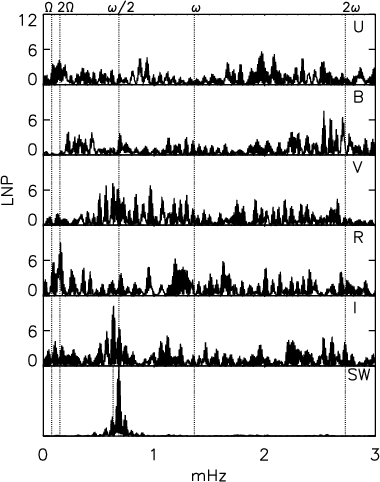 |
Figure 2:
Lomb-Scargle
periodogram of the circular polarization data in all bands.
In the bottom panel, the spectral window is shown (it has
been shifted in order to have the peak at /2). |
| Open with DEXTER | |
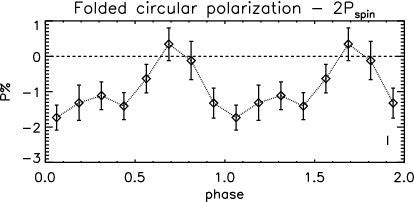 |
Figure 3:
Circular
polarization data in I band, folded with the 1466 s period and
rebinned. The time of the zero phase for all the folded plot
in this paper is
 (Zharikov et al.
2000).
(Zharikov et al.
2000). |
| Open with DEXTER | |
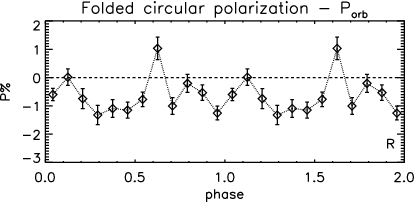 |
Figure 4:
Circular
polarization data in R band, folded with the orbital period (4.36 ,
Zharikov et al.
2000), and rebinned. The time of the zero phase is
. ,
Zharikov et al.
2000), and rebinned. The time of the zero phase is
. |
| Open with DEXTER | |
Due to the reduced efficiency (50%) of the linear polarization
measurements in the simultaneous linear and circular polarization
mode, the data have a lower signal to noise ratio than for the
circular polarization. A Lomb-Scargle periodograms of the Q/Iand U/I normalized Stokes parameters does not show any
significant peak. Near the frequencies of interest, we carried
out a  epoch folding analysis (Leahy et al.
1983), which is more sensitive than the Fourier
techniques to non-sinusoidal signals, but no significant features
were apparent.
epoch folding analysis (Leahy et al.
1983), which is more sensitive than the Fourier
techniques to non-sinusoidal signals, but no significant features
were apparent.
The relatively flat wavelength dependence of the average linear polarization (Table 3) is within the measurement errors consistent with that of typical interstellar polarization, and there is no clear evidence of intrinsic component from the nightly mean polarization values.
Photometric data were first corrected for atmospheric extinction
and then a 3rd order polynomial was subtracted in order to
remove long time scale variations due to residual atmospheric
effects. Periodograms of the flux intensity in the five bands are
presented in Fig. 5. In U band a well defined peak
occurs at
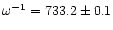 s and synodic
pulses at both
s and synodic
pulses at both
 and
and
 are clearly
apparent. In the other bands the
peak is weaker, but
some power concentration is always present. Modulation at the
orbital period (
are clearly
apparent. In the other bands the
peak is weaker, but
some power concentration is always present. Modulation at the
orbital period (
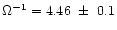 h, with
1/d alias at 3.76 and 5.48 h) and at its first
and second harmonic is also detected. Instead, we cannot find any
indication of the 1466 s period and light curves folded
at this period show no significant odd-even effect. If the spin
period is indeed 1466 s, both poles must emit in a very
symmetrical manner.
h, with
1/d alias at 3.76 and 5.48 h) and at its first
and second harmonic is also detected. Instead, we cannot find any
indication of the 1466 s period and light curves folded
at this period show no significant odd-even effect. If the spin
period is indeed 1466 s, both poles must emit in a very
symmetrical manner.
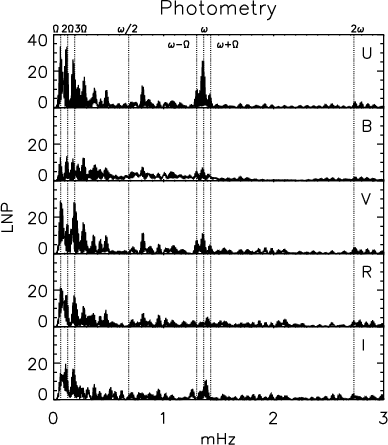 |
Figure 5: Lomb-Scargle periodogram of the flux in UBVRI bands. |
| Open with DEXTER | |
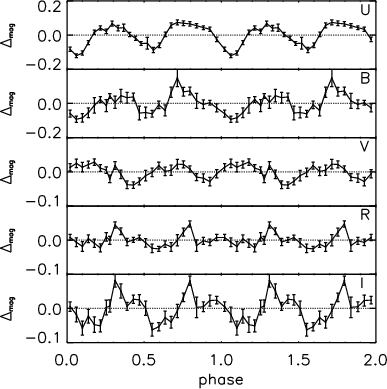 |
Figure 6: Folded light curves at the 1466 s period with 25 bin, in magnitudes relative to the mean level. The standard errors of the bin values were calculated from the scatter of the individual integrations (in this case 40). |
| Open with DEXTER | |
Polarization curves and measurements of cyclotron lines are used to measure the magnetic field and the topology in Polars. Instead, in Intermediate Polars, which have lower magnetic fields, polarization is rarely detected. To our knowledge, only four other IPs show significant polarization: BG CMi (Penning et al. 1986), PQ Gem (Piirola et al. 1993), RX J1712.6-2414 (Buckley et al. 1997) and V405 Aur (Shakhovskoj & Kolesnikov 1997; Piirola et al. 2001). The circular polarization of BG Cmi appears to be constant, whereas the latter three show spin modulation: in all cases the polarization is in the order of few %.
Our data are not sufficient to establish conclusively phase-dependent variability of the polarization at any of the characteristic frequencies, but, surprisingly, the clearest indication is for a modulation at a period twice the accepted spin period. This seems provide a strong evidence that the spin period is 1466 s and that the main frequency in optical and X-ray light curves is its first harmonic. In Uslenghi et al. (2000) evidence for optical flux modulation at the 1466 s period was reported, but for one night only. However, among the IP, there are other systems (YY Dra and V405 Aur, Allan et al. 1996) which have optical and X-ray light curves dominated by the first harmonic.
Acknowledgements
We thank the NOT staff for technical support during the observations, in particular Anlaug Amanda Kaas and Carlos Perez. We are grateful to Lucio Chiappetti for helpful conversations and to Santo Catalano for a critical reading of the manuscript and for his valuable comments. Financial support from EC grant ERBFM-RXCT 98-0195 and Italian Murst COFIN 98021541 are acknowledged.
 a,
J., & C
a,
J., & C
 rdenas, A. A. 2001, A&A, 366, 834
In the text
NASA ADS
rdenas, A. A. 2001, A&A, 366, 834
In the text
NASA ADS


