A&A 371, 643-651 (2001)
DOI: 10.1051/0004-6361:20010381
A representative sample of Be stars III:
H band spectroscopy
I. A. Steele1
- J. S. Clark2,3
1 - Astrophysics Research Institute, Liverpool John Moores
University, Liverpool CH41 1LD, UK
2 - Astronomy Centre, CPES, University of Sussex, Brighton BN1 9QH,
UK
3 - Dept. of Physics & Astronomy, University College London, London
WC1E 6BT, UK
Received 24 January 2000 / Accepted 6 March 2001
Abstract
We present
H band (1.53  m-1.69 m) spectra of 57 isolated Be stars
of spectral types O9-B9 and luminosity classes III, IV & V. The H I
Brackett (n-4) series is seen in emission from Br-11-18, and Fe II
emission is also apparent for a subset of those stars with H I emission.
No emission from species with a higher excitation temperature, such as
He II or C III is seen, and no forbidden line emission is
present. A subset of 12 stars show no evidence for emission from any species;
these stars appear indistinguishable from normal B stars of a comparable
spectral type.
In general the
line ratios constructed from the transitions in the range Br-11-18
do not fit case B recombination theory particularly well.
Strong correlations between the line ratios with Br-
m-1.69 m) spectra of 57 isolated Be stars
of spectral types O9-B9 and luminosity classes III, IV & V. The H I
Brackett (n-4) series is seen in emission from Br-11-18, and Fe II
emission is also apparent for a subset of those stars with H I emission.
No emission from species with a higher excitation temperature, such as
He II or C III is seen, and no forbidden line emission is
present. A subset of 12 stars show no evidence for emission from any species;
these stars appear indistinguishable from normal B stars of a comparable
spectral type.
In general the
line ratios constructed from the transitions in the range Br-11-18
do not fit case B recombination theory particularly well.
Strong correlations between the line ratios with Br- and spectral type are found.
These results most likely represent systematic variations in the temperature
and ionization of the circumstellar disc with spectral type.
Weak correlations between the line widths and projected rotational velocity
of the stars are
observed; however no systematic trend for increasing line width through the
Brackett series is observed.
and spectral type are found.
These results most likely represent systematic variations in the temperature
and ionization of the circumstellar disc with spectral type.
Weak correlations between the line widths and projected rotational velocity
of the stars are
observed; however no systematic trend for increasing line width through the
Brackett series is observed.
Key words: stars: emission-line, Be - infrared: stars
Be stars are defined as hot, non-supergiant stars that show, or have
shown at some stage, emission lines in their spectrum. About
20% of B stars are Be stars hence they are an
important part of the hot star population. Understanding them
is crucial to our obtaining a complete picture of hot-star winds.
They are rapid rotators (rotating at a mean velocity of 70% of their break-up
speeds, Porter 1996) and often
have complex and variable emission line profiles that at sufficient
resolution are double peaked. In addition they show an optical and infrared
continuum excess. In spite of many attempts, no complete explanation for the
Be phenomenon has yet been found.
Observations have produced an empirical
description of Be star circumstellar environments which is now
generally accepted: a dense "disc''
exists in the equatorial plane (probably rotating in a Keplerian
fashion), whilst over the polar regions there is a fast wind
(velocities up to
 kms-1).
The disc is ionized, and it is recombination in the disc that gives the emission lines.
The double peaked structure of these lines is then due to the
velocity structure and to self-absorption in the disc.
Gehrz et al. (1974)
showed that the optical and infrared excess in the systems could be
explained by disc free-free emission. Recent radio and optical
interferometric data has confirmed the existence of the
disc (Dougherty & Taylor 1992; Quirrenbach et al. 1994; Stee et al. 1995).
kms-1).
The disc is ionized, and it is recombination in the disc that gives the emission lines.
The double peaked structure of these lines is then due to the
velocity structure and to self-absorption in the disc.
Gehrz et al. (1974)
showed that the optical and infrared excess in the systems could be
explained by disc free-free emission. Recent radio and optical
interferometric data has confirmed the existence of the
disc (Dougherty & Taylor 1992; Quirrenbach et al. 1994; Stee et al. 1995).
Studies of Be stars have traditionally concentrated on
optical-near IR photometry and optical spectroscopy. However, the
optical H I recombination lines do not
function as good diagnostics of the inner regions of the circumstellar
disc. Since it is likely that studying the inner regions of the disc
will result in important constraints to the physical processes giving rise
to the different wind regimes the need for observations of this region
are pressing. Near-IR spectroscopy provides one tool to probe the
innermost regions of the circumstellar disc. We have therefore obtained
H and K band spectra of a sample of some  60 Be stars, from
B0-B9 to study this region of the circumstellar envelope for the
first time.
60 Be stars, from
B0-B9 to study this region of the circumstellar envelope for the
first time.
This paper is the third of a series on the optical and
near IR spectral properties of a representative sample of 58 Be stars.
In Steele et al. (1999; Paper I) we discuss the the
basic properties of our sample, such as spectral type, luminosity
class and projected rotational velocity, and determine that no
significant selection effects bias our sample.
In Clark & Steele (2000; Paper II) we
present the K band spectra of the sample and relate these to the
underlying properties of the stars. In this paper
we present H band (1.53-1.69 m) spectra
of 54 of the stars from Paper I, plus three
additional objects (see Table 7).
The sample of target objects contains objects from
O9 to B8.5 and of luminosity classes III (giants) to V (dwarfs),
as well as three shell stars.
The sample was selected in an attempt to contain several objects that were
typical of each spectral
and luminosity class in the above range; it therefore does not
reflect the spectral and luminosity class space distribution of Be stars,
but only the average properties of each subclass in temperature and
luminosity. A spectral type and measure
of  was derived for each object in the sample and were presented
in Paper I (only the spectral classifications are repeated here
for sake of brevity).
The distribution of
within each temperature and
luminosity class was carefully investigated and the conclusion
drawn that there were no significant selection effects biasing the
average properties of the objects (see Paper I for details).
was derived for each object in the sample and were presented
in Paper I (only the spectral classifications are repeated here
for sake of brevity).
The distribution of
within each temperature and
luminosity class was carefully investigated and the conclusion
drawn that there were no significant selection effects biasing the
average properties of the objects (see Paper I for details).
![\begin{figure}
\par\includegraphics[width=7cm,clip]{h1978f3.ps}
\end{figure}](/articles/aa/full/2001/20/aah1978/Timg9.gif) |
Figure 3:
H band spectra for Group 1 (top panel) objects (III),
Group 2 (middle panel) objects and
Group 3 objects (bottom panel) |
| Open with DEXTER |
The observations were carried out on the United Kingdom Infrared
Telescope (UKIRT) on 1996 June 29 and October 1-2
(see Tables 2-7), using the Cooled Grating Spectrometer
(CGS4). The observations were made
using the short focal length camera
plus the 150 line/mm grating, giving an ideal coverage
from 1.53 to 1.71 m with a velocity resolution of  kms-1.
Unfortunately, due to problems with the slit rotation mechanism,
the wavelength coverage was slightly curtailed,
leading to a final wavelength coverage of 1.53 to 1.69 m,
excluding the He I 1.7004 m transition.
Data reduction was carried out in a similar manner as described in Paper II
with correction for telluric features by
ratioing observed G type standards with the solar spectrum to
remove features within their photosphere, and then ratioing the
object spectrum with the modified standard spectrum.
kms-1.
Unfortunately, due to problems with the slit rotation mechanism,
the wavelength coverage was slightly curtailed,
leading to a final wavelength coverage of 1.53 to 1.69 m,
excluding the He I 1.7004 m transition.
Data reduction was carried out in a similar manner as described in Paper II
with correction for telluric features by
ratioing observed G type standards with the solar spectrum to
remove features within their photosphere, and then ratioing the
object spectrum with the modified standard spectrum.
Table 2:
Summary of measured H I Brackett series, He I and
Fe II equivalent widths in Å
for Group 1 stars. Note that no correction is made in these tables for
the underlying photospheric absorption line, and that
a positive EW corresponds to emission.
e indicates emission in the relevant transition that is to
weak to measure (typically <0.2 Å), the
addition of a question mark represents an uncertainty as to its presence.
A dash indicates that the feature was not within the wavelength
range of that particular spectrum.
The estimated error in the equivalent widths is 20%.
The spectral type of each star as
determined in Paper I is given in Col. 2 (where an italicized type indicates
that only a historical classification is available), and the
observation date during 1996 is indicated in Col. 3
| Object |
Spec. |
Obs. |
Br18 |
Br17 |
Br16 |
Br15 |
Fe II |
Br14 |
Br13 |
Br12 |
Fe II |
Br11 |
Fe II |
| |
Type |
Date |
|
|
|
|
1.576 |
|
|
|
1.679 |
|
1.687 |
| CD -27 11872 |
B0.5V-III |
29/6 |
8.3 |
9.2 |
9.8 |
10.0 |
0.8 |
10.0 |
9.7 |
9.6 |
e |
9.6 |
e |
| BD -13 893 |
B1-3V |
1/10 |
0.0 |
0.0 |
0.0 |
0.0 |
0.0 |
0.0 |
0.0 |
0.2 |
0.0 |
1.4 |
- |
| BD -12 5132 |
BN0.2III |
29/6 |
2.8 |
3.1 |
3.5 |
3.9 |
1.0 |
4.7 |
4.6 |
4.1 |
e |
3.9 |
e |
| BD -1 3834 |
B2IV |
29/6 |
4.6 |
5.3 |
5.6 |
6.2 |
0.8 |
6.3 |
6.2 |
5.7 |
e |
5.6 |
e |
| BD +1 1005 |
B1-3V |
2/10 |
4.9 |
5.0 |
5.5 |
6.3 |
0.0 |
6.1 |
5.9 |
5.6 |
0.0 |
5.7 |
- |
| BD +4 1002 |
B2-3III |
2/10 |
0.2 |
0.2 |
0.3 |
0.2 |
0.0 |
0.3 |
0.7 |
0.1 |
0.0 |
0.1 |
- |
| BD +5 3704 |
B2.5V |
29/6 |
0.0 |
0.0 |
0.0 |
0.1 |
0.0 |
0.2 |
0.0 |
0.0 |
0.0 |
-0.2 |
0.0 |
| BD +29 4453 |
B1.5V |
29/6 |
8.7 |
9.7 |
9.9 |
10.2 |
0.9 |
10.6 |
11.5 |
10.5 |
e |
11.7 |
e |
| BD +36 3946 |
B1V |
29/6 |
4.6 |
5.5 |
5.5 |
5.6 |
0.4 |
6.0 |
5.7 |
5.5 |
e |
5.4 |
e |
| BD +45 3879 |
B1.5V |
29/6 |
7.8 |
7.8 |
7.8 |
8.5 |
0.7 |
7.7 |
8.4 |
7.8 |
e |
9.3 |
e? |
| BD +47 3985 |
B1-2sh |
29/6 |
1.8 |
2.1 |
2.4 |
1.9 |
0.2 |
1.8 |
2.1 |
2.4 |
e |
4.1 |
e |
| BD +55 605 |
B1V |
1/10 |
0.7 |
0.9 |
1.4 |
2.1 |
0.0 |
2.1 |
2.4 |
2.9 |
0.0 |
3.2 |
- |
| BD +55 552 |
B4V |
1/10 |
0.1 |
-0.4 |
-0.1 |
-1.2 |
0.0 |
-1.0 |
-1.1 |
-3.0 |
0.0 |
-0.3 |
- |
| BD +56 469 |
B0-2III |
1/10 |
-0.4 |
-0.4 |
-0.3 |
-0.3 |
0.0 |
-0.3 |
-0.3 |
-0.6 |
0.0 |
-0.6 |
- |
| BD +56 473 |
B1V-III |
2/10 |
3.4 |
3.5 |
3.7 |
3.9 |
0.5 |
4.0 |
3.9 |
3.8 |
e |
4.5 |
- |
| BD +56 478 |
B1.5V |
1/10 |
0.9 |
1.2 |
1.4 |
1.5 |
0.0 |
1.5 |
1.4 |
1.9 |
0.0 |
2.1 |
- |
| BD +56 511 |
B1III |
1/10 |
0.5 |
0.4 |
0.7 |
1.0 |
0.0 |
0.1 |
0.3 |
0.7 |
0.0 |
0.3 |
- |
| BD +56 573 |
B1.5V |
1/10 |
5.9 |
7.2 |
7.8 |
8.6 |
2.1 |
9.8 |
8.8 |
9.7 |
e |
10.3 |
- |
| BD +57 681 |
B0.5V |
1/10 |
0.6 |
0.4 |
0.9 |
1.2 |
0.0 |
0.9 |
1.0 |
1.6 |
0.0 |
2.0 |
- |
| BD +58 2320 |
B2V |
29/6 |
2.9 |
3.6 |
4.1 |
4.0 |
0.0 |
3.2 |
4.6 |
3.8 |
0.0 |
5.9 |
0.0 |
Table 3:
Summary of H I Brackett series for Group 2 stars.
See Table 2 for explanation
| Object |
Spec. |
Obs. |
Br18 |
Br17 |
Br16 |
Br15 |
Fe II |
Br14 |
Br13 |
Br12 |
Fe II |
Br11 |
Fe II |
| |
Type |
Date |
|
|
|
|
1.576 |
|
|
|
1.679 |
|
1.687 |
| CD -25 12642 |
B0.7III |
29/6 |
-0.3 |
-0.5 |
-0.4 |
-0.8 |
0.0 |
-1.7 |
-2.9 |
-3.0 |
0.0 |
-4.0 |
0.0 |
| BD +20 4449 |
B0III |
29/6 |
0.0 |
0.0 |
0.0 |
-0.5 |
0.0 |
-1.0 |
-1.7 |
-2.0 |
0.0 |
-3.0 |
0.0 |
| BD +25 4083 |
B0.7III |
29/6 |
-0.4 |
-0.2 |
-0.1 |
-0.7 |
0.0 |
-1.5 |
-2.1 |
-2.5 |
0.0 |
-3.2 |
0.0 |
| BD +28 3598 |
O9II |
29/6 |
0.0 |
0.0 |
0.0 |
0.0 |
0.0 |
-0.3 |
0.3 |
-0.7 |
0.0 |
-1.5 |
0.0 |
| BD +29 3842 |
B1II |
29/6 |
-0.3 |
-0.3 |
-0.3 |
-0.8 |
0.0 |
-1.4 |
-1.6 |
-2.3 |
0.0 |
-2.3 |
0.0 |
| BD +37 3856 |
B0.5V |
29/6 |
0.0 |
0.0 |
0.0 |
-0.5 |
0.0 |
-0.8 |
-1.7 |
-2.3 |
0.0 |
-2.8 |
0.0 |
| BD +45 933 |
B1.5V |
1/10 |
-0.5 |
-0.9 |
-1.1 |
-1.6 |
0.0 |
-1.8 |
-1.3 |
-2.0 |
0.0 |
-1.9 |
- |
| BD +56 493 |
B1V |
1/10 |
-0.3 |
-0.1 |
-0.2 |
-0.7 |
0.0 |
-1.3 |
-2.3 |
-1.7 |
0.0 |
-2.9 |
- |
Table 4:
Summary of H I Brackett series for Group 3 stars.
See Table 2 for explanation
| Object |
Spec. |
Obs. |
Br18 |
Br17 |
Br16 |
Br15 |
Fe II |
Br14 |
Br13 |
Br12 |
Fe II |
Br11 |
Fe II |
| |
Type |
Date |
|
|
|
|
1.576 |
|
|
|
1.679 |
|
1.687 |
| BD -8 929 |
B2V |
2/10 |
4.6 |
4.5 |
4.5 |
4.6 |
0.0 |
5.0 |
5.2 |
4.6 |
0.0 |
4.9 |
- |
| BD +42 4538 |
B2.5 |
29/6 |
8.2 |
8.7 |
9.2 |
8.4 |
0.0 |
9.0 |
9.3 |
9.2 |
0.0 |
10.6 |
0.0 |
| BD +47 183 |
B2.5V |
29/6 |
5.6 |
5.6 |
5.7 |
5.8 |
0.3 |
5.6 |
6.4 |
6.3 |
e |
7.0 |
e |
| BD +47 857 |
B4IV |
1/10 |
2.4 |
3.5 |
4.3 |
4.4 |
1.5 |
4.4 |
4.5 |
5.3 |
e |
5.7 |
- |
| BD +47 939 |
B2.5V |
1/10 |
3.6 |
4.1 |
4.3 |
4.6 |
0.9 |
5.4 |
5.2 |
5.2 |
e |
6.4 |
- |
Table 5:
Summary of H I Brackett series for Group 4 stars.
See Table 2 for explanation
| Object |
Spec. |
Obs. |
Br18 |
Br17 |
Br16 |
Br15 |
Fe II |
Br14 |
Br13 |
Br12 |
Fe II |
Br11 |
Fe II |
| |
Type |
Date |
|
|
|
|
1.576 |
|
|
|
1.679 |
|
1.687 |
| BD -19 5036 |
B4III |
29/6 |
-0.8 |
-1.4 |
-2.0 |
-2.5 |
0.0 |
-4.8 |
-5.4 |
-6.3 |
0.0 |
-7.5 |
0.0 |
| BD +17 4087 |
B6III-V |
29/6 |
-1.2 |
-1.4 |
-2.1 |
-2.9 |
0.0 |
-3.5 |
-5.1 |
-5.2 |
0.0 |
-5.7 |
0.0 |
| BD +19 578 |
B8V |
1/10 |
-0.3 |
-0.4 |
-0.4 |
-1.2 |
0.0 |
-2.1 |
-4.1 |
-5.3 |
0.0 |
-5.9 |
- |
| BD +30 3227 |
B4V |
29/6 |
0.0 |
0.0 |
0.0 |
-1.0 |
0.0 |
-3.4 |
-5 |
-5.7 |
0.0 |
-7.5 |
0.0 |
Table 6:
Summary of H I Brackett series for Group 5 stars.
See Table 2 for explanation
| Object |
Spec. |
Obs. |
Br18 |
Br17 |
Br16 |
Br15 |
Fe II |
Br14 |
Br13 |
Br12 |
Fe II |
Br11 |
Fe II |
| |
Type |
Date |
|
|
|
|
1.576 |
|
|
|
1.679 |
|
1.687 |
| CD -27 13183 |
B7V |
29/6 |
0.0 |
0.0 |
-1.0 |
-1.4 |
0.0 |
-2.0 |
-3.1 |
-3.2 |
0.0 |
-4.80 |
0.0 |
| BD -20 5381 |
B5V |
29/6 |
1.0 |
1.0 |
1.7 |
1.1 |
0.0 |
0.7 |
1.4 |
0.7 |
0.0 |
0.8 |
- |
| BD -0 3543 |
B7V |
29/6 |
0.0 |
0.0 |
0.0 |
-1.2 |
0.0 |
-2.2 |
-2.4 |
-2.7 |
0.0 |
-3.3 |
0.0 |
| BD +0 1203 |
B5III |
29/6 |
1.1 |
0.7 |
0.7 |
0.8 |
0.0 |
0.9 |
0.8 |
1.2 |
0.0 |
2.0 |
0.0 |
| BD +2 3815 |
B7-8sh |
29/6 |
-0.5 |
-0.8 |
-1.2 |
-2.0 |
0.0 |
-3.7 |
-3.5 |
-4.1 |
0.0 |
-4.6 |
0.0 |
| BD +21 4695 |
B6III-V |
29/6 |
0.0 |
-0.3 |
-0.8 |
-1.3 |
0.0 |
-2.8 |
-3.4 |
-5.4 |
0.0 |
-6.4 |
0.0 |
| BD +27 3411 |
B8V |
29/6 |
0.0 |
-0.4 |
-0.7 |
-1.1 |
0.0 |
-2.4 |
-4.5 |
-5.6 |
0.0 |
-6.5 |
0.0 |
| BD +37 675 |
B7V |
1/10 |
1.2 |
0.6 |
1.0 |
0.0 |
e |
-0.2 |
-1.7 |
-2.0 |
e |
-1.5 |
- |
| BD +43 1048 |
B6IIIsh |
1/10 |
0.2 |
0.2 |
0.2 |
0.3 |
0.0 |
0.5 |
0.7 |
1.4 |
0.0 |
1.2 |
- |
| BD +46 275 |
B5III |
2/10 |
-0.1 |
-0.9 |
-2.2 |
-2.4 |
0.0 |
-4.9 |
-4.3 |
-5.2 |
0.0 |
-6.0 |
- |
| BD +49 614 |
B5III |
1/10 |
0.2 |
0.3 |
0.6 |
0.5 |
0.0 |
-1.6 |
-3.3 |
-2.7 |
0.0 |
-2.7 |
- |
| BD +50 825 |
B7V |
2/10 |
0.3 |
0.3 |
0.2 |
-1.0 |
0.0 |
-0.2 |
-1.7 |
-2.0 |
0.0 |
-1.5 |
- |
| BD +50 3430 |
B8V |
29/6 |
0.5 |
0.5 |
0.6 |
-1.7 |
0.0 |
-1.7 |
-1.9 |
-2.6 |
0.0 |
-4.5 |
0.0 |
| BD +51 3091 |
B7III |
29/6 |
-1.0 |
-1.8 |
-2.4 |
-3.8 |
0.0 |
-4.3 |
-6.2 |
-6.8 |
0.0 |
-6.7 |
0.0 |
| BD +53 2599 |
B8V |
29/6 |
-1.1 |
-1.9 |
-1.9 |
-2.7 |
0.0 |
-2.4 |
-3.7 |
-5.1 |
0.0 |
-7.5 |
0.0 |
| BD +55 2411 |
B8.5V |
29/6 |
-0.4 |
-0.6 |
-1.2 |
-2.1 |
0.0 |
-4.0 |
-5.0 |
-6.0 |
0.0 |
-7.5 |
0.0 |
| BD +58 554 |
B7V |
1/10 |
0.0 |
0.8 |
1.2 |
0.7 |
0.0 |
0.2 |
0.7 |
0.6 |
0.0 |
0.3 |
- |
Table 7:
Summary of H I Brackett series for new stars. See Table 2
for explanation
| Object |
Spec. |
Obs. |
Br18 |
Br17 |
Br16 |
Br15 |
Fe II |
Br14 |
Br13 |
Br12 |
Fe II |
Br11 |
Fe II |
| |
Type |
Date |
|
|
|
|
1.576 |
|
|
|
1.679 |
|
1.687 |
| BD +54 2348 |
B2V |
29/6 |
6.2 |
7.0 |
7.3 |
7.9 |
0 |
7.6 |
7.7 |
7.9 |
0.0 |
8.7 |
0.0 |
| BD +54 2718 |
B2 III |
29/6 |
-0.5 |
-0.4 |
0.0 |
0.0 |
-0.7 |
-1.0 |
-0.9 |
-1.4 |
0.0 |
-3.0 |
0.0 |
| MWC 659 |
BOIIIpe |
29/6 |
7.8 |
8.9 |
9.8 |
9.4 |
0.8 |
10.7 |
10.3 |
10.9 |
e |
11.3 |
e |
The primary goal of these observations was to observe the H I
Brackett recombination series. The wavelength range chosen encompasses
Br-18-11, as well as Fe II lines at 1.534, 1.600 and 1.620 m
(amongst others). Various He II transitions are also
found within this wavelength region, however given their absence in the
K band spectra
presented in Paper II, we do not expect to see these in emission. The
spectra are presented in Figs. 1-6, and are presented
in the same Groups we defined in Paper II, which were based on
their K band spectral morphology (see Table 1).
This approach has been adopted, rather than
grouping the spectra on the basis of their optically derived spectral
classifications since one aim of this work was to define a
classification scheme based on near-IR spectroscopy alone, for use in
the classification of heavily obscured stars, such as
those often found in High Mass X-ray binary systems.
Unsurprisingly, based on the features present in the K band spectra,
the obvious lines seen in emission
are Br-18-11, and Fe II 1.576 m and 1.687 m.
A further feature in the blue wing of Br-11 (
 m)
is also seen in a subset of spectra, the identity of which is discussed
further below. No emission from species of higher excitation (such as
He II, N III or C III) was observed.
The presence and equivalent widths (EW)
of these features are summarised in Tables 2-7. Equivalent widths
and FWHM were measured using the ABLINE routine of the
FIGARO software package. This measures
EW by integrating the line flux relative to an interpolated continuum
produced by polynomial fitting in the vicinity of the line - it therefore
makes no assumption about line shape. FWHM are measured by looking at
the line width which encompasses 68% of the line flux and multiplying
by 1.18. For a line of Gaussian profile this gives exactly the
FWHM, and for any reasonably centrally concentrated profile (as ours are)
it gives a result very close to the FWHM that is more robust than
simple Gaussian fitting.
m)
is also seen in a subset of spectra, the identity of which is discussed
further below. No emission from species of higher excitation (such as
He II, N III or C III) was observed.
The presence and equivalent widths (EW)
of these features are summarised in Tables 2-7. Equivalent widths
and FWHM were measured using the ABLINE routine of the
FIGARO software package. This measures
EW by integrating the line flux relative to an interpolated continuum
produced by polynomial fitting in the vicinity of the line - it therefore
makes no assumption about line shape. FWHM are measured by looking at
the line width which encompasses 68% of the line flux and multiplying
by 1.18. For a line of Gaussian profile this gives exactly the
FWHM, and for any reasonably centrally concentrated profile (as ours are)
it gives a result very close to the FWHM that is more robust than
simple Gaussian fitting.
Brackett series emission is seen in all stars of Groups 1, 3 and
5 (which all possess Br
emission), with the possible exception
of BD +51 3091, a B7 III star (Fig. 6). Of Groups 2 and 4, which were
defined on the basis of the absence of Br
emission in the K band
spectra, only BD +30 3227 appears to show evidence for partial infilling of
Br-11-14 (Fig. 3), while the remainder appear to possess pure absorption
spectra.
Fe II 1.576 m
emission is seen in a total of 13 stars, compared to a total of 19 stars
showing Fe II 2.089 m emission.
Of the 33 stars where the wavelength coverage encompassed Fe II
1.688 m, the line was in emission in 6 stars, 5 of which
are Group 1 objects, the final star, MWC 659, being one of the 3 objects
without corresponding K band observations (see Tables 2-7).
We note that all stars with
Fe II 1.576 m emission also show Fe II 1.688 m
emission. The correlation between the presence of Fe II emission
in the H and K bands is weaker, with a total of 8 stars showing Fe II
emission in either the H or K band, but not in the other. However, as
with the K band spectra, Fe II emission only occurs in the H band
spectra of those stars with strong Brackett series emission;
 Å
Å![[*]](/icons/foot_motif.gif) (
(
 Å).
Å).
Two possible identifications exist for the emission feature at
1.678 m; Fe II 1.679 m and [Fe II] 1.678 m.
Of these, we favour Fe II 1.679 m since the feature is only seen in
stars that show emission in the other two Fe II lines, and no emission
is seen in the (albeit weaker) [Fe II] transitions at 1.534 m
and 1.644 m (Hamann & Persson 1989).
Overall, as regards spectral classification using the H band
spectra of Be stars, it is apparent that with the absence of many pure
photospheric features that are uncontaminated by disc emission it is only
possible to perform a very general spectral classification into "early''
(B0e-B4e) and "late'' (B5e-B9e) spectral types.
The problem of the lack of photospheric features
uncontaminated by emission from the circumstellar disc is compounded by
the (expected) lack of emission from species with a wide range of excitation
energies (although we speculate that the presence of He I 1.700 m
emission may function as an additional, valuable diagnostic of early
spectral types).
![\begin{figure}
\par\includegraphics[width=8.2cm,clip]{h1978f6.ps}
\end{figure}](/articles/aa/full/2001/20/aah1978/Timg16.gif) |
Figure 6:
H band spectra for Group 5 (upper panel) objects (II)
and new objects (lower panel) |
| Open with DEXTER |
![\begin{figure}
\par\includegraphics[width=7.4cm,clip]{h1978f7.ps}
\end{figure}](/articles/aa/full/2001/20/aah1978/Timg17.gif) |
Figure 7:
Equivalent width (EW) of Br-11 (top panel), Br-15
(middle panel ) and Br-18 (bottom panel) in Å (where positive
EW's indicate emission) against spectral type. The equivalent widths
have been corrected for the underlying photospheric absorption
as indicated in the text. Triangular symbols represent luminosity class III,
squares luminosity class IV and circles luminosity class V |
| Open with DEXTER |
![\begin{figure}
\par\includegraphics[width=7.4cm,clip]{h1978f8.ps}
\end{figure}](/articles/aa/full/2001/20/aah1978/Timg18.gif) |
Figure 8:
EW of Br-11 against Br-12 (top panel), Br-15
(middle panel) and Br-18 (bottom panel). Filled circles represent objects
from Groups 1, circles Group 2, stars Group 3, empty squares Group 4 and
filled squares Group 5 (see Table 1 for group definitions).
The line indicates the expected line ratio for case B recombination |
| Open with DEXTER |
![\begin{figure}
\par\includegraphics[width=7.4cm,clip]{h1978f9.ps}
\end{figure}](/articles/aa/full/2001/20/aah1978/Timg19.gif) |
Figure 9:
EW of Br-18 against Br-12, -15, -16 and -17.
Symbols and line as Fig. 8 |
| Open with DEXTER |
![\begin{figure}
\par\includegraphics[width=7.4cm,clip]{h1978f10.ps}
\end{figure}](/articles/aa/full/2001/20/aah1978/Timg20.gif) |
Figure 10:
Plot of the EW of Br
(data from Paper II)
against Br-11 (top panel), Br-15 (middle panel)
and Br-18 (bottom panel; all EW in -Å). Symbols as
Fig. 8 |
| Open with DEXTER |
In order to make an accurate comparison of Brackett line strengths
between objects of different spectral type, it is necessary to remove
the effect of the underlying photospheric absorption lines from the spectra.
To carry out this correction we used the equivalent widths for
normal (non-emission) B stars presented for Br-
by
Hanson et al. (1996) and for Br 11-18 by
Steele & Clark (2001). The correction itself simply consisted of
subtracting the equivalent width derived from a least squares fit
to the appropriate transition for the normal B stars from the emission
line equivalent width. The discussion and figures in this section
therefore refer to this corrected equivalent width. We note that
within the small wavelength range encompassed by
Br-11 to Br-18, these corrected equivalent widths may be divided
by one another and treated as flux ratios without introducing significant error.
We plot the EW of Br-11, 15 & 18 against spectral type in Fig. 7 (the
remainder of the lines are not plotted due to reasons of space). As with
Br
(Paper II) we find that while a linear correlation between spectral
type and EW is absent, a strong trend in the upper envelope of the
line strengths is present, with lower mean and maximum line strengths
for the later (B5-B9) spectral types.
We find no evidence of systematic differences between the
emission characteristics of stars of differing luminosity classes.
In Fig. 8 we plot the EW of Br-11 against those of Br-12, -15 and -18,
while in Fig. 9 we plot the EW of Br-18 versus Br-12, -15, -16 and -17.
Note that the empty symbols cluster around EW of zero in both figures, with
a typical deviation of  Å. As these are non-emission
line objects, this indicates that the accuracy of our correction
for the photospheric absorption component is of that order. We also
note that there appears to be no significant difference in these
graphs between the various spectral groups.
Å. As these are non-emission
line objects, this indicates that the accuracy of our correction
for the photospheric absorption component is of that order. We also
note that there appears to be no significant difference in these
graphs between the various spectral groups.
Given that the Br 11-18 lines arise from high levels in the
hydrogen atom they might be expected to be optically thin, and therefore
well represented by case B recombination theory. In order to
test this, we plot as a straight line
in Figs. 8 and 9 the expected case B line ratios
from Storey & Hummer (1995) for ionized hydrogen.
The predicted line ratios are constant to within a few per-cent for temperatures in the
range 7500-40 000 K and
electron densities in the range
1010-1014 cm-3,
and are therefore should not be sensitive to these conditions within the disk.
From the figures it is apparent that although there is reasonable
agreement between case B theory and observation
in the line ratios between closely adjacent lines
(e.g. Br-11 and Br-12, or Br-17 and Br-18), for more separated
transitions the case B ratios do not
seem to fit the data well. This may reflect either
a complex disk temperature and density profile (as discussed
in the following paragraph) or that the optically thin and/or LTE
assumptions for these lines are not valid. Spectra extending further down the
series (e.g. to Br-22) where the lines are weaker
would help to resolve this question.
In Fig. 10 we plot the EW of Br
(taken from Paper II)
against that of Br-11, 15 & 18. Unlike the higher
transition ratios of Figs. 2 and 3 here there
are large differences in the flux ratios between the groups, with
a progression in the ratio Br-15/Br
from  (Group 1), through
 (group 3) to
  (Group 5).
This effect is a real reflection of differences in
line flux and not just due to continuum differences over the
larger wavelength range for the Br-15/Br
equivalent width ratio.
At first sight it may seem that the stronger circumstellar free-free
excesses of the Group 1 objects could account for this effect, by
reducing the Br
EW for these objects. However this effect
is small. The two continuum regions
are well approximated by the photometric H and K bands, and
Howells et al. (2001) show that the mean
(Group 5).
This effect is a real reflection of differences in
line flux and not just due to continuum differences over the
larger wavelength range for the Br-15/Br
equivalent width ratio.
At first sight it may seem that the stronger circumstellar free-free
excesses of the Group 1 objects could account for this effect, by
reducing the Br
EW for these objects. However this effect
is small. The two continuum regions
are well approximated by the photometric H and K bands, and
Howells et al. (2001) show that the mean
 only varies
from
only varies
from
 for Group 1 objects to
  for Group 5 objects,
insufficient to cause the observed EW ratio changes. We also note that
this effect is somewhat mitigated by the change in intrinsic
colours between Groups 1 (
for Group 5 objects,
insufficient to cause the observed EW ratio changes. We also note that
this effect is somewhat mitigated by the change in intrinsic
colours between Groups 1 (
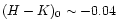 )
and 5 (
)
and 5 (
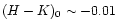 )
(Koornneef 1983).
We therefore believe that this progression is likely to be
due to systematic changes in the temperature, degree
of ionization, and structure
within the discs as the temperature and flux of the underlying stars changes.
Marlborough et al. (1997) present simulations of selected near-IR H I
transitions for both isothermal discs, and discs with a simple radial
temperature gradient, and find that varying the disc temperature does indeed
lead to changes in the line decrement. However, recent work by Millar &
Marlborough (1998) shows that these simple models for the disc temperature
are incorrect, and that the equilibrium temperatures for Be star discs are
a complex function of disc radius, particularly in the inner disc regions
responsible for near-IR recombination line emission. Further evidence for
this is found in our inability to fit case B line ratios to the
higher transitions as noted previously.
Consequently, we defer detailed discussion of the systematic variations in the
Brackett line decrement for a future paper, where
modeling of the line fluxes will be accomplished for the full
optical-IR dataset.
)
(Koornneef 1983).
We therefore believe that this progression is likely to be
due to systematic changes in the temperature, degree
of ionization, and structure
within the discs as the temperature and flux of the underlying stars changes.
Marlborough et al. (1997) present simulations of selected near-IR H I
transitions for both isothermal discs, and discs with a simple radial
temperature gradient, and find that varying the disc temperature does indeed
lead to changes in the line decrement. However, recent work by Millar &
Marlborough (1998) shows that these simple models for the disc temperature
are incorrect, and that the equilibrium temperatures for Be star discs are
a complex function of disc radius, particularly in the inner disc regions
responsible for near-IR recombination line emission. Further evidence for
this is found in our inability to fit case B line ratios to the
higher transitions as noted previously.
Consequently, we defer detailed discussion of the systematic variations in the
Brackett line decrement for a future paper, where
modeling of the line fluxes will be accomplished for the full
optical-IR dataset.
![\begin{figure}
\par\includegraphics[width=7cm,clip]{h1978f11.ps}
\end{figure}](/articles/aa/full/2001/20/aah1978/Timg31.gif) |
Figure 11:
Plot of the FWHM (in Å) of Br-11, 12, 15 and 18
plotted against projected
rotational velocity. Dotted line indicates
 from Paper
I
from Paper
I |
| Open with DEXTER |
In Paper II we found correlations between the full width half maximum (FWHM)
of Br
and He I 2.058 m lines and the projected rotational
velocity of the stars, in a similar fashion that those found for H ,
,
 ,
and selected optical Fe II lines by Hanuschik (1989). He
further found that the intrinsically weaker lines such as the higher Balmer
lines and Fe II were systematically broader than H
which he
attributed to the weaker lines being produced in a smaller region of a
quasi- Keplerian disc than the intrinsically
stronger H
line, where the rotational velocity would be greater, and
thus the line broader. Simulations by Marlborough et al. (1997)
also demonstrate the same effect, as do the longer wavelength
infrared spectra of -Cas presented by Hony et al. (2000).
,
and selected optical Fe II lines by Hanuschik (1989). He
further found that the intrinsically weaker lines such as the higher Balmer
lines and Fe II were systematically broader than H
which he
attributed to the weaker lines being produced in a smaller region of a
quasi- Keplerian disc than the intrinsically
stronger H
line, where the rotational velocity would be greater, and
thus the line broader. Simulations by Marlborough et al. (1997)
also demonstrate the same effect, as do the longer wavelength
infrared spectra of -Cas presented by Hony et al. (2000).
In Fig. 11 we plot the full width half maximum (FWHM) of Br-11, 12, 15
and 18 for stars of Groups 1 and 3 against
their projected rotational velocities from Paper 1 (stars from Group 5 were
excluded due to the bias introduced into the FWHM by the underlying
photospheric feature). Weak correlations were found between the FWHM and the
projected rotational velocities by applying Spearman's Rank Correlation to
the datasets, and the results of least square fits to the
data are presented in Table 7.
It is interesting to note that the minimum
measured FWHM is around 300 kms-1 (considerably
larger than the instrumental resolution of kms-1). This means
that for the relatively slow (
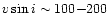 kms-1)
rotators, the FWHM for these lines is often more than twice
the
of the underlying star, possibly indicating more rapid rotation
at the inner edge of the disk than at the surface of the star.
We also note three Group 1 (BD +47 3985, BD +58 2320 and BD +1 1005)
and one Group 3 (BD +42 4538) appear to have very large Br-11 FWHM of greater
than around 500 kms-1. However these objects also show
double peaks in their line profiles, making the derivation (and interpretation) of FWHMuncertain.
kms-1)
rotators, the FWHM for these lines is often more than twice
the
of the underlying star, possibly indicating more rapid rotation
at the inner edge of the disk than at the surface of the star.
We also note three Group 1 (BD +47 3985, BD +58 2320 and BD +1 1005)
and one Group 3 (BD +42 4538) appear to have very large Br-11 FWHM of greater
than around 500 kms-1. However these objects also show
double peaks in their line profiles, making the derivation (and interpretation) of FWHMuncertain.
In Fig. 12 we plot the FWHM of Br-18, 15 & 12 vs. Br-11. It can be seen that
there is no trend to
broader line profiles with higher Brackett series transitions as was
suggested by the results of Hony et al. (2000).
We attribute this result primarily
to the narrow wavelength (and hence transition) range of our spectra
compared to the work of Hony et al.
(2000) whose spectra extend to the limit of each series.
Table 8:
Summary of best fits between the FWHM of Br11-18 and the
vsin i of the individual star. The best fit from Br,
taken
from Paper II is also shown for comparison
| Transition |
Best Fit |
| Br18 |
1.132 vsin i +181 kms-1 |
| Br17 |
1.145 vsin i +203 kms-1 |
| Br16 |
0.868 vsin i +280 kms-1 |
| Br15 |
0.337 vsin i +377 kms-1 |
| Br14 |
0.607 vsin i +304 kms-1 |
| Br13 |
0.541 vsin i +301 kms-1 |
| Br12 |
0.553 vsin i +283 kms-1 |
| Br11 |
0.803 vsin i +245 kms-1 |
| Br |
0.759 vsin i +149 kms-1 |
![\begin{figure}
\par\includegraphics[width=7.5cm,clip]{h1978f12.ps}
\end{figure}](/articles/aa/full/2001/20/aah1978/Timg35.gif) |
Figure 12:
FWHM of Br-18, 15 & 12 vs. Br-11 for the objects showing
emission features. No systematic difference between the FWHM of Br-11, and
those of the higher transitions is apparent. The larger scatter of points
in the lower panel is likely to be due to the weakness of the Br-18 line,
and the consequent difficulties in obtaining an accurate measurement of the
FWHM. Symbols as Fig. 8 |
| Open with DEXTER |
We have analysed the H band (1.53 m-1.69 m) spectra of 61 Be stars
and found emission from H I Br11-18 and Fe II 1.576 &
1.698 m. A further emission feature at 1.679 m is
present in a subset of 14 stars; this is also likely to be Fe
II emission. The Br 11-18 line ratios of non adjacent lines
are not well fit by the
case B assumption, and strong systematic trends in both line strength
and the ratio of the higher Brackett series strengths to Br-with spectral type (but not luminosity class) are observed.
This is likely to be due to systematic changes in the temperature and degree
of ionization between the discs of stars of early (B0-B4) and late (B5-B9)
spectral type. We find that analysis of H band spectra alone
only allow the classification of stars into "early'' (B0e-B4e) or late
(B5e-B9e) types; no determination of the luminosity class of the object can
be made. This is due to the lack of any uncontaminated photospheric features
in this region, the lack of emission features encompassing a wide range of
excitation temperatures and the similarity of Brackett line strengths and
decrements for the early type stars.
As with Br,
we find weak
correlations between the FWHM of Br11-18 and the
projected rotational velocity of the underlying stars. We
find no systematic trend in FWHM through the Brackett
series down to Br-18.
Acknowledgements
UKIRT is operated by the Joint Astronomy Centre, Hawaii for the UK PPARC.
We thank the support astronomers and staff
of UKIRT for their invaluable assistance at the telescope.
Data reduction and analysis for this paper was carried out using
the Liverpool JMU and Sussex University Starlink Nodes.
JSC wishes to acknowledge a PPARC research award.
-
Clark, J. S., & Steele, I. A. 2000, A&AS, 141, 65, Paper II
In the text
NASA ADS
-
Dougherty, S. M., & Taylor, A. R. 1992, Nature, 359, 808
In the text
NASA ADS
-
Gehrz, R. D., Hackwell, J. A., & Jones, T. W. 1974, ApJ, 191, 675
In the text
NASA ADS
-
Hamann, F., & Persson, S. E. 1989, ApJS, 71, 931
In the text
NASA ADS
-
Hanson, M. M., Conti, P. S., & Rieke, G. H. 1996, ApJS, 107, 281
In the text
NASA ADS
-
Hanson, M. M., Rieke, G. H., & Luhman, K. L. 1998, AJ, 116, 1915
NASA ADS
-
Hanuschik, R. W. 1989, Astron. Space Sci., 161, 61
In the text
NASA ADS
-
Hony, S., et al. 2000, A&A, 355, 187
In the text
NASA ADS
-
Howells, L., Steele, I. A., Porter, J. M., & Etherton, J. 2001, A&A, 369, 99
In the text
NASA ADS
-
Koornneef, J. 1983, A&A, 128, 84
In the text
NASA ADS
-
Millar, C. E., & Marlborough, J. M. 1998, ApJ, 494, 715
In the text
NASA ADS
-
Marlborough, J. M., Zijlstra, J.-W., & Waters, L. B. F. M. 1997, A&A,
321, 867
In the text
NASA ADS
-
Porter, J. M. 1996, MNRAS, 280, L31
In the text
NASA ADS
-
Quirrenbach, A., Buscher, D. F., Mozurkewich, D., Hummel, C. A.,
& Armstrong, J. T. 1994, A&A, 283, 13
In the text
-
Scargle, J. D., et al. 1978, ApJ, 224, 527
NASA ADS
-
Stee, P., de Araujo, F. X., Vakili, F., et al. 1995, A&A, 300, 219
In the text
NASA ADS
-
Steele, I. A., Negueruela, I., & Clark, J. S. 1999, A&AS, 137, 147, Paper I
In the text
NASA ADS
-
Steele, I. A., & Clark, J. S. 2001, MNRAS, submitted
In the text
-
Storey, P. J., & Hummer, D. G. 1995, MNRAS, 272, 41
In the text
NASA ADS
Copyright ESO 2001
![\begin{figure}
\par\includegraphics[width=7cm,clip]{h1978f1.ps}
\end{figure}](/articles/aa/full/2001/20/aah1978/img7.gif)
![\begin{figure}
\par\includegraphics[width=7cm,clip]{h1978f2.ps}
\end{figure}](/articles/aa/full/2001/20/aah1978/img8.gif)
![\begin{figure}
\par\includegraphics[width=7cm,clip]{h1978f3.ps}
\end{figure}](/articles/aa/full/2001/20/aah1978/img9.gif)
![\begin{figure}
\par\includegraphics[width=7cm,clip]{h1978f4.ps}
\end{figure}](/articles/aa/full/2001/20/aah1978/img10.gif)
![\begin{figure}
\par\includegraphics[width=8.2cm,clip]{h1978f5.ps}
\end{figure}](/articles/aa/full/2001/20/aah1978/img13.gif)
![\begin{figure}
\par\includegraphics[width=8.2cm,clip]{h1978f6.ps}
\end{figure}](/articles/aa/full/2001/20/aah1978/img16.gif)
![\begin{figure}
\par\includegraphics[width=7.4cm,clip]{h1978f7.ps}
\end{figure}](/articles/aa/full/2001/20/aah1978/img17.gif)
![\begin{figure}
\par\includegraphics[width=7.4cm,clip]{h1978f8.ps}
\end{figure}](/articles/aa/full/2001/20/aah1978/img18.gif)
![\begin{figure}
\par\includegraphics[width=7.4cm,clip]{h1978f9.ps}
\end{figure}](/articles/aa/full/2001/20/aah1978/img19.gif)
![\begin{figure}
\par\includegraphics[width=7.4cm,clip]{h1978f10.ps}
\end{figure}](/articles/aa/full/2001/20/aah1978/img20.gif)
![\begin{figure}
\par\includegraphics[width=7cm,clip]{h1978f11.ps}
\end{figure}](/articles/aa/full/2001/20/aah1978/img31.gif)
![\begin{figure}
\par\includegraphics[width=7.5cm,clip]{h1978f12.ps}
\end{figure}](/articles/aa/full/2001/20/aah1978/img35.gif)