 nicis stars in the core of 47 Tucanae
![[*]](/icons/foot_motif.gif)
A&A 371, 614-625 (2001)
DOI: 10.1051/0004-6361:20010369
nicis stars in the core of 47 TucanaeH. Bruntt1 - S. Frandsen1
- R. L. Gilliland2 - J. Christensen-Dalsgaard1,3
- J. O. Petersen4 - P. Guhathakurta5, - P. D. Edmonds6 - G. Bono7,8
1 - Institut for Fysik og Astronomi,
Aarhus Universitet, 8000 Aarhus C, Denmark
2 -
Space Telescope Science Institute, 3700 San Martin Drive,
Baltimore, Maryland 21218, USA
3 -
Teoretisk Astrofysik Center, Danmarks Grundforskningsfond,
Aarhus Universitet, 8000 Aarhus C, Denmark
4 -
Astronomisk Observatorium, Niels Bohr Institutet for Astronomi,
Fysik og Geofysik,
Juliane Maries Vej 30,
2100 København Ø, Denmark
5 -
UCO/Lick Observatory, University of California,
1156 High Street, Santa Cruz, California 95064, USA
6 -
Center for Astrophysics, 60 Garden Street, Cambridge,
MA 02138, USA
7 -
Osservatorio Astronomico di Roma,
via Frascati 33, 00040 Monte Porzio Catone, Italy
8 -
European Southern Observatory, Casilla 19001, Santiago, Chile
Received 7 December 2000 / Accepted 9 March 2001
Abstract
We present new results on five of six known SX Phnicis
stars in the core of the globular cluster 47 Tucanae.
We give interpretations of the light curves in
the V and I bands from 8.3 days of observations
with the Hubble Space Telescope near the core of 47 Tuc.
The most evolved SX Phe star in
the cluster is a double-mode pulsator (V2)
and we determine its mass to be
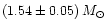 from its position in the Hertzsprung-Russell diagram and by
comparing observed periods with current theoretical
pulsation models.
For V14 we do not detect any pulsation signal.
For the double-mode pulsators V3, V15, and V16 we cannot
give a safe identification of the modes.
We also describe the photometric techniques we have used to
extract the light curves of stars in the crowded
core. Some of the SX Phnicis are saturated and
we demonstrate that even for stars that show signs of a bleeding
signal we can obtain a point-to-point accuracy of 1-3%.
from its position in the Hertzsprung-Russell diagram and by
comparing observed periods with current theoretical
pulsation models.
For V14 we do not detect any pulsation signal.
For the double-mode pulsators V3, V15, and V16 we cannot
give a safe identification of the modes.
We also describe the photometric techniques we have used to
extract the light curves of stars in the crowded
core. Some of the SX Phnicis are saturated and
we demonstrate that even for stars that show signs of a bleeding
signal we can obtain a point-to-point accuracy of 1-3%.
Key words: techniques: photometric - stars: blue stragglers -
stars: variable:  set - stars: individual: 47 Tuc
Blue straggler stars (BSS) are found in all globular clusters
where thorough searches for them have been made (Bailyn 1995).
BSS are thought to be the results of direct collisions between
stars or perhaps the gradual coalescence of
binary stars (Guhathakurta et al. 1998; Bailyn 1995).
The BSS are hotter and brighter than the turn-off stars in a globular
cluster and some BSS will cross the classical instability strip for
Scuti stars. The variable globular cluster
BSS are called SX Phnicis (SX
Phe) stars, using the name for the prototype population II field star.
|
[Fe/H] |
E(B-V) | Age [Gyr] |
 |
(m-M)V |
| -0.83 | 0.032 | 11.5 | 17.65 | 13.37 |
 |
 |
 |
|
 |
When discussing globular clusters it is important to realize that they are not just a large group of individual independent stars. BSS are but one piece of evidence for non-standard stellar evolution due to dynamical processes (Camilo et al. 2000; Bailyn 1995). For the past five years a number of globular cluster cores have been probed to look more closely at the populations of stars that are direct evidence that the dynamics of stars have influence on the evolution of globular clusters as a whole. This is possible with the Hubble Space Telescope (HST) and has indeed yielded some interesting surprises: 1) BSS are found in all globular clusters (Bailyn 1995). 2) The horizontal-branch morphology possibly depends on the dynamical evolution of the cluster, although the metallicity is the most important parameter (Fusi Pecci et al. 1996). 3) The discovery of cataclysmic variables in NGC 6397 (Cool et al. 1998).
BSS and in turn SX Phe stars are found primarily near the cluster core as a result of mass segregation (see e.g. Edmonds et al. 1996). With the exceptional resolving power of HST it is possible to probe the cores of globular clusters, examples of such research are 47 Tuc (Gilliland et al. 1998) and M 5 (Drissen & Shara 1998) - but see also Piotto et al. (1999).
The globular cluster 47 Tucanae is one of several clusters which have been searched for binaries and variable stars with the HST. Early results showed that 47 Tuc contained a significant number of BSS (Guhathakurta et al. 1992). With observations carried out with the uncorrected optics of HST (September 1993) a study of variable stars in 47 Tuc was made by Edmonds et al. (1996). In this search a few SX Phe and several eclipsing binaries were found (Edmonds et al. 1996) as well as variable K giant stars (Edmonds & Gilliland 1996).
In particular the BSS were analyzed by Gilliland et al. (1998)
who found six SX Phe stars.
From the location of the double-mode variables in the Petersen diagram
(Petersen & Christensen-Dalsgaard 1996)
Gilliland et al. (1998) were able to estimate the
pulsation masses for the four double-mode SX Phe stars.
Indeed, they showed that the pulsation masses and the
evolutionary masses, which were estimated from
the positions in the HR diagram,
agreed quite well. Combining these two methods of weighing stars,
they found masses from
 to
to
 well above
the turn-off mass at
well above
the turn-off mass at 
 in agreement with the generally
accepted merging or colliding star scenario for BSS
(Bailyn 1995).
in agreement with the generally
accepted merging or colliding star scenario for BSS
(Bailyn 1995).
Among the SX Phe stars the double-mode pulsators are particularly interesting.
In some cases it is possible to identify the pulsation modes.
This class of star is comparable to the classical double-mode Cepheids
(Petersen & Christensen-Dalsgaard 1996).
The SX Phe stars are often
pulsating in the fundamental mode and the first overtone or perhaps
in two modes of higher overtones (second and third, third and fourth, etc.).
Detections of double-mode SX Phe oscillation have been made in 47 Tuc
(Gilliland et al. 1995,1998),  Cen (Freyhammer et al. 1998),
and in a few field variables including SX Phe itself
(e.g. Garrido & Rodriguez 1996).
Cen (Freyhammer et al. 1998),
and in a few field variables including SX Phe itself
(e.g. Garrido & Rodriguez 1996).
The observed period ratio and the period of the main mode depend quite sensitively on the mass, metallicity, and evolutionary stage of the star (i.e. the age for a given mass). The ratio of the periods of the double-mode pulsators are well determined from theoretical models: as discussed in Sect. 5.4 below, the intrinsic precision of the theoretical period ratio is better than 0.01 percent (see also Petersen & Christensen-Dalsgaard 1996). Hence it is certainly possible to infer physical properties of the double-mode SX Phe stars.
There is evidence that some observed SX Phe stars oscillate in non-radial modes and it may become possible to extract information about the properties of the cores of these stars. Examples of observed SX Phe stars that show evidence of non-radial modes are SX Phe itself (Garrido & Rodriguez 1996) and V3 in 47 Tuc (Gilliland et al. 1998). Progress in the understanding of SX Phe stars can also be made if one can detect low-amplitude modes, which may provide more detailed information about the internal structure of these stars.
Section 2 contains a description of the data set.
In Sect. 3 we discuss the reduction of the
data including the task of dealing with saturated bleeding pixels on the CCD.
Section 4 contains the details of the time-series analysis while
in Sect. 5 we present the results with emphasis on
the double-mode SX Phe stars. Finally, Sect. 6 summarizes our conclusions.
![\begin{figure}
\par\includegraphics[width=8.6cm,clip]{MS10539f1.eps}\end{figure}](/articles/aa/full/2001/20/aa10539/img28.gif) |
Figure 1: Contour plots around the SX Phe star V2 in the super frame with the F555W and F814W filter. V2 is at position (15, 15) and is clearly contaminated by another bright star above it (15, 16). In F555W it can be seen that both stars are bleeding in the horizontal (CCD read-out) direction |
| Open with DEXTER | |
) and
optimized for stars at and below the turn-off. Consequently, the luminous
BSS stars are all saturated in V and some are also saturated in I.
The PC1 CCD of WFPC2 was placed near the center of 47 Tuc. This is where the density of stars is highest and most of the BSS stars are found. Five of the six known SX Phe stars in the core of 47 Tuc (Gilliland et al. 1998) are within the field of view (V1 fell outside).
The present study is an improvement compared to the results by Gilliland et al. (1998). They used HST photometry (with the aberrated WF/PC) in the U band with a total coverage of 39 hours. Although ideal for the detection of stellar oscillations the exposure time was 1000 s compared to 160 s for the present data set. The new time series are more than five times longer with total of 1289 data points compared to the 99 points in the old data set. Although the amplitudes are about a factor of two smaller (using V and I instead of U) for the present data set and some of the stars are saturated, we expect to be able to derive more accurate periods for the SX Phe stars.
We have used the DAOPHOT/ALLSTAR (D-A) software which is designed for doing photometry in crowded fields (Stetson 1987). For this study we have only reduced the PC1 frames as the BSS stars are found near the core of 47 Tuc. We use D-A to construct an empirical PSF model from about 60 stars. Because of the extreme crowding near the core of 47 Tuc this is a difficult task. The PSF model is iteratively improved by cleaning the neighbouring stars around the stars used for creating the PSF model.
It is well known that the PSF changes with time due to the
breathing of HST (Suchkov & Casertano 1997).
We also need a good description of the PSF
wings, as this has serious impact on the accuracy of the
photometry of the saturated SX Phe stars: for these stars the light in the
core is not used in the D-A analysis, and we have to look for oscillations in the wings
of the PSF profile.
Thus we constructed empirical PSF models for all frames.
![\begin{figure}
\par\includegraphics[width=8.2cm,clip]{MS10539f2.eps}\end{figure}](/articles/aa/full/2001/20/aa10539/img29.gif) |
Figure 2: Difference in internal standard deviation of light curves for two different reduction techniques for the I (left) and V (right) filters. A significant improvement is obtained for the brightest stars |
| Open with DEXTER | |
To improve the photometry we have stacked all the
frames in each filter to create a super frame.
This technique is described in Gilliland et al. (1999).
In this way we are able to combine the information from all frames to obtain
accurate positions of the stars in each individual frame.
This is done by calculating
the offset position from the stars in the super frame to each individual frame
from the position of several hundred reasonably isolated and bright stars.
In order to be able to account for geometric distortion,
we find the six coefficients (a1-a6) in the transformation

We then redo the D-A photometry with the improved positions of the stars being fixed thus the magnitudes are the only parameters which are fitted by D-A. This step greatly improves the photometric accuracy.
![\begin{figure}
\par\includegraphics[width=8.3cm,clip]{MS10539f3.eps}\end{figure}](/articles/aa/full/2001/20/aa10539/img31.gif) |
Figure 3: The final internal standard deviation of light curves for the I (left) and V (right) filters. The SX Phe stars have been clearly marked |
| Open with DEXTER | |
We find that the photometry of the brightest saturated stars is quite poor. By inspecting contour levels around stars with different degrees of saturation it is obvious that the signal from the saturated core starts to bleed along the read-out direction. Thus the stellar profile is slightly elongated, i.e. the nice symmetry of the PSF is broken due to the contamination from the bleeding pixels. A specific example of bleeding stars is shown in Fig. 1. Note that the data analyzed here have been rotated by 90 degrees from normal WFPC2 conventions, hence bleeding along x. We assume that the signal in pixels that are neighbours to saturated cores may not be reliable. To correct for this, we used different methods to find the pixels that were affected. It turned out that a simple correction gave good results: we have found that the contamination due to bleeding pixels seems to set in at a certain degree of saturation, i.e. stars for which only the central one or two pixels are saturated do not suffer from contamination. The best result was obtained by flagging pixels which are neighbours to three or more pixels (in the read-out direction) that are above the saturation limit. Flagging simply means that the pixel value is set to a value above the saturation limit, and is hence treated as such by D-A, i.e. it is not used for the PSF fitting and hence the determination of the magnitude.
The improvement for the saturated stars is significant.
In Fig. 2
we show the difference in internal standard deviation (ISD) for
the light curves
of all stars on PC1 before (N) and after flagging (F) the contaminated pixels.
The final ISD for all stars is shown in Fig. 3 in which
the five SX Phe stars have been emphasized. We define
![\begin{displaymath}\sigma_{\rm ISD}^2 = {\sum_{i}^{N-1} (m_ i - m_{i+1})^2} / [2(N-1)],
\end{displaymath}](/articles/aa/full/2001/20/aa10539/img32.gif)
A specific example of the importance of flagging the contaminated
pixels is shown
in Fig. 4. This shows the light curve in both
F555W ( )
and F814W (
)
and F814W ( )
before and after the flagging.
Due to the
amplitude dependence on wavelength the F555W light curve has been scaled by an
empirical factor of
A814/A555=0.639
(this scaling is also made before the time-series analysis in
Sect. 4).
)
before and after the flagging.
Due to the
amplitude dependence on wavelength the F555W light curve has been scaled by an
empirical factor of
A814/A555=0.639
(this scaling is also made before the time-series analysis in
Sect. 4).
![\begin{figure}
\par\includegraphics[width=8.8cm,clip]{MS10539f4.eps}\end{figure}](/articles/aa/full/2001/20/aa10539/img33.gif) |
Figure 4:
Light curve for SX Phe star V2 in F555W ()
and
F814W ()
when using two different reduction techniques
(see text for details). The abscissa is the heliocentric Julian
date minus 2451300 |
| Open with DEXTER | |
Two other time-series analyses should be mentioned here. Gilliland et al. (2000) describe use of difference image analyses for obtaining optimal results for the unsaturated stars comprising the primary data use. The difference image analysis provided time-series precisions averaging a factor of two better than those presented here for unsaturated stars, but cannot be applied at all to the saturated stars. A second approach to saturated-star extractions has been developed by one of us (RLG, Gilliland 1994) making use of aperture photometry including the saturated pixels. The latter approach provides generally comparable results to those described here for the PC1 extractions.
To perform the frequency analysis of the light curves
we used the software package period98 developed by
Sperl (1998). Figure 5 shows the
amplitude spectrum for the SX Phe star V2 (top left plot) and
also the resulting amplitude spectra when
the variation corresponding to the most significant peaks has been subtracted.
The arrows show the frequencies in cycles per day (c/d)
- one barely significant
peak at 14.88 c/d is labeled "HST'', and may be due to the
96.4 min orbital period of the observatory. The dotted
line is the empirically
determined 4 detection limit; peaks below this are
not considered to be significant. All mode frequencies,
amplitudes, phases, and errors are quoted in Table 2.
We note that the light curves have been analyzed
independently by three of the authors using different software - and
our results agree.
detection limit; peaks below this are
not considered to be significant. All mode frequencies,
amplitudes, phases, and errors are quoted in Table 2.
We note that the light curves have been analyzed
independently by three of the authors using different software - and
our results agree.
![\begin{figure}
\par\includegraphics[width=8.8cm,clip]{MS10539f5.eps}\end{figure}](/articles/aa/full/2001/20/aa10539/img34.gif) |
Figure 5:
Amplitude spectra
for the SX Phe star V2 computed
when using the combined F555W and F814W light curve
(top left plot and labeled A).
The other three plots (labeled B, C, and D)
show the resulting amplitude spectra when
the modes marked by arrows have been subtracted.
Note that the scales on the ordinate differ.
The dotted line is the 4
detection limit |
| Open with DEXTER | |
The primary modes of V2 have sufficient amplitude to provide unambiguous
detections from both the 1993 (Gilliland et al. 1998) and 1999
time series.
We now consider the other four SX Phe stars for which some of the modes
claimed previously were near the detection limit provided by the 1993 data.
Figure 6 shows the amplitude spectra for V3, V14, V15,
and V16 with the original U-band (1993) and I-band (1999) amplitudes
transformed to a common V estimate by scaling by central wavelength ratios.
Time series for V3 and V15 are based upon combined V and I (as for V2)
data making use of techniques previously described for analyzing saturated stars.
For V14 and V16 the stars never saturate in I exposures; for these
we use only the 653 unsaturated images and the more precise photometry
provided by difference image analyses.
Results for V3, V15, and V16 show that all primary modes claimed from the
1993 data are present, and these will be further discussed in Sect. 5.5.
V14 was the least significant detection from the 1993 data, and was only
selected (Gilliland et al. 1998) as a likely variable by searching
for repeated low amplitude peaks with spacing characteristic of successive
radial modes.
The 1999 data for V14 clearly show that not even a slight hint of the
claimed modes exists; the most likely interpretation is that V14 is not
a variable and we will not further consider V14 as an SX Phe star.
The V14 amplitude spectrum for 1999 nicely illustrates a characteristic of the
extensive HST observations - a very clean spectrum that in fact stays
flat from below 1 cycle/day out to the Nyquist frequency of 180 cycles/day.
V16 was also only found as a variable from the 1993 data based on a search
for successive radial overtone peaks; in this case the 1999 data clearly
confirm oscillations are again present.
![\begin{figure}
\par\includegraphics[width=8.8cm,clip]{MS10539f6.eps}\end{figure}](/articles/aa/full/2001/20/aa10539/img35.gif) |
Figure 6: Amplitude spectra for V3, V14, V15, and V16 are shown comparing the 1993 (Gilliland et al. 1998) results with the new 1999 data. All amplitudes have been scaled as needed by wavelength to provide V-band equivalent magnitudes. Frequency units are cycles per day. All modes claimed from the 1993 data are marked with vertical bars under the corresponding peaks |
| Open with DEXTER | |
In Figs. 7 and 8 we show the phase diagrams for the three largest amplitude double-mode stars in our sample. In each diagram all known modes have been subtracted except for one mode, the frequency of which is shown in the top left corner. Note the different scale on the ordinates.
The original HST data
(WF/PC; Gilliland et al. 1998) used to find
SX Phe variables in 47 Tuc covered an area of 66
66 arcsec2,
with the cluster centre about 10 arcsec from the field of view centre.
The new search domain with WFPC2 observing in 1999 is such that
the PC1 field of view is almost entirely contained within the
original search area, while the much larger field of view of the
WF CCDs is (at the 90% level) outside the original search space.
We have extracted time series for 2968 saturated stars on the 4
WFPC2 CCDs using the technique of Gilliland (1994).
Near the domain in the CMD where the previous SX Phe stars were found,
the root-mean-square variations in the resulting time series are
 1 - 2% (albeit with non-Gaussian
characteristics). We note that the previously detected SX Phe
variables V2, V3, V15, and V16 are easily observed in these new
time series.
Although the new survey field of view is much larger than that
previously surveyed, it is also on average farther from the cluster
center. In the domain
15.0 < V < 17.0,
0.2 < V - I < 0.45,
the original search contained about 25 stars, of which 6
are SX Phe variables. The number of new stars surveyed within this
box in the CMD is only 7, consistent with the known, strong central
concentration of BSS. The time series for all of the
newly surveyed BSS were analyzed by taking power spectra
and searching for significant peaks; no convincing evidence of
variables was found. Amplitudes of 0.01 magnitudes would in
general be easily seen unless the period is similar to the 96.4 min
HST orbital period or its harmonics.
1 - 2% (albeit with non-Gaussian
characteristics). We note that the previously detected SX Phe
variables V2, V3, V15, and V16 are easily observed in these new
time series.
Although the new survey field of view is much larger than that
previously surveyed, it is also on average farther from the cluster
center. In the domain
15.0 < V < 17.0,
0.2 < V - I < 0.45,
the original search contained about 25 stars, of which 6
are SX Phe variables. The number of new stars surveyed within this
box in the CMD is only 7, consistent with the known, strong central
concentration of BSS. The time series for all of the
newly surveyed BSS were analyzed by taking power spectra
and searching for significant peaks; no convincing evidence of
variables was found. Amplitudes of 0.01 magnitudes would in
general be easily seen unless the period is similar to the 96.4 min
HST orbital period or its harmonics.
| Star | Frequency | V Amplitude | Phase | Mode | Gilliland et al. |
| [c/d] | [mag] | [c] | combination | ||
| V2 | 9.816(0.002) | 0.044(0.001) | 0.662(0.004) | *  |
9.807(0.013) |
| 12.684(0.002) | 0.034(0.001) | 0.488(0.005) | *  |
12.700(0.016) | |
| 22.490(0.005) | 0.012(0.001) | 0.187(0.014) | *
 |
22.494(0.057) | |
| 2.866(0.007) | 0.011(0.001) | 0.620(0.014) | *
 |
||
| 19.604(0.020) | 0.008(0.001) | 0.564(0.076) | *  |
||
| 25.354(0.013) | 0.005(0.001) | 0.351(0.035) | ?  |
||
| 6.914(0.013) | 0.005(0.001) | 0.179(0.025) | ?
 |
||
| V3 | 17.929(0.001) | 0.036(0.005) | 0.624(0.007) | * |
17.948(0.022) |
| 18.359(0.004) | 0.009(0.005) | 0.925(0.017) | ? |
18.585(0.064) | |
| V15 | 30.110(0.004) | 0.0084(0.0004) | 0.727(0.007) | * |
30.157(0.053) |
| 34.807(0.010) | 0.0038(0.0004) | 0.493(0.016) | * |
34.671(0.070) | |
| V16 | 31.988(0.005) | 0.0039(0.0005) | 0.055(0.016) | * |
31.894(0.064) |
| 28.165(0.008) | 0.0016(0.0005) | 0.256(0.016) | ? |
28.116(0.071) |
![\begin{figure}
\par\includegraphics[width=8.8cm,height=7cm,clip]{MS10539f7.eps}\end{figure}](/articles/aa/full/2001/20/aa10539/img42.gif) |
Figure 7: Phase diagrams for V2 for the three main modes |
| Open with DEXTER | |
The conversion from the instrumental to standard V,I (Johnson-Cousins) magnitudes was done following the "photometric cookbook'' of Holtzman et al. (1995). We correct for geometric distortion and the "34th row effect'' (Anderson & King 1999). We have corrected for the charge-transfer efficiency (CTE) problem by following the formulation of Stetson (1998) and we include his new photometric zero-points.
Systematic differences between long and short exposures obtained with the HST have been reported in the literature (see e.g. Kelson et al. 1996). There is a tendency that measurements of stellar brightness from frames with long exposure times yield brighter magnitudes than short-time exposures. To be able to correct for the "long-short anomaly'', we reduced some additional short exposures obtained for our field: four 1.6 s exposures in F555W and F814W (the same field as the 160 s exposures).
We then determined
the offsets in V and I from frames with different exposure
times. The offsets are:
 (160-1.6 s)
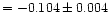 (1042 stars), and
 (160-1.6 s)
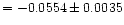 (1034 stars).
We stress that this is after correcting for the CTE effect, i.e. the
long-short anomaly is "real'' and not only a part of the CTE problem.
A possible explanation for the offsets is the difficulty of
determining the 0.5 arcsec
aperture correction due to crowding.
This correction is needed when following the calibration "cookbook''
of Holtzman et al. (1995).
(1034 stars).
We stress that this is after correcting for the CTE effect, i.e. the
long-short anomaly is "real'' and not only a part of the CTE problem.
A possible explanation for the offsets is the difficulty of
determining the 0.5 arcsec
aperture correction due to crowding.
This correction is needed when following the calibration "cookbook''
of Holtzman et al. (1995).
After the removal of the offsets,
we compare our CMD with several results from the literature.
We have found the average V of the stars in the transition between
the turn-off and the red giant branch:
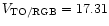 near V-I=0.80.
The mean of Hesser et al. (1987), Kaluzny et al. (1998),
and Alcaino & Liller (1987) is
near V-I=0.80.
The mean of Hesser et al. (1987), Kaluzny et al. (1998),
and Alcaino & Liller (1987) is
 .
We thus apply an offset of
.
We thus apply an offset of
 .
The offset in Iis found from the colour of the turn-off. The mean colour from Kaluzny et al. (1998)
and Alcaino & Liller (1987) is
.
The offset in Iis found from the colour of the turn-off. The mean colour from Kaluzny et al. (1998)
and Alcaino & Liller (1987) is
 .
We find
.
We find
 .
.
The final colour-magnitude diagram (CMD) is shown in Fig. 9 where the BSS stars have been marked. The parameters of the SX Phe stars are given in Table 3.
Two groups in our team have performed the
standard photometry in order to detect systematic differences.
The first group reduced each short exposure image individually while the second
group worked on combined images.
The photometry of the SX Phe stars and the CMD presented here are
the results of the first group - here we mention the main differences.
After correcting for the offsets mentioned above
(TO/RGB transition level and colour of the turn-off) the results
from both groups based on the short exposures generally agree:
we note that for the CMD presented here, the brightest
part (V<14.5) of the giant branch is more red (
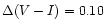 )
than the ground-based study by Da Costa & Armandroff (1990).
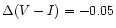
Our second group finds
)
than the ground-based study by Da Costa & Armandroff (1990).
Our second group finds
 for these stars.
In the interesting case of the SX Phe star
V2, both groups agree that
for these stars.
In the interesting case of the SX Phe star
V2, both groups agree that
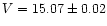 while
we find discrepant results for the red filter:
while
we find discrepant results for the red filter:
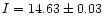 and
and
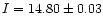 .
The most immediate explanations for this
are the crowding around V2 (cf. Fig. 1)
and that the images are under-sampled.
We note that systematic errors of the order 0.03 magnitudes
may still be present (see e.g. Stetson 1998) for all stars.
.
The most immediate explanations for this
are the crowding around V2 (cf. Fig. 1)
and that the images are under-sampled.
We note that systematic errors of the order 0.03 magnitudes
may still be present (see e.g. Stetson 1998) for all stars.
![\begin{figure}
\par\includegraphics[width=8.8cm,clip]{MS10539f8a.eps}\includegraphics[width=8.8cm,clip]{MS10539f8b.eps}\end{figure}](/articles/aa/full/2001/20/aa10539/img57.gif) |
Figure 8: Phase diagram for V3 and V15 for two modes |
| Open with DEXTER | |
To transform the empirical data into the theoretical plane we adopted
the bolometric corrections (BCs) and the colour-temperature relations
provided by Bessell et al. (1998).
By means of a linear interpolation of the tables for
![${\rm [Fe/H]}=-0.5$](/articles/aa/full/2001/20/aa10539/img58.gif) and
-1.0 we estimated a new list of BCs for
and
-1.0 we estimated a new list of BCs for
![${\rm [Fe/H]}=-0.83$](/articles/aa/full/2001/20/aa10539/img59.gif) .
For MS stars we use
.
For MS stars we use
 ,
while for BSS we use
,
while for BSS we use
 .
As a special case we assumed
.
As a special case we assumed
 for V2, since this SX Phe has
already evolved off the MS. Note that such a value is somewhat
lower than the value obtained on the basis of an evolutionary track
with
for V2, since this SX Phe has
already evolved off the MS. Note that such a value is somewhat
lower than the value obtained on the basis of an evolutionary track
with
 (VandenBerg, private communication).
On the basis of these assumptions and of the observed colour (two
independent determinations) we find that
the effective temperature for V2 ranges
from
(VandenBerg, private communication).
On the basis of these assumptions and of the observed colour (two
independent determinations) we find that
the effective temperature for V2 ranges
from
 K (
(V-I)0=0.39)
to
K (
(V-I)0=0.39)
to
 K (
(V-I)0=0.23).
We have used
K for V2 and find BC =-0.02 mag.
The BCs for all stars were estimated by adopting a
similar procedure. The BC for the SX Phe stars are listed in Table 3.
K (
(V-I)0=0.23).
We have used
K for V2 and find BC =-0.02 mag.
The BCs for all stars were estimated by adopting a
similar procedure. The BC for the SX Phe stars are listed in Table 3.
The distance modulus of 47 Tuc has been determined several times
in the literature.
VandenBerg (2000) found
 (using
new isochrones and B,V photometry by Hesser et al. 1987).
Grundahl et al. (2001) made Strömgren
photometry on 47 Tuc and 14 field sub dwarfs.
By fitting the lower main sequence of 47 Tuc
to the field stars, they find a distance modulus
(using
new isochrones and B,V photometry by Hesser et al. 1987).
Grundahl et al. (2001) made Strömgren
photometry on 47 Tuc and 14 field sub dwarfs.
By fitting the lower main sequence of 47 Tuc
to the field stars, they find a distance modulus
 .
The quoted errors ignore systematic
errors, e.g. the zero point of the metallicity scale
and the error on the interstellar reddening.
The systematic error is of the order 0.10 magnitudes.
These three independent studies all seem to deviate significantly from
Carretta et al. (2000)
and Salaris & Weiss (1998) who find
.
The quoted errors ignore systematic
errors, e.g. the zero point of the metallicity scale
and the error on the interstellar reddening.
The systematic error is of the order 0.10 magnitudes.
These three independent studies all seem to deviate significantly from
Carretta et al. (2000)
and Salaris & Weiss (1998) who find
 and
and
 ,
respectively.
We finally draw attention to
the study of the white dwarf cooling sequence by
Zoccali et al. (1999). They find a distance modulus
of
,
respectively.
We finally draw attention to
the study of the white dwarf cooling sequence by
Zoccali et al. (1999). They find a distance modulus
of
 (assuming again
E(B-V)=0.032).
In the following, we adopt the value obtained by
VandenBerg (2000), i.e.
.
(assuming again
E(B-V)=0.032).
In the following, we adopt the value obtained by
VandenBerg (2000), i.e.
.
Figure 10 is the Hertzsprung-Russell (HR) diagram for 47 Tuc in which all BSS stars and main-sequence stars with the best photometry are shown. The five known SX Phe stars have been labelled. Also seen in the plot are evolutionary tracks for models computed with the evolution code by Christensen-Dalsgaard (Petersen & Christensen-Dalsgaard 1996,1999). The abundances of hydrogen, helium, and heavy elements are (X,Y,Z)=(0.754,0.241,0.005) which is appropriate for 47 Tuc according to VandenBerg (2000).
We note that Salaris & Weiss (1998) discuss the evidence
for a somewhat higher value of Y=0.273 for 47 Tuc. For example
they use the R-method (Buzzoni et al. 1983) with
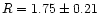 and
and
 based on
Buzzoni et al. (1983) and Hesser et al. (1987),
respectively. This corresponds to a mean
based on
Buzzoni et al. (1983) and Hesser et al. (1987),
respectively. This corresponds to a mean
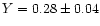 which is
roughly consistent with the value we have adopted (using the
calibration by Buzzoni et al. 1983).
We note that a more recent determination of the R parameter was
done by Zoccali et al. (2000) based on observations
with HST. They find
which is
roughly consistent with the value we have adopted (using the
calibration by Buzzoni et al. 1983).
We note that a more recent determination of the R parameter was
done by Zoccali et al. (2000) based on observations
with HST. They find
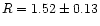 corresponding to
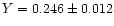 (again using Buzzoni et al. 1983).
Based on this short discussion we have adopted the same
helium content as VandenBerg (2000), i.e. Y=0.241.
(again using Buzzoni et al. 1983).
Based on this short discussion we have adopted the same
helium content as VandenBerg (2000), i.e. Y=0.241.
The age of the cluster was determined to be
11.5 Gyr by VandenBerg (2000) from the B,V photometry
by Hesser et al. (1987). The new combined V,I photometry from HST
indicates that this age estimate may be a bit too young.
In Fig. 10 we have also shown an isochrone of age
12.5 Gyr computed by VandenBerg (private communication).
For comparison the
 evolutionary model
in Fig. 10 reaches the
turn-off at
evolutionary model
in Fig. 10 reaches the
turn-off at
 after 10 Gyr and
starts climbing the Hayashi-track around 13 Gyr: This evolutionary
model is indeed comparable with stars near the observed turn-off.
Thus our models are in qualitative agreement with VandenBerg.
We note that Salaris & Weiss (1998)
find an age of
after 10 Gyr and
starts climbing the Hayashi-track around 13 Gyr: This evolutionary
model is indeed comparable with stars near the observed turn-off.
Thus our models are in qualitative agreement with VandenBerg.
We note that Salaris & Weiss (1998)
find an age of
 Gyr for 47 Tuc.
The BSS population is clearly seen in the HR diagram
in Fig. 10.
The "life span'' for models with the metallicity of 47 Tuc and
masses
 and
and
 (typical for BSS stars)
is only about 1.8 Gyr and 1.3 Gyr, respectively (the time to reach the hook).
Thus it is evident that these stars have formed late in the
evolution of the cluster,
probably by a merger or collision between two stars
of mass below the turn-off mass.
(typical for BSS stars)
is only about 1.8 Gyr and 1.3 Gyr, respectively (the time to reach the hook).
Thus it is evident that these stars have formed late in the
evolution of the cluster,
probably by a merger or collision between two stars
of mass below the turn-off mass.
The observed instability strip for population I
Scuti stars is also
shown in Fig. 10 (Breger 1990).
Four of five SX Phe stars are located inside
the instability region. Even when taking into account the
uncertainty of the temperature V14 is not inside the
instability region - possibly explaining the lack of variation
for this BSS (cf. the amplitude diagram in Fig. 6).
![\begin{figure}
\par\includegraphics[width=8.5cm,clip]{MS10539f9.eps}\end{figure}](/articles/aa/full/2001/20/aa10539/img80.gif) |
Figure 9: Combined CMD for 47 Tuc. Filled dots mark the BSS stars, and the SX Phe stars have been labeled |
| Open with DEXTER | |
Detailed modelling of the BSS stars is hampered by the uncertainties
relating to their formation (e.g. Benz & Hills 1987,
1992;
Bailyn & Pinsonneault 1995).
This likely leads to changes in composition due to mixing;
in the extreme case where stars at the turn-off are completely
mixed, the resulting homogeneous helium content would be
 .
Furthermore, it is plausible that, for example, the orbital angular
momentum in a merging binary star would lead to a very rapidly rotating BSS.
A detailed investigation of such effects is beyond the scope of the
present paper.
However, we have explored the effects of a change in the composition:
in addition to the models with the
standard helium abundance (SHe, Y=0.241),
we have considered models with increased helium content (IHe, Y=0.261)
and masses
.
Furthermore, it is plausible that, for example, the orbital angular
momentum in a merging binary star would lead to a very rapidly rotating BSS.
A detailed investigation of such effects is beyond the scope of the
present paper.
However, we have explored the effects of a change in the composition:
in addition to the models with the
standard helium abundance (SHe, Y=0.241),
we have considered models with increased helium content (IHe, Y=0.261)
and masses
 and
and
 ;
these are also shown in Fig. 10 (dashed lines).
;
these are also shown in Fig. 10 (dashed lines).
From the evolutionary tracks it is possible to estimate the masses
of the SX Phe stars. A unique case is V2 for which an unambiguous
estimate can be given:
the evolutionary tracks are almost horizontal around V2,
hence the uncertainty in
 is not so important for the mass estimation from the position
in the HR diagram. For V2 we find
is not so important for the mass estimation from the position
in the HR diagram. For V2 we find
 for
the standard helium abundance;
using instead the models with increased
helium abundance (IHe) we obtain
for
the standard helium abundance;
using instead the models with increased
helium abundance (IHe) we obtain
 .
The other SX Phe stars all lie
around the hooks of the evolutionary tracks and the mass estimate
is more uncertain for these stars (
.
The other SX Phe stars all lie
around the hooks of the evolutionary tracks and the mass estimate
is more uncertain for these stars (
 ).
In Table 3 we have given mass estimates and
various parameters of the SX Phe stars.
).
In Table 3 we have given mass estimates and
various parameters of the SX Phe stars.
In Fig. 10 the model ages in Gyr are given
at three points along the
 track which is below V2
(in square brackets). Consequently the age of V2 must be
somewhat lower than the 1.9 Gyr found from this track.
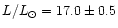
If we assume that V2 is following the evolutionary track of a
standard model (ignoring formation history, e.g. mixing of the
merging stars) and that the position in the HR diagram is correct
we can conclude (from an evolutionary track of mass
track which is below V2
(in square brackets). Consequently the age of V2 must be
somewhat lower than the 1.9 Gyr found from this track.
If we assume that V2 is following the evolutionary track of a
standard model (ignoring formation history, e.g. mixing of the
merging stars) and that the position in the HR diagram is correct
we can conclude (from an evolutionary track of mass
 ):
the age of V2 is around
):
the age of V2 is around
 Gyr,
Gyr,
 ,
core burning of
hydrogen has ceased
,
core burning of
hydrogen has ceased
 ,
and the star has only
a few hundred million years left before it will start climbing the
Hayashi track and eventually go into the helium-burning phase.
,
and the star has only
a few hundred million years left before it will start climbing the
Hayashi track and eventually go into the helium-burning phase.
| Star | V | V-I |
 |
 |
|
 |
| V2 | 15.07 | 0.43 | 1.68 | -0.02 | 7100 | 1.54 |
| V3 | 15.93 | 0.38 | 2.54 | -0.02 | 7300 | 1.35 |
| V15 | 15.28 | 0.24 | 1.91 | -0.01 | 7900 | 1.65 |
| V16 | 15.76 | 0.38 | 2.37 | -0.02 | 7300 | 1.35 |
For some double-mode SX Phe stars a safe mode identification is possible. Most double-mode pulsators oscillate in radial modes (l=0) of low radial order (n=1-6). One can put constraints on the astrophysical properties (mass, helium content) of these stars by comparing observed and theoretical data in a period-ratio versus period diagram, the so-called Petersen diagram. In the following we look more closely at the double-mode SX Phe star V2, and then discuss the more difficult stars V3, V15, and V16.
We interpret the dominant observed modes as the
the fundamental mode and the first overtone
and obtain a period ratio of
 .
Gilliland et al. (1998) found
.
Gilliland et al. (1998) found
 ,
i.e. the results are essentially consistent.
With the more accurate
period ratio obtained from the new longer time series we can
constrain the mass of V2 to within a formal error of
,
i.e. the results are essentially consistent.
With the more accurate
period ratio obtained from the new longer time series we can
constrain the mass of V2 to within a formal error of
 at a given composition from the position
in the Petersen diagram. The error in the mass estimate will be
discussed further below.
at a given composition from the position
in the Petersen diagram. The error in the mass estimate will be
discussed further below.
We have used a series of
pulsation models which are extracted from the grid of evolutionary tracks
in Fig. 10.
From the HR diagram we make a rough
estimate of the range of stellar masses that are relevant
(
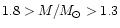 ).
As before, in addition to the standard models we have also calculated
pulsation models with higher helium content.
).
As before, in addition to the standard models we have also calculated
pulsation models with higher helium content.
![\begin{figure}
\par\includegraphics[width=8.5cm,clip]{MS10539f10.eps}\end{figure}](/articles/aa/full/2001/20/aa10539/img100.gif) |
Figure 10:
HR diagram of 47 Tuc. Several theoretical evolutionary tracks
are shown. For models in the mass interval
 to 1.9
and standard chemical composition tracks are plotted with either solid
or dotted lines.
Two tracks with increased helium content are also shown with dashed lines.
For the
to 1.9
and standard chemical composition tracks are plotted with either solid
or dotted lines.
Two tracks with increased helium content are also shown with dashed lines.
For the
 model the age in Gyr is indicated at three points.
The filled circles mark the BSS stars and the SX Phe stars have been labeled.
The turn-off region can be seen in the lower right corner.
The age of the isochrone is
12.5 Gyr (computed by VandenBerg, private communication)
model the age in Gyr is indicated at three points.
The filled circles mark the BSS stars and the SX Phe stars have been labeled.
The turn-off region can be seen in the lower right corner.
The age of the isochrone is
12.5 Gyr (computed by VandenBerg, private communication) |
| Open with DEXTER | |
Figure 11 compares the observed period ratio of V2 with data for several stellar oscillation models. Solid lines are computed from models with standard helium abundance (SHe, Y=0.241), dashed lines have increased helium content (IHe, Y=0.261). A decrease in effective temperature causes an increase in the pulsation period and as a consequence a stellar model moves from left to right in Fig. 11 during its post-main-sequence evolution.
The double-mode SX Phe star V2 is shown in the plot. We estimate
the mass of V2 to be
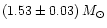 for SHe.
From the models with IHe we infer
the mass to be
for SHe.
From the models with IHe we infer
the mass to be
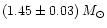 .
.
The good accuracy of the observed period ratio for V2
- the error bars can be seen in the inserted plot -
is due to the long time series with good sampling.
In comparison the result by Gilliland et al. (1998) is
 (cf. their Fig. 22).
The mass determination is obviously also sensitive to errors in
the stellar modelling used in computing periods and period ratios.
We have estimated the intrinsic errors arising from numerical
effects in the computation of the evolutionary models and their
oscillation frequencies; the effect on the computed period ratio
 is minute, less than 10-4.
On the other hand,
major contributions to the uncertainty in the mass determination arise from
uncertainties in the composition parameters and possible effects from
rotation of V2.
The possible effects on the helium abundance of mixing associated
with the formation of BSS have already been mentioned.
To this must be added the uncertainties in the determination of
the overall composition of the cluster.
Also, it is well known that rotation affects the evolution of stellar models
and the derived oscillation frequencies (e.g. Pamyatnykh 2000;
Goupil et al. 2000). Fast rotation modifies the evolutionary tracks in
the HR and Petersen diagrams, particularly in the post-main-sequence
stages where V2 is located. Although the frequency corrections are
expected to be relatively small for radial modes, they may be significant.
For the high-amplitude
Scuti stars
(with amplitude AV > 0.3 mag) rotation is usually slow.
However, V2 has relatively low amplitude (
AV = 0.15)
and its rotational velocity (
is minute, less than 10-4.
On the other hand,
major contributions to the uncertainty in the mass determination arise from
uncertainties in the composition parameters and possible effects from
rotation of V2.
The possible effects on the helium abundance of mixing associated
with the formation of BSS have already been mentioned.
To this must be added the uncertainties in the determination of
the overall composition of the cluster.
Also, it is well known that rotation affects the evolution of stellar models
and the derived oscillation frequencies (e.g. Pamyatnykh 2000;
Goupil et al. 2000). Fast rotation modifies the evolutionary tracks in
the HR and Petersen diagrams, particularly in the post-main-sequence
stages where V2 is located. Although the frequency corrections are
expected to be relatively small for radial modes, they may be significant.
For the high-amplitude
Scuti stars
(with amplitude AV > 0.3 mag) rotation is usually slow.
However, V2 has relatively low amplitude (
AV = 0.15)
and its rotational velocity ( )
is not known.
Finally, we recall from Sect. 5.1 that basic
parameters of the star, i.e. the effective temperature and
the distance modulus, are subject to substantial uncertainty.
)
is not known.
Finally, we recall from Sect. 5.1 that basic
parameters of the star, i.e. the effective temperature and
the distance modulus, are subject to substantial uncertainty.
![\begin{figure}
\par\includegraphics[width=8.5cm,clip]{MS10539f11.eps}\end{figure}](/articles/aa/full/2001/20/aa10539/img106.gif) |
Figure 11:
The Petersen diagram for several stellar model series.
The helium content of the different model series is
explained in the top left corner;
as indicated, the SHe models cover the mass range
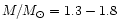 ,
while IHe models are shown for ,
while IHe models are shown for
 and 1.5.
In the inserted plot the ages of models with Y=0.241and mass
and 1.6 are given in Gyr
and 1.5.
In the inserted plot the ages of models with Y=0.241and mass
and 1.6 are given in Gyr |
| Open with DEXTER | |
Given these uncertainties, to what extent can we trust our mass determinations?
A very significant aspect in the interpretation is the consistency
between different determinations.
As an example, consider the effects of the helium abundance,
exemplified by the SHe and IHe model series.
From the analysis of the HR diagram (Fig. 10)
V2 has evolutionary mass
 with
SHe,
for which the period-ratio mass is
with
SHe,
for which the period-ratio mass is
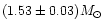 ;
for IHe the corresponding values are
;
for IHe the corresponding values are
 and
and
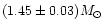 from the period ratio.
Thus for both compositions the two mass determinations
agree within the formal error bars, although the match
is somewhat better for SHe.
We also note that the mass estimates allow a better
constraint on the change in the helium abundance resulting from complete mixing.
Assuming that the progenitor stars had masses of around
from the period ratio.
Thus for both compositions the two mass determinations
agree within the formal error bars, although the match
is somewhat better for SHe.
We also note that the mass estimates allow a better
constraint on the change in the helium abundance resulting from complete mixing.
Assuming that the progenitor stars had masses of around
 and had evolved for 10 Gyr before the merger,
the average helium abundance would be increased by around 0.04
relative to the original value, i.e. twice the difference
between SHe and IHe.
Since complete mixing is thought to be unlikely during BSS formation,
the SHe abundance solution is favoured (Y = 0.241).
and had evolved for 10 Gyr before the merger,
the average helium abundance would be increased by around 0.04
relative to the original value, i.e. twice the difference
between SHe and IHe.
Since complete mixing is thought to be unlikely during BSS formation,
the SHe abundance solution is favoured (Y = 0.241).
We have adopted a metal content
Z = 0.005 for the
models. However, the value of
from Table 1 with the
original definition
![${\rm [Fe/H]} = \log (Z/Z_{\odot})$](/articles/aa/full/2001/20/aa10539/img112.gif) and
and
 gives
Z = 0.0028, and Salaris & Weiss (1998) use Z=0.008,
since they account for
gives
Z = 0.0028, and Salaris & Weiss (1998) use Z=0.008,
since they account for  -element enhancement.
In addition to the analysis based on
standard stellar model series with
Z = 0.005, we have also
performed mass estimations using the composition used by
Salaris & Weiss (1998), i.e.
Y=0.273, Z= 0.008.
We find that for this composition we cannot obtain consistent
modelling satisfying the observational constraints:
V2 fits an evolutionary track in the HR diagram of mass
-element enhancement.
In addition to the analysis based on
standard stellar model series with
Z = 0.005, we have also
performed mass estimations using the composition used by
Salaris & Weiss (1998), i.e.
Y=0.273, Z= 0.008.
We find that for this composition we cannot obtain consistent
modelling satisfying the observational constraints:
V2 fits an evolutionary track in the HR diagram of mass
 and the period ratio yields the mass
 .
.
Composition |
SHe | IHe | S-W |
| Y | 0.241 | 0.261 | 0.273 |
| Z | 0.005 | 0.005 | 0.008 |
| Method | Mass estimates () |
||
| HR-diagram | 1.54 | 1.50 | 1.56 |
| Pulsation modes | 1.53 | 1.45 | 1.67 |
From the period and period ratio we may also infer the
age and effective temperature of V2.
For the SHe models of mass 1.6 and
we have
indicated the age of the models in Gyr in the inserted plot in
Fig. 11;
this can be compared with the ages in the HR diagram
in Fig. 10 for the
model.
The analysis indicates that
may be somewhat higher than inferred from our adopted V-I photometry:
from the Petersen diagram we infer that
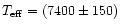 K.
The ages roughly agree with Fig. 10 when taking the
error on
into account, leading to an age of
K.
The ages roughly agree with Fig. 10 when taking the
error on
into account, leading to an age of
 Gyr.
Gyr.
The determination of
 is sensitive to errors
in the distance modulus.
An independent estimate of this may be obtained from the
period-luminosity-colour-metallicity (PLCZ) relation for
SX Phe stars, derived by
Petersen & Christensen-Dalsgaard (1999) from
theoretical stellar models.
This relation is sensitive to the adopted values of Z and in
particular of
.
In the above analysis of V2 we have considered the
-interval
7100 to 7700 K. For the preferred Z = 0.005 the PLCZ relation gives
the corresponding interval in
of 1.98 to 1.56 mag. We note that
this is in rough agreement with the value given
in Table 3 for V2 (
= 1.68)
and hence justifies our use of the VandenBerg (2000)
distance modulus.
Although this is somewhat speculative, a
higher temperature for V2, as inferred from the
period, seems to be necessary to explain the distance
modulus inferred from the main period.
We recall from Sect. 5.1 that independent estimates of
V-I gave discrepant results for V2.
is sensitive to errors
in the distance modulus.
An independent estimate of this may be obtained from the
period-luminosity-colour-metallicity (PLCZ) relation for
SX Phe stars, derived by
Petersen & Christensen-Dalsgaard (1999) from
theoretical stellar models.
This relation is sensitive to the adopted values of Z and in
particular of
.
In the above analysis of V2 we have considered the
-interval
7100 to 7700 K. For the preferred Z = 0.005 the PLCZ relation gives
the corresponding interval in
of 1.98 to 1.56 mag. We note that
this is in rough agreement with the value given
in Table 3 for V2 (
= 1.68)
and hence justifies our use of the VandenBerg (2000)
distance modulus.
Although this is somewhat speculative, a
higher temperature for V2, as inferred from the
period, seems to be necessary to explain the distance
modulus inferred from the main period.
We recall from Sect. 5.1 that independent estimates of
V-I gave discrepant results for V2.
We thus have two clues that indicate the
of V2 may be
higher than what we find from the colour
(i.e.
V-I = 0.43 or
K): 1) a comparison of the
theoretical model ages that best fit the position in the
Petersen diagram and the HR diagram do not agree. 2) The PLCZ calibration from
Petersen & Christensen-Dalsgaard (1999) gives a small
distance modulus (
 )
for Z = 0.005 and
K.
Both these observations indicate a higher value of
.
If for V2 we assume
)
for Z = 0.005 and
K.
Both these observations indicate a higher value of
.
If for V2 we assume
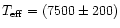 K
appropriate to the independent V-I = 0.27 determination
we find that the PLCZ relation gives a distance modulus
of
K
appropriate to the independent V-I = 0.27 determination
we find that the PLCZ relation gives a distance modulus
of
 in agreement with VandenBerg (2000)
and Grundahl et al. (2001) - and with this temperature
the new position of V2 in the HR diagram agrees with
the position in the Petersen diagram within error-bars.
in agreement with VandenBerg (2000)
and Grundahl et al. (2001) - and with this temperature
the new position of V2 in the HR diagram agrees with
the position in the Petersen diagram within error-bars.
It is evident that there are a number of uncertainties concerning
the parameters and modelling of V2.
Also, we have not been able to take into account the possible
effects of rotation on the inferences.
However, the fact that
we obtain a consistent description of V2 using standard modelling
without rotation - which is the simplest possibility -
gives us some confidence in this modelling.
Since V2 is a relatively evolved and hence old BSS at 1.7 Gyr
it could by now have lost significant angular momentum even if it
was formed initially as a rapid rotator.
Thus, from this discussion
we maintain that a reasonable estimate for the mass of V2 is
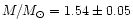 ;
we stress, however, that this assumes V2
to have the same chemical composition as an average star in the cluster.
;
we stress, however, that this assumes V2
to have the same chemical composition as an average star in the cluster.
In Table 4 we present the results of the mass estimation of V2 for the three different chemical compositions discussed above.
We finally note that we have also found new low-amplitude modes for V2 (see Table 2), but their frequencies are simply linear combinations of the frequencies of the two main modes. This indicates that the modes are interacting non-linearly, as was also noted by Gilliland et al. (1998), and the pattern given in Table 2 is in perfect agreement with predictions from Garrido & Rodriguez (1996).
The interpretation
of the modes of V3 is difficult since the period ratio
is close to unity. Gilliland et al. (1998) propose that it is
a rotationally split non-radial mode (l=1). If this is true, the
rotational period of V3 (based on the splitting in Table 2)
is
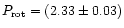 days. Gilliland et al. (1998) found
a significantly faster rotation period
days. Gilliland et al. (1998) found
a significantly faster rotation period
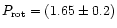 days.
days.
The interpretation of the double-mode SX Phe
star V15 is also difficult. If this star is assumed to be a "classical''
double-mode pulsator
oscillating in radial modes, it must be oscillating in high overtones.
The observed period ratio is
 ,
which
is below the ratio calculated from theoretical models
with radial orders 5 and 6 - but above the calculated ratio for
radial orders 4 and 5.
Figure 12
shows several series of models oscillating in these high overtones.
The 10
error bars are shown.
,
which
is below the ratio calculated from theoretical models
with radial orders 5 and 6 - but above the calculated ratio for
radial orders 4 and 5.
Figure 12
shows several series of models oscillating in these high overtones.
The 10
error bars are shown.
The result for V15 by Gilliland et al. (1998)
was
 .
This result
was consistent with V15 oscillating in two high overtones
with their analysis, i.e. orders 4 and 5.
With the new results none of the
calculated models fits the observed properties of V15.
This is also the case when using the composition from Salaris
& Weiss (1998), i.e. models with higher helium
and heavy element content.
.
This result
was consistent with V15 oscillating in two high overtones
with their analysis, i.e. orders 4 and 5.
With the new results none of the
calculated models fits the observed properties of V15.
This is also the case when using the composition from Salaris
& Weiss (1998), i.e. models with higher helium
and heavy element content.
Possible explanations for the apparent discrepancy are e.g. (i) that at least one of the observed modes is a non-radial mode, or (ii) that the frequencies are modified by rotation of the star. A clear interpretation of the modes in V15 cannot yet be made.
We note that for the two modes in V15 the periods
determined from 1993 and 1999 observations
agree to 0.8
and 2.0
for the large- and small-amplitude
peaks, respectively.
Either spurious agreement with radial overtone period ratios was allowed by
the larger errors in the results of Gilliland et al. (1998),
or the lower-amplitude peak
represents different modes having been excited 6 years apart.
Interpretation of the double-mode star V16 is also problematic here.
The mode near 32 cycles/day from 1993 is clearly present in the 1999
observations with the new frequency 1.2
from the original value.
The mode near 28 cycles/day is at a lower amplitude in 1999 and at
marginal 3
significance in each epoch separately.
Taking the agreement (to 0.8
from the 1999 period) as
confirmation of this mode and evaluating the period ratio yields
 (compared to 1993 data result
of 0.8816
(compared to 1993 data result
of 0.8816  0.0028) which falls just above the period
ratios for orders 5 and 6 in Fig. 12.
However, there are evidently other modes present to equal or higher
significance - these cannot all be radial modes. The significance of
amplitudes quoted in Table 2 represent very conservative values
based upon establishing a local mean in the amplitude spectra
and considering the ratio of the mode amplitude to this.
Since our power spectra for non-variable stars remain flat consistent
with white noise, it may well be appropriate to base the errors
on means over the full available frequency range.
As an example, for V16 adopting a global normalization for the
amplitude spectrum noise would increase the significance of the
three modes near 28, 29, and 31 cycles/day to over 8
each
with the possibility that yet weaker modes are also present.
0.0028) which falls just above the period
ratios for orders 5 and 6 in Fig. 12.
However, there are evidently other modes present to equal or higher
significance - these cannot all be radial modes. The significance of
amplitudes quoted in Table 2 represent very conservative values
based upon establishing a local mean in the amplitude spectra
and considering the ratio of the mode amplitude to this.
Since our power spectra for non-variable stars remain flat consistent
with white noise, it may well be appropriate to base the errors
on means over the full available frequency range.
As an example, for V16 adopting a global normalization for the
amplitude spectrum noise would increase the significance of the
three modes near 28, 29, and 31 cycles/day to over 8
each
with the possibility that yet weaker modes are also present.
![\begin{figure}
\par\includegraphics[width=8.5cm,clip]{MS10539f12.eps}\end{figure}](/articles/aa/full/2001/20/aa10539/img130.gif) |
Figure 12:
Petersen diagram showing radial overtones of orders four to six
for several stellar model series.
The  mark the SX Phe stars V15 and V16. The vertical bars are
the 10
error on the period ratio
mark the SX Phe stars V15 and V16. The vertical bars are
the 10
error on the period ratio |
| Open with DEXTER | |
How can the analysis of the SX Phe variables in 47 Tuc be improved in the future? From the discussion above it is evident that accurate determinations of effective temperatures will give stronger constraints on the modelling. Secure determinations of the chemical composition and studies of rotation will also be important.
A more ambitious project is simultaneous
modelling of several SX Phe variables in 47 Tuc following the philosophy
of the programme for asteroseismology in open clusters
(e.g. Frandsen et al. 1996).
The new results for V15 and V16 are consistent with the presence of
some non-radial modes, perhaps with high overtone radial modes
present as well.
Another challenging case is V1,
which Gilliland et al. (1998) found to be a
triple-mode variable with period ratios
that cannot be explained by
radial oscillations of standard evolutionary models with the
accepted composition of 47 Tuc.
Either this star, with an amplitude of about 0.15 mag, has a low
 ,
its modes are non-radial or perhaps a large effect from rotation needs
to be considered. It seems clear that more detailed studies of the SX Phe
stars in 47 Tuc will provide valuable asteroseismological information.
,
its modes are non-radial or perhaps a large effect from rotation needs
to be considered. It seems clear that more detailed studies of the SX Phe
stars in 47 Tuc will provide valuable asteroseismological information.
The unique time series of 8.3 days from HST of 47 Tuc analyzed here was optimized to look for planets around stars fainter than the turn-off. We have shown that it is possible to obtain good photometry for the saturated stars by identifying and flagging (i.e. not using) pixels that are contaminated by neighbouring pixels due to bleeding of the signal. We have thus extracted good (1-3% noise) light curves for the saturated stars. No new variable BSS stars were found in the sample but we have analyzed five of the six known SX Phe stars in the core of 47 Tuc (V1 was not in the field of view). For V14 we do not detect the oscillation signal that has been claimed previously. For three of the double-mode stars (V2, V15, and V16), we have used theoretical stellar models to attempt to determine their masses: both through the position in the HR diagram (using the observed magnitudes) and in the Petersen diagram (using the observed periods).
The most striking result from this study is the determination of
the mass of the SX Phe star V2. From the HR diagram
(not depending on the uncertainty of
)
and the
Petersen diagram we infer a mass of
 .
Important sources of error in this mass
estimate of V2 are the chemical composition
and effects of rotation;
even so, we believe that we have obtained
the most precise determination so far of the mass of a
BSS (see Shara et al. 1997).
Further progress requires
a spectroscopic study to constrain
,
rotational velocity,
and chemical composition for V2;
this would be difficult from the ground due to crowding,
but it is feasible with HST.
Our results indicate that,
with such additional data, we would be able to obtain strong
constraints on the processes that lead to the formation of BSS.
.
Important sources of error in this mass
estimate of V2 are the chemical composition
and effects of rotation;
even so, we believe that we have obtained
the most precise determination so far of the mass of a
BSS (see Shara et al. 1997).
Further progress requires
a spectroscopic study to constrain
,
rotational velocity,
and chemical composition for V2;
this would be difficult from the ground due to crowding,
but it is feasible with HST.
Our results indicate that,
with such additional data, we would be able to obtain strong
constraints on the processes that lead to the formation of BSS.
Acknowledgements
We wish to express our gratitude to Don VandenBerg for providing us with a set of independently calculated evolutionary models and an isochrone for 47 Tucanae. This research was supported by the Danish Natural Science Research Council through its Centre for Ground-based Observational Astronomy and by the Danish National Research Foundation through its establishment of the Theoretical Astrophysics Center. U.S. investigators were supported in part by STScI Grant GO-8267.01-97A to the Space Telescope Science Institute and several STScI grants from the same proposal to co-I institutions.
 .
For the mass in Col. 6 the error
estimate is
.
For the mass in Col. 6 the error
estimate is
 for V2 and