![[*]](/icons/foot_motif.gif)
A&A 371, 560-570 (2001)
DOI: 10.1051/0004-6361:20010397
K. Gigoyan1 - N. Mauron2 - M. Azzopardi3 - G. Muratorio3 - H. V. Abrahamyan1
1 - 378433 Byurakan Astrophysical Observatory & Isaac
Newton Institute of Chile, Armenian Branch, Ashtarak d-ct, Armenia
2 - Groupe d'Astrophysique, CNRS & Univ. de Montpellier, CC 072,
Place Bataillon, 34095 Montpellier Cedex 5, France
3 - IAM, Observatoire de Marseille, 2 place Le Verrier,
13248 Marseille Cedex 4, France
Received 6 December 2000 / Accepted 16 February 2001
Abstract
We present and analyse in this paper the first results of a systematic search
for Galactic carbon (C) stars using the First Byurakan Spectral Sky Survey
(FBS). The present surveyed area extends over  6140 deg2 on the sky
corresponding to 1/3 of the complete FBS Survey. Accurate positions,
spectral classifications, approximate B and R magnitudes, and finding
charts are provided for 35 objects. Identification and spectral subclasses
(R or N) of those stars, belonging to the magnitude range
10.5
6140 deg2 on the sky
corresponding to 1/3 of the complete FBS Survey. Accurate positions,
spectral classifications, approximate B and R magnitudes, and finding
charts are provided for 35 objects. Identification and spectral subclasses
(R or N) of those stars, belonging to the magnitude range
10.5 R16.4, were determined
by scrutinizing the
Byurakan Schmidt telescope
objective-prism plates. Subsequent slit-spectroscopic
observations were
obtained by us for 21 stars, confirming the carbon nature of them all.
From this result, it is assumed that the remaining C star candidates
are most likely carbon-rich stars as well. 18 of the listed objects
at a Galactic latitude (|b|>30
R16.4, were determined
by scrutinizing the
Byurakan Schmidt telescope
objective-prism plates. Subsequent slit-spectroscopic
observations were
obtained by us for 21 stars, confirming the carbon nature of them all.
From this result, it is assumed that the remaining C star candidates
are most likely carbon-rich stars as well. 18 of the listed objects
at a Galactic latitude (|b|>30 )
are faint enough (R > 11.0) to be
considered as Faint High Latitude Carbon (FHLC) stars according to the
definition of Totten & Irwin (1998). JHK magnitudes for 23 objects of
our list are provided by the 2MASS database. Approximate distances are
estimated from R and/or JHK data. Most of the stars are located between
)
are faint enough (R > 11.0) to be
considered as Faint High Latitude Carbon (FHLC) stars according to the
definition of Totten & Irwin (1998). JHK magnitudes for 23 objects of
our list are provided by the 2MASS database. Approximate distances are
estimated from R and/or JHK data. Most of the stars are located between
 7 and 25 kpc from the Sun while their distances
z to the Galactic plane range from about 2 to 25 kpc.
The most distant object of our
sample is found at
45 kpc and
7 and 25 kpc from the Sun while their distances
z to the Galactic plane range from about 2 to 25 kpc.
The most distant object of our
sample is found at
45 kpc and
 kpc. It is interesting
to note that the rate of newly discovered FBS FHLC stars - one object per
200 deg2 - is comparable to that achieved by other previous surveys.
Consequently it is reasonable to expect that the full exploitation of the
FBS plates might result in the identification of about 45 new FHLC stars.
kpc. It is interesting
to note that the rate of newly discovered FBS FHLC stars - one object per
200 deg2 - is comparable to that achieved by other previous surveys.
Consequently it is reasonable to expect that the full exploitation of the
FBS plates might result in the identification of about 45 new FHLC stars.
Key words: stars: carbon - surveys - Galaxy: halo - Galaxy: stellar content
Stars showing a carbon-rich atmosphere are generally either cool giants
evolving on the asymptotic giant branch or binary giants having gained
carbon material from a companion. Because they are easily recognizable
thanks to their pronounced molecular bands and their relative high
luminosity, carbon (C) stars are valuable objects to study the kinematics
and stellar evolution of our Galaxy and of nearby external systems (see for
instance the review papers by Wallerstein & Knapp 1998;
Groenewegen 1999).
C stars found in the Galactic halo are of peculiar interest since they can
be detected up to large distances, i.e. up to  100 kpc from the Sun
and the Galactic center (Totten & Irwin 1998,
hereafter TI98). Consequently,
their kinemical properties provide information on the properties and mass
of the halo (including dark matter) while their distribution may reveal and
trace the tidal streams due to merging events in the history of the Galaxy
(TI98, Ibata et al. 2000).
100 kpc from the Sun
and the Galactic center (Totten & Irwin 1998,
hereafter TI98). Consequently,
their kinemical properties provide information on the properties and mass
of the halo (including dark matter) while their distribution may reveal and
trace the tidal streams due to merging events in the history of the Galaxy
(TI98, Ibata et al. 2000).
However, due to the scarcity of halo C stars (1 per 200 deg2),
extensive systematic searches are mandatory to find this kind of object.
Previous surveys have been carefully reviewed by TI98: they are mainly the
Case low-dispersion Survey covering 1000 deg2 of the North
Galactic Cap (Sanduleak & Pesch 1988) and the
University of Michigan Thin
Prism Survey extending over 225 deg2 of the South Galactic Cap
(MacAlpine  Lewis 1978;
Bothun et al. 1991), as well as the deep
CCD survey for faint high-latitude carbon (FHLC) stars by Green et al.
(1994) although this resulted in the discovery of only one
carbon-rich star in
the 52 deg2 area searched. More recently, a major improvement in this
domain was achieved by the APM Carbon Star Survey (TI98) which covers
7000 deg2. In their Table 3,
TI98 listed 48 high-latitude distant cool C stars
of which 41 were either found or confirmed by the APM survey. TI98 performed
slit spectroscopy of a sample of C star candidates selected through
colour-magnitude diagrams obtained by scanning UKST, POSS1 or POSS2 plates.
The selection criteria of the APM C stars, at
Lewis 1978;
Bothun et al. 1991), as well as the deep
CCD survey for faint high-latitude carbon (FHLC) stars by Green et al.
(1994) although this resulted in the discovery of only one
carbon-rich star in
the 52 deg2 area searched. More recently, a major improvement in this
domain was achieved by the APM Carbon Star Survey (TI98) which covers
7000 deg2. In their Table 3,
TI98 listed 48 high-latitude distant cool C stars
of which 41 were either found or confirmed by the APM survey. TI98 performed
slit spectroscopy of a sample of C star candidates selected through
colour-magnitude diagrams obtained by scanning UKST, POSS1 or POSS2 plates.
The selection criteria of the APM C stars, at
 ,
are
,
are
 and
and
 (or
(or  for POSS1
colours). The red colour cut-off favours the cool N-type C star detection
as opposed to the bluer CH-type while the limits imposed in R can reveal
objects as distant as 100 kpc. So far, a total of 71 FHLC (
and
for POSS1
colours). The red colour cut-off favours the cool N-type C star detection
as opposed to the bluer CH-type while the limits imposed in R can reveal
objects as distant as 100 kpc. So far, a total of 71 FHLC (
and  ), not including dwarf C stars, are presently known.
In this context, we report here a search for faint Galactic C stars using
the First Byurakan Spectral Sky Survey (henceforth FBS). This
objective-prism survey was carried out by Markarian and associates
(Markarian et al. 1989)
over the 1965-1980 period using the Schmidt
telescope of the Byurakan Astrophysical Observatory in Armenia. The FBS
original goal was to identify objects with strong UV-excess in a region set
by |b|>30
and
 .
Works related to the detection
of white dwarfs, subdwarfs, QSO's and Seyfert galaxies have been reported
elsewhere (Abrahamyan et al. 1990;
Mickaelian et al. 1999). As
a by-product, FBS plates can also successfully be used to survey late-type
stars. Starting as early as 1986, this systematic search resulted in the
discovery of more than 300 M-type and a number of C-type stars whose
identifications have already be published in various brief reports
(Abrahamyan
Gigoyan 1989,
1990a, 1990b;
Abrahamyan et al. 1989;
Gigoyan
Hambaryan 1989;
Gigoyan et al. 1998).
.
Works related to the detection
of white dwarfs, subdwarfs, QSO's and Seyfert galaxies have been reported
elsewhere (Abrahamyan et al. 1990;
Mickaelian et al. 1999). As
a by-product, FBS plates can also successfully be used to survey late-type
stars. Starting as early as 1986, this systematic search resulted in the
discovery of more than 300 M-type and a number of C-type stars whose
identifications have already be published in various brief reports
(Abrahamyan
Gigoyan 1989,
1990a, 1990b;
Abrahamyan et al. 1989;
Gigoyan
Hambaryan 1989;
Gigoyan et al. 1998).
We present in this paper a first updated comprehensive list of 35 newly identified C stars provided by the FBS survey over an area of about 6000 deg2 covering both medium and high Galactic latitudes. Section 2 gives general information on the high-ranked C star candidates found in the FBS survey. For most of them, Sect. 3 presents spectra which helped us to confirm their carbon star nature, as well as visual and and near-infrared photometric data coming mainly from the 2MASS database that have been used to derive the distances. Finally, the main results derived from this partial C star FBS survey are analysed and discussed in Sect. 4 that gives also predictions based on the near future, complete C star survey of the FBS plates.
The FBS survey covers a total of 17000 deg2 segmented in 24 parallel
zones (see Markarian et al. 1989).
Photographic plates were obtained
using the Byurakan 1-m Schmidt telescope equipped with a 1.5objective-prism giving a reciprocal dispersion of 1800 Å mm-1 near
H throughout a useful field of 4
  4.
During the observations, various Kodak emulsions were used (IIF, IIAF, IIaF
and 103aF) providing a 3400-6900 Å spectral range with a 70 Å-wide gap
at 5300 Å. The resulting limiting magnitude is about 16 in the Vband.
4.
During the observations, various Kodak emulsions were used (IIF, IIAF, IIaF
and 103aF) providing a 3400-6900 Å spectral range with a 70 Å-wide gap
at 5300 Å. The resulting limiting magnitude is about 16 in the Vband.
The large spectral range of the FBS plates is well suited to identify
various types of objects, and especially cool M-type or C-type stars. Visual
inspection with a magnification of 15 was used for selecting
slitless spectra showing pronounced absorption bands. C stars can be
identified through the presence of the Swan bands of the C2 molecule
at 4737, 5165 and 5636 Å (N-stars). Several objects also showing the
C2 bandhead at 4382 Å are probably carbon stars of R- or CH-type.
Late M-type star spectra can easily be distinguished thanks to the TiO
absorption bands. In practice, the limiting magnitude of the FBS survey
for stars of late spectral classes is estimated to be 15.0-16.0
in the V-band (Abrahamyan
Gigoyan 1989).
So far we have surveyed a total sky area of 6136 deg2 which are distributed among 10 zones
defined by the limits given in Table 1 and shown in Fig. 1.
This area contains 4141 deg2 at high Galactic latitude, 3054 deg2 being
located at
 and 1087 deg2 at
 .
.
![\begin{figure}
\par\includegraphics[angle=-90,width=7cm,clip]{MS10534f1-01.ps}\end{figure}](/articles/aa/full/2001/20/aa10534/img20.gif) |
Figure 1: Planisphere in l cos(b) versus b showing the the FBS sky survey regions searched for Galactic C stars (shaded zones) |
| Open with DEXTER | |
| Zone | Area |  limits
 |
 limits
 |
| No. | deg2 |

|
h m h m |
| 1 | 1070 |
 |
0 00 - 4 00 |
| 6 00 - 18 20 | |||
| 22 00 - 24 00 | |||
| 2 | 836 |
 |
0 00 - 4 00 |
| 6 00 - 19 00 | |||
| 22 00 - 24 00 | |||
| 3 | 879 |
 |
0 00 - 3 40 |
| 6 35 - 18 35 | |||
| 22 00 - 24 00 | |||
| 4 | 460 |
 |
5 00 - 18 30 |
| 5 | 309 |
 |
5 00 - 18 30 |
| 6 | 491 |
 |
3 45 - 18 00 |
| 7 | 128 |
 |
3 40 - 18 30 |
| 8 | 177 |
= +82.0 |
5 45 - 18 35 |
|
= +86.0 |
3 00 - 19 20 | ||
|
= +88.5 |
0 00 - 24 00 | ||
| 9 | 658 |
 |
0 00 - 5 20 |
| 20 20 - 24 00 | |||
| 10 | 1128 |
 |
0 00 - 5 20 |
| 8 20 - 16 20 | |||
| 20 20 - 24 00 |
Newly identified C stars by our partial survey of the FBS plates are
listed in Table 2 where the columns give:
- Column 1: Running number. An asterisk indicates that
the object meets the TI98 criteria to be thought as a FHLC star
(|b|>30
and R > 11.0).
- Column 2: FBS number.
-
Columns 3 and 4: Right ascension and declination for equinox J2000
determined using POSS images in combination with the UNOSC-A2.0 catalog
(Monet et al. 1998) and/or
the APM catalog (Irwin 2000).
- Column 5: Galactic coordinates in degrees.
- Column 6: Spectral subclasses of the C stars (N or R) as
determined by K.G. from the slitless objective-prism spectra; R-type
stars are characterized by the presence of the C2 bandhead at 4382
Å in their spectra.
- Column 7: A "C'' means that the carbon-rich nature of the C star
candidate has been confirmed by subsequent spectroscopic observations.
-
Columns 8 and 9: The R magnitude and B-R index as given in the
USNOC-A2.0 catalog.
- Column 10: Cross-identifications with IRAS sources; "P'' refers to
the PSC2 catalog and "F'' to the FSC catalog.
- Column 11: Indication of the presence of H,
and often H ,
in emission as shown by our medium-resolution spectra.
,
in emission as shown by our medium-resolution spectra.
- Column 12: Notes as given at the end of the table.
Individual finding charts of size 5'5' were extracted from
the POSS Digital Sky Survey for all objects listed in Table 2, and are
displayed in Fig. 2.
| (1) | (2) | (3) | (4) | (5) | (6) | (7) | (8) | (9) | (10) | (11) | (12) |
| No. | FBS No. | (J) |
(J) |
l, b | sp | R | B-R | IRAS | em.lines | Notes | |
| h m s |

 |
|
mag | mag | |||||||
| 1* | 0102-110 | 01 05 03.1 | -10 49 14 | 135 -73 | R | C | 14.1 | 1.3 | a | ||
| 2 | 0137+400 | 01 40 20.6 | +40 15 19 | 133 -22 | N | (C) | 10.5 | 7.0 | P 01373+4000 | b, c | |
| 3 | 0144+369 | 01 47 36.3 | +37 12 30 | 135 -24 | N | C | 13.3 | 4.1 | d | ||
| 4 | 0259+444 | 03 02 27.1 | +44 38 29 | 146 -12 | R | C | 12.8 | 1.8 | |||
| 5 | 0324+389 | 03 27 31.4 | +39 04 51 | 153 -14 | N | C | 11.8 | 4.2 | F 03242+3854 | ||
| 6 | 0328+390 | 03 31 33.6 | +39 14 50 | 154 -14 | N | C | 13.9 | 3.5 | |||
| 7 | 0337+386 | 03 40 18.1 | +38 45 39 | 155 -13 | N | C | 11.6 | 4.5 | F 03369+3835 | ||
| 8 | 0518+687 | 05 24 00.2 | +68 50 01 | 144 +18 | N | 11.4 | 3.7 | F 05186+6847 | |||
| 9 | 0644+616 | 06 49 11.1 | +61 33 19 | 154 +23 | R | 11.5 | 2.1 | ||||
| 10 | 0645+375 | 06 48 23.3 | +37 28 56 | 178 +15 | N | C | 12.2 | 3.5 | P 06450+3732 | b, e | |
| 11 | 0656+351 | 07 00 01.7 | +35 05 56 | 182 +17 | N | C | 12.3 | 4.1 | F 06567+3510 | d | |
| 12 | 0702+402 | 07 06 07.8 | +40 12 02 | 177 +20 | N | C | 12.4 | 3.5 | F 07027+4016 | ||
| 13 | 0800+368 | 08 03 52.8 | +36 44 43 | 184 +29 | R | C | 12.7 | 2.5 | |||
| 14 | 0846-071 | 08 49 11.0 | -07 21 44 | 234 +22 | R | 13.5 | 3.0 | ||||
| 15* | 0922+786 | 09 28 48.5 | +78 25 46 | 134 +34 | R | C | 12.1 | 1.8 | a | ||
| 16* | 0947-087 | 09 49 30.3 | -08 59 37 | 246 +33 | R | 14.5 | 2.1 | f | |||
| 17* | 1056+399 | 10 59 23.9 | +39 44 06 | 177 +63 | N | C | 13.3 | 3.6 | H,
H |
g | |
| 18* | 1127+782 | 11 31 04.4 | +77 59 47 | 128 +38 | R | C | 12.0 | 2.1 | a | ||
| 19* | 1331+421 | 13 33 19.4 | +41 54 51 | 096 +73 | N | C | 11.6 | 2.9 | H,
H |
||
| 20* | 1339-070 | 13 42 26.8 | -07 15 23 | 323 +54 | N | C | 13.1 | 2.8 | h | ||
| 21* | 1416+640 | 14 18 07.7 | +63 49 07 | 108 +51 | N | C | 12.3 | 3.1 | H,
H |
||
| 22* | 1431-079 | 14 34 32.6 | -08 08 37 | 342 +47 | R | 12.7 | 2.1 | ||||
| 23* | 1434-080 | 14 37 25.9 | -08 16 41 | 343 +46 | R | 14.3 | 1.3 | ||||
| 24* | 1435-092 | 14 37 46.4 | -09 26 60 | 342 +45 | R | 13.7 | 1.6 | ||||
| 25* | 1502+359 | 15 04 55.3 | +35 47 58 | 058 +60 | N | C | 16.4 | 5.0 | H |
i | |
| 26* | 1515+666 | 15 15 45.4 | +66 26 04 | 103 +45 | N | C | 11.6 | 4.0 | P 15151+6637 | H |
b |
| 27 | 1618-087 | 16 21 36.3 | -08 53 18 | 005 +28 | N | 12.1 | 3.7 | ||||
| 28* | 1713+527 | 17 14 47.5 | +52 40 07 | 080 +36 | N | C | 12.6 | 3.2 | H,
H |
||
| 29 | 1919+869 | 19 01 03.7 | +87 03 45 | 120 +27 | N | C | 11.6 | 2.2 | F 19191+8658 | ||
| 30 | 1934+545 | 19 35 18.8 | +54 39 53 | 087 +16 | N | C | 13.7 | 5.7 | H,
H |
||
| 31* | 2123-104 | 21 26 06.2 | -10 13 46 | 042 -39 | N | 12.9 | 2.1 | ||||
| 32* | 2143-081 | 21 46 38.0 | -07 53 11 | 047 -43 | R | 14.8 | 0.9 | f | |||
| 33* | 2144-089 | 21 46 40.6 | -08 41 05 | 048 -42 | R | 14.5 | 1.7 | f | |||
| 34* | 2207-095 | 22 09 57.5 | -09 16 06 | 050 -48 | N | 12.7 | 2.1 | ||||
| 35 | 2219+333 | 22 21 38.6 | +33 35 59 | 090 -20 | N | C | 13.2 | 3.7 | P 22193+3320 | b |
 )
on FBS plates; further
slit-spectroscopy confirmation is mandatory.
)
on FBS plates; further
slit-spectroscopy confirmation is mandatory.
 and B-R >5.
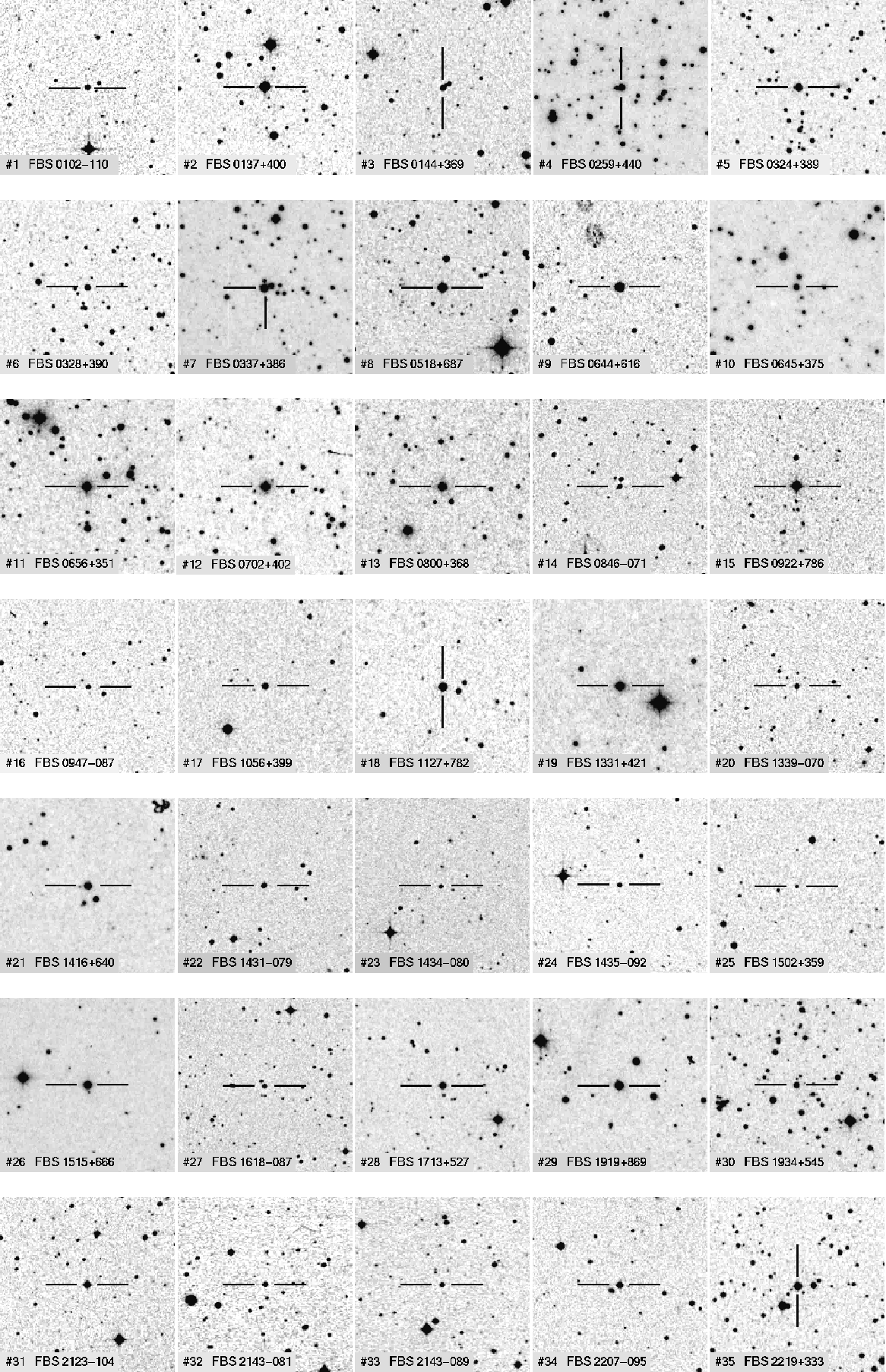 |
Figure 2:
Finding charts. Each image shows a 55 arcmin2 region
with north at the top and east to the left |
| Open with DEXTER | |
Subsequent slit spectroscopy was carried out by us for 21 C star
candidates in order to check their carbon-rich nature:
i) Two 300 line mm-1 Grism spectra (3900-5300 Åwavelength range)
of the C star candidate FBS 0102-110 were obtained - as back-up
observations - during the nights October 12 and 13 1996, at the 2.2-m ESO
telescope equipped with EFOSC2 and a
 (15
(15  m 15 m) pixels CCD camera as detector.
ii) Spectra in the range 7550-8000 Å were also obtained for 11 C star
candidates during an observing run (Jan. 31 to Feb. 4 1997) with the
Haute Provence 1.93-m telescope, equipped with the Carelec
spectrograph and a
 (27 m
27 m) pixels
Tektronix CCD camera as detector. A 1200 line mm-1 grating was used,
providing a resolution of about of 0.89 Å pixel-1.
(27 m
27 m) pixels
Tektronix CCD camera as detector. A 1200 line mm-1 grating was used,
providing a resolution of about of 0.89 Å pixel-1.
iii) Another observing run on June 26-29 1998 with the same
telescope/instrument, but using a 300 line mm-1 grating and a
20481024 (13.5 m
13.5 m) pixels CCD detector
(EEV 42-20), provided spectra with 1.75 Å pixel-1 resolution for
11 objects.
All spectra were reduced and wavelength calibrated with the ESO-MIDAS reduction package. Spectrograms from the Haute Provence Observatory observations are presented in Figs. 3 and 4. FBS 0102-110 spectrograms are shown in the paper by Gigoyan et al. (1999).
Up to now, 22 out of the 35 C star candidates presented in this paper have had their carbon-rich star nature confirmed by subsequent slit-spectroscopy (FBS 1339-070 confirmation by TI98). In addition, FBS 0137+400 is also classified as a C-star from Low-Resolution IRAS Spectra (LRS) by Kwok et al. (1997). These results suggest that the C-star eye survey of the FBS plates by K.G. is very reliable, hence infers for the 13 remaining candidates (at least for the brightest ones with R < 14.5) a high probability of beeing carbon-rich stars as well. Note that 18 objects are FHLC, among which 10 received spectroscopic confirmation.
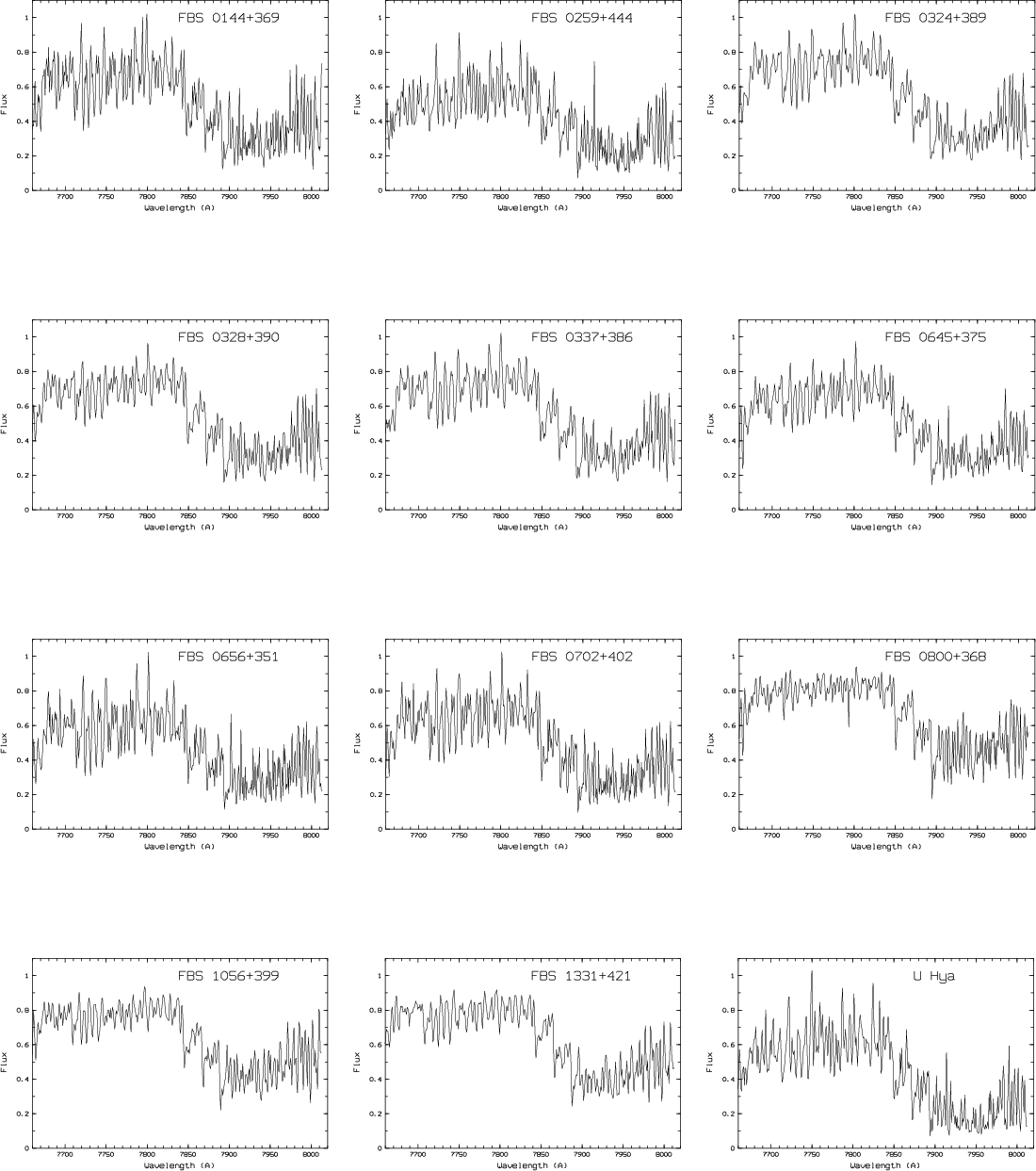 |
Figure 3: High-resolution spectrograms for 11 Galactic C stars. The spectrum of U Hya used as radial velocity"standard'' is displayed for comparison |
| Open with DEXTER | |
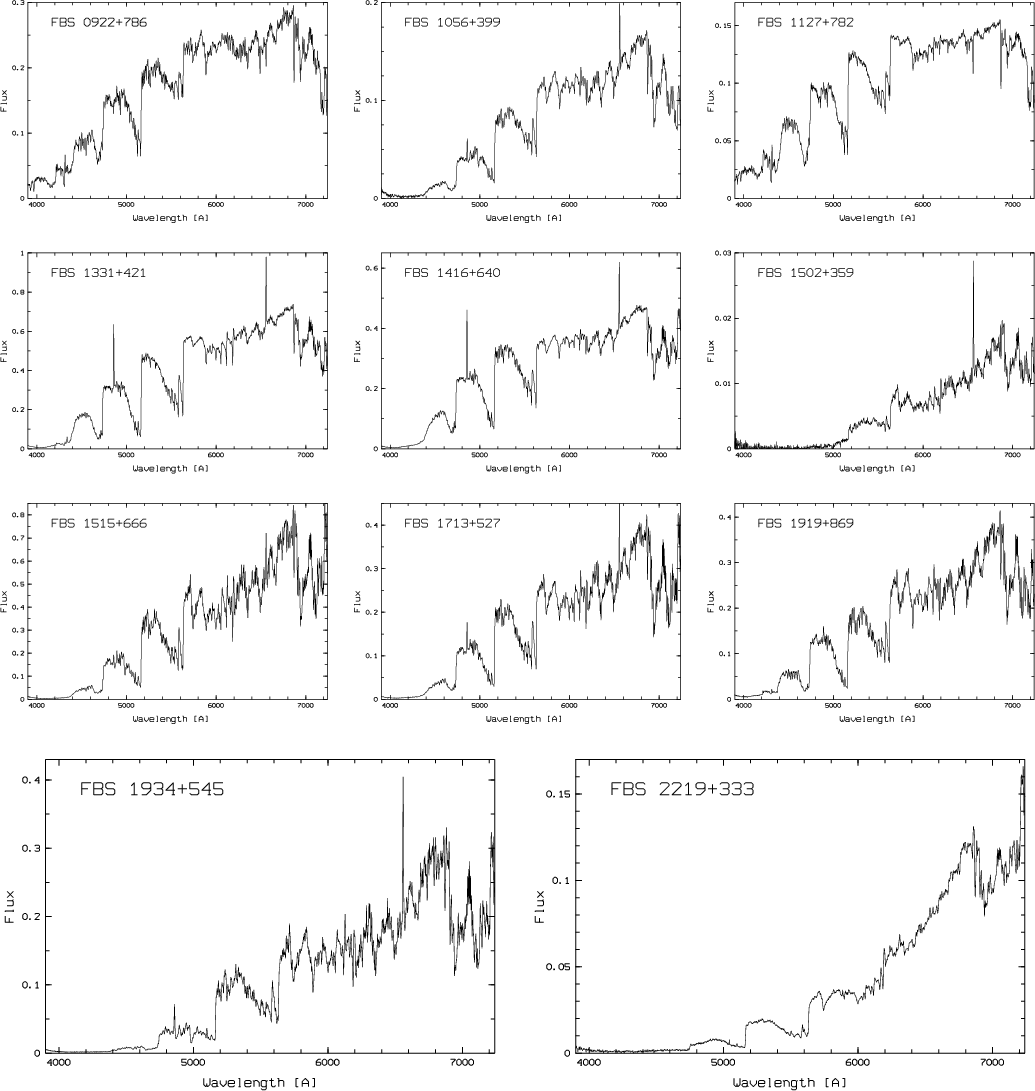 |
Figure 4: Medium-resolution spectrograms for 11 Galactic C stars |
| Open with DEXTER | |
Spectra over the 7500-8000 Å region allowed us to determine the
radial velocities (RV) of 11 FBS stars. This was done by using spectra
of three bright AGB carbon stars (U Hya, Y CVn, V Hya) taken during
each observing night. These three objects are not actually RV standards
since the photosphere of such AGB stars are known to pulsate with an
amplitude of a few km s-1. However, for simplicity, we will name them
"standard'' hereafter. Using three different standards allowed us to check our
results and to increase the accuracy of our RV
determinations. The adopted RVs of the standard stars were derived from the
CO millimeter spectra of their circumstellar envelope, i.e.
 ,
+13, and -9 kms-1 for U Hya, Y CVn, V Hya, respectively (from
the
,
+13, and -9 kms-1 for U Hya, Y CVn, V Hya, respectively (from
the
 values which are given by Loup et al.
1993).
values which are given by Loup et al.
1993).
Each FBS C-star spectrum was cross-correlated with the spectrum of each
standard star, in a manner similar to that described in detail by TI98.
As a further check on the calculated RV, the FBS carbon stars were also
cross-correlated with 7 RV "standards'' from TI98. Both results were found
in very good agreement (within 3 kms-1). It is important to
note that FBS1056+399 shows an anomalous cross correlation peak
which was not well fitted by a Gaussian - the best possible fit was applied.
The value given in Table 3 results from that fit.
| (1) | (2) | (3) | (4) | (5) | (6) | (7) | (8) | (9) | (10) | (11) |
| No. | FBS No. | J | H | K |  |
 |
 |
z |  |
|
| mag | mag | mag | kpc | kpc | kpc | kpc | km s-1 | |||
| 1* | 0102-110 | C | 12.56 | 12.05 | 11.90 | 20 | 14 | 16 | -15 | |
| 2 | 0137+400 | (C) | 9.08 | 7.26 | 5.74 | 6 | 8 | 7 | -2.5 | |
| 3 | 0144+369 | C | 10.51 | 9.42 | 8.86 | 21 | 22 | 22 | -9 | -113 |
| 4 | 0259+444 | C | 9.96 | 9.04 | 8.68 | 9 | 13 | 11 | -2.5 | -40 |
| 5 | 0324+389 | C | 8.66 | 7.56 | 7.03 | 9 | 9 | 9 | -2.0 | -52 |
| 6 | 0328+390 | C | 25 | 25 | -6 | -54 | ||||
| 7 | 0337+386 | C | 8.63 | 7.46 | 6.80 | 8 | 9 | 9 | -2.0 | -79 |
| 8 | 0518+687 | 8 | 8 | +2.5 | ||||||
| 9 | 0644+616 | 5 | 5 | +2.0 | ||||||
| 10 | 0645+375 | C | 9.66 | 8.18 | 7.02 | 12 | 14 | 13 | +3.5 | -5 |
| 11 | 0656+351 | C | 8.48 | 7.35 | 6.63 | 13 | 9 | 11 | +3.0 | -21 |
| 12 | 0702+402 | C | 8.69 | 7.61 | 7.09 | 14 | 9 | 11 | +4 | -16 |
| 13 | 0800+368 | C | 9.98 | 9.09 | 8.80 | 10 | 12 | 11 | +5 | +14 |
| 14 | 0846-071 | 10.51 | 9.50 | 9.06 | 15 | 20 | 17 | +6 | ||
| 15* | 0922+786 | C | 9.70 | 9.10 | 8.89 | 8 | 6 | 7 | +4 | |
| 16* | 0947-087 | 12.58 | 11.95 | 11.74 | 24 | 23 | 23 | +12 | ||
| 17* | 1056+399 | C | 11.08 | 10.08 | 9.44 | 22 | 28 | 25 | +22 | -166 |
| 18* | 1127+782 | C | 10.93 | 10.37 | 10.30 | 8 | 6 | 7 | +4 | |
| 19* | 1331+421 | C | 9.88 | 9.00 | 8.66 | 10 | 12 | 11 | +11 | -211 |
| 20* | 1339-070 | C | 20 | 20 | +16 | |||||
| 21* | 1416+640 | C | 10.75 | 9.94 | 9.57 | 14 | 17 | 16 | +12 | |
| 22* | 1431-079 | 10 | 10 | +7 | ||||||
| 23* | 1434-080 | 21 | 21 | +15 | ||||||
| 24* | 1435-092 | 15 | 15 | +11 | ||||||
| 25* | 1502+359 | C | 12.00 | 10.68 | 9.68 | 94 | 45 | 45 | +40 | |
| 26* | 1515+666 | C | 10 | 10 | +7 | |||||
| 27 | 1618-087 | 9 | 9 | +4 | ||||||
| 28* | 1713+527 | C | 10.71 | 9.84 | 9.32 | 16 | 21 | 18 | +5 | |
| 29 | 1919+869 | C | 9 | 9 | +4 | |||||
| 30 | 1934+545 | C | 24 | 24 | +7 | |||||
| 31* | 2123-104 | 18 | 18 | -11 | ||||||
| 32* | 2143-081 | 14.02 | 13.49 | 13.41 | 27 | 23 | 25 | -17 | ||
| 33* | 2144-089 | 12.50 | 11.81 | 11.68 | 24 | 21 | 22 | -15 | ||
| 34* | 2207-095 | 10.56 | 9.81 | 9.59 | 17 | 12 | 15 | -11 | ||
| 35 | 2219+333 | C | 10.01 | 8.53 | 7.24 | 20 | 16 | 18 | -6 |
5 kms-1 accuracy).
| FBS | J | H | K |  |
 |
 |
0137+400 |
8.03 | 6.33 | 5.08 | -1.05 | -0.93 | -0.66 |
| 0324+389 | 8.67 | 7.70 | 7.15 | +0.01 | +0.14 | +0.12 |
| 0337+386 | 8.48 | 7.53 | 6.81 | -0.15 | +0.07 | +0.01 |
| 0645+375 | 9.94 | 8.25 | 7.07 | +0.28 | +0.07 | +0.05 |
| 0656+351 | 8.41 | 7.23 | 6.50 | -0.07 | -0.12 | -0.13 |
| 0702+402 | 8.56 | 7.48 | 6.95 | -0.13 | -0.13 | -0.14 |
| 0800+368 | 9.85 | 9.10 | 8.80 | -0.13 | +0.01 | +0.00 |
| 1056+399 | 10.60 | 9.65 | 9.17 | -0.48 | -0.43 | -0.27 |
| 2219+333 | 9.67 | 7.92 | 6.92 | -0.34 | -0.61 | -0.32 |
Our main source for JHK magnitudes is the 2MASS Survey in its Second Incremental Release, which provided JHK data for 23 stars. These are listed in Table 3.
Near-infrared photometric observations were also
kindly performed for
us by Dr. Noguchi at the 1.26-m telescope of Beijing Astrophysical
Observatory (Hinglog, China) using the infrared photometer of Nagoya
University (Japan). JHK data for 9 stars, presented in Table 4, were
obtained during the period October 7-10, 1992. For a complete
description of the photometer and the photometric system used, see
Noguchi
Akiba (1986).
Since all the stars observed by Dr. Noguchi have also 2MASS photometry,
we also give in Table 4 the differences between the two sets of data. It
is plausible that part of the variations (
 mag) may be due
either to experimental errors and bandpass differences, or slight
variability of the objects. However, evidence for a significant
variability is noticeable for C stars FBS 0137+400, FBS 1056+399,
and FBS 2219+33; this is consistent with their N-type as set by our
spectral classification.
mag) may be due
either to experimental errors and bandpass differences, or slight
variability of the objects. However, evidence for a significant
variability is noticeable for C stars FBS 0137+400, FBS 1056+399,
and FBS 2219+33; this is consistent with their N-type as set by our
spectral classification.
A J-H vs. H-K diagram for the FBS objects is presented
in Fig. 5
and compared to the colours of others known FHLC. According to the 2MASS
Explanatory Supplement, the 2MASS photometric system is almost identical
to that of Bessel & Brett (1988,
hereafter BB88). Therefore,
we have plotted these JHK diagrams using the BB88 system.
Figure 5a shows a J-H, H-Kdiagram for 70 previously known FHLC (no carbon dwarfs). The data come
mainly from Table 3 of Totten et al. (2000, hereafter TIW) and in some
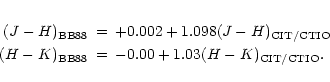
case from Table 1 of TI98. The SAAO and CIT/CTIO colour indices that have
been published by TIW and TI98, respectively, were transformed into the
BB88 system using the following relations (given in BB88):
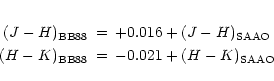
![\begin{figure}
\par\includegraphics[width=6.5cm,clip]{hh1.ps}\par\includegraphics[angle=-90,width=8.2cm,clip]{MS10534f5-02.ps}\end{figure}](/articles/aa/full/2001/20/aa10534/img56.gif) |
Figure 5:
J-H,H-K diagrams.
a) Plot for 70 previously known FHLC stars from the lists of
TI98 and TIW: open circles (N-type), filled circles (CH-type), plus signs
(either N- or CH-type), crosses "'' (unknown C-type).
The boundaries of the
locii of CH- and N-type stars are those defined by TIW. Note that most of
the unknown C-type stars likely belong to the CH-subclass;
b) plot for the 23 FBS C stars with available 2MASS
JHK photometry: open circles (N-type), filled circles (CH-type) |
| Open with DEXTER | |
Two methods were adopted to derive approximate distances of the FBS stars.
The first used the R magnitude provided for each star by the USNOC-A2.0,
(see Table 2) which is probably known with an accuracy of 0.4 mag
only. According to TI98, we assumed for N-type stars
MR=-3.5,
and for the others (presumably CH-type)
MR=-2.5. Because several
stars lay at |b|<30,
the Galactic absorption in the R-band was
taken into account and estimated from the Schlegel et al.
(1998) extinction
maps. For our sample AR was found to reach up to 0.77 mag
(for FBS 1618-087 at b=+28). The second method used the 2MASS
photometry and the MK vs. J-K relation set up for C stars,
in the SAAO system, by TIW. This is not a real problem since the Bessel
& Brett (1988)
system used in the 2MASS catalog is virtually identical to
the SAAO one. Differences in the region of a few hundredths of magnitude
may be ignored since the typical dispersion in the MK vs. J-Krelation is about  mag in MK. Distance estimates dRand dJHK resulting from the two methods are listed in Table 3.
It is noteworthy that the distance estimates that have been derived from Rand JHK photometry independently are generally in rather good agreement.
Consequently, we adopted for each star an average heliocentric distance,
except FBS 1502+359 for which dJHK was chosen (see the
discussion below). Estimated distances to the Galactic plane z were also
determined. Due to the uncertainties affecting R, MR and
MK, errors on distances are probably of the order of  %
at least. Estimated distances
%
at least. Estimated distances
 and z are listed in
Table 3.
and z are listed in
Table 3.
Our first list of Galactic C stars contains 35 objects of which 17 are located
at |b|<30:
13 belong to the N-subclass and 4 from the CH-subclass.
Table 3 shows that the heliocentic distances of these 17 stars range between
7 and 25 kpc and their distances to the Galactic plane from 2 to 9 kpc.
Most of these stars should belong to the halo population, since the N-type
C stars of the Galactic disk have a scale height of about 200-300 pc (Claussen
et al. 1987;
Groenewegen et al. 1992). Although interesting in
itself, this sample of 17 C stars is far from being statistically complete
due to large interstellar absorption in the visible at such galactic
latitudes. So, it is not adequate to compare this subsample to any other
ones from previous surveys.
However, the comparison with the APM survey is possible for the 18 C stars
located at |b|>30.
The heliocentric distances of our FHLCs generally
range between 10 and 25 kpc, with |z| between 4
and 22 kpc (except for FBS 1502+359 discussed below). These distances
are smaller than the distances of a number of FHLC found by TI98 and TIW which
are located from about 20 to 100 kpc. This is due to the fact that the APM
objects are significantly fainter than ours: about half of the APM C stars
have  ,
whereas only 6 over 35 from our list have .
,
whereas only 6 over 35 from our list have .
Our newly discovered and spectroscopically confirmed FHLC star, FBS 1502+359,
is the faintest of our sample (
 ), hence relatively distant
(
), hence relatively distant
(
 kpc and
  40 kpc). Both its medium-resolution spectrum
and its B-R colour index (>5) suggests that this object is surrounded by
a dusty envelope. Consequently, we adopted the distance determined from JHKphotometry, rather than the much larger one based on its R magnitude.
The discovery of FBS 1502+359 lead us to think that a careful survey of the
remaining FBS plates might reveal other faint interesting objects of this
kind.
40 kpc). Both its medium-resolution spectrum
and its B-R colour index (>5) suggests that this object is surrounded by
a dusty envelope. Consequently, we adopted the distance determined from JHKphotometry, rather than the much larger one based on its R magnitude.
The discovery of FBS 1502+359 lead us to think that a careful survey of the
remaining FBS plates might reveal other faint interesting objects of this
kind.
Our partial FBS C star survey resulted in the identification of 18 FHLC
stars in an area of about 4100 deg2 at |b|>30,
two objects
(FBS 1056+399 and FBS 1339-070) also belonging to the TI98 list.
Consequently, the frequency of FBS FHLC stars is about 1 object per 200 deg2 which is comparable to the discovery rate of previous FHLC star
surveys: for instance Green et al. (1994)
found one FHLC star in a
52 deg2 area and the APM survey brought 33 new faint FHLC stars
over an area of 6500 deg2.
According to the TI98 census, the total number of FHLC stars
(|b|>30,
R>11) known at that time
was 71. With 16 newly discovered objects, the present FBS
C-star survey - of a sky area intensively searched for this kind of
object - increases by more than 20% the number of FHLC stars known.
Since only one third of the total area covered by the FBS plates at
|b|>30
has been searched for C stars so far, one can expect
that the FBS survey will provide about 30 more FHLC stars.
Faint high latitude carbon stars (|b|>30,
R>11) are
sparse, and only 71 objects of this kind were known (see TI98).
Using the FBS sky survey we have searched for
C stars. Up to now, objective-prism plates were eye scrutinized
covering an area of 6100 deg2 of which 4100 deg2 are located at high
Galactic latitudes (|b|>30). A total of 35 C star candidates were
found, the carbon-rich star nature beeing spectroscopically confirmed for
23 of them. Among these 35 objects, 18 are FHLC stars (10 with subsequent
slit-spectroscopy) and have heliocentric distances d ranging from about
5 to 25 kpc, except for our present most distant object which is located at
kpc. It is expected that our survey, currently
in progress, of the complete set of FBS plates, might
provide another 30 FHLC stars.
Acknowledgements
The authors express their thanks to Dr. K. Noguchi for providing JHKphotometric data, to Dr. E. Totten for helping in the radial velocity measurements, and to our referee Dr. G. R. Knapp for valuable remarks. The use of data products from the Two Micron All Sky Survey (2MASS), which is a joint project of the Univ. of Massachusetts and the Infrared Processing and Analysis Center/California Institute of Technology, funded by NASA and NSF, is greatly appreciated. This work also benefited from the CDS database of Strasbourg and the POSS-UKST Digitized Sky Survey made available by the ESO/ST-ECF center in Garching. This research was supported by CNRS (N.M.) and through the Jumelage 18 "Astrophysique France-Arménie'' (K.G. and M.A.).
 (Noguchi) - mag(2MASS)