

The results of millimeter
interferometry for the four stars
are summarized in Table 2, which
gives in Col. 1 the name of the star, in Cols. 2 and 3 the coordinates
of the millimeter peak, in Cols. 4-7
the observed wavelengths and fluxes,
in Col. 8 the spectral index
 between the two wavelengths
(
between the two wavelengths
(
 ), in Col. 9 the FWHM size,
in Col. 10 the
disk mass derived from the observed flux assuming optically thin
emission, in Cols. 11 and 12 the interferometer where the
observations have been obtained and related references.
), in Col. 9 the FWHM size,
in Col. 10 the
disk mass derived from the observed flux assuming optically thin
emission, in Cols. 11 and 12 the interferometer where the
observations have been obtained and related references.
All the four stars have millimeter continuum emission which is well detected by the interferometers. This is a strong, albeit indirect, proof that the emitting dust must be distributed in a highly asymmetric manner, i.e., in a circumstellar disk (Beckwith et al. 1990). In the two nearest stars (AB Aur and CQ Tau), the continuum emission is resolved by the interferometers, confirming its disk-like structure (Dutrey et al., private communication). The existence of a disk in AB Aur is proved further by interferometric maps in the CO lines, which resolve the emission and show a velocity pattern typical of rotation (Mannings & Sargent 1997).
The disk mass (gas and dust) in Table 2
has been computed from the 1.3 mm flux assuming
that the emission is optically thin:
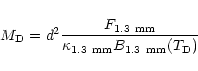 |
(1) |
 cm2 g-1, and
 K for the three A stars and 16 K for CQ Tau (Natta et al. 2000a).
The four stars have values of
K for the three A stars and 16 K for CQ Tau (Natta et al. 2000a).
The four stars have values of  between 0.02 and 0.05
  ,
typical
of HAe stars.
Note that in reality
depends also on the radial distributions
of the
disk surface density and temperature (see, for example, Beckwith et al.
1990).
Also, the assumption that
the millimetric emission is optically thin may not hold. Natta et al.
(1999) discuss the possibility that UX Ori, which has a black-body-like
millimeter
emission (
,
typical
of HAe stars.
Note that in reality
depends also on the radial distributions
of the
disk surface density and temperature (see, for example, Beckwith et al.
1990).
Also, the assumption that
the millimetric emission is optically thin may not hold. Natta et al.
(1999) discuss the possibility that UX Ori, which has a black-body-like
millimeter
emission (
 ), has a disk which is optically thick at
millimeter wavelengths and estimate the required disk mass
to be
), has a disk which is optically thick at
millimeter wavelengths and estimate the required disk mass
to be
 0.1 .
0.1 .
The spectral index in the millimeter range probed by the interferometers
is quite low when compared to the value
of  4 expected for the optically thin
emission of small grains, ranging from 2.1 in UX Ori to 3.1 in AB Aur.
Note that there are no published interferometer measurements of AB Aur
at 1.3 mm, so that the spectral index we computed combining a single-dish
and an interferometric
observation may be overestimated.
4 expected for the optically thin
emission of small grains, ranging from 2.1 in UX Ori to 3.1 in AB Aur.
Note that there are no published interferometer measurements of AB Aur
at 1.3 mm, so that the spectral index we computed combining a single-dish
and an interferometric
observation may be overestimated.
The SEDs of the four stars are shown in
Fig. 1.
References for the observed fluxes are given in the figure caption.
In Table 3, we give for each star the observed
excess luminosity after subtraction of the stellar emission
(
 ), the excess luminosity between 1.25 and 7
  m, i.e.,
shortward of the silicate feature (
m, i.e.,
shortward of the silicate feature (
 ),
the luminosity in the silicate feature
),
the luminosity in the silicate feature
 ,
computed by subtracting
from the observed fluxes a power-law continuum between
7.7 and 13 m, and the ratio of the flux at the peak of the
feature to that at 7.7 m (
,
computed by subtracting
from the observed fluxes a power-law continuum between
7.7 and 13 m, and the ratio of the flux at the peak of the
feature to that at 7.7 m (
 ).
).
![\begin{figure}
\par\includegraphics[width=7cm,clip]{f1.eps}
\end{figure}](/articles/aa/full/2001/19/aa1143/img65.gif) |
Figure 1:
SEDs of the four stars in the sample. For AB Aur, triangles
and open dots plot ground-based fluxes (Mannings 1994 and references
therein), while the thick line is
the ISO SWS+LWS spectrum (Bouwman et al. 2000).
For CQ Tau, visual (Rostopchina, private
communication) and near-IR
(Glass & Penston 1974) fluxes are shown by triangles, SWS points (Thi et al. 2001)
by crosses, the LWS spectrum by
small dots at
 m,
the open dots are JCMT data from Mannings (unpublished data),
the large filled dots from
Dutrey et al. (private communication);
at 10 m, both ground-based photometry from this paper
(small dots) and LRS-IRAS data
are shown.
For UX Ori, the symbols are as follows (see Natta et al. 1999 and
references therein):
visual and near-IR photometry (triangles), ISO-PHOT (squares),
PHOT-S (small dots), SWS (crosses), PdB (large filled dots).
For WW Vul, visual and near-IR photometry are from Rostopchina (private
communication)
and Glass & Penston (1974),
crosses are SWS points from Thi et al. (2001); PHOT-S (thich line),
PHOT (squares) and PdB (filled dots) fluxes from this paper.
The observed fluxes have been
de-reddened using the values of AV in Table 1.
The thin lines show for
each star the adopted photospheric spectrum (Kurucz 1979).
Thick solid lines show
the predictions of CG97 disk models (Sect. 4); dotted lines the
separate contribution of the disk surface and midplane m,
the open dots are JCMT data from Mannings (unpublished data),
the large filled dots from
Dutrey et al. (private communication);
at 10 m, both ground-based photometry from this paper
(small dots) and LRS-IRAS data
are shown.
For UX Ori, the symbols are as follows (see Natta et al. 1999 and
references therein):
visual and near-IR photometry (triangles), ISO-PHOT (squares),
PHOT-S (small dots), SWS (crosses), PdB (large filled dots).
For WW Vul, visual and near-IR photometry are from Rostopchina (private
communication)
and Glass & Penston (1974),
crosses are SWS points from Thi et al. (2001); PHOT-S (thich line),
PHOT (squares) and PdB (filled dots) fluxes from this paper.
The observed fluxes have been
de-reddened using the values of AV in Table 1.
The thin lines show for
each star the adopted photospheric spectrum (Kurucz 1979).
Thick solid lines show
the predictions of CG97 disk models (Sect. 4); dotted lines the
separate contribution of the disk surface and midplane |
Detailed aspects of the SEDs will be discussed in the following section.
Here we want to note that the infrared excess of
these stars is a large fraction of the
stellar luminosity, varying between 35 and 44%. This is much more than
the maximum fraction (25%) expected from a flat reprocessing disk extending
from the stellar surface to infinity.
It is possible in principle that additional
excess luminosity is produced by viscous heating of an accreting disk.
However, the "missing" luminosity (20%  )
requires a very high accretion rate
(10-6 yr-1),
much higher than current estimates in HAeBe stars
(Ghandour et al. 1994; Tambovtseva et al. 2001). Accretion, as shown by Hartmann et al. (1993),
cannot contribute
significantly to the observed SEDs of HAe stars.
)
requires a very high accretion rate
(10-6 yr-1),
much higher than current estimates in HAeBe stars
(Ghandour et al. 1994; Tambovtseva et al. 2001). Accretion, as shown by Hartmann et al. (1993),
cannot contribute
significantly to the observed SEDs of HAe stars.
Another interesting aspect of the SEDs is the strong
10 m silicate feature in emission shown by all four stars.
The luminosity in the feature is
between 2 and 4% of the stellar luminosity and
the ratio
varies betwen 2.5 and 4.7. Both quantities
are somewhat
higher than
observed in a sample of 9 T Tauri stars (TTS) in Chameleon by Natta
et al. (2000b),
who found that in 8/9 stars
ranges from 0.2 to 3.7 and
/
from 0.2 to 2%.
Figure 2 shows in detail the shape of the 10 m silicate feature
for the four stars, to which we have added
GlassIa, a K4 star in Chamaleon with an unusually
strong IR excess, discussed in Natta et al. (2000b).
We overlay for comparison the
spectrum of AB Aur to that of the other stars (thin lines).
For UX Ori, Fig. 2 shows
the three spectra, the 1997 ISOPHOT one and the
two HIFOGS spectra of 1996 and 1997.
The HIFOGS fluxes are about 25% lower than the PHOT-S values,
with a peak ratio
 4.0 and
/0.03.
The normalized profiles are very similar
at short wavelength, but differ at long wavelength, especially
around 11 m, where the HIFOGS
data indicate a narrower profile.
The difference could be due to different beams
(18
4.0 and
/0.03.
The normalized profiles are very similar
at short wavelength, but differ at long wavelength, especially
around 11 m, where the HIFOGS
data indicate a narrower profile.
The difference could be due to different beams
(18
 for PHOT-S and 3
for HIFOGS),
or to time variabilty.
At present, however, given the uncertainty on the absolute calibration,
it is
difficult to decide if the difference is significant or not.
for PHOT-S and 3
for HIFOGS),
or to time variabilty.
At present, however, given the uncertainty on the absolute calibration,
it is
difficult to decide if the difference is significant or not.
The shape of the feature shows small variations
from star to star, with AB Aur being somewhat narrower on the short
wavelength side.
The GlassIa silicate feature was fit by Natta et al. (2000b)
with mixtures of amorphous pyroxene and olivine with radius 0.1-1 m.
In all of the stars, there is a hint of excess emission around 8.5 m
of uncertain identification. There is no convincing evidence
of the 11.3 m component due to cristalline silicates, seen in some
isolated HAe stars (Bouwman et al. 2001). AB Aur shows PAH features at 6.2, 7.6
and 12.3 m (Bouwman et al. 2000). No features of comparable intensity
are seen in the other stars, although we cannot rule out the presence
of low-intensity features at other PAH wavelengths
(see, for example, the 6.9 m bump in the spectrum of WW Vul, or
the small, but significant variation of the shape of the silicate feature
at 8.6 and 11.2 m between the two HIFOGS spectra of UX Ori).
![\begin{figure}
\par\includegraphics[width=7cm,clip]{f2.eps}\end{figure}](/articles/aa/full/2001/19/aa1143/img67.gif) |
Figure 2:
Profile of the 10 m silicate feature for the four
stars in this paper and Glass Ia.
For each star we have subtracted a linear continuum between 7.7 and
13 m and normalized to the peak intensity (Jy). For each star,
the dots are the observed points: SWS data for AB Aur (Bouwman et al. 2000),
PHOT-S for WW Vul (this paper) and Glass Ia (Natta et al. 2000b),
HIFOGS for CQ Tau (this paper).
For UX Ori we show PHOT-S data (Natta et al. 1999; squares)
and the two spectra taken with HIFOGS in 1996 (circles) and 1997
(triangles) (this paper).
The thin line shows the AB Aur profile, that we repeat on each panel
to facilitate the comparison |
|
(2) | (3) | (4) | (5) | (6) | (7) | (8) |
| Star |
|
 |
|
 |
|
 |
 |
( ) ) |
() |
() |
|||||
| AB Aur | 21.3 | 0.44 | 11.1 | 0.23 | 1.0 | 0.02 | 2.5 |
| CQ Tau | 1.8 | 0.36 | 0.6 | 0.12 | 0.16 | 0.03 | 4.1 |
| UX Ori | 14.6 | 0.35 | 7.8 | 0.18 | 1.6 | 0.04 | 4.7 |
| WW Vul | 18.0 | 0.42 | 11.0 | 0.25 | 1.1 | 0.03 | 3.2 |
Copyright ESO 2001