

In this section, we present results for 74 computed systems. Rather than providing a detailed description of the evolution of each system, we focus on the general trends of key properties as function of the major initial parameters. Table 3 provides the most important quantities for all computed systems. We focus on the various mechanisms which can drive massive close binary systems into contact.
| No. | M1 | M2 | Pi | case | Y</I>1 |
 |
 |
 |
 |
 |
 |
 |
 |
 |
 |
|
 |
d | % | |
log( ) ) |
 |
d |
 |
 |
||||||||
| 1 | 12 | 11.5 | 2.5 | A | - | 87 | 1.42 | 21.5 | 2.98 | 4.99 | 0.3 | 16.5 | 218 | 0.71 | 1.8 | 1.00 |
| 2 | 12 | 11 | 3 | B | - | 98 | 2.44 | 20.4 | 3.93 | 4.74 | 0.8 | 7.2 | 54 | 4.0 | 7.3 | 1.00 |
| 3 | 12 | 11 | 6 | B | - | 98 | 2.38 | 20.4 | 3.82 | 4.79 | 0.6 | 6.8 | 115 | 10 | 7.3 | 1.00 |
| 4 | 12 | 11 | 10 | B | - | 98 | -- | -- | -- | -- | -- | -- | -- | 17 | 7.5 | 1.00 |
| 5 | 12 | 11 | 16 | B | - | 98 | -- | -- | -- | -- | -- | -- | -- | 25 | 7.5 | 1.00 |
| 6 | 12 | 11 | 22 | B | - | 98 | -- | -- | -- | -- | -- | -- | -- | 28 | 7.6 | 1.00 |
| 7 | 12 | 11 | 30 | B | D | 98 | -- | -- | -- | -- | -- | -- | -- | >33 | 6.5 | 0.68 |
| 8 | 12 | 11 | 40 | B | D | 98 | -- | -- | -- | -- | -- | -- | -- | >33 | 5.7 | 0.60 |
| 9 | 12 | 10.5 | 2 | A | M | 75 | -- | -- | -- | -- | -- | -- | -- | 0.67 | 1.5 | 0.70 |
| 10 | 12 | 10.5 | 2.5 | A | - | 87 | 1.42 | 20.7 | 2.97 | 4.87 | 0.3 | 7.9 | 190 | 0.93 | 2.0 | 1.00 |
| 11 | 12 | 10 | 2 | A | M | 76 | -- | -- | -- | -- | -- | -- | -- | 0.82 | 1.6 | 0.68 |
| 12 | 12 | 10 | 16 | B | - | 98 | 2.43 | 19.4 | 3.81 | 4.71 | 0.6 | 6.6 | 255 | 22 | 7.0 | 1.00 |
| 13 | 12 | 10 | 22 | B | D | 98 | -- | -- | -- | -- | -- | -- | -- | >28 | 6.9 | 0.73 |
| 14 | 12 | 9.5 | 2 | A | - | 76 | 1.29 | 19.4 | 2.93 | 5.00 | 0.4 | 32.3e | 171 | 1.8 | 2.0 | 1.00 |
| 15 | 12 | 9.5 | 2.5 | A | - | 88 | 1.41 | 19.7 | 2.96 | 4.79 | 0.3 | 7.5 | 166 | 1.2 | 2.0 | 1.00 |
| 16 | 12 | 9.5 | 3.5 | B | - | 98 | 2.45 | 18.9 | 3.94 | 4.63 | 0.8 | 6.3 | 50 | 4.0 | 2.9 | 1.00 |
| 17a | 12 | 9 | 2 | A | R | 76 | 1.15 | 19.4 | 2.67 | 4.87 | 0.3 | 9.0 | 214 | 1.2 | 1.7 | 1.00 |
| 18 | 12 | 9 | 3.5 | B | - | 98 | 2.32 | 18.5 | 3.74 | 4.63 | 0.6 | 6.5 | 53 | 6.5 | 3.4 | 1.00 |
| 19 | 12 | 9 | 6 | B | - | 98 | 2.36 | 18.5 | 3.81 | 4.63 | 0.6 | 6.2 | 87 | 9.9 | 7.4 | 1.00 |
| 20 | 12 | 9 | 10 | B | - | 98 | -- | -- | -- | -- | -- | -- | -- | 15 | 7.0 | 1.00 |
| 21 | 12 | 9 | 16 | B | d | 98 | -- | -- | -- | -- | -- | -- | -- | 28 | 7.0 | 1.00 |
| 22 | 12 | 9 | 22 | B | D | 98 | -- | -- | -- | -- | -- | -- | -- | >29 | 5.9 | 0.62 |
| 23 | 12 | 8.5 | 2.5 | A | - | 88 | 1.43 | 18.8 | 2.97 | 4.72 | 0.3 | 6.8 | 135 | 1.6 | 2.1 | 1.00 |
| 24 | 12 | 8 | 2 | A | - | 77 | 1.12 | 18.5 | 2.64 | 4.84 | 0.3 | 8.5 | 189 | 3.0 | 2.3 | 1.00 |
| 25c | 12 | 8 | 2.5 | A | R | 87 | 1.66 | 17.9 | 3.18 | 4.68 | 0.4 | 6.5 | 81.5 | 3.6 | 2.5 | 1.00 |
| 26 | 12 | 8 | 3.5 | B | q | 98 | -- | -- | -- | -- | -- | -- | -- | 7.3 | 3.0 | 1.00 |
| 27 | 12 | 8 | 6 | B | - | 98 | 2.37 | 17.5 | 3.79 | 4.55 | 0.6 | 5.8 | 72 | 8.9 | 3.5 | 1.00 |
| 28 | 12 | 8 | 10 | B | - | 98 | -- | -- | -- | -- | -- | -- | -- | 15 | 6.8 | 1.00 |
| 29 | 12 | 8 | 16 | B | D | 98 | -- | -- | -- | -- | -- | -- | -- | >24 | 6.0 | 0.63 |
| 30 | 12 | 7.5 | 2 | A | q | 78 | -- | -- | -- | -- | -- | -- | -- | 2.1 | 2.0 | 1.00 |
| 31 | 12 | 7.5 | 2.5 | A | - | 89 | 1.45 | 17.8 | 2.99 | 4.64 | 0.3 | 6.3 | 104 | 2.5 | 2.0 | 1.00 |
| 32 | 12 | 7.5 | 3.5 | B | Q | 98 | -- | -- | -- | -- | -- | -- | -- | >8.1 | 2.8 | 0.27 |
| 33 | 12 | 6.5 | 2 | A | Q | 78 | -- | -- | -- | -- | -- | -- | -- | >4.6 | 1.4 | 0.13 |
| 34 | 16 | 15.7 | 3.2 | A | - | 91 | 2.79 | 27.8 | 3.88 | 5.14 | 0.5 | 9.3 | 75 | 3.5 | 3.6 | 1.00 |
| 35 | 16 | 15.7 | 6 | B | - | 98 | 3.49 | 27.5 | 4.17 | 5.14 | 0.6 | 8.3 | 86 | 22 | 7.7 | 1.00 |
| 36 | 16 | 15 | 2.5 | A | M | 80 | -- | -- | -- | -- | -- | -- | -- | 2.5 | 2.6 | 0.70 |
| 37 | 16 | 15 | 8 | B | - | 98 | 3.63 | 26.7 | 4.20 | 5.10 | 0.7 | 8.9 | 96 | 29 | 8.0 | 1.00 |
| No. | M1 | M2 | P</I>i | case | Y</I>1 |
|
|
|
|
|
|
|
 |
|
|
|
|
d | % | |
log() |
|
d |
|
|
||||||||
| 38 | 16 | 15 | 9 | B | d | 98 | 3.64 | 26.7 | 4.22 | 5.10 | 0.7 | 8.1 | 107 | 32 | 8.1 | 1.00 |
| 39 | 16 | 15 | 15 | B | D | 98 | -- | -- | -- | -- | -- | -- | -- | >37 | 6.7 | 0.48 |
| 40 | 16 | 14 | 2 | A | M | 69 | -- | -- | -- | -- | -- | -- | -- | 2.2 | 2.2 | 0.86 |
| 41a | 16 | 14 | 2 | A | - | 68 | 2.12 | 27.0 | 3.68 | 5.21 | 0.6 | 11.0 | 110 | 1.2 | 2.1 | 1.00 |
| 42 | 16 | 14 | 2.5 | A | - | 80 | 2.39 | 26.5 | 3.78 | 5.17 | 0.6 | 11.0 | 97.5 | 3.1 | 2.9 | 1.00 |
| 43 | 16 | 14 | 3 | A | - | 87 | 2.52 | 26.6 | 3.75 | 5.10 | 0.5 | 9.0 | 101 | 2.0 | 2.8 | 1.00 |
| 44 | 16 | 14 | 6 | B | - | 98 | 3.60 | 25.8 | 4.19 | 5.04 | 0.6 | 7.8 | 67 | 24 | 7.9 | 1.00 |
| 45 | 16 | 14 | 9 | B | D | 98 | 3.64 | 25.7 | 4.21 | 5.04 | 0.7 | 7.6 | 98 | 31 | 8.2 | 0.64f |
| 46 | 16 | 13 | 2 | A | M | 69 | -- | -- | -- | -- | -- | -- | -- | 3.0 | 2.5 | 0.68 |
| 47 | 16 | 13 | 2.5 | A | - | 80 | 2.28 | 26.1 | 3.65 | 5.11 | 0.5 | 9.1 | 99 | 2.1 | 2.4 | 1.00 |
| 48c | 16 | 13 | 2.5 | A | - | 79 | 2.47 | 25.6 | 3.77 | 5.10 | 0.6 | 7.6 | 78 | 4.3 | 3.0 | 1.00 |
| 49 | 16 | 13 | 3 | A | - | 88 | 2.64 | 25.3 | 3.84 | 5.07 | 0.5 | 9.1 | 64 | 5.2 | 3.5 | 1.00 |
| 50c | 16 | 13 | 3 | A | - | 87 | 2.66 | 25.2 | 3.81 | 5.08 | 0.5 | 7.8 | 62,5 | 5.1 | 3.2 | 1.00 |
| 51 | 16 | 13 | 4 | B | d | 98 | 3.55 | 24.8 | 4.19 | 4.99 | 0.7 | 8.2 | 41 | 18 | 6.9 | 1.00 |
| 52 | 16 | 13 | 6 | B | D | 98 | 3.70 | 24.7 | 4.24 | 4.95 | 0.7 | 6.8 | 57 | 27 | 7.8 | 0.62f |
| 53 | 16 | 12 | 1.5 | A | M | 54 | -- | -- | -- | -- | -- | -- | -- | 3.5 | 2.4 | 0.71 |
| 54 | 16 | 12 | 1.7 | A | M | 61 | -- | -- | -- | -- | -- | -- | -- | 3.7 | 2.5 | 0.75 |
| 55 | 16 | 12 | 2 | A | - | 70 | 2.07 | 24.8 | 3.57 | 5.17 | 0.5 | 11.8 | 93 | 4.2 | 2.8 | 1.00 |
| 56 | 16 | 12 | 4 | B | d | 98 | 3.55 | 23.9 | 4.17 | 4.93 | 0.6 | 7.0 | 37 | 18 | 6.3 | 1.00 |
| 57 | 16 | 12 | 6.5 | B | D | 98 | -- | -- | -- | -- | -- | -- | -- | 26 | 7.7 | 0.38f |
| 58 | 16 | 11 | 2 | A | - | 71 | 2.00 | 24.1 | 3.56 | 5.10 | 0.5 | 10.8 | 89 | 5.7 | 3.1 | 1.00 |
| 59c | 16 | 11 | 2 | A | qR | 69 | 2.10 | 24.0 | 3.54 | 5.13 | 0.5 | 8.4 | 77 | 5.9 | 3.1 | 1.00 |
| 60 | 16 | 11 | 3 | A | - | 89 | 2.52 | 23.8 | 3.74 | 4.95 | 0.5 | 7.3 | 61 | 3.8 | 2.8 | 1.00 |
| 61 | 16 | 11 | 3.2 | A | - | 92 | 2.81 | 23.3 | 3.87 | 4.93 | 0.5 | 7.4 | 42 | 8.2 | 4.0 | 1.00 |
| 62 | 16 | 10 | 2.5 | A | q | 81 | 2.28 | 23.1 | 3.77 | 4.97 | 0.6 | 7.8 | 65 | 8.7 | 3.5 | 1.00 |
| 63 | 16 | 10 | 3 | B | q | 89 | -- | -- | -- | -- | -- | -- | -- | 9.9 | 3.9 | 1.00 |
| 64 | 16 | 9 | 2.5 | A | Q | 82 | -- | -- | -- | -- | -- | -- | -- | 12 | 3.4 | 0.16f |
| 65 | 25 | 24 | 3.5 | A | - | 83 | 5.15 | 40.6 | 4.53 | 5.54 | 0.6 | 13.7 | 41 | 3.0 | 4.6 | 1.00 |
| 66a | 25 | 24 | 3.5 | A | - | 83 | 5.21 | 40.6 | 4.54 | 5.54 | 0.6 | 12.4 | 40 | 3.0 | 4.2 | 1.00 |
| 67b | 25 | 24 | 3.5 | A | - | 82 | --d | 40.5 | --d | 5.54 | --d | 11.2 | -- | 3.0 | 4.6 | 1.00 |
| 68 | 25 | 24 | 5 | B | d | 98 | 7.28 | 39.2 | 4.85 | 5.45 | 0.8 | 11.9 | 31 | 30 | 8.2 | 1.00 |
| 69 | 25 | 24 | 9 | B | D | 98 | -- | -- | -- | -- | -- | -- | -- | >37 | 7.4 | 0.43 |
| 70 | 25 | 23 | 4 | A | - | 87 | 5.31 | 39.4 | 4.56 | 5.49 | 0.6 | 12.4 | 39 | 4.0 | 5.2 | 1.00 |
| 71 | 25 | 22 | 2.5 | A | - | 70 | 4.80 | 39.6 | 4.45 | 5.55 | 0.7 | 14.2 | 39 | 2.7 | 2.9 | 1.00 |
| 72c | 25 | 22 | 2.5 | A | - | 68 | 4.68 | 38.9 | 4.44 | 5.62 | 0.7 | 10.5 | 39 | 5.3 | 3.6 | 1.00 |
| 73 | 25 | 19 | 4 | A | - | 88 | 5.26 | 35.9 | 4.55 | 5.38 | 0.7 | 8.7 | 30 | 6.3 | 4.9 | 1.00 |
| 74 | 25 | 16 | 4 | A | - | 89 | 5.22 | 33.3 | 4.54 | 5.29 | 0.6 | 8.8 | 24 | 8.8 | 5.0 | 1.00 |
a
 . .
b  . .
c Schwarzschild criterion instead of Ledoux criterion used. d Only secondary is computed but primary should not be very different from Nos. 65 and 66. e Secondary at ECHeB. f Treated as if  . . |
Case B systems with an initial mass ratio close to 1 and a rather
short initial period (early Case B) are known to have a good
chance to avoid contact during the Case B mass transfer (cf. Pols
1994). Our Table 3 contains 15 examples, i.e. systems Nos. 2...6, 12,
16, 18...20, 27, 28 (initial primary mass of
 ), and Nos. 35, 37
and 44 (initial primary mass of
), and Nos. 35, 37
and 44 (initial primary mass of
 ). The fact that no such
system with an initial primary mass of
). The fact that no such
system with an initial primary mass of
 could be found is
discussed in Sect. 5.1. It is often assumed that late Case B
systems, i.e. such with a relatively large initial period, evolve
through a common envelope stage (Podsiadlowski et al. 1992; Vanbeveren
1998a,b,c). In the following, we will have a closer look to the
transition region in between both extremes.
could be found is
discussed in Sect. 5.1. It is often assumed that late Case B
systems, i.e. such with a relatively large initial period, evolve
through a common envelope stage (Podsiadlowski et al. 1992; Vanbeveren
1998a,b,c). In the following, we will have a closer look to the
transition region in between both extremes.
Figure 5 shows the mass transfer rates as a function
of the secondary mass for Case B binaries with initial primary and
secondary masses of 12
and 11,
respectively, but different
initial periods in the range 6...40 d (Systems Nos. 3 to 8).
Generally, initially wider systems develop larger mass transfer rates.
However, it is interesting to consider the time dependence of the mass
transfer rate of these systems in some detail. The first maximum in
the mass transfer rate is related to the end of decrease of the
orbital separation at mass ratio one. I.e., when the primary has
become the less massive component in the system, the period and the
Roche lobe of the primary begin to grow, and the increase of the mass
transfer rate flattens. This happens with some time delay due to the
finite thermal response time of the primary.
d (Systems Nos. 3 to 8).
Generally, initially wider systems develop larger mass transfer rates.
However, it is interesting to consider the time dependence of the mass
transfer rate of these systems in some detail. The first maximum in
the mass transfer rate is related to the end of decrease of the
orbital separation at mass ratio one. I.e., when the primary has
become the less massive component in the system, the period and the
Roche lobe of the primary begin to grow, and the increase of the mass
transfer rate flattens. This happens with some time delay due to the
finite thermal response time of the primary.
Later during the mass transfer, the orbit widens significantly.
Therefore, the primary becomes more extended and its surface
temperature decreases. In the wider systems considered in
Fig. 5, the outer envelope of the primary becomes
even convectively unstable. It is the drop of the adiabatic
mass-radius exponent
 (cf. Ritter 1988) which leads to
another rise of the mass transfer rate even though the orbit widens.
We designate this feature as delayed contact. Table 3 shows nine
systems which evolve delayed contact. It is restricted to the Case B
and has no counterpart in our Case A systems (cf. Sect. 4.1.2).
(cf. Ritter 1988) which leads to
another rise of the mass transfer rate even though the orbit widens.
We designate this feature as delayed contact. Table 3 shows nine
systems which evolve delayed contact. It is restricted to the Case B
and has no counterpart in our Case A systems (cf. Sect. 4.1.2).
![\begin{figure}
\par\includegraphics[width=8cm,clip]{m12bxx.roche2.ps}
\end{figure}](/articles/aa/full/2001/15/aah2433/img77.gif) |
Figure 6: Radius of the secondary during mass transfer as a function of its mass, for the same systems as in Fig. 5. In the systems with 30 and 40 days initial period the large increase in radius leads to contact, at which time we stop the calculation |
Figure 6 displays the radius evolution of the
secondary stars of the systems considered in Fig. 5.
Initially, the radii do not grow significantly, although it can be
seen seen that larger radii are obtained for larger initial periods,
i.e. for larger mass transfer rates. Later on, mass transfer rates in
excess of 
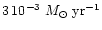 make the secondary swell enormously.
This mass transfer rate corresponds roughly to
make the secondary swell enormously.
This mass transfer rate corresponds roughly to
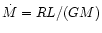 ,
i.e. to the condition
,
i.e. to the condition
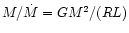 for the secondary.
In the two systems with initial periods of 30 and 40 days, the radius
increases until the secondary also fills its Roche lobe and a contact
system is formed. This effect marks the limit of contact free systems
towards larger periods.
for the secondary.
In the two systems with initial periods of 30 and 40 days, the radius
increases until the secondary also fills its Roche lobe and a contact
system is formed. This effect marks the limit of contact free systems
towards larger periods.
It is remarkable that approximately 5
for the 40 d binary
(system No. 8) and 6
for the 30 d binary (system No. 7) are
transfered before the contact occurs (cf. Fig. 6). From
Fig. 6 we see that contact occurs the earlier (in
terms of already transfered mass) the larger the initial system period
is. I.e., there is a continuous transition towards very wide binaries
with convective primaries, which evolve into contact at the very
beginning of the mass transfer process (Podsiadlowski et al. 1992).
According to the estimate of Webbink (1984), which compares the
orbital energy of the binary with the binding energy of the envelope,
our System No. 7 does not merge during the Case B mass transfer.
Instead, with an efficiency parameter of
 ,
it
obtains a period of about 7.5 d in a common envelope evolution by
expelling the remaining envelope of the primary of
,
it
obtains a period of about 7.5 d in a common envelope evolution by
expelling the remaining envelope of the primary of
 from
the system.
from
the system.
In summary, in delayed contact systems a conservative part of Case B
mass transfer is followed by a non-conservative one, leading to an
oscillation of the orbit: it first shrinks until the mass ratio is 1,
then widens up to the end of the conservative part, and then shrinks
again due to mass and angular momentum loss from the system. For our
System No. 7, the parameter
for the complete Case B mass
transfer, i.e., the ratio of the amount of mass accreted by the
secondary to the amount lost by the primary, is about
 .
.
After the delayed contact and common envelope evolution, System No. 7
consists of a
 main sequence star - the secondary -
and a
main sequence star - the secondary -
and a
 helium star in a 7.5 d orbit. The further
evolution (which we have not computed) depends on the
post-common envelope period. For 7.5 d,
the primary fills its Roche lobe as it expands to a helium giant, and transfers
part of its helium envelope to the secondary in a Case BB mass
transfer, similar to that discussed in Sect. 3.2 for system No. 37.
helium star in a 7.5 d orbit. The further
evolution (which we have not computed) depends on the
post-common envelope period. For 7.5 d,
the primary fills its Roche lobe as it expands to a helium giant, and transfers
part of its helium envelope to the secondary in a Case BB mass
transfer, similar to that discussed in Sect. 3.2 for system No. 37.
In contrast, the systems which avoid contact during the Case B mass
transfer all together can often, even if the secondary evolves faster,
avoid the reverse Case B mass transfer if the secondary star does not
rejuvenate (cf. values of
 in Table 3). After
the Case B mass transfer, their periods are typically larger than
50 d.
in Table 3). After
the Case B mass transfer, their periods are typically larger than
50 d.
We find that in our most massive systems, with a primary mass of
25,
even early Case B mass transfer leads into contact,
even for an initial mass ratios very close to 1 (cf. systems Nos. 68
and 69 in Table 3). In the two considered systems, large amounts of
mass are transferred conservatively before contact occurs (8.2and 7.4;
cf. Table 3), i.e., we have a delayed contact situation.
In system No. 68, the contact is marginal, in system No. 69 it is not.
Figure 7 demonstrates a completely different mechanism
of contact formation operating in Case A systems, which occurs for
short periods (cf. also Pols 1994). It shows the radius
evolution of three secondaries in Case A systems which have identical
initial parameters except the period (systems Nos. 53...55 in
Table 3). All three secondaries evolve through the
rapid part of the Case A mass transfer (cf. Sect. 3.1) without
expanding significantly (which is different for initial mass ratios
 ;
cf. Sect. 5.1). However, in the two closer systems, the
mass transfer appears so early in the evolution of the primary that
the now more massive secondary finishes core hydrogen burning first.
It then starts to expand, but soon fills its Roche lobe and attempts a
reverse Case B mass transfer (in systems Nos. 53 and 54). Thus, both
stars now fill their Roche lobes and come into contact while the
primary is still burning hydrogen in its core; we designate this as
premature contact. The likely outcome of premature contact is a
merger because the corresponding periods are too small for a
successful common envelope ejection. This effect marks the lower
period limit for contact free binaries.
;
cf. Sect. 5.1). However, in the two closer systems, the
mass transfer appears so early in the evolution of the primary that
the now more massive secondary finishes core hydrogen burning first.
It then starts to expand, but soon fills its Roche lobe and attempts a
reverse Case B mass transfer (in systems Nos. 53 and 54). Thus, both
stars now fill their Roche lobes and come into contact while the
primary is still burning hydrogen in its core; we designate this as
premature contact. The likely outcome of premature contact is a
merger because the corresponding periods are too small for a
successful common envelope ejection. This effect marks the lower
period limit for contact free binaries.
In model No. 55, the primary ends core H-burning first. Therefore, Case AB mass transfer (cf. Sect. 3.1) sets in before the secondary expands strongly. This has two effects: it drives the two stars further apart - the period increases from 5.24 d at the beginning to 93 d at the end of Case AB mass transfer -, and it enhances the mixing of hydrogen into the core (cf. Braun & Langer 1995) and thus delays the evolution of the secondary. I.e., if the initial period exceeds a critical value, Case AB mass transfer starts before the secondary expands and premature contact can be avoided. If the secondary star does not rejuvenate, reverse Case B mass transfer is avoided as well. Curiously, the secondary star in our Case A system No. 1 finishes core hydrogen burning just after the end of the Case A mass transfer and before the beginning of the Case AB mass transfer. However, the accretion due to the Case AB mass overflow leads to a shrinkage of its radius, and contact is avoided (see also Fig. 11 below).
The lower period limit for contact free binaries depends sensitively
on the convection criterion. As mentioned in Sect. 2, we compute
stellar models using the Ledoux criterion for convection and
semiconvection with an efficiency parameter of
 .
The semiconvective mixing efficiency - which is infinite in
the case of the Schwarzschild criterion for convection - determines
to a large extent whether an accreting core hydrogen burning star
rejuvenates or not (Braun & Langer 1995). If it fails, which is the
more likely for less efficient semiconvection and the more advanced
the star is in its evolution when it starts to accrete, it retains an
unusual structure, with a smaller helium core mass and a larger
hydrogen envelope mass compared to single stars. As such a structure
keeps the star relatively compact during all the advanced burning
stages - i.e., it avoids the red supergiant stage (Braun & Langer
1995) - it will not fill its Roche lobe after core hydrogen burning.
This is the situation in all our Case A systems which avoid premature
contact and have initial mass ratios of
.
The semiconvective mixing efficiency - which is infinite in
the case of the Schwarzschild criterion for convection - determines
to a large extent whether an accreting core hydrogen burning star
rejuvenates or not (Braun & Langer 1995). If it fails, which is the
more likely for less efficient semiconvection and the more advanced
the star is in its evolution when it starts to accrete, it retains an
unusual structure, with a smaller helium core mass and a larger
hydrogen envelope mass compared to single stars. As such a structure
keeps the star relatively compact during all the advanced burning
stages - i.e., it avoids the red supergiant stage (Braun & Langer
1995) - it will not fill its Roche lobe after core hydrogen burning.
This is the situation in all our Case A systems which avoid premature
contact and have initial mass ratios of
 .
.
For models computed with the Schwarzschild criterion, the secondaries in Case A systems rejuvenate during or shortly after the rapid Case A mass transfer. This results in longer main sequence life times for the secondaries, and thus leads to less premature contact situations. I.e., the critical initial period for premature contact is shifted to smaller values. In this case, the secondaries all expand to red supergiants. Assuming the primary star is still present at that time, this is likely to initiate reverse Case B mass transfer. As the life time of a rejuvenating star is extended, the primaries have often finished their evolution by that time and the binary may even be disrupted (cf. Pols 1994). However, as the life time of a low mass helium star (i.e. the primary of such a system) can be comparable to the remaining hydrogen burning life time of the very massive secondary, reverse Case B mass transfer onto the low mass helium star may also occur. In this case, the helium star builds up a hydrogen envelope and swells to red giant dimensions. We designate the ensuing contact situation in Table 3 as reverse contact.
This scenario is illustrated by five of our Case A systems (Nos. 25,
48, 50, 59, and 72) which are computed using the Schwarzschild instead
of the Ledoux criterion (marked "c'' in Table 3). Nos. 25 and
59, initially having a 12
and a 16
primary, a mass ratio
of 0.67 and 0.69, and a period of 2.5 d and 2.0 d, respectively, avoid
premature contact. However, they encounter reverse contact when the
primaries have burnt 91% and 80% of their helium in the core. Both
systems avoid contact altogether when they are computed with our
standard convection physics, and evolve a reverse supernova order.
I.e., an increase of the semiconvective mixing efficiency may reduce
the number of systems with premature contact but increase the number
with reverse contact. From system Nos. 25 we conclude that, were the
Schwarzschild criterion correct, the majority of Case A binaries with
12
primaries would evolve into reverse contact.
Comparing our models Nos. 58 and 59, which have identical initial
conditions but vary in the treatment of convection, shows that also in
systems with 16
primaries the lower period limit for contact
free systems increases.
In the three other systems computed with the Schwarzschild criterion, systems Nos. 48, 50, and 72, the primaries explode as supernovae before the reverse mass transfer can occur. Two of these (Nos. 48 and 72), when computed with our standard convection physics, have a reverse supernova order (see systems Nos. 47 and 71 in Table 3), the other (No. 50) does not (cf. system No. 49 in Table 3).
Thus, the lower period limit for contact free evolution with the
Schwarzschild criterion is expected between the lower period limit and
the limit for reverse supernova order for Ledoux criterion and
.
The one early case A system containing a
25
primary (No. 72) also shows no reverse mass transfer before
the supernova explosion of the primary, despite being a system with
reverse supernova order when computed with our standard convection
physics. We conclude that for large masses, the amount of contact free
case A systems does not change very much for different convection
physics. On the contrary, at 12
primary mass and below no
contact free case A system are expected at all if the Schwarzschild
criterion is used.
While the previous two subsections concerned contact formation due to large (delayed contact) or small (premature and reverse contact) initial periods, we investigate here contact formation due to large or small initial mass ratios.
Figure 8 shows the mass transfer rate as function of
the transferred amount of mass for three Case B systems with identical
initial primary mass (12)
and period (6 d), but different
initial secondary masses. For smaller initial mass ratios
 ,
the mass transfer rates are
somewhat larger in the early part of the mass transfer, since the
orbit shrinks more rapidly for smaller
,
the mass transfer rates are
somewhat larger in the early part of the mass transfer, since the
orbit shrinks more rapidly for smaller  .
For conservative
evolution (also ignoring stellar winds), the minimum separation
depends on initial separation
.
For conservative
evolution (also ignoring stellar winds), the minimum separation
depends on initial separation  and mass ratio as
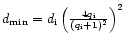 .
As, in a given system, period and orbital separation
scale as
.
As, in a given system, period and orbital separation
scale as
 ,
this means that in systems with the same
initial period, the primary star is, at the time when
,
this means that in systems with the same
initial period, the primary star is, at the time when
 ,
squeezed into a smaller volume for smaller .
This makes the
mass transfer rate during the first phase of Case B mass transfer
larger for smaller .
,
squeezed into a smaller volume for smaller .
This makes the
mass transfer rate during the first phase of Case B mass transfer
larger for smaller .
However, the maximum mass transfer rate, which is achieved after mass
ratio reversal (cf. Sect. 4.1), is very similar in all three systems,
even though the post-mass transfer periods (115 d, 87 d, and 72 d for
secondary initial masses of 11,
9,
and 8,
respectively) are not the same. Also the amount of mass which is
transferred is independent of the secondary mass - it consists of
the whole hydrogen-rich envelope of the primary.
Whether or not contact is reached is here mostly determined by the
reaction of the secondary star to the accretion.
Figure 9 shows that the primary with the lowest
initial mass swells most during the mass transfer. The smallest
initial mass ratio for which contact is avoided corresponds roughly to
the condition that the mass accretion time scale of the secondary
 remains smaller than its thermal time scale
 .
We designate contact due to
this reason as q-contact.
.
We designate contact due to
this reason as q-contact.
As q-contact is established during the first phase of Case B mass transfer, it is quite distinct from delayed contact (Sect. 4.1). As q-contact evolves early during Case B mass transfer, it does not allow a major amount of mass to be accreted by the secondary. I.e., either the major part of the primary's hydrogen-rich envelope can be ejected from the system, or both stars merge. The situation that the secondary star can accrete significant amounts after a non-conservative early q-contact phase is unlikely since it would bring both stars even closer together.
In principle, there is also a maximum initial mass ratio for
contact-free evolution of Case B systems: for
 ,
both
stars age at the same rate and attempt to expand to red giants
simultaneously. However, since the limiting value is very close to
,
we ignore this effect here as statistically
insignificant.
,
both
stars age at the same rate and attempt to expand to red giants
simultaneously. However, since the limiting value is very close to
,
we ignore this effect here as statistically
insignificant.
![\begin{figure}
\par\includegraphics[width=7.8cm,clip]{m12X9.mdot1.ps}
\end{figure}](/articles/aa/full/2001/15/aah2433/img100.gif) |
Figure 9: Radii of the secondary stars as function of their mass for the same systems as shown in Fig. 8 |
![\begin{figure}
\par\includegraphics[width=7.8cm,clip]{m12X4.mdot1.ps}
\end{figure}](/articles/aa/full/2001/15/aah2433/img102.gif) |
Figure 11: Radii of the secondary stars as function of their mass for the same systems shown in Fig. 10. The first maximum is achieved during rapid Case A mass transfer. The second maximum is achieved during slow Case A mass transfer due to the nuclear evolution of the secondary. The radius decrease after the second maximum is due to the Case AB mass transfer |
The maximum mass transfer rate in Case A systems is achieved during
the rapid mass transfer phase while the orbit is shrinking.
Figure 10 shows the mass transfer rates of five Case A
systems with identical initial conditions except for the initial
secondary mass and thus the initial mass ratio .
As shown
in Sect. 4.2.1, the smaller
the larger is the maximum mass
transfer rate since the primary is squeezed into a smaller volume.
Also, more mass is transfered during the rapid Case A mass transfer
for smaller .
As for Case B, q-contact may occur for small
due to higher maximum mass transfer rates and due to
larger thermal time scales of the secondary, the latter effect being
the more important one. In Fig. 11, all systems shown
avoid q-contact, but the relative radius increase during the rapid
Case A mass transfer is clearly larger for the systems with smaller
initial secondary masses.
The second expansion of the secondaries during the Case A mass transfer (Fig. 11) is due to their nuclear evolution during the slow mass transfer phase. It is ended by the onset of Case AB mass transfer. The secondary star in system No. 1 has already ended core hydrogen burning and expanded appreciably before the onset of Case AB mass transfer. The onset of Case AB mass transfer stops its expansion and prevents the system from evolving into premature contact. However, Figs. 10 and 11 demonstrate, that for too large mass ratios, massive Case A binaries evolve into premature contact as in the case of too small initial periods (cf. Sect. 4.1.2). I.e., while Case B systems evolve into contact only when their initial mass ratio is too large, Case A binaries can do so for too large or too small initial mass ratio.
Figure 10 shows also, that the total amount of mass
which is transfered during case A and AB is nearly independent of
.
This can not be expected in general, as we shall see
below that the primary mass after Case A and AB mass transfer depends
on the core hydrogen abundance at the onset of mass transfer and on
the initial mass ratio (cf. Fig. 14 below). While
smaller initial mass ratios lead to smaller primary masses, the larger
Roche lobe due to the lower secondary mass (for the same period) leads
to mass transfer only later in the evolution of the primary and thus
to larger post-mass transfer primary masses. Both effects cancel each
other in the models shown in Fig. 10.
Copyright ESO 2001
 ,
and
,
and
 ,
,
 ,
,
 ,
,
 ,
,
![\begin{figure}
\par\includegraphics[width=8.5cm,clip]{m12bxx.roche1.ps}
\end{figure}](/articles/aa/full/2001/15/aah2433/img74.gif)
![\begin{figure}
\par\includegraphics[width=7.9cm,clip]{m16+12.R.ps}
\end{figure}](/articles/aa/full/2001/15/aah2433/img87.gif)
 )
before the secondary has exhausted
hydrogen in the core, and contact is avoided (see text)
)
before the secondary has exhausted
hydrogen in the core, and contact is avoided (see text)![\begin{figure}
\par\includegraphics[width=8cm,clip]{m12X9.mdot2.ps}
\end{figure}](/articles/aa/full/2001/15/aah2433/img99.gif)
![\begin{figure}
\par\includegraphics[width=8cm,clip]{m12X4.mdot2.ps}
\end{figure}](/articles/aa/full/2001/15/aah2433/img101.gif)