

A burst of duration  produces a shell of width
  ,
travelling outward at a speed
,
travelling outward at a speed  .
The observed radiation from
this shell is produced when it has expanded to a radius
.
The observed radiation from
this shell is produced when it has expanded to a radius  .
This
thin shell carries with it magnetic field lines from the source, which
we call "trapped field lines''. For the rest of this section, we assume
a relativistic outflow,
.
This
thin shell carries with it magnetic field lines from the source, which
we call "trapped field lines''. For the rest of this section, we assume
a relativistic outflow,
 .
.
If reconnection processes inside the shell can be neglected, the field
lines are frozen in the expanding shell. If
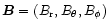 (in spherical coordinates), and the width of the shell is
constant, the components then vary with distance as
(in spherical coordinates), and the width of the shell is
constant, the components then vary with distance as
 ,
,
 .
This is because the radial
component is divided over the surface of the spherical shell, while
the components parallel to the shell surface decrease with the
circumference. More formally, the induction equation
.
This is because the radial
component is divided over the surface of the spherical shell, while
the components parallel to the shell surface decrease with the
circumference. More formally, the induction equation
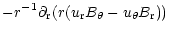
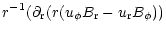
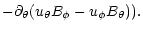
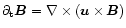 has the components
 and spherical symmetry
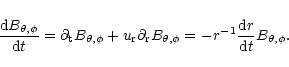
 the time evolution in a comoving fluid element is
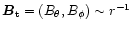 .
Since the expansion factor is very large between the
source and the radius from which the emitted radiation reaches us, the
radial component (varying as
.
Since the expansion factor is very large between the
source and the radius from which the emitted radiation reaches us, the
radial component (varying as  r-2) can be neglected and the
field is almost exactly parallel to the surface of the shell
(Fig. 1). If the width of the shell is constant, the magnetic
energy in the shell
r-2) can be neglected and the
field is almost exactly parallel to the surface of the shell
(Fig. 1). If the width of the shell is constant, the magnetic
energy in the shell
 is constant. The magnetic field thus carries a constant
fraction of the kinetic energy of the outflow. Depending on how
large this fraction is, the trapped field can be sufficient to produce
the synchrotron emission proposed in internal shock models, without
the need for "in situ'' field generation mechanisms (Medvedev & Loeb
1999).
is constant. The magnetic field thus carries a constant
fraction of the kinetic energy of the outflow. Depending on how
large this fraction is, the trapped field can be sufficient to produce
the synchrotron emission proposed in internal shock models, without
the need for "in situ'' field generation mechanisms (Medvedev & Loeb
1999).
How many field lines are trapped in the outflow, and hence which fraction of the outflow energy is magnetic, depends on conditions near the source. We consider here the representative possibilities.
First consider a fireball expanding from the surface of a central
object (not specified further) of radius R and a dipolar magnetic
field of moment  .
We assume that the magnetic field plays no role
in the driving of the outflow, but that it can confine plasma up to
its own energy density
.
We assume that the magnetic field plays no role
in the driving of the outflow, but that it can confine plasma up to
its own energy density  .
.
Assume first that the expansion is kinematic, i.e. that the magnetic
field is weak and its backreaction on the flow can be neglected. The
number of field lines trapped in the outflow is equal to the flux of
field lines outside crossing the dipole's equator outside the radius
R:
 |
(12) |
 ,
or
,
or
 .
Whether this is a large field strength, compared
with the kinetic energy density
.
Whether this is a large field strength, compared
with the kinetic energy density
 ,
depends on the
assumed dipole moment .
An upper limit to the dipole moment
follows from the requirement that the energy of the burst should be
able to open the field lines of the central object. Let the energy of
the burst be
,
depends on the
assumed dipole moment .
An upper limit to the dipole moment
follows from the requirement that the energy of the burst should be
able to open the field lines of the central object. Let the energy of
the burst be
 ,
where
,
where  the asymptotic Lorentz
factor of the outflow and M the baryon load. If this energy was
initially confined in a region of size R (the size of the central
engine), the magnetic field strength B0 in the confining dipole
field of the source must satisfy
the asymptotic Lorentz
factor of the outflow and M the baryon load. If this energy was
initially confined in a region of size R (the size of the central
engine), the magnetic field strength B0 in the confining dipole
field of the source must satisfy
 |
(14) |
 is the kinetic energy density in the shell:
 |
(16) |
 .
A "passive'' model, in which the magnetic field does
not play a role in driving the outflow, therefore can only yield field
strengths in the shell which are small compared with kinetic energy
density. Even at such a low field strength, however, the magnetic
field can become important for synchrotron emission in internal
shocks, as discussed below in Sect. 4.
.
A "passive'' model, in which the magnetic field does
not play a role in driving the outflow, therefore can only yield field
strengths in the shell which are small compared with kinetic energy
density. Even at such a low field strength, however, the magnetic
field can become important for synchrotron emission in internal
shocks, as discussed below in Sect. 4.
In magnetic models for GRB engines, the magnetic field serves to
extract rotation energy from a rapidly rotating relativistic object.
The details of such magnetic extraction (especially three-dimensional
ones) are still somewhat uncertain, but basic energetic considerations
are simple. Rotation of the mass-loaded field lines induces an
azimuthal field component  .
Let the distance from the rotating
object where this component is equal to the radial field be r0.
Except for cases with large baryon loading that are probably not
relevant for GRB engines, r0 is of the order of the Alfvén
radius, which can lie anywhere between the surface of the object Rand the light cylinder
.
Let the distance from the rotating
object where this component is equal to the radial field be r0.
Except for cases with large baryon loading that are probably not
relevant for GRB engines, r0 is of the order of the Alfvén
radius, which can lie anywhere between the surface of the object Rand the light cylinder
 .
The energy output Ltransmitted by the azimuthal magnetic stress (
.
The energy output Ltransmitted by the azimuthal magnetic stress (
 )
is
then of the order
)
is
then of the order
 .
For a field
dominated by its dipole component ,
this yields a luminosity
.
For a field
dominated by its dipole component ,
this yields a luminosity
 ,
this yields (by order of magnitude) the pulsar
spin-down formula for an inclined dipole rotating in vacuum, emitting
an electromagnetic wave from its light cylinder.
,
this yields (by order of magnitude) the pulsar
spin-down formula for an inclined dipole rotating in vacuum, emitting
an electromagnetic wave from its light cylinder.
The energy estimate (17) does not tell what the field
configuration in the outflow looks like. The possibilities for
dissipation of magnetic energy inside the outflow depend strongly on
this configuration, which in turn depends on the nature of the
magnetic field of the central engine. An important distinction is
whether the rotating magnetic field is axisymmetric or
nonaxisymmetric. In the nonaxisymmetric case, the outflow
contains magnetic fields varying on the rather small scale
 ,
the wavelength of the outgoing wave. In such a field,
internal dissipation turns out to be much more likely to be important
than in an axisymmetric field, where the length scale of the field is
of the order of the distance r. In the following, this is
illustrated with a few specific cases.
,
the wavelength of the outgoing wave. In such a field,
internal dissipation turns out to be much more likely to be important
than in an axisymmetric field, where the length scale of the field is
of the order of the distance r. In the following, this is
illustrated with a few specific cases.
Estimate (17) only gives the total luminosity. Which
fraction of it is in the form of kinetic energy and which in magnetic
energy depends on more physics. At one extreme is Michel's
(1969) model, in which the outflow consists of cold
(pressureless) matter accelerated exclusively by the magnetic field.
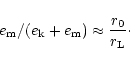
In this case, the ratio
 of
magnetic to kinetic luminosity is of the order
of
magnetic to kinetic luminosity is of the order
 .
At large Lorentz factors, the energy is almost entirely in
electromagnetic form, in this model. This is probably a property of
the special geometry of the model, in which the flow is limited to the
equatorial plane. If outflow in other directions is considered, much
smaller values of
.
At large Lorentz factors, the energy is almost entirely in
electromagnetic form, in this model. This is probably a property of
the special geometry of the model, in which the flow is limited to the
equatorial plane. If outflow in other directions is considered, much
smaller values of  result (Begelman & Li 1994).
At the other extreme, consider a case in which most magnetic energy is
released inside the light cylinder, in the form of a dense pair plasma
(by some form of magnetic reconnection, for example). The result would
then be just like the hydrodynamic expansion of a simple (Goodman
1986; Paczynski 1986) pair plasma
fireball, and the resulting outflow would have
result (Begelman & Li 1994).
At the other extreme, consider a case in which most magnetic energy is
released inside the light cylinder, in the form of a dense pair plasma
(by some form of magnetic reconnection, for example). The result would
then be just like the hydrodynamic expansion of a simple (Goodman
1986; Paczynski 1986) pair plasma
fireball, and the resulting outflow would have  .
If some but
not all energy is dissipated close to the source, intermediate values
of
would result. Since these important questions have not been
resolved yet, we keep
as a free parameter in the following.
Where necessary we assume that it typically has values or order unity.
.
If some but
not all energy is dissipated close to the source, intermediate values
of
would result. Since these important questions have not been
resolved yet, we keep
as a free parameter in the following.
Where necessary we assume that it typically has values or order unity.
Assume we have a perpendicular rotator, i.e. the rotating object has
its dipole axis orthogonal to the rotation axis. At the source surface
r0, the rotating field is then strongest at the equator, and one
expects the energy flux to be largest near the equatorial plane. With
each rotation, a "stripe'' consisting of a band of eastward and one of
westward azimuthal field moves outward (Fig. 2, see also
Coroniti 1990; Usov 1994). Assuming the
outflow to be relativistic, the width  of such a stripe in
the rest frame of the central object is
of such a stripe in
the rest frame of the central object is
 .
The
(absolute value of the) azimuthal flux
.
The
(absolute value of the) azimuthal flux  in each half-wavelength
is of the order of the poloidal flux outside the source surface r0,
in each half-wavelength
is of the order of the poloidal flux outside the source surface r0,
 .
For spherical expansion of this amount of
azimuthal flux, the field strength at distance r is then
.
For spherical expansion of this amount of
azimuthal flux, the field strength at distance r is then
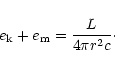
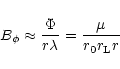 |
(18) |
is
 |
(19) |
Consider a collimated outflow along the axis of rotation
(Fig. 3). This might be achieved by magnetic models in which
the azimuthal field collimates the flow towards the axis by hoop
stress (Bisnovatyi-Kogan & Ruzmaikin 1976; Blandford
& Payne 1982; Sakurai 1985). In such a
model, one assumes an axisymmetric (about the rotation axis) poloidal
field, which is wound up into an azimuthal field wrapped around the
axis. Let the opening angle of the outflow be  (assumed
constant), and
(assumed
constant), and  the cylindrical radius. At the source surface
 the poloidal and azimuthal field components
are equal, and in the absence of magnetic reconnection processes
the poloidal and azimuthal field components
are equal, and in the absence of magnetic reconnection processes
 |
= |  |
(21) |
 |
= |  |
(22) |
 of the order of the Alfvén crossing time, i.e.
 .
Though the details of this
process have not been worked out for jets (see however Lucek & Bell
1996,1997), it is likely that the release of magnetic
energy operates in two steps. In the first step, kink instability
transforms the axisymmetric configuration into a nonaxisymmetric,
helical, configuration. For an application to jets, see Königl &
Choudhuri (1985). This step is fast, operating on the
Alvén crossing time. At this stage, the field has already lost much
of its collimating ability, since the average azimuthal field strength
has decreased in favour of a less ordered field component. During the
instability, the so-called magnetic helicity is conserved, however, so
that only a fraction of the magnetic energy is released. The further
release of magnetic energy depends on reconnection processes. As
discussed in Sect. 5, this is also likely to proceed on
a time scale proportional to the Alfvén crossing time, though
somewhat slower than the kink process itself.
As in the quasi-spherical outflow case, we ignore this internal
dissipation of the magnetic energy for the moment, and return to it in
Sect. 5. For a jet expanding with fixed opening angle
(see Fig. 3), the field strength then varies as
r-1 and the magnetic energy is constant with distance. Since only
a fraction of the magnetic energy is released in the kinking process,
the ratio of magnetic to kinetic energy density is still of the order
found in axisymmetric magnetic jet calculations (e.g. Camenzind
1987), i.e. of order unity:
.
Though the details of this
process have not been worked out for jets (see however Lucek & Bell
1996,1997), it is likely that the release of magnetic
energy operates in two steps. In the first step, kink instability
transforms the axisymmetric configuration into a nonaxisymmetric,
helical, configuration. For an application to jets, see Königl &
Choudhuri (1985). This step is fast, operating on the
Alvén crossing time. At this stage, the field has already lost much
of its collimating ability, since the average azimuthal field strength
has decreased in favour of a less ordered field component. During the
instability, the so-called magnetic helicity is conserved, however, so
that only a fraction of the magnetic energy is released. The further
release of magnetic energy depends on reconnection processes. As
discussed in Sect. 5, this is also likely to proceed on
a time scale proportional to the Alfvén crossing time, though
somewhat slower than the kink process itself.
As in the quasi-spherical outflow case, we ignore this internal
dissipation of the magnetic energy for the moment, and return to it in
Sect. 5. For a jet expanding with fixed opening angle
(see Fig. 3), the field strength then varies as
r-1 and the magnetic energy is constant with distance. Since only
a fraction of the magnetic energy is released in the kinking process,
the ratio of magnetic to kinetic energy density is still of the order
found in axisymmetric magnetic jet calculations (e.g. Camenzind
1987), i.e. of order unity:
Copyright ESO 2001
![\begin{figure}
\hfill\includegraphics[width=0.17\hsize]{H2167F1.eps}\hfill
\in...
...fill
\includegraphics[width=0.50\hsize]{H2167F4.eps}\hfill\mbox{}
\end{figure}](/articles/aa/full/2001/14/aah2167/img39.gif)
 .
It has stretched
the field interior to the shell into a radial field. Lower left:
reconnection in the low-density interior region restores the
dipole field near the source. Lower right: as the shell moves out
its thickness becomes small compared the distance travelled, and
the further evolution depends on reconnection processes inside the
shell
.
It has stretched
the field interior to the shell into a radial field. Lower left:
reconnection in the low-density interior region restores the
dipole field near the source. Lower right: as the shell moves out
its thickness becomes small compared the distance travelled, and
the further evolution depends on reconnection processes inside the
shell




![\begin{figure}
\parbox[c]{0.5\hsize}{
\includegraphics[width=\hsize]{H2167F5.e...
....eps}\\ [1ex]
\includegraphics[width=\hsize]{H2167F7.eps}
\par }
\end{figure}](/articles/aa/full/2001/14/aah2167/img78.gif)


![\begin{figure}
\includegraphics[height=6.5cm]{H2167F8.eps}\hfill
\includegraphics[height=6.5cm]{H2167F9.eps} \end{figure}](/articles/aa/full/2001/14/aah2167/img100.gif)