![[*]](/icons/foot_motif.gif)
A&A 369, L17-L21 (2001)
DOI: 10.1051/0004-6361:20010245
M. E. van den Ancker1,2 - G. Meeus3 - J. Cami2,4 - L. B. F. M. Waters2,3 - C. Waelkens3
1 -
Harvard-Smithsonian Center for Astrophysics, 60 Garden Street, MS 42,
Cambridge MA 02138, USA
2 -
Astronomical Institute, University of Amsterdam,
Kruislaan 403, 1098 SJ Amsterdam, The Netherlands
3 -
Instituut voor Sterrenkunde, Katholieke Universiteit Leuven, Celestijnenlaan
200B, 3001 Heverlee, Belgium
4 -
SRON, PO Box 800, 9700 AV Groningen, The Netherlands
Received 2 January 2001 / Accepted 14 February 2001
Abstract
We analyze ISO archive data of the nearby bright emission-line star
51 Oph, previously classified as a proto-planetary system similar to
 Pic. The infrared spectrum reveals the presence of gas-phase
emission bands of hot (
Pic. The infrared spectrum reveals the presence of gas-phase
emission bands of hot ( 850 K) CO, CO2, H2O and NO. In
addition to this, partially crystalline silicate dust is present. The
solid-state bands and the energy distribution are indicative of dust
that has formed recently, rather than of debris dust. The presence of
hot molecular gas and the composition of the circumstellar dust are
highly unusual for a young star and are reminiscent of what is found
around evolved (AGB) stars, although we exclude the possibility of
51 Oph belonging to this group. We suggest several explanations for
the nature of 51 Oph, including a recent episode of mass loss from a
Be star, and the recent destruction of a planet-sized body around a
young star.
850 K) CO, CO2, H2O and NO. In
addition to this, partially crystalline silicate dust is present. The
solid-state bands and the energy distribution are indicative of dust
that has formed recently, rather than of debris dust. The presence of
hot molecular gas and the composition of the circumstellar dust are
highly unusual for a young star and are reminiscent of what is found
around evolved (AGB) stars, although we exclude the possibility of
51 Oph belonging to this group. We suggest several explanations for
the nature of 51 Oph, including a recent episode of mass loss from a
Be star, and the recent destruction of a planet-sized body around a
young star.
Key words: circumstellar matter - stars: emission-line - stars: evolution - stars: 51 Oph - infrared: stars
51 Oph exhibits a normal UV and visual energy distribution, but IRAS
and subsequent ground-based follow-up observations revealed an
unusually large infrared excess longward of 2  m, interpreted as
being due to hot (up to 1000 K) circumstellar dust (Coté & Waters
1987; Waters et al. 1988). The peculiarity of the energy distribution
of 51 Oph when compared to those of Be, Ae and A-shell stars led
Waters et al. (1988) to suggest that it may be a candidate
proto-planetary disk system, similar to
Pictoris. This
suggestion was further strengthened by Grady & Silvis (1993), who
found evidence for the presence of variable columns of accreting gas,
similar to those found around Pic.
m, interpreted as
being due to hot (up to 1000 K) circumstellar dust (Coté & Waters
1987; Waters et al. 1988). The peculiarity of the energy distribution
of 51 Oph when compared to those of Be, Ae and A-shell stars led
Waters et al. (1988) to suggest that it may be a candidate
proto-planetary disk system, similar to
Pictoris. This
suggestion was further strengthened by Grady & Silvis (1993), who
found evidence for the presence of variable columns of accreting gas,
similar to those found around Pic.
The presence of dust in the 51 Oph system was unambiguously
established in 1993, when Fajardo-Acosta et al. detected a prominent
10 m silicate feature in emission. Their results were
subsequently confirmed from the ground by Lynch et al. (1994); Walker
& Butner (1995); Sylvester et al. (1996); by Waelkens et al. (1996) using the Infrared Space Observatory (ISO; Kessler et al. 1996).
Lecavelier des Etangs et al. (1997) found cold neutral C
(N =
5 1013 cm-2, T = 20 K) in 51 Oph, yielding a
C I/dust ratio similar to that derived for Pic. Since
C I has a very short lifetime, it must be continuously
replenished, providing evidence for the existence of evaporating
bodies in 51 Oph, similar to those inferred around Pic.
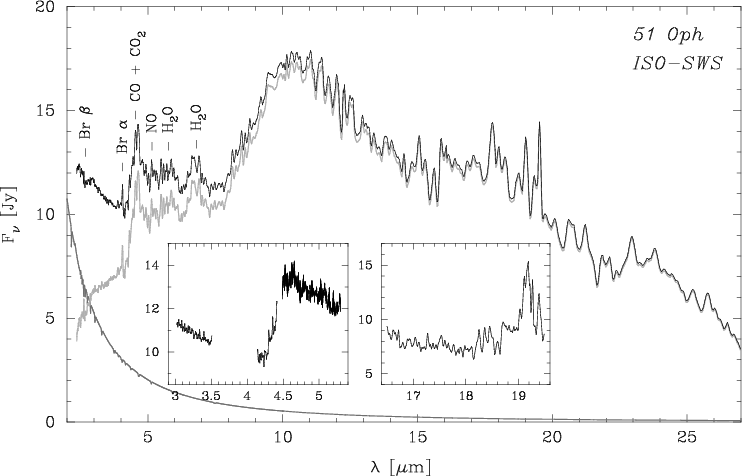 |
Figure 1: ISO-SWS spectra of 51 Oph. The main figure shows the AOT 01 spectrum, whereas the insets show the AOT 06 data. The grey lines show a Kurucz (1991) model for the A0 primary (dark) and the spectrum (light) obtained by subtracting this photosphere model from the observed spectrum |
| Open with DEXTER | |
However, the analogy with the Pic system is not complete.
51 Oph possesses strong H emission, absent in Pic. The
shape of the spectral energy distribution suggests that only very few
large dust grains are present, unusual for a protoplanetary disk, but
in agreement with what is found in Vega-type systems. However, the
magnitude and temperature of the infrared emission is more reminiscent
of disks surrounding younger stars. These indicators, together with
its position to the right of the main-sequence, lead some authors to
consider 51 Oph to be related to the Herbig Ae/Be stars (e.g. van den
Ancker et al. 1998; Meeus et al. 2001).
emission, absent in Pic. The
shape of the spectral energy distribution suggests that only very few
large dust grains are present, unusual for a protoplanetary disk, but
in agreement with what is found in Vega-type systems. However, the
magnitude and temperature of the infrared emission is more reminiscent
of disks surrounding younger stars. These indicators, together with
its position to the right of the main-sequence, lead some authors to
consider 51 Oph to be related to the Herbig Ae/Be stars (e.g. van den
Ancker et al. 1998; Meeus et al. 2001).
In this letter we will re-analyze archive ISO spectroscopy of
51 Oph. We will show that its 4-8 m spectrum, not shown by
Waelkens et al. (1996), reveals the presence of hot circumstellar
molecular gas. This is highly unexpected for a proto-planetary or
debris disk system. We investigate several different explanations for
the remarkable composition of the circumstellar material in 51 Oph and
comment on those.
ISO observed 51 Oph with the Short Wavelength Spectrometer (SWS; de Graauw et al. 1996) in mode "AOT 01'' (full spectral scan) and twice in mode "AOT06'' (deeper scans over a limited wavelength range). In addition, a Long Wavelength Spectrometer (LWS; Clegg et al. 1996) full grating scan ("AOT L01'') was taken. The data were reduced in a standard fashion using calibration files corresponding to ISO off-line processing software (OLP) version 7.02, after which they were corrected for remaining fringing and glitches. The resulting SWS spectra are shown in Fig. 1.
The spectra observed by ISO are in good agreement with the ground-based
N-band spectroscopy of 51 Oph by Fajardo-Acosta et al. (1993),
Walker & Butner (1995) and Sylvester et al. (1996). However, the
more complete wavelength coverage, and the higher spectral resolution
and signal to noise reveal a wealth of structure hidden in the
ground-based data. Shortward of 4.1 m, the spectrum consists
of a smooth continuum, dominated by the photosphere of the central
star. A broad absorption due to Br
can
be seen around 2.63 m. The Br
line at 4.05 m is
filled in with emission (line flux
2.5 10-15 W m-2),
confirming the emission-line classification of 51 Oph.
A number of strong spectral features due to gas-phase molecules are present
in the 4.1-7.5 m spectral range. We recognise the 4.2-5.4 m
fundamental vibritional band (v = 1-0) of CO, the P and R branches
of the  bending mode of H2O in the 5.2-7.5 m range,
the 4.1-4.4 m
bending mode of H2O in the 5.2-7.5 m range,
the 4.1-4.4 m  band of CO2 and the fundamental
vibritional band of NO (
band of CO2 and the fundamental
vibritional band of NO ( = 1) around 5.1-5.9 m.
To further quantify the gas-phase emission lines,
we have compared the continuum-subtracted 51 Oph spectrum to a model for
gas-phase emission using a single layer, plane parallel LTE code (Cami et al. 2000). A satisfactory fit to our data can be obtained with
= 1) around 5.1-5.9 m.
To further quantify the gas-phase emission lines,
we have compared the continuum-subtracted 51 Oph spectrum to a model for
gas-phase emission using a single layer, plane parallel LTE code (Cami et al. 2000). A satisfactory fit to our data can be obtained with
 = 750-900 K, N(CO) = 1020-1022 cm-2.
The best fitting model has
= 850 K,
N(H2O) =
4 1018 cm-2,
N(12CO2) =
3 1016 cm-2,
N(12CO) =
3 1021 cm-2,
N(13CO) =
4 1018 cm-2,
and N(14NO)
1 1018 cm-2. It is shown in Fig. 2.
We stress that this fit is not unique and that several other combinations
of temperature and column density also give a satisfactory fit. However,
we can exclude a large abundance of 13CO. The presence of NO is surprising
but is needed in order to fit the emission structure near 5-5.5 m.
= 750-900 K, N(CO) = 1020-1022 cm-2.
The best fitting model has
= 850 K,
N(H2O) =
4 1018 cm-2,
N(12CO2) =
3 1016 cm-2,
N(12CO) =
3 1021 cm-2,
N(13CO) =
4 1018 cm-2,
and N(14NO)
1 1018 cm-2. It is shown in Fig. 2.
We stress that this fit is not unique and that several other combinations
of temperature and column density also give a satisfactory fit. However,
we can exclude a large abundance of 13CO. The presence of NO is surprising
but is needed in order to fit the emission structure near 5-5.5 m.
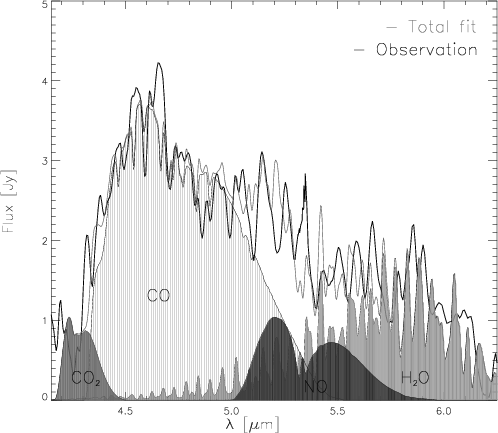 |
Figure 2:
Continuum subtracted 4-6 m spectrum of
51 Oph (heavy solid line) compared to a model for gas-phase emission
of H2O, CO, CO2 and NO at 850 K with
N(H2O) =
4 1018 cm-2,
N(12CO2) =
3 1016 cm-2,
N(12CO) =
3 1021 cm-2,
N(13CO) =
4 1018 cm-2,
and N(14NO)
1 1018 cm-2 (grey line).
Contributions of the different
gas-phase components are indicated by the shaded area |
| Open with DEXTER | |
Longward of 8 m, the spectrum is dominated by solid-state emission
from O-rich dust. A strong amorphous silicate feature is present, peaking
at 10.3 m. As was already noted by Fajardo-Acosta et al. (1993) and
Sylvester et al. (1996), the long-wavelength shoulder of this feature consists
of an almost linear part extending up to 15 m. We note that this
behaviour is incompatible with a purely silicate origin of this feature.
A secondary feature, peaking around 11.5 m and with a width of
3 m must be present as well to be able to explain the shape of
the 8-15 m emission complex. A very broad 10 m band is also
seen in the enigmatic object  Car (Morris et al., in preparation).
A second broad bump around 18 m is present and may be due to
amorphous silicates. In the SWS AOT 06 spectrum a narrower (
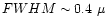 m) peak at 19.2 m, similar to that seen in stars with
emission due to crystalline silicates (e.g. Molster et al. 1999), is
superimposed on the broad amorphous silicate feature.
51 Oph was not detected in the LWS scan.
m) peak at 19.2 m, similar to that seen in stars with
emission due to crystalline silicates (e.g. Molster et al. 1999), is
superimposed on the broad amorphous silicate feature.
51 Oph was not detected in the LWS scan.
The presence of spectral features in 51 Oph due to hot gas-phase
molecules is highly surprising. None of the 47 Herbig Ae/Be stars for
which material is present in the ISO data archive shows a 4-8 m
emission complex resembling the one found in 51 Oph. However, such a
complex due to emission from hot molecular gas is commonly found in
the ISO spectra of O-rich evolved stars on or near the Asymptotic
Giant Branch (AGB; e.g. Yamamura et al. 1999; Sylvester et al. 1999).
A further inspection of the ISO data archives confirms our suspicion
that the spectrum of 51 Oph is highly unusual for a protoplanetary
system: none of the young stars for which spectroscopic data is
present shows the 11.5 m shoulder to the amorphous silicate
feature found in 51 Oph, including the isolated Herbig Ae/Be stars, of
which 51 Oph is believed to be a member (Meeus et al. 2001; Bouwman et al. 2001).
However, comparison of the observed 10 m profile with
archive ISO-SWS data of the symbiotic star V835 Cen (Fig. 3) shows
that the 10-15 m complex in 51 Oph is
similar to the one found in this highly evolved system. In fact, the
presence of a long-wavelength shoulder to the 10 m feature is a
common feature in the spectra of O-rich AGB objects (e.g. Tielens et al. 1998). It is not observed in other types of stars.
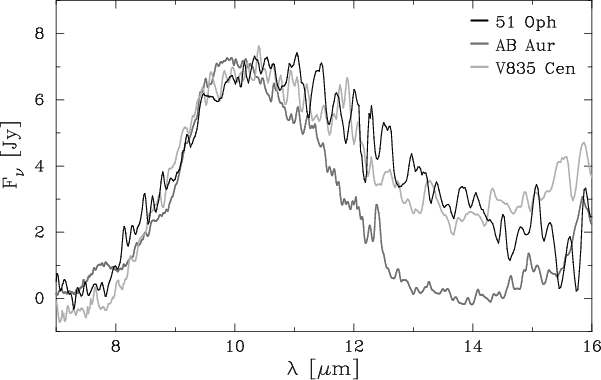 |
Figure 3:
Continuum subtracted 7-16 m spectrum of
51 Oph (black solid line) compared to continuum-subtracted ISO
SWS spectra of the Herbig Ae star AB Aur (van den Ancker et al. 2000;
dark grey curve) and that of the symbiotic star V835 Cen
(Mikolajewska et al. 1997; light grey line) |
| Open with DEXTER | |
The question arises what is the origin of the circumstellar gas and
dust in 51 Oph. In view of the peculiar molecular spectrum (indicative
of a large column of hot gas) and the deviating 10 m silicate
band, as well as the sharply dropping mid-IR to millimeter continuum
(pointing to a lack of large, cold grains typical for proto-planetary
disks) it is interesting to consider the possibility that the
circumstellar dust in 51 Oph is "fresh'', i.e. recently formed rather
than accreted from the interstellar medium and processed in a
proto-planetary disk.
One possible explanation for the presence of hot gas and newly formed dust in 51 Oph would be to assume that 51 Oph is a highly evolved rather than a relatively young system. This assumption agrees well with the above main-sequence position of 51 Oph in the HRD. The optical spectrum of 51 Oph, as well as its luminosity, show that a single post-main sequence star can not have created the large amount of circumstellar material we observe. However, the presence of a cool post-main sequence companion may explain the observed properties of the system. We note that a companion to 51 Oph may have been detected: Buscombe (1963) found the radial velocity of 51 Oph to be variable, which could be due to the reflex motion of the companion.
By comparing the optically visible A0 star's
 of
10000 K and
of
10000 K and
 of 260
 with the post-main sequence evolutionary tracks by Schaller et al.
(1992), we derive a mass of
with the post-main sequence evolutionary tracks by Schaller et al.
(1992), we derive a mass of
 and an age of
2 108 years for the primary. Using the ISO data
and the Hipparcos distance of 131
+17-13 pc towards
51 Oph we compute an infrared excess of 7.1
and an age of
2 108 years for the primary. Using the ISO data
and the Hipparcos distance of 131
+17-13 pc towards
51 Oph we compute an infrared excess of 7.1
 for 51 Oph. Assuming that both stars in our putative binary
system formed at the same time, a lower mass companion
should stil be on the main-sequence, limiting its mass to
<
for 51 Oph. Assuming that both stars in our putative binary
system formed at the same time, a lower mass companion
should stil be on the main-sequence, limiting its mass to
< if its luminosity is not to exceed the
observed infrared excess. This lower mass for the more
evolved star in the system is at odds with the mass derived
for 51 Oph itself, unless significant interaction between
both stars occurred. In addition, it is highly unlikely
that an evolved star of less than
if its luminosity is not to exceed the
observed infrared excess. This lower mass for the more
evolved star in the system is at odds with the mass derived
for 51 Oph itself, unless significant interaction between
both stars occurred. In addition, it is highly unlikely
that an evolved star of less than
 shows such
a large amount of circumstellar matter.
shows such
a large amount of circumstellar matter.
Another possibility would be to assume that the companion
is more massive than the optically visible A0 star. Any
scenario in which the companion would be a red giant or
AGB star of comparable mass to the primary is impossible,
since such a star would have a luminosity that greatly
exceeds
.
However, if the companion would
be sufficiently massive (

 ), it would
already have evolved to become a massive white dwarf of
very low luminosity. In this scenario, the material observed
around 51 Oph today could be caught in remnants of material
from the AGB wind of its companion. However, the lack of
a significant amount of 13CO in the composition of
the circumstellar material argues against this scenario.
We conclude that the presence of an evolved companion in 51 Oph
is unlikely.
), it would
already have evolved to become a massive white dwarf of
very low luminosity. In this scenario, the material observed
around 51 Oph today could be caught in remnants of material
from the AGB wind of its companion. However, the lack of
a significant amount of 13CO in the composition of
the circumstellar material argues against this scenario.
We conclude that the presence of an evolved companion in 51 Oph
is unlikely.
The rapidly rotating ( = 270 km s-1; Dunkin et al. 1997), emission-line character of 51 Oph has led to an association
with the Be stars, who share many of the properties of
51 Oph. However, as pointed out by Waters et al. (1988),
circumstellar dust is highly unusual in Be stars. The presence of
double-peaked H
emission in 51 Oph does indicate the presence
of a gaseous disk, and the width of the line suggests that this gas is
close to the star. It is reasonable to assume that the dust is also
located in this disk, at a larger distance from the star. In Be stars,
the disk can either be the result of (time-variable) mass loss, or
from mass accretion from an evolved companion. However, as pointed out
above, the presence of an evolved cool companion is difficult to
understand given the luminosity of the dust/gas emission in the
infrared. If one accepts that the circumstellar material is due to a
recent period of high mass loss from the Be star into a disk, the
presence of dust suggests that the amount of gas ejected must have
been high enough to shield the UV radiation field of the central star
to allow for dust formation. We have fitted the ISO-SWS spectrum using
the dust radiative transfer code MODUST (Bouwman & de Koter, in
preparation) and find a dust mass of
= 270 km s-1; Dunkin et al. 1997), emission-line character of 51 Oph has led to an association
with the Be stars, who share many of the properties of
51 Oph. However, as pointed out by Waters et al. (1988),
circumstellar dust is highly unusual in Be stars. The presence of
double-peaked H
emission in 51 Oph does indicate the presence
of a gaseous disk, and the width of the line suggests that this gas is
close to the star. It is reasonable to assume that the dust is also
located in this disk, at a larger distance from the star. In Be stars,
the disk can either be the result of (time-variable) mass loss, or
from mass accretion from an evolved companion. However, as pointed out
above, the presence of an evolved cool companion is difficult to
understand given the luminosity of the dust/gas emission in the
infrared. If one accepts that the circumstellar material is due to a
recent period of high mass loss from the Be star into a disk, the
presence of dust suggests that the amount of gas ejected must have
been high enough to shield the UV radiation field of the central star
to allow for dust formation. We have fitted the ISO-SWS spectrum using
the dust radiative transfer code MODUST (Bouwman & de Koter, in
preparation) and find a dust mass of
 .
This is a factor of 5 higher than the (distance-corrected) value given
by Fajardo-Acosta et al. (1993). In this scenario the late-main
sequence nature of 51 Oph may be related to the ejection of a large
amount of mass, since rapidly rotating early type stars are believed
to move closer to their breakup velocity as they evolve
(e.g. Langer et al. 1999; Langer 2000).
.
This is a factor of 5 higher than the (distance-corrected) value given
by Fajardo-Acosta et al. (1993). In this scenario the late-main
sequence nature of 51 Oph may be related to the ejection of a large
amount of mass, since rapidly rotating early type stars are believed
to move closer to their breakup velocity as they evolve
(e.g. Langer et al. 1999; Langer 2000).
A more exotic possibility to explain the properties of 51 Oph would be to infer that we are seeing the aftermath of a recent event such as the collision of two gas-rich planets or the accretion of a solid body as the star increases its size at the end of its main-sequence life. New dust could form at the site of the evaporation of the solid body, explaining both the high column of hot gas, the apparent small dust particle sizes and the composition of the silicate dust.
As was already pointed out by previous authors (e.g. Herbig 1994) the problem of separating young stars from their evolved counterparts is non trivial. The case of 51 Oph presented in this letter may serve once more to illustrate this difficulty. Even with the extensive data present on this enigmatic object, its evolutionary status remains unclear. New data that is able to resolve the system spatially, as well as a more thorough investigation of the suspected radial velocity variations, may be needed to shed more light on its nature.
Acknowledgements
The authors would like to thank Dr. Frank Molster for useful discussions regarding the nature of 51 Oph. We thank Dr. Alex de Koter and Drs. Jeroen Bouwman for their help in the use of MODUST. We are also grateful to the referee, Mike Barlow, for many useful comments. This research has made use of the Simbad data base, operated at CDS, Strasbourg, France. LBFMW acknowledges financial support from an NWO Pionier grant.