

The overall design constraints have been investigated in detail in order to optimise the number and optical design of each viewing direction, the choice of wavelength bands, detection systems, detector sampling strategies, basic angle, metrology system, satellite layout, and orbit (Mérat et al. 1999). The resulting proposed payload design (Fig. 2) consists of:
(a) two astrometric viewing directions. Each of these astrometric
instruments comprises an all-reflective three-mirror telescope with an
aperture of
 m2, the two fields separated by a basic
angle of 106
m2, the two fields separated by a basic
angle of 106 .
Each astrometric field comprises an astrometric
sky mapper, the astrometric field proper, and a broad-band
photometer. Each sky mapper system provides an on-board
capability for star detection and selection, and for the star position
and satellite scan-speed measurement. The main focal plane assembly
employs CCD technology, with about 250 CCDs and accompanying video
chains per focal plane, a pixel size 9
.
Each astrometric field comprises an astrometric
sky mapper, the astrometric field proper, and a broad-band
photometer. Each sky mapper system provides an on-board
capability for star detection and selection, and for the star position
and satellite scan-speed measurement. The main focal plane assembly
employs CCD technology, with about 250 CCDs and accompanying video
chains per focal plane, a pixel size 9  m along scan, TDI
(time-delayed integration) operation, and an integration time of
m along scan, TDI
(time-delayed integration) operation, and an integration time of
 0.9 s per CCD;
(b) an integrated radial velocity spectrometer and photometric
instrument, comprising an all-reflective three-mirror
telescope of aperture
 m2. The field of view is
separated into a dedicated sky mapper, the radial velocity
spectrometer, and a medium-band photometer. Both
instrument focal planes are based on CCD technology operating in TDI
mode;
m2. The field of view is
separated into a dedicated sky mapper, the radial velocity
spectrometer, and a medium-band photometer. Both
instrument focal planes are based on CCD technology operating in TDI
mode;
(c) the opto-mechanical-thermal assembly comprising: (i) a single
structural torus supporting all mirrors and focal planes, employing
SiC for both mirrors and structure. There is a symmetrical
configuration for the two astrometric viewing directions, with the
spectrometric telescope accommodated within the same structure, between the two
astrometric viewing directions; (ii) a deployable Sun shield to avoid
direct Sun illumination and rotating shadows on the payload module,
combined with the Solar array assembly; (iii) control of the heat
injection from the service module into the payload module, and control
of the focal plane assembly power dissipation in order to provide an
ultra-stable internal thermal environment; (iv) an alignment mechanism
on the secondary mirror for each astrometric instrument, with
micron-level positional accuracy and 200 m range, to correct for
telescope aberration and mirror misalignment at the beginning of life;
(v) a permanent monitoring of the basic angle, but without active
control on board.
The accuracy goal is to reach a 10 as rms positional accuracy for
stars of magnitude V=15 mag. For fainter magnitudes, the accuracy
falls to about
 as at V=17-18 mag, and to
 as
at V=20 mag, entirely due to photon statistics. For V<15 mag,
higher accuracy is achieved, but will be limited by systematic effects
at about
as
at V=20 mag, entirely due to photon statistics. For V<15 mag,
higher accuracy is achieved, but will be limited by systematic effects
at about  as for V<10-11 mag. Raw data representing the star
profile along scan must be sent to ground. An integral objective of the
mission is to provide the sixth astrometric parameter, radial
velocity, by measuring the Doppler shift of selected spectral lines.
Colour information is to be acquired for all observed objects,
primarily to allow astrophysical analyses, though calibration of the
instrument's chromatic dependence is a key secondary consideration.
as for V<10-11 mag. Raw data representing the star
profile along scan must be sent to ground. An integral objective of the
mission is to provide the sixth astrometric parameter, radial
velocity, by measuring the Doppler shift of selected spectral lines.
Colour information is to be acquired for all observed objects,
primarily to allow astrophysical analyses, though calibration of the
instrument's chromatic dependence is a key secondary consideration.
The astrometric accuracy can be separated into two independent terms, the random part induced by photo-electron statistics on the localisation process accuracy, and a bias error which is independent of the number of collected photons. The random part decreases in an ideal system as N-0.5, where N is the number of detected electrons per star; the bias part is independent of N, represents the ultimate capability of the system for bright stars, is limited by payload stability on timescales shorter than those which can be self-calibrated, i.e. shorter than about 5 hours.
GAIA will operate through continuous sky scanning, this mode being
optimally suited for a global, survey-type mission with very many
targets, and being of proven validity from Hipparcos. The satellite
scans the sky according to a pre-defined pattern in which the axis of
rotation (perpendicular to the three viewing directions) is kept at a
nominally fixed angle  from the Sun, describing a precessional
motion about the Solar direction at constant speed with respect to the
stars. This angle is optimised against satellite Sun shield demands,
parallax accuracy, and scanning law. Resulting satellite pointing
performances are determined from operational and scientific processing
requirements on ground, and are summarised in
Table 5.
from the Sun, describing a precessional
motion about the Solar direction at constant speed with respect to the
stars. This angle is optimised against satellite Sun shield demands,
parallax accuracy, and scanning law. Resulting satellite pointing
performances are determined from operational and scientific processing
requirements on ground, and are summarised in
Table 5.
A mission length of 5 years is adopted for the satellite design
lifetime, which starts at launcher separation and includes the
transfer phase and all provisions related to system, satellite or
ground segment dead time or outage. A lifetime of 6 years has been
used for the sizing of all consumables.
| Parameter | Value |
| Satellite scan axis tilt angle | 55
to the Sun |
| Scan rate | 120 arcsec s-1 |
| Absolute scan rate error | 1.2 arcsec s-1 (3 ) ) |
| Precession rate | 0.17 arcsec s-1 |
| Absolute precession rate error | 0.1 arcsec s-1 (3) |
| Absolute pointing error | 5 arcmin (3) |
| Attitude absolute measurement error | 0.001 arcsec (1) |
| High-frequency disturbances: | |
| power spectral density at 0.05 Hz |
 as2 Hz-1 as2 Hz-1 |
| for f > 0.05 Hz | decreasing as f-2 |
The astrometric telescopes have a long focal length, necessary for
oversampling the individual images. A pixel size of
9 m in the along-scan direction was selected, with the 50 m focal
length allowing a 6-pixel sampling of the diffraction image along scan
at 600 nm. The resulting optical system is very compact, fitting into
a volume 1.8 m high, and within a mechanical structure adapted to the
Ariane 5 launcher. Deployable payload elements have been avoided.
System optimisation yields a suitable full pupil of
m2 area with a rectangular shape. Optical
performances which have been optimised are the image quality,
characterised by the wave-front error, and the along-scan
distortion, avoiding at the same time a curved focal plane in order to
facilitate CCD positioning and mechanical complexity. The optical
configuration is derived from a three-mirror anastigmatic design with
an intermediate image. The three mirrors have aspheric surfaces with
limited high-order terms, and each of them is a part of a rotationally
symmetric surface. The aperture shapes are rectangular and decentered,
while each mirror is slightly tilted and decentered.
The tolerable optical distortion arises from the requirement that any variation of scale across the field must not cause significant image blurring during TDI operation. The number and size of the CCDs has been determined to match the optical quality locally in the field.
The monochromatic point spread function,
 ,
at a
specific point in the field, is related to the corresponding wavefront
error map w(x,y) in the pupil plane through the diffraction formula.
The overall wavefront error of the telescope is the sum of the errors
arising from optical design, alignment, and polishing residuals
for the three mirrors. The design target of
,
at a
specific point in the field, is related to the corresponding wavefront
error map w(x,y) in the pupil plane through the diffraction formula.
The overall wavefront error of the telescope is the sum of the errors
arising from optical design, alignment, and polishing residuals
for the three mirrors. The design target of
 rms over the
whole field corresponds to a Strehl ratio of 0.84 at 500 nm.
From analysis performed using the optical design software package
Code V, alignment errors can be made negligible (wave front error
rms over the
whole field corresponds to a Strehl ratio of 0.84 at 500 nm.
From analysis performed using the optical design software package
Code V, alignment errors can be made negligible (wave front error
 /70 rms) provided that the mirrors are positioned with an
accuracy of about
/70 rms) provided that the mirrors are positioned with an
accuracy of about  m. A 5 degree-of-freedom compensation
mechanism with this accuracy (not considered to be excessively
stringent with piezo-type actuators) is therefore implemented on the
secondary reflector of each of the astrometric telescopes. This allows
optimization of the overall optical quality
in orbit as a result of on-ground residual alignment errors, and the
recovery of misalignments of the telescope optics which may be induced by
launch effects, even if all the mirrors are randomly misaligned by an
amplitude
m. A 5 degree-of-freedom compensation
mechanism with this accuracy (not considered to be excessively
stringent with piezo-type actuators) is therefore implemented on the
secondary reflector of each of the astrometric telescopes. This allows
optimization of the overall optical quality
in orbit as a result of on-ground residual alignment errors, and the
recovery of misalignments of the telescope optics which may be induced by
launch effects, even if all the mirrors are randomly misaligned by an
amplitude  m in all directions. The required wavefront error
measurement will be performed on at least three points of the field of
view. In practice, the astrometric performance is not strongly
dependent on the actual telescope wavefront error, since the effect of
aberrations corresponds to first order in an energy loss in the
central diffraction peak, which is the only part of the point spread
function used for the star localization.
m in all directions. The required wavefront error
measurement will be performed on at least three points of the field of
view. In practice, the astrometric performance is not strongly
dependent on the actual telescope wavefront error, since the effect of
aberrations corresponds to first order in an energy loss in the
central diffraction peak, which is the only part of the point spread
function used for the star localization.
Although the optical design only employs mirrors, diffraction effects
with residual (achromatic) aberrations induce a small chromatic shift
of the diffraction peak. The chromaticity image displacement depends
on position in the field, and on the star's spectral energy
distribution (colour), but not on its magnitude. One purpose of the
broad-band photometric measurements within the main field is to provide
colour information on each
observed object in the astrometric field to enable this chromaticity
bias calibration on ground. Recent developments made on ion beam
polishing have shown that polishing errors can be made practically
negligible ( /100 rms obtained on a SiC reflector of about
200 mm diameter). It is therefore likely that the chromatic shift can
be reduced below a few tens of as over the whole field, easing
calibration requirements.
Combination of the satellite Sun shield and internal baffling reduce
straylight to negligible levels.
/100 rms obtained on a SiC reflector of about
200 mm diameter). It is therefore likely that the chromatic shift can
be reduced below a few tens of as over the whole field, easing
calibration requirements.
Combination of the satellite Sun shield and internal baffling reduce
straylight to negligible levels.
The focal plane contains a set of CCDs operating in TDI (time-delayed integration) mode, scanning at the same velocity as the spacecraft scanning velocity and thus integrating the stellar images until they are transferred to the serial register for read out. Three functions are assigned to the focal plane system: (i) the astrometric sky mapper; (ii) the astrometric field, devoted to the astrometric measurements; (iii) the broad band photometer, which provides broad-band photometric measurements for each object. The same elementary CCD is used for the entire focal plane, with minor differences in the operating modes depending on the assigned functions.
The astrometric sky mapper detects objects entering the field of view, and communicates details of the star transit to the subsequent astrometric and broad-band photometric fields. Three CCD strips provide (sequentially) a detection region for bright stars, a region which is read out completely to detect all objects crossing the field, and a third region which reads out detected objects in a windowed mode, to reduce read-out noise (and hence to improve the signal-to-noise ratio of the detection process), and to confirm objects provisionally detected in the previous CCD strips, in the presence of, e.g., cosmic rays. Simulations have shown that algorithms such as those developed for the analysis of crowded photometric fields (e.g. Irwin 1985) can be adapted to the problem of on-board detection, yielding good detection probabilities to 20 mag, with low spurious detection rates. Passages of stars across the sky mapper yield the instantaneous satellite spin rate, and allow the prediction of the the individual star transits across the main astrometric field with adequate precision for the foreseen windowing mode.
The size of the astrometric field is optimised at system level to
achieve the specified accuracy, with a field of
0.5  0.66. The size of the individual CCD is a
compromise between manufacturing yield, distortion, and integration
time constraints. The pixel size is a compromise between manufacturing
feasibility, detection performances (QE and MTF), and charge-handling
capacity: a dimension of 9 m in the along-scan direction provides
full sampling of the diffraction image, and a size of 27 m in the
across-scan direction is compatible with the size of the dimensions of
the point spread function and cross scan image motion. In addition, it
provides space for implementation of special features for the CCD
(e.g. pixel anti-blooming drain) and provides improved
charge-handling capacity. Quantitative calculations have demonstrated
that the pixel size, TDI smearing, pixel sampling, and point spread
function are all matched to system requirements. The CCDs are slightly
rotated in the focal plane and are individually sequenced in order to
compensate for the telescope optical distortion. Cross-scan binning of
8 pixels is implemented in the serial register for improvement of the
signal-to-noise ratio.
0.66. The size of the individual CCD is a
compromise between manufacturing yield, distortion, and integration
time constraints. The pixel size is a compromise between manufacturing
feasibility, detection performances (QE and MTF), and charge-handling
capacity: a dimension of 9 m in the along-scan direction provides
full sampling of the diffraction image, and a size of 27 m in the
across-scan direction is compatible with the size of the dimensions of
the point spread function and cross scan image motion. In addition, it
provides space for implementation of special features for the CCD
(e.g. pixel anti-blooming drain) and provides improved
charge-handling capacity. Quantitative calculations have demonstrated
that the pixel size, TDI smearing, pixel sampling, and point spread
function are all matched to system requirements. The CCDs are slightly
rotated in the focal plane and are individually sequenced in order to
compensate for the telescope optical distortion. Cross-scan binning of
8 pixels is implemented in the serial register for improvement of the
signal-to-noise ratio.
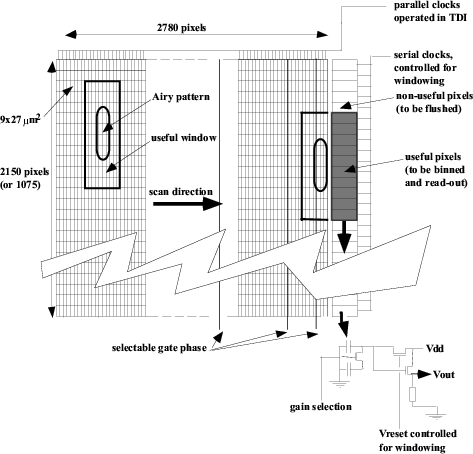
Each individual CCD features specific architecture allowing
measurement of stars brighter than the normal saturation limit of
about V=11-12 mag: selectable gate phases allow pre-selection of the
number of TDI stages to be used within a given CCD array. The
resulting astrometric error versus magnitude shows the effect of this
discrete selection (Fig. 4).
At the apparent magnitude and integration time limits appropriate for GAIA most of the pixel data do not include any useful information. There is a clear trade-off between reading too many pixels, with associated higher read-noise and telemetry costs, and reading too few, with associated lost science costs. This contributes to the choice of on-board real-time detection, with definition of a window around each source which has sufficient signal to be studiable, and determination of the effective sensitivity limit to be that which saturates the telemetry, and which provides a viable lower signal. Combining all these constraints sets the limit near V=20 mag, resulting in an estimated number of somewhat over one billion targets.
The broad-band photometric field provides multi-colour, multi-epoch photometric measurements for each object observed in the astrometric field, for chromatic correction and astrophysical analysis. Four photometric bands are implemented within each instrument.
A dedicated telescope, with a rectangular entrance pupil of
m2, feeds both the radial velocity spectrometer
and the medium-band photometer: the overall field of view is split
into a central
 devoted to the radial velocity
measurements, and two outer
regions devoted to
medium-band photometry. The telescope is a 3-mirror standard
anastigmatic of focal length 4.17 m. The mirror surfaces are coaxial
conics. An all-reflective design allows a wide spectral bandwidth for
photometry. The image quality at telescope focus allows the use of
devoted to the radial velocity
measurements, and two outer
regions devoted to
medium-band photometry. The telescope is a 3-mirror standard
anastigmatic of focal length 4.17 m. The mirror surfaces are coaxial
conics. An all-reflective design allows a wide spectral bandwidth for
photometry. The image quality at telescope focus allows the use of
 m2 pixels within the photometric field,
corresponding to a spatial resolution of 0.5 arcsec.
m2 pixels within the photometric field,
corresponding to a spatial resolution of 0.5 arcsec.
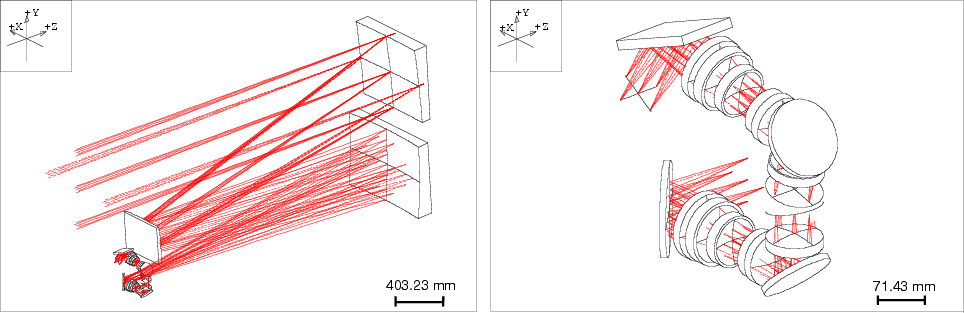 |
Figure 5: Optical configuration of the spectrometric instrument. The left figure shows the overall telescope design, while the right figure shows details of the spectrograph optics |
The radial velocity spectrometer acquires spectra of all sufficiently
bright sources, and is based on a slit-less spectrograph comprising a
collimator, transmission grating plus prism (allowing TDI operation
over the entire field of view) and an imager, working at unit
magnification. The two lens assemblies (collimating and focusing) are
identical, compensating odd aberrations including coma and distortion.
The dispersion direction is perpendicular to scan direction. The
overall optical layout is shown in Fig. 5.
The array covers a field height of 1.
Each
 m2 pixel corresponds to an angular sampling of
1 arcsec and a spectral sampling of approximately 0.075 nm/pixel. The
focal plane consists of three CCDs mechanically butted together, each
operated in TDI mode with its own sequencing, providing read-noise as
low as 3 e- rms with the use of a dedicated "skipper-type'' multiple
non-destructive readout architecture with 4 non-destructive readout
samples per pixel.
m2 pixel corresponds to an angular sampling of
1 arcsec and a spectral sampling of approximately 0.075 nm/pixel. The
focal plane consists of three CCDs mechanically butted together, each
operated in TDI mode with its own sequencing, providing read-noise as
low as 3 e- rms with the use of a dedicated "skipper-type'' multiple
non-destructive readout architecture with 4 non-destructive readout
samples per pixel.
The requirements for the CCDs are very similar to those of the astrometric field, including the use of TDI, and dedicated sky mapper. The photometric bands (Fig. 1) will require filters to be directly fixed onto the CCD array.
Preliminary investigations have been carried out to identify the minimum set of data to be transmitted to ground to satisfy the scientific mission objectives; to identify some on-board data discrimination compression principles able to provide the targeted data compression ratio; to assess the feasibility and complexity of implementing such compression strategies and related algorithms on board; to assess the resulting compressed data rate at payload output, which are used for the sizing of the solid state memory and communication subsystem; and to derive preliminary mass, size, and power budgets for the on-board processing hardware. For estimating telemetry rates (Table 6), a specific spatial sampling of the CCD data has been assumed. This sampling is not yet optimised and final, but represents a useful first approximation.
The instantaneous data rate will primarily
fluctuate with the stellar density in each of the three fields of
view, which scale with Galactic latitude. On-board storage will store
a full day of observation for downlink at a higher rate during
ground-station visibility.
Including overhead, the total raw science data rate is roughly a
factor 7 higher than the mean (continuous) payload data rate foreseen
in the telemetry budget (1 Mbit s-1). Data compression
will reduce this discrepancy, but there remains roughly a
factor two to be gained either by smarter CCD
sampling, or by increasing the link capacity.
CCD detectors form the core of the GAIA payload: their development and manufacture represents one of the key challenges for the programme. In the present study, consideration was given to the requirements on electro-optical behaviour; array size; buttability; pixel size; bright star handling; serial register performance; output amplifiers; power dissipation in the image zone, serial register, and output amplifier; trade-off between QE and MTF; photo-response non-uniformity; dark current; conversion factor and linearity; charge handling capacity per pixel; charge transfer efficiency in the image zone and serial register; minimization of residual images; anti-blooming efficiency; and packaging. The present baseline design is summarised in Table 7.
For astrometric use CCD accuracy
depends essentially on the integral of QEMTF over the
wavelength band. CCD MTF must be optimised in parallel with the
QE. The QE and MTF values for the CCD optimised for the astrometric
field have been used in the detailed astrometric accuracy analysis.
The pixel size, nominally adopted as
 m2 for the
astrometric field, is an important design parameter. A smaller
pixel size would decrease the telescope focal length, as well as the
overall size of the astrometric focal plane assembly, and consequently
the overall size of the overall payload. However, such devices provide
worse performance in a number of other areas. The trade-off
between QE, MTF, and charge-handling capacity results in
design reference values, and bread-boarding
activities are underway to verify these performances in detail.
m2 for the
astrometric field, is an important design parameter. A smaller
pixel size would decrease the telescope focal length, as well as the
overall size of the astrometric focal plane assembly, and consequently
the overall size of the overall payload. However, such devices provide
worse performance in a number of other areas. The trade-off
between QE, MTF, and charge-handling capacity results in
design reference values, and bread-boarding
activities are underway to verify these performances in detail.
| Parameter | Astro-1 and 2 (per instrument) | Spectro | |||||
| ASM3 | AF01-16 | AF17 | BBP | SSM1 | MBP | RVS | |
Limiting magnitude,
 [mag]
[mag] |
20 | 20 | 17 | ||||
Average star density,  [deg-2]
 |
25000 | 25000 | 2900 | ||||
TDI integration time per CCD,  [s]
[s] |
0.86 | 3.0 | 30 | ||||
Field width across scan,  [deg]
[deg] |
0.66 | 1.0 | 1.0 | ||||
Star flow through ,
 [s-1]
[s-1] |
550 | 833 | 97 | ||||
Number of CCDs along scan,
 |
1 | 16 | 1 | 4 | 1 | 14 | 1 |
Solid angle of CCDs,  [deg2]
 |
0.019 | 0.302 | 0.019 | 0.077 | 0.100 | 1.400 | 1.000 |
Number of stars on the CCDs,
 |
473 | 7568 | 473 | 1892 | 2500 | 35000 | 2900 |
Readout rate,
 [s-1]
[s-1] |
550 | 8800 | 550 | 2200 | 833 | 11662 | 97 |
| Samples per star read out | 25 | 6 | 30 | 16 or 10 | 42 | 14 | 930 |
| Samples per star transmitted, n | 25 | 6 | 30 | 10 | 42 | 8 | 930 |
| Raw data rate, 16nR [kbit s-1] | 220 | 845 | 264 | 352 | 560 | 1494 | 1443 |
| Raw data rate per instrument [kbit s-1] | 1681 | 3496 | |||||
| Total raw data rate [kbit s-1] |
 |
||||||
A "worst-case'' star density, corresponding to about 2.8 106stars per square degree (about 19-20 mag in Baade's Window) has been used in a detailed analysis of CCD performance. The total noise per sample includes contributions from the CCD read-out noise at the relevant read frequency, analog-to-digital conversion noise, and the video chain analog noise.
All CCDs used for both astrometric and photometric measurements are
operated in the drift-scan or TDI (time delay and integration) mode.
That is, charge packets are gradually built up while transferred from
pixel to pixel at the same rate as the optical image moves across the
detector. Centroiding on the digitised output provides a measure of
the position of the optical image relative to the electronic transfer
along the pixel columns. Demands on the precision of the mean image
position are strict: a standard error of 10 as in the final
trigonometric parallax translates to a required centroiding precision
in the astrometric field of 36 nm, 1/250 of a pixel.
Specific laboratory experiments, using the  m pixel EEV device CCD42-10
in windowing mode, non-irradiated as well as irradiated at doses of up
to 5 109 protons cm-2, have been conducted in TDI mode,
using different illumination levels, and at different CCD operating
temperatures. Although not fully representative of the flight
configuration, and while not yet fully evaluated, these experiments
have demonstrated that the targetted
centroiding accuracy appears to be achievable.
m pixel EEV device CCD42-10
in windowing mode, non-irradiated as well as irradiated at doses of up
to 5 109 protons cm-2, have been conducted in TDI mode,
using different illumination levels, and at different CCD operating
temperatures. Although not fully representative of the flight
configuration, and while not yet fully evaluated, these experiments
have demonstrated that the targetted
centroiding accuracy appears to be achievable.
A key parameter for achieving a high degree of reproducibility
is the Charge Transfer Efficiency (CTE) of the CCD. In the present
context it is more convenient to discuss the Charge Transfer
Inefficiency (CTI)
 .
Very few charge
carriers are actually lost (through recombination) during the
transfer process; rather, some carriers are captured by "traps'' and
re-emitted at a later time, thus ending up in the "wrong'' charge packet
at the output; if short-time constant processes dominate, the main effect
observed is that of image smearing. The
CTI has an effect both on the photometric measurement (by reducing
the total charge remaining within the image) and the astrometric
measurement (by shifting charges systematically in one direction).
CTI during parallel transfer is
particularly critical, since it affects the astrometric measurements
in the direction where the highest precision is required, i.e. along
the scan. In addition, CTI is worse along-scan due to the lower
transfer rate.
The magnitude of the problem can be crudely
estimated as follows: assume a constant fraction
.
Very few charge
carriers are actually lost (through recombination) during the
transfer process; rather, some carriers are captured by "traps'' and
re-emitted at a later time, thus ending up in the "wrong'' charge packet
at the output; if short-time constant processes dominate, the main effect
observed is that of image smearing. The
CTI has an effect both on the photometric measurement (by reducing
the total charge remaining within the image) and the astrometric
measurement (by shifting charges systematically in one direction).
CTI during parallel transfer is
particularly critical, since it affects the astrometric measurements
in the direction where the highest precision is required, i.e. along
the scan. In addition, CTI is worse along-scan due to the lower
transfer rate.
The magnitude of the problem can be crudely
estimated as follows: assume a constant fraction
 of the
charge is left behind while the fraction
of the
charge is left behind while the fraction
 flows into
the next pixel. The expected centroid shift is
flows into
the next pixel. The expected centroid shift is
 pixels. The CCDs in the astrometric field of GAIA
have N=2780 pixels of size 9 m along the scan. Assuming
pixels. The CCDs in the astrometric field of GAIA
have N=2780 pixels of size 9 m along the scan. Assuming
 results in a centroid shift of 125 nm or about
500 as.
results in a centroid shift of 125 nm or about
500 as.
More careful appraisal of the CTI effects on the astrometric accuracy
show the effect after calibration is negligible for the the undamaged
(beginning-of-life) CCD, but potentially serious for the degraded
performance that may result after significant exposure to particle
radiation in orbit. Although most of the CTI effects can be
calibrated as part of the normal data analysis, stochastic effects
related to the charge losses can never be eliminated by clever
processing. Extensive laboratory experiments are underway to quantify
the amplitude of these residual effects.
| Feature | Details |
| Array size |
 mm2 active area mm2 active area |
| Pixels per CCD | 2150 cols
2780 TDI stages |
| Dead zones | top: 0.25 mm; sides: 0.6 mm; |
| bottom: <5 mm | |
| Pixel size in image zone |
m2 |
| Phases in image zone | 4 |
| Pixel size in serial register |
 m2 m2 |
| Phases in serial register | 4 |
| Device thickness | 10-12 m |
| Si resistivity | 20-100 cm |
| Buried channel | n-type channel |
| Oxide thickness | standard |
| Anti-blooming | shielded at pixel level |
| Notch channel | implanted for all CCDs |
| Output amplifiers | 2 per device, 2-stage |
| Conversion factor | between 3-6 V/e- |
| Additional gates | 5-10 |
| Power dissipation | <560 mW |
| Non-uniformity | <1% rms local |
| <10% peak-to-peak global | |
| Mean dark current | <0.5 e-s-1pix-1 (200 K) |
| Non-linearity | <1 per cent over 0-2 V; |
| <20 per cent over 2-3.5 V | |
| CTI in image area | <10-5 at beginning-of-life; |
 after major Solar flare
 |
|
| CTI in serial register | <10-5 at beginning-of-life; |
 after major flare
 |
|
| Quantum efficiency | trade with MTF and RON |
| MTF at Nyquist frequency | trade with QE and RON |
| Read-out noise | trade with QE and MTF |
In summary, the GAIA payload comprises the following elements:
(a) two identical astrometric telescopes:
| - | fully-reflective 3-mirror SiC optics, |
| - | separation of viewing directions: 106, |
| - | monolithic primary mirrors:
m2, |
| - | field of view: 0.32 deg2, |
| - | focal length: 50 m, |
| - | wavelength range: 300-1000 nm, |
| - | 4-colour broad-band photometry, |
| - | operating temperature: 200 K, |
| - | detectors: CCDs operating in TDI mode, |
| - | pixel size along-scan: 9 m; |
(b) spectrometric instrument:
| - | spectrometer for radial velocities, |
| - | 11 colour medium-band photometry, |
| - | entrance pupil:
m2, |
| - | field of view: 4 deg2, |
| - | focal length: 4.17 m, |
| - | detectors: CCDs operating in TDI mode. |
Copyright ESO 2001
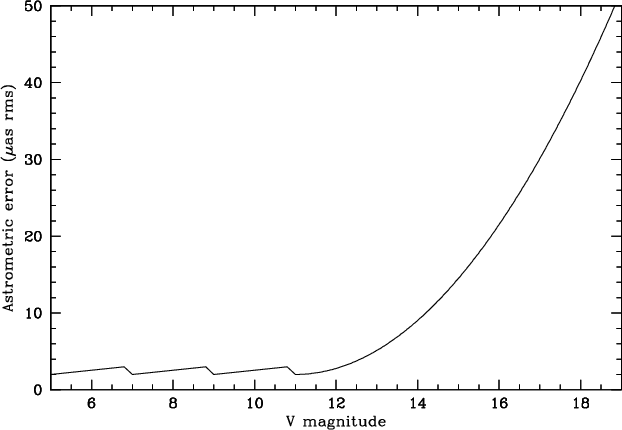
 11.6 for G2V star). Brighter than this,
the performance is practically independent of magnitude, due to the
pre-selection of the number of TDI stages required to avoid saturation
11.6 for G2V star). Brighter than this,
the performance is practically independent of magnitude, due to the
pre-selection of the number of TDI stages required to avoid saturation