A&A 368, 749-759 (2001)
DOI: 10.1051/0004-6361:20010080
Details of the mass-temperature relation for clusters of galaxies
A. Finoguenov - T. H. Reiprich - H. Böhringer
Max-Planck-Institut für extraterrestrische Physik, Giessenbachstraße, 85748 Garching, Germany
Received 9 October 2000 / Accepted 20 December 2000
Abstract
We present results on the total mass and temperature determination using two
samples of clusters of galaxies. One sample is constructed with emphasis on
the completeness of the sample, while the advantage of the other is the use
of the temperature profiles, derived with ASCA. We obtain remarkably similar
fits to the M-T relation for both samples, with the normalization and the
slope significantly different from both prediction of self-similar collapse
and hydrodynamical simulations. We discuss the origin of these discrepancies
and also combine the X-ray mass with velocity dispersion measurements to
provide a comparison with high-resolution dark matter simulations. Finally,
we discuss the importance of a cluster formation epoch in the observed M-Trelation.
Key words: galaxies: clusters: general - cosmology: observations; dark
matter; large-scale structure of Universe
There is increasing interest in using galaxy clusters characterized by X-ray
observations as probes for cosmic structure and its evolution. In one of the
applications, Press-Schechter models (Press & Schechter 1974) are used to
constrain the shape and amplitude of the primordial density fluctuation
spectrum at present day scales of
5 - 10 h-1 Mpc (e.g. Henry & Arnaud
1991; Oukbir & Blanchard 1992; Henry et al. 1992; Eke et al. 1996, 1998;
Borgani et al. 1999). Another important measurement is that of the spatial
correlations of X-ray clusters or, alternatively, the measurement of the
power spectrum of the density fluctuations in the cluster density
distribution (e.g. Nichol et al. 1992; Romer et al. 1994; Retzlaff et al. 1998;
Miller & Batuski 2000; Schuecker et al. 2000; Collins et al. 2000). In both
cases, the masses of the clusters have to be known for a large test sample
in order to apply it to the structure analysis. The mass determination is
still only feasible for a limited number of well-observed galaxy clusters,
however. Therefore, in the above approaches the empirically-found
correlation of the mass with the more easily observable parameters, X-ray
luminosity or intracluster gas temperature, are used to make the connection
between theoretical modeling and observations. The mass-temperature relation
plays a crucial role in this analysis, since it was found to be particularly
tight. Since the time of the first X-ray temperature measurements it was
observed that the X-ray temperature is closely connected to the velocity
dispersion of galaxies in clusters, indicating that both cluster components
trace the cluster potential in a similar way (e.g. Mushotzky et al. 1978;
Mushotzky 1984).
The validity of this approach was investigated in numerical calculations
based on N-body dynamic and hydrodynamic simulations making predictions on
the mass-temperature relation and its dispersion, as measured in X-ray
studies (Evrard et al. 1996; Evrard 1997). A close correlation
with a dependence of
 was predicted. It was found in this
work and also by e.g. Schindler (1996) that the X-ray mass determination
should be reliable (with an uncertainty in the range 14-29%). Evrard
et al. (1996 and Evrard 1997) argue, however, that the predicted
mass-temperature relation has such a small dispersion that a mass estimate
based on the temperature measurement only is more accurate than that
determined on the basis of the additional knowledge of the gas density
profile as obtained from
was predicted. It was found in this
work and also by e.g. Schindler (1996) that the X-ray mass determination
should be reliable (with an uncertainty in the range 14-29%). Evrard
et al. (1996 and Evrard 1997) argue, however, that the predicted
mass-temperature relation has such a small dispersion that a mass estimate
based on the temperature measurement only is more accurate than that
determined on the basis of the additional knowledge of the gas density
profile as obtained from  -model surface brightness profile fits.
These predictions from simulations have been tested recently by means of
observational results by several authors (e.g. Böhringer 1995; Hjorth et al.
1998; Horner et al. 1999; Nevalainen et al. 2000). Disagreements have been
found concerning the predicted slope (see e.g. Horner et al. 1999; Nevalainen
et al. 2000) and the normalization of the mass-temperature relation.
-model surface brightness profile fits.
These predictions from simulations have been tested recently by means of
observational results by several authors (e.g. Böhringer 1995; Hjorth et al.
1998; Horner et al. 1999; Nevalainen et al. 2000). Disagreements have been
found concerning the predicted slope (see e.g. Horner et al. 1999; Nevalainen
et al. 2000) and the normalization of the mass-temperature relation.
At the time of writing, this discrepancy has not been solved, and various
aspects of the data analysis and simulations have been discussed: the
correct measurement of temperature gradients in the intracluster gas (e.g.
Markevitch et al. 1998; Irwin et al. 1999; White 2000), influence
of cooling flows (Allen 1998), non-thermal pressure support (e.g. Schindler
1996; Fukazawa et al. 2000), influence of the heating of the intracluster
medium by supernovae (e.g. Balogh et al. 1999; Loewenstein 2000;
Finoguenov et al. 2000, hereafter FAD), density and velocity
bias in the galactic component of the cluster (Colín et al. 1999) and
effects of numerical resolution in the simulations (Nevalainen et al. 2000).
In this paper we reinvestigate the observational mass-temperature relation
using an extended sample of clusters with measured temperature profiles
covering a wide range of systems with luminosity-averaged temperatures from
below 1 up to 10 keV. In particular, we include 22 low temperature systems,
thus improving on sampling the low-mass part of the M-T relation, compared
to previous studies (e.g. Horner et al. 1999; Nevalainen et al. 2000). To
study in detail the parameters that influence the normalization and the
slope of the M-T relation, we rederive the M-T relation assuming an
isothermal temperature distribution and also compare with the M-T relation
for HIFLUGCS, a statistically complete sample of clusters, described in more
detail below, where the isothermality assumption was the only choice. This
sample is included in our study primarily to demonstrate that the result of
the M-T relation is not affected by any selection bias. In addition, we
discuss implications from the results of the M-T relation study on the
epoch (redshift) of cluster formation.
The paper is organized as follows. In Sect. 2 we describe the
sample compilation, in 3 we compare the results obtained for
the two different samples, in 4 we combine the X-ray mass with
velocity dispersion measurements to provide a comparison with
high-resolution dark matter simulations and in 5 we discuss a
correction for the redshift of cluster formation. Unless noted otherwise, we
assume
 ,
,
 and 0,
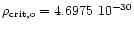 g cm-3 throughout the paper.
2 Data compilation and results
In this paper we compare the M-T relation of two cluster samples. The
first is a statistically complete sample of the X-ray brightest clusters,
the HIghest X-ray FLUx Galaxy Cluster Sample (HIFLUGCS), for which the
selection criteria and thus possible bias effects are well defined. For this
sample, masses have been determined on the assumption of isothermality of
the X-ray emitting plasma. The second sample comprises those clusters for
which we have temperature profiles from ASCA observations and for which a
refined mass determination is possible. For the analysis of both samples, we
use the same definition of the ``total mass'' as the mass enclosed by the
radius, r500, inside which the mean cluster mass density is 500 times
higher than the critical density of the Universe. Accounting for the
observed redshift means that the critical density, used to calculate the
overdensity, is scaled for every cluster according to its redshift. Later,
in fitting the M-T relation, we correct the temperature of the cluster by
dividing by (1+z). These corrections mean that clusters form at different
epochs at similar overdensity, so
 .
Therefore, for a fixed mass
.
Therefore, for a fixed mass
 ,
and
,
and
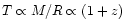 .
This is strictly correct only for
.
However, correction for the observed redshift assuming lower values
of
.
This is strictly correct only for
.
However, correction for the observed redshift assuming lower values
of
 has even smaller effect on the derived parameters of the
M-T relation, so our correction, assuming
,
can be
considered as an extreme case. As we will show below, even in this case,
there is no difference in the results obtained for both cluster samples
considered here and thus no difference in the derived parameters of the
M-T relation is expected for any value of
.
has even smaller effect on the derived parameters of the
M-T relation, so our correction, assuming
,
can be
considered as an extreme case. As we will show below, even in this case,
there is no difference in the results obtained for both cluster samples
considered here and thus no difference in the derived parameters of the
M-T relation is expected for any value of
.
Candidates for HIFLUGCS have been selected from recent cluster catalogs based
on the ROSAT All-Sky Survey. They have been reanalyzed homogeneously to
construct a complete X-ray flux-limited sample of the brightest clusters in
the sky, comprising 63 clusters. Details of the sample construction are
described in Reiprich et al. (2001). The cluster masses have been calculated
by assuming hydrostatic equilibrium and isothermality of the intracluster
gas and determining the gas density profile with the
model
(Cavaliere & Fusco-Femiano 1976; Gorenstein et al. 1978; Jones & Forman 1984). Overall cluster temperatures have been compiled from the literature,
giving preference to temperatures measured with the ASCA satellite. The
cluster masses, M500 and the mass errors, determined by adding the
temperature error and the errors of the fit parameter values (
and
core radius), are tabulated in Reiprich et al. (2001). Since HIFLUGCS is purely
flux-limited, we avoid any bias that could be introduced in a subjectively
compiled sample, e.g. based on the most preferred targets selected for deep
observations. To maintain the completeness of the sample, out of 63 systems
in HIFLUGCS, for two we have to use estimated temperatures based on the L-Trelation by Markevitch (1998). We have checked, however, that excluding
these two systems from the fit does not change the derived parameters of the
M-T relation.
In addition, we will use also a larger sample (enlarged HIFLUGCS, 88 clusters),
which is not strictly flux-limited, but contains only clusters with measured
temperatures.
A linear regression is performed in log(T)-log(M) space. The method
allows for errors in both variables and intrinsic scatter (Akritas &
Bershady 1996). We use the bisector method to determine the best-fit
parameters (Isobe et al. 1990). Errors are transformed into log space by
 where x+ and x- denote the
upper and lower boundary of the quantity's error range, respectively. The
values of the fit parameters
are given in Table 1.
where x+ and x- denote the
upper and lower boundary of the quantity's error range, respectively. The
values of the fit parameters
are given in Table 1.
Table 1:
Fit parameter values for the M-T relation
| sample |
slope |
norm, 1 keV |
| |
|
1013  |
| HIFLUGCS |
| flux-limited |
 |
3.53-0.30+0.33 |
| enlarged |
 |
3.74-0.27+0.29 |
flux-limited,
 |
 |
3.52-0.31+0.33 |
| enlarged,
|
 |
3.74-0.27+0.29 |
| Sample with kT-profiles |
| entire sample |
1.78-0.09+0.09 |
2.61-0.33+0.38 |
| entire sample,
|
1.78-0.09+0.10 |
2.64-0.34+0.39 |
|
M>5 1013 |
1.58-0.07+0.06 |
3.57-0.35+0.41 |
 |
1.58-0.05+0.05 |
3.57-0.26+0.27 |
| Implying isothermality to sample with kT-profiles |
| entire sample |
1.89-0.09+0.10 |
2.45-0.32+0.37 |
|
M>5 1013 |
1.74-0.06+0.07 |
3.04-0.29+0.29 |
|
1.66-0.04+0.05 |
3.50-0.23+0.21 |
-
- Errors are given at the 68% confidence
level. A bootstrap method is used to estimate the errors.
The results, obtained for the flux-limited and the enlarged sample agree
within the uncertainty of the fit. A correction for the observed redshift
does not result in any change in the derived parameters. The derived slope
of the M-T relation is steeper than the value of 1.5, expected from
self-similar scaling relations. The normalization obtained in the
hydrodynamical/N-body simulations of Evrard et al. (1996) is higher than
found here. No break in the M-T relation is visible over the whole range
of temperatures.
Note, however, that the determination of the mass value itself depends on
the temperature, therefore some care has to be taken in the interpretation
of the fit results. In the discussion, which follows below, we take this
effect into account.
To derive the total masses for the clusters in this sample, we use the
spatially resolved temperature profiles found in ASCA measurements
(Markevitch et al. 1998; Finoguenov & Ponman 1999; Finoguenov et al. 2000, hereafter FDP, FAD; Finoguenov et al. 2001). The
sample totals 39 systems with temperatures from 0.7 keV to 10 keV. This
corresponds to a factor of 100 difference in total mass, determined at a
given overdensity. A major difference of this sample, compared to studies of
Horner et al. (1999) and Nevalainen et al. (2000), is an inclusion of 22
systems with temperatures spanning the range from 0.7 keV to 3.5 keV. This
sample is therefore well suited to study the possible break in the M-Trelation, suggested by Nevalainen et al. (2000).
![\begin{figure}
\includegraphics[width=13cm]{ms10339f1.ps}
\end{figure}](/articles/aa/full/2001/12/aa10339/Timg31.gif) |
Figure 1:
M-T relation for the enlarged HIFLUGCS (filled circles indicate
the data with solid line indicating the best-fit). For comparison, the fit
to the M-T relation for the flux-limited HIFLUGCS is also shown (dot-dashed
line). The dashed line shows the result of simulations by Evrard et al.
(1996) |
| Open with DEXTER |
![\begin{figure}
\includegraphics[width=13cm]{ms10339f2.ps}
\end{figure}](/articles/aa/full/2001/12/aa10339/Timg32.gif) |
Figure 2:
M-T relation (analog to Fig. 1) for the sample
with temperature profiles. Crosses represent the mass determinations using
ASCA temperature profiles and ROSAT surface brightness profile fitting. The
dotted line denotes the best fit using the total sample, while the solid
line denotes the best fit, when groups (
M500<5 1013 )
are
excluded from the fitting. The dashed line shows the result of simulations
by Evrard et al. (1996). The long-dashed line shows the fit for the
low-temperature end of the sample (
 keV). The grey line shows
the effect of SN preheating on the M-T relation, discussed in FAD keV). The grey line shows
the effect of SN preheating on the M-T relation, discussed in FAD |
In calculating the total cluster masses we used polytropic indices to
describe the temperature profiles, omitting the cluster core, where effects
of cooling may be important. For the total mass estimates, we used the fits
to the surface brightness profiles from ROSAT PSPC data on the outskirts of
the clusters from Vikhlinin et al. (1999), FDP, FAD, Finoguenov et al. (2001), thus avoiding the cooling zone of the cluster. We
estimate the uncertainty of surface brightness profile fitting on the mass
estimation as 4%.
The uncertainties in the total mass estimations are much larger and are due to
the uncertainty in temperature estimates and temperature gradients.
There could be a systematic effect in the analysis of ROSAT surface
brightness profiles of groups, caused by variation of the ROSAT
countrate-to-emission measure conversion factor at low emission temperatures
(Böhringer 1996; Finoguenov et al. 1999). To evaluate this effect, we
compare our fits to ROSAT surface brightness profiles with the spectral
normalizations, derived in our 3d modeling of ASCA data. The latter accounts
for both temperature and metallicity effects, but has larger systematics due
to the complex PSF. From a good agreement, found in this comparison, a
possible systematics in the total mass calculation, resulting from our
approach to measuring the
values, is constrained to be less than
10%.
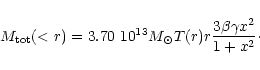
Under the assumption of hydrostatic equilibrium, when the density profile is
described by a -model and the temperature distribution is expressed
in polytropic form (
 ), the total mass within
the radius
), the total mass within
the radius
 is simply
 |
(1) |
We employed Eq. (1) for our mass measurements. In Table 2
we list our mass determinations at overdensity 500. Columns denote system
(1), redshift (2), emission weighted temperature (3), temperature at
r500 (4), total mass within r500 in 1014
(5), measured
r500 in Mpc (6), beta and core radius (7-8). Temperature gradients
are tabulated in Col. (9), expressed as polytropic indices ( ). In
Col. (10) we cite the outer radii included in the analysis of ASCA data. All
errors in this table are given at the 68% confidence level.
). In
Col. (10) we cite the outer radii included in the analysis of ASCA data. All
errors in this table are given at the 68% confidence level.
In calculating the emission-averaged temperatures we removed the effects of
cooling flows and emission lines. Thus, these temperatures are not subject
to effects discussed in Mathiesen & Evrard (2000, hereafter ME00). The
deviation of the measured M-T relation relative to the simulated one could
be characterized by observing a higher temperature for a given
mass. If a distinction exists between the spectral temperature measurements
and the mass-averaged temperatures, as discussed in ME00, the
above-mentioned discrepancy should only increase. This, however, is not true
in the case of decreasing temperature profiles. We will return to this issue
below.
In this section we investigate how the resulting parameters describing the
M-T relation depend on the selection of the sample, with the most
important results listed in Table 1.
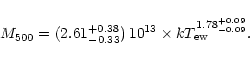
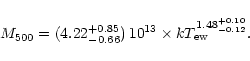
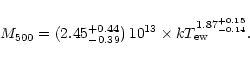
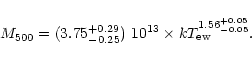
Without the correction for the observed redshift the fit to the M-Trelation using the bisector method by Akritas & Bershady (1996) gives
All the errors for the M-T relation reported in this section were
calculated from 10000 bootstrap realizations. The mass is expressed in
and the temperature in keV.
![\begin{figure}
\includegraphics[width=8.4cm,clip]{ms10339f3.ps}
\end{figure}](/articles/aa/full/2001/12/aa10339/Timg37.gif) |
Figure 3:
Parameters of the bisector fit to the M-T relation. Contours,
drawn at 1, 2 and 3  confidence level, denote the parameters derived
from the sample with temperature profiles. In grey we show the fit to all
the data and in black those excluding the groups (
M500<5 1013). The black point shows the value obtained in simulations of Evrard
et al. (1996), while the black crosses denote the values obtained for the
enlarged and flux-limited HIFLUGCS sample with the error bars shown at the 68%
confidence intervals
confidence level, denote the parameters derived
from the sample with temperature profiles. In grey we show the fit to all
the data and in black those excluding the groups (
M500<5 1013). The black point shows the value obtained in simulations of Evrard
et al. (1996), while the black crosses denote the values obtained for the
enlarged and flux-limited HIFLUGCS sample with the error bars shown at the 68%
confidence intervals |
| Open with DEXTER |
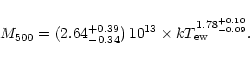
Correcting for the redshift we obtain
Thus, there is no significant effect due to the redshift correction for our
sample, composed from nearby objects, and we will omit it in further
relations.
Our results on the slope of the M-T relation are in agreement with
findings of Nevalainen et al. (2000), who determined a significantly steeper
slope than 1.5 (
 ,
90% confidence interval is cited) at an
overdensity of 1000.
,
90% confidence interval is cited) at an
overdensity of 1000.
Horner et al. (1999) find a flatter M-T relation, consistent with a value
of 1.5, but their sample lacks groups. Nevalainen et al. (2000) suggest on
the basis of their comparison of the M-T relation, derived for hot
clusters and adding a few groups, that there might be a break in the M-Trelation, occurring below 4 keV. Since our data uniquely sample a
temperature range from groups to clusters of galaxies, we are in a position
to check this suggestion.
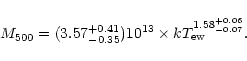
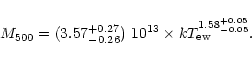
The M-T relation derived without groups (
M500>5 1013 )
is
![\begin{figure}
\includegraphics[width=8.4cm,clip]{ms10339f4.ps}
\end{figure}](/articles/aa/full/2001/12/aa10339/Timg41.gif) |
Figure 4:
Parameters of the bisector fit to the M-T relation, derived
from the sample with temperature profiles. Light grey contours describe the
slope and normalization of the M-T relation for clusters with temperature
below 4 keV. In grey we show the fit to all the data and in black those
excluding the groups (
M500<5 1013 ). Contours are drawn at
1, 2 and 3
confidence level. The innermost contour marks the center |
| Open with DEXTER |
Note that it is more straightforward to operate in terms of mass in
separating the groups, since their temperatures are strongly affected by
even a slight degree of preheating (Loewenstein 2000; Tozzi et al. 2000).
Restricting ourselves to the systems with temperatures above 3 keV, the fit
is
The low-temperature end of the M-T relation (systems with temperatures
below 4.5 keV) yields
The above fits and the data are shown in Fig. 2. The parameters
of the fits are compared with the results for the HIFLUGCS and simulations of
Evrard et al. (1996) in Fig. 3.
To study the confidence area of the parameter estimation for the above fits,
we choose a normalization at 3.5 keV, which makes the determination of the
slope less dependent on the normalization. We present the values derived
this way in Fig. 4. It can be seen from this figure that
the total sample is inconsistent with a power law index of 1.5 on more than
99.9% level. The high-temperature system sample (excluding groups),
although revealing a flatter index consistent with a value of 1.5, is not
strongly deviant from the total sample, e.g. the break in the M-T relation
has only 95% confidence. A steeper slope, derived for the low-temperature
end of the sample, can still be considered as a fluctuation. However, larger
errors in the parameter determination in the case of inclusion of groups are
due to the large spread of groups on the M-T relation (see
Fig. 2). So, the meaning of ``fluctuation'' is that a subsample
of systems leading to a derivation of the flat slope could be drawn from the
existing sample at a high probability. The origin of the scatter is further
discussed in Sect. 5.
In many studies the virial radius is suggested as a unit of length (e.g. Evrard et al. 1996; Markevitch et al. 1998; Cen & Ostriker 1999) to provide a
comparison among the systems at equal overdensity. For these estimations,
the luminosity averaged temperature of the cluster is used (Markevitch et al.
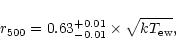
1998, FDP). Therefore, we provide here a relation between r500 and the
luminosity-weighted X-ray temperature, derived from the data in Table 2:
where r500 is in Mpc and
 in keV. For a given temperature this
relation implies a 20% smaller value for r500 compared to similar
formulae derived from the simulations of Evrard et al. (1996).
in keV. For a given temperature this
relation implies a 20% smaller value for r500 compared to similar
formulae derived from the simulations of Evrard et al. (1996).
Table 2:
Mass determinations using spatially resolved temperatures
| Name |
z |
kT |
kT500 |
M500 |
r500 |
|
 |
|
 |
| |
|
keV |
keV |
1014 |
Mpc |
|
Mpc |
|
Mpc |
| A2029 |
0.077 |
 |
 |
 |
 |
0.68 |
0.28 |
 |
2.82 |
| A401 |
0.074 |
 |
 |
 |
 |
0.63 |
0.27 |
 |
1.82 |
| A3266 |
0.055 |
 |
 |
 |
 |
0.74 |
0.50 |
 |
1.57 |
| A1795 |
0.062 |
 |
 |
 |
 |
0.83 |
0.39 |
 |
1.56 |
| A2256 |
0.058 |
 |
 |
 |
 |
0.82 |
0.52 |
 |
1.83 |
| A3571 |
0.040 |
 |
 |
 |
 |
0.69 |
0.27 |
 |
2.28 |
| A1651 |
0.085 |
 |
 |
 |
 |
0.70 |
0.26 |
 |
1.62 |
| A119 |
0.044 |
 |
 |
 |
 |
0.66 |
0.48 |
 |
1.28 |
| A3558 |
0.048 |
 |
 |
 |
 |
0.55 |
0.19 |
 |
1.39 |
| A2199 |
0.030 |
 |
 |
 |
 |
0.64 |
0.14 |
 |
1.25 |
| A496 |
0.033 |
 |
 |
 |
 |
0.70 |
0.25 |
 |
1.32 |
| A4059 |
0.048 |
 |
 |
 |
 |
0.67 |
0.22 |
 |
0.92 |
| A3112 |
0.075 |
 |
 |
 |
 |
0.63 |
0.12 |
 |
1.74 |
| Hydra |
0.057 |
 |
 |
 |
 |
0.66 |
0.12 |
 |
1.35 |
| A2063 |
0.035 |
 |
 |
 |
 |
0.69 |
0.22 |
 |
0.93 |
| MKW3S |
0.045 |
 |
 |
 |
 |
0.71 |
0.30 |
 |
1.16 |
| A2657 |
0.040 |
 |
 |
 |
 |
0.76 |
0.37 |
 |
1.17 |
| AWM7 |
0.017 |
 |
 |
 |
 |
0.53 |
0.10 |
 |
0.75 |
| A2052 |
0.035 |
 |
 |
 |
 |
0.64 |
0.10 |
 |
0.46 |
| HCG94 |
0.042 |
 |
 |
|
 |
0.48 |
0.08 |
 |
1.08 |
| 2A0335 |
0.035 |
 |
 |
 |
 |
0.65 |
0.08 |
 |
0.92 |
| A4038 |
0.028 |
 |
 |
 |
 |
0.61 |
0.16 |
 |
0.38 |
| A1060 |
0.011 |
 |
 |
 |
 |
0.70 |
0.16 |
 |
0.31 |
| A2634 |
0.031 |
 |
 |
 |
 |
0.69 |
0.45 |
 |
0.83 |
| MKW9 |
0.040 |
 |
 |
 |
 |
0.52 |
0.05 |
 |
0.71 |
| AWM4 |
0.032 |
 |
 |
 |
 |
0.62 |
0.11 |
 |
0.46 |
| A539 |
0.029 |
 |
 |
 |
 |
0.69 |
0.25 |
|
0.72 |
| MKW4S |
0.028 |
 |
 |
 |
 |
0.51 |
0.12 |
 |
0.75 |
| A262 |
0.016 |
 |
 |
 |
 |
0.46 |
0.06 |
 |
0.44 |
| A400 |
0.024 |
 |
 |
 |
 |
0.56 |
0.18 |
 |
0.64 |
| N3258 |
0.009 |
 |
 |
 |
 |
0.34 |
0.05 |
 |
0.57 |
| MKW4 |
0.020 |
 |
 |
 |
|
0.64 |
0.18 |
 |
0.66 |
| N6329 |
0.028 |
 |
 |
 |
 |
0.53 |
0.12 |
 |
0.64 |
| HCG51 |
0.026 |
 |
 |
 |
 |
0.30 |
0.08 |
 |
0.69 |
| N5044 |
0.009 |
 |
 |
 |
 |
0.51 |
0.01 |
 |
0.28 |
| HCG62 |
0.014 |
 |
 |
 |
 |
0.31 |
0.02 |
|
0.58 |
| N4325 |
0.026 |
 |
 |
 |
 |
0.59 |
0.01 |
 |
0.60 |
| IC4296 |
0.013 |
 |
 |
 |
 |
0.31 |
0.06 |
 |
0.32 |
| N5129 |
0.023 |
 |
 |
 |
 |
0.60 |
0.10 |
 |
0.58 |
3 Polytropic vs. isothermal
As given in Eq. (1), the deduced mass depends on the temperature and
the parameters
and ,
describing the shape of the density and
temperature profile. To further elucidate the origin of the behavior of the
M-T relation and to circumvent the direct dependence of M on T we
examine in Fig. 5 the dependence of
(correctly
 at r500) on T. We note four systems with
 that imply a steep dependence of beta on the temperature. They are mainly
responsible for the steep slope of the M-T relation in our sample with
spatially resolved temperatures. In fact, excluding these systems (IC 4296,
HCG62, HCG51, NGC 3258), but leaving other groups in, the M-T relation is
given by
that imply a steep dependence of beta on the temperature. They are mainly
responsible for the steep slope of the M-T relation in our sample with
spatially resolved temperatures. In fact, excluding these systems (IC 4296,
HCG62, HCG51, NGC 3258), but leaving other groups in, the M-T relation is
given by
Excluding two more systems (A262, HCG94), whose -index is less than
0.5, no further changes in the derived parameters of the M-T relation are
obtained:
All of the three groups in a sample of Nevalainen et al. (2000) have a
-index less or equal to 0.5. The above demonstrates the importance of
selection effects on the derived slope of the M-T relation, especially on
the group scale, originating from apparent scatter in the M-T relation on
the scales of groups. Observationally, this scatter is correlated with flat
gas density profiles, which are often taken for signs of preheating (Metzler
& Evrard 1997). In reality, the situation is more complex, since as
pointed out by Loewenstein (2000), when the effect of the SN feedback is the
only one responsible for the observed M-T relation, in low-mass systems, a
large amount of metals associated with SN explosions should be observed and
also isentropic cores, corresponding to the case of adiabatic
collapse. Although some of the groups do show such features (Finoguenov
et al. 2001), these are surprisingly not the most deviant systems in the
M-T relation.
Horner et al. (1999) have found that the dependence of
on
 is
responsible for the steepening of the derived M-T in the isothermal
assumption, but when the temperature profiles are taken into account, the
slope becomes 3/2 again. To verify this, we rewrite Eq. (1) in terms
of overdensity
is
responsible for the steepening of the derived M-T in the isothermal
assumption, but when the temperature profiles are taken into account, the
slope becomes 3/2 again. To verify this, we rewrite Eq. (1) in terms
of overdensity
 |
(2) |
where  denotes the chosen overdensity. If the idea of Horner et al.
(1999) is correct, Eq. (2) should contain a term counterbalancing
the dependence of
on
,
with possibilities
denotes the chosen overdensity. If the idea of Horner et al.
(1999) is correct, Eq. (2) should contain a term counterbalancing
the dependence of
on
,
with possibilities
 ,
,
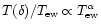 or both. The
index
or both. The
index  of this (counter-)dependence is
 according to
Horner et al. (1999), but weaker dependences of
on T are also
reported (e.g. 0.16 in Vikhlinin et al. 1999).
according to
Horner et al. (1999), but weaker dependences of
on T are also
reported (e.g. 0.16 in Vikhlinin et al. 1999).
As is seen from Figs. 6 and 7, the data show two
trends, which cancel each other: both very hot and very cold systems seem
to have stronger temperature gradients. So, the trend on the high-energy
part counterbalances the weak dependence of
on T, while the trend
in the low-temperature part only reinforces the trend observed in
.
Thus, it becomes clear why inclusion of groups makes such a drastic
difference in the derived M-T relation. An overall fit to these figures
gives
 and
and
 .
.
![\begin{figure}
\includegraphics[width=7.8cm,clip]{ms10339f6.ps}
\end{figure}](/articles/aa/full/2001/12/aa10339/Timg251.gif) |
Figure 6:
Relation between
and
.
The data are shown as
crosses with error bars drawn at the 68% confidence level |
| Open with DEXTER |
In fact, the arguments presented in Horner et al. (1999) are not strictly
correct. They base their conclusion on the fact that
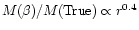 for an individual cluster, where
  is the mass estimate using the -model and assuming isothermality and
 is the true mass of the cluster.
However, what is relevant is:
 for the cluster sample,
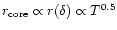 where
is the
cluster core radius and
where
is the
cluster core radius and  is the radius of overdensity ,
from which it follows:

This means that if clusters are self similar, the overestimate of the beta
model is the same for all clusters. In view of this consideration, we note
that there is a very close agreement between the parameters of the M-Trelation determined in our two samples. This agreement, which demonstrates
that usage of the isothermality assumption does not bias the derived
parameters of the M-T relation, can be used to justify the validity of the
M-T relation, derived for high-redshift samples, where detailed
temperature measurements are difficult and an assumption of isothermality is
the only choice.
Following a suggestion of the referee, we examine also the effect of
assuming isothermality in deriving the total mass for the sample with
spatially resolved temperature measurements. The results are listed in Table
1. The slope of the M-T relation, obtained for the total
sample, is still steeper, while avoiding the systems with flat
gives
results consistent with HIFLUGCS in both slope and normalization. We note that
the lowest
value for the HIFLUGCS sample is 0.44, which again supports
the idea of the importance of the selection of the systems with respect to
their values of .
Concluding this section, we identify the inclusion of systems with low
values of
as the most important cause of the steep slope of the
M-T relation, which could be overcome by excluding such systems from the
sample. As we have shown, a flat
is not necessarily a unique
characteristic of groups, which most likely implies a different importance
of preheating in low-mass systems. This is in qualitative agreement with the
preferential infall scenario, proposed by FAD.
In all the fits, however, the normalization of the M-T relation appears
smaller than in the simulations of Evrard et al. (1996). In the following, we
would like to comment on this issue. As pointed out by Nevalainen et al.
(2000), the resolution in the simulations of Evrard et al. (1996) is
insufficient to resolve the cluster cores. One can assume, however, that
their simulations are correct at low overdensities. Since we measure the
temperature up to the radius of the overdensity chosen for the mass
calculations, we can directly check this effect by using a temperature at
the radius of mass determination, (T500), instead of the
luminosity-weighted temperatures. Such a comparison may also be less
affected by preheating, since at
 no significant variation in
the gas fraction is seen (Ettori & Fabian 1999; Vikhlinin et al.
1999). Taking measured temperatures also avoids many possible effects of averaging, discussed in ME00 and is
therefore closer to the relations predicted for the mass-weighted
temperature. A fit to the
M500-T500 relation reads as
no significant variation in
the gas fraction is seen (Ettori & Fabian 1999; Vikhlinin et al.
1999). Taking measured temperatures also avoids many possible effects of averaging, discussed in ME00 and is
therefore closer to the relations predicted for the mass-weighted
temperature. A fit to the
M500-T500 relation reads as
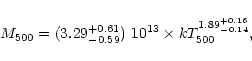
(errors are stated at the 68% confidence level).
The normalization of M-T500 in the simulations by Evrard et al. (1996)
is about
9.-15. 1013
(considering
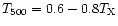 ),
closer to the observed points, but still in obvious disagreement (fixing the
slope to 1.5 we obtain a normalization at 1 keV of
4.81-0.29+0.30 1013 ).
),
closer to the observed points, but still in obvious disagreement (fixing the
slope to 1.5 we obtain a normalization at 1 keV of
4.81-0.29+0.30 1013 ).
![\begin{figure}
\includegraphics[width=8.2cm,clip]{ms10339f8.ps}
\end{figure}](/articles/aa/full/2001/12/aa10339/Timg263.gif) |
Figure 8:
M500-T500 relation. Dashed line shows the rescaled
simulations by Evrard et al. (1996) |
| Open with DEXTER |
4 Comparison with optical data
Comparison between the X-ray and the virial mass measurements, obtained
using velocity dispersions, is long known to be subject to contradictions,
with velocity bias considered as the most likely origin. Recently, a new
compilation of optical measurements was made by Girardi et al. (1998), where
a much more detailed study was carried out, e.g. different velocity
dispersion profiles in clusters were identified. Since we have measured the
masses for many clusters in common, we can combine the X-ray mass with
velocity dispersion measurements to provide a comparison with
high-resolution dark matter simulations.
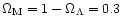
We take high-resolution
 (
(
 ,
,
 ;
H0=70 km s-1 Mpc-1) simulations using the
ART code (Kravtsov et al. 1997), with 2563 particles of
1.1 109
each in a simulation box of 60h-1 Mpc (see
Gottloeber et al. 1999 for details). The particular runs of the ART code we
use for comparison are characterized by a scale of velocity dispersion with
overdensity of
;
H0=70 km s-1 Mpc-1) simulations using the
ART code (Kravtsov et al. 1997), with 2563 particles of
1.1 109
each in a simulation box of 60h-1 Mpc (see
Gottloeber et al. 1999 for details). The particular runs of the ART code we
use for comparison are characterized by a scale of velocity dispersion with
overdensity of
 with a residual scatter around
the best-fit of 20-30%. Within the simulated box, 17 clusters have been
identified and we build the
with a residual scatter around
the best-fit of 20-30%. Within the simulated box, 17 clusters have been
identified and we build the
 relation, scaling the measurements
done at different overdensities. One possible weakness of such a comparison
is that in the simulations we have studied the dispersion of the dark
matter, not of the galaxies.
relation, scaling the measurements
done at different overdensities. One possible weakness of such a comparison
is that in the simulations we have studied the dispersion of the dark
matter, not of the galaxies.
![\begin{figure}
\includegraphics[width=8cm,clip]{ms10339f9.ps}
\end{figure}](/articles/aa/full/2001/12/aa10339/Timg268.gif) |
Figure 9:
relation at overdensity of 90. Circles represent
the results of high-resolution simulations. Black crosses represent a
correlation of the X-ray mass measurements with the velocity dispersion of
galaxies at overdensity of 90. Type A clusters (Girardi et al. 1998) are
shown in black, type B in grey and C in light grey (this
identification has been made to denote different velocity dispersion
profiles measured in these clusters, which reflect, according to Girardi
et al. (1998), that type B and C cluster have been formed earlier and are
therefore more relaxed) |
| Open with DEXTER |
Optical observations reveal 3 types of clusters, according to their degree
of virialization. In comparing the data, we have scaled the optical velocity
dispersions according to the given type of cluster, using identification and
scaling profiles, reported in Girardi et al. (1998). To compare our X-ray
results with the work of Girardi et al. (1998), we rescale our mass estimates
to the overdensity of 90, using the Navarro et al. (1996) profile.
The resulting
relation is presented in Fig. 9. The
outliers on the
relation, A2319, A3558 and A400, are already
known to have a peculiar structure (Feretti et al. 1997;
Venturi et al. 2000; Lloyd-Davies et al. 2000). The scatter of the
other points around the simulations is within 30% and therefore comparable
to the scatter seen in simulations. We note, however, that there is a trend
of type B and C clusters to have a higher velocity dispersion for a given
mass, which is consistent with a definition of their type: type B and C are
older systems, according to modeling of Girardi et al. (1998), that should
imply a higher formation redshift. Since such a correction is not introduced
into the virial mass calculation, this results in a slight bias in mass
estimates for these clusters, as seen in Fig. 10.
![\begin{figure}
\includegraphics[width=8cm,clip]{ms10339f10.ps}
\end{figure}](/articles/aa/full/2001/12/aa10339/Timg269.gif) |
Figure 10:
Comparison of the X-ray and optical mass estimates. Black
crosses denote type A clusters in Girardi et al. (1998), grey crosses type B
and light grey crosses type C. Type A clusters show the best agreement with
the X-ray mass measurements |
| Open with DEXTER |
5 Implications on the redshift (epoch) of cluster formation
The issue of the redshift of cluster formation was strongly suggested in
studies of Lilje (1992); Kitayama & Suto (1996); Voit & Donahue
(1998). The effect on the M-T relation is such that for a given mass, the
systems that formed at earlier times should have higher temperatures. Since
this scenario is in qualitative agreement with trends observed by comparing
our sample with the simulations of Evrard et al. (1996), we decided to
estimate whether the shift observed in the M-T relation could be explained
just by this scenario.
To do this, we invert the problem, i.e. use the X-ray mass and temperature
measurements and the M-T relation obtained in the simulations to derive
the distribution of redshifts of cluster formation for our sample. In more
detail, for a measured mass of the system, we compare the measured
temperature with the value obtained from the simulation for the measured
mass and attribute the difference to the redshift of cluster formation,
which for
is simply
 .
To be able to do this, one should
make sure that the simulated relation explicitly assumes that the clusters
form at the redshift of observation. Fortunately, the simulations of Evrard
et al. (1996) have this assumption, which is quite logical for
,
used for most of their runs (Metzler, private communication).
.
To be able to do this, one should
make sure that the simulated relation explicitly assumes that the clusters
form at the redshift of observation. Fortunately, the simulations of Evrard
et al. (1996) have this assumption, which is quite logical for
,
used for most of their runs (Metzler, private communication).
In Fig. 11 we illustrate the effect of the redshift of cluster
formation, by comparison with the model of Lacey & Cole (1993) following
the formulae presented in Balogh et al. (1999) for
 .
We
subdivide our sample into 3 parts with masses in the 0.1-0.8, 0.8-3 and
3-15 1014
range. From the figure one can see that the
theoretical prediction varies significantly between the three subsets and
generally matches the trends seen in the corresponding subset. While a more
detailed comparison should await an M-T relation simulated with much
better resolution, we can state already that a steeper slope of the observed
M-T relation implies that lower-mass systems form preferentially at
earlier times, compared to rich clusters. The formation redshift
distribution for groups is wider than the model prediction, which can be
taken as a sign of the importance of SN preheating, but a more detailed
study is needed to verify this suggestion.
.
We
subdivide our sample into 3 parts with masses in the 0.1-0.8, 0.8-3 and
3-15 1014
range. From the figure one can see that the
theoretical prediction varies significantly between the three subsets and
generally matches the trends seen in the corresponding subset. While a more
detailed comparison should await an M-T relation simulated with much
better resolution, we can state already that a steeper slope of the observed
M-T relation implies that lower-mass systems form preferentially at
earlier times, compared to rich clusters. The formation redshift
distribution for groups is wider than the model prediction, which can be
taken as a sign of the importance of SN preheating, but a more detailed
study is needed to verify this suggestion.
![\begin{figure}
\includegraphics[width=7.8cm,clip]{ms10339f11.ps}
\end{figure}](/articles/aa/full/2001/12/aa10339/Timg271.gif) |
Figure 11:
Redshifts of cluster formation, deduced from a requirement for
measurements to match the simulations of Evrard et al. (1996). The black
solid histogram shows the calculation for the sample with temperature
profiles with dashed histograms indicating the number count errors at the 68%
confidence level. We present the comparison with the model of Lacey & Cole
(1993) following the formulae presented in Balogh et al. (1999) for
and three mass ranges in our sample with typical masses
of 5 1013 ,
1 1014
and 5 1014
(grey lines) |
| Open with DEXTER |
We can already identify one source of bias in the formation redshift
distribution of the clusters in the present study. Systems that collapsed
recently bear indications of recent merger activity and therefore are
selectively removed from the sample aimed to determine the mass using the
assumption of hydrostatic equilibrium. Therefore, the first bin in the
derived  distribution should be disregarded in
Fig. 11. Flux-limited samples, such as HIFLUGCS, are in principle also
biased in this regard, since older systems are expected to be brighter for a
given mass. The lack of clusters lying close to the simulations on the
M-T plane is also caused by influence of a central region on the
determination of the luminosity averaged temperature, since formation of the
central part of a cluster is slightly shifted towards higher formation
epochs.
distribution should be disregarded in
Fig. 11. Flux-limited samples, such as HIFLUGCS, are in principle also
biased in this regard, since older systems are expected to be brighter for a
given mass. The lack of clusters lying close to the simulations on the
M-T plane is also caused by influence of a central region on the
determination of the luminosity averaged temperature, since formation of the
central part of a cluster is slightly shifted towards higher formation
epochs.
6 Conclusions
We have studied the M-T relation using a sample of clusters with resolved
temperature profiles and also using HIFLUGCS. Our findings are
- Using spatially resolved temperatures in mass estimates results in
similar parameters of the M-T relation to the analysis assuming
isothermality. The observed slope of the M-T relation is steeper than the
predictions of the self-similar relations and the measured normalization is
two times lower than that obtained in the simulations of Evrard et al.
(1996);
- Significant scatter of the points on the M-T relation was found for
groups. This is a likely source of the disagreement found between the
studies of Nevalainen et al. (2000) and Horner et al. (1999);
- We find that the derived slope of the M-T relation depends strongly
on the
dependence on temperature and is not counterbalanced by
inclusion of temperature gradients, as proposed by Horner et al. (1999). This
provides an explanation for similar parameters of the M-T relation,
derived using temperature profiles, compared to the method employing
the assumption of isothermality, as in the HIFLUGCS sample;
- We conclude that the deviation of the measured M-T relation from the
simulated one is due to the combined effect of preheating and the difference
between observed redshift and epoch of cluster formation. Avoiding clusters
with signs of recent merger activity in a sample selected for mass estimates
biases the sample toward earlier formation epochs;
- To avoid the effects of preheating, we combine X-ray mass measurements
with galaxy velocity dispersion measurements of Girardi et al. (1998) to
build an
relation, which we compare with high-resolution dark
matter simulations. Apart from obvious outliers, also identified in other
studies, there is a clear difference between different cluster types,
derived according to velocity dispersion profile. In type B and C clusters,
identified as most relaxed, the velocity dispersion is highest for a given
mass, in qualitative agreement with predictions from models accounting for
the epoch of cluster formation.
Acknowledgements
The authors thank Stephan Gottloeber for providing the results of
simulations using ART code. AF acknowledges useful conversations with
Monique Arnaud, Stefano Ettori, Yasushi Ikebe, Maxim Markevitch, Chris
Metzler, Volker Mueller and Alexey Vikhlinin during preparation of this
paper. AF acknowledges support from Alexander von Humboldt Stiftung and NASA
grant NAG5-3064 during preparation of this work. The authors thank the
anonymous referee for useful comments on the manuscript. The authors
acknowledge the devoted work of the ROSAT and ASCA operation and calibration
teams, without which this paper would not be possible.
- Akritas, M. G., & Bershady, M. A. 1996, ApJ, 470, 706
In the text
NASA ADS
- Allen, S. W. 1998, MNRAS, 296, 392
In the text
NASA ADS
- Balogh, M. L., Babul, A., & Patton, D. R. 1999, MNRAS, 307, 463
In the text
NASA ADS
- Böhringer, H. 1995, in Large Scale Structure in the Universe, ed. J. P. Mücket, S. Gottlöber, & V. Müller (World Scientific, Singapore), 181
In the text
- Böhringer, H. 1996, in Röntgenstrahlung from the Universe, ed. H. U. Zimmermann, J. E. Trümper, & H. Yorke, MPE Report, No. 263, 537
In the text
- Borgani, S., Girardi, M., Carlberg, R. G., Yee, H. K. C., & Ellingson,
E. 1999, ApJ, 527, 561
In the text
NASA ADS
- Cavaliere, A., & Fusco-Femiano, R. 1976, A&A, 49, 137
In the text
NASA ADS
- Cen, R., & Ostriker, J. P. 1999, ApJ, 519, L109
In the text
NASA ADS
- Colín, C., Klypin, A., Kravtsov, A., & Khokhlov, A. 1999, ApJ,
523, 32
In the text
NASA ADS
- Collins, C. A., Guzzo, L., Böhringer, H., Schuecker, P.,
Chincarini, G., et al. 2000, MNRAS, accepted [astro-ph/0008245]
In the text
- Eke, V., Cole, S., & Frenk, C. 1996, 282, 263
In the text
- Eke, V., Cole, S., Frenk, C., & Henry, P. J. 1998, MNRAS, 298, 1145
In the text
NASA ADS
- Ettori, S., & Fabian, A. 1999, MNRAS, 305, 834
In the text
NASA ADS
- Evrard, A. E., Metzler, C. A., & Navarro, J. F. 1996, ApJ, 469, 494
In the text
NASA ADS
- Evrard, A. E. 1997, MNRAS, 292, 289
In the text
NASA ADS
- Feretti, L., Giovannini, G., & Böhringer, H. 1997, New Astron., 2, 501
In the text
NASA ADS
- Finoguenov, A., Jones, C., Forman, W., & David, L. 1999, ApJ,
514, 844
In the text
NASA ADS
- Finoguenov, A., & Ponman, T. J. 1999, MNRAS, 305, 325
NASA ADS
- Finoguenov, A., David, L. P., & Ponman, T. J. 2000, ApJ, 544, 188; FDP
In the text
NASA ADS
- Finoguenov, A., Arnaud, M., & David, L. P. 2000, ApJ, accepted
[astro-ph/0009007]; FAD
- Finoguenov, A., Jones, C., & Böhringer, H. 2001, ApJ, in preparation
In the text
- Fukazawa, Y., Nakazawa, K., Isobe, N., et al. 2000, ApJ, accepted [astro-ph/0011257]
In the text
- Girardi, M., Giuricin, G., Mardirossian, F., Mezzetti, M., & Boschin,
W. 1998, ApJ, 505, 74
In the text
NASA ADS
- Gottloeber, S., Klypin, A., Kravtsov, A., & Turchaninov, V. 1999,
preprint [astro-ph/9909185]
In the text
- Gorenstein, P., Fabricant, D., Topka, K., Harnden Jr., F. R.,
& Tucker W. H. 1978, ApJ, 224, 718
In the text
NASA ADS
- Henry, J. P., & Arnaud, K. A. 1991, ApJ, 372, 410
In the text
NASA ADS
- Henry, J. P., Gioia, I. M., Maccacaro, T., Morris, S. L., Stocke, J. T.,
& Wolter, A. 1992, ApJ, 386, 408
In the text
NASA ADS
- Hjorth, J., Oukbir, J., & van Kampen, E. 1998, MNRAS, 298, 1
In the text
- Horner, D. J., Mushotzky, R. F., & Scharf, C. A. 1999, ApJ, 520, 78
In the text
NASA ADS
- Irwin, J. A., Bregman, J. N., & Evrard, A. E. 1999, ApJ, 519, 518
In the text
NASA ADS
- Isobe, T., Feigelson, E. D., Akritas, M. G., & Babu, G. J. 1990, ApJ,
364, 104
In the text
NASA ADS
- Jones, C., & Forman, W. R. 1984, ApJ, 276, 38
In the text
NASA ADS
- Kitayama, T., & Suto, Y. 1996, ApJ, 469, 480
In the text
NASA ADS
- Kravtsov, A., Klypin, A., & Khokhlov, A. 1997, ApJS, 111, 73
In the text
NASA ADS
- Lacey, C., & Cole, S. 1993, MNRAS, 262, 627
In the text
NASA ADS
- Lilje, P. B. 1992, ApJ, 386, L33
In the text
NASA ADS
- Lloyd-Davies, E. J., Ponman, T. J., & Cannon, D. B. 2000, MNRAS, 315, 689
In the text
NASA ADS
- Loewenstein, M. 2000, ApJ, 532, 17
In the text
NASA ADS
- Markevitch, M., Forman, W. R., Sarazin, C. L., & Vikhlinin, A.
1998, ApJ, 503, 77
In the text
NASA ADS
- Markevitch, M. 1998, ApJ, 504, 27
In the text
NASA ADS
- Mathiesen, B. F., & Evrard, A. E. 2000, preprint [astro-ph/0004309], ME00
In the text
- Metzler, C. A., & Evrard, A. E. 1997, preprint [astro-ph/9710324]
- Miller, C. J., & Batuski, D. J. 2000, ApJ, submitted [astro-ph/0002295]
In the text
- Mushotzky, R. F., Serlemitsos, P. J., Smith, B. W., Boldt, E. A.,
& Holt, S. S. 1978, ApJ, 225, 21
In the text
NASA ADS
- Mushotzky, R. F. 1984, Phys. Scr. T, 7, 157
In the text
- Navarro, J. F., Frenk, C. S., & White, S. D. M. 1996, ApJ, 462, 563
In the text
NASA ADS
- Nevalainen, J., Markevitch, M., & Forman, W. 2000, ApJ, 536, 73
In the text
NASA ADS
- Nichol, R. C., Collins, C. A., Guzzo, L., & Lumsden, S. L. 1992, MNRAS,
255, 21
In the text
- Oukbir, J., & Blanchard, A. 1992, A&A, 262, 21
In the text
- Press, W. H., & Schechter, P. 1974, ApJ, 187, 425
In the text
NASA ADS
- Reiprich, et al. 2001, A&A, in preparation
In the text
- Retzlaff, J., Borgani, S., Gottlober, S., Klypin, A., & Müller, V.
1998, NewA, 3, 631
In the text
NASA ADS
- Romer, A. K., Collins, C. A., Böhringer, H., et al. 1994, Nature, 372, 75
In the text
- Schindler, S., A&A, 1996, 305, 756
In the text
NASA ADS
- Schuecker, P., Böhringer, H., Guzzo, L., Collins, C. A.,
Neumann, D. M., et al. 2000, A&A, accepted [astro-ph/0012105]
In the text
- Tozzi, P., Scharf, C., & Norman, C. 2000, ApJ, 542, 106
In the text
NASA ADS
- Vikhlinin, A., Forman, W., & Jones, C. 1999, ApJ, 525, 47
In the text
NASA ADS
- Venturi, T., Bardelli, S., Morganti, R., & Hunstead, R. W. 2000,
MNRAS, 314, 594
In the text
NASA ADS
- Voit, G. M., & Donahue, M. 1998, ApJ, 500, L111
In the text
NASA ADS
- White, D. A. 2000, MNRAS, 312, 663
In the text
NASA ADS
Copyright ESO 2001
![\begin{figure}
\includegraphics[width=13cm]{ms10339f1.ps}
\end{figure}](/articles/aa/full/2001/12/aa10339/img31.gif)
![\begin{figure}
\includegraphics[width=13cm]{ms10339f2.ps}
\end{figure}](/articles/aa/full/2001/12/aa10339/img32.gif)
![\begin{figure}
\includegraphics[width=8.4cm,clip]{ms10339f3.ps}
\end{figure}](/articles/aa/full/2001/12/aa10339/img37.gif)
![\begin{figure}
\includegraphics[width=8.4cm,clip]{ms10339f4.ps}
\end{figure}](/articles/aa/full/2001/12/aa10339/img41.gif)
![\begin{figure}
\includegraphics[width=7.8cm,clip]{ms10339f5.ps}
\end{figure}](/articles/aa/full/2001/12/aa10339/img242.gif)
![\begin{figure}
\includegraphics[width=7.8cm,clip]{ms10339f6.ps}
\end{figure}](/articles/aa/full/2001/12/aa10339/img251.gif)
![\begin{figure}
\includegraphics[width=7.8cm,clip]{ms10339f7.ps}
\end{figure}](/articles/aa/full/2001/12/aa10339/img252.gif)
 and
and
![\begin{figure}
\includegraphics[width=8.2cm,clip]{ms10339f8.ps}
\end{figure}](/articles/aa/full/2001/12/aa10339/img263.gif)
![\begin{figure}
\includegraphics[width=8cm,clip]{ms10339f9.ps}
\end{figure}](/articles/aa/full/2001/12/aa10339/img268.gif)
![\begin{figure}
\includegraphics[width=8cm,clip]{ms10339f10.ps}
\end{figure}](/articles/aa/full/2001/12/aa10339/img269.gif)
![\begin{figure}
\includegraphics[width=7.8cm,clip]{ms10339f11.ps}
\end{figure}](/articles/aa/full/2001/12/aa10339/img271.gif)