A&A 368, 298-310 (2001)
DOI: 10.1051/0004-6361:20000472
The combination of ground-based astrometric compilation catalogues
with the HIPPARCOS Catalogue
II. Long-term predictions and short-term predictions
R. Wielen - H. Lenhardt - H. Schwan - C. Dettbarn
Astronomisches Rechen-Institut, Moenchhofstrasse 12-14,
69120 Heidelberg, Germany
Received 4 August 2000 / Accepted 4 December 2000
Abstract
The combination of ground-based astrometric compilation catalogues, such as the
FK5 or the GC, with the results of the ESA Astrometric Satellite HIPPARCOS
produces for many thousands of stars proper motions which are significantly
more accurate than the proper motions derived from the HIPPARCOS observations
alone. In Paper I (Wielen, et al. 1999, A&A, 347, 1046)
we have presented a method of
combination for single stars (SI mode). The present Paper II derives a
combination method which is appropriate for an ensemble of "apparently
single-stars'' which contains undetected astrometric binaries. In this case the
quasi-instantaneously measured HIPPARCOS proper motions and positions are
affected by "cosmic errors'', caused by the orbital motions of the photo-centers
of the undetected binaries with respect to their center-of-mass. In contrast,
the ground-based data are
"mean values'' obtained from a long period of observation. We derive a linear
"long-term prediction'' (LTP mode) for epochs far from the HIPPARCOS epoch
 ,
and a linear "short-term prediction'' (STP mode) for
epochs close to
,
and a linear "short-term prediction'' (STP mode) for
epochs close to  .
The most accurate prediction for a position at an
arbitrary epoch is provided by a smooth, non-linear transition from the STP
solution to the LTP solution.
We present an example for the application of our method, and we discuss the
error budget of our method for the FK6 (a combination of the FK5 with
HIPPARCOS) and for the combination catalogue
GC+HIP. For the basic fundamental
stars, the accuracy of the FK6 proper motions in the LTP mode is better than
that of the HIPPARCOS proper motions (taking here the cosmic errors into
account) by a factor of more than 4.
.
The most accurate prediction for a position at an
arbitrary epoch is provided by a smooth, non-linear transition from the STP
solution to the LTP solution.
We present an example for the application of our method, and we discuss the
error budget of our method for the FK6 (a combination of the FK5 with
HIPPARCOS) and for the combination catalogue
GC+HIP. For the basic fundamental
stars, the accuracy of the FK6 proper motions in the LTP mode is better than
that of the HIPPARCOS proper motions (taking here the cosmic errors into
account) by a factor of more than 4.
Key words: astrometry - catalogs - stars: binaries: general
In Paper I (Wielen et al. 1999b), we have shown that
the combination of the data of the HIPPARCOS astrometric satellite (ESA 1997)
with ground-based results (such as the FK5) is able to provide for many stars
individual proper motions which are significantly more accurate than the
HIPPARCOS proper motions themselves. The method has been already successfully
applied in the construction of the FK6, the Sixth Catalogue of Fundamental
Stars (Part I of the FK6: Wielen et al. 1999d,
Part III of the FK6: Wielen et al. 2000a).
The method of combination presented in Paper I is, however, strictly valid for
single stars only. In the FK6, we call this procedure therefore the
"single-star mode''.
In reality most of the stars are members of binaries or of multiple systems. If
the duplicity of an individual object is already definitely known, either from
ground-based investigations or from HIPPARCOS observations, then the method of
combination has to be changed properly in order to obtain meaningful results.
We call such procedures "special solutions''. Paper III of this series of papers
will discuss the special solutions for visual binaries and other types of
double stars.
 |
Figure 1:
Wavy motion of the photo-center of an astrometric binary (solid
curve) around the linear motion of its center-of-mass (cms; dashed line).
An instantaneous position
and an instantaneous proper motion are indicated (filled dot; arrow).
The linear
prediction based on the instantaneous values is shown as a dotted line.
The long-term averaged "mean'' proper motion is equal to the
motion of the cms |
| Open with DEXTER |
The present paper (Paper II) describes an appropriate method of the combination
of HIPPARCOS results with ground-based observations for "apparently single
stars''. Even if we have removed from such a sample of apparently single stars
all the objects with known duplicity, there remains beside the truly
single-stars a large number of hitherto undetected astrometric binaries. The
measured photo-center of an unresolved astrometric binary moves on the sky on a
wavy curve, in contrast to the linear motion of single stars (Fig. 1). In such
a case, an "instantaneously'' measured proper motion deviates from a "mean''
proper motion, averaged over a long interval of time. The proper motions
provided by HIPPARCOS (ESA 1997) are essentially such instantaneously measured
quantities, since they are derived from positional measurements spread over
about three years only. In contrast, the proper motions given in the FK5
(Fricke et al. 1988, 1991) are long-term averages over up to about 200 years.
We have called the difference between the instantaneous proper-motion and the
mean one the "cosmic error'' of the instantaneous proper motion (Wielen 1995a,b, 1997; Wielen et al. 1997).
In some cases, the individual cosmic error is so large that the duplicity of an
apparently single star is strongly indicated by this fact. We have called such
objects " binaries'' (Wielen et al. 1999a). In most cases, however,
the cosmic error in the HIPPARCOS proper motion of a hitherto undetected
astrometric binary is not individually significant, but can be shown to
exist only statistically in a larger sample of apparently single stars.
Nevertheless, an appropriate combination method should not neglect the
statistical consequences of these cosmic errors. Our comparison of HIPPARCOS
proper motions with ground-based results has shown that, at least for brighter
stars, the average cosmic error in a HIPPARCOS proper motion is often larger
than the HIPPARCOS measuring error, typically by a factor of three (Wielen 1995a,b;
Wielen et al. 1997, 1998, 1999c).
binaries'' (Wielen et al. 1999a). In most cases, however,
the cosmic error in the HIPPARCOS proper motion of a hitherto undetected
astrometric binary is not individually significant, but can be shown to
exist only statistically in a larger sample of apparently single stars.
Nevertheless, an appropriate combination method should not neglect the
statistical consequences of these cosmic errors. Our comparison of HIPPARCOS
proper motions with ground-based results has shown that, at least for brighter
stars, the average cosmic error in a HIPPARCOS proper motion is often larger
than the HIPPARCOS measuring error, typically by a factor of three (Wielen 1995a,b;
Wielen et al. 1997, 1998, 1999c).
Wielen (1997, henceforth called Paper WPSA) has developed a coherent scheme of
"statistical astrometry'' for handling the effects of cosmic errors in
high-precision astrometry. In the following sections, we shall apply the
concepts of statistical astrometry to the problem of combining the HIPPARCOS
results with ground-based measurements for a sample of apparently single stars.
The main results will be solutions which we call the "long-term prediction mode
(LTP)'' and the "short-term prediction mode (STP)''. Our results have already
been applied for the LTP and STP solutions given in Part I and Part III
of the FK6 (Wielen et al. 1999d, 2000a).
It is clear that in principle the most desirable solution for our problem would
be to treat each star individually and fully correctly. This would mean (1) for
truly single stars: to use the "single-star mode (SI)'' described in Paper I,
and (2) for binaries: to apply individual orbital corrections, as e.g. done for
Polaris by Wielen et al. (2000b). However, since for "apparently single stars''
the true nature (single or double) of the individual objects is unknown, we
have to rely on statistical methods in order
to handle such a sample of stars
properly. The treatment of a sample of apparently single stars by our
statistical procedures gives on average the best astrometric prediction,
and it provides the most realistic error budget for such a sample. In this
sense, our statistical treatment is certainly much more appropriate than to
ignore the binary nature of a large fraction of a sample of apparently single
stars altogether.
In Paper I, we have already pointed out that the older observations carry a
high weight in the combination of ground-based measurements with HIPPARCOS
data, and that therefore the GC (Boss et al. 1937) should be also considered
here because of its high number of rather well-measured stars. We call the
result of the combination of the GC with HIPPARCOS the combination catalogue
GC+HIP.
With respect to the two catalogues which should be combined into a new one, we
follow closely the situation described in Sect. 2 of Paper I. We are using also
as far as possible the nomenclature of that section.
We assume that two astrometric compilation catalogues are available, identified
by the indices 1 (e.g. for the FK5) and 2 (e.g. for HIPPARCOS). For the
combined catalogue (e.g. the FK6), we use the index C, usually now supplemented
by an additional subindex which identifies the special mode of the solution
(e.g. LTP or STP). Each of the two basic catalogues
(i = 1, 2) provides for
the stars a position xi (Ti)at a central epoch Tiand a proper motion  for two angular coordinates
(e.g. right ascension
for two angular coordinates
(e.g. right ascension
 and declination
  ). The mean measuring errors of xi
(Ti) and
are denoted by
). The mean measuring errors of xi
(Ti) and
are denoted by
 and
and
 .
Usually one of the catalogues
(e.g. i = 1) has first to be reduced to
the astrometrical system of the other catalogue (e.g. the FK5 to the HIPPARCOS
system). In this case, x1 and
.
Usually one of the catalogues
(e.g. i = 1) has first to be reduced to
the astrometrical system of the other catalogue (e.g. the FK5 to the HIPPARCOS
system). In this case, x1 and  denote the already systematically
corrected quantities, and their mean errors
denote the already systematically
corrected quantities, and their mean errors
 and
and
 include the uncertainty of the systematic corrections.
For the determination of the systematic differences between two catalogues,
we use methods developed for the construction of the FK5 (Bien et al. 1978).
include the uncertainty of the systematic corrections.
For the determination of the systematic differences between two catalogues,
we use methods developed for the construction of the FK5 (Bien et al. 1978).
With respect to the principles of statistical astrometry, we make now the
important additional assumptions that Catalogue 1 gives "mean'' quantities for
x and  ,
averaged over a long interval of time, while Catalogue 2
provides "instantaneously'' measured values of x and .
If we apply our
scheme to a combination of the FK5 with HIPPARCOS, both assumptions are
fulfilled to a high degree of approximation: the FK5 is based on ground-based
observations spread over about two centuries, while the HIPPARCOS results are
obtained from measurements made during a short interval of time, about three
years only. In the terminology of statistical astrometry, our assumptions mean
that we suppose that the FK5 is free from cosmic errors. The cosmic errors in
the HIPPARCOS positions and proper motions are denoted by
,
averaged over a long interval of time, while Catalogue 2
provides "instantaneously'' measured values of x and .
If we apply our
scheme to a combination of the FK5 with HIPPARCOS, both assumptions are
fulfilled to a high degree of approximation: the FK5 is based on ground-based
observations spread over about two centuries, while the HIPPARCOS results are
obtained from measurements made during a short interval of time, about three
years only. In the terminology of statistical astrometry, our assumptions mean
that we suppose that the FK5 is free from cosmic errors. The cosmic errors in
the HIPPARCOS positions and proper motions are denoted by
 and
and
 .
The correlation functions
.
The correlation functions
 ,
,
 ,
and
,
and
 are explained in WPSA
(especially Sect. 3). Numerical values for cx (p) and
are explained in WPSA
(especially Sect. 3). Numerical values for cx (p) and  as
functions of the parallax p will be provided in Sect. 5.
as
functions of the parallax p will be provided in Sect. 5.
In the combination of two astrometric catalogues of which at least one contains
instantaneously measured data (affected by cosmic errors), the predicted
position
 at an arbitrary epoch t should not be anymore a
linear
function of time. According to the principles of statistical astrometry, the
"best'' prediction
for the true instantaneous position x (t) is
given by the non-linear expression (WPSA, Eq. (82), with a slight change
in nomenclature):
at an arbitrary epoch t should not be anymore a
linear
function of time. According to the principles of statistical astrometry, the
"best'' prediction
for the true instantaneous position x (t) is
given by the non-linear expression (WPSA, Eq. (82), with a slight change
in nomenclature):
The quantities
 and
and  are functions of time t to be
determined. For computational reasons, we often use
are functions of time t to be
determined. For computational reasons, we often use
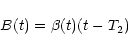 |
(2) |
instead of .
The functions
and
are determined from the condition
that the mean error
 of the predicted positions
should be a minimum for every value of t, averaged over the ensemble:
of the predicted positions
should be a minimum for every value of t, averaged over the ensemble:
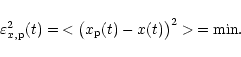 |
(3) |
The operator <q> means, as in WPSA (1997), the average of the quantity qover the ensemble of similar stars. For an individual star, <q> can be
interpreted as the "expectation value'' of the quantity q for this star. In
this sense, we consider the ensemble averages as statistical predictions for
the mean behaviour of a typical individual member of the ensemble.
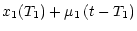
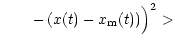
Inserting Eq. (1) into Eq. (3), and using the scheme of statistical astrometry,
we obtain for
 :
:
The quantities
 and
and
 are the true mean position
and the true mean proper motion of the star
(in the sense of statistical astrometry).
are the true mean position
and the true mean proper motion of the star
(in the sense of statistical astrometry).
 is a linear function of t, e.g.
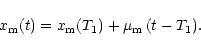 |
(5) |
In deriving Eq. (4) we have used the following relations:
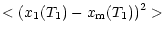
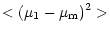
According to our assumption that Catalogue 1 provides mean quantities, x1
(T1) and
differ from
 and
and
 by their measuring errors only:
The quantities x (t) and  are the true instantaneous position and
proper motion of the star at epoch t. Since Catalogue 2 is assumed to provide
instantaneous quantities, x2 (T2) and
are the true instantaneous position and
proper motion of the star at epoch t. Since Catalogue 2 is assumed to provide
instantaneous quantities, x2 (T2) and
 differ from x (T2)and
  also by their measuring errors only:
| < (x2 (T2) - x (T2))2 > |
= |
 |
(8) |
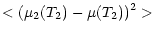 |
= |
 |
(9) |
The correlation functions
 ,
and
(see WPSA) occur because of:
,
and
(see WPSA) occur because of:
 |
(10) |
 |
(11) |
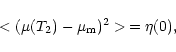 |
(12) |
 |
(13) |
We have further to remember
 |
(14) |
The products of the other terms occuring in the second line of Eq. (4) all
vanish, because the measuring errors are not correlated with the cosmic errors,
for example
 |
(15) |
and because the measuring errors of xi (Ti) and
 are not
correlated at the central epoch Ti (by definition of the central epoch), for
example:
are not
correlated at the central epoch Ti (by definition of the central epoch), for
example:
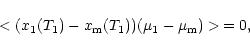 |
(16) |
and finally because the measuring errors of x1 and
are not
correlated with those of x2 and  ,
for example
,
for example
 |
(17) |
The conditions for the minimum of
with respect
to  and
and  are
are
 |
(18) |
and
 |
(19) |
Carrying out these procedures and using the final part of Eq. (4) for
,
we obtain the following two equations of
condition
for the functions
and
which give the "best'' values of
:
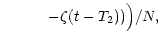
 |
| |
|
 |
(21) |
The Eqs. (20) and (21) correspond to the Eqs. (86) and (87) in WPSA.
Solving the Eqs. (20) and (21) for the unknowns
and
we
obtain:
with the auxiliary quantity N:
 |
| |
|
 |
(24) |
For deriving the functions
and ,
we have up to now
implicitely assumed that all the stars in the ensemble have the same measuring
errors. This is, of course, not strictly true in reality. However, the ensemble
averages are actually neccessary for handling the cosmic errors only, but not
for treating the measuring errors. Hence we shall use all the equations derived
above by inserting the individual measuring errors if we treat individual stars
of the ensemble. Formally we may imagine to handle subsamples of stars in which
the stars have the overall behaviour with respect to the cosmic errors, but in
which the common measuring errors are equal to those of the individual star
under consideration. It is a more severe problem that we do not make use of our
knowledge of how large the individual cosmic errors in x and
are for a
given individual object (e.g.
 ). As discussed in WPSA,
this would require "conditioned'' correlation functions. Since this
information is presently not available, we are treating here the consequences
of the cosmic errors on the level of ensemble averages only.
). As discussed in WPSA,
this would require "conditioned'' correlation functions. Since this
information is presently not available, we are treating here the consequences
of the cosmic errors on the level of ensemble averages only.
Inserting these results for
and
from Eqs. (22) and
(23) into Eqs. (1) and (4), we derive the prediction
for the
instantaneous position x (t) of the star and the mean error
of this prediction. The prediction
is a non-linear
function of t, because the correlation functions
 and
and
 ,
which occur in the formulae for
and ,
are non-linear functions. A typical run of
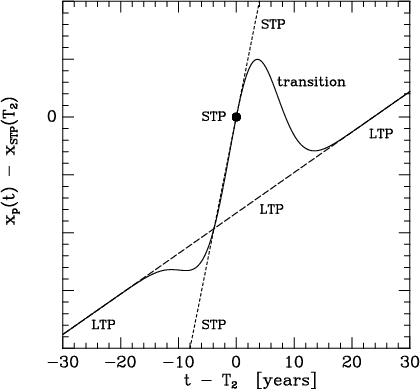
is shown in
Fig. 2.
,
which occur in the formulae for
and ,
are non-linear functions. A typical run of
is shown in
Fig. 2.
 |
Figure 2:
Schematic illustration of the non-linear transition
of the "best'' prediction
(solid curve)
from the
linear short-term prediction
 (STP mode, valid for epochs (STP mode, valid for epochs
 ;
short-dashed line)
to the linear long-term prediction ;
short-dashed line)
to the linear long-term prediction
 (LTP mode, valid for epochs (LTP mode, valid for epochs
 ;
long-dashed line) ;
long-dashed line) |
| Open with DEXTER |
In order to illustrate the properties of our prediction
,
we
consider
in the following Sects. 2.3 and 2.4 two limiting cases in which we either
neglect the measuring errors or the cosmic errors.
If we neglect all the measuring errors and set
 ,
then we obtain for
and
,
then we obtain for
and
These results were already derived and discussed in WPSA (Sect. 4.2.4
and Fig. 10). The corresponding prediction
 ,
shown in
Fig. 2,
passes through the point x2 (T2) with the slope
.
Therefore,
the measured instantaneous position and proper motion at epoch T2 are
exactly reproduced by
.
For
,
shown in
Fig. 2,
passes through the point x2 (T2) with the slope
.
Therefore,
the measured instantaneous position and proper motion at epoch T2 are
exactly reproduced by
.
For
 ,
the prediction
approaches asymptotically the mean position
,
the prediction
approaches asymptotically the mean position
 of the star. The
uncertainty
of the star. The
uncertainty
 of the prediction is given by
 |
|
|
(27) |
We see that
 is zero at the epoch T2 and
approaches
for
,
since in this limit
is equal to
,
and
differs from the instantaneous
position x (t) by the cosmic error cx on average.
is zero at the epoch T2 and
approaches
for
,
since in this limit
is equal to
,
and
differs from the instantaneous
position x (t) by the cosmic error cx on average.
If we neglect the cosmic errors and set
 ,
then we
obtain
,
then we
obtain
with
 |
(30) |
Equation (29) illuminates one of the advantages of introducing
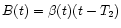 as a substitute for .
While
as a substitute for .
While
 ,
and in general B (T2) for non-zero measuring errors, remains finite,
the quantity
,
and in general B (T2) for non-zero measuring errors, remains finite,
the quantity
 ,
and in general ,
tends towards
infinity for
,
and in general ,
tends towards
infinity for
 .
Only in some degenerated cases, such as
.
Only in some degenerated cases, such as
 or
or
 or
or
 ,
the quantity
,
and in general
,
remains finite for
.
,
the quantity
,
and in general
,
remains finite for
.
If we insert
 and
and
 into Eq. (1), the
corresponding prediction
into Eq. (1), the
corresponding prediction
 for the position of the star at
an epoch t is now a strictly linear function of
t, since
and
are linear in t.
for the position of the star at
an epoch t is now a strictly linear function of
t, since
and
are linear in t.
In order to facilitate the understanding of the behaviour of the prediction
,
we rewrite
 by using the auxiliary
quantities
by using the auxiliary
quantities
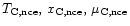 .
If we insert Eqs.
(28) and
(29) into Eq. (1), we obtain after some lengthy algebra:
.
If we insert Eqs.
(28) and
(29) into Eq. (1), we obtain after some lengthy algebra:
 |
= |
 |
(31) |
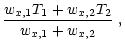
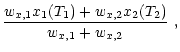
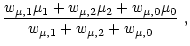
with the auxiliary quantities
 |
= |
 |
(32) |
 |
= |
 |
(33) |
 |
= |
 |
(34) |
 |
= |
(x2 (T2) - x1 (T1)) / (T2 - T1) . |
(35) |
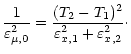
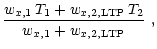
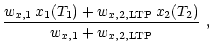
The weights w are given by
| wx, 1 |
= |
 |
(36) |
| wx, 2 |
= |
 |
(37) |
 |
= |
 |
(38) |
 |
= |
 |
(39) |
 |
= |
 |
(40) |
Inserting
and
into Eq. (4), we obtain the mean
error
 of
.
Using the form of
as given in Eq. (31) and the auxiliary quantities with the index C, we find
of
.
Using the form of
as given in Eq. (31) and the auxiliary quantities with the index C, we find
 |
(41) |
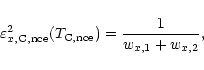
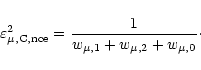
with
 |
(42) |
 |
(43) |
A comparison of the Eqs. (31)-(42) with the analytic version of the
single-star-mode solution of Paper I (Sect. 2, especially Eqs. (19), (23),
(30)-(32)) shows that the prediction
and its mean error
are strictly identical with the
single-star-mode solution
 and its mean error
 .
This result is
very pleasing, since it proves the internal consistency of our scheme: in
the limit of vanishing cosmic errors, the prediction
according
to Eq. (1) is asymptotically approaching the single-star mode solution
.
This result is not apriori self-evident, since our definitions for the
"best'' solution for predicting x (t) differ at least formally in Paper I and
in this Paper II (i.e., Eqs. (5) and (35) of Paper I versus Eq. (3) of Paper II).
.
This result is
very pleasing, since it proves the internal consistency of our scheme: in
the limit of vanishing cosmic errors, the prediction
according
to Eq. (1) is asymptotically approaching the single-star mode solution
.
This result is not apriori self-evident, since our definitions for the
"best'' solution for predicting x (t) differ at least formally in Paper I and
in this Paper II (i.e., Eqs. (5) and (35) of Paper I versus Eq. (3) of Paper II).
The general solution of our combination problem is given in Sect. 2.2. for all
epochs t. The solution
is a non-linear function of t, and
requires the knowledge of the correlation functions
and
as functions of the epoch difference  .
At present,
we do not have a well-established
knowledge about the run of
and
.
Only the cosmic errors
and
can be empirically determined from the comparison of
the FK5 with HIPPARCOS, assuming that the FK5 is giving "mean'' quantities.
.
At present,
we do not have a well-established
knowledge about the run of
and
.
Only the cosmic errors
and
can be empirically determined from the comparison of
the FK5 with HIPPARCOS, assuming that the FK5 is giving "mean'' quantities.
Even if we would know the run of
and
as a
function of ,
the non-linearity of
would demand
a table of
for a sequence of epochs, e.g. for each year, if
the user should
not have the burden to do the full calculation himself by running a
program.
We propose the following solution: The general solution for
allows rather easily to obtain two limiting solutions for
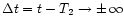 and for
 .
We call the
solution for
.
We call the
solution for
 the "long-term prediction
(LTP)'', and the solution for
the "short-term
prediction (STP)'' around the epoch T2.
the "long-term prediction
(LTP)'', and the solution for
the "short-term
prediction (STP)'' around the epoch T2.
Both the LTP and STP solutions are linear in t. They can be therefore given
in the usual astrometric style, i.e. as a position at a central epoch and a
proper motion, together with their mean errors. The details on the LTP and STP
solutions
and
are given in the Sects. 3
and 4.
The general solution
is a smooth transition from short-term
prediction
(for epochs around T2) to the long-term
prediction
for epochs t far away from T2. In Sect. 5,
we will discuss a convenient (but only approximately valid) method to carry
out this transition, if we know the run of
.
This gives at least a rough indication on the process of transition as a
function of the epoch difference ,
even if
is
not well-established. If, in the future,
should be better
determined, then our method would allow rather conveniently the (approximate)
determination of
also for epochs inbetween the validity ranges
of
and
.
We consider in this section the limiting case of the general solution
for
 .
This "long-term prediction''
is valid for epochs not too close to the epoch T2 of the
instantaneous Catalogue 2 (i.e. here the HIPPARCOS Catalogue with
.
This "long-term prediction''
is valid for epochs not too close to the epoch T2 of the
instantaneous Catalogue 2 (i.e. here the HIPPARCOS Catalogue with
 ).
).
We assume that the epoch difference
 is so large that the
correlation functions
and
both vanish.
Setting
is so large that the
correlation functions
and
both vanish.
Setting
 and
and
 ,
we obtain from the
general Eqs. (22) and (23) for the LTP solution
,
we obtain from the
general Eqs. (22) and (23) for the LTP solution
where N is still given by Eq. (24). If we compare the Eqs. (43), (44), and
(24) for
 ,
,
 ,
and
,
and
 with the corresponding
Eqs. (28)-(30) for
with the corresponding
Eqs. (28)-(30) for
 ,
,
 ,
and
,
and
 ,
we find that they are
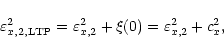
identical if we replace in the equations for the nce solution the quantity
,
we find that they are
identical if we replace in the equations for the nce solution the quantity
 by
by
 |
(46) |
and
 by
by
 |
(47) |
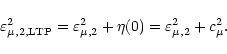
This is very plausible, since the instantaneously measured quantities x2
(T2) and
are affected by the cosmic errors cx and  .
If we add these cosmic errors to the corresponding measuring errors
.
If we add these cosmic errors to the corresponding measuring errors
 and
and
 ,
we obtain "apparent'' measuring
errors
,
we obtain "apparent'' measuring
errors
 and
and
 .
Since the
cosmic errors are not correlated with the measuring errors, the summation has
to be done quadratically.
.
Since the
cosmic errors are not correlated with the measuring errors, the summation has
to be done quadratically.
Using this finding we obtain for the long-term prediction
 |
= |
 |
(48) |
with
The weights w are given by Eqs. (36) and (38), and by
The long-term prediction
has in fact two conceptionally
different
properties: (1) As described above, it is the limit of the general prediction
for the true instantaneous position x (t) for
.
(2) On the other hand,
is for all epochs tthe best prediction
for the mean position
of the object. This means
especially that
 is the best estimate of the center-of-mass
velocity of the object.
is the best estimate of the center-of-mass
velocity of the object.
The two different concepts produce two different error estimates
 for
.
If we consider
for
.
If we consider
 as
the prediction for the mean position
then the mean error
as
the prediction for the mean position
then the mean error
 is given by:
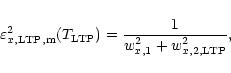
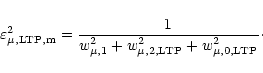
 |
(55) |
with
 |
(56) |
 |
(57) |
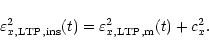
If we consider
as the prediction for the instantaneous
position
x (t) for large values of
 ,
then the uncertainty
,
then the uncertainty
 of
is given by
of
is given by
 |
(58) |
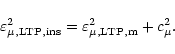
Similarly, the mean error
 of the predicted
instantaneous proper motion for large
is given by
of the predicted
instantaneous proper motion for large
is given by
 |
(59) |
The equations above describe what we have called the "analytic'' approach in
Paper I. For the "numerical'' approach, we can take over for the LTP solution
the formulae given in Paper I for the single-star mode (SI) with the following
changes: (1) we should not redetermine the parallax p of the star. The
determination of p by HIPPARCOS requires instantaneous values of x and
,
not the "mean'' LTP values. Formally, we set all correlations between pand the other quantities (position, proper motion) equal to zero. (2) In the
variance-covariance matrix D we replace in the diagonal line the
HIPPARCOS values of
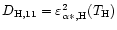 by
by
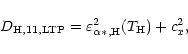 |
(60) |
and
 by
by
 ,
,
 by
by
 ,
and
,
and
 by
by
 ,
respectively. No changes are made in the
non-diagonal
elements (except for decoupling the parallax as described above), i.e. all the
covariances remain in the LTP as they were in the SI mode, e.g.
,
respectively. No changes are made in the
non-diagonal
elements (except for decoupling the parallax as described above), i.e. all the
covariances remain in the LTP as they were in the SI mode, e.g.
 |
(61) |
In this section, we consider the other limiting case of the general solution
,
namely the limit for
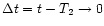 .
This
"short-term prediction''
is valid for epochs close to T2(in the case of using HIPPARCOS:
).
.
This
"short-term prediction''
is valid for epochs close to T2(in the case of using HIPPARCOS:
).
For the case
,
we use for the correlation function
and
Taylor series in ,
and keep
only terms which are linear in .
From the Eqs. (54) and (55) of WPSA, we obtain
for small values of
In Eq. (63), we have made use of the differential relation (28) of WPSA.
Although HIPPARCOS values are already averaged over about 3 years of
observation, the use of Eq. (63) is justified according to numerical
investigations carried out by M. Biermann (1996, unpublished, see also WPSA,
Sect. 3.4).
Inserting Eqs. (62) and (63) into the Eqs. (22) and (23), we find for the
short-term prediction
where N is still given by Eq. (24). Inserting
 and
and
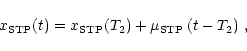
 into Eq. (1), we obtain
 |
(66) |
which is a linear function of the epoch t. We do not use here a "central''
epoch
 ,
since our Taylor series for
is
centered around
t = T2. The proper motion
,
since our Taylor series for
is
centered around
t = T2. The proper motion
 can be derived as the sum of the
coefficients in front of t in the Eqs. (1), (63), and (64):
can be derived as the sum of the
coefficients in front of t in the Eqs. (1), (63), and (64):
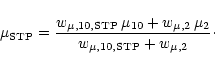
After some algebra,
can be rewritten as
 |
(68) |
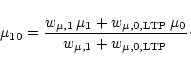
The "combined'' mean proper motion  is derived from
and
is derived from
and  by
by
 |
(69) |
 ,
and
,
and
 are given by the corresponding
equations in Sect. 2.4, and
are given by the corresponding
equations in Sect. 2.4, and
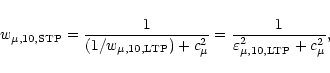
 by Eq. (53). The weight
 of
in the STP solution is given by
of
in the STP solution is given by
 |
(70) |
with
 |
(71) |
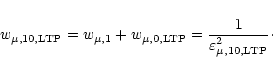
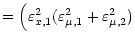
The meaning of Eqs. (68)-(71) is the following:
is the
weighted
mean of
and the combined mean proper motion ,
where the
cosmic error
in
has to be taken into account in
.
The combined mean proper motion
is itself a weighted
mean of
and ,
where for
the cosmic error cx in
x2 (T2)has to be included into
.
The exact expression for
 is given by
For all practical purposes we can, however, neglect the last term in Eq. (72), which is proportional to
.
The measuring accuracy
for the HIPPARCOS positions x2 (T2) at
is so high, relative to the other measuring errors and cosmic errors,
that this term is usually of the order of 0.01 mas only. We use
instead of Eq. (72) the very good approximation
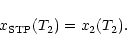 |
(73) |
The mean errors of
and of
are given by
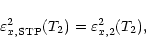 |
(74) |
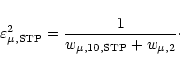 |
(75) |
The full uncertainty
 of
is
given by
of
is
given by
 |
| |
|
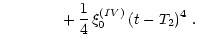 |
(76) |
In Eq. (76), we have neglected the very small correlation between
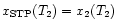 and
which is caused by the use of x2
(T2)in deriving
which in turn enters into
.
The last term
in Eq. (76)
is the statistical uncertainty of a prediction based on instantaneous data
at T2 for small epoch differences
(see Eq. (57) of WPSA).
and
which is caused by the use of x2
(T2)in deriving
which in turn enters into
.
The last term
in Eq. (76)
is the statistical uncertainty of a prediction based on instantaneous data
at T2 for small epoch differences
(see Eq. (57) of WPSA).
 is the fourth derivative of the correlation function
with respect to
at
is the fourth derivative of the correlation function
with respect to
at
 .
.
In the numerical approach for deriving the short-term prediction, we modify the
procedure for the single-star mode presented in Paper I more strongly than for
the LTP solution. As "observations'' b we use first b
 ,
as
in Paper I, the parallax
,
as
in Paper I, the parallax  inclusive. The corresponding part D
 of
the variance-covariance matrix D remains also unchanged. The second part
of b, which we now call b
of
the variance-covariance matrix D remains also unchanged. The second part
of b, which we now call b is given by the
 and
components of the combined mean proper motion .
The quantity
is obtained in a preparatory step from Eq. (69), and its mean error
from Eq. (70) as
and
components of the combined mean proper motion .
The quantity
is obtained in a preparatory step from Eq. (69), and its mean error
from Eq. (70) as
 .
Each component of
,
i.e. of b,
is considered not to be correlated with any
other component of b. The numerical approach for STP produces values for
.
Each component of
,
i.e. of b,
is considered not to be correlated with any
other component of b. The numerical approach for STP produces values for
 and
(in
and ), a new
parallax
and
(in
and ), a new
parallax
 ,
and the corresponding variance-covariance matrix. In presenting
the
results in printed form, we use again central epochs
(different
for
and ), at which
and
are uncorrelated. However,
differs usually only very slightly
from the individual central epochs of the basic HIPPARCOS data.
,
and the corresponding variance-covariance matrix. In presenting
the
results in printed form, we use again central epochs
(different
for
and ), at which
and
are uncorrelated. However,
differs usually only very slightly
from the individual central epochs of the basic HIPPARCOS data.
As discussed in Sect. 2.4 and illustrated in Fig. 2, the general solution
is a smooth transition from the short-term prediction
for epochs t close to T2 to the long-term prediction
for
.
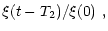
We are now asking for the "transition function''
 which describes this transition in x:
 |
(77) |
Formally we can always solve Eq. (77) for
,
using our
former results for
 and
.
However, the
resulting transition function
is then very complicated
and depends unfortunately not only on the correlation functions, but also
explicitely on the measured values of
and
.
However, the
resulting transition function
is then very complicated
and depends unfortunately not only on the correlation functions, but also
explicitely on the measured values of
 ,
and on their
measuring errors. Such a result is not very suitable for a practical
application.
,
and on their
measuring errors. Such a result is not very suitable for a practical
application.
There does exist, however, an approximate treatment for the transition function
which gives a very simple and easily applicable
result, and which nevertheless describes the transition quantitatively rather
accurately. The basic idea is the observation that in real applications the
mean position x1 (T1) enters into the final result
mainly
through
the proper motion .
This is caused by the small error of the HIPPARCOS
position x2 (T2) with respect to the error of the mean (FK5 or GC) position
x1 (T1). Only in cases of a large cosmic error cx (p) in x2 (T2),
our approximation becomes less accurate. We therefore consider the transition
function
for the limiting case in which
tends towards infinity while
 remains finite (equal to its actual value). The latter can be enforced by
setting
remains finite (equal to its actual value). The latter can be enforced by
setting
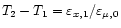 .
This means
that we let go
.
This means
that we let go
 and
and
 in such a way that
remains
constant.
in such a way that
remains
constant.
If we use this special case as an approximation, we derive after some lengthy
algebra the following rather simple expression for the transition function:
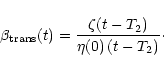 |
(78) |
A similar function has already been derived as Eq. (70) in Sect. 4.2.4 of WPSA.
The function
 has the welcome property that it does neither
depend on the measured values of x and
nor on the mean errors of a
given star. These values are fully absorbed in the individual solutions
and
.
Hence
is
the same
function for all the objects. We should remark here that the apparently more
complicated form of the transition function according to Eq. (75) of WPSA is
caused by the fact that we have used in WPSA a slightly different definition of
the long and short-term prediction, namely x2 (t) instead of
and x1 (t) instead of
.
has the welcome property that it does neither
depend on the measured values of x and
nor on the mean errors of a
given star. These values are fully absorbed in the individual solutions
and
.
Hence
is
the same
function for all the objects. We should remark here that the apparently more
complicated form of the transition function according to Eq. (75) of WPSA is
caused by the fact that we have used in WPSA a slightly different definition of
the long and short-term prediction, namely x2 (t) instead of
and x1 (t) instead of
.
The function
has the desired properties in the limits
or  .
For t = T2, we have
.
For t = T2, we have
 ,
because of
,
because of
 for small values of .
For
for small values of .
For
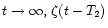 vanishes and hence
 .
An example for the full run of
.
An example for the full run of
 ,
from 1 to 0, is illustrated by the full curve
shown in Fig. 8 of WPSA. Table 1 gives
for a few values of |t - T2|, using the example given in
Sect. 3.6 of WPSA for the correlation function
.
At
,
from 1 to 0, is illustrated by the full curve
shown in Fig. 8 of WPSA. Table 1 gives
for a few values of |t - T2|, using the example given in
Sect. 3.6 of WPSA for the correlation function
.
At
 5-6 years,
the general solution
is
about half-way between
and
.
From both the
Fig. 8 of WPSA and Table 1,
we get an indication for the range of applicability of the
short and long-term prediction. The short-term prediction
has
a rather limited range of applicability, namely a few years around T2 only.
5-6 years,
the general solution
is
about half-way between
and
.
From both the
Fig. 8 of WPSA and Table 1,
we get an indication for the range of applicability of the
short and long-term prediction. The short-term prediction
has
a rather limited range of applicability, namely a few years around T2 only.
The long-term prediction
is a good approximation for the
general
solution
for epoch differences |t - T2| which are larger
than
about 10 years. Hence the transition from STP to LTP is rather rapid, at least
in our example.
We should remark here that (by chance) the transition function
given by Eq. (78) is even strictly
valid (exact) for the example used for the correlation functions in Sect. 3.6
of WPSA and adopted in Table 1. For more general runs of the correlation
functions,
can become quite large
at epochs around the "crossing time'' at which
 ,
if
and
are significantly different from
,
if
and
are significantly different from  at that time.
The most accurate prediction
 for the instantaneous proper
motion
at an arbitrary epoch tis formally given by
for the instantaneous proper
motion
at an arbitrary epoch tis formally given by
 |
(79) |
The transition function
 for the proper motion
is,
similar to
,
in general a rather complicated function,
which depends on the measured values of
for the proper motion
is,
similar to
,
in general a rather complicated function,
which depends on the measured values of
 and .
If we
adopt the same approximation as used in Sect. 5.1 for obtaining Eq. (78) for
,
namely
and .
If we
adopt the same approximation as used in Sect. 5.1 for obtaining Eq. (78) for
,
namely
 while
keeping
constant, we derive for
also a very simple expression:
while
keeping
constant, we derive for
also a very simple expression:
This transition function
for
has the same
proper limiting values as
:
for
 ,
we have
,
we have
 and hence
 ,
and for
,
and for
 we obtain
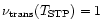 and
and
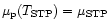 .
In Table 1 we list
.
In Table 1 we list
 for a few values of
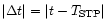 ,
using Eq. (80) and the simple example
for
given in Sect. 3.6 of WPSA.
,
using Eq. (80) and the simple example
for
given in Sect. 3.6 of WPSA.
The transition functions
and
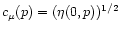
according to Eqs. (78) and (80) have another nice property: if we use the
example given in Sect. 3.6 of WPSA, then the function
depends only on t - T2, but not on the individual cosmic error
 ,
since
,
since  occurs also as a factor in
and cancels out in Eq. (78). Similarly, the transition function
is a "scaled'' function and depends on t - T2 only,
but not on
occurs also as a factor in
and cancels out in Eq. (78). Similarly, the transition function
is a "scaled'' function and depends on t - T2 only,
but not on
 .
.
For deriving the solutions in the LTP and STP mode, we need to know the cosmic
errors
and
.
The cosmic
errors depend strongly on the distance r of the star from the Sun, or
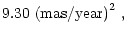
equivalently on the stellar parallax p. For 1202 "apparently single stars''
from the basic FK5, we have obtained the functions
and cx (p)empirically by using groups of stars in various distance intervals. The
data can be represented by the following fit functions:
with
| C1 |
= |
 |
(83) |
| C2 |
= |
 |
(84) |
| C3 |
= |
 |
(85) |
These versions of
and cx (p) have been used for the FK6 (Wielen
et al. 1999d, 2000a).
A table for
and cx as a function of p or r,
based in Eqs. (81)-(85), is given on page 12 of Wielen et al. (1999d).
In the future we hope to determine also the dependence of the cosmic errors on
the absolute magnitude (or mass) of the stars for a given parallax. A
comparison of the results
for the cosmic errors based on the FK5 stars with those derived from the (on
average fainter) GC stars seems to indicate a rather weak dependence on the
brightness of the stars (Wielen et al. 1998).
In order to illustrate our combination method for all the three modes (SI, LTP,
STP), we give in Table 2 the results for one individual star. As in Paper I
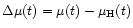
(Sect. 5), we give the positions x (t) and the proper motions always relative to the HIPPARCOS solution as
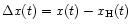 and
and
 ,
in order to save printing space and
to make the comparison of the results easier. The ground-based data are always
reduced to the HIPPARCOS system. The results of the single-star mode presented
here in Paper II differ somewhat from those of Paper I, because we now adopt
slightly improved systematic differences FK5-HIP and GC-HIP. For a valid
comparison of the results of the three different modes it is necessary to use
exactly the same basic input data.
,
in order to save printing space and
to make the comparison of the results easier. The ground-based data are always
reduced to the HIPPARCOS system. The results of the single-star mode presented
here in Paper II differ somewhat from those of Paper I, because we now adopt
slightly improved systematic differences FK5-HIP and GC-HIP. For a valid
comparison of the results of the three different modes it is necessary to use
exactly the same basic input data.
Table 2 shows that the short-term prediction is usually quite close to the
HIPPARCOS solution. On the other hand, the long-term prediction differs most
strongly from the HIPPARCOS solution, since the HIPPARCOS values are entering
with a lower weight into the LTP mode than in the SI mode, because of the
cosmic errors in the HIPPARCOS data. The central epoch
 is the
only one which is usually significantly earlier than
,
and the mean error of the central position
is the
only one which is usually significantly earlier than
,
and the mean error of the central position
 is
typically only slightly smaller than the cosmic error cx (p).
is
typically only slightly smaller than the cosmic error cx (p).
In Table 3 we present the error budget of proper motions in the three different
modes (SI, LTP, STP) for two samples of basic FK5 stars.
The mean errors
 given in Table 3 refer to one "mean'' coordinate component. It
is obtained as an rms average over
given in Table 3 refer to one "mean'' coordinate component. It
is obtained as an rms average over
 and
and
 ,
and over all the stars in the
corresponding sample. The error budget for the 1535 basic FK5 stars is slightly
fictious, since this sample contains double stars for which the FK6 provides in
reality "special'' solutions instead of the "direct'' combination solutions
discussed in this paper. Nevertheless, the results for this sample provide a
valid indication for the overall accuracy of our combination method in the
direct modes SI, LTP, and STP. The sample of 1202 basic FK5 stars contains
"apparently single objects'' only. Most of these stars (878 objects) have direct
solutions in the FK6. The error budget for these 878 basic FK5 stars in Part I
of the FK6 is given in Wielen et al. (1999d). The error budgets for 3272
additional fundamental stars with direct solutions in the three modes are
presented in Part III of the FK6 (Wielen et al. 2000a).
,
and over all the stars in the
corresponding sample. The error budget for the 1535 basic FK5 stars is slightly
fictious, since this sample contains double stars for which the FK6 provides in
reality "special'' solutions instead of the "direct'' combination solutions
discussed in this paper. Nevertheless, the results for this sample provide a
valid indication for the overall accuracy of our combination method in the
direct modes SI, LTP, and STP. The sample of 1202 basic FK5 stars contains
"apparently single objects'' only. Most of these stars (878 objects) have direct
solutions in the FK6. The error budget for these 878 basic FK5 stars in Part I
of the FK6 is given in Wielen et al. (1999d). The error budgets for 3272
additional fundamental stars with direct solutions in the three modes are
presented in Part III of the FK6 (Wielen et al. 2000a).
Table 4 gives the error budget for the combination of the GC (Boss et al. 1937)
with HIPPARCOS.
The sample of GC stars are the "full sample'' of 29717 GC
stars observed by HIPPARCOS, and the "subsample'' of 11737 GC stars with
linear HIPPARCOS standard solutions.
From Table 4 it is obvious that the original proper motions
 of the GC do not contribute significantly to the GC+HIP on average.
However, for some brighter and well-observed stars, the accuracy of
is much better than the rms value of
of the GC do not contribute significantly to the GC+HIP on average.
However, for some brighter and well-observed stars, the accuracy of
is much better than the rms value of
 seen in Table 4.
Furthermore, the proper motion
seen in Table 4.
Furthermore, the proper motion
 ,
derived from the central positions of the GC and the HIPPARCOS Catalogue,
has usually a quite reasonable accuracy for most of the GC stars.
,
derived from the central positions of the GC and the HIPPARCOS Catalogue,
has usually a quite reasonable accuracy for most of the GC stars.
The typical gain in accuracy in the proper motions derived in the long-term
prediction mode, relative to the original HIPPARCOS proper motions, is a
factor of 4.6 for the basic fundamental stars in the FK6=FK5+HIP, and a
factor of 1.8 for the 11773 GC stars in the GC+HIP. This improvement in the
LTP mode with respect to HIPPARCOS is a consequence of the cosmic errors in the
instantaneously measured HIPPARCOS proper motions. In contrast to the LTP
mode, the short-term predictions (STP mode) do not differ so much from the
HIPPARCOS solutions. However, in most cases we are more interested in the
long-term averaged proper motion (LTP) or in the single-mode result (SI), where
the gain in accuracy is quite significant.
The long-term predictions and the short-term predictions derived in the former
sections are statistically the best astrometric solution for a sample of
"apparently single-stars''. However, an unsatisfactory property of these
statistically valid solutions is the fact that we are not able to make proper
use of the available information on the individual behaviour of the
stars. For example, we use the overall cosmic errors
and cx (p),
no matter whether the object is a
binary or a single-star candidate
(Wielen et al. 1999a).
In principle, for each individual star, one would have to use
"conditioned correlation functions'' which are based on the individually
observed differences between the instantaneous measurements and the mean data
(e.g. on
 ). Unfortunately, the conditioned
correlation functions, i.e. "conditioned cosmic errors'' in particular, are not
available at present.
). Unfortunately, the conditioned
correlation functions, i.e. "conditioned cosmic errors'' in particular, are not
available at present.
We should also point out that presently the cosmic errors cx in position are
much more uncertain than the cosmic errors
in proper motion. While the
typical values of
are larger than the measuring errors
 ,
,
and
,
,
and
 ,
the typical values of cx are nearly lost in
the measuring errors of the ground-based data.
,
the typical values of cx are nearly lost in
the measuring errors of the ground-based data.
Furthermore, our knowledge about the actual form of the correlation functions
,
,
for
 is presently still quite rudimentary. The simple example for the correlation
functions presented in Sect. 3.6 of WPSA is mainly given for illustrating the
general behaviour of these functions. The application of this example to real
data should be done very cautiously. Hence the real transition from the STP
solution to the LTP solution (discussed in Sect. 5) is quantitatively not
well-determined.
is presently still quite rudimentary. The simple example for the correlation
functions presented in Sect. 3.6 of WPSA is mainly given for illustrating the
general behaviour of these functions. The application of this example to real
data should be done very cautiously. Hence the real transition from the STP
solution to the LTP solution (discussed in Sect. 5) is quantitatively not
well-determined.
Which of the three solutions offered (SI, LTP, STP) should be used in real
applications? For single-star candidates, the single-star mode should be
adopted, although some of the single-star candidates may nevertheless be
binaries. If the user is handling a sample of "apparently single stars'' (which
usually contains single-star candidates,
binaries, and
intermediate cases), then
the LTP or STP solutions are recommended, depending on the
corresponding epoch difference
 (with
(with
 ).
).
The problems discussed above are especially severe for objects detected as
binaries (Wielen et al. 1999a). For
binaries the
difference between the instantaneous proper motion (
 )
and the
mean one (e.g.,
)
and the
mean one (e.g.,
 or )
is sometimes much larger than the
cosmic error
expected on average. In such a case the weight
or )
is sometimes much larger than the
cosmic error
expected on average. In such a case the weight
 (Eq. (53)) of the HIPPARCOS proper motion (
 )
is higher than appropriate for this individual object. The derived mean
proper motion
is then biased towards the HIPPARCOS proper
motion, and the derived mean error
)
is higher than appropriate for this individual object. The derived mean
proper motion
is then biased towards the HIPPARCOS proper
motion, and the derived mean error
 is too small.
In the case of extreme
binaries, it is better to adopt a properly
weighted mean of
(e.g.
)
and
as a prediction
for the mean proper motion
.
The main problem in such a procedure
is the unknown individual value of the cosmic error in the HIPPARCOS position,
which is higher than the value of cx expected on average. This value enters
into the weight of ,
and hence into the predicted value of
.
We shall discuss this problem in more detail in a subsequent
paper. In any case, the LTP solutions (and, of course, the SI solutions) for
binaries are inherently the least accurate ones among the class of
direct solutions, because of the disturbing double-star nature of these
objects.
is too small.
In the case of extreme
binaries, it is better to adopt a properly
weighted mean of
(e.g.
)
and
as a prediction
for the mean proper motion
.
The main problem in such a procedure
is the unknown individual value of the cosmic error in the HIPPARCOS position,
which is higher than the value of cx expected on average. This value enters
into the weight of ,
and hence into the predicted value of
.
We shall discuss this problem in more detail in a subsequent
paper. In any case, the LTP solutions (and, of course, the SI solutions) for
binaries are inherently the least accurate ones among the class of
direct solutions, because of the disturbing double-star nature of these
objects.
In this Paper II, we have derived and discussed an appropriate method to
combine a ground-based astrometric catalogue (such as the FK5 or GC) with the
HIPPARCOS Catalogue, taking cosmic errors (due to undetected binaries) in the
quasi-instantaneously measured
data into account. The method leads to long-term
predictions (LTP mode) and to short-term predictions (STP mode), which are the
limiting cases of the general solution. The general solution is a smooth
transition from the STP to the LTP mode. The case of single stars with no
cosmic errors was already treated in Paper I (SI mode). In a subsequent paper,
we shall present "special solutions'' for known double stars.
-
Bien, R., Fricke, W., Lederle, T., & Schwan, H. 1978, Veröff. Astron.
Rechen-Inst. Heidelberg, No. 29
In the text
-
Boss, B., Albrecht, S., Jenkins, H., et al. 1937, General Catalogue of
33342 Stars for the Epoch 1950, Carnegie Institution of Washington,
Publ., No. 486 [GC]
In the text
-
ESA 1997, The Hipparcos Catalogue, ESA SP-1200
In the text
-
Fricke, W., Schwan, H., Lederle, T., et al. 1988, Veröff. Astron.
Rechen-Inst. Heidelberg, No. 32 [FK5, Part I]
In the text
-
Fricke, W., Schwan, H., Corbin, T., et al. 1991, Veröff. Astron.
Rechen-Inst. Heidelberg, No. 33 [FK5, Part II]
In the text
-
Wielen, R. 1995a, A&A, 302, 613
In the text
NASA ADS
-
Wielen, R. 1995b,
in Future Possibilities for Astrometry in Space, ed.
M. A. C. Perryman, & F. van Leeuwen, ESA SP-379, 65
-
Wielen, R. 1997, A&A, 325, 367 [WPSA]
In the text
-
Wielen, R., Schwan, H., Dettbarn, C., Jahreiß, H., & Lenhardt, H. 1997,
in
Hipparcos Venice '97, Presentation of the Hipparcos and Tycho Catalogues
and first astrophysical results of the Hipparcos space astrometry mission, ed.
B. Battrick, M. A. C. Perryman, & P. L. Bernacca, ESA SP-402, 727
In the text
-
Wielen, R., Schwan, H., Dettbarn, C., Jahreiß, H., & Lenhardt, H. 1998,
in
The Message of the Angles - Astrometry from 1798 to 1998, Proceedings of the
International Spring Meeting of the
Astronomische Gesellschaft, held in Gotha,
11-15 May 1998, ed. P. Brosche, W. R. Dick, O. Schwarz, & R. Wielen,
Acta
Historica Astronomiae, vol. 3, Verlag Harri Deutsch, Thun and Frankfurt am
Main, 123
In the text
-
Wielen, R., Dettbarn, C., Jahreiß H.,
Lenhardt, H., & Schwan, H. 1999a,
A&A, 346, 675
In the text
NASA ADS
-
Wielen, R., Lenhardt, H., Schwan, H., & Dettbarn, C. 1999b,
A&A, 347, 1046, Paper I
In the text
NASA ADS
-
Wielen, R., Schwan, H., Dettbarn, C., Jahreiß, H., & Lenhardt, H. 1999c,
in
Modern Astrometry and Astrodynamics,
Proceedings of the International Conference
honouring Heinrich Eichhorn,
held at Vienna Observatory, Austria, 25-26 May
1998,
ed. R. Dvorak, H. F. Haupt, & K. Wodnar,
Verlag der Österreichischen Akademie der
Wissenschaften, Wien, 161
In the text
-
Wielen, R., Schwan, H., Dettbarn, C., et al. 1999d,
Veröff. Astron. Rechen-Inst. Heidelberg, No. 35 [FK6, Part I]
In the text
-
Wielen, R., Schwan, H., Dettbarn, C., et al. 2000a,
Veröff. Astron. Rechen-Inst. Heidelberg, No. 37 [FK6, Part III]
In the text
-
Wielen, R., Jahreiß, H., Dettbarn, C.,
Lenhardt, H., & Schwan, H. 2000b,
A&A, 360, 399
In the text
NASA ADS
Copyright ESO 2001



































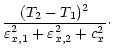
![$\displaystyle \Big(\varepsilon^2_{x, 1}
\left(\varepsilon^2_{\mu,
1} + \left[\varepsilon^2_{\mu, 2} + \eta (0)\right]\right)$](/articles/aa/full/2001/10/aah2376/img164.gif)
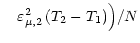
![$\displaystyle + \ \varepsilon^2_{\mu, 1} \!\left[\varepsilon^2_{\mu, 2}\! +\!
\eta (0)\right] \left(T_2 - T_1\right)\! \left(t - T_1\right)\Big)\! / N,\!$](/articles/aa/full/2001/10/aah2376/img165.gif)

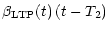
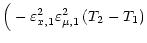
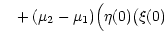
![$\displaystyle + \left(\varepsilon^2_{x, 1}
+ \left[\varepsilon^2_{x, 2}
+ \xi (0)\right]\right)
\varepsilon^2_{\mu, 1} \left(t - T_1\right)\Big) / N ,$](/articles/aa/full/2001/10/aah2376/img169.gif)

























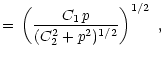
![$\left[\rm {years}\right]$](/articles/aa/full/2001/10/aah2376/img295.gif)






 Ari
for the various modes
Ari
for the various modes or
or

 12.52
12.52 or
or

 or
or


 Ari
Ari


 .
.