 Scuti stars
![[*]](/icons/foot_motif.gif)
A&A 366, 547-557 (2001)
DOI: 10.1051/0004-6361:20000196
Scuti starsL. Mantegazza - E. Poretti - F. M. Zerbi
Osservatorio Astronomico di Brera, Via E. Bianchi 46, 23807 Merate, Italy
Received 6 September 2000 / Accepted 3 November 2000
Abstract
We discuss here the pulsation properties of the
Scuti star BV Circini
on the basis of data obtained during a simultaneous photometric and spectroscopic
campaign in 1996 and a spectroscopic one in 1998, and taking also advantage
of the previous photometric observations by Kurtz (#!kur81!#).
Nine pulsation modes were detected from photometry and
thirteen from spectroscopy; five of them are in common to both techniques.
The spectroscopic data give ample evidence of dramatic amplitude
variations in some modes, in particular the strongest spectroscopic mode in
1998 was not detectable in 1996 data. The two dominant photometric modes
(6.33 and 7.89 cd-1) are observed on both seasons.
The typing of the modes was performed by means of a simultaneous model
fit of line profile and light variations. The 6.33 cd-1photometric term
is probably the fundamental radial mode, while the 7.89 cd-1is a
nonradial mode with  .
There are six
high-degree prograde modes with an azimuthal order m ranging from -12 to -14,
and also a retrograde mode with
.
There are six
high-degree prograde modes with an azimuthal order m ranging from -12 to -14,
and also a retrograde mode with  .
These modes combined with the
identification of the 6.33 cd-1mode allowed us to estimate
.
These modes combined with the
identification of the 6.33 cd-1mode allowed us to estimate
 for the value of
the inclination of the rotation axis. An accurate evaluation of the main
stellar physical parameters is also proposed as a result of the pulsational analysis.
for the value of
the inclination of the rotation axis. An accurate evaluation of the main
stellar physical parameters is also proposed as a result of the pulsational analysis.
Key words: methods: data analysis - techniques: spectroscopic -
techniques: photometric - stars: individual: BV Cir - stars: oscillations -
stars: variables:
Sct
Asteroseismology is knowing an increasing interest thanks to
satellites which are expected to fly in the incoming years
(MOST, MONS, COROT) and which will perform accurate investigations of
stellar variability at the  mag level. Stars located in the lower
part of the instability
strip are suitable candidates to find a large quantity of excited modes,
both radial and nonradial. The detailed knowledge of the pulsational properties
of
Sct stars can help in the preparation of the scientific
background of these missions; a review of the photometric properties
of these variable stars is given by Poretti (2000). The main difficulty
in their investigation is the typing of the excited modes, i.e. classifying
the oscillations in terms of quantum numbers
mag level. Stars located in the lower
part of the instability
strip are suitable candidates to find a large quantity of excited modes,
both radial and nonradial. The detailed knowledge of the pulsational properties
of
Sct stars can help in the preparation of the scientific
background of these missions; a review of the photometric properties
of these variable stars is given by Poretti (2000). The main difficulty
in their investigation is the typing of the excited modes, i.e. classifying
the oscillations in terms of quantum numbers  and m. To proceed
on this way, we started an observational project combining photometric and
spectroscopic techniques at the European Southern Observatory.
In this paper we supply the last result, after those
on FG Vir (Mantegazza et al. 1994), X Cae (Mantegazza & Poretti 1996;
Mantegazza et al. 2000)
and HD 2724 (Mantegazza & Poretti 1999).
and m. To proceed
on this way, we started an observational project combining photometric and
spectroscopic techniques at the European Southern Observatory.
In this paper we supply the last result, after those
on FG Vir (Mantegazza et al. 1994), X Cae (Mantegazza & Poretti 1996;
Mantegazza et al. 2000)
and HD 2724 (Mantegazza & Poretti 1999).
BV Circini  HD 132209 was discovered to be a
Scuti
variable star by Kurtz (1981). He detected four pulsation modes from the
frequency analysis of 18 nights of observations in the
B and V colours in 1980. The author also pointed out that these modes did not
provide a complete description of the stellar variability. The strongest term
at 6.328 cd-1 was suggested to be the radial fundamental mode.
Since the star is rather bright (V=6.56) and its light variations are quite
large (
HD 132209 was discovered to be a
Scuti
variable star by Kurtz (1981). He detected four pulsation modes from the
frequency analysis of 18 nights of observations in the
B and V colours in 1980. The author also pointed out that these modes did not
provide a complete description of the stellar variability. The strongest term
at 6.328 cd-1 was suggested to be the radial fundamental mode.
Since the star is rather bright (V=6.56) and its light variations are quite
large (
 mag), we decided to include it among our targets.
The stellar physical parameters can be estimated independently by means
of the  and Geneva colour indices and related calibrations.
They are required for fitting
the line profile variations and are useful for discussing the pulsation
properties.
and Geneva colour indices and related calibrations.
They are required for fitting
the line profile variations and are useful for discussing the pulsation
properties.
The Moon & Dworetsky (1985) calibration applied to Hauck & Mermilliod's
data supplies
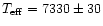 K and
K and
 (this estimate also includes the correction for metallicity effects as derived
by Dworetsky & Moon 1986). The recent calibration of Geneva photometric indices
by Kunzli et al. (1997) applied to the data by Rufener (1988)
supplies
(this estimate also includes the correction for metallicity effects as derived
by Dworetsky & Moon 1986). The recent calibration of Geneva photometric indices
by Kunzli et al. (1997) applied to the data by Rufener (1988)
supplies
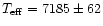 K and
K and
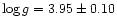 .
The
discrepancy in the value of the temperature is negligible since models
are marginally affected by small temperature differences. In the
following an average value of
.
The
discrepancy in the value of the temperature is negligible since models
are marginally affected by small temperature differences. In the
following an average value of
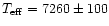 K will be
adopted.
K will be
adopted.
The disagreement on  deserves further investigation in the future,
since it has also
been found for X Cae (Mantegazza et al. 2000). From some tests
made on other
Sct stars, the
values derived from Geneva
photometry seem to be always higher than those derived from photometry,
even if usually with a lesser extent than here. In the case of BV Cir,
the HIPPARCOS parallax measurement (
deserves further investigation in the future,
since it has also
been found for X Cae (Mantegazza et al. 2000). From some tests
made on other
Sct stars, the
values derived from Geneva
photometry seem to be always higher than those derived from photometry,
even if usually with a lesser extent than here. In the case of BV Cir,
the HIPPARCOS parallax measurement (
 mas) offers us
the possibility to solve the matter. From this
parallax
and the interstellar reddening estimate supplied by the
indices
(
E(b-y)=0.022, and thus AV=0.095), we derive
mas) offers us
the possibility to solve the matter. From this
parallax
and the interstellar reddening estimate supplied by the
indices
(
E(b-y)=0.022, and thus AV=0.095), we derive
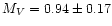 and
therefore
and
therefore
 (BC=+0.035, Flower 1996).
Finally, from the photometric temperature and the HIPPARCOS luminosity,
we get
(BC=+0.035, Flower 1996).
Finally, from the photometric temperature and the HIPPARCOS luminosity,
we get
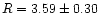
 .
BV Cir is then an evolved
Scuti star, located
in the middle of the instability strip, slightly shifted
toward the cold border.
.
BV Cir is then an evolved
Scuti star, located
in the middle of the instability strip, slightly shifted
toward the cold border.
According to the theoretical models by
Schaller et al. (1992) a mass
of
 can correspond to such temperature and luminosity;
finally, by combining this with the radius estimate we get
can correspond to such temperature and luminosity;
finally, by combining this with the radius estimate we get
 in nice agreement with the estimate from
the Moon & Dworetsky (1985) calibration.
in nice agreement with the estimate from
the Moon & Dworetsky (1985) calibration.
Since the solution proposed by Kurtz (1981) did not give a fully satisfactory fit of the observations, we decided to analyze his data with the least-squares power spectrum technique, which has been widely used by us in a lot of papers and has proved to be rather efficient in analysing multi-periodic time-series (e.g. Mantegazza et al. 2000).
Both B and V datasets were independently analyzed and the results are summarized in Table 1. Nine components were found in common between the two datasets, 8 with the same frequencies and one with an uncertainty of 1 cd-1(9.232 cd-1in B and 10.232 cd-1in V). One low frequency term was detected in both datasets, but the frequency is slightly different (0.295 cd-1in B and 0.239 cd-1in V). Owing to the fact that the data are distributed in 5 sequential segments and were obtained with three different telescopes, this term could be due to the procedure adopted to align the differents datasets. This spurious nature can account for the quite high AB/AV ratio, i.e. 1.9, unlikely for a pulsation mode.
The four strongest terms are the same as detected by Kurtz (1981). We note that among the new terms, a frequency (9.901 cd-1) is very close to a 2 cd-1alias of the term at 7.892 cd-1. However, it should be a real feature since each attempt to get rid of it has failed (for example by substituting the two frequencies with the intermediate alias at 8.90 cd-1and so on).
Other terms are probably present but their unambiguous detection is problematic with the present data. There could be also variations in the amplitudes of the detected terms, as detected in the spectroscopic data (see below); since the photometric baseline spans 116 days, these variations could be appreciable, but again the data sample is inadequate to supply an unambiguous answer.
In order to get a final list of frequencies, the B and V data were
put together by aligning the zero-points and rescaling the V data
in order to match the B amplitudes; the resulting time-series
was frequency analyzed again. This approach is the same as used by
Breger et al. (1998) to study FG Vir and by Mantegazza et al.
(2000) to study X Cae. The frequencies detected in this way
are also listed in
Table 1; the B and V amplitudes obtained by fitting the
respective time-series and the rms residual are also reported.
| Frequencies [cd-1] | Amplitudes [mmag] | ||||
| B | V |  |
AB | AV | |
| 0.295 | 0.239 | 0.294 | 3.1 | 1.6 | |
| 6.328 | 6.328 | 6.328 | 24.3 | 19.7 | |
| 7.892 | 7.892 | 7.892 | 10.0 | 8.2 | |
| 9.901 | 9.901 | 9.901 | 5.6 | 4.6 | |
| 9.232 | 10.233 | 10.234 | 2.5 | 2.0 | |
| 11.077 | 11.077 | 11.077 | 3.5 | 3.6 | |
| 11.128 | 11.128 | 11.128 | 6.8 | 6.0 | |
| 11.631 | 11.631 | 11.631 | 7.3 | 6.0 | |
| 12.289 | 12.289 | 12.289 | 12.5 | 10.0 | |
| 12.381 | 12.380 | 12.381 | 5.4 | 4.1 | |
| rms residuals | 4.4 | 3.5 | |||
The photometric data presented in this paper were collected during a campaign in June 1996 with the 0.5 m telescope at la Silla Observatory. During five consecutive nights 322 and 312 measurements were collected in the Strömgren v and y bands respectively. Differential photometry was performed by using HD 132249 and HD 132222 as comparison stars. These stars were used by Kurtz (1981), who found them constant at the mmag level. Due to the non-perfect atmospheric transparency during these Chilean winter nights, systematic intra-night variations were noticed in the extinction coefficient. Therefore, the data were reduced by means of the instantaneous extinction coefficient procedure (Poretti & Zerbi 1993). Nevertheless, the photometric measurements could not reach the typical level of precision for the La Silla site; the magnitude differences between the two comparison stars show a standard deviation of 6.5 mmag in y-light and 8.7 mmag in v-light.
The new observations were analyzed with the same approach adopted
for the Kurtz (1981) data: the v and y measurements were first
frequency analyzed separately and then were merged together. The
detected frequencies are listed in the first 3 columns of Table 2.
We notice that the spectral resolution of this dataset, 0.2 cd-1,
is consistently lower than that of the 1980 dataset. In the 4th
column the corresponding frequencies of
Table 1 are reported for comparison purposes. The frequencies at 6.328
and 7.892 cd-1that were dominant in the 1980 data are still present
in the new photometry still with a dominant character. A number of
other terms such as 9.901, 11.631, 12.289, 12.381 cd-1were also
confirmed in the new photometry while the term at 10.234 cd-1
presented some aliasing uncertainty. The terms at 11.077 and
11.128 cd-1were not recovered in the 1996 dataset;
as we shall see later, they were not detected
in the spectroscopic analysis too.
Also in our dataset low frequency terms are observed, at
values (0.36 cd-1and its alias 0.64 cd-1)
different from those observed in Kurtz's data (0.29 cd-1): this
difference can be accounted for the worst frequency resolution, but
it is greater than that observed for other terms (see Table 2). Moreover,
the power spectrum of the measurements between the two comparison
stars shows increased noise at f<1 cd-1, strongly supporting a spurious nature
of the detected peaks.
![\begin{figure}
{
\includegraphics[width=8.5cm,clip]{MS10255f1.eps} }
\end{figure}](/articles/aa/full/2001/05/aa10255/img32.gif) |
Figure 1: Light curves obtained at ESO in the y-light. The fit is calculated by using the parameters listed in Table 2 |
| Open with DEXTER | |
Amplitudes in the v and y bands were derived by fitting the respective data adopting the Kurtz values for the frequencies, which are more accurate because of the longer baseline. Figure 1 shows the fit of the measurements in the y-band. By comparing the Vamplitudes of Kurtz's (1981) data with those of the present ones it appears that most of the terms have comparable values. This is not true for the 10.23 cd-1term, much stronger in the recent data. However, this term is not well resolved from the alias at 2 cd-1of the 12.29 cd-1term and therefore this effect could be spurious.
| Frequencies [cd-1] | Amplitudes [mmag] | |||||
| v | y |  |
|
Av | Ay | |
| 0.64 | 0.36 | 0.65 | -- | 4.8 | 3.9 | |
| 6.33 | 6.33 | 6.33 | 6.328 | 28.2 | 19.3 | |
| 7.88 | 7.88 | 7.87 | 7.892 | 16.0 | 10.3 | |
| -- | 9.93 | 9.94 | 9.901 | 6.9 | 5.5 | |
| 10.28 | 9.23 | 9.27 | 10.234 | 9.2 | 7.1 | |
| 11.69 | 11.61 | 11.63 | 11.631 | 8.7 | 5.8 | |
| -- | 11.25 | 12.29 | 12.289 | 10.5 | 7.3 | |
| 11.38 | 13.42 | 12.36 | 12.381 | 7.3 | 5.4 | |
| rms residuals | 7.2 | 5.4 | ||||
The spectroscopic observations were performed during two runs in 1996 and 1998 at La Silla Observatory (ESO) with the Coudé Echelle Spectrograph attached to the Coudé Auxiliary Telescope (1.4 m).
The first run (6 consecutive nights, June 18-24,
1996) was performed in Remote Control Mode from Garching with the CES
configured in the blue path with the long camera and the CCD #38. The
reciprocal dispersion was 0.018 Å pix-1 with an effective resolution
of about 54000, and the useful spectral region ranged from 4482 to 4532 Å.
The weather conditions were not always optimal and, to get
an adequate S/N, the integration times ranged between 12 to 25 min.
118 useful spectrograms were gathered; they monitor the star
variability for about 38 hours (duty cycle of about 30 )
and on a
baseline of 5.2 days.
)
and on a
baseline of 5.2 days.
The second run (12 consecutive nights, June 7-19, 1998) was performed from
La Silla with the same CCD and blue path, but with the very-long camera.
The reciprocal dispersion was of 0.0075 Å pix-1 with an
effective resolution of about 51000. The useful spectral region ranged from
4498 to 4517 Å. Integration times were of 15 min and a total of 156
useful spectrograms were obtained during 9 nights, corresponding to about
48 hours of stellar monitoring (duty cycle about 18)
on a baseline
of 11.3 days.
The data reduction was performed using the MIDAS package developed at ESO. The spectrograms have been normalized by means of internal quartz lamp flat fields, and calibrated into wavelengths by means of a thorium lamp.
The spectrograms of each run have then been averaged and some windows on the continuum were selected in the very high S/N mean spectra. The individual spectrograms have been normalized to the continuum by fitting a 3rd degree polynomial to these windows for the first run set (longer spectral range) and a 2nd degree polynomial for the second run set (shorter spectral range).
Finally the spectra have been shifted in order to remove the observer's motion (Earth's rotation and revolution). The spectrograms were rebinned with a step of 0.04 Å (average of 2 original pixels) for the first season data and of 0.035 Å (average of 5 original pixels) for the second one. This step allows us to save the effective resolution according to the Nyquist criterion, and not to have too many pixels to analyze.
Due to the relatively high projected rotation velocity (see below), only the Fe II line at 4508.3 Å is completely free from blends of adjacent features, and therefore was the only line suitable to study line profile variations.
The mean standard deviation of the pixels belonging to the continuum allows an estimation of the S/N of the spectrograms. The resulting average value at the continuum level is about 257 for the first season data and 251 for the second one.
A non-linear least-squares fit of a rotationally broadened Gaussian profile
to the average line profiles of the two seasons allows us to get very similar
estimates of the projected rotational velocity and the intrinsic width
of the 4508 Å line. We get
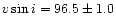 kms-1and
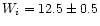 kms-1, respectively.
Radial velocities were derived by the computation of the instantaneous
line barycentre (i.e. they coincide with the first moment of the line profile,
Balona 1986). They were derived for both datesets and the two
resulting timeseries were analyzed by the same least-squares
technique adopted for the light curve analysis.
The amplitudes of radial velocity variations are rather small,
not exceeding 5 km s-1peak to peak;
the accuracy of these data is 0.6-0.7 km s-1as estimated from the white
noise level. Because of this, only the 6.33 cd-1can be detected unambiguously
in both datasets. Its semi-amplitude is the same within the uncertainties
in both seasons:
 kms-1. The fit of the radial velocity data with
the other
photometrically dominant frequencies shows that these terms should have
amplitudes of the order of 0.5 km s-1or less.
The analysis of the second moment supplies again the same result for both
seasons: only one mode is clearly discernible, but it
is the 7.89 cd-1, not the 6.33 cd-1mode. Forcing the fit of the 6.33 cd-1
term to the data
we get a negligible amplitude. The conclusion is that the 6.33 cd-1mode,
which is also the photometrically dominant term, is axisymmetric (m=0);
on the contrary the 7.89 cd-1mode should have .
kms-1. The fit of the radial velocity data with
the other
photometrically dominant frequencies shows that these terms should have
amplitudes of the order of 0.5 km s-1or less.
The analysis of the second moment supplies again the same result for both
seasons: only one mode is clearly discernible, but it
is the 7.89 cd-1, not the 6.33 cd-1mode. Forcing the fit of the 6.33 cd-1
term to the data
we get a negligible amplitude. The conclusion is that the 6.33 cd-1mode,
which is also the photometrically dominant term, is axisymmetric (m=0);
on the contrary the 7.89 cd-1mode should have .
The variations of the shape of the line profiles was studied by means
of the pixel by pixel analysis. A detailed description of this approach
was made by Mantegazza & Poretti (1999) and by Mantegazza (2000).
In particular Fig. 6 of the second paper shows the pixel by pixel
least-squares power spectrum relative to the Fe II 4508 Å line of BV Cir as derived
from the 1998 data, where it is apparent that there is a significant
contribution to
the line profile variations in the whole frequency range (from 1 to 20 cd-1).
![\begin{figure}
\par\includegraphics[width=8.4cm,clip]{MS10255f2.eps}\end{figure}](/articles/aa/full/2001/05/aa10255/img38.gif) |
Figure 2: Least-squares global power spectra of the line profile variations of the 4508 Å line. Left: 1996 data; right: 1998 data. Upper panels: spectra of the signal contained in the data. Lower panels: residual spectra after considering all the detected terms. The reduction factors refer to the initial data variance of the respective season both in the upper and lower panels |
| Open with DEXTER | |
The frequencies detected for the two datasets with this technique are listed in
order of increasing frequency in Table 3.
Not all the terms were detected in both seasons; in particular the dominant
term in the 1998 data (17.28 cd-1) was not seen in the 1996 ones.
The upper panels of Fig. 2 show all the signal contained in the data, while
the bottom panels show the signal left after considering all the
detected terms.
In the 2nd and 3rd columns of Table 3 we report
the mean square amplitudes
across the line profile of the detected terms for the 1996 and 1998 data
respectively. These quantities are expressed in square units of
the local continuum of the stellar spectrum.
Due to the high number of excited modes and to the complexity of the spectral
window it cannot be ruled out that some of the detected frequencies could be
1 cd-1aliases of the true ones. We can be more confident on terms which
have been independently detected in both seasons and/or in the
photometric data.
| Freq. | Power | Photom. | ||
| [cd-1] | 1996 | 1998 | [cd-1] | |
| 0.65 | 2.88 | 3.28 | 0.65 | |
| 1.48 | 4.02 | 2.88 | -- | |
| 2.22 | -- | 3.08 | -- | |
| 6.33 | 3.42 | 2.42 | 6.328 | |
| 7.89 | 3.40 | 3.55 | 7.892 | |
| 9.90 | -- | 2.85 | 9.901 | |
| 11.63 | 3.11 | 3.40 | 11.631 | |
| (13.43) | 3.18 | -- | 12.381 | |
| 13.85 | 9.04 | 10.07 | -- | |
| 14.34 | 4.41 | 2.87 | -- | |
| 14.95 | 7.97 | 7.03 | -- | |
| 15.80 | -- | 3.86 | -- | |
| 16.44 | -- | 6.74 | -- | |
| 17.28 | -- | 12.87 | -- | |
Fourteen terms were detected out of which seven were present in both seasons. Moreover six terms have an independent photometric detection: 0.65, 6.33, 7.89, 9.90, 11.63 and 13.43 cd-1. The last value probably corresponds to the 1 cd-1alias of the photometric value of 12.38 cd-1and in the following we shall adopt this photometric value. The nature of the low-frequency terms is discussed in Sect. 6.4.
An independent check of these detections can be performed with the CLEAN algorithm (Roberts et al. 1987) generalized to study line profile variations (see for example Bossi et al. 1998; De Mey et al. 1998). Such an approach is complementary to the previous one because the selection of the peaks is completely automatic, i.e. free from human judgement, with the consequent merits and defects. Among the merits the major one is the absence of human intervention: indeed any time we select a known constituent and add it to the least-squares solution we intervene on the representation of the signal thus conditioning to some extent the next procedure. Among the defects the major one is that CLEAN is in condition to make a reliable distinction between a true signal and an alias only when the spectral window is of very good quality. For this reason the procedure we adopted in the past on similar analyses was to put more reliability on the least-squares analysis and use CLEAN only as a cross-check. Moreover, for sake of clarity, we prefer to use the CLEAN power spectra to present the frequency content of the data.
The results of the CLEAN analysis are shown in the two panels of Fig. 3. By comparing this figure with Table 3 we can see that there are no great differences with the least-squares technique and that both techniques agree on several detections. Two different alias identifications are observed: the 0.65 and 0.35 cd-1peaks, the 14.94 and 13.94 cd-1peaks. Moreover, in the 1998 data the 12.87 and 13.85 cd-1peaks are related to the same term. It is also possible to see that the peaks of the 1998 data are narrower than those of the 1996 data because of the longer baseline; the same fact can be appreciated with the least-squares power spectra (Fig. 2).
The comparison with the least-squares analysis confirms most of the terms (0.65, 1.46, 2.22, 6.33, 7.89, 9.92, 11.63, 14.34 and 17.28 cd-1) and allows us to prefer the 14.94 and 13.85 cd-1terms to their aliases.
As regards the terms with frequencies around 16.2-16.5 cd-1, both CLEAN and the least-squares technique confirm the difference between the 1996 (no significant term detected in this region) and 1998 (a bunch of detected terms) datasets. The least-squares technique seems to explain the signal in this region in a simplest way (a unique term, rather than the three suggested by CLEAN). Moreover, CLEAN did not reveal clearly the 15.80 and 12.38 cd-1terms. These small discrepancies can be accounted for by a noise effect and bad spectral window. In the following analysis we shall use the terms identified by means of the least-squares approach.
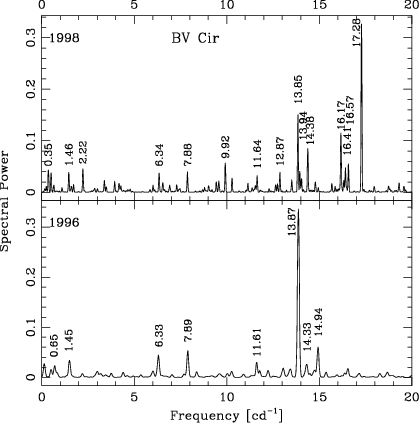 |
Figure 3: Average CLEAN power spectra of the line profile variations across the Fe II 4508 Å line. The frequencies of the main peaks are given in the labels. Lower panel: 1996 data; upper panel: 1998 data |
| Open with DEXTER | |
![\begin{figure}
\par\includegraphics[width=12cm,clip]{MS10255f4.eps}\end{figure}](/articles/aa/full/2001/05/aa10255/img40.gif) |
Figure 4:
Behaviours of phases across the line profile
of the Fe II 4508 Å line of the terms detected with
the least-squares power spectrum analysis both in the 1996 and the 1998
data. The phases are
in degrees (each tickmark corresponds to
 ). The thin horizontal line in each panel gives the zeropoint level.
The line profile is measured in Doppler velocities: the centre of the line
defines the zeropoint.
The frequency of each mode is written on the top of each panel.
The doubtful pulsational nature of the 0.65 cd-1term is discussed in the
text ). The thin horizontal line in each panel gives the zeropoint level.
The line profile is measured in Doppler velocities: the centre of the line
defines the zeropoint.
The frequency of each mode is written on the top of each panel.
The doubtful pulsational nature of the 0.65 cd-1term is discussed in the
text |
| Open with DEXTER | |
![\begin{figure}
\par\includegraphics[width=12cm,clip]{MS10255f5.ps}\end{figure}](/articles/aa/full/2001/05/aa10255/img41.gif) |
Figure 5: Same as in the previous figure but relative to the modes detected in one dataset only: 12.38 cd-1and 14.34 cd-1were detected in the 1996 data, the others in the 1998 ones. The doubtful pulsational nature of the 2.22 cd-1term is discussed in the text |
| Open with DEXTER | |
In particular, we don't put particular confidence on the low-frequency terms, except for the 1.48 cd-1term. The other terms (0.65 and its alias 0.35 cd-1, the 2.22 cd-1) are considered to be spurious ones (see Sect. 6.4).
The behaviours of phases across the line profile of the modes adopted for further analysis are shown in Fig. 4 for the 8 modes detected in the spectra of both seasons and in Fig. 5 for those detected in one dataset only. The behaviour of the 9.901 cd-1term is puzzling. It was observed photometrically in 1980 and 1996. On this latter occasion, there was no significant spectroscopic counterpart (see lower panel of Fig. 3): the spectroscopic amplitude may be undetectable because the mode had quite a small photometric amplitude. Moreover, owing to the modest frequency resolution, its power could have been transferred via the 2 cd-1 alias to the stronger 7.89 cd-1mode. The frequency resolution is better in the 1998 data and the 9.901 cd-1term was clearly detected, maybe thanks to an increased amplitude; unfortunately, we do not have photometric data with which to check this possibility. Therefore, we decided to consider a 9.90 cd-1term in the analysis of the 1996 spectroscopic data also.
The behaviour of the phases across the line profile gives already some hints about the nature of a few of the detected modes. For instance the phases of the 13.85, 14.34, 14.95, 15.80, 16.44 and 17.28 cd-1modes have the typical signature of high-degree prograde modes. The behaviour of the phases of the 1.48 cd-1term is interesting because it is typical of a retrograde mode.
It is possible to try to estimate the  ,
m parameters of the detected
modes by a model which fits the variations induced on the line profile shape.
The technique adopted to separate the contributions of the different modes
to the global observed line profile variations and to fit them is described
in Mantegazza et al. (2000) and Mantegazza (2000).
The theoretical line profile variations are computed according to the model
developed by Balona (1987), by means of his LNPROF routine.
If simultaneous light variations are available it is possible to fit them
with the same model at the same time, and in this case a more accurate
typing of the mode can be proposed, since we can constrain at the same time both
the velocity fields and the flux variations.
The best fitting modes are selected according to a "discriminant''
whose value defines the goodness with which the candidate mode
reproduces the variations of the line profile and of the light (if available)
of the detected frequency term. For some modes the discriminant is also
sensitive to the inclination of the rotational axis, and therefore if
several modes are detected it is possible to build a total discriminant
(the sum of the individual ones) as a function of inclination angle i.
The minimum of this function can in principle fix this parameter.
,
m parameters of the detected
modes by a model which fits the variations induced on the line profile shape.
The technique adopted to separate the contributions of the different modes
to the global observed line profile variations and to fit them is described
in Mantegazza et al. (2000) and Mantegazza (2000).
The theoretical line profile variations are computed according to the model
developed by Balona (1987), by means of his LNPROF routine.
If simultaneous light variations are available it is possible to fit them
with the same model at the same time, and in this case a more accurate
typing of the mode can be proposed, since we can constrain at the same time both
the velocity fields and the flux variations.
The best fitting modes are selected according to a "discriminant''
whose value defines the goodness with which the candidate mode
reproduces the variations of the line profile and of the light (if available)
of the detected frequency term. For some modes the discriminant is also
sensitive to the inclination of the rotational axis, and therefore if
several modes are detected it is possible to build a total discriminant
(the sum of the individual ones) as a function of inclination angle i.
The minimum of this function can in principle fix this parameter.
In the case of BV Cir only the 1996 data have simultaneous light and spectroscopic observations and therefore only these data can be used to perform a simultaneous fit of both quantities and hence to constrain velocity and flux variations.
![\begin{figure}
\par\includegraphics[width=8.3cm,clip]{MS10255f6.eps}\end{figure}](/articles/aa/full/2001/05/aa10255/img43.gif) |
Figure 6:
Discriminants of the 1.48 cd-1mode as a function
of the azimuthal order m computed from the 1996 (solid lines) and 1998
(dashed lines) data. These values are relative to
 and
and  .
But the discriminants are rather insensitive to i and are comparable for
any .
But the discriminants are rather insensitive to i and are comparable for
any
 |
| Open with DEXTER | |
Three terms were observed at low frequencies: 0.65, 1.48 and 2.22 cd-1. The attempts to fit 0.65 and 2.22 cd-1 were fruitless and no meaningful identification was possible. The phase diagrams of 0.65 (Fig. 4, left panel of the upper row) and 2.22 cd-1(Fig. 5, left panel of the upper row) terms look like a scattered plot, without any discernible trend. This result supports our hypothesis that these terms are spurious effects in the analysis. It can be argued that the 0.65 cd-1term is found both in the spectroscopic and in the photometric datasets, which are independent from each other. However, there are other peaks in this frequency region having similar amplitudes (see Fig. 3) and therefore the numeric coincidence can be considered as merely casual. We again remind the reader that in the photometric analysis also there are many doubts on the reality of the 0.65 cd-1term. Therefore, in the discussion, we prefer not to consider the 0.65 and 2.22 cd-1terms as pulsational modes, even if some uncertainties are left, especially on the former.
![\begin{figure}
\par\includegraphics[width=16cm,clip]{MS10255f7.eps}\end{figure}](/articles/aa/full/2001/05/aa10255/img44.gif) |
Figure 7: Behaviours of the discriminant of the best fitting modes versus the inclination for the terms detected both spectroscopically and photometrically. Left panels: discriminants computed by simultaneously fitting line profile and light variations in the 1996 season. Central panels: discriminant computed by fitting line profile variations in the 1996 data only. Right panels: discriminants computed by fitting line profile variations in the 1998 data. The panels of the same line concern the same term whose frequency is reported in the leftmost panel |
| Open with DEXTER | |
On the contrary the term at 1.48 cd-1, which has been
observed in both seasons, and whose phase diagrams clearly show that it
is a retrograde mode, supplied useful discriminants. As is also evident
from its phase diagrams (Fig. 4, right panel of the upper row) it is
retrograde and has a rather
high degree, and as in the case of the prograde mode the discriminant is
rather insensitive
to the inclination and to the
degree. The derived values from the two
datasets are shown in Fig. 6.
The 1998 discriminant has a lower depth than the 1996 one because in that
season the S/N was lower. In any case we can estimate m=7 or 8.
Such modes are rarely observed in Scuti stars, and often their detection is rather ambiguous, but in this
case the evidence is remarkable and is independently shown by the two
datasets (Fig. 4). This typing constitutes a warning about the
identification of a low-frequency terms as a g-mode, since a p-mode
can assume these values in the observer's reference frame.
The identification of the
modes which were independently detected both by photometry and spectroscopy
was performed looking for all the possible  combinations up to
  and with inclinations of the rotation axis between 20 and 90 degrees
(the lower limit was fixed considering that the star reaches the break-up
velocity at about
and with inclinations of the rotation axis between 20 and 90 degrees
(the lower limit was fixed considering that the star reaches the break-up
velocity at about
 ).
The main results are shown in Fig. 7 where the horizontal panels
belong to the same mode whose frequency is reported in the leftmost panel.
In each panel the behaviours of the discriminants versus the inclinations
of the best fitting modes are reported. Each mode is identified by a different
colour.
Since in the 1998 season we have no photometric data, in order to allow a
comparison of the results the 1996 data were analyzed fitting
simultaneously line profile and light variations (left panels)
and only line profile variations (central panels).
The panels on the right contain the discriminant computed from the 1998
spectroscopic data. In the first case the models allowed
for both velocity and flux
variations, while in the second case only velocity variations were considered.
In the 1998 data the 12.38 cd-1term was not detected and therefore the
corresponding panel is missing.
The simultaneous fitting of velocity and flux variations made
the results shown in the leftmost panels more reliable.
Those in the other two
panels are useful only to check how reasonable it is to neglect flux
variations to model line profile variations (and hence if we can avoid getting
simultaneous light and spectroscopic data) and
the consistency between the two seasons' data.
The general conclusion is that the agreement between the best fitting modes
in the two seasons' data is reasonable because
the best fitting modes are the same, with a few exceptions. However we can see
that by fitting
line profile variations only we tend to assign a higher degree to the detected
modes. The light curves play a decisive role in the
mode typing since the photometric amplitude is very sensitive to the
cancellation effects originated by the high-degree modes.
For instance for the 6.33 cd-1term the possibility of
identifying it as 3,0is completely ruled out if we also take into account light variations.
).
The main results are shown in Fig. 7 where the horizontal panels
belong to the same mode whose frequency is reported in the leftmost panel.
In each panel the behaviours of the discriminants versus the inclinations
of the best fitting modes are reported. Each mode is identified by a different
colour.
Since in the 1998 season we have no photometric data, in order to allow a
comparison of the results the 1996 data were analyzed fitting
simultaneously line profile and light variations (left panels)
and only line profile variations (central panels).
The panels on the right contain the discriminant computed from the 1998
spectroscopic data. In the first case the models allowed
for both velocity and flux
variations, while in the second case only velocity variations were considered.
In the 1998 data the 12.38 cd-1term was not detected and therefore the
corresponding panel is missing.
The simultaneous fitting of velocity and flux variations made
the results shown in the leftmost panels more reliable.
Those in the other two
panels are useful only to check how reasonable it is to neglect flux
variations to model line profile variations (and hence if we can avoid getting
simultaneous light and spectroscopic data) and
the consistency between the two seasons' data.
The general conclusion is that the agreement between the best fitting modes
in the two seasons' data is reasonable because
the best fitting modes are the same, with a few exceptions. However we can see
that by fitting
line profile variations only we tend to assign a higher degree to the detected
modes. The light curves play a decisive role in the
mode typing since the photometric amplitude is very sensitive to the
cancellation effects originated by the high-degree modes.
For instance for the 6.33 cd-1term the possibility of
identifying it as 3,0is completely ruled out if we also take into account light variations.
As regards possible identification, we can give reasonable
estimates for two terms only. The terms at 9.91, 11.63, and 12.38 cd-1are
the more uncertain since many modes supply comparable results.
The term at 6.33 cd-1is certaintly axissymmetric (all the proposed
identifications have m=0) and its most probable
identification is  ,
m=0, unless the star is seen almost exactly
equator-on. In this case
,
m=0, unless the star is seen almost exactly
equator-on. In this case  ,
m=0 could also be possible.
The term at 7.89 cd-1has
,
m=0 could also be possible.
The term at 7.89 cd-1has  ,
m=-1 or ,
m=-1 as the most
probable identifications, although we cannot completely rule out the possibility
,
m=-2.
,
m=-1 or ,
m=-1 as the most
probable identifications, although we cannot completely rule out the possibility
,
m=-2.
![\begin{figure}
\par\includegraphics[width=7.3cm,clip]{MS10255f8new.eps}\end{figure}](/articles/aa/full/2001/05/aa10255/img52.gif) |
Figure 8:
Discriminants of the six high degree prograde modes as a function
of the azimuthal order m computed from the 1996 (dashed lines) and 1998
(solid lines) data. These values are relative to
and  .
But the discriminants are rather insensitive to i and are comparable for any .
But the discriminants are rather insensitive to i and are comparable for any
 |
| Open with DEXTER | |
Because of the mode involved, the present discriminants do not help very much to decide on the most probable inclination of the rotational axis, which however will be constrained on the basis of different considerations later.
Six of the detected terms belong to this group: 13.85 and 14.95 cd-1(which
were detected both in the 1996 and in the 1998 data), 14.34 cd-1(which was detected in
the 1996 data) and 15.80, 16.44 and 17.28 cd-1(which were detected in the 1998 data).
In order to fit the line profile variations produced by these terms all the
prograde modes with
 were explored,
either taking into account flux variations or not.
These high- modes are not very sensitive to flux variations.
In turn, line profile variations are
rather insensitive to the inclination and to the
degree, while they
were strongly dependent upon the azimuthal order. Figure 8
shows the discriminant of these six terms as a function of m and computed
for
and
were explored,
either taking into account flux variations or not.
These high- modes are not very sensitive to flux variations.
In turn, line profile variations are
rather insensitive to the inclination and to the
degree, while they
were strongly dependent upon the azimuthal order. Figure 8
shows the discriminant of these six terms as a function of m and computed
for
and
 .
However as was said above the inclination is
rather unimportant, as for a fixed mode the discriminant is flat at minimum
and increases appreciably only for
.
However as was said above the inclination is
rather unimportant, as for a fixed mode the discriminant is flat at minimum
and increases appreciably only for
 .
In Fig. 8 the solid lines indicate the discriminants derived from the
1998 data while the dashed lines indicate those obtained from the 1996 data, and they are in
agreement. From Fig. 8 we can also estimate the m values reported in Table 4.
.
In Fig. 8 the solid lines indicate the discriminants derived from the
1998 data while the dashed lines indicate those obtained from the 1996 data, and they are in
agreement. From Fig. 8 we can also estimate the m values reported in Table 4.
As an example of how the fits of the models to the observational
quantities look we show in Fig. 9 the behaviour of the amplitude and phase
across the line profile of the 17.28 cd-1mode with the best fitting solutions
for
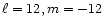 (dashed lines) and
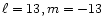 (dotted lines).
![\begin{figure}
\par\includegraphics[width=7.5cm,clip]{MS10255f9.eps}\end{figure}](/articles/aa/full/2001/05/aa10255/img58.gif) |
Figure 9:
Behaviour of amplitude (solid line upper panel) and phase (dots,
lower panel) of the 17.28 cd-1term across the line profile and their best
fits with
 (dashed lines) and
 (dotted lines)
 |
| Open with DEXTER | |
| Freq. | Tech. | Typing | Detection | ||
| [cd-1] | 1996 | 1998 | |||
| 1.48 | S | m=7 or 8 | Y | Y | |
| 6.33 | S P | ,
m=0 |
Y | Y | |
| 7.89 | S P |
or 2, m= -1 or -2 |
Y | Y | |
| 9.91 | S P |
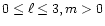 |
Y | Y | |
| 11.63 | S P |
 ,
m=-1 or -2 ,
m=-1 or -2 |
Y | Y | |
| 12.38 | S P |
 |
Y | N | |
| 13.85 | S | m= -12 or -13 | Y | Y | |
| 14.34 | S | m= -13 | Y | Y | |
| 14.95 | S | m= -14 | Y | Y | |
| 15.80 | S | m= -13 | N | Y | |
| 16.44 | S | m= -12 | N | Y | |
| 17.28 | S | m= -12 or -13 | N | Y | |
| 1980 | 1996 | ||||
| 10.23 | P | Y | Y | ||
| 12.29 | P | Y | Y | ||
| 11.077 | P | Y | N | ||
| 11.128 | P | Y | N | ||
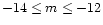
Six of the detected modes are high azimuthal order prograde modes with
 and one is retrograde with m=7 or 8.
For only two of the modes detected by simultaneous photometry and spectroscopy
it has been possible to suggest a complete
and one is retrograde with m=7 or 8.
For only two of the modes detected by simultaneous photometry and spectroscopy
it has been possible to suggest a complete  identification, while
better S/N spectroscopic data are needed for the others. The two identified modes
are the one at 6.33 cd-1(the photometric dominant mode),
which can be identified as the
(radial mode).
The other is the one at 7.89 cd-1which is a low degree prograde mode
with
or 2 and m=-1. The proposed typings of the pulsation
modes of BV Cir are summarized in Table 4.
identification, while
better S/N spectroscopic data are needed for the others. The two identified modes
are the one at 6.33 cd-1(the photometric dominant mode),
which can be identified as the
(radial mode).
The other is the one at 7.89 cd-1which is a low degree prograde mode
with
or 2 and m=-1. The proposed typings of the pulsation
modes of BV Cir are summarized in Table 4.
By using the physical parameters computed in Sect. 2 we can evaluate the
pulsation constant of the 6.33 cd-1mode, i.e.
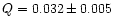 d.
Therefore, this mode is probably the radial fundamental in agreement
with the suggestion by Kurtz (1981). If we take this result for granted,
we can use this information to narrow the uncertainties on some physical
parameters. In fact, assuming for this mode the
theoretical value of
d.
Therefore, this mode is probably the radial fundamental in agreement
with the suggestion by Kurtz (1981). If we take this result for granted,
we can use this information to narrow the uncertainties on some physical
parameters. In fact, assuming for this mode the
theoretical value of
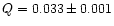 d as pulsation constant, we get
from its definition
d as pulsation constant, we get
from its definition
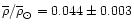 and also
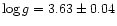 .
Moreover if we combine the mean density with the
radius estimate we get
.
Moreover if we combine the mean density with the
radius estimate we get
 ,
again in excellent
agreement with the value derived from the evolutionary models (see Sect. 2).
,
again in excellent
agreement with the value derived from the evolutionary models (see Sect. 2).
Hence by comparing the information from pulsation properties (as derived from our analysis), HIPPARCOS parallax and effective temperature (as derived from multicolour photometry), we determined physical parameters which are perfectly consistent (Table 5.)
We have remarked in the previous section that the discriminants of
the detected modes are not particularly sensitive to the
inclination of the rotation axis.
However we can constrain this value using the azimuthal orders
derived for the high degree modes and the fact that the 6.33 cd-1 mode is the radial fundamental, because in this case their
frequencies in the stellar reference frame should be larger than
the radial fundamental one. Among the prograde modes the critical
one is the 13.85 cd-1, which with
 imposes
 ,
while the 1.48 cd-1with
,
while the 1.48 cd-1with  gives
gives
 .
By combining the two results we obtain
.
Consequently the equatorial rotation velocity is about 111 kms-1 and the rotation frequency
.
By combining the two results we obtain
.
Consequently the equatorial rotation velocity is about 111 kms-1 and the rotation frequency  about 0.61 rev d-1.
| Parameter | Estimated value |
| Mass |
 |
| Effective temperature |
 K K |
| Absolute bolometric magnitude |
 |
|
 |
| Radius |
 |
| Equatorial rotational velocity |  kms-1
kms-1 |
| Rotational frequency |
 d-1
d-1 |
Let us finally deal with a few considerations about the technique to fit line profile
variations. We have seen that in order to get an unambiguous discrimination
between the possible identifications we need data with a rather high S/N.
The present data, with a S/N of the order of 250, supply useful
information for the strongest spectroscopic terms only. Since the
observed amplitudes are typical of
Scuti stars, it is not
unreasonable to believe that, in order to do a good job, data with a
S/N of 500 or better could be necessary.
We have also explored the difference between fitting line profile variations considering velocity fields only or taking also into account flux variations. We have seen that in the first case we tend to overweight the higher degree modes when we try to identify low degree modes. For these modes it is therefore important to consider flux variations too, and in this case, in order to properly constrain the fitted model, it is necessary to have simultaneous light variations.
Acknowledgements
The authors wish to thank D. Kurtz for kindly putting his data at their disposal and Jacques Vialle for checking the English form of the manuscript.