(RI)
(RI)
 JHKLL'M,
HST-WFPC2, Geneva
JHKLL'M,
HST-WFPC2, Geneva and Washington photometric systems
![[*]](/icons/foot_motif.gif)
A&A 366, 538-546 (2001)
DOI: 10.1051/0004-6361:20000214
(RI)
JHKLL'M,
HST-WFPC2, Geneva T. Lejeune1,2 - D. Schaerer 3
1 - Observatório Astronómico da Universidade de Coimbra,
Santa Clara, 3040 Coimbra, Portugal
2 - Astronomisches Institut
der Universität Basel, Venusstr. 7, 4102 Binningen, Switzerland
3 - Observatoire Midi-Pyrénées, Laboratoire d'Astrophysique, UMR
5572, 14 avenue E. Belin, 31400 Toulouse, France
Received 28 July 2000 / Accepted 3 November 2000
Abstract
We have used an updated version of the empirically and semi-empirically
calibrated BaSeL library of synthetic stellar spectra of Lejeune
et al. (1997, 1998) and Westera et al. (1999) to calculate synthetic
photometry in the (UBV) (RI)
(RI) JHKLL
JHKLL M, HST-WFPC2, Geneva, and Washington systems
for the entire set of non-rotating Geneva stellar evolution models
covering masses from 0.4-0.8 to 120-150
M, HST-WFPC2, Geneva, and Washington systems
for the entire set of non-rotating Geneva stellar evolution models
covering masses from 0.4-0.8 to 120-150  and metallicities
Z=0.0004 (1/50
and metallicities
Z=0.0004 (1/50  )
to 0.1 (5 ).
The results are provided in a database
which includes all individual
stellar tracks and the corresponding isochrones covering ages from
103 yr to 16-20 Gyr in time steps of
)
to 0.1 (5 ).
The results are provided in a database
which includes all individual
stellar tracks and the corresponding isochrones covering ages from
103 yr to 16-20 Gyr in time steps of
 0.05 dex. The
database also includes a new grid of stellar tracks of very metal-poor
stars (Z=0.0004) from 0.8-150
calculated with the Geneva
stellar evolution code.
0.05 dex. The
database also includes a new grid of stellar tracks of very metal-poor
stars (Z=0.0004) from 0.8-150
calculated with the Geneva
stellar evolution code.
Key words: stars: general - stars: evolution - stars: Hertzsprung-Russell diagram - stars: fundamental parameters
Extensive grids of stellar tracks covering the most important evolutionary phases and a large metallicity range have become available in the nineties (see e.g. compilation in Leitherer et al. 1996). In addition, recent efforts have been undertaken to provide accurate synthetic colours from grids of atmosphere models covering the bulk of the parameter space occupied by observed stars of spectral types from O to M and all luminosity classes (Lejeune et al. 1997, 1998; Bessell et al. 1998). With the availability of such data it now becomes feasible to systematically convert stellar tracks of all stellar masses and derived isochrones to a variety of photometric systems. To provide such a tool is the main goal of our database.
Existing grids, partly fulfilling this aim, include the library of Padova
isochrones with UBVRIJHK photometry for ages  4 Myr-20 Gyr and
metallicities Z between 0.0004 and 0.05 (Bertelli et al. 1994; Girardi
et al. 1996), the recent
4 Myr-20 Gyr and
metallicities Z between 0.0004 and 0.05 (Bertelli et al. 1994; Girardi
et al. 1996), the recent  -element enhanced tracks and isochrones
of Salasnich et al. (2000) with UBVRIJHK and HST-WFPC2 photometry,
and various other calculations covering smaller fractions of the parameter
space.
-element enhanced tracks and isochrones
of Salasnich et al. (2000) with UBVRIJHK and HST-WFPC2 photometry,
and various other calculations covering smaller fractions of the parameter
space.
For the present work we rely on an updated version of the hybrid
library of synthetic stellar spectra compiled by Lejeune et al. (1997,
1998), which is corrected to match empirical colour-temperature
relations at solar metallicity and semi-empirically corrected at other
metallicities. These atmosphere models are used to derive synthetic
photometry of the (UBV)(RI)
JHKLLM, WFPC2, Geneva, and Washington systems,
using proper reference spectra for the zero points and up-to-date
filter curves.
This procedure is applied to essentially the full set of Geneva stellar
evolution models to yield the photometric data for these systems for
1) individual stellar tracks in the mass range from 0.4-0.8
to 120-150
and metallicities Z=0.0004 (1/50 )
to 0.1 (5 ), and
2) corresponding isochrones covering ages from 0 to 16-20 Gyr.
The input tracks, atmosphere models, and the synthetic photometry are described in Sect. 2. The resulting database products (tracks and isochrones) are presented in Sect. 3. Concluding remarks on the use of the various database sets are given in Sect. 4. The Appendix includes the relevant data for a previously unpublished set of stellar tracks at Z=0.0004.
,
see Appendix).
Pre-main sequence models are not included
(but cf. Bernasconi 1996 and Paper VIII).
The complete set including the references, a grid number used
subsequently throughout the paper, and other main characteristics are
listed in Table 1 (see the original papers for a full
description).
| Grid | database | Z | X | Y |  |
mass range | paper(*) | description |
| # | ID | |||||||
| (1) | (2) | (3) | (4) | (5) | (6) | (7) | (8) | (9) |
| Basic grids: | ||||||||
| 1 | e | 0.0004 | 0.7584 | 0.2412 |
 |
0.8-150 |
this paper | basic grid |
| 2 | c | 0.001 | 0.756 | 0.243 | standard | 0.8-120 |
I | basic grid |
| 3 | c | 0.004 | 0.744 | 0.252 | standard | 0.8-120 |
III | basic grid |
| 4 | c | 0.008 | 0.728 | 0.264 | standard | 0.8-120 |
II | basic grid |
| 5 | c | 0.020 | 0.680 | 0.300 | standard | 0.8-120 |
I | basic grid |
| 6 | c | 0.040 | 0.620 | 0.340 | standard | 0.8-120 |
IV | basic grid |
| 7 | c | 0.100 | 0.420 | 0.480 | standard | 0.8-60 |
VII | basic grid |
| Extended grids: | ||||||||
| 8 | e | 0.001 | 0.756 | 0.243 |
:
 |
0.8-120 |
V, I | high mass loss for massive stars |
| 9 | e | 0.004 | 0.744 | 0.252 |
:
 |
0.8-120 |
V, III | high mass loss for massive stars |
| 10 | e | 0.008 | 0.728 | 0.264 |
:
 |
0.8-120 |
V, II | high mass loss for massive stars |
| 11 | e | 0.020 | 0.680 | 0.300 |
:
|
0.8-120 |
V, I | high mass loss for massive stars |
| 12 | e | 0.040 | 0.620 | 0.340 |
:
 |
0.8-120 |
V, IV | high mass loss for massive stars |
| 13 | p | 0.001 | 0.756 | 0.243 | standard | 0.8-1.7 |
VI | including HB and EAGB |
| 14 | p | 0.020 | 0.680 | 0.300 | standard | 0.8-1.7 |
VI | including HB and EAGB |
| 15 | m | 0.001 | 0.756 | 0.243 | standard | 0.4-1.0 |
VIII | MHD equation of state |
| 16 | m | 0.020 | 0.700 | 0.280 | standard | 0.4-1.0 |
VIII | MHD equation of state |
| 17 | 0.020 | 0.680 | 0.300 | standard | 0.4-1.0 |
VIII | MHD equation of state | |
| Alternate and combined model sets: | ||||||||
| o | 0.0004 | 0.7584 | 0.2412 | 2 std std |
0.8-2.5 |
this paper | no overshooting: 1.25 |
|
| o | 0.001 | 0.756 | 0.243 | standard | 0.8-2.5 |
I | no overshooting: 1.25 |
|
| o | 0.004 | 0.744 | 0.252 | standard | 0.8-2.5 |
III | no overshooting: 1.25 |
|
| o | 0.008 | 0.728 | 0.264 | standard | 0.8-2.5 |
II | no overshooting: 1.25 |
|
| o | 0.020 | 0.680 | 0.300 | standard | 0.8-2.5 |
I | no overshooting: 1.25 |
|
| o | 0.040 | 0.620 | 0.340 | standard | 0.8-2.5 |
IV | no overshooting: 1.25 |
|
| l | 0.001 | 0.756 | 0.243 | standard | 0.4-2.5 |
combination: grids 15, 13, 2 | ||
| l | 0.020 | 0.680 | 0.300 | standard | 0.4-2.5 |
combination: grids 17, 14, 5 | ||
| Database | Z | age range ( ) ) |
description | |
| ID | from | to | ||
| (1) | (2) | (3) | (4) | (5) |
| Basic grids: | ||||
| e | 0.0004 | 3.00 | 10.20 | basic grid |
| c | 0.001 | 3.00 | 10.20 | basic grid |
| c | 0.004 | 3.00 | 10.20 | basic grid |
| c | 0.008 | 3.00 | 10.20 | basic grid |
| c | 0.020 | 3.00 | 10.20 | basic grid |
| c | 0.040 | 3.00 | 10.20 | basic grid |
| c | 0.100 | 3.00 | 10.20 | basic grid |
| Extended grids: | ||||
| e | 0.001 | 3.00 | 7.50 | high mass loss for massive stars |
| e | 0.004 | 3.00 | 7.50 | high mass loss for massive stars |
| e | 0.008 | 3.00 | 7.50 | high mass loss for massive stars |
| e | 0.020 | 3.00 | 7.50 | high mass loss for massive stars |
| e | 0.040 | 3.00 | 7.50 | high mass loss for massive stars |
| p | 0.001 | 9.00 | 10.20 | including HB and EAGB phases for low mass stars |
| p | 0.020 | 9.00 | 10.20 | including HB and EAGB phases for low mass stars |
| m | 0.001 | 9.00 | 10.30 | MHD equation of state for low mass stars |
| m | 0.020 | 9.00 | 10.30 | MHD equation of state for low mass stars |
| Alternate and combined model sets: | ||||
| o | 0.0004 | 9.00 | 10.20 | no overshooting: 1.25 |
| o | 0.001 | 9.00 | 10.20 | no overshooting: 1.25 |
| o | 0.004 | 9.00 | 10.20 | no overshooting: 1.25 |
| o | 0.008 | 9.00 | 10.20 | no overshooting: 1.25 |
| o | 0.020 | 9.00 | 10.20 | no overshooting: 1.25 |
| o | 0.040 | 9.00 | 10.20 | no overshooting: 1.25 |
| l | 0.001 | 9.00 | 10.30 | combination "best'' low mass star models |
| l | 0.020 | 9.00 | 10.30 | combination "best'' low mass star models |
| File extension | description |
| dat | Complete set of predicted surface stellar properties |
| UBVRIJHKLM | Main stellar properties and photometric data for (UBV) (RI)
JHKLL M system |
| WFPC2 | Main stellar properties and photometric data for WFPC2 system |
| geneva | Main stellar properties and photometric data for Geneva system |
| CMT1T2 | Main stellar properties and photometric data for Washington system |
The physical ingredients have been discussed in Papers I-VIII. For
completeness sake a brief summary of the basic assumptions common to
most model sets is presented here. Variations are discussed below.
1) OPAL and low temperature opacities of Kurucz (1991) or
Alexander & Ferguson (1994) are used.
2) The initial (Y,Z) composition is derived from a linear
chemical enrichment law
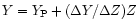 with
with
 ,
and
,
and
 for
for
 and
and
 for Z>0.02 respectively.
3) Mass loss rates are taken from de Jager et al. (1998)
throughout the HR-diagram except on the red giant branch (RGB) and
early asymptotic giant branch (EAGB) for initial masses M < 5 ,
where the following expression is used (cf. Reimers 1975):
for Z>0.02 respectively.
3) Mass loss rates are taken from de Jager et al. (1998)
throughout the HR-diagram except on the red giant branch (RGB) and
early asymptotic giant branch (EAGB) for initial masses M < 5 ,
where the following expression is used (cf. Reimers 1975):
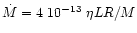 in units of
yr-1,
with
in units of
yr-1,
with  at solar metallicity (see Maeder & Meynet 1989).
Mass loss is scaled with metallicity by (Z/)0.5,
except for Wolf-Rayet (WR) stars.
In the WR phases the relation of Langer (1989) for WNE and WC stars,
and
at solar metallicity (see Maeder & Meynet 1989).
Mass loss is scaled with metallicity by (Z/)0.5,
except for Wolf-Rayet (WR) stars.
In the WR phases the relation of Langer (1989) for WNE and WC stars,
and
 yr-1 for WNL stars is used.
4) Moderate core overshooting of
yr-1 for WNL stars is used.
4) Moderate core overshooting of
 is
included for stars
is
included for stars  .
For stars at M=1.25
with
a small or absent convective core tracks with and without overshooting
are provided.
5) In addition to the effects treated by Maeder & Meynet (1989), partial
ionisation of heavy elements is included in the equation of state.
6) Optically thick envelopes of WR stars are treated in the
framework of the modified Castor et al. (CAK, 1975)
theory.
.
For stars at M=1.25
with
a small or absent convective core tracks with and without overshooting
are provided.
5) In addition to the effects treated by Maeder & Meynet (1989), partial
ionisation of heavy elements is included in the equation of state.
6) Optically thick envelopes of WR stars are treated in the
framework of the modified Castor et al. (CAK, 1975)
theory.
The above ingredients are used in grids 2-7 which cover the
metallicity range from Z=0.001 to 0.100 (1/20-5 ). Grids 1
and 8-12 were calculated with mass loss rates enhanced by a factor of
2 during the MS, the pre-WR, and WNL phases for massive stars (range
indicated in Col. 6); for lower masses the models are complemented
with the tracks from grids 2-6 or represent new calculations (grid 1;
see Appendix).
In grids 1-12, depending on the stellar mass range, the evolution is
in general followed up to the following phases: to the end of
C-burning for massive stars ( ), to the end of the early
asymptotic giant branch (EAGB) for intermediate mass stars (
), to the end of the early
asymptotic giant branch (EAGB) for intermediate mass stars (
 ), and up to before the helium flash
for low mass stars (
), and up to before the helium flash
for low mass stars (

 ). Grids 13 and 14
(Paper VI) present new calculations for the latter mass range at
metallicities Z=0.020 and 0.001 including post-helium flash models,
i.e. covering the horizontal branch (HB) and EAGB phases. The
post-helium flash tracks do not include overshooting and
semi-convection.
The MHD (Mihalas et al. 1988) equation of state was used
for the low mass models of Paper VIII (grids 15-17). The
calculations in grids 15-17 are followed up to before the helium flash
or ages larger than the Hubble time (
). Grids 13 and 14
(Paper VI) present new calculations for the latter mass range at
metallicities Z=0.020 and 0.001 including post-helium flash models,
i.e. covering the horizontal branch (HB) and EAGB phases. The
post-helium flash tracks do not include overshooting and
semi-convection.
The MHD (Mihalas et al. 1988) equation of state was used
for the low mass models of Paper VIII (grids 15-17). The
calculations in grids 15-17 are followed up to before the helium flash
or ages larger than the Hubble time (
 20 Gyr). Note that the
solar metallicity grid 16 uses a different Y/Z composition than the
remaining Z=0.020 grids.
20 Gyr). Note that the
solar metallicity grid 16 uses a different Y/Z composition than the
remaining Z=0.020 grids.
The present compilation includes stellar models covering a very large parameter space in terms of mass, metallicity, and evolutionary phases. However, we wish to stress again that e.g. the following evolutionary phases are not covered: 1) pre-main sequence tracks (for Geneva models see Bernasconi 1996 and Paper VIII), 2) thermally pulsing AGB stars, and 3) post-AGB stars and white dwarfs. Other phases (e.g. horizontal branch) are given only for a subset of metallicities. These limitations should be recognized by the user of the database. Calculations from other groups partly including such phases are mentioned in Sect. 4.
The conversion of the theoretical tracks and isochrones of the
present compilation to observational colour-magnitude (c-m) diagrams
has been performed using the stellar spectral library of Lejeune
et al. (1997, 1998) that provides empirically and semi-empirically
colour-calibrated model atmosphere spectra for a large range of
fundamental stellar parameters,
 (2000 K to 50000 K),
 (-1.0 to 5.5), and
![${\rm [Fe/H]}$](/articles/aa/full/2001/05/aa10158/img48.gif) (5.0 to +1.0).
(5.0 to +1.0).
For the present calculations, we use the most recent version of this
library (Westera et al. 1999), BaSeL-2.2, in which (1)
all the model spectra of stars with
 K are now
calibrated upon empirical colours from the
versus (B-V) relation of Flower (1996), and (2) the calibration
procedure for the cool giant model spectra has been extended to the
parameter ranges 2500 K
K are now
calibrated upon empirical colours from the
versus (B-V) relation of Flower (1996), and (2) the calibration
procedure for the cool giant model spectra has been extended to the
parameter ranges 2500 K  < 6000 K and
 < 3.5, with in particular the effect to provide redder model
colours for giants, in better agreement with observed red giant
branches of metal-poor globular clusters (see Lejeune & Buser 1999).
< 3.5, with in particular the effect to provide redder model
colours for giants, in better agreement with observed red giant
branches of metal-poor globular clusters (see Lejeune & Buser 1999).
In order to transform the theoretical quantities (
 )
into magnitudes and colours, we first compute, by
interpolation in the BaSeL grid (
,
,
and
the model spectrum at each point along the track or the isochrone, and
then derive the synthetic photometry by convolving the resulting flux
distribution with the filter transmission functions (as given in the
following sections).
)
into magnitudes and colours, we first compute, by
interpolation in the BaSeL grid (
,
,
and
the model spectrum at each point along the track or the isochrone, and
then derive the synthetic photometry by convolving the resulting flux
distribution with the filter transmission functions (as given in the
following sections).
The Wolf-Rayet phases in the stellar tracks are excluded from this
interpolation procedure because no physical model is available in the
BaSeL grid to accurately describe the atmosphere and the spectra of
stars in these phases. For these reasons, in the files we assign an
arbitrary value (-99) to the magnitudes and the colours
corresponding to these points. It has also to be pointed out that,
because of some missing models in the BaSeL set of models near
 K and
K and
 ,
extrapolations in
are necessary to compute the colours in this parameter range,
leading to a few numerical approximations. As a consequence, the
derived magnitudes and colours change more abruptly with
than expected, and hence the shape of the stellar
tracks do not appear very smooth in this region of the c-m diagram.
For these peculiar points, we estimate our computed photometry
to be accurate to about
,
extrapolations in
are necessary to compute the colours in this parameter range,
leading to a few numerical approximations. As a consequence, the
derived magnitudes and colours change more abruptly with
than expected, and hence the shape of the stellar
tracks do not appear very smooth in this region of the c-m diagram.
For these peculiar points, we estimate our computed photometry
to be accurate to about  mag.
mag.
The zero-points of the colours are defined from the Vega model
spectrum of Kurucz (1992); for the (UBV)(RI)
JHKLLM, the CMT1T2, and the
HST-WFPC2 photometric systems, the computed colours for this model are
set to zero, while for the Geneva system these values are adjusted on
the observed photometry of Vega, U-B=1.505,
B1-B=0.959,
B2-B=0.900,
V1-B=1.510,
V*-B=1.662, and G-B=2.168 (Rufener
1976), and
V*-V=0.0.
(RI)
JHKLL'M
 .
.
from May 1998 which include the effects of
all the detection chain (filter transmission, CCD quantum efficiency,
etc.), hence allowing direct comparisons of our synthetic c-m
diagrams with HST data. The WFPC2 zero-points are usually defined on
the STMAG system, based on a constant-flux-density-per-unit-wavelength. The conversion between
the VEGAMAG system (based on the Vega's spectrum) and the STMAG system is given by the following formula:
 which, with our passband definitions
and the Vega model spectrum of Kurucz, give the colour differences,
VEGAMAG-STMAG= -1.740, 1.514, 1.619, and 1.292 for
F336W-F439W, F439W-F555W, F555W-F675W, and F675W-F814W respectively.
which, with our passband definitions
and the Vega model spectrum of Kurucz, give the colour differences,
VEGAMAG-STMAG= -1.740, 1.514, 1.619, and 1.292 for
F336W-F439W, F439W-F555W, F555W-F675W, and F675W-F814W respectively.
Colour-temperature and bolometric corrections using both the Lejeune et al. (1997) models and the Bessell et al. (1998) models have been presented by Origlia & Leitherer (2000). This paper also includes HST-NICMOS photometry and information on the transformation between WFPC2 and NICMOS and other systems.
 to 5 from the Rufener
(1988) catalogue. The results have shown a good or very good
agreement with the observations for most of the colour indices, with
most of the colour diferences
to 5 from the Rufener
(1988) catalogue. The results have shown a good or very good
agreement with the observations for most of the colour indices, with
most of the colour diferences
 0.05 mag. Larger deviations have
been found in the UV (0.1 to 0.2 mag near
= 8000K), and also for some peculiar multicolour parameters of the Geneva
system, such as
0.05 mag. Larger deviations have
been found in the UV (0.1 to 0.2 mag near
= 8000K), and also for some peculiar multicolour parameters of the Geneva
system, such as  and g.
Grids 1-16 are included integrally in the database. The files with the
ID "c'' or "e'' contain the 1.25
track calculated with
overshooting. The corresponding no overshoot model is found in
the "o'' files, as indicated in Col. 9 of Table 1.
The "l'' model set, providing the most appropriate low mass star
models, consist of the following combination of tracks: 0.4-1
main sequence tracks from Paper VIII (grids 15, 17 respectively),
post-He flash models for 0.9 and 1
from Paper VI (with ages
properly adjusted to the calculations of Paper VIII), 1.25 (no
overshoot), 1.5, and 1.7
tracks from Paper VI (grids 13, 14
respectively), and 2 and 2.5
tracks from Paper I (grids 2, 5).
Obviously some of the sets in the database contain redundant data.
This is due to the organisation of the sets designed for a simple and
covenient use. See Sect. 4 for some recommendations on how
to use the database.
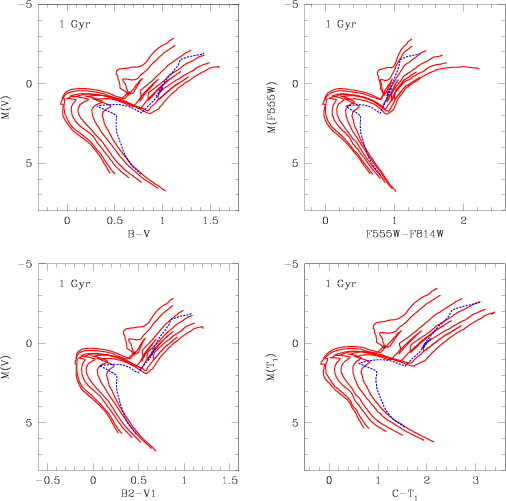 |
Figure 1: Synthetic colour-magnitude diagrams in different observationnal planes (upper left: Johnson, upper right: HST-WFPC2, lower left: Geneva, lower right: Washington system) for the 1 Gyr isochrones at different metallicities: from left to right in each panel, Z = 0.0004, 0.001, 0.004, 0.008, 0.02, 0.04, and Z = 0.1 (dashed line) |
| Open with DEXTER | |
The content of the various files is as follows:
otherwise (Col. 16), and the mass loss
rate (
 in /yr; Col. 17).
Columns 1-15 contain the following values: ID of evolutionary point
(Col. 1), age (2), present mass (3),
in /yr; Col. 17).
Columns 1-15 contain the following values: ID of evolutionary point
(Col. 1), age (2), present mass (3),
 (4),
(4),
 (5), and the surface abundances in mass fraction of H,
4He, 12C, 13C, 14N, 16O, 17O, 18O,
20Ne, and 22Ne (Cols. 6-15).
The central properties are given in the tables of the original
papers.
(5), and the surface abundances in mass fraction of H,
4He, 12C, 13C, 14N, 16O, 17O, 18O,
20Ne, and 22Ne (Cols. 6-15).
The central properties are given in the tables of the original
papers.
(4),
(5),
(6), M(V) (7),
U-B (8), B-V (9), V-R (10), V-I (11), V-K (12), R-I (13), I-K (14), J-H (15), H-K (16), K-L (17), J-K (18),
J-L (19), J-L2 (20), K-M (21).
(4),
(5),
(6), M(V) (7),
F336W-F439W (8), F439W-F555W (9), F555W-F675W (10), F555W-F814W
(11), F675W-F814W (12), F439W-V (13).
(4),
(5),
(6), M(V) (7),
U-B (8), B1-B (9), B2-B (10), V1-B (11), V*-B (12),
G-B (13), B1-B2 (14), B2-V1 (15), V1-G (16), V*-V (17).
(4),
(5),
(6), M(V) (7),
C-M (8), M-T1 (9), T1-T2 (10), C-T1 (11), M-T2 (12),
C-R (13), M-R (14), R-T2 (15), V-T1 (16).
 for ages above 1 Myr
(
for ages above 1 Myr
(
 ). For younger ages isochrones are available for
  3.0, 5.0, 5.3, 5.6, 5.8, and 5.9 yr.
The isochrones are grouped in files named according to the following
conventions: iso_Izzz_ffff_tttt.ext, where I stands for
the database ID (Col. 2), zzz for the metallicity, ffff
and tttt indicate the logarithmic age range (from - to) covered
by isochrones, and ext for the extension specifying the type of
data (see Table 3). For example iso_c001_0300_1020.UBVRIJHKLM includes the (UBV)(RI)
JHKLLM photometry of
all isochrones with ages from 103 yr to 1010.2 yr (
15.8
Gyr) of grid # 2.
The content of the files is the same as for the stellar tracks described above, with the following exceptions: Col. 1 is replaced by a line number, and Col. 2 now gives the initial mass along the isochrone.
In Fig. 1, we give an illustration of some synthetic c-m diagrams obtained from the present database. The figure shows in various planes the 1 Gyr isochrones at the different metallicities available (Z = 0.0004, 0.001, 0.004, 0.008, 0.02, 0.04, and 0.1). The peculiar behaviour of the Z=0.1 isochrone is due to the overluminosity and the hotter temperature of these very metal-rich stars discussed in detail in Mowlavi et al. (1998a,b).
and on the Web page http://webast.ast.obs-mip.fr/stellar/.
Future updates of the
database, including e.g. additional photometric systems, are foreseen
through the latter site.
For most purposes the "basic model set'' (files with the ID "c'')
should be appropriate. The tracks of this set have e.g. been applied
to analysis of Galactic open clusters with ages 4 Myr-9.5 Gyr by Meynet et al. (1993).
For analysis of massive stars (
 )
the
high mass loss models (ID: "e'') should preferrentially be used (see
Maeder & Meynet 1994).
)
the
high mass loss models (ID: "e'') should preferrentially be used (see
Maeder & Meynet 1994).
For studies of low mass stars (
 0.4-2.5 )
the combined model set (ID: "l'') at Z=0.001 and Z=0.02 should
be most appropriate since it includes the MHD equation of state for
0.4-2.5 )
the combined model set (ID: "l'') at Z=0.001 and Z=0.02 should
be most appropriate since it includes the MHD equation of state for  and covers also the post-helium flash evolutionary phases
of stars with masses 0.8
and covers also the post-helium flash evolutionary phases
of stars with masses 0.8  .
.
For studies limited to the lowest masses ( )
the "m''
set should be preferred.
For studies critical to the properties of stars in the mass range
1-1.5 ,
corresponding to the appearance of core convection on
the main sequence, the "o'' sets allow in comparison with the basic
sets ("c'') to study the effect of enhanced convective cores
(overshooting) in this mass range.
As mentioned earlier, the Geneva stellar grids used in this work do not include thermally pulsing AGB stars and post-AGB phases, such as central stars of planetary nebulae (CSPN) and white dwarfs (WD). If necessary the present data must be complemented with existing calculations from the literature. For recent calculations of AGB stars we refer e.g. to the complete or combined complete + synthetic models of Vassiliadis & Wood (1993); Blöcker (1995a); Forestini & Charbonnel (1997); and Langer et al. (1999), and to the synthetic models of Van den Hoeck & Groenewegen (1997) and Marigo et al. (1998). Recent models of CSPN and WD are given by e.g. Blöcker (1995b); Driebe et al. (1998), and Hansen & Phinney (1998).
 is briefly summarised here.
The input physics is identical to that of Meynet et al. (1994, Paper V). This includes in particular the adoption of "high'' mass loss
rates, i.e.
 /yr for WNL stars and twice
the mass loss rates of de Jager et al. (1988) for stars with
/yr for WNL stars and twice
the mass loss rates of de Jager et al. (1988) for stars with
 .
Otherwise we follow the prescription of Paper I. For consistence with the earlier grids the initial composition is
calculated as in Paper I: X=0.7584, Y=0.2412, Z=0.0004.
.
Otherwise we follow the prescription of Paper I. For consistence with the earlier grids the initial composition is
calculated as in Paper I: X=0.7584, Y=0.2412, Z=0.0004.
The HRD with the calculated tracks is shown in
Fig. A1.
Hatched areas indicate regions of slow nuclear
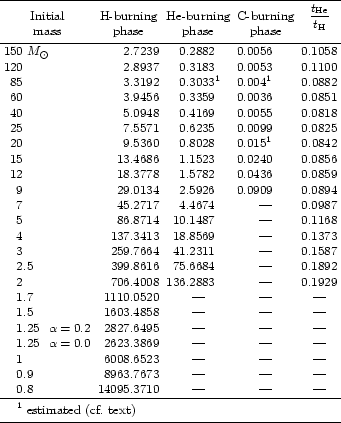
burning phases. The H, He, and C burning lifetimes are given in Table A1. Due to numerical instabilities the 85
model
could not be fully evolved to the end of He burning. The remaining
He-burning lifetime as well as the duration of C-burning were
estimated by interpolation between the two adjacent tracks.
For similar reasons  of the 20
model had also
to be estimated.
of the 20
model had also
to be estimated.
The mass limit for the formation of WR stars,
 ,
at
Z=0.0004 from the present tracks is
,
at
Z=0.0004 from the present tracks is
 85 ,
as
already derived in de Mello et al. (1998). Other properties of the
Z=0.0004 models can readily be derived from the detailed data included
in the present database.
85 ,
as
already derived in de Mello et al. (1998). Other properties of the
Z=0.0004 models can readily be derived from the detailed data included
in the present database.
Acknowledgements
We thank G. Burki, N. Cramer and B. Nicolet for help with the Geneva photometric system. We have benefited from useful discussions with R. Buser, C. Charbonnel, A. Maeder, J.-C. Mermilliod, and G. Meynet. E. Grebel and E. Tolstoy provided some early user feedback on the database. TL gratefully acknowledges financial support from the Swiss National Science Foundation (grant 20-53660.98 to Prof. Buser) and from the "Fundação para a Ciência e Tecnologia'' (Portugal), (grant PRAXIS-XXI/BPD/22061/99).
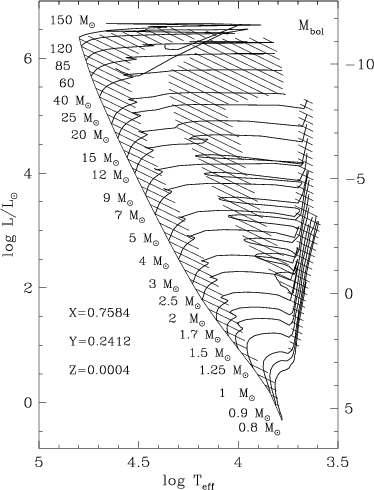
 .
The slow phases of nuclear burning are indicated by
hatched areas. The
.
The slow phases of nuclear burning are indicated by
hatched areas. The
 track corresponds to the model
without overshooting
track corresponds to the model
without overshooting