A&A 366, 311-316 (2001)
DOI: 10.1051/0004-6361:20000290
Solar model: Element diffusion or metal-enhanced envelope?
J. Y. Yang - Y. Li - H. Y. Xu
Yunnan Observatory, NAOCAS, PO Box 110, Kunming 650011, PR China
Received 16 December 1998 / Accepted 4 October 2000
Abstract
Solar models with moderate enrichment of heavy elements in the convective
envelope (CSM) and with element diffusion (DSM) are investigated using
updated input physics. It is found that both CSM and DSM can result
in adequate depth of the convection zone and appropriate surface helium
abundance, and the agreement between the calculated and observed
p-mode frequencies are also improved. The sound speed of DSM is better
than CSM and the standard solar model (SSM) in the deep interior, which means
that element diffusion helps improve the sound speed profile in
the solar interior. In the area just below the base of the convection zone, CSM
is the best of the three models.
Key words: solar structure - solar evolution - solar oscillations
Solar models are crucial to verify the hypotheses
used in modeling of stellar evolution. Precise solar models have been
constructed over the past three decades. Today we have
two methods to probe the structure of solar interior: solar neutrino
experiments and helioseismological analysis. The results of these investigations
impose stringent restrictions on the solar modeling, and allow
definitive tests and refinements of the input physics.
An important assumption involved in the so-called standard solar
models (SSM) is that, except for the central nuclear transmutation,
the chemical composition is homogeneous in the solar interior and
remains constant throughout the solar evolution. A discrepancy
has existed between SSM predictions of neutrino fluxes and the rates
observed in terrestrial experiments for more than three decades
(Bahcall 1989). In
recent years, the combined results from four solar neutrino experiments
have sharpened the discrepancy.
Low Z models were proposed at the beginning to reduce the predicted
solar neutrino flux (Bahcall & Ulrich 1971).
Contrary to the standard models, low Z models take into
account the possibility of chemical stratification of the Sun.
A pre-main sequence star is chemically homogeneous, since it
experiences fully convective mixing during the Hayashi phase of evolution.
However, the star may capture afterwards some interplanetary matter.
Joss (1974) suggested that stellar surfaces
may be continuously enriched with heavy elements by in-falling comets.
Levy & Ruzmaikina (1994) investigated the effects
of dust-gas separation during the star formation process. As they pointed
out, dust grains
that aggregate by turbulence to large sizes will settle from the upper
layers toward the center of the molecular cloud and merge into the
proto-planetary nebula disk, and finally fall onto the star by means
of disk accretion. For the case of the Sun that has a convection zone
just below its photosphere, the falling matter will be mixed into the
whole convection zone. As the metal abundance of the interplanetary
dust is much higher than that of the solar material, the solar
convection zone will be enhanced with heavy elements.
Low Z models can give rather low neutrino fluxes, but can not completely
solve the solar neutrino problems. Moreover, they usually result
in shallow convection zones and very low initial helium abundance,
and their calculated p-mode oscillation frequencies and sound
speed in the solar interior are not in agreement with observations
(Christensen-Dalsgaard et al. 1979;
Christensen-Dalsgaard & Gough 1980; Bahcall & Ulrich 1988). Therefore,
in recent years low Z models have been thought to
be unrealistic. At the same time, more and more
authors prefer the standard solar models with helium and heavy
element diffusion (Bahcall & Pinsonneault 1992; Bahcall et al. 1995; Bahcall et al. 1997;
Bahcall et al. 1998). The computed depth of the
convective zone, the
present-day surface helium abundance and the sound speeds of these
models are in good agreement with helioseismological measurements,
but the calculated neutrino event rates are even higher than that of the
standard solar models.
However, much evidence indicates that the solar envelope has inevitably
been contaminated by interplanetary material, even if not as much
as demanded by previous low Z models. Henney & Ulrich (1998) investigated
the effects of cometary mass accretion with heavy-element diffusion on
solar oscillation frequencies. They found that for solar models with
element diffusion, the addition of mass accretion shifts the predicted
p-mode frequencies to slightly lower values, and the predicted g-mode
frequencies exhibit a greater shift of approximately 1 Hz. The net
accreted masses they chose are 1.7, 8.3 and 166 earth masses, but we
think these values are too low or too high. In this paper, we investigate
the moderate enhancement of the envelope metallicity, using updated
input physics, and focus our attention on
the influences of the structure and p-mode oscillations
of the Sun. Our input physics and model computation method are described
in Sect. 2. We discuss and compare the properties of the metal-enriched
model with that of the standard and diffusion models
in Sect. 3 and their seismic
properties in Sect. 4. Our main conclusions are summarized in Sect. 5.
Solar evolution models are calculated using an evolution code
originally written by Bohdan Paczynski and Maciek Kozlowski,
and updated by Ryszard Sienliewicz in 1995. We made some modifications
to incorporate metal-enhancement of the solar envelope. Energy
transfer by convection is treated according to the standard mixing-length
theory, and the boundaries of the convection zones are determined by
the Schwarzschild criterion (see Cox & Giuli 1968).
Nuclear reaction rates are those used in BP95
(Bahcall et al. 1995). The equation of state we used here is
the OPAL EOS from Lawrence Livermore National Laboratory (Rogers 1994;
Rogers et al. 1996).
OPAL opacities GN93hz series
(Rogers & Iglesias 1995; Iglesias & Rogers 1996) are used in the high
temperature region. In the outer envelope of the Sun, low-temperature
opacities from Alexander & Ferguson (1994) are
used to include the contributions from molecules and grains. These two
sets of opacity data are connected around temperatures of 8000 K, at
that fitting point they coincide closely. For the model that
considered helium and heavy element diffusion, we used the exportable
diffusion subroutine of Thoule et al. (Thoule et al. 1994).
Our solar models consist
of more than 10000 mass zones and are evolved from the zero-age main
sequence for 210 time steps to reach the present solar age.
Previous low Z models usually adopted very low central metal abundance,
so as to reduce the calculated neutrino emission fluxes. Observations
show, however, that the Sun has the normal Population I abundance
(Anders & Grevesse 1989;
Grevesse & Noels 1993). Solar neutrino experiments also put strong
restrictions on the metal abundance distribution, i.e., the metal
abundances in the solar interior do not deviate too much from its
surface observation value (Fukugita & Hata 1998).
Correspondingly, we chose the initial metallicity to be Z0=0.015,
which is much higher than the choices of other investigations
(see Bahcall & Ulrich 1971; Christensen-Dalsgaard et al. 1979).
Interplanetary mass accretion can be very complex. According to the
present observation, the processes of mass accretion and mass loss may
be co-exist at the same time. If considerable interplanetary matter falls
onto the Sun, we prefer to believe that this occurs during the early
phase of the solar evolution, when the Sun is still surrounded by an
opaque disk. We assume, for simplicity, that the Sun
acquires an amount of matter made up of purely heavy elements
at a certain moment in its early evolution,
resulting in the enhancement of its envelope
metallicity to the present observed value of Z=0.02. This is also distinct
from the previous approaches of gradual enrichment of the envelope
metallicity. As we can see below, the mass falling onto the Sun
corresponding to this enhancement of metal abundance is about 40 earth masses,
which is just in the gap of Henney and Ulrich's investigation. The fallen
interplanetary matter immediately spreads out
by convective motion to the whole convection zone. The Sun then
consists of two parts, the envelope enhanced with heavy elements
and the core, being of the original metal abundance, with the bottom of the
convection zone as the boundary.
Suppose
Hz. The net
accreted masses they chose are 1.7, 8.3 and 166 earth masses, but we
think these values are too low or too high. In this paper, we investigate
the moderate enhancement of the envelope metallicity, using updated
input physics, and focus our attention on
the influences of the structure and p-mode oscillations
of the Sun. Our input physics and model computation method are described
in Sect. 2. We discuss and compare the properties of the metal-enriched
model with that of the standard and diffusion models
in Sect. 3 and their seismic
properties in Sect. 4. Our main conclusions are summarized in Sect. 5.
Solar evolution models are calculated using an evolution code
originally written by Bohdan Paczynski and Maciek Kozlowski,
and updated by Ryszard Sienliewicz in 1995. We made some modifications
to incorporate metal-enhancement of the solar envelope. Energy
transfer by convection is treated according to the standard mixing-length
theory, and the boundaries of the convection zones are determined by
the Schwarzschild criterion (see Cox & Giuli 1968).
Nuclear reaction rates are those used in BP95
(Bahcall et al. 1995). The equation of state we used here is
the OPAL EOS from Lawrence Livermore National Laboratory (Rogers 1994;
Rogers et al. 1996).
OPAL opacities GN93hz series
(Rogers & Iglesias 1995; Iglesias & Rogers 1996) are used in the high
temperature region. In the outer envelope of the Sun, low-temperature
opacities from Alexander & Ferguson (1994) are
used to include the contributions from molecules and grains. These two
sets of opacity data are connected around temperatures of 8000 K, at
that fitting point they coincide closely. For the model that
considered helium and heavy element diffusion, we used the exportable
diffusion subroutine of Thoule et al. (Thoule et al. 1994).
Our solar models consist
of more than 10000 mass zones and are evolved from the zero-age main
sequence for 210 time steps to reach the present solar age.
Previous low Z models usually adopted very low central metal abundance,
so as to reduce the calculated neutrino emission fluxes. Observations
show, however, that the Sun has the normal Population I abundance
(Anders & Grevesse 1989;
Grevesse & Noels 1993). Solar neutrino experiments also put strong
restrictions on the metal abundance distribution, i.e., the metal
abundances in the solar interior do not deviate too much from its
surface observation value (Fukugita & Hata 1998).
Correspondingly, we chose the initial metallicity to be Z0=0.015,
which is much higher than the choices of other investigations
(see Bahcall & Ulrich 1971; Christensen-Dalsgaard et al. 1979).
Interplanetary mass accretion can be very complex. According to the
present observation, the processes of mass accretion and mass loss may
be co-exist at the same time. If considerable interplanetary matter falls
onto the Sun, we prefer to believe that this occurs during the early
phase of the solar evolution, when the Sun is still surrounded by an
opaque disk. We assume, for simplicity, that the Sun
acquires an amount of matter made up of purely heavy elements
at a certain moment in its early evolution,
resulting in the enhancement of its envelope
metallicity to the present observed value of Z=0.02. This is also distinct
from the previous approaches of gradual enrichment of the envelope
metallicity. As we can see below, the mass falling onto the Sun
corresponding to this enhancement of metal abundance is about 40 earth masses,
which is just in the gap of Henney and Ulrich's investigation. The fallen
interplanetary matter immediately spreads out
by convective motion to the whole convection zone. The Sun then
consists of two parts, the envelope enhanced with heavy elements
and the core, being of the original metal abundance, with the bottom of the
convection zone as the boundary.
Suppose
 to be the initial mass of the model and
 the mass of the convection zone just before
the metal contamination. After the acquirement of the interplanetary
matter, which is assumed to be composed of purely heavy elements,
the mass of the model increases to
the mass of the convection zone just before
the metal contamination. After the acquirement of the interplanetary
matter, which is assumed to be composed of purely heavy elements,
the mass of the model increases to
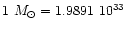 g,
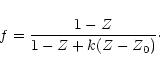
while the metal abundance in the convection zone increases from Z0
to Z. After a few steps of simple manipulations, f is found to be:
g,
while the metal abundance in the convection zone increases from Z0
to Z. After a few steps of simple manipulations, f is found to be:
 |
(1) |
We have calculated three different series of evolution models. SSM and DSM
are standard models, without and with helium and heavy
element diffusion, respectively. Neither model considers the effects
of metal enrichment. CSM is a metal enriched model without element
diffusion, in order to distinguish the effects of the envelope metal
enrichment and element diffusion. We assume that the metal enrichment
takes place at the zero-age main sequence. The initial
helium abundance, Y0, and the mixing-length to pressure scale
height ratio,  ,
are iteratively adjusted to give the solar
luminosity (
,
are iteratively adjusted to give the solar
luminosity (
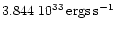 )
and solar
radius (
6.96 1010cm) at the present solar age (4.566 Gyrs)
(see Dar & Shaviv 1996).
In the meantime, the mass fraction of the convection zone just before
the interplanetary contamination, k, is also found.
Table 1 gives the basic parameters of the three models, where
Y0 and Z0 are the initial helium and metal abundance. For solar
age models,
)
and solar
radius (
6.96 1010cm) at the present solar age (4.566 Gyrs)
(see Dar & Shaviv 1996).
In the meantime, the mass fraction of the convection zone just before
the interplanetary contamination, k, is also found.
Table 1 gives the basic parameters of the three models, where
Y0 and Z0 are the initial helium and metal abundance. For solar
age models,  and
and  are the surface helium and metal
abundance,
are the surface helium and metal
abundance,  and
and  are the central helium and
metal abundance,
are the central helium and
metal abundance,  and
and
 are the central
temperature and density,
are the central
temperature and density,
 is the mass interior to the
base of the convection zone,
is the mass interior to the
base of the convection zone,
 and
and
 are the
radius and temperature at the base of the convection zone,
are the
radius and temperature at the base of the convection zone,
 and
and
 are neutrino fluxes for Cl and Ga detectors.
Table 1:
Properties of evolution models
| Parameters |
SSM |
DSM |
CSM |
Observation |
| Y0 |
0.275 |
0.272 |
0.250 |
|
| Z0 |
0.02 |
0.02 |
0.015 |
|
|
1.638 |
1.726 |
1.697 |
|
 |
|
|
0.000129 |
|
 |
0.275 |
0.242 |
0.248 |
 |
 |
0.02 |
0.018 |
0.02 |
|
|
0.632 |
0.649 |
0.605 |
|
|
0.02 |
0.021 |
0.015 |
|
 |
15.69 |
15.79 |
15.35 |
|
 |
153.2 |
157.7 |
150.7 |
|
 |
0.979 |
0.977 |
0.979 |
|
 |
0.724 |
0.716 |
0.719 |
 |
 |
2.122 |
2.155 |
2.139 |
|
|
(SNUs) |
7.70 |
8.52 |
5.32 |
 |
|
(SNUs) |
127.50 |
131.52 |
115.88 |
 |
It can be found from Table 1 that 1-f, which is the mass in units of
 falling onto the Sun, is about
 .
This value (1029 g) coincides with those of some other authors.
For instance, Jeffery et al. (Jeffery et al. 1997) considered
six main sources of infalling material to estimate the mass
accreted onto the solar surface during its main-sequence lifetime
to be about 6 1029 g.
.
This value (1029 g) coincides with those of some other authors.
For instance, Jeffery et al. (Jeffery et al. 1997) considered
six main sources of infalling material to estimate the mass
accreted onto the solar surface during its main-sequence lifetime
to be about 6 1029 g.
![\begin{figure}
\par\includegraphics[angle=-90,width=8.8cm,clip]{8405f1.eps}
\end{figure}](/articles/aa/full/2001/04/aa8405/Timg33.gif) |
Figure 1:
Masses included beyond the bases of the convection zones of
SSM, DSM and CSM during the evolution. Solid line represent SSM,
dashed line is for DSM, and dotted line is for CSM |
| Open with DEXTER |
If we take the metal abundance of the interplanetary dust to be the
solar value of 0.02 as a minimum limit, the mass required to provide
the captured heavy elements is
 ,
which is about 30
percent of the mass of the solar proto-planetary nebula of
,
which is about 30
percent of the mass of the solar proto-planetary nebula of
 (Safronov & Ruzmaikina 1985). Therefore, the accreted mass
in our model is acceptable.
It is very interesting to notice that the surface helium abundance and
the bases of the convection zone
for the metal enriched model CSM are 0.248 and
(Safronov & Ruzmaikina 1985). Therefore, the accreted mass
in our model is acceptable.
It is very interesting to notice that the surface helium abundance and
the bases of the convection zone
for the metal enriched model CSM are 0.248 and
 ;
both
are in good agreement with recent helioseismic determinations
;
both
are in good agreement with recent helioseismic determinations
 (Basu & Antia 1997)
and
(Basu & Antia 1997)
and
 (Basu
& Antia 1995). This is contrary to the
results of previous investigations, in which metal enriched models result
in shallow convection zones and very low surface helium abundances
(see Christensen-Dalsgaard et al. 1979;
Christensen-Dalsgaard & Gough 1980; Bahcall & Ulrich 1988).
For the standard model with element diffusion, DSM, these two values are
0.242 and
(Basu
& Antia 1995). This is contrary to the
results of previous investigations, in which metal enriched models result
in shallow convection zones and very low surface helium abundances
(see Christensen-Dalsgaard et al. 1979;
Christensen-Dalsgaard & Gough 1980; Bahcall & Ulrich 1988).
For the standard model with element diffusion, DSM, these two values are
0.242 and
 ,
also in good agreement with the measured values.
This is similar to many other authors' results (see Bahcall et al. 1995;
Bahcall & Pinsonneault 1998). We can
conclude from Table 1 that SSM is in poor agreement with helioseismological
analysis. Element diffusion and settling are initially introduced to
reduce the envelope helium abundance during the evolution. Now we have
another approach to remedy the discrepancy between the calculated and
observed solar envelope helium abundance. It should be noticed that,
unlike the helium diffusion that brings the helium originally in the
solar envelope down to the solar core and leaves a helium abundance
profile in the present solar interior, our approach will reduce the
helium abundance over the whole solar interior from the beginning
of the solar evolution.
It can be seen from Table 1 that CSM gives lower
neutrino fluxes for either Cl or Ga detectors while DSM gives higher
fluxes than SSM. The reason is mainly due
to the fact that the central helium abundance of CSM,
which is of strong influence on the flux of high energy neutrinos,
is considerably lower than that of SSM, while
of DSM
is higher than that of SSM. Further
decrease of the central heavy element abundance can still reduce
the neutrino fluxes, along with smaller values of the initial
helium abundance, and therefore, is not a reasonable measure to
solve the solar neutrino anomaly.
Evolution for the convection zones of three models are shown in Figs. 1
and 2. The solid line is for SSM, dashed line is for DSM and dotted
line is for CSM. As shown in Fig. 1, the masses exterior to the bases of the
convection zones for all three models always decrease during their
evolution, and DSM has more mass in its convection envelope than CSM and
SSM. The temperature at the base of the convection zone for the three
models show similar behavior: they all decrease as the age increases,
and DSM has a higher temperature than SSM and CSM, as seen in Fig. 2.
,
also in good agreement with the measured values.
This is similar to many other authors' results (see Bahcall et al. 1995;
Bahcall & Pinsonneault 1998). We can
conclude from Table 1 that SSM is in poor agreement with helioseismological
analysis. Element diffusion and settling are initially introduced to
reduce the envelope helium abundance during the evolution. Now we have
another approach to remedy the discrepancy between the calculated and
observed solar envelope helium abundance. It should be noticed that,
unlike the helium diffusion that brings the helium originally in the
solar envelope down to the solar core and leaves a helium abundance
profile in the present solar interior, our approach will reduce the
helium abundance over the whole solar interior from the beginning
of the solar evolution.
It can be seen from Table 1 that CSM gives lower
neutrino fluxes for either Cl or Ga detectors while DSM gives higher
fluxes than SSM. The reason is mainly due
to the fact that the central helium abundance of CSM,
which is of strong influence on the flux of high energy neutrinos,
is considerably lower than that of SSM, while
of DSM
is higher than that of SSM. Further
decrease of the central heavy element abundance can still reduce
the neutrino fluxes, along with smaller values of the initial
helium abundance, and therefore, is not a reasonable measure to
solve the solar neutrino anomaly.
Evolution for the convection zones of three models are shown in Figs. 1
and 2. The solid line is for SSM, dashed line is for DSM and dotted
line is for CSM. As shown in Fig. 1, the masses exterior to the bases of the
convection zones for all three models always decrease during their
evolution, and DSM has more mass in its convection envelope than CSM and
SSM. The temperature at the base of the convection zone for the three
models show similar behavior: they all decrease as the age increases,
and DSM has a higher temperature than SSM and CSM, as seen in Fig. 2.
![\begin{figure}
\par\includegraphics[angle=-90,width=8.8cm,clip]{8405f2.eps}
\end{figure}](/articles/aa/full/2001/04/aa8405/Timg40.gif) |
Figure 2:
Temperatures at the bases of the convection zones for SSM, DSM
and CSM. Solid line is for SSM, dashed line is for DSM, and dotted
line is for CSM |
| Open with DEXTER |
Figures 3 and 4 show for the solar age models the differences of the
temperature and pressure profiles of DSM and CSM with respect to
that of SSM. It can be seen that the temperatures over the whole
interior of CSM are 1-3% cooler than SSM, while DSM has almost
the same temperature as SSM in the core and is approximately
2.5% cooler than SSM in the convective envelope.
The pressure of CSM is higher (about 0-1%) in the nuclear
burning core and lower (about 0-4%) in the middle radiative and
outermost convective zones than that of SSM, while the behave of DSM
is opposite, i.e. lower in the core and higher in the envelope.
![\begin{figure}
\par\includegraphics[angle=-90,width=8.8cm,clip]{8405f3.eps}
\end{figure}](/articles/aa/full/2001/04/aa8405/Timg41.gif) |
Figure 3:
Temperature differences of DSM and CSM with respect to SSM.
Solid line is for DSM to SSM, and dotted line for CSM to SSM |
| Open with DEXTER |
![\begin{figure}
\par\includegraphics[angle=-90,width=8.8cm,clip]{8405f4.eps}
\end{figure}](/articles/aa/full/2001/04/aa8405/Timg42.gif) |
Figure 4:
Pressure differences of DSM and CSM with respect to SSM.
Solid line is for DSM to SSM, and dotted line for CSM to SSM |
| Open with DEXTER |
The three solar age models are input into an updated linear adiabatic
pulsation code of Li (1992) to calculate the p-mode
oscillation frequencies. We calculated the frequencies
for the spherical harmonic degree
l=0,1,2,3. Frequencies of modes with high values of l are
seriously influenced by the non-adiabatic effects and are not
considered in this paper.
We have used the gray atmosphere
in our p-mode oscillation calculations.
In Fig. 5 we compare the calculated frequencies of l=0,1,2,3
with the observed
values obtained by Libbrecht et al. (1990). It
is found that the p-mode frequencies of DSM and CSM are in better
agreement with the observations than those of SSM. This is an
important result, and completely contradicts the conclusions of
previous low Z models. As our metal enriched models should not
necessarily result in worse p-mode frequencies, a major argument
against the possibility of non-homogeneous solar models may
no longer be valid.
We notice that the tendency of the frequency differences between
the calculation and observation is similar for all three models.
For the cases of l=0,1, the p-mode frequencies of DSM and CSM
are in good agreement with each other, while those of SSM are
slightly higher than those of DSM and CSM. When l=2,3, the p-mode
frequencies of CSM are close to those of SSM.
![\begin{figure}
\par\includegraphics[angle=-90,width=13.5cm,clip]{8405f5.eps}
\end{figure}](/articles/aa/full/2001/04/aa8405/Timg43.gif) |
Figure 5:
Comparisons of calculated solar p-mode frequencies of
l=0,1,2,3 with respect to the observations. Solid line is for
SSM, dashed line is for DSM and dotted line is for CSM |
| Open with DEXTER |
Figure 6 shows the profiles of sound speed differences of the three
models with respect to the observed values (Basu et al. 2000). It
can be seen from Fig. 6 that the calculated sound speed
is higher in the nuclear fusion cores and lower in the outer
adjacent radiative zones than the observed sound speed,
and is almost the same as the observation in the convection zones for all three
models. For the solar interior where
 ,
DSM is in better
agreement with observation than SSM, while CSM is worse than SSM,
but the maximum difference is less than 1%. It seems that all three models
are acceptable, and element diffusion could improve the sound speed
profile in the deep interior of the Sun. In the area just below
the base of the convection zone, the calculated sound speed from CSM is almost the
same as the observed value, while DSM and SSM give their maximum
difference, which is about 0.6%.
Low Z models have been rejected so far due to three major disagreements
with observations: the depths of their convection zones are shallower
than the seismic determined value, their p-mode frequencies are in
poor agreement with the observations, and their initial helium
abundance adjusted by matching the model's radius and luminosity to
the observed values at the present solar age is too small. However,
much evidence indicates that the Sun may be enriched
with heavy elements, and the metal abundance in its convection zone
can be higher than in the radiative core.
,
DSM is in better
agreement with observation than SSM, while CSM is worse than SSM,
but the maximum difference is less than 1%. It seems that all three models
are acceptable, and element diffusion could improve the sound speed
profile in the deep interior of the Sun. In the area just below
the base of the convection zone, the calculated sound speed from CSM is almost the
same as the observed value, while DSM and SSM give their maximum
difference, which is about 0.6%.
Low Z models have been rejected so far due to three major disagreements
with observations: the depths of their convection zones are shallower
than the seismic determined value, their p-mode frequencies are in
poor agreement with the observations, and their initial helium
abundance adjusted by matching the model's radius and luminosity to
the observed values at the present solar age is too small. However,
much evidence indicates that the Sun may be enriched
with heavy elements, and the metal abundance in its convection zone
can be higher than in the radiative core.
![\begin{figure}
\par\includegraphics[angle=-90,width=8.8cm,clip]{8405f6.eps}
\end{figure}](/articles/aa/full/2001/04/aa8405/Timg45.gif) |
Figure 6:
The sound speed differences of three models with respect to
observation values. Solid line is for SSM, dashed
line is for DSM and dotted line is for CSM |
| Open with DEXTER |
We investigate this possibility again, using up-to-date input
physics and some improvements. We do not adopt a very low central
metal abundance, which has often been used to considerably reduce the
predicted solar neutrino flux. Instead, we calculate a model
with the central metal abundance just a little lower than the surface value.
It is interesting to note that our metal enriched model results in adequate
depth of the convection zone and appropriate surface helium abundance,
both of which are in good agreement with
the seismic results. The agreement between the p-mode frequencies
of our metal enriched models and the observations are also improved,
and even better than the standard homogeneous solar model, SSM. The sound speed
of our model CSM is worse than SSM but that of DSM is better than SSM
in the area where
.
It seems that element diffusion can reduce the difference of the sound speed
between calculated and observed in the solar interior. In the
base of the convective envelope, our model gives the sound speed more accurately
than that of DSM and SSM. Further more, our metal-enriched model CSM
gives lower neutrino fluxes for either Cl or Ga detectors than do SSM and
DSM, which is helpful to solve the solar neutrino problem.
Investigations based on the solar neutrino experiments made by
Fukugita & Hata (1998) set an important restriction
on the metal abundance distribution over the solar interior, i.e.
the ratio of the metal abundance in the solar core to that in the
solar envelope is in the range of 0.4-1.4, with the peak of the
probability at 0.8. This clearly shows that the central metal
abundance can be smaller than the surface
metal abundance of the Sun.
Given the improvements discussed above, we conclude that solar models
with an enhancement of heavy elements exterior to the base of their
convection zones are still useful, and we cannot rule out either
DSM or CSM with present helioseismological analysis.
Acknowledgements
This work are co-sponsored by the NSFC of China through project number
19625306 and 19833040 and National Key Fundamental Research Project
"Formation and Evolution of Galaxies''. Fruitful
discussions with R.Q. Huang, G.Q. Luo, and Z.W. Han are highly
appreciated.
-
Alexander, D. R., & Ferguson, J. W. 1994, ApJ, 437, 879
In the text
NASA ADS
-
Anders, E., & Grevesse, N. 1989, Geochim. Cosmochim. Acta, 53, 197
In the text
NASA ADS
-
Bahcall, J. N. 1989, Neutrino Astrophysics (Cambridge Univ. Press, Cambridge)
In the text
-
Bahcall, J. N., & Ulrich, R. K. 1971, ApJ, 170, 593
In the text
NASA ADS
-
Bahcall, J. N., & Ulrich, R. K. 1988, Rev. Mod. Phys., 60, 297
In the text
NASA ADS
-
Bahcall, J. N., & Pinsonneault, M. H. 1992, Rev. Mod. Phys., 64, 885
In the text
NASA ADS
-
Bahcall, J. N., Pinsonneault, M. H., & Wasserburg, G. J. 1995, Rev. Mod. Phys., 67, 781
In the text
NASA ADS
-
Bahcall, J. N., Pinsonneault, M. H., Basu, S., et al. 1997, Phys.
Rev. Lett., 78, 171
In the text
NASA ADS
-
Bahcall, J. N., Basu, S., & Pinsonneault, M. H. 1998, Phys. Lett., B 433, 1
In the text
-
Basu, S., & Antia, H. M. 1995, MNRAS, 276, 1402
In the text
NASA ADS
-
Basu, S., & Antia, H. M. 1997, MNRAS, 287, 189
In the text
NASA ADS
-
Basu, S., Pinsonneault, M. H., & Bahcall, J. N. 2000, ApJ, 529, 1084
In the text
NASA ADS
-
Christensen-Dalsgaard, J., & Gough, D. O. 1980, Nature, 288, 544
In the text
NASA ADS
-
Christensen-Dalsgaard, J., Gough, D. O., & Morgan, J. G. 1979, A&A, 73, 121
In the text
NASA ADS
-
Cox, J. P., & Giuli, R. T. 1968, Principles of Stellar
Structure (Gordon Breach, New York)
In the text
-
Dar, A., & Shaviv, G. 1996, ApJ, 468, 933
In the text
NASA ADS
-
Fukugita, M., & Hata, N. 1998, ApJ, 499, 513
In the text
NASA ADS
-
Grevesse, N., & Noels, A. 1993, Origin and evolution
of the elements, ed. N. Prantzos, E. Vangioni, & M. Cassé (Cambridge Univ. Press, Cambridge), 15
In the text
-
Henney, C. J., & Ulrich, R. K. 1998, Effects of cometary mass accretion
with heavy-element diffusion on solar oscillation frequencies,
Structure and dynamics of the interior of the Sun and Sun-like stars,
Proceedings of SOHO 6/GONE 98 Workshop, 473
In the text
-
Iglesias, C. A., & Rogers, F. J. 1996, ApJ, 464, 943
In the text
NASA ADS
-
Jeffery, C. S., Bailey, M. E., & Chambers, J. E. 1997, Observatory, 117, 224
In the text
NASA ADS
-
Joss, P. C. 1974, ApJ, 191, 771
In the text
NASA ADS
-
Levy, E. H., & Ruzmaikina, T. V. 1994, ApJ, 431, 881
In the text
NASA ADS
-
Li, Y. 1992, A&A, 257, 133
In the text
NASA ADS
-
Libbrecht, K. G., Woodard, M. F., & Kaufman, J. M. 1990, ApJS, 74, 1129
In the text
NASA ADS
-
Rogers, F. J. 1994, The Equation of State in
Astrophysics, ed. G. Chabrier, & E. Schatzman, IAU Colloq., 147, 16
In the text
-
Rogers, F. J., & Iglesias, C. A. 1995, ASP Conf. Ser., 78, 78
In the text
-
Rogers, F. J., Swenson, F. J., & Iglesias, C. A. 1996, ApJ, 456, 902
In the text
NASA ADS
-
Safronov, V. S., & Ruzmaikina, T. V. 1985, in Protostars
and Planets, ed. D. C. Black, & M. S. Mathews, 959
In the text
-
Thoul, A. A., Bahcall, J. N., & Loeb, A. 1994, ApJ, 421, 828
In the text
NASA ADS
Copyright ESO 2001
![\begin{figure}
\par\includegraphics[angle=-90,width=8.8cm,clip]{8405f1.eps}
\end{figure}](/articles/aa/full/2001/04/aa8405/img33.gif)
![\begin{figure}
\par\includegraphics[angle=-90,width=8.8cm,clip]{8405f2.eps}
\end{figure}](/articles/aa/full/2001/04/aa8405/img40.gif)
![\begin{figure}
\par\includegraphics[angle=-90,width=8.8cm,clip]{8405f3.eps}
\end{figure}](/articles/aa/full/2001/04/aa8405/img41.gif)
![\begin{figure}
\par\includegraphics[angle=-90,width=8.8cm,clip]{8405f4.eps}
\end{figure}](/articles/aa/full/2001/04/aa8405/img42.gif)
![\begin{figure}
\par\includegraphics[angle=-90,width=13.5cm,clip]{8405f5.eps}
\end{figure}](/articles/aa/full/2001/04/aa8405/img43.gif)
![\begin{figure}
\par\includegraphics[angle=-90,width=8.8cm,clip]{8405f6.eps}
\end{figure}](/articles/aa/full/2001/04/aa8405/img45.gif)