![[*]](/icons/foot_motif.gif) - F.
Verbunt4
- F.
Verbunt4
A&A 365, 491-507 (2001)
DOI: 10.1051/0004-6361:20000147
G. Nelemans1 - L. R.
Yungelson1,2 - S. F.
Portegies Zwart3 - F.
Verbunt4
Send offprint request: G. Nelemans
1 -
Astronomical Institute ``Anton Pannekoek'',
Kruislaan 403, 1098 SJ Amsterdam, The Netherlands
e-mail: This email address is being protected from spambots. You need JavaScript enabled to view it.
2 -
Institute of Astronomy of the Russian Academy of
Sciences, 48 Pyatnitskaya Str., 109017 Moscow, Russia
e-mail: This email address is being protected from spambots. You need JavaScript enabled to view it.
3 -
Department of Physics and Center for Space Research, MIT,
77 Massachusetts Avenue, Cambridge,
MA 02139, USA
e-mail: This email address is being protected from spambots. You need JavaScript enabled to view it.
4 -
Astronomical Institute, Utrecht University,
PO Box 80000, 3508 TA Utrecht, The Netherlands
e-mail: F.W.M This email address is being protected from spambots. You need JavaScript enabled to view it.
Received 3 July 2000 / Accepted 19 October 2000
Abstract
We model the population of double white dwarfs in the Galaxy and
find a better agreement with observations compared to earlier
studies, due to two modifications. The first is the treatment of the
first phase of unstable mass transfer and the second the modelling
of the cooling of the white dwarfs.
A satisfactory agreement with observations of the local sample of
white dwarfs is achieved if we assume that the initial binary
fraction is  50% and that the lowest mass white dwarfs (
 )
cool faster than the most recently published cooling
models predict.
With this model we find a Galactic birth rate of close double
white dwarfs of 0.05 yr-1, a birth rate of AM CVn systems of
0.005 yr-1, a merger rate of pairs with a combined mass
exceeding the Chandrasekhar limit (which may be progenitors of
SNe Ia) of 0.003 yr-1 and a formation rate of planetary nebulae
of 1 yr-1. We estimate the total number of double white dwarfs
in the Galaxy as 2.5 108.
In an observable sample with a limiting magnitude
)
cool faster than the most recently published cooling
models predict.
With this model we find a Galactic birth rate of close double
white dwarfs of 0.05 yr-1, a birth rate of AM CVn systems of
0.005 yr-1, a merger rate of pairs with a combined mass
exceeding the Chandrasekhar limit (which may be progenitors of
SNe Ia) of 0.003 yr-1 and a formation rate of planetary nebulae
of 1 yr-1. We estimate the total number of double white dwarfs
in the Galaxy as 2.5 108.
In an observable sample with a limiting magnitude
 we predict the presence of 855 white dwarfs of which
220 are close pairs. Of these 10 are double CO white
dwarfs of which one has a combined mass exceeding the Chandrasekhar
limit and will merge within a Hubble time.
we predict the presence of 855 white dwarfs of which
220 are close pairs. Of these 10 are double CO white
dwarfs of which one has a combined mass exceeding the Chandrasekhar
limit and will merge within a Hubble time.
Key words: stars: white dwarfs - stars: statistics - binaries: close - binaries: evolution
Author for correspondance: This email address is being protected from spambots. You need JavaScript enabled to view it.
Close double white dwarfs form an interesting population for a number of reasons.
First they are binaries that have experienced at least two phases of
mass transfer and thus provide good tests for theories of binary
evolution. Second it has been argued that type Ia supernovae arise
from merging double CO white dwarfs (Webbink 1984;
Iben & Tutukov 1984). Thirdly
close double white dwarfs may be the most important contributors to
the gravitational wave signal at low frequencies, probably even
producing an unresolved noise burying many underlying signals
(Evans et al. 1987; Hils et al. 1990).
A fourth reason to study the population of
double white dwarfs is that in combination with binary evolution
theories, the recently developed detailed cooling models for
(low-mass) white dwarfs can be tested.
The formation of the population of double white dwarfs has been studied analytically by Iben & Tutukov (1986a, 1987) and numerically by Lipunov & Postnov (1988); Tutukov & Yungelson (1993, 1994); Yungelson et al. (1994); Han et al. (1995); Iben et al. (1997, hereafter ITY97), and Han (1998, hereafter HAN98). Comparison between these studies gives insight in the differences that exist between the assumptions made in different synthesis calculations.
Following the discovery of the first close double white dwarf (Saffer et al. 1988), the observed sample of such systems in which the mass of at least one component is measured has increased to 14 (Maxted & Marsh 1999; Maxted et al. 2000). This makes it possible to compare the models to the observations in more detail.
In this paper we present a new population synthesis for double white dwarfs, which is different from previous studies in three aspects. The first are some differences in the modelling of the binary evolution, in particular the description of a common envelope without spiral-in, in which the change in orbit is governed by conservation of angular momentum, rather than of energy (Sect. 2). The second new aspect is the use of detailed models for the cooling of white dwarfs (Sect. 4.3), which are important because it is the rate of cooling which to a large extent determines how long a white dwarf remains detectable in a magnitude-limited observed sample. The third new aspect is that we use different models of the star formation history (Sect. 5). Results are presented in Sect. 6 and discussed in Sect. 7. The conclusions are summarised in Sect. 8. In the Appendix some details of our population synthesis are described.
The code we use is based on the code described by Portegies Zwart & Verbunt (1996) and Portegies Zwart & Yungelson (1998), but has been modified in two respects; the white dwarf masses and the treatment of unstable mass transfer.
The masses of white dwarfs in binaries provide important observational constraints on evolution models. Therefore we have improved the treatment of the formation of white dwarfs in our binary evolution models by keeping more accurate track of the growth of the mass of the core. Details are given in Appendix A.1.1.
There exist two "standard'' scenarios for the formation of close double white dwarfs. In the first, the binary experiences two stages of unstable mass transfer in which a common envelope is formed. The change of the binary orbital separation in a common envelope is treated on the base of a balance between orbital energy and the binding energy of the envelope of the mass-losing star (Paczynski 1976; Tutukov & Yungelson 1979; Webbink 1984; Iben & Livio 1993). The second scenario assumes that the first-born white dwarf of the pair is formed via stable mass transfer, like in Algol-type binaries (possibly accompanied by some loss of mass and angular momentum from the system) and the second white dwarf is formed via a common envelope.
Reconstruction of the evolution of three double helium white dwarfs
with known masses of both components led us to the conclusion that a
spiral-in could be avoided in the first phase of unstable mass
transfer (Nelemans et al. 2000). Briefly, when the mass ratio of two stars
entering a common envelope is not too far from unity, we assume that
the envelope of the evolving giant is ejected without a spiral-in, and
that the change in orbital separation is governed by conservation of
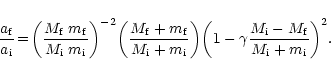
angular momentum (the equation used is given in
Appendix A.2.3).
We parametrise the loss of angular
momentum from the binary with a factor  .
If the mass ratio is
more extreme, the common envelope leads to a spiral-in, which is
governed by the conservation of energy (the equation used is given in
Appendix A.2.2). The efficiency with which the energy of the
binary orbit is used to expell the envelope of the giant is
parametrised by a factor
.
If the mass ratio is
more extreme, the common envelope leads to a spiral-in, which is
governed by the conservation of energy (the equation used is given in
Appendix A.2.2). The efficiency with which the energy of the
binary orbit is used to expell the envelope of the giant is
parametrised by a factor
 .
We switch between
the two descriptions at the mass ratio where both give the same change
of the separation (roughly at 0.2). Nelemans et al. (2000) find that values
of
.
We switch between
the two descriptions at the mass ratio where both give the same change
of the separation (roughly at 0.2). Nelemans et al. (2000) find that values
of
 and
and
 give the best
agreement of evolution models with the observed parameters of three
binaries in which the masses of both white dwarfs are known, and
therefore we use these values in our calculations.
give the best
agreement of evolution models with the observed parameters of three
binaries in which the masses of both white dwarfs are known, and
therefore we use these values in our calculations.
Another novelty is what we suggest to call "double spiral-in'' (see Brown 1995). It describes the situation when the primary fills its Roche lobe at the time that its companion has also evolved off the main sequence. This kind of evolution can only take place when the initial mass ratio is close to unity. Such a mass transfer phase has hitherto been described with the standard common envelope formalism; in the same way as when the companion is still a main sequence star. However, if the companion is evolved, one might as well argue that the envelope of the smaller star becomes part of the common envelope, and the envelopes of both stars will be expelled. We propose to use the energy balance here, since the double core binary will in general not have enough angular momentum to force the envelope into co-rotation. An equation for the change in orbital separation in the case of a "double spiral-in'' is derived in Appendix A.2.4 exactly analogous to the usual common envelope formalism (e.g. Webbink 1984).
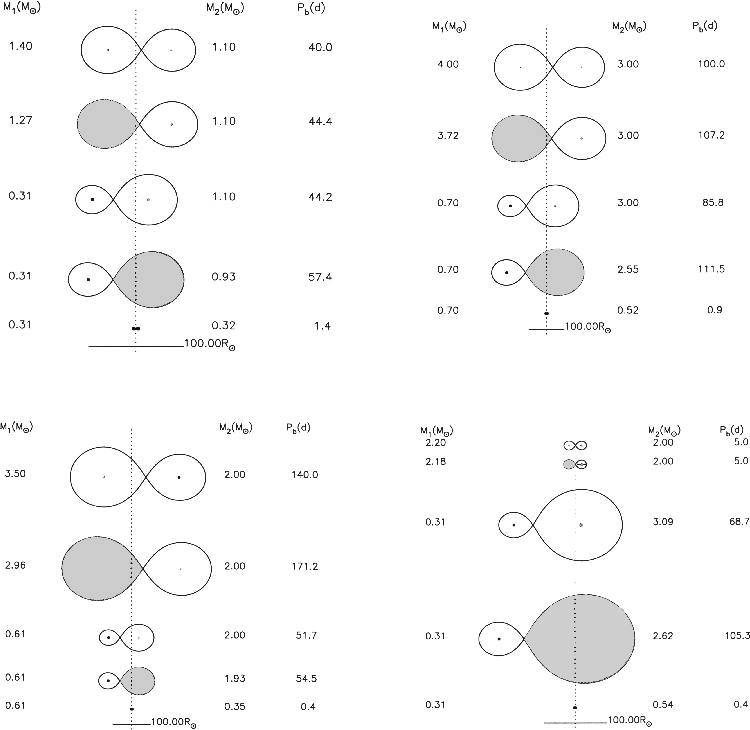 |
Figure 1:
Evolutionary scenarios for the formation of a double helium
white dwarf (top left), a double CO white dwarf (top right) and the
CO+He and He+CO pairs (bottom ones). Note that the scales in the
panels differ as indicated by the 100  rulers at the
bottom. For a more detailed discussion see Sect. 2.3
rulers at the
bottom. For a more detailed discussion see Sect. 2.3 |
| Open with DEXTER | |
Before discussing effects that influence the double white dwarf population as a whole we discuss some typical examples of binary evolution leading to close double white dwarfs, to illustrate some of the assumptions used in our models. For details of the treatment of binary evolution we refer to Portegies Zwart & Verbunt (1996) and the Appendix.
The most common double white dwarfs consist of two helium white dwarfs
(Sect. 6.1). These white dwarfs descend from
systems in which both stars have
 2.3
2.3 and fill their
Roche lobes before He ignition in their degenerate cores. In
Fig. 1 (top left) we show an example of the formation
of such a system. We start with a binary with an orbital period of 40
days and components of 1.4 and 1.1.
The primary fills its
Roche lobe after 3 Gyrs, at which moment it has already evolved up the
first giant branch and has lost 0.13
in a stellar wind.
When the star fills its Roche lobe it has a deep convective envelope,
so the mass transfer is unstable. We apply the envelope ejection
formalism to describe the mass transfer with a -value of 1.75
(see Eq. (A.16)). The core of the donor becomes a
0.31
helium white dwarf. The orbital period of the system
hardly changes. After 4 Gyr, when the first formed white dwarf has
already cooled to very low luminosity, the secondary fills its Roche
lobe and has a deep convective envelope. Mass loss again proceeds on
dynamical time scale, but the mass ratio of the components is rather
extreme and a common envelope is formed in which the orbit shrinks
dramatically.
and fill their
Roche lobes before He ignition in their degenerate cores. In
Fig. 1 (top left) we show an example of the formation
of such a system. We start with a binary with an orbital period of 40
days and components of 1.4 and 1.1.
The primary fills its
Roche lobe after 3 Gyrs, at which moment it has already evolved up the
first giant branch and has lost 0.13
in a stellar wind.
When the star fills its Roche lobe it has a deep convective envelope,
so the mass transfer is unstable. We apply the envelope ejection
formalism to describe the mass transfer with a -value of 1.75
(see Eq. (A.16)). The core of the donor becomes a
0.31
helium white dwarf. The orbital period of the system
hardly changes. After 4 Gyr, when the first formed white dwarf has
already cooled to very low luminosity, the secondary fills its Roche
lobe and has a deep convective envelope. Mass loss again proceeds on
dynamical time scale, but the mass ratio of the components is rather
extreme and a common envelope is formed in which the orbit shrinks
dramatically.
Most double CO white dwarfs are formed in systems which are initially so wide that both mass transfer phases take place when the star is on the AGB and its core consists already of CO, such that a CO white dwarfs are formed directly. An example is shown in Fig. 1 (top right). In the first phase of mass transfer the change of the orbital separation is regulated by the conservation of angular momentum during envelope ejection, according to Eq. (A.16), while in the second phase of mass transfer spiral-in is described by Eq. (A.14).
Much less frequently, CO white dwarfs are formed by stars more massive
than 2.3
which fill their Roche lobe when they have a
nondegenerate core, before helium ignition. Roche lobe overflow then
results in the formation of a low-mass helium star. A brief
additional phase of mass transfer may happen, if the helium star
expands to giant dimensions during helium shell burning. This is the
case for 0.8
 3 (see
Appendix A.1.2). After exhaustion of helium in its
core, the helium star becomes a CO white dwarf.
3 (see
Appendix A.1.2). After exhaustion of helium in its
core, the helium star becomes a CO white dwarf.
In Fig. 1 (bottom left) we show an example in which the CO white dwarf is formed first. It starts with a more extreme mass ratio and a relatively wide orbit, which shrinks in a phase of envelope ejection. The secondary does not accrete anything and fills its Roche lobe when it ascends the first giant branch, having a degenerate helium core. It then evolves into a helium white dwarf.
In the second example (shown in Fig. 1; bottom right), the system evolves through a stable mass exchange phase because the primary has a radiative envelope when it fills its Roche lobe. Part of the transferred mass is lost from the system (see Appendix A.2.1). The orbit widens and the primary forms a helium white dwarf when it has transferred all its envelope to its companion. The secondary accretes so much mass that it becomes too massive to form a helium white dwarf. The secondary fills its Roche lobe on the AGB to form a CO white dwarf in a common envelope in which the orbital separation reduces strongly. Because of the differential cooling (Sect. 4.3) the CO white dwarf, despite the fact that it is formed last, can become fainter than its helium companion. Since the probability to fill their Roche lobe when the star has a radiative envelope, is low for low-mass stars, the scenario in which the helium white dwarf is formed first is less likely (see Sect. 6).
| Model | SFH | % binaries | cooling |
| A1 | Exp | 50 | DSBH98 |
| A2 | Exp | 50 | Modified DSBH98 |
| A3 | Exp | 50 | 100 Myr |
| B | Exp | 100 | Modified DSBH98 |
| C | Cnst | 50 | Modified DSBH98 |
| D | Cnst | 100 | Modified DSBH98 |
We model the current population of double and single white dwarfs in the Galaxy using population synthesis and compare our models with the observed population. We initialise 250000 "zero-age'' binaries and evolve these binaries according to simplified prescriptions for single and binary star evolution, including stellar wind, mass transfer (which may involve loss of mass and angular momentum from the binary), common envelopes and supernovae.
For each initial binary the mass  of the more massive
component, the mass ratio
of the more massive
component, the mass ratio
 ,
where
,
where  is the mass of the less massive component, the
orbital separation
is the mass of the less massive component, the
orbital separation  and eccentricity
  are chosen
randomly from distributions given by
are chosen
randomly from distributions given by
,
the minimum mass for hydrogen core burning. The
distribution over separation is truncated at the lower end by the
separation at which the ZAMS binary would be semi-detached.
To investigate the effects of different cooling models (Sect. 4.3) and different assumptions about the star formation history (Sect. 5) different models have been computed (Table 1).
To model the observable population we have to take orbital evolution and selection effects into account.
The most important effect of orbital evolution, which is taken into
account also in all previous studies of close binary white dwarfs, is
the disappearance from the sample of the tightest systems as they
merge, due to the loss of angular momentum via gravitational wave
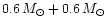
radiation. For example an
 white dwarf pair
with orbital period of 1 hour merges in 3 107yr. If it
is located at a distance of 100pc from the Sun it will disappear
abruptly from a magnitude limited sample by merging before the white dwarfs
have become undetectable due to cooling.
white dwarf pair
with orbital period of 1 hour merges in 3 107yr. If it
is located at a distance of 100pc from the Sun it will disappear
abruptly from a magnitude limited sample by merging before the white dwarfs
have become undetectable due to cooling.
The observed double white dwarfs are a biased sample. First, they were
mainly selected for study because of their supposed low mass, since
this is a clear indication of binarity (Saffer et al. 1988;
Marsh et al. 1995). Secondly,
for the mass determinations and the measurement of the radial
velocities the white dwarfs must be sufficiently bright. A third
requirement is that the radial velocities must be large enough that
they can be found, but small enough that spectral lines don't get smeared
out during the integration. Maxted & Marsh (1999) discuss
this last requirement in detail. Following them, we include a detection
probability in the model assuming that double white dwarfs in the
orbital period range between 0.15hr and 8.5day will be detected
with 100% probability and that above 8.5day the detection
probability decreases linearly from 1 at 8.5 days to 0 at 35
days (see Fig. 1 in Maxted & Marsh 1999).
The second selection effect is related to the brightness of the white dwarfs, which is governed by their cooling curves.
Iben & Tutukov (1985) noticed that for a 0.6
white dwarf the maximum
probability of discovery corresponds to a cooling age of 108yr.
In absence of detailed cooling curves for low-mass white
dwarfs, it was hitherto assumed in population synthesis studies that
white dwarfs remain bright enough to be observed during 108yr,
irrespective of their mass. However, recent computations (Blöcker
1995; Driebe et al. 1998, hereafter
DSBH98; Hansen 1999) indicate that helium
white dwarfs cool more slowly than CO white dwarfs, for two reasons.
First, helium cores contain a higher number of ions than carbon-oxygen
cores of the same mass, they store more heat and are brighter at the
same age (Hansen 1999). Second, if the mass of the hydrogen envelope
of the white dwarf exceeds a critical value, pp-reactions remain the
main source of energy down to effective temperatures well below 104K (Webbink 1975; DSBH98; Sarna et al.
2000). This residual burning may lead to a significant
slow-down of the cooling.
White dwarfs in close binaries form when the evolution of (sub)giants with degenerate cores and hydrogen-rich envelopes is terminated by Roche lobe overflow. The amount of hydrogen that is left on the white dwarf depends on the details of this process. Fully fledged evolutionary calculations of the formation of helium white dwarfs, e.g. Giannone & Giannuzzi (1970); Sarna et al. (2000), as well as calculations that mimic Roche lobe overflow by mass loss at fixed constant rate (Driebe et al. 1998), find that the thickness of the residual envelope around the white dwarf is increasing with decreasing white dwarf mass. As a result the brightness at fixed age decreases monotonically with increasing white dwarf mass (see also Fig. A.2).
However, it is not clear that these calculations are valid for white
dwarfs formed in a common envelope. In addition, white dwarfs may
lose mass by stellar wind when they still have a high luminosity. Such
winds are observed for nuclei of planetary nebulae and post-novae and
could also be expected for He white dwarfs. Finally, white dwarfs
with masses between 0.2 and 0.3
experience thermal
flashes (Kippenhahn et al. 1968; Webbink 1975; Iben & Tutukov 1986b;
Driebe et al. 1999; Sarna et al. 2000), in which the envelopes
expand. This may lead to additional mass loss in a temporary common
envelope, especially in the closest systems with separations
 .
Mass loss may result in extinguishing of hydrogen burning
(Iben & Tutukov 1986b; Sarna et al. 2000).
.
Mass loss may result in extinguishing of hydrogen burning
(Iben & Tutukov 1986b; Sarna et al. 2000).
Hansen (1999) argues that the details of the loss of the hydrogen envelope are very uncertain and assumes that all white dwarfs have a hydrogen envelope of the same mass. He finds that helium white dwarfs cool slower than the CO white dwarfs, but inside these groups, the more massive white dwarfs cool the slowest. The difference within the groups are small.
We conclude that the cooling models are still quite uncertain, so we will investigate the result of assuming different cooling models in our population synthesis.
The first model we compute (A1; see Table 1 for a list
of all computed models) uses the cooling curves as given by
Blöcker (1995) for CO white dwarfs and DSBH98 for He
white dwarfs as detailed in Appendix A.1.5. For the
second model (A2) we made a crude estimate of the cooling curves for
the case that the thermal flashes or a stellar wind reduce the mass of
the hydrogen envelope and terminate the residual burning of hydrogen.
We apply this to white dwarfs with masses below 0.3,
and model
all these white dwarfs identically and simply with cooling curves for
a more massive (faster cooling) white dwarf of 0.46 .
To compare with the previous investigators, we include one model (A3)
in which all white dwarfs can be seen for 100 Myrs. We did not model
the cooling curves of Hansen (1999), because no data for
 are given.
To convert the total Galactic population to a local population and to
compute a magnitude limited sample, we assume a distribution of all
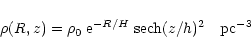
single and binary stars in the galactic disk of the form
To construct a magnitude limited sample, we compute the magnitude for all model systems from the cooling curves and estimate the contribution of each model system from Eq. (2). The absolute visual magnitudes along the cooling curves are derived using bolometric corrections after Eggleton et al. (1989).
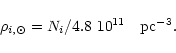
From Eq. (2) the local (R = 8.5 kpc, z = 30 pc)
space density (
 )
of any type of system is
related to the total number in the Galaxy (Ni) by:
)
of any type of system is
related to the total number in the Galaxy (Ni) by:
Some progenitors of white dwarfs are formed long ago. Therefore the history of star formation in the Galaxy affects the contribution of old stars to the population of local white dwarfs. To study this we compute different models.
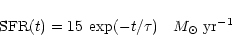
For models A and B (see Table 1), we model the star
formation history of the galactic disk as
 Gyr. It gives a current rate of 3.6 yr-1which is compatible with observational estimates (Rana 1991;
van den Hoek & de Jong 1997).
The integrated SFR, i.e. the amount of matter that has been turned
into stars over the whole history of the galactic disk (10 Gyr) with
this equation is
Gyr. It gives a current rate of 3.6 yr-1which is compatible with observational estimates (Rana 1991;
van den Hoek & de Jong 1997).
The integrated SFR, i.e. the amount of matter that has been turned
into stars over the whole history of the galactic disk (10 Gyr) with
this equation is
 which is higher
than the current mass of the disk, since part of the gas that is
turned into stars is given back to the ISM by supernovae and stellar
winds.
which is higher
than the current mass of the disk, since part of the gas that is
turned into stars is given back to the ISM by supernovae and stellar
winds.
For models C and D we use a constant SFR of
 yr-1(as Tutukov & Yungelson 1993). We use an age of the disk of 10 Gyr, while
Tutukov & Yungelson (1993) use 15 Gyr. Model D also allows us to compare our results
with previous studies (ITY97 and HAN98; see Sect. 7).
yr-1(as Tutukov & Yungelson 1993). We use an age of the disk of 10 Gyr, while
Tutukov & Yungelson (1993) use 15 Gyr. Model D also allows us to compare our results
with previous studies (ITY97 and HAN98; see Sect. 7).
Most binary population synthesis calculations take a binary fraction of 100%. Since we want to compare our models with the observed fraction of close double white dwarfs among all white dwarfs, we present models with 100% binaries (models B and D); and with 50% binaries and 50% single stars, i.e. with 2/3 of all stars in binaries (models A and C).
| Model | SFH | % bin |
 |
 |
SN Ia |
 |
#(wd, wd) |
| (10-2) | (10-2) | (10-3) | (10-3) | (108) | |||
| A | Exp | 50 | 4.8 | 2.2 | 3.2 | 4.6 | 2.5 |
| B | Exp | 100 | 8.1 | 3.6 | 5.4 | 7.8 | 4.1 |
| C | Cnst | 50 | 3.2 | 1.6 | 3.4 | 3.1 | 1.2 |
| D | Cnst | 100 | 5.3 | 2.8 | 5.8 | 5.2 | 1.9 |
| ITY971 | Cnst | 100 | 8.7 | 2.4 | 2.7 | 12.0 | 3.5 |
| HAN981 | Cnst | 100 | 3.2 | 3.1 | 2.9 | 26 | 1.0 |
| 1 Note that ITY97 and HAN98 used a normalisation that is higher than we use | |||||||
| for model D by factors
1.4 and 1.1 respectively (see
Sect. 7.1). |
|||||||
Our results are presented in the next subsections. In Sect. 6.1 we give the birth rates and total number of double white dwarfs in the Galaxy. These numbers allow a detailed comparison with results of earlier studies, which we defer to Sect. 7. They cannot be compared with observations directly, with the exception of the SN Ia rate. For comparison with the observed sample, described in Sect. 6.2, we compute magnitude limited samples in the remaining sections. In Sect. 6.3 the distribution over periods and masses is compared with the observations, which constrains the cooling models. Comparison of the mass ratio distribution with the observations gives further support for our new description of a common envelope without spiral-in (Sect. 6.4). In Sect. 6.5 we compare our model with the total population of single and binary white dwarfs and in Sect. 6.6 we compare models that differ in the assumed star formation history with the observed rate of PN formation and the local space density of white dwarfs.
In Table 2 the birth rates for all models are
given. According to Eq. (1) the mass of a binary is on
average 1.5 times the mass of a single star. For each binary in models
A and C we also form a single star, i.e. per binary a total of 2.5
times the mass of a single star is formed (1.5 for the binary, 1 for
the single star). For models B and D only 1.5 times the mass of a
single star is formed per binary. Thus for the same SFR in yr-1 the frequency of each process involving a binary of the
models A and C is 0.6 times that in models B and D.
For model A the current birth rate for close double white dwarfs is
4.8 10-2 yr-1 in the Galaxy. The expected total
population of close binary white dwarfs in the galactic disk is
2.5 108 (see Table 2).
The double white dwarfs are of the following types: 53% contains two helium white dwarfs; 25% two CO white dwarfs; in 14% a CO white dwarf is formed first and a helium white dwarf later and in 6% a helium white dwarf is formed followed by the formation of a CO white dwarf. The remaining 1% of the double white dwarfs contains an ONeMg white dwarf. The CO white dwarfs can be so called hybrid white dwarfs; having CO cores and thick helium envelopes (Iben & Tutukov 1985, 1987). Of the double CO white dwarfs, 6% contains one and 5% two hybrid white dwarfs. In the mixed pairs the CO white dwarf is a hybrid in 20% of the cases.
Forty eight percent of all systems are close enough to be brought into
contact within a Hubble time. Most are expected to merge. The
estimated current merger rate of white dwarfs is
2.2 10-2 yr-1. The current merger rate of pairs
that have a total mass larger than the Chandrasekhar limit (
 = 1.44)
is 3.2 10-3yr-1. Since the
merging of binary CO white dwarfs with a combined mass in excess of
is a viable model for type Ia SNe (see Livio 1999, for the
most recent review), our model rate can be compared with the
SN Ia rate of (
= 1.44)
is 3.2 10-3yr-1. Since the
merging of binary CO white dwarfs with a combined mass in excess of
is a viable model for type Ia SNe (see Livio 1999, for the
most recent review), our model rate can be compared with the
SN Ia rate of ( )
10-3yr-1 for Sbc
type galaxies like our own (Cappellaro et al. 1999). In 19% of the systems
that come into contact the ensuing mass transfer is stable and an
interacting double white dwarf (identified with AM CVn stars) is
formed. The model birth rate of AM CVn systems is
4.6 10-3 yr-1 (see Table 2).
)
10-3yr-1 for Sbc
type galaxies like our own (Cappellaro et al. 1999). In 19% of the systems
that come into contact the ensuing mass transfer is stable and an
interacting double white dwarf (identified with AM CVn stars) is
formed. The model birth rate of AM CVn systems is
4.6 10-3 yr-1 (see Table 2).
| WD/sdB | P(d) | q | m | sdB | P(d) |
| 0135-052 | 1.556 | 0.90 | 0.25 | 0101+039 | 0.570 |
| 0136+768 | 1.407 | 1.31 | 0.44 | 0940+068 | 8.33 |
| 0957-666 | 0.061 | 1.14 | 0.37 | 1101+249 | 0.354 |
| 1022+050 | 1.157 | 0.35 | 1432+159 | 0.225 | |
| 1101+364 | 0.145 | 0.87 | 0.31 | 1538+269 | 2.50 |
| 1202+608 | 1.493 | 0.40 | 2345+318 | 0.241 | |
| 1204+450 | 1.603 | 1.00 | 0.51 | ||
| 1241-010 | 3.347 | 0.31 | |||
| 1317+453 | 4.872 | 0.33 | |||
| 1704+481A | 0.145 | 0.7 | 0.39 | ||
| 1713+332 | 1.123 | 0.38 | |||
| 1824+040 | 6.266 | 0.39 | |||
| 2032+188 | 5.084 | 0.36 | |||
| 2331+290 | 0.167 | 0.39 | |||
| KPD 0422+5421 | 0.090 | 0.96 | 0.51 | ||
| KPD 1930+2752 | 0.095 | 0.52 | 0.5 |
The properties of the observed double white dwarfs with which we will
compare our models are summarised in Table 3. Only
WD 1204+450 and WD 1704+481 are likely to contain CO white dwarfs,
having components with masses higher than 0.46;
the limiting
mass to form a helium white dwarf (Sweigart et al. 1990). The remaining systems
are probably helium white dwarfs. In principle in the mass range
 white dwarfs could also be hybrid; however
in this range the probability for a white dwarf to be hybrid is
4-5 times lower than to be a helium white dwarf, because hybrid white
dwarfs originate from more massive stars which fill their Roche lobe
in a narrow period range (see, however, an example of such a
scenario for WD
0957-666 in Nelemans et al. 2000). We assume
white dwarfs could also be hybrid; however
in this range the probability for a white dwarf to be hybrid is
4-5 times lower than to be a helium white dwarf, because hybrid white
dwarfs originate from more massive stars which fill their Roche lobe
in a narrow period range (see, however, an example of such a
scenario for WD
0957-666 in Nelemans et al. 2000). We assume
 for
the uncertainty in the estimates of the masses of white dwarfs, which
may be somewhat optimistic.
for
the uncertainty in the estimates of the masses of white dwarfs, which
may be somewhat optimistic.
Table 3 also includes data on subdwarf B stars with suspected white dwarf companions. Subdwarf B (sdB) stars are hot, helium rich objects which are thought to be helium burning remnants of stars which lost their hydrogen envelope. When their helium burning has stopped they will become white dwarfs. Of special interest are KPD 0422+5421 (Koen et al. 1998; Orosz & Wade 1999) and KPD1930+2752 (Maxted et al. 2000). With orbital periods as short as 0.09 and 0.095 days, respectively, their components will inevitably merge. In both systems the sdB components will become white dwarfs before the stars merge. In KPD 1930+2752 the total mass of the components is close to the Chandrasekhar mass or even exceeds it. That makes this system the only currently known candidate progenitor for a SN Ia.
![\begin{figure}
\par\includegraphics[angle=-90,width=6cm,clip]{H2305f5.ps}\hspace...
...\hspace*{4mm}
\includegraphics[angle=-90,width=7cm,clip]{H2305f8.ps}\end{figure}](/articles/aa/full/2001/03/aah2305/img48.gif) |
Figure 2:
Model population of double white dwarfs as function of orbital
period and mass of the brighter white dwarf of the pair. Top left:
distribution of the double white dwarfs that are currently born for
models A. This is independent of cooling. In the remaining three
plots we show the currently visible population of double white
dwarfs for different cooling models: (top right) cooling according
to DSBH98 and Blöcker (1995, model A1); (bottom right)
cooling according to DSBH98, but with faster cooling
for WD with masses below 0.3
(model A2). Both plots are for
a limiting magnitude
;
(bottom left) with constant
cooling time of 100 Myr (model A3, note that in this case we only
obtain the total number of potentially visible double white
dwarfs in the Galaxy and we cannot construct a magnitude limited
sample). For comparison, we also plot the observed binary white
dwarfs |
| Open with DEXTER | |
The observed quantities that are determined for all double white
dwarfs are the orbital period and the mass of the brighter white
dwarf. Following Saffer et al. (1998), we plot in Fig. 2 the
 distributions of the frequency of occurrence for
the white dwarfs which are born at this moment and for the simulated
magnitude limited sample for the models with different cooling
prescriptions, (models A1, A2 and A3; see Table 1),
where we assume
as the limiting magnitude of the
sample. For m we always use the
mass of the brighter white dwarf. In general the brighter white
dwarf is the one that was formed last, but occasionally, it is the one
that was formed first as explained in Sect. 2.3.3. For
comparison, we also plot the observed binary white dwarfs in
Fig. 2.
distributions of the frequency of occurrence for
the white dwarfs which are born at this moment and for the simulated
magnitude limited sample for the models with different cooling
prescriptions, (models A1, A2 and A3; see Table 1),
where we assume
as the limiting magnitude of the
sample. For m we always use the
mass of the brighter white dwarf. In general the brighter white
dwarf is the one that was formed last, but occasionally, it is the one
that was formed first as explained in Sect. 2.3.3. For
comparison, we also plot the observed binary white dwarfs in
Fig. 2.
There is a clear correlation between the mass of new-born low-mass (He) white dwarf and the orbital period of the pair. This can be understood as a consequence of the existence of a steep core mass-radius relation for giants with degenerate helium cores (Refsdal & Weigert 1970). Giants with more massive cores (forming more massive white dwarfs) have much larger radii and thus smaller binding energies. To expell the envelope in the common envelope, less orbital energy has to be used, leading to a larger orbital period. The spread in the distribution is caused by the difference in the masses of the progenitors and different companion masses.
In the simulated population of binary white dwarfs there are three
distinct groups of stars: He dwarfs with masses below 0.45,
hybrid white dwarfs with masses in majority between 0.4 and 0.5
and periods around a few hours, and CO ones with masses above
0.5.
The last groups are clearly dominated by the lowest mass
objects. The lowest mass CO white dwarfs are descendants of most
numerous initial binaries with masses of components 1-2.
The different cooling models result in very different predicted
observable distributions. Model A1 where the cooling curves of
DSBH98 are applied favours low mass white dwarfs to such
an extent that almost all observed white dwarfs are expected to have
masses below 0.3.
This is in clear contrast with the
observations, in which all but one white dwarf have a mass above
0.3.
Reduced cooling times for white dwarfs with masses below
0.3
(model A2) improves this situation. Model A3, with a
constant cooling time (so essentially only affected by merging due to
GWR), seems to fit all observed systems also nicely. However, a
complementary comparison with the observations as given by cumulative
distributions of the periods (Fig. 3), shows that model
A2 fits the data best, and that model A3 predicts too many short
period systems.
The observed period distribution for double white dwarfs shows a gap between 0.5 and 1 day, which is not present in our models. If we include also sdB binaries, the gap is partially filled in. More systems must be found to determine whether the gap is real.
The comparison of our models with observations suggests that white
dwarfs with masses below 0.3
cool faster than predicted by
DSBH98. Mass loss in thermal flashes and a stellar wind
may be the cause of this.
 |
Figure 3:
Cumulative distribution of periods. Solid line for our best
model (A2); DSBH98 cooling, but with lower luminosity
due to thermal flashes for white dwarfs with masses below
0.3.
Dashed line for DSBH98 without
modifications (model A1) and dash dotted line for constant cooling
time of 100 Myr (model A3). Open squares for the observed double
white dwarfs, filled circles give the observed systems including the
sdB binaries (Table 3) |
| Open with DEXTER | |
The model sample of detectable systems is totally dominated by He
white dwarfs with long cooling times. Given our model birth rates and
the cooling curves we apply, we estimate the number of double white
dwarfs to be detected in a sample limited by
 = 15 as 220
of which only 10 are CO white dwarfs for model A2. Roughly one of
these is expected to merge within a Hubble time having a total mass
above
.
For future observations we give in
Table 4 a list of expected number of systems for
different limiting magnitudes.
= 15 as 220
of which only 10 are CO white dwarfs for model A2. Roughly one of
these is expected to merge within a Hubble time having a total mass
above
.
For future observations we give in
Table 4 a list of expected number of systems for
different limiting magnitudes.
It should be noted that these numbers are uncertain. This is
illustrated by the range in birth rates for the different models
(Table 2) and by the differences with previous
studies (see Sect. 7.1). Additional
uncertainties are introduced by our limited knowledge of the initial
distributions (Eq. (1)) and the uncertainties in the cooling
and the Galactic model (Eq. (2)). For example
Yungelson et al. (1994) compare models with two different  distributions (one peaked towards
 )
and show that
the birth rates differ by a factor 1.7. In general the relative
statistics of the model is more reliable than the absolute
statistics.
)
and show that
the birth rates differ by a factor 1.7. In general the relative
statistics of the model is more reliable than the absolute
statistics.
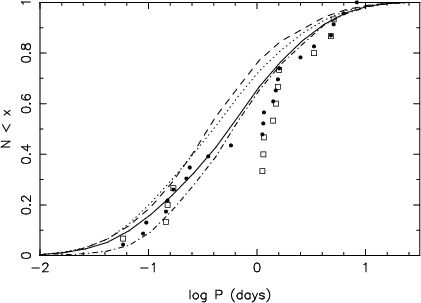 |
Figure 4:
Cumulative distribution of periods. Solid line for model A2
as in Fig. 3, dashed line for the same model but
with
 ,
dash-dotted line for a model
with ,
dash-dotted line for a model
with
 and finally the dotted line for model C
(constant SFR)
and finally the dotted line for model C
(constant SFR) |
| Open with DEXTER | |
|
|
#wd | #wdwd | #SN Ia prog |
| 15.0 | 855 | 220 | 0.9 |
| 15.5 | 1789 | 421 | 1.7 |
| 16.0 | 3661 | 789 | 3.2 |
| 17.0 | 12155 | 2551 | 11.2 |
Before turning to the mass ratio distribution, we illustrate the
influence of the model parameters we choose. We do this by showing
cumulative period distributions for some models with different
parameters in Fig. 4;
(dashed line) and
(dash-dotted line). It
shows that the change in parameters influences the distributions less
than the different cooling models discussed above, although the
observations favour a higher
.
We also
included the cumulative distribution for model C (with a constant SFR;
dotted line) which differs from that for model A2 in that it has fewer
long period systems. This is a consequence of the larger relative
importance of old, low-mass progenitor binaries in model A2, which
lose less mass and thus shrink less in the first phase of mass
transfer (see Eq. (A.16)).
 |
Figure 5: Top: current population of double white dwarfs as function of orbital period and mass ratio, for model A2, a limiting magnitude of 15 and a maximal ratio of luminosities of 5. Bottom: the same for a run in which the first phase of mass transfer is treated as a standard common envelope, as is done by ITY97 and HAN98. For comparison, we also plot theobserved binary white dwarfs |
| Open with DEXTER | |
 |
Figure 6:
Cumulative mass ratio distributions for the models A2
(solid line) and A (dotted line) as explained in
Sect. 6.4. The observed mass ratio's are plotted as the
open squares
(dotted line) as explained in
Sect. 6.4. The observed mass ratio's are plotted as the
open squares |
| Open with DEXTER | |
Our assumption that a common envelope can be avoided in the first
phase of mass transfer between a giant and a main-sequence star, is
reflected in the mass ratios of the model systems. A clear prediction
of the model is that close binary white dwarfs must concentrate to
 For the observed systems, the mass ratio can only be
determined if both components can be seen, which in practice requires
that the luminosity of the fainter component is more than 20% of that
of the brighter component (Moran et al. 2000). Applying this selection
criterium to the theoretical model, we obtain the distribution shown
in Fig. 5 for the magnitude limited sample. Note that
since lower mass white dwarfs cool slower this selection criterion
favours systems with mass ratios above unity. In the same figure we
also show the observed systems.
For comparison we also computed a run (A)
in which we used
the standard common envelope treatment for the first phase of mass
transfer, which is done by ITY97 and HAN98.
The fraction of double white dwarfs for which the mass ratio can be
determined according to the selection criterium of a luminosity ratio
greater than 0.2, is 27% for model A2 and 24% for model A.
In a total of 14 systems one thus expects
For the observed systems, the mass ratio can only be
determined if both components can be seen, which in practice requires
that the luminosity of the fainter component is more than 20% of that
of the brighter component (Moran et al. 2000). Applying this selection
criterium to the theoretical model, we obtain the distribution shown
in Fig. 5 for the magnitude limited sample. Note that
since lower mass white dwarfs cool slower this selection criterion
favours systems with mass ratios above unity. In the same figure we
also show the observed systems.
For comparison we also computed a run (A)
in which we used
the standard common envelope treatment for the first phase of mass
transfer, which is done by ITY97 and HAN98.
The fraction of double white dwarfs for which the mass ratio can be
determined according to the selection criterium of a luminosity ratio
greater than 0.2, is 27% for model A2 and 24% for model A.
In a total of 14 systems one thus expects  and
and  systems
of which the mass ratio can be determined. Model A2 fits the observed number
better, but the numbers are too small to draw conclusions. The
distribution of mass ratios in model A
(Fig. 5,
bottom) however clearly does not describe the observations as
well as our model A2, as illustrated in more detail in a plot where
the cumulative mass ratio distributions of the two models and the
observations are shown (Fig. 6).
systems
of which the mass ratio can be determined. Model A2 fits the observed number
better, but the numbers are too small to draw conclusions. The
distribution of mass ratios in model A
(Fig. 5,
bottom) however clearly does not describe the observations as
well as our model A2, as illustrated in more detail in a plot where
the cumulative mass ratio distributions of the two models and the
observations are shown (Fig. 6).
Figures 7 and 8 show the model
spectrum of white dwarf masses for models B and A2, including both
single and double white dwarfs for a limiting magnitude
.
For this plot we consider as "single'' white dwarfs all objects
that were born in initially wide pairs, single merger products, white
dwarfs that became single as a result of binary disruption by SN
explosions, white dwarfs in close pairs which are brighter than their
main-sequence companions and genuine single white dwarfs for the
models with an initial binary fraction smaller than 100%.
These model spectra can be compared to the observed mass spectrum of
DA white dwarfs studied by Bergeron et al. (1992)
and Bragaglia et al. (1995), shown in
Fig. 9. The latter distribution may have to be
shifted to higher masses by about 0.05,
if one uses models of
white dwarfs with thick hydrogen envelopes for mass estimates
(Napiwotzki et al. 1999). Clearly, a binary fraction of 50% fits the observed
sample better, if indeed helium white dwarfs cool much slower than CO
white dwarfs. We can also compare the absolute numbers. Maxted & Marsh (1999)
conclude that the fraction of close double white dwarfs among DA white
dwarfs is between 1.7 and 19% with 95% confidence. For model B the
fraction of close white dwarfs is 43% (853 white dwarfs of
which 368 are close pairs), for model A2 is is 26% (855 white
dwarfs and 220 close pairs). Note that this fraction slightly
decreases for higher limiting magnitudes because the single white
dwarfs are more massive and thus generally dimmer, sampling a
different fraction of Galaxy. An even lower binary fraction apparently
would fit the data better, but is in conflict with the estimated
fraction of binaries among normal main sequence binaries
(Abt 1983; Duquennoy & Mayor 1991).
However this number highly depends on uncertain
selection effects.
There are some features in the model mass spectrum in model A2 that
appear to be in conflict with observations. The first is the clear
trend that with the cooling models of DSBH98, even with
our modifications, there should be an increasing number of helium
white dwarfs towards lower masses. The observed distribution is flat.
A very simple numerical experiment in which we assign a cooling curve
to all helium white dwarfs as the one for a 0.414
white dwarf
according to DSBH98 and a cooling curve as for a
0.605
white dwarf according to Blöcker (1995)
for
all CO white
dwarfs (Fig. 10), shows that an equal cooling time
for all helium white dwarfs seems to be in better agreement with the
observations. It has a fraction of double white dwarfs of 18%.
Another feature is the absence of stars with 0.45
0.5 in the model distributions. This is a consequence of the fact that
in this interval in our models only hybrid white dwarfs can be
present, which have a low formation probability (see
Sect. 6.2).
We conclude that an initial binary fraction of 50% can explain the observed close binary fraction in the white dwarf population. The shape of the mass spectrum, especially for the helium white dwarfs is a challenge for detailed mass determinations and cooling models.
 |
Figure 7: Mass spectrum of all white dwarfs for model B (100% binaries). Members of close double white dwarfs are in grey. The cumulative distribution is shown as the solid black line. For comparison, the grey line shows the cumulative distribution of the observed systems (Fig. 9) |
| Open with DEXTER | |
 |
Figure 8: Mass spectrum of all white dwarfs for model A2 (initial binary fraction of 50%) Double white dwarfs are in grey. The cumulative distribution is shown as solid black line and cumulative distribution of observed systems as the grey line |
| Open with DEXTER | |
 |
Figure 9: Mass spectrum of observed white dwarfs. Data are taken from Bergeron et al. (1992) and Bragaglia et al. (1995). The solid line is the cumulative distribution |
| Open with DEXTER | |
 |
Figure 10:
Mass spectrum of all white dwarfs as in
Fig. 8 in a model in which all helium white dwarfs
cool like a 0.4
dwarf and all CO white dwarfs cool like a
0.6
white dwarf. Lines are cumulative distributions for the
model (black) and the observations (grey) |
| Open with DEXTER | |
| Model | SFH | % bin | #wd |
 |
 |
 |
| 109 | (10-3) | (10-12) | ||||
| A | Exp | 50 | 9.2 | 1.1 | 19 | 2.3 |
| C | Const | 50 | 4.1 | 0.8 | 8.5 | 1.7 |
| Obs | 4-20 | 3 |
Finally, we compare models A and C (see Table 1), which differ only by the assumed star formation history. The star formation rate was probably higher in the past than at present and some (double) white dwarfs descend from stars that are formed just after the galactic disk was formed.
Table 5 gives the formation rates of PN and the total number of white dwarfs in the Galaxy for models A and C. The total number of white dwarfs is computed by excluding all white dwarfs in binaries where the companion is brighter. The local density of white dwarfs and PN rate are computed with Eq. (3) as described in Sect. 4.4.
We can compare these numbers with the observational estimates for the
local PN formation rate of 3 10-12 pc-3 yr-1(Pottasch 1996) and the local space density of white dwarfs, which range
from e.g. 4.2 10-3 pc-3 (Knox et al. 1999) through
7.6+3.7-0.7 10-3 pc-3 (Oswalt et al. 1995) and
10 10-3 pc-3 (Ruiz & Takamiya 1995) to  10-3 pc-3 (Festin 1998).
This list shows the large uncertainty in the observed local space density of white dwarfs. It appears that the lower values are somewhat favoured in the literature. Both models A and C appear for the moment to be consistent with the observed local white dwarf space density and with the PN formation rate. However, we prefer model A2 since it fits the period distribution better (see Fig. 4).
The ratio of the local space density of white dwarfs to the current
local PN formation rate could in principle serve as a diagnostic for
the star formation history of the Galaxy, given better knowledge of
,
which critically depends on the estimates of the
incompleteness of the observed white dwarf samples and the applied
cooling curves.
We now compare our work with the results of previous studies; in particular the most recent studies of Iben et al. (1997, ITY97) and Han (1998, HAN98).
In Table 2 we show the birth rates of close double white dwarfs for the different models. We also include numbers from HAN98 (model 1) and a set of numbers computed with the same code as used in ITY97, but for an age of the galactic disk of 10 Gyr, as in our models. The numbers of HAN98 are for an age of the disk of 15 Gyr. Our model D is the closest to the models of ITY97 and HAN98, assuming a constant SFR and 100% binaries. To estimate the influence of the binary evolution models only in comparing the different models we correct for their different normalisations.
In the recomputed ITY97 model the formation rate of interacting binaries in which the primary evolves within the age of the Galaxy is 0.35 yr-1. In our model D this number is 0.25 yr-1. In the following we therefore multiply the formation rates of ITY97 as given in Table 2 with 0.71.
In the model of HAN98 one binary with a primary mass
above 0.8
is formed in the Galaxy annually with
 ,
i.e. 0.9 binary with
,
i.e. 0.9 binary with
 ,
which is our
limit to .
Correcting for the different assumed age of the
Galaxy we estimate this number to be 0.81; in our model this number is
0.73. We thus multiply the the formation rates of HAN98
as given in Table 2 with 0.9.
,
which is our
limit to .
Correcting for the different assumed age of the
Galaxy we estimate this number to be 0.81; in our model this number is
0.73. We thus multiply the the formation rates of HAN98
as given in Table 2 with 0.9.
Applying these corrections to the normalisation, we find that some
interesting differences remain. The birth rate of double white dwarfs
is 0.029, 0.053 and 0.062 per year for HAN98, model D and
ITY98 respectively. At the same time the ratio of the merger rate to
the birth rate decreases: 0.97, 0.53 and 0.28 for these models. This
can probably be attributed to the different treatment of the common
envelope. HAN98 uses a common envelope spiral-in
efficiency of 1 in Webbinks (1984) formalism, while we
use 4 (for
 ,
see De Kool et al. 1987). ITY97
use the formalism proposed by Tutukov & Yungelson (1979) with an efficiency of 1.
This is comparable to an efficiency of 4-8 in the Webbink
formalism. This means that in the model of HAN98, more
systems merge in a common envelope, which yields a low formation rate
of double white dwarfs. The ones that form (in general) have short
periods for the same reason, so the ratio of merger to birth rate is
high. In the ITY model the efficiency is higher, so more systems will
survive both common envelopes and have generally wider orbits, leading
to a much lower ratio of merger to birth rate. Our model D is somewhat
in between, but also has the different treatment of the first mass
transfer phase (Sect. 2), in which a strong spiral-in is
avoided.
,
see De Kool et al. 1987). ITY97
use the formalism proposed by Tutukov & Yungelson (1979) with an efficiency of 1.
This is comparable to an efficiency of 4-8 in the Webbink
formalism. This means that in the model of HAN98, more
systems merge in a common envelope, which yields a low formation rate
of double white dwarfs. The ones that form (in general) have short
periods for the same reason, so the ratio of merger to birth rate is
high. In the ITY model the efficiency is higher, so more systems will
survive both common envelopes and have generally wider orbits, leading
to a much lower ratio of merger to birth rate. Our model D is somewhat
in between, but also has the different treatment of the first mass
transfer phase (Sect. 2), in which a strong spiral-in is
avoided.
The difference between the models in the SN Ia rate (
 )
is related both to the total merger rate and to the
masses of the white dwarfs. The former varies within a
factor 1.5: 0.017, 0.028, and 0.028
)
is related both to the total merger rate and to the
masses of the white dwarfs. The former varies within a
factor 1.5: 0.017, 0.028, and 0.028
 for
ITY97, model D, and HAN98, while
is higher by a factor 2-3 in model D compared to the
other models. This is caused by the initial-final mass relation in
our models, which is derived from stellar models with core
overshooting, producing higher final masses.
for
ITY97, model D, and HAN98, while
is higher by a factor 2-3 in model D compared to the
other models. This is caused by the initial-final mass relation in
our models, which is derived from stellar models with core
overshooting, producing higher final masses.
The difference in the birthrate of interacting white dwarfs (
)
is mainly a consequence of our treatment of the first mass
transfer, which gives for model D a mass ratio distribution which is
peaked to 1 (Sect. 6.4), while in ITY97 and
HAN98 the mass ratio is in general different from 1
(Sect. 7.2), favouring stable mass transfer and the
formation of AM CVn systems. An additional factor, which reduces the
number of AM CVn systems is the assumption in model D and
ITY97 that the mass transfer rate is limited by the
Eddington rate. The formation and evolution of AM CVn stars is
discussed in more detail in Tutukov & Yungelson (1996) and Nelemans et al. (2001).
Comparing our Fig. 2 with the corresponding figure in Saffer et al. (1998), we find the same trend of higher white dwarf masses at longer periods. However, in our model the masses are higher than in the model of Saffer et al. (1998) at the same period. This is a consequence of the absence of a strong spiral-in in the first mass transfer phase in our model, contrary to the conventional common envelope model, as discussed in 2.2.
In our model the mass ratio distribution is peaked at
 .
This is different from the models of ITY97 and
Saffer et al. (1998) which predict a strong concentration to
.
This is different from the models of ITY97 and
Saffer et al. (1998) which predict a strong concentration to
 and from HAN98 who finds typical values of
 ,
with a tail to
,
with a tail to  .
The difference between these two
latter groups of models may be understood as a consequence of enhanced
wind in Han's model (see also Tout & Eggleton 1988), which allows wider
separations before the second common envelope. The mass ratio
distribution of our model, peaked at
.
The difference between these two
latter groups of models may be understood as a consequence of enhanced
wind in Han's model (see also Tout & Eggleton 1988), which allows wider
separations before the second common envelope. The mass ratio
distribution of our model, peaked at
 ,
appears to be more
consistent with the observed mass ratio distribution.
,
appears to be more
consistent with the observed mass ratio distribution.
To explain the lack of observed white dwarfs with masses below 0.3
we had to assume that these white dwarfs cool faster than
predicted by the models of DSBH98.
The same assumption was required by Kerkwijk et al. (2000), to bring the cooling age of the white dwarf that accompanies PSR B1855+09 into agreement with the pulsar spin-down age; and to obtain cooling ages shorter than the age of the Galaxy for the white dwarfs accompanying PSR J0034-0534 and PSR J1713+0747.
The absence of the lowest mass white dwarfs could also be explained by
the fact that a common envelope involving a giant with a low mass
helium core (
 -
-
 )
always leads to a
complete merger, according to Sandquist et al. (2000). However it can not
explain the absence of the systems with
)
always leads to a
complete merger, according to Sandquist et al. (2000). However it can not
explain the absence of the systems with
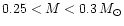 ,
which
would form the majority of the observed systems using the full
DSBH98 cooling (model A1; see Fig. 2).
,
which
would form the majority of the observed systems using the full
DSBH98 cooling (model A1; see Fig. 2).
We computed a model of the population of close binary white dwarfs and found good agreement between our model and the observed double white dwarf sample. A better agreement with observations compared to earlier studies is found due to two modifications.
The first is a different treatment of unstable mass transfer from a giant to a main sequence star of comparable mass. The second is a more detailed modelling of the cooling of low mass white dwarfs which became possible because detailed evolutionary models for such white dwarfs became available. Our main conclusions can be summarised as follows.
.
This discrepancy can be removed with
the assumption that low-mass white dwarfs cool faster than computed
by Driebe et al. (1998). The same assumption removes discrepancies
between observed and derived ages of low-mass white dwarfs that
accompany recycled pulsars, as shown by van Kerkwijk et al. (2000). Faster
cooling is expected if the hydrogen envelopes around low-mass white
dwarfs are partially expelled by thermal flashes or a stellar wind;
 ,
to
find one such pair in a sample of 200 to 600 white
dwarfs. Reversing this argument, when the statistics become more
reliable, the observed number of systems with different types of
white dwarfs could provide constraints on the cooling models for
these white dwarfs.
,
to
find one such pair in a sample of 200 to 600 white
dwarfs. Reversing this argument, when the statistics become more
reliable, the observed number of systems with different types of
white dwarfs could provide constraints on the cooling models for
these white dwarfs.
Acknowledgements
We thank the referee A. Gould for valuable comments. LRY and SPZ acknowledge the warm hospitality of the Astronomical Institute "Anton Pannekoek''. This work was supported by NWO Spinoza grant 08-0 to E. P. J. van den Heuvel, the Russian Federal Program "Astronomy'' and RFBR grant 99-02-16037 and by NASA through Hubble Fellowship grant HF-01112.01-98A awarded (to SPZ) by the Space Telescope Science Institute, which is operated by the Association of Universities for Research in Astronomy, Inc., for NASA under contract NAS 5-26555.
We present some changes we made to the population synthesis code SeBa (see Portegies Zwart & Verbunt 1996; Portegies Zwart & Yungelson 1998).
As before, the treatment of stellar evolution in our code is based on the fits to detailed stellar evolutionary models (Eggleton et al. 1989; Tout et al. 1997), which give the luminosity and the radius of the stars as a function of time and mass. In addition to this we need the mass of the core and the mass loss due to stellar wind. These we obtain as follows.
For the mass of the helium core
 at the end of the main
sequence we use (Eggleton, private communication, 1998)
at the end of the main
sequence we use (Eggleton, private communication, 1998)
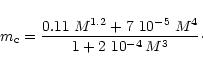 |
(A.1) |
 |
(A.2) |
 |
(A.3) |
When giants have degenerate cores, application of a core mass-luminosity relation gives more accurate results than direct integration of the growth of the core.
For degenerate helium cores of stars with
 we use
(Boothroyd & Sackmann 1988)
we use
(Boothroyd & Sackmann 1988)
 on the AGB we use (Groenewegen & de Jong 1993)
 in stars
 where the two relations fit
together reasonably. We changed the power of the dependence on Mfrom -0.19 in the original paper to -0.25 because the maximum
luminosities given by our fits otherwise lead to white dwarf masses
too high compared to initial-final mass relations as found from
observations (see Groenewegen & de Jong 1993).
where the two relations fit
together reasonably. We changed the power of the dependence on Mfrom -0.19 in the original paper to -0.25 because the maximum
luminosities given by our fits otherwise lead to white dwarf masses
too high compared to initial-final mass relations as found from
observations (see Groenewegen & de Jong 1993).
The masses of CO cores formed by central He burning inside the helium core are defined in the same way as we define the relation between the mass of helium stars and their CO cores (see Sect. A.1.2).
A white dwarf forms if a component of a binary with
 loses its hydrogen envelope through RLOF either before core helium
burning (case B mass transfer) or after helium exhaustion (case C).
The masses of white dwarfs formed in cases B and C as function of initial
mass are shown in Fig. A.1.
loses its hydrogen envelope through RLOF either before core helium
burning (case B mass transfer) or after helium exhaustion (case C).
The masses of white dwarfs formed in cases B and C as function of initial
mass are shown in Fig. A.1.
A helium star is formed when a star more massive than 2.3
loses its hydrogen envelope in case B mass transfer. The helium star
starts core helium burning and forms a CO core. In our code, this
core grows linearly at a rate given by the ratio of 65% of the
initial mass of the helium star and the total lifetime of the helium
star. This is suggested by computations of Habets (1986) and gives a
CO core of the Chandrasekhar mass for a 2.2
helium star; the
minimum mass to form a neutron star in our code.
Helium stars with
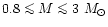 expand again after core
helium exhaustion and can lose their remaining helium envelope in so
called case BB mass transfer. The amount of mass that can be lost is
defined as increasing linearly from 0 to 45% for stars between 0.8
and 2.2
and stays constant above 2.2 .
The maximum
mass of the CO white dwarf thus formed is 1.21 .
Helium stars
of lower mass (
expand again after core
helium exhaustion and can lose their remaining helium envelope in so
called case BB mass transfer. The amount of mass that can be lost is
defined as increasing linearly from 0 to 45% for stars between 0.8
and 2.2
and stays constant above 2.2 .
The maximum
mass of the CO white dwarf thus formed is 1.21 .
Helium stars
of lower mass (
 )
do not expand and retain their thick
helium envelopes, forming hybrid white dwarfs (Iben & Tutukov 1985).
)
do not expand and retain their thick
helium envelopes, forming hybrid white dwarfs (Iben & Tutukov 1985).
We describe mass loss in a stellar wind in a very general way in
which the amount of wind loss increases in time according to
 is derived from fitting stellar wind mass
loss on the main sequence of massive stars (
is derived from fitting stellar wind mass
loss on the main sequence of massive stars (
 Meynet et al. 1994),
but we apply it also for low and intermediate mass
stars. For these stars
Meynet et al. 1994),
but we apply it also for low and intermediate mass
stars. For these stars  is the duration of the evolutionary
phase that the star is in (as given by Eggleton et al. 1989). For the
different evolutionary phases, the parameters
is the duration of the evolutionary
phase that the star is in (as given by Eggleton et al. 1989). For the
different evolutionary phases, the parameters
 is
defined as follows.
is
defined as follows.
In the Hertzsprung gap
is 1% of the total mass of the
star.
For the first giant branch (hydrogen shell burning), we use a fit to
models of Sweigart et al. (1990) for stars with degenerate helium cores
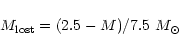 |
(A.7) |
 above
above
 .
.
On the horizontal branch
is 5% of the envelope mass.
For the AGB phase we take
equal to 80% of the mass of
the envelope of the star when it enters the early AGB phase.
In the previous version of the SeBa code all gyration radii were set to 0.4. The gyration radius plays a role in the determination of the stability of the mass transfer (Portegies Zwart & Verbunt 1996, Appendix C.1). We now use the following values.
For main-sequence stars we use a fit to the results by Claret & Giménez (1990).
Further we classify stars either as radiative (stars in Hertzsprung
gap and helium stars) or as convective (red giants, AGB stars). A
summary of radii of gyration are given in Table A.1.
| Type | k2 |
| Radiative stars | 0.03 |
| Convective stars | 0.2 |
| White dwarfs | 0.4 |
| Neutron stars | 0.25a |
| Black holes |
 |
| (a) Gunn & Ostriker (1969). | |
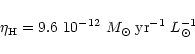
We model the cooling of white dwarfs according to the results of Blöcker (1995) and Driebe et al. (1998).
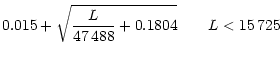
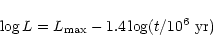
Luminosity
The luminosity of white dwarfs as function of time t can be reasonably
well modelled by
 is a linear fit given by
stays constant (i.e.
is a linear fit given by
stays constant (i.e.
 below
below
 and
and
 above
above
 ). For white dwarf
masses below
). For white dwarf
masses below
 the luminosity is constrained to be below
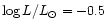 ,
for more massive white dwarfs below
,
for more massive white dwarfs below
 .
In Fig. A.2 we show the fits and the
results of
Blöcker (1995) and Driebe et al. (1998).
.
In Fig. A.2 we show the fits and the
results of
Blöcker (1995) and Driebe et al. (1998).
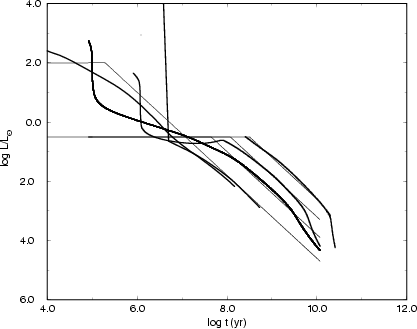 |
Figure A.2: White dwarf cooling tracks from Driebe et al. (1998) and Blöcker (1995). Straight lines are the fits to these curves. The curves are for masses of 0.179, 0.300, 0.414, 0.6 and 0.8 from top right to bottom left |
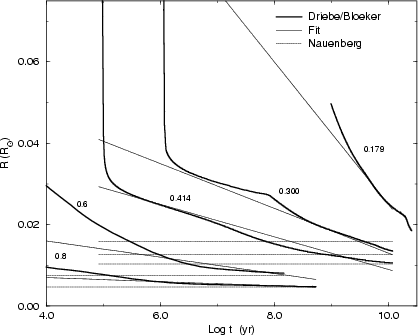 |
Figure A.3: White dwarf radii from Driebe et al. (1998) and Blöcker (1995). Straight lines are the fits to these curves. The curves are for masses of 0.179, 0.300, 0.414, 0.6 and 0.8 from top right to bottom left |
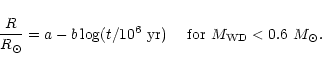
Radius
We fitted the models of Driebe et al. (1998) and Blöcker (1995), and
interpolated between the fits. The fits are given by
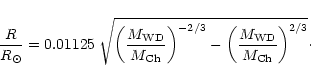
For more massive white dwarfs we use the mass-radius relation for
zero-temperature spheres (Nauenberg 1972)
Our modification to the cooling described above reduces the cooling
time scale for white dwarfs with masses below
 .
For these
white dwarfs we use the cooling curve and the radius of a more
massive, thus faster cooling white dwarf of 0.46
(see
Sect. 4.3).
.
For these
white dwarfs we use the cooling curve and the radius of a more
massive, thus faster cooling white dwarf of 0.46
(see
Sect. 4.3).
As suggested by Nelemans et al. (2000), we distinguish four types of mass transfer with different outcomes: stable mass transfer, common envelope evolution, envelope ejection and a double spiral-in.
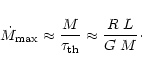
The amount of mass that can be accreted by a star is limited by its
thermal time scale
 |
(A.12) |
 times the specific
angular momentum of the binary.
times the specific
angular momentum of the binary.
This assumption gives for the variation of orbital separation
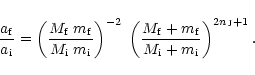 |
(A.13) |
 ,
which gives good agreement for the periods
of low-mass Algols and Be X-ray binaries (Portegies Zwart 1996).
,
which gives good agreement for the periods
of low-mass Algols and Be X-ray binaries (Portegies Zwart 1996).
 |
a | b |
| 0.2 | 0.1 | 0.0175 |
| 0.4 | 0.03 | 0.0044 |
| 0.6 | 0.017 | 0.001 |
| 0.8 | 0.011 | 0.0005 |
When the mass transfer is unstable due to a tidal instability, the
accretor is a compact object, or the envelope ejection equation gives
a smaller orbital separation, we apply the standard common envelope
equation
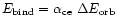 (Webbink 1984):
is an efficiency parameter and  a
parameter describing the strucure of the envelope of the giant. Both
are uncertain so we use them combined:
a
parameter describing the strucure of the envelope of the giant. Both
are uncertain so we use them combined:
 .
.
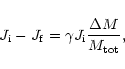
In the case of envelope ejection (Nelemans et al. 2000), we assume that the
complete envelope is lost and that this mass loss reduces the
angular momentum of the system linearly proportional to the mass
loss, as first suggested for the general case of non-conservative
mass transfer by Paczynski & Zio kowski (1967)
 |
(A.15) |
 is the angular momentum of the pre-mass transfer
binary and
is the angular momentum of the pre-mass transfer
binary and
 is the total mass of the binary. The
companion does not accrete al all (see discussion in
Sect. 2.2 and Nelemans et al. 2000).
The change in orbital
separation is given by
.
is the total mass of the binary. The
companion does not accrete al all (see discussion in
Sect. 2.2 and Nelemans et al. 2000).
The change in orbital
separation is given by
.
If mass transfer is unstable when both stars are evolved (which can
only happen if the mass ratio is close to unity), we model the
evolution as a common envelope in which the two cores spiral-in. The
energy needed to expel the complete envelope is computed analogously
to the case of a standard common envelope (Webbink 1984; see also
Sect. A.2.2):
![\begin{displaymath}\frac{M_{\rm i} \; (M_{i} - M_{\rm f})}{\lambda \; R}\!+\!
\...
...m f}} -
\frac{M_{\rm i}\; m_{\rm i}}{2 \;a_{\rm i}} \right].
\end{displaymath}](/articles/aa/full/2001/03/aah2305/img135.gif)
![\begin{displaymath}\frac{M_{\rm i} (1-f) M_{\rm i}}{\lambda \; R} +
\frac{m_{\r...
...RLOF}} -
\frac{M_{\rm i}\; m_{\rm i}}{2 \;a_{\rm i}} \right]
\end{displaymath}](/articles/aa/full/2001/03/aah2305/img136.gif)
 is the separation at which one of the
cores fills its Roche lobe. This is solved for f.
is the separation at which one of the
cores fills its Roche lobe. This is solved for f.
kowski, J. 1967, Acta Astron., 17, 7
In the text








 )
are in units of yr-1 in the
Galaxy. All numbers (#) are total numbers in the Galaxy. Close
double white dwarfs are represented with (wd, wd). See
Sect.
)
are in units of yr-1 in the
Galaxy. All numbers (#) are total numbers in the Galaxy. Close
double white dwarfs are represented with (wd, wd). See
Sect. 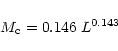


![\begin{figure}
\par\includegraphics[angle=-90,width=8.4cm,clip]{H2305f18.ps}\end{figure}](/articles/aa/full/2001/03/aah2305/img94.gif)
![\begin{displaymath}\Delta M_{\rm w} = M_{\rm lost} \; \left[ \left( \frac{t + \D...
...right)^\eta - \left( \frac{t}{t_{\rm f}} \right)^\eta \right].
\end{displaymath}](/articles/aa/full/2001/03/aah2305/img97.gif)

![\begin{displaymath}
\frac{M_{\rm i} \; (M_{\rm i} - M_{\rm f})}{\lambda \; R}
...
...{2 \;a_{\rm f}} -
\frac{M_{\rm i} \; m}{2 \;a_{\rm i}} \right]
\end{displaymath}](/articles/aa/full/2001/03/aah2305/img127.gif)