A&A 365, 49-77 (2001)
DOI: 10.1051/0004-6361:20000014
On the origin of the O and B-type stars with high velocities
II. Runaway stars and pulsars ejected from the nearby young stellar groups
R. Hoogerwerf - J. H. J. de Bruijne - P. T. de Zeeuw
Send offprint request: P. T. de Zeeuw,
Sterrewacht Leiden, Postbus 9513, 2300 RA Leiden, The Netherlands
Received 17 August 2000 / Accepted 28 September 2000
Abstract
We use milli-arcsecond accuracy astrometry (proper motions and
parallaxes) from Hipparcos and from radio observations to retrace the
orbits of 56 runaway stars and nine compact objects with distances
less than 700 pc, to identify the parent stellar group. It is possible
to deduce the specific formation scenario with near certainty for two
cases. (i) We find that the runaway star  Ophiuchi and the
pulsar PSR J1932+1059 originated about 1 Myr ago in a supernova
explosion in a binary in the Upper Scorpius subgroup of the Sco OB2
association. The pulsar received a kick velocity of
Ophiuchi and the
pulsar PSR J1932+1059 originated about 1 Myr ago in a supernova
explosion in a binary in the Upper Scorpius subgroup of the Sco OB2
association. The pulsar received a kick velocity of
 350 km s-1 in this event, which dissociated the binary, and gave
Oph its large space velocity. (ii) Blaauw & Morgan and Gies
& Bolton already postulated a common origin for the runaway-pair
AE Aur and
350 km s-1 in this event, which dissociated the binary, and gave
Oph its large space velocity. (ii) Blaauw & Morgan and Gies
& Bolton already postulated a common origin for the runaway-pair
AE Aur and  Col, possibly involving the massive highly-eccentric
binary
Col, possibly involving the massive highly-eccentric
binary  Ori, based on their equal and opposite velocities. We
demonstrate that these three objects indeed occupied a very small
volume 2.5 Myr ago, and show that they were ejected from the
nascent Trapezium cluster.
We identify the parent group for two more pulsars: both likely
originate in the 50 Myr old association Per OB3, which
contains the open cluster
Ori, based on their equal and opposite velocities. We
demonstrate that these three objects indeed occupied a very small
volume 2.5 Myr ago, and show that they were ejected from the
nascent Trapezium cluster.
We identify the parent group for two more pulsars: both likely
originate in the 50 Myr old association Per OB3, which
contains the open cluster Persei. At least 21 of the 56
runaway stars in our sample can be linked to the nearby associations
and young open clusters. These include the classical runaways
53 Arietis (Ori OB1),
Persei. At least 21 of the 56
runaway stars in our sample can be linked to the nearby associations
and young open clusters. These include the classical runaways
53 Arietis (Ori OB1),  Persei (Per OB2), and
  Cephei
(Cep OB3), and fifteen new identifications, amongst which a pair of
stars running away in opposite directions from the region containing
the
Ori cluster. Other currently nearby runaways and pulsars
originated beyond 700 pc, where our knowledge of the parent groups is
very incomplete.
Cephei
(Cep OB3), and fifteen new identifications, amongst which a pair of
stars running away in opposite directions from the region containing
the
Ori cluster. Other currently nearby runaways and pulsars
originated beyond 700 pc, where our knowledge of the parent groups is
very incomplete.
Key words: Astrometry -
stars: early-type -
stars: kinematics -
pulsars: general -
supernova: general
Author for correspondance: This email address is being protected from spambots. You need JavaScript enabled to view it.
1 Introduction
About 10-30% of the O stars and 5-10% of the B stars (Gies
1987; Stone 1991) have large peculiar velocities
(up to 200 km s-1), and are often found in isolated locations;
these are the so-called "runaway stars'' (Blaauw 1961,
hereafter Paper I). The velocity dispersion of the population of
runaway stars,
 km s-1 (e.g., Stone
1991), is much larger than that of the "normal'' early-type
stars,
km s-1 (e.g., Stone
1991), is much larger than that of the "normal'' early-type
stars,
 km s-1. Besides their peculiar
kinematics, runaway stars are also distinguished from the normal
early-type stars by an almost complete absence of multiplicity (cf. the binary fraction of normal early-type stars is >50% [e.g., Mason
et al. 1998]). Furthermore, over 50% of the (massive)
runaways have large rotational velocities and enhanced surface helium
abundances (Blaauw 1993).
km s-1. Besides their peculiar
kinematics, runaway stars are also distinguished from the normal
early-type stars by an almost complete absence of multiplicity (cf. the binary fraction of normal early-type stars is >50% [e.g., Mason
et al. 1998]). Furthermore, over 50% of the (massive)
runaways have large rotational velocities and enhanced surface helium
abundances (Blaauw 1993).
Several mechanisms have been suggested for the origin of runaway stars
(Zwicky 1957; Paper I; Poveda et al. 1967;
Carrasco et al. 1980; Gies & Bolton 1986), two of
which are still viable: the binary-supernova scenario (Paper I) and
the dynamical ejection scenario (Poveda et al. 1967). We
summarize them in turn.
In this scenario a runaway star receives its velocity when the primary component of a massive
binary system explodes as a supernova. When the supernova shell passes
the secondary the gravitational attraction of the primary reduces
considerably, and the secondary starts to move through space with a
velocity comparable to its original orbital velocity
(30-150 km s-1). What remains of the primary after the
explosion is a compact object, either a neutron star or a black
hole. Depending on the details of the preceding binary evolution, the
eccentricity of the orbit, and the kick velocity
 due to the asymmetry of the supernova
explosion (e.g., Burrows et al. 1995), the
compact object may or may not remain bound to the runaway star (e.g.,
Hills 1983). In most cases less than half of the total mass
of the binary is expelled in the explosion. As this is insufficient to
break up the binary (Paper I), most BSS runaways are
expected to remain double. Examples of such systems are provided by
the high-mass-X-ray binaries (e.g., van den Heuvel et al. 2000). Their typical velocities of 50 km s-1(Kaper et al. 1997; Chevalier & Ilovaisky 1998)
are the natural result of the recoil velocity acquired when the
supernova shell leaves the binary system.
due to the asymmetry of the supernova
explosion (e.g., Burrows et al. 1995), the
compact object may or may not remain bound to the runaway star (e.g.,
Hills 1983). In most cases less than half of the total mass
of the binary is expelled in the explosion. As this is insufficient to
break up the binary (Paper I), most BSS runaways are
expected to remain double. Examples of such systems are provided by
the high-mass-X-ray binaries (e.g., van den Heuvel et al. 2000). Their typical velocities of 50 km s-1(Kaper et al. 1997; Chevalier & Ilovaisky 1998)
are the natural result of the recoil velocity acquired when the
supernova shell leaves the binary system.
Several searches failed to find compact companions of classical
runaway stars (Gies & Bolton 1986; Philp et al. 1996; Sayer et al. 1996), suggesting that for these systems
of the
neutron star was large enough (several 100 km s-1) to unbind the binary (e.g.,
Frail & Kulkarni 1991; Cordes et al.
1993; Lai 1999). The typical magnitude of this
"threshold'' kick velocity is uncertain (e.g., Hills 1983;
Lorimer et al. 1997; Hansen & Phinney
1997; Hartman 1997).
Single BSS runaways must originate in close binaries because these
systems have the largest orbital velocities, and therefore they have
experienced close binary evolution before being ejected as a
runaway. This leads to the following observable characteristics:
- 1:
- BSS runaways are expected to have increased helium
abundance
![[*]](/icons/foot_motif.gif) and large rotational velocity:
when the primary fills its Roche lobe, mass and angular momentum is
transferred to the star that will become the runaway. The mass
transfer stops when the "primary'' has become a helium star (i.e., only
the helium core remains). This process enriches the runaway with
helium, and spins it up (e.g., Packet 1981; van den Heuvel
1985; Blaauw 1993);
and large rotational velocity:
when the primary fills its Roche lobe, mass and angular momentum is
transferred to the star that will become the runaway. The mass
transfer stops when the "primary'' has become a helium star (i.e., only
the helium core remains). This process enriches the runaway with
helium, and spins it up (e.g., Packet 1981; van den Heuvel
1985; Blaauw 1993);
- 2:
- A BSS runaway can become a blue straggler, because it is
rejuvenated during the mass-transfer period through the fresh
fuel it receives from the primary;
- 3:
- The kinematic age of a BSS runaway star (defined as the time
since the runaway left its parent group) should be smaller than
the age of the parent group. The primary of the original binary
system first evolves for several Myr before it explodes and the
runaway is ejected.
In this scenario runaway stars are formed through gravitational interactions between
stars in dense, compact clusters. Although binary-single star
encounters produce runaways (e.g., Hut & Bahcall 1983), the
most efficient interaction is the encounter of two hard binary systems
(Hoffer 1983). Detailed simulations show that these
collisions produce runaways with velocities up to 200 km s-1(Mikkola 1983a, 1983b; Leonard & Duncan
1988, 1990; Leonard 1991). The outcome of
a binary-binary collision can be (i) two binaries, (ii) one single
star and a hierarchical triple system, (iii) two single stars and one
binary, and (iv) four single stars (Leonard 1989). In most
cases the collision will result in the ejection of two single stars
and one hard binary with an eccentric orbit
(Hoffer 1983;
Mikkola 1983a). Since the resulting binary is the most
massive end product of the collision it is unlikely to gain a lot of
speed; it might even remain within the parent cluster. This process
naturally leads to a low (0-33%) runaway binary fraction which is in
qualitative agreement with the observations (e.g, Gies & Bolton
1986). For the DES to be efficient the initial binary
fraction in clusters needs to be large. Recent observations show that
the binary fraction for massive stars in young clusters is >50%
(Abt 1983; Kroupa et al. 1999;
Preibisch et al. 1999 [approaching 100%]).
DES runaways have the following characteristics:
- 1:
- DES runaways are formed most efficiently in a high-density
environment, e.g., in young open clusters. They may also
originate in OB associations. These birth sites of massive stars
are unbound stellar groups and therefore expand (e.g., Blaauw
1952a,1978; Elmegreen 1983;
Kroupa 2000a), so DES runaways
must have been ejected very soon after their formation. The
kinematic age and the age of the parent association are thus
nearly equal;
- 2:
- DES runaways are not expected to show signs of binary evolution
such as large rotational velocities and increased helium
abundance. However, Leonard (1995) suggested that some
binary-binary encounters produce runaways consisting of two
stars that merged during the interaction. These would have
enhanced helium abundances and large rotational velocities (Benz
& Hills 1987, but see Lombardi et al. 1995);
- 3:
- DES runaways are expected to be mostly single stars.
Table 1:
The nearby runaway stars and pulsars with accurate
astrometry. HIP indicates the number of the runaway star in the
Hipparcos Catalogue,
 indicates the space motion
of the runaway star relative to Galactic rotation (in km s-1),
and PSR indicates the pulsar identifications
indicates the space motion
of the runaway star relative to Galactic rotation (in km s-1),
and PSR indicates the pulsar identifications
| HIP |
|
HIP |
|
HIP |
|
HIP |
|
HIP |
|
HIP |
|
PSR |
| 3478 |
80.4 |
28756 |
196.6 |
43158 |
57.2 |
61602 |
30.2 |
91599 |
44.7 |
101350 |
36.4 |
J0826+2637 |
| 3881 |
32.1 |
29678 |
63.0 |
45563 |
125.9 |
62322 |
43.9 |
92609 |
31.0 |
102274 |
46.1 |
J0835-4510 |
| 9549 |
107.9 |
30143 |
55.5 |
46928 |
45.3 |
66524 |
112.7 |
94899 |
162.8 |
103206 |
32.3 |
J0953+0755 |
| 10849 |
50.0 |
35951 |
34.9 |
46950 |
32.1 |
69491 |
77.2 |
94934 |
94.0 |
105811 |
38.3 |
J1115+5030 |
| 14514 |
39.4 |
36246 |
32.1 |
48715 |
34.5 |
70574 |
205.3 |
95818 |
34.7 |
106620 |
45.2 |
J1136+1551 |
| 18614 |
64.9 |
38455 |
41.4 |
48943 |
35.2 |
76013 |
69.0 |
96115 |
165.6 |
109556 |
74.0 |
J1239+2453 |
| 20330 |
34.7 |
38518 |
31.1 |
49934 |
31.2 |
81377 |
23.5 |
97774 |
35.0 |
|
|
J1456-6843 |
| 22061 |
86.5 |
39429 |
62.4 |
52161 |
34.8 |
82171 |
62.9 |
97845 |
70.3 |
|
|
J1932+1059 |
| 24575 |
113.3 |
40341 |
61.7 |
57669 |
31.1 |
82868 |
30.3 |
99435 |
39.4 |
|
|
Geminga |
| 27204 |
107.8 |
42038 |
31.3 |
59607 |
78.8 |
86768 |
30.1 |
99580 |
55.6 |
|
|
|
Which of the two formation processes is responsible for runaway stars
has been debated vigorously. Both mechanisms create stars with large
peculiar velocities which enable them to travel far from their parent
group: a velocity of 100 km s-1 corresponds to 100 pc in
only 1 Myr. The relative importance of the two scenarios can be
established by (i) studying the statistical properties of the ensemble
of runaway stars, or by (ii) investigating individual runaways in
detail. The former approach is based on differences in the general
runaway characteristics predicted by each scenario. This requires a
large, complete database of runaway stars, which is, to date,
unavailable (e.g., Moffat et al. 1998). Here we therefore
follow the latter, individual approach by retracing the orbits of
runaway stars back in time. The objects encountered by a runaway along
its path (e.g., an open cluster, an association, other runaways, or a
neutron star), and the times at which these encounters occurred, provide
information about its formation. Evidence for the BSS as the formation
mechanism for single runaway stars is to find a runaway and a neutron
star (pulsar) which occupied the same region of space at the same time
in the past. Evidence for the DES is to find a common site of origin
for the individual components of the encounter, e.g., a pair of
runaways and a binary, in a dense star cluster.
The individual approach requires highly accurate positions
(,
 ,
,
 )
and velocities
(
)
and velocities
(
 ,
,
 ,
,
 ). Here
denotes right ascension,
declination, parallax,
). Here
denotes right ascension,
declination, parallax,
 proper motion in
right ascension,
proper motion in declination, and
the radial velocity. The milli-arcsecond (mas)
accuracy of Hipparcos astrometry (ESA 1997) allows specific
investigations of the runaway stars within 700 pc. Positions
and proper motions of similar accuracy are now available as well for
some pulsars through timing measurements and VLBI observations (e.g.,
Taylor et al. 1993; Campbell 1995). The Hipparcos data
also significantly improved and extended the membership lists of the nearby
OB associations (de Zeeuw et al. 1999), and of some nearby young
open clusters. The
resulting improved distances and space velocities of these stellar
aggregates make it possible to connect the runaways and pulsars to
their parent group, and, in some cases, to identify the specific
formation scenario (Hoogerwerf et al. 2000;
de Zeeuw et al. 2000). Pre-Hipparcos
data (e.g., Blaauw & Morgan 1954; Paper I; Blaauw
1993; van Rensbergen et al. 1996) allowed
identification of the parent groups for some
runaways, but generally lacked the accuracy to study the orbits of the
runaways in detail (but see Blaauw & Morgan 1954; Gies &
Bolton 1986).
proper motion in
right ascension,
proper motion in declination, and
the radial velocity. The milli-arcsecond (mas)
accuracy of Hipparcos astrometry (ESA 1997) allows specific
investigations of the runaway stars within 700 pc. Positions
and proper motions of similar accuracy are now available as well for
some pulsars through timing measurements and VLBI observations (e.g.,
Taylor et al. 1993; Campbell 1995). The Hipparcos data
also significantly improved and extended the membership lists of the nearby
OB associations (de Zeeuw et al. 1999), and of some nearby young
open clusters. The
resulting improved distances and space velocities of these stellar
aggregates make it possible to connect the runaways and pulsars to
their parent group, and, in some cases, to identify the specific
formation scenario (Hoogerwerf et al. 2000;
de Zeeuw et al. 2000). Pre-Hipparcos
data (e.g., Blaauw & Morgan 1954; Paper I; Blaauw
1993; van Rensbergen et al. 1996) allowed
identification of the parent groups for some
runaways, but generally lacked the accuracy to study the orbits of the
runaways in detail (but see Blaauw & Morgan 1954; Gies &
Bolton 1986).
We define a sample of nearby runaways and pulsars with good astrometry
in Sect. 2, and then analyse two cases in depth:
Oph and PSR J1932+1059 in Sect. 3 and AE Aur,
Col and Ori in Sect. 4. We apply the method
developed in these sections to the entire sample of runaways and
pulsars in Sects. 5, 6, and
7. We discuss helium abundances, rotational
velocities and the blue straggler nature of runaways in
Sects. 8 and 9, and summarize our conclusions
in Sect. 10.
2 Nearby runaway stars and pulsars
The parent group is known for about a dozen "classical'' runaway stars
(Paper I; Blaauw 1993). The Hipparcos Catalogue
contains these stars, as well as many additional O and B stars which
were known in 1982 to have large radial velocities, including 153 of
the 162 runaway candidates in Hipparcos Proposal 141 (de Zeeuw et al. 1999). Many of
these objects are located beyond 700 pc, where the Hipparcos
parallax measurement is of modest quality. For this reason we
restricted ourselves to a sample of nearby runaway stars, and added to
this the (few) nearby pulsars with measured proper motions.
![\begin{figure}\includegraphics[angle=0.0, width=12.2cm, clip=true, keepaspectratio=true]{10198_fig01.eps} \end{figure}](/articles/aa/full/2001/02/aa10198/Timg35.gif) |
Figure 1:
a) Histogram of the space motions of the
sample of runaway stars defined in Sect. 2.1.
b) Distribution of pulsars from the Taylor et al. (1993)
catalogue with measured proper motions. The light grey histogram
shows all pulsars within 2 kpc and the dark grey histogram shows the
pulsar with accurate proper motions (
 ). The
latter, for D < 1 kpc, is the pulsar sample defined in
Sect. 2.1 ). The
latter, for D < 1 kpc, is the pulsar sample defined in
Sect. 2.1 |
| Open with DEXTER |
2.1 Selection of the sample
We started with all 1118 O to B5 stars in the Hipparcos Catalogue
which have radial velocities listed in the Hipparcos Input Catalogue
(Turon et al. 1992). Next we only considered those stars
which have significant parallaxes (
 mas) and
proper motions (
mas) and
proper motions (
 ), and space velocities
larger than 30 km s-1 with respect to the standard of rest of the
runaway. For the last requirement we corrected the runaway velocity
for Solar motion and Galactic rotation (Dehnen & Binney
1997). The somewhat arbitrary choice of the velocity limit of
30 km s-1 minimizes the contamination of the sample by normal O
and B stars (Sect. 1). These criteria yield 54 runaway
candidates (five of which are classical runaways). This new sample does not
contain the nearby runaways Oph and Per. The former is
not selected because its space velocity is smaller than 30 km s-1(although its velocity relative to its parent group Sco OB2 is larger,
cf. Sect. 3) and the latter is not selected because
), and space velocities
larger than 30 km s-1 with respect to the standard of rest of the
runaway. For the last requirement we corrected the runaway velocity
for Solar motion and Galactic rotation (Dehnen & Binney
1997). The somewhat arbitrary choice of the velocity limit of
30 km s-1 minimizes the contamination of the sample by normal O
and B stars (Sect. 1). These criteria yield 54 runaway
candidates (five of which are classical runaways). This new sample does not
contain the nearby runaways Oph and Per. The former is
not selected because its space velocity is smaller than 30 km s-1(although its velocity relative to its parent group Sco OB2 is larger,
cf. Sect. 3) and the latter is not selected because
 .
However, since the runaway nature of these
two stars is well established (e.g., Paper I) we
included them in our sample, bringing the total to 56. The Hipparcos
numbers and space velocities of these 56 stars are listed in
Table 1. Panel a of Fig. 1
shows the histogram of the derived space velocities.
.
However, since the runaway nature of these
two stars is well established (e.g., Paper I) we
included them in our sample, bringing the total to 56. The Hipparcos
numbers and space velocities of these 56 stars are listed in
Table 1. Panel a of Fig. 1
shows the histogram of the derived space velocities.
We selected a sample of nearby pulsars from the Taylor, Manchester &
Lyne (1993) catalogue, as updated
on http://pulsar.princeton.edu/.
It contains 94 pulsars with known
proper motions and distances. Only seven of these meet our distance
(
 kpc) and proper motion (
)
constraints (see panel b of Fig. 1). Most
pulsar distances are derived from the dispersion measure. These
distances are unreliable, especially for nearby objects, since they
depend on the local properties of the ISM.
For one nearby pulsar, PSR J0953+0755, high precision VLBA
measurements became available recently (Brisken et al. 2000). We added this pulsar to our sample.
The eight pulsars are listed in Table 1, together with
Geminga, a nearby neutron star which is not a pulsar, for which an
accurate proper motion is known (Caraveo et al. 1996).
kpc) and proper motion (
)
constraints (see panel b of Fig. 1). Most
pulsar distances are derived from the dispersion measure. These
distances are unreliable, especially for nearby objects, since they
depend on the local properties of the ISM.
For one nearby pulsar, PSR J0953+0755, high precision VLBA
measurements became available recently (Brisken et al. 2000). We added this pulsar to our sample.
The eight pulsars are listed in Table 1, together with
Geminga, a nearby neutron star which is not a pulsar, for which an
accurate proper motion is known (Caraveo et al. 1996).
Table 2:
The nearby (D < 700 pc), young ( Myr), open clusters listed in the WEBDA Catalogue. The
table gives the designation of the open cluster (Name), its position
on the sky
Myr), open clusters listed in the WEBDA Catalogue. The
table gives the designation of the open cluster (Name), its position
on the sky  ,
the number of member stars contained in the
Hipparcos (HIP) and Hipparcos Input Catalogues (HIC), its distance,
proper motion, and radial velocity as obtained from the Hipparcos
data (D,
,
the number of member stars contained in the
Hipparcos (HIP) and Hipparcos Input Catalogues (HIC), its distance,
proper motion, and radial velocity as obtained from the Hipparcos
data (D,
![$[\mu_{\ell\ast},\mu_b]$](/articles/aa/full/2001/02/aa10198/img41.gif) ,
), and
whether the cluster is a candidate parent group in this study
(Cand.). The candidate status is denoted by ``Y'' for the clusters
with well-determined positions and velocities, by ``N'' for clusters
for which not all information is available (either astrometry or
radial velocity), by ``N*'' if the astrometry does not show a
clear signature of an open cluster (i.e., a clump in the
proper-motion vs. proper-motion diagram), or by ``?'' if the
measurements are not very reliable (either because of a small number
of member stars or a large spread in the data)
,
), and
whether the cluster is a candidate parent group in this study
(Cand.). The candidate status is denoted by ``Y'' for the clusters
with well-determined positions and velocities, by ``N'' for clusters
for which not all information is available (either astrometry or
radial velocity), by ``N*'' if the astrometry does not show a
clear signature of an open cluster (i.e., a clump in the
proper-motion vs. proper-motion diagram), or by ``?'' if the
measurements are not very reliable (either because of a small number
of member stars or a large spread in the data)
| Name |
 |
b |
HIP |
HIC |
D |
 |
 |
|
Cand. |
| |
[deg.] |
[deg.] |
[#] |
[#] |
[pc] |
[mas yr-1] |
[mas yr-1] |
[km s-1] |
|
| Collinder 359 |
29.75 |
12.54 |
10 |
- |
|
|
|
|
N* |
| IC 4665 |
30.61 |
17.08 |
13 |
5 |
 |
 |
 |
 |
Y |
| Stephenson 1 |
66.85 |
15.51 |
0 |
- |
|
|
|
|
N |
| Roslund 5 |
71.40 |
0.25 |
13 |
- |
|
|
|
|
N* |
| Stock 7 |
134.68 |
0.04 |
3 |
- |
|
|
|
|
N* |
| Persei |
Central part of the Per OB3 association, contained in the list of de Zeeuw et al. |
| IC 0348 |
Associated with Per OB2 |
| Collinder 69 |
195.05 |
-12.00 |
6 |
- |
Ori cluster |
N* |
| NGC 1976 |
Trapezium cluster: associated with Ori OB1 |
| NGC 2232 |
214.36 |
-47.65 |
10 |
3 |
 |
 |
 |
 |
? |
| Collinder 121 |
Contained in list of nearby associations of de Zeeuw et al. |
| Collinder 140 |
245.18 |
-7.87 |
14 |
4 |
 |
 |
 |
 |
Y |
| Collinder 135 |
248.76 |
-11.20 |
19 |
4 |
 |
 |
 |
 |
Y |
| Pismis 5 |
259.39 |
0.86 |
0 |
- |
|
|
|
|
N |
| Pismis 4 |
262.74 |
-2.37 |
4 |
0 |
|
|
|
|
N |
| Trumpler 10 |
Contained in list of nearby associations of de Zeeuw et al. |
| IC 2391 |
270.36 |
-6.88 |
24 |
13 |
 |
 |
 |
 |
Y |
| vdB-Hagen 99 |
286.56 |
-0.63 |
7 |
2 |
 |
 |
 |
 |
? |
| IC 2602 |
289.60 |
-4.90 |
25 |
8 |
 |
 |
 |
 |
Y |
Our sample of nearby runaway stars and compact objects is severely
incomplete. The Hipparcos Catalogue is complete to V = 7.3-9 mag,
with the limit depending on Galactic latitude and spectral type (2163
of the 3622 O to B5 stars have V > 7.3 mag). The data available for
the O and B stars is inhomogeneous and incomplete, e.g., less than a
third of the O to B5 stars in the Catalog has a measured radial
velocity. We have excluded those with large
but
insignificant proper motions, as their retraced orbits are uncertain.
The beamed nature of the radio emission from pulsars hides many from
observation, and not all of those that do radiate in our direction
have been found. Of these, only a few have an accurately measured
proper motion and a reliable distance.
2.2 Nearby OB associations and open clusters
We adopt the positions and mean space motions of the OB associations
within 700 pc of the Sun as derived by de Zeeuw et al. (1999) from Hipparcos measurements. For the open clusters
we compiled a list from the WEBDA
catalogue (http://obswww.unige.ch/webda/), and consider only those which are
young ( Myr) and with distances less than 700 pc as likely
parent groups. The age requirement is comparable to the age of the
oldest runaways we consider here (B5V). Typical pulsar ages are less
than 50 Myr (e.g., Blaauw & Ramachandran 1998). This
selection yields nineteen open clusters (see
Table 2), of which five are already covered in the
study of the nearby associations by de Zeeuw et al. (1999).
To obtain the space motion of these clusters we use the WEBDA
member stars listed in the Hipparcos Catalogue to obtain reliable
astrometry, and those in the Hipparcos Input Catalogue to obtain the
radial velocity. In this way we are able to construct a more or less
reliable space motion for seven of the fourteen remaining open
clusters (those labeled "Y'' or "?'' in Table 2
which summarizes the results).
2.3 Orbits
Traditionally, the orbits of runaway stars have been traced back in
time using straight lines through space. This is sufficiently accurate
for identification of the parent group for times up to a few Myr and
distances less than a few hundred pc. To make sure we include the
effect of the Galactic potential, we use a fourth-order Runge-Kutta
numerical integration method, with a fixed time-step of  yr,
to calculate the orbit. The Galactic potential we use consists of (i)
a logarithmic potential for the halo, (ii) a Miyamoto-Nagai potential
for the disk, and (iii) a Plummer potential for the bulge of the
Galaxy. The potential predicts Oort constants A =
13.5 km s-1 kpc-1 and B = -12.4 km s-1 kpc-1and a circular velocity
yr,
to calculate the orbit. The Galactic potential we use consists of (i)
a logarithmic potential for the halo, (ii) a Miyamoto-Nagai potential
for the disk, and (iii) a Plummer potential for the bulge of the
Galaxy. The potential predicts Oort constants A =
13.5 km s-1 kpc-1 and B = -12.4 km s-1 kpc-1and a circular velocity
 km s-1 at
R0 = 8.5 kpc. These values agree with those which Feast &
Whitelock (1997) obtained using Hipparcos data:
km s-1 at
R0 = 8.5 kpc. These values agree with those which Feast &
Whitelock (1997) obtained using Hipparcos data:
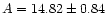 km s-1 kpc-1,
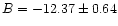 km s-1 kpc-1,
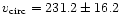 km s-1 at R0 = 8.5 kpc. Since the volume
covered in the orbit integration is typically a few hundred pc, and
the time of the integration is typically less than 10 Myr,
perturbations of the orbits caused by small-scale structure in the
disk are negligible.
km s-1 at R0 = 8.5 kpc. Since the volume
covered in the orbit integration is typically a few hundred pc, and
the time of the integration is typically less than 10 Myr,
perturbations of the orbits caused by small-scale structure in the
disk are negligible.
Before integrating the orbit, we correct the observed velocity
 for (i) the Solar motion with respect to the Local
Standard of Rest,
for (i) the Solar motion with respect to the Local
Standard of Rest,
 (Dehnen & Binney
1997), and (ii) the Galactic rotational velocity of the Local
Standard of Rest,
(Dehnen & Binney
1997), and (ii) the Galactic rotational velocity of the Local
Standard of Rest,
 (Binney & Tremaine
1987, p. 14). The stellar velocity
(Binney & Tremaine
1987, p. 14). The stellar velocity
 relative to the Galactic reference frame
is then given by
relative to the Galactic reference frame
is then given by
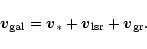 |
(1) |
To retrace the orbit, we reverse the velocity and integrate forward in
time. We calculate the distance of a star as  ,
where
is
the trigonometric parallax. Since we use the individual parallax, we
cannot correct this distance for possible biases (e.g., Smith &
Eichhorn 1996).
,
where
is
the trigonometric parallax. Since we use the individual parallax, we
cannot correct this distance for possible biases (e.g., Smith &
Eichhorn 1996).
We calculate the past orbit of each of the 56 runaway stars listed in
Table 1 for 10 Myr. We do this
times for each
star, in order to sample the error ellipsoid of the measured
parameters, defined by the covariance matrix of the Hipparcos
astrometry and the error in the radial velocity measurement.
Retracing the orbit of a pulsar is more difficult, because the radial
velocity is unknown. We therefore cover a range of radial velocities
of
 km s-1 in the orbit
integrations for the pulsars. Figure 2 shows the
positions of the runaways and pulsars on the sky, together with their
orbits, retraced back for only 2 Myr so as not to confuse the diagram.
Three orbits are shown for each pulsar: for
km s-1 in the orbit
integrations for the pulsars. Figure 2 shows the
positions of the runaways and pulsars on the sky, together with their
orbits, retraced back for only 2 Myr so as not to confuse the diagram.
Three orbits are shown for each pulsar: for
 km s-1 (filled square),
 km s-1 (open square), and
 km s-1 (open star).
We also retrace the orbits of the set of nearby OB associations and
open clusters defined in Sect. 2.2. These groups have
typical linear dimensions of 10-30 pc. We consider a group to be a
possible site of origin for a runaway or pulsar if the minimum
separation between the runaway/pulsar and the group was less than
10 pc at some time in the past 10 Myr. With this definition, we find a
parent group for 21 of the 56 runaways. These stars are indicated by
the filled circles in Fig. 2, and include the seven
classical runaways in the sample. We discuss them in detail in
Sects. 3-6 below. Six of the nine
neutron stars possibly traversed one of the nearby stellar groups;
these are PSR J0826+2637, PSR J0835-4510, PSR J1115+5030,
PSR J1239+2453, PSR J1932+1059, and Geminga (objects 1, 2, 4, 6,
8, and 9 in Fig. 2). We discuss them in
Sects. 3 and 6, and identify the
parent group for four of them. Table 3 summarizes the
data for the 22 runaways, four pulsars, and Geminga.
The pulsars and
runaways for which we cannot identify a parent group are discussed
further in Sect. 7.
![\begin{figure}\includegraphics[angle=0.0, width=14cm, clip=true, keepaspectratio=true]{10198_fig02.eps} \vskip -5mm
\end{figure}](/articles/aa/full/2001/02/aa10198/Timg88.gif) |
Figure 2:
Top: Sample of runaway stars defined in
Sect. 2.1, in Galactic cordinates. The open circles
denote the present positions of the runaways, and the arcs show
their past orbits, calculated for 2 Myr. The filled circles are the
runaways for which we can identify the parent association. The
numbers refer to the entries in Table 3. The asterisks
indicate two additional runaways (72 Col, HIP 94899 [left most of
the two asterisks]) discussed in Sect. 7. The grey
fields outline the nearby OB associations (de Zeeuw et al. 1999). From left to right and from top to bottom: Per OB3
( Persei), Per OB2, Cep OB3, Cep OB2, Cep OB6, Lac OB1,
Upper Scorpius, Upper Centaurus Lupus, Lower Centaurus Crux, Tr 10,
Vel OB2, Col 121, and Ori OB1. The open clusters are identified by
the filled light-grey circles for those with reliable positions and
velocities, and by the open, crossed circles for the remaining
clusters. The positions and designations of the clusters can be
found in Table 2. Bottom: Pulsar sample defined in
Sect. 2.1, in Galactic coordinates. The filled circles
indicate the present positions of the pulsars. The past orbits of
pulsars, calculated for 2 Myr, are shown for three different assumed
radial velocities: 0 km s-1 (filled squares),
200 km s-1 (open squares), -200 km s-1 (open stars).
The pulsars are labeled 1 through 8; 1: J0826+2637, 2:
J0835-4510 (Vela pulsar), 3: J0953+0755, 4: J1115+5030, 5:
J1136+1551, 6: J1239+2453, 7: J1456-6843, 8:
J1932+1059. Number 9 is the neutron star Geminga. The associations
and open clusters typically move comparatively little in 2 Myr |
| Open with DEXTER |
3 A binary supernova in Upper Scorpius
3.1
Oph and PSR J1932+1059
Oph is a single O9.5Vnn star, and was first identified as a
runaway originating in the Sco OB2 association by Blaauw
(1952b). Based on its proper motion, which points away from
the association, its radial velocity, and the large space velocity
(30 km s-1), Blaauw suggested that Oph might have
formed in the center of the association 3 Myr ago. Later
investigations (e.g., Paper I; Blaauw 1993;
van Rensbergen et al. 1996) showed that Oph either
became a runaway 1 Myr ago in the Upper Scorpius subgroup of
Sco OB2, or 2-3 Myr ago in the Upper Centaurus Lupus subgroup (cf. de Zeeuw et al. 1999).
Table 3:
Data for the nearby runaway stars and pulsars discussed
in this paper. The stars which have an  appended to their HIP
identifier are the classical runaways (i.e., a parent group was
already known before this study, see Paper I). Unless indicated
otherwise, the position (,
), proper motion
(
,
), and parallax ()
were taken
from the Hipparcos Catalogue (ESA 1997), the radial velocity
(
)
from the Hipparcos Input Catalogue
(Turon et al. 1992), the space velocity (
)
with
respect to the standard of rest of the runaway, the rotational
velocity (
appended to their HIP
identifier are the classical runaways (i.e., a parent group was
already known before this study, see Paper I). Unless indicated
otherwise, the position (,
), proper motion
(
,
), and parallax ()
were taken
from the Hipparcos Catalogue (ESA 1997), the radial velocity
(
)
from the Hipparcos Input Catalogue
(Turon et al. 1992), the space velocity (
)
with
respect to the standard of rest of the runaway, the rotational
velocity (
 )
for the runaways from Penny
(1996) and the period P for the pulsars in seconds, the spectral
type from Mason et al. (1998) or the Hipparcos Catalogue for the
runaways and the characteristic age (
)
for the runaways from Penny
(1996) and the period P for the pulsars in seconds, the spectral
type from Mason et al. (1998) or the Hipparcos Catalogue for the
runaways and the characteristic age (
 )
for the
pulsars, and the helium abundance (
)
for the
pulsars, and the helium abundance ( )
from Herrero et al. (1992), defined as the number of He atoms relative to H. The mass
)
from Herrero et al. (1992), defined as the number of He atoms relative to H. The mass
 has been derived from the Schmidt-Kaler (1982) calibration,
using interpolation. The mass
has been derived from the Schmidt-Kaler (1982) calibration,
using interpolation. The mass
 is taken from Vanbeveren et al.
(1998). The last column (N) indicates the
number of the runaway/pulsar in Fig. 2. The proper motion
and radial velocity are not corrected for Solar motion and Galactic
rotation. The astrometric data (,
,
,
,
and
)
for the pulsars (the last five
lines) are taken from the Taylor et al. (1993)
catalogue. Abbreviations used: mas = milli-arcsec;
is taken from Vanbeveren et al.
(1998). The last column (N) indicates the
number of the runaway/pulsar in Fig. 2. The proper motion
and radial velocity are not corrected for Solar motion and Galactic
rotation. The astrometric data (,
,
,
,
and
)
for the pulsars (the last five
lines) are taken from the Taylor et al. (1993)
catalogue. Abbreviations used: mas = milli-arcsec;
| HIP |
HD |
Name |
(
 ) ) |
(
 ) ) |
|
|
|
|
|
|
SpT |
|
|
|
N |
| |
|
|
[J1991.25] |
[J1991.25] |
[mas] |
[mas yr-1] |
[mas yr-1] |
[km s-1] |
[km s-1] |
[km s-1] |
|
[ ] ] |
[] |
[#] |
|
| 3881 |
4727 |
 And And |
0 49 48.83 |
+41 04 44.2 |
 |
 |
 |
 |
32.1 |
80a |
B5V+F8V |
6.9b |
|
|
1 |
|
14514 |
19374 |
53 Ari |
3 07 25.69 |
+17 52 47.9 |
 |
 |
 |
 c c |
39.4 |
10d |
B1.5V |
10.4 |
8.5 |
|
2 |
|
18614 |
24912 |
Per |
3 58 57.90 |
+35 47 27.7 |
 |
 |
 |
 e e |
64.9 |
204 |
O7.5III |
33.8 |
33.5 |
0.18 |
3 |
|
22061 |
30112 |
|
4 44 42.16 |
+0 34 05.4 |
 |
 |
 |
 |
86.5 |
|
B2.5V |
8.6 |
7.5 |
|
4 |
|
24575 |
34078 |
AE Aur |
5 16 18.15 |
+34 18 44.0 |
 |
 |
 |
 |
113.3 |
25 |
O9.5V |
15.9 |
21.1 |
0.09 |
5 |
|
26241 |
37043 |
Ori |
5 35 25.98 |
-05 54 35.6 |
 |
 |
 |
 f f |
8.0 |
71g |
O9III+B1IIIh |
37.8i |
38.6 |
|
|
|
27204 |
38666 |
Col |
5 45 59.89 |
-32 18 23.0 |
 |
 |
 |
 |
107.8 |
111 |
O9.5V |
15.9 |
21.1 |
|
6 |
|
29678 |
43112 |
|
6 15 08.46 |
+13 51 03.9 |
 |
 |
 |
 |
63.0 |
<25j |
B1V |
11.5 |
12.0 |
|
7 |
|
38455 |
64503 |
|
7 52 38.65 |
-38 51 46.2 |
 |
 |
 |
 |
41.4 |
212k |
B2V |
9.4 |
8.0 |
|
8 |
|
38518 |
64760 |
|
7 53 18.16 |
-48 06 10.6 |
 |
 |
 |
 |
31.1 |
220d |
B0.5Iab |
25.0 |
35.1 |
|
9 |
|
39429 |
66811 |
Pup |
8 03 35.07 |
-40 00 11.5 |
 |
 |
 |
|
62.4 |
203 |
O4I |
|
67.5 |
0.14l |
10 |
|
42038 |
73105 |
|
8 34 09.60 |
-53 04 17.5 |
 |
 |
 |
 |
31.3 |
|
B3V |
7.9 |
7.0 |
|
11 |
|
46950 |
83058 |
|
9 34 08.80 |
-51 15 19.0 |
 |
 |
 |
 |
32.1 |
|
B1.5IV |
10.4m |
9.0 |
|
12 |
|
48943 |
86612 |
|
9 59 06.32 |
-23 57 02.8 |
 |
 |
 |
 |
35.2 |
230d |
B5V |
5.8 |
|
|
13 |
|
49934 |
88661 |
|
10 11 46.47 |
-58 03 38.0 |
 |
 |
 |
 |
31.2 |
280d |
B2IVnpe |
9.4m |
8.0 |
|
14 |
|
57669 |
102776 |
|
11 49 41.09 |
-63 47 18.6 |
 |
 |
 |
 |
31.1 |
251n |
B3V |
7.9 |
7.0 |
|
15 |
|
69491 |
124195 |
|
14 13 39.84 |
-54 37 32.2 |
 |
 |
 |
 |
77.2 |
|
B5V |
5.8 |
|
|
16 |
|
76013 |
137387 |
 Aps Aps |
15 31 30.82 |
-73 23 22.4 |
 |
 |
 |
 |
69.0 |
|
B1npe |
|
|
|
17 |
|
81377 |
149757 |
Oph |
16 37 09.53 |
-10 34 01.7 |
 |
 |
 |
 |
23.5 |
348 |
O9.5Vnn |
15.9 |
21.1 |
0.16 |
18 |
|
82868 |
152478 |
|
16 56 08.85 |
-50 40 29.2 |
 |
 |
 |
 |
30.3 |
|
B3Vnpe |
7.9 |
7.0 |
|
19 |
|
91599 |
172488 |
|
18 40 48.06 |
-08 43 07.5 |
 |
 |
 |
 o o |
44.7 |
|
B0.5V |
12.7 |
13.5 |
|
20 |
|
102274 |
197911 |
|
20 43 21.62 |
+63 12 32.9 |
 |
 |
 |
 |
46.1 |
|
B5 |
|
|
|
21 |
|
109556 |
210839 |
Cep |
22 11 30.58 |
+59 24 52.3 |
 |
 |
 |
 |
74.0 |
214 |
O6I |
40.0 |
64.6 |
0.17l |
22 |
| J0826+2637 |
8 26 51.31 |
+26 37 25.6 |
 |
 |
 |
|
|
 |
 |
1.4p |
|
|
1 |
| J0835-4510 |
8 35 20.68 |
-45 10 35.8 |
 |
 |
 |
|
|
0.09 |
0.01 |
1.4p |
|
|
2 |
| J1115+5030 |
11 15 38.35 |
+50 30 13.6 |
 |
 |
 |
|
|
1.65 |
10.53 |
1.4p |
|
|
4 |
| J1932+1059 |
19 32 13.87 |
+10 59 31.8 |
 |
 |
 |
|
|
0.22 |
3.10 |
1.4p |
|
|
8 |
| Gemingaq |
6 33 54.15 |
+17 46 12.9 |
 |
 |
 |
|
|
|
|
1.4p |
|
|
9 |
Notes:
a:
from Slettebak et al.
(1997).
b: Total mass for the binary: B5V (

)
+ F8V (

).
c:
from Duflot et al. (1995). The
Hipparcos Input Catalogue radial velocity is incorrect.
d:
from Bernacca & Perinotto (1970).
e: We took the average
from Bohannan & Garmany
(1978), Garmany et al. (1980), Stone
(1982), and Gies & Bolton (1986).
f:
,
i.e., center of mass velocity, from Stickland et al. (1987).
g:
from Gies (1987).
h: Spectral type of the secondary of
Ori from Stickland et
al.
i: Total mass for the binary
Ori. The individual masses are

for the primary and

for the secondary.
j:
from Morse et al. (1991).
k:
from Uesugi & Fukuda (1970).
l:
from Kudritzki & Hummer (1990).
m: Assumed mass for main-sequence star instead of luminosity class IV.
n:
from Brown & Verschueren (1997).
o:
from Gies & Bolton (1986).
p: We take the characteristic mass for a neutron star.
q: Position from Caraveo et al. (
1998); parallax and
proper motion from Caraveo et al. (
1996).
If Oph is a BSS runaway, as suggested by its high helium
abundance (
 ,
corresponding to a mass fraction X =
0.577 of H) and large rotational velocity (348 km s-1), and if
the binary dissociated after the supernova explosion, we might be able
to identify the associated neutron star. None of the pulsars in
Fig. 2 was ever inside the Upper Centaurus Lupus
subgroup, but two could have originated from the Upper Scorpius
subgroup: PSR J1239+2453 and PSR J1932+1059.
,
corresponding to a mass fraction X =
0.577 of H) and large rotational velocity (348 km s-1), and if
the binary dissociated after the supernova explosion, we might be able
to identify the associated neutron star. None of the pulsars in
Fig. 2 was ever inside the Upper Centaurus Lupus
subgroup, but two could have originated from the Upper Scorpius
subgroup: PSR J1239+2453 and PSR J1932+1059.
We first consider PSR J1239+2453. Its estimated distance is
560 pc. It passed within about 20 pc of the Upper Scorpius
region 1 Myr ago if and only if its (unknown) radial velocity is
large and positive (650 km s-1). With a tangential velocity
of 300 km s-1 (the proper motion is 114 mas yr-1), the
space velocity would have to be over 700 km s-1, which is
uncomfortably large. Furthermore, while 1 Myr is consistent with the
kinematic age for Oph, it is in conflict with the characteristic age
(
 Myr) of the pulsar. The latter is an uncertain age
indicator, but the difference between the two times is so large that
we consider it unlikely that PSR J1239+2453 was associated with
Oph. The pulsar is currently at a Galactic latitude of
Myr) of the pulsar. The latter is an uncertain age
indicator, but the difference between the two times is so large that
we consider it unlikely that PSR J1239+2453 was associated with
Oph. The pulsar is currently at a Galactic latitude of
 ,
i.e, at
,
i.e, at  pc above the Galactic plane. Typical
z-oscillation periods of pulsars are of order 100 Myr (e.g., Blaauw
& Ramachandran 1998), so that maximum height is reached
after
pc above the Galactic plane. Typical
z-oscillation periods of pulsars are of order 100 Myr (e.g., Blaauw
& Ramachandran 1998), so that maximum height is reached
after
 Myr. Taking the characteristic age at face value
suggests the pulsar is near its maximum height above the plane, had a
z-velocity of about 30 km s-1, and was not formed in the Upper
Scorpius association (age 5 Myr), but was born 25 Myr ago
in the Galactic plane outside the Solar neighbourhood.
Myr. Taking the characteristic age at face value
suggests the pulsar is near its maximum height above the plane, had a
z-velocity of about 30 km s-1, and was not formed in the Upper
Scorpius association (age 5 Myr), but was born 25 Myr ago
in the Galactic plane outside the Solar neighbourhood.
The path of the other pulsar, PSR J1932+1059 (earlier designation
PSR B1929+10), also passed the Upper Scorpius association some
1-2 Myr ago. The characteristic age of this pulsar is only
3 Myr, consistent with the kinematic age of Oph within
the uncertainties. The present z-velocity of the pulsar
(40 km s-1 away from the Galactic plane) predicts a maximum
distance away from the plane of 680 pc and
 Myr. The
pulsar is presently located only 10 pc below the plane. Since it
presumably formed close to the plane, this means that PSR J1932+1059
either formed recently or well over 50 Myr ago. Considering that both
the characteristic age and the typical pulsar ages (up to
50 Myr) (Blaauw & Ramachandran 1998) are significantly
smaller than 50 Myr, we conclude that the pulsar formed
recently. Upper Scorpius is the only site of star formation along the
past trajectory of the pulsar. We thus consider PSR J1932+1059 a
good candidate for the remnant of the supernova which caused the
runaway nature of Oph.
Myr. The
pulsar is presently located only 10 pc below the plane. Since it
presumably formed close to the plane, this means that PSR J1932+1059
either formed recently or well over 50 Myr ago. Considering that both
the characteristic age and the typical pulsar ages (up to
50 Myr) (Blaauw & Ramachandran 1998) are significantly
smaller than 50 Myr, we conclude that the pulsar formed
recently. Upper Scorpius is the only site of star formation along the
past trajectory of the pulsar. We thus consider PSR J1932+1059 a
good candidate for the remnant of the supernova which caused the
runaway nature of Oph.
Table 3 summarizes the data for Oph and PSR
J1932+1059. The radial velocity of the pulsar is unknown. The
pulsar proper motion listed by Taylor et al. (1993) was
calculated from timing measurements (Downs & Reichley 1983).
More accurate proper motions can be obtained from VLBI observations;
Campbell (1995) measured a provisional proper motion and
parallax of PSR J1932+1059 of
 mas yr-1 and
 mas, respectively, including a full covariance matrix.
These measurements are in good agreement with those of Taylor et al. (1993; see Table 3 and Fig. 5).
mas, respectively, including a full covariance matrix.
These measurements are in good agreement with those of Taylor et al. (1993; see Table 3 and Fig. 5).
3.3 Simulations
Our hypothesis is that Oph and PSR J1932+1059 are the
remains of a binary system in Upper Scorpius which became unbound when
one of the components exploded as a supernova. Support for this
hypothesis would be to find both objects at the same position at the
same time in the past. Our approach is to calculate their past orbits
and simultaneously determine the separation between the two objects,
 ,
as a function of time,
,
as a function of time,  .
We define
as
.
We define
as
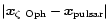 ,
where
,
where  is the position of object
j. We consider the time
is the position of object
j. We consider the time  at which
reaches a minimum to be the kinematic age. To take the errors in the
observables into account we calculate a large set of orbits, sampling
the parameter space defined by the errors. We use the Taylor et al. (1993) proper motion for the pulsar. The errors in the
positions of the runaway and the pulsar are negligible, and those in
the proper motions of the two objects and in the parallax of the
runaway are modest (
at which
reaches a minimum to be the kinematic age. To take the errors in the
observables into account we calculate a large set of orbits, sampling
the parameter space defined by the errors. We use the Taylor et al. (1993) proper motion for the pulsar. The errors in the
positions of the runaway and the pulsar are negligible, and those in
the proper motions of the two objects and in the parallax of the
runaway are modest ( %). However, the radial-velocity error of
Oph is considerable (5 km s-1). The distance to the
pulsar has a significant error, and its radial velocity is unknown.
Accordingly, we first determine the region in the
%). However, the radial-velocity error of
Oph is considerable (5 km s-1). The distance to the
pulsar has a significant error, and its radial velocity is unknown.
Accordingly, we first determine the region in the
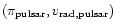 parameter space
for which the pulsar approaches the runaway when we retrace both
orbits. Sampling a grid in
while keeping the other parameters fixed,
we find that, for
parameter space
for which the pulsar approaches the runaway when we retrace both
orbits. Sampling a grid in
while keeping the other parameters fixed,
we find that, for
 mas and
 km s-1, the motions of the
pulsar and the runaway are such that their separation decreases as one
goes back in time.
km s-1, the motions of the
pulsar and the runaway are such that their separation decreases as one
goes back in time.
Adopting
 mas and
 km s-1, we calculate
three million orbits for the pulsar and the runaway. Considering that
the pulsar proper-motion errors might be underestimated (Campbell
et al. 1996; Hartman 1997), we increased them by a
factor of two. For each run we create a set of positions and
velocities for the runaway and the pulsar consistent with the
(modified 3
km s-1, we calculate
three million orbits for the pulsar and the runaway. Considering that
the pulsar proper-motion errors might be underestimated (Campbell
et al. 1996; Hartman 1997), we increased them by a
factor of two. For each run we create a set of positions and
velocities for the runaway and the pulsar consistent with the
(modified 3 )
errors on the observables. We also calculated the
orbit of the Upper Scorpius association back in time, using the mean
position and velocity derived by de Zeeuw et al. (1999,
their Table 2).
)
errors on the observables. We also calculated the
orbit of the Upper Scorpius association back in time, using the mean
position and velocity derived by de Zeeuw et al. (1999,
their Table 2).  of these simulations resulted in a minimum
separation between the pulsar and the runaway of less than 10 pc. In
of these simulations resulted in a minimum
separation between the pulsar and the runaway of less than 10 pc. In
 simulations the pulsar and the runaway had a minimum
separation less than 10 pc and were both situated within 10 pc of the
center of the association (the smallest minimum separation found was
0.35 pc). Thus, only a small fraction (0.14%) of the simulations is
consistent with the hypothesis that the pulsar and the runaway were
once, 1 Myr ago, close together within the Upper Scorpius
association. We now show that given the measurement uncertainties,
this low fraction is perfectly consistent with the two objects being
in one
location in the past.
simulations the pulsar and the runaway had a minimum
separation less than 10 pc and were both situated within 10 pc of the
center of the association (the smallest minimum separation found was
0.35 pc). Thus, only a small fraction (0.14%) of the simulations is
consistent with the hypothesis that the pulsar and the runaway were
once, 1 Myr ago, close together within the Upper Scorpius
association. We now show that given the measurement uncertainties,
this low fraction is perfectly consistent with the two objects being
in one
location in the past.
![\begin{figure}\includegraphics[angle=0.0, width=8.8cm, clip=true, keepaspectratio=true]{10198_fig03.eps} \end{figure}](/articles/aa/full/2001/02/aa10198/Timg232.gif) |
Figure 3:
Left: Distribution of minimum separations,
 ,
between Oph and
PSR J1932+1059. The solid line denotes the expected distribution of ,
between Oph and
PSR J1932+1059. The solid line denotes the expected distribution of
 ,
see Sect. 3.3. Right:
Distribution of the times
at which the minimum separation
was reached ,
see Sect. 3.3. Right:
Distribution of the times
at which the minimum separation
was reached |
| Open with DEXTER |
Figure 3 shows the distribution of the minimum
separations,
,
and the kinematic ages,
,
of the
simulations mentioned above. The lack of
simulations which yield very small minimum absolute separations is due
to the three-dimensional nature of the problem. Consider the following
case: two objects are located at exactly the same position in space,
e.g., the binary containing the pulsar progenitor and the
runaway. However, the position measurement of each of these objects
has an associated typical error. The distribution of the absolute
separation between the objects, obtained from repeated measurements of
the positions of both objects, can be calculated analytically for a
Gaussian distribution of errors (see Appendix A). The solid line in
Fig. 3 shows the result for an adopted distance
measurement error of 2.5 pc, which agrees very well with our
simulations. The peculiar statistical properties of the sample of
successful simulations make it difficult to give a simple argument to
derive the value of 2.5 pc from the uncertainties in the kinematic
properties of the runaway and the pulsar. We suspect that the
disagreement between the solid line and histogram for separations
>6 pc is most likely due to a slight mismatch between the model and
the actual situation. Even so, Fig. 3 shows that due to
measurement errors, very few simulations will produce a small observed
minimum separation, even when the intrinsic separation is
zero.
![\begin{figure}\includegraphics[angle=0.0, width=13.5cm, clip=true, keepaspectratio=true]{10198_fig04.eps} \end{figure}](/articles/aa/full/2001/02/aa10198/Timg233.gif) |
Figure 4:
Astrometric parameters of the runaway Oph and the
pulsar PSR J1932+1059 at the start of each of the
simulations for which the minimum separation between the runaway and
the pulsar was less than 10 pc, and both of them were within 10 pc of
the center of Upper Scorpius sometime in the past |
| Open with DEXTER |
Figure 4 shows the astrometric parameters of the pulsar
and the runaway at the start of the orbit integration, i.e., the
"present'' observables, for the simulations which result in a minimum
separation less than 10 pc occurring within Upper Scorpius. The
parameters of Oph show no correlations except between the
parallax and the radial velocity. This is expected due to the
degeneracy of these two quantities (a change in stellar distance,
depending on whether it increases or decreases the separation between
the star and the association, can be compensated for by a larger or
smaller radial velocity, respectively).
The parameters of the pulsar behave very differently. In addition to
the
vs.
correlation, we find that the
parallax is also correlated with both of the proper motion
components. As a result, the proper motion components are correlated
with each other. This means that only a subset of the full parameter
space defined by the six-dimensional error ellipsoid of the pulsar
fulfills the requirement that the pulsar and the runaway meet.
Furthermore, if they met, then we know the radial velocity of the
pulsar for each assumed value of its distance. A reliable distance
determination would thus yield an astrometric radial velocity. The
current best distance estimate of the pulsar derived from VLBI
measurements,
mas (Campbell 1995), predicts
a radial velocity of 100-200 km s-1. This radial velocity is
comparable to the tangential velocity: 100 km s-1 (for  mas).
mas).
The pulsar proper motions of the
successful simulations are
shown in Fig. 5, together with the proper-motion
measurements of Lyne et al. (1982) (dot-dash
line), Taylor et al. (1993) (solid line), and Campbell
(1995) (dashed line). The measurements show a reasonable
spread, reflecting the difficulty in obtaining pulsar proper motions,
but are consistent, within 3,
with the proper motions
predicted by the simulations.
The observed astrometric and spectroscopic parameters of Oph
and PSR J1932+1059 are consistent with the assumption that these
objects were very close together 1 Myr ago
(Fig. 3). At that time both were within the boundary
of Upper Scorpius (Fig. 6), which has a nuclear age of
5 Myr (de Geus et al. 1989).
Several characteristics of Oph and Upper Scorpius support the
interpretation that the runaway and the pulsar must have been produced
by the BSS. (i) The HI distribution in the direction of Upper Scorpius
shows an expanding shell-like structure. De Geus (1992)
argued that the energy output of the stellar winds of the massive
stars in Upper Scorpius is two orders of magnitudes too low to account
for the kinematics of the HI shell, and proposed that a supernova
explosion created the Upper Scorpius HI shell.
(ii) Based on the present-day mass function, de Geus showed that the
initial population of Upper Scorpius most likely contained one star or
binary more than the present population. The estimated mass of this
additional object is 40 .
Stars of this mass have
main-sequence lifetimes of 4 Myr, and end their lives in a
supernova explosion. Since the association has an age of 5 Myr,
the supernova explosion might have taken place 1 Myr ago.
(iii) The characteristics of Oph are indicative of close
binary evolution. The helium abundance is large, and the star has a
large rotational velocity (see Sect. 1).
These facts make it very likely that the same supernova event in Upper
Scorpius created PSR J1932+1059 and endowed Oph with its
large velocity.
![\begin{figure}\includegraphics[angle=0.0, width=8.8cm, clip=true, keepaspectratio=true]{10198_fig05.eps} \end{figure}](/articles/aa/full/2001/02/aa10198/Timg235.gif) |
Figure 5:
Proper motions of the pulsar PSR J1932+1059 at the
start of the
successful simulations (dots; see
Sect. 3.3), and the proper-motion measurements of the
pulsar: dot-dash line denotes Lyne et al. (1982), solid
line denotes Taylor et al. (1993), and the dashed line
denotes Campbell (1995). The contours indicate the 1, 2, and
3
confidence levels |
| Open with DEXTER |
It could be that Oph and PSR J1932+1059 are not
related. This would imply that the pulsar originated in Upper Scorpius
1 Myr ago and that Oph obtained its large velocity
either in a separate BSS event in Upper Scorpius, or in Upper
Centaurus Lupus, 3 Myr ago, as suggested by van Rensbergen et al. (1996). In the latter case, it would also have to be
formed by the BSS, because of its high helium abundance, large
rotational velocity, and the 10 Myr difference between the age
of Upper Centaurus Lupus and the kinematic age of Oph
(Sect. 1). Given the small probability of finding a runaway
star and a pulsar with orbits that cross, and with both objects
at the point of intersection at the same time, we conclude
that Oph and PSR J1932+1059 were once part of the
same close binary in Upper Scorpius, providing the first direct
evidence for the generation of a single runaway star by the BSS.
![\begin{figure}\includegraphics[angle=0.0, width=8.8cm, clip=true, keepaspectratio=true]{10198_fig06.eps} \end{figure}](/articles/aa/full/2001/02/aa10198/Timg236.gif) |
Figure 6:
The orbits of Oph, PSR J1932+1059, and Upper
Scorpius. The present positions are denoted by a star for the
runaway, a filled circle for the pulsar, and by a filled square for
the association. The top panel shows the distance vs. Galactic longitude of the stars. The bottom panel shows the
orbits projected on the sky in Galactic coordinates. The small open
circles in the bottom panel denote the present-day positions of the
O, B, and A-type members of Upper Scorpius, taken from de Zeeuw et
al. (1999). The large circle denotes the position of the
association at the time of the supernova explosion, and has a 10 pc
radius. This figure assumes a set of space motions consistent with
the common origin hypothesis |
| Open with DEXTER |
If Oph and PSR J1932+1059 were once part of a binary, then
we can derive a number of properties of this system. For example, the
true age of the pulsar must be the kinematic age of 1 Myr (as compared
to the characteristic age estimate of 3 Myr). It follows that, if no
glitches occurred, the pulsar had a period of 0.18 s at birth,
as compared to the current period of 0.22 s.
The velocity distribution of the pulsar population is much broader (a
few 100 km s-1) than that of the pulsar progenitors (a
few10 km s-1). The mechanism responsible for this
additional velocity (the "kick velocity''
)
is not well understood (e.g., Lai 1999). The kick velocity
is most likely due to asymmetries in the core of a star just before,
or during, the supernova explosion.
100 km s-1) than that of the pulsar progenitors (a
few10 km s-1). The mechanism responsible for this
additional velocity (the "kick velocity''
)
is not well understood (e.g., Lai 1999). The kick velocity
is most likely due to asymmetries in the core of a star just before,
or during, the supernova explosion.
The simulations described in Sect. 3.3 provide the velocities
of the runaway star, the pulsar, and the association at the present
time. This makes it possible to determine
of the neutron star. For the
successful runs we find that the
average velocities with respect to Upper Scorpius are:
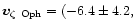
 ,
,
 km s-1 and
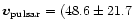 ,
,
 ,
,
 km s-1 in Galactic Cartesian coordinates (U,V,W).
To derive
we consider a binary with
components of mass M1 and M2 in a circular orbit, in which the
first component (star1) explodes as a supernova and creates a
neutron star. At the time of the explosion, star1 is the least
massive component of the binary, due to the prior mass transfer phase,
and is most likely a helium star. The rapidly expanding supernova
shell, with mass
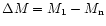 ,
where
,
where
 is the typical mass a neutron star, will quickly leave
the binary system. The shell has a net velocity equal to the orbital
velocity of star1 at the moment of the explosion (v1). A net
amount of momentum (
is the typical mass a neutron star, will quickly leave
the binary system. The shell has a net velocity equal to the orbital
velocity of star1 at the moment of the explosion (v1). A net
amount of momentum (
 )
is thus extracted from the
system and the binary reacts by moving in the opposite direction with
a velocity
)
is thus extracted from the
system and the binary reacts by moving in the opposite direction with
a velocity
 ,
the so-called
"recoil velocity''. The binary will remain bound after the explosion
because less than half of the total mass of the system is expelled
(M1 < M2; cf. Paper I). However, if the neutron
star receives a kick in the supernova explosion the binary might
dissociate, depending on the direction and magnitude of the kick
velocity. We simulate this by using a simple orbit integrator for two
bodies. We determine the semi-major axis and orbital velocities
assuming the binary has a circular orbit and masses
,
the so-called
"recoil velocity''. The binary will remain bound after the explosion
because less than half of the total mass of the system is expelled
(M1 < M2; cf. Paper I). However, if the neutron
star receives a kick in the supernova explosion the binary might
dissociate, depending on the direction and magnitude of the kick
velocity. We simulate this by using a simple orbit integrator for two
bodies. We determine the semi-major axis and orbital velocities
assuming the binary has a circular orbit and masses
 and
and
 ( Oph). We then change the mass of
star1 to
( Oph). We then change the mass of
star1 to  and add a kick-velocity to its orbital velocity. We
start the integration at this point and try to reproduce the observed
velocity of Oph, the pulsar, and the angle between the two
velocity vectors (35
and add a kick-velocity to its orbital velocity. We
start the integration at this point and try to reproduce the observed
velocity of Oph, the pulsar, and the angle between the two
velocity vectors (35 ). It turns out that a kick velocity of
order 350 km s-1 is needed in a direction almost opposite to the
orbital velocity of star1's prior to the explosion. This value is
in good agreement with the average pulsar kick velocity found by
Hartman (1997) and Hansen & Phinney (1997). The
current velocity of the pulsar, 240 km s-1, is more
than 100 km s-1 smaller than the kick it acquired. Our simulations
show that this deceleration is due to the gravitational pull of
Oph on the pulsar.
). It turns out that a kick velocity of
order 350 km s-1 is needed in a direction almost opposite to the
orbital velocity of star1's prior to the explosion. This value is
in good agreement with the average pulsar kick velocity found by
Hartman (1997) and Hansen & Phinney (1997). The
current velocity of the pulsar, 240 km s-1, is more
than 100 km s-1 smaller than the kick it acquired. Our simulations
show that this deceleration is due to the gravitational pull of
Oph on the pulsar.
The mass of Oph used in the above estimate is consistent with
the calibration of Schmidt-Kaler (1982). The more recent mass
calibration of Vanbeveren, Van Rensbergen & De Loore (1998)
suggests 21
(Table 3). This would increase the
inferred kick velocity to 400 km s-1.
4 A dynamical ejection in Orion
Blaauw & Morgan (1954) drew attention to the isolated stars
AE Aur (O9.5V) and Col (O9.5V/B0V), which move away from the
Orion star-forming region (e.g., McCaughrean & Burkert 2000)
in almost opposite directions with comparable space velocities of
100 km s-1 (Fig. 11, stars 5 and 6 in
Table 3). Blaauw & Morgan suggested that "... the
stars were formed in the same physical process 2.6 million years ago
and that this took place in the neighborhood of the Orion Nebula.''
The past orbits of AE Aur and Col intersect on the sky near the
location of the massive highly-eccentric double-lined spectroscopic
binary Ori (O9III+B1III, see Stickland et al. 1987). This led Gies & Bolton (1986) to suggest
that the two runaways resulted from a dynamical interaction also
involving Ori: "... Ori is the surviving binary
of a binary-binary
collision that ejected both AE Aur and Col.''
![\begin{figure}\includegraphics[angle=0.0, width=8.8cm, clip=true, keepaspectratio=true]{10198_fig07.eps} \end{figure}](/articles/aa/full/2001/02/aa10198/Timg252.gif) |
Figure 7:
Contours of minimum separation for the pairs
AE Aur- Col ( top), AE Aur- Ori ( middle),
and Col- Ori ( bottom). The contours are spaced
every 1 pc with the outermost contour being 10 pc. The ordinates
represent straight lines in the distance-distance plane, defined
as indicated in the top right of each panel |
| Open with DEXTER |
4.2 Data
Table 3 lists the data for AE Aur, Col, and
Ori. We adopt Stickland's et al. (1987) radial
velocity for Ori (
 ). For the
radial-velocity errors for AE Aur and Col we use the largest
errors quoted in either the Catalogue de Vitesses Radiales Moyennes
Stellaires (Barbier-Brossat 1989), the Hipparcos Input
Catalogue (Turon et al. 1992), the Wilson-Evans-Batten
Catalogue (Duflot et al. 1995), or in the
SIMBAD database.
). For the
radial-velocity errors for AE Aur and Col we use the largest
errors quoted in either the Catalogue de Vitesses Radiales Moyennes
Stellaires (Barbier-Brossat 1989), the Hipparcos Input
Catalogue (Turon et al. 1992), the Wilson-Evans-Batten
Catalogue (Duflot et al. 1995), or in the
SIMBAD database.
4.3 Simulations
To investigate the hypothesis that the three stellar systems, AE Aur,
Col, and Ori, were involved in a binary-binary
encounter, we retrace their orbits back in time to find the minimum
separation between them. As in Sect. 3, we explore the
parameter space determined by the errors of, and correlations between,
the observables.
Even with the unprecedented accuracy in trigonometric parallaxes
obtained by the Hipparcos satellite, the errors on the individual
distances are rather large:
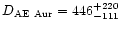 pc,
pc,
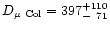 pc,
pc,
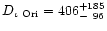 pc. We therefore first determine which
distances are most likely to agree with our hypothesis, and then study
the effect of the measurement errors on the other observables. For
each pair of stars, Fig. 7 shows contours of minimum
separation between the respective orbits as a function of their
present distances. The distances of the stars for which the orbits
have a small minimum separation are strongly correlated, i.e., if the
distance of star i increases that of star j also needs to increase
to obtain a small minimum separation. We therefore choose to show the
contours of constant minimum separation with respect to this
correlation. The vertical axes thus show offsets from the straight
line in the distance vs. distance plane defined by the equation in
the top right of each panel.
pc. We therefore first determine which
distances are most likely to agree with our hypothesis, and then study
the effect of the measurement errors on the other observables. For
each pair of stars, Fig. 7 shows contours of minimum
separation between the respective orbits as a function of their
present distances. The distances of the stars for which the orbits
have a small minimum separation are strongly correlated, i.e., if the
distance of star i increases that of star j also needs to increase
to obtain a small minimum separation. We therefore choose to show the
contours of constant minimum separation with respect to this
correlation. The vertical axes thus show offsets from the straight
line in the distance vs. distance plane defined by the equation in
the top right of each panel.
We start each simulation with a set of positions and velocities which
are in agreement with the observed parameters and their covariance
matrices (<3). Furthermore, we require the distances of the
stars to fall within the 10 pc minimum-separation contours of
Fig. 7. We then calculate the orbits of AE Aur,
Col, and Ori. We define the separation between the three
stellar systems,
,
as the maximum deviation of
the objects from their average position, i.e.,
 for j = AE Aur,
Col, and Ori, where
for j = AE Aur,
Col, and Ori, where
 is the mean position and the position of star j. The time
at which
reaches a minimum is considered to be the time
of the encounter, i.e., the kinematic age.
is the mean position and the position of star j. The time
at which
reaches a minimum is considered to be the time
of the encounter, i.e., the kinematic age.
![\begin{figure}\includegraphics[angle=0.0, width=8.8cm, clip=true, keepaspectratio=true]{10198_fig08.eps} \end{figure}](/articles/aa/full/2001/02/aa10198/Timg262.gif) |
Figure 8:
Left: Distribution of minimum separations between
AE Aur, Col, and Ori,
,
of
Monte Carlo simulations of the stellar encounter.
Right: The
distribution for three randomly
drawn points from three spherical Gaussians with standard deviations
of
 pc (solid line and shaded), pc (solid line and shaded),
 pc (dotted
line), and pc (dotted
line), and
 pc (dashed line). The
distribution for
pc is a good representation of the
distribution in the left panel. Four pc is the typical spread
in the end positions of the orbits due to the errors on the present
day velocity (2 km s-1). The dotted and dashed histograms
have been normalized such that their shapes can be compared with the
solid histogram pc (dashed line). The
distribution for
pc is a good representation of the
distribution in the left panel. Four pc is the typical spread
in the end positions of the orbits due to the errors on the present
day velocity (2 km s-1). The dotted and dashed histograms
have been normalized such that their shapes can be compared with the
solid histogram |
| Open with DEXTER |
We computed 2.5 million orbits, of which 114 yielded
 pc with
  2-3 Myr. One of the
simulations resulted in a minimum separation of 0.019 pc which is
equal to
2-3 Myr. One of the
simulations resulted in a minimum separation of 0.019 pc which is
equal to  AU (Fig. 8). The small number of
simulations with small minimum separations is due to (i) the large
number of parameters involved (i.e., 18) and (ii) the
three-dimensional nature of the problem (cf. Sect. 3.3).
AU (Fig. 8). The small number of
simulations with small minimum separations is due to (i) the large
number of parameters involved (i.e., 18) and (ii) the
three-dimensional nature of the problem (cf. Sect. 3.3).
We have numerically determined the distribution of the minimum
separations
of three points drawn from a
three-dimensional Gaussian error distribution (the analytic results of
Appendix A are valid only for two Gaussians). We randomly draw three
points from three spherical three-dimensional Gaussians (with standard
deviation )
and determine
.
The Gaussians have
the same mean positions. The resulting distribution for
pc resembles the real one remarkably well (Fig. 8).
A distance uncertainty of four pc is consistent with the
2 km s-1 uncertainties in the velocities of the runaways
and Ori: 2 km s-1 over 2 Myr results in a
displacement of 4 pc. Thus, the data and their errors are
consistent with the hypothesis that 2.5 Myr ago AE Aur,
Col, and Ori were in the same small region of space.
![\begin{figure}\includegraphics[angle=0.0, width=\textwidth, clip=true, keepaspectratio=true]{10198_fig09.eps} \end{figure}](/articles/aa/full/2001/02/aa10198/Timg267.gif) |
Figure 9:
Properties of the parent cluster of the runaways AE Aur and
Col and the binary Ori obtained from our Monte Carlo
simulations. First row: cluster properties plotted vs. the
cluster distance. The grey dots denote the median values of the
cluster properties for distance-bins of 25 pc. Second row:
histograms of the predicted cluster properties. The tick marks on the
vertical axis have a spacing of 1000. Third row: histograms of the
predicted cluster properties when the mass of Col is changed by
 .
Note that the distance, time, and radial-velocity
histograms do not change significantly. The tick-mark spacing along the
vertical axis is similar to that in the second row .
Note that the distance, time, and radial-velocity
histograms do not change significantly. The tick-mark spacing along the
vertical axis is similar to that in the second row |
| Open with DEXTER |
The nominal observed properties of the runaway stars AE Aur and
Col and the binary Ori are consistent with a common
origin 2.5 Myr ago. The most likely mechanism that created the
large velocities of the runaways and the high eccentricity of the
Ori binary is a binary-binary encounter, as suggested by Gies
& Bolton (1986). The normal rotational velocities of both
runaways (25 km s-1 and 111 km s-1) and the normal helium
abundance of AE Aur (Table 3, see Blaauw 1993,
Fig. 6) also suggest that these runaways were formed by the
dynamical ejection scenario. The helium abundance of Col is
unknown.
4.5 Parent cluster
To find the cluster, or region of space, where the encounter between
AE Aur, Col, and Ori took place we assume that the
center of mass velocity of the three objects is identical to the mean
velocity
 of the parent cluster. Then
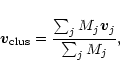 |
(2) |
for j = AE Aur,
Col, and
Ori. For each star we
estimate the mass by interpolating the mass vs. spectral-type
calibration of Schmidt-Kaler (1982, Table 23). We obtain
 for AE Aur and Col, and
and
for the primary and secondary of Ori,
respectively (
for AE Aur and Col, and
and
for the primary and secondary of Ori,
respectively (
 for the binary system). We use the
cluster velocity (
)
and the mean position
of the three stellar systems at the moment of the encounter to
integrate the orbit of the ensemble of stars
Myr into the
future. The position and velocity at the end of this integration
should coincide with the present-day properties of the parent
cluster. We extend the Monte Carlo simulations described in
Sect. 4.3 to include the integration of the orbit of the
"cluster'' forward in time. Figures 9 and 10
summarize the results. Panel b of Fig. 10 shows
that the distances of the three stars and the predicted cluster
distance are tightly correlated (see also Fig. 7); all
distances increase when the cluster distance increases. A consequence
of this tight correlation is that as soon as the distance to one of
the objects is known, all other distances are fixed.
for the binary system). We use the
cluster velocity (
)
and the mean position
of the three stellar systems at the moment of the encounter to
integrate the orbit of the ensemble of stars
Myr into the
future. The position and velocity at the end of this integration
should coincide with the present-day properties of the parent
cluster. We extend the Monte Carlo simulations described in
Sect. 4.3 to include the integration of the orbit of the
"cluster'' forward in time. Figures 9 and 10
summarize the results. Panel b of Fig. 10 shows
that the distances of the three stars and the predicted cluster
distance are tightly correlated (see also Fig. 7); all
distances increase when the cluster distance increases. A consequence
of this tight correlation is that as soon as the distance to one of
the objects is known, all other distances are fixed.
![\begin{figure}\includegraphics[angle=0.0, width=\textwidth, clip=true, keepaspectratio=true]{10198_fig10.eps} \par\end{figure}](/articles/aa/full/2001/02/aa10198/Timg273.gif) |
Figure 10:
Properties of the parent cluster of the runaways AE Aur
and Col and the binary Ori. a) Proper
motions and their errors (grey circles) for all stars in the Tycho 2
Catalogue (filled triangles) within an area of 0
 4 by 0
4
centred on the Trapezium cluster. The large grey dot denotes the
average of the predicted cluster proper motion for the Monte Carlo
simulations. b) Distances of the runaway stars as a
function of the cluster distance in the Monte Carlo simulations. The
different grey scales are labeled in the panel. The filled circles and
their error bars denote the observed distances of the stars derived
from the Hipparcos parallaxes (prlx) and the open circles denote the
distances derived from photometry (phot) (Gies 1987). c)
the biases on the predicted cluster distance as discussed in
Sect. 4.5.1. The filled and open symbols denote the mean and
median, respectively, of the cluster distance distributions. The
circles include only the first bias, the aiming effect, and the
triangles include both the aiming effect and the ``incorrect''
Hipparcos parallax of
Col. For clarity, the circles and
triangles are displaced -3 and 3 pc, respectively. The dotted line
indicates the mean cluster distance based on the Monte Carlo
simulation 4 by 0
4
centred on the Trapezium cluster. The large grey dot denotes the
average of the predicted cluster proper motion for the Monte Carlo
simulations. b) Distances of the runaway stars as a
function of the cluster distance in the Monte Carlo simulations. The
different grey scales are labeled in the panel. The filled circles and
their error bars denote the observed distances of the stars derived
from the Hipparcos parallaxes (prlx) and the open circles denote the
distances derived from photometry (phot) (Gies 1987). c)
the biases on the predicted cluster distance as discussed in
Sect. 4.5.1. The filled and open symbols denote the mean and
median, respectively, of the cluster distance distributions. The
circles include only the first bias, the aiming effect, and the
triangles include both the aiming effect and the ``incorrect''
Hipparcos parallax of
Col. For clarity, the circles and
triangles are displaced -3 and 3 pc, respectively. The dotted line
indicates the mean cluster distance based on the Monte Carlo
simulation |
| Open with DEXTER |
4.5.1 Biases and measurement errors
Two effects influence the mean cluster properties as predicted by the
Monte Carlo simulations. First, it is easier to hit a target from
close by than from far away, i.e., a larger range of velocities
(within the errors) is consistent with the encounter hypothesis when
the distance between the star and the encounter point is small (the
"aiming effect'').
We simulate this effect in the following way. We assume a range of
cluster distances, 350-500 pc. For each distance we use
Fig. 9 (the gray dots in the first row) to determine
the other phase-space coordinates of the parent (position on the sky,
proper motion, and radial velocity). With these "observables'' we
calculate the three-dimensional velocity of the cluster, corrected for
Solar motion, and determine its position at a time
(see first
row in Fig. 9) in the past. We neglect the variation
of the Galactic potential, ignore Galactic rotation, and use the
linear velocity, to speed up the calculations. This past position of
the cluster combined with the present three-dimensional positions of
AE Aur,
Col, and
Ori (based on the present positions on
the sky and the distances from Fig. 10 panel b)
gives the velocities of the three stellar systems today, using
as the time difference. These "observed'' properties are then
used as input for the Monte Carlo simulations described above to
investigate the influence of the aiming effect on the predicted
cluster distance. The circles in Fig. 10 panel c
display the bias in the cluster distance.
Secondly, the trigonometric distance of
Col,
pc, is smaller
(2)
than the observed photometric distance, 750 pc
(e.g., Gies 1987). The photometric distance is reliable
since Col is located in a region free of interstellar
absorption. This difference between the trigonometric distance and the
"real'' distance results in an additional bias towards smaller
distances for the stars and the cluster. In our Monte Carlo simulation
we draw the parallaxes, like all other observables, from a Gaussian
centred on the observed value and with a width equal to the observed
error. For the Hipparcos distance of Col this means that less
than 10% of the random realizations will be consistent with the
photometric distance. And because the distances of the
three stellar systems and the cluster are correlated (see
Fig. 10 panel b), the other stars also need to be
at smaller distances for the encounter to take place. This effect
will result in a mean cluster distance (the mean of the Monte Carlo
simulations) which is underestimated. We simulated this effect in a
similar manner as the aiming effect. The results on the mean cluster
distance in the Monte Carlo simulations, aiming effect and the
parallax of Col, are shown as the triangles in
Fig. 10 panel c.
Taking the biases on the cluster distance into account, we reconstruct
the present-day properties of the parent cluster of the stars AE Aur,
Col, and Ori. The mean cluster distance from our
Monte Carlo simulations is 339 pc (right most panel in the second row
of Fig. 9). The cluster distance corrected for biases is
425-450 pc. Using this distance we determine the other
properties of the cluster (first row of Fig. 9), and
summarize them in Table 4. Figure 9
(right most panel of the first row) indicates that the encounter
happened 2.5 Myr ago; this obviously is a lower limit to the age of
the cluster. Figure 11 shows the region of the sky where the
parent cluster should be located: the Orion Nebula. The black contours
in the bottom panel show the distribution of
of the parent
cluster obtained from the Monte Carlo simulations.
Table 4:
Predicted properties of the parent cluster of the stellar
systems AE Aur, Col, and Ori: the cluster distance
 ,
the sky position in equatorial
,
the sky position in equatorial
 and Galactic
coordinates, the proper motions
and Galactic
coordinates, the proper motions
 and
and
 ,
and the
radial velocity
.
The predicted distances of the
runaways and Ori if there was an encounter:
,
and the
radial velocity
.
The predicted distances of the
runaways and Ori if there was an encounter:
 pc,
pc,
 pc, and
 pc
pc
| |
|
|
 |
|
|
|
425-450 |
|
425-450 |
pc |
|
|
(84
0,-5
8) |
|
(83
9,-5
2) |
|
|
|
(1.7,-0.8) |
|
(1.7,-0.2) |
mas yr-1 |
|
(209
4,-19
4) |
|
(208
9,-19
2) |
|
|
|
(1.3,1.2) |
|
(0.9,1.4) |
mas yr-1 |
|
|
28.3 |
|
27.6 |
km s-1 |
Of all clusters in this active star-forming region the Trapezium
cluster (NGC 1976) is the most likely parent cluster for the following
reasons.
- 1:
- The cluster is young. Palla & Stahler (1999) find a
mean age of 2 Myr based on theoretical pre-main-sequence
tracks, and established that the first stars formed not more
than 5 Myr ago. Thus, the Trapezium is old enough to have
produced the runaways;
- 2:
- The Trapezium is one of the most massive, dense clusters in the
Solar neighbourhood. Estimates for the stellar density are
 stars pc-3 for the inner 0.1-0.3 pc (e.g.,
McCaughrean & Stauffer 1994; Hillenbrand & Hartmann
1998). These high stellar densities favor dynamical
interactions within the cluster core;
stars pc-3 for the inner 0.1-0.3 pc (e.g.,
McCaughrean & Stauffer 1994; Hillenbrand & Hartmann
1998). These high stellar densities favor dynamical
interactions within the cluster core;
- 3:
- The Trapezium shows a strong mass segregation (Zinnecker
et al. 1993; Hillenbrand & Hartmann
1998). Five of the six stars more massive than
 are in the centre. This concentration of massive
stars increases the probability for dynamical interactions
between these stars;
are in the centre. This concentration of massive
stars increases the probability for dynamical interactions
between these stars;
- 4:
- The binary fraction in the Trapezium cluster is at least as high
as that of the Solar-type field stars, i.e., 60% (Prosser
et al. 1994; Petr et al. 1998; Simon et al.
1999; Weigelt et al. 1999). This
means that enough binary systems are available for binary-binary
or binary-single-star interactions to become efficient in
expelling stars from the cluster.
The mean astrometric properties and the radial velocity of the
Trapezium agree perfectly with those predicted by our Monte Carlo
simulation. The distance to the Trapezium is estimated to be
450-500 pc (Walker 1969; Warren & Hesser 1977a,
1977b, 1978; Genzel & Stutzki 1989); we
predict 425-450 pc. The observed radial velocity of the Trapezium is
23-25 km s-1 (Johnson 1965; Warren & Hesser
1977a, 1977b; Abt et al. 1991;
Morrell & Levato 1991); we predict 28 km s-1.
The absolute proper motion of the Trapezium is ill-determined, but is
known to be small (e.g., de Zeeuw et al. 1999). We
collected all stars, within a 0
4 by 0
4 region centred on the
Trapezium, based on the Tycho 2 Catalogue (Høg 2000), and
plot the proper motions in Fig. 10a. The proper
motions agree with the predicted cluster proper motion.
Table 4 shows that the predicted position on the sky of the
parent cluster does not fully agree with the position of the Trapezium
(see Fig. 11). Here it is important to remember that we
did not allow for any errors on the stellar masses used in
Eq. (2). We investigate the effect of mass errors by changing
the masses and running a new set of Monte Carlo simulations. We find
that (i) the results are insensitive to the mass of Ori: a
change as large as  5
produces no noticeable change in
the cluster properties, and (ii) the sky position of the parent
cluster and its proper motion depend on the mass ratio of AE Aur and
Col. Changing the mass of Col by
or the mass
of AE Aur by
5
produces no noticeable change in
the cluster properties, and (ii) the sky position of the parent
cluster and its proper motion depend on the mass ratio of AE Aur and
Col. Changing the mass of Col by
or the mass
of AE Aur by
 shifts the predicted sky position of the
parent cluster to that of the Trapezium cluster
(Fig. 11). A mass change in the other direction,
for Col and
for AE Aur, creates a
similar shift in the opposite direction. There are indications from
spectral-type determinations that Col is indeed slightly less
massive than AE Aur. Most spectral-type determinations of Col
give O9.5V; however, Blaauw & Morgan (1954) and Paper I
quote B0V and Houk (1982) quotes B1IV/V.
shifts the predicted sky position of the
parent cluster to that of the Trapezium cluster
(Fig. 11). A mass change in the other direction,
for Col and
for AE Aur, creates a
similar shift in the opposite direction. There are indications from
spectral-type determinations that Col is indeed slightly less
massive than AE Aur. Most spectral-type determinations of Col
give O9.5V; however, Blaauw & Morgan (1954) and Paper I
quote B0V and Houk (1982) quotes B1IV/V.
![\begin{figure}\includegraphics[angle=0.0, width=15.7cm, clip=true, keepaspectratio=true]{10198_fig11.eps}\vskip -0.5truecm
\end{figure}](/articles/aa/full/2001/02/aa10198/Timg285.gif) |
Figure 11:
Top & middle: Orbits, calculated back in time,
of the runaways AE Aur (dotted line) and Col (solid line) and
the binary Ori for one of the Monte Carlo simulations
described in the text. The top panel shows the distance vs. Galactic longitude of the stars. The middle panel shows the
orbits projected on the sky in Galactic coordinates. The starred
symbols depict the present position of the three stars. The stars met
2.5 Myr ago. Using conservation of linear momentum, the orbit of
the parent cluster (grey solid line, see blow up) is calculated from
the time of the assumed encounter to the present. The large circles
denote all stars in the Hipparcos Catalogue brighter than V =
3.5 mag; filled circles denote O and B stars, open circles denote
stars of other spectral type. The small circles denote the O and B
type stars with
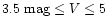 mag (cf. Fig. 1 in
Blaauw & Morgan 1954). The Orion constellation is indicated for
reference. Bottom: The predicted position of the parent
cluster (black contours) together with all stars in the Tycho
Catalogue (ESA 1997) in the field down to V = 12.4 mag. The size of
the symbols scales with magnitude; the brightest star is
Ori. The Trapezium and Ori are indicated. The black
and dark grey lines are the past orbits of Ori and the
Trapezium, respectively (see top panel). The triangle denotes the
predicted present-day position of the parent cluster for this
particular simulation. The grey contours display the IRAS 100 micron
flux map, and mainly outline the Orion Nebula mag (cf. Fig. 1 in
Blaauw & Morgan 1954). The Orion constellation is indicated for
reference. Bottom: The predicted position of the parent
cluster (black contours) together with all stars in the Tycho
Catalogue (ESA 1997) in the field down to V = 12.4 mag. The size of
the symbols scales with magnitude; the brightest star is
Ori. The Trapezium and Ori are indicated. The black
and dark grey lines are the past orbits of Ori and the
Trapezium, respectively (see top panel). The triangle denotes the
predicted present-day position of the parent cluster for this
particular simulation. The grey contours display the IRAS 100 micron
flux map, and mainly outline the Orion Nebula |
| Open with DEXTER |
We note that the calibration of Vanbeveren et al. (1998) gives a mass of 38.6
for Ori,
similar to that found with the Schmidt-Kaler calibration, but
increases the masses of AE Aur and Col to 21.1 .
This
does not change our results, as it is the ratio of the runaway masses
that determines the predicted current position of the parent cluster.
In summary, the position, distance, proper motion, and radial velocity
of the Trapezium cluster fall within the range predicted by our Monte
Carlo simulations. Furthermore, the youth, extreme stellar density,
mass segregation, and the high binary fraction make it the best
candidate for the parent cluster of the runaways AE Aur and Col
and the binary Ori. Finally, it is the only likely candidate
in this region of the sky.
5 53 Ari,
Per, Pup, and
Cep
The previous sections gave a specific example of each formation
mechanism for runaway stars, and described our orbit retracing methods
in detail. We now consider the three other classical runaways, as
well as Pup, and we discuss the likely formation
mechanisms. The results are summarized in Table 5.
Blaauw (1956) classified 53 Arietis (HIP 14514) as a runaway
star based on its proper motion which is directed away from the Orion
association. He deduced that 53 Ari left the Orion association
4.8 Myr ago and predicted the radial velocity of the star (at
that time unknown) to be 18 km s-1. The discrepancy in
kinematic ages of AE Aur and Col (Sect. 4) and that of
53 Ari indicates that it is not related to the same event that created
AE Aur and Col (Sect. 4) but is another runaway from
the Orion star-forming region. Table 3 lists the
observables of 53 Ari.
![\begin{figure}\includegraphics[angle=0.0, width=8.8cm, clip=true, keepaspectratio=true]{10198_fig12.eps} \end{figure}](/articles/aa/full/2001/02/aa10198/Timg286.gif) |
Figure 12:
Predicted distance ( left) and kinematic age (
right) of 53 Arietis as a function of the distance of the parent
association: Ori OB1 subgroup a ( top), Ori OB1
subgroup b ( middle), and Ori OB1 subgroup c ( bottom). The Hipparcos distance and its 1
error are
indicated in the left panels. Distance estimated by Warren & Hesser
(1977a, 1977b, WH77), Brown et al. (1994, B94), and de Zeeuw et al. (1999, Z99)
are indicated in the middle panels |
| Open with DEXTER |
The Ori OB1 association has four subgroups: a, b, c,
and d (Blaauw 1964; Brown et al.
1994). We do not consider subgroup d (the Trapezium)
as a possible parent group of 53 Ari, since this subgroup is younger
than the runaway (Sect. 4). The ages of the other
subgroups are: 8-12 Myr for subgroup a, 2-5 Myr for subgroup
b, and 4 Myr for subgroup c (Warren & Hesser
1977a, 1977b; Brown et al. 1994).
We performed a set of simulations as in Sect. 2, retracing
orbits for each subgroup (a, b, c). The kinematic
age of 53 Ari from subgroup a is 4.3 Myr
(Fig. 12). This means that the subgroup was
6 Myr old when 53 Ari became a runaway star. This very likely
rules out the DES as the formation mechanism (see Sect. 1).
However, there is little direct evidence in favor of the BSS. The
helium abundance of 53 Ari is unknown and its observed rotational
velocity is small (
 km s-1), but
this could be caused by a near pole-on orientation. We did not find a
neutron star associated with 53 Ari, but our sampling of the nearby
compact objects is severely limited
(Sect. 2.1).
km s-1), but
this could be caused by a near pole-on orientation. We did not find a
neutron star associated with 53 Ari, but our sampling of the nearby
compact objects is severely limited
(Sect. 2.1).
If subgroup b is the parent association the kinematic age for
53 Ari is 4.8 Myr. This is comparable to the canonical age of
the subgroup, and excludes the BSS as a production mechanism for
53 Ari (see Sect. 1). If Ori OB1 b is the parent group
of 53 Ari then the kinematic age is 4.8 Myr and the formation
mechanism is most likely the DES. However, the most recent age
determination (Brown et al. 1994) gives  Myr. If
Ori OB1 b is indeed this young then the subgroup is younger than
53 Ari and cannot be the parent group.
Myr. If
Ori OB1 b is indeed this young then the subgroup is younger than
53 Ari and cannot be the parent group.
For subgroup c we find that the minimum separation between the
subgroup centre and the runaway was never smaller than 15 pc, while
the simulations for the other two subgroups a and b yield
minimum separations as small as 1 pc. The space motion of Ori OB1 is
mostly directed radially away from the Sun, and the proper motion
component is relatively small. The Hipparcos data did not allow de
Zeeuw et al. (1999) to discriminate between the different
subgroups in their selection procedure; they only give one proper
motion and radial velocity for the whole Orion complex. It is possible
that subgroup c has a motion that differs slightly from that of
the other two subgroups, so that it cannot be ruled out as a candidate
parent group. The age of subgroup c, 5 Myr, is similar to
the kinematic age of 53 Ari. By the argument given above this suggests
that if Ori OB1 c is the parent association of 53 Ari, then the
formation mechanism is most likely the DES.
In order to decide which of the Ori OB1 subgroups is the parent group
of 53 Ari, we need to know the distances and velocities of the
subgroups and the runaway star with a better accuracy than is now
available. Figure 12 could then be used to pin down the
parent group, and the mechanism which is responsible for the runaway
nature of 53 Ari. Since subgroup a is the only one for which the
BSS is indicated, finding a pulsar originating from subgroup aat the same time as 53 Ari would also clinch the issue.
The O7.5III star Persei (HIP 18614) lies within the boundary of
the Per OB2 association on the sky. This positional coincidence, and
the low density of early-type stars near Per OB2, led Blaauw
(1944) to propose Per as a member of the association.
At that time it was thought that the large radial-velocity difference
between Per and Per OB2 (40 km s-1) was due to
uncertainties in the measurement of
for
Per. However, when the radial velocity of Per was
confirmed, its membership of the Per OB2 association became doubtful
(Blaauw 1952a). In Paper I, Blaauw classified
Per as a runaway star from the Per OB2 association, which
naturally explains the discrepancy of the radial velocity of the star
and the association. Per was the first star to be classified as
runaway based on its
alone. Most other runaways
were recognized because their proper motions were directed away from
an association. The parent group, Per OB2, has an age of 7 Myr
(e.g., Seyfert et al. 1960; de Zeeuw & Brand
1985).
We adopt
 km s-1 for Per
(Bohannan & Garmany 1978;
Garmany et al. 1980;
Stone 1982;
Gies & Bolton 1986).
This value differs by 10 km s-1 from those quoted in the
Hipparcos Input Catalogue (67.1 km s-1, Turon et al. 1992) and the WEB catalogue (70.1 km s-1, Duflot et
al. 1995), which derive from the value listed in the
General Catalogue of Radial Velocities (70.1 km s-1, Wilson
1953). We take the radial-velocity error to be
5 km s-1; this is equal to the amplitude of the velocity
variations induced by the non-radial pulsations of Per (de Jong
et al. 1999). The rotational velocity and helium abundance
are
km s-1 for Per
(Bohannan & Garmany 1978;
Garmany et al. 1980;
Stone 1982;
Gies & Bolton 1986).
This value differs by 10 km s-1 from those quoted in the
Hipparcos Input Catalogue (67.1 km s-1, Turon et al. 1992) and the WEB catalogue (70.1 km s-1, Duflot et
al. 1995), which derive from the value listed in the
General Catalogue of Radial Velocities (70.1 km s-1, Wilson
1953). We take the radial-velocity error to be
5 km s-1; this is equal to the amplitude of the velocity
variations induced by the non-radial pulsations of Per (de Jong
et al. 1999). The rotational velocity and helium abundance
are
 km s-1 and
 ,
respectively (see also Table 3).
,
respectively (see also Table 3).
![\begin{figure}\includegraphics[angle=0.0, width=8.8cm, clip=true, keepaspectratio=true]{10198_fig13.eps} \end{figure}](/articles/aa/full/2001/02/aa10198/Timg292.gif) |
Figure 13:
Predicted distance ( left) and kinematic age (
right) of Per as a function of the distance of Per OB2. The
Hipparcos distance and its 1
error are indicated in the left
panel. Distance estimates for Per OB2 by Klochkova & Kopylov (1985,
KK85), Cernis (1993, C93), and de Zeeuw et al. (1999, Z99) are indicated in the middle
panel |
| Open with DEXTER |
Our orbit calculations (Sect. 2) show that the kinematic
age of Per is 1 Myr (Fig. 13). At that time
the star was located 5 pc from the center of Per OB2, well
inside the association. Figure 13 also shows that the
present distance of the runaway is 360 pc, assuming 318 pc as the
distance of Per OB2 (de Zeeuw et al. 1999). This distance
for Per is consistent with the Hipparcos parallax at the
2
level.
We infer that the BSS is responsible for the runaway nature of
Per based on (i) the 6 Myr age of Per OB2 at the time that
Per was ejected, (ii) the high helium abundance of Per,
(iii) its blue straggler nature (Sect. 9), and (iv) the large
rotational velocity (see Sect. 1). Further evidence of a
supernova explosion in the Per OB2 association is provided by a shell
structure containing HI, dust, OH, CH, and other molecules (Sancisi
1970; Sancisi et al. 1974). This feature has been
interpreted as a supernova shell which is physically connected to the
Per OB2 association. We have not found a pulsar counterpart.
Per presently illuminates the California Nebula (NGC 1499),
resulting in an HII emission region. The distance of this nebula is
hard to determine (350-525 pc; Bohnenstengel & Wendker
1976; Sargent 1979; Klochkova & Kopylov
1985; Shull & van Steenberg 1985), but must be
similar to that of Per, i.e., 360 pc.
The O4I star Puppis (HIP 39429) is the brightest and nearest
single O star to the Sun. Its location outside any known association
and its large space velocity (60 km s-1) led Upton
(1971) to propose Pup as a runaway star. In spite of
the many groups of young, massive stars in the direction of
Pup, Upton could not make a unique identification of the
parent association. He proposed Vel OB2 as the most likely
candidate. In a recent study of the stars and ISM in the direction of
Vela, Sahu (1992) proposed the R association Vel R2 as a
possible parent for Pup, based on the retraced path of the
runaway on the sky. For our simulations we considered Vel OB2, Vel R2,
the open cluster NGC 2391, and the cluster/association
Tr 10 (de Zeeuw et al. 1999) which also lies in the same
direction as Vel R2.
Table 3 summarizes the data for Pup. The position
and velocity for the associations Vel OB2 and Tr 10 are adopted from
de Zeeuw et al. (1999). Only two of the Vel R2 members are
contained in the Hipparcos Catalogue. Their distances,
411-143+473 (HIP 43792) and
294-61+107 (HIP 43955),
have large uncertainties or do not agree well with the canonical
distance of Vel R2, 870 pc (Herbst 1975). We are
therefore unable to obtain meaningful phase-space coordinates of
Vel R2.
Although we are unable to run our simulations for Vel R2, we conclude
that it is not a likely candidate parent association for
Pup. The distance difference between Vel R2 (870 pc) and
Pup  400 pc, its canonical distance) is too large. The
relative radial velocity between the star and association is
40 km s-1 (
400 pc, its canonical distance) is too large. The
relative radial velocity between the star and association is
40 km s-1 (
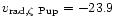 km s-1 and
 km s-1). The
differences in distance, 400 pc, and velocity,
40 km s-1, between Pup and Vel R2 yield a kinematic
age of 10 Myr. This is older than the expected life time of
Pup (van Rensbergen et al. 1996). Hence Vel R2 is
not likely to be the parent group.
km s-1). The
differences in distance, 400 pc, and velocity,
40 km s-1, between Pup and Vel R2 yield a kinematic
age of 10 Myr. This is older than the expected life time of
Pup (van Rensbergen et al. 1996). Hence Vel R2 is
not likely to be the parent group.
Our simulations also show that Vel OB2 is not the parent
association. The minimum separation between the association and the
runaway star is never smaller than 40 pc for reasonable association
distances. Since the association radius is, at maximum, 30 pc, we
conclude that Pup has never been inside the boundaries of
Vel OB2. We similarly rule out NGC 2391 as parent group.
![\begin{figure}\includegraphics[angle=0.0, width=8.8cm, clip=true, keepaspectratio=true]{10198_fig14.eps} \end{figure}](/articles/aa/full/2001/02/aa10198/Timg296.gif) |
Figure 14:
Predicted distance ( left) and kinematic age (
right) of Pup as a function of the distance of Tr 10. The
Hipparcos distance and its 1
error are indicated in the left
panel. The distance estimate by de Zeeuw et al. (1999, Z99) is indicated
in the middle panel |
| Open with DEXTER |
The simulations for the Trumpler 10 group result in minimum
separations of  10 pc. The inferred kinematic age is 2 Myr
(Fig. 14). Ten parsec is comparable to the radius of
Tr 10, so we cannot unambiguously identify or exclude it as the parent
association. Furthermore, if Pup was in or near Tr 10, then
its current distance must be 250-350 pc (Fig. 14),
which is smaller than the canonical distance of 400 pc.
10 pc. The inferred kinematic age is 2 Myr
(Fig. 14). Ten parsec is comparable to the radius of
Tr 10, so we cannot unambiguously identify or exclude it as the parent
association. Furthermore, if Pup was in or near Tr 10, then
its current distance must be 250-350 pc (Fig. 14),
which is smaller than the canonical distance of 400 pc.
The Vela region contains many young stellar clusters, and suffers from
a fair amount of extinction (although Pup itself is almost
unreddened). It is therefore reasonable to assume that we have not yet
identified the parent group of Pup. Similar conclusions were
obtained by Vanbeveren et al. (1998), and Vanbeveren, De Loore
& Van Rensbergen (1998).
![\begin{figure}\includegraphics[angle=0.0, width=8.8cm, clip=true, keepaspectratio=true]{10198_fig15.eps} \end{figure}](/articles/aa/full/2001/02/aa10198/Timg298.gif) |
Figure 15:
Predicted distance ( left) and kinematic age (
right) of Cep as a function of the distance of Cep OB3. The
Hipparcos distance and its 1
error are indicated in the left
panel. The distance estimate by Crawford & Barnes (1970, CB70) is
indicated in the middle panel |
| Open with DEXTER |
Cep (HIP 109556) was first classified as a runaway star by
Blaauw (Paper I). He noted that its position on the sky, the
direction of the proper motion, and the radial velocity were
consistent with an origin in the association Cep OB2 (see, e.g.,
Fig. 22 in de Zeeuw et al. 1999). This luminous
supergiant (O6I(n)f) is located below Cep OB2 (in Galactic
coordinates) and is traveling away from the Galactic plane and
Cep OB2. Several other stellar groups are located near Cep OB2, and of
these, Cep OB3 may also be a possible parent of Cep. We
consider both associations.
The data for Cep are given in Table 3. The
phase-space coordinates of Cep OB2 are adopted from de Zeeuw et al. (1999). Unfortunately, the Hipparcos data did not allow
these authors to obtain meaningful results for Cep OB3 which is at a
distance of 730 pc (Crawford & Barnes 1970). To
estimate the phase-space coordinates of Cep OB3 we used the mean
position, proper motion, and radial velocity for the Cep OB3 members
of Blaauw et al. (1959):
 ;
;
 mas yr-1;
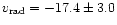 km s-1.
The orbit calculations show that Cep OB2 cannot be the parent group of
Cep. The simulations do result in small minimum separations
between the two, but only for
 pc
and a kinematic age of 9 Myr. These values do not agree with the
observed photometric (860 pc, Gies 1987) and trigonometric
distances (
505-95+153 pc, Hipparcos) of Cep, nor
with the age of the association (5-7 Myr, de Zeeuw et al. 1999). Moreover, Cep is a massive O supergiant, and its
lifetime cannot be more than a few million years.
pc
and a kinematic age of 9 Myr. These values do not agree with the
observed photometric (860 pc, Gies 1987) and trigonometric
distances (
505-95+153 pc, Hipparcos) of Cep, nor
with the age of the association (5-7 Myr, de Zeeuw et al. 1999). Moreover, Cep is a massive O supergiant, and its
lifetime cannot be more than a few million years.
When we run the simulations using Cep OB3 as the parent group we also
obtain minimum separations <10 pc. Figure 15 shows
that the expected distance of the runaway is now 450 pc and that
the kinematic age is 4.5 Myr. This is a little on the large side
for the nominal lifetime of a 40
star, but might not be
impossible. Cep OB3 consists of two subgroups with ages of 5.5
(subgroup b) and 7.5 Myr (subgroup a) (e.g., Jordi et al. 1996).
Considering the high helium abundance and large rotational velocity of
Cep, subgroup a is a likelier parent of the runaway
than subgroup b, since the age difference between the subgroup
and the runaway is 3 Myr for a. For subgroup b this is only 1 Myr,
leaving little time for binary evolution. We conclude that
Cep is likely to have become a runaway star as the result of
a supernova explosion in a binary system in subgroup a of
Cep OB3 4.5 Myr ago.
6 Identification of new parent groups
The orbit retracing technique allows us to identify the (likely)
parent group for thirteen "new'' single runaways, one new pair, two
more pulsars, and Geminga from the samples defined in
Sect. 2. Little is known about most of these objects, so
our discussion is relatively brief. The results are summarized in
Table 5.
The orbit of the spectroscopic binary Andromedae (B5V+F8V)
intersected the Lac OB1 association 8-10 Myr ago. If this is the
parent group, then the kinematic age is comparable to the (uncertain)
age of the association (10 Myr). This, together with a normal
rotational velocity for the primary (80 km s-1) and the binary
nature (two main-sequence stars) of this runaway, suggests that it was
formed by dynamical ejection.
The two stars form an analog of the runaway pair AE Aur and
Col (Sect. 4). They also move in opposite directions
and with similar space motions: 86.5 km s-1 for HIP 22061 (B2.5V)
and 63.0 km s-1 for HIP 29678 (B1V) (velocities are with respect to their own standard
of rest). Retracing the orbits of HIP 22061 and HIP 29678, we find
that the two stars were close together 1.1 Myr ago, suggesting
that these two runaways were also formed by the DES. We did not find a
possible third party (i.e., another runaway in the neighbourhood or a
massive binary).
Applying the principle of conservation of linear momentum at the time
of the encounter, as we did in Sect. 4, we can predict the
properties of the parent cluster. We can only use these two stars and
not three as in Sect. 4.5. We find that the parent cluster
should be located around
 .
This
coincides with the Orionis star-forming region (e.g., Gomez
& Lada 1998; Dolan & Mathieu 1999), which contains
at least three young stellar clusters (the Ori cluster and
the clusters associated with the dark clouds B30 and B35) and is
surrounded by the Orionis ring. Several authors have
suggested that this expanding ring of molecular clouds is the result
of a supernova explosion 0.35 Myr ago (e.g., Cunha & Smith
1996). The predicted cluster position does not coincide with
one of the three star clusters. Furthermore, the predicted radial
velocity of the cluster, 10 km s-1, differs significantly
from that of the Ori clusters, 24 km s-1.
However, these differences might be erased if a third body (either a
single star or a binary) was involved (cf. Sect. 4).
.
This
coincides with the Orionis star-forming region (e.g., Gomez
& Lada 1998; Dolan & Mathieu 1999), which contains
at least three young stellar clusters (the Ori cluster and
the clusters associated with the dark clouds B30 and B35) and is
surrounded by the Orionis ring. Several authors have
suggested that this expanding ring of molecular clouds is the result
of a supernova explosion 0.35 Myr ago (e.g., Cunha & Smith
1996). The predicted cluster position does not coincide with
one of the three star clusters. Furthermore, the predicted radial
velocity of the cluster, 10 km s-1, differs significantly
from that of the Ori clusters, 24 km s-1.
However, these differences might be erased if a third body (either a
single star or a binary) was involved (cf. Sect. 4).
The conclusion that the DES is the acting mechanism for these runaways
is supported by (i) the youth of the clusters in the Ori
star-forming region, 2-6 Myr (Dolan & Mathieu 1999), (ii)
the density of these clusters (Dolan & Mathieu), and (iii) the small
rotational velocity of HIP 29678, <25 km s-1 (Morse et al. 1991).
It is worth mentioning that HIP 22061 and HIP 29678 are not the only
objects running away from the Orionis region. Frisch
(1993) and Smith et al. (1994) suggested
that the neutron star Geminga also originated from this star-forming
region (Fig. 2; but see Bignami & Caraveo
1996). Moreover, the age of Geminga ( yr)
agrees well with the time of the supernova explosion which created the
Orionis ring.
yr)
agrees well with the time of the supernova explosion which created the
Orionis ring.
The ellipsoidal variable star HIP 38455 (B2V) moves away from the open
cluster Collinder 135 with a velocity of almost 40 km s-1, mostly
in the radial direction. The orbits of the
runaway and cluster intersected each other about 3 Myr ago; this is
significantly smaller than the age of the open cluster:
35 Myr. This difference, and the large rotational velocity
(
 km s-1), suggest that the
runaway originated via the BSS.
Ellipsoidal variable stars show brightness variation because of their
non-spherical shapes. The deformation of the star is thought to be due
to tidal interactions with a companion star (Beech 1985).
The fact that HIP 38455 is double (cf. Häfner & Drechsel
1986) suggests that the kick velocity of the compact object
created in the supernova explosion was small and that the binary
remained bound. This system might in the future become a high-mass
X-ray binary (Sect. 1).
km s-1), suggest that the
runaway originated via the BSS.
Ellipsoidal variable stars show brightness variation because of their
non-spherical shapes. The deformation of the star is thought to be due
to tidal interactions with a companion star (Beech 1985).
The fact that HIP 38455 is double (cf. Häfner & Drechsel
1986) suggests that the kick velocity of the compact object
created in the supernova explosion was small and that the binary
remained bound. This system might in the future become a high-mass
X-ray binary (Sect. 1).
This B0.5Iab supergiant is located behind the Vel OB2 association and
is currently moving away from it. Retracing the orbit shows that
6 Myr ago the star was located inside the Vel OB2
association. This kinematic age is smaller than the association age
(10-15 Myr). Adding to this the large rotational velocity
(
 km s-1) and the blue
straggler character of HIP 38518 (see Sect. 9 for a further
discussion), we infer that the BSS is the preferred scenario.
km s-1) and the blue
straggler character of HIP 38518 (see Sect. 9 for a further
discussion), we infer that the BSS is the preferred scenario.
The path of the B3V runaway star HIP 42038 traversed the open cluster
IC 2391 6 Myr ago and the Upper Centaurus Lupus association
8 Myr ago. Little is known about HIP 42038, making it difficult
to determine its origin. The only available criterion is that the
kinematic age is smaller than both the age of IC 2391 (45 Myr) and the
age of Upper Centaurus Lupus (13 Myr) favoring the BSS.
Somewhere between 2 Myr and 10 Myr ago the B1.5IV star occupied the
same space as the open cluster IC 2602. The only bit of information
available for the identification of the runaway's origin is the
difference between the kinematic age and the age of the open cluster
(25 Myr). This would suggest that the BSS is the origin.
HIP 48943 is a runaway from the Lower Centaurus Crux association. The
orbit of the B5Ve star intersected the association center 4 Myr
ago. The runaway has a rotational velocity of 230 km s-1 and its
kinematic age is significantly smaller than the age of Lower Centaurus
Crux, 10 Myr. The BSS is thus the most likely formation
mechanism.
The retraced orbit of the emission-line star HIP 49934 (B2IVnpe)
intersects two open clusters: IC 2391 3 Myr ago and IC 2602
6 Myr ago. The large difference between the nuclear ages of both
clusters (45 Myr and 25 Myr, respectively) and the kinematic age
indicates that the BSS is the most likely origin of HIP 49934. This
assumption is supported by the large rotational velocity
(
 km s-1).
About 3 Myr ago the emission-line star HIP 57669 left the open cluster
IC 2602. This B3Ve star has a large rotational velocity
(
 km s-1) and its kinematic age
differs significantly from the age of IC 2602. Both these points
suggest the BSS as the origin of HIP 57669.
km s-1) and its kinematic age
differs significantly from the age of IC 2602. Both these points
suggest the BSS as the origin of HIP 57669.
This candidate runaway is an eclipsing binary (B5V). Its path
traverses the Upper Centaurus Lupus association and the Cep OB6
association. The respective kinematic ages are 3 and 10 Myr. Both these
kinematic ages are smaller than the association ages of 13 Myr for Upper
Centaurus Lupus and 50 Myr for Cep OB6. This discrepancy in ages
combined with the binary nature of the candidate runaway excludes both
the standard BSS and the DES and might suggest that neither Upper
Centaurus Lupus nor Cep OB6 is the parent of HIP 69491. The BSS is
highly unlikely because the eclipses imply two objects of similar size
and not, for example, a main-sequence star and a compact object. The
DES is excluded because both associations were no longer compact/dense
enough for dynamical encounters to be efficient at the time of
ejection.
What other mechanisms do exist to create a fast moving
(
 km s-1) binary system? One
possibility is a supernova explosion in a triple system consisting of
a hard binary and a third star with a larger semi-major axis (i.e., a
stable triple system). This would result in either (i) a hard binary
moving at moderate speed (<30 km s-1) or (ii) a fast runaway
and a normal field star. In the latter case one of the stars in the
binary explodes and creates a fast runaway. The third star, being
weakly bound to the system would hardly be affected by the
explosion. In the former case the single star explodes causing the
binary to start moving at the orbital speed it had within the triple
system. This velocity should be small since the binary is much more
massive than the third star. However, neither case would create a
runaway binary-system like HIP 69491. Whereas it is likely that the
star originated in either Upper Centaurus Lupus or Cep OB6, the
mechanism that formed this runaway remains unknown.
km s-1) binary system? One
possibility is a supernova explosion in a triple system consisting of
a hard binary and a third star with a larger semi-major axis (i.e., a
stable triple system). This would result in either (i) a hard binary
moving at moderate speed (<30 km s-1) or (ii) a fast runaway
and a normal field star. In the latter case one of the stars in the
binary explodes and creates a fast runaway. The third star, being
weakly bound to the system would hardly be affected by the
explosion. In the former case the single star explodes causing the
binary to start moving at the orbital speed it had within the triple
system. This velocity should be small since the binary is much more
massive than the third star. However, neither case would create a
runaway binary-system like HIP 69491. Whereas it is likely that the
star originated in either Upper Centaurus Lupus or Cep OB6, the
mechanism that formed this runaway remains unknown.
Apodis is a B1npe emission-line star, and is the brightest
component of a visual double system. This star has a radial velocity
of 62 km s-1 and is moving away from the Galactic plane. Its
orbit intersects the Lower Centaurus Crux subgroup of Sco OB2 2-3 Myr
ago. Because of the large difference in kinematic age and association
age (10 Myr) the BSS is the most likely explanation for the
runaway nature of Aps.
Little is known about the B3Vnpe star HIP 82868 whose orbit intersects
that of the IC 2602 open cluster some 6 Myr ago. A firm
identification of the formation mechanism is difficult, since we only
know that the kinematic age differs from the age of IC 2602
(25 Myr). This suggests that HIP 82686 is a BSS runaway.
HIP 91599 is a known runaway star (B0.5V; Vitrichenko et al.
1965); however, its parent association/cluster has
never been identified. The simulations show that HIP 91599 originates
from Per OB2 or Per OB3. The two associations have very different ages
(7 Myr for Per OB2 and 50 Myr for Per OB3). The kinematic
age of HIP 91599 is 8 Myr and 6 Myr for Per OB2 and
Per OB3, respectively. Since we lack information on the rotational
velocity and the helium abundance, we are unable to conclude whether
HIP 91599 is a DES runaway from Per OB2 or a BSS runaway from Per OB3.
The B5 star HIP 102274 was located at the center of the Cep OB2
association between two and three Myr ago, when the association was
3-4 Myr old. This kinematic age coincides with the time of the
supernova explosion proposed by Kun et al.
(1987) to explain the characteristics of the Cepheus bubble,
a ring-like structure of infrared emission. Taken together, this is
strong circumstantial evidence for HIP 102274 being a BSS runaway.
The orbits of the pulsars J0826+2637 and J1115+5030 intersect that
of the Per OB3 association. This group contains the Persei
open cluster, and is often referred to as the Cassiopeia-Taurus
association (de Zeeuw et al. 1999). The simulations show
that if Per OB3 is the parent of PSR J0826+2637, its kinematic age
is 1 Myr and its radial velocity is 100 km s-1. For
PSR J1115+5030 we predict a kinematic age of 1.5 Myr and a
radial velocity of 150 km s-1. The characteristic ages
(
 )
of the pulsars are 4.9 Myr and 10 Myr for
PSR J0826+2637 and PSR J1115+5030, respectively. The unknown
radial velocity of these pulsars makes it difficult to prove beyond
doubt that these pulsars were born in the Per OB3 association.
Although Fig. 2 shows that the orbits projected on the
sky do not differ much for different radial velocities, and that they
cross Per OB3, they may also cross the paths of other, more distant,
associations or clusters not shown in the figure.
)
of the pulsars are 4.9 Myr and 10 Myr for
PSR J0826+2637 and PSR J1115+5030, respectively. The unknown
radial velocity of these pulsars makes it difficult to prove beyond
doubt that these pulsars were born in the Per OB3 association.
Although Fig. 2 shows that the orbits projected on the
sky do not differ much for different radial velocities, and that they
cross Per OB3, they may also cross the paths of other, more distant,
associations or clusters not shown in the figure.
If the two pulsars orginated in Per OB3, then the initial periods
would be 0.47 s for J0826+2637 and 1.53 s for J1115+5030, assuming
no glitches occurred. The latter value is large, which might indicate
that this pulsar travelled longer, from another site of origin.
It is not unlikely to find many pulsars associated with Per OB3 since
its age, 50 Myr, is comparable to the main-sequence life-time of
an 8
star. These are the least massive stars to explode as a
supernova. Since the moment at which a star explodes,
 ,
depends on its mass, (
,
depends on its mass, (
 ,
where
,
where
 and
and
 )
and the number
of stars of mass M, N(M), also depends on the mass (
)
and the number
of stars of mass M, N(M), also depends on the mass (
 ,
where
,
where  ), the number of supernovae increases
with time (
), the number of supernovae increases
with time (
 ,
for
). The number of supernovae, and thus the number of pulsars,
will thus increase with time until the stars of
,
for
). The number of supernovae, and thus the number of pulsars,
will thus increase with time until the stars of  have
exploded as supernovae. Afterwards the pulsar production rate will
drop to almost zero.
have
exploded as supernovae. Afterwards the pulsar production rate will
drop to almost zero.
PSR J0835-4510 is only yr old, and therefore has not
travelled far from its birth place (9' on the sky), the Vela
star-forming region at 450 pc. It lies within the boundaries of
the 10 Myr old Vel OB2 association (de Zeeuw et al. 1999), which is the likely parent group.
![\begin{figure}\includegraphics[angle=0.0, width=15cm, clip=true, keepaspectratio=true]{10198_fig16.eps} \end{figure}](/articles/aa/full/2001/02/aa10198/Timg322.gif) |
Figure 16:
Helium abundance (:
# relative to Hydrogen)
versus rotational velocity for O stars. Left: open circles:
stars with
 km s-1, filled circles: stars with
|v| > 30 km s-1, stars: stars with km s-1, filled circles: stars with
|v| > 30 km s-1, stars: stars with
 mas, and asterisks: stars without Hipparcos data. Right: open
circles: non-runaway stars, filled circles: runaway stars, and stars:
doubtful runaways. The right of each panel display the helium abundances
of stars with an unknown rotational velocity. See text for
details mas, and asterisks: stars without Hipparcos data. Right: open
circles: non-runaway stars, filled circles: runaway stars, and stars:
doubtful runaways. The right of each panel display the helium abundances
of stars with an unknown rotational velocity. See text for
details |
| Open with DEXTER |
7 Runaways and pulsars without parents?
The sample of runaways and pulsars we have analysed here is severely
incomplete (see Sect. 2.1). Furthermore, we have only a
limited knowledge of where massive stars form in the Solar
neighbourhood. The case of Pup described in
Sect. 5 shows that some local parent groups may not
yet have been found. Beyond 500 pc, only the large complexes
such as Cygnus OB1/OB2 or Sco OB1 are well documented. The accuracy of
the three-dimensional positions and velocities of these distant
star-forming regions is poor, making determination of reliable orbits
very difficult. Runaway stars of spectral types B0 and later are
especially difficult to link to a parent group. These stars have
main-sequence lifetimes of up to several tens of Myr and can therefore
travel far (several kpc) from their places of origin. A similar
argument holds for the pulsars. We suspect that most of the runaway
stars and pulsars in our sample for which we were not able to identify
a parent group originated outside the Solar neigbourhood.
An example is the B2.5V star 72 Col, HIP 28756 (van Albada
1961; the asterisk at
![$[\ell,b] \sim [238^\circ,-23^\circ]$](/articles/aa/full/2001/02/aa10198/img323.gif) in Fig. 2). It has a peculiar velocity of
200 km s-1 and its parent association is Sco OB1, at a
distance of 2 kpc (Humphreys 1978). Van Albada derived
a kinematic age of 14 Myr for 72 Col, based on a simple model of
Galactic rotation (Kwee et al. 1954). This
star does not appear in Sects. 5
and 6 because its path did not carry it through
one of the nearby associations. The Solar neighbourhood thus not only
contains runaways for which the parent associations are also nearby,
but it also contains runaways which originated far from the Sun.
in Fig. 2). It has a peculiar velocity of
200 km s-1 and its parent association is Sco OB1, at a
distance of 2 kpc (Humphreys 1978). Van Albada derived
a kinematic age of 14 Myr for 72 Col, based on a simple model of
Galactic rotation (Kwee et al. 1954). This
star does not appear in Sects. 5
and 6 because its path did not carry it through
one of the nearby associations. The Solar neighbourhood thus not only
contains runaways for which the parent associations are also nearby,
but it also contains runaways which originated far from the Sun.
Another star that immediately catches the eye in Fig. 2
is HIP 94899 (the asterisk at
![$[\ell,b] \sim [341^\circ,-26^\circ]$](/articles/aa/full/2001/02/aa10198/img324.gif) ).
This double star of spectral type B3Vn has a radial velocity of
151 km s-1, and its path seems to cross the Per OB3
association. However, our simulations show that the runaway never
comes within 40 pc of the association, implying that this system must
have another, unknown, parent.
).
This double star of spectral type B3Vn has a radial velocity of
151 km s-1, and its path seems to cross the Per OB3
association. However, our simulations show that the runaway never
comes within 40 pc of the association, implying that this system must
have another, unknown, parent.
We have seen in Sect. 3 that PSR J1239+2453 most likely
originates outside the Solar neighbourhood. We did not find a parent
group for the remaining pulsars because (i) an unreasonably large
radial velocity (>500 km s-1) is necessary for the paths of the
pulsar and parent group to intersect (PSR J1135+1551), just as we
found for PSR J1239+2453, or (ii) the past orbit simply does not
intersect any of the nearby young stellar groups (PSR J0953+0755 and
PSR J1456-6845).
8 Helium abundance versus rotational velocity
Blaauw (1993) pointed out that most of the reliable runaways
known at the time have high helium abundances (
 )
and large rotational velocities (
)
and large rotational velocities (
 km s-1), whereas most of the non-runaways have normal helium
abundances and rotational velocities. Only one classical runaway star,
AE Aur, does not follow this trend, and this was already suspected to
be the result of the DES rather than the BSS. Blaauw suggested that
the
km s-1), whereas most of the non-runaways have normal helium
abundances and rotational velocities. Only one classical runaway star,
AE Aur, does not follow this trend, and this was already suspected to
be the result of the DES rather than the BSS. Blaauw suggested that
the
 -diagram of the small
sample of known runaway stars supported the conjecture that most
runaways are produced by the BSS, since these characteristics are
natural consequences of close binary evolution (Sect. 1; van
den Heuvel 1985).
-diagram of the small
sample of known runaway stars supported the conjecture that most
runaways are produced by the BSS, since these characteristics are
natural consequences of close binary evolution (Sect. 1; van
den Heuvel 1985).
As shown in Table 3, only five of the 23 runaways listed
there have a measurement of ,
and six do not have a measured
rotational velocity. In order to pursue Blaauw's suggestion, we
therefore constructed a sample of O stars with known rotational
velocities (Penny 1996) and helium abundances (Kudritzki &
Hummer 1990; Herrero et al. 1992). We also
determined, based on Hipparcos astrometry and Hipparcos Input
Catalogue radial velocities, the space velocities of these stars with
respect to their local standard of rest. The
diagram in the left panel of
Fig. 16 shows that these O stars can roughly be divided
into three groups:
(i) those with small rotational velocities,
 km s-1, and normal helium abundances,
 ,
(ii) those with moderate rotational velocities,
,
(ii) those with moderate rotational velocities,
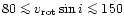 km s-1, and normal to high
helium abundances,
km s-1, and normal to high
helium abundances,
 ,
and
(iii) those with large rotational velocities,
km s-1, and high helium abundances,
,
and
(iii) those with large rotational velocities,
km s-1, and high helium abundances,
 .
The symbols in the left panel of Fig. 16 are chosen
according to the magnitude of the space velocity. The stars
represented by filled circles have space velocities
.
The symbols in the left panel of Fig. 16 are chosen
according to the magnitude of the space velocity. The stars
represented by filled circles have space velocities
 km s-1, and the open circles have
 km s-1; the other symbols indicate
stars for which no Hipparcos data are available (asterisks) or for
stars with insignificant Hipparcos data (starred).
km s-1; the other symbols indicate
stars for which no Hipparcos data are available (asterisks) or for
stars with insignificant Hipparcos data (starred).
![\begin{figure}\includegraphics[angle=0.0, width=15.5cm, clip=true, keepaspectratio=true]{10198_fig17.eps} \end{figure}](/articles/aa/full/2001/02/aa10198/Timg335.gif) |
Figure 17:
Colour vs. absolute magnitude diagrams of the runaways
(stars) and their parent association/cluster (small dots). The
association/cluster members have been de-reddened using the
Q-method. The colours and absolute magnitudes of the runaways have
been determined using their spectral types (Table 3;
Schmidt-Kaler 1983). The isochrones are from Schaller et al. (1992) for Solar metallicity and standard mass loss. The ages of the
associations are indicated in the top right of each panel (US:
Upper Scorpius, UCL: Upper Centaurus Lupus, LCC: Lower Centaurus
Crux) |
| Open with DEXTER |
The left panel of Fig. 16 does not show an obvious
separation between runaways (filled circles) and non-runaways (open
circles). However, based on the available data for each star
(position, radial velocity, distance modulus, cluster membership) it
is possible to decide whether the star is a runaway. The result is
shown in the right panel of Fig. 16; it turns out that
many of the stars with insignificant Hipparcos data are runaways
(including some classical runaways), and that some of the stars
indicated as high-velocity stars in the left panel are members of a
cluster which has a peculiar motion. The resulting
diagram now shows a clear
separation between the runaway stars and the normal O stars. Except
for AE Aur (Sect. 4) all runaways have high helium
abundances,
 ,
and large rotational velocities,
km s-1. Only one star in
this area of the
diagram is
not indicated as a runaway: the double star HIP 113306 (OV7n). This
star is a member of Cep OB3 (
,
and large rotational velocities,
km s-1. Only one star in
this area of the
diagram is
not indicated as a runaway: the double star HIP 113306 (OV7n). This
star is a member of Cep OB3 (
 ,
,
 km s-1).
We thus confirm Blaauw's conclusion that massive runaways
predominantly have high helium abundances and large rotational
velocities, suggesting that they are formed mainly by the
binary-supernova scenario. However, this conclusion is based on a
limited sample which is by no means statistically complete. A
systematic survey of the radial velocities, rotational velocities and
chemical abundances of the early-type stars in the Solar neighbourhood
is highly desirable.
9 Blue stragglers
One of the characteristics of runaway stars produced according to the
binary-supernova scenario is that these stars are expected to be blue
stragglers (Sect. 1). The mass transfer in close binary
systems from the primary to the secondary prior to the supernova
explosion deposits a large amount of hydrogen onto the future
runaway. This new supply of fuel makes the runaway appear younger than
the association/cluster in which it was born, i.e., it appears
rejuvenated.
Figure 17 shows the colour vs. absolute magnitude
diagrams of the parent clusters discussed in this paper. The
association members (dots) have been de-reddened following the
Q-method; only the early-type members (A0 and earlier) are shown. The
solid lines denote the Schaller et al. (1992) isochrones
for Solar metallicity and a standard mass loss rate for the ages of
the associations. The runaway stars are denoted by starred symbols. A
runaway can appear in more than one panel if two or more possible
parents have been identified. The B-V colour and absolute magnitude
have been determined using the spectral type of the runaways
(Table 3; Schmidt-Kaler 1982). Three stars in
Fig. 17 clearly are blue stragglers: HIP 38518,
Per, and Cep; and three others could be blue
stragglers depending on the correct identification of the parent:
Pup, HIP 49934, and HIP 91599. The latter three stars have
uncertain parent identifications (see Sects. 5
and 6). The blue straggler nature of the former
three stars confirms their identification as BSS runaway (see
Table 5). The star Oph has also been claimed to
be a blue straggler (e.g., Blaauw 1993). However, the Upper
Scorpius panel shows that Oph is the bluest star of the group,
but it lies on the main sequence, as also found by de Geus et al. (1989) on the basis of  photometry.
By contrast to the BSS runaways, those produced by the DES are
expected to follow the main sequence of the parent group. These
runaways most likely did not experience a period of binary evolution
in which mass transfer was important. The runaway stars which we
identified securely as DES runaways (AE Aur, Col, HIP 22061, and
HIP 29678) indeed fall on the main sequence of their parents (the
Trapezium and the Ori cluster).
10 Concluding remarks
We have used the Hipparcos astrometry for a sample of nearby candidate
OB runaway stars to locate their parent groups, and to identify their
formation mechanisms. We retraced the orbits of these candidate
runaways, and determined where and when they passed through a possible
parent group. We find that both mechanisms proposed for the production
of runaway stars, the binary-supernova scenario (BSS) and the
dynamical ejection scenario (DES), operate. Table 5
summarizes the results. Even though the number of runaways discussed
in this paper is small, and the weight of evidence varies, we find
that roughly 2/3 of the runaways is produced by the BSS and 1/3 by
the DES. This agrees with the results of binary population synthesis
calculations by Portegies Zwart (2000). At present it is not
feasible to extend this study to other runaways. This is mainly due to
large uncertainties in the velocities and distances of the runaways,
and the limited knowledge of star-forming regions with distances
>500 pc.
Tracing the runaway orbits back in time provides, for the first time,
direct evidence that both scenarios produce single runaway stars
(Hoogerwerf et al. 2000). The orbit calculations
demonstrate that the runaway Oph and the progenitor of
PSR J1932+1059 once formed a binary system in the Upper Scorpius
association, and that the neutron star acquired a kick velocity of
350 km s-1 in the supernova explosion. The runaways AE Aur
and Col, and the binary Ori were involved in a dynamical
interaction (a binary-binary collision) 2.5 Myr ago, which took
place in the Trapezium cluster.
Table 5:
Parent associations, kinematic ages ()
and
formation mechanisms of the runaways and neutron stars discussed in this
paper. For runaway stars which have more than one possible parent we
give the results for the individual parent
associations/clusters. The last column indicates the number of the
runaway/pulsar in Fig. 2. Abbreviations: US: Upper
Scorpius; UCL: Upper Centaurus Lupus; LCC: Lower Centaurus Crux;
BSS: binary supernova scenario; DES: dynamical ejection
scenario
| HIP |
Name |
Parent |
|
Origin |
Fig. 2 |
| |
|
|
[Myr] |
|
|
| 3881 |
And |
Lacerta OB1 b |
9.0 |
DES |
1 |
| 14514 |
53 Ari |
Orion OB1 a |
4.3 |
BSS |
2 |
| |
|
Orion OB1 b |
4.8 |
DES |
2 |
| |
|
Orion OB1 c |
5.0 |
DES |
2 |
| 18614 |
Per |
Perseus OB2 |
1.0 |
BSS |
3 |
| 22061 |
|
Ori SFR |
1.1 |
DES |
4 |
| 24575 |
AE Aur |
Trapezium |
2.5 |
DES |
5 |
| 27204 |
Col |
Trapezium |
2.5 |
DES |
6 |
| 29678 |
|
Ori SFR |
1.1 |
DES |
7 |
| 38455 |
|
Collinder 135 |
3.0 |
BSS |
8 |
| 38518 |
|
Vela OB2 |
6.0 |
BSS |
9 |
| 39429 |
Pup |
? |
|
|
10 |
| 42038 |
|
UCL |
8.0 |
BSS |
11 |
| |
|
IC 2391 |
6.0 |
BSS |
11 |
| 46950 |
|
IC 2602 |
2-10 |
BSS |
12 |
| 48943 |
|
LCC |
4.0 |
BSS |
13 |
| 49934 |
|
IC 2391 |
3.0 |
BSS |
14 |
| |
|
IC 2602 |
6.0 |
BSS |
14 |
| 57669 |
|
IC 2602 |
3.0 |
BSS |
15 |
| 69491 |
|
UCL(?) |
3.0 |
? |
16 |
| |
|
Cepheus OB6(?) |
10.0 |
? |
16 |
| 76013 |
Aps |
LCC |
2.5 |
BSS |
17 |
| 81377 |
Oph |
US |
1.0 |
BSS |
18 |
| 82868 |
|
IC 2602 |
6.0 |
BSS |
19 |
| 91599 |
|
Perseus OB2 |
8.0 |
DES |
20 |
| |
|
Perseus OB3 |
6.0 |
BSS |
20 |
| 102274 |
|
Cepheus OB2 |
2.5 |
BSS |
21 |
| 109556 |
Cep |
Cepheus OB3 |
4.5 |
BSS |
22 |
| |
|
|
|
|
|
| |
J0826+2637 |
Perseus OB3 |
1.0 |
? |
1 |
| |
J0835-4510 |
Vela OB2 |
0.01 |
? |
2 |
| |
J1115+5030 |
Perseus OB3 |
1.5 |
? |
4 |
| |
J1932+1059 |
US |
1.0 |
BSS |
8 |
| |
Geminga |
Orionis |
0.35 |
? |
9 |
The current investigation is biased towards finding BSS runaways. This
is mainly due to the fact that the accuracy of the available data, and
our knowledge of the location and motions of star-forming regions,
restrict the study to 700 pc. The small volume implies that we
are only able to identify runaway stars with small kinematic ages of
0-10 Myr (i.e., runaways which recently left their parent
association). Runaways which were created at an earlier time have most
likely traveled outside our sample limits. Since associations and open
clusters can create BSS runaways during 50 Myr (approximately
the lifetime of a
star) and DES runaways only in the
inital stages when the group still has a high density, we expect to find
more BSS than DES runaways because there are relatively many more old
parents than young parents in the Solar neighbourhood. This bias is
somewhat weakened by the fact that most dynamical interactions produce
two runaway stars while the binary-supernova mechanism produces only
one.
The creation of runaway stars modifies the mass function of the parent
group at the high-mass end, where the total number of stars is
small. For example, the encounter in Orion described in
Sect. 4 removed four stars with a total mass of order 70
from the Trapezium cluster, while only six stars more
massive than 10
remain. Derivation of the initial mass
function of young stellar groups from the present-day mass function
without accounting for the associated runaway stars leads to
erroneous results.
Our Hipparcos-based study has identified 56 runaway stars within 700
pc from the Sun, and tripled the subset of these for which a parent
group is known (from 6 to 21). As mentioned in Sect. 2,
less than a third of the O-B5 stars in the Hipparcos Catalog have a
measured radial velocity. Obtaining these is likely to result in
another factor of three increase in the size of the sample, so that
statistical studies become possible.
The next major step in our understanding of the origin of runaway
stars will come when large datasets of micro-arcsecond (as)
astrometry and accurate radial velocities (1-2 km s-1) become
available. Distances accurate to a few parsec will allow for a final
confirmation or rejection of the genetic link between runaways and
their parents (e.g., Fig. 12). These data will become
available over the next two decades with the launches of several
astrometric satellites (FAME, SIM, GAIA). These aim to obtain as
astrometry for a large number of stars, from
stars with SIM
to 1 billion stars with GAIA. Besides astrometry, accurate radial
velocities are also required; unfortunately, there is no dedicated
effort to obtain these for a large number of O and B stars.
The BSS and DES can produce runaway stars with spectral types beyond
B5 (e.g., Kroupa 2000b; Portegies Zwart 2000).
These will be harder to find, as the velocity distribution of the
later-type stars in the Galactic disk is broader than for the O-B5
stars, and the fractional production of low-mass runaways is
small. Identifying their parent groups is also harder, because these
stars may have traveled for much longer times. However, as
accuracy astrometry complemented with accurate radial velocities will
undoubtedly reveal such objects, and will provide further constraints
on the binary fraction and the binary mass-ratios in open clusters and
associations.
![\begin{figure}\includegraphics[angle=0.0, width=14cm, clip=true, keepaspectratio=true]{10198_figa1.eps} \end{figure}](/articles/aa/full/2001/02/aa10198/Timg346.gif) |
Figure A1:
Left to right: The distribution of absolute
differences between two observable quantities,  ,
in one
( ,
in one
(
 ), two ( ), two (
 ), and three
( ), and three
(
 )
dimensions, taking into account the measurement
errors. Top: )
dimensions, taking into account the measurement
errors. Top:  ,
1, 2, and 3 are represented by the
solid, dotted, dashed, and dot-dashed lines,
is indicated
in the top right of each panel. Bottom: ,
1, 2, and 3 are represented by the
solid, dotted, dashed, and dot-dashed lines,
is indicated
in the top right of each panel. Bottom:
 ,
2, 3,
and 4 are represented by the solid, dotted, dashed, and dot-dashed
lines,
is indicated in the top right of each panel ,
2, 3,
and 4 are represented by the solid, dotted, dashed, and dot-dashed
lines,
is indicated in the top right of each panel |
Figure 1b shows that there are 19 additional
pulsars within one kpc for which an accurate proper motion is not
available. A systematic program to measure these might allow the
detection of more examples of pairs such as Oph and
PSR J1932+1059. It would also improve the characterisation of the
pulsar population as a whole. VLBI techniques hold the promise of
achieving sub-mas astrometry (positions, proper motions, and
parallaxes) in the near future.
Acknowledgements
It is a pleasure to thank Bob Campbell for a discussion on VLBI proper
motions of pulsars, Rob den Hollander for writing an early version of
the software used here, Nicolas Cretton for providing the Galactic
potential used in the orbit integrations, and Ed van den Heuvel, Lex
Kaper, Michael Perryman, the referee Walter van Rensbergen, and in
particular Adriaan Blaauw, for stimulating comments and suggestions.
This research was supported by the Netherlands Foundation for Research
in Astronomy (NFRA) with financial aid from the Netherlands
Organization for Scientific Research (NWO).
Appendix A: Distribution of differences
In this appendix we record the distribution of the difference between
two observables, each of which has a Gaussian error distribution.
We define two observable quantities, x1 and x2, which are both
distributed normally,
 and
and
 ,
respectively, where
,
respectively, where  and
and  are the mean and standard deviation of G1, and
  ,
,
 for G2. We define
 as the
absolute difference between the observables, where
as the
absolute difference between the observables, where  and
and
 are the measurements of x1 and x2. We calculate the
distribution of the difference,
are the measurements of x1 and x2. We calculate the
distribution of the difference,  ,
in the one-
(
,
in the one-
(
 ), two-
(
), two-
(
 ), and three-dimensional
(
), and three-dimensional
(
 )
case. In all cases we took
)
case. In all cases we took
 and
and
 and
and
 .
The
former simplification is harmless since only the difference
.
The
former simplification is harmless since only the difference
 is important. The results are:
![\begin{displaymath}F_{\rm 2D}(\Delta) = \frac{\Delta}{2 \sigma^2}
\exp \left [...
...^2} \right ]
I_0 \left (\frac{\Delta\mu}{2\sigma^2} \right ),
\end{displaymath}](/articles/aa/full/2001/02/aa10198/img368.gif) |
(A2) |
where I0 is a modified Bessel function of order zero, and
Applying L'Hospital's rule we calculate the limit of
for
 :
:
![\begin{displaymath}\lim\limits_{\mu \rightarrow 0} F_{\rm 3D}(\Delta){\rm d}\Del...
...gma^3}
\exp \left [
- \frac{\Delta^2}{4\sigma^2}
\right ].
\end{displaymath}](/articles/aa/full/2001/02/aa10198/img373.gif) |
(A4) |
Figure A1 and Eqs. (A.2) and (A.3) show
that for the two- and three-dimensional cases there is a zero
probability of measuring the same value for x1 and x2, i.e.,
 .
.
Appendix B: The neutron star RX J185635-3754
After this paper was submitted, Walter (2000) suggested that
perhaps the past trajectory of the isolated neutron star
RX J185635-3754 intersected that of Oph. He used HST WFPC2
observations over a three-year baseline to obtain a very accurate
proper motion and parallax, and approximated the past orbit by a
straight line. He concluded that the neutron star came very near
Oph 1.15 Myr ago in Upper Scorpius for an assumed radial
velocity of -45 km s-1.
We have used the simulation machinery described in Sect. 3
to analyse this case in the same way as done there for Oph and
PSR J1932+1059. We have again run three million simulations,
covering the range  km s-1 for the radial velocity of
the neutron star. Figure B1 presents the resulting distribution of
minimum separations
and associated kinematic ages
.
This figure can be compared directly with
Fig. 3. We have seen in Sect. 3 that
simulations put PSR J1932+1059 within 10 pc of Oph, and in
4214 of these the encounter took place in Upper Scorpius. By contrast,
only 748 simulations put RX J185635-3754 within 10 pc of Oph,
about 1.5 Myr ago. None of these encounters occur within 15 pc of
Upper Scorpius. We conclude that it is unlikely that RX J185635-3754
is the remnant of the supernova that gave Oph its large space
velocity. We suspect that this neutron star formed long ago somewhere
else in the Galactic plane.
km s-1 for the radial velocity of
the neutron star. Figure B1 presents the resulting distribution of
minimum separations
and associated kinematic ages
.
This figure can be compared directly with
Fig. 3. We have seen in Sect. 3 that
simulations put PSR J1932+1059 within 10 pc of Oph, and in
4214 of these the encounter took place in Upper Scorpius. By contrast,
only 748 simulations put RX J185635-3754 within 10 pc of Oph,
about 1.5 Myr ago. None of these encounters occur within 15 pc of
Upper Scorpius. We conclude that it is unlikely that RX J185635-3754
is the remnant of the supernova that gave Oph its large space
velocity. We suspect that this neutron star formed long ago somewhere
else in the Galactic plane.
![\begin{figure}\includegraphics[angle=0.0, width=8.5cm, clip=true, keepaspectratio=true]{10198_figb1.eps} \end{figure}](/articles/aa/full/2001/02/aa10198/Timg376.gif) |
Figure B1:
Left: Distribution of minimum separations,
,
between Oph and
RX J185635-3754. The solid line denotes the expected distribution of
,
see Sect. 3.3. Right:
Distribution of the times
at which the minimum separation
was reached |
- Abt, H. A. 1983, ARA&A, 21, 343
In the text
NASA ADS
- Abt, H. A., Wang, R., & Cardona, O. 1991, ApJ,
367, 155
In the text
NASA ADS
- van Albada, T. S. 1961, Bull. Astron. Inst. Netherlands, 15, 301
In the text
NASA ADS
- Barbier-Brossat, M. 1989, Catalogue de
Vitesses Radiales Moyennes Stellaires, A&AS, 80, 67
In the text
NASA ADS
- Barbier-Brossat, M., Petit, M., & Figon, P. 1994,
A&AS, 108, 603
NASA ADS
- Beech, M. 1985, Ap&SS, 117, 69
In the text
NASA ADS
- Benz, W., & Hills, J. G. 1987, ApJ, 323, 614
In the text
NASA ADS
- Bernacca, P. L., & Perinotto, M. 1970, Contr. Oss. Astrof. Padova in Asiago, 239, 1
NASA ADS
- Bignami, G. F., & Caraveo, P. A. 1996, ARA&A, 34, 331
In the text
NASA ADS
- Binney, J. J., & Tremaine, S. 1987, Galactic
Dynamics (Princeton University Press)
In the text
- Blaauw, A. 1944, Bull. Astron. Inst. Netherlands, 10, 29
In the text
- Blaauw, A. 1952a, Bull. Astron. Inst. Netherlands, 11, 405
In the text
- Blaauw, A. 1952b, Bull. Astron. Inst. Netherlands, 11, 414
In the text
- Blaauw, A. 1956, ApJ, 123, 408
In the text
NASA ADS
- Blaauw, A. 1961, Bull. Astron. Inst. Netherlands, 15, 265 (Paper I)
In the text
NASA ADS
- Blaauw, A. 1964, ARA&A, 2, 213
In the text
NASA ADS
- Blaauw, A. 1978, in Problems of Physics and
Evolution of the Universe, ed. L. V. Mirzoyan (Yerevan:
Armenian Acad. Sci.), 101
In the text
- Blaauw, A. 1993, in Massive Stars: Their
Lives in the Interstellar Medium, ed. J. P. Cassinelli & E. B. Churchwell, ASP Conf. Ser., 35, 207
In the text
- Blaauw, A., & Morgan, W. W. 1954, ApJ, 119, 625
In the text
NASA ADS
- Blaauw, A., Hiltner, W. A., & Johnson, H. L. 1959,
ApJ, 130, 69 [Erratum: ApJ, 131, 527 (1960)]
In the text
NASA ADS
- Blaauw, A., & Ramachandran, R. 1998, J. Astroph. Astr., 19, 19
In the text
NASA ADS
- Bohannan, B., & Garmany, C. D. 1978, ApJ, 223, 908
In the text
NASA ADS
- Bohnenstengel, H.-D., & Wendker, H. J. 1976, A&A, 52, 23
In the text
NASA ADS
- Bonnell, I. A. 1999, in The Origin of Stars
and Planetary Systems, ed. C. J. Lada & N. D. Kylafis, NATO
ASI Ser. C., 540, 479
- Bonnell, I. A., Bate, M. R., & Zinnecker, H. 1998,
MNRAS, 298, 93
NASA ADS
- Brisken, W. F., Benson, J. M., Beasley, A. J.,
et al. 2000, preprint, [astro-ph/0005324]
In the text
- Brown, A. G. A., & Verschueren, W. 1997, A&A, 319, 811
NASA ADS
- Brown, A. G. A., de Geus, E. J., & de Zeeuw, P. T.
1994, A&A, 289, 101
In the text
NASA ADS
- Van Buren, D., Noriega-Crespo, A., & Dgani, R.
1995, AJ, 110, 2914
NASA ADS
- Burrows, A., Hayes, J., & Fryxell, B. A. 1995, ApJ,
450, 830
In the text
NASA ADS
- Campbell, R. M. 1995, Ph.D. Thesis (Harvard
University)
In the text
- Campbell, R. M., Bartel, N., Shapiro, I. I., et al. 1996, ApJ, 461, L95
In the text
NASA ADS
- Caraveo, P. A., Bignami, G. F., Mignani, R. P.,
& Taff L. G. 1996, ApJ, 461, L91
In the text
NASA ADS
- Caraveo, P. A., Lattanzi, M. G., Massone, G.,
et al. 1998, A&A, 329, L1
In the text
NASA ADS
- Carrasco, L., Bisiacchi, G. F., Firmani, C.,
Costero, R., & Cruz-González, C. 1980, A&A, 92, 253
In the text
NASA ADS
- Cernis, K. 1993, Baltic
Astron., 2, 214
NASA ADS
- Chevalier, C., & Ilovaisky, S. A. 1998, A&A, 330, 201
In the text
NASA ADS
- Comerón, F., Torra, J., & Gómez, A. E. 1998,
A&A, 330, 975
NASA ADS
- Cordes, J. M., Romani, R. W., & Lundgren, S. C. 1993,
Nat, 362, 133
In the text
NASA ADS
- Crawford, D. L., & Barnes, J. V. 1970, AJ, 75, 952
In the text
NASA ADS
- Cunha, K., & Smith, V. V. 1996, A&A, 309, 892
In the text
NASA ADS
- Dehnen, W., & Binney, J. J. 1997, MNRAS, 298, 387
In the text
NASA ADS
- Dolan, C. J., & Mathieu, R. D. 1999, ApJ, 118, 2409
In the text
- Downs, G. S., & Reichley, P. E. 1983, ApJS, 53, 169
In the text
NASA ADS
- Duflot, M., Figon, P., & Meyssonnier, N. 1995,
The Wilson Evans Batten Catalogue, A&AS, 114, 269
In the text
NASA ADS
- Elmegreen, B. G. 1983, MNRAS, 203, 1011
In the text
NASA ADS
- ESA, 1997, The Hipparcos and Tycho
Catalogues, ESA SP-1200
In the text
- Feast, M., & Whitelock, P. 1997, MNRAS, 291, 683
In the text
NASA ADS
- Frail, D. A., Kulkarni, S. R. 1991, Nat, 352, 785
In the text
NASA ADS
- Frisch, P. C. 1993, Nat, 364, 395
In the text
NASA ADS
- Garmany, C. D., Conti, P. S., & Massey, P. 1980,
ApJ, 242, 1063
In the text
NASA ADS
- Genzel, R., & Stutzki, J. 1989, ARA&A, 27, 41
In the text
NASA ADS
- de Geus, E. J. 1992, A&A, 262, 258
In the text
NASA ADS
- de Geus, E. J., de Zeeuw, P. T., & Lub, J. 1989,
A&A, 216, 44
In the text
NASA ADS
- Gies, D. R., & Bolton, C. T. 1986, ApJS, 61, 419
In the text
NASA ADS
- Gies, D. R. 1987, ApJS, 64, 545
In the text
NASA ADS
- Gomez, M., & Lada, C. J. 1998, AJ, 115, 1524
In the text
NASA ADS
- Häfner, R., & Drechsel, H. 1986, Ap&SS, 121, 205
In the text
NASA ADS
- Hansen, B. M. S., & Phinney, E. S. 1997, MNRAS, 291, 569
In the text
NASA ADS
- Hartman, J. W. 1997, A&A, 322, 127
In the text
NASA ADS
- Herbst, W. 1975, AJ, 80, 683
In the text
NASA ADS
- Herrero, A., Kudritzki, R. P., Vilchez, J. M.,
et al.
1992, A&A, 261, 209
In the text
NASA ADS
- van den Heuvel, E. P. J. 1985, in Birth
and Evolution of Massive Stars and Stellar Groups, ed. W. Boland, &
H. van Woerden (Dordrecht: Reidel), 107
In the text
- van den Heuvel, E. P. J., Portegies Zwart, S. F.,
Bhattacharya, D., & Kaper, L. 2000, A&A, in press [astro-ph/0005245]
In the text
- Hillenbrand, L. A., & Hartmann, L. W. 1998, ApJ, 492, 540
In the text
NASA ADS
- Hills, J. G. 1983, ApJ, 267, 322
In the text
NASA ADS
- Hoffer, J. B. 1983, AJ, 88, 1420
In the text
NASA ADS
- Høg E., et al. 1998, A&A, 335, L65
NASA ADS
- Høg E., Fabricius, C., Makarov, V. V.,
et al. 2000, A&A, 357, 367
In the text
NASA ADS
- Hoogerwerf, R., de Bruijne, J. H. J., & de Zeeuw, P. T. 2000,
ApJL, in press [astro-ph/0007436]
In the text
- Houk, N. 1982, Michigan Spectral Survey, Ann
Arbor, Dep. Astron., Univ. Michigan, 3
In the text
- Humphreys, R. M. 1978, ApJS, 38, 309
In the text
NASA ADS
- Hut, P., & Bahcall, J. N. 1983, ApJ, 268, 319
In the text
NASA ADS
- Johnson, H. M. 1965, ApJ, 142, 964
In the text
NASA ADS
- de Jong, J. A., Henrichs, H. F., Schijvers, C., et al. 1999, A&A, 345, 172
In the text
NASA ADS
- Jordi, C., Trullols, E., &
Galadí-Enríquez, D. 1996, A&A, 312, 499
In the text
NASA ADS
- Kaper, L., van Loon, J. Th., Augusteijn, T.,
et al. 1997, ApJ, 475, L37
In the text
NASA ADS
- Klochkova, V. G., & Kopylov, I. M. 1985, Bull. Spec. Astrophys. Obs., 20, 3
In the text
- Kroupa, P. 2000a, New Astron., 4, No. 8, 615
In the text
- Kroupa, P. 2000b, in Massive Stellar
Clusters, ed. A. Lancon, & C. Boily, ASP Conf. Ser., in press
[astro-ph/0001259]
In the text
- Kroupa, P., Petr, M. G., & McCaughrean, M. J. 1999,
New Astron., 4, No. 7, 495
In the text
- Kudritzki, R. P., & Hummer, D. G. 1990, ARA&A, 28, 303
In the text
NASA ADS
- Kun, M., Balázs, L. G., & Tóth, I. 1987,
Ap&SS, 134, 211
In the text
- Kwee, K. K., Muller, C. A., & Westerhout, G. 1954,
Bull. Astron. Inst. Netherlands, 12, 211
In the text
- Lai, D. 1999, in Stellar Astrophysics
Pacific Rim Conf. Proc., (Kluwer Pub.) [astro-ph/9912522]
In the text
- Leonard, P. J. T. 1989 AJ, 98, 217
In the text
NASA ADS
- Leonard, P. J. T. 1991, AJ, 101, 562
In the text
NASA ADS
- Leonard, P. J. T. 1995, MNRAS, 277, 1080
In the text
NASA ADS
- Leonard, P. J. T., & Dewey, R. 1993, in
Luminous High-Latitude Stars, ed. D. Sasselov, ASP Conf. Ser.,
45, 239
- Leonard, P. J. T., & Duncan, M. J. 1988, AJ, 96, 222
In the text
NASA ADS
- Leonard, P. J. T., & Duncan, M. J. 1990, AJ, 99, 608
In the text
NASA ADS
- Lombardi, J. C. Jr., Rasio, F. A., & Shapiro, S. L.
1995, ApJ, 445, L117
In the text
NASA ADS
- Lorimer, D. R., Bailes, M., & Harrison, P. A. 1997,
MNRAS 289, 592
In the text
NASA ADS
- Lyne, A. G., Anderson, B., & Salter, M. J. 1982,
MNRAS, 201, 503
In the text
NASA ADS
- Maitzen, H. M., Paunzen, E., Pressberger, R.,
Slettebak, A., & Wagner, R. M. 1998, A&A, 339, 782
NASA ADS
- Mason, B. D., Gies, D. R., Hartkopf, W. I.,
et al.
1998, AJ, 115, 821
In the text
NASA ADS
- McCaughrean, M. J., & Burkert, A. 2000, The
Orion Complex Revisited, ASP Conf. Ser., in press
In the text
- McCaughrean, M. J., & Stauffer, J. R. 1994, AJ, 108, 1382
In the text
NASA ADS
- Mikkola, S. 1983a, MNRAS, 203, 1107
In the text
NASA ADS
- Mikkola, S. 1983b, MNRAS, 205, 733
In the text
NASA ADS
- Moffat, A. F. J., et al. 1998, A&A, 331, 949
In the text
NASA ADS
- Morrell, N., & Levato, H. 1991, A&AS, 75, 965
In the text
- Morse, J. A., Mathieu, R. D., & Levine, S. E. 1991,
AJ, 101, 1495
In the text
NASA ADS
- Packet, W. 1981, A&A, 102, 17
In the text
NASA ADS
- Palla, F., & Stahler, S. W. 1999, ApJ, 525, 772
In the text
NASA ADS
- Penny, L. R. 1996, ApJ, 463, 737
In the text
NASA ADS
- Petr, M. G., Coude Du Foresto, V., Beckwith,
S. V. W., Richichi, A., & McCaughrean, M. J. 1998, ApJ, 500, 825
In the text
NASA ADS
- Philp, C. J., Evans, C. R., Leonard, P. J. T., & Frail,
D. A. 1996, AJ, 111, 1220
In the text
NASA ADS
- Portegies Zwart, S. F. 2000, ApJ, in press
[astro-ph/0005021]
In the text
- Poveda, A., Ruiz, J., & Allen, C. 1967, Bol. de
los Obs. Tonantzintla y Tacubaya, 28, 86
In the text
- Preibisch, T., Balega, Y., Hofmann, K.-H.,
Weigelt, G., & Zinnecker, H. 1999, New Astron., 4, 531
In the text
NASA ADS
- Prosser, C. F., Stauffer, J. R., Hartmann, L. W.,
et al.
1994, ApJ, 421, 517
In the text
NASA ADS
- van Rensbergen, W., Vanbeveren, D., & de Loore, C.
1996, A&A, 305, 825
In the text
NASA ADS
- Sahu, M. S. 1992, A Study of the ISM in
Puppis-Vela Including the Gum Nebula, Ph.D. Thesis
(Groningen Univ.)
In the text
- Sancisi, R. 1970, A&A, 4, 387
In the text
NASA ADS
- Sancisi, R., Goss, W. M., Anderson, C., Johansson,
L. E. B., & Winnberg, A. 1974, A&A, 35, 445
In the text
NASA ADS
- Sargent, A. I. 1979, ApJ, 233, 163
In the text
NASA ADS
- Sayer, R. W., Nice, D. J., & Kaspi, V. M. 1996, ApJ,
461, 357
In the text
NASA ADS
- Schaller, G., Schaerer, D., Meynet, G., & Maeder,
A. 1992, A&AS, 96, 269
In the text
NASA ADS
- Schmidt-Kaler, Th. 1982, in
Landolt-Börnstein New Series, Group VI, vol. 2b, ed. K. Schaifers, & H. H. Voigt (Springer-Verlag), 1
In the text
- Seyfert, C. K., Hardie, R. H., & Grenchik, R. T.
1960, ApJ, 132, 58
In the text
NASA ADS
- Shull, J. M., & van Steenberg, M. E. 1985, ApJ, 294, 599
In the text
NASA ADS
- Simon, M., Close, L. M., & Beck, T. L. 1999, AJ,
117, 1375
In the text
NASA ADS
- Slettebak, A., Wagner, R. M., & Bertram, R. 1997,
PASP, 109, 1
NASA ADS
- Smith, V. V., Cunha, K., & Plez, B. 1994, A&A, 281, L41
In the text
NASA ADS
- Smith, H., & Eichhorn, H. 1996, MNRAS, 281, 211
In the text
NASA ADS
- Sterken, C. 1988, A&A, 189, 81
NASA ADS
- Stickland, D. J., Pike, C. D., Lloyd, C., & Howarth,
I. D. 1987, A&A, 184, 185
In the text
NASA ADS
- Stone, R. C. 1982, ApJ, 261, 208
In the text
NASA ADS
- Stone, R. C. 1991, AJ, 102, 333
In the text
NASA ADS
- Taylor, J. H., Manchester, R. N., & Lyne, A. G. 1993,
ApJS, 88, 529 (see also http://pulsar.princeton.edu/)
In the text
NASA ADS
- Turon, C., et al. 1992, The Hipparcos Input
Catalogue, ESA SP-1136
In the text
- Uesugi, A., & Fukada, I. 1970, Contr. Astroph. Kwasan Obs. Univ. Kyoto, 189
- Upton, E. K. L. 1971, in The Gum nebula and
related problems, ed. S. P. Maran, J. C. Brandt & T. P. Stecher, NASA SP-332, 119
In the text
- Vanbeveren, D., De Loore, C., & Van Rensbergen, W.
1998, A&AR, 9, 63
In the text
- Vanbeveren, D., Van Rensbergen, W., & De Loore, C.
1998, The Brightest Binaries, ASSL, vol. 232
In the text
- Vitrichenko, E. A., Gershberg, R. E., & Metik, L. P.
1965, Izv. Krymsk. Ap. Obs., 34, 193
In the text
- Walker, M. F. 1969, ApJ, 155, 447
In the text
NASA ADS
- Walker, M. F. 1983, ApJ, 271, 642
NASA ADS
- Walter, F. M. 2000, preprint [astro-ph/0009031]
In the text
- Warren, W. H., & Hesser, J. E. 1977a, ApJS, 34, 115
In the text
NASA ADS
- Warren, W. H., & Hesser, J. E. 1977b, ApJS, 34, 207
In the text
NASA ADS
- Warren, W. H., & Hesser, J. E. 1978, ApJS, 36, 497
In the text
NASA ADS
- Weigelt, G., Balega, Y., Preibisch, Th.,
et al.
1999, A&A, 347, L15
In the text
NASA ADS
- Wilson, R. E. 1953, General Catalogue of
Stellar Radial velocities, Carnegie Institution of Washington,
Publication 601, Washington, D. C
In the text
- de Zeeuw, P. T., & Brand, J. 1985, in Birth
and Evolution of Massive Stars and Stellar Groups, ed. W. Boland, &
H. van Woerden (Dordrecht: Reidel), ASP Lib., vol. 120, 95
In the text
- de Zeeuw, P. T., Hoogerwerf, R., de Bruijne,
J. H. J., Brown, A. G. A., & Blaauw, A. 1999, AJ, 117, 354
In the text
NASA ADS
- de Zeeuw, P. T., Hoogerwerf, R., & de Bruijne, J. H. J. 2000,
in Dynamics of Starclusters and the Milky Way,
ed. S. Deiters, et al., ASP Conf. Ser., in press [astro-ph/0007436]
In the text
- Zinnecker, H., McCaughrean, M. J., & Wilking, B. A.
1993, in Protostars and Planets III, ed. E. Levy &
J. Lunine (Univ. Arizona Press), 429
In the text
- Zwicky, F. 1957, Morphological
Astronomy (Springer-Verlag, Berlin), 258
In the text
© ESO 2001
![\begin{figure}\includegraphics[angle=0.0, width=12.2cm, clip=true, keepaspectratio=true]{10198_fig01.eps} \end{figure}](/articles/aa/full/2001/02/aa10198/img35.gif)
![\begin{figure}\includegraphics[angle=0.0, width=14cm, clip=true, keepaspectratio=true]{10198_fig02.eps} \vskip -5mm
\end{figure}](/articles/aa/full/2001/02/aa10198/img88.gif)
![\begin{figure}\includegraphics[angle=0.0, width=8.8cm, clip=true, keepaspectratio=true]{10198_fig03.eps} \end{figure}](/articles/aa/full/2001/02/aa10198/img232.gif)
![\begin{figure}\includegraphics[angle=0.0, width=13.5cm, clip=true, keepaspectratio=true]{10198_fig04.eps} \end{figure}](/articles/aa/full/2001/02/aa10198/img233.gif)
![\begin{figure}\includegraphics[angle=0.0, width=8.8cm, clip=true, keepaspectratio=true]{10198_fig05.eps} \end{figure}](/articles/aa/full/2001/02/aa10198/img235.gif)
![\begin{figure}\includegraphics[angle=0.0, width=8.8cm, clip=true, keepaspectratio=true]{10198_fig06.eps} \end{figure}](/articles/aa/full/2001/02/aa10198/img236.gif)
![\begin{figure}\includegraphics[angle=0.0, width=8.8cm, clip=true, keepaspectratio=true]{10198_fig07.eps} \end{figure}](/articles/aa/full/2001/02/aa10198/img252.gif)
![\begin{figure}\includegraphics[angle=0.0, width=8.8cm, clip=true, keepaspectratio=true]{10198_fig08.eps} \end{figure}](/articles/aa/full/2001/02/aa10198/img262.gif)
![\begin{figure}\includegraphics[angle=0.0, width=\textwidth, clip=true, keepaspectratio=true]{10198_fig09.eps} \end{figure}](/articles/aa/full/2001/02/aa10198/img267.gif)
![\begin{figure}\includegraphics[angle=0.0, width=\textwidth, clip=true, keepaspectratio=true]{10198_fig10.eps} \par\end{figure}](/articles/aa/full/2001/02/aa10198/img273.gif)
![\begin{figure}\includegraphics[angle=0.0, width=15.7cm, clip=true, keepaspectratio=true]{10198_fig11.eps}\vskip -0.5truecm
\end{figure}](/articles/aa/full/2001/02/aa10198/img285.gif)
![\begin{figure}\includegraphics[angle=0.0, width=8.8cm, clip=true, keepaspectratio=true]{10198_fig12.eps} \end{figure}](/articles/aa/full/2001/02/aa10198/img286.gif)
![\begin{figure}\includegraphics[angle=0.0, width=8.8cm, clip=true, keepaspectratio=true]{10198_fig13.eps} \end{figure}](/articles/aa/full/2001/02/aa10198/img292.gif)
![\begin{figure}\includegraphics[angle=0.0, width=8.8cm, clip=true, keepaspectratio=true]{10198_fig14.eps} \end{figure}](/articles/aa/full/2001/02/aa10198/img296.gif)
![\begin{figure}\includegraphics[angle=0.0, width=8.8cm, clip=true, keepaspectratio=true]{10198_fig15.eps} \end{figure}](/articles/aa/full/2001/02/aa10198/img298.gif)
![\begin{figure}\includegraphics[angle=0.0, width=15cm, clip=true, keepaspectratio=true]{10198_fig16.eps} \end{figure}](/articles/aa/full/2001/02/aa10198/img322.gif)
![\begin{figure}\includegraphics[angle=0.0, width=15.5cm, clip=true, keepaspectratio=true]{10198_fig17.eps} \end{figure}](/articles/aa/full/2001/02/aa10198/img335.gif)
![\begin{figure}\includegraphics[angle=0.0, width=14cm, clip=true, keepaspectratio=true]{10198_figa1.eps} \end{figure}](/articles/aa/full/2001/02/aa10198/img346.gif)

![$\displaystyle \!\frac{1}{\sqrt{4 \pi \sigma^2}}
\left\{ \exp \left [ -\frac{(\Delta+\mu)^2}{4 \sigma^2} \right ]
\right.$](/articles/aa/full/2001/02/aa10198/img365.gif)

![$\displaystyle \qquad\quad \left.
+ \exp \left [ -\frac{(\Delta-\mu)^2}{4 \sigma^2} \right ] \right \}$](/articles/aa/full/2001/02/aa10198/img367.gif)

![$\displaystyle \frac{\Delta}{2 \sqrt{\pi} \sigma \mu}
\left \{
\exp \left [
-\frac{1}{2}\frac{(\Delta-\mu)^2}{2\sigma^2}
\right ] \right.$](/articles/aa/full/2001/02/aa10198/img370.gif)
![$\displaystyle \qquad\quad - \left.
\exp \left [
-\frac{1}{2}\frac{(\Delta+\mu)^2}{2\sigma^2}
\right ]
\right \}.$](/articles/aa/full/2001/02/aa10198/img371.gif)
![\begin{figure}\includegraphics[angle=0.0, width=8.5cm, clip=true, keepaspectratio=true]{10198_figb1.eps} \end{figure}](/articles/aa/full/2001/02/aa10198/img376.gif)