A&A 365, L110-L115 (2001)
XMM-Newton first-light observations of the Hickson galaxy group 16
M. J. L. Turner1
- J. N. Reeves1 - T. J. Ponman2 - M. Arnaud3 - M. Barbera16 - P. J. Bennie1 - M. Boer4 -
U. Briel5 - I. Butler2 - J. Clavel6 - P. Dhez7 - F. Cordova8 - S. Dos Santos1 - P. Ferrando3 - S. Ghizzardi9 -
C. V. Goodall2 - R. G. Griffiths1 - J. F. Hochedez15 - A. D. Holland 1 - F. Jansen 10 - E. Kendziorra11 -
A. Lagostina 9 - R. Laine12 - N. La Palombara9 - M. Lortholary3 - K. O. Mason13 - S. Molendi9 - C. Pigot3 -
W. Priedhorsky14 - C. Reppin5 - R. Rothenflug3 - P. Salvetat15 - J. Sauvageot3 - D. Schmitt3 - S. Sembay1 -
A. Short1 - L. Strüder5 - M. Trifoglio17 - J. Trümper5 - S. Vercellone9 - L. Vigroux3 - G. Villa9 - M. Ward1
Send offprint request: J. N. Reeves
1 - X-ray Astronomy Group, Department of Physics and Astronomy,
Leicester University, Leicester LE1 7RH, UK
2 - School of Physics and Astronomy, University of Birmingham, B15 2TT, UK
3 - CEA Saclay, 91191 Gif-sur-Yvette, France
4 - CESR Toulouse, BP 4346, 31028 Toulouse Cedex 4, France
5 - Max-Planck-Institut für extraterrestrische Physik, Postfach 1603,
85748 Garching, Germany
6 - ESA-SOC, Vilspa, PO Box 50727, 28080, Madrid, Spain
7 - LURE, Bât. 209 D, Université Paris Sud, 91405 Orsay, France
8 - Office of Research, University of California, Santa Barbara, CA 93106, USA
9 - IFC Milan, 20133 Milano, Italy
10 - PS Estec, Postbus 299, 2200 AG Noordwijk, The Netherlands
11 - IAAP Tuebingen, 72076, Germany
12 - PX Estec, Postbus 299, 2200 AG Noordwijk, The Netherlands
13 - MSSL Holmbury St Mary, Dorking RH5 6NT, UK
14 - LANL, SST9, MS D436, Los Alamos, NM 87545, USA
15 - Institut d'Astrophysique Spatiale, Bât. 121, Université Paris Sud,
91405 Orsay, France
16 - Osservatorio Astronomico di Palermo, Palermo 90134, Italy
17 - ITESRE, 41010 Bologna, Italy
Received 13 October 2000 / Accepted 27 October 2000
Abstract
This paper presents the XMM-Newton first-light observations of the
Hickson-16 compact group of galaxies. Groups are
possibly the oldest large-scale structures in the Universe,
pre-dating clusters of galaxies, and are highly evolved. This group
of small galaxies, at a redshift of 0.0132 (or 80 Mpc) is
exceptional in the having the highest concentration of starburst or
AGN activity in the nearby Universe. So it is a veritable laboratory
for the study of the relationship between galaxy interactions and
nuclear activity. Previous optical emission line studies
indicated a strong ionising
continuum in the galaxies, but its origin, whether from starbursts,
or AGN, was unclear. Combined imaging and spectroscopy with the
EPIC X-ray CCDs unequivocally reveals a heavily obscured AGN and a
separately identified thermal (starburst) plasma, in NGC 835, NGC
833, & NGC 839. NGC 838 shows only starburst thermal emission.
Starbursts and AGN can evidently coexist in members of this highly
evolved system of merged and merging galaxies, implying a high
probability for the formation of AGN as well as starbursts in
post-merger galaxies.
Key words: galaxies: active - galaxies: starburst - X-rays: galaxies
 |
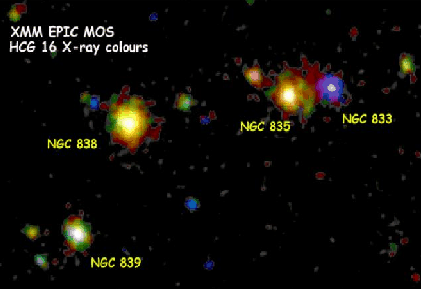
Figure 1:
The smoothed colour X-ray image of HGC 16 made with the EPIC
MOS CCD imaging spectrometers on XMM-Newton. The spatial resolution
is 6
 Full Width at Half Maximum, and 15
Half Energy Width, limited
by the mirrors. The energy band is 0.2-10 keV and the energy
resolution varies from 140 eV FWHM at 6 keV to 70 eV at 500 eV. In
the colour image, red corresponds to 800 eV and blue to >3 keV. The
physical scale across the image corresponds to 200 kpc (using
H0 = 50 kms-1Mpc-1).
Notice the very hard (blue) nucleus of NGC 833 and the soft (red) halo
emission around the companion galaxy NGC 835
Full Width at Half Maximum, and 15
Half Energy Width, limited
by the mirrors. The energy band is 0.2-10 keV and the energy
resolution varies from 140 eV FWHM at 6 keV to 70 eV at 500 eV. In
the colour image, red corresponds to 800 eV and blue to >3 keV. The
physical scale across the image corresponds to 200 kpc (using
H0 = 50 kms-1Mpc-1).
Notice the very hard (blue) nucleus of NGC 833 and the soft (red) halo
emission around the companion galaxy NGC 835 |
| Open with DEXTER |
The Hickson-16 galaxy group (or HCG-16) comprises seven galaxies with a mean
recession velocity (Ribeiro et al. 1996) of
 kms-1
and a velocity dispersion of
kms-1
and a velocity dispersion of  kms-1, centered on the
position
kms-1, centered on the
position
 ,
,
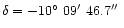 (J2000). The four
central members of the group, originally identified by
Hickson (Hickson 1982),
all fall within the 30
(J2000). The four
central members of the group, originally identified by
Hickson (Hickson 1982),
all fall within the 30 field of view of EPIC,
they all show evidence for mergers and a strong ionising continuum;
they have well resolved optical nuclei (Mendes de Oliveira et al.
1998). However the nature of the ionising continuum is
unclear. Optical emission line diagnostics (de Carvalho & Coziol
1999; Veilleux & Osterbrock 1987) suggest
that in NGC 838 and NGC 835 there is a starburst nucleus, whilst in NGC
835, NGC 833 and NGC 839 there is a low ionisation narrow emission
line region (or LINER 2 nucleus). This could arise either from an AGN or from
starburst activity: [OIII]/H
field of view of EPIC,
they all show evidence for mergers and a strong ionising continuum;
they have well resolved optical nuclei (Mendes de Oliveira et al.
1998). However the nature of the ionising continuum is
unclear. Optical emission line diagnostics (de Carvalho & Coziol
1999; Veilleux & Osterbrock 1987) suggest
that in NGC 838 and NGC 835 there is a starburst nucleus, whilst in NGC
835, NGC 833 and NGC 839 there is a low ionisation narrow emission
line region (or LINER 2 nucleus). This could arise either from an AGN or from
starburst activity: [OIII]/H values for the nuclei are all
<2.5 (de Carvalho & Coziol 1999).
The EPIC instrument is able to observe directly the ionising
continuum, and distinguish clearly between optically thin thermal emission
from a starburst, and non-thermal hard X-ray emission from an AGN. These
observations can therefore be used to determine the nature of the
ionising continuum, helping to clarify the relationship between
mergers, the triggering of starbursts, and the creation and fueling
of black holes.
values for the nuclei are all
<2.5 (de Carvalho & Coziol 1999).
The EPIC instrument is able to observe directly the ionising
continuum, and distinguish clearly between optically thin thermal emission
from a starburst, and non-thermal hard X-ray emission from an AGN. These
observations can therefore be used to determine the nature of the
ionising continuum, helping to clarify the relationship between
mergers, the triggering of starbursts, and the creation and fueling
of black holes.
 |
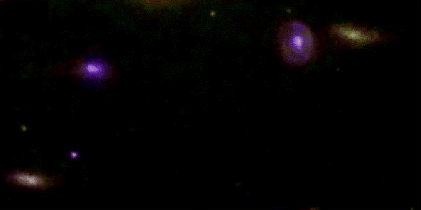
Figure 2:
The OM colour image of HCG 16 derived from 1000 s
exposures in V and UV bands. A bright foreground star has been
removed from the lower right of the image. Blue here represents the
UV band |
| Open with DEXTER |
The XMM-Newton Observatory (Jansen et al. 2001) has three X-ray
telescopes of area  1500 cm2, with the three EPIC instruments
at the foci; two of the EPIC
imaging spectrometers use MOS CCDs (Turner et al. 2001; Holland
et al. 1996)
and one uses a PN CCD (Strüder et al. 2001).
The observations of the HCG-16 galaxy group were taken in
orbit-23 as part of the XMM-Newton EPIC first-light.
Exposures of 50 ksec were taken with EPIC (sensitive from 0.2
to 10 keV) and 1 ksec exposures
were taken in V (550 nm) and UV (280 nm) with the XMM-Newton
Optical/UV Monitor (OM) telescope (Mason et al. 2001).
The EPIC data were
processed using the pipeline scripts EMCHAIN (MOS) and
EPCHAIN (PN). Screening was applied using the XMM-Newton SAS (Science Analysis Software). Hot and bad pixels and negative E3
events were removed from the data to reduce the level of electronic
noise. A low energy cut of 200 eV was
applied to the data. The first 10 ksec of data were also removed from the
EPIC observation, as this contained a high count-rate background
particle flare. The resultant exposure time for each of the detectors
was 40 ksec.
1500 cm2, with the three EPIC instruments
at the foci; two of the EPIC
imaging spectrometers use MOS CCDs (Turner et al. 2001; Holland
et al. 1996)
and one uses a PN CCD (Strüder et al. 2001).
The observations of the HCG-16 galaxy group were taken in
orbit-23 as part of the XMM-Newton EPIC first-light.
Exposures of 50 ksec were taken with EPIC (sensitive from 0.2
to 10 keV) and 1 ksec exposures
were taken in V (550 nm) and UV (280 nm) with the XMM-Newton
Optical/UV Monitor (OM) telescope (Mason et al. 2001).
The EPIC data were
processed using the pipeline scripts EMCHAIN (MOS) and
EPCHAIN (PN). Screening was applied using the XMM-Newton SAS (Science Analysis Software). Hot and bad pixels and negative E3
events were removed from the data to reduce the level of electronic
noise. A low energy cut of 200 eV was
applied to the data. The first 10 ksec of data were also removed from the
EPIC observation, as this contained a high count-rate background
particle flare. The resultant exposure time for each of the detectors
was 40 ksec.
Figure 1 shows the resultant EPIC X-ray colour image of the centre of
the HCG-16 field. The hard,
absorbed, spectrum of the AGN in NGC 833 shows up as a blue point
source, and the soft starburst emission in the outer regions of NGC
835 shows as a red halo; the other galaxies show extended X-ray
discs. Figure 2 also shows the V-UV colour image from the OM. The nuclear
regions of NGC 835 and NGC 838 show up brightly in the ultraviolet,
indicative of hot stars or gas associated with enhanced star
formation. There are also bright UV knots in the outer regions of NGC
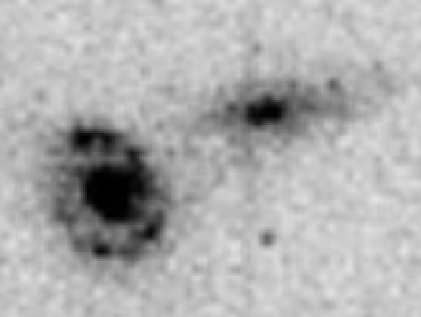
835 showing enhanced star formation there. A close-up OM image of NGC
835 is shown in Fig. 3.
 |
Figure 3:
A close-up, greyscale UV image from the Optical Monitor, showing the
galaxies NGC 833 (right) and NGC 835 (left). Bright UV knots, corresponding
to possible regions of star formation, are seen in the outer disk of
NGC 835 |
| Open with DEXTER |
Since EPIC resolves the optical disks of the
galaxies, the spectra were prepared from photons falling within a
region of interest based on the X-ray image. For NGC 833 the X-ray
source is point-like, while for NGC 835 the core and the surrounding
region (the red halo in Fig. 1) were analysed separately,
the spectra of the remaining
galaxies were made using the entire X-ray disc.
Background spectra were taken from source-free regions
on the central EPIC-MOS and PN chips; the background spectra were
normalised to the area of the source extraction regions.
The background subtracted EPIC spectra
were fitted, using XSPEC V11.0, with the latest response
matrices produced by the EPIC team; the systematic level of uncertainty
is <5%. Finally spectra were binned to a minimum of 20 counts per
bin, in order to apply the  minimisation technique. All
subsequent errors are quoted to 90% confidence
(
minimisation technique. All
subsequent errors are quoted to 90% confidence
(
 for 2 interesting parameters).
Values of H0 = 50 kms-1Mpc-1 and q0 = 0.5have been assumed and all fit parameters are given in the rest-frame
of the HCG-16 system. We now present the individual EPIC spectra of the
4 main Hickson-16 galaxies.
for 2 interesting parameters).
Values of H0 = 50 kms-1Mpc-1 and q0 = 0.5have been assumed and all fit parameters are given in the rest-frame
of the HCG-16 system. We now present the individual EPIC spectra of the
4 main Hickson-16 galaxies.
Optical imaging data on NGC 833 reveal a disturbed velocity field and
pronounced misalignment of the kinematic and stellar axes, indicative
of an ongoing interaction (Mendes de Oliveira et al. 1998). The emission
lines present in the optical spectra (de Carvalho & Coziol 1999)
indicate weak non-stellar LINER-2 activity in the core; there is no optical
evidence for current star formation ([NII]/H
 ).
The EPIC image of this galaxy is point-like, much smaller than the
stellar disc.
).
The EPIC image of this galaxy is point-like, much smaller than the
stellar disc.
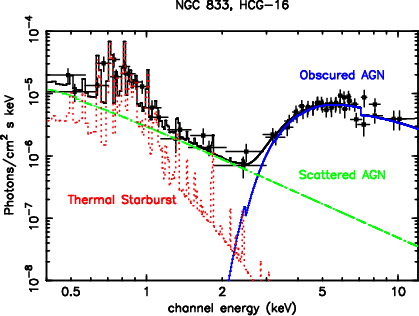
The best-fitting EPIC X-ray spectrum (Fig. 4) shows three
distinct components, all required at >99.99% confidence.
The most obvious is
the peak at high energies from an obscured AGN; this emission is in
the form of a power-law of index
 ,
absorbed by material of
column density equal to
,
absorbed by material of
column density equal to
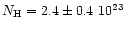 cm-2.
The second component is an un-absorbed power-law, resulting from radiation
scattered into our line of sight, by thin, hot, plasma directly
illuminated by the AGN. The third component is radiation from an
optically-thin thermal plasma, with a temperature of kT=470 eV.
The improvement in the fit upon adding the thermal emission is
cm-2.
The second component is an un-absorbed power-law, resulting from radiation
scattered into our line of sight, by thin, hot, plasma directly
illuminated by the AGN. The third component is radiation from an
optically-thin thermal plasma, with a temperature of kT=470 eV.
The improvement in the fit upon adding the thermal emission is
 .
A summary
of the fits to NGC 833 (and the other 3 galaxies) are given in Table 1.
.
A summary
of the fits to NGC 833 (and the other 3 galaxies) are given in Table 1.
This complex X-ray spectrum amply confirms the presence of an AGN in NGC
833 of luminosity
 erg s-1, it is,
remarkably, the dominant source of power in the galaxy. In contrast,
the thermal X-ray emission, is more than 100 times weaker
(
erg s-1, it is,
remarkably, the dominant source of power in the galaxy. In contrast,
the thermal X-ray emission, is more than 100 times weaker
(
 erg s-1) and the FIR luminosity
(Verdes-Montenegro et al. 1998)
is also very low (
<3 1042 ergs-1).
erg s-1) and the FIR luminosity
(Verdes-Montenegro et al. 1998)
is also very low (
<3 1042 ergs-1).
 |
Figure 4:
The X-ray spectrum of the galaxy NGC 833. The most
striking feature is the high-energy, absorbed power-law (at > 3 keV)
that is the direct emission from the active black hole at the centre
of the galaxy. There is also an un-absorbed power-law, resulting from
radiation scattered into our line of sight, by material
directly illuminated by the AGN. These two spectral components
together show the presence of an AGN of luminosity
erg s-1.
There is also weak soft X-ray emission from an optically thin plasma,
perhaps originating from starburst activity |
The adjacent galaxy, NGC 835 is undergoing a gravitational
interaction with its neighbour NGC 833, as evidenced by the tidal
tails in the optical image; and apparently contiguous stellar
discs (Mendes de Oliveira et al. 1998).
The velocity field is normal, but there is emission line
evidence (de Carvalho & Coziol 1999) for LINER nuclear activity,
and for current starburst
activity in the outer regions; the knotted ring structure seen in the
OM image supports this.
 |
Figure 5:
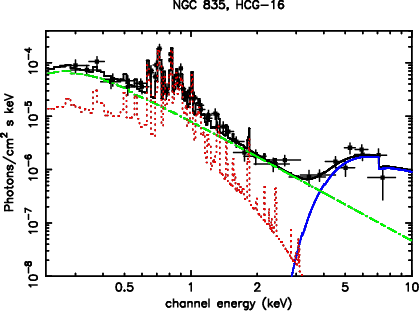
The spectrum of the companion galaxy, NGC 835,
which also shows an obscured active nucleus together with
strong thermal soft X-ray emission. The AGN in both NGC 833 and NGC 835 may have been triggered by mutual gravitational interaction |
| Open with DEXTER |
The X-ray emission from NGC 835 can be
spatially separated into two areas, the core, and an outer region
corresponding to the remainder of the stellar disc. The core has a
very similar spectrum (Fig. 5) to that of NGC 833. There are
absorbed and scattered power-laws indicating a heavily obscured AGN
(
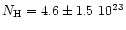 cm-2) of luminosity
1.2 1042 ergs-1
(0.5-10 keV), but the soft thermal component is more luminous than NGC
833 at
cm-2) of luminosity
1.2 1042 ergs-1
(0.5-10 keV), but the soft thermal component is more luminous than NGC
833 at
 ergs-1;
it is almost certainly from current starburst activity
and the FIR luminosity (Verdes-Montenegro et al. 1998)
is 100 times larger at
2.7 1044 erg s-1. The spectrum at the periphery of NGC 835 is
purely thermal, with a temperature of 300 eV and a luminosity of
ergs-1;
it is almost certainly from current starburst activity
and the FIR luminosity (Verdes-Montenegro et al. 1998)
is 100 times larger at
2.7 1044 erg s-1. The spectrum at the periphery of NGC 835 is
purely thermal, with a temperature of 300 eV and a luminosity of
 erg s-1, similar to that of the core.
This is the
X-ray emission from the starburst region including the ring structure
and knots seen in the OM V-UV image.
erg s-1, similar to that of the core.
This is the
X-ray emission from the starburst region including the ring structure
and knots seen in the OM V-UV image.
To summarize, the EPIC data clearly show the presence of an AGN, in
both NGC 833 and NGC 835, that coexists with present starburst activity
in the core (and for NGC 835 in the periphery) of the galaxies. The detections
of the obscured AGN and thermal starburst components in both galaxies
are highly significant, at >99.99% confidence (see Table 1).
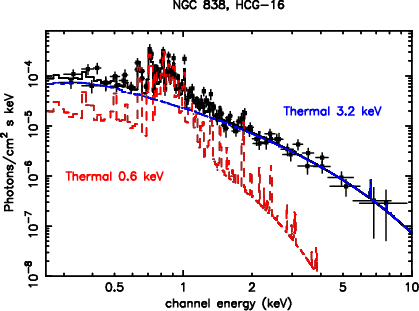
NGC 838 is an ongoing merger with strong starburst activity.
Optical data (Mendes de Oliveira et al. 1998) show kinematic warping,
and multiple velocity components in the ionised gas, and a double
optical core (also see de Carvalho & Coziol 1999). The
infrared luminosity is
 ergs-1. The EPIC spectrum of
NGC 838 (Fig. 6) shows purely thermal emission, the disc is resolved in
X-rays, but there is no separate sharp core in the X-ray image. The
spectrum is fitted with a two temperature thermal spectrum (kT=3.2 keV
and kT=590 eV) and the luminosity is high at
ergs-1. The EPIC spectrum of
NGC 838 (Fig. 6) shows purely thermal emission, the disc is resolved in
X-rays, but there is no separate sharp core in the X-ray image. The
spectrum is fitted with a two temperature thermal spectrum (kT=3.2 keV
and kT=590 eV) and the luminosity is high at
 ergs-1.
This is all consistent with the optical data: the soft X-ray
emission is from the ionised gas produced in the starburst while the
hard thermal spectrum could be characteristic of unresolved X-ray
binaries. There is no statistically significant scattered or obscured
power law; the upper limit for the AGN luminosity is
5 1040 erg s-1, assuming an absorbing column of
5 1023 cm-2.
ergs-1.
This is all consistent with the optical data: the soft X-ray
emission is from the ionised gas produced in the starburst while the
hard thermal spectrum could be characteristic of unresolved X-ray
binaries. There is no statistically significant scattered or obscured
power law; the upper limit for the AGN luminosity is
5 1040 erg s-1, assuming an absorbing column of
5 1023 cm-2.
 |
Figure 6:
The EPIC-MOS spectrum of NGC 838. Only emission from the
starburst is present, with no detectable hard X-ray emission from a
central AGN; the hard X-ray emission could arise from unresolved
X-ray binaries in the galaxy |
| Open with DEXTER |
 |
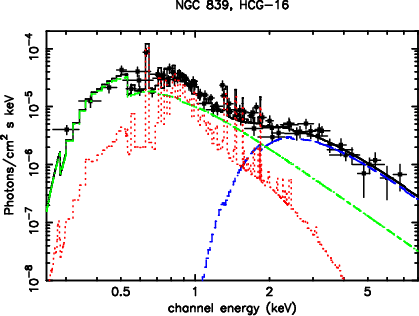
Figure 7:
The X-ray spectrum of NGC 839. There is both
starburst emission and emission from a low luminosity obscured AGN.
Unusually the elemental abundance of NGC 839 appears to be 5
times solar |
| Open with DEXTER |
NGC 839 may also be a recent merger (Mendes de Oliveira et al. 1998;
de Carvalho & Coziol 1999), it has a double nucleus in the
optical, a FIR luminosity of
3.1 1044 erg s-1, and a disturbed
velocity field; optical lines indicate an active LINER-2 nucleus (de
Carvalho & Coziol 1999).
In the soft X-ray EPIC spectrum (Fig. 7) there is
optically-thin thermal emission,
similar to that of the other galaxies, of temperature kT=600 eV, and
luminosity
 ergs-1;
a typical indicator of a current starburst.
The spectrum also shows an obscured AGN, as found in NGC
835 & NGC 833; it is however much less luminous
(
ergs-1;
a typical indicator of a current starburst.
The spectrum also shows an obscured AGN, as found in NGC
835 & NGC 833; it is however much less luminous
(
 erg s-1) for a column of
 cm-2. Interestingly the abundances in NGC
839 appear to be higher than solar. There are apparent weak
Lyman-
cm-2. Interestingly the abundances in NGC
839 appear to be higher than solar. There are apparent weak
Lyman- lines of O, Mg and Si in the EPIC spectrum, although
the significance of
these features is low (at only 90% confidence). Fitting the soft X-ray
spectrum with the MEKAL model does however yield an over-abundance of
lines of O, Mg and Si in the EPIC spectrum, although
the significance of
these features is low (at only 90% confidence). Fitting the soft X-ray
spectrum with the MEKAL model does however yield an over-abundance of
 times the solar value. One interesting possibility is
that the heavier elements have been enriched through the intense
starburst activity in this galaxy.
times the solar value. One interesting possibility is
that the heavier elements have been enriched through the intense
starburst activity in this galaxy.
Direct X-ray spectroscopy is the best way to identify hidden AGN in
galaxies, and here the EPIC cameras on XMM-Newton have produced clear
evidence for active, massive black holes in three out of four
galaxies in HCG-16. The presence of a similar active nucleus in NGC 838
is unlikely, unless it is very heavily absorbed. The nature of the
ionising continuum in the four galaxies has been elucidated: there is
thermal emission from starburst activity in three, (possibly four) of
the galaxies, and in three of them there is a coexisting active black
hole. While LINER-1 galaxies with broad H
lines do harbour black
holes (Terashima et al. 1998, 2000)
this is the first direct evidence that black holes power
LINER2 galaxies. These AGN are at the low end of the luminosity
scale, consistent with their small size (Magorrian et al. 1998).
In NGC 833, the accreting black hole X-ray luminosity arguably
exceeds the FIR luminosity. This
is very unusual, even compared with much more luminous AGN, and may
indicate the stripping of dust and gas by past interactions with
other galaxies (Mendes de Oliveira et al. 1998). The EPIC X-ray study of
this nearby and evolved system of small galaxies indicates a high
fraction of active black holes coexisting with starbursts. This
is consistent with optical studies of compact groups
(e.g. Coziol et al. 2000),
where a large fraction of galaxies with nuclear activity is found.
The observations may also provide a link between normal
galaxies, where black holes may be inactive, and Seyfert galaxies and
quasars, where black holes dominate, and where galaxy mergers may be
implicated in the onset of black hole activity (Boyce et al. 1996;
Bahcall et al. 1997). Further
observations with XMM-Newton have the potential to determine more
precisely the fraction of nearby galaxies that harbour active,
low-luminosity black holes.
Acknowledgements
This work is based on observations obtained with XMM-Newton, an ESA science
mission with instruments and contributions directly funded by
ESA Member States and the USA (NASA).
EPIC was developed by the EPIC Consortium led by the Principal
Investigator, Dr. M. J. L. Turner. The consortium comprises the
following Institutes: University of Leicester, University of
Birmingham, (UK); CEA/Saclay, IAS Orsay, CESR Toulouse, (France);
IAAP Tuebingen, MPE Garching, (Germany); IFC Milan, ITESRE Bologna,
OAPA Palermo, (Italy). EPIC is funded by: PPARC, CEA, CNES, DLR and
ASI. Finally we thank the referee, Reinaldo de Carvalho, for his
report, and for some useful comments and suggestions.
-
Bahcall, J. N., Kirhakos, S., & Saxe, D. 1997, ApJ, 479, 642
In the text
NASA ADS
-
Boyce, P. J., Disney, M. J., Blades, J. C., et al. 1996, ApJ, 473, 760
In the text
NASA ADS
-
Coziol, R., Iovino, A., & de Carvalho, R. R. 2000, AJ, 120, 47
In the text
NASA ADS
- de Carvalho, R. R., & Coziol, R. 1999, AJ, 117, 1657
In the text
NASA ADS
- Hickson, P. 1982, ApJ, 255, 382
In the text
NASA ADS
-
Holland, A. D., Turner, M. J. L., Abbey, A. F., & Pool, P. 1996, SPIE, 2808 414
In the text
- Jansen, F., Lumb, D., Altieri, B., et al. 2001,
A&A, 365, L1
In the text
- Magorrian, J., Tremaine, S., Richstone, D., et al.
1998, AJ, 115, 2285
In the text
NASA ADS
- Mason, K. O., Breeveld, A., Much, R., et al. 2001, A&A, 365, L36
In the text
-
Mendes de Oliveira, C., Plana, H., Amram, P., Bolte, M.,
& Boulesteix, J. 1998, ApJ, 507, 691
In the text
NASA ADS
-
Ribeiro, A. L. B., de Carvalho, R. R., Coziol, R.,
Capelato, H. V., & Zepf, S. E. 1996, ApJ, 463, L5
In the text
NASA ADS
- Strüder, L., Briel, U., Dennerl, K., et al. 2001,
A&A, 365, L18
In the text
-
Terashima, Y., Kunieda, H., Misaki, K., et al. 1998, ApJ, 503, 312
In the text
-
Terashima, Y., Ho, L. C., Ptak, A. F., & Kunieda, H. 2000, ApJ, 533, 729
In the text
NASA ADS
-
Turner, M. J. L., Abbey, A., Arnaud, M., et al. 2001, A&A, 365, L27
In the text
- Veilleux, S., & Osterbrock, D. E. 1987, ApJS, 63, 295
In the text
NASA ADS
-
Verdes-Montenegro, L., Yun, M. S., Perea, J., del Olmo, A., & Ho,
P. T. B. 1998, ApJ, 497, 89
In the text
NASA ADS
© ESO 2001
 for these 2 components have been tied
 b
b c
c e
e