

An initial estimate of the zero points of the various XMM-OM broadband filters (i.e. the magnitude which yields 1 count per second; Table 2) was derived from calibration observations of two white dwarfs.
The calculated OM zeropoints are written into the relevant XMM-CCF file, to be used by the XMM Science Analysis System (SAS) (Watson et al. 2001). Updates of the zeropoint definitions as well as more precise colour transformations (Royer et al. 2000) to the standard UBV system are expected once the results of a dedicated ground based photometric observation programme become available. In the framework of this programme several OM calibration fields are anchored to high quality secondary photometric standards deep fields established by ESO. Early results of this ground observations are expected in October 2000.
| Filter | wavelength band (nm) | zeropoints (mag) |
| Blocked V | 510-580 | 18.11 |
| Magnifier | 380-650 | |
| U | 300-390 | 18.24 |
| B | 390-490 | 19.28 |
| White (clear) | 150-500 | |
| Grism 2 (vis) | 290-500 | |
| UVW1 | 245-320 | 17.37 |
| UVM2 | 205-245 | 16.02 |
| UVW2 | 180-225 | 15.17 |
| Grism 1 (UV) | 200-350 |
 23.5.
23.5.
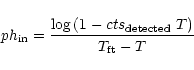
The coincidence loss can be approximated by
 |
infalling photon rate per second |
 |
measured count rate per second |
| T | CCD frametime in units of seconds |
 |
frametransfer time in units of seconds. |
Equation (1) applies strictly in the case of a perfectly point-like source. In practice a real stellar profile has wings, and the formula will break down at very high rates when coincidence among photons in the wings of the profile becomes significant.
The CCD deadtime depends on the size and shape of the science window used but can be calculated accurately. The deadtime correction should be applied by the SAS after any coincidence loss corrections.
An LED can be used to illuminate the detector by backscatter of
the photons from the blocked filter. These images are not completely flat
due to the illumination pattern of the LED, the gross shape of which could
be removed by comparing with sky flats. However, using the LED allows a
large number of events to be collected in every pixel to give sufficiently
high statistics for pixel to pixel sensitivity to be measured
and the relative measurement of any variation of the
detector response on a fine scale. The LED brightness is adjustable and is
currently operated at a level that produces
3.25 10-3 count s-1 per binned (2  2) pixel.
So far, flat fields have been obtained to the level of 400 counts
per binned (2 2) pixel allowing an accuracy of 5% in the
sensitivity measurement.
A CCF file in the SAS currently represents the accuracy of flat fields
obtained before mid June, which is at the 10% level.
Once sufficient flat fields have been obtained for a 2-3% sensitivity
the relevant CCF file will be updated.
2) pixel.
So far, flat fields have been obtained to the level of 400 counts
per binned (2 2) pixel allowing an accuracy of 5% in the
sensitivity measurement.
A CCF file in the SAS currently represents the accuracy of flat fields
obtained before mid June, which is at the 10% level.
Once sufficient flat fields have been obtained for a 2-3% sensitivity
the relevant CCF file will be updated.
The background count rate in the OM is dominated by the zodiacal light in the optical. In the far UV the intrinsic detector background becomes important. Images are regularly taken with the blocked filter and no LED illumination to measure the detector dark counts.
The mean OM dark count rate is
2.56 10-4 count s-1 per pixel. The variation in
dark count rate across the detector is  and shows mainly a radial
dependence, being highest in an annulus at about 8 arcmin radius and lowest
in the centre. When the
spacecraft is pointing at a very bright star, the dark rate is noticeably
increased (e.g. up to 65% higher for the V=0 star Capella) despite the blocked filter.
Excluding those dark frames taken during Capella
(V=0) and Zeta Puppis (V=2) observations, the counts per dark frame
vary by only
and shows mainly a radial
dependence, being highest in an annulus at about 8 arcmin radius and lowest
in the centre. When the
spacecraft is pointing at a very bright star, the dark rate is noticeably
increased (e.g. up to 65% higher for the V=0 star Capella) despite the blocked filter.
Excluding those dark frames taken during Capella
(V=0) and Zeta Puppis (V=2) observations, the counts per dark frame
vary by only  and show no trend of change with time.
The positions of selected guide stars in the
XMM-OM FOV are measured each 10-20 s tracking frame, and an
X-Y offset applied to image mode data obtained during the tracking frame
before they are added to the master image in the DPU memory. The tracking
offsets are computed in pixels irrespective of the binning parameter
chosen. Using this ``Shift and Add'' technique, the final image
is corrected on timescales greater than a few tens of
seconds and on spatial scales down to 0.5 pixels,
for drift in the pointing direction of the spacecraft.
The performance of tracking can be verified by comparing the PSFs of stars taken during Fast Mode (at high time resolution and with no tracking) with those data taken using Image Mode when tracking is enabled. This analysis has shown that XMM-OM tracking is performing as expected.
Analysis of OM tracking histories show that the spacecraft drift is less
than 0.5 pixels for approximately 75% of all frames taken, and therefore
require no shift and add correction (a shift of one pixel will be made if
the guide stars are calculated to have drifted more than
 pixels from their reference positions).
Of the remaining, the corrections due to drift are rarely
more than 2 pixels in any one direction.
Tracking is turned off automatically when no suitable guide stars are
found, which is usually due to poor statistics.
This can occur in observations of very sparse
fields (rare) or when using the UVM2 and UVW2 filters, where throughput is
lower than in the optical bands. However, given the pointing stability of
XMM-Newton and the intrinsically poorer resolution of the detector in the UV (Sect. 5.6),
this does not normally lead to any significant degradation
in the PSF for non-magnified data.
pixels from their reference positions).
Of the remaining, the corrections due to drift are rarely
more than 2 pixels in any one direction.
Tracking is turned off automatically when no suitable guide stars are
found, which is usually due to poor statistics.
This can occur in observations of very sparse
fields (rare) or when using the UVM2 and UVW2 filters, where throughput is
lower than in the optical bands. However, given the pointing stability of
XMM-Newton and the intrinsically poorer resolution of the detector in the UV (Sect. 5.6),
this does not normally lead to any significant degradation
in the PSF for non-magnified data.
After launch the measured PSFs in the V-filter had FWHM widths broader than expected from preflight measurements. The focus was therefore adjusted using the control heaters as discussed in Sect. 2.3. Figure 5 shows the gradual change in the PSF with the heater setting. As can be seen from the figure, the optimum setting for the Magnifier is clearly at -100% i.e. at the minimum separation of the primary and secondary mirrors, whereas for the V-filter it is above 70%. A value of 100% (maximum separation of mirrors) was chosen for subsequent measurements in all filters, except for the Magnifier where -100% is selected. To allow for the thermal settling time involved in a change of focus, twenty minutes of additional overhead time is inserted before and after a sequence of Magnifier exposures.
![\begin{figure}
\includegraphics[width=8.8cm,clip]{xmm33_f5r.eps}\end{figure}](/articles/aa/full/2001/01/aaxmm33/img19.gif) |
Figure 5: PSF width with changing heater setting. Each point in the V-filter represents the average of 23 stars in the BPM16274 field |
The PSFs contain a contribution from the telescope optics and
from the detector. They can be assumed to be radially symmetric in shape,
with an approximately gaussian central peak and extended
wings. The width of the PSF increases with photon energy because of the
detector component, from 3.1 pixels (1.5 arcsec)
FWHM in the V band to 6 pixels (3 arcsec)
pixels in the UV filters (see Fig. 6).
![\begin{figure}
\includegraphics[width=8.8cm,clip]{xmm33_f6r.eps}\end{figure}](/articles/aa/full/2001/01/aaxmm33/img20.gif) |
Figure 6: Point spread function radial distribution. The inner curve is the average PSF of 23 stars from the V-filter; the outer curve from the UVW1-filter |
The XMM-OM optics, filters and (primarily) the detector system result in a certain amount of image distortion. It is mainly in the form of barrel distortion, and if not corrected can result in shifts from the expected position of up to 20 arcsec. By comparing the expected position with the measured position for a large number of stars in the FOV a distortion map has been derived. The preliminary V-filter analysis was performed on the LMC pointing and is based on 230 sources. A 3rd order polynomial was fitted to the deviations assuming that there is no error at the centre of the FOV (i.e. at address (1024.5,1024.5)). This polynomial can be used to correct source positions measured in other fields, and currently gives a positional rms accuracy of 1.0 arcsec (1.9 pixels) in the V-filter (see Fig. 7; astrometry relative to stars of known position over restricted regions of the field can of course be more accurate than this). Using higher orders of the polynomial does not increase the accuracy and is detrimental particularly for sources at the edges of the FOV. Using functions other than polynomials has not yet been investigated, but may lead to an improvement to the correction for sources near the edges of the FOV. Distortion maps using the 3C 273 field have been derived for the other filters, but are not yet to such high accuracy. Further work will either use fields with more sources in the FOV or combine data from several observations. The preliminary distortion maps have been entered into the appropriate CCF files and can be used in conjunction with the SAS. They are also used on board to automatically position windows on the detector that are specified in sky coordinates. This is important for small windows such as those used in Fast Mode.
As discussed earlier, the XMM-OM detector functions by centroiding a photon splash to within a fraction (1/8th) of a physical CCD pixel. This calculation is performed in real-time by the detector electronics, and therefore has to be fast. It is done by means of a lookup table whose parameters are computed onboard once per revolution, based on a short image taken with the internal flood LED lamp, and periodically updated. The lookup table parameters are the mean values derived from a selected part of the active area of the detector (usually the central region). They do not take into account small variations in the shape of the photon splash over the detector face and as such are an approximation to the optimum value at a given location on the detector.
The result of imperfections in the lookup table is that the size of the
pixels is not equal on the sky. When displayed with a normal image
display routine, therefore, uncorrected XMM-OM images can exhibit a faint
modulation in the apparent background level repeating every eight
pixels, corresponding to every physical CCD pixel (see Fig. 8). SAS
tasks that, for example, search for sources in XMM-OM images
take the variation in pixel size into account and compute the local 8 8
pattern post facto based on the measured image. Similarly the raw image can
be resampled for display purposes. The SAS routine does not lose or gain
counts, but resamples them according to the true pixel sizes.
The detector centroiding process also breaks down if more than one photon
splash overlaps on a given CCD frame. Thus an 8 8 pattern is often seen
around bright stars (see Fig. 8a), or when two bright stars occur close together on an
image.
Artifacts can appear in XMM-OM images due to light being scattered within the detector. These have two causes: internal reflection of light within the detector window and reflection of off-axis starlight and background light from part of the detector housing.
The first of these causes a faint, out of focus ghost image of a bright star displaced in the radial direction away from the primary image due the curvature of the detector window (Fig. 8a).
The second effect is due to light reflecting off a chamfer in the detector window housing. Bright stars that happen to fall in a narrow annulus 12.1 to 13 arcmin off axis shine on the reflective ring and form extended loops of emission radiating from the centre of the detector (Fig. 8b). Similarly there is an enhanced ``ring'' of emission near the centre of the detector due to diffuse background light falling on the ring (Fig. 8b).
The reflectivity of the ring, and of the detector window, reduces with increasing photon energy. Therefore these features are less prominent when using the UV filters.
© ESO 2001
![\begin{figure}
\includegraphics[width=8.8cm,clip]{xmm33_f7r.eps}\end{figure}](/articles/aa/full/2001/01/aaxmm33/img21.gif)
![\begin{figure}
\subfigure[]{\includegraphics[width=8.8cm,clip]{xmm33_f8a.eps} }
\par\subfigure[]{\includegraphics[width=8.8cm,clip]{xmm33_f8b.eps} }
\end{figure}](/articles/aa/full/2001/01/aaxmm33/img22.gif)