![[*]](/icons/foot_motif.gif)
A&A 394, 459-478 (2002)
DOI: 10.1051/0004-6361:20021118
A. Stolte 1,2 - E. K. Grebel1 - W. Brandner2 - D. F. Figer3
1 - Max-Planck-Institut für Astronomie, Königstuhl 17,
69117 Heidelberg, Germany
2 -
European Southern Observatory, Karl-Schwarzschild-Str. 2, 85748 Garching, Germany
3 -
Space Telescope Science Institute, 3700 San Martin Drive, Baltimore, MD 21218, USA
Received 8 March 2002 / Accepted 30 July 2002
Abstract
We have analysed high resolution adaptive optics (AO) science demonstration data
of the young, massive stellar cluster Arches near the Galactic Center,
obtained with the Gemini North telescope
in combination with the University of Hawai'i AO system Hokupa'a.
The AO H and K' photometry is calibrated using HST/NICMOS observations
in the equivalent filters F160W and F205W obtained by Figer et al. (1999).
The calibration procedure allows a detailed comparison of the
ground-based adaptive optics observations against
diffraction limited space-based photometry. The spatial resolution as
well as the overall signal-to-noise ratio of the Gemini/Hokupa'a data
is comparable to the HST/NICMOS data.
The low Strehl ratio of only a few percent is
the dominant limiting factor in the Gemini AO
science demonstration data as opposed to space-based observations. After a thorough
technical comparison, the Gemini and HST data are used in combination to
study the spatial distribution of stellar masses in the Arches cluster.
Arches is one of the densest young clusters known in the Milky Way, with
a central density of 
 and a total
mass of about
and a total
mass of about
 .
A strong colour gradient is observed over the cluster field.
The visual extinction increases by
.
A strong colour gradient is observed over the cluster field.
The visual extinction increases by
 mag over a distance of
15
mag over a distance of
15
 from the cluster core.
Extinction maps reveal a low-extinction cavity in the densest parts of
Arches (
from the cluster core.
Extinction maps reveal a low-extinction cavity in the densest parts of
Arches (
 ), indicating the depletion of dust due to stellar winds
or photo-evaporation. We correct for the change in extinction over the field
and show that the slope of the mass function is strongly influenced by
the effects of differential extinction.
We obtain present-day mass function
slopes of
), indicating the depletion of dust due to stellar winds
or photo-evaporation. We correct for the change in extinction over the field
and show that the slope of the mass function is strongly influenced by
the effects of differential extinction.
We obtain present-day mass function
slopes of
 in the mass range
 from both data sets. The spatial analysis reveals a steepening of
the mass function slope from close to zero in the cluster center to
from both data sets. The spatial analysis reveals a steepening of
the mass function slope from close to zero in the cluster center to
 at
at
 ,
in accordance
with a Salpeter slope (
,
in accordance
with a Salpeter slope (
 ).
The bias in the mass function towards high-mass stars in the Arches
center is a strong indication for mass segregation. The dynamical and relaxation timescales
for Arches are estimated, and possible mass segregation effects are discussed
with respect to cluster formation models.
).
The bias in the mass function towards high-mass stars in the Arches
center is a strong indication for mass segregation. The dynamical and relaxation timescales
for Arches are estimated, and possible mass segregation effects are discussed
with respect to cluster formation models.
Key words: open clusters and associations: individual: Arches - stars: luminosity function, mass function - stars: early-type - stars: formation - ISM: dust, extinction - instrumentation: adaptive optics
The Galactic Center (GC) is the most extreme star forming environment within the Milky Way. High stellar and gas densities, turbulent motion, tidal torques exerted by the steep gravitational potential, magnetic fields and an intense radiation field determine the physical environment of star formation in the GC region. Although disruptive forces exerted by the gravitational and radiation fields counteract the agglomeration of material, the high gas and dust densities cause star formation in the GC environment to be most efficient. In particular, the formation of high mass stars and massive clusters is more successful than in any other region of the Milky Way.
A detailed study of star
formation processes and the stellar content of the GC region has until recently
been limited to the brightest and most massive stars due to the large amount of
extinction (
 mag) along the line of sight.
Additional constraints are imposed due to the spatial resolution at the GC
distance of 8 kpc (
mag) along the line of sight.
Additional constraints are imposed due to the spatial resolution at the GC
distance of 8 kpc (
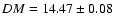 mag, e.g., McNamara et al.
2000),
much farther than nearby star forming regions such as the Orion or
mag, e.g., McNamara et al.
2000),
much farther than nearby star forming regions such as the Orion or  Ophiuchi
star forming complexes, which have been studied in greater detail to date.
Only with the advent of deep, high resolution near-infrared instruments, the
analysis of stellar populations in young star clusters near the GC has become feasible.
Ophiuchi
star forming complexes, which have been studied in greater detail to date.
Only with the advent of deep, high resolution near-infrared instruments, the
analysis of stellar populations in young star clusters near the GC has become feasible.
During the past few years, it has become evident that three out of four young starburst clusters known in the Milky Way are located in the GC region - namely, the Arches and Quintuplet clusters, as well as the Galactic Center Cluster itself. With a cluster age of only a few Myr for Arches and Quintuplet, the question arises how many clusters do actually form in the densest environment of the Milky Way. The 2MASS database yielded new insights into the estimated number of star clusters hidden in the dense stellar background. Dutra & Bica (2000, 2001) report the detection of new cluster candidates of various ages located in the innermost 200 pc of the Galaxy found in 2MASS. Numerical simulations by Portegies Zwart et al. (2001) suggest that clusters with properties similar to the massive Arches and Quintuplet may have formed in the past in the innermost 200 pc, but were then dispersed and are now indistinguishable from the dense stellar background. As dynamical evolution timescales are short due to the strong tidal field in the GC region (Kim et al. 1999), young star clusters are disrupted quickly after formation, contributing to the Galactic bulge population. Thus, only the youngest clusters remain intact for the study of star formation in this extraordinary environment.
The Arches cluster, at a projected distance of only 25 pc from the GC
(assuming a heliocentric distance of 8 kpc to the GC),
is one of the most massive young clusters known in the Milky Way.
With an estimated mass of about
and a central density
of
,
Arches is the densest young star
cluster (YC) known (Figer et al. 1999).
From physical properties of Wolf-Rayet stars, the age of the cluster is estimated
to be between 2 and 4.5 Myr (Blum et al. 2001).
The stellar content of Arches has been
studied by Figer et al. (1999) using HST/NICMOS data.
They derived a shallow initial
mass function in the range
 with a slope of
 ,
but with significant flattening observed in the innermost
part of the cluster (
,
but with significant flattening observed in the innermost
part of the cluster (
 ).
).
Most young star clusters and associations in the Milky Way display a mass
function close to a Salpeter (1955) power law with a slope of
.
Several such star forming regions have been studied by Massey et al.
(1995a), yielding slopes in the range
 with an average of
 ,
which leads these authors to conclude
that within the statistical limits no deviation from a Salpeter slope is observed.
,
which leads these authors to conclude
that within the statistical limits no deviation from a Salpeter slope is observed.
A flat mass function as observed in Arches implies an overpopulation of
the high-mass end as compared to "normal'' clusters.
The special physical conditions in the GC region have been suggested
to enhance the formation of massive stars, thereby resulting in a flattened
mass function (Morris 1993).
The formation of high-mass stars in itself poses serious problems for
the standard core collapse and subsequent accretion model, as radiation pressure
from the growing star is capable of reversing the gas infall as soon as
the mass is in excess of
 (Yorke & Krügel 1977).
Assuming disk accretion instead of spherical infall, the limiting mass may be
increased to
(Yorke & Krügel 1977).
Assuming disk accretion instead of spherical infall, the limiting mass may be
increased to
 (Behrend & Maeder 2001),
still far below the mass
observed in O-type stars.
Various scenarios are suggested to circumvent this problem.
Simulations with enhanced accretion rates and collision probabilities
in dense cluster centers (Bonnell et al. 1998),
as well as growing accretion rates depending on the mass of
the accreting protostar (Behrend & Maeder 2001), allow stars of up to
(Behrend & Maeder 2001),
still far below the mass
observed in O-type stars.
Various scenarios are suggested to circumvent this problem.
Simulations with enhanced accretion rates and collision probabilities
in dense cluster centers (Bonnell et al. 1998),
as well as growing accretion rates depending on the mass of
the accreting protostar (Behrend & Maeder 2001), allow stars of up to
 to form in the densest regions of a rich star cluster.
In case of the GC environment,
a higher gas density may lead to a higher accretion rate and/or to a
longer accretion process in the protostellar phase.
As long as the gravitational potential is strongly influenced by
the amount of gas associated with the cluster, gas infall causes
a decrease in cluster radius and subsequent increase in the collision rate,
reinforcing the formation of high-mass stars.
Physical processes such as gravitational
collapse or cloud collisions scale with the square root of the local density,
to form in the densest regions of a rich star cluster.
In case of the GC environment,
a higher gas density may lead to a higher accretion rate and/or to a
longer accretion process in the protostellar phase.
As long as the gravitational potential is strongly influenced by
the amount of gas associated with the cluster, gas infall causes
a decrease in cluster radius and subsequent increase in the collision rate,
reinforcing the formation of high-mass stars.
Physical processes such as gravitational
collapse or cloud collisions scale with the square root of the local density,
 (Elmegreen 1999, 2001),
causing an enhanced star formation rate
(SFR) in high density environments. Elmegreen (2001) shows that the total
mass as well as the maximum stellar mass in a cluster strongly depends on the
SFR and local density. This is confirmed by observations of high-mass stars
found predominantly in the largest star forming clouds (Larson 1982).
(Elmegreen 1999, 2001),
causing an enhanced star formation rate
(SFR) in high density environments. Elmegreen (2001) shows that the total
mass as well as the maximum stellar mass in a cluster strongly depends on the
SFR and local density. This is confirmed by observations of high-mass stars
found predominantly in the largest star forming clouds (Larson 1982).
Both the growing accretion and the collision scenario predict the high-mass stars to form in the densest central region of a cluster, leading to primordial mass segregation, which may be evidenced in a flat mass function in the dense cluster center. As an additional physical constraint, both scenarios require the lower-mass stars to form first, and the highest-mass stars last in the cluster evolution process. As the strong UV-radiation field originating from hydrogen ignition in high-mass stars expells the remaining gas from the cluster center, the accretion process should be halted immediately after high-mass star formation.
The short dynamical timescales of compact clusters are, however, influencing the spatial distribution of stellar masses as well. On the one hand, high-mass stars are dragged into the cluster center due to the gravitational potential of the young cluster. On the other hand, low-mass stars may easily be flung out of the cluster due to interaction processes, especially given star densities as high as in the Arches cluster. The result of these processes would also be a flat mass function in the cluster center, steepening as one progresses outwards due to dynamical mass segregation. Dynamical segregation is predicted to occur within one relaxation time (Bonnell & Davies 1998), which for compact clusters is only one to a few Myr, and should thus be well observable in Arches in the form of a spatially varying mass function.
In addition to the internal segregation process, the external GC tidal field exerts shear forces tearing apart the cluster entity. N-body simulations by Kim et al. (2000) yield tidal disruption timescales as short as 10 to 20 Myr in the GC tidal field. We expect to find a mixture of all these effects in the Arches cluster.
We have analysed adaptive optics (AO) data obtained under excellent seeing conditions with the Gemini North 8 m telescope in combination with the University of Hawai'i (UH) AO system Hokupa'a. We are investigating the presence of radial variations in the mass distribution within the Arches cluster. We compare our ground-based results in detail to the HST/NICMOS data presented in Figer et al. (1999, hereafter FKM), discussing possible achievements and limitations of ground-based, high-resolution adaptive optics versus space-based deep NIR photometry.
In Sect. 2, we will introduce the data and describe the reduction and calibration processes. In this context, a thorough investigation of the quality of ground-based adaptive optics photometry as compared to space-based diffraction limited observations will be presented. The photometric results derived from colour-magnitude diagrams and extinction maps will be discussed in Sect. 3. A comparison of Gemini and HST luminosity functions will be given in Sect. 4. The mass functions will be derived in Sect. 5, and their spatial variation will be discussed with respect to cluster formation scenarios. We will estimate the relevant timescales for cluster evolution for the Arches cluster in Sect. 6, and discuss the implication on the dynamical evolution of Arches. We will summarise our results in Sect. 7.
We analysed H and  images of the Arches cluster center
obtained in the course of the Gemini science demonstration
at the Gemini North 8 m telescope located on Mauna Kea, Hawai'i,
at an altitude of 4200 m above sea level.
images of the Arches cluster center
obtained in the course of the Gemini science demonstration
at the Gemini North 8 m telescope located on Mauna Kea, Hawai'i,
at an altitude of 4200 m above sea level.
Gemini is an alt-azimuth-mounted telescope with a monolithic primary mirror and small secondary mirror optimised for IR observations. The telescope is always used in Cassegrain configuration with instruments occupying either the upward looking Cassegrain port or one of three sideward facing ports. The University of Hawai'i adaptive optics (AO) system Hokupa'a is a 35 element curvature sensing AO system (Graves et al. 2000), which typically delivers Strehl ratios between 5% and 25% in the K-band.
Hokupa'a is operated with the near-infrared camera QUIRC
(Hodapp et al. 1996), equipped with
a
 pixel HgCdTe array. The plate scale is
19.98 milliarcsec per pixel, yielding a field of view (FOV) of 20.2
.
The images are shown in Fig. 1, along with the HST/NICMOS images
used for calibration.
pixel HgCdTe array. The plate scale is
19.98 milliarcsec per pixel, yielding a field of view (FOV) of 20.2
.
The images are shown in Fig. 1, along with the HST/NICMOS images
used for calibration.
![\begin{figure}
\par\includegraphics[bb=25 510 284 757,width=18cm,clip]{racha.ps}
\end{figure}](/articles/aa/full/2002/41/aah3531/img220.gif) |
Figure 1:
Upper panels: Gemini/Hokupa'a H (left) and
(right) images,
20
 20
(0.8 pc
0.8 pc)
with a spatial resolution of less than 0.2
.
North is up and East is to the right.
Lower panels: HST/NICMOS F160W and F205W images from Figer et al. (1999), geometrically
transformed to the Gemini FOV.
20
(0.8 pc
0.8 pc)
with a spatial resolution of less than 0.2
.
North is up and East is to the right.
Lower panels: HST/NICMOS F160W and F205W images from Figer et al. (1999), geometrically
transformed to the Gemini FOV. |
| Open with DEXTER | |
The observations were carried out between July 3 and 30, 2000.
12 individual 60 s exposures, dithered in a 4 position pattern
with an offset of 16 pixels (0.32
)
between subsequent frames,
were coadded to an H-band image
with a total integration time of 720 s. In ,
the
set of 34 dithered 30 s exposures obtained under the best observing conditions
was coadded to yield a total exposure time of 1020 s.
The full width at half maximum (FWHM) of the point spread function (PSF)
was 9.5 pixels (0.19
)
in H and 6.8 pixels (0.135
)
in .
The observations were carried out at an airmass of 1.5,
the lowest airmass at which the Galactic Center can be observed from Hawai'i.
The H-band data were oversampled, and  binning was
applied to improve the effective signal-to-noise ratio per resolution element,
allowing a more precise PSF fit.
A combination of long and short exposures has been used to
increase the dynamic range.
For the short exposures, 3 frames with 1 s exposure time have been coadded
in H, and 16 such frames in .
See Table 1 for the observational details.
In the long exposures, the limiting magnitudes were about 21 mag in H and
20 mag in .
Note that the completeness limit in the crowded regions
was significantly lower. The procedure used for completeness correction
will be described in detail in Sect. 2.1.6.
binning was
applied to improve the effective signal-to-noise ratio per resolution element,
allowing a more precise PSF fit.
A combination of long and short exposures has been used to
increase the dynamic range.
For the short exposures, 3 frames with 1 s exposure time have been coadded
in H, and 16 such frames in .
See Table 1 for the observational details.
In the long exposures, the limiting magnitudes were about 21 mag in H and
20 mag in .
Note that the completeness limit in the crowded regions
was significantly lower. The procedure used for completeness correction
will be described in detail in Sect. 2.1.6.
The data reduction was carried out by the Gemini data reduction team, F. Rigaut,
T. Davidge, R. Blum, and A. Cotera. The procedure as outlined in the
science demonstration report
was as follows: sky images, obtained after the short observation period
when the Galactic Center was in culmination, were averaged using median clipping
for star rejection, and then subtracted from the individual images.
The frames were then flatfielded and corrected for bad pixels and cosmic ray
hits. After inspecting the individual frames with respect to signal-to-noise ratio
and resolution, and background adjustment, the images with sufficient quality were
combined using sigma clipped averaging. The final images were scaled to counts per
second. For the analysis presented in this paper, this set
of images reduced by the Gemini reduction team has been used.
The photometry was performed using the IRAF
(Tody 1993) DAOPHOT implementation
(Stetson 1987).
Due to the wavelength dependence of the adaptive optics correction and
anisoplanatism
over the field, the H and
data
have been treated differently for PSF fitting. While in H the PSF radius
increases significantly with distance from the guide star,
with a radially varying FWHM in the range of 0.18
to 0.23
(see the science demonstration data description),
the
PSF was nearly constant over the field
(0.125
to 0.135
). This behaviour is expected from an AO system,
as the isoplanatic angle
 varies as
 ,
yielding a 1.4 times larger
in
than in H,
resulting in a more uniform PSF in
across the field of view.
,
yielding a 1.4 times larger
in
than in H,
resulting in a more uniform PSF in
across the field of view.
As obscuration due to extinction decreases with increasing wavelength,
many more stars are detected in
than in H.
For comparison, the number of objects found with
 mag and
uncertainty
mag and
uncertainty
 mag was 1017 (1020 s effective exposure time),
while for H < 20 mag and
mag was 1017 (1020 s effective exposure time),
while for H < 20 mag and
 mag
we detected only 391 objects (720 s effective exposure time),
where in both cases visual inspection led to the conclusion
that objects with photometric uncertainties below 0.2 mag were real detections.
On the other hand, the increased stellar number density in
leads to
increased crowding effects,
such that we decided to use a non-variable PSF for the -band data
after thorough investigation of the results of a quadratically, linearly or
non-varying PSF. It turns out that, due to a lack of isolated stars for
the determination of the PSF variation across the field, the mean uncertainty is
lower and the number of outliers with unacceptably large uncertainties reduced
when a non-variable PSF is used.
Thus, the 5 most isolated stars on the
image, which were
well spread out over the field, were used to derive the median averaged PSF
of the long exposure.
In the case of the short exposure, where due to the very short integration
time faint stars are indistinguishable from the background,
leaving more "uncrowded'' stars to derive the shape
of the PSF, 7 isolated stars could be used.
In ,
the best fitting function was an elliptical
Moffat-function with
mag
we detected only 391 objects (720 s effective exposure time),
where in both cases visual inspection led to the conclusion
that objects with photometric uncertainties below 0.2 mag were real detections.
On the other hand, the increased stellar number density in
leads to
increased crowding effects,
such that we decided to use a non-variable PSF for the -band data
after thorough investigation of the results of a quadratically, linearly or
non-varying PSF. It turns out that, due to a lack of isolated stars for
the determination of the PSF variation across the field, the mean uncertainty is
lower and the number of outliers with unacceptably large uncertainties reduced
when a non-variable PSF is used.
Thus, the 5 most isolated stars on the
image, which were
well spread out over the field, were used to derive the median averaged PSF
of the long exposure.
In the case of the short exposure, where due to the very short integration
time faint stars are indistinguishable from the background,
leaving more "uncrowded'' stars to derive the shape
of the PSF, 7 isolated stars could be used.
In ,
the best fitting function was an elliptical
Moffat-function with
 .
.
| Date | Filter | single exp. |
 |
exp. total | det. limit |
 |
resolution | diffraction limit |
| Gemini | ||||||||
| 05/07/2000 | H | 1 s | 3 | 3 s | 18.5 mag | 7.74 | 0.17
|
0.05
|
| 05/07/2000 | H | 60 s | 12 | 720 s | 21 mag | 0.19 | 0.20
|
0.05
|
| 30/07/2000 | |
1 s | 16 | 16 s | 17.5 mag | 3.73 | 0.12
|
0.07
|
| 09/07/2000 | |
30 s | 34 | 1020 s | 20 mag | 0.22 | 0.13
|
0.07
|
| HST | ||||||||
| 14/09/1997 | F160W | 256 s | 21 mag | 0.04 | 0.18
|
0.17
|
||
| 14/09/1997 | F205W | 256 s | 20 mag | 0.15 | 0.22
|
0.21
|
||
Due to the lower detection rate on the H-band image crowding is less severe,
while the PSF exhibits more pronounced spatial variations than in .
We thus used the quadratically variable option of the DAOPHOT psf and
allstar tasks for our H-band images, with 27 stars to determine a
median averaged PSF function and residuals.
The best fitting function was a Lorentz function
on the binned H-band image.
In both filters, the average FWHM of the data has been used as the PSF
fitting radius, i.e., the kernel
of the best-fitting PSF function, to derive PSF magnitudes of the stars.
The short exposures have been used
to obtain photometry of the brightest stars, which are saturated in the
long exposures. The photometry of the long and short exposures
agreed well after atmospheric extinction correction in the form of a constant
offset had been applied.
The saturation limit was 13.0 mag in H and 13.3 mag in .
At fainter magnitudes, the photometry of both images
was indiscernible within the uncertainties for the
bright stars, and the better quality long exposure values were used.
Furthermore, a comparison of the bright star photometries was used to
estimate photometric uncertainties (see Sect. 2.1.6 and Table 2).
![\begin{figure}
\par\includegraphics[width=17cm,clip=]{aah3531f2.eps}\end{figure}](/articles/aa/full/2002/41/aah3531/img50.gif) |
Figure 2:
Formal DAOPHOT photometric uncertainties. Top panel: Gemini/Hokupa'a H and
photometry transformed to HST/NICMOS F160W and F205W filter magnitudes,
m160 and m205.
Bottom panel: HST/NICMOS m160, m205 photometry of the same
 field (shown in Fig. 1).
 |
| Open with DEXTER | |
To transform instrumental into apparent magnitudes, we used the HST/NICMOS photometry of Figer et al. (1999) as local standards. The advantage of this procedure lies in the possibility to correct for remaining PSF deviations over the field, e.g., due to a change in the Strehl ratio with distance from the guide star or due to the increased background from bright star halos in the cluster center. Indeed, as will be discussed below, the spatial distribution of photometric residuals shows a mixture of these effects.
We were able to use approximately 380 stars to derive colour equations.
The residuals obtained for these stars after calibration allow a detailed
analysis and correction of field variations.
The colour equations to transform Gemini instrumental H and magnitudes to magnitudes in the HST/NICMOS filter system were determined
using the IRAF PHOTCAL package, yielding:


 and
and
 are the Gemini instrumental
magnitudes, and m160 and m205 correspond to magnitudes obtained with
the NICMOS broadband filters F160W and F205W, respectively.
After the transformation had been applied, it turned out that the residual
magnitudes in the two independent fitting parameters
are the Gemini instrumental
magnitudes, and m160 and m205 correspond to magnitudes obtained with
the NICMOS broadband filters F160W and F205W, respectively.
After the transformation had been applied, it turned out that the residual
magnitudes in the two independent fitting parameters
 and
still varied systematically over the field.
As can be seen in Fig. 3, the variation is not a simple radial
variation increasing with distance from the guide star (GS), but a mixture
of displacement from the GS position (shown in the contour map in Fig.
3 as a cross), and the position with respect to the cluster center
or bright stars in the field.
Fortunately, the variation was well behaved in the Y-direction, and
could be fitted by a fourth order polynomial. Close inspection showed
that two areas on the QUIRC array showed a remaining photometric offset compared
to the HST photometry. In the region
400 < X < 700 pixels and Y < 250 pixels,
the magnitude was underestimated by 0.1 mag. For X > 850 pixels
and Y > 850 pixels, i.e., the upper right corner, the
magnitude was
overestimated by 0.25 mag (however, note that there are only 7 stars
in this region). For a discussion of these effects, see Sect. 2.1.4.
We corrected for these offsets before deriving the Y-correction, which then
showed remarkable homogeneity over the entire field.
This smooth correction function is probably due to discrepancies in the
dome flat field illumination versus sky exposures.
The correction
was then applied to transformed
and
magnitudes,
denoted
and
still varied systematically over the field.
As can be seen in Fig. 3, the variation is not a simple radial
variation increasing with distance from the guide star (GS), but a mixture
of displacement from the GS position (shown in the contour map in Fig.
3 as a cross), and the position with respect to the cluster center
or bright stars in the field.
Fortunately, the variation was well behaved in the Y-direction, and
could be fitted by a fourth order polynomial. Close inspection showed
that two areas on the QUIRC array showed a remaining photometric offset compared
to the HST photometry. In the region
400 < X < 700 pixels and Y < 250 pixels,
the magnitude was underestimated by 0.1 mag. For X > 850 pixels
and Y > 850 pixels, i.e., the upper right corner, the
magnitude was
overestimated by 0.25 mag (however, note that there are only 7 stars
in this region). For a discussion of these effects, see Sect. 2.1.4.
We corrected for these offsets before deriving the Y-correction, which then
showed remarkable homogeneity over the entire field.
This smooth correction function is probably due to discrepancies in the
dome flat field illumination versus sky exposures.
The correction
was then applied to transformed
and
magnitudes,
denoted
 and
and
 from now on.
The
from now on.
The
 magnitude was calculated from the corrected
and
values.
magnitude was calculated from the corrected
and
values.
An additional advantage of this procedure is the independence on uncertainties in
colour transformations at large reddening and non-main sequence colours,
as opposed to colour transformations derived from typical main sequence
standard stars.
Using the HST photometry as local standards, we are naturally in equal
colour and temperature regimes,
allowing the direct comparison of the Gemini and HST photometry.
For most parts of the paper, we remain in the HST/NICMOS system.
We use the colour equations obtained in Brandner et al. (2001,
hereafter BGB) to transform typical main sequence colours
and theoretical isochrone magnitudes into the HST/NICMOS system where
indicated. This allows us to transform mainly unreddened main-sequence stars,
for which the BGB colour transformations have been established.
The only exceptions are the two-colour diagram (Sect. 3.4)
and the derivation of the extinction variation from colour gradients
(Sect. 3.1), where the extinction law is needed to
determine the reddening path.
We will use the notation "m160'' and "m205'' as in FKM for magnitudes in the
HST/NICMOS filters,
and "
'' and "
'' for the Gemini/Hokupa'a
data calibrated to the NICMOS photometric system.
HST magnitudes transformed to the ground-based 2MASS system will be denoted by
 or simply
 .
.
![\begin{figure}
\par\mbox{\includegraphics[width=8cm,angle=0,clip=]{H3531F3a.ps}\...
...hspace{0.7cm}
\includegraphics[width=8.2cm,clip=]{aah3531f3d.eps} }
\end{figure}](/articles/aa/full/2002/41/aah3531/img61.gif) |
Figure 3:
Map of residuals of NICMOS vs. Gemini photometry (orientation as in
Fig. 1).
Left panels:
 ,
right panels: ,
right panels:
 .
Stars have been binned into areas of .
Stars have been binned into areas of
 pixels, and the value displayed
shows the average of all stars in each bin. Statistical fluctuations are large
due to the varying number of stars in each pixel intervall, but the overall
trends are clearly visible. The position of the guide star is marked by a cross,
the cluster center as determined from the HST/NICMOS F205W image as an asterisk,
and stars denote stars resolved in the Gemini images with magnitudes brighter than
pixels, and the value displayed
shows the average of all stars in each bin. Statistical fluctuations are large
due to the varying number of stars in each pixel intervall, but the overall
trends are clearly visible. The position of the guide star is marked by a cross,
the cluster center as determined from the HST/NICMOS F205W image as an asterisk,
and stars denote stars resolved in the Gemini images with magnitudes brighter than
 mag. The strong correlation between the position of bright
stars and positive residuals reveals the tendency of PSF fitting photometry
applied to AO data to overestimate the flux of bright sources, and underestimate
the flux of faint sources in their vicinity (see text for discussion).
mag. The strong correlation between the position of bright
stars and positive residuals reveals the tendency of PSF fitting photometry
applied to AO data to overestimate the flux of bright sources, and underestimate
the flux of faint sources in their vicinity (see text for discussion). |
| Open with DEXTER | |
The behaviour of the residual of the HST/NICMOS vs. Gemini magnitudes,
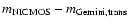 ,
can be analysed in more detail when studying
the residual map and the smoothed contour plot. In Fig. 3,
positive (negative) residuals correspond to overestimated (underestimated) flux.
From the map we denote a general tendency to overestimate the flux.
The contour maps show that positive residuals are correlated
with the position of bright stars on the
image, both in the crowded
cluster center as well as in the area to the lower left, where a band of bright stars
is located (see Fig. 1). This is the area where the
magnitudes
were found to be underestimated in Sect. 2.1.3, and thus the flux overestimated.
This suggests that the increased background
due to the uncompensated seeing halos of bright stars (cf. Sect. 2.1.5),
inherent to AO observations, causes an overestimation of the flux of bright
(
,
can be analysed in more detail when studying
the residual map and the smoothed contour plot. In Fig. 3,
positive (negative) residuals correspond to overestimated (underestimated) flux.
From the map we denote a general tendency to overestimate the flux.
The contour maps show that positive residuals are correlated
with the position of bright stars on the
image, both in the crowded
cluster center as well as in the area to the lower left, where a band of bright stars
is located (see Fig. 1). This is the area where the
magnitudes
were found to be underestimated in Sect. 2.1.3, and thus the flux overestimated.
This suggests that the increased background
due to the uncompensated seeing halos of bright stars (cf. Sect. 2.1.5),
inherent to AO observations, causes an overestimation of the flux of bright
(
 mag) sources.
On the other hand, points with negative residuals are mainly correlated with fainter
stars (
mag) sources.
On the other hand, points with negative residuals are mainly correlated with fainter
stars ( mag), suggesting that this enhanced background
leads to an oversubtraction of the individually calculated
background of nearby fainter stars. The result is an underestimate of the
flux of companion stars in the vicinity of bright stars.
The correlation of positive residuals with the position of bright stars
seems to be less pronounced in the H-band image
(Fig. 3). In H, the distance from the guide star is supposed to
be more important due to the smaller size of the isoplanatic angle
at shorter wavelengths and consequently more pronounced anisoplanatism.
Indeed, the smoothed residual contour plot shows a symmetry in the residuals
around the guide star, with close-to-zero residuals in the immediate vicinity
of the guide star, where the best adaptive optics correction can be achieved.
With increasing distance from the guide star,
the residuals increase not only towards the bright
cluster, but also to the west (left in Fig. 1) of the field,
indicating that remaining distortion
effects from the AO correction are mixed with the problem of the proximity to
bright stars as seen in .
mag), suggesting that this enhanced background
leads to an oversubtraction of the individually calculated
background of nearby fainter stars. The result is an underestimate of the
flux of companion stars in the vicinity of bright stars.
The correlation of positive residuals with the position of bright stars
seems to be less pronounced in the H-band image
(Fig. 3). In H, the distance from the guide star is supposed to
be more important due to the smaller size of the isoplanatic angle
at shorter wavelengths and consequently more pronounced anisoplanatism.
Indeed, the smoothed residual contour plot shows a symmetry in the residuals
around the guide star, with close-to-zero residuals in the immediate vicinity
of the guide star, where the best adaptive optics correction can be achieved.
With increasing distance from the guide star,
the residuals increase not only towards the bright
cluster, but also to the west (left in Fig. 1) of the field,
indicating that remaining distortion
effects from the AO correction are mixed with the problem of the proximity to
bright stars as seen in .
The Strehl ratio (SR) is defined to be the ratio of the observed peak-to-total flux
ratio
to the peak-to-total flux ratio of a perfect diffraction limited optical system.
This definition allows to compare the quality and photometric resolution of
different optical systems using a single characteristic quantity.
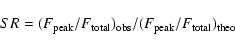
 is the maximum flux value of the PSF, and
 is
the total flux, including the uncompensated halos induced by the natural seeing.
The labels obs and theo refer
to the observed and the theoretically expected flux, respectively.
Diffraction limited theoretical PSFs have been calculated using the
imgen task of the ESO data analysis package eclipse (Devillard
1997).
The Strehl ratio in the Gemini H-band 720 s exposure is found to be 2.5% compared
to 95% in the HST F160W image, and 7% in
(1020 s)
compared to 90% in F205W. The low SRs measured in the Gemini science
demonstration data indicate that more than 90% of the light of a star
is distributed into the resolution pattern of the AO PSF and the halo around
each star induced by the natural seeing. It has turned out that these
halos cause a significant limitation to the resolution and depth of the observations
in a crowded field, as faint stars can be lost to the enhanced background in the
vicinity of bright objects. When comparing the HST and Gemini luminosity functions
(Sect. 4), this effect causes the main difference between both data sets.
is
the total flux, including the uncompensated halos induced by the natural seeing.
The labels obs and theo refer
to the observed and the theoretically expected flux, respectively.
Diffraction limited theoretical PSFs have been calculated using the
imgen task of the ESO data analysis package eclipse (Devillard
1997).
The Strehl ratio in the Gemini H-band 720 s exposure is found to be 2.5% compared
to 95% in the HST F160W image, and 7% in
(1020 s)
compared to 90% in F205W. The low SRs measured in the Gemini science
demonstration data indicate that more than 90% of the light of a star
is distributed into the resolution pattern of the AO PSF and the halo around
each star induced by the natural seeing. It has turned out that these
halos cause a significant limitation to the resolution and depth of the observations
in a crowded field, as faint stars can be lost to the enhanced background in the
vicinity of bright objects. When comparing the HST and Gemini luminosity functions
(Sect. 4), this effect causes the main difference between both data sets.
In the case of very low Strehl ratios, the SR does not directly indicate the
fraction of the flux concentrated in the FWHM area of the PSF. A much larger
fraction of the source flux can be used for PSF fitting in this case,
although the spatial resolution is limited by the large FWHM as compared to
diffraction limited observations (cf. Table 1).
The ratio of the flux in the FWHM kernel of the compensated stellar image
to the total flux,
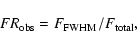
 only in H, although
many stars on the H-band image were still too influenced by
neighbours to study the aperture curve of growth in detail.
We were able to create well-behaved curves of growth for 7 stars.
As in the PSF fitting routine, we have used the FWHM of the PSF as kernel radius
and as the reference flux for the flux ratio determination.
These ratios range from 0.47 to 0.58, with an average of
only in H, although
many stars on the H-band image were still too influenced by
neighbours to study the aperture curve of growth in detail.
We were able to create well-behaved curves of growth for 7 stars.
As in the PSF fitting routine, we have used the FWHM of the PSF as kernel radius
and as the reference flux for the flux ratio determination.
These ratios range from 0.47 to 0.58, with an average of
 ,
i.e., 50% of the integrated point source flux are used for PSF fitting.
In addition, the variation of the flux ratio
over the field
serves as an indicator of the Strehl ratio variation.
If the AO correction mechanism is the dominant factor determining the
concentration of the flux into the FWHM kernel, the Strehl ratio and
thus
should decrease with distance form the guide star,
as the seeing correction worsens.
No correlation of the flux ratio with distance from the guide star is found.
Though these are small number statistics, this supports the suggestion
that the sensitivity variations over the field are not predominantly due
to increasing distance from the guide star (Sect. 2.1.4).
,
i.e., 50% of the integrated point source flux are used for PSF fitting.
In addition, the variation of the flux ratio
over the field
serves as an indicator of the Strehl ratio variation.
If the AO correction mechanism is the dominant factor determining the
concentration of the flux into the FWHM kernel, the Strehl ratio and
thus
should decrease with distance form the guide star,
as the seeing correction worsens.
No correlation of the flux ratio with distance from the guide star is found.
Though these are small number statistics, this supports the suggestion
that the sensitivity variations over the field are not predominantly due
to increasing distance from the guide star (Sect. 2.1.4).
For the incompleteness correction, artificial frames were
created with randomly positioned artificial stars. Magnitudes were
also assigned automatically in a random way. Due to the very crowded
field, only 40 stars were added to each artificial frame in order
to avoid significant changes in the stellar density. A total of 100 frames
was created for both the H and
deep exposures, leading
to a total of 4000 artificial stars used in the statistics.
In addition to the individual incompleteness in each band, the loss of
sources due to scatter of the main sequence generated by the more
uncertain photometry
in the dense parts of the cluster was estimated. For this purpose the
artificial
stars were assigned a formal instrumental "colour''
of
 mag (corresponding to 1.745 mag after photometric
transformation),
derived from the average observed instrumental colour of the main sequence,
and via this transformed into instrumental H magnitudes.
Artificial stars were inserted at the same positions in the H and frames.
In this way the procedure also accounts for
stars lost due to the matching of H and
data.
The artificial stars were calibrated
using the colour equations shown in Sect. 2.1.3 , thus allowing us
to estimate
the loss of stars in the mass function derivation due to the applied main sequence
colour selection (see Sect. 5).
This resulted in significantly larger corrections as compared
to the individual filter recoverage without matching and colour selection.
As an example, the results for the mass function calculation performed
on the artificial stars are displayed in Fig. 4.
mag (corresponding to 1.745 mag after photometric
transformation),
derived from the average observed instrumental colour of the main sequence,
and via this transformed into instrumental H magnitudes.
Artificial stars were inserted at the same positions in the H and frames.
In this way the procedure also accounts for
stars lost due to the matching of H and
data.
The artificial stars were calibrated
using the colour equations shown in Sect. 2.1.3 , thus allowing us
to estimate
the loss of stars in the mass function derivation due to the applied main sequence
colour selection (see Sect. 5).
This resulted in significantly larger corrections as compared
to the individual filter recoverage without matching and colour selection.
As an example, the results for the mass function calculation performed
on the artificial stars are displayed in Fig. 4.
As the recovery rate depends strongly on the stellar density and thus radial distance from the cluster center, the incompleteness correction will be determined in dependence of the radial bin analysed when radial variations in the MF are studied (Sect. 5.3).
![\begin{figure}
\par\includegraphics[width=8.8cm,clip=]{aah3531f4.eps}\end{figure}](/articles/aa/full/2002/41/aah3531/img72.gif) |
Figure 4:
Incompleteness tests performed on the Gemini H and
data.
The plot demonstrates the necessity to include the matching between single filter
observations to obtain a realistic estimate on the incompleteness, when matching
of objects is needed to create colour-magnitude- and two-colour-diagrams. |
| Open with DEXTER | |
In addition to luminosity and mass function corrections, the artificial star tests
were used to estimate the real photometric uncertainties by comparing
inserted to recovered magnitudes of the artificial stars.
The median difference between the original and the recovered
magnitude of the artificial stars,
 ,
has
been used as an estimate of the real photometric uncertainty. To obtain the
median uncertainty, the intervalls
,
has
been used as an estimate of the real photometric uncertainty. To obtain the
median uncertainty, the intervalls
 and
and
 have been treated individually, and the mean of the absolute
value of both median values,
weighted with the number of objects in each intervall, is quoted in Table 2.
The overall flux deviation, including positive and negative deviations,
is close to zero for stars brighter than 20 mag (<
have been treated individually, and the mean of the absolute
value of both median values,
weighted with the number of objects in each intervall, is quoted in Table 2.
The overall flux deviation, including positive and negative deviations,
is close to zero for stars brighter than 20 mag (< ), and for fainter stars
becomes -0.17 and -0.13 in H and ,
respectively, showing a
tendency to underestimate the flux of faint stars. This tendency is more serious
in the cluster center, where comparably large uncertainties are already observed for
magnitudes fainter than 18 mag in both pathbands.
), and for fainter stars
becomes -0.17 and -0.13 in H and ,
respectively, showing a
tendency to underestimate the flux of faint stars. This tendency is more serious
in the cluster center, where comparably large uncertainties are already observed for
magnitudes fainter than 18 mag in both pathbands.
In a second test,
photometry of the bright stars in the short exposures was compared to the
magnitudes of the deep exposures, yielding
 using the same procedure as for artificial stars.
Note, however, that the quality of the short
exposures is much worse than the one of the long exposures due to the high
background noise. Therefore, the artificial star experiments, for which only
the deep exposures have been used, yield a more realistic estimate of the
photometric uncertainties. The results of both tests are summarised in Table
2.
using the same procedure as for artificial stars.
Note, however, that the quality of the short
exposures is much worse than the one of the long exposures due to the high
background noise. Therefore, the artificial star experiments, for which only
the deep exposures have been used, yield a more realistic estimate of the
photometric uncertainties. The results of both tests are summarised in Table
2.
The resulting uncertainty is roughly a factor of 2 to 3 larger than
the theoretical magnitude uncertainty
 determined
from detector characteristics by DAOPHOT. The photometry in the cluster
center shows a larger uncertainty than the photometry in the outskirts.
As expected in a crowding-limited field, this also implies a reduced
detection probability of faint sources in the center of the cluster.
determined
from detector characteristics by DAOPHOT. The photometry in the cluster
center shows a larger uncertainty than the photometry in the outskirts.
As expected in a crowding-limited field, this also implies a reduced
detection probability of faint sources in the center of the cluster.
| Band | mag |
 |
 |
|
|
|
|
|
|
|
| all | R < 10
|
R > 10
|
||||||||
| H | 12-14 | 0.007 | 0.059 | 0.004 | 0.012 | 0.052 | 0.005 | 0.004 | - | 0.002 |
| 14-16 | 0.015 | 0.061 | 0.008 | 0.025 | 0.065 | 0.010 | 0.011 | 0.035 | 0.004 | |
| 16-18 | 0.044 | 0.128 | 0.015 | 0.077 | 0.120 | 0.017 | 0.038 | 0.134 | 0.009 | |
| 18-20 | 0.119 | - | 0.036 | 0.167 | - | 0.039 | 0.098 | - | 0.030 | |
| >20 | 0.264 | - | 0.142 | 0.514 | - | 0.142 | 0.265 | - | 0.144 | |
|
10-12 | 0.004 | - | 0.005 | 0.004 | - | 0.005 | 0.003 | - | 0.006 |
| 12-14 | 0.008 | 0.042 | 0.005 | 0.011 | 0.048 | 0.005 | 0.007 | 0.028 | 0.005 | |
| 14-16 | 0.027 | 0.072 | 0.007 | 0.041 | 0.086 | 0.007 | 0.020 | 0.042 | 0.006 | |
| 16-18 | 0.071 | 0.121 | 0.016 | 0.125 | 0.166 | 0.017 | 0.057 | 0.088 | 0.016 | |
| 18-20 | 0.206 | - | 0.060 | 0.280 | - | 0.073 | 0.189 | - | 0.056 | |
| >20 | 0.411 | - | 0.274 | 0.520 | - | - | 0.360 | - | 0.274 | |
HST/NICMOS observations have been obtained in the three broad-band filters F110W, F160W and F205W, roughly equivalent to J, H and K. The basic parameters are included in Table 1. For a detailed description of the HST data and their reduction see Figer et al. (1999).
During the process of calibration we realised that a strong colour gradient is
present in the Arches field.
In Fig. 5, the
colour is plotted against radial
distance from the cluster center.
As the extinction law has not yet been derived
for HST filters, we have used the colour transformations in BGB
to transform NICMOS into 2MASS magnitudes. Though the 2MASS filters
deviate slightly from the standard Johnson JHK filters used to determine the
extinction law (Rieke & Lebofsky 1985), we will be able to estimate
the approximate amount of change in visual extinction across the field.
The extinction parameters from Rieke & Lebofsky (1985) are given by

 is the extinction in the given filter.
For a change in extinction of
is the extinction in the given filter.
For a change in extinction of
 this leads to
 |
|||
 |
|||
 |
photometry.
The resulting
is given in each plot in Fig. 6,
together with the fitting uncertainty from the rms scatter in the colour.
From the linear fits in Fig. 6 we see that
AV increases by about one order of magnitude
over the entire field when moving outwards from
the cluster center. The effect is
most pronounced in the HST
 vs. radius diagram (Fig. 6, bottom),
where the longest colour baseline is used. We derive a change in visual extinction
of
vs. radius diagram (Fig. 6, bottom),
where the longest colour baseline is used. We derive a change in visual extinction
of
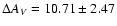 mag over the Gemini field
(1000 pixels
mag over the Gemini field
(1000 pixels  0.8 pc).
Notably, if only the innermost 5
(250 pixels, 0.2 pc)
are fitted, no variation in AV is observed.
When fitting the core separately, we get
0.8 pc).
Notably, if only the innermost 5
(250 pixels, 0.2 pc)
are fitted, no variation in AV is observed.
When fitting the core separately, we get
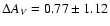 mag for
 (250 pixels)
versus
(250 pixels)
versus
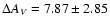 mag for
 (
250 < R < 1000 pixels). The latter value corresponds to
(
250 < R < 1000 pixels). The latter value corresponds to
 ,
consistent
with the trend over the entire field.
The small radial trend and low extinction value in the cluster center
indicates the local depletion of dust. This could be either due to
winds from massive stars or due to photo-evaporation of dust grains
caused by the intense UV-radiation field.
,
consistent
with the trend over the entire field.
The small radial trend and low extinction value in the cluster center
indicates the local depletion of dust. This could be either due to
winds from massive stars or due to photo-evaporation of dust grains
caused by the intense UV-radiation field.
A change in AV of
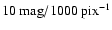 is also
consistent with the result found in J-H,
is also
consistent with the result found in J-H,
 ,
while a larger value of
,
while a larger value of
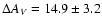 mag is derived
from the
mag is derived
from the
 plot. Due to the uncertainties we conclude that the
extinction varies by
plot. Due to the uncertainties we conclude that the
extinction varies by
 mag across the
Arches field of 20
or 0.8 pc, most likely
closer to the lower value. This is in any case a tremendous change
in the dust column density along the line of sight, with strong implications
on limiting magnitudes and the potential detection of faint objects.
mag across the
Arches field of 20
or 0.8 pc, most likely
closer to the lower value. This is in any case a tremendous change
in the dust column density along the line of sight, with strong implications
on limiting magnitudes and the potential detection of faint objects.
We have used a linear fit to the colour variation with radius for
 to correct for the strong change in reddening observed in the outer cluster field.
The values for cluster center stars (
)
have been left unchanged,
due to the large scatter and the very small trend found. Thus, these adjusted colours
are scaled to the cluster center, where AV is lowest.
From the Rieke & Lebofsky (1985) extinction law, the change in
K-band magnitude with radius corresponding to the change in colour
can be derived as
to correct for the strong change in reddening observed in the outer cluster field.
The values for cluster center stars (
)
have been left unchanged,
due to the large scatter and the very small trend found. Thus, these adjusted colours
are scaled to the cluster center, where AV is lowest.
From the Rieke & Lebofsky (1985) extinction law, the change in
K-band magnitude with radius corresponding to the change in colour
can be derived as
 .
We have used this relation to adjust the K-band magnitudes accordingly.
The "dereddened'' colour-magnitude diagrams will be shown in direct comparison with
the observed CMDs in Sect. 3.3 (cf. Fig. 9).
.
We have used this relation to adjust the K-band magnitudes accordingly.
The "dereddened'' colour-magnitude diagrams will be shown in direct comparison with
the observed CMDs in Sect. 3.3 (cf. Fig. 9).
![\begin{figure}
\par\includegraphics[width=8.8cm,clip=]{aah3531f5.eps}\end{figure}](/articles/aa/full/2002/41/aah3531/img99.gif) |
Figure 5: Colour variation across the Gemini field, as observed in instrumental Gemini magnitudes and HST/NICMOS data. As a trend of increasing colour excess with increasing distance from the Arches cluster center is observed in the two independent datasets, an instrumental effect as the cause for this variation is highly improbable. |
| Open with DEXTER | |
![\begin{figure}
\par\includegraphics[width=8.8cm,clip=]{aah3531f6.eps}\end{figure}](/articles/aa/full/2002/41/aah3531/img100.gif) |
Figure 6:
Colour trends over the Arches field as observed in the HST/NICMOS data set within the area covered by the Gemini observations.
The radial distance from the cluster center is given in pixels on the Gemini
scale. For the calculation of
,
the Rieke & Lebofsky (1985) reddening law has
been assumed. |
| Open with DEXTER | |
Since the original HST/NICMOS field has twice the area of the Gemini central Arches field, we have also calculated the extinction map for the entire NICMOS field following the same procedure. The corresponding map is shown in Fig. 8.
The extinction measured with this procedure in the K-band lies in the range
1.9 < AK < 4.1 mag, with an average value of 3.1 mag,
corresponding to
16 < AV < 37 mag,
 mag.
Cotera et al. (2000) derive a near-infrared extinction of
2.8 < AK < 4.2 mag,
with an average value of
mag.
Cotera et al. (2000) derive a near-infrared extinction of
2.8 < AK < 4.2 mag,
with an average value of
 mag for 15 lines of sight towards
several Galactic Center regions, corresponding to an average visual extinction of
mag for 15 lines of sight towards
several Galactic Center regions, corresponding to an average visual extinction of
 mag (transformed using Rieke & Lebofsky 1985).
They obtain the highest extinction
towards a field close to the Arches cluster,
AV = 37.5 mag.
This is very close to our highest extinction value.
The average value determined from individual dereddening here is the same
as the average extinction obtained by Figer et al. (1999),
mag (transformed using Rieke & Lebofsky 1985).
They obtain the highest extinction
towards a field close to the Arches cluster,
AV = 37.5 mag.
This is very close to our highest extinction value.
The average value determined from individual dereddening here is the same
as the average extinction obtained by Figer et al. (1999),
 mag.
Note that the typical random scatter
mag.
Note that the typical random scatter
 from foreground dust density
fluctuations found in GC fields is linearly related to the average extinction
within a field. The relation determined by Frogel et al. (1999) from giant
branch stars in 22 pointings towards fields within 4
from foreground dust density
fluctuations found in GC fields is linearly related to the average extinction
within a field. The relation determined by Frogel et al. (1999) from giant
branch stars in 22 pointings towards fields within 4 from the GC is given by
 .
This yields an
expected natural scatter from GC clouds of only
.
This yields an
expected natural scatter from GC clouds of only
 mag for
 mag, much below the difference in
reddening observed in the Arches field. Thus, the change in extinction cannot be
explained by the natural fluctuations of the dust distribution in the GC region.
mag, much below the difference in
reddening observed in the Arches field. Thus, the change in extinction cannot be
explained by the natural fluctuations of the dust distribution in the GC region.
Comparison of the cluster center main sequence population
with the main sequence colour of a theoretical 2 Myr isochrone
from the Geneva set of models (Lejeune & Schaerer 2001), later-on used for
the derivation of the mass function, yields an average extinction of
 mag
in the cluster center.
This extinction value has been used to transform isochrone magnitudes
and colours into the cluster magnitude system. It has been suggested that the
brightest and most massive stars in Arches are Wolf-Rayet stars of type WN7
(Cotera et al. 1996; Blum et al. 2001).
Fundamental parameters of Wolf-Rayet stars are compiled in Crowther et al.
(1995).
For stars of subtype WN7 they find typical colours of
mag
in the cluster center.
This extinction value has been used to transform isochrone magnitudes
and colours into the cluster magnitude system. It has been suggested that the
brightest and most massive stars in Arches are Wolf-Rayet stars of type WN7
(Cotera et al. 1996; Blum et al. 2001).
Fundamental parameters of Wolf-Rayet stars are compiled in Crowther et al.
(1995).
For stars of subtype WN7 they find typical colours of
 mag,
leading to an extinction of
mag,
leading to an extinction of
 mag with an observed
H - K colour of 1.77 mag for the WN7 stars, which were
identified by comparison with the Blum et al. (2001) narrow band photometry.
This value is in very good agreement with the AV determined from the
main sequence colour in the cluster center.
mag with an observed
H - K colour of 1.77 mag for the WN7 stars, which were
identified by comparison with the Blum et al. (2001) narrow band photometry.
This value is in very good agreement with the AV determined from the
main sequence colour in the cluster center.
![\begin{figure}
\par\mbox{\includegraphics[width=8cm,clip=]{H3531F7a.ps}\hspace{1cm}
\includegraphics[width=7cm,clip=]{H3531F7b.ps} }
\end{figure}](/articles/aa/full/2002/41/aah3531/img113.gif) |
Figure 7: AK extinction map, binned in the same manner as the residual map in Fig. 3 (North is up, East is to the right). White spots are positions without stars for evaluation. The individual extinction has been calculated by shifting the stars in the K vs. H - K colour-magnitude diagram to a 2 Myr isochrone offset bluewards of the main sequence. Transformation to AK = 0 mag has been performed afterwards, to avoid large errors in the shifting procedure. This results in a minimum AK of 1.86 mag, and a maximum of 4.08 mag, assuming a Rieke & Lebofsky (1985) extinction law. |
| Open with DEXTER | |
![\begin{figure}
\par\mbox{\includegraphics[width=8cm,clip=]{H3531F8a.ps}\hspace{1cm}
\includegraphics[width=7cm,clip=]{H3531F8b.ps} }
\end{figure}](/articles/aa/full/2002/41/aah3531/img114.gif) |
Figure 8:
AK extinction map derived from HST m205 photometry. See Fig. 7
for details. The coordinate transformed HST/NICMOS F205W image is also shown
for comparison. Note the different scales (HST/NICMOS:
 ,
Gemini/Hokupa'a: ,
Gemini/Hokupa'a:
 ). ). |
| Open with DEXTER | |
The resulting colour-magnitude diagrams for Gemini and HST are presented in
Fig. 9 (upper panel). Two important differences are seen when inspecting the CMDs.
First, the scatter in the main sequence is significantly larger in the ground-based
photometry. While the HST/NICMOS CMD reveals a
narrow main sequence in the cluster center (circles in Fig. 9), the same
stars display a much larger colour range in the Gemini CMD.
The poor Strehl ratio in the Gemini/Hokupa'a data as compared to
the HST/NICMOS data (see Sect. 2.1.5)
causes a high, non-uniform additional background due to uncompensated
seeing halos around bright stars, which decreases photometric accuracy.
In the dense regions of the cluster center, where crowding problems are most
severe, the photometry is most affected. The number of faint,
unresolved companion stars that merge into the high stellar background underneath
the bright cluster population is very high. As discussed in Sect. 2.1.4,
the halos of the bright stars hinder the detection of faint objects
despite the principally high spatial resolution seen in individual PSF kernels.
Operating at the diffraction limit,
NICMOS is not restricted by these effects, yielding a better effective resolution
especially in the dense regions. A tighter main sequence and less
scatter is the consequence.
In Fig. 9, the innermost 5
of the Arches
cluster are marked by open circles.
It is clearly seen that most massive (bright) stars are located
in the cluster center.
A second effect observed is the much larger number of faint objects seen in the HST data (cf. Fig. 2). As the limiting magnitude and the measured spatial resolution of the images are similar in both datasets, this, too, has to be a consequence of the low Strehl ratio in the AO data.
![\begin{figure}
\par\includegraphics[width=8.8cm,clip=]{aah3531f9.eps}\end{figure}](/articles/aa/full/2002/41/aah3531/img115.gif) |
Figure 9: Colour-magnitude diagrams. Left: Gemini/Hokupa'a, right: HST/NICMOS. Lower panel: CMDs corrected for radial reddening gradient (Sect. 3.1). |
| Open with DEXTER | |
The lower panel of Fig. 9 shows the "dereddened'' CMDs, corrected
for the radial colour gradient found and the corresponding change
in extinction,
 (Sect. 3.1). The colours of
stars beyond
have been adjusted to the colour of the cluster
center.
Comparison with the original CMDs shows that
most of the bright, seemingly reddened stars fall onto the same main sequence
after correcting for the colour trend.
These stars are located at larger distances from the cluster
center and thus suffer from more reddening by residual dust.
As will be discussed in the context of the mass function (Sect. 5),
these stars might have formed close to the cluster at a similar time
as the cluster population. At the faint end of the CMD,
there are, however, a large number of objects that remain unusually red after
the correction has been applied.
These objects may either be pre-main sequence stars or faint background sources.
Unfortunately, we are not able to disentangle these two possible contributions,
and will thus exclude objects significantly reddened relative to the main
sequence when deriving the mass function.
(Sect. 3.1). The colours of
stars beyond
have been adjusted to the colour of the cluster
center.
Comparison with the original CMDs shows that
most of the bright, seemingly reddened stars fall onto the same main sequence
after correcting for the colour trend.
These stars are located at larger distances from the cluster
center and thus suffer from more reddening by residual dust.
As will be discussed in the context of the mass function (Sect. 5),
these stars might have formed close to the cluster at a similar time
as the cluster population. At the faint end of the CMD,
there are, however, a large number of objects that remain unusually red after
the correction has been applied.
These objects may either be pre-main sequence stars or faint background sources.
Unfortunately, we are not able to disentangle these two possible contributions,
and will thus exclude objects significantly reddened relative to the main
sequence when deriving the mass function.
For comparison with the reddening path and a main sequence in standard
colours, the NICMOS filters have been transformed into the 2MASS
system.
In Fig. 10, we show the transformed HST/NICMOS colour-colour diagram
for the stars bright enough to be observed in all three filters.
The AV values are from the Rieke & Lebofsky (1985) extinction
law for standard JHK photometry.
Though we are aware of the uncertainties inherent to the transformation
of severely reddened stars, the proximity of the reddening path to
the data points supports the validity of the equations derived by BGB.
Changing the transformation parameters slightly results in a large angle between the
data points and the reddening path.
A wide spread population of stars is clearly seen along the reddening path, as expected from the colour trend discussed in Sect. 3.1 (no correction for the varying extinction has been applied in this diagram). Again, the stars with the lowest reddening within the cluster population are the bright stars in the Arches cluster center. Moving along the reddening line towards higher values of AV mainly means moving radially outwards from the cluster center. As in the CMD, a correction for the observed colour gradient causes the bulk of the stars to fall onto the main sequence with a reddening of AV = 24 mag, corresponding to the cluster center.
![\begin{figure}
\par\includegraphics[width=8.8cm,clip=]{aah3531f10.eps}\end{figure}](/articles/aa/full/2002/41/aah3531/img117.gif) |
Figure 10: Two-colour diagram from HST observations. The reddening path is shown as a straight line labeled with AV values, and the main sequence is indicated by the thick grey line. The area between the dashed lines marks the region of reddened main sequence stars. |
| Open with DEXTER | |
In Fig. 11, we compare the Gemini with the HST luminosity function for the
vs. m205 observations.
For direct comparison of the observational efficiency, no colour
cut has been applied, but the entire physically reasonable colour range
from approximately 0 to 4 mag in
,
including reddened and foreground objects, has been included in the luminosity
function (LF). Therefore, these LFs are not the ones from which the
mass functions have
been derived. The only selection criterion that has been applied
is a restriction of the photometric uncertainty in both magnitude
(
mag)
and colour (
 mag,
corresponding to
mag and
mag,
corresponding to
mag and
 mag).
The uncertainty selection in colour allowed us to select only those
objects that have been detected with high confidence in both H and images in the Gemini data, and in the F160W and F205W filters in the NICMOS data,
respectively. The colour-uncertainty selection on the HST data simulates the
matching of H and
detections used on the Gemini data
for the selection of real objects. Thus, only objects that are detected
in both H and
have been included in the luminosity
function. This gives us
some confidence that we are not picking up hot pixels or cosmic ray events.
The area covered with Gemini has been selected from the HST
photometry as displayed in Fig. 1.
mag).
The uncertainty selection in colour allowed us to select only those
objects that have been detected with high confidence in both H and images in the Gemini data, and in the F160W and F205W filters in the NICMOS data,
respectively. The colour-uncertainty selection on the HST data simulates the
matching of H and
detections used on the Gemini data
for the selection of real objects. Thus, only objects that are detected
in both H and
have been included in the luminosity
function. This gives us
some confidence that we are not picking up hot pixels or cosmic ray events.
The area covered with Gemini has been selected from the HST
photometry as displayed in Fig. 1.
As can be seen in Fig. 11, many objects are missed
by Gemini in the fainter regime, though the actual limiting (i.e., cut-off)
magnitudes are the same in both datasets.
This is due to the fact that 50% of the light is distributed into
a halo around each star.
These halos prevent the detection of faint objects
around bright sources, especially in the crowded regions.
This effect is most obvious when examining the star-subtracted frames resulting
from the DAOPHOT allstar task. In these frames the cluster center is
marked by a diffuse background, enhanced by 20 counts in
and 40 counts in H above the observational background of
2 and 4 counts in the cluster vicinity, respectively.
In addition to the simple crowding problem due to the stellar density
affecting both datasets,
the overlap of many stellar halos hinders the detection of faint
stars in the Gemini data.
At larger radial distances from the cluster center, more and more faint stars
are detected both in the HST as well as in the Gemini data (Fig. 12).
The fact that the incompleteness corrected Gemini LFs follow closely the shape of the HST LFs supports the results of our incompleteness calculations, which will be used to determine the incompleteness in the mass function.
![\begin{figure}
\par\includegraphics[width=8.8cm,clip=]{aah3531f11.eps}\end{figure}](/articles/aa/full/2002/41/aah3531/img120.gif) |
Figure 11: Comparison of Gemini versus HST luminosity functions. |
| Open with DEXTER | |
Radial luminosity functions were calculated in
 bins, using the same uncertainty selection as in Fig. 11 (Sect. 4.1).
The resulting radial LFs are shown in Fig. 12, along with the
incompleteness determined for each radial bin.
In the cluster center (lowest panel), the very good match of the Gemini and
HST LFs for
bins, using the same uncertainty selection as in Fig. 11 (Sect. 4.1).
The resulting radial LFs are shown in Fig. 12, along with the
incompleteness determined for each radial bin.
In the cluster center (lowest panel), the very good match of the Gemini and
HST LFs for
 mag reveals the comparable spatial
resolution obtained in both data sets. Despite the strong crowding seen
already in these bright stars, the Gemini AO data resolve the sources
in the cluster center nicely. When we move on to fainter magnitudes, however,
we are limited by the halos of these bright stars, as discussed above.
The clear decrease below
mag reveals the comparable spatial
resolution obtained in both data sets. Despite the strong crowding seen
already in these bright stars, the Gemini AO data resolve the sources
in the cluster center nicely. When we move on to fainter magnitudes, however,
we are limited by the halos of these bright stars, as discussed above.
The clear decrease below
 mag marks
the point where stars are lost due to the enhanced background. When we move
radially outwards, the limiting magnitude above which faint stars are lost
shifts towards fainter magnitudes. The tendency to loose the faint tail
of the magnitude distribution nevertheless remains clearly seen, though
it becomes much less pronounced for
,
where the Gemini and
HST LFs resemble each other. For
mag marks
the point where stars are lost due to the enhanced background. When we move
radially outwards, the limiting magnitude above which faint stars are lost
shifts towards fainter magnitudes. The tendency to loose the faint tail
of the magnitude distribution nevertheless remains clearly seen, though
it becomes much less pronounced for
,
where the Gemini and
HST LFs resemble each other. For
 (upper panel) we are limited by
small number statistics due to the small area in this radial bin.
As it is hard to observe a well-defined LF at these radii, we will add the
two upper bins when we create the radially dependent mass functions in
Sect. 5.3.
(upper panel) we are limited by
small number statistics due to the small area in this radial bin.
As it is hard to observe a well-defined LF at these radii, we will add the
two upper bins when we create the radially dependent mass functions in
Sect. 5.3.
The magnitude-dependent distribution of stars within the cluster is evident in
these LFs. While bright stars are predominantly found in the cluster center,
their number density strongly decreases with increasing radius.
When we analyse the Gemini LFs more quantitatively,
we find 25 (50) stars with
 mag within
,
but
only 8 (23) such stars with
mag within
,
but
only 8 (23) such stars with
 ,
and beyond 10
,
we observe only 7 (11) such stars. The numbers for HST are comparable in the bright
magnitude bins. On the other hand, the number of faint stars with
,
and beyond 10
,
we observe only 7 (11) such stars. The numbers for HST are comparable in the bright
magnitude bins. On the other hand, the number of faint stars with
 mag increases from 1 (0) to 14 (3) to 48 (16).
As we see significantly more faint stars in the HST data, the corresponding
numbers are higher, i.e. the number of stars with m205 > 19 mag is 0 in the
innermost bin, 24 in the intermediate bin, and 81 in the outermost bin.
Despite the fact that the area on the Gemini frame increases by about a factor
of 3 between the inner and intermediate bin, the number of bright stars is strongly
diminished beyond a few arcseconds, while the number of the faint stars increases
by much more than the change in area can account for. Although for the fainter stars
the effects of crowding and a real increase in the fainter population of the
cluster cannot be disentangled, the decrease in the number of bright stars is
a clear indication of mass segregation within the Arches cluster.
mag increases from 1 (0) to 14 (3) to 48 (16).
As we see significantly more faint stars in the HST data, the corresponding
numbers are higher, i.e. the number of stars with m205 > 19 mag is 0 in the
innermost bin, 24 in the intermediate bin, and 81 in the outermost bin.
Despite the fact that the area on the Gemini frame increases by about a factor
of 3 between the inner and intermediate bin, the number of bright stars is strongly
diminished beyond a few arcseconds, while the number of the faint stars increases
by much more than the change in area can account for. Although for the fainter stars
the effects of crowding and a real increase in the fainter population of the
cluster cannot be disentangled, the decrease in the number of bright stars is
a clear indication of mass segregation within the Arches cluster.
![\begin{figure}
\par\includegraphics[width=8.8cm,clip=]{aah3531f12.eps}\end{figure}](/articles/aa/full/2002/41/aah3531/img128.gif) |
Figure 12: Radial variation of the luminosity function. The comparison of Gemini and HST LFs is shown together with the Gemini incompleteness calculation. The dependence of the magnitude limits on the distance to the cluster center is striking. |
| Open with DEXTER | |
The mass function (MF) may be defined as the number of stars observed in a certain
mass bin. The mass function in stellar populations is most frequently
fitted by a power law, whose slope depends on the mass range analysed
(e.g., Kroupa 2001).
In the logarithmic representation, the mass function is defined as
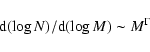
 is the slope of the
mass function. The exact shape of the mass function and, in particular,
its slope, has been subject of intense discussion (see, e.g., Massey 1995a,
1995b; Scalo 1986; and Scalo 1998 for a review).
Massey et al. (1995a, 1995b) report slopes
between -0.7 and -1.7 with a weighted mean of
for
is the slope of the
mass function. The exact shape of the mass function and, in particular,
its slope, has been subject of intense discussion (see, e.g., Massey 1995a,
1995b; Scalo 1986; and Scalo 1998 for a review).
Massey et al. (1995a, 1995b) report slopes
between -0.7 and -1.7 with a weighted mean of
for
 in several starforming regions in the Milky Way, and
 with a mean of
 for
for
 in the LMC.
From these studies in young clusters and associations, the mass function
has been suspected to be rather universal, following a Salpeter (1955) power law
with a slope of
for stars with masses
in the LMC.
From these studies in young clusters and associations, the mass function
has been suspected to be rather universal, following a Salpeter (1955) power law
with a slope of
for stars with masses
 (Kroupa 2001).
For the two starburst clusters studied in the Milky Way, Arches (FKM) and NGC 3603
(Eisenhauer et al. 1998), a flat slope of -0.7 is observed
for masses
(Kroupa 2001).
For the two starburst clusters studied in the Milky Way, Arches (FKM) and NGC 3603
(Eisenhauer et al. 1998), a flat slope of -0.7 is observed
for masses
 in Arches, and
 in NGC 3603.
These values have to be kept in mind as a comparison for the results presented
in the following sections. The mass regime which will be discussed here
spans a mass range of
for Arches cluster stars.
in NGC 3603.
These values have to be kept in mind as a comparison for the results presented
in the following sections. The mass regime which will be discussed here
spans a mass range of
for Arches cluster stars.
The present-day mass function (Fig. 13) of the Arches cluster
has been derived from the colour-magnitude diagram
by transforming stellar luminosities into masses via a 2 Myr isochrone
from the Geneva basic set of stellar evolution models
(Lejeune & Schaerer 2001)
using the method described in Grebel & Chu (2000).
Enhanced mass loss models were also used, but did not alter the resultant
mass function. Stellar evolution (mass loss, giant evolution)
is not important on timescales of the Arches age of 2 Myr
for stars with initial masses of
 (
(
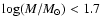 ,
i.e. stellar evolution affects the two upper mass bins of the MF at most).
No attempt has been made to reconstruct the initial mass function (IMF)
from the present-day MF for
,
i.e. stellar evolution affects the two upper mass bins of the MF at most).
No attempt has been made to reconstruct the initial mass function (IMF)
from the present-day MF for
 .
A distance modulus of 14.5 mag and an extinction of
AV = 24.1 mag
have been applied.
.
A distance modulus of 14.5 mag and an extinction of
AV = 24.1 mag
have been applied.
The slopes of all mass functions discussed have been derived by performing a
weighted least-squares fit to the number of stars per mass bin.
The size of the mass bins was chosen to be
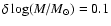 as the best
compromise between mass function resolution and statistical relevance.
This bin size is significantly larger than the photometric uncertainty in
the considered mass and thus magnitude ranges. Only mass bins
with a completeness factor of
as the best
compromise between mass function resolution and statistical relevance.
This bin size is significantly larger than the photometric uncertainty in
the considered mass and thus magnitude ranges. Only mass bins
with a completeness factor of  75% have been included in the fit.
Note that we have not attempted to subtract the field star contribution. As can be seen in Fig. 1, the Gemini field is mostly restricted to the densest cluster region. When comparing to an arbitrary part of the GC field, we do not expect to observe the same distribution of stars as in the Arches field, as the faint, reddened background sources are negligible due to the high density of bright sources in the cluster area.
In addition, the stellar density in the GC is strongly variable, imposing additional uncertainties on the field contribution. Neither the Gemini nor the HST field covers enough area to estimate the field star population in the immediate vicinity of the cluster. A main sequence colour cut ( 1.15 < H-K < 1.90 mag) has been applied to the colour-corrected CMDs to select Arches members, excluding blue foreground and red background sources.
To allow for a direct comparison with the results obtained in FKM,
we have used isochrones calculated for a metallicity of Z = 0.04 for all
MF derivations. The derived MFs are displayed in Fig. 13.
The overall mass function derived from the Gemini data displays the same
slope as derived from NICMOS within the uncertainties, namely
 and
and
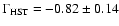 fitted for
 (Fig. 13),
which may be extrapolated down to
(Fig. 13),
which may be extrapolated down to
 when taking into account the incompleteness
correction. The present-day upper mass of
when taking into account the incompleteness
correction. The present-day upper mass of
 corresponds to an initial
mass of about
according to the Geneva models.
FKM derive an overall slope of
in the inital mass range
corresponds to an initial
mass of about
according to the Geneva models.
FKM derive an overall slope of
in the inital mass range
 ,
in good agreement with our results.
The remaining difference in the maximum mass is due to the different extinction
and the extinction corrections applied, which represent the largest
uncertainties in the mass function derivation.
As in particular the correction of the K magnitude for the varying extinction
is uncertain due to the unknown extinction law of the NICMOS filters, we have
also derived the mass function for uncorrected K magnitudes, with only the
colour correction applied, which is independent of the extinction law assumed.
In this case, the MF appears flatter with a slope of
,
in good agreement with our results.
The remaining difference in the maximum mass is due to the different extinction
and the extinction corrections applied, which represent the largest
uncertainties in the mass function derivation.
As in particular the correction of the K magnitude for the varying extinction
is uncertain due to the unknown extinction law of the NICMOS filters, we have
also derived the mass function for uncorrected K magnitudes, with only the
colour correction applied, which is independent of the extinction law assumed.
In this case, the MF appears flatter with a slope of
 (Fig. 13, lower panel).
The discrepancy in the derived slopes clearly shows that the effects of
differential extinction are not negligible, especially when deriving mass
functions for very young regions, where the reddening varies significantly.
(Fig. 13, lower panel).
The discrepancy in the derived slopes clearly shows that the effects of
differential extinction are not negligible, especially when deriving mass
functions for very young regions, where the reddening varies significantly.
Furthermore, we have checked the effect of the binning on the MF by shifting
the starting point of each bin by one tenth of the bin-width,
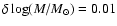 .
The resultant slopes range from
.
The resultant slopes range from
 and
and
 .
The average slopes for Gemini and
HST,
.
The average slopes for Gemini and
HST,
 and
and
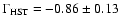 ,
respectively, agree well within the errors.
The slightly flatter slope observed in the Gemini data may reflect the more severe
incompleteness due to crowding.
Although all slopes are consistent within the errors,
the range in slopes derived by scanning the bin-step shows that
statistical effects due to the binning may not be entirely neglected in the MF derivation.
,
respectively, agree well within the errors.
The slightly flatter slope observed in the Gemini data may reflect the more severe
incompleteness due to crowding.
Although all slopes are consistent within the errors,
the range in slopes derived by scanning the bin-step shows that
statistical effects due to the binning may not be entirely neglected in the MF derivation.
The metallicity within the immediate Galactic Center region has been a matter
of discussion during the past decade. Several authors report supersolar
metallicities derived from CO index strength and TiO bands in bulge stars
(Frogel & Whitford 1987; Rich 1988; Terndrup et al.
1990, 1991).
Carr et al. (2000) measure [Fe/H]
 dex for the 7 Myr old
supergiant IRS 7, and Ramirez et al. (2000) derive an average of
[Fe/H]
dex for the 7 Myr old
supergiant IRS 7, and Ramirez et al. (2000) derive an average of
[Fe/H]
 dex for 10 young to intermediate age supergiants, both
very close to the solar value.
dex for 10 young to intermediate age supergiants, both
very close to the solar value.
Using a 2 Myr isochrone with solar metallicity Z=0.02,
the average slope of all bin steps is
 and
and
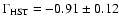 .
The mass function is thus not significantly altered when using solar
instead of enhanced GC metallicity. We note, however, that a lower metallicity
(i.e., in this case solar) steepens the MF slightly, thus working into the same
direction as the incompleteness correction.
.
The mass function is thus not significantly altered when using solar
instead of enhanced GC metallicity. We note, however, that a lower metallicity
(i.e., in this case solar) steepens the MF slightly, thus working into the same
direction as the incompleteness correction.
FKM report a flat portion of the
MF in the range
 ,
which is not seen in the Gemini
MF. This plateau can, however, be recovered, when we create a MF from
K-band magnitudes uncorrected for differential extinction,
and use a lowest mass of
,
which is not seen in the Gemini
MF. This plateau can, however, be recovered, when we create a MF from
K-band magnitudes uncorrected for differential extinction,
and use a lowest mass of
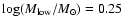 .
For
.
For
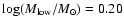 the plateau is seen neither with
nor without extinction correction.
This, again, shows the dependence of the shape of the MF on the extinction corrections
applied, as well as on the chosen binning.
the plateau is seen neither with
nor without extinction correction.
This, again, shows the dependence of the shape of the MF on the extinction corrections
applied, as well as on the chosen binning.
From the considerations above,
we conclude that the overall mass function of the Arches cluster has
a slope of
 to -0.9 in the range
.
Although the uncertainty of missing lower mass stars in the
immediate cluster center remains, the incompleteness correction strongly supports
the derived shape of the MF. If the flat slope would be solely due to a low recovery
rate of low-mass stars in the cluster center, this should be visible in a much
steeper rise of the incompleteness corrected MF in contrast to the observed MF.
We thus conclude that the slope of the MF observed in Arches is flatter than the
Salpeter slope of
,
assumed to be a standard mass distribution in
young star clusters. Such a flat mass function is a strong indication of the
efficient production of high-mass stars in the Arches cluster and the GC environment.
to -0.9 in the range
.
Although the uncertainty of missing lower mass stars in the
immediate cluster center remains, the incompleteness correction strongly supports
the derived shape of the MF. If the flat slope would be solely due to a low recovery
rate of low-mass stars in the cluster center, this should be visible in a much
steeper rise of the incompleteness corrected MF in contrast to the observed MF.
We thus conclude that the slope of the MF observed in Arches is flatter than the
Salpeter slope of
,
assumed to be a standard mass distribution in
young star clusters. Such a flat mass function is a strong indication of the
efficient production of high-mass stars in the Arches cluster and the GC environment.
Blum et al. (2001) estimate a cluster age of 2-4.5 Myr for Arches
assuming that the observed high-mass stars are of type WN7.
If we compare the Geneva basic grid of isochrones with fundamental
parameters obtained for WN7 stars (Crowther et al. 1995), a reasonable
upper age limit for this set of isochrones is 3.5 Myr.
Crowther compares the parameters derived for WN stars with evolutionary
models at solar metallicity from Schaller et al. (1992) and with the
mass-luminosity relation for O supergiants from Howarth & Prinja (1989),
yielding a mass range of
 ,
but with high uncertainties
at the low-mass end. The more reliable mass estimates for the colour
and magnitude range observed for WN stars in Arches are restricted to
,
but with high uncertainties
at the low-mass end. The more reliable mass estimates for the colour
and magnitude range observed for WN stars in Arches are restricted to
 .
From spectroscopic binaries, the masses
of two WN7 stars are determined to be 30
.
From spectroscopic binaries, the masses
of two WN7 stars are determined to be 30  and >48 (Smith & Maeder 1989).
The theoretical lower limit to form Wolf-Rayet
stars is
and >48 (Smith & Maeder 1989).
The theoretical lower limit to form Wolf-Rayet
stars is
 for the Geneva models
(Schaerer et al. 1993).
for the Geneva models
(Schaerer et al. 1993).
In the Geneva basic grid of models with Z = 0.04,
the 3.5 Myr isochrone is limited by a turnoff mass of
 .
We have thus calculated mass functions for isochrones with ages 2.5, 3.2, and
3.5 Myr in addition to the 2 Myr case discussed above.
Though the derived slopes scatter widely, irrespective of the isochrone
used, the slope of the MF tends to be even flatter for any of the older
population models.
We thus conclude that, regardless of the choice of model and
parameters, the Arches mass function displays a flat slope.
.
We have thus calculated mass functions for isochrones with ages 2.5, 3.2, and
3.5 Myr in addition to the 2 Myr case discussed above.
Though the derived slopes scatter widely, irrespective of the isochrone
used, the slope of the MF tends to be even flatter for any of the older
population models.
We thus conclude that, regardless of the choice of model and
parameters, the Arches mass function displays a flat slope.
The radial variation (Fig. 14) of the mass function is
particularly interesting with respect to YC evolution.
We have analysed the stellar population in Arches within
three different radial bins,
 ,
,
 and
and
 .
The resulting mass functions for the Gemini and HST datasets,
along with the radius dependent incompleteness correction for the Gemini MFs,
are displayed in Fig. 14.
.
The resulting mass functions for the Gemini and HST datasets,
along with the radius dependent incompleteness correction for the Gemini MFs,
are displayed in Fig. 14.
We confirm the flat mass function observed by FKM
in the innermost regions of the cluster, which steepens
rapidly beyond the innermost few arcseconds.
Most of the bright, massive stars are
found in the dense cluster center, where the mass function slope is very flat.
FKM derive a slope of
 from the HST data in this region,
which is consistent with Fig. 14. It is obvious from the lowest panel
in Fig. 14 that we are crowding limited in the innermost region.
We have thus not tried to fit a slope for
.
from the HST data in this region,
which is consistent with Fig. 14. It is obvious from the lowest panel
in Fig. 14 that we are crowding limited in the innermost region.
We have thus not tried to fit a slope for
.
In the next bin,
,
the mass function obtained from
the weighted least-squares fit has already steepened to a slope of
 .
Again, the MF in this radial bin remains significantly flatter (
.
Again, the MF in this radial bin remains significantly flatter (
 )
when no AK-correction is applied.
Beyond 10
(0.4 pc, upper panel), a power law can only be defined in the range
)
when no AK-correction is applied.
Beyond 10
(0.4 pc, upper panel), a power law can only be defined in the range
 (
(
 ), where a slope of
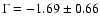 is found, consistent with a Salpeter (
)
law.
The large error obviously reflects the small
number of mass bins used in the fit. Nevertheless, Fig. 14 clearly
reveals the steepening of the MF very soon beyond the cluster center.
is found, consistent with a Salpeter (
)
law.
The large error obviously reflects the small
number of mass bins used in the fit. Nevertheless, Fig. 14 clearly
reveals the steepening of the MF very soon beyond the cluster center.
For a more quantitative confirmation of the mass segregation present in the Arches cluster, we created cumulative functions for the mass distributions in the three radial bins (Fig. 15). We have applied a Kolmogorov-Smirnov test to quantify the observed differences of these functions. When the central, intermediate, and outer radial bin are compared pairwise, we obtain in each case a confidence level of more than 99% that the mass distributions do not originate from the same distribution.
Thus, the inner regions of the cluster are indeed skewed towards higher masses either by sinking of the high mass stars towards the cluster center due to dynamical processes or by primordial mass segregation, or both. The same effect is observed in the similarly young cluster NGC 3603 (Grebel et al. 2002, in prep.).
We find several (5)
high mass stars in the cluster vicinity. These stars fall onto the Arches main
sequence after applying the reddening correction (Sect. 3.1).
When the entire HST field is separated into two equalsize areas,
the first area being a circle of radius 16
around
the cluster center, and the second the surrounding field,
no additional comparably high-mass stars are found with Arches main sequence colours
except for the two bright stars found at the edges of the Gemini field.
In the dynamical models of
Bonnell & Davies (1998) there is a low, but non-zero probability that
a massive star originating outside the cluster's half-mass radius might
remain in the cluster vicinity. High-mass stars formed near the center
show, however, a tendency to migrate closer to the cluster center.
The disruptive GC potential might enhance the ejection process of low-mass stars,
but according to equipartition, it is unlikely that the most massive stars gain
energy due to dynamical interaction with lower mass objects.
We have to bear in mind, however, that interactions between massive stars in the
dense cluster core could cause the ejection of high-mass stars.
N-body simulations performed
by Portegies Zwart et al. (1999) show that the inclusion
of dynamical mass segregation in cluster evolution models enhances the
collision rate by about
a factor of 10 as compared to theoretical cross section considerations.
For a cluster with 12 000 stars initially distributed according to a Scalo
(1986)
mass function, a relaxation time of 10 Myr, and a central density and half-mass radius
comparable to the values found in Arches, about 15 merging collisions occur
within the first 10 Myr (
 )
of the simulated cluster. Shortly after
the start of the simulations, frequent binary and multiple systems form from
dynamical interactions leading to the ejection of several contributing massive
stars. The flat MF in the Arches center as compared to a Scalo MF,
containing a larger fraction of massive stars to interact, may even
increase the collision rate.
)
of the simulated cluster. Shortly after
the start of the simulations, frequent binary and multiple systems form from
dynamical interactions leading to the ejection of several contributing massive
stars. The flat MF in the Arches center as compared to a Scalo MF,
containing a larger fraction of massive stars to interact, may even
increase the collision rate.
Though it is likely that the high-mass stars seen in the immediate vicinity of the Arches cluster have formed from the same molecular cloud at the same time as the cluster, a final conclusion on the possible ejection of these stars from the cluster core due to dynamical processes can only be drawn when velocities for these cluster member candidates are available.
![\begin{figure}
\par\includegraphics[width=8.8cm,clip=]{aah3531f13a.eps}\vspace*{4mm}
\par\includegraphics[width=8.8cm,clip=]{aah3531f13b.eps}\end{figure}](/articles/aa/full/2002/41/aah3531/img179.gif) |
Figure 13:
Arches mass function derived from the Gemini/Hokupa'a colour-magnitude
diagram shown in Fig. 9. A 2 Myr main sequence
isochrone from the Geneva set of models (Lejeune & Schaerer 2001)
was used to transform magnitudes into stellar masses.
The mass function has been derived for bins of
with a lowest mass bin
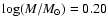 .
Upper panel: with AK correction.
Lower panel: without AK correction. .
Upper panel: with AK correction.
Lower panel: without AK correction. |
| Open with DEXTER | |
![\begin{figure}
\par\includegraphics[width=8.8cm,clip=]{aah3531f14.eps}\end{figure}](/articles/aa/full/2002/41/aah3531/img180.gif) |
Figure 14:
Radial change of the mass function as observed in the Gemini/Hokupa'a
data. A very flat mass function is seen in the inner cluster regions, where
predominantly massive stars are found. The slope of the mass function
increases towards the Salpeter value (
)
already at a radial
distance from the cluster center of >10
(0.4 pc at a
distance of 8 kpc). |
| Open with DEXTER | |
In this section, we will first use the simple analytical approach to analyse internal cluster dynamics as summarised in Binney & Tremaine (1987), and will then compare the derived dynamical timescales to N-body simulations where the tidal force of the Galactic Center potential is considered.
From the transformation of stellar magnitudes into masses, a rough estimate
of the timescales relevant for dynamical cluster evolution can be made.
For larger area coverage, we have used the HST/NICMOS data in the calculation
below. The timescales characterising cluster evolution are the cluster's crossing
time,
 ,
which is simply given by some characteristic radius divided
by the average velocity, i.e., the mean velocity dispersion of the cluster,
,
which is simply given by some characteristic radius divided
by the average velocity, i.e., the mean velocity dispersion of the cluster,
 ,
and the relaxation time,
,
and the relaxation time,
 .
The median relaxation time is
the time after which gravitational encounters of stars have caused the system
to equilibrate to a state independent of the original stellar orbits
(Binney & Tremaine 1987, hereafter BT87)
.
The median relaxation time is
the time after which gravitational encounters of stars have caused the system
to equilibrate to a state independent of the original stellar orbits
(Binney & Tremaine 1987, hereafter BT87)

 ,
,
 is a characteristic stellar mass, here defined as the median of
the observed mass distribution, and N is the number of stars in the cluster.
may also be expressed in terms of the
crossing time,
is a characteristic stellar mass, here defined as the median of
the observed mass distribution, and N is the number of stars in the cluster.
may also be expressed in terms of the
crossing time,
 .
.
To evaluate the above formula, we need to know the total mass of the system, M,
a characteristic radius, ,
the number of stars, N,
and the characteristic stellar mass, .
In principle, we are able to derive most of these quantities from
isochrone fitting, by assigning each star a mass corresponding to its
K-band luminosity, and analysing the resulting spatial distribution of masses.
Naturally, these individual masses cannot be accurate for each star, as they
depend strongly on the choice of the isochrone and inherit the
uncertainties of the photometry. The integrated properties are, however,
not very sensitive to the age of the model isochrone used, within the reasonable
age range of Arches, 2-3 Myr (results will be given below).
We have attempted to create a density profile from the HST/NICMOS data,
but as the profile appears to be very distorted, we have chosen to use
the half-mass radius,
 ,
as a characteristic scale.
has been obtained from the observed
stellar population of the cluster under the assumption that the mass in the
cluster center, relevant for the spatial scale on which gravitational
interactions
are important, is dominated by the detected high-mass stellar population
in the cluster center.
The relaxation time derived from
is usually referred to as the
"half-mass relaxation time'' (cf. Portegies Zwart et al. 2002).
,
as a characteristic scale.
has been obtained from the observed
stellar population of the cluster under the assumption that the mass in the
cluster center, relevant for the spatial scale on which gravitational
interactions
are important, is dominated by the detected high-mass stellar population
in the cluster center.
The relaxation time derived from
is usually referred to as the
"half-mass relaxation time'' (cf. Portegies Zwart et al. 2002).
![\begin{figure}
\par\includegraphics[]{aah3531f15.eps}\end{figure}](/articles/aa/full/2002/41/aah3531/img189.gif) |
Figure 15:
Cumulative functions of the stars in each radial bin obtained from
HST/NICMOS data. Each radial bin corresponds to one radial mass function in
Fig. 14. The cumulative distributions have been normalised at
,
the limit where all radii are more than 75% complete. |
| Open with DEXTER | |
The mass distribution within the cluster as derived from the isochrone allows
us to estimate
,
M, and .
Taking all stars within
a certain radius with Arches main sequence colours as cluster members,
we can also estimate N.
We obtain a half-mass radius of
 pc, irrespective of the age of the isochrone
used (2 Myr or 3.2 Myr) to transform K-band magnitudes into masses.
The total mass measured within this radius is
pc, irrespective of the age of the isochrone
used (2 Myr or 3.2 Myr) to transform K-band magnitudes into masses.
The total mass measured within this radius is
 (
(
 for the 3.2 Myr isochrone).
By extrapolation of the mass function down to
for the 3.2 Myr isochrone).
By extrapolation of the mass function down to
 ,
FKM
derived a total mass of
,
FKM
derived a total mass of
 within 9
radius.
To estimate the total mass in the cluster center, they used the relative fraction
of stars with
within 9
radius.
To estimate the total mass in the cluster center, they used the relative fraction
of stars with
 in two annuli separated at
 as a scaling factor. This procedure ignores the segregation of high-mass stars.
As the cluster shows strong evidence for mass segregation (see Sect. 5.3),
this may overestimate the total cluster mass (within
as a scaling factor. This procedure ignores the segregation of high-mass stars.
As the cluster shows strong evidence for mass segregation (see Sect. 5.3),
this may overestimate the total cluster mass (within
 ).
On the other hand, our mass estimate, ignoring incompleteness and the lower
mass tail, is a lower limit to the total mass within
).
On the other hand, our mass estimate, ignoring incompleteness and the lower
mass tail, is a lower limit to the total mass within
 .
We thus conclude that for an order-of-magnitude estimation,
a total mass of
within the half-mass radius
is a good approximation. This yields an average mass density of
.
We thus conclude that for an order-of-magnitude estimation,
a total mass of
within the half-mass radius
is a good approximation. This yields an average mass density of
 .
.
The calculation of the relaxation time requires an estimate of the characteristic
stellar mass and the number of stars. The median mass within
is
 in our observed mass range of
 in the HST sample, and the number of stars actually observed is 486.
We choose to use the median mass here as a more realistic mass estimate
than the mean for individual stars participating in interaction processes, as
we are aware of the fact that the mean is highly biased by the high fraction
of high-mass stars in the cluster center. Nevertheless, we have to keep in mind
that this median value is still unrealistically high as we miss the low-mass
tail of the mass distribution, which also has the highest number of stars.
in the HST sample, and the number of stars actually observed is 486.
We choose to use the median mass here as a more realistic mass estimate
than the mean for individual stars participating in interaction processes, as
we are aware of the fact that the mean is highly biased by the high fraction
of high-mass stars in the cluster center. Nevertheless, we have to keep in mind
that this median value is still unrealistically high as we miss the low-mass
tail of the mass distribution, which also has the highest number of stars.
As the low-mass tail of the distribution is highly incomplete, we estimate N
to be at least
 .
This results in
.
This results in
 Myr. Decreasing the characteristic mass and
increasing the number of stars lengthens the relaxation time.
For instance, lowering
to
Myr. Decreasing the characteristic mass and
increasing the number of stars lengthens the relaxation time.
For instance, lowering
to  ,
where we take into account
the fact that the cluster center is mass segregated as opposed to a standard
Salpeter mass function and thus the characteristic mass of a star should be higher, and
raising N to 10 000 stars, would result in
,
where we take into account
the fact that the cluster center is mass segregated as opposed to a standard
Salpeter mass function and thus the characteristic mass of a star should be higher, and
raising N to 10 000 stars, would result in
 Myr.
If a significant fraction of low-mass stars would have been formed and survived
in the cluster center, the half-mass relaxation time would increase even more.
The present-day relaxation time is thus at least on the order of or
longer than the age of the Arches cluster.
Myr.
If a significant fraction of low-mass stars would have been formed and survived
in the cluster center, the half-mass relaxation time would increase even more.
The present-day relaxation time is thus at least on the order of or
longer than the age of the Arches cluster.
A relaxation time longer than the lifetime of the cluster would imply that
not yet sufficient time has passed for dynamical mass segregation
to take place and would thus indicate that primordial mass segregation
was present at the time of cluster formation.
However, we have so far ignored the Galactic Center tidal forces
accelerating the dynamical evolution of the cluster.
Kim et al. (2000) performed N-body simulations using the
observed parameters of the Arches cluster to trace the dynamical
evolution of the cluster and constrain initial conditions.
They use a total mass of
 ,
tidal radius of
1 pc and a single power-law IMF with slopes of
,
tidal radius of
1 pc and a single power-law IMF with slopes of
 and -1.35.
The number of stars ranges between 2600 for a lower mass cutoff of
and -1.35.
The number of stars ranges between 2600 for a lower mass cutoff of
 and 12 700 for
 .
From comparison
with the HST/NICMOS data of FKM their models yield a power law with
.
From comparison
with the HST/NICMOS data of FKM their models yield a power law with
 as the most probable initial mass distribution.
Although this slope is very close to the observed present-day MF,
they also note that mass segregation takes place on timescales as short as
1 Myr, such that the cluster looses all memory of the initial conditions
shortly after formation. Portegies Zwart et al. (2002) use a Scalo
(1986) MF to model the Arches cluster,
and derive a total cluster mass of
as the most probable initial mass distribution.
Although this slope is very close to the observed present-day MF,
they also note that mass segregation takes place on timescales as short as
1 Myr, such that the cluster looses all memory of the initial conditions
shortly after formation. Portegies Zwart et al. (2002) use a Scalo
(1986) MF to model the Arches cluster,
and derive a total cluster mass of
 ,
and an initial relaxation time of 20-40 Myr. When comparing with the
same set of HST/NICMOS observations, they conclude that a standard IMF can evolve
into the current MF due to dynamical segregation, and that the IMF did
not need to be overpopulated in high-mass stars.
Their computations indicate that the relaxation time
is strongly variable. During the dynamical evolution,
increases strongly
after core collapse, which occurs within 2 Myr, due to cluster
re-expansion, and only starts to decrease after 10 Myr or later.
The observed relaxation time does thus probably not
trace the cluster's initial conditions, but reflects the current dynamical
state in the evolution of Arches.
In particular, a present-day relaxation time larger than the cluster's age
does not necessarily imply that the cluster is not dynamically relaxed.
,
and an initial relaxation time of 20-40 Myr. When comparing with the
same set of HST/NICMOS observations, they conclude that a standard IMF can evolve
into the current MF due to dynamical segregation, and that the IMF did
not need to be overpopulated in high-mass stars.
Their computations indicate that the relaxation time
is strongly variable. During the dynamical evolution,
increases strongly
after core collapse, which occurs within 2 Myr, due to cluster
re-expansion, and only starts to decrease after 10 Myr or later.
The observed relaxation time does thus probably not
trace the cluster's initial conditions, but reflects the current dynamical
state in the evolution of Arches.
In particular, a present-day relaxation time larger than the cluster's age
does not necessarily imply that the cluster is not dynamically relaxed.
Unfortunately, this means that we are not able to distinguish between primordial and dynamical mass segregation from the estimated relaxation time. For the Orion Nuclear Cluster (ONC) and its core, the Trapezium, which has been studied in greater detail (e.g., Hillenbrand 1997; Hillenbrand & Hartmann 1998), Bonnell & Davies (1998) derive dynamical timescales too long to explain the segregation observed in high-mass stars within the Trapezium by dynamical evolution, concluding that a significant amount of primordial segregation must have been present. In the case of the Arches cluster, the external gravitational field acts towards a fast disruption, thereby impeding the equilibration process, such that dynamical segregation may well be under way.
As the different model calculations do not agree with respect to the IMF required to create the observed present-day mass distribution, a final conclusion on whether or not the Arches initial mass function had to be enriched in massive stars, thus supporting high-mass star formation models, cannot be drawn.
The evaporation time, setting the scale for dynamical dissolution
by internal processes, can be estimated as
 Myr
(857 Myr for
Myr
(857 Myr for
 ,
BT87).
Kim et al. (1999) have shown that the time required to disrupt an Arches-like
cluster within the GC potential is only 10 Myr, much shorter than evaporation
by internal processes will ever be relevant. The models by Portegies Zwart et al.
(2002) suggest somewhat longer evaporation times in the range
,
BT87).
Kim et al. (1999) have shown that the time required to disrupt an Arches-like
cluster within the GC potential is only 10 Myr, much shorter than evaporation
by internal processes will ever be relevant. The models by Portegies Zwart et al.
(2002) suggest somewhat longer evaporation times in the range
 Myr for an Arches-like cluster.
The external potential is thus the dominating
factor in the dynamical evolution of Arches. Note that, however, even a cluster
as dense as Arches would not survive for more than 1 Gyr independent of its
locus of formation. The relaxation and evaporation times found for Arches are
very similar to our results for the young, compact cluster in NGC 3603
(Grebel et al. 2002, in prep.).
However, as NGC 3603 is not torn apart by additional external tidal forces,
it may survive much longer than Arches.
For comparison, massive young clusters in the Magellanic Clouds
have relaxation times of 108 yr, and corresponding evaporation times
of 1010 yr (e.g., Subramaniam et al. 1993),
and may thus survive for one Hubble time.
Myr for an Arches-like cluster.
The external potential is thus the dominating
factor in the dynamical evolution of Arches. Note that, however, even a cluster
as dense as Arches would not survive for more than 1 Gyr independent of its
locus of formation. The relaxation and evaporation times found for Arches are
very similar to our results for the young, compact cluster in NGC 3603
(Grebel et al. 2002, in prep.).
However, as NGC 3603 is not torn apart by additional external tidal forces,
it may survive much longer than Arches.
For comparison, massive young clusters in the Magellanic Clouds
have relaxation times of 108 yr, and corresponding evaporation times
of 1010 yr (e.g., Subramaniam et al. 1993),
and may thus survive for one Hubble time.
We have analysed high-resolution Gemini/Hokupa'a adaptive optics and HST/NICMOS data of the Arches cluster near the Galactic Center with respect to spatial variations in the mass function and their implications for cluster formation. A detailed comparison of the Gemini data to HST/NICMOS observations allows us to investigate the instrumental characteristics of PSF fitting photometry with the Hokupa'a AO system.
The calibration of the Gemini/Hokupa'a data
of the Arches cluster using HST/NICMOS data from Figer et al. (1999)
allows us to carry out a detailed technical comparison of the two datasets.
Maps of photometric residuals show a strong dependence of
the calibration error on the stellar density within the field.
In particular, the vicinity of fainter objects to bright stars
causes the Gemini magnitude to be underestimated in comparison
with HST/NICMOS. This is understandable as the uncompensated seeing
halos of bright stars enhance the background in a non-homogeneous
way, thereby causing an overestimation of the background and a
subsequent underestimation of the faint objects' magnitude.
Conversely, the flux of very bright sources seems to be overestimated.
The correlation of the photometric residual with the position
of bright stars is more pronounced in ,
where crowding
is the dominant source of photometric uncertainty, while the
effect of angular anisoplanatism is less severe.
In the H-band the anisoplanatism is more pronounced, and hence
photometric uncertainties are a blend of uncertainties due to the
distance to the guide star and due to the proximity to bright sources.
The incompleteness of the luminosity function measured with Hokupa'a increases faster at fainter magnitudes than the incompleteness observed in the NICMOS LF despite the comparable detection limit in both datasets. As expected, this effect is particularly pronounced in the dense cluster center, where crowding is most severe.
As the Strehl ratio determines the amount of light scattered into
the seeing induced halo around each star, a good SR is crucial
to achieve not only a diffraction limited spatial resolution,
but to benefit from the adaptive optics correction in dense fields
containing a wide range of magnitudes. In the Arches dataset, the
SR of only 2.5% in H and 7% in
as compared to 95%
in F160W and 90% in F205W (NICMOS) is clearly the limiting
factor for crowded field photometry. As Hokupa'a was initially designed
and developed for the 3.6 m CFH telescope, its performance at the 8 m Gemini
telescope is naturally constrained by the limited number of only 36 actuators.
In the case of the Arches science demonstration data, additional constraints
were given by the seeing, the high airmass due to the low latitude of the
Galactic Center, and the guide star magnitude. Under better observing
conditions and with a brighter guide star Strehl ratios of up to 30% can
be achieved with Hokupa'a at Gemini. Higher order AO systems are currently
capable to produce SRs of up to 50%.
The Gemini ground-based AO data are comparable to the
HST/NICMOS data in the resolution of bright sources
(
 mag), and in a non-crowded field. They do reach their
limitations in the densest cluster area and in the case where faint stars
are located close to a bright object.
Higher Strehl ratios would of course reduce this unequality.
mag), and in a non-crowded field. They do reach their
limitations in the densest cluster area and in the case where faint stars
are located close to a bright object.
Higher Strehl ratios would of course reduce this unequality.
A strong colour gradient is detected over the field of the Arches cluster,
revealing an increase in visual extinction of approximately
 mag when progressing outwards from the cluster
center. The visual extinction is estimated from the Rieke & Lebofsky
(1985) extinction law to be
mag when progressing outwards from the cluster
center. The visual extinction is estimated from the Rieke & Lebofsky
(1985) extinction law to be
 mag in the cluster center,
increasing to a maximum of
33 < AV < 39 mag in the vicinity,
in accordance with Cotera et al. (2000), who found a maximum of
AV = 37 mag in the Arches field.
Within the central 5
radius, however, no colour gradient is observed.
This indicates that the cluster center has been stripped of the
remaining dust and gas either by strong stellar winds from massive
stars or by photo-evaporation, or both. Beyond 5
,
a linear
increase in extinction is observed, suggesting an increasing
amount of dust with distance from the cluster center.
Photo-evaporation due to
the strong UV radiation of the 8 WN7/8-stars and more than 100 O-stars
found in the cluster center is most probably responsible for
dust dissolution.
mag in the cluster center,
increasing to a maximum of
33 < AV < 39 mag in the vicinity,
in accordance with Cotera et al. (2000), who found a maximum of
AV = 37 mag in the Arches field.
Within the central 5
radius, however, no colour gradient is observed.
This indicates that the cluster center has been stripped of the
remaining dust and gas either by strong stellar winds from massive
stars or by photo-evaporation, or both. Beyond 5
,
a linear
increase in extinction is observed, suggesting an increasing
amount of dust with distance from the cluster center.
Photo-evaporation due to
the strong UV radiation of the 8 WN7/8-stars and more than 100 O-stars
found in the cluster center is most probably responsible for
dust dissolution.
The m160-m205, m205 (equivalent to H-K, K) colour-magnitude diagrams derived from the HST and Gemini data sets both show a bent main sequence following this colour trend. The main sequence straightens out when correcting for this colour variation. A spatial analysis of the CMDs reveals the bulk of the bright stars on the Arches field to be located in the cluster center.
Present-day mass functions have been derived from the CMDs after linear correction of
the colour trend and corresponding change in extinction over the field,
and selection of a reasonable main sequence colour cut.
The integrated mass function derived from the Gemini photometry
displays a slope of
 for
,
less steep than the Salpeter slope of
.
This value agrees
with the slopes derived from the HST data in the same manner
(Sect. 5), and with the values presented in FKM within
the uncertainties. When the magnitudes are not corrected for
differential extinction, the slope of the MF is significantly
flatter,
.
Particularly in young
star forming regions, the effects of differential extinction
are thus clearly non-negligible.
for
,
less steep than the Salpeter slope of
.
This value agrees
with the slopes derived from the HST data in the same manner
(Sect. 5), and with the values presented in FKM within
the uncertainties. When the magnitudes are not corrected for
differential extinction, the slope of the MF is significantly
flatter,
.
Particularly in young
star forming regions, the effects of differential extinction
are thus clearly non-negligible.
The analysis of the radial dependence of the mass function reveals a
very flat IMF in the immediate cluster center with a slope close to zero.
The IMF slope seems to increase outwards with
for
and
 beyond
.
We have created cumulative functions for the stars
in each radial bin, and performed a KS test to derive the significance
level of the variance in the mass distributions. The probability for
the observed distributions to originate in the same mass function
is below 1% when comparing each two of the three radial bins analysed.
beyond
.
We have created cumulative functions for the stars
in each radial bin, and performed a KS test to derive the significance
level of the variance in the mass distributions. The probability for
the observed distributions to originate in the same mass function
is below 1% when comparing each two of the three radial bins analysed.
The flat mass function in the Arches center is a strong indication for mass segregation. While the center seems to be dominated by high-mass stars, the cluster edges display the standard behaviour of a young stellar population. A similar radial dependence of the mass function is observed in the young, compact cluster NGC 3603 (Grebel et al. 2002, in prep.), located in a normal star forming environment in the Carina spiral arm. The fact that two out of three compact young clusters found in the Milky Way, which have been analysed in such detail to date, display a flat mass function slope in the core indicates that such a behaviour might be typical for starburst clusters and is not restricted to the extreme GC environment.
Mass segregation in a compact, massive cluster can either be caused
by an enhanced production efficiency of massive stars, or by dynamical
segregation during the cluster's evolution.
We roughly estimate the present-day relaxation time of Arches
from mass function considerations to be about a few Myr (20
),
and thus of the same order of magnitude as the cluster age of 2 Myr.
Again, a similar timescale has been found for NGC 3603 as well
(Grebel et al. 2002, in prep.). The comparison with N-body simulations suggests, however,
that the dynamical evolution of massive clusters close to the Galactic Center
whipes out the initial conditions within less than 1 Myr. We are therefore not
able to distinguish between primordial and dynamical mass segregation.
Both effects are intertwined at the current state of
cluster evolution, such that a detailed dynamical analysis is crucial
for a thorough understanding of the formation process. This analysis
has to await deep, high resolution infrared spectroscopy to obtain
radial velocities and proper motions for a significant fraction of
stars belonging to the cluster population.
Acknowledgements
We are grateful to the Gemini Team for providing the science demonstration data, as well as for all kinds of useful information and support on data analysis issues. In particular, we would like to thank Dr. François Rigaut, Dr. Jean-René Roy and Dr. Mark Chun for their help with data reduction problems. We thank Dr. Michael Odenkirchen for infinite patience in helpful discussions. We also thank our referee Simon Portegies Zwart for discussions and useful comments which helped to improve the paper, in particular with respect to the mass function discussion and dynamical considerations.
The work presented here is based on observations obtained at the Gemini Observatory, which is operated by the Association of Universities for Research in Astronomy, Inc., under a cooperative agreement with the NSF on behalf of the Gemini partnership: the National Science Foundation (United States), the Particle Physics and Astronomy Research Council (UK), the National Research Council (Canada), CONICYT (Chile), the Australian Research Council (Australia), CNPq (Brazil) and CONICET (Argentina), and based on observations made with the NASA/ESA Hubble Space Telescope, obtained at the Space Telescope Science Institute, which is operated by the Association of Universities for Research in Astronomy, Inc., under NASA contract NAS 5-26555. These observations are associated with proposal No. 7364.