A&A 487, 503-508 (2008)
DOI: 10.1051/0004-6361:20078783
GRB 060206: hints of precession of the central engine?
X. W. Liu1,2,3 - X. F. Wu1,2,3,4 - T. Lu1,2,3
1 - Purple Mountain Observatory, Chinese Academy of
Sciences, Nanjing 210008, PR China
2 - National
Astronomical Observatories, Chinese Academy of Sciences, Beijing
100012, PR China
3 - Joint Center for Particle Nuclear
Physics and Cosmology of Purple Mountain Observatory - Nanjing
University, Nanjing 210008, PR China
4 - Theoretical
Astrophysics 130-33, California Institute of Technology, Pasadena,
California 91125, USA
Received 3 October 2007 / Accepted 15 May 2008
Abstract
Aims. The high-redshift (z=4.048) gamma-ray burst GRB 060206 showed unusual behavior, with a significant rebrightening by a factor of  4 at about 3000 s after the burst. We argue that this rebrightening implies that the central engine became active again after the main burst produced by the first ejecta, then drove another more collimated jet-like ejecta with a larger viewing angle. The two ejecta both interacted with the ambient medium, giving rise to forward shocks that propagated into the ambient medium and reverse shocks that penetrated into the ejecta. The total emission was a combination of the emissions from the reverse- and forward- shocked regions. We discuss how this combined emission accounts for the observed rebrightening.
Methods. We apply numerical models to calculate the light curves from the shocked regions, which include a forward shock originating in the first ejecta and a forward-reverse shock for the second ejecta.
Results. We find evidence that the central engine became active again 2000 s after the main burst. The combined emission produced by interactions of these two ejecta with the ambient medium can describe the properties of the afterglow of this burst. We argue that the rapid rise in brightness at 3000 s in the afterglow is due to the off-axis emission from the second ejecta. The precession of the torus or accretion disk of the central engine is a natural explanation for the departure of the second ejecta from the line of sight.
Key words: gamma rays: bursts - gamma rays: theory - gamma rays: observations
The gamma-ray burst (GRB) 060206 at Galactic Coordinates l=78.07
deg, b=78.28 deg triggered  -BAT on February 6th,
04:46:53 UT (trigger time t=0) (Morris et al. 2006). It
exhibited a single peak, with a duration of
-BAT on February 6th,
04:46:53 UT (trigger time t=0) (Morris et al. 2006). It
exhibited a single peak, with a duration of
 s and a total fluence of

 in the 15-350 keV band (Palmer et al. 2006). The
spectroscopic redshift z is 4.048 (Fynbo et al. 2006). Applying the peak energy
in the 15-350 keV band (Palmer et al. 2006). The
spectroscopic redshift z is 4.048 (Fynbo et al. 2006). Applying the peak energy
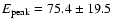 keV, the best-fit low energy photon index
 and a fixed high energy
photon index
and a fixed high energy
photon index
 ,
the isotropic-equivalent energy
integrated from 1 to 104 keV in the explosion rest frame is
,
the isotropic-equivalent energy
integrated from 1 to 104 keV in the explosion rest frame is
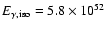 erg (Palmer et al. 2006).
- began to observe this burst 58 s after the BAT
trigger time. At the same time, -UVOT started the on-target
monitoring and detected the optical afterglow (Boyd et al. 2006).
A number of ground-based telescopes performed follow up
observations. The 2-m robotic Liverpool Telescope began to observe
it at t=309 s and carried out multicolor r'i'z' photometry. In
the R-band the light-curve exhibited three obvious bumps in the
first 75 min including a steep rise (
began to observe this burst 58 s after the BAT
trigger time. At the same time, -UVOT started the on-target
monitoring and detected the optical afterglow (Boyd et al. 2006).
A number of ground-based telescopes performed follow up
observations. The 2-m robotic Liverpool Telescope began to observe
it at t=309 s and carried out multicolor r'i'z' photometry. In
the R-band the light-curve exhibited three obvious bumps in the
first 75 min including a steep rise (
 at
at
 s) (Monfardini et al. 2006). About 48.1 min
later after the trigger time, the Rapid Telescopes for Optical
Response (RAPTOR) system at Los Alamos National Laboratory began
to take optical images. The obtained light curve
confirmed the rebrightening from
s) (Monfardini et al. 2006). About 48.1 min
later after the trigger time, the Rapid Telescopes for Optical
Response (RAPTOR) system at Los Alamos National Laboratory began
to take optical images. The obtained light curve
confirmed the rebrightening from
 to a peak value
 .
The subsequent decline to
.
The subsequent decline to
 at
t=80 min was followed by a secondary rebrightening by
at
t=80 min was followed by a secondary rebrightening by
 around t=90 min (
 et al. 2006). The MDM telescope observed a smooth break at
 days with another bump at
 s. The overall X-ray
light curve has a similar shape as the optical light curve (Stanek
et al. 2007).
s. The overall X-ray
light curve has a similar shape as the optical light curve (Stanek
et al. 2007).
One of the most remarkable features of this burst is that the
optical light curve had a significant rebrightening and exhibited small
``bumps'' and ``wiggles''. Similar bumps and wiggles have also
been seen in a number of optical afterglows (Stanek et al. 2007).
GRB 970508 had an optical afterglow light curve rather
similar to that of GRB 060206 (Galama et al. 1998). The
optical light curve of another recent burst, GRB 060210, also
displayed a rebrightening at time  s and a
shallow decay in the early epoch. The above ``unusual'' behavior, which is not predicted by the standard fireball model, may be more the norm
than the exception (Stanek et al. 2007).
s and a
shallow decay in the early epoch. The above ``unusual'' behavior, which is not predicted by the standard fireball model, may be more the norm
than the exception (Stanek et al. 2007).
Possible scenarios for the remarkable rebrightening in GRB 060206
at 3000 s are a renewed energy injection (Rees & Mészáros 1998; Kumar & Piran 2000; Sari & Mészáros 2000) and a density-jump
in the circum-burst medium (Dai & Lu 2002). However, as discussed
by Monfardini et al. (2006), the X-ray band frequency is above the
cooling frequency at
 s, so the flux does not depend
on the ambient density (Freedman & Waxman 2001). Nakar
& Granot (2007) showed that even a sharp and large increase
in the ambient medium density cannot produce a significant
rebrightening as seen in the afterglow. So the rebrightening
cannot be due to a density jump in the ambient medium. If the
rebrightening is caused by energy injection, a huge impulsive
energy injection
s, so the flux does not depend
on the ambient density (Freedman & Waxman 2001). Nakar
& Granot (2007) showed that even a sharp and large increase
in the ambient medium density cannot produce a significant
rebrightening as seen in the afterglow. So the rebrightening
cannot be due to a density jump in the ambient medium. If the
rebrightening is caused by energy injection, a huge impulsive
energy injection
 at 3000 s was
required, where E0 is the blast wave energy before the
rebrightening.
at 3000 s was
required, where E0 is the blast wave energy before the
rebrightening.
In this paper, we present an alternative scenario. The central
engine of this burst become active again after the
initial burst and ejects another more collimated jet
with a larger viewing angle. This jet and the initial jet sweep up
the interstellar medium (ISM). The multi-wavelength emission
predicted by this model
can reproduce both the observed X-ray and optical data.
The observational results are presented in Sect. 2. We describe the
scenario in Sect. 3 and fit the remarkable optical
rebrightening of GRB 060206 in Sect. 4. Finally, we summarize our
results and discuss their implications in Sect. 5.
The R-band light curve of GRB 060206 contains five distinct bumps
detected by telescopes mentioned in Sect. 1. Monfardini et al. (2006)
attempted to describe the optical afterglow by applying an empirical
model, which consists of a sum of smoothly-connected broken
power-law functions
![\begin{displaymath}F_{\nu}(t)=\sum_j F_j
\left[\frac{2}{(t/t_j)^{-\alpha_{1,j}\cdot n}+(t/t_j)^{-\alpha_{2,j}\cdot n}}\right]^{1/n}, \end{displaymath}](/articles/aa/full/2008/32/aa8783-07/img24.gif) |
(1) |
where
 and
and
 are the pre-bump and post-bump temporal indices
of the jth-bump, and n is the sharpness parameter. By fitting
the R-band light curve, they are able to obtain temporal information
about every bump and the break at 53 000 s of post-break index
are the pre-bump and post-bump temporal indices
of the jth-bump, and n is the sharpness parameter. By fitting
the R-band light curve, they are able to obtain temporal information
about every bump and the break at 53 000 s of post-break index
 (see Table 2 of Monfardini et al. 2006). The
post-bump indices of the 1st, 2nd, and 4th bumps are
(see Table 2 of Monfardini et al. 2006). The
post-bump indices of the 1st, 2nd, and 4th bumps are
 ,
1.0 and
,
1.0 and
 ,
respectively,
which are consistent with a typical value 3(p-1)/4 or (3p-2)/4in the normal decay phase predicted by the standard afterglow model
(Sari et al. 1998). If we fit the 5th bump independently, its
post-bump index follows obviously the normal decay slope. As shown
in Stanek et al. (2007), the X-ray light curve demonstrated similar
behavior to the optical light curve. There were only two X-ray
observations before 3000 s of temporal index
,
respectively,
which are consistent with a typical value 3(p-1)/4 or (3p-2)/4in the normal decay phase predicted by the standard afterglow model
(Sari et al. 1998). If we fit the 5th bump independently, its
post-bump index follows obviously the normal decay slope. As shown
in Stanek et al. (2007), the X-ray light curve demonstrated similar
behavior to the optical light curve. There were only two X-ray
observations before 3000 s of temporal index  .
The
later X-ray light curve exhibited clear short timescale variations,
but corresponding bumps were not seen.
.
The
later X-ray light curve exhibited clear short timescale variations,
but corresponding bumps were not seen.
Multi-epoch spectral energy distribution (SED) analysis revealed
either an SED evolution or an additional unresolved activity (or
both) during the early time interval from  s to
s based on the i' and z' photometric data
(Monfardini et al. 2006). At a later time, the infrared to X-ray
fluxes (after a significant rebrightening) can be fitted by a single
power law with a spectral index
s to
s based on the i' and z' photometric data
(Monfardini et al. 2006). At a later time, the infrared to X-ray
fluxes (after a significant rebrightening) can be fitted by a single
power law with a spectral index
 .
However, a
broken power law with
.
However, a
broken power law with
 and
and
 cannot be
ruled out.
cannot be
ruled out.
It is generally accepted that long GRBs (duration > 2 s)
originate in collapsars (Woosley 1993;
MacFadyen & Woosley 1999), while short GRBs, of duration
less than 2 s, are associated with the merging of compact objects
(see Nakar 2007, for a review). In both scenarios of
GRB origins, a hot and dense accretion disk formed possibly around the
GRB central engine.
Reynoso et al. (2006) argued that a rotating black hole
could induce the surrounding neutrino-cooled accretion disk
to precess and nutate. The precession period varied between
approximately 0.01 s and 10 s for typical central engines.
Therefore, even if the jet producing the main burst is along
the line-of-sight (LOS), the collimated outflow supplied
by the late activity of the central engine is possibly
off-LOS due to the precession of either the torus or the accretion
disk. The interaction of the off-LOS outflow with
the ambient medium could play an important role in
the GRB afterglow emissions, e.g., produce a rebrightening as
observed in the afterglow of GRB 060206.
In our scenario illustrated in Fig. 1, the accretion-powered GRB
central engine firstly generates a jet (denoted by Jet A) along
LOS, which produces the observed prompt  -ray emission. The
interaction between Jet A and the ambient medium is responsible
for the first part of the afterglow until the large rebrightening. A
period
-ray emission. The
interaction between Jet A and the ambient medium is responsible
for the first part of the afterglow until the large rebrightening. A
period  later, the central engine ejects the second jet
(denoted by Jet B) at a larger viewing angle preventing
-ray detection. By assuming that the isotropic energy of
Jet B is, however, significantly higher than that of Jet A, the
off-axis afterglow emission from Jet B produces significant
rebrightening at lower energies. The two jets should also not
intersect, and therefore collide, with each other.
later, the central engine ejects the second jet
(denoted by Jet B) at a larger viewing angle preventing
-ray detection. By assuming that the isotropic energy of
Jet B is, however, significantly higher than that of Jet A, the
off-axis afterglow emission from Jet B produces significant
rebrightening at lower energies. The two jets should also not
intersect, and therefore collide, with each other.
Pre-large rebrightening. Emission from the forward shock,
driven by Jet A, interacts with the ambient medium to produce an
afterglow for up to 3000 s; during this time, the temporal decay
indices of the two small bumps are similar to the values predicted
by the standard fireball model. There is no signature of reverse
shock emission, which possibly ceases at very early times.
Alternatively, the reverse shock emission could be suppressed by the
magnetization of the ejecta (Zhang & Kobayashi 2005) and many other
physical processes (Kobayashi 2000; Nakar & Piran 2004; Kobayashi
et al. 2007; Jin et al. 2007). We consider that the cold Jet Awith a total isotropic kinetic energy
 erg propagates into the ambient
medium with a constant density n1. A forward shock emerges and
energizes the surrounding materials by converting the bulk kinetic
energy of the jet into the internal energy of the shocked materials.
This internal energy is assumed to be shared by electrons and
magnetic fields with energy equipartition factors
erg propagates into the ambient
medium with a constant density n1. A forward shock emerges and
energizes the surrounding materials by converting the bulk kinetic
energy of the jet into the internal energy of the shocked materials.
This internal energy is assumed to be shared by electrons and
magnetic fields with energy equipartition factors
 and
and
 ,
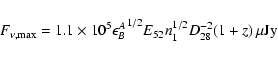
respectively. If the shock is adiabatic, the
synchrotron emission produced by slow cooling electrons is expected
to have a peak flux
,
respectively. If the shock is adiabatic, the
synchrotron emission produced by slow cooling electrons is expected
to have a peak flux
 |
(2) |
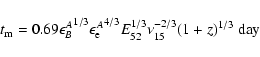
at time
 |
(3) |
which is
defined to be the time at which the typical synchrotron frequency
 crosses the observed frequency
 Hz (Sari
et al. 1998). The luminosity distance of the burst is
Hz (Sari
et al. 1998). The luminosity distance of the burst is
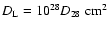 .
.
For GRB 060206, no early flux peaks were detected in the optical and X-ray
bands, even at  s. It is reasonable to
believe that the flux peak time was less than
s. It is reasonable to
believe that the flux peak time was less than
 .
A lower limit to the peak flux
.
A lower limit to the peak flux
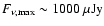 can be obtained accordingly, by
extrapolating the R-band flux of the first post-bump back to 200 s.
Since the optical flux peak was at time
can be obtained accordingly, by
extrapolating the R-band flux of the first post-bump back to 200 s.
Since the optical flux peak was at time  and a cooling break in
the X-ray afterglow was not observed, the orderof the frequencies,
after the flux peak, was
and a cooling break in
the X-ray afterglow was not observed, the orderof the frequencies,
after the flux peak, was
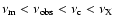 ,
where
,
where
 is the cooling frequency and
 is the typical X-ray frequency. The redshift of GRB 060206 is known, so the isotropic
energy of its first jet
is the typical X-ray frequency. The redshift of GRB 060206 is known, so the isotropic
energy of its first jet
 is
is
 erg.
The energy equipartition factors of magnetic fields
and electrons, according to Eqs. (2) and (3), can be constrained if the number density of the
ambient medium is known. The spectral analysis revealed a high
number density in the environment of GRB 060206 (Fynbo et al. 2006).
Given a rational value of n1=50
erg.
The energy equipartition factors of magnetic fields
and electrons, according to Eqs. (2) and (3), can be constrained if the number density of the
ambient medium is known. The spectral analysis revealed a high
number density in the environment of GRB 060206 (Fynbo et al. 2006).
Given a rational value of n1=50
 ,
it can be proven
that
,
it can be proven
that
 and
and
 .
Our subsequent numerical results are consistent with this
constraint. We calculate the forward shock synchrotron emission from
Jet A that reproduces the first post-bump segment of the R-band
light curve of temporal index
,
which implies
an electron energy spectral index
.
Our subsequent numerical results are consistent with this
constraint. We calculate the forward shock synchrotron emission from
Jet A that reproduces the first post-bump segment of the R-band
light curve of temporal index
,
which implies
an electron energy spectral index
 .
.
Large rebrightening. The large rebrightening is due to the
off-axis emission from the second beamed jet. The off-axis effects
can generate a fast rise light curve, and the gamma-ray emission,
from internal shocks in the second jet, would not trigger
-BAT due to the large viewing angle and the
initially large Lorentz factor when the condition
 is fulfilled, where
  is the initial bulk Lorentz factor of Jet B. The half opening angle
of Jet B can be estimated by the measured jet break time
is the initial bulk Lorentz factor of Jet B. The half opening angle
of Jet B can be estimated by the measured jet break time
 s (e.g., Frail et al. 2001)
 |
|
|
(4) |
The half opening angle and isotropic kinetic energy
 of Jet B can be obtained only by numerical fitting to the rebrightening
and the late afterglow light curve.
of Jet B can be obtained only by numerical fitting to the rebrightening
and the late afterglow light curve.
When Jet A/B sweeps up the ambient medium,
a pair of shocks could be generated, including a
forward shock propagating into the medium and a
reverse shock penetrating into the ejecta. However, as analyzed
above, the reverse shock driven by Jet A can
be ignored for the afterglow phase of interest, whereas it
may be necessary to consider the contribution of
the reverse shock to the afterglow emissions for Jet B. We would therefore describe the dynamics of the two jets in
different ways.
The evolution
of the forward shock driven by Jet A with an
initial Lorentz factor  follows the
equation (Huang et al. 2000)
follows the
equation (Huang et al. 2000)
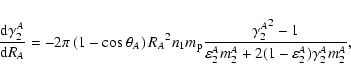 |
(5) |
where  is the mass of the proton,
 is the
bulk Lorentz factor of the forward shock, and
is the
bulk Lorentz factor of the forward shock, and
 is the radiative efficiency of the
forward-shocked electrons. In our calculations, we take
adiabatic shock assumption and thus
is the radiative efficiency of the
forward-shocked electrons. In our calculations, we take
adiabatic shock assumption and thus
 .
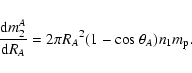
The swept-up mass mA2 by the shock is determined by
.
The swept-up mass mA2 by the shock is determined by
 |
(6) |
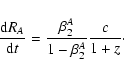
Finally, for describing the temporal
behavior of the shock, we refer to the equation
 |
(7) |
With respect to Jet A,
the consideration of Jet B is more complicated
because of the involvement of the reverse shock. The system is
divided into four regions by the two shocks and the
contact discontinuity surface: the unshocked medium, the
shocked medium, the shocked ejecta, and the unshocked
ejecta, which is denoted by 1-4, respectively. Since the
Lorentz factor
and energy density e are
continuous along the contact discontinuity, we have
 and
eB2=eB3 (Sari & Piran
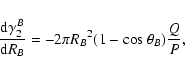
1995). The hydrodynamics of the forward-reverse shock
pairs are determined by (Huang et al. 2000; Yan et al. 2007)
and
eB2=eB3 (Sari & Piran
1995). The hydrodynamics of the forward-reverse shock
pairs are determined by (Huang et al. 2000; Yan et al. 2007)
 |
(8) |
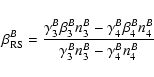
where the convenient parameters Qand Pare defined in Yan et al. (2007) to be
where  ,
,
 and
and
 |
(10) |
are the velocities of the shocked medium,
unshocked ejecta, and the reverse shock in the observer's frame,
respectively.
The relative Lorentz factor of region 3 with respect to
region 4 is
 .
The radiative
efficiency
.
The radiative
efficiency
 of region i (i=2, 3) is
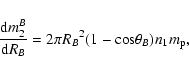
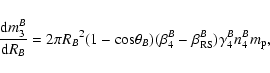
equal to zero for the adiabatic shock. The mass mB2swept up by the forward shock
and mB3 by the reverse shock, can be calculated
respectively, by
of region i (i=2, 3) is
equal to zero for the adiabatic shock. The mass mB2swept up by the forward shock
and mB3 by the reverse shock, can be calculated
respectively, by
 |
(11) |
 |
(12) |
where the comoving number density
of the unshocked ejecta is expressed
as
 where
and
where
and  are the
kinetic energy and the width of Jet B, respectively.
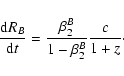
The temporal evolution of the radius RB of
Jet B satisfies the same equation as that of Jet A, which reads
are the
kinetic energy and the width of Jet B, respectively.
The temporal evolution of the radius RB of
Jet B satisfies the same equation as that of Jet A, which reads
 |
(13) |
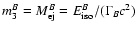
After the reverse shock crosses the ejecta, the Lorentz
factor of
the reverse-shocked ejecta follows
 and the mass of the shocked
ejecta remains constant
and the mass of the shocked
ejecta remains constant
 .
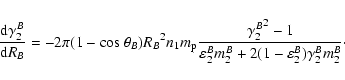
However, the forward shock
continues to sweep up the external medium, evolving in a
similar way to Jet Adescribed by Eq. (5) as
.
However, the forward shock
continues to sweep up the external medium, evolving in a
similar way to Jet Adescribed by Eq. (5) as
 |
(14) |
Due to the existence of the shocks, the bulk kinetic energy
of the ejecta should be gradually converted to the
internal energy e of the shocked materials,
which is shared between magnetic fields, electrons and
protons according to the fractions
 ,
,
 and
and
 ,
respectively.
,
respectively.
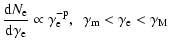
It is accepted in general that the synchrotron radiation of the
shocked electrons produces the observed X-ray and optical afterglow
emissions. In a detailed calculation, we consider, as often assumed,
that the electrons without energy losses are accelerated by the
shocks in a way described by a power law distribution
 |
|
|
(15) |
with a minimum Lorentz factor
 and a maximum Lorentz
factor
and a maximum Lorentz
factor
 .
Another
critical Lorentz factor
.
Another
critical Lorentz factor
 ,
above which the energy losses of
the electrons due to both synchrotron and inverse Compton (IC)
radiation is significant, was derived by Sari et al. (1998). The
actual distribution of the electrons should be given according to
the following cases (Sari et al. 1998; Yan et al. 2007) as
,
above which the energy losses of
the electrons due to both synchrotron and inverse Compton (IC)
radiation is significant, was derived by Sari et al. (1998). The
actual distribution of the electrons should be given according to
the following cases (Sari et al. 1998; Yan et al. 2007) as
 |
|
|
(16) |
 |
|
|
(17) |
To be specific, the three characteristic Lorentz factors for the
distribution of the electrons can be calculated by
 ,
,
 and
and
![$\gamma_{\rm c}=6\pi m_{\rm e}c(1+z)/[(1+Y)\sigma_T\gamma{B}^2t]$](/articles/aa/full/2008/32/aa8783-07/img101.gif) ,
where the
magnetic field strength
,
where the
magnetic field strength
 ,
the relative
Lorentz factor
,
the relative
Lorentz factor
 is taken to be
 for
the reverse-shocked region and
for
the reverse-shocked region and  for the forward-shocked
region, and the Compton parameter Y is defined as the ratio
between the IC and synchrotron luminosities (Sari et al. 1998;
Sari & Esin 2001).
for the forward-shocked
region, and the Compton parameter Y is defined as the ratio
between the IC and synchrotron luminosities (Sari et al. 1998;
Sari & Esin 2001).
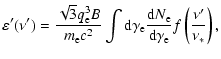
Using the derived electron distribution,
we can calculate the synchrotron emissivity to be (Rybicki &
Lightman 1979)
 |
|
|
(18) |
where  is the electron charge,
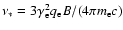 ,
,
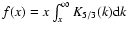 with
K5/3(k) being the modified Bessel function.
By integrating over all of the emitting regions, we derive the observed
synchrotron flux density at a frequency
with
K5/3(k) being the modified Bessel function.
By integrating over all of the emitting regions, we derive the observed
synchrotron flux density at a frequency  to be (Huang et al. 2000)
![$\displaystyle F_{\nu}(t)={1\over 4\pi D_{L}^2}\int
{\rm d}V'{\varepsilon'[\gamma(1-\beta\mu)\nu(1+z)]\over[\gamma(1-\beta\mu)]^3},$](/articles/aa/full/2008/32/aa8783-07/img111.gif) |
|
|
(19) |
where
 is the cosine value of the angle
  between the velocity of emitting materials and LOS. Taking into
account the time delay between the emissions from different
latitudes, the above integration should be performed on the
so-called equal-arrival-time surface that is determined by (Huang
et al. 2000)
between the velocity of emitting materials and LOS. Taking into
account the time delay between the emissions from different
latitudes, the above integration should be performed on the
so-called equal-arrival-time surface that is determined by (Huang
et al. 2000)
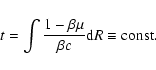 |
(20) |
From the obtained numerical synchrotron spectra, two break
frequencies appear, that is,
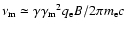 and
and
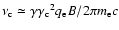 ,
which correspond
to the characteristic Lorentz factors
and
,
respectively. The peak flux at min{
,
which correspond
to the characteristic Lorentz factors
and
,
respectively. The peak flux at min{
 } is
} is
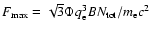 ,
where
,
where  is an
integrating coefficient from Eq. (18) (Wijers & Galama
1999). These characteristic quantities are applied in our analysis
in Sect. 3.
is an
integrating coefficient from Eq. (18) (Wijers & Galama
1999). These characteristic quantities are applied in our analysis
in Sect. 3.
We also take into account the
synchrotron self-absorption effect, which implies that a
correction should be applied to spectra below the synchrotron self-absorption
frequency
 as performed by Wu et al. (2003) and Zou
et al. (2005).
as performed by Wu et al. (2003) and Zou
et al. (2005).
Table 1:
The main parameters adopted in our calculations.
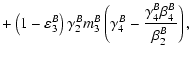
Using the model described above with parameter values as listed in
Table 1, we describe numerically the R-band afterglow data of GRB 060206 in Fig. 2. As can be seen, the first post-bump in the light
curve can be reproduced well using the forward shock emission from
Jet A. Both the forward- and reverse-shock light curves of Jet Bare also presented in Fig. 2. The large rebrightening can be
attributed mainly to the forward shock emission from Jet B because
the off-axis effect suppresses the peak flux of the reverse-shock
emission, which usually peaks at a few hundred seconds from its
beginning. For Jet A, we observe that the values of
,
,
and n1 are consistent with our
analysis in Sect. 3. For Jet B, we adopt typical values of 0.1 for
 and 0.01 for
 since there is no
observational constraint on the shock parameters. The shock
parameters
since there is no
observational constraint on the shock parameters. The shock
parameters
 for different jets and/or
for different shocked regions may be different as found for the
two-component jets model (Jin et al. 2007) and the forward-reverse
shock model (Fan et al. 2002). The off-axis effect alone cannot
explain the fast rise in the large rebrightening. In addition, the
zero time effect can steepen the rise further (Zhang et al. 2006;
Liang et al. 2006). We find that the time delay between the two jets
is
for different jets and/or
for different shocked regions may be different as found for the
two-component jets model (Jin et al. 2007) and the forward-reverse
shock model (Fan et al. 2002). The off-axis effect alone cannot
explain the fast rise in the large rebrightening. In addition, the
zero time effect can steepen the rise further (Zhang et al. 2006;
Liang et al. 2006). We find that the time delay between the two jets
is
 s, which agrees with the rising segment, the
subsequent normal decay phase, and the break in the light curve at
late times.
s, which agrees with the rising segment, the
subsequent normal decay phase, and the break in the light curve at
late times.
It should be noted that the parameters ( ,
,
 ,
)
for Jet A, (
,
)
for Jet A, ( ,
,
 ,
,
,
,
,
)
for Jet B and the number density of the
ambient medium n1 are not exclusively
determined. The jet break time for Jet A is hidden by the
dominating emission of Jet B, while the isotropic kinetic energy
of Jet B cannot be measured because its gamma-ray emission cannot
trigger the detector. The most appropriate method for determining
the parameter values depends upon the following ingredients: (1) we
fit the observational R-band data of the first post-bump segment to
constrain the values of
and
combined with the
known isotropic gamma-ray energy of Jet A, (2) typical values of
,
and
are used for Jet B, (3) the
off-axis angle
cannot be too large, otherwise an
abnormally large isotropic energy for Jet B is required, (4) the
condition of
should be
satisfied to avoid the detection of gamma-ray emission from Jet B,
and (5) to simplify the calculation, we assume that the path of
Jet A does not intersect with that of Jet B, which requires that
,
,
,
,
,
)
for Jet B and the number density of the
ambient medium n1 are not exclusively
determined. The jet break time for Jet A is hidden by the
dominating emission of Jet B, while the isotropic kinetic energy
of Jet B cannot be measured because its gamma-ray emission cannot
trigger the detector. The most appropriate method for determining
the parameter values depends upon the following ingredients: (1) we
fit the observational R-band data of the first post-bump segment to
constrain the values of
and
combined with the
known isotropic gamma-ray energy of Jet A, (2) typical values of
,
and
are used for Jet B, (3) the
off-axis angle
cannot be too large, otherwise an
abnormally large isotropic energy for Jet B is required, (4) the
condition of
should be
satisfied to avoid the detection of gamma-ray emission from Jet B,
and (5) to simplify the calculation, we assume that the path of
Jet A does not intersect with that of Jet B, which requires that
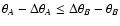 .
.
![\begin{figure}
\par\includegraphics[angle=0,width=9cm,clip]{8783fig2.eps}
\end{figure}](/articles/aa/full/2008/32/aa8783-07/Timg173.gif) |
Figure 2:
R-band light curve of
GRB 060206. ``FE''
and ``RE'' represent the forward shock emission and the reverse
shock emission, respectively. The dotted line
represents the contribution from Jet A. The thick, dashed
line and the thin, dashed line correspond to the emissions from the
forward shock and the reverse shock of Jet B,
respectively. The dash-dotted lines represent the emission
from Jet B taking into account the zero-time effect. The
thick, solid line includes the contribution from both Jet A and Jet B. R-band data are taken from
Monfardini et al. (2006), Stanek et al. (2007) and
et al. (2006). |
| Open with DEXTER |
We have presented a solution for the remarkable rebrightening
observed
in the afterglow of GRB 060206, which is
attributed to emission from an off-axis beamed jet
originating from the late activity of the central engine
after the prompt gamma-ray emission phase. We have argued that
the precession of the torus or accretion disk of the
central engine has caused the two jets to move in different directions.
Although we only attempt to describe the large rebrightening, it is
reasonable to speculate that the five bumps in the R-band
afterglow light curve of similar profiles may have the
similar origins: emission from different delayed off-axis
jets ejected by the GRB central engine.
The difference between the temporal indices of the five
post-bump
light curves indicates that the electrons in
different jets have different spectral indices p for their
electron distributions. As a result, the spectra exhibit
an SED evolution, especially when the separate jets have
comparable contributions to the total emission. This
can be naturally explained by the significant SED evolution
in GRB 060206 detected by the Liverpool Telescope
(Monfardini et al. 2006).
The isotropic energy of the second jet is more than
one order of magnitude higher than the first jet in our
scenario. The collimation-corrected energy of Jet Bis 4.3 times larger than Jet A, which is larger
than the energy required to explain the big rebrightening
in the energy injection model as mentioned in Sect. 1.
The precise mechanism that triggers the central engine again
remains unknown. One possibility is that a mass of debris falls
back onto the central compact object, generating another
more energetic jet. Since our scenario can reproduce well
the observations of the large bump in GRB 060206, as a conservative
extrapolation, we propose that GRB 970508 and GRB 060210,
which display remarkable rebrightening, may
have in addition a precessing torus or accretion disk.
A further consequences of our scenario is that the jet break is
determined by the off-axis second jet rather than the first one,
which produces the main burst. In this case, we cannot measure the
isotropic energy of the second jet directly and must fit the
afterglow data to obtain an estimation. When a large bump appears in
GRB afterglows, we are therefore unlikely to be able to derive the
jet opening angle, using the break time and isotropic gamma-ray
energy release, because these two quantities originate in two
different jets (Stanek et al. 2007).
Finally, several models could be applied to explain afterglow
light curves exhibiting rebrightening. These include variable
external density profiles (Lazzati et al. 2002), refreshed shocks
(Granot et al. 2003; Bj
 rnsson et al. 2004), and angular dependence of
the energy profile on the jet structure (Nakar et al. 2003), each
of which can play a role. Peculiar behavior in light
curves caused by the precession of the central engine was
discussed by Reynoso et al. (2006), although more observations are required
to identify its true nature.
rnsson et al. 2004), and angular dependence of
the energy profile on the jet structure (Nakar et al. 2003), each
of which can play a role. Peculiar behavior in light
curves caused by the precession of the central engine was
discussed by Reynoso et al. (2006), although more observations are required
to identify its true nature.
Acknowledgements
We would like to thank the anonymous referee's
constructive comments and suggestions which improved our
paper significantly. X.W. Liu thanks D.M. Wei for his encouragement to accomplish
this work. We thank Y.F. Huang, Y.W. Yu, Y. Li and L. Shao for helpful
discussions. This work was supported by the National Natural
Science Foundation of China (grants 10473023, 10503012, 10621303,
and 10633040). XFW gratefully acknowledges Re'em Sari during his
visit to Caltech, also thanks the supports of China Postdoctoral
Science Foundation, K.C. Wong Education Foundation (Hong Kong),
and Postdoctoral Research Award of Jiangsu Province.
- Boyd, P., Hunsberger,
S., & Gronwall, C. 2006, GCN Circ., 4684 [NASA ADS]
(In the text)
- Bj
 rnsson, G., Gudmundsson, E. H., & Jóhannesson,
G. 2004, ApJ, 615, L77 [NASA ADS] [CrossRef]
rnsson, G., Gudmundsson, E. H., & Jóhannesson,
G. 2004, ApJ, 615, L77 [NASA ADS] [CrossRef]
- Dai, Z. G., & Lu, T.
2002, ApJ, 565, L87 [NASA ADS] [CrossRef]
(In the text)
- Fan, Y. Z., Dai, Z. G.,
Huang, Y. F., & Lu, T., et al. 2002, Chin. J. Astron.
Astrophys., 2, 449 [NASA ADS]
(In the text)
- Freedman, D.
L., & Waxman, E. 2001, ApJ, 547, 922 [NASA ADS] [CrossRef]
(In the text)
- Fynbo, J. P. U.,
Starling, R. L. C., Ledoux, C., et al. 2006, A&A, 451, L47 [NASA ADS] [CrossRef] [EDP Sciences]
(In the text)
- Frail, D. A.,
Kulkarni, S. R., Sari, R., et al. 2001, ApJ, 562, L55 [NASA ADS] [CrossRef]
(In the text)
- Galama, T. J.,
Groot, P. J., van Paradijs, J., et al. 1998, ApJ, 497, L13 [NASA ADS] [CrossRef]
(In the text)
- Granot, J., Nakar,
E., & Piran, T. 2003, Nature, 426, 138 [NASA ADS] [CrossRef]
(In the text)
- Huang, Y. F., Gou, L.
J., Dai, Z. G., & Lu, T. 2000, ApJ, 543, 90 [NASA ADS] [CrossRef]
(In the text)
- Jin, Z. P., Yan, T., Fan,
Y. Z., & Wei, D. M. 2007, ApJ, 656, L57 [NASA ADS] [CrossRef]
(In the text)
- Kobayashi, S.
2000, ApJ, 545, 807 [NASA ADS] [CrossRef]
(In the text)
- Kobayashi,
S., Zhang, B., Mészáros, P., & Burrows, D. N. 2007,
ApJ, 655, 391 [NASA ADS] [CrossRef]
(In the text)
- Kumar, P., &
Piran, T. 2000, ApJ, 532, 286 [NASA ADS] [CrossRef]
(In the text)
- Lazzati, D.,
Rossi, E., Covino, S., Ghisellini, G., & Malesani, D. 2002,
A&A, 396, L5 [NASA ADS] [CrossRef] [EDP Sciences]
(In the text)
- Liang, E. W., Zhang,
B., O'Brien, P. T., et al. 2006, ApJ, 646, 351 [NASA ADS] [CrossRef]
(In the text)
- MacFadyen, A.
I., & Woosley, S. E. 1999, ApJ, 524, 262 [NASA ADS] [CrossRef]
(In the text)
- Morris, D. C.,
Burrows, D., Gehrels, N., et al. 2006, GCN Circ., 4682 [NASA ADS]
(In the text)
- Monfardini,
A., Kobayashi, S., Guidorzi, C., et al. 2006, ApJ, 648, 1125 [NASA ADS] [CrossRef]
(In the text)
- Nakar, E. 2007, Phys.
Rep., 442, 166 [NASA ADS] [CrossRef]
(In the text)
- Nakar, E., &
Granot, J. 2007, MNRAS, 380, 1744 [NASA ADS] [CrossRef]
- Nakar, E., &
Piran, T. 2004, MNRAS, 353, 647 [NASA ADS] [CrossRef]
(In the text)
- Nakar, E., Piran, T.,
& Granot, J. 2003, NewA, 8, 495 [NASA ADS] [CrossRef]
(In the text)
- Nousek, J. A.,
Kouveliotou, C., Grupe, D., et al. 2006, ApJ, 642, 389 [NASA ADS] [CrossRef]
- O'Brien, P. T.,
Willingale, R., Osborne, J., et al. 2006, ApJ, 647, 1213 [NASA ADS] [CrossRef]
- Palmer, D.,
Barbier, L., Barthelmy, S., et al. 2006, GCN Circ., 4697 [NASA ADS]
(In the text)
- Rees, M. J., &
Mészáros, P. 1998, ApJ, 496, L1 [NASA ADS] [CrossRef]
(In the text)
- Reynoso, M. M.,
Romero, G. E., & Sampayo, O. A. 2006, A&A, 454, 11 [NASA ADS] [CrossRef] [EDP Sciences]
(In the text)
- Rybicki, G. B.,
& Lightman, A. P. 1979, Radiative Processes in Astrophysics
(New York: Wiley)
(In the text)
- Sari, R., & Esin,
A. A. 2001, ApJ, 548, 787 [NASA ADS] [CrossRef]
(In the text)
- Sari, R., &
Mészáros, P. 2000, ApJ, 535, L33 [NASA ADS] [CrossRef]
(In the text)
- Sari, R., & Piran,
T. 1995, ApJ, 455, L143 [NASA ADS] [CrossRef]
(In the text)
- Sari, R., Piran, T.,
& Narayan, R. 1998, ApJ, 497, L17 [NASA ADS] [CrossRef]
(In the text)
- Stanek, K. Z., Dai,
X., Prieto, J. L., et al. 2007, ApJ, 654, L21 [NASA ADS] [CrossRef]
(In the text)
- Wo
 niak, P. R., Vestrand, W. T., Wren, J. A., et al. 2006,
ApJ, 642, L99 [NASA ADS] [CrossRef]
(In the text)
niak, P. R., Vestrand, W. T., Wren, J. A., et al. 2006,
ApJ, 642, L99 [NASA ADS] [CrossRef]
(In the text) - Wijers, R. A. M.
J., & Galama, T. J. 1999, ApJ, 523, 177 [NASA ADS] [CrossRef]
(In the text)
- Woosley, S. E.
1993, ApJ, 405, 273 [NASA ADS] [CrossRef]
(In the text)
- Wu, X. F., Dai, Z. G.,
Huang, Y. F., & Lu, T. 2003, MNRAS, 342, 1131 [NASA ADS] [CrossRef]
(In the text)
- Yan, T., Wei, D. M.,
& Fan, Y. Z. 2007, Chin. J. Astron. Astrophys, 7, 777 [NASA ADS] [CrossRef]
(In the text)
- Zhang, B., &
Kobayashi, S. 2005, ApJ, 628, 315 [NASA ADS] [CrossRef]
(In the text)
- Zhang, B., Fan, Y.
Z., Dyks, J., et al. 2006, ApJ, 642, 354 [NASA ADS] [CrossRef]
(In the text)
- Zou, Y. C., Wu, X. F.,
& Dai, Z. G. 2005, MNRAS, 363, 93 [NASA ADS] [CrossRef]
(In the text)
Copyright ESO 2008
![\begin{figure}
\par\includegraphics[width=8.8cm,clip]{8783fig1.eps}
\end{figure}](/articles/aa/full/2008/32/aa8783-07/img37.gif)


![\begin{figure}
\par\includegraphics[angle=0,width=9cm,clip]{8783fig2.eps}
\end{figure}](/articles/aa/full/2008/32/aa8783-07/img173.gif)