![\begin{figure}
\par\includegraphics[width=12cm,clip]{9321fig1.ps}
\end{figure}](/articles/aa/full/2008/16/aa9321-07/img62.gif) |
Figure 1:
EOS for water, rock and iron for two temperatures: T=300 K for ANEOS (red solid line) and SESAME (blue dash-dotted curve); T=6000 K for ANEOS (red short-dashed curve) and SESAME (blue dotted curve). The long-dashed (magenta) curves correspond to the zero-temperature EOS of Seager et al. (2007; their Table 3). The inset in the lower panel (water) shows a zoom of the  relation for
 . . |
| Open with DEXTER | |
In the text
![\begin{figure}
\par\includegraphics[width=8cm,clip]{9321fig2.ps}\end{figure}](/articles/aa/full/2008/16/aa9321-07/img68.gif) |
Figure 2: Pressure (in dyne cm-2) and temperature (in K) dependence of the entropy (in erg/g/s), as obtained for water for the ANEOS EOS (solid line) and the SESAME EOS (dash-line). The entropy for a H/He fluid, with Y=0.275 obtained with the SCVH EOS is shown for comparison (dash-dotted line). Upper panel: for each EOS, three isobars are displayed (the corresponding pressure is given on the right hand side of the figure). Lower panel: three isotherms are shown for each EOS (corresponding temperatures given on the right hand side of the figure). The T and P domains characteristic of Neptune-like and Jupiter-like planet interiors are indicated. |
| Open with DEXTER | |
In the text
![\begin{figure}
\par\includegraphics[width=7.4cm,clip]{9321fig3.ps}
\end{figure}](/articles/aa/full/2008/16/aa9321-07/img102.gif) |
Figure 3:
Effect of the composition and internal distribution of heavy elements on the radius
evolution for a planet of mass
 with a total heavy element mass
fraction
with a total heavy element mass
fraction
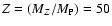 %.
a) Models with %.
a) Models with
 of water (solid line), rock (dashed-line)
and iron (dotted line), and
of water (solid line), rock (dashed-line)
and iron (dotted line), and
 .
b) Models with no core and heavy elements distributed over the entire planet.
Dash-dotted line: mixture of H/He + Z described by the SCVH EOS with .
b) Models with no core and heavy elements distributed over the entire planet.
Dash-dotted line: mixture of H/He + Z described by the SCVH EOS with
 .
Long-dashed line: mixture of H/He + water (SESAME EOS)
using the additive volume law. Short-dashed line:
mixture of H/He + water (ANEOS EOS) using the additive volume law. For comparison,
the model with
of water and
is shown by the solid line.
c) More realistic models with a 8 .
Long-dashed line: mixture of H/He + water (SESAME EOS)
using the additive volume law. Short-dashed line:
mixture of H/He + water (ANEOS EOS) using the additive volume law. For comparison,
the model with
of water and
is shown by the solid line.
c) More realistic models with a 8
 core of water (ANEOS EOS) and a
 % heavy element enrichment in the envelope. Dash-dotted line: mixture of H/He + % heavy element enrichment in the envelope. Dash-dotted line: mixture of H/He +
 described by the SCVH EOS with
 .
Long-dashed line: mixture of H/He + water (SESAME EOS) using the additive volume law. Short-dashed line:
mixture of H/He + water (ANEOS EOS) using the additive volume law.
Also displayed is the model with
of water and
(solid line). .
Long-dashed line: mixture of H/He + water (SESAME EOS) using the additive volume law. Short-dashed line:
mixture of H/He + water (ANEOS EOS) using the additive volume law.
Also displayed is the model with
of water and
(solid line).
|
| Open with DEXTER | |
In the text
![\begin{figure}
\par\includegraphics[width=7.4cm,clip]{9321fig4.ps}
\end{figure}](/articles/aa/full/2008/16/aa9321-07/img117.gif) |
Figure 4:
Effect of the EOS on the inner profile as a function of fractional mass for a planet of 20
with
a mass fraction Z=50% of heavy elements distributed over the entire planet. In all panels,
the curves correspond to: a mixture of H/He + Z described by: the SCVH EOS with
(solid line); a mixture of H/He + water (SESAME EOS)
using the additive volume law (dash-dotted line); a mixture of H/He + water (ANEOS EOS) using the additive volume law (dashed line).
Upper panel: inner profile of the local gravothermal energy,
 (in erg/g/s), at the beginning of the evolution.
Middle panel: pressure profile (in dyne/cm2) at 1 Gyr.
Lower panel: specific entropy profile (in erg/g/K) at 1 Gyr.
(in erg/g/s), at the beginning of the evolution.
Middle panel: pressure profile (in dyne/cm2) at 1 Gyr.
Lower panel: specific entropy profile (in erg/g/K) at 1 Gyr.
|
| Open with DEXTER | |
In the text
![\begin{figure}
\par\includegraphics[width=7.4cm,clip]{9321fig5.ps}\end{figure}](/articles/aa/full/2008/16/aa9321-07/img119.gif) |
Figure 5:
Internal temperature (K) and density (g cm-3) profiles for a 20
planet,
irradiated by a Sun at 0.045 AU, at an age of 4 Gyr.
Solid line:
 ,
;
long-dash line: ,
;
long-dash line:
 ,
Z=0.5, AVL SESAME EOS;
short-dash line:
,
Z=0.5, AVL ANEOS EOS. ,
Z=0.5, AVL SESAME EOS;
short-dash line:
,
Z=0.5, AVL ANEOS EOS.
|
| Open with DEXTER | |
In the text
![\begin{figure}
\par\includegraphics[width=7cm,clip]{9321fig6.ps}\end{figure}](/articles/aa/full/2008/16/aa9321-07/img129.gif) |
Figure 6:
Effect of the composition and the distribution of heavy elements on the radius
evolution of a planet of 1  (318
).
a) Total heavy element enrichment Z=50%.
Models with
(318
).
a) Total heavy element enrichment Z=50%.
Models with
 of water (solid line), rock (dashed-line)
and iron (dotted line), and
.
b) Total heavy element enrichment Z=50%. The solid line corresponds to a model with
of water and
.
The other curves correspond to
models with no core and heavy elements distributed over the entire planet: mixture of H/He + Z described by the SCVH EOS with
(dash-dotted line); mixture of H/He + water (SESAME EOS)
using the additive volume law (long-dashed line);
mixture of H/He + water (ANEOS EOS) using the additive volume law (short-dashed line).
c) Total heavy element enrichment Z=20%. Solid line: model with
of water (solid line), rock (dashed-line)
and iron (dotted line), and
.
b) Total heavy element enrichment Z=50%. The solid line corresponds to a model with
of water and
.
The other curves correspond to
models with no core and heavy elements distributed over the entire planet: mixture of H/He + Z described by the SCVH EOS with
(dash-dotted line); mixture of H/He + water (SESAME EOS)
using the additive volume law (long-dashed line);
mixture of H/He + water (ANEOS EOS) using the additive volume law (short-dashed line).
c) Total heavy element enrichment Z=20%. Solid line: model with
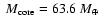 of water and
;
dash-dotted-line: no core and mixture of H/He + Z described by the SCVH EOS with
of water and
;
dash-dotted-line: no core and mixture of H/He + Z described by the SCVH EOS with
 ;
long-dashed line: no core and mixture of H/He + water (SESAME EOS) with the AVL and ;
long-dashed line: no core and mixture of H/He + water (SESAME EOS) with the AVL and
 ;
short-dashed line: no core and mixture of H/He + water (ANEOS EOS) using the AVL and
. ;
short-dashed line: no core and mixture of H/He + water (ANEOS EOS) using the AVL and
.
|
| Open with DEXTER | |
In the text
![\begin{figure}
\par\includegraphics[width=7cm,clip]{9321fig7.ps}
\end{figure}](/articles/aa/full/2008/16/aa9321-07/img134.gif) |
Figure 7:
Internal temperature and density profiles for a 1
planet at an age of 4 Gyr.
Solid line:
;
long-dash line:
,
Z=0.5, AVL SESAME EOS;
short-dash line:
,
Z=0.5, AVL ANEOS EOS.
|
| Open with DEXTER | |
In the text
![\begin{figure}
\par\includegraphics[width=7.2cm,clip]{9321fig8.ps}\end{figure}](/articles/aa/full/2008/16/aa9321-07/img167.gif) |
Figure 8:
Evolution of a planet with the characteristics of HD 149206b (

 )
with different heavy element distributions.
Solid line: model with )
with different heavy element distributions.
Solid line: model with
 of water (ANEOS EOS) and
.
The other curves correspond to
models with heavy elements distributed over the entire planet.
Dash-dot line: mixture of H/He + Z described by the SCVH EOS with an effective helium
abundance,
of water (ANEOS EOS) and
.
The other curves correspond to
models with heavy elements distributed over the entire planet.
Dash-dot line: mixture of H/He + Z described by the SCVH EOS with an effective helium
abundance,
 ,
which corresponds to Z=0.69,
i.e. ,
which corresponds to Z=0.69,
i.e.
 of heavy elements. Long-dash line: mixture of H/He + water (SESAME EOS) using the AVL with Z=69%. Short-dash line:
mixture of H/He + water (ANEOS EOS) using the AVL with Z=69%.
Dotted line: mixture of H/He + water (ANEOS EOS) using the AVL with Z=51%, i.e. 60
of heavy elements.
of heavy elements. Long-dash line: mixture of H/He + water (SESAME EOS) using the AVL with Z=69%. Short-dash line:
mixture of H/He + water (ANEOS EOS) using the AVL with Z=69%.
Dotted line: mixture of H/He + water (ANEOS EOS) using the AVL with Z=51%, i.e. 60
of heavy elements. |
| Open with DEXTER | |
In the text
![\begin{figure}
\par\includegraphics[width=7cm,clip]{9321fig9.ps}\end{figure}](/articles/aa/full/2008/16/aa9321-07/img175.gif) |
Figure 9:
Evolution of a planet characteristic of GJ 436b (
 ,)
with different heavy element distributions. Models with no irradiation:
Solid line: model with ,)
with different heavy element distributions. Models with no irradiation:
Solid line: model with
 of water (ANEOS EOS) and
;
short-dash line: model with
of water (SESAME EOS) and
;
dotted line: test model with
of water (SESAME EOS) and
,
assuming an uniform temperature of 300 K in the core.
Effect of irradiation, with
of water (ANEOS EOS) and
;
short-dash line: model with
of water (SESAME EOS) and
;
dotted line: test model with
of water (SESAME EOS) and
,
assuming an uniform temperature of 300 K in the core.
Effect of irradiation, with
 for GJ 436b (see text):
long-dash line: same as short-dash line with irradiated atmosphere models;
dash-dot line: same as dotted line with irradiated atmosphere models.
for GJ 436b (see text):
long-dash line: same as short-dash line with irradiated atmosphere models;
dash-dot line: same as dotted line with irradiated atmosphere models.
|
| Open with DEXTER | |
In the text
![\begin{figure}
\par\includegraphics[width=7cm,clip]{9321fig10.ps}\end{figure}](/articles/aa/full/2008/16/aa9321-07/img180.gif) |
Figure 10:
Various contributions to the gravothermal energy,
 ,
normalized to the total value, for a planet characteristic of GJ 436b (
), with a 21
core of water with the SESAME EOS. Solid line: global contribution from the core; dash-dot line: contraction
work contribution from the core; long-dash line: thermal contribution from the core; short-dash line:
global contribution from the H/He 1.6
envelope. ,
normalized to the total value, for a planet characteristic of GJ 436b (
), with a 21
core of water with the SESAME EOS. Solid line: global contribution from the core; dash-dot line: contraction
work contribution from the core; long-dash line: thermal contribution from the core; short-dash line:
global contribution from the H/He 1.6
envelope.
|
| Open with DEXTER | |
In the text
![\begin{figure}
\par\includegraphics[width=7cm,clip]{9321fig11.ps}\end{figure}](/articles/aa/full/2008/16/aa9321-07/img197.gif) |
Figure 11:
Evolution of a super-Jupiter planet with the characteristics of HAT-P-2b
(
 )
for different distributions of heavy elements. Irradiation effects from the parent star are taken into
account, adopting a time-average orbital distance a=0.077 AU, for the proper eccentricity e=0.52and semimajor axis of the relative orbit )
for different distributions of heavy elements. Irradiation effects from the parent star are taken into
account, adopting a time-average orbital distance a=0.077 AU, for the proper eccentricity e=0.52and semimajor axis of the relative orbit
 AU.
Solid line: AU.
Solid line:
 of water (ANEOS EOS) and
.
Long-dashed line:
of water (ANEOS EOS) and
.
Long-dashed line:
 of water (ANEOS EOS) and
.
Dash-dotted line: 600
of heavy elements with 100
in the core (water, with ANEOS EOS) and 500
in the envelope, i.e.
of water (ANEOS EOS) and
.
Dash-dotted line: 600
of heavy elements with 100
in the core (water, with ANEOS EOS) and 500
in the envelope, i.e.
 ,
mimicked by an ,
mimicked by an
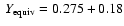 .
Short-dashed line: H/He brown dwarf with .
Short-dashed line: H/He brown dwarf with  . . |
| Open with DEXTER | |
In the text
![\begin{figure}
\par\includegraphics[width=8cm,clip]{9321fig12.ps}\end{figure}](/articles/aa/full/2008/16/aa9321-07/img221.gif) |
Figure 12:
Mass-radius relationships for planets in the mass range 10
-1 at different ages, as indicated in the panels, and different levels of heavy element enrichment:
(solid lines);
 (short-dash lines);
  (dash-dot lines); Z=90% (long-dash lines). Left panels: without irradiation; right panels: with irradiation from a Sun at 0.045 AU. Symbols indicate
the observed data for transiting Neptune-mass to Jupiter mass planets, taken from F. Pont's website (www.inscience.ch/transits).
(dash-dot lines); Z=90% (long-dash lines). Left panels: without irradiation; right panels: with irradiation from a Sun at 0.045 AU. Symbols indicate
the observed data for transiting Neptune-mass to Jupiter mass planets, taken from F. Pont's website (www.inscience.ch/transits). |
| Open with DEXTER | |
In the text