A&A 481, 705-712 (2008)
DOI: 10.1051/0004-6361:20079156
First optical detection of the supernova remnant G 15.1-1.6
P. Boumis1 - J. Alikakos1,2 - P. E. Christopoulou2 - F. Mavromatakis3 - E. M. Xilouris1 - C. D. Goudis1,2
1 - Institute of Astronomy & Astrophysics, National
Observatory of Athens, I. Metaxa & V. Paulou, P. Penteli, 15236
Athens, Greece
2 - Astronomical Laboratory, Department of Physics, University of
Patras, 26500 Rio-Patras, Greece
3 - Technological Education Institute of Crete, General Department of
Applied Science, PO Box 1939, 710 04 Heraklion, Crete, Greece
Received 27 November 2007 / Accepted 17 January 2008
Abstract
Deep optical CCD images of the supernova remnant G
15.1-1.6 were obtained where filamentary and diffuse emission was
discovered. The images, taken in the emission lines of H N II],
[S II], and [O III], reveal filamentary and diffuse structures all
around the remnant. The radio emission at 4850 MHz in the same area
is found to be strongly correlated with the brightest optical filaments.
The IRAS 60
N II],
[S II], and [O III], reveal filamentary and diffuse structures all
around the remnant. The radio emission at 4850 MHz in the same area
is found to be strongly correlated with the brightest optical filaments.
The IRAS 60  m emission may also be correlated with the optical
emission but to a lesser extent. The flux-calibrated images suggest
that the optical emission originates from shock-heated gas
([S II]/H
m emission may also be correlated with the optical
emission but to a lesser extent. The flux-calibrated images suggest
that the optical emission originates from shock-heated gas
([S II]/H > 0.4), while there is a possible H II region
([S II]/H
> 0.4), while there is a possible H II region
([S II]/H  0.3) contaminating the supernova remnant's
emission to the east. Furthermore, deep long-slit spectra were
taken at two bright filaments and also show that the emission
originates from shock-heated gas. An [O III] filamentary structure
is also detected farther to the west, but it lies outside the
remnant's boundaries and may not be associated to it. The
[O III] flux suggests shock velocities into the interstellar
``clouds'' 100 km s-1, while the [S II
0.3) contaminating the supernova remnant's
emission to the east. Furthermore, deep long-slit spectra were
taken at two bright filaments and also show that the emission
originates from shock-heated gas. An [O III] filamentary structure
is also detected farther to the west, but it lies outside the
remnant's boundaries and may not be associated to it. The
[O III] flux suggests shock velocities into the interstellar
``clouds'' 100 km s-1, while the [S II
![$]\lambda\lambda\ 6716/6731$](/articles/aa/full/2008/15/aa9156-07/img8.gif) ratio indicates
electron densities up to 250 cm-3. Finally, the H emission is measured to be between 2 to
ratio indicates
electron densities up to 250 cm-3. Finally, the H emission is measured to be between 2 to  10-16 erg s-1 cm-2 arcsec-2, while the
lower limit to the distance is estimated at 2.2 kpc.
10-16 erg s-1 cm-2 arcsec-2, while the
lower limit to the distance is estimated at 2.2 kpc.
Key words: ISM: general - ISM: supernova remnants - ISM: individual
objects: G15.1-1.6
Supernova remants (SNRs) play an important role when studying the
SN mechanism, the interstellar medium (ISM), and their interaction. Most
of the SNRs have been detected in radio from their nonthermal
synchrotron emission. Observations of SNRs in X-rays allow us to
probe the hot gas inside the primary shock wave directly, while
optical observations offer an important tool for studying of the
interaction of the shock wave with dense material found in the
ISM. New searches in the optical waveband continue to identify Galactic
SNRs (e.g. Boumis et al. 2002, 2005; Mavromatakis et al. 2002, 2005), while in the past decade, observations
in X-rays have also detected new Galactic SNRs (e.g. Seward et al. 1995; see also Green 2006, for a complete catalogue).
G 15.1-1.6 is not a well-known SNR. It was first detected by Reich
et al. (1988) in the Effelsberg 2.7 GHz survey, and the radio
image was published by Reich et al. (1990). It is classified
as a shell-type SNR with a spectral index of 0.8. Its angular
size is 30
 24,
and using the
brightness-to-diameter (
24,
and using the
brightness-to-diameter ( -D) relationship, the distance of
the remnant was calculated at 5.7 kpc (Green 2006). Radio
surveys of the surrounding area do not reveal any pulsar associated
with G 15.1-1.6, while it is not detected optically in the past.
-D) relationship, the distance of
the remnant was calculated at 5.7 kpc (Green 2006). Radio
surveys of the surrounding area do not reveal any pulsar associated
with G 15.1-1.6, while it is not detected optically in the past.
In this paper we report the optical detection of G 15.1-1.6. We
present images of the remnant in the HN II], [S II], and [O III] emission lines. Deep long-slit spectra were also acquired in a
number of selected areas. In Sect. 2 we present information about the
observations and data reduction, while the results of the imaging and
spectroscopic observations are given in Sect. 3. In Sect. 4 we discuss
the optical properties of this SNR, while we summarize the
results of this work in Sect. 5.
Table 1:
Imaging and spectral log.
A summary and log of our observations are given in
Table 1. In the sections below, we describe the details of
these observations.
![\begin{figure}
\par\includegraphics[width=12cm,clip]{9156fig1.eps}
\end{figure}](/articles/aa/full/2008/15/aa9156-07/Timg24.gif) |
Figure 1:
The G 15.1-1.6 in the H + [N II]
filter. Shadings run linearly from 0 to
 erg s-1 cm-2 arcsec-2. The image has been smoothed to
suppress the residuals from the imperfect continuum subtraction. The
bright region in the northwest edge of the image is a known H
II region (Lockman 1989). erg s-1 cm-2 arcsec-2. The image has been smoothed to
suppress the residuals from the imperfect continuum subtraction. The
bright region in the northwest edge of the image is a known H
II region (Lockman 1989). |
| Open with DEXTER |
G 15.1-1.6 was observed with the 0.3 m Schmidt-Cassegrain (f/3.2)
telescope at Skinakas Observatory, Crete, Greece in June 11 and August
27, 28, and 30, 2005. The data were taken with a
 Thomson CCD with a pixel size of 19 m resulting in a
70 70
field of view and an image scale of 4
Thomson CCD with a pixel size of 19 m resulting in a
70 70
field of view and an image scale of 4
 per pixel. The area of the remnant was observed with the HN II], [S
II], and [O III] filters. The exposure time was set to 2400 s
for each observation and to 180 s for the continuum red and blue
filters. The continuum-subtracted images of the HN II] and [O
III] emission lines are shown in Figs. 1 and 2,
respectively.
per pixel. The area of the remnant was observed with the HN II], [S
II], and [O III] filters. The exposure time was set to 2400 s
for each observation and to 180 s for the continuum red and blue
filters. The continuum-subtracted images of the HN II] and [O
III] emission lines are shown in Figs. 1 and 2,
respectively.
![\begin{figure}
\par\includegraphics[width=12cm,clip]{9156fig2.eps}
\end{figure}](/articles/aa/full/2008/15/aa9156-07/Timg26.gif) |
Figure 2:
The G 15.1-1.6 in the [O III] filter. Shadings run linearly from 0 to
 erg s-1 cm-2 arcsec-2. The image has been smoothed to suppress the residuals from the imperfect continuum subtraction. erg s-1 cm-2 arcsec-2. The image has been smoothed to suppress the residuals from the imperfect continuum subtraction. |
| Open with DEXTER |
The IRAF and MIDAS packages were used for the data reduction. All
frames were bias-subtracted and flatfield-corrected using a series
of twilight flatfields. Using the continuum images multiplied with a
proper factor, we subtracted the stars in order to present the
remnant. The spectrophotometric standards stars HR5501, HR7596,
HR7950, HR8634, and HR9087 (Hamuy et al. 1992) were used for
the absolute flux calibration. The astrometric solution for all data
frames were calculated using the Hubble Space Telescope (HST) Guide
Star Catalogue (Lasker et al. 1999). All the equatorial
coordinates quoted in this work refer to epoch 2000.
Optical images at higher angular resolution of G 15.1-1.6 were also
obtained with the 1.3 m (f/7.7) Ritchey-Cretien telescope at
Skinakas Observatory in July 4-7 and 8-10, 2007, using the
H + [N II] and the [O III] interference filters,
respectively. The detector was a
SITe CCD with a
field of view of
 arcmin2 and an image scale of
0.5
per pixel. Nine exposures were taken through the
H + [N II] and [O III] filters each of 2400 s and nine
corresponding exposures in the continuum, each of 180 s. During the
observations, the ``seeing'' varied between 0.8
and 1.5
,
while the full width at half maximum (FWHM) of the star images was
between 1.2
and 2.1
.
The continuum-subtracted mosaic of
the H + [N II] and [O III] images are shown in
Figs. 3 and 4, respectively.
arcmin2 and an image scale of
0.5
per pixel. Nine exposures were taken through the
H + [N II] and [O III] filters each of 2400 s and nine
corresponding exposures in the continuum, each of 180 s. During the
observations, the ``seeing'' varied between 0.8
and 1.5
,
while the full width at half maximum (FWHM) of the star images was
between 1.2
and 2.1
.
The continuum-subtracted mosaic of
the H + [N II] and [O III] images are shown in
Figs. 3 and 4, respectively.
![\begin{figure}
\par\includegraphics[width=15cm,clip]{9156fig3.eps}
\end{figure}](/articles/aa/full/2008/15/aa9156-07/Timg28.gif) |
Figure 3:
The continuum-subtracted mosaic of G 15.1-1.6 taken with
the 1.3-m telescope in the light of H + [N II]. The
image has been smoothed to suppress the residuals from the imperfect
continuum subtraction. |
| Open with DEXTER |
![\begin{figure}
\par\includegraphics[width=12cm,clip]{9156fig4.eps}
\end{figure}](/articles/aa/full/2008/15/aa9156-07/Timg29.gif) |
Figure 4:
The continuum-subtracted mosaic of G 15.1-1.6 taken with
the 1.3-m telescope in the light of [O III]. The image has been smoothed to
suppress the residuals from the imperfect continuum subtraction. |
| Open with DEXTER |
The 1.3 m Ritchey-Cretien (f/7.7) telescope at Skinakas Observatory
was used to obtain low-dispersion, long-slit spectra on June 4 and 5
and September 7, 2005. The exposure time was 3900 s, except for the
north area of G 15.1-1.6, which was 7800 s. The data were taken with
a 1300 line mm-1 grating and a 2000 800 (13 m) SITe CCD covering the range 4750 Å-6815 Å. The spectral
resolution is 8 pixels and 11 pixels full width at half
maximum (FWHM) for the red and blue wavelengths, respectively. The
airmass of the object varied between 1.6 and 1.7. The slit has a width
of 7
 7 and length of 7
 9 and was oriented in all cases in
the south-north direction. The coordinates of the slit centers of
each spectrum are given in Table 1. For the absolute calibration we
used the spectrophotometric standard stars HR4468, HR5501,
HR7596, HR7950, HR8634, and HR9087. The data reduction was performed
with the IRAF package.
9 and was oriented in all cases in
the south-north direction. The coordinates of the slit centers of
each spectrum are given in Table 1. For the absolute calibration we
used the spectrophotometric standard stars HR4468, HR5501,
HR7596, HR7950, HR8634, and HR9087. The data reduction was performed
with the IRAF package.
Optical filamentary and diffuse emission was detected for the first
time for this remnant with several thin and curved filaments found all
around the remnant. The most interesting regions, where complex
filamentary structures exist, lie in the northwest, west, and
southeast. In Table 2, we present typical, average fluxes
measured in several locations within the field of G 15.1-1.6. The
detected [S II] emission appears more diffuse and less filamentary than
in the HN II] image; however, its morphology is similar to the
HN II], so it is not shown here.
Starting from the north, a bright filament 2
long (named A in
Fig. 1) is present with its center approximately at

 24
24 04
04 and
and

 2547
.
This filament lies a few arcminutes to
the northeast of the very bright 4
filamentary structure
(named B) which is between
2349,
2726
and
2336,
3055
.
In particular, there is a
very bright filament 3
long and 1.2
wide with
1diffuse emission in its south. Southwest of this
filament a fainter one (C1) appears at
2334,
3508
,
which is up to 1
long separated by a 2.5
gap with area B. This gap is due to a
dark region in the area (probably created by dust - supported also by
the IRAS map) preventing the detection of optical emission from the
SNR. Farther to the south, there is a prominent bright structure that
also appears strong and is designated as filament C2. This structure
(3
long, 40
wide) lies at
2330,
4156
.
To the
south, there is fainter 1
long emission (named D), which has
strong [S II] emission like the filament in area A ([S II]/H 0.7). The east structure consists of two main parts; a very
bright one that covers an area of
2547
.
This filament lies a few arcminutes to
the northeast of the very bright 4
filamentary structure
(named B) which is between
2349,
2726
and
2336,
3055
.
In particular, there is a
very bright filament 3
long and 1.2
wide with
1diffuse emission in its south. Southwest of this
filament a fainter one (C1) appears at
2334,
3508
,
which is up to 1
long separated by a 2.5
gap with area B. This gap is due to a
dark region in the area (probably created by dust - supported also by
the IRAS map) preventing the detection of optical emission from the
SNR. Farther to the south, there is a prominent bright structure that
also appears strong and is designated as filament C2. This structure
(3
long, 40
wide) lies at
2330,
4156
.
To the
south, there is fainter 1
long emission (named D), which has
strong [S II] emission like the filament in area A ([S II]/H 0.7). The east structure consists of two main parts; a very
bright one that covers an area of  arcmin2,
centered at
2417,
3936
(E1), and a more complex but less bright
one between
2438,
3128
,
and
2420,
3751
(E2). Diffuse emission is also
present close to the filamentary structures, as well as the center of
the SNR. All filamentary structures have the same curvature, which
supports their belonging to G 15.1-1.6. It is interesting to note
two very thin long filaments to the north of E2 extending for
10
and joined to a 2.5
single filament. Similar
filaments also apear to the northeast of area A. Both seem to follow
the infrared emission but the low resolution of the latter does not
allow a detailed investigation.
arcmin2,
centered at
2417,
3936
(E1), and a more complex but less bright
one between
2438,
3128
,
and
2420,
3751
(E2). Diffuse emission is also
present close to the filamentary structures, as well as the center of
the SNR. All filamentary structures have the same curvature, which
supports their belonging to G 15.1-1.6. It is interesting to note
two very thin long filaments to the north of E2 extending for
10
and joined to a 2.5
single filament. Similar
filaments also apear to the northeast of area A. Both seem to follow
the infrared emission but the low resolution of the latter does not
allow a detailed investigation.
The detected [O III] emission (Figs. 2, 4) appears
less filamentary and more diffuse than in the HN II] image. Typical
[O III] fluxes are listed in Table 2. Significant
differences between the HN II] and [O III] images are present for many
of the filaments. In particular, to the north, west, and south (A, B,
C, and D), in contrast to the bright filaments found in HN II], the
[O III] displays a different morphology with much fainter diffuse
emission. Only within area B, there is a bright [O III] filament
centered at
2343,
2830
,
which lies exactly at the same position
with the bright one in HN II]. Farther to the west, there is a bright
[O III]filament (named F) splits to a very thin one
(30
wide) at
 182310,
3125
and a wider complex structure at
2259,
3549
.
This filament does not have an HN II] counterpart, and only very faint diffuse emission is found at the same
location. However, it is not correlated with the 4850 MHz radio map
(Fig. 6) of G 15.1-1.6 and probably does not belong to the
remnant. On the other hand, the bright HN II] emission found to the
east (area E) also appears bright but less filamentary in [O III].
Finally, a similar situation appears both in [O III] and HN II] in the
areas where weak and diffuse emission is found.
182310,
3125
and a wider complex structure at
2259,
3549
.
This filament does not have an HN II] counterpart, and only very faint diffuse emission is found at the same
location. However, it is not correlated with the 4850 MHz radio map
(Fig. 6) of G 15.1-1.6 and probably does not belong to the
remnant. On the other hand, the bright HN II] emission found to the
east (area E) also appears bright but less filamentary in [O III].
Finally, a similar situation appears both in [O III] and HN II] in the
areas where weak and diffuse emission is found.
All images being flux-calibrated provides a first indication of
the nature of the observed emission. An examination of the diagnostic
ratio [S II]/H
shows that the emission from the brightest parts of
the remnant originates from shock-heated gas, since we estimate
ratios [S II]/H
of 0.4-0.6, which agree with our spectral
measurements (Sect. 3.2). The northern and southern areas (A and D)
show [S II]/H 0.7. A photoionization mechanism may be producing
the emission in the southeastern region since the ratio [S II]/H
is
0.3. The possibility that an H II emission contaminates the
remnant's emission to the east (E) cannot be ruled out since, for some
of the areas close to both the filament and to the central region of
the remnant, we estimate [S II]/H 0.3-0.4 which also agrees
with our spectra.
Assuming that all the bright filaments belong to the remnant, their
geometry allows us to define its diameter approximately. In
particular, the eastern border of the remnant is defined by the outer
filament at  182440.0,
the western border at 182325.0,
the northern border at
182440.0,
the western border at 182325.0,
the northern border at  -1624,
and the southern border at -1646.
Then a diameter of 30 24
can be derived with its center at 182400,
-163520
.
The optically derived angular
size is identical to what is quoted in Green's catalogue (Green
2006).
-1624,
and the southern border at -1646.
Then a diameter of 30 24
can be derived with its center at 182400,
-163520
.
The optically derived angular
size is identical to what is quoted in Green's catalogue (Green
2006).
The deep low-resolution spectra were taken on the relatively bright
optical filaments at two different locations (Table 1).
Table 3 quotes the relative line fluxes taken from the
above locations (designated Area B and E). In particular, we extracted
two different apertures (BI and BII) in Area B, along the slit that
are free of field stars and include enough line emission to allow an
accurate determination of the observed lines. The background
extraction apertures were selected towards the northern and southern
ends of each slit depending on the filament's position within the
slit. The measured line fluxes indicate emission from shock-heated
gas, since [S II]/H 0.5. Furthermore, the [N II]/H ratio,
which takes values between 0.63 and 1.07 (see Table 3,
falls well inside the range expected for an SNR (Fesen et al. 1985). The signal-to-noise ratios do not include
calibration errors, which are less than 10 percent. Typical spectra
from the north (BI) and south (E1) are shown in Fig. 5.
The absolute H
flux covers a range of values from 2 to
10-16 erg s-1 cm-2 arcsec-2. The [S II
ratio that was calculated between 1.3 and 1.4,
indicates electron densities between 40 and 150 cm-3 (Osterbrock
& Ferland 2006). However, taking the statistical errors on
the sulfur lines into account, we calculate that electron densities up
to 250 cm-3 are allowed (Shaw & Dufour
1995). Measurements for the [O III]/ H ratio result in
values less than 6. Theoretical models of Cox & Raymond
(1985) and Hartigan et al. (1987) suggest that this
value is 6 for shocks with complete recombination zones, while
this limit is exceeded in case of shock with incomplete recombination
zones (Raymond et al. 1988). Our measured values suggest that
shocks with complete recombination zones are present. Therefore,
according to our measurements and the theoretical models above, the
estimated shock velocities are 100 km s-1.
ratio result in
values less than 6. Theoretical models of Cox & Raymond
(1985) and Hartigan et al. (1987) suggest that this
value is 6 for shocks with complete recombination zones, while
this limit is exceeded in case of shock with incomplete recombination
zones (Raymond et al. 1988). Our measured values suggest that
shocks with complete recombination zones are present. Therefore,
according to our measurements and the theoretical models above, the
estimated shock velocities are 100 km s-1.
The optical emission matches the radio emission of G 15.1-1.6 very
well at 4850 MHz, suggesting their correlation (Fig. 6). The
observed filaments are located close to the outer edge of the radio
contours but the low resolution of the radio images does not allow us
to determine the relative position of the filament with respect to the
shock front. To explore how the optical emission correlates with the
infrared emission, we examined IRAS images at 60 m of the same
area. Figure 6 shows a deep greyscale representation of the optical
emission (HN II]) with overlapping contours of the infrared emission
(60 m). Although the low-resolution IRAS map does not permit a
detailed comparison with the optical image, there is a clear
enhancement of infrared emission in the area where the optical
emission of the SNR is detected. The infrared emission follows the
morphology of the SNR closely, but it also fills the central area that
shows no optical emission. We also examined the ROSAT All-sky survey
data, but no significant X-ray emission was detected.
![\begin{figure}
\par\includegraphics[width=12cm,clip]{9156fig6.eps}
\end{figure}](/articles/aa/full/2008/15/aa9156-07/Timg39.gif) |
Figure 6:
The correlation between the H + [N II] emission,
and the radio emission at 4850 MHz (solid red line), the infrared emission
at IRAS 60 m (solid green line). The 4850 MHz radio contours scale linearly from
 Jy/beam, to
0.3 Jy/beam while the 60 m contours are at the level of 170, 200, 230, and 260 MJy/sr. The ellipse (dash blue line) defines
the SNR's boundary approximately. Jy/beam, to
0.3 Jy/beam while the 60 m contours are at the level of 170, 200, 230, and 260 MJy/sr. The ellipse (dash blue line) defines
the SNR's boundary approximately. |
| Open with DEXTER |
The supernova remnant G 15.1-1.6 shows up as an almost complete shell in the
radio band without any X-ray emission detected so far. The absence of
soft X-ray emission may indicate a low shock temperature and/or a low
density of the local interstellar medium. The HN II] image describes
the newly detected structures best. Both [S II] and [O III] emission is
also detected and generally appears less filamentary and more diffuse
than in the HN II] image with their position and shape in agreement
with that of the HN II]. The [O III] emission does not seem to be
bounded by HN II] emission. An explanation is given in Blair et al. (2005), indicating that the shock emission from the
nascent radiative region is strong enough to fully ionize the local
preshock gas. The presence of [O I] 6300 Å line emission is
also consistent with the emission being shock material. Both the
calibrated images and the long-slit spectra suggest that the detected
emission results from shock-heated gas since the [S II]/H ratio
exceeds the empirical SNR criterion value of 0.4-0.5, while the
measured [N II]/H ratio also confirms this result. Note that the
possible H II region found in the low ionization images shows an
[S II]/H
ratio of 0.33. The eastern filament lies very close to
this H II region. The morphological differences between the low and
medium ionization lines provide evidence of significant
inhomogeneities and density variations in the ambient medium. Hester
et al. (1987) suggested that the presence of these inhomogeneities and
density variations would mainly affect the recombination zone where
the low ionization lines are produced, and it could also explain the
[O III]/H
ratio variations seen in the long-slit spectra.
Table 2:
Typically measured fluxes over the brightest filaments.
Table 3:
Relative line fluxes.
An interstellar extinction c between (see Table 3) 1.17 ( 0.05) and 1.68
(0.05) or an
0.05) and 1.68
(0.05) or an  between 2.51
(0.11) and 3.60 (0.10) were measured, respectively. We
have also determined the electron density by measuring the density
sensitive line ratio of [S II
.
The densities we measure are below
250 cm-3. Assuming that the temperature is close to 104 K, it is
possible to estimate basic SNR parameters. The remnant under
investigation is one of the least studied remnants and thus, the
current stage of its evolution is unknown. Assuming that the remnant
is still in the adiabatic phase of its evolution, the preshock cloud
density
between 2.51
(0.11) and 3.60 (0.10) were measured, respectively. We
have also determined the electron density by measuring the density
sensitive line ratio of [S II
.
The densities we measure are below
250 cm-3. Assuming that the temperature is close to 104 K, it is
possible to estimate basic SNR parameters. The remnant under
investigation is one of the least studied remnants and thus, the
current stage of its evolution is unknown. Assuming that the remnant
is still in the adiabatic phase of its evolution, the preshock cloud
density  can be measured by using the relationship (Dopita
1979)
can be measured by using the relationship (Dopita
1979)
![\begin{displaymath}{n_{\rm [SII]} \simeq\ 45\ n_{\rm c} V_{\rm s}^2}~{\rm cm^{-3}},
\end{displaymath}](/articles/aa/full/2008/15/aa9156-07/img45.gif) |
(1) |
where
![${n_{\rm [SII]}}$](/articles/aa/full/2008/15/aa9156-07/img46.gif) is the electron density derived from the
sulfur line ratio, and
is the electron density derived from the
sulfur line ratio, and  the shock velocity into the
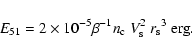
clouds in units of 100 km s-1. Furthermore, the blast wave energy can be
expressed in terms of the cloud parameters by using the equation given
by McKee & Cowie (1975):
the shock velocity into the
clouds in units of 100 km s-1. Furthermore, the blast wave energy can be
expressed in terms of the cloud parameters by using the equation given
by McKee & Cowie (1975):
 |
(2) |
The factor
is approximately equal to 1 at the blast
wave shock, E51 the explosion energy in units of 1051erg, and  the radius of the remnant in pc. By using
the upper limit on the electron density of 250 cm-3, which was
derived from our spectra, we obtain from Eq. (1) that
the radius of the remnant in pc. By using
the upper limit on the electron density of 250 cm-3, which was
derived from our spectra, we obtain from Eq. (1) that
 .
Then Eq. (2) becomes
.
Then Eq. (2) becomes
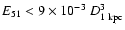 ,
where
,
where
 the distance to
the remnant in units of 1 kpc.
the distance to
the remnant in units of 1 kpc.
Estimated values of
 cm-2 and
 cm-2 are given by Dickey &
Lockman (1990) and Kalberla et al. (2005)
respectively, for the column density in the direction of G 15.1-1.6. Using the relation of Ryter et al. (1975), we
obtain an
cm-2 are given by Dickey &
Lockman (1990) and Kalberla et al. (2005)
respectively, for the column density in the direction of G 15.1-1.6. Using the relation of Ryter et al. (1975), we
obtain an
 of
of
 and
and
 for the minimum and maximum c values
calculated from our spectra, respectively. Both values are consistent
with the estimated galactic considering the uncertainties
involved. Since, there are no other measurements of the interstellar
density n0, values of 0.1 and 1.0 will be examined. Following the
result of Eq. (2) and assuming the typical value of 1 for the
supernova explosion energy (E51), we find that the remnant may
lie at a distance greater than 2.2 kpc. Then, the lower interstellar
density of 0.1 cm-3 suggests that the column density is
greater than
for the minimum and maximum c values
calculated from our spectra, respectively. Both values are consistent
with the estimated galactic considering the uncertainties
involved. Since, there are no other measurements of the interstellar
density n0, values of 0.1 and 1.0 will be examined. Following the
result of Eq. (2) and assuming the typical value of 1 for the
supernova explosion energy (E51), we find that the remnant may
lie at a distance greater than 2.2 kpc. Then, the lower interstellar
density of 0.1 cm-3 suggests that the column density is
greater than
 ,
while for
,
while for
 it becomes greater than
 .
Combining the previous results and assuming
that the column density is found in the range of
.
Combining the previous results and assuming
that the column density is found in the range of
 ,
then the lower interstellar density seems to
be more probable. However, since neither the distance nor the
interstellar medium density are accurately known, we cannot
confidently determine the current stage of evolution of G 15.1-1.6.
,
then the lower interstellar density seems to
be more probable. However, since neither the distance nor the
interstellar medium density are accurately known, we cannot
confidently determine the current stage of evolution of G 15.1-1.6.
The faint supernova remnant G 15.1-1.6 was observed for the first
time in major optical emission lines. The images show filamentary and
diffuse emission structures. The bright filaments are correlated very
well with the remnant's radio emission at 4850 MHz suggesting their
association, while correlation evidence is also shown with the IRAS
60 m map. The flux-calibrated images and the long-slit spectra
indicate that the emission arises from shock-heated gas. Finally, an
upper limit for the electron density of 250 cm-3and a lower limit
for the distance of 2.2 kpc are calculated.
Acknowledgements
J.A. acknowledges funding by the European Union and the Greek Ministry
of Development in the framework of the program ``Promotion of
Excellence in Research Institutes (2nd Part)''. Skinakas Observatory is
a collaborative project of the University of Crete, the Foundation for
Research and Technology-Hellas, and the Max-Planck-Institut für
Extraterrestrische Physik.
- Blair, W. P., Sankrit,
R., & Raymond, J. C. 2005, AJ, 129, 2268 [NASA ADS] [CrossRef]
(In the text)
- Boumis, P., Mavromatakis,
F., & Paleologou, E. V. 2002, A&A, 385, 1042 [NASA ADS] [CrossRef] [EDP Sciences]
(In the text)
- Boumis, P., Mavromatakis,
F., Xilouris, E. M., et al. 2005, A&A, 443, 175 [NASA ADS] [CrossRef] [EDP Sciences]
(In the text)
- Cox, D. P., &
Raymond, J. C. 1985, ApJ, 298, 651 [NASA ADS] [CrossRef]
(In the text)
- Dickey, J. M., &
Lockman, F. J. 1990, ARA&A, 28, 215 [NASA ADS] [CrossRef]
(In the text)
- Dopita, M. A. 1979, ApJS,
40, 455 [NASA ADS] [CrossRef]
(In the text)
- Fesen, R. A., Blair, W.
P., & Kirshner, R. P. 1985, ApJ, 292, 29 [NASA ADS] [CrossRef]
(In the text)
- Green, D. A. 2006, A
Catalog of Galactic Supernova Remnants (2006 April version),
Mullard Radio Astronomy Observatory Cambridge
(In the text)
- Hamuy, M., Walker, A. R.,
& Suntzeff, N. B. 1992, PASP, 104, 533 [NASA ADS] [CrossRef]
(In the text)
- Hartigan, P., Raymond,
J., & Hartmann, L. 1987, ApJ, 316, 323 [NASA ADS] [CrossRef]
(In the text)
- Kalberla, P. M. W.,
Burton, W. B., Hartmann, D., et al. 2005, A&A, 440, 775 [NASA ADS] [CrossRef] [EDP Sciences]
(In the text)
- Lasker, B. M., Russel, J.
N., & Jenkner, H. 1999, in the HST Guide Star Catalog, version
1.1-ACT, The Association of Universities for Research in Astronomy,
Inc.
(In the text)
- Lockman, F. J. 1989,
ApJS, 71, 469 [NASA ADS] [CrossRef]
(In the text)
- Mavromatakis, F., Boumis,
P., Papamastorakis, J., & Ventura, J. 2002, A&A, 388,
355 [NASA ADS] [CrossRef] [EDP Sciences]
(In the text)
- Mavromatakis, F., Boumis,
P., Xilouris, E. M., et al. 2005, A&A, 435, 141 [NASA ADS] [CrossRef] [EDP Sciences]
(In the text)
- McKee, C. F., &
Cowie, L. L. 1975, ApJ, 195, 715 [NASA ADS] [CrossRef]
(In the text)
- Osterbrock, D. E., &
Ferland, G. J. 2006, Astrophysics of gaseous nebulae and AGN, ed.
University Science Books, US
(In the text)
- Raymond, J. C., Blair, W.
P., Fesen, R. A., & Gull, T. R. 1983, ApJ, 275, 636 [NASA ADS] [CrossRef]
- Raymond, J. C., Hester,
J. J., Cox, D., et al. 1988, ApJ, 324, 869 [NASA ADS] [CrossRef]
(In the text)
- Reich, W., Fürst,
E., Reich, P., & Junkes, N. 1988, in Supernova Remnants and the
Interstellar Medium, ed. R. S. Rogerand, & T. L. Landecker
(Cambridge Univ. Press), IAU Colloq., 101, 293
(In the text)
- Reich, W., Fürst E.,
Reich, P., & Reif, K. 1990, A&AS, 85, 633 [NASA ADS]
(In the text)
- Ryter, C., Cesarsky, C.
J., & Audouze, J. 1975, ApJ, 198, 103 [NASA ADS] [CrossRef]
(In the text)
- Seward, F. D., Dame, T.
M., Fesen, R. A., & Aschenbach, B. 1995, ApJ, 449, 681 [NASA ADS] [CrossRef]
(In the text)
- Shaw, R. A., &
Dufour, R. J. 1995, PASP, 107, 896 [NASA ADS] [CrossRef]
(In the text)
Copyright ESO 2008
![\begin{figure}
\par\includegraphics[width=12cm,clip]{9156fig1.eps}
\end{figure}](/articles/aa/full/2008/15/aa9156-07/img24.gif)
![\begin{figure}
\par\includegraphics[width=12cm,clip]{9156fig2.eps}
\end{figure}](/articles/aa/full/2008/15/aa9156-07/img26.gif)
![\begin{figure}
\par\includegraphics[width=15cm,clip]{9156fig3.eps}
\end{figure}](/articles/aa/full/2008/15/aa9156-07/img28.gif)
![\begin{figure}
\par\includegraphics[width=12cm,clip]{9156fig4.eps}
\end{figure}](/articles/aa/full/2008/15/aa9156-07/img29.gif)
![\begin{figure}
\par\includegraphics[width=11.5cm,clip]{9156fig5.eps}
\end{figure}](/articles/aa/full/2008/15/aa9156-07/img30.gif)
![\begin{figure}
\par\includegraphics[width=12cm,clip]{9156fig6.eps}
\end{figure}](/articles/aa/full/2008/15/aa9156-07/img39.gif)