![\begin{figure}
{
\begin{picture}
(0,0)%
\scalebox{1.4}{\includegraphics{8020fig1...
...(0,0)[l]{\strut{}$i=30^\circ$ , noise}}%
\end{picture}%
\endgroup }
\end{figure}](/articles/aa/full/2007/42/aa8020-07/img42.gif) |
Figure 1:
Cumulative mass profiles M<r(r) of an analytic halo and its reconstructions from X-ray and SZ maps with and without observational noise as well as from lensing maps with and without noise. The upper panels show the results obtained from maps without noise, while the lower panels show the profiles found from noisy maps. For the reconstructions shown in the left panels an inclination angle of  was used and assumed to be known, while the right panels show the corresponding results for an inclination angle of
  .
Lensing reconstructions are shown for a flat and for the spherically symmetrised prior. The XSZ reconstructions were done for halos with ratios f of .
Lensing reconstructions are shown for a flat and for the spherically symmetrised prior. The XSZ reconstructions were done for halos with ratios f of
 to
to
 of 1.0 and 0.8. For comparison we also show the original analytic cumulative mass multiplied by 0.8.
 |
| Open with DEXTER | |
In the text
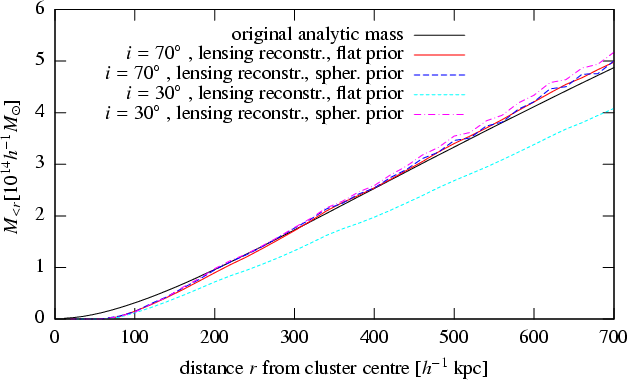 |
Figure 2:
Cumulative mass profiles M<r(r) of an ellipsoidal analytic halo and its reconstructions from lensing maps without noise. Inclination angles of
 and
and
 were used for the synthetic observations and assumed to be known for the reconstructions. Lensing reconstructions are shown for a flat and for the spherically symmetrised prior.
 |
| Open with DEXTER | |
In the text
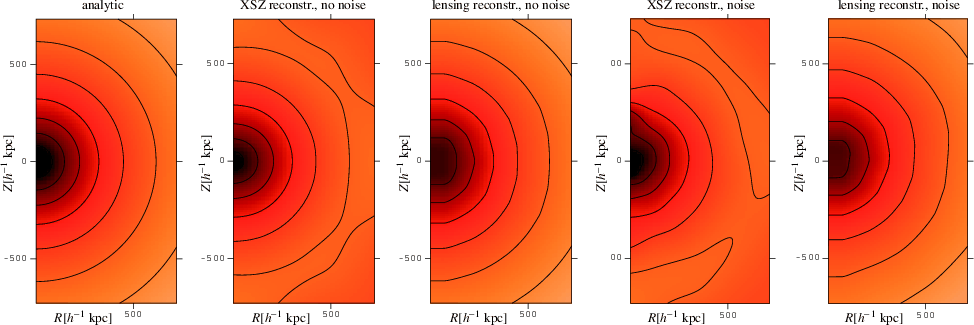 |
Figure 3: Gravitational potential of an analytic halo and its reconstructions from synthetic X-ray and SZ observations and from synthetic lensing observations each with and without observational noise. The XSZ reconstructions work well even close to the cluster centre, where lensing observations lack the resolution to accurately resolve the central peak. However, farther outside the lensing reconstructions perform better, due to the different noise properties, but in the example shown here also because of the smaller box size used for the XSZ reconstructions. |
| Open with DEXTER | |
In the text
![\begin{figure}
{
\begin{picture}
(0,0)%
\scalebox{1.4}{\includegraphics{8020fig5...
...akebox(0,0)[r]{\strut{}XSZ reconstr.}}%
\end{picture}%
\endgroup
}
\end{figure}](/articles/aa/full/2007/42/aa8020-07/img74.gif) |
Figure 4: Cumulative mass profiles M<r(r) of relaxed simulated clusters g1 at redshift z=0.25 and g51 at redshift z=0.3. Profiles of the original simulated mass distribution, of the lensing and of the XSZ reconstructions are shown, as well as the profile obtained directly from the simulated gas distribution by assuming hydrostatic equilibrium. The lensing and XSZ reconstructions are based on synthetic observations that contain observational noise. For such relaxed clusters both the lensing and the XSZ reconstructions agree very well with the original mass profile. |
| Open with DEXTER | |
In the text
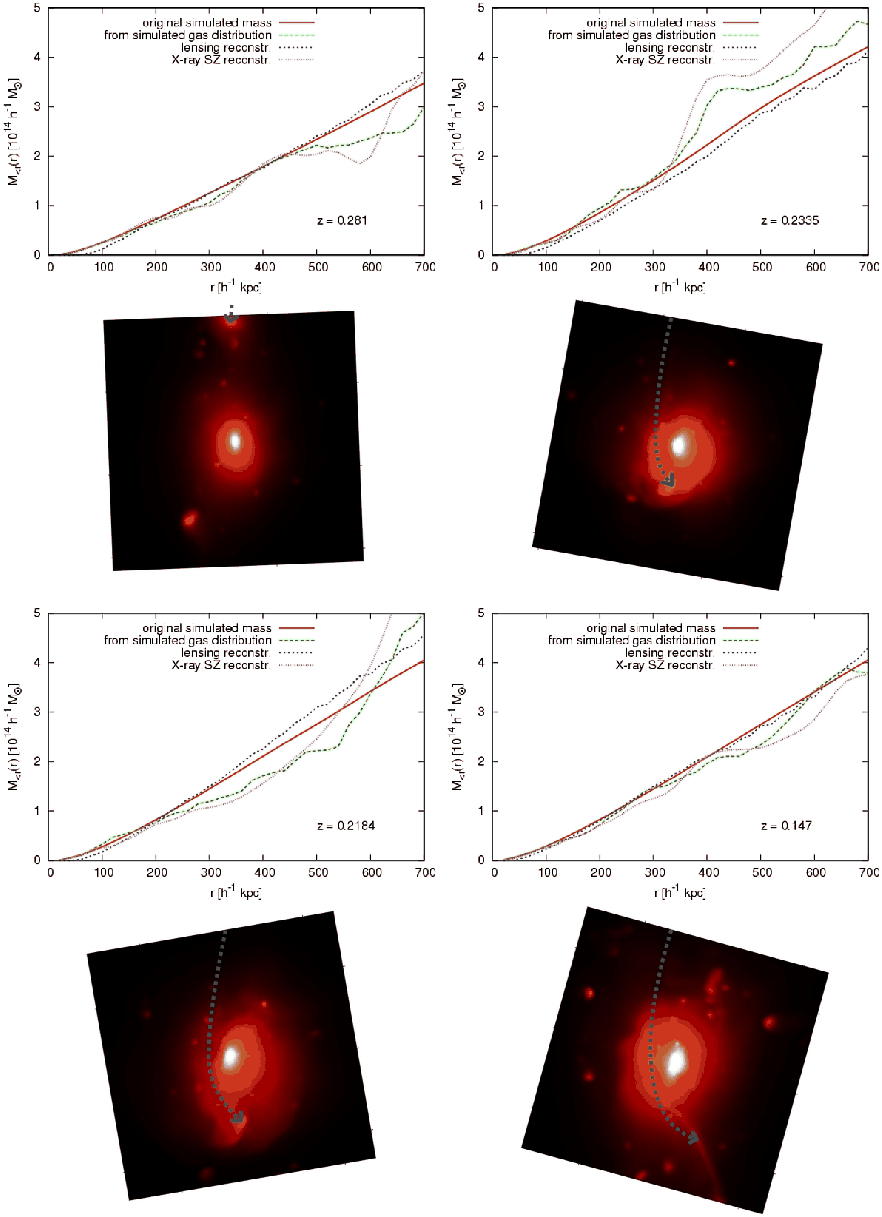 |
Figure 5: Cumulative mass profiles M<r(r) and X-ray surface brightness maps of simulated cluster g51at four different redshifts during a merger. The approximate trajectory of the infalling subhalo is illustrated in the X-ray maps. Profiles of the original simulated mass distribution, of the lensing and of the XSZ reconstructions are shown, as well as the profile obtained directly from the simulated gas distribution by assuming hydrostatic equilibrium. The lensing and XSZ reconstructions are based on synthetic observation that contain observational noise. The X-ray maps shown above are however idealised noise-free versions and were rotated such as to all have the same orientation in space. Their side length is 1.5 h-1 Mpc. |
| Open with DEXTER | |
In the text
![\begin{figure*}
{
\begin{picture}
(0,0)%
\scalebox{1.4}{\includegraphics{8020fig...
...l]{\strut{}different lines-of-sight}}%
\end{picture}%
\endgroup
}
\end{figure*}](/articles/aa/full/2007/42/aa8020-07/img78.gif) |
Figure 6:
Mean XSZ and lensing reconstructed cumulative mass profiles M<r(r) and their 1- errors of merging simulated cluster g51 obtained for different noise realisations ( left panel) and different lines-of-sight ( right panel). Profiles of the original simulated mass distribution and the profiles obtained directly from the simulated gas distribution by assuming hydrostatic equilibrium are shown for reference. X-ray, SZ and lensing observations along one line-of-sight but with 50 different noise realisations were used for the reconstructions whose mean and 1-
errors are shown in the left panel. For the right panel we started with a sample of noisy synthetic observations along 50 different randomly oriented lines-of-sight. However we rejected projections for which the merging subhalo is almost directly behind or in front of the main halo (projected distance <200 h-1 kpc) as well as one line-of-sight with an inclination of only
errors of merging simulated cluster g51 obtained for different noise realisations ( left panel) and different lines-of-sight ( right panel). Profiles of the original simulated mass distribution and the profiles obtained directly from the simulated gas distribution by assuming hydrostatic equilibrium are shown for reference. X-ray, SZ and lensing observations along one line-of-sight but with 50 different noise realisations were used for the reconstructions whose mean and 1-
errors are shown in the left panel. For the right panel we started with a sample of noisy synthetic observations along 50 different randomly oriented lines-of-sight. However we rejected projections for which the merging subhalo is almost directly behind or in front of the main halo (projected distance <200 h-1 kpc) as well as one line-of-sight with an inclination of only  with respect to the clusters symmetry axis which is to small for a faithful reconstruction. The mean and the 1-
errors of the profiles reconstructed from the observations along the remaining 33 lines-of-sight are shown. For both the different noise realisations and the different lines-of-sight deviations from hydrostatic equilibrium can be reliably detected.
with respect to the clusters symmetry axis which is to small for a faithful reconstruction. The mean and the 1-
errors of the profiles reconstructed from the observations along the remaining 33 lines-of-sight are shown. For both the different noise realisations and the different lines-of-sight deviations from hydrostatic equilibrium can be reliably detected. |
| Open with DEXTER | |
In the text