Table 3:
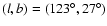
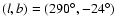
Hemisphere fit of H0/H0* and q0at small redshifts. We compare the number of degrees of freedom
(d.o.f.),  /d.o.f., and the best fit cosmological parameters for
the data sets A, B and D for the galactic, equatorial and maximal
asymmetry hemispheres. In addition we show for the galactic and
equatorial hemispheres the percentage of MC simulations with a
larger deviation in ,
H0/H0* and q0. In
brackets we provide the respective differences
/d.o.f., and the best fit cosmological parameters for
the data sets A, B and D for the galactic, equatorial and maximal
asymmetry hemispheres. In addition we show for the galactic and
equatorial hemispheres the percentage of MC simulations with a
larger deviation in ,
H0/H0* and q0. In
brackets we provide the respective differences
 ,
,
 and
and
 .
.
| |
d.o.f. |
 |
 |
q0 |
MC |
MC
 |
MCq0 |
| |
|
|
|
|
(
) |
(
) |
(
) |
| data set A |
|
|
|
|
|
|
|
 , ,
 km s-1,
 |
137 |
1.27 |
 |
 |
|
|
|
| Galactic hemispheres |
|
|
|
|
|
|
|
North:
 |
72 |
1.34 |
 |
 |
32.6 |
21.2 |
14.2 |
South:
 |
63 |
1.18 |
 |
 |
(4.75) |
(0.05) |
(1.95) |
| Equatorial hemispheres |
|
|
|
|
|
|
|
North:
 |
70 |
1.35 |
 |
 |
0.8 |
4.6 |
81.6 |
South:
 |
65 |
1.07 |
 |
 |
(21.71) |
(0.06) |
(0.26) |
| Hemispheres max. Asymmetry in : |
|
|
|
|
|
|
|
Pole:
 |
65 |
0.89 |
 |
 |
|
|
|
Pole:
 |
70 |
1.38 |
 |
 |
|
|
|
| data set B |
|
|
|
|
|
|
|
|
,
km s-1,
|
75 |
0.84 |
|
 |
|
|
|
| Galactic hemispheres |
|
|
|
|
|
|
|
| North:
|
41 |
0.80 |
 |
 |
81.4 |
56.2 |
59.8 |
| South:
|
32 |
0.93 |
 |
 |
(0.49) |
(0.02) |
(0.76) |
| Equatorial hemispheres |
|
|
|
|
|
|
|
| North:
|
41 |
0.80 |
 |
 |
15.2 |
54.2 |
61.6 |
| South:
|
32 |
0.86 |
 |
 |
(5.36) |
(0.02) |
(0.70) |
| Hemispheres max. Asymmetry in : |
|
|
|
|
|
|
|
Pole:
 |
33 |
0.57 |
 |
 |
|
|
|
Pole:
 |
40 |
0.93 |
 |
 |
|
|
|
| data set D |
|
|
|
|
|
|
|
,
km s-1,

|
117 |
1.37 |
|
 |
|
|
|
| Galactic hemispheres |
|
|
|
|
|
|
|
| North:
|
69 |
1.49 |
 |
 |
82.8 |
89.4 |
73.6 |
| South:
|
46 |
1.25 |
|
 |
(0.82) |
(0.004) |
(0.77) |
| Equatorial hemispheres |
|
|
|
|
|
|
|
| North:
|
64 |
1.71 |
|
 |
7.8 |
5.0 |
31.8 |
| South:
|
51 |
0.87 |
 |
 |
(10.84) |
(0.075) |
(2.07) |
| Hemispheres max. Asymmetry in : |
|
|
|
|
|
|
|
Pole:
 |
61 |
1.15 |
 |
 |
|
|
|
Pole:
 |
54 |
1.31 |
 |
 |
|
|
|
Source LaTeX |
All tables |
In the text