![[*]](/icons/foot_motif.gif) ,
,
A&A 454, 553-558 (2006)
DOI: 10.1051/0004-6361:20064895
,S. Desidera1 - R. G. Gratton1 - S. Lucatello1 - R. U. Claudi1 - T. H. Dall2
1 - INAF - Osservatorio Astronomico di Padova,
Vicolo dell' Osservatorio 5, 35122 Padova, Italy
2 -
European Southern Observatory, Casilla 19001, Santiago, Chile
Received 23 January 2006 / Accepted 22 February 2006
Abstract
Aims. We present the spectroscopic characterization of 56 pairs of visual binaries with similar components, based on high resolution spectra acquired with FEROS at ESO La Silla.
Methods. For all stars, we measured radial and rotational velocities and CaII H&K emission.
Results. Five previously unknown double lined spectroscopic binaries were found. Six other pairs show velocity differences that are not compatible with the orbital motion of the wide pair, indicating the presence of further companion(s) in the system. The fraction of visual binaries that contain additional spectroscopic components is  %, compatible with other literature estimates. The ages of the components of the pairs derived from chromospheric activity typically show apparent differences of about 0.2 dex. A few pairs show a rather large difference in activity level, but in most cases this is consistent with the variability of chromospheric emission observed for the Sun along its magnetic cycle.
Key words: stars: binaries: visual - stars: binaries: spectroscopic - stars: activity - stars: rotation - techniques: radial velocities - techniques: spectroscopic
Visual binaries represent a class of binaries for which individual components can be studied in detail. The large separation makes the effects of tidal and magnetic interactions negligible, so that the components can be considered as evolving in isolation. Characterization of the individual components allows the dispersion of several physical parameters in coeval systems to be evaluated. In binary systems with evolved components, accurate isochrone ages can also be derived.
Differential chemical abundance analysis of main sequence stars
with temperature differences lower than  300 K may reach
sensitivities to abundance differences between the
components down to 0.02 dex (Desidera et al. 2004a).
This allows us to place very tight limits
on the amount of planetary material accreted during the main-sequence
lifetime.
Differences in the lithium content between the components of binary systems,
observed in a significant fraction of the pairs
(Martin et al. 2002),
may shed light on the mechanism(s) that alter the abundance of this
element during the evolution a star.
300 K may reach
sensitivities to abundance differences between the
components down to 0.02 dex (Desidera et al. 2004a).
This allows us to place very tight limits
on the amount of planetary material accreted during the main-sequence
lifetime.
Differences in the lithium content between the components of binary systems,
observed in a significant fraction of the pairs
(Martin et al. 2002),
may shed light on the mechanism(s) that alter the abundance of this
element during the evolution a star.
The measurement of rotational velocities and chromospheric activity are also important. Differences between the components in these quantities are useful for determining the dispersion of these parameters at a fixed age. The availability of activity indicators may help in the selection of stars suitable for planets searches. Slowly-rotating, chromospherically quiet stars are the best targets for radial velocity surveys, because the radial velocity jitter caused by stellar activity is lower (e.g. Saar et al. 1998). On the other hand, nearby young stars are the best targets for direct imaging searches, because of the larger intrinsic luminosity of brown dwarfs and planets at young ages (Burrows et al. 1997).
The multiplicity of the components of visual binaries is also relevant. In fact, the number of components in multiple systems may provide crucial clues to the star formation mechanism (Tokovinin 2004; Goodwin & Kroupa 2005). Statistical studies indicate that the distribution of orbital and stellar parameters in close binary systems with another distant third component may be different from those of double stars (Tokovinin & Smekhov 2002). Furthermore, peculiar dynamical configurations and orbital characteristics were found in high-multiplicity systems. Measurement of the radial velocity of the components might reveal additional companions. In the case of visual binaries, the presence of companions can be inferred in many cases from single-epoch spectra of the components, when the velocity difference between the components exceed what is expected on the basis of the long-period orbit of the wide binary (about 2-3 km s-1 for systems with projected separation of a few hundredths AU, such as those studied in this paper). Identifying close spectroscopic binaries among the components of the wide pairs allows us also to clean the sample from systems for which mutual interaction might not be negligible.
With the main goals of i) increasing the sample of visual binaries with high precision differential abundance measurement and ii) of characterizing targets in visual binaries for future planet search programs, we acquired high resolution spectra of a sample of southern wide binaries.
The pairs were selected from the Hipparcos Multiple Star Catalog
(Double and Multiples: Component solutions; ESA 1997)
adopting
the following criteria:
V<10.0, parallax greater than 10 mas,
magnitude difference lower tham 1.0 mag,
colors in the range
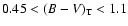 or spectral type later than F5, and a projected
separation larger than 4 arcsec
(to avoid contamination of the spectra). The projected physical
separation spans the range between 28 and 5000 AU.
or spectral type later than F5, and a projected
separation larger than 4 arcsec
(to avoid contamination of the spectra). The projected physical
separation spans the range between 28 and 5000 AU.
The similarity between the components is important to obtain differential abundance measurements with errors smaller than 0.02 dex. The chemical composition analysis of the suitable pairs is presented in the companion paper, Desidera et al. (2006b). In this paper, we present our measurements of radial velocities, Ca II H&K emission and rotational velocities for the 56 pairs we observed.
Thirty-one pairs have independent proper motion in the Hipparcos
Multiple Star Catalog.
Seven of them show a difference at 
 level in at least
one of the coordinates. The consistency of RV and other stellar properties
(activity level and rotational velocity studied here, metallicity
from Desidera et al. 2006b) suggests that the proper motion
difference is not real. In some cases, it is very likely due to the orbital
motion of the wide pair.
Hereafter we assume that all the pairs are physical with the possible
exception of the composite system HIP 40831.
level in at least
one of the coordinates. The consistency of RV and other stellar properties
(activity level and rotational velocity studied here, metallicity
from Desidera et al. 2006b) suggests that the proper motion
difference is not real. In some cases, it is very likely due to the orbital
motion of the wide pair.
Hereafter we assume that all the pairs are physical with the possible
exception of the composite system HIP 40831.
The outline of the paper is as follows: the observations and data reduction are described in Sect. 2; the radial velocities are presented in Sect. 3; the spectroscopic binaries in the sample are discussed in Sect. 4; Sects. 5 and 6 present the measurements of the projected rotational velocity and the chromospheric activity; in Sect. 7 we discuss individual systems worthy of special mention; we summarize the results in Sect. 8.
High resolution spectra of 56 pairs were acquired using the FEROS spectrograph at ESO in two observing runs (August 2002 and March 2003). The spectrograph was attached to the 1.5 m and 2.2 m telescopes for the first and second runs respectively. The spectral format includes the spectral region 3900-9200 Å, at a nominal resolving power of R=48 000.
Due to some technical problem and the smaller telescope aperture during the first run, it was not possible to observe all the originally selected pairs. Some standard stars with known chromospheric emission were also observed in order to provide a suitable calibration.
The on-line data reduction procedure was not fully adequate for our main scientific goal. In fact, the difference in equivalent widths of multiple spectra for the same star showed systematic trends with wavelength. Furthermore, the spectra obtained with the simultaneous thorium calibration (August 2002 run) show some contamination by the lamp lines.
A new reduction was then performed, using IRAF.
Extraction of apertures was performed by tracing one of the two peaks
due to the image slicer
and by assigning an asymmetric size to the aperture to include most of the
light from the target.
Analysis of the FWHM of thorium lines indicates that our reduction
procedure does not degradate spectral resolution.
Inter-order background was subtracted, and flat-fielding division performed using the flat field spectrum extracted on the same pixels as the science spectra, efficiently removing interference fringes in the red part of the spectra and the blaze function pattern.
For the spectra of the August 2002 run an additional step was performed at the beginning of the procedure: an image with no stellar flux, but with thorium lines in the second channel, was used to remove the residual contamination of the Th lines, scaling the flux with respect to each science frame. The procedure succesfully removes the contamination of Th lines on science spectra. A more severe clipping factor was used in determining the background level, to minimize the effect of any impefection on the substraction of thorium lines.
Radial velocities (hereafter RV) of program stars were derived by means of
the cross correlation technique using the FXCOR task in IRAF.
Comparison of 10 stars with radial velocity
measured by Nidever et al. (2002)
shows a mean difference
 km s-1, with
a dispersion of 0.087 km s-1.
This confirms the reliability of the radial velocities measured with
the FEROS spectrograph.
km s-1, with
a dispersion of 0.087 km s-1.
This confirms the reliability of the radial velocities measured with
the FEROS spectrograph.
Individual radial velocities are listed in Table 4. Errors are estimated from the scatter of the RV of individual spectral orders, adding a 0.1 km s-1 systematic error in quadrature.
Several components of the visual binaries turned out to be itself spectroscopic binaries. We describe here their identification from our data and the literature and we discuss their frequency in our sample.
Five stars in our sample are resolved as double-lined spectroscopic binaries (hereafter SB2) in our spectra. Table 1 lists the RV of the components, the FWHM of the spectral lines corrected for instrumental broadening, and the ratio of equivalent width measured on a few isolated lines in the range 6000-6700 Å.
Table 1: Properties of double-lined spectroscopic binaries detected in our spectra: identification, radial velocities, FWHM of spectral lines corrected for instrumental broadening, and ratio of equivalent width at about 6400 Å. The epoch of the observations is listed in Table 4.
Two further SB2 are HIP 43692A = HD 76037A (Desidera et al. 2006a) and HIP 45734B (Covino et al. 1997). HIP 40831B may also be a SB2 system. Its spectrum appears to be composite, with the spectral features of a solar-type star dominating most of the spectrum, but with the strong Hydrogen lines typical of a late A star in the blue. The physical association between these two stars is not clear and is discussed in Sect. 7.
For the wide binaries we are considering, radial velocity difference between the components caused by the orbital motion should be less than 2-3 km s-1. When the velocity differences are larger than this limit, most likely one (or both) components of the visual pair is a spectroscopic binary.
Six pairs show RV difference larger than 5 km s-1: HIP 25434/6, HIP 51578, HIP 61465/6, HIP 79819, HIP 100045, HIP 110832. As the faintness of the secondary makes its spectral lines not visible in the spectrum, it is not possible to identify which of the components hosts a further companion by using a single spectrum.
An alternative explanation to the observed RV difference is that
some of these pairs might only be optical. Only two of the six pairs
listed above have independent proper motion determinations in the Hipparcos
Multiple Star Catalog. Those for HIP 61465/6 agree within errors,
while those for HIP 25434-HIP 25436 are different at
about a  level.
However, the small RV difference (7 km s-1), the
Hipparcos parallaxes that agree within the (rather large) errors,
and the fast rotational
velocity observed for both stars (suggesting commong young age)
make a chance association unlikely.
More likely, the binarity of one of the components induces
the relative astrometric motion detected by Hipparcos.
level.
However, the small RV difference (7 km s-1), the
Hipparcos parallaxes that agree within the (rather large) errors,
and the fast rotational
velocity observed for both stars (suggesting commong young age)
make a chance association unlikely.
More likely, the binarity of one of the components induces
the relative astrometric motion detected by Hipparcos.
Two further spectroscopic binaries are HIP 76603 = HD 139461 (Tokovinin & Gorynya 2001) and HIP 64030A (Desidera et al. 2006c).
![\begin{figure}
\par\includegraphics[width=7.6cm,clip]{4895fig1.ps}
\end{figure}](/articles/aa/full/2006/29/aa4895-06/img12.gif) |
Figure 1:
Distribution of the absolute value of the RV difference
between the components of the wide binaries studied here.
Most of them have RV difference below 2-3 km s-1, compatible
with the expected binary motion and observational errors.
The pairs with
 km s-1 should likely host
an additional spectroscopic components.
A few stars are outside the plot limits. km s-1 should likely host
an additional spectroscopic components.
A few stars are outside the plot limits. |
| Open with DEXTER | |
From the results of Sects. 4.1 and 4.2 we can derive
the frequency of systems with at least three components in our sample.
These are 15 or 16 out of 56 pairs (
 ,
respectively),
depending on the inclusion of HIP 40831 or not. This fraction is
compatible with the results by Tokovinin & Smekhov (2002)
and Tokovinin (2004), about 33% of visual binaries
contain additional spectroscopic components.
Some observational incompleteness is certainly present, since
single-epoch observations are not sensitive to spectroscopic
binaries with an amplitude lower than about 2-3 km s-1 and a pair
can by chance have a small radial velocity difference at the epoch
of our observation even if one of the components is itself a
large-amplitude spectroscopic
binary. On the other hand, some biases may favor the inclusion of triples
in our sample. The Malmquist bias (magnitude limit was one of the
selection criteria) favors the inclusion of stars with companions
significantly contributing to the integrated light. This might
explain the relatively large number of SB2 systems.
Another bias is due to the fact that parallax errors are on average larger
for pairs with additional unrecognized components
(see e.g. Söderhjelm 1999),
because the binary
motion is not taken into account in the parallax solution.
This makes the inclusion of high multiplicity systems
within the nominal 100 pc limit more likely.
A detailed statistical evaluation of the frequency of high
multiplicity systems in our sample is beyond the scope of this paper.
,
respectively),
depending on the inclusion of HIP 40831 or not. This fraction is
compatible with the results by Tokovinin & Smekhov (2002)
and Tokovinin (2004), about 33% of visual binaries
contain additional spectroscopic components.
Some observational incompleteness is certainly present, since
single-epoch observations are not sensitive to spectroscopic
binaries with an amplitude lower than about 2-3 km s-1 and a pair
can by chance have a small radial velocity difference at the epoch
of our observation even if one of the components is itself a
large-amplitude spectroscopic
binary. On the other hand, some biases may favor the inclusion of triples
in our sample. The Malmquist bias (magnitude limit was one of the
selection criteria) favors the inclusion of stars with companions
significantly contributing to the integrated light. This might
explain the relatively large number of SB2 systems.
Another bias is due to the fact that parallax errors are on average larger
for pairs with additional unrecognized components
(see e.g. Söderhjelm 1999),
because the binary
motion is not taken into account in the parallax solution.
This makes the inclusion of high multiplicity systems
within the nominal 100 pc limit more likely.
A detailed statistical evaluation of the frequency of high
multiplicity systems in our sample is beyond the scope of this paper.
The rotational velocity was derived by means of a suitable calibration
of the FWHM of stellar lines.
The FWHM of each spectral line was determined as part of the
equivalent width measurement for the abundance analysis
using a Gaussian fitting. More than 300 lines were
measured for slowly rotating stars.
A relation of FWHM vs. equivalent width was then derived
(see. Bragaglia et al. 2001). The adopted FWHM is the result of
the fitting relation for an equivalent width of 50 mÅ.
This technique is applicable to stars with rotational velocities
lower than about 40 km s-1. For the remaining stars,  was
estimated directly from the line profile of a few isolated lines in
the red portion of the spectra.
was
estimated directly from the line profile of a few isolated lines in
the red portion of the spectra.
The other broadening mechanisms (macroturbulence, microturbulence, thermal
broadening, instrumental broadening) have to be properly taken into account
when deriving the rotational velocity.
Such broadening represents
a lower envelope of the FWHM as a function of (B-V)
(see e.g. Valenti & Fischer 2005).
It is then quadratically subtracted to the observed
FWHM, obtaining the broadening caused by stellar rotation.
The latter is finally calibrated using stars with known (Table 2, available only in electronic form),
giving half weight to the
Nordstrom et al. (2004) results:
 |
(1) |
For the few evolved stars, the instrinsic broadening is larger than the adopted one, derived mostly from main sequence stars. The rotational velocity is then overestimated for these objects.
![\begin{figure}
\par\includegraphics[width=7.8cm,clip]{4895fig2.ps}
\end{figure}](/articles/aa/full/2006/29/aa4895-06/img16.gif) |
Figure 2: FWHM (corrected for instrumental broadening) vs. B-V for program stars. The lower envelope shown as a continuous line is taken as our estimate of the instrinsic broadening due to other causes than rotation (thermal, macro, and microturbulence). The stars with the largest rotational velocities are outside of the plot limits. |
| Open with DEXTER | |
![\begin{figure}
\par\includegraphics[width=7.8cm,clip]{4895fig3.ps}
\end{figure}](/articles/aa/full/2006/29/aa4895-06/img17.gif) |
Figure 3:
Calibration of FWHM (corrected for broadening
mechanisms other than rotation) and
from the literature.
Empty circles are the stars in common with
Nordstrom et al. (2004), and filled circles
are the stars from other literature sources
(see Table 2).
The adopted calibration is overplotted as a solid line. |
| Open with DEXTER | |
The inclusion of the H and K CaII lines in the spectral format allowed us to measure the chromospheric emission of our program star and to derive the age from its strength.
We determined the chromospheric activity index S by measuring the fluxes in the 1 Å wide band centered on H and K Ca II lines and in two adjacent continuum windows that are 20 Å wide. For homogeneity with the published literature, the resulting S index has to be calibrated into the Mount Wilson system. To this aim, a number of standard stars with known activity level were observed during our second run. Furthermore, some of our program stars also have a published CaII H&K determination (Table 3, available only in electronic form).
The calibration of our instrumental S index (
 )
into the standard system is (Fig. 4):
)
into the standard system is (Fig. 4):
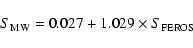 |
(2) |
Photon noise errors of the measured S index are always below 0.005 and in most cases below 0.002. However, as is typical of S-index measurement from high resolution spectra, errors are probably dominated by systematics, due to e.g. imperfect corrections for scattered light and blaze function and to problems with order extraction in a region with low flux (Wright et al. 2004). Such errors are difficult to quantify but from the difference in the S index measured on consecutive spectra and, in a few cases, on spectra taken in two consecutive nights we estimate that the typical measurement error of the S index is about 0.01. The intrinsic variability of chromospheric emission should then contribute significantly to the scatter of the calibration.
![\begin{figure}
\par\includegraphics[width=7.8cm,clip]{4895fig4.ps}
\end{figure}](/articles/aa/full/2006/29/aa4895-06/img20.gif) |
Figure 4: Calibration of instrumental S index measured on FEROS spectra in the standard Mount Wilson system. Filled circles and squares represent stars observed in the first and second observing runs. The crosses represent the pairs for which only the S-index measurement composite of the two components are available in the literature. They were not used in the derivation of the calibration. |
| Open with DEXTER | |
The calibration of Noyes et al. (1984) was used to derive
the chromospheric flux in the CaII H & K lines  (HK) from
the measured S index
(HK) from
the measured S index
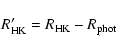 |
(3) |
 is the photospheric component approximated as
 |
(4) |
 is the total CaII H&K flux (chromospheric+photospheric)
given as
is the total CaII H&K flux (chromospheric+photospheric)
given as
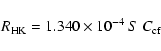 |
(5) |
 |
(6) |
(HK) caused by the uncertainty in
the S index (0.01) and B-V color (about 0.03 mag, because of the low quality
of Tycho photometry for our stars) is about 0.1 dex.
The values of chromospheric activity derived for the components of HIP 114914 = HD 219542 supersede those reported in Desidera et al. (2003), which are based on a preliminary calibration performed on the data reduced with the on-line pipeline and used as calibrators objects observed during the instrument commissioning (Kaufer et al. 1999).
Ages were derived from the observed (HK) using the calibration by
Donahue (1993).
The validity of this calibration has been recently questioned for very
young stars (Song et al. 2004), as well as for old stars
(Pace & Pasquini 2004).
We are observing pairs of stars supposed to be coeval with a separation large enough to make negligible the magnetic activity enhancements due to proximity effects (save for the few pairs with additional components, whose orbits have to be determined). We can then address the issue of the reliability of relative ages based on chromospheric activity, by comparing the ages derived for the two components (Fig. 5).
In some cases, a spurious difference in the age
derived from chromospheric activity might be the
result of several factors. Pairs
with SB2 components might have disturbed line profiles,
and the flux ratio at CaII H&K wavelength should be
different from the one used for
the B-V color.
Stars with
 km s-1 have
wide enough spectral lines so that
H&K core emission in not entirely included in the adopted 1 Å band (see Sect. 6.1).
Furthermore, there are stars in our sample with
colors that are outside the range on which the
Noyes et al. (1984) calibration is defined
(
0.44<B-V<0.9), and the age calibration should also not be
applicable to the pair whose primary is a giant (HIP 70264).
At young ages the very steep age dependence
in the adopted calibration implies large
errors in the derived ages even when
the activity level of the components is consistent
within errors (HIP 37923/18, HIP 44817/14,
HIP 51266).
km s-1 have
wide enough spectral lines so that
H&K core emission in not entirely included in the adopted 1 Å band (see Sect. 6.1).
Furthermore, there are stars in our sample with
colors that are outside the range on which the
Noyes et al. (1984) calibration is defined
(
0.44<B-V<0.9), and the age calibration should also not be
applicable to the pair whose primary is a giant (HIP 70264).
At young ages the very steep age dependence
in the adopted calibration implies large
errors in the derived ages even when
the activity level of the components is consistent
within errors (HIP 37923/18, HIP 44817/14,
HIP 51266).
Excluding all these cases, the typical difference in the ages measured from the activity level results of about 0.2 dex, not much larger than the error bars of the activity measurement itself (0.15 dex). However, in a few cases, the differences in the activity level between the components are significant and cause apparent age differences between the components above 0.25 dex. For comparison, the age of the Sun derived from the activity level at the minimum and maximum of a solar cycle differs by 0.56 dex (Henry et al. 1996).
From Fig. 5 it also appears that the apparent age difference between the components, as determined from chromospheric activity, is larger for stars 2-5 Gyr old than at very old ages. This might be explained by a decline in the variability of magnetic activity between solar age and very old ages. A few cases with rather large apparent age difference probably due to a real difference in the activity level between the components are discussed in Sect. 7.
![\begin{figure}
\par\includegraphics[width=7.8cm,clip]{4895fig5.ps}
\end{figure}](/articles/aa/full/2006/29/aa4895-06/img29.gif) |
Figure 5: Ages of the components of the wide binaries studied in this paper derived from our measurement of chromospheric activity. Empty circles: pairs for which the choromosphric activity measurement is less reliable (pairs with a SB2 component; rotational velocity larger than 40 km s-1; magnitude difference larger than 1 mag, B-V color outside the validity of the calibration by Noyes et al. (1984). Filled circles: the other pairs. |
| Open with DEXTER | |
We comment here on individual systems that deserve mention for their binarity (Sects. 4.1, 4.2) or different activity level (Sect. 6).
 km s-1)
that is significantly different from our (
km s-1)
that is significantly different from our (
 ).
This difference suggests that HIP 35564 A may itself be a
spectroscopic binary, making the system a quintuple.
).
This difference suggests that HIP 35564 A may itself be a
spectroscopic binary, making the system a quintuple.
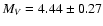 ,
,
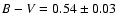 )
is consistent with
this classification.
The origin of the A-type features is then not clear, since
a normal A main sequence star would overcome the brightness of the
two solar-type stars if placed at the same distance, and
the system would have an absolute magnitude that is not compatible with those
derived from Hipparcos.
The small RV differences between the components of the wide pair
makes it unlikely that HIP 40831B is a short period binary.
The proper motion of the components of HIP 40831 listed in the Hipparcos Multiple
Star Catalog are different, with those of HIP 40831B showing
huge errors (
)
is consistent with
this classification.
The origin of the A-type features is then not clear, since
a normal A main sequence star would overcome the brightness of the
two solar-type stars if placed at the same distance, and
the system would have an absolute magnitude that is not compatible with those
derived from Hipparcos.
The small RV differences between the components of the wide pair
makes it unlikely that HIP 40831B is a short period binary.
The proper motion of the components of HIP 40831 listed in the Hipparcos Multiple
Star Catalog are different, with those of HIP 40831B showing
huge errors (
 ,
,
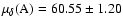 ,
,
 ,
,
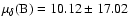 ).
This indicates problems in the Hipparcos solution, probably due to the
unrecognized presence of the A star. The possibility that the A type
component is an unrelated background star seems viable, but
further studies are required to reveal the nature of this object.
).
This indicates problems in the Hipparcos solution, probably due to the
unrecognized presence of the A star. The possibility that the A type
component is an unrelated background star seems viable, but
further studies are required to reveal the nature of this object.
 emission.
The primary instead has a much lower emission.
emission.
The primary instead has a much lower emission.
 planets in
close orbits are excluded
by the high-precision radial velocity
monitoring going on at SARG (Desidera et al. 2006a).
planets in
close orbits are excluded
by the high-precision radial velocity
monitoring going on at SARG (Desidera et al. 2006a).

 ,
,
 ,
,
 ,
,
 ), indicating
physical association.
), indicating
physical association.
We have performed a spectroscopic characterization of the components of 56 visual binaries with similar components. Visual inspection of the spectra and the measurement of radial velocities allowed identification of some new double-lined spectroscopic binaries and several single-lined spectroscopic binary candidates. The fraction of spectroscopic components in our sample agrees within errors with estimates from the literature.
The measurements of projected rotational velocity and of Ca II chromospheric emission allowed us to further characterize the stars. A few stars show rather large differences in their activity level, but this appears consistent with the variability actually observed for the Sun during its magnetic activity cycle. The typical apparent difference in ages derived from chromospheric activity results about 0.2 dex.
Some pairs with low rotational velocity and low magnetic activity level are well suited for the search for planets using radial velocity and for a detailed differential chemical abundance analysis, for which sensitivities down to a few earth masses of accreted rocky material can be achieved. This work is presented in a companion paper (Desidera et al. 2006b).
Active, probably young, stars are instead interesting as possible targets for next generation, direct imaging instruments such as the VLT Planet Finder (Beuzit et al. 2005). Some potential candidates were identified and will be studied in more detail in the future.
Acknowledgements
This research has made use of the SIMBAD database, operated at the CDS, Strasbourg, France. We warmly thank Ivo Saviane for useful discussions. This work was partially funded by COFIN 2004 "From stars to planets: accretion, disk evolution and planet formation'' by the Ministero Università e Ricerca Scientifica Italy. We thank the referee, Dr. A. Tokovinin, for a prompt and thoughtful report.
Table 2:
Calibration of .
Table 3: Calibration of S index on the Mount Wilson system.
Table 4:
Results of our measurement for program stars: HIP and HD names, identification of the component (A, B)
date of the observations,
radial velocity, B-V color,
FWHM of spectral lines (corrected for instrumental broadening),
projected rotational velocity, S index calibrated on the Mount Wilson scale,
chromospheric emission flux, logarithm of age derived from chromospheric activity,
and additional remarks. For stars with
km s-1, only lower limits to chromospheric emission were measured.