![\begin{figure}
\par\includegraphics[width=8.8cm,clip]{H4448F1.EPS}
\end{figure}](/articles/aa/full/2004/10/aah4448/img6.gif) |
Figure 1:
The Orgueil nanodiamond spectra (2703-3030 cm-1) in the
region of the surface C-H stretching features (solid black line)
with the Lorentzian profile fits superimposed (grey lines). The
mean particle size is  3 nm. The fit residual (difference + 1.1) is shown in the upper part of the plot along with the 3 nm. The fit residual (difference + 1.1) is shown in the upper part of the plot along with the  for the fit. The band positions, in
  m and cm-1, are
indicated in the tabulated values on the right side of the plot. m and cm-1, are
indicated in the tabulated values on the right side of the plot. |
| Open with DEXTER | |
In the text
![\begin{figure}
\par\includegraphics[width=8.8cm,clip]{H4448F2.EPS}
\par\end{figure}](/articles/aa/full/2004/10/aah4448/img8.gif) |
Figure 2: Same as for Fig. 1 but for the 5 nm synthetic nanodiamond surface C-H stretching features. |
| Open with DEXTER | |
In the text
![\begin{figure}
\par\includegraphics[width=8.8cm,clip]{H4448F3.EPS}
\par\end{figure}](/articles/aa/full/2004/10/aah4448/img9.gif) |
Figure 3: Same as for Fig. 1 but for the 100 nm synthetic diamond surface C-H stretching features. |
| Open with DEXTER | |
In the text
![\begin{figure}
\par\includegraphics[width=8.8cm,clip]{H4448F4.EPS}
\end{figure}](/articles/aa/full/2004/10/aah4448/img12.gif) |
Figure 4: The Orgueil nanodiamond spectra (2703-3030 cm-1) in the region of the surface C-H stretching features. The smooth grey line is the same spectrum as shown in Fig. 1. The dashed line (continuous black line) shows the further oxidised, ORGox, (hydrolysed, ORGhyd) Orgueil nanodiamond spectra (Hill et al. 1997). A typical class B infrared emission band spectrum, IRAS 05341+0852 (Joblin et al. 1996), is shown for comparison (thick grey line). |
| Open with DEXTER | |
In the text
![\begin{figure}
\par\includegraphics[width=8.8cm,clip]{H4448FA1.EPS}
\end{figure}](/articles/aa/full/2004/10/aah4448/img14.gif) |
Figure A.1: Central wavelengths of the Lorentzian bands fitted to the surface C-H stretching features as a function of particle size. The individual plots are labelled by the band positions (in cm-1) of the 100 nm or 5 nm diamond samples (see Table 1). |
In the text
![\begin{figure}
\par\includegraphics[width=8.7cm]{H4448FA2.EPS}
\end{figure}](/articles/aa/full/2004/10/aah4448/img15.gif) |
Figure A.2: FWHM of the Lorentzian bands fitted to the surface C-H stretching features as a function of particle size. The bands are indicated as per Fig. A.1. |
In the text
![\begin{figure}
\par\includegraphics[width=8.8cm,clip]{H4448FA3.EPS}
\end{figure}](/articles/aa/full/2004/10/aah4448/img16.gif) |
Figure A.3: Relative intensities (normalised to the strongest band for each sample) of the Lorentzian bands fitted to the surface C-H stretching features as a function of particle size. The bands are indicated as per Fig. A.1. |
In the text
![\begin{figure}
\par\includegraphics[width=8.8cm,clip]{H4448FA4.EPS}
\end{figure}](/articles/aa/full/2004/10/aah4448/img17.gif) |
Figure A.4:
Areas (
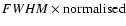 intensity) of the Lorentzain bands
fitted to the surface C-H stretching features as a function of
particle size. The bands are indicated as per Fig. A.1.
intensity) of the Lorentzain bands
fitted to the surface C-H stretching features as a function of
particle size. The bands are indicated as per Fig. A.1. |
In the text