![\begin{figure}
\par\includegraphics[angle=270,width=8.8cm,clip]{h4146F1.ps}
\end{figure}](/articles/aa/full/2003/22/aah4146/img19.gif) |
Figure 1:
H-R diagram of single giants (Gondoin 1999) compared with
evolutionary tracks (Schaller et al. 1992) of 1  (lower
dashed line), 1.25 ,
1.5 ,
1.7
(solid
line), 2
and 2.5 .
Black circles mark giants
known as X-ray sources. The H-R diagram location of V390 Aurigae
is indicated by an error bar.
(lower
dashed line), 1.25 ,
1.5 ,
1.7
(solid
line), 2
and 2.5 .
Black circles mark giants
known as X-ray sources. The H-R diagram location of V390 Aurigae
is indicated by an error bar. |
| Open with DEXTER | |
In the text
![\begin{figure}
\par\includegraphics[angle=270,width=7.2cm,clip]{h4146F2.ps}\hspace*{4mm}
\includegraphics[angle=270,width=7.2cm,clip]{h4146F3.ps}
\end{figure}](/articles/aa/full/2003/22/aah4146/img39.gif) |
Figure 2: Light curves of V390 Aurigae during revolutions 135 (left) and 232 (right) obtained with the EPIC p-n camera. In each graph, the upper curve is the count rate within the 0.3 to 2 keV band and the lower curve is the count rate within the 2 to 10 keV band. The events are binned in 300 s time intervals and the background has been subtracted. |
| Open with DEXTER | |
In the text
![\begin{figure}
\par\includegraphics[angle=270,width=8cm,clip]{h4146F4.ps}\hspace*{4mm}
\includegraphics[angle=270,width=8cm,clip]{h4146F5.ps}
\end{figure}](/articles/aa/full/2003/22/aah4146/img42.gif) |
Figure 3:
Best fit model to revolution 135 (left) and 232 (right)
spectra. The EPIC data (crosses) and spectral fit (solid line) are
shown in the upper panel. The  contributions are given in
the lower panel of each graph.
contributions are given in
the lower panel of each graph. |
| Open with DEXTER | |
In the text
![\begin{figure}
\par\includegraphics[width=8.4cm,clip]{h4146F6.ps}\par\vspace*{3mm}
\includegraphics[width=8.4cm,clip]{h4146F7.ps}
\end{figure}](/articles/aa/full/2003/22/aah4146/img86.gif) |
Figure 4: Averaged first order spectra of RGS 1 and 2 obtained during revolution 135 (top) and revolution 232 (bottom). |
| Open with DEXTER | |
In the text
![\begin{figure}
\par\includegraphics[angle=270,width=8.8cm,clip]{h4146F8.ps}
\end{figure}](/articles/aa/full/2003/22/aah4146/img120.gif) |
Figure 5:
Equatorial rotational velocity of V390 Aurigae (filled
circle) compared with  values of single field giants
(Gondoin 1999). The solid line and the dashed line describe the
equatorial velocity evolution of 1.7
and 2.5 stars respectively assuming angular momentum conservation and
values of single field giants
(Gondoin 1999). The solid line and the dashed line describe the
equatorial velocity evolution of 1.7
and 2.5 stars respectively assuming angular momentum conservation and
 km s-1 at km s-1 at
 K. K. |
| Open with DEXTER | |
In the text
![\begin{figure}
\par\includegraphics[angle=270,width=8.8cm,clip]{h4146F9.ps}
\end{figure}](/articles/aa/full/2003/22/aah4146/img124.gif) |
Figure 6:
The error bars in the upper part of the graph indicate the
XMM-Newton luminosity range of FK Comae and of V390 Aurigae
(bold bar) in the 0.3 to 2 keV band compared with ROSAT PSPC
measurements of single field giants (Hünsch et al. 1998). Upper
limits of X-ray luminosities measured with the Einstein observatory
(Maggio et al. 1990) are indicated by small triangles, large
triangles and filled triangles for low-mass
(1.2
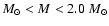 ), intermediate-mass (2.0 ), intermediate-mass (2.0
 )
and clump giants respectively. )
and clump giants respectively. |
| Open with DEXTER | |
In the text