

Using the k=7, 19, and 20 modes in seismological fits produces a best-fitting model that is similar to that derived from only the k=8 through 18 modes, indicating that the new modes do not deviate drastically from the expected mode pattern.
The reappearance of modes with frequencies similar to those obtained
before the mode disappeared (true of all modes from k=8 through 19),
shows that the stellar structure sampled by these modes remained the
same for almost 20 years. This is in spite of rapid amplitude change
events like the "forte'' one observed in August 1996. Our
observations, coupled with guidance from the available theories of
Brickhill (1992) and Wu & Goldreich (2001) suggest that the "forte''
event was probably an extreme manifestation of a nonlinear mode-coupling event
that did not materially affect the structure of the star other than
possibly the driving region. The appearance and disappearance of modes is
similar to the behavior observed in the ZZ Ceti star G 29-38
by Kleinman et al. (1998), and we note that "ensemble'' seismology
works for GD 358 as well as for the cool ZZ Ceti stars.
The one caveat is that the 
 Hz frequency "wobbles'' will
place a limit on the accuracy of the seismology.
Hz frequency "wobbles'' will
place a limit on the accuracy of the seismology.
We also appear to have discovered an  mode (at
 Hz)
in GD 358 for the first time, based on the match of the observed
period to that of
modes from our best fitting model. Our
model indicates that this is the k=34 mode. This mode has a relatively
large amplitude of 14.9 mma, which combined with the increased
geometric cancellation (about
Hz)
in GD 358 for the first time, based on the match of the observed
period to that of
modes from our best fitting model. Our
model indicates that this is the k=34 mode. This mode has a relatively
large amplitude of 14.9 mma, which combined with the increased
geometric cancellation (about  )
of an
mode,
implies that it has the largest amplitude of any mode observed in 2000.
We note the existence of several linear combination peaks
involving the
)
of an
mode,
implies that it has the largest amplitude of any mode observed in 2000.
We note the existence of several linear combination peaks
involving the  Hz mode, that also show complex structures.
This lends credence to the Hz mode being a real mode,
and that the complex structure is associated with the real mode
(such as amplitude modulation),
as opposed to being some sort of combination peak.
The amplitude of the Hz mode changed during the WET run,
so we suspect that the many subcomponents observed are most likely
due to amplitude modulation.
Hz mode, that also show complex structures.
This lends credence to the Hz mode being a real mode,
and that the complex structure is associated with the real mode
(such as amplitude modulation),
as opposed to being some sort of combination peak.
The amplitude of the Hz mode changed during the WET run,
so we suspect that the many subcomponents observed are most likely
due to amplitude modulation.
The period structure of the 1990 and 1994 WET data sets are similar, but
show that the amplitude of the modes, and even the fine structure,
changes with time. In August 1996, the period structure changed
rapidly and dramatically,
with essentially all the observed pulsation power going to the k=8mode.
In spite of the large amplitude, the light curve was surprisingly
sinusoidal, with a small contribution from the k=9 mode.
Single site observations
one month earlier (June 1996) and one month later (September 1996)
show a period structure similar to those present in the 1990
and 1994 data sets. For the 2000 data set, the period structure shows
close to equal frequency splittings,
and the fine structure is different than observed before. Only the
k=9 mode show the same clear triplet observed in 1990 and 1994,
with the same frequency splitting. The k=8 mode shows the m=-1 and
m=1 modes, while the central m=0 mode is below our
 significance level.
The other modes do not show clearly the triplet structure
previously observed.
The 1990 and 1994 data sets show the m-splitting
expected by rotational splitting, but the change of the splitting
frequency difference from 6
significance level.
The other modes do not show clearly the triplet structure
previously observed.
The 1990 and 1994 data sets show the m-splitting
expected by rotational splitting, but the change of the splitting
frequency difference from 6  Hz to 3 Hz from k=17 to k=8was interpreted as indicating differential rotation.
The apparent anticorrelation between the abundance of multiplet structure and the highest order of combination frequencies seen is a puzzle. As we do not expect the differential rotation profile of GD 358 changed in the last 10 years (and the splittings we do see in 2000 support this contention), the anticorrelation must be telling something about what is going on with rotation in the convection zone. We say this because the combination peaks are believed to be caused by the nonlinear response of the depth varying convection zone, and thus the increased order of combination peaks implies that the convection zone is more "efficient'' at mixing eigenmodes to observable amplitudes. The k=8 and 9 modes continue to show obvious multiplet structure and little, if any, change in splitting. These modes are the most "internal'' of the observed modes of GD 358, and we speculate that this must have some bearing on their multiplet structure's ability to persist. We do not see any obvious pattern in the dominant amplitude multiplet member with overtone number, so there is not an obvious pattern of rotational coupling to the convection zone for determining mode amplitude. We will need theoretical guidance to make sense of these observations.
A related puzzle is the presence of extra multiplet members and/or
apparent large frequency shifts of modes in the k=15 and 16 multiplets.
The k=15 mode shows an extra component at
 Hz in the
1994 data and a peak at
Hz in the
1994 data and a peak at
 Hz in the 2000 data that have
not been seen before or since.
Some possible explanations include: rapid amplitude modulation of a
k=15 multiplet member that the FT interprets as an extra peak;
the 2000 peak is about the right frequency to be another mode, if we use the
Hz mode as a reference point;
it could be an unattributed combination peak involving sums and
differences of known modes; or it could be something else entirely.
The large peak at about
Hz in the 2000 data that have
not been seen before or since.
Some possible explanations include: rapid amplitude modulation of a
k=15 multiplet member that the FT interprets as an extra peak;
the 2000 peak is about the right frequency to be another mode, if we use the
Hz mode as a reference point;
it could be an unattributed combination peak involving sums and
differences of known modes; or it could be something else entirely.
The large peak at about  Hz in 1996 and 2000 is also something
of a mystery. It is possible that the k=16, m=-1 component
really changed by
Hz in 1996 and 2000 is also something
of a mystery. It is possible that the k=16, m=-1 component
really changed by
 from the
  Hz observed in 1990,
although we would have to explain why only this large amplitude multiplet
member suffered this large a frequency change.
Other possibilities include: the peak is a 1 cycle per day alias of
another mode; the peak is a combination peak -- the combination
Hz observed in 1990,
although we would have to explain why only this large amplitude multiplet
member suffered this large a frequency change.
Other possibilities include: the peak is a 1 cycle per day alias of
another mode; the peak is a combination peak -- the combination
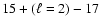 is a perfect frequency match; or possibly an mode, based on period spacing arguments.
Further observations, data analysis with tools like wavelet analysis,
and further model fitting may help determine which explanation fits the
data best.
is a perfect frequency match; or possibly an mode, based on period spacing arguments.
Further observations, data analysis with tools like wavelet analysis,
and further model fitting may help determine which explanation fits the
data best.
Brickhill (1992) proposed that the combination frequencies result from mixing
of the eigenmode signals by a depth-varying surface convection zone when
undergoing pulsation.
He pointed out that the convective turnover time in DA and DB variable
white dwarf stars occurs on a timescale much shorter than the pulsation
period. As a consequence, the convective region adjusts almost
instantaneously during a pulsation cycle. Brickhill demonstrated
that the flux leaving the convective zone depends on the depth
of the convective zone, which changes during the pulsation cycle,
distorting the observed flux. This distortion introduces combination
frequencies, even if the pulsation at the bottom of the convection zone
is linear, i.e., a single sinusoidal frequency.
Wu (2001) analytically calculated the amplitude and phases expected
of such combination frequencies, and concluded that the convective
induced distortion was roughly in agreement with GD358's 1994 observations,
provided that the inclination of the pulsation axis to the
line of sight is between
 and
and
 .
Wu also calculated that the harmonics for
modes should be much
higher than for
.
Wu also calculated that the harmonics for
modes should be much
higher than for  .
However the theory overpredicts the amplitude
of the
harmonics. She also predicts that
geometrical cancellation will, in principle, allow a determination of
.
However the theory overpredicts the amplitude
of the
harmonics. She also predicts that
geometrical cancellation will, in principle, allow a determination of
 if both frequencies sums and differences are observed.
These predictions still need testing.
if both frequencies sums and differences are observed.
These predictions still need testing.
While Wu & Goldreich (2001) discuss parametric instability mechanisms
for the amplitude of the pulsation modes, they only discuss the case
where the parent mode is unstable and the daughter modes are stable.
However, with GD 358, we have a different situation. The highest frequency
k=8 and 9 modes can have as a daughter mode one of the lower frequency
(k=17, 18, or 19)
modes and an  higher mode. One or
both or these daughter modes are actually pulsationally unstable as well,
which we believe would require coupling to still lower frequency
granddaughter modes that are predicted to be stable by our models and
the calculations of Brickhill (1990, 1991) and Goldreich & Wu (1999a,b).
We suggest that occasionally the nonlinear coupling of the granddaughter
and daughter modes with the k=8 and 9 modes can allow the k=8 and
9 modes to suffer abrupt amplitude changes when everything is "just
right''. In the meantime, the granddaughter modes will couple to the
excited daughter modes (k=13 through 19 in general) to produce the
observed amplitude instability of these modes. We need a quantitative
theoretical treatment of this circumstance worked out to see if the
predicted behavior matches what we observe in GD 358.
higher mode. One or
both or these daughter modes are actually pulsationally unstable as well,
which we believe would require coupling to still lower frequency
granddaughter modes that are predicted to be stable by our models and
the calculations of Brickhill (1990, 1991) and Goldreich & Wu (1999a,b).
We suggest that occasionally the nonlinear coupling of the granddaughter
and daughter modes with the k=8 and 9 modes can allow the k=8 and
9 modes to suffer abrupt amplitude changes when everything is "just
right''. In the meantime, the granddaughter modes will couple to the
excited daughter modes (k=13 through 19 in general) to produce the
observed amplitude instability of these modes. We need a quantitative
theoretical treatment of this circumstance worked out to see if the
predicted behavior matches what we observe in GD 358.
Observations of GD 358 have been both rewarding and vexing. We have been
rewarded with enough
modes being present to decipher the mode
structure and perform increasingly refined asteroseismology of this star,
starting with Bradley & Winget (1994) up to the latest paper of Metcalfe
et al. (2002). One thing asteroseismology has not provided us with is the
structure of and/or the depth of the surface convection zone. This would
help us test the "convective driving'' mechanism introduced by Brickhill
(1991) and elaborated on by Goldreich & Wu (1999a,b).
Our observations point out the need for further refinements of the
parametric instability mechanism described by Wu & Goldreich (2001)
to better cover the observed mode behavior. The observational data set
is quite rich, and coupled with more detailed theories, offers the
promise of being able to unravel the mysteries of amplitude variation
seen in the DBV and DAV white dwarfs. This in turn, may offer us the
insights needed to ascertain why only some of the predicted modes are
seen at any one time.
Acknowledgements
MAW, AKJ, AEC, and MLB acknowledge support by the National Science Foundation through the Research Experiences for Undergraduates Summer Site Program to Florida Tech.
Copyright ESO 2003